
By Dr. Pellumb Kabashi, DBA, MBA, CES, CFE, EA
Founder, Tax Expert Today LLC · Tax advisors, enrolled agents, CPAs, and attorneys · Serving clients in all 50 states
Quick Answer: California QSBS gain receives no state exclusion. Revenue and Taxation Code section 18152 states that Internal Revenue Code section 1202 does not apply, so a founder who excludes the entire gain federally still reports the entire gain to California at rates reaching 13.3 percent. Because section 17952 sources gain on stock to the seller’s state of residence, the residency date is the variable that decides the California result. Call (239) 441-2005 for a free consultation.
What Does California QSBS Treatment Mean in 2026?
California QSBS treatment means that the state ignores the federal qualified small business stock exclusion entirely. A shareholder who pays zero federal tax on a qualifying sale under IRC section 1202 still includes one hundred percent of that same gain in California taxable income. California provides no partial exclusion, no deferral, and no replacement credit, so the only lever that changes the outcome is residency.
- No state exclusion exists. Section 18152 of the Revenue and Taxation Code switches off IRC section 1202 for California purposes.
- No rollover exists either. The state analog to the federal section 1045 rollover was repealed and never replaced.
- The whole gain is reported. The FTB instruction is to enter the entire gain realized, not the federally excluded remainder.
- Rates reach 13.3 percent. The top bracket of 12.3 percent plus the 1 percent Behavioral Health Services Tax applies to the gain.
- Residency decides the result. Gain on stock is intangible income, sourced to where the seller resides rather than to where the company sits.
This is the single most expensive conformity gap a California founder encounters, and it is widening. The federal exclusion grew in 2025 while the California disapplication stayed exactly where it has been since 2013. The sections below work through the statute, the litigation that produced it, the arithmetic, and the timing questions that follow.
Does California Conform to IRC Section 1202?
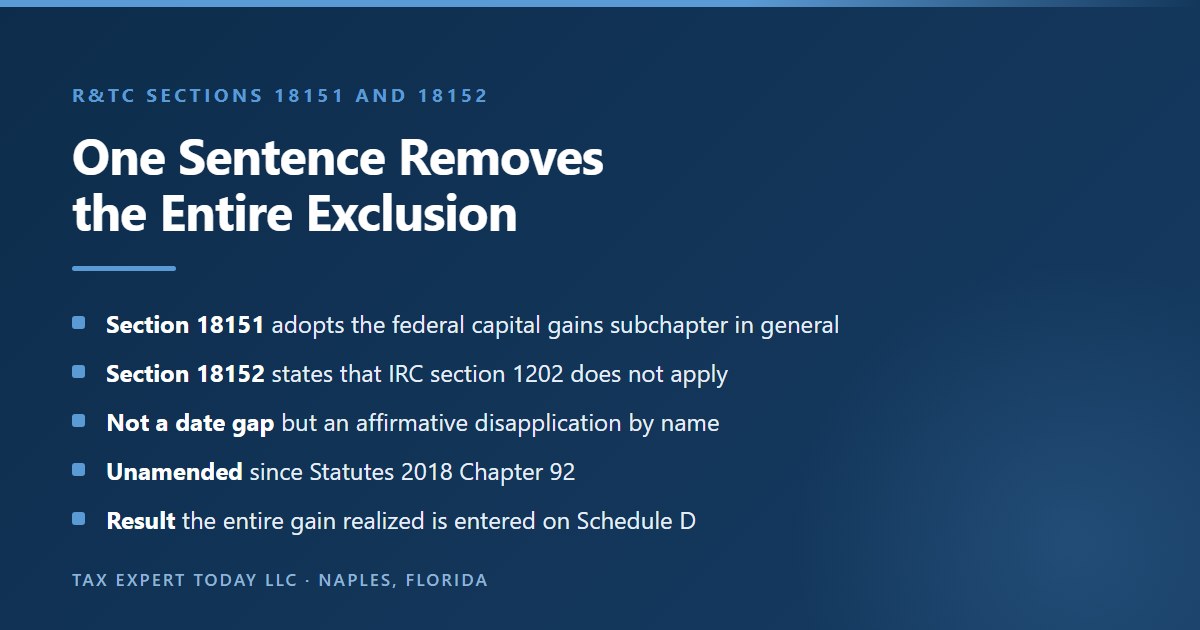
California does not conform to IRC section 1202. The non conformity is written directly into the Revenue and Taxation Code rather than arising from a gap in the conformity date. Section 18151 incorporates the federal capital gains subchapter in general terms, and section 18152 then removes section 1202 from that incorporation by name, in a single operative sentence.
- Section 18151 is the general rule. It provides that Subchapter P of Chapter 1 of Subtitle A of the Internal Revenue Code, relating to capital gains and losses, shall apply, except as otherwise provided.
- Section 18152 is the exception. It provides that section 1202 of the Internal Revenue Code, relating to the 50 percent exclusion for gain from certain small business stock, does not apply.
- The disapplication is affirmative. It is a standing instruction in California law, not an accident of timing.
- It has not been amended since 2018. The credit line on section 18152 reads Stats. 2018, Ch. 92, Sec. 197 (SB 1289), effective January 1, 2019, and that amendment was a technical renumbering rather than a policy change.
The wording of section 18152 repays a careful reading. It describes section 1202 as the “50-percent exclusion for gain from certain small business stock.” That description was accurate when the California provision was written, because the federal exclusion was 50 percent from 1993 until the 2009 and 2010 amendments raised it. The federal benefit has since climbed to 100 percent for most stock, and the California statute that switches it off still carries its 1993 caption. The label is frozen while the benefit it denies has doubled, which is precisely why the gap costs more every year.
| Provision | Federal treatment | California treatment |
|---|---|---|
| IRC section 1202 gain exclusion | Up to 100 percent of eligible gain excluded | Does not apply (R&TC section 18152) |
| IRC section 1045 rollover into replacement stock | Gain deferred if reinvested within 60 days | Does not conform (FTB Schedule D instructions) |
| State level exclusion of its own | Not applicable | Repealed, formerly R&TC section 18152.5 |
| State level rollover of its own | Not applicable | Repealed, formerly R&TC section 18038.5 |
| Amount of gain entered on the return | Excluded portion removed from income | Entire gain realized entered in column (e) |
| Preferential rate on long term gain | 0, 15 or 20 percent depending on bracket | None, taxed at ordinary graduated rates |
The last row of that table is worth separating from the rest, because it is a distinct point that often gets merged into the conformity discussion incorrectly. California has no preferential capital gains rate at all. That is true of every capital asset, not only qualified small business stock, and it would be true even if section 18152 were repealed tomorrow. The gain keeps its character as capital gain; California simply applies the same graduated rate schedule to it that applies to wages. Descriptions that say California taxes QSBS gain “as ordinary income” conflate rate with character, and the distinction matters when a taxpayer is computing basis, netting losses, or reading a brokerage statement.
Did the 2026 Conformity Update Restore the California QSBS Exclusion?
No. California advanced its Internal Revenue Code conformity date to January 1, 2025 for taxable years beginning on or after that date, and section 17024.5 was most recently amended by SB 1435, Stats. 2026, Ch. 236, effective September 14, 2026. That update did not restore the qualified small business stock exclusion, and three independent reasons each defeat the result on their own.
- Section 18152 is untouched. SB 1435 amends a long list of sections and repeals several others, and it does not mention section 18152 or IRC section 1202 anywhere in the bill.
- A conformity date cannot cure a named disapplication. Advancing the date changes which version of an incorporated federal provision applies. It does nothing to a provision California has expressly declined to incorporate.
- The federal amendments postdate the conformity date anyway. The 2025 changes to section 1202 were enacted on July 4, 2025, which falls after the specified date of January 1, 2025.
- The agency says so in the current instructions. The FTB states that California generally does not conform to the One Big Beautiful Bill Act and lists the expansion of the qualified small business stock gain exclusion as an adjustment item.
This point deserves emphasis because the timing invites a reasonable mistake. California moved its conformity date for the first time in a decade, from January 1, 2015 to January 1, 2025, and a great deal of published commentary about California conformity was written before that happened. A reader who knows that the date moved, and who also knows that the federal QSBS rules improved in 2025, might reasonably infer that the two developments meet somewhere. They do not meet. Conformity dates operate on provisions California has chosen to incorporate, and section 1202 has been outside that set since the incorporation was written.
| Question | Answer | Authority |
|---|---|---|
| Did California advance its IRC conformity date? | Yes, to January 1, 2025 for taxable years beginning on or after January 1, 2025 | R&TC section 17024.5(a)(1)(Q) |
| Was that section amended in 2026? | Yes, by SB 1435, Stats. 2026, Ch. 236, effective September 14, 2026 | Chaptered bill text |
| Did SB 1435 change section 18152? | No, the bill does not reference it | Chaptered bill text |
| Does the new date reach the 2025 federal QSBS changes? | No, those were enacted July 4, 2025, after the specified date | R&TC section 17024.5; P.L. 119-21 |
| Does the FTB treat the federal expansion as an adjustment? | Yes, it is named in the OBBBA adjustment list | 2025 Schedule CA (540NR) instructions |
| Net effect on a California QSBS sale | No change, the entire gain remains taxable | 2025 Schedule D (540) instructions |
What Happened in Cutler v. Franchise Tax Board?
Cutler v. Franchise Tax Board (2012) 208 Cal.App.4th 1247 struck down California’s own qualified small business stock statutes as unconstitutional. The Second District Court of Appeal held that because the purpose and effect of the statutes was to favor California corporations over their out of state competitors in raising capital among California residents, the provisions discriminated against interstate commerce and could not stand under the Commerce Clause.
- The old statute had in state tests. Former section 18152.5 required that at least 80 percent of the corporation’s payroll by total dollar value be attributable to employment located within California.
- It also had an in state asset test. At least 80 percent by value of the corporation’s assets had to be used in the active conduct of qualified trades or businesses, applied through the same California focused structure.
- The trial court upheld the statutes. The Court of Appeal reversed that determination.
- The benefit was never 100 percent. Former section 18152.5 excluded 50 percent of gain on stock held more than five years, subject to a $10,000,000 or ten times basis cap.
The decision itself did not decide what should happen to taxpayers who had already claimed the benefit, and that question produced the second half of the story. The FTB answered it in Notice 2012-03, issued December 21, 2012, which concluded that because the Court of Appeal had held sections 18152.5 and 18038.5 unconstitutional, both sections were invalid and unenforceable. Guided by River Garden Retirement Home v. Franchise Tax Board and by the United States Supreme Court decision in McKesson Corp. v. Florida Alcohol & Tobacco Division, the agency reasoned that the appropriate remedy for a discriminatory exclusion was to deny it rather than to extend it.
The practical consequence was severe. For taxable years beginning before January 1, 2008, the four year statute of limitations had closed, so the FTB allowed the exclusion to taxpayers who met the requirements other than the unconstitutional California property and payroll tests. For taxable years beginning on or after January 1, 2008, the department announced it would disallow all section 18152.5 exclusions and all section 18038.5 deferrals. Taxpayers who had reported in good faith under a statute the Legislature had enacted, and which a trial court had upheld, faced assessments for five open years.
What Did AB 1412 Do to the Former California Exclusion?
AB 1412, chaptered as Stats. 2013, Ch. 546 and signed on October 4, 2013, reversed the retroactive assessments and then closed the provisions prospectively. It amended sections 18152.5 and 18038.5 to remove the unconstitutional in state requirements for 2008 through 2012, added section 18153 to waive penalties and interest, and repealed the amended provisions so that no California benefit survives for later years.
- A 50 percent exclusion was preserved for five years only. The relief covered taxable years beginning on or after January 1, 2008 and before January 1, 2013.
- Penalties and interest were waived. Section 18153 provided that no penalty would be imposed and no interest would accrue on the additional tax attributable to the Cutler implementation.
- Installment relief was mandated. The FTB was required to accept full payment of that additional tax in installments over a period not exceeding five years, notwithstanding the usual eligibility rules.
- Everything was given an expiry. The amended exclusion and deferral provisions were repealed on January 1, 2016, and section 18153 was repealed on January 1, 2018.
The result is a clean and unusually well documented line in California law. For any sale in a taxable year beginning on or after January 1, 2013, there is no California exclusion, no California deferral, and no transitional relief. The statutes that once provided them have been repealed and their repeal dates have passed. What remains is section 18152, which handles the federal provision, and nothing on the state side at all.
| Period | California QSBS position | Governing authority |
|---|---|---|
| 1993 through 2007 | 50 percent state exclusion available, subject to the in state payroll and asset tests | Former R&TC section 18152.5 |
| Taxable years beginning before January 1, 2008 | Exclusion allowed without the unconstitutional in state tests, limitations period closed | FTB Notice 2012-03 |
| 2008 through 2012, as first announced | All exclusions and deferrals to be disallowed | FTB Notice 2012-03 |
| 2008 through 2012, as finally enacted | 50 percent exclusion restored without the in state tests, penalties and interest waived | AB 1412, Stats. 2013, Ch. 546 |
| Taxable years beginning on or after January 1, 2013 | No state exclusion and no state deferral | AB 1412 repeal provisions |
| January 1, 2016 forward | Former sections 18152.5 and 18038.5 repealed outright | AB 1412 sunset clauses |
| 2026 and current years | IRC section 1202 disapplied, entire gain taxable | R&TC section 18152 |
Why Did the 2025 Federal Changes Widen the California QSBS Gap?
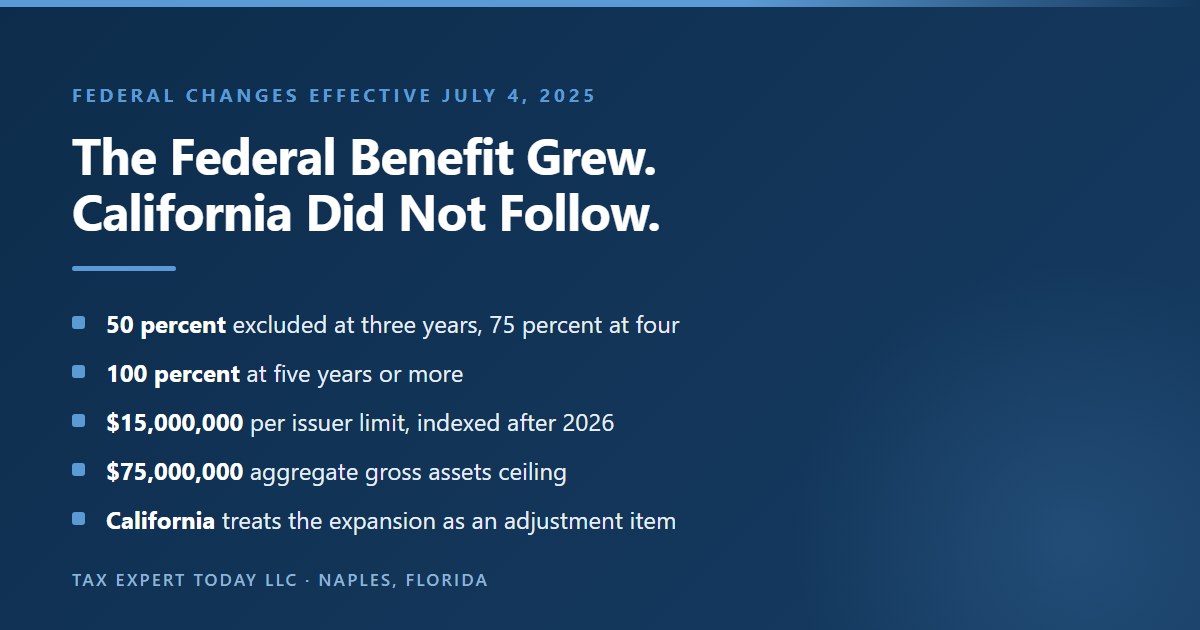
The One Big Beautiful Bill Act enlarged the federal exclusion in three directions at once, and California adopted none of them. A larger federal benefit against an unchanged state disapplication produces a larger absolute gap, so founders holding stock issued after July 4, 2025 face a wider spread between their federal and California results than any prior cohort.
- The holding period shortened. Stock acquired after the applicable date reaches a 50 percent exclusion at three years, 75 percent at four years, and 100 percent at five years or more.
- The per issuer cap increased. The applicable dollar limit rose from $10,000,000 to $15,000,000 for stock acquired after the applicable date, and it is indexed for inflation for taxable years beginning after 2026.
- The company size test loosened. The aggregate gross assets ceiling rose from $50,000,000 to $75,000,000, both before and immediately after issuance.
- The alternative cap is unchanged. A taxpayer may still use ten times the aggregate adjusted bases of the stock disposed of during the year if that produces a larger figure.
- California follows none of it. The FTB names the expansion of the exclusion as an item requiring a California adjustment.
The applicable date in the statute is defined as the date of enactment of the paragraph that introduced it, which is July 4, 2025. Stock acquired on or before that date stays on the legacy rules, meaning a holding period of more than five years and a $10,000,000 per issuer limit. Stock acquired after that date moves to the tiered schedule. A founder with several financing rounds may therefore hold two cohorts of stock in the same company under two different federal regimes, while California applies one rule to both cohorts: include all of it.
| Feature | Stock acquired on or before July 4, 2025 | Stock acquired after July 4, 2025 | California |
|---|---|---|---|
| Minimum holding period for any exclusion | More than 5 years | At least 3 years | Not applicable |
| Exclusion at 3 years | None | 50 percent | None |
| Exclusion at 4 years | None | 75 percent | None |
| Exclusion at 5 years or more | Up to 100 percent | 100 percent | None |
| Per issuer dollar limit | $10,000,000 | $15,000,000, indexed after 2026 | No limit needed, nothing is excluded |
| Aggregate gross assets ceiling | $50,000,000 | $75,000,000 | Not applicable |
| Married filing separately limit | $5,000,000 | One half of the applicable amount | Not applicable |
How Much California Tax Does a QSBS Sale Actually Cost?
California applies its graduated personal income tax schedule to the entire gain, and adds the 1 percent Behavioral Health Services Tax on taxable income above $1,000,000. For 2025 the top bracket of 12.3 percent begins at $742,953 for single filers and at double that figure for joint filers, which puts the combined top marginal rate on a large liquidity event at 13.3 percent.
- There is no capital gains preference. The same schedule that applies to salary applies to the gain.
- The surcharge threshold does not double. Section 17043 switches off section 17045, so the $1,000,000 threshold is the same for joint filers as for single filers.
- The surcharge threshold is not indexed. It has stood at $1,000,000 since Proposition 63 took effect in 2005.
- The label changed in 2025. Proposition 1 renamed the Mental Health Services Act, so the return now calls this the Behavioral Health Services Tax.
That third and fourth point together create an asymmetry worth naming, because it catches joint filers with large but not enormous gains. The 12.3 percent bracket for a joint return does not begin until $1,485,906 of taxable income for 2025, yet the 1 percent surcharge begins at $1,000,000 for every filing status. A married couple with $1.2 million of California taxable income is therefore still inside the 11.3 percent bracket while already paying the surcharge on $200,000. Our guide to the California Behavioral Health Services Tax works through the threshold mechanics and the separate Form 540NR computation in detail.
| 2025 taxable income, single or married filing separately | Marginal rate | Surcharge under section 17043 |
|---|---|---|
| $0 to $11,079 | 1.00 percent | None |
| $72,724 to $371,479 | 9.30 percent | None |
| $371,479 to $445,771 | 10.30 percent | None |
| $445,771 to $742,953 | 11.30 percent | None |
| Over $742,953 | 12.30 percent | None below $1,000,000 |
| Over $1,000,000 | 12.30 percent | Additional 1 percent, combined 13.30 percent |
A simple illustration makes the size of the gap concrete. Assume a founder holds stock acquired in 2019 that satisfies every federal requirement, and sells in 2026 for a gain of $10,000,000 with a negligible basis. Federally, the entire gain falls within the $10,000,000 per issuer limit for stock of that vintage and is excluded, so the federal income tax on the gain approaches zero. For California, the entire $10,000,000 enters taxable income. At the top marginal rates the state liability on that gain approaches $1.33 million. This is a hypothetical for illustration only, it ignores deductions, other income, the alternative minimum tax and the net investment income tax, and no particular result is promised for any taxpayer. It does show why the residency question below is not a detail.
Does California Conform to the Section 1045 Rollover?
California does not conform to the section 1045 rollover. The FTB instruction for Schedule D (540) states that California does not conform to the qualified small business stock deferral and gain exclusion under IRC sections 1045 and 1202, and directs the taxpayer to enter the entire gain realized. Reinvesting sale proceeds into replacement qualified small business stock therefore defers nothing for California purposes.
- The federal rollover defers. Section 1045 permits deferral where proceeds are reinvested in replacement qualified small business stock within 60 days.
- California taxes in the year of sale. The gain is recognized for state purposes even though it is deferred federally.
- A cash mismatch follows. The taxpayer owes California tax in a year when the proceeds have already been reinvested.
- The state analog is gone. Former section 18038.5 provided a California rollover and was repealed effective January 1, 2016.
The practical trap here is a liquidity trap rather than a rate trap. A founder who rolls an entire position into a new venture under section 1045 may reasonably believe the transaction is tax neutral, because federally it is. California will nonetheless assess tax on the full gain in the year of the original sale, and the money to pay it has already gone into the replacement stock. Basis then diverges permanently between the two systems, because California has taxed gain the federal system has not yet recognized, and that difference has to be tracked until the replacement stock is sold.
How Does Residency Change the California QSBS Result?
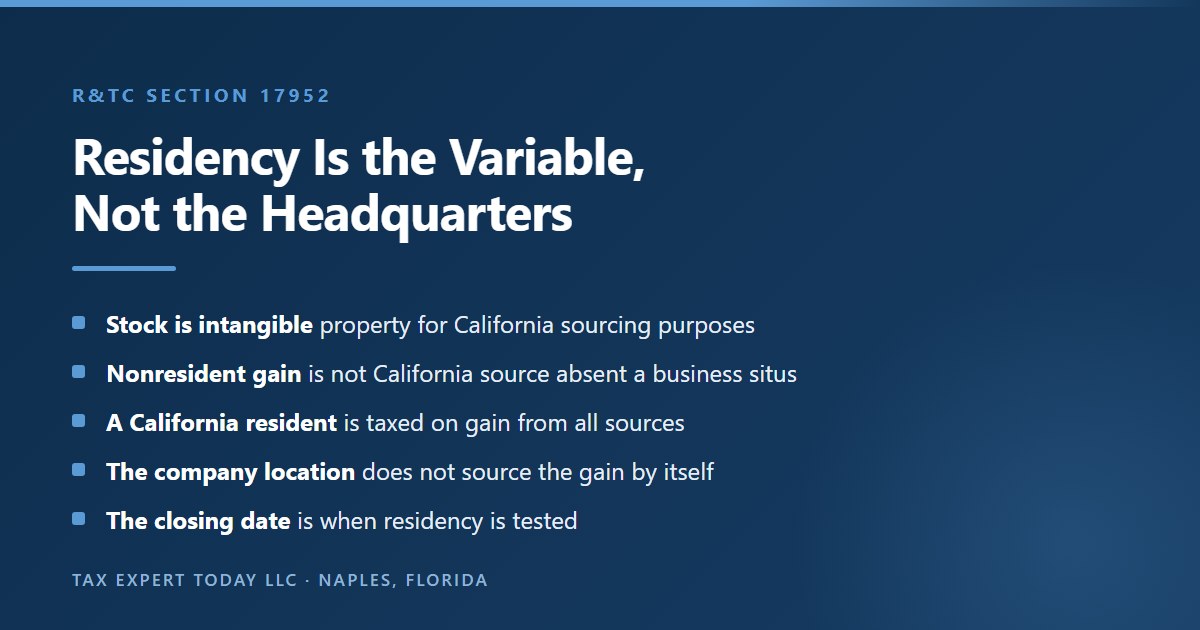
Residency changes everything, because gain on stock is income from an intangible asset. Revenue and Taxation Code section 17952 provides that income of nonresidents from stocks, bonds, notes or other intangible personal property is not income from sources within this state unless the property has acquired a business situs in California. A genuine nonresident selling stock therefore has no California source gain, regardless of where the company is headquartered.
- The company’s location does not source the gain. A California headquarters does not make stock gain California source income for a nonresident.
- The seller’s residence does. A California resident is taxed on all income from all sources, wherever earned.
- Business situs is the exception. Intangible property can acquire a California situs, and section 17952 also reaches a nonresident trading so regularly and continuously in California as to constitute doing business here.
- This is why the sale date matters. The question is not where the company is, it is where the seller is on the day the gain is realized.
That asymmetry is the whole planning question. Stock in a Silicon Valley company sold by a Florida resident generally produces no California tax, while the same stock sold by a California resident produces tax on the entire gain at up to 13.3 percent. Nothing about the company changed. Our guide to the California exit tax and what actually follows you covers which categories of income do trail a departing resident, and qualified small business stock gain is not among them once residency has genuinely changed. The complete California to Florida tax guide maps the whole corridor.
When Does the Residency Change Have to Happen?
The residency change has to be complete before the gain is realized, which for a stock sale generally means before the closing date. A move that follows the sale does not retroactively change the character of income already recognized, and a move that is announced but not carried out is the pattern the FTB examines most closely in a liquidity event.
- Realization fixes the year. The gain belongs to the taxable year in which the sale occurs.
- Residency is tested at that moment. A resident on the closing date is taxed on the gain as a resident.
- Intent alone is insufficient. California looks at where a taxpayer’s closest connections actually are, not at a stated plan.
- Proximity invites scrutiny. A departure shortly before a large closing attracts attention precisely because the sequence is valuable.
California tests residency through the closest connections analysis rather than through a single bright line, which means the evidence is cumulative and the record matters more than any one fact. Home ownership and use, the location of a spouse and children, where children attend school, professional licenses, voter registration, vehicle registration, the location of bank and investment accounts, club memberships, and physical presence all feed the analysis. Our detailed treatment of the California residency audit sets out what the FTB requests and the burden the taxpayer carries, and the departure checklist for leaving California sequences the steps. For the arrival side, see how to establish Florida residency and the Florida 183 day rule calculator.
Founders should also understand what a change of residency does not accomplish. It does not reach compensation income sourced to California workdays, which follows a different rule entirely. Stock options and restricted stock units are the common example, because their income is compensation for services rather than gain on an intangible, and California allocates it by workday. Our guide to RSU and stock option taxation when leaving California covers that allocation, and the difference between an equity award taxed as compensation and founder stock taxed as capital gain is one of the most consequential distinctions in the whole corridor.
What Happens If You Move Partway Through the Sale Year?
A taxpayer who changes residency during the year files as a part year resident on Form 540NR. Section 17041(i)(1) supplies the seam: all income from all sources is taxable for the portion of the year the taxpayer was a California resident, and only California source income is taxable for the nonresident portion. The sale date relative to the residency change date therefore determines which side of the seam the gain falls on.
- The resident period captures worldwide income. A sale closing during that period is fully taxable to California.
- The nonresident period captures source income only. A stock sale closing during that period generally produces no California source gain under section 17952.
- One return covers both. Form 540NR handles the split rather than requiring two filings.
- The rate is computed on total income. California determines the rate using all income and then prorates, so other income still influences the rate applied.
That last point catches people who assume a part year return simply taxes a fraction of their income at a fraction of the rate. The computation instead figures tax as though the taxpayer were a resident for the entire year, then applies the resulting effective rate to California taxable income. A very large gain realized while still a resident consequently raises the rate applied to the rest of the year’s California income as well. Our guide to the California part year resident return works the allocation mechanics through the schedule in full.
How Is the California QSBS Adjustment Reported on the Return?
The adjustment runs through Schedule CA and Schedule D rather than through a dedicated QSBS form. The federal return reports the excluded gain and removes it, and the California schedules add it back, because California begins from federal amounts and then adjusts for every provision where the two systems differ.
- Schedule D computes the difference. California Schedule D reconciles California basis and California gain against the federal figures.
- Column (e) takes the whole gain. The instruction is to enter the entire gain realized rather than the federally reported net.
- Schedule CA carries the adjustment. The capital gain line of Schedule CA reflects the difference between federal and California amounts.
- Nonresidents and part year residents use the 540NR versions. Schedule CA (540NR) and Schedule D (540NR) perform the same function on the nonresident return.
The FTB instructions name qualified small business stock explicitly in the list of items that create a basis or gain difference requiring Schedule D treatment, alongside items such as gain on investments inside a health savings account, installment sale gain reported on form FTB 3805E, and prior year basis differences. Because the adjustment is computed rather than transcribed, the supporting schedule matters. A return that simply reports a different number from the federal return without a schedule showing how the figure was derived is difficult to defend later, and a liquidity event of this size is a return that may well be examined.
| Step | Full year resident | Part year resident or nonresident |
|---|---|---|
| Federal reporting | Form 8949 and Schedule D, exclusion claimed | Form 8949 and Schedule D, exclusion claimed |
| California gain computation | Schedule D (540) | Schedule D (540NR) |
| California adjustment | Schedule CA (540), capital gain line | Schedule CA (540NR), Part II capital gain line |
| Return form | Form 540 | Form 540NR |
| Amount of gain entered | Entire gain realized | Entire gain realized for the resident period |
| Surcharge line | Form 540, line 62 | Form 540NR, line 72 |
What About Installment Sales, Earnouts and Escrows?
Deferred consideration extends the residency question across several years instead of settling it on one closing date. Where an installment sale spreads gain over future years, each year’s recognized gain is tested under the rules that apply in that year, which means a taxpayer who is a genuine nonresident when a later payment is received generally has no California source gain on that payment.
- Installment gain is recognized as received. Each payment carries its share of gain into the year of receipt.
- Intangible sourcing applies each year. Section 17952 is applied to the payment in the year it is recognized.
- Earnouts can behave differently. An earnout conditioned on continued services may be compensation rather than sale proceeds, which changes the sourcing rule entirely.
- Escrow releases follow the underlying sale. A holdback released later generally retains the character of the original transaction.
- Elections matter. Electing out of installment treatment accelerates all gain into the sale year, which is a residency decision as much as a tax rate decision.
The earnout point is the one that most often surprises founders, and it deserves care rather than assumption. Consideration that is contingent on the seller remaining employed can be recharacterized as compensation for services, and compensation is sourced to where the services are performed rather than to where the recipient resides. A founder who leaves California, stays on with the acquirer, and performs services from the new state has a reasonable position on the later payments, while a founder who continues working from California does not, even after changing residency on paper. Our guide to the federal tax treatment of a business sale covers purchase price allocation and the federal section 1202 mechanics that sit underneath all of this, and the timing analysis for moving to Florida before selling a business addresses the sequencing from the Florida side.
Does Holding the Stock in a Trust Change the California Answer?
Holding qualified small business stock in a trust changes who is taxed and under which rules, but it does not create a California exclusion. Section 18152 disapplies IRC section 1202 for purposes of the Personal Income Tax Law generally, so a trust that is subject to California tax on the gain faces the same disapplication that an individual faces.
- Grantor trusts are transparent. Income is reported by the grantor, so the grantor’s residency governs.
- Nongrantor trusts are separate taxpayers. California taxes them by reference to the residence of fiduciaries and noncontingent beneficiaries as well as to California source income.
- Source income is taxed regardless. California source income is taxable to a trust whatever the residence of its fiduciaries.
- The exclusion still does not apply. No trust structure restores a California benefit that the statute has removed.
Structures marketed on the strength of avoiding state tax on a liquidity event deserve particular scrutiny in California, and the history here is instructive. California addressed the incomplete gift nongrantor trust directly rather than leaving the question to litigation, which is a reminder that a structure permitted in one state and untested in another is not the same thing as a settled planning position. Any trust approach around a California liquidity event should be evaluated by counsel on its own facts before it is implemented, and well before a transaction is signed.
What Does the FTB Examine in a Liquidity Event Residency Case?
The FTB examines whether the taxpayer’s closest connections genuinely moved, and it examines the documentary record contemporaneous with the move rather than statements made afterward. A residency change surrounding a large stock sale receives attention because the tax at stake is large and the timing is visible on the return itself.
- The record is cumulative. No single factor decides the question.
- Contemporaneous evidence carries weight. Documents created at the time of the move are more persuasive than reconstructions.
- Family location is heavily weighted. A spouse and school age children remaining in California is difficult to overcome.
- Physical presence is measurable. Travel records, phone records and credit card activity establish where time was actually spent.
- Retained California property is not fatal but is examined. How the property is used matters more than whether it is owned.
| Factor | Supports nonresidency | Undermines nonresidency |
|---|---|---|
| Primary home | Sold or leased out, new home purchased elsewhere | California home retained and used as before |
| Family | Spouse and children relocated | Family remains in California |
| Time present | Majority of days in the new state | Substantial continuing California presence |
| Registrations | Voter, vehicle and license moved promptly | California registrations maintained |
| Professional and social ties | New advisors, memberships and physicians | All relationships remain in California |
| Work location | Services performed from the new state | Continued work from California premises |
| Timing relative to the sale | Move completed well before the closing | Move executed immediately before closing |
None of these factors operates as a safe harbor, and no combination of them assures a particular outcome. What the record does is shift the practical burden. A taxpayer with a coherent, documented, early move is in a materially different position from a taxpayer whose file consists of a change of address form filed the month before a closing. Our Florida residency audit guide and the dual state residency trap cover the same evidentiary questions from the arrival side, and Florida domicile for executives addresses the equity compensation overlay.
Which Other States Tax Qualified Small Business Stock Gain?
Most states with an income tax follow the federal exclusion automatically, because they begin from federal adjusted gross income or federal taxable income and do not add the gain back. California is among a small group that departs from that pattern, and states with no personal income tax reach the same result as full conformity by a different route.
- Rolling conformity states generally follow. Beginning from federal income and making no QSBS adjustment produces the federal answer.
- Florida imposes no personal income tax. There is no state level gain to exclude in the first place.
- California disapplies the provision by name. Section 18152 is an explicit departure rather than a drafting gap.
- The corridor result is stark. The same sale can produce a state liability approaching 13.3 percent or none at all, depending only on residency.
| State position | Effect on a qualifying QSBS sale | Example |
|---|---|---|
| No personal income tax | No state tax on the gain | Florida, Texas, Nevada, Washington on most income |
| Conforms to the federal exclusion | Follows the federal result, no addback | Most states beginning from federal income |
| Disapplies section 1202 by statute | Entire gain taxed at state rates | California, R&TC section 18152 |
| No preferential capital gains rate | Gain taxed on the ordinary schedule | California |
Readers comparing states should confirm the current position of any state directly rather than relying on a summary, including this one, because conformity provisions are amended frequently and a state that followed the federal rule last year may have decoupled since. That caution applies with particular force in 2026, given how many states are still legislating their response to the 2025 federal changes.
What Should a Founder Review Before a Liquidity Event?
The review should establish the federal qualification first, then determine the California exposure, then address residency, and it should happen long before a term sheet is signed. Qualification is a historical question answered by records created at issuance, and residency is a question answered by a pattern of conduct that takes time to establish.
- Confirm the stock qualifies federally. Original issuance, C corporation status, the gross assets test at issuance, the active business requirement and the holding period all have to be documented.
- Identify the acquisition dates. Stock acquired before and after July 4, 2025 sits under different federal rules.
- Quantify the California exposure. Model the state liability on the full gain at the applicable marginal rates.
- Decide the residency question early. A move is evidence over time, not a filing.
- Plan for estimated payments. A large gain creates estimated tax obligations in the year of sale.
- Preserve the documentation. Capitalization tables, subscription agreements and board minutes establish issuance facts years later.
| Question | Who answers it | When it should be settled |
|---|---|---|
| Does the stock meet the section 1202 requirements? | Tax advisor with company records | Before any sale process begins |
| Which acquisition cohort applies? | Tax advisor with the capitalization table | Before modeling any outcome |
| What is the California liability if nothing changes? | Tax advisor | Before evaluating alternatives |
| Is a change of residency genuinely intended? | The taxpayer and family | Well before a closing date |
| Is any consideration compensation rather than gain? | Tax advisor and transaction counsel | During negotiation of the terms |
| What estimated payments are due and when? | Tax advisor | In the quarter of the sale |
Founders who also hold California business entities should review those separately, because the entity level obligations continue independently of the shareholder question. Our guides to the California LLC franchise tax and the California pass through entity elective tax cover the entity side, and California capital gains tax on a home sale and Form 593 withholding address the residence that often sells in the same period. Taxpayers who end up owing California more than they can pay at once should review the FTB installment agreement options.
California QSBS Tax Help in Naples & Southwest Florida
QSBS tax help Naples founders can use starts with the same two questions we ask every corridor client: does the stock qualify federally, and where will you actually be living when it sells. Tax Expert Today LLC advises founders, early employees and investors on state residency and tax matters nationwide, including California departures and Florida arrivals, from our office in Naples, Florida. Our team includes tax advisors, enrolled agents, CPAs and attorneys, and we work with transaction counsel rather than in place of it.
We are located at 11983 Tamiami Trail N, Naples, FL 34110. Call (239) 441-2005, Monday through Friday, 10:00 a.m. to 5:00 p.m. Eastern. Clients across Naples, Bonita Springs, Estero, Fort Myers, Marco Island and the wider Southwest Florida region engage us for California residency planning, part year return preparation and FTB correspondence. Our California tax services page describes the state engagements we take, and Naples tax planning covers the local advisory work.
Local FAQ: I moved to Naples from the Bay Area last year and my company is being acquired this year. Does California still tax my stock gain? If your residency change was complete and genuine before the closing, section 17952 generally treats the gain from the stock as income from an intangible sourced to your state of residence, which would place it outside California source income. The analysis turns on whether your closest connections actually moved and on whether any part of the consideration is compensation for services rather than gain on the stock. Bring your capitalization table, your closing documents and your move documentation, and we will work through both questions before the transaction closes rather than after.
When to Engage a Professional
Engage a professional before the transaction is structured, not after the closing statement arrives. Almost every meaningful choice in a California QSBS situation, including the residency question, the treatment of contingent consideration and the installment election, has to be made before the documents are signed, and none of them can be revisited on the return.
- The amounts are large and the rules are unforgiving. A residency determination can move a seven figure liability in either direction.
- Federal qualification is a records question. Establishing original issuance and the gross assets test years later requires documents that may be difficult to reconstruct.
- The state and federal answers diverge. A transaction optimized only for the federal result can be expensive in California.
- Examination is a realistic possibility. A large gain paired with a recent move is visible on the face of the return.
Tax Expert Today LLC advises on state residency and tax matters nationwide. We can evaluate whether stock appears to satisfy the federal requirements, quantify the California exposure under current law, review the residency record against the factors the FTB actually weighs, and coordinate with transaction counsel on the treatment of contingent consideration. We do not promise any particular result, and outcomes depend on facts and on law that may change. Call (239) 441-2005 to discuss your situation, or review our California tax services.
Frequently Asked Questions About California QSBS
Does California tax QSBS gain that is fully excluded federally?
Yes. Revenue and Taxation Code section 18152 provides that IRC section 1202 does not apply for California purposes, so gain excluded on the federal return is included in full on the California return. The FTB instruction for Schedule D directs the taxpayer to enter the entire gain realized.
What is the California tax rate on a QSBS sale?
California applies its graduated personal income tax rates, which reach 12.3 percent for 2025 above $742,953 of taxable income for single filers, plus the 1 percent Behavioral Health Services Tax on taxable income above $1,000,000. The combined top marginal rate is 13.3 percent. California has no preferential capital gains rate.
Did California ever have its own QSBS exclusion?
Yes. Former section 18152.5 provided a 50 percent exclusion for stock held more than five years, conditioned on California payroll and asset tests. Cutler v. Franchise Tax Board held those tests unconstitutional in 2012, and AB 1412 preserved a 50 percent exclusion for 2008 through 2012 before repealing the provisions entirely.
Does the 2026 California conformity update change the QSBS answer?
No. California advanced its conformity date to January 1, 2025, and section 17024.5 was amended by SB 1435 effective September 14, 2026, but that bill does not reference section 18152 or IRC section 1202. A conformity date cannot restore a provision that California has expressly declined to incorporate.
Does California conform to the section 1045 rollover?
No. The FTB states that California does not conform to the qualified small business stock deferral and gain exclusion under IRC sections 1045 and 1202. Reinvesting proceeds in replacement stock defers the gain federally but not for California, which can create a cash shortfall in the year of sale.
If I move out of California before selling, does California still tax the gain?
Generally no, if the residency change is genuine and complete before the sale. Section 17952 treats income of nonresidents from stocks and other intangible personal property as not sourced to California unless the property has acquired a business situs here. The analysis depends on the facts of the move rather than on the date of a filing.
What if the sale closes partway through my move year?
A part year resident files Form 540NR. Under section 17041(i)(1), all income from all sources is taxable for the resident portion of the year and only California source income is taxable for the nonresident portion, so the closing date relative to the residency change date determines the treatment.
Do the 2025 federal QSBS changes help in California?
Not directly. The tiered exclusion beginning at three years, the $15,000,000 per issuer limit and the $75,000,000 gross assets ceiling improve the federal result only. The FTB lists the expansion of the qualified small business stock gain exclusion as an item requiring a California adjustment.
This article is educational and general in nature. It is not tax, legal or investment advice for any particular taxpayer, and it does not create a client relationship. California and federal law change, and the application of these rules depends on facts specific to each situation. Consult a qualified advisor about your circumstances before acting.
Published September 22, 2026 by Dr. Pellumb Kabashi « Back to Learning Center
Have a question this article touches on?
Tax Expert Today LLC, based in Naples, Florida and serving clients across the United States.
Schedule a Consultation (239) 441-2005