
By Dr. Pellumb Kabashi, DBA, MBA, CES, CFE, EA
Founder, Tax Expert Today LLC · Tax advisors, enrolled agents, CPAs, and attorneys · Serving clients in all 50 states
Quick answer: Selling rental property taxes arrive in four layers: unrecaptured section 1250 gain at a maximum 25 percent, long term capital gain on the remainder, the 3.8 percent net investment income tax, and the income tax of the state where the building stands. Florida itself takes nothing, and that is the trap, because a Florida resident has no resident return for a credit to reduce. Call (239) 441-2005 for a free consultation.
Published: September 2026
What Do You Owe in Selling Rental Property Taxes After Moving to Florida?
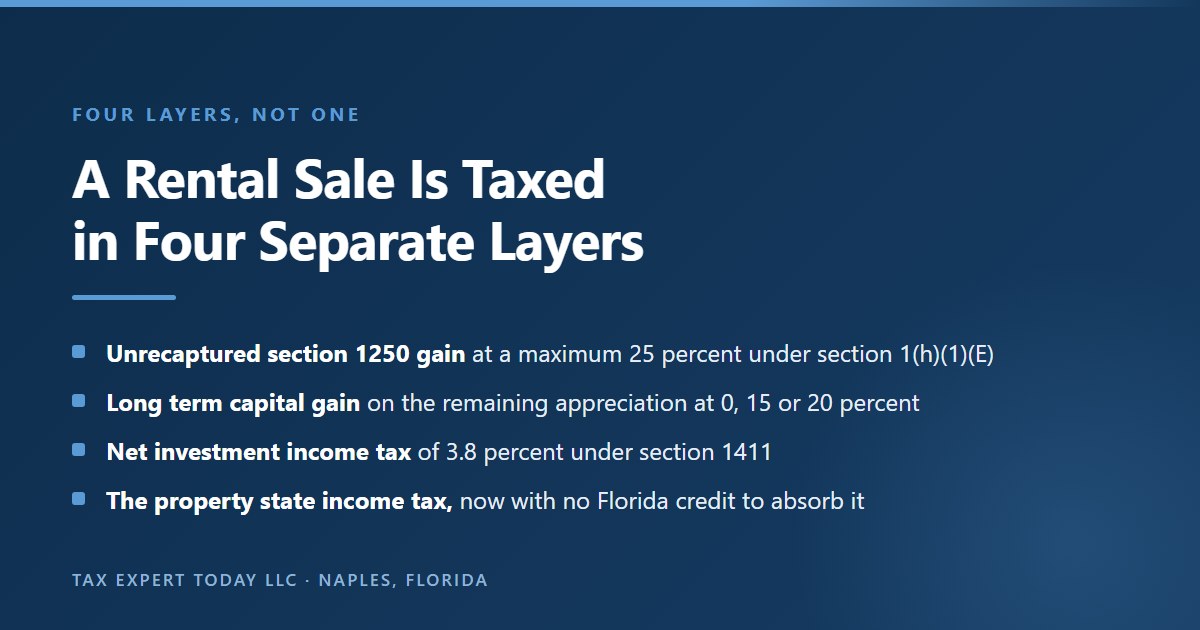
Selling rental property taxes break into four layers, and only the last changes when you move. Depreciation returns as unrecaptured section 1250 gain at a maximum 25 percent under IRC §1(h)(1)(E). The rest is long term capital gain. The 3.8 percent net investment income tax may sit on top. Then the property state taxes the same gain, and Florida offers nothing against it.
- Layer one, the depreciation you took. Every rental year reduced basis, so a sale at the price you paid can still produce taxable gain.
- Layer two, the real appreciation. Gain above original cost is long term capital gain if you held the property more than one year.
- Layer three, the surtax. Rental gain is net investment income under IRC §1411 unless the activity is a non passive trade or business for you.
- Layer four, the state you left. Real property is sourced where it sits. Moving your domicile to Naples does not move the building.
That fourth layer is the one national guides omit, and it is the one that changes character after a relocation. While you were a resident of the property state, it taxed the gain and you filed one return. After the move, that state taxes the gain as a nonresident while your resident state is Florida, which levies no income tax on natural persons under Fla. Const. Art. VII, §5(a). No resident return means nothing for a credit for taxes paid to another state to reduce. We work through that base tax and apportionment mechanic in our guide to the nonresident state tax return after a move.
| Layer | Authority | Rate or effect | Does the move change it? |
|---|---|---|---|
| Unrecaptured section 1250 gain | IRC §1(h)(1)(E) and §1(h)(6) | Maximum 25 percent | No |
| Long term capital gain on the balance | IRC §1(h)(1)(B) to (D) | 0, 15 or 20 percent | No |
| Net investment income tax | IRC §1411(a)(1) | 3.8 percent of the lesser of net investment income or modified adjusted gross income over the threshold | No |
| Property state income tax | The property state sourcing statute | That state schedule, collected on a nonresident return | Yes, and the credit that used to absorb it disappears |
So the after tax cost of the identical sale is higher than it would have been a year earlier, even though no federal number moved. Anyone modelling selling rental property taxes for a post relocation sale has to price that fourth layer separately, the way we do for a departing owner in what leaving New York really costs and in what selling after a New Jersey move costs.
Is Depreciation Recapture on a Rental Sale Really Taxed as Ordinary Income?
For essentially every residential rental sold today, no, and this is the most repeated error on the subject. Ordinary recapture under IRC §1250(a)(1) reaches only additional depreciation, which subsection (b)(1) defines as adjustments exceeding straight line. Residential rental property must use straight line under IRC §168(b)(3)(B), so there is nothing to recapture as ordinary income.
The chain is short enough to follow in full. IRC §168(b)(3) states that the applicable depreciation method is the straight line method for nonresidential real property and for residential rental property. IRC §168(c) sets the recovery period at 27.5 years for residential rental property and 39 years for nonresidential real property. Because the deductions were computed on a straight line basis to begin with, they cannot exceed what straight line would have produced, so the §1250(b)(1) definition yields zero additional depreciation for property held more than one year.
What remains is unrecaptured section 1250 gain, defined in IRC §1(h)(6)(A) as the long term capital gain that would have been ordinary income if §1250(b)(1) had included all depreciation and the applicable percentage had been 100 percent. IRC §1(h)(1)(E) taxes that amount at 25 percent, and IRC §1(h)(3) removes it from adjusted net capital gain so it cannot reach the 0, 15 or 20 percent rates. The Internal Revenue Service states the same conclusion in Topic no. 409: the portion of any unrecaptured section 1250 gain from selling section 1250 real property is taxed at a maximum 25 percent rate.
| Characterization | What triggers it | Rate | Applies to a modern residential rental? |
|---|---|---|---|
| Section 1250 ordinary recapture | Additional depreciation, meaning adjustments above straight line | Ordinary rates | Generally no, because §168(b)(3)(B) mandates straight line |
| Unrecaptured section 1250 gain | Straight line depreciation adjustments reflected in basis | Maximum 25 percent under §1(h)(1)(E) | Yes, and this is where the depreciation actually lands |
| Remaining long term capital gain | Appreciation above original cost | 0, 15 or 20 percent | Yes |
The distinction matters in dollars, not vocabulary, because 25 percent is a ceiling rather than a flat charge. A taxpayer whose other income leaves part of the gain in a bracket below 25 percent pays the lower rate on that slice, a result the ordinary income framing hides, and a seller who assumes a 37 percent hit on the depreciation layer may reject a sale the real arithmetic supports.
One nuance runs the other way, worth knowing before anyone quotes you the published line that recapture reaches depreciation you never claimed. Basis is reduced under IRC §1016(a)(2) by depreciation allowed, but not less than the amount allowable, so an owner who under claimed still faces the larger gain. The characterization rule is softer: the closing sentence of IRC §1250(b)(3) provides that where the taxpayer can establish by adequate records that the amount allowed for a period was less than the amount allowable, the amount taken into account is the amount allowed. Records decide whether that softer rule is available at all.
How Is the Gain on a Rental Property Sale Actually Calculated?
Gain equals amount realized less adjusted basis. Amount realized is the contract price reduced by selling costs. Adjusted basis is original cost, increased by capital improvements, and reduced by every year of depreciation allowed or allowable under IRC §1016(a)(2). Because that reduction is cumulative and mandatory, a long held rental can produce a large gain at a modest price.
The reporting route differs from a residence sale. A rental is business or investment property, so the sale goes on Form 4797 rather than Schedule D alone, as IRS Publication 527 directs. Depreciation history therefore has to be reconstructed from the actual schedules rather than estimated, and that is the most common gap in a file arriving after a relocation. Owners who converted a property from personal to rental use carry a further wrinkle, because Publication 527 sets a distinct basis rule for property changed to rental use.
- Pull every year of depreciation, including partial first and last years. The conventions in IRC §168(d) mean those figures are rarely a full twelve months.
- Separate the land. Land is not depreciable, so the original allocation constrains how much basis reduction was ever possible.
- Add capital improvements, not repairs. A roof replacement is basis. A turnover paint job was already deducted.
- Identify appliances, carpet and furniture separately. Those are five and seven year property on the Publication 527 recovery table, and they are section 1245 property, where ordinary recapture genuinely does apply.
- Confirm whether cost segregation was used. A study shifts basis into shorter lived components and changes the recapture mix on the way out.
That final point is the exception to the section 1250 analysis above. A seller who accelerated deductions through cost segregation, or claimed bonus depreciation on personal property inside the building, holds section 1245 property alongside the building, and section 1245 recapture is ordinary income with no 25 percent ceiling. This is one reason the planning in our piece on the short term rental tax loophole carries a cost that only appears at disposition.
Does Florida Tax the Sale of a Rental Property You Kept in Another State?
Florida does not tax the gain, and that is not an unmixed benefit. Fla. Const. Art. VII, §5(a) bars any tax on the income of natural persons resident in the state. The property state still taxes the gain, and with no Florida resident return there is no resident liability for a credit for taxes paid to another state to reduce.
The credit for taxes paid to another state is a resident state mechanism: it reduces what your home state charges on income another state already taxed. A resident of a taxing state selling out of state property generally pays roughly the higher of the two rates rather than both. A Florida resident pays the property state in full, with nothing on the Florida side to absorb it, so that tax becomes an absolute cost rather than a partially credited one.
None of this argues against moving. It argues for sequencing, which is the same question we work through for a business owner in moving to Florida before selling a business and for a residence in selling your home after moving to Florida. The Florida side of the file still matters even though Florida takes nothing, because the property state may test whether you were genuinely a nonresident on the sale date. Filing a declaration of domicile under Fla. Stat. §222.17 is one piece of that record, and our guides to establishing Florida residency, surviving a Florida residency audit and the 183 day rule calculator cover the rest of it.
Will the Closing Agent Withhold State Tax From a Nonresident Seller?
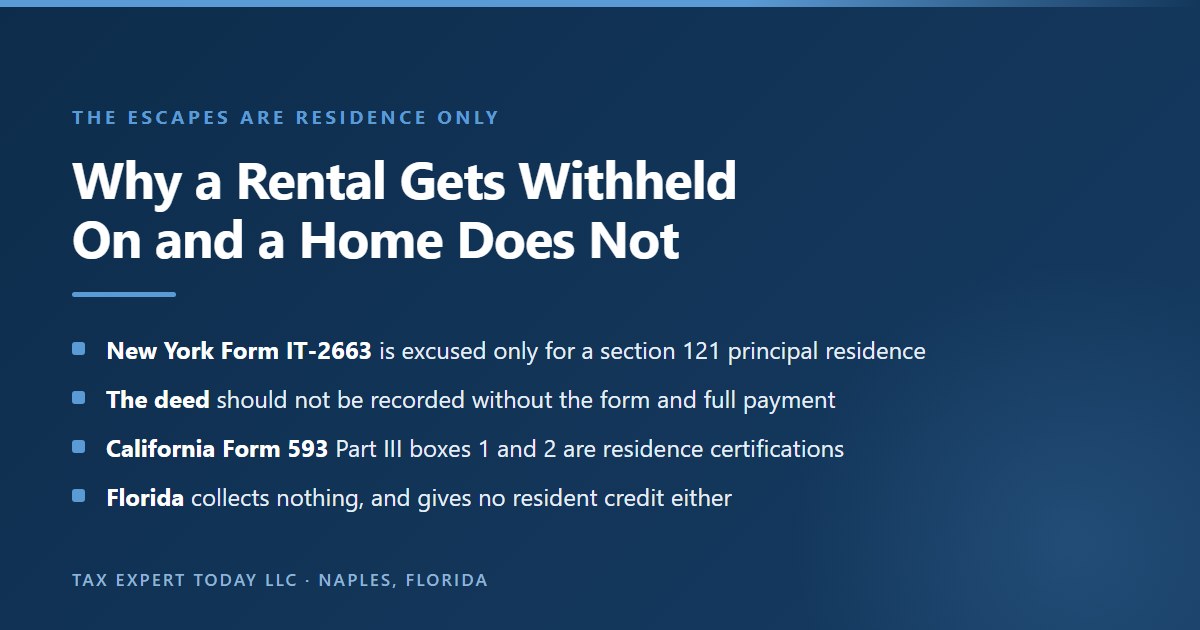
In several states, yes, and a rental is far more exposed than a residence, because the escapes sellers rely on are principal residence certifications. New York Tax Law §663(c)(1) exempts a nonresident from Form IT-2663 only where the property qualifies in total as an IRC §121 principal residence. California Form 593 works the same way. A rental qualifies for neither.
New York is the cleanest illustration because the mechanism is tied to recording the deed. The instructions to Form IT-2663 for 2026 state that nonresident individuals, estates and trusts are required to estimate the personal income tax liability on the gain from the sale or transfer of certain real property located in New York State, and unless the transfer is exempt, must use Form IT-2663 to compute the gain or loss and pay the full amount of estimated tax due. The 2026 form covers sales occurring after December 31, 2025 but before January 1, 2027. The instructions then note that a deed for a fee simple interest by an individual, estate or trust should not be recorded by any recording officer unless the seller has signed Form TP-584, Schedule D, or presents Form IT-2663 with full payment of estimated personal income tax due.
Read the exemption list closely, because it is short. Under Tax Law §663(c) a nonresident is relieved only where the property qualifies in total as the seller principal residence within the meaning of IRC §121, where a mortgagor conveys to a mortgagee in foreclosure or in lieu of foreclosure with no additional consideration, or where the transferor or transferee is a listed government or quasi government entity. There is no rental exemption and no small transaction exemption. The instructions add a nuance that helps only a residence owner: property qualifying in total as the principal residence keeps the exemption even if part of the gain exceeds the IRC §121 exclusion amount.
| State | Form | What triggers collection | Does a rental escape? |
|---|---|---|---|
| New York | Form IT-2663 with voucher IT-2663-V, filed alongside Form TP-584 | Nonresident sale of New York real property, collected by the county recording officer when the deed is presented | No. The §663(c)(1) exemption requires an IRC §121 principal residence |
| California | Form 593 with voucher 593-V | Withholding by the escrow or remitter unless a Part III or Part IV certification applies | No. Part III boxes 1 and 2 are the principal residence certifications |
| Florida | None | No state income tax on natural persons under Fla. Const. Art. VII, §5(a) | Not applicable, and no resident credit either |
Three details from the New York instructions belong in any closing file. A separate Form IT-2663 is required for each sale and each nonresident seller, with a separate check, except that married nonresident sellers may file one form and one check. On an installment sale the seller computes total gain but pays estimated tax only on the portion reportable on the 2026 federal return, with later years on Form IT-2105 or IT-2106. Estates and trusts must estimate tax on the entire gain without regard to distributions during the year of sale, and a fiduciary allocating those payments to beneficiaries files Form IT-205-T. Expect the sale to raise the wider residency question rather than settle it, which our guides to the New York residency audit and the dual state residency trap address.
Can You Choose How Much the State Withholds at the Closing Table?
In California, yes, and the choice is an election on the form rather than a negotiation. Form 593 offers the default sales price method at 3 1/3 percent of the selling price, or an alternative calculation applying 12.3 percent to the gain for an individual. Which is cheaper depends entirely on how much of the price is gain.
The 2026 Form 593 sets it out at lines 29 and 30. Line 30 is the sales price withholding amount, the selling price multiplied by 3 1/3 percent, shown on the form as .0333. Line 29 is the alternative withholding calculation, the gain from the Part VI computation multiplied by the rate for the filing type: 12.3 percent for an individual, a trust or a non California partnership, 8.84 percent for a corporation, 10.84 percent for a bank or financial corporation, 13.8 percent for an S corporation and 15.8 percent for a financial S corporation. Line 36 records the election, box A for the sales price method and boxes B through H for the alternative calculation.
The break even is simple arithmetic. The gain based election withholds less whenever 12.3 percent of the gain is below 3 1/3 percent of the price, which happens when gain is under roughly 27 percent of the selling price. Above that ratio the gross price method withholds less. A rental held two decades and depreciated toward its land allocation frequently sits far above that ratio, which is where the reflexive gain based election costs the seller cash at closing that will not return until the nonresident return is filed.
| Illustrative ratio of gain to price | Sales price method, 3 1/3 percent of price | Alternative calculation, 12.3 percent of gain | Which withholds less |
|---|---|---|---|
| Gain is 15 percent of price | 3.33 percent of price | 1.85 percent of price | Alternative calculation |
| Gain is 27 percent of price | 3.33 percent of price | 3.32 percent of price | Roughly the break even point |
| Gain is 50 percent of price | 3.33 percent of price | 6.15 percent of price | Sales price method |
| Gain is 80 percent of price | 3.33 percent of price | 9.84 percent of price | Sales price method, by a wide margin |
Those percentages are a rate comparison, not a prediction about any particular sale, and the correct election depends on the full Part VI computation for the property. Note what the election does not do: withholding is a prepayment, not a final tax, so an over withheld seller recovers the excess only by filing the California return. Two further certifications matter. Part III box 3 covers a seller with a loss or zero gain for California purposes, which requires the Part VI computation and then removes withholding entirely, and Part IV box 10 covers a like kind exchange under IRC §1031. On an installment sale the buyer withholds on the principal portion of each payment and remits by the twentieth day of the following month. Our pieces on California Form 593 and California nonresident withholding go deeper.
What Happens to Suspended Passive Losses When You Sell the Rental?
They are released, and for many owners this is the largest single item in the calculation. IRC §469(g)(1)(A) provides that on disposing of an entire interest in a passive activity in a fully taxable transaction, the excess of that activity loss over income from all other passive activities becomes a loss which is not from a passive activity.
Three conditions in the statute do the work, and each is a place a sale goes wrong.
- The disposition must be of the entire interest. Selling one of three rentals in a grouped activity, or retaining a fractional interest, does not trigger the release.
- The transaction must be fully taxable. All gain or loss realized has to be recognized, which is why a §1031 exchange defers the loss release along with the gain.
- The buyer must not be a related party. IRC §469(g)(1)(B) provides that where the seller and the acquirer bear a relationship described in IRC §267(b) or §707(b)(1), the release waits until the interest is acquired by someone outside that relationship. A sale to a child, or to a controlled entity, defers the benefit indefinitely.
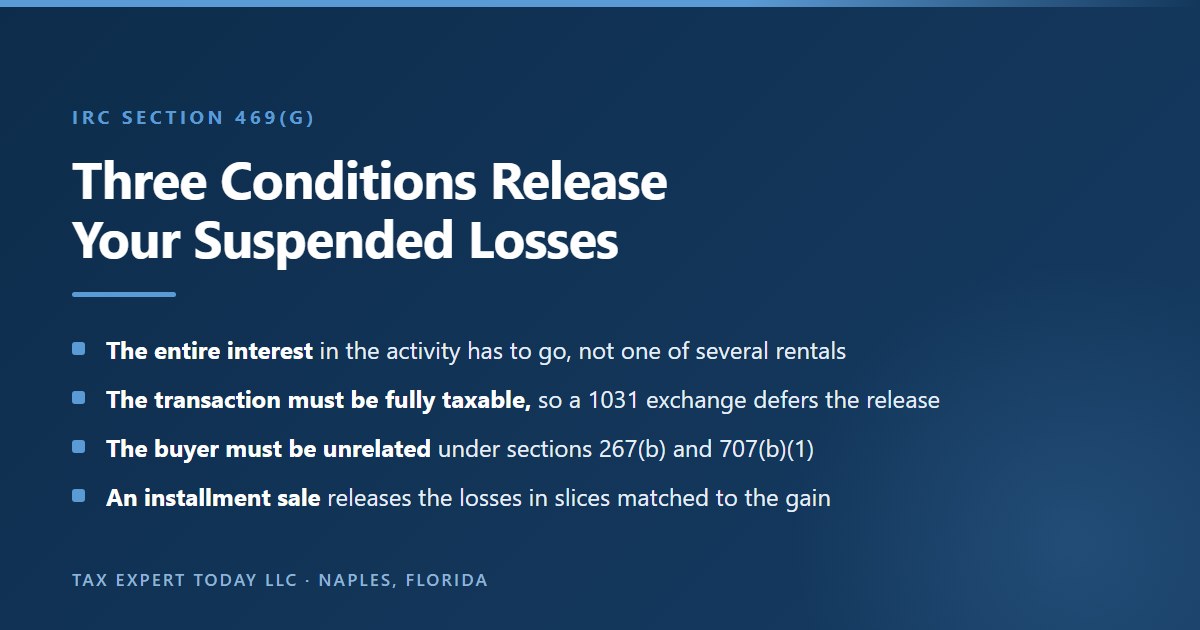
Installment sales have their own rule. Under IRC §469(g)(3), where an entire interest is sold on the installment method under IRC §453, the release applies each year to the portion of the suspended losses bearing the same ratio to the total as that year recognized gain bears to gross profit. An installment seller therefore unlocks the losses in slices matched to the gain, which is either a benefit or a problem depending on where the rest of the income sits.
Losses released under §469(g)(1)(A) become non passive ordinary losses, so they offset ordinary income rather than the 25 percent unrecaptured section 1250 layer directly. For an owner whose suspended losses accumulated across many years of a marginally cash flowing rental, that released deduction can be the reason the year is manageable at all. Pulling Form 8582 for every year of ownership is therefore not optional preparation.
Does the 3.8 Percent Net Investment Income Tax Apply to a Rental Sale?
Usually yes. IRC §1411(a)(1) imposes 3.8 percent on the lesser of net investment income or the excess of modified adjusted gross income over the threshold amount. IRC §1411(b) fixes those thresholds at $250,000 for a joint return or surviving spouse, $125,000 for married filing separately, and $200,000 in any other case. Those figures are not indexed for inflation.
That last sentence turns an occasional surtax into a routine one. Because the thresholds have not moved since the provision took effect, an ordinary rental sale gain is now enough on its own to lift modified adjusted gross income over the line for a large share of sellers, even in a year with otherwise modest income. The surtax applies to the lesser of the two measures, so a seller near the threshold pays it on the excess rather than on the whole gain, which is a meaningful distinction in a year built around one transaction.
Two escapes exist and both are narrower than they sound. Gain from property held in a trade or business that is not a passive activity with respect to the taxpayer is generally outside net investment income, the route a genuine real estate professional may take. Separately, IRC §1411(a)(2) charges estates and trusts on undistributed net investment income measured against the dollar amount at which the highest trust bracket begins, a far lower threshold than the individual figures, so a rental held in a trust deserves separate attention. Where that trust was drafted in the state you left, the state side is the subject of our piece on trust situs after moving to Florida.
Is a 1031 Exchange a Better Move Than Selling After You Relocate?
An exchange defers the federal and state gain, but it also defers the suspended loss release and commits you to replacement real property on a fixed clock. IRC §1031(a)(1) now reaches only real property held for business use or investment, and §1031(a)(3) sets the deadlines that end most failed attempts: identification within 45 days, completion within 180 days.
For a Florida mover the appeal is obvious, because replacement property bought in Florida sits in a state that will not tax the eventual gain. Deferral is not forgiveness, though. The old state generally continues to track deferred gain attributable to property it once sourced, so an exchange out of a high tax state into Florida does not always sever the connection cleanly. California Form 593 anticipates the exchange at Part IV box 10 and covers the failed exchange and boot scenarios in its Part VII transaction types, which tells you the state expects to see the transaction again if it does not complete.
- Real property only. Personal property and the appliance and carpet components inside a building no longer qualify, so a cost segregated building carries a taxable slice through an otherwise clean exchange.
- The clock is unforgiving. The 45 day identification and 180 day completion periods in §1031(a)(3) run from the transfer of the relinquished property.
- Held for sale does not qualify. IRC §1031(a)(2) excludes real property held primarily for sale.
- The suspended losses stay suspended. Because the transaction is not fully taxable, the §469(g)(1)(A) release does not occur.
- A later move into the property is constrained. IRC §121(d)(10) denies the principal residence exclusion for five years from the date property acquired in a §1031 exchange was acquired.
That last item is the trap in the strategy most commonly recommended online, which is to exchange into a Florida property and later convert it to a home. The five year bar runs from acquisition, and it applies to the taxpayer and to anyone whose basis is determined by reference to the taxpayer basis. An exchange can still be the right answer. It is simply a different transaction from a sale, with a different cash profile, and it should be chosen rather than defaulted into.
Can the Home Sale Exclusion Ever Reduce Tax on a Former Rental?
Sometimes, and the direction of the conversion decides how much. If you lived there and rented it out after moving, that post residence rental period inside the five year window is not nonqualified use, because IRC §121(b)(5)(C)(ii)(I) carves it out. Rent first and move in later, and those rental years are nonqualified use.
The asymmetry is written into the statute and it surprises people in both directions. IRC §121(b)(5)(A) provides that the exclusion does not apply to gain allocated to periods of nonqualified use, and subparagraph (B) allocates that gain on the ratio of nonqualified use periods to the total ownership period. Subparagraph (C)(i) defines a period of nonqualified use as any period, other than the portion preceding January 1, 2009, during which the property is not used as the principal residence of the taxpayer or the taxpayer spouse or former spouse. Subparagraph (C)(ii)(I) then removes from that definition any portion of the five year period described in §121(a) falling after the last date the property was used as the principal residence.
Put plainly: rent out your former home on the way to Florida and, within the qualifying window, that rental period does not dilute the exclusion. Buy a rental, hold it for years, then convert it to your residence, and the rental years do dilute it. Separately, IRC §121(d)(6) caps the benefit in every conversion case, providing that §121(a) does not apply to gain up to the depreciation adjustments, as defined in IRC §1250(b)(3), attributable to periods after May 6, 1997. Depreciation claimed during a rental period is therefore never excluded. The exclusion shelters appreciation, not recaptured depreciation.
| Relief | Available on a pure rental? | Available on a converted former home? | Authority |
|---|---|---|---|
| IRC §121 exclusion of up to $250,000, or $500,000 on a joint return | No | Yes, subject to the ownership and use tests | IRC §121(a) and (b) |
| Exclusion of the depreciation portion | No | No | IRC §121(d)(6) |
| New York exemption from Form IT-2663 | No | Yes, if it qualifies in total as the principal residence | N.Y. Tax Law §663(c)(1) |
| California Form 593 full exemption | No | Yes, under Part III box 1 or box 2 | 2026 Form 593, Part III |
| Release of suspended passive losses | Yes, on a fully taxable disposition | Yes, for the rental period losses | IRC §469(g)(1)(A) |
What Should You Gather Before Anyone Can Price This Sale?
Six documents decide the answer and five of them predate the sale: depreciation schedules for every year of ownership, the original purchase closing statement, capital improvement records, Form 8582 for each year, the last resident year state return, and the draft closing statement. Without the depreciation history, any figure quoted for selling rental property taxes is a guess.
- Depreciation schedules, every year. These establish the unrecaptured section 1250 layer and whether section 1245 property exists. A gap year has to be reconstructed, because IRC §1016(a)(2) reduces basis by the allowable amount regardless.
- The original settlement statement. This fixes cost basis and the land allocation, which caps how much depreciation was ever possible.
- Capital improvement records. Invoices, not recollection. Improvements raise basis and reduce every layer.
- Form 8582 for each year of ownership. This is the suspended loss inventory that IRC §469(g) releases, frequently the largest favorable item in the year of sale.
- The final resident year state return. This establishes when residency changed, which the property state may test on the nonresident filing.
- Any cost segregation study. If one exists, the recapture mix differs and the exchange analysis changes with it.
Two items belong in the pre closing conversation rather than the post closing one, because neither can be fixed afterward. The first is the withholding certification, since the Form 593 election and the Form IT-2663 computation are made at or before closing. The second is the identification decision if an exchange is even a candidate, because the 45 day clock in IRC §1031(a)(3) starts at transfer and cannot be extended by hindsight.
Rental Property Sale Help in Naples & Southwest Florida
Tax Expert Today LLC works with owners who have relocated to Florida from New York, New Jersey, California, Illinois, Connecticut, Pennsylvania and other high tax states and who still hold rental or investment real estate in the state they left. The firm brings together tax advisors, enrolled agents, CPAs and attorneys, and handles residency, multistate and real estate tax matters nationwide. Southwest Florida draws from exactly the states whose nonresident withholding reaches hardest at the closing table, so an out of state rental sold from a Florida address is familiar ground here.
Our office is located at 11983 Tamiami Trail N, Naples, Florida 34110. You can reach us at (239) 441-2005, Monday through Friday, 10am to 5pm ET. We also work with clients across all 50 states.
- Rental property sale help Naples: rebuilding the depreciation history, separating the section 1245 and section 1250 layers, and pricing selling rental property taxes across all four layers before the property goes under contract.
- Nonresident withholding review Naples: running the Form 593 election arithmetic or the Form IT-2663 computation before closing, rather than reclaiming an over withheld amount on a return months later.
- Tax planning Naples FL: sequencing a disposition against the residency change, described on our Naples tax planning page and in our guide to Florida tax services.
- Florida residency Naples FL: building the domicile record the property state will test, including the issues raised in a Florida residency audit.
- Estate and trust planning Naples: where the rental sits in a trust, coordinating the sale with the plan described on our estate and trust planning page.
- Tax resolution Naples: unfiled nonresident years, withholding credits never claimed and notices from a prior sale, handled through our IRS resolution and audit support practice and our Naples tax resolution page.
A local question we are asked often: does selling a Naples rental raise the same issues? The federal four layer analysis is identical, because IRC §1(h), §1250, §469 and §1411 do not care where the building stands. The state layer disappears. So selling rental property taxes on a Southwest Florida property involve no closing table withholding and no nonresident return, which is why owners intending to redeploy into rental real estate frequently look at Florida property first. Sales and use tax on transient rentals and local tourist development tax are separate obligations, unaffected by the sale of the asset.
When to Engage a Professional
A rental sale with a short ownership history, complete depreciation schedules, no suspended losses and no out of state property is straightforward, and the arithmetic runs in an afternoon. Most post relocation sales are not that. The combination that makes selling rental property taxes hard is specific: a long holding period that has driven basis down, a depreciation record spread across several preparers, suspended losses nobody has inventoried, and a property state that collects at the closing table on a form signed before anyone has run the numbers. Coordinating that with the wider relocation plan is part of what our Florida residency and tax planning work does, alongside the sourcing questions in our guide to the convenience of the employer rule and the retirement income issues in retiring to Florida.
Consider engaging an advisor before the property goes under contract when any of the following is present: depreciation schedules are incomplete or span multiple preparers, so the unrecaptured section 1250 layer cannot be computed reliably; a cost segregation study was performed, which introduces section 1245 ordinary recapture and complicates any exchange; suspended passive losses have accumulated and nobody has totalled them from Form 8582; the buyer is a family member or a controlled entity, where IRC §469(g)(1)(B) defers the loss release; the property sits in a state with closing table withholding, where the Form 593 or Form IT-2663 decision is made before closing and not after; a §1031 exchange is under consideration, where the 45 day and 180 day deadlines leave no room for a late start; the property is held in a trust, where the §1411 threshold is far lower than the individual figures; or the residency change is recent enough that the property state may test whether you were a nonresident on the sale date, the situation our guides to the New York residency audit and first year snowbird filing address.
The firm brings together tax advisors, enrolled agents, CPAs and attorneys and works with clients nationwide from its Naples office. If you have relocated to Southwest Florida and are preparing to sell rental or investment property in a state you have left, call (239) 441-2005 or use our contact page to arrange a consultation. Outcomes depend on the specific facts of each property and each return, and nothing here is a prediction about any particular sale.
This article is educational and general in nature. It is not legal, tax or accounting advice, and it does not create a professional relationship. Federal rates and thresholds and state withholding rules change, and the figures cited here were verified against primary sources on the date of publication. Please consult a qualified advisor about your own situation.
Published September 12, 2026 by Dr. Pellumb Kabashi « Back to Learning Center
Have a question this article touches on?
Tax Expert Today LLC, based in Naples, Florida and serving clients across the United States.
Schedule a Consultation (239) 441-2005