
By Dr. Pellumb Kabashi, DBA, MBA, CES, CFE, EA
Founder, Tax Expert Today LLC · Tax advisors, enrolled agents, CPAs, and attorneys · Serving clients in all 50 states
Quick Answer: California section 179 is capped at $25,000 for 2026, and the cap shrinks dollar for dollar once qualifying property placed in service passes $200,000, so it disappears at $225,000. California also rejects federal bonus depreciation. The result is a second depreciation schedule, a Form FTB 3885A adjustment, and a California basis that follows the asset even after you move to Florida. Call (239) 441-2005 for a free consultation.
What Is the California Section 179 Limit for 2026?
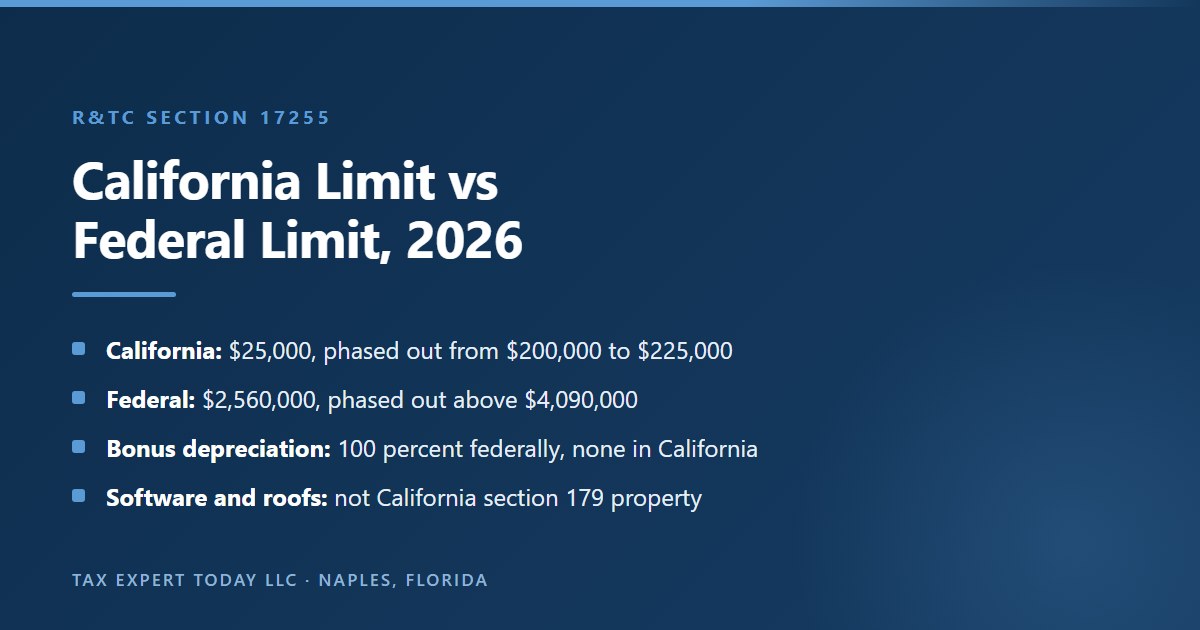
The California section 179 limit for 2026 is $25,000 of elected cost. It is reduced dollar for dollar by the amount by which the cost of all section 179 property placed in service during the year exceeds $200,000, so a business that places $225,000 or more of qualifying property in service has no California section 179 deduction at all.
- Dollar limit: $25,000, fixed in R&TC section 17255(a) and not indexed for inflation.
- Phase-out threshold: $200,000 of section 179 property placed in service, under section 17255(b).
- Full phase-out: at $225,000 of qualifying property placed in service.
- Federal limit for 2026: $2,560,000, with a reduction above $4,090,000, per IRS Publication 946.
- Form: Form FTB 3885A for individuals and pass-through owners, Form FTB 3885 for corporations.
California section 179 looks like a small number because it is a small number. The Legislature wrote the $25,000 figure directly into the Revenue and Taxation Code. Section 17255(a) says that section 179(b)(1) of the Internal Revenue Code, the federal dollar limitation, does not apply, and that the aggregate cost taken into account for any taxable year shall not exceed twenty-five thousand dollars. Section 17255(b) does the same for the federal reduction rule and substitutes a $200,000 threshold. Neither figure carries an inflation adjustment, which is why the California numbers on the 2025 forms are the same numbers that appeared on California forms more than a decade ago.
The 2025 Instructions for Form FTB 3885A say it in one sentence: for California purposes, the maximum IRC section 179 expense deduction allowed is $25,000. The worksheet printed in those instructions then walks through the reduction: line 1 is the $25,000 maximum, line 2 is the total cost of section 179 property placed in service, line 3 is the $200,000 threshold, line 4 is the excess of line 2 over line 3, and line 5 is the dollar limit for the year after the reduction. A business that buys $210,000 of equipment has a California dollar limit of $15,000, not $25,000. A business that buys $230,000 has a California dollar limit of zero.
Because the statute fixes the amounts in dollars and contains no indexing language, the 2026 figures are the same as the 2025 figures printed by the Franchise Tax Board. At the time of writing, the Franchise Tax Board had not yet posted the 2026 version of the Form FTB 3885A instructions (the 2026 address returned a not found page on November 22, 2026), so this guide relies on the 2025 instructions together with the statute. If the Legislature amends section 17255 before the 2026 forms are released, the forms will say so, and the analysis below should be rechecked against them.
This guide is written for business owners who are leaving California or have already left, and in particular for those who have moved to Naples, Florida and the rest of Southwest Florida while their companies, their K-1s or their equipment still touch California. For the federal side of the same purchases, our guide to bonus depreciation in 2026 covers the restored 100 percent allowance and the higher federal section 179 limit. This page owns the California side.
| Item | California figure for 2026 | Where it comes from |
|---|---|---|
| Maximum section 179 expense | $25,000 | R&TC 17255(a); R&TC 24356(b)(2) for corporations |
| Phase-out threshold | $200,000 of property placed in service | R&TC 17255(b); R&TC 24356(b)(3) |
| Point where the deduction reaches zero | $225,000 of property placed in service | Arithmetic of the two figures |
| Inflation indexing | None | No indexing language in either section |
| Bonus depreciation under IRC 168(k) | Not allowed | R&TC 17250(a)(11) |
| Off-the-shelf computer software | Not section 179 property | R&TC 17255(e); R&TC 24356(b)(6) |
| Form for individuals and pass-through owners | Form FTB 3885A, Part II | 2025 Form FTB 3885A instructions |
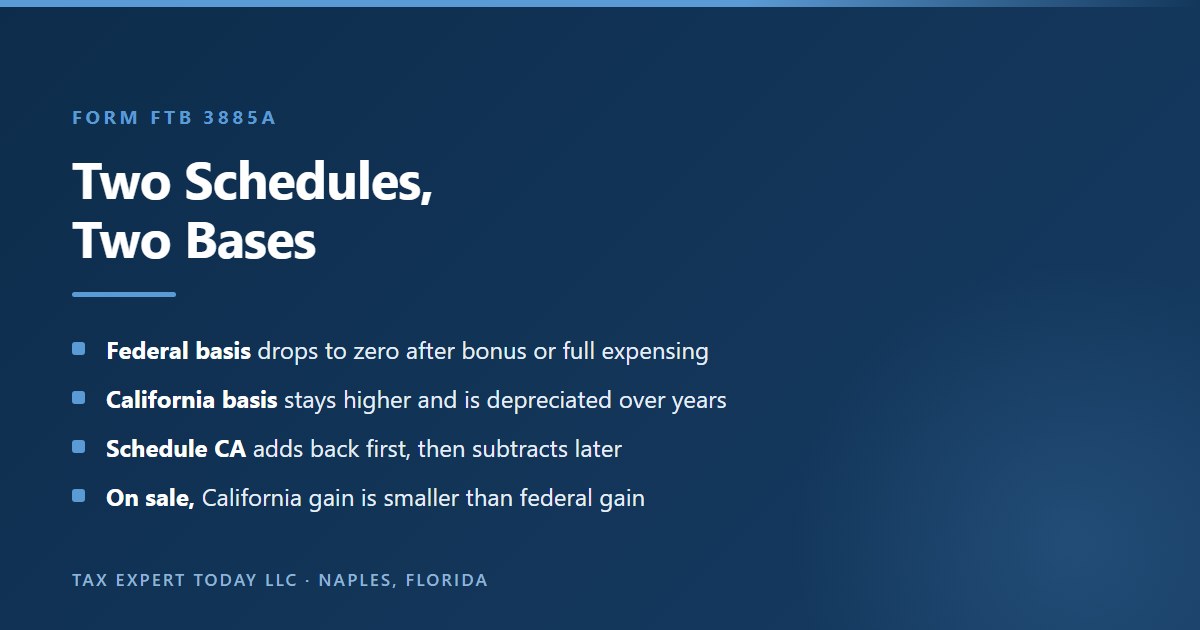
The practical consequence is that almost every business that uses federal section 179 or federal bonus depreciation in a meaningful way will have a California difference. The difference is not a one-year item. It produces a California depreciable basis that is higher than the federal basis, a stream of California depreciation in later years that the federal return does not have, and a California gain or loss on sale that is different from the federal one. Those three effects are what the rest of this guide is about.
How Does California Section 179 Compare With the Federal Limit?
The federal section 179 limit for tax years beginning in 2026 is $2,560,000, with a reduction above $4,090,000 of property placed in service, while California section 179 stops at $25,000 with a $200,000 threshold. The federal limit is about one hundred times the California limit, so most federal elections above $25,000 create a California add back.
- Federal 2025: $2,500,000 limit, reduced above $4,000,000, after the 2025 federal legislation.
- Federal 2026: $2,560,000 limit, reduced above $4,090,000, after inflation adjustment.
- Federal SUV cap for 2026: $32,000 of section 179 for certain heavy sport utility vehicles.
- California 2025 and 2026: $25,000 limit, reduced above $200,000, no inflation adjustment.
- Effect: the excess federal deduction is added back on Schedule CA and recovered through California depreciation.
The federal figures come from the current IRS Publication 946, which states that for tax years beginning in 2025 the maximum section 179 expense deduction is $2,500,000, with a reduction by the amount by which the cost of section 179 property placed in service exceeds $4,000,000, and that for tax years beginning in 2026 the maximum is $2,560,000, with a reduction above $4,090,000. The same publication states a 2026 cap of $32,000 for certain sport utility vehicles. Those increases trace to Public Law 119-21, the 2025 federal budget legislation, which raised the base amounts and kept inflation indexing. The statutory text is in 26 U.S.C. section 179.
California has not adopted those amounts. The federal changes were enacted after January 1, 2025, which is the specified date in R&TC section 17024.5 for California conformity to the Internal Revenue Code for taxable years beginning on or after January 1, 2025. Even if the date moved, section 17255 overrides the federal dollar limit by name, so a later conformity bill would still leave the $25,000 figure in place unless it amended section 17255 itself. The FTB Publication 1001 difference table says it plainly: federal limitation amounts are different than California limitation amounts, California allows an expense election up to $25,000, and the California phase-out starts at $200,000.
| Measure | Federal, tax years beginning in 2026 | California, 2026 |
|---|---|---|
| Maximum section 179 deduction | $2,560,000 | $25,000 |
| Phase-out threshold | $4,090,000 | $200,000 |
| Deduction reaches zero at | $6,650,000 of property | $225,000 of property |
| Heavy SUV cap | $32,000 | No separate cap; the $25,000 overall limit governs |
| Off-the-shelf software | Qualifies | Does not qualify |
| Qualified real property election | Allowed | Not allowed |
| Bonus depreciation available as well | Yes, 100 percent for qualified property acquired after January 19, 2025 | No |
A hypothetical illustrates the scale. Assume a Los Angeles design studio, organized as a single member LLC owned by an individual, buys $180,000 of computers, furniture and production equipment in 2026 and elects section 179 for all of it on the federal return. Federally, the full $180,000 is deducted in 2026, subject to the business income limit. For California, the studio is under the $200,000 threshold, so the California dollar limit is the full $25,000. The owner deducts $25,000 under California section 179 and depreciates the remaining $155,000 of California basis over the normal recovery periods. The 2026 California depreciation on that remaining basis is far smaller than $155,000, so the California return shows a large positive adjustment in the first year and negative adjustments in later years.
The point of the comparison is not that California is unusually harsh. The point is that the gap is large enough that a business cannot treat California as a rounding difference. Our guide to the California LLC versus S corporation choice shows how entity type changes which form carries the computation, and the sections below follow the numbers through each type of return.
Why Does California Not Follow the Federal Section 179 Amount?
California follows the Internal Revenue Code only as of a specified date and only with listed modifications. For section 179, the Legislature has written its own dollar limit, threshold and software rule into R&TC section 17255 for personal income tax and section 24356 for corporations, and those sections override the federal amounts regardless of when federal law changes.
- Static conformity: California adopts the Internal Revenue Code as of a fixed date, January 1, 2025, for current years.
- Express override: section 17255 replaces section 179(b)(1) and (b)(2) by name.
- Repeated rejection: section 17255(g) and (h) reject the 2015 and 2017 federal expansions specifically.
- Corporate parallel: section 24356(b) applies the same $25,000 and $200,000 figures to corporations.
- 2026 legislation: section 17250 was repealed and added again by Stats. 2026, Ch. 236, keeping bonus depreciation off.
The structure of California law explains the result. California does not adopt federal tax law automatically. R&TC section 17024.5 defines the Internal Revenue Code, for personal income tax purposes, as the federal code as enacted on a specified date, and for taxable years beginning on or after January 1, 2025, that date is January 1, 2025. Federal amendments made after that date do not apply in California unless the Legislature adopts them. The section also says that any reference to a specific provision of the Internal Revenue Code includes the California modifications of that provision, which is how section 17255 attaches to section 179.
Section 17255 then goes further than a date. It lists the parts of section 179 that do not apply. Subdivision (a) replaces the federal dollar limit with $25,000. Subdivision (b) replaces the federal reduction threshold with $200,000. Subdivision (c) says the carryover of a disallowed amount is computed under California law as it read when the property was placed in service. Subdivision (d) turns off section 179(c)(2), the federal provision that lets a taxpayer revoke an election without consent. Subdivision (e) turns off section 179(d)(1)(A)(ii), the software provision. Subdivision (f) turns off the disaster assistance property rules. Subdivisions (g) and (h) reject the 2015 and 2017 federal amendments by citation. The current version of section 17255 carries the note that it was amended by Stats. 2025, Ch. 231 (SB 711), effective October 1, 2025.
| R&TC 17255 subdivision | Federal provision affected | California result |
|---|---|---|
| (a) | IRC 179(b)(1), dollar limitation | Replaced by $25,000 |
| (b) | IRC 179(b)(2), reduction in limitation | Replaced by a $200,000 threshold |
| (c) | IRC 179(b)(3)(B), aggregate amount disallowed | Computed under California law as of the date the property was placed in service |
| (d) | IRC 179(c)(2), revocation of elections | Does not apply |
| (e) | IRC 179(d)(1)(A)(ii), computer software | Does not apply |
| (f) | IRC 179(e), qualified disaster assistance property | Does not apply |
| (g) and (h) | 2015 and 2017 federal amendments to section 179 | Do not apply |
For corporations, R&TC section 24356 contains the same list in subdivision (b): section 179 applies in lieu of the older 20 percent allowance, except that the dollar limit is $25,000, the threshold is $200,000, the disallowed amount is computed under California law as it read when the property was placed in service, section 179(c)(2) does not apply, the software provision does not apply, and the disaster property rules do not apply. The two sections are drafted to produce the same section 179 limits under the personal income tax and the corporation tax.
The bonus depreciation side has its own statute. R&TC section 17250 modifies section 168 of the Internal Revenue Code, and paragraph (11) of subdivision (a) says that section 168(k), the special allowance for certain property, shall not apply. The current text of section 17250 shows that it was repealed and added by Stats. 2026, Ch. 236 (SB 1435), effective September 14, 2026, and applicable to taxable years beginning on or after January 1, 2025. In other words, the Legislature revisited the depreciation statute in 2026 and kept bonus depreciation off.
How Does the California Section 179 Phase-Out Work?
The California phase-out compares the total cost of section 179 property placed in service during the year with $200,000. Every dollar above $200,000 reduces the $25,000 limit by one dollar, and the reduction is based on all qualifying property placed in service, not only the property you elect to expense.
- Measured on: the total cost of section 179 property placed in service in the year, worksheet line 2.
- Group test: the instructions say the limit applies to all qualifying assets as a group rather than to each asset.
- Not elective: buying property you do not expense still counts toward the threshold.
- Entity and owner: for LLCs and partnerships, the limits apply to the entity and to each owner.
- Floor: the limit is reduced, but not below zero, under section 17255(b).
The worksheet in the Form FTB 3885A instructions makes the computation mechanical. Line 1 is the $25,000 maximum dollar limitation for California. Line 2 is the total cost of section 179 property placed in service. Line 3 is the $200,000 threshold. Line 4 is line 2 minus line 3, but not less than zero. Line 5, the dollar limitation for the tax year, is line 1 minus line 4, again not less than zero. The instructions tell the preparer to include all assets qualifying for the deduction because the limit applies to all qualifying assets as a group rather than to each asset individually.
That group rule is the part that surprises growing businesses. The threshold is measured on property that qualifies as section 179 property, not on the amount the owner chooses to expense. A business that places $240,000 of equipment in service and elects section 179 on only $20,000 of it still has $240,000 on line 2, a reduction of $40,000 on line 4, and a dollar limit of zero on line 5. On the federal return, the same purchases sit far below the $4,090,000 federal threshold, so the federal election is unaffected.
| Section 179 property placed in service in 2026 | Reduction (line 4) | California dollar limit (line 5) | Federal dollar limit |
|---|---|---|---|
| $50,000 | $0 | $25,000 | $2,560,000 |
| $150,000 | $0 | $25,000 | $2,560,000 |
| $200,000 | $0 | $25,000 | $2,560,000 |
| $205,000 | $5,000 | $20,000 | $2,560,000 |
| $215,000 | $15,000 | $10,000 | $2,560,000 |
| $225,000 | $25,000 | $0 | $2,560,000 |
| $500,000 | $300,000 | $0 | $2,560,000 |
The pass-through rule adds a second layer. The worksheet in the Form FTB 3885L for LLCs says the limitations apply to the LLC and each member, and the worksheet in the Form FTB 3885P for partnerships says the limitations apply to the partnership and each partner. So the LLC first tests its own purchases against the $200,000 threshold and the $25,000 limit, and the member then tests the total of everything that reaches the member, from every source, against the member’s own $25,000 limit. The owner level computation is covered in detail later in this guide.
The phase-out also matters for timing. Because the threshold is annual, a business that expects to cross $225,000 of qualifying purchases can sometimes place part of a purchase in service in a different year without any effect on the federal result. Whether that is worth doing depends on the federal side, the business reason for the purchase and the timing of income, and it should be modeled rather than assumed. Section 179 is never a reason to buy equipment the business does not need.
What Property Qualifies for California Section 179?
California section 179 property is tangible depreciable property, generally machinery, equipment, furniture and similar personal property, acquired by purchase for use in an active trade or business and placed in service during the year. California excludes off-the-shelf computer software and does not allow the federal election for qualified real property such as roofs and HVAC.
- Qualifies: tangible personal property used more than 50 percent in a trade or business, bought from an unrelated seller.
- Does not qualify in California: off-the-shelf computer software, under section 17255(e).
- Does not qualify in California: qualified real property and lodging related property added by the 2017 federal law.
- Does not qualify anywhere: land, land improvements, property acquired by gift or inheritance, and property bought from related persons.
- Investment property: rental property that is not a trade or business, and property held only to produce income, does not qualify.
The starting point is federal. California applies section 179 except as modified, so the federal definitions in 26 U.S.C. section 179(d) and the explanations in IRS Publication 946 supply the basic tests. Property must be depreciable, must be tangible personal property or another listed category, must be acquired by purchase, and must be acquired for use in the active conduct of a trade or business. Publication 946 states that property acquired by gift or inheritance does not qualify, that property bought from certain related persons does not qualify, and that property used for both business and personal purposes qualifies only if business use is more than 50 percent in the year it is placed in service.
California then removes items. Section 17255(e) turns off section 179(d)(1)(A)(ii), which is the federal provision that treats off-the-shelf computer software as section 179 property. Section 17255(h) rejects the 2017 federal amendments to section 179, which added certain lodging related personal property and qualified real property, meaning roofs, HVAC systems, fire protection and alarm systems, and security systems for nonresidential real property. The Form FTB 3885 instructions for corporations list the same nonconformity: California does not conform to the expanded definition of section 179 property for certain depreciable tangible personal property related to furnishing lodging and for qualified real property for improvements to nonresidential real property.
| Type of property | Federal section 179 | California section 179 |
|---|---|---|
| Machinery and production equipment | Qualifies | Qualifies, within the $25,000 limit |
| Office furniture and fixtures | Qualifies | Qualifies, within the $25,000 limit |
| Computers and peripheral equipment | Qualifies | Qualifies, within the $25,000 limit |
| Off-the-shelf computer software | Qualifies | Does not qualify |
| Roofs, HVAC, fire protection, alarm and security systems on nonresidential buildings | Qualifies by election | Does not qualify |
| Lodging related personal property such as furniture in an apartment building | Qualifies | Does not qualify |
| Vehicles used more than 50 percent for business | Qualifies, subject to vehicle limits | Qualifies, subject to California vehicle limits |
| Land and land improvements | Does not qualify | Does not qualify |
The business use test works the same way in both systems. Publication 946 gives the example of property that costs $11,000 and is used 80 percent for business: the business cost, $8,800, is the amount that can be considered for section 179. A California owner applies the same percentage to the California computation. If business use later drops to 50 percent or less, section 179 recapture rules apply, and California follows the federal recapture concept on its own numbers.
One practical consequence of the California exclusions is that a building owner who uses the federal qualified real property election for a new roof on an office building has no California section 179 deduction for that roof, and, as discussed below, California does not treat qualified improvement property the same way the federal system does either. That combination can make the California depreciation on a building project very different from the federal figure.
Is Off-the-Shelf Software Eligible for California Section 179?
No. California does not allow the section 179 election for off-the-shelf computer software. R&TC section 17255(e) turns off the federal software provision for individuals and pass-through owners, section 24356(b)(6) does the same for corporations, and the software is instead recovered through California depreciation or amortization.
- Federal rule: off-the-shelf software is section 179 property and is also eligible for bonus depreciation.
- California rule: software is not section 179 property and bonus depreciation is not allowed.
- Typical California recovery: straight line over 36 months under the general software rules, absent a different required method.
- Common error: listing a software license on the California worksheet because it appeared on federal Form 4562.
- Threshold effect: software is excluded from section 179 property, so it should not be counted on worksheet line 2 either.
The Form FTB 3885 instructions state the corporate rule directly: California does not allow the IRC section 179 expense election for off-the-shelf computer software. The FTB Publication 1001 difference table states the personal income tax rule: federal law allows a section 179 expense election for off-the-shelf software and certain qualified real property, and California law does not conform. The statutory source is subdivision (e) of R&TC section 17255 and paragraph (6) of subdivision (b) of R&TC section 24356.
Federally, IRS Publication 946 describes off-the-shelf software as software readily available for purchase by the general public, subject to a nonexclusive license and not substantially modified, and it says that if the software qualifies, it may also qualify for the section 179 deduction and the special depreciation allowance. It also states that depreciable computer software that does not get those treatments is recovered using the straight line method over a useful life of 36 months. On our reading, California generally follows that 36 month straight line rule for software placed in service by individuals and pass-through owners, because California has not modified the general software depreciation provision, but the California treatment for corporations follows the corporate depreciation rules described later in this guide.
| Software item, hypothetical $36,000 cost placed in service January 2026 | Federal first year deduction | California first year deduction |
|---|---|---|
| Election under section 179 | $36,000, if within the business income limit | $0 under section 179 |
| Bonus depreciation instead of section 179 | $36,000 at 100 percent | $0 bonus |
| Straight line over 36 months | Not needed if expensed | About $12,000 for a full year of use |
| Schedule CA adjustment for 2026 | Not applicable | About $24,000 added back to California income |
| Adjustment in 2027 and 2028 | Not applicable | About $12,000 subtracted each year |
The example assumes a full year of use and ignores any mid-month or partial year convention, so the exact figures on a real return will differ. The shape is what matters: the software creates a California add back in the first year and California deductions in the next two years, and those later deductions are worth something only if the owner still has California taxable income from that business when they arrive. That point returns later in the guide, because it is the core of the move-to-Florida problem.
Software subscriptions paid monthly or annually are usually ordinary business expenses rather than depreciable property, and they do not create a California section 179 question at all. The issue arises with purchased licenses that are capitalized, which is why it shows up most often in professional practices, engineering firms and production studios that buy perpetual licenses in bulk.
Does California Allow Bonus Depreciation in 2026?
No. California does not allow federal bonus depreciation in 2026 or in any recent year. R&TC section 17250(a)(11) says IRC section 168(k) shall not apply, so property that is fully expensed under the federal 100 percent allowance is depreciated for California over its normal recovery period instead.
- Federal rule: 100 percent bonus for qualified property acquired and placed in service after January 19, 2025, made permanent by the 2025 federal law.
- California rule: no bonus at all, for property placed in service in any year since the 2001 federal provision first appeared.
- Corporate exception: corporations may elect a separate California allowance of 20 percent on up to $10,000 of cost, covered later.
- 2026 statute: section 17250 was repealed and added by Stats. 2026, Ch. 236, and still turns off section 168(k).
- Form: the difference is computed on Form FTB 3885A and carried to Schedule CA.
Bonus depreciation is the larger of the two federal write-offs for most growing businesses, which is why the California answer matters more than the section 179 cap alone. The FTB Publication 1001 history is clear. Federal law allowed a 30 percent first-year allowance after September 10, 2001, raised it to 50 percent after May 5, 2003, created a 50 percent allowance again after 2008, increased it to 100 percent for property acquired after September 27, 2017, phased it down by 20 percent per year for property placed in service after 2022, and, under the 2025 federal law, permanently set it at 100 percent for qualified property acquired and placed in service after January 19, 2025. For each step, Publication 1001 records the same result: California does not conform.
The statutory source today is R&TC section 17250(a)(11): section 168(k) of the Internal Revenue Code, relating to the special allowance for certain property, shall not apply. Paragraphs (12) and (13) of the same subdivision turn off section 168(l), the special allowance for second generation biofuel plant property, and section 168(m), the special allowance for certain reuse and recycling property. Publication 1001 adds that California does not conform to the 100 percent depreciation election for qualified production property under section 168(n), which the federal law allows for property placed in service after July 4, 2025.
| Federal accelerated provision | Federal status in 2026 | California status in 2026 | Source |
|---|---|---|---|
| IRC 168(k) bonus depreciation | 100 percent for qualified property acquired after January 19, 2025 | Not allowed | R&TC 17250(a)(11); FTB Pub. 1001 |
| IRC 168(n) qualified production property | 100 percent election for property placed in service after July 4, 2025 | Not allowed | FTB Pub. 1001; Form FTB 3885A instructions |
| IRC 168(e)(6) qualified improvement property as 15-year property | Applies | Does not apply | R&TC 17250(a)(7) |
| IRC 179 expensing | $2,560,000 limit | $25,000 limit | R&TC 17255 |
| IRC 174 research expensing changes | Federal changes apply | California follows section 174 as it read on January 1, 2015 | FTB Pub. 1001 |
For a business that uses bonus depreciation federally, the California depreciation schedule is the federal schedule with the bonus taken out and the section 179 figure cut to the California amount. The California recovery period and method for individuals, LLCs and S corporations are generally the federal MACRS period and method, because California conforms to the federal depreciation system for those taxpayers except as modified. That is why the California schedule is usually built by copying the federal fixed asset ledger, removing the bonus and excess section 179, and recomputing MACRS on the higher California basis.
The federal background, including the acquisition date rules for the restored allowance, is covered in our guide to bonus depreciation in 2026. The California consequence is simple to state and easy to underestimate: every dollar of federal bonus becomes a California deduction spread over future years.
Can You Combine California Section 179 With Federal Bonus Depreciation?
Yes, the two returns are computed separately. A business can use federal bonus depreciation, federal section 179 or both on the federal return, and still elect up to $25,000 of California section 179 on Form FTB 3885A. The California election is made on the California return and does not have to mirror the federal choice.
- Federal side: section 179 first, then bonus on the remaining basis, then regular MACRS.
- California side: California section 179 up to $25,000, then California MACRS on the remaining California basis.
- Separate election: Form FTB 3885A Part II is the California election for individuals and pass-through owners.
- Basis effect: the instructions say you must reduce your California depreciable basis by the California section 179 expense.
- Corporations: must choose between California section 179 and the 20 percent allowance for the same year.
The two systems are independent once the federal numbers are in hand. Part II of Form FTB 3885A is headed Election To Expense Certain Tangible Property (IRC section 179), and the instructions say that if you qualify, you may elect to expense part of the cost of depreciable personal property used in your trade or business, and that if you elect this deduction, you must reduce your California depreciable basis by the IRC section 179 expense. Nothing in the instructions requires the California election to follow the federal one asset by asset.
The choice of which assets to expense for California can matter. Section 179 is most valuable when applied to property with the longest recovery period, because the alternative is slow depreciation. A business that places both five-year computers and seven-year furniture in service will often choose to apply the California $25,000 to the seven-year property, although the right answer depends on how long the owner expects to keep California taxable income from the business, which, for people leaving California, may be shorter than the recovery period of either asset.
| Hypothetical 2026 purchase: $120,000 of seven-year equipment | Federal | California |
|---|---|---|
| Section 179 elected | $0 (bonus used instead) | $25,000 |
| Bonus depreciation | $120,000 at 100 percent | $0 |
| Basis left for regular depreciation | $0 | $95,000 |
| First year MACRS on remaining basis, half year convention | $0 | About $13,576 at the 14.29 percent first year rate |
| Total first year deduction | $120,000 | About $38,576 |
| Schedule CA adjustment in year one | About $81,424 added to California income | |
| California deductions still to come | $0 | About $81,424 over the next seven years |
The figures assume the seven-year MACRS half year convention table rate of 14.29 percent and ignore the mid-quarter convention, which can apply when more than 40 percent of a year’s property is placed in service in the last quarter. They are illustrations of the published rules, not results for any business.
What the table shows is that the federal return and the California return each produce a sensible answer on their own, but they produce different answers, and the difference has to be tracked asset by asset for as long as the business holds the property. For an S corporation, the same computation also feeds the entity level 1.5 percent tax described below. For an owner who is planning a move, it also creates a future stream of California deductions whose value depends on where the income will be taxed when the deductions arrive.
How Is Qualified Improvement Property Treated in California?
California does not apply the federal rule that treats qualified improvement property as 15-year property. R&TC section 17250(a)(7) says IRC section 168(e)(6) shall not apply, and California does not allow the section 179 election for qualified real property, so interior improvements to commercial buildings generally follow the longer real property rules in California.
- Federal rule: qualified improvement property is 15-year property eligible for bonus depreciation and the section 179 election.
- California rule: section 168(e)(6) does not apply, under section 17250(a)(7).
- Section 179 for roofs and HVAC: not available in California under section 17255(h).
- Likely California result: nonresidential real property recovery, on our reading 39 years straight line for current placements.
- Who it affects: tenants and owners who build out offices, restaurants, medical suites and retail space.
Qualified improvement property is an improvement to the interior of a nonresidential building placed in service after the building itself, other than enlargements, elevators, escalators and the internal structural framework. Federally, 26 U.S.C. section 168(e)(6) defines it, and the federal law treats it as 15-year property, which makes it eligible for bonus depreciation. Federal law also allows a section 179 election for certain qualified real property, including roofs, HVAC, fire protection and alarm systems, and security systems on nonresidential real property.
California turns off both pieces. R&TC section 17250(a)(7) says section 168(e)(6) of the Internal Revenue Code, relating to qualified improvement property, shall not apply. Section 17255(h) rejects the 2017 federal amendments to section 179 that added qualified real property. The FTB Publication 1001 table on the MACRS recovery period for nonresidential real property says the federal recovery period is 39 years and that California conformed to it on January 1, 1997. On our reading, an interior build-out that is 15-year property federally is generally 39-year nonresidential real property for California when placed in service today, although a cost segregation study can separate components that are personal property in both systems.
| Hypothetical $400,000 interior build-out of a leased office, placed in service 2026 | Federal | California, on our reading |
|---|---|---|
| Classification | Qualified improvement property, 15-year | Nonresidential real property, 39-year |
| Bonus depreciation | Available at 100 percent | Not available |
| Section 179 election | Generally not needed if bonus is used | Not available for qualified real property |
| Approximate first year deduction | $400,000 | A small fraction of cost under 39-year straight line, mid-month convention |
| Years to recover the California basis | Not applicable | Roughly 39 to 40 years |
This is often the single largest California difference on the return of a professional practice or restaurant group, and it is also the one most likely to outlast the owner’s residence in California. A Los Angeles medical practice that builds out a suite in 2026 will be taking California depreciation on that build-out well into the 2060s if it keeps the space, and an owner who moves to Naples in 2027 but keeps the practice in California will continue to see those deductions on a California nonresident return.
Because the California treatment of building improvements depends on facts such as who owns the improvement, the lease terms and the component breakdown, it is one of the places where the California schedule should be built from the underlying invoices rather than copied from the federal asset list.
What Are the California Vehicle Depreciation Limits?
California does not conform to the federal luxury automobile limits under IRC section 280F. For passenger automobiles placed in service in 2025, California allows $3,860 in the first year, $6,100 in the second, $3,650 in the third and $2,175 in each later year; trucks and vans get $4,360, $6,900, $4,150 and $2,475.
- California passenger auto, 2025 placement: $3,860, $6,100, $3,650, then $2,175 per year.
- California truck or van, 2025 placement: $4,360, $6,900, $4,150, then $2,475 per year.
- Federal passenger auto, 2025 placement: $20,200 first year in the Publication 946 table, then $19,600, $11,800 and $7,060.
- Weight rule: California does include SUVs and minivans built on a truck chassis in the trucks and vans definition for the 6,000 pound test.
- 2026 placements: the 2026 California table was not yet posted when this guide was written.
The Form FTB 3885A instructions contain both halves of the vehicle rule. First, sport utility vehicles and minivans built on a truck chassis are included in the definition of trucks and vans when applying the 6,000 pound gross weight limit. Second, California does not conform to the federal modifications to depreciation limitations on luxury automobiles under IRC section 280F, and the instructions then print the California limits for vehicles placed in service in calendar year 2025. The same table appears in the Form FTB 3885 instructions for corporations and on Form FTB 3885L for LLCs.
The federal limits in IRS Publication 946 are much higher because the 2017 federal law roughly tripled them and the federal figures have since been indexed. The Publication 946 table for passenger automobiles placed in service in 2025 shows $20,200 for the first year, $19,600 for the second, $11,800 for the third and $7,060 for each later year. The federal first year figure includes the special depreciation allowance, which California does not allow in any case.
| Year of recovery, vehicle placed in service in 2025 | California passenger automobile | California truck or van | Federal passenger automobile (Pub. 946) |
|---|---|---|---|
| First tax year | $3,860 | $4,360 | $20,200 |
| Second tax year | $6,100 | $6,900 | $19,600 |
| Third tax year | $3,650 | $4,150 | $11,800 |
| Each succeeding year | $2,175 | $2,475 | $7,060 |
Two points follow. First, the California limits apply to section 179 and regular depreciation combined, so a California section 179 election on a passenger automobile cannot exceed the first year California limit. A business owner who expenses a $55,000 sedan federally, to the extent the federal limits allow, will be limited to $3,860 of combined California depreciation and section 179 in the first year. Second, the unrecovered California basis is recovered slowly at the succeeding year amount, which means a vehicle bought in California can still be producing California deductions many years after it is sold or after the owner has left the state.
The Form FTB 3885 instructions also note that California does not conform to the first-year depreciation deduction allowed for new luxury autos or certain passenger automobiles acquired and placed in service in 2010 through 2025, which is the federal add-on for bonus eligible vehicles. Lease inclusion amounts for leased vehicles are published separately by the Franchise Tax Board.
Can a Heavy SUV Use California Section 179?
Generally yes, within the California $25,000 overall limit. A sport utility vehicle rated above 6,000 pounds gross vehicle weight is not a passenger automobile for the luxury auto limits, so it can use California section 179 if business use exceeds 50 percent, but it shares the single $25,000 California limit with every other asset placed in service that year.
- Weight test: more than 6,000 pounds gross vehicle weight, and not more than 14,000 pounds for the SUV cap.
- Federal SUV cap: $31,300 for 2025 and $32,000 for 2026, per Publication 946.
- California practical cap: $25,000, because the overall California limit is $25,000.
- Business use: must exceed 50 percent, and the cost is multiplied by the business use percentage.
- Listed property: reported on the listed property line of the California worksheet.
IRS Publication 946 explains the federal SUV rule: you cannot elect to expense more than $31,300 of the cost of any heavy sport utility vehicle and certain other vehicles placed in service in tax years beginning in 2025, and the 2026 figure is $32,000. The rule applies to four-wheeled vehicles primarily designed to carry passengers that are rated at more than 6,000 pounds and not more than 14,000 pounds gross vehicle weight, with exceptions for vehicles that seat more than nine passengers behind the driver, vehicles with an open cargo area at least six feet long, and certain cab-forward work vehicles.
On our reading, the California SUV cap is the original $25,000 figure from the 2004 federal provision, because section 17255(h) rejects the 2017 federal amendments that indexed it. That figure is the same as the overall California limit, so in practice the binding California number for a heavy SUV is the $25,000 overall limit, reduced by the phase-out and shared with the rest of the year’s purchases. The Form FTB 3885A worksheet has a separate line 7 for listed property, and the instructions for the corporate form describe listed property as including passenger automobiles weighing 6,000 pounds or less and other property used for transportation that lends itself to personal use, such as pickup trucks and SUVs.
| Hypothetical: $90,000 heavy SUV, 80 percent business use, placed in service 2026 | Federal | California |
|---|---|---|
| Business cost | $72,000 | $72,000 |
| Section 179 limit for this vehicle | $32,000 SUV cap | $25,000 overall limit, if no other California section 179 is used |
| Bonus depreciation on the remainder | Available | Not available |
| Remaining basis for MACRS | Often zero after bonus | $47,000, recovered over five years |
| Luxury auto limits | Do not apply above 6,000 pounds | Do not apply above 6,000 pounds |
| Effect on other assets | None | Uses the entire California limit for the year |
The vehicle question is also a residency question for people who move. A vehicle registered and garaged in California that moves with its owner to Florida is a personal asset in many cases, and if business use falls to 50 percent or less after the move, the section 179 recapture rules apply on both returns. Recapture is computed separately for California on the California figures, which are smaller.
Vehicle deductions are a frequent audit topic in every system, and contemporaneous mileage records are the evidence that supports the business use percentage. California and federal records should be the same records.
How Does the Business Income Limit Work in California?
California section 179 cannot exceed the taxable income from the active conduct of a trade or business, figured under California law before the section 179 deduction. Any elected amount above that income limit is carried forward to the next year on line 13 of the California worksheet rather than lost.
- Worksheet line 11: the smaller of business income (not less than zero) or the dollar limit on line 5.
- Worksheet line 12: the deduction, which is line 9 plus line 10, but not more than line 11.
- Worksheet line 13: the carryover of disallowed deduction to the next year.
- California figures: business income is measured under California law, not taken from the federal Form 4562.
- Married couples: joint filers are treated as one taxpayer for the limits, under the federal rules California follows.
The business income limit is the second ceiling. The Form FTB 3885A worksheet makes line 9 the tentative deduction, the smaller of the dollar limit on line 5 or the total elected cost on line 8, and line 10 the carryover of disallowed deduction from the prior year. Line 11 is the smaller of business income, not less than zero, or line 5. Line 12, the California section 179 expense deduction, is line 9 plus line 10, but not more than line 11. Line 13, the carryover of disallowed deduction to 2026 on the 2025 form, is line 9 plus line 10 minus line 12.
For corporations, the Form FTB 3885 instructions define business income for this purpose as the net income derived from the corporation’s active trade or business, taken from Form 100 or Form 100W before the section 179 deduction and excluding items not derived from a trade or business actively conducted by the corporation. For LLCs, Form FTB 3885L line 11 uses the aggregate of the LLC’s items of income and expense described in IRC section 702(a) from any business actively conducted by the LLC, other than credits, tax-exempt income, the section 179 deduction and payments to members described in IRC section 707(c).
| Worksheet line, Form FTB 3885A Part II | What it measures | Hypothetical figures |
|---|---|---|
| Line 1 | Maximum dollar limitation | $25,000 |
| Line 2 | Total cost of section 179 property placed in service | $60,000 |
| Line 3 | Threshold | $200,000 |
| Line 4 | Reduction | $0 |
| Line 5 | Dollar limitation for the year | $25,000 |
| Line 8 | Total elected cost | $25,000 |
| Line 9 | Tentative deduction | $25,000 |
| Line 10 | Carryover from prior year | $0 |
| Line 11 | Business income limit | $18,000 |
| Line 12 | California section 179 deduction | $18,000 |
| Line 13 | Carryover to next year | $7,000 |
For an individual, business income for this test generally includes wages as well as net business income, under the federal rules that California follows, which is why a business owner with a salaried spouse on a joint return often has no income limit problem. IRS Publication 946 says that the section 179 limits apply to each taxpayer, not to each business, and that a married couple filing jointly is treated as one taxpayer in determining any reduction to the dollar limit, regardless of which spouse purchased the property.
The carryover is where the move to Florida matters, because a California section 179 carryover is a California item that will be measured on a California return in a later year when the owner may be a nonresident. That problem is addressed in the move-year sections below.
Which Form Reports California Section 179?
The form depends on the taxpayer. Individuals, sole proprietors and owners receiving pass-through amounts use Form FTB 3885A. Corporations use Form FTB 3885. LLCs taxed as partnerships use Form FTB 3885L, partnerships use Form FTB 3885P, fiduciaries use Form FTB 3885F, and S corporations use Schedule B (100S).
- Form FTB 3885A: individuals on Form 540 or Form 540NR, including sole proprietors and pass-through owners.
- Form FTB 3885: C corporations, and partnerships and LLCs classified as corporations.
- Form FTB 3885L: LLCs classified as partnerships, filed with Form 568.
- Form FTB 3885P: partnerships filing Form 565.
- Schedule B (100S): S corporations, which may use MACRS for California.
Each California return family has its own depreciation form. The Form FTB 3885 instructions say the form is used to calculate the California depreciation and amortization deduction for corporations, including partnerships and LLCs classified as corporations, and that S corporations must use Schedule B (100S). The Form FTB 3885A instructions say the form is used only if there is a difference between the depreciation and amortization allowed using California law and the amount allowed using federal law, which is the situation of nearly every business that uses federal bonus depreciation or federal section 179 above $25,000.
The pass-through forms carry the section 179 worksheet at the entity level. Form FTB 3885L line 7 takes the section 179 expense from line 12 of the worksheet printed in its instructions, and the worksheet says the amount is entered on Schedule K (568), line 12. Form FTB 3885P does the same for partnerships. The 2025 Form 568 booklet says the section 179 deduction is not deducted by the LLC; it is passed through separately to the members on line 12 of Schedule K (568) and Schedule K-1 (568). The 2025 Form 565 booklet uses the same language for partnerships.
| Taxpayer | California return | Depreciation form | Where section 179 ends up |
|---|---|---|---|
| Individual or sole proprietor | Form 540 or Form 540NR | Form FTB 3885A | Schedule CA adjustment, business income line |
| LLC taxed as a partnership | Form 568 | Form FTB 3885L | Schedule K-1 (568), line 12, to each member |
| Partnership | Form 565 | Form FTB 3885P | Schedule K-1 (565), line 12, to each partner |
| S corporation | Form 100S | Schedule B (100S) | Entity level for the 1.5 percent tax, and Schedule K-1 (100S) for shareholders |
| C corporation | Form 100 | Form FTB 3885 | Corporation’s own deduction |
| Estate or trust | Form 541 | Form FTB 3885F | Section 179 not available to estates and trusts, per Pub. 946 |
A single member LLC that is disregarded for federal purposes still files Form 568 in California and pays the annual tax, but its income and deductions are generally reported by the owner, and the Form 568 booklet explains that a single member LLC below the filing thresholds for Schedule B and Schedule K still completes Schedule IW using the California amounts from the owner’s federal schedules. The depreciation difference for that business is computed on the owner’s own Form FTB 3885A. Our guide to the California LLC franchise tax covers the annual tax and fee side of Form 568, and our guide to California Form 541 covers trust returns.
IRS Publication 946 states that estates and trusts cannot elect the section 179 deduction, and because California applies section 179 except as modified, that limit carries into California. A trust that owns business equipment depreciates it on Form FTB 3885F using regular California depreciation.
How Do You Complete Form FTB 3885A Part II?
Part II of Form FTB 3885A is completed once per return, even if you file several copies of the form for several businesses. You list every qualifying asset placed in service, apply the $25,000 limit and $200,000 threshold, add any prior year carryover, test the business income limit and carry any excess forward.
- One per return: the instructions say to complete Part II only once, even with separate forms for each activity.
- Line 6: description, cost and elected cost for each asset other than listed property.
- Line 7: listed property, such as vehicles, with the elected section 179 cost.
- Part III: uses the California basis, which is cost minus the California section 179 amount.
- Line 8a and line 8b: carry the difference to Schedule CA, or to Form FTB 3801 for passive activities.
The Form FTB 3885A instructions begin the specific line instructions with an important sentence: prepare and file a separate Form FTB 3885A for each business or activity on your tax return that has a difference between California and federal depreciation or amortization, but complete Part II, Election to Expense Certain Tangible Property (IRC section 179), only once. That rule implements the principle that the section 179 limit belongs to the taxpayer, not to each business.
Part I asks whether the activity is passive or nonpassive. If the activity is passive, the form is used as a worksheet for Form FTB 3801, the California passive activity form. The instructions note that California does not conform to the federal rule, in place since 1994, that rental real estate activities of persons in a real property business are not automatically passive, which can change which activities flow through the California passive loss rules.
| Part of Form FTB 3885A | What you enter | Practical note |
|---|---|---|
| Part I, line 1 | Passive or nonpassive box | Passive activities route the adjustment through Form FTB 3801 |
| Part II, worksheet lines 1 to 5 | Dollar limit, total section 179 property, threshold, reduction, limit for the year | Line 2 includes all qualifying property, not only the elected assets |
| Part II, worksheet lines 6 to 9 | Assets, elected cost, listed property, tentative deduction | Off-the-shelf software is excluded |
| Part II, worksheet lines 10 to 13 | Carryover in, income limit, deduction, carryover out | Carryover is computed under California law |
| Part III, line 3 | California depreciation for assets placed in service this year | Use the California basis after section 179 |
| Part III, lines 8a and 8b | Line 8a when California depreciation (line 6) is more than federal (line 7); line 8b when it is less | Line 8a goes to Schedule CA column B; line 8b to column C |
| Part IV, lines 9 to 14b | Amortization of intangibles | Uses the California basis and recovery period |
Part III, line 3, asks for each tangible asset or group of assets placed in service during the year, and the instructions say to use the California basis for assets on which you elected section 179, which will be the difference between line 6, column (b) and line 6, column (c) of the worksheet. In other words, the California basis for depreciation is cost minus the California section 179 amount, not cost minus the federal section 179 amount.
The totals at the end of Part III compare the two figures. Line 6 is total California depreciation from the activity, including the California section 179 amount on line 2, and line 7 is total federal depreciation from federal Form 4562, line 22. Line 8a is used if line 6 is more than line 7, which produces a decrease in California income, and line 8b is used if line 6 is less than line 7, which produces an increase. The instructions say to include the line 8a amount on Schedule CA (540), Part I, Section B, line 3, line 5 or line 6, column B, for business income, supplemental income or farming income, and the line 8b amount in column C of the same line. In the first year after a large federal write-off, line 8b carries the adjustment, because federal depreciation is larger. In later years, when the California schedule still has basis to recover and the federal schedule does not, line 8a usually carries it.
Where Does the Federal and California Difference Land on Schedule CA?
For a resident, the difference lands on Schedule CA (540), Part I, Section B, line 3 for business income, line 5 for rental and supplemental income, or line 6 for farm income. Federal depreciation in excess of California depreciation goes in column C as an addition, and the reverse goes in column B as a subtraction.
- Schedule C business: Schedule CA (540), Part I, Section B, line 3.
- K-1 and rental income: Schedule CA (540), Part I, Section B, line 5.
- Farm income: Schedule CA (540), Part I, Section B, line 6.
- Nonresidents and part-year residents: Schedule CA (540NR), Part II, Section B, the same lines.
- Gains on sale: Schedule D (540) and Schedule D-1 when the California basis differs.
The column labels on Schedule CA follow the form. The Form FTB 3885A instructions send line 8a, where California depreciation is larger, to column B, the subtraction column, and line 8b, where California depreciation is smaller, to column C, the addition column, for business income or loss. For a loss line, an addition reduces the loss. The instructions for line 3 in the 2025 Schedule CA (540) instructions say adjustments to federal business income generally are necessary because of the difference between California and federal law relating to depreciation methods, special credits and accelerated write-offs, and that the adjustment is figured on Form FTB 3885A.
The same instructions point to Form FTB 3801 when the business is a passive activity that produces a loss, and to Form FTB 3885A when the activities are nonpassive or passive with gains. The 2025 Schedule CA (540NR) instructions carry the same direction for nonresidents and part-year residents, with the adjustment entered in Part II, Section B. For a nonresident, the Schedule CA (540NR) figures are then split between total income under California law and California source income in later columns of the schedule, which is the mechanism that makes the California deductions after a move valuable or worthless, as discussed below.
| Source of the depreciation difference | Resident line on Schedule CA (540) | Nonresident or part-year line on Schedule CA (540NR) |
|---|---|---|
| Sole proprietorship on federal Schedule C | Part I, Section B, line 3 | Part II, Section B, line 3 |
| Rental property on federal Schedule E | Part I, Section B, line 5 | Part II, Section B, line 5 |
| Partnership, LLC or S corporation K-1 items | Part I, Section B, line 5 | Part II, Section B, line 5 |
| Farm on federal Schedule F | Part I, Section B, line 6 | Part II, Section B, line 6 |
| Gain or loss on sale of business property | Schedule D-1 and Schedule CA other gains line | Same, with California source split |
| Employee business expense depreciation | Part II, line 19 | Part III, line 19 |
For K-1 items, the pass-through entity usually reports California amounts directly on the California K-1, so the owner’s adjustment on Schedule CA is the difference between the federal K-1 and the California K-1 for the same item. The section 179 amount, however, is limited again at the owner level, which is why the owner still completes Part II of Form FTB 3885A even when every asset sits inside an LLC.
A missed Schedule CA depreciation adjustment is one of the more common reasons the Franchise Tax Board adjusts a business owner’s return, and a correction often requires an amended return. Our guide to the California amended tax return covers Form 540X and the claim for refund deadlines that apply when a California depreciation deduction was missed in an earlier year.
How Does California Section 179 Flow Through an LLC K-1?
An LLC taxed as a partnership does not deduct section 179 itself. It computes the California amount on Form FTB 3885L, applies the $25,000 limit and $200,000 threshold at the entity level, and passes the result to members on Schedule K-1 (568), line 12. Each member then applies the California limits again on Form FTB 3885A.
- Entity step: Form FTB 3885L worksheet, with the LLC’s own threshold and income limit.
- Reporting step: Schedule K (568), line 12, and each member’s Schedule K-1 (568), line 12.
- Owner step: the member includes the K-1 amount on Form FTB 3885A Part II with any other section 179 amounts.
- Federal comparison: the federal K-1 shows the federal section 179 amount, which is usually larger.
- Basis effect: the LLC reduces the California basis of the property by the California amount it allocated.
The Form 568 booklet instructions for the deduction lines say not to include any expense deduction for depreciable property under IRC section 179 on the ordinary deduction line, because this expense is not deducted by the LLC and is instead passed through separately to the members on line 12 of Schedule K (568) and Schedule K-1 (568). The instructions for Schedule K, line 12, add a direct pointer: IRC section 179 expense deductions are subject to different rules for California, see the instructions for Form FTB 3885L.
The Form FTB 3885L worksheet then applies California’s numbers: line 1 is $25,000, line 3 is the $200,000 threshold, and line 11 is the LLC level income limit based on the items of income and expense described in IRC section 702(a) from any business actively conducted by the LLC, other than credits, tax-exempt income, the section 179 deduction and IRC section 707(c) payments to members. The worksheet heading says these limitations apply to the LLC and each member. The result is entered on Schedule K (568), line 12 and on line 7 of Form FTB 3885L.
| Step | Federal partnership return | California Form 568 |
|---|---|---|
| Entity computes section 179 | Form 4562 at federal limits | Form FTB 3885L worksheet at California limits |
| Entity deducts section 179 | No, separately stated | No, separately stated |
| Amount reported to owners | Federal K-1 box 12 | Schedule K-1 (568), line 12 |
| Bonus depreciation | Deducted inside ordinary income | Not allowed; California depreciation used instead |
| Owner applies the limits again | Form 4562 on the individual return | Form FTB 3885A Part II on Form 540 or Form 540NR |
| Basis reduction | By the federal section 179 allocated | By the California section 179 allocated |
Because the LLC also deducts regular California depreciation inside its ordinary income, the California ordinary income on the K-1 is usually higher than the federal ordinary income in the year of a large purchase, and lower in later years. The member does not have to recompute the LLC’s depreciation, but the member does need the California K-1, not only the federal K-1, to prepare a correct California return.
For a member who has left California, the California K-1 also reports which part of each item is California source, which is what the nonresident return uses. A Florida resident member of a California operating LLC continues to receive a California K-1 every year the LLC operates in California, and the depreciation differences described in this guide continue to appear on it. Our guide to California source income explains how business income of a pass-through is sourced to California for nonresident owners.
Do the California Limits Apply at the Entity and the Owner Level?
Yes. The Form FTB 3885L and Form FTB 3885P worksheets say the limitations apply to the LLC or partnership and to each member or partner. The entity cannot allocate more than $25,000 in total, and each owner cannot deduct more than $25,000 in total from all sources, including other K-1s and the owner’s own businesses.
- First ceiling: the entity’s own $25,000 limit, reduced by its own purchases above $200,000.
- Second ceiling: the owner’s $25,000 limit, applied to the total of all section 179 reaching the owner.
- Threshold at the owner level: under the federal rules California follows, an owner’s threshold test generally counts the owner’s own purchases, not the entity’s.
- Income limit: applied at the entity on Form FTB 3885L line 11, and again by the owner on Form FTB 3885A line 11.
- Excess at the owner level: generally not carried forward when it exceeds the owner’s dollar limit.
The two level structure comes from federal law, which California follows except as modified, and it is stated on the California forms. The Form FTB 3885L worksheet says these limitations apply to the LLC and each member, and the Form FTB 3885P worksheet says these limitations apply to the partnership and each partner. IRS Publication 946 describes the federal version: the dollar limit applies to the partnership and to each partner, and a partner who receives section 179 allocations from several partnerships must apply the dollar limit to the total.
The practical difference between the systems is the size of the second ceiling. Federally, very few owners receive more than $2,560,000 of section 179 from all sources, so the owner level limit almost never binds. In California, an owner who belongs to two LLCs that each allocate $20,000 of California section 179 has $40,000 of allocations and a $25,000 limit. Under the federal regulations under section 179, which California generally follows on this point, an amount allocated to a partner above the partner’s own dollar limit is generally not carried forward by the partner, while the entity still reduces the basis of the property by the amount it allocated. On our reading, the same result applies in California on the California figures, which is why the allocation from each entity should be planned rather than discovered on the owner’s return.
| Hypothetical owner, 2026 | California section 179 received | Running total | Status against the $25,000 owner limit |
|---|---|---|---|
| Owner’s own Schedule C equipment | $8,000 | $8,000 | Within limit |
| K-1 (568) from operating LLC A | $15,000 | $23,000 | Within limit |
| K-1 (565) from partnership B | $10,000 | $33,000 | $8,000 above the limit |
| Owner level California section 179 deduction | $25,000 | Subject also to the owner’s business income limit | |
| Excess allocation | $8,000 | Generally not deductible and, on our reading, not carried forward |
The owner level test is one more reason a California owner with several entities should coordinate the California section 179 elections across entities each year. An LLC that simply copies its federal election to California, capped at $25,000, may allocate more than its members can use, and the result is a permanent loss of the California deduction for the excess, combined with a California basis reduction at the entity. The better practice is for each entity to make a deliberate California election that reflects the owners’ other allocations.
The married couple rule also applies at the owner level. Spouses who file a joint California return are treated as one taxpayer for the $25,000 limit, so two spouses who each own an LLC share one California limit.
What Happens When Several K-1s Pass Through Section 179?
The owner adds every California section 179 amount from every K-1 to any section 179 from the owner’s own businesses, completes Part II of Form FTB 3885A once, and deducts no more than $25,000, limited further by the owner’s business income. The federal amounts on the same K-1s are larger and are handled separately on federal Form 4562.
- Gather: every California K-1, line 12, from Form 568, Form 565 and Form 100S.
- Add: the owner’s own section 179 assets on the same worksheet.
- Limit: $25,000 for the owner, or the shared limit for spouses filing jointly.
- Compare: the California total to the federal total to compute the Schedule CA difference.
- Record: keep a schedule showing which entity’s allocation was used and which was not.
The owner’s California section 179 deduction is a single number for the whole return. Because Part II of Form FTB 3885A is completed only once, the owner lists the pass-through amounts and the owner’s own assets together, applies the limit, and enters the result on line 2 of the form for the activity that carries it. The Schedule CA adjustment for each K-1 is then the difference between the federal and California figures for that K-1, after the owner level limit is applied.
An S corporation shareholder follows the same steps with the Form 100S booklet figures. The booklet’s Schedule K instructions for line 11, the section 179 expense deduction, say the amount that can be claimed from all sources varies depending on the type of property and the year of designation, and refer to IRC section 179 and R&TC section 17201. The shareholder’s California K-1 (100S) line 11 amount is then included on the shareholder’s Form FTB 3885A worksheet with everything else.
| California K-1 source | Line carrying section 179 | Entity form computing it |
|---|---|---|
| LLC taxed as a partnership | Schedule K-1 (568), line 12 | Form FTB 3885L |
| Partnership | Schedule K-1 (565), line 12 | Form FTB 3885P |
| S corporation | Schedule K-1 (100S), line 11 | Schedule B (100S) |
| Owner’s own sole proprietorship | Not applicable | Form FTB 3885A, line 6 or line 7 |
Multi-entity owners who are also leaving California face one more layer: some of their entities will remain California businesses, with California source income, and some may move to Florida with them. Each K-1 will then carry different California source percentages, and the owner’s section 179 allocation is worth the most when it is applied against income that California will actually tax. On our reading, the owner level $25,000 limit is applied to the total California law amount on the worksheet, and the nonresident return then measures how much of the resulting deduction is California source. That interaction is why multi-entity owners benefit from a single schedule that tracks every California asset by entity.
When a business owner is weighing whether to keep operating through an LLC or an S corporation, the different depreciation rules for each are part of the comparison. Our guide to S corporation versus C corporation treatment and our guide to the California LLC versus S corporation choice cover the other moving parts.
How Do S Corporations Handle California Section 179?
A California S corporation computes California section 179 on Schedule B (100S) at the $25,000 limit and $200,000 threshold. Unlike a C corporation, it may use MACRS. The section 179 amount reduces the S corporation’s own income for the 1.5 percent California tax and also passes to shareholders on Schedule K-1 (100S), line 11.
- Depreciation system: S corporations follow personal income tax depreciation rules and may use MACRS.
- Form: Schedule B (100S), with the section 179 amount from Part I, line 5.
- Entity tax: the 1.5 percent franchise or income tax, or the minimum franchise tax if greater.
- Shareholder level: Schedule K-1 (100S), line 11, then the shareholder’s own Form FTB 3885A limit.
- Recapture: gain on section 179 property is included in the S corporation’s California taxable income.
California taxes S corporations at two levels, which makes the depreciation computation matter twice. The 2025 Form 100S booklet says all federal S corporations subject to California law must file Form 100S and pay the greater of the minimum franchise tax or the 1.5 percent income or franchise tax, with a 3.5 percent rate for financial S corporations. The booklet explains that taxable income is calculated two ways: first in the same manner as for C corporations, with certain modifications, for the 1.5 percent tax, and second using federal rules for the pass-through of income and deductions to shareholders.
On depreciation, the booklet says depreciation for S corporations follows the depreciation rules provided under California personal income tax law, and that, unlike other corporations, an S corporation is allowed to compute depreciation using the Modified Accelerated Cost Recovery System. Schedule B (100S) is completed for assets subject to depreciation and amortization, and its total goes to Form 100S, Side 1, line 5. For the entity level deduction lines, the booklet says to enter any IRC section 179 expense from Schedule B (100S), Part I, line 5. The same booklet lists the enhanced IRC section 179 expensing election and IRC section 168(k) among the federal provisions to which California does not conform.
| Item | California S corporation treatment | Source |
|---|---|---|
| Depreciation method | MACRS allowed, under personal income tax rules | Form 100S booklet |
| Section 179 limit | $25,000, with a reduction above $200,000 | R&TC 17255 through the personal income tax rules |
| Bonus depreciation | Not allowed | Form 100S booklet; R&TC 17250 |
| Entity tax rate | 1.5 percent, or 3.5 percent for financial S corporations, with the minimum franchise tax as a floor | Form 100S booklet |
| Shareholder reporting | Schedule K-1 (100S), line 11 | Form 100S booklet, Schedule K instructions |
| Section 179 recapture gain | Included in the S corporation’s California taxable income | Form 100S booklet, General Information FF |
The entity level deduction does not change the shareholder level limit. A shareholder who receives $25,000 of California section 179 on Schedule K-1 (100S), line 11, and another $15,000 from an LLC K-1 is still limited to $25,000 in total on the shareholder’s own return. Because the entity has already reduced its 1.5 percent tax base by the full amount it computed, the coordination question is again an owner level one.
The S corporation also matters to people leaving California because the 1.5 percent tax continues as long as the corporation is doing business in California, regardless of where the shareholders live. A Florida resident who owns an S corporation that keeps California operations, employees or property will see the California depreciation differences at the entity level for as long as the assets remain in service there. Our guide to S corporation reasonable compensation covers the other main S corporation planning point for owner employees.
How Do C Corporations Claim California Section 179?
A California C corporation claims section 179 on Form FTB 3885 at the same $25,000 limit and $200,000 threshold, under R&TC section 24356(b). It cannot use MACRS for its own assets, must choose between section 179 and the 20 percent California allowance for the year, and must make the election on a timely filed return including extensions.
- Statute: R&TC section 24356(b), which applies section 179 in lieu of the 20 percent allowance.
- Depreciation methods: straight line, declining balance, sum of the years digits and the Class Life ADR system, not MACRS.
- One election per year: section 179 or the additional first year allowance, not both.
- Timing: the election is made on a timely filed return, including extensions.
- Affiliated groups: members of an affiliated group are treated as one taxpayer for the limits.
The corporation tax uses a separate depreciation system. The Form FTB 3885 instructions list among the federal provisions to which California does not conform the depreciation under MACRS for corporations, except to the extent such depreciation is passed through from a partnership or LLC classified as a partnership. The corporation instead uses the methods described in R&TC sections 24349 through 24354: straight line, declining balance, sum of the years digits and other consistent methods, together with the Class Life ADR system, and the instructions point to the useful lives in IRS Rev. Proc. 87-56 as a guide.
The section 179 rules for corporations are in R&TC section 24356. Subdivision (b)(1) says section 179 applies in lieu of the 20 percent allowance in subdivision (a). Subdivisions (b)(2) through (b)(7) set the $25,000 limit and $200,000 threshold, compute the disallowed amount under California law as it read when the property was placed in service, and turn off the federal revocation, software and disaster property provisions. Subdivision (c) says the election shall be made within the time prescribed by law, including extensions, for filing the return, and that any election shall not be revoked except with the consent of the Franchise Tax Board. Subdivision (d)(4) says all members of an affiliated group shall be treated as one taxpayer, and that the Franchise Tax Board shall apportion the dollar limitation among them.
| Corporate California depreciation item | Rule | Source |
|---|---|---|
| Section 179 limit | $25,000, with a reduction above $200,000 | R&TC 24356(b)(2) and (b)(3) |
| Alternative first year allowance | 20 percent of up to $10,000 of cost | R&TC 24356(a) |
| Both in the same year | Not allowed; one or the other | Form FTB 3885 instructions |
| Time to elect | Timely filed return, including extensions | R&TC 24356(c)(1) |
| Revocation | Only with Franchise Tax Board consent | R&TC 24356(c)(2) |
| Affiliated groups | Treated as one taxpayer | R&TC 24356(d)(4) |
| MACRS for the corporation’s own assets | Not allowed | Form FTB 3885 instructions |
| Off-the-shelf software | Not section 179 property | R&TC 24356(b)(6) |
The instructions add one income limit detail for corporations: the total section 179 expense deduction cannot exceed the corporation’s business income, and for this purpose business income is net income from Form 100 or Form 100W, Side 2, line 17, before the section 179 deduction, excluding items not derived from an actively conducted trade or business.
Because California C corporations cannot use MACRS, the California depreciation schedule for a C corporation is often a different schedule altogether rather than a modified copy of the federal one. A corporation that is also filing in Florida, where corporate income tax is computed starting from federal taxable income with Florida’s own modifications, will usually have three schedules to keep straight. The Florida corporate rules are outside the scope of this guide and should be confirmed separately.
What Is the California 20 Percent Additional First Year Depreciation for Corporations?
It is an older California allowance for corporations under R&TC section 24356(a): a first year deduction of 20 percent of the cost of qualifying tangible personal property with a useful life of at least six years, limited to $10,000 of cost, so the maximum is $2,000. A corporation may elect it or section 179 for a year, but not both.
- Rate: 20 percent of cost.
- Cost cap: $10,000 of qualifying property per year, so a $2,000 maximum deduction.
- Qualifying property: tangible personal property used in business with a useful life of six years or more.
- Excluded: land, buildings, structural components and property from related parties.
- Basis effect: the basis used for regular depreciation is reduced by the allowance claimed.
The allowance is small, but it still appears on Form FTB 3885 and it is the only first year bonus of any kind in California law for corporations. R&TC section 24356(a)(1) says that for section 24356 property the reasonable allowance for depreciation may, at the election of the taxpayer, include an allowance of 20 percent of the cost of the property in the first taxable year for which depreciation is allowable. Paragraph (2) says that if the cost of qualifying property in a year exceeds $10,000, the allowance applies only to items selected by the taxpayer up to an aggregate cost of $10,000.
The Form FTB 3885 instructions for column (h) of line 14 summarize the rule: corporations may elect to deduct up to 20 percent of the cost of qualifying property in the year acquired, in addition to the regular depreciation deduction; the maximum additional first-year depreciation deduction is $2,000; and corporations must reduce the basis used for regular depreciation by the allowance. Qualifying property is tangible personal property used in business with a useful life of at least six years, and property converted from personal use, acquired by gift or inheritance or acquired from related parties does not qualify.
| Corporate choice for a hypothetical $40,000 machine, 10-year life | California section 179 | California 20 percent allowance |
|---|---|---|
| First year special deduction | Up to $25,000 | $2,000 (20 percent of $10,000) |
| Basis left for regular depreciation | $15,000 | $38,000 |
| Can be combined with the other in the same year | No | No |
| Election timing | Timely filed return, including extensions | Timely filed return, including extensions |
| Usually larger first year result | Yes, when business income allows | Rarely |
For most corporations section 179 is the larger choice. The 20 percent allowance can still be relevant to a corporation that has no business income to absorb a section 179 deduction, because the 20 percent allowance is part of depreciation rather than a separately limited expense. On our reading, that difference means the 20 percent allowance can contribute to a loss in a year when section 179 would be limited by business income, but the numbers involved are small.
The allowance is a corporate rule only. Individuals, LLCs taxed as partnerships and S corporations, which follow the personal income tax depreciation rules, use California section 179 and California MACRS without the 20 percent allowance.
How Does a California Section 179 Carryover Work?
A California section 179 amount that is elected but not deductible because of the business income limit carries forward on line 13 of the California worksheet and is added back in on line 10 the next year. The carryover is a California amount, tracked separately from the federal carryover, and section 17255(c) says it is computed under California law as it read when the property was placed in service.
- Created by: the business income limit on worksheet line 11, not by the dollar limit.
- Carried on: worksheet line 13 out, worksheet line 10 in the next year.
- Separate: the California carryover is almost always smaller than the federal carryover.
- Measured under: California law as it read on the date the property generating it was placed in service.
- Owners: an owner’s carryover from pass-through amounts belongs to the owner, not the entity.
The carryover exists because the business income limit defers part of the elected amount rather than eliminating it. On the Form FTB 3885A worksheet, line 10 is the carryover of disallowed deduction from the prior year, line 12 allows line 9 plus line 10 up to the income limit on line 11, and line 13 is the carryover to the next year. The amount elected above the dollar limit does not create a carryover, because it was never within the limit in the first place. R&TC section 17255(c) adds that the aggregate amount disallowed under IRC section 179(b)(3)(B) is computed under California law as it read on the date the property generating the amount disallowed was placed in service, so later changes to California law do not change an existing carryover.
The federal and California carryovers rarely match. Federally, a business with $2,000,000 of section 179 and $500,000 of business income has a $1,500,000 carryover. In California, the same business is above the $225,000 point and has no California section 179 at all, so it has no California carryover. A smaller business with $25,000 elected in both systems and $10,000 of business income has a $15,000 carryover in both systems, but the federal carryover may also include amounts above $25,000.
| Hypothetical sole proprietor, 2026 to 2028 | 2026 | 2027 | 2028 |
|---|---|---|---|
| California section 179 elected (line 8) | $25,000 | $0 | $0 |
| Carryover in (line 10) | $0 | $16,000 | $4,000 |
| Business income limit (line 11) | $9,000 | $12,000 | $30,000 |
| Deduction (line 12) | $9,000 | $12,000 | $4,000 |
| Carryover out (line 13) | $16,000 | $4,000 | $0 |
The carryover becomes a residency question when the owner leaves. For a part-year resident or a nonresident, California computes tax on all income as if the taxpayer were a resident and then applies a ratio based on California source income. The FTB Publication 1031 states that the computation treats the taxpayer as a resident for the current year and for all prior taxable years for any carryover items, deferred income, suspended losses or suspended deductions. The application of that rule to a section 179 carryover is covered in the move-year sections below.
For our readers who already track other California carryovers, such as capital loss carryovers, the logic is similar. Our guide to the California capital loss carryover walks through how a California carryover differs from the federal one and how it behaves after a move.
Can You Revoke a California Section 179 Election?
Not freely. California turns off IRC section 179(c)(2), the federal provision that lets a taxpayer make or revoke a section 179 election on an amended return without consent. For corporations, R&TC section 24356(c) says the election is made on a timely filed return and may not be revoked except with Franchise Tax Board consent.
- Federal rule: section 179(c)(2) allows an election, or a revocation, on an amended return without consent.
- Personal income tax: section 17255(d) says section 179(c)(2) shall not apply.
- Corporation tax: section 24356(b)(5) says the same, and section 24356(c)(2) requires consent to revoke.
- Practical effect: decide the California election before filing the original return.
- Specific assets: choose which assets to expense on the original return.
Federal section 179(c)(2) is the provision that made section 179 flexible: since 2003 it has allowed taxpayers to make, change or revoke a section 179 election on an amended return without the consent of the Internal Revenue Service. R&TC section 17255(d) says that section 179(c)(2), relating to elections, shall not apply. R&TC section 24356(b)(5) says the same for corporations, and section 24356(c) adds that the election must be made within the time prescribed by law, including extensions, for filing the return, and that it may not be revoked except with the consent of the Franchise Tax Board. The Form FTB 3885 instructions repeat that the election must be made on a timely filed tax return, including extension, and may not be revoked except with the Franchise Tax Board’s consent.
On our reading, the absence of section 179(c)(2) means that a California personal income tax election is governed by the general federal rule in section 179(c)(1), under which the election is made in the manner prescribed by regulations and may be revoked only with consent. The safer working assumption for individuals and pass-through owners is the same as the corporate rule: make the California election on the original, timely filed return, and do not plan on adding or revoking it later by amendment.
| Question | Federal | California |
|---|---|---|
| Make the election on an amended return | Generally allowed under 179(c)(2) | 179(c)(2) does not apply; plan on the original return |
| Revoke the election without consent | Generally allowed under 179(c)(2) | Not allowed; consent required for corporations by statute |
| Change which assets are expensed | Generally allowed by amended return | Treat as requiring consent |
| Where the election is made | Form 4562 | Form FTB 3885A Part II, Form FTB 3885, Form FTB 3885L, Form FTB 3885P or Schedule B (100S) |
The difference matters most in the year of a move. A business owner who files a California return in April and later realizes, after the move to Florida, that a California section 179 election was applied to the wrong assets or in the wrong amount cannot assume the federal flexibility carries over. The time to model the California election, including how much of the resulting deduction will actually offset California taxed income, is before the original return is filed.
An amended return is still the correct tool for computational errors, such as a missed Schedule CA adjustment or a depreciation figure that was simply wrong. The California amended return guide covers that process.
How Does California Section 179 Interact With the PTET and the NOL Suspension?
California section 179 and the California depreciation schedule determine the California income figures that other California rules start from. Lower California depreciation in the purchase year raises the California income that can be subject to the elective pass-through entity tax, and it raises income in years when California has suspended net operating loss deductions for larger taxpayers.
- PTET: the elective tax is computed on the entity’s qualified net income, which reflects California depreciation.
- NOL suspension: California suspended NOL deductions for taxable years 2024 through 2026 for taxpayers above the threshold.
- Timing: the California depreciation difference shifts deductions to later years.
- AMT: California has its own alternative minimum tax with its own depreciation adjustments.
- Planning point: model the California numbers, not only the federal ones.
The California elective pass-through entity tax is computed on the entity’s qualified net income, built from California figures. On our reading, because California section 179 and California depreciation are part of the California computation of each owner’s distributive share, a larger California income in the purchase year can mean a larger elective tax and a larger PTET credit, while later years show the reverse. The exact effect depends on whether the section 179 amount is treated as reducing qualified net income at the entity level, which should be confirmed against the current California PTET rules and the entity’s own computation before relying on it.
The net operating loss suspension is more direct. California suspended the deduction of net operating losses for taxable years 2024 through 2026 for taxpayers whose income exceeds the threshold described in our guide to the California NOL suspension. A business that shows a federal loss because of bonus depreciation may show California income, because California depreciation is smaller, and a business that carries a California loss from an earlier year may be unable to use it in 2026 even though its California income is higher than its federal income because of the depreciation difference.
| California rule | How the depreciation difference reaches it | Direction in the purchase year |
|---|---|---|
| Elective PTET | Through California qualified net income of the entity | Tends to increase the base, on our reading |
| NOL suspension, 2024 to 2026 | Through California taxable income | Higher California income in the purchase year |
| California AMT | Through California depreciation preferences and adjustments | Depends on the asset and method |
| Other state tax credit | Through California income that another state also taxes | Depends on sourcing |
| Nonresident ratio on Form 540NR | Through California source and total income | Depends on where the business operates |
California also has its own alternative minimum tax, with its own adjustments for depreciation. Our guide to the California AMT explains Schedule P and the adjustments that can apply to depreciable property. For owners who pay tax to another state on the same business income, the California depreciation difference also changes the figures on Schedule S, which our guide to the California other state tax credit covers.
The point of listing these interactions is that California section 179 is not a self-contained calculation. The same asset purchase changes several California numbers at once, and the federal return gives no warning of any of them.
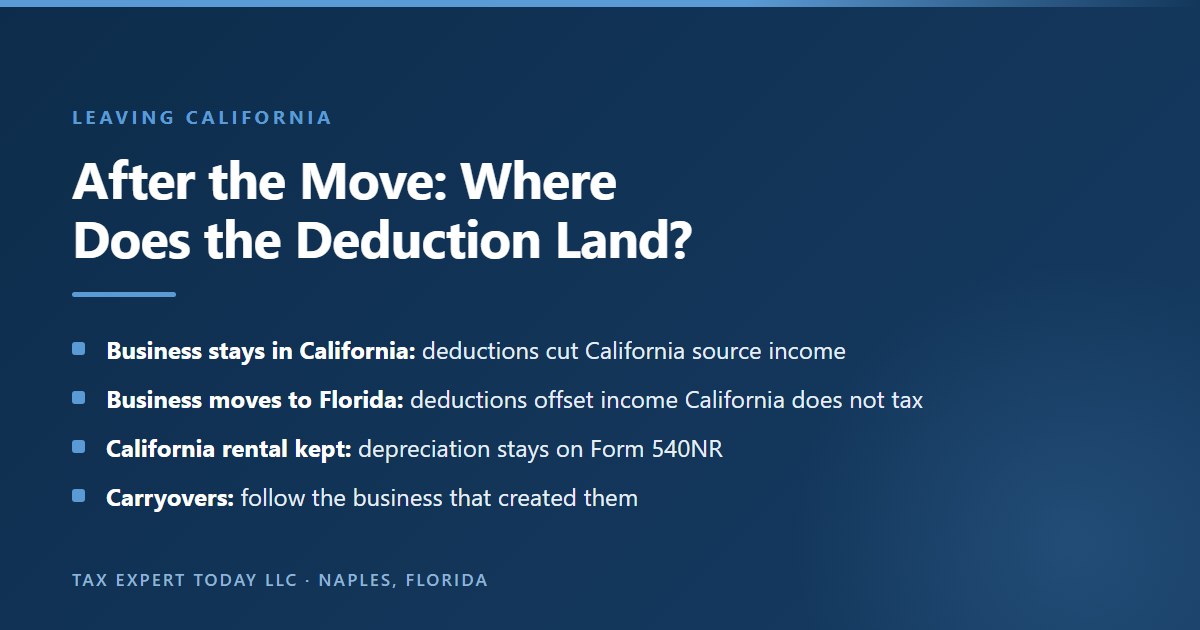
Why Does Federal and California Basis Differ After Section 179?
Basis is cost minus the depreciation and section 179 actually allowed under each system. Because California allows only $25,000 of section 179 and no bonus depreciation, the California adjusted basis of an asset is almost always higher than its federal adjusted basis for years after purchase, and the two figures converge only when both schedules are fully recovered or the asset is sold.
- Federal basis: cost minus federal section 179, federal bonus and federal MACRS.
- California basis: cost minus California section 179 and California depreciation.
- Instruction: Form FTB 3885A says to reduce your California depreciable basis by the California section 179 expense.
- Duration: the gap lasts as long as either schedule has basis left to recover.
- Owner level: partners and LLC members also have different federal and California outside basis.
The basis difference is the asset level record of every deduction California deferred. The Form FTB 3885A instructions say that if you elect section 179, you must reduce your California depreciable basis by the IRC section 179 expense, and that the California basis for Part III depreciation is cost minus the California elected cost. The Schedule CA (540) instructions add, for gains and losses, that the California basis of assets may be different from the federal basis due to differences between California and federal law, and that Schedule D (540) or Schedule D-1 is used to compute the California figure when there are differences.
The Form FTB 3885L instructions describe the same idea for LLCs under the heading Assets with a Federal Basis Different from California Basis: some assets placed in service on or after January 1, 1987, will have a different adjusted basis for California purposes due to the credits claimed or accelerated write-offs of the assets. The Form 568 booklet adds that LLCs should keep records to figure the basis of their assets and that members should keep records substantiating their basis in the LLC.
| Hypothetical $120,000 seven-year equipment placed in service 2026 | Federal adjusted basis at year end | California adjusted basis at year end | Gap |
|---|---|---|---|
| 2026 (federal bonus; California $25,000 section 179 plus MACRS) | $0 | About $81,424 | About $81,424 |
| 2027 | $0 | About $58,159 | About $58,159 |
| 2028 | $0 | About $41,544 | About $41,544 |
| 2029 | $0 | About $29,678 | About $29,678 |
| 2030 | $0 | About $21,194 | About $21,194 |
| 2031 | $0 | About $12,720 | About $12,720 |
| 2032 | $0 | About $4,237 | About $4,237 |
| 2033 | $0 | $0 | $0 |
The table uses the seven-year MACRS half year convention rates (14.29, 24.49, 17.49, 12.49, 8.93, 8.92, 8.93 and 4.46 percent) applied to the $95,000 California basis left after $25,000 of California section 179, and rounds to the dollar. It shows the pattern rather than any specific return. For eight years the asset has a California basis that the federal ledger does not show at all.
The same gap exists at the owner level for pass-through entities. A partner’s or member’s federal outside basis is reduced by federal section 179 and federal depreciation flowing through the K-1, and the California outside basis is reduced by the California amounts. When the owner later sells the interest, the California gain uses the California outside basis. This is why an owner who is planning to sell a business after moving should have both basis figures ready, a point our guide to selling a business makes for federal purposes as well.
What Happens to the Basis Gap When You Sell the Asset?
On a sale, each system computes gain from its own adjusted basis. Because the California basis is higher, the California gain is usually smaller than the federal gain, and the difference reverses the deductions California deferred. The California adjustment is reported through Schedule D-1 and the Schedule CA other gains line.
- Federal gain: amount realized minus federal adjusted basis.
- California gain: amount realized minus California adjusted basis, usually a smaller number.
- Character: California taxes capital gains and ordinary income at the same rates.
- Recapture: section 1245 recapture is computed separately in each system on that system’s figures.
- Form: Schedule D-1, Sales of Business Property, for the California figures.
The sale is where the two schedules settle up. Federally, a machine that was fully expensed has a zero basis, so the entire sale price is gain, generally recaptured as ordinary income under section 1245 to the extent of prior deductions. For California, the same machine still has its remaining California basis, so the California gain is smaller by exactly the amount of deductions California has not yet allowed. Over the life of the asset, the total deductions plus the gain or loss come to the same economic result in both systems; California has only changed when the deductions arrive.
The Schedule CA (540) instructions say for the other gains line that generally no adjustments are made, but that the California basis of other assets may differ from the federal basis, so you may have to adjust the amount of other gains or losses, and they direct taxpayers to Schedule D-1. For capital gains, the instructions note that California taxes long and short term capital gains as regular income and that no special rate for long term capital gains exists. A lower California gain therefore reduces California tax at ordinary rates.
| Hypothetical sale of the $120,000 equipment for $70,000 at the end of 2028 | Federal | California |
|---|---|---|
| Adjusted basis at sale | $0 | About $41,544 |
| Gain on sale | $70,000 | About $28,456 |
| Character | Section 1245 ordinary income | Section 1245 recapture computed on California figures; taxed at ordinary rates in any case |
| Schedule CA adjustment in the year of sale | About $41,544 subtracted from the federal gain | |
| Total deductions plus gain over 2026 to 2028 | $120,000 deducted, $70,000 gain | About $78,456 deducted, about $28,456 gain |
| Net economic result | $50,000 net cost recovered | About $50,000 net cost recovered |
The table ignores the half year convention in the year of sale, which would add a partial year of depreciation in both systems, so a real computation will differ slightly. The last row is the point. Both systems recover the same $50,000 of net cost; California just recovers it later. For a business owner who stays in California, the difference is a timing difference. For an owner who leaves, the timing determines whether the deferred deductions are ever worth anything, because the subtraction in the year of sale only reduces California tax if the gain would otherwise have been taxed by California.
A trade-in of equipment is no longer a tax deferred like-kind exchange federally after 2017. California adopted its own version of that change with transition rules and income thresholds, so the California treatment of a particular trade-in should be confirmed rather than assumed; where it is treated as a sale, each system uses its own basis. Real property exchanges are different, and our guide to the California 1031 exchange clawback covers how California follows exchanged real property after a move.
How Is Section 179 Recapture Reported in California?
California follows the federal instructions for reporting dispositions of property on which section 179 was claimed, with California figures. LLCs, partnerships and S corporations must report to owners the cost, the depreciation allowed excluding section 179, and the section 179 amount passed through, and S corporations must include section 179 recapture gain in their own California taxable income.
- Pass-throughs: report section 179 dispositions on the California K-1 as supplemental information, as federal Form 4797 instructs.
- Required items: description, dates, sale price, cost, depreciation excluding section 179, and section 179 passed through.
- S corporations: two sets of Schedule D-1 and Schedule D (100S), one including section 179 assets for the entity level tax.
- Business use recapture: applies when business use falls to 50 percent or less, on the California numbers.
- Owners: compute recapture using the California section 179 amount actually allowed.
The Form 568 booklet says California will follow the revised federal instructions, with some exceptions, for reporting the sale, exchange or disposition of property for which a section 179 expense deduction was claimed in prior years by a partnership, LLC or S corporation, and that members should follow the instructions in federal Form 4797. The LLC must provide, with respect to the disposition, information that includes the cost or other basis plus expense of sale, not including the entity’s basis reduction for section 179; the depreciation allowed or allowable, not including the section 179 deduction; and the amount of section 179 deduction passed through to each member and the years in which it was passed through. The Form 565 booklet requires the same information from partnerships.
The Form 100S booklet adds a rule specific to S corporations. Under General Information FF, for federal purposes the gain from the disposition of section 179 property is no longer included in income at the entity level, but for California purposes it must be included in the taxable income of the S corporation. The booklet tells the S corporation to complete two sets of Schedule D-1 and Schedule D (100S): one including both section 179 assets and other business assets, reported on Form 100S, Side 1, line 4, for the entity level tax, and one excluding section 179 assets, reported on Schedule K and Schedule K-1 (100S).
| Entity type | California section 179 recapture reporting | Source |
|---|---|---|
| LLC taxed as a partnership | Supplemental information on Schedule K and K-1 (568), following federal Form 4797; gain included in LLC total income for the LLC fee computation | Form 568 booklet, General Information U |
| Partnership | Supplemental information on Schedule K and K-1 (565), following federal Form 4797 | Form 565 booklet, General Information T |
| S corporation | Gain included in S corporation taxable income on Form 100S line 4; two sets of Schedule D-1 | Form 100S booklet, General Information FF |
| Individual or sole proprietor | Form 4797 concepts on Schedule D-1 using California figures | Schedule CA (540) instructions |
| Owner of a pass-through | Recapture computed on the owner’s return using the California section 179 actually allowed | Federal Form 4797 instructions as followed by California |
The Form 568 booklet also says LLCs should follow the federal Form 4797 instructions with the exception that the amount of gain on property subject to section 179 recapture must be included in the total income of the LLC. That matters because total income drives the LLC fee, which our California LLC franchise tax guide explains.
Recapture is also triggered without a sale when business use of listed property drops to 50 percent or less. A vehicle that was used heavily for a California business and becomes a family car in Florida is a common example. The recapture amount in each system is the excess of the section 179 and depreciation actually claimed over the depreciation that would have been allowed without section 179, so the California recapture is computed on the smaller California figures.
Does the Basis Gap Disappear When You Move to Florida?
No. A change of residence is not a sale, so the asset keeps both its federal basis and its California basis. What changes is whether California still taxes the income the asset produces. If the business stays in California, the remaining California deductions keep reducing California source income; if the business and asset leave with you, those deductions largely stop mattering to California.
- Not a disposition: moving your residence does not trigger gain or recapture by itself.
- Business stays in California: later California depreciation offsets California source income on Form 540NR.
- Business moves to Florida: later California depreciation offsets income California no longer taxes.
- Pass-through owners: the entity’s California K-1 continues to carry the differences.
- Florida: has no personal income tax, so there is no Florida depreciation schedule for individuals.
Florida has no personal income tax, so a Florida resident’s only state level depreciation question is California’s. The California question turns on source. A nonresident is taxed by California only on California source income, and for business income that means income from a business conducted in California, determined under California law. The Form 568 booklet states that regardless of the classification of income for federal purposes, the LLC’s income from California sources is determined in accordance with California law, citing Cal. Code Regs., tit. 18 section 17951-4, and that nonbusiness income from real or tangible personal property located in California is California source income.
Two common situations produce opposite results. In the first, the owner moves to Naples and keeps a California operating business, perhaps a professional practice or a manufacturing company with a plant in California. The equipment stays in California, the business income stays California source, and the remaining California depreciation continues to reduce California source income on the owner’s Form 540NR, or on the K-1 if the business is a pass-through. In the second, the owner moves the business itself to Florida, along with its equipment. After the move, the business income is no longer California source, and the remaining California depreciation reduces income that California would not tax anyway.
| After the move | Business and equipment stay in California | Business and equipment move to Florida |
|---|---|---|
| California return | Form 540NR, or K-1 from the California entity | Form 540NR in the move year; often none after |
| Business income | California source | Not California source after the move |
| Remaining California depreciation | Reduces California source income | Reduces only non-California income, which California does not tax |
| Later sale of the equipment | California source gain, computed on California basis | Generally not California source if the property is located and used outside California |
| Value of the basis gap to the owner | Preserved over time | Largely lost for California purposes |
The second situation is the one that surprises people. The California add backs in the purchase years increased California tax while the owner was a resident, and the matching California deductions in later years arrive after the owner has stopped paying California tax on that business. The result is not a penalty and not an exit tax; it is the arithmetic of a timing difference that straddles a change of residence. Our guide to the California exit tax explains why there is no general California departure tax, and this is one of the narrow ways in which the timing of earlier California rules still reaches people after they leave.
The planning lesson is limited but real. An owner who expects to leave California and move the business in a few years gains little California benefit from deferred California depreciation, and that is a reason to understand the California schedule before the move rather than after. An owner who expects to keep the business in California while living in Florida keeps the benefit, but now as a nonresident with a Form 540NR every year. Either way, the federal choice to expense an asset does not have a California equivalent, and the California result should be modeled separately. Our hub guide to moving from California to Florida sets out the rest of the departure picture.
How Does a Part-Year Resident Handle California Section 179 in the Move Year?
A part-year resident files Form 540NR. California first computes tax as if the taxpayer were a resident all year, using California depreciation and the California section 179 limit, and then taxes only the share of income that was earned while a resident or that came from California sources while a nonresident. The section 179 deduction follows the business income it offsets.
- Return: Form 540NR with Schedule CA (540NR).
- Total column: all income and deductions under California law, including California section 179 and depreciation.
- California column: income while a resident, plus California source income while a nonresident.
- Section 179 limit: one $25,000 limit for the year, not one for each residency period.
- Timing within the year: on our reading, a deduction follows the business and period that produced it.
The structure of Form 540NR is described in the 2025 Form 540NR booklet and in FTB Publication 1031. Publication 1031 explains that nonresidents and part-year residents determine their California tax by multiplying California taxable income by an effective tax rate, which is the California tax on all income as if the taxpayer were a resident for the current year and for all prior taxable years for any carryover items, deferred income, suspended losses or suspended deductions, divided by that income. That method, the publication says, ensures that nonresidents pay the correct tax on California source income and do not pay tax on non-California source income.
In the move year, the Schedule CA (540NR) instructions direct the depreciation adjustment computed on Form FTB 3885A into Part II, Section B, on the same lines a resident would use, and the later columns of the schedule then separate the amounts attributable to the resident period and to California sources in the nonresident period. A sole proprietor who operated in California for the resident part of the year and in Florida after the move would generally include the resident period business income and its deductions in the California column, and the Florida period business income and its deductions outside it. On our reading, that means a California section 179 deduction for equipment bought and used in California before the move belongs to the California column, while one for equipment bought for the Florida business after the move generally does not.
| Move-year item, hypothetical owner moving July 1, 2026 | Total under California law | California column |
|---|---|---|
| Business income January to June, operated in California | Included | Included |
| Business income July to December, operated in Florida | Included | Excluded |
| California section 179 on equipment placed in service in California in March | Included, within the single $25,000 limit | Included |
| California section 179 on equipment placed in service in Florida in September | Included, within the same $25,000 limit | Generally excluded, on our reading |
| California depreciation on pre-move assets after the move, business now in Florida | Included | Generally excluded, on our reading |
| K-1 from a California LLC that keeps operating in California | Included | Resident period share plus California source share after the move |
The single $25,000 limit for the year means that a California section 179 election made on equipment for the new Florida business uses up California limit that could have been applied to the California business. Because the Florida period deduction does not reduce the California column, allocating the California election to the California assets is usually the better use of it, although the federal election does not have to follow.
The part-year return as a whole, including the residency date and the allocation of wages, investment income and deductions, is covered in our guide to the California part-year resident tax return. Getting the residency date right matters more than any single depreciation figure, and our California residency audit guide explains how the Franchise Tax Board tests it.
Is California Depreciation After the Move California Source Income?
Depreciation is not income, but it follows the income it offsets. After you become a nonresident, California depreciation and any California section 179 deduction reduce California source income only to the extent they belong to a business, rental or pass-through activity whose income is California source. Deductions attached to a business operated outside California do not reduce California source income.
- California operating business: depreciation reduces California source business income.
- California rental property: depreciation reduces California source rental income, since real property income is sourced to its location.
- Multistate business: depreciation is part of the business income that is apportioned to California.
- Florida business: depreciation reduces non-California income.
- Intangible income: generally sourced to the owner’s residence, so not California source for a Florida resident.
The sourcing rules come from the California regulations under R&TC section 17951, summarized in the Form 568 booklet and the Form 565 booklet. Income from a business conducted wholly within California is California source. Income from a business conducted within and outside California is either separately accounted for or apportioned to California under the apportionment rules, and the booklets say that business income of an apportioning trade or business is apportioned to California by multiplying it by the sales factor. Nonbusiness income from real or tangible personal property located in California is California source, and nonbusiness income from intangible property is generally sourced to the owner’s state of residence.
Because depreciation is a deduction in computing business income, it follows that income. For a California rental property kept after the move, the remaining California depreciation reduces California source rental income on Form 540NR every year, which is one reason a former resident who keeps a California rental continues to file. For an apportioning business, the California depreciation is part of the business income that is then apportioned by the sales factor, so only the California share of it reduces California source income.
| Activity after the move | How the income is sourced | Effect of remaining California depreciation on California source income |
|---|---|---|
| California rental property | Location of the real property | Fully reduces California source rental income |
| Business conducted wholly in California | California | Fully reduces California source business income |
| Multistate business that apportions | Sales factor apportionment | Reduces California source income by the apportioned share |
| Business moved wholly to Florida | Not California | No effect on California source income |
| Investment interest in a business, no active role | Business income of the entity, sourced at the entity | Through the entity’s California K-1 |
Two related guides go deeper. Our guide to California source income explains each sourcing rule for nonresidents, and our guide to California nonresident withholding covers the withholding that California pass-through entities apply to distributions to nonresident owners, which often continues after the move.
For rental property sold after the move, the sale is also subject to California real estate withholding, which our guide to California Form 593 covers. The California basis used for that sale, including any remaining California depreciation differences on improvements, comes from the same California schedule this guide describes.
What Happens to a California Section 179 Carryover After You Leave?
The carryover remains a California item. In a later year when you are a nonresident, California computes the effective rate as if you had been a resident in all prior years, so the carryover is counted in the total, but it reduces California source income only to the extent it relates to a business whose income California still taxes.
- Stays on the books: the California carryover continues on line 10 of the California worksheet.
- Rate computation: counted as if you had been a resident in all prior years, per FTB Publication 1031.
- California column: on our reading, only the part attributable to California source business income reduces California taxable income.
- Business still in California: the carryover can still offset California source income from that business.
- Business moved to Florida: the carryover generally has little or no California value.
FTB Publication 1031 describes the rule that frames every California carryover after a move: the effective tax rate is the California tax on all income as if the taxpayer were a resident for the current year and for all prior taxable years for any carryover items, deferred income, suspended losses or suspended deductions, divided by that income. A section 179 carryover is a carryover item. It therefore enters the total income computation, which sets the rate, as though the taxpayer had remained a resident.
The separate question is how much of it reduces California taxable income, the number the rate is applied to. California taxes a nonresident only on California source income, and a section 179 deduction is a business deduction that follows the business that generated it. On our reading, a carryover generated by a California business that is still operating in California continues to reduce California source income when it is finally deductible, while a carryover generated by a business that has moved out of California reduces income California does not tax. The precise allocation under R&TC section 17041 for carryover items should be confirmed on the specific facts, and our guide to the California part-year resident tax return explains how those carryover rules work for other items.
| Carryover situation after the move | Total income column (sets the rate) | California taxable income (taxed) |
|---|---|---|
| Carryover from a California LLC still operating in California | Included when deductible | Generally reduces California source income from that LLC |
| Carryover from a sole proprietorship that moved to Florida | Included when deductible | Generally no reduction, on our reading |
| Carryover from a California rental activity treated as a trade or business | Included when deductible | Generally reduces California source rental income |
| Carryover with no remaining business income anywhere | Carried forward under the income limit | Not deductible until business income returns |
The carryover also needs business income to be used at all. A section 179 carryover is deductible only within the business income limit of a later year, so a business owner who retires to Naples and stops operating any business may never use it, in either system. That outcome is the same federally, but the federal carryover is often used up quickly because federal income limits are higher relative to the deduction, while the California carryover may sit unused.
The carryover is tracked year by year on Form FTB 3885A, and a missing California carryover schedule is a common gap when a new preparer takes over the returns of someone who has moved. Our guide to leaving California taxes lists the other California items that tend to follow people out of state.
What if the Business Moves Equipment From California to Florida?
Moving equipment is not a sale and does not by itself trigger California gain or section 179 recapture, as long as the property stays in business use above 50 percent. The equipment keeps its California basis, but once the business operates in Florida, later California depreciation and any later gain on sale are generally outside California’s reach.
- No sale: relocating equipment is not a disposition for gain purposes.
- Business use: recapture applies if business use of the property falls to 50 percent or less.
- Later sale in Florida: gain on tangible property located outside California is generally not California source for a nonresident.
- Installment sales: California taxes installment gains from tangible property on a source basis.
- Entity still files in California: if it keeps any California activity, its California returns continue.
A move of business equipment across state lines is a physical event, not a tax event. The asset is still owned by the same taxpayer and still used in the same business, so neither the federal nor the California system treats it as a sale. The California schedule simply continues, with the same California basis and the same California recovery period, until the asset is fully depreciated, sold or converted to personal use.
What changes is source. After the business is operating in Florida, its income is generally not California source for a nonresident owner. The Franchise Tax Board’s sourcing rules, summarized in FTB Publication 1031, provide that California taxes installment gains received by a nonresident from the sale of tangible property on a source basis, and that real property is sourced to where it is located. On our reading, a later sale of equipment located and used in Florida by a nonresident owner’s Florida business is not California source, so the California basis gap on that equipment has no further California effect. If the equipment is sold while still in California, or sold on an installment basis while it was California source, the result can be different.
| Event | Federal effect | California effect for a Florida resident owner |
|---|---|---|
| Equipment moved from California to Florida | None | None by itself |
| Business use stays above 50 percent | No recapture | No recapture |
| Business use falls to 50 percent or less | Section 179 recapture | Section 179 recapture on California figures, sourcing to be analyzed |
| Equipment sold while located in California | Gain on federal basis | Generally California source gain on California basis |
| Equipment sold after the move, located and used in Florida | Gain on federal basis | Generally not California source, on our reading |
| Equipment sold on installment while California source | Installment reporting | Installment gain taxed on a source basis |
The timing of a move, the timing of a sale and the location of the property at the time of sale all interact. Owners who are planning to sell a business after moving should read our guide to moving to Florida before selling a business, which covers the residency and sourcing tests for the sale of the business itself. Equipment sales are a smaller version of the same question.
The FTB Publication 1001 has a separate entry for business property that moves into California, which requires depreciation methods acceptable to California. There is no parallel California rule for property moving out, because once the property is outside California and used in a non-California business, California generally has no further claim on its income.
How Should You Plan Equipment Purchases Before Leaving California?
Model the California result separately from the federal one. If the business will stay in California after you move, California deductions deferred by the $25,000 cap and the bonus nonconformity keep their value. If the business will move with you, deferred California deductions may never reduce California tax, which changes the timing analysis for purchases near the move.
- Step one: decide whether the business, and the equipment, will stay in California after you move.
- Step two: project the California schedule for each planned purchase, not only the federal deduction.
- Step three: apply the California $25,000 to the assets with the longest California recovery periods.
- Step four: keep total qualifying purchases below $200,000 in a year if the California election matters.
- Step five: never buy equipment for the deduction alone; the business case comes first.
This is the part of California section 179 that the ranking pages on the topic do not reach. They state the $25,000 cap correctly, and some add that bonus depreciation is not allowed, but they stop at the purchase year. For someone leaving California, the purchase year is the least interesting year, because the question is what happens to the deferred California deductions afterward.
The decision tree is short. If the business will keep operating in California, the deferred California deductions continue to reduce California source income, and the planning is the same as for any California business, with the added need to file Form 540NR or to receive a California K-1. If the business will move to Florida with the owner, the deferred California deductions after the move generally reduce only non-California income, so purchases made shortly before the move produce California add backs while the owner is a resident and California deductions when the owner is not. In that case, the timing of a purchase relative to the residency change can matter as much as its federal treatment.
| Planning question | If the business stays in California | If the business moves to Florida |
|---|---|---|
| Value of deferred California depreciation | Preserved | Largely lost after the move |
| Use of the $25,000 California election | Longest lived assets | Assets placed in service in California before the move |
| Purchases near the move date | No special California effect | Pre-move purchases create add backs while a resident |
| California filing after the move | Form 540NR or California K-1 every year | Often none after the move year |
| Records to keep | Full California schedule indefinitely | California schedule through the move year and any later California audit period |
None of this is a reason to delay or accelerate a business purchase that the business needs. It is a reason to understand the California consequence before the decision is final. A business owner who is already working with a CFO advisory and bookkeeping team can usually have the California schedule built into the fixed asset ledger at the time of purchase, which makes the analysis straightforward. Our explainer on what a fractional CFO does describes how that kind of support works for owner managed businesses.
Owners who are also weighing the federal qualified business income deduction or the federal excess business loss limitation should remember that California does not follow the federal qualified business income deduction at all, so the federal and California taxable income figures diverge for that reason as well.
What Records Should You Keep for Two Depreciation Schedules?
Keep a fixed asset ledger with a federal column and a California column for every asset: cost, date placed in service, business use percentage, section 179 elected, bonus claimed, method, life, annual depreciation and adjusted basis in each system. Keep the invoices, the elections and each year’s Form FTB 3885A for as long as the asset is held plus the California audit period after it is sold.
- Ledger: one line per asset with federal and California figures side by side.
- Source documents: invoices, closing statements, and placed in service evidence.
- Elections: copies of the Form FTB 3885A Part II worksheet for each year.
- Vehicles: contemporaneous mileage logs supporting business use.
- Owners: California K-1s, which show the California figures the federal K-1 does not.
The Franchise Tax Board’s own guidance supports keeping these records for a long time. The Form 568 booklet says the Franchise Tax Board recommends keeping copies of returns and records that verify income, deductions, adjustments or credits for at least the minimum time required under the statute of limitations, and that some records should be kept much longer; it gives the example that members should keep records substantiating their basis in an LLC and LLCs should keep records to figure the basis of their assets. A California basis that differs from the federal basis can only be proven with California records.
For business owners who move, records also matter for residency. A California asset ledger that shows equipment in use in California after a claimed move date, or a Florida business that continues to place property in service in California, can raise questions about where the business, and the owner, really were. The ledger should match the residency story.
| Ledger column | Federal | California |
|---|---|---|
| Cost and date placed in service | Same | Same |
| Business use percentage | Same | Same |
| Section 179 elected | Federal Form 4562 amount | Form FTB 3885A Part II amount, $25,000 overall limit |
| Bonus depreciation | Federal amount | Zero |
| Method and recovery period | MACRS or ADS | MACRS for individuals and S corporations; California methods for C corporations |
| Annual depreciation | Federal Form 4562 | Form FTB 3885A, 3885, 3885L, 3885P or Schedule B (100S) |
| Adjusted basis | Federal | California, usually higher |
| Location of the asset | Optional | Important for sourcing after a move |
A location column is the one most federal ledgers lack, and it is the one that matters most for a former Californian. When the equipment is sold, the location at the time of sale, together with the business’s sourcing, determines whether California has any claim to the gain.
If the Franchise Tax Board questions California depreciation, it will typically ask for the asset ledger and the computation. Our guide to the FTB notice of proposed assessment explains how California proposes adjustments and how to respond within the protest period.
What Are Common California Section 179 Mistakes?
The most common mistakes are copying the federal section 179 amount to California, claiming federal bonus depreciation on the California return, counting only elected assets toward the $200,000 threshold, expensing software, applying federal vehicle limits, and losing the California basis when the asset is sold or the owner moves.
- Copying the federal figure: California is limited to $25,000 regardless of the federal election.
- Bonus on the California return: section 168(k) does not apply in California.
- Threshold error: all qualifying property placed in service counts, not just elected property.
- Software: off-the-shelf software is not California section 179 property.
- Lost basis: selling an asset using the federal basis on the California return overstates the California gain.
Most of these errors come from treating the California return as a copy of the federal one. Tax software usually carries the federal depreciation forward and asks for California adjustments, but it relies on the preparer to tell it which assets are section 179 property for California and how the California limit is allocated among them. When a business uses several entities, the software for each entity rarely knows what the others did, which is how owners end up with more than $25,000 of California allocations.
The mistakes are not one-sided. Overstating the California gain on a sale because the California basis was lost is as common as understating California income in the purchase year. A business owner who sold equipment after several years of federal bonus depreciation, and reported the federal gain on the California return, may have paid California tax on gain that California should not have taxed, and may be able to correct it by amended return within the refund period.
| Mistake | California consequence | Correct approach |
|---|---|---|
| Federal section 179 copied to California | California income understated | Apply the $25,000 limit and $200,000 threshold |
| Bonus claimed on California return | California income understated | Remove bonus; compute California MACRS |
| Threshold measured on elected assets only | Limit overstated | Count all section 179 property placed in service |
| Software expensed for California | California income understated | Depreciate or amortize software for California |
| Federal vehicle limits used | California deduction overstated | Use the California 280F table |
| Federal basis used on sale | California gain overstated | Use California adjusted basis on Schedule D-1 |
| Several entities each allocate $25,000 | Owner limit exceeded; excess lost | Coordinate California elections across entities |
| California election added on amended return | Election may not be valid | Make the California election on the original return |
Each of these mistakes is visible to the Franchise Tax Board when it compares a federal Form 4562 with a California return that has no Form FTB 3885A adjustment. Our guide to the California late payment penalty explains what follows when an assessment results in additional tax.
California Section 179 Help in Naples & Southwest Florida
California section 179 help Naples FL: Tax Expert Today LLC serves clients from our office at 11983 Tamiami Trail N, Naples FL 34110, in Naples, Florida. We are a multidisciplinary firm of tax advisors, enrolled agents, CPAs and attorneys handling state residency and tax matters nationwide, and we build California depreciation schedules, Form FTB 3885A computations and the matching Form 540NR returns for business owners who have moved from California to Southwest Florida. Call (239) 441-2005, Monday through Friday, 10:00 to 5:00 Eastern Time.
- California fixed asset schedules: federal and California columns rebuilt from the asset ledger.
- Multi-entity coordination: California section 179 allocations planned across LLCs, partnerships and S corporations.
- Move-year returns: Form 540NR with resident and nonresident depreciation separated.
- Sales of business property: California basis and gain computed on Schedule D-1.
- FTB notices: responses when California depreciation is questioned.
California returns are filed electronically with the Franchise Tax Board, so the work does not require a California office. Many of the business owners we help left Los Angeles, Orange County, the Bay Area or San Diego for Naples, Bonita Springs, Marco Island or Fort Myers, and still own California entities, California rental property or equipment with a California basis that differs from the federal one. Our Naples, FL tax planning page and our California tax services page describe the broader engagements, and our business consulting page covers entity and operations work.
Local FAQ: I moved from San Diego to Naples in 2026 but kept my California dental practice LLC, which bought $150,000 of equipment this year. What happens to the California depreciation? The LLC computes California section 179 at the $25,000 limit on Form FTB 3885L and depreciates the rest of the California basis over the normal recovery periods, with no bonus depreciation. Because the practice keeps operating in California, its income stays California source, so the remaining California depreciation in later years continues to reduce the California source income on your Form 540NR. Your federal return may show the whole $150,000 deducted in 2026, so the two returns will differ for several years. Bring the asset list and both K-1s to our Naples office and we can reconcile the two schedules.
When to Engage a Professional
California section 179 is simple for a small business that buys less than $25,000 of qualifying equipment in a year and never leaves California. It becomes a professional question in any of the following situations, because the California figures then diverge from the federal figures in ways the federal return does not show.
- You use federal bonus depreciation or federal section 179 above $25,000 in any year.
- You own more than one pass-through entity that places equipment in service.
- You are moving, or have moved, from California while the business or its equipment stays behind.
- You are moving the business itself and its equipment to Florida.
- You are selling equipment, a building or the business after several years of federal expensing.
- You received an FTB notice adjusting California depreciation or a California gain.
Our role is to apply the published rules correctly, document how each figure was built, and prepare federal and California returns that agree with each other and with the asset records. We do not promise any particular tax result, and the examples in this guide are hypothetical illustrations of the published rules, not descriptions of any client’s situation. To start, gather your fixed asset ledger, the last three years of federal and California returns including every Form FTB 3885A, your California K-1s, and the date your California residency ended, and contact us through our contact page or at (239) 441-2005.
For the rest of the departure picture, see our guides to the California exit tax proposals, the California residency audit, and selling rental property after moving.
Frequently Asked Questions
What is the California section 179 limit for 2026?
The California section 179 limit for 2026 is $25,000. It is reduced dollar for dollar when the cost of section 179 property placed in service during the year exceeds $200,000, so it reaches zero at $225,000. The figures are fixed in R&TC section 17255 and are not indexed for inflation.
Does California conform to federal section 179?
Only in part. California applies section 179 but replaces the federal dollar limit and phase-out threshold with $25,000 and $200,000, excludes off-the-shelf software and qualified real property, and turns off the federal rule that allows elections to be made or revoked on an amended return without consent.
Does California allow bonus depreciation?
No. R&TC section 17250(a)(11) says IRC section 168(k) shall not apply, so California does not allow the federal 100 percent bonus depreciation. Property expensed federally under bonus is depreciated for California over its normal recovery period. Corporations have only a small separate 20 percent allowance on up to $10,000 of cost.
Which form do I use for California section 179?
Individuals and pass-through owners use Form FTB 3885A, completing Part II once per return. Corporations use Form FTB 3885, LLCs taxed as partnerships use Form FTB 3885L, partnerships use Form FTB 3885P, and S corporations use Schedule B (100S).
Can I claim $25,000 of California section 179 from each of my LLCs?
No. The limits apply to the LLC and to each member. An owner adds the California section 179 amounts from every K-1 and from the owner’s own businesses and deducts no more than $25,000 in total, limited further by business income. Spouses filing jointly share one limit.
Is off-the-shelf software eligible for California section 179?
No. R&TC section 17255(e) and section 24356(b)(6) turn off the federal provision that treats off-the-shelf computer software as section 179 property. For California, software is recovered through depreciation or amortization rather than expensed.
Why is my California gain smaller than my federal gain when I sell equipment?
Because California allowed less depreciation, the California adjusted basis is higher than the federal basis. Gain is the sale price minus adjusted basis, so the California gain is smaller. The difference is reported on Schedule D-1 and the Schedule CA other gains line.
Does moving to Florida eliminate the California depreciation difference?
No. A move is not a sale, so the asset keeps both bases. If the business stays in California, the remaining California depreciation keeps reducing California source income on Form 540NR. If the business moves to Florida, later California deductions generally reduce income California no longer taxes.
Can I change my California section 179 election on an amended return?
Plan on not being able to. California turns off IRC section 179(c)(2), the federal provision that allows elections to be made or revoked on an amended return without consent, and for corporations section 24356(c) requires the election on a timely filed return and consent to revoke it.
Can a Naples, Florida advisor prepare my California depreciation schedules?
Yes. California returns, including Form 540NR, Form 568 and Form 100S with their depreciation schedules, are filed electronically with the Franchise Tax Board, so the preparer does not need to be in California. A Naples, Florida advisor can rebuild the California schedule from the asset ledger and reconcile it to the federal one.
This guide is general information about California tax rules as published by the Franchise Tax Board and the California Legislature as of November 22, 2026, using the 2025 Form FTB 3885A, Form FTB 3885, Form FTB 3885L and Form FTB 3885P instructions and the current text of R&TC sections 17024.5, 17250, 17255 and 24356. The 2026 California forms had not been released when this guide was written. It is not tax or legal advice for any specific situation. All examples are hypothetical. Tax Expert Today LLC is a multidisciplinary firm of tax advisors, enrolled agents, CPAs and attorneys.
Published November 22, 2026 by Dr. Pellumb Kabashi « Back to Learning Center
Have a question this article touches on?
Tax Expert Today LLC, based in Naples, Florida and serving clients across the United States.
Schedule a Consultation (239) 441-2005