
By Dr. Pellumb Kabashi, DBA, MBA, CES, CFE, EA
Founder, Tax Expert Today LLC · Tax advisors, enrolled agents, CPAs, and attorneys · Serving clients in all 50 states
Quick Answer
S corp reasonable compensation is the W-2 salary a shareholder-employee must take before distributions, equal to what a comparable business would pay for the same services. Neither the Code nor the regulations set a percentage. Courts weigh nine factors drawn from the facts. In 2026 the calculation also turns on the Section 199A wage limit and the $184,500 wage base. Call (239) 441-2005 for a free consultation.
What is S corp reasonable compensation?
S corp reasonable compensation is the wage an S corporation must pay a shareholder who performs services before it distributes profit to that shareholder. The standard is what the business would have to pay an unrelated person to do the same work. There is no statutory percentage, and the amount is tested against the facts of each engagement.
- Officers are employees by definition. Treas. Reg. 31.3121(d)-1(b) treats a corporate officer as an employee for employment tax purposes.
- The minor-services exception is narrow. An officer who performs only minor services and neither receives nor is entitled to receive remuneration falls outside the definition.
- Distributions do not escape the test. Cash, property, and loans to a working shareholder may be recharacterized as wages to the extent they represent payment for services.
- The ceiling is what actually moved. Per IRS Fact Sheet 2008-25, the compensation figure will never exceed the amount the shareholder received directly or indirectly.
The phrase appears in the statute itself. IRC Section 1366(e) directs the Secretary to make adjustments where a member of a shareholder family renders services or furnishes capital without receiving reasonable compensation. That provision is aimed at family groups, but it is the clearest signal in the Code that Congress expected service value to be respected rather than routed around. Most published guides to S corp reasonable compensation never cite it. Owner compensation draws separate scrutiny during a divorce, where the tax return and the financial affidavit are read side by side; our guide to business owner divorce taxes covers that overlap.
Why does an S corporation election reduce self-employment tax at all?
A sole proprietor pays self-employment tax on the entire net profit of the business. An S corporation shareholder pays FICA only on the W-2 wage. The distributive share reported on Schedule K-1 is not self-employment income, so the portion of profit taken as a distribution carries no payroll tax at all.
- Self-employment tax reaches all net earnings. IRC Section 1402 defines net earnings from self-employment for a proprietor or partner.
- FICA reaches only wages. IRC Section 3101 and Section 3111 impose the employee and employer shares on wages paid.
- The gap is the entire strategy. Everything the S corporation election accomplishes on the payroll side comes from the difference between those two bases.
- The gap is also the entire exposure. Because the saving depends on the wage being lower than the profit, the wage is exactly what the IRS examines.
This is why the S corp reasonable compensation question exists at all. The election creates an incentive to set the wage low, and the doctrine is the IRS response to that incentive. Understanding the structure matters more than memorizing a percentage, because it tells you where the argument will actually be fought. It also explains why S corp reasonable compensation is examined more often than most other owner-level positions: the amount is visible on the return, and the comparison the examiner needs is usually available without leaving the corporation records.
How much does S corp reasonable compensation actually save in 2026?
The difference equals the payroll tax on the profit taken as distribution rather than wage. On a business earning $150,000 before owner pay, moving from a proprietorship to an S corporation with a $90,000 wage produces a payroll tax difference of roughly $7,424 in 2026, before considering the income tax effects discussed below.
The illustration below is hypothetical and assumes a single owner with no other wage income. Self-employment tax applies to 92.35 percent of net profit under Section 1402, which is why the proprietor base is $138,525 rather than $150,000. Actual results depend on filing status, other income, state law, and the facts of the business.
| Structure | Payroll or SE tax base | Total payroll or SE tax | Difference vs proprietorship |
|---|---|---|---|
| Sole proprietorship, $150,000 net profit | $138,525 | $21,194 | Baseline |
| S corporation, $120,000 wage | $120,000 | $18,360 | $2,834 |
| S corporation, $90,000 wage | $90,000 | $13,770 | $7,424 |
| S corporation, $60,000 wage | $60,000 | $9,180 | $12,014 |
Notice what the table also shows. The lower the wage, the larger the payroll difference, and the weaker the position if S corp reasonable compensation is ever examined. A $60,000 wage on a business producing $150,000 of profit for a full-time owner is the pattern that draws attention. The arithmetic that makes it attractive is the same arithmetic that makes it fragile. Owners frequently pair this analysis with other owner-level strategies such as the Augusta Rule under IRC 280A(g), which operates outside the wage base entirely.
Why do the savings collapse above the Social Security wage base?
The Social Security portion of FICA stops at the wage base, which is $184,500 for 2026. Above that figure only Medicare applies, so the marginal cost of an additional dollar of wage falls from 15.3 percent to 2.9 percent, and then to 3.8 percent once Additional Medicare tax begins.
- The 2026 wage base is $184,500. Confirmed in IRS Publication 15 (2026) and IRS Topic 751.
- Medicare has no ceiling. The 1.45 percent employee and employer shares apply to every dollar of wage.
- Additional Medicare tax begins at $200,000. The 0.9 percent employee-only charge under Form 8959 has no employer match.
- The strategy weakens as income rises. Once wages clear the base, the reason to keep the wage low largely disappears.
| 2026 wage band | Marginal payroll cost of the next dollar | What applies |
|---|---|---|
| $0 to $184,500 | 15.3 percent | Social Security 12.4 percent plus Medicare 2.9 percent |
| $184,500 to $200,000 | 2.9 percent | Medicare only, the Social Security ceiling has been reached |
| Over $200,000 | 3.8 percent | Medicare 2.9 percent plus Additional Medicare 0.9 percent |
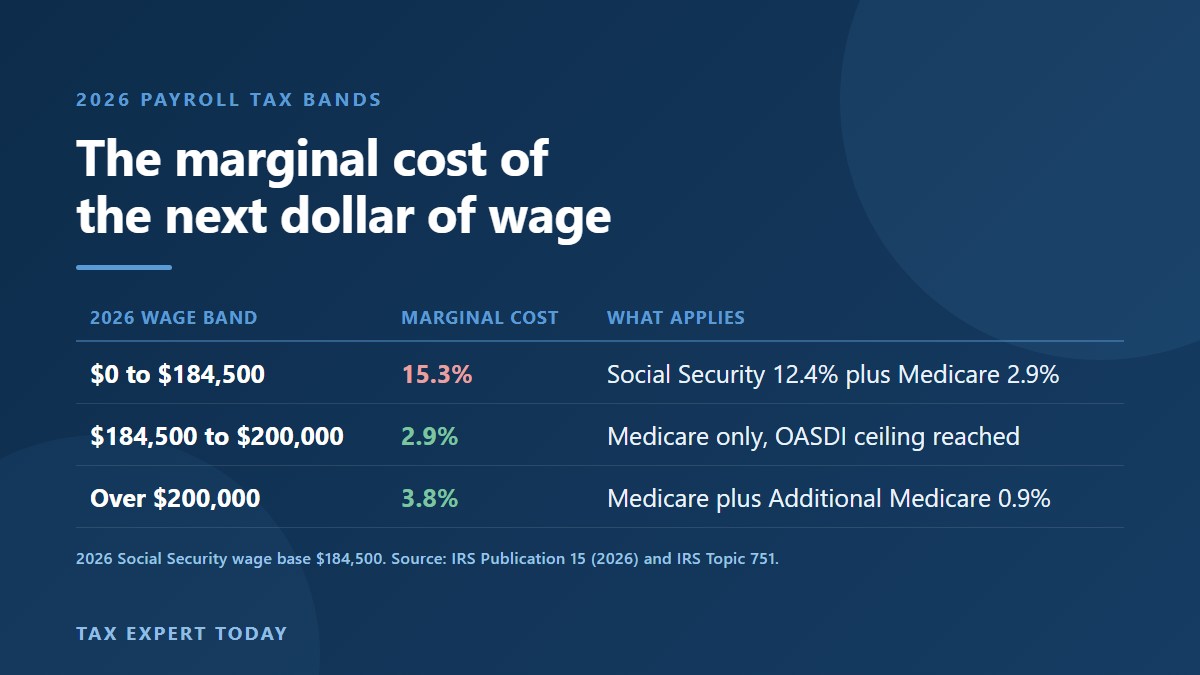
This band structure is where a great deal of published advice on S corp reasonable compensation goes wrong. Articles that describe the election as producing a fixed 15.3 percent benefit on every dollar of distribution are describing a business whose owner earns below the wage base. For a higher-earning owner the payroll argument is comparatively small, and the decision may turn on the income tax items discussed next.
How does the Section 199A deduction change S corp reasonable compensation?
Wages reduce qualified business income, so a higher salary shrinks the Section 199A deduction for owners under the threshold. Above the threshold the logic reverses, because the deduction is capped at 50 percent of W-2 wages. A wage that is too low can cap the deduction and cost more than the payroll tax it avoids.
Three points of 2026 law matter here, and they are new. Public Law 119-21 struck the sunset that previously ended Section 199A after 2025, so the deduction is now permanent. The same act widened the phase-in range above the threshold from $50,000 to $75,000 for single filers and from $100,000 to $150,000 for joint filers. And a new Section 199A(i) provides a minimum deduction of $400 for a taxpayer with at least $1,000 of qualified business income from an active trade or business in which the taxpayer materially participates. All of it applies to taxable years beginning after December 31, 2025, which makes 2026 the first affected year. How those changes play out for each filing status, including the specified service phase-in ladder and the new minimum, is worked through in our guide to the qualified business income deduction.
The 2026 threshold amounts come from Rev. Proc. 2025-32 and are set out below.
| Filing status | 2026 threshold amount | Top of the phase-in range |
|---|---|---|
| Married filing jointly | $403,500 | $553,500 |
| Married filing separately | $201,775 | $276,775 |
| All other returns | $201,750 | $276,750 |
Below the threshold, the familiar advice holds. Consider a hypothetical single owner of a business producing $200,000 before owner pay, with taxable income under $201,750 so that the wage limitation does not apply. Raising the wage from $80,000 to $120,000 reduces qualified business income, which reduces the deduction by $8,612 and increases income tax by roughly $2,067 at a 24 percent marginal rate, on top of $6,120 of additional payroll tax. The higher wage costs about $8,187 in that illustration.
Above the phase-in range the picture inverts, and this is the part almost nobody models. Under Section 199A(b)(2)(B) the deduction cannot exceed the greater of 50 percent of W-2 wages or 25 percent of W-2 wages plus 2.5 percent of the unadjusted basis of qualified property. For a service business with little depreciable property, that means a low wage caps the deduction directly.
| Owner wage | Qualified business income | 20 percent of QBI | 50 percent of wages | Allowable deduction | Total FICA |
|---|---|---|---|---|---|
| $100,000 | $692,350 | $138,470 | $50,000 | $50,000 | $15,300 |
| $175,000 | $611,612 | $122,322 | $87,500 | $87,500 | $26,775 |
| $250,000 | $534,936 | $106,987 | $125,000 | $106,987 | $30,578 |
| $325,000 | $458,848 | $91,770 | $162,500 | $91,770 | $33,428 |
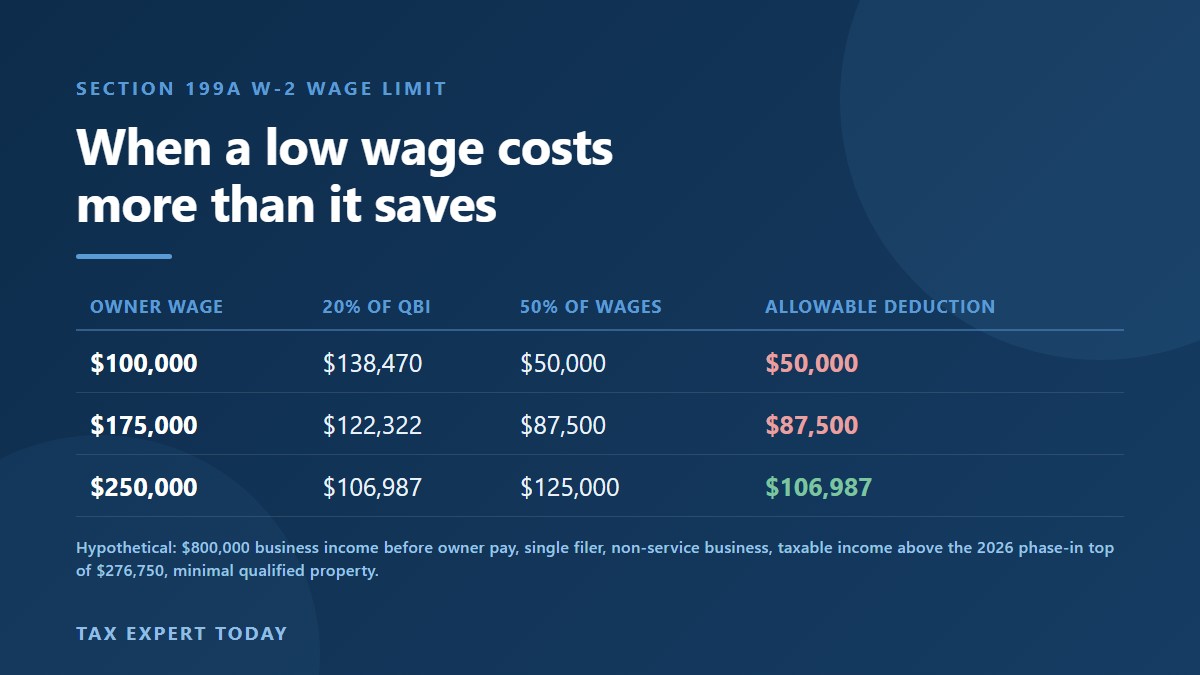
This hypothetical assumes a single filer, a non-service business, taxable income above the 2026 phase-in top of $276,750, minimal qualified property, and $800,000 of business income before owner pay. Moving the wage from $100,000 to $250,000 increases the allowable deduction from $50,000 to $106,987. At a 35 percent marginal rate that is roughly $19,946 of income tax reduction against roughly $15,278 of additional payroll tax, a net position of about $4,668 in favor of the higher wage. The wage that minimizes payroll tax is not the wage that minimizes total tax.
That result is worth stating plainly because it runs against the conventional framing of S corp reasonable compensation. For a high-income owner of a non-service business, a wage set at the lowest defensible number may be the more expensive answer. Whether it applies to any particular owner depends on filing status, the service or non-service character of the business, qualified property, and total taxable income, which is why S corp reasonable compensation belongs in a modeling exercise rather than a rule of thumb. Coordinating that modeling with entity design and owner pay is ordinary tax planning work in Naples, Florida, and it usually pays to run it before the year closes rather than after. Where the business owns real property, a cost segregation study can also raise the unadjusted basis figure that feeds the alternative 25 percent limitation, which is a second lever on the same constraint.
Is the 60/40 rule for S corp reasonable compensation real?
No. The 60/40 split, and every similar percentage rule, has no basis in the Code, the regulations, or IRS guidance. IRS Fact Sheet 2008-25 states directly that there are no specific guidelines for reasonable compensation in the Code or the Regulations, and that courts decide the question on the facts and circumstances of each case.
- No percentage is published. No revenue ruling, regulation, or form instruction sets a salary-to-distribution ratio.
- Percentages ignore the actual test. The standard is the market value of services, which does not scale with profit in a fixed proportion.
- A formula can cut against the taxpayer. Where profit is largely owner labor, a 60/40 split may understate the wage substantially.
- Formulas are themselves a factor. The use of a formula to determine compensation appears in the IRS factor list, and a formula unsupported by market data carries little weight.
The practical problem with a percentage rule is that it answers the wrong question. If a solo professional generates essentially all revenue personally, the value of the services may approach the whole of the profit, and a mechanical split will not survive scrutiny. If a business earns substantial return on invested capital, equipment, or the labor of others, a smaller wage may be entirely defensible. The correct input for S corp reasonable compensation is comparable market pay for the work performed, supported by documentation prepared contemporaneously rather than reconstructed during an examination.
What factors does the IRS use to test S corp reasonable compensation?
IRS Fact Sheet 2008-25 lists nine factors the courts have applied. They center on what the owner does, what the market pays for that work, and how the corporation treats everyone else it pays. No single factor controls, and the weight given to each depends on the facts.
| Factor | What it tests in practice |
|---|---|
| Training and experience | Credentials and years in the field that a hired replacement would need |
| Duties and responsibilities | The actual role, not the title on the organizational chart |
| Time and effort devoted to the business | Hours worked, and whether the role is full-time or part-time |
| Dividend history | Whether distributions track service value rather than return on capital |
| Payments to non-shareholder employees | Whether the owner is paid less than staff doing comparable work |
| Timing and manner of paying bonuses to key people | Whether bonus practice is consistent across the organization |
| What comparable businesses pay for similar services | Market survey data for the role, industry, and geography |
| Compensation agreements | Whether a written arrangement exists and is actually followed |
| The use of a formula to determine compensation | Whether a defensible method was applied before the fact |
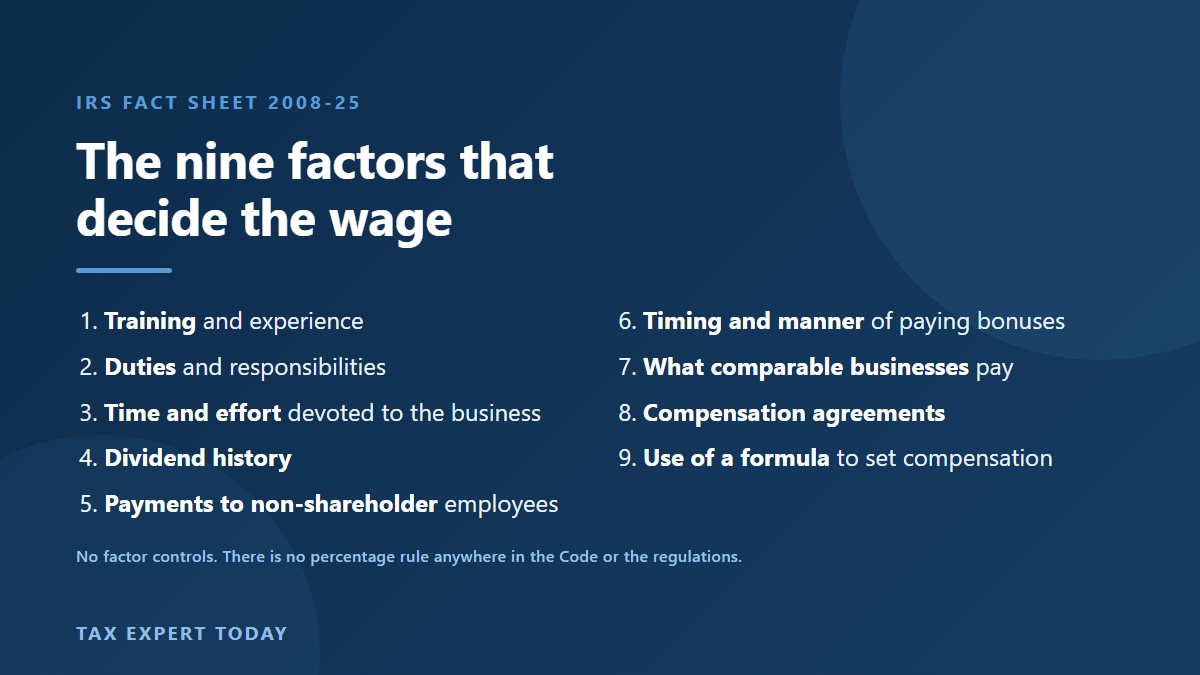
Two of these deserve emphasis because they are where S corp reasonable compensation files most often fail. Payments to non-shareholder employees is a comparison the examiner can make from the corporation records alone, without any survey, and an owner wage below that of a subordinate is difficult to explain. Compensation agreements matter because the absence of any contemporaneous documentation was a specific weakness the court noted in the leading case, discussed next.
What did the courts hold about S corp reasonable compensation in Watson?
In Watson v. United States, 668 F.3d 1008 (8th Cir. 2012), the Eighth Circuit upheld the recharacterization of distributions as wages for an accountant whose corporation paid him a $24,000 salary while distributing roughly $200,000. The court sustained a determination that reasonable compensation was $91,044 for each year at issue.
- The owner was highly qualified. An advanced degree and nearly twenty years of accounting and tax experience.
- The hours were substantial. Thirty-five to forty-five hours per week as one of the primary earners of the firm.
- Market data drove the figure. The government expert built the number from professional compensation surveys for accountants.
- Documentation was absent. The court noted there were no documents reflecting the salary discussions.
The reasoning is what makes the decision useful rather than merely cautionary. The court did not apply a ratio to reach S corp reasonable compensation. It compared the wage actually paid against the market value of the services performed, using survey evidence adjusted for the role. An owner who prepares the same kind of analysis in advance, and keeps it, is preparing the evidence that the court in Watson found missing. That documentation costs very little to create contemporaneously and is difficult to reconstruct once a notice arrives.
How does a low salary shrink the retirement plan?
Employer retirement contributions for a shareholder-employee are calculated on W-2 compensation, not on distributions. A low wage therefore caps the profit sharing contribution, and the resulting shortfall in tax-deferred saving can exceed the payroll tax the low wage avoided.
The 2026 limits below come from IRS Notice 2025-67. The elective deferral limit under Section 402(g)(1) is $24,500, total annual additions under Section 415(c)(1)(A) are capped at $72,000, and the compensation limit under Section 401(a)(17) is $360,000. Catch-up contributions for older participants are additional and are not shown. Where a plan permits after-tax contributions, the gap between those figures and the $72,000 ceiling is the room used by a mega backdoor Roth.
| W-2 wage | Elective deferral | 25 percent profit sharing | Maximum annual additions |
|---|---|---|---|
| $50,000 | $24,500 | $12,500 | $37,000 |
| $100,000 | $24,500 | $25,000 | $49,500 |
| $150,000 | $24,500 | $37,500 | $62,000 |
| $190,000 | $24,500 | $47,500 | $72,000 |
The pattern is straightforward. A wage of roughly $190,000 is required before a solo 401(k) reaches the full $72,000 annual additions limit for 2026. An owner paying a $50,000 wage is limited to $37,000, a gap of $35,000 per year of tax-deferred contribution capacity. This is the second reason S corp reasonable compensation should not be set purely to minimize payroll tax. Whether the gap matters depends on whether the owner would actually make the larger contribution, which is a planning question rather than a compliance one. For owners who want to move materially more than these figures allow, a defined benefit design such as a cash balance plan raises the ceiling considerably, and it is likewise driven by W-2 compensation.
When does the S corporation election not help?
The election adds cost and complexity that can exceed the payroll tax difference. It tends not to help when profit is modest, when the owner already has wage income near the Social Security wage base, when profit is largely return on capital, or when the owner needs the qualified business income deduction more than the payroll relief.
- Profit is too small. Payroll administration, a separate return on Form 1120-S, and state filings consume the difference.
- Outside wages already fill the base. An owner with a $185,000 salary elsewhere has already reached the 2026 ceiling, so the Social Security portion is not in play.
- The profit is not labor. Where returns come from capital or the work of employees, a proprietorship or partnership may reach a similar answer without the payroll obligation.
- Fringe benefits get worse. Under IRC Section 1372, a more-than-2-percent shareholder is treated as a partner for many fringe benefit purposes, so health premiums must be reported as W-2 wages.
- Shareholder eligibility is restricted. IRC Section 1361 limits the number and type of shareholders and permits only one class of stock.
The one class of stock requirement is worth flagging separately because it is a trap in growing businesses. Disproportionate distributions among shareholders can be treated as creating a second class of stock, which puts the election itself at risk. Businesses planning outside investment, preferred returns, or an eventual sale should test the structure early. Where a sale is contemplated, the entity choice also drives the outcome, and the mechanics differ substantially, as set out in our guide to the tax treatment of selling a business.
How do you fix a late S corporation election?
Rev. Proc. 2013-30 provides simplified relief for an election filed after the deadline. Relief is generally available within three years and seventy-five days of the requested effective date, provided the entity has reasonable cause for the failure and acted diligently to correct it once discovered.
- The ordinary deadline is strict. Under IRC Section 1362(b), the election must be filed by the fifteenth day of the third month of the taxable year, or it applies to the following year.
- The statute contemplates relief. Section 1362(b)(5) permits the Secretary to treat a late election as timely where there was reasonable cause.
- The window is three years and seventy-five days. Measured from the requested effective date, and an extension to file Form 1120-S does not extend it.
- The form must be marked. Form 2553 must state at the top that it is filed pursuant to Rev. Proc. 2013-30.
Two practical notes. Reasonable cause requires an actual explanation, and the most common facts that support relief involve a professional adviser who failed to file rather than an owner who simply did not know. Second, the relief covers the election, not the payroll obligation. An entity granted retroactive S corporation status still has to address the wage question for the intervening years, which frequently means amended employment tax returns and an S corp reasonable compensation analysis for periods already closed on the books.
What happens if the IRS reclassifies distributions as wages?
The corporation owes the employee and employer shares of FICA on the reclassified amount, plus FUTA where applicable, plus penalties and interest. Corrections run through Form 941-X for the affected quarters, and responsible individuals can face personal liability under the trust fund recovery provisions.
- Both FICA shares fall on the corporation. The employer generally remains liable for amounts it failed to withhold.
- FUTA may apply. The federal unemployment tax under IRC Section 3301 attaches to the reclassified wages.
- Corrections use Form 941-X. The adjusted return on Form 941-X is filed for each affected quarter.
- Personal exposure is real. IRC Section 6672 reaches responsible persons who willfully fail to collect or pay over trust fund taxes.
The knock-on effects are often larger than the tax itself. Reclassification changes W-2 wages, which changes the Section 199A wage limitation for the same years, which can change the qualified business income deduction in either direction. It can also change the retirement plan contribution that was permissible, and in some cases the plan requires correction as well. An owner facing a proposed S corp reasonable compensation adjustment is usually better served by addressing the compensation analysis and the collateral items together rather than sequentially. Our business tax consulting and IRS resolution and audit support teams handle both sides of that in the same engagement.
S corp reasonable compensation Naples: help in Southwest Florida
Tax Expert Today LLC advises S corporation owners in Naples, Florida and across Southwest Florida on setting and documenting reasonable compensation, modeling the Section 199A interaction, and responding when an examination questions owner pay. The firm serves clients in all 50 states under federal practice authority.
Florida imposes no personal income tax, which changes the arithmetic in a way that owners moving from higher-tax states often find counterintuitive. In a state with an income tax, some of the Section 199A modeling is offset or complicated at the state level. In Florida the federal answer is very close to the whole answer for the individual owner, so the payroll and qualified business income tradeoff described above carries proportionally more weight. Florida does impose a corporate income tax, and although an S corporation is generally not subject to it, the entity may still have a filing obligation in some circumstances, and reemployment tax applies to wages once they are paid.
Our office is at 11983 Tamiami Trail N, Naples, FL 34110. Call (239) 441-2005, Monday through Friday, 10am to 5pm ET. Owners in Naples, Bonita Springs, Estero, Fort Myers, Marco Island, and the surrounding communities work with us in person or remotely.
Owner pay questions reach us most often from the Lee County trades, where a strong rebuilding season frequently prompts an S corporation election. Our Fort Myers tax advisor guide covers that question alongside the other federal situations that recur in the county.
Does moving to Florida change my S corporation reasonable compensation?
The federal reasonable compensation standard does not change, because it is measured by the market value of the services performed. What can change is the comparable wage data, since the standard looks to what comparable businesses pay for similar services, and geography is one of the inputs the IRS factor list contemplates. Owners relocating from a higher-cost market should not assume the prior figure carries over unexamined in either direction, and the state tax consequences of the move itself deserve separate attention.
When to engage a professional
S corp reasonable compensation is a documentation exercise as much as a computation. The work worth paying for is the comparable market analysis prepared before the wage is set, the modeling that shows how the wage interacts with the Section 199A deduction and the retirement plan, and the file that supports the number if it is ever questioned. Consider engaging an adviser when any of the following is true.
- Profit has grown materially and the wage has not been revisited since the election was made.
- Taxable income is near or above the 2026 Section 199A threshold, where the wage limitation begins to govern the answer.
- The business is service-based and substantially all revenue is generated by the owner personally.
- An examination has opened or a notice has proposed reclassifying distributions as wages.
- The election was filed late or the entity is uncertain whether a valid election is in place.
Tax Expert Today LLC works as a multidisciplinary firm of tax advisors, enrolled agents, CPAs, and attorneys, which matters here because S corp reasonable compensation sits between planning, payroll compliance, and controversy. Our tax planning services cover the modeling, and fees are scoped and quoted after a consultation. Owners who also want the underlying profitability examined at the same time often pair this with fractional CFO advisory, since the wage decision is easier when margin by service line is understood.
Frequently asked questions
Is there a minimum S corp reasonable compensation amount?
No. There is no statutory minimum and no published floor. The standard is the value of the services actually performed, so a shareholder who performs no services and takes no remuneration may owe no wage at all, while a full-time owner of a profitable service business may owe a wage approaching the whole of the profit. The absence of a floor is why documentation of comparable market pay carries the argument.
Can I pay myself a salary only at year end?
An annual payroll run is permitted and is common for closely held S corporations, though it requires care. Deposits and returns must still be handled correctly for the quarter in which the wage is paid, and paying nothing during a year in which distributions were taken throughout can look like an afterthought rather than a compensation practice. The timing and manner of paying bonuses appears in the IRS factor list for exactly this reason. Business costs the owner pays personally are a separate question from salary: they are usually reimbursed through an accountable plan rather than added to the paycheck.
Do health insurance premiums count toward reasonable compensation?
Premiums paid for a more-than-2-percent shareholder are included in Box 1 wages on Form W-2 and are generally not subject to Social Security or Medicare tax. They are compensation for income tax purposes, but because they are excluded from the FICA wage base they do not contribute to the payroll tax the reasonable compensation doctrine is protecting. They do, however, count as W-2 wages for some purposes, which is one more reason the analysis should be run rather than estimated. The shareholder side of that reporting, including why the deduction limit is the box 5 Medicare wage figure, is covered in our guide to the self-employed health insurance deduction.
Does an S corporation shareholder pay self-employment tax on the K-1?
Generally no. The distributive share reported on Schedule K-1 of Form 1120-S is not net earnings from self-employment for a shareholder, which is the structural feature the entire strategy depends on. That treatment is what makes the wage figure the focus of examination, since it is the only amount subject to employment tax.
How often should S corp reasonable compensation be reviewed?
Annually is a reasonable practice, and sooner when the business changes materially. A wage that was defensible when the business produced modest profit may be difficult to support after several years of growth, and the Section 199A threshold amounts are adjusted for inflation each year, so the point at which the wage limitation begins to bind moves as well.
Published August 23, 2026 by Dr. Pellumb Kabashi « Back to Learning Center
Have a question this article touches on?
Tax Expert Today LLC, based in Naples, Florida and serving clients across the United States.
Schedule a Consultation (239) 441-2005