
By Dr. Pellumb Kabashi, DBA, MBA, CES, CFE, EA
Founder, Tax Expert Today LLC · Tax advisors, enrolled agents, CPAs, and attorneys · Serving clients in all 50 states
Quick Answer
The California LLC franchise tax is an $800 annual tax that every LLC organized in California or doing business in California owes for each taxable year, or part of a year, until a certificate of cancellation is filed with the Secretary of State. Moving away does not end it. Closing the bank account does not end it. Only the cancellation filing does. Call (239) 441-2005 for a free consultation.
What is the California LLC franchise tax?
The California LLC franchise tax is a flat $800 annual charge imposed by Revenue and Taxation Code section 17941 for the privilege of doing business in California. It is not an income tax, so profitability is irrelevant. A company with no revenue, no employees, and no activity owes the same $800 as a company with a full operating history.
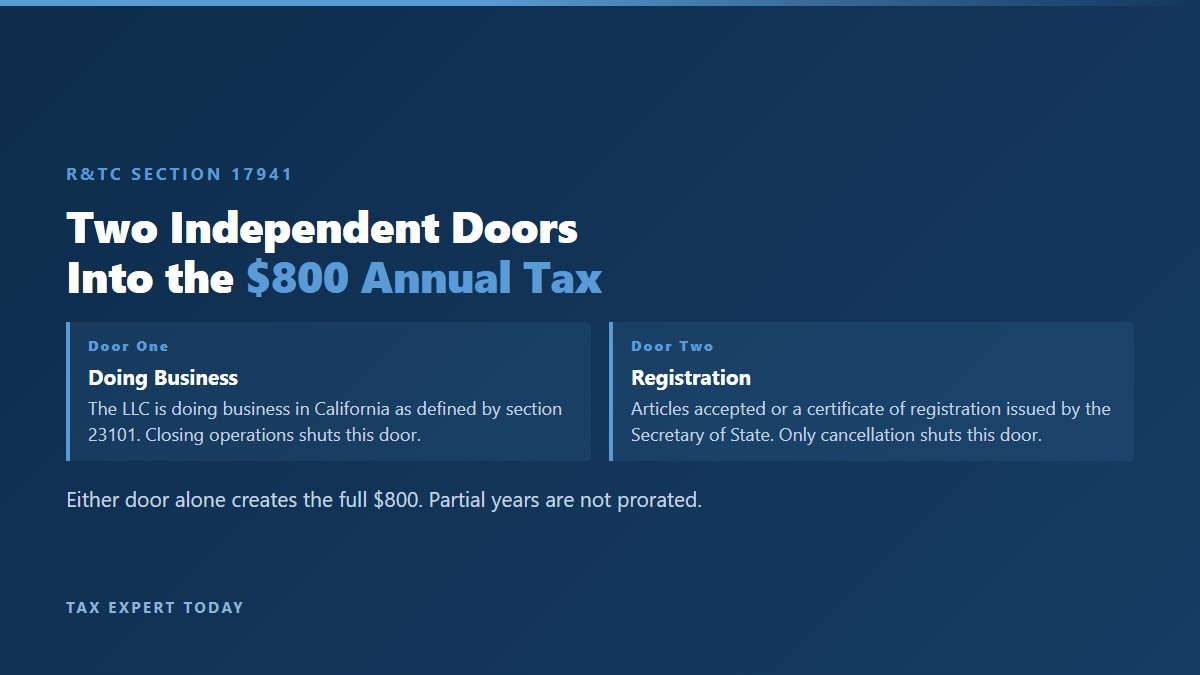
The statute reaches an LLC through either of two independent doors, and understanding which door applies to your company is the whole analysis when you leave the state.
- The activity door. Section 17941(a) applies the tax to an LLC that is doing business in California, as that phrase is defined in section 23101.
- The registration door. Section 17941(b)(1) applies the tax separately to any LLC whose articles of organization have been accepted, or whose certificate of registration has been issued, by the California Secretary of State.
- Either one is enough. An LLC that satisfies neither owes nothing. An LLC that satisfies either one owes the full $800.
- Partial years count in full. The statute states that the tax is paid for each taxable year, or part thereof, so a short year does not produce a prorated bill.
The amount itself is set by cross reference. Section 17941(a) fixes the tax at the amount specified in section 23153(d), which is the same $800 minimum that applies to corporations. The 2026 instructions for Form FTB 3522 confirm the figure for the current year and describe the payment as the annual limited liability company tax of $800 for taxable year 2026.
Who has to pay the $800 California LLC annual tax?
Every LLC registered with the California Secretary of State owes the $800, and so does every unregistered LLC that meets the doing business test. Formation state is irrelevant to the second category. A Wyoming, Nevada, Delaware, or Florida LLC that conducts California business owes the same annual tax as a California LLC, whether or not it ever registered.
The Franchise Tax Board states the position plainly on its limited liability company guidance page: every LLC that is doing business or organized in California must pay an annual tax of $800, and that yearly tax will be due even if you are not conducting business, until you cancel your LLC.
Two timing rules govern the payment itself. Section 17941(c) makes the tax due on or before the 15th day of the fourth month of the taxable year, which is April 15 for a calendar year company. For a newly formed LLC, the first payment is due on the 15th day of the fourth month measured from the date of the Secretary of State filing rather than from the start of the calendar year. Payment travels with Form FTB 3522 unless the company pays electronically.
One historical exception is worth naming because it still causes confusion. For taxable years beginning on or after January 1, 2021, and before January 1, 2024, a newly organized or registered LLC was not subject to the $800 tax for its first tax year. That window has closed. An LLC formed in 2026 owes the first year tax on the ordinary schedule, and any planning built on the assumption that the first year is free is now out of date.
When does the California LLC franchise tax stop after you move out of state?
The tax stops when a certificate of cancellation is filed with the California Secretary of State, and not before. Section 17941(b)(1) states that the tax shall be paid for each taxable year, or part thereof, until a certificate of cancellation of registration or of articles of organization is filed on behalf of the LLC with the office of the Secretary of State.
This is the single most expensive misunderstanding in the entire subject, and it is the point the widely read explainers on this topic omit. Owners who relocate reasonably assume that the obligation follows the business. It does not. The registration door in section 17941(b) is independent of activity, so a dormant California LLC owned by a Florida resident, generating no revenue and holding no California property, continues to accrue $800 every year the registration remains open.
- Ceasing operations does not stop it. Activity is only one of the two doors. Closing the doors closes the activity door and leaves the registration door open.
- Leaving the state does not stop it. The owner’s residency is a separate question from the entity’s registration status.
- Filing a final return does not stop it. Section 17941(b)(2) requires the Franchise Tax Board to notify a taxpayer who files a return designated as final that the annual tax continues to be due annually until the appropriate certificate is filed with the Secretary of State.
- Only the Secretary of State filing stops it. The statute names the two operative documents: a certificate of dissolution under Corporations Code section 17707.08 or a certificate of cancellation under Corporations Code section 17708.06.
There is one narrow relief provision for very new companies. If the LLC is cancelled within one year of organizing, the Short Form Certificate of Cancellation, Secretary of State Form LLC-4/8, allows the company to avoid the annual tax for its first tax year. That path is available only inside the twelve month window and only when the specific conditions on the form are met.
What does doing business in California mean for an LLC?
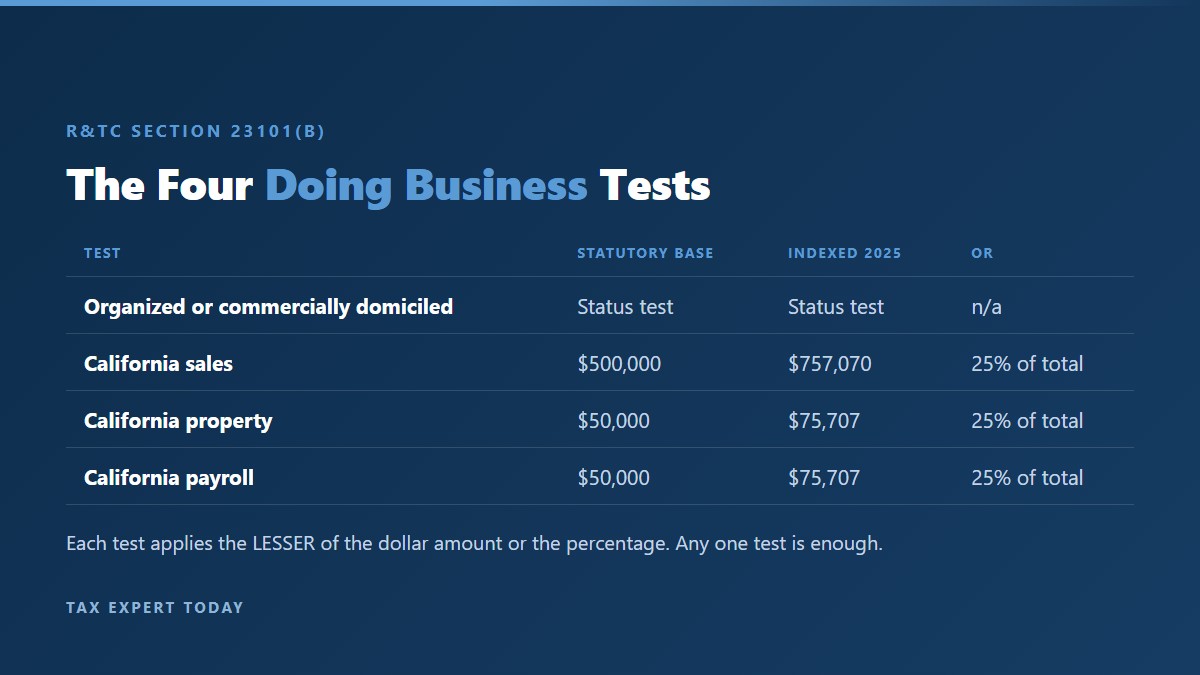
Section 23101(a) defines doing business as actively engaging in any transaction for the purpose of financial or pecuniary gain or profit. Section 23101(b) then adds four bright line tests, and satisfying any one of them makes the company a California taxpayer regardless of where it was formed or where its owners now live.
The four tests are organization or commercial domicile in California, California sales above a threshold, California real and tangible personal property above a threshold, and California payroll above a threshold. The statutory figures are $500,000 for sales and $50,000 for property and payroll, but each test is stated as the lesser of the dollar figure or 25 percent of the company total, and section 23101(c) directs the Franchise Tax Board to index the dollar amounts annually.
| Test under R&TC 23101(b) | Statutory base amount | Indexed amount, 2025 | Percentage alternative |
|---|---|---|---|
| Organized or commercially domiciled in California | Not applicable | Not applicable | Status test, no threshold |
| California sales | $500,000 | $757,070 | 25 percent of total sales |
| California real and tangible personal property | $50,000 | $75,707 | 25 percent of total property |
| California payroll compensation | $50,000 | $75,707 | 25 percent of total compensation |
The indexed figures come from the Franchise Tax Board doing business in California page, which publishes the table by year. Two features of the test deserve attention from anyone who has left the state.
- The percentage alternative is the trap. A small company with modest total sales can cross the threshold on the 25 percent branch long before it approaches the dollar figure. A business with $200,000 of total sales and $60,000 of California sales is doing business in California even though $60,000 is far below $757,070.
- Pass-through interests flow up. Section 23101(d) provides that the sales, property, and payroll of the taxpayer include the taxpayer’s pro rata or distributive share from partnerships and S corporations, so an investment in a California operating partnership can pull a passive holding company into the test.
- Commercial domicile can lag the owner. A single member LLC managed from Naples, Florida is ordinarily no longer commercially domiciled in California, but management activity that continues to occur on California trips is a fact the Franchise Tax Board can examine.
- The current thresholds are the published ones. The 2025 figures above are the most recent the agency has published. The base amounts are indexed under section 17041(h), applied by substituting 2012 for 1988, per the amendment made by Proposition 39 in November 2012.
What is the LLC fee, and how is it different from the $800 tax?
The LLC fee under section 17942 is a second, separate charge that applies only when total California income reaches $250,000. It is graduated rather than flat, it is due on a different date, and it is remitted on a different form. An LLC can owe the $800 tax and no fee, but it cannot owe the fee without also owing the tax.
| Total California income | LLC fee under R&TC 17942 |
|---|---|
| Under $250,000 | $0 |
| $250,000 to $499,999 | $900 |
| $500,000 to $999,999 | $2,500 |
| $1,000,000 to $4,999,999 | $6,000 |
| $5,000,000 or more | $11,790 |
The measuring base is unusual and departing owners consistently underestimate it. Section 17942(b)(1)(A) defines total income from all sources derived from or attributable to this state as gross income under section 24271 plus the cost of goods sold. A company with thin margins can therefore owe a fee on a base that looks nothing like its profit. Section 17942(b)(1)(B) assigns the receipts using the sales assignment rules of sections 25135 and 25136, which is a market based approach rather than a location of operations approach.
| Feature | Annual tax, R&TC 17941 | LLC fee, R&TC 17942 |
|---|---|---|
| Amount | Flat $800 | Graduated, $900 to $11,790 |
| Trigger | Registration or doing business | Total California income of $250,000 or more |
| Due date | 15th day of the 4th month of the taxable year | 15th day of the 6th month of the taxable year |
| Form | FTB 3522 | FTB 3536 |
| Owed by a dormant registered LLC | Yes | No |
The 2026 instructions for Form FTB 3536 set the estimated fee deadline at the 15th day of the sixth month of the taxable year, which is June 15, 2026 for a calendar year company, and they note that if the taxable year ends before that date no estimated payment is due and the fee is payable with the return. Both charges are reported on the Form 568 Limited Liability Company Return of Income, which is described further in FTB Publication 3556.
How do you actually cancel a California LLC?
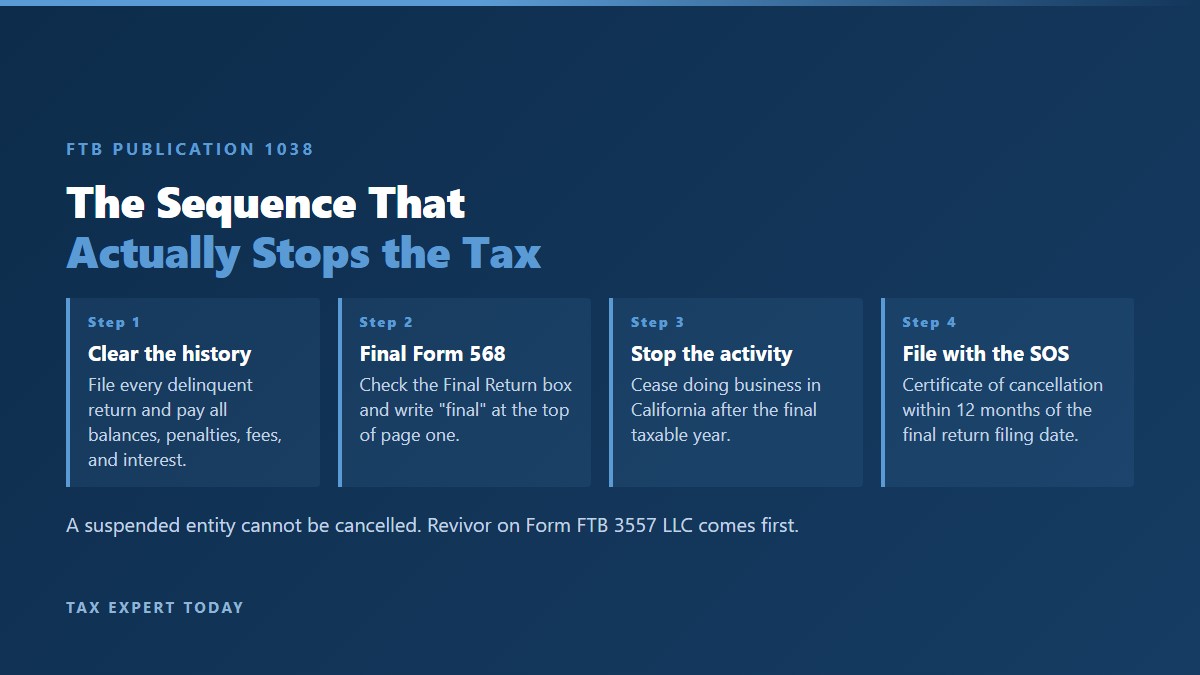
Cancellation is a two agency sequence, and the order matters. The Franchise Tax Board requirements come first, the Secretary of State filing comes second, and FTB Publication 1038 requires the Secretary of State documents to be filed within twelve months of the filing date of the final tax return.
| Step | Agency | What it requires |
|---|---|---|
| 1. Clear the history | Franchise Tax Board | File all delinquent returns and pay all balances, including penalties, fees, and interest |
| 2. File the final return | Franchise Tax Board | File the final or current year Form 568, check the Final Return box on page one, and write “final” at the top of the first page |
| 3. Stop the activity | The company | Cease doing or transacting business in California after the final taxable year |
| 4. File the termination documents | Secretary of State | File the applicable cancellation form within twelve months of the filing date of the final return |
The correct Secretary of State form depends on how the company was created and how it is being wound up. A California LLC files a Certificate of Dissolution, Form LLC-3, and a Certificate of Cancellation, Form LLC-4/7, or the Short Form Certificate of Cancellation, Form LLC-4/8, when it qualifies. An out of state LLC that registered to transact business in California files a certificate of cancellation of its registration. Current versions of each form are available through the Secretary of State business entity forms page and the bizfile Online portal.
Publication 1038 also sets out the conditions under which the company may avoid the annual tax for the current and subsequent taxable years. All three must be satisfied: timely file the final return for the preceding taxable year including any extension, cease doing or transacting business in California after the last day of that preceding taxable year, and file the Secretary of State documents within twelve months of the filing date of the final return. Missing any one of them generally means another $800 accrues.
What happens if you simply stop paying?
Unpaid California LLC franchise tax does not lapse. It compounds. The balance accrues penalties and interest, the Secretary of State imposes a separate $250 penalty for an unfiled Statement of Information, and the entity is eventually suspended or forfeited, which blocks the very cancellation filing the owner needs in order to stop the meter.
The suspension consequence is the one that converts a small problem into an expensive one. Publication 1038 is explicit that the Secretary of State cannot accept termination documents while the Franchise Tax Board has suspended or forfeited the entity. Reaching the exit therefore requires going backward first.
- Pay all outstanding balances. Every year of accrued tax, fee, penalty, and interest has to be satisfied before the entity can be revived.
- File all delinquent returns. Each open year needs a Form 568, including years in which the company was dormant.
- Apply for revivor. An LLC files Form FTB 3557 LLC, Application for Certificate of Revivor, to restore good standing.
- Then cancel. Only after revivor will the Secretary of State accept the cancellation, at which point the annual tax finally stops under section 17941(b)(1).
A suspended LLC also loses practical rights that matter well beyond tax. It generally cannot defend or maintain an action in California courts and cannot enforce its contracts while suspended, and it is not granted automatic filing extensions. Penalty and interest mechanics for the underlying balances are described on the Franchise Tax Board penalties and interest page.
Can you move a California LLC to Florida instead of dissolving it?
Yes, in the sense that the business can end up operating as a Florida entity, but every route requires an affirmative California filing to close the California registration. There is no procedure by which a California LLC quietly becomes a Florida LLC while the California obligation simply expires.
Owners generally choose among three approaches, and the tax analysis differs from the legal analysis in each.
- Conversion or domestication. The existing entity converts into a Florida LLC under both states’ statutes, keeping its history and its federal employer identification number. California still requires the corresponding filing to close the California record.
- Form new and wind down. A new Florida LLC is organized, the operations and assets transfer to it, and the California LLC is cancelled. This is administratively simpler and often has federal consequences worth modeling before any assets move.
- Keep both. The California LLC stays registered because it still holds California property or continues California activity. This is a legitimate choice, and it means the $800 continues indefinitely by design rather than by accident.
The Florida side is comparatively simple. Florida imposes no personal income tax at all under Article VII, section 5 of the Florida Constitution, so there is no Florida analogue to the $800 privilege tax on a pass-through LLC. Florida instead charges an annual report fee. Under Florida Statutes section 605.0212 the report is delivered between January 1 and May 1 each year, and the Division of Corporations fee schedule currently sets the LLC annual report at $138.75, rising to $538.75 when it is received after May 1.
| Recurring entity cost | California LLC | Florida LLC |
|---|---|---|
| Annual privilege tax | $800 under R&TC 17941 | None |
| Income based entity charge | LLC fee, $900 to $11,790 above $250,000 | None on a pass-through LLC |
| Annual state filing | Statement of Information, biennial for most LLCs | Annual report, $138.75 |
| Late filing exposure | $250 Secretary of State penalty, collected by FTB | $538.75 annual report after May 1 |
| Owner level state income tax | Yes, on California source and resident income | None |
The comparison explains the direction of travel, and it is the entity level counterpart to the individual analysis in our guide to moving from California to Florida taxes. Owners considering Texas rather than Florida should read our comparison of Texas LLC taxes and our guide to moving a business to Texas, because the Texas franchise tax operates on a completely different base.
How does the owner’s personal California return interact with the LLC?
The entity question and the residency question are separate, and they can resolve in opposite directions. Cancelling the LLC does not make the owner a nonresident, and becoming a nonresident does not cancel the LLC. In the year of a move, both determinations usually have to be made on the same set of facts.
A single member LLC is normally a disregarded entity, so its income flows onto the owner’s individual return. When the owner moves mid year, the California portion of that income is reported on Form 540NR under the part year rules, which we walk through line by line in our guide to the California part year resident tax return. A multi member LLC files Form 568 and issues a Schedule K-1 that carries California source amounts to each member separately.
- Source survives the move. Income attributable to California business activity remains California source income for a nonresident member, so the personal filing obligation can continue after the residency change.
- Residency is decided on connections. The Franchise Tax Board applies the closest connections analysis described in our guide to leaving California taxes, and a retained California business is one of the connections it weighs.
- An open entity is visible evidence.
- The elective tax is a separate decision. A multi member LLC taxed as a partnership may also elect the entity level tax described in our guide to the California PTET, which is voluntary and distinct from the $800 annual tax.
- A sale changes the sequencing question entirely. If the plan includes selling the business, the ordering of the sale relative to the residency change is a separate analysis, covered in our guides to moving to Florida before selling a business and to the taxes on selling a business.
A still registered California LLC is a data point the state can raise in a California residency audit, alongside the other factors.
Owners occasionally assume that because California has no wealth tax and no departure levy, the entity obligations disappear along with the residency. They do not, and the distinction between a myth and a live statute is one we set out in our article on the California exit tax.
What deadlines apply in the year you leave?
Four dates control the move year for a calendar year LLC, and three of them fall before the return is prepared. Missing them does not merely defer the cost, because the annual tax accrues automatically and the LLC fee carries its own underpayment exposure.
| Date | Obligation | Form | Applies if |
|---|---|---|---|
| April 15 | $800 annual tax for the current year | FTB 3522 | Still registered or still doing business on the first day of the year |
| June 15 | Estimated LLC fee for the current year | FTB 3536 | Total California income is expected to reach $250,000 |
| Return due date | Final Form 568 with the Final Return box checked | Form 568 | The company is winding up its California presence |
| Within 12 months of that filing | Certificate of cancellation | LLC-4/7, LLC-3, or LLC-4/8 | Registered with the Secretary of State |
The practical consequence is that a decision made in, for example, October rarely stops the current year tax, because the $800 for that year became due the previous April. The realistic goal in most late year situations is to stop the following year, which means completing the Secretary of State filing before the next taxable year begins.
California LLC Franchise Tax Help in Naples & Southwest Florida
California LLC tax help Naples is a recurring engagement in our practice, because Southwest Florida receives a steady flow of business owners relocating from California who discover that the entity did not travel as cleanly as they did. Tax Expert Today LLC works on both ends of that corridor, coordinating the California closeout with the Florida formation so the entity record and the residency record tell one consistent story.
Our office is at 11983 Tamiami Trail N, Naples, Florida 34110, and you can reach us at (239) 441-2005, Monday through Friday, 10am to 5pm ET. We are a multidisciplinary firm of tax advisors, enrolled agents, CPAs, and attorneys handling state residency and tax matters nationwide. Our California tax services page and our Naples tax planning page describe how these engagements are typically structured.
I moved to Naples years ago but my California LLC is still registered. Is it too late?
No, and this is among the most common situations we see. The registration can still be cancelled, which stops future years even when prior years remain open. The sequence usually involves reconstructing the dormant year filings, resolving the balance, obtaining a revivor if the entity has been suspended, and then filing the cancellation. Prior year exposure is a separate conversation, and in qualifying cases penalty relief may be available depending on the facts.
When to Engage a Professional
A single dormant LLC with no history of missed filings can often be closed by the owner directly, working from Publication 1038 and the Secretary of State forms, and the California LLC franchise tax then stops on schedule. Professional involvement earns its place when the record is incomplete, when more than one state is involved, or when the entity holds assets.
Consider engaging a professional if the LLC has unfiled Form 568 returns for one or more years, if the entity has been suspended or forfeited, if California source income continued after the owner moved, if the company holds California real property, if the plan involves converting rather than dissolving the entity, or if the owner’s own residency for the move year has not yet been documented. Where a business sale is contemplated, the sequencing of that sale relative to both the entity change and the residency change can materially affect the California result, and that opportunity generally exists only before the transaction closes.
Outcomes depend on individual facts, and nothing in this article is a prediction about any particular situation. If you have left California and the LLC is still open, or you are planning the move now and want the entity handled in the right order, call (239) 441-2005 or read our guide to establishing Florida residency for the arrival side of the same move. If the entity is staying open and the real question is which structure carries the lower California charge, our guide to California LLC vs S corp runs that comparison against both tax bases.
Published August 6, 2026 by Dr. Pellumb Kabashi « Back to Learning Center
Have a question this article touches on?
Tax Expert Today LLC, based in Naples, Florida and serving clients across the United States.
Schedule a Consultation (239) 441-2005