
By Dr. Pellumb Kabashi, DBA, MBA, CES, CFE, EA
Founder, Tax Expert Today LLC · Tax advisors, enrolled agents, CPAs, and attorneys · Serving clients in all 50 states
Quick Answer
Bonus depreciation under section 168(k) is an immediate deduction equal to 100 percent of the adjusted basis of qualifying property in the year it is placed in service. The One, Big, Beautiful Bill Act made that rate permanent for property acquired and placed in service after January 19, 2025. Property acquired under an earlier written binding contract stays on the old phase-down and is limited to 20 percent in 2026. Call (239) 441-2005 for a free consultation.
What is bonus depreciation?
Bonus depreciation is the additional first year depreciation allowance in section 168(k). It lets a business deduct a percentage of the cost of qualifying property in the year that property is placed in service, instead of spreading the cost across the recovery period. Section 168(k)(1)(A) now states that allowance as a flat 100 percent of adjusted basis.
- It is a timing provision, not a permanent exclusion. Section 168(k)(1)(B) reduces basis by the amount deducted, so the deduction is pulled forward rather than created.
- It is automatic. A taxpayer who wants ordinary depreciation instead must affirmatively elect out under section 168(k)(7).
- It has no dollar ceiling. Unlike the section 179 election, nothing caps the total amount deducted in a year.
- It can produce a loss. There is no taxable income limitation of the kind that applies to section 179.
- It applies to used property. The property must be new to the taxpayer, not new to the world.
The phrase most readers have absorbed over the last several years is the phase-down: 100 percent, then 80, then 60, then 40, then 20, then nothing. That schedule lived in section 168(k)(6). It is worth being precise about what happened to it, because nearly every explanation still written on the open web is organized around it. Section 70301 of Public Law 119-21 replaced the annual phase-down with a permanent 100 percent allowance, and the current statutory text of section 168(k)(1)(A) simply reads “an allowance equal to 100 percent of the adjusted basis of the qualified property.” The applicable percentage mechanism is gone from the operative provision.
That is the part that is easy to report. The part that decides real returns is that the old percentages did not disappear from practice on the same date they disappeared from the statute, and 2026 is the year where that distinction does the most damage.
What is the bonus depreciation rate for 2026?
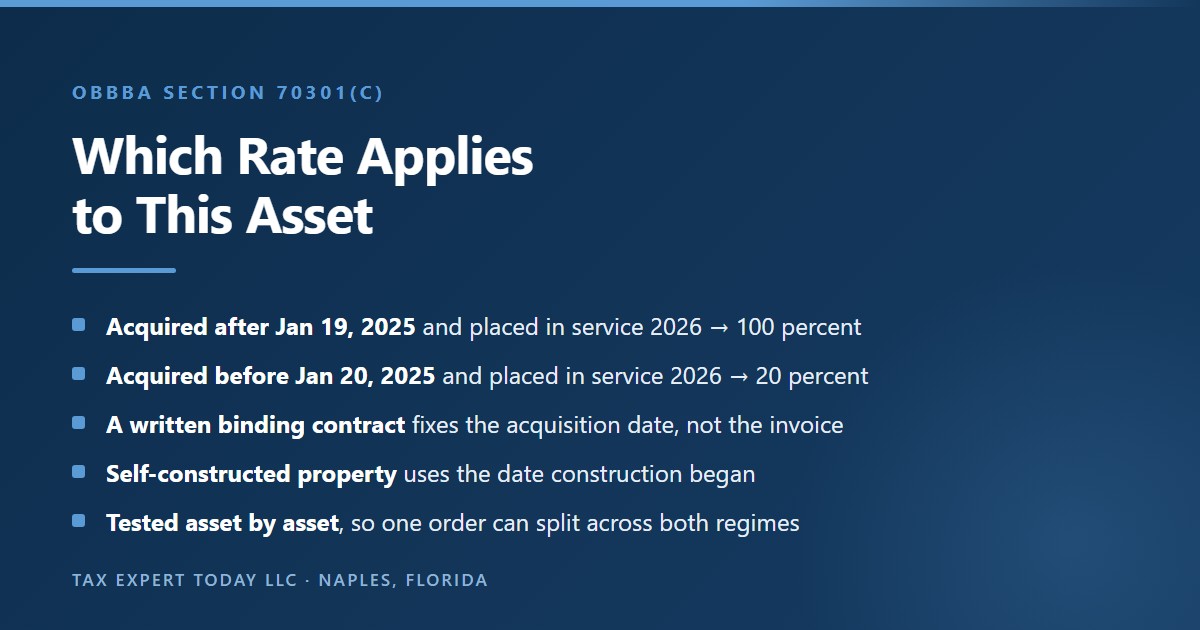
There are two rates in 2026 and the correct one depends on when the property was acquired, not when it was placed in service. Property acquired after January 19, 2025 receives 100 percent. Property acquired after September 27, 2017 and before January 20, 2025, but placed in service during 2026, receives 20 percent under the prior version of section 168(k)(6).
This is not an interpretation. Section 2.02 of Rev. Proc. 2026-15 states it directly: “the applicable percentage for qualified property acquired after September 27, 2017, and before January 20, 2025, and placed in service during calendar year 2026 is 20 percent.” The same revenue procedure explains that former section 168(k) continues to apply to property acquired after September 27, 2017 and before January 20, 2025 which is placed in service before January 1, 2027.
| Acquisition date | Placed in service | Applicable percentage | Governing provision |
|---|---|---|---|
| After January 19, 2025 | 2026 | 100 percent | Section 168(k)(1)(A) as amended by OBBBA section 70301 |
| After September 27, 2017 and before January 20, 2025 | 2026 | 20 percent | Former section 168(k)(6); Rev. Proc. 2026-15 section 2.02 |
| After September 27, 2017 and before January 20, 2025 | 2027 or later | Not eligible | Former section 168(k) required placement in service before January 1, 2027 |
| On or before September 27, 2017 | 2026 | Not eligible | Outside both regimes |
Two rules run side by side in the same tax year, on the same Form 4562, for the same taxpayer. A calendar year business that placed two machines in service in March 2026 may be entitled to 100 percent on one and 20 percent on the other, and nothing about the machines themselves explains the difference.
Why do two bonus depreciation rates apply in the same year?
Because the OBBBA amendments are keyed to an acquisition date rather than a placed in service date. Section 70301(c) of Public Law 119-21 provides that the amendments apply to property acquired after January 19, 2025. Property acquired before that line remains governed by the prior statute, which is still running its phase-down through the end of 2026.
Congress used the same drafting pattern in 2017. Section 70301(c)(4) of the OBBBA contains language similar to section 13201(h)(1) of the Tax Cuts and Jobs Act, and Notice 2026-11 says so expressly at section 2.02. The practical consequence is that the entire body of existing regulation and guidance built around the September 27, 2017 line was carried forward with a date substitution rather than rewritten.
Section 3.03 of the notice sets out the mechanism. In determining whether property is acquired after January 19, 2025, taxpayers apply rules consistent with sections 1.168(k)-2(b)(5) and 1.1502-68(a) through (d), “by substituting ‘January 19, 2025’ for ‘September 27, 2017’ each place it appears, and by substituting ‘January 20, 2025’ for ‘September 28, 2017’ each place it appears.” Section 3.07 then instructs taxpayers to substitute “100 percent” for “the applicable percentage” each place it appears in the regulation.
The notice is interim guidance ahead of proposed regulations. Section 6 states that taxpayers may rely on sections 3 through 5 for property placed in service in taxable years beginning before the forthcoming proposed regulations are published in the Federal Register. That reliance matters, because the substitutions are the only current authority on several of the questions below.
What counts as the acquisition date, and why does a written binding contract matter?
Property is not treated as acquired after the date a written binding contract is entered into for its acquisition. Section 70301(c)(4) of the OBBBA says so directly. A contract signed before January 20, 2025 therefore fixes the acquisition date in the earlier regime, and the 100 percent rate is unavailable no matter how late the property is delivered or placed in service.
- The contract date controls, not the invoice or the delivery. A machine ordered in December 2024 and installed in March 2026 was acquired in December 2024.
- Self-constructed property uses the date construction began. The regulation treats manufacture, construction, or production commencing as acquisition.
- A component election may rescue part of the cost. Section 3.05 of Notice 2026-11 permits an election for eligible components of larger self-constructed property.
- A contract that is not binding does not start the clock. The existing regulation looks to enforceability and to damages provisions, so purchase orders and letters of intent require examination rather than assumption.
- The test is applied property by property. One supplier agreement can place some assets in one regime and some in the other.
Here is the arithmetic on two identical machines, as a hypothetical illustration. Both cost $500,000, both are five year property, and both are placed in service in March 2026 by a calendar year business. Only the contract dates differ.
| Item | Machine A, ordered June 2025 | Machine B, binding contract December 2024 |
|---|---|---|
| Cost | $500,000 | $500,000 |
| Deemed acquisition date | June 2025 | December 2024 |
| Applicable percentage | 100 percent | 20 percent |
| Bonus depreciation | $500,000 | $100,000 |
| Remaining depreciable basis | $0 | $400,000 |
| Regular MACRS, first year at 20.00 percent | $0 | $80,000 |
| Total first year deduction | $500,000 | $180,000 |
| Difference in first year deduction | $320,000 | |
| Hypothetical federal tax effect at a 32 percent marginal rate | $102,400 | |
The remaining $400,000 on Machine B is not lost. It is recovered across the five year schedule in the ordinary way. What is lost is the timing, and with it the present value, on a decision that was made when someone signed a purchase document in a month nobody now remembers as significant. This is the single most valuable question to ask before preparing a 2026 depreciation schedule, and it is the question the ranking results for this topic do not ask.
What property qualifies for 100 percent bonus depreciation?
Qualified property under section 168(k)(2)(A) is property with a MACRS recovery period of 20 years or less, computer software, water utility property, and qualified film, television, live theatrical, and now sound recording productions. The property must also satisfy an original use or acquisition requirement, which is what allows used equipment to qualify.
- Short life tangible property. Machinery, equipment, computers, furniture, vehicles, and similar assets with a recovery period of 20 years or less.
- Qualified improvement property. Interior improvements to nonresidential buildings, which section 168(e)(6) defines and which carries a 15 year recovery period.
- Land improvements. Paving, site work, fencing, and landscaping, generally 15 year property.
- Used property new to the taxpayer. The original use requirement is satisfied by acquisition, provided the taxpayer did not previously use the property and the acquisition is not from a related party. Publication 946 sets out the recovery period tables that decide eligibility.
- Qualified sound recording productions. Added by OBBBA section 70434(g) for productions commencing in taxable years ending after July 4, 2025.
The sound recording addition is genuinely new and is the specific reason Notice 2026-11 was issued in the form it was. Section 5 of the notice treats a qualified sound recording production as acquired on the date principal recording commences, and as placed in service at the time of initial release or broadcast under section 168(k)(2)(H)(iii). The section 181 deduction for such productions is capped at $150,000 in the aggregate, but section 168(k) eligibility is determined without regard to that cap.
What does not qualify for bonus depreciation?
Property depreciated under the alternative depreciation system is excluded by section 168(k)(2)(D)(i). Section 168(k)(9) separately excludes property used in a regulated utility trade or business described in section 163(j)(7)(A)(iv), and property used in a trade or business that had floor plan financing indebtedness whose interest was taken into account under section 163(j)(1)(C).
- Buildings themselves. Nonresidential real property at 39 years and residential rental property at 27.5 years both exceed the 20 year ceiling.
- Property required to use ADS. Including property of an electing real property trade or business, discussed below.
- Regulated utility property. Excluded outright by section 168(k)(9)(A).
- Floor plan financing businesses. Section 168(k)(9)(B) removes the deduction where floor plan interest was used to lift the section 163(j) limitation, a rule that reaches many vehicle and equipment dealerships.
- Related party and carryover basis acquisitions. The acquisition requirements in section 179(d)(2) and (3), incorporated by reference, disqualify purchases from related persons and property whose basis carries over.
The floor plan exclusion deserves a sentence of its own because it is counterintuitive. A dealership that benefited from the floor plan financing carve out in the interest limitation gives up bonus depreciation on property used in that trade or business. The two provisions were written to be mutually exclusive, and a business that has never examined which side of that line it sits on may be claiming a deduction it is not entitled to.
Is it better to take bonus depreciation or Section 179?
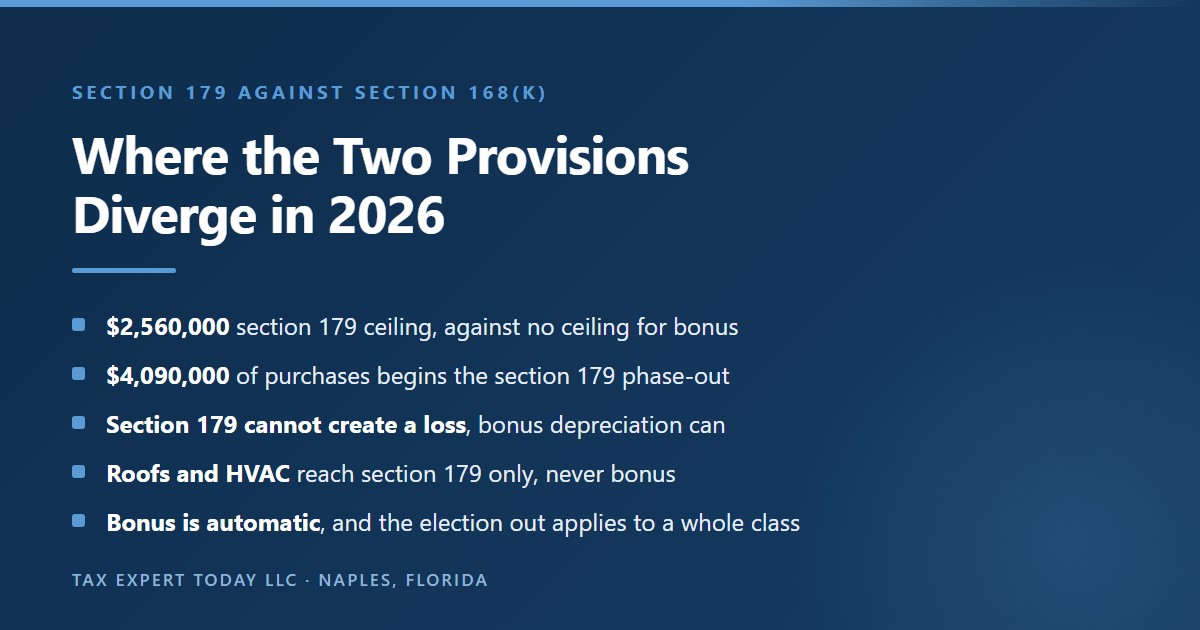
Neither is categorically better. Section 179 is limited in amount but flexible in application, and it cannot create a loss. Bonus depreciation is unlimited in amount but rigid in application, and it can create a loss. For 2026 the section 179 cap is $2,560,000, and it phases out dollar for dollar once section 179 property placed in service exceeds $4,090,000.
Those 2026 figures come from section 4.24 of Rev. Proc. 2025-32, which adjusts the statutory $2,500,000 and $4,000,000 amounts in section 179(b)(1) and (b)(2) for inflation. The same section sets the sport utility vehicle limit in section 179(b)(5)(A) at $32,000 for 2026.
| Feature | Section 179 expensing | Section 168(k) bonus depreciation |
|---|---|---|
| 2026 dollar ceiling | $2,560,000 | None |
| 2026 phase-out threshold | Reduced above $4,090,000 of purchases | None |
| Can it create or increase a loss | No, limited to business taxable income | Yes |
| Disallowed amount | Carries forward indefinitely | Not applicable |
| How it is chosen | Affirmative election, asset by asset | Automatic, election out by class |
| Partial application | Yes, any dollar amount per asset | No, all or nothing within a class |
| Roofs, HVAC, fire protection, security systems | Eligible under section 179(f) | Not eligible, these are 39 year property |
| Sport utility vehicle over 6,000 pounds | Capped at $32,000 for 2026 | No separate cap |
| Availability to trusts and estates | No, section 179(d)(4) | Yes |
The two rows that decide most engagements are the taxable income limitation and the qualified real property row. A business with modest income and a large roof replacement may find section 179 is the only provision that reaches the expenditure, while a business with a large equipment purchase and a deliberate reason to generate a loss may find only bonus depreciation does what it needs.
Can bonus depreciation create a loss?
Yes, and this is the clearest structural difference between the two provisions. Section 179(b)(3)(A) limits the expensing deduction to taxable income derived from the active conduct of a trade or business, with the excess carried forward under section 179(b)(3)(B). Section 168(k) contains no comparable limitation, so bonus depreciation can push taxable income below zero.
Consider a hypothetical business with $300,000 of taxable income before any depreciation election, which places $500,000 of five year equipment in service in 2026.
| Measure | Section 179 route | Bonus depreciation route |
|---|---|---|
| Equipment placed in service | $500,000 | $500,000 |
| Taxable income before the deduction | $300,000 | $300,000 |
| Deduction allowed this year | $300,000 | $500,000 |
| Limited by | Section 179(b)(3)(A) | Nothing |
| Amount carried forward | $200,000 under section 179(b)(3)(B) | Not applicable |
| Resulting taxable income | $0 | Negative $200,000 |
| Treatment of the excess | Section 179 carryforward, usable against future business income | May contribute to a net operating loss under section 172 |
Whether the loss is useful is a separate question and frequently the answer is no. A net operating loss carried forward is generally limited to 80 percent of taxable income in the year it is used, it does not reduce self-employment tax, and for an owner of a pass-through entity it may waste deductions that would otherwise have offset income taxed at the top marginal rate. Generating a loss deliberately is a decision that should be modeled across several years rather than taken because the deduction is available. Where the goal is simply a deduction rather than the asset itself, an owner level provision such as a cash balance plan or the Augusta rule may reach the same result without committing capital to equipment, and without the recapture described later in this article.
Can I take bonus depreciation without Section 179?
Yes. The two provisions are independent, and bonus depreciation requires no election at all. If a taxpayer makes no section 179 election and does not elect out under section 168(k)(7), bonus depreciation applies automatically to every class of qualified property placed in service that year.
When both are used, section 179 is applied first. The expensing election reduces basis, and bonus depreciation then applies to whatever basis remains. Ordinary MACRS depreciation applies to anything still left. That ordering matters for the vehicle computations below, where the section 179 cap and the absence of a bonus cap interact in a way that surprises people.
Can you write off 100 percent of a 6,000 lb vehicle?
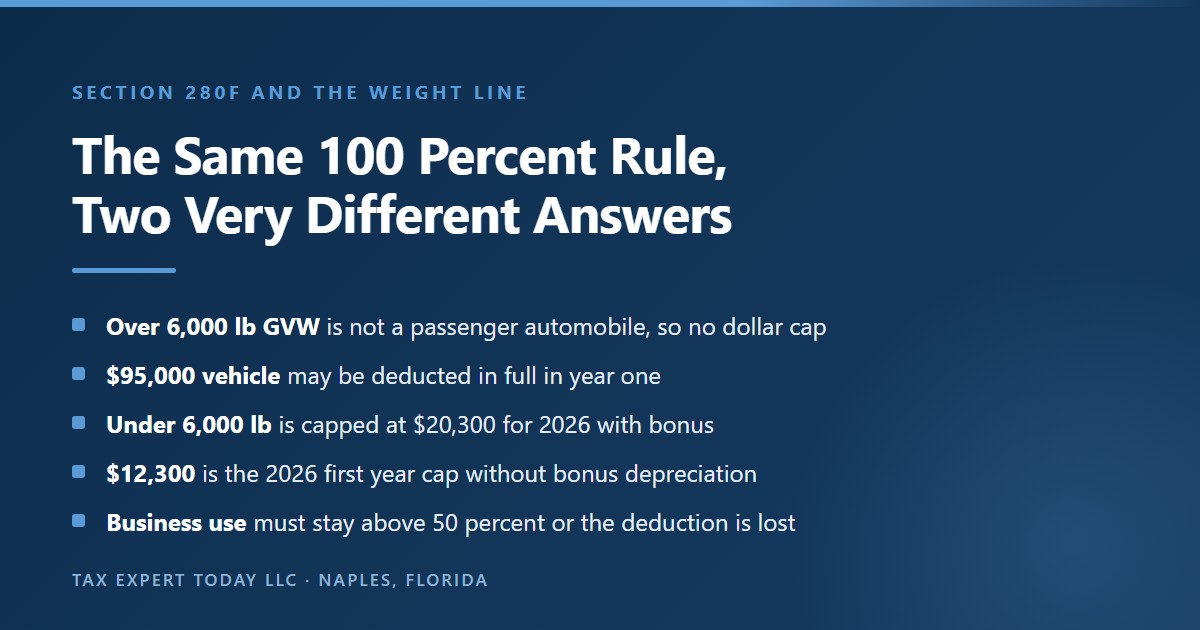
Often yes, but not for the reason usually given. A vehicle rated above 6,000 pounds gross vehicle weight is not a passenger automobile under section 280F(d)(5)(A)(ii), so the annual dollar caps in section 280F(a) do not apply to it. Section 179 is still capped at $32,000 for 2026, but bonus depreciation carries no separate vehicle cap.
- The weight test uses gross vehicle weight for trucks and vans. Unloaded gross vehicle weight applies only to other vehicles.
- Escaping section 280F(a) does not escape section 280F(b). The vehicle is still listed property under section 280F(d)(4)(A)(ii) as property used as a means of transportation.
- Business use must exceed 50 percent. If it does not, section 280F(b)(1) forces ADS, and section 168(k)(2)(D)(i) applies “after the application of section 280F(b),” so bonus depreciation is lost entirely.
- Falling below 50 percent later triggers recapture. Section 280F(b)(2) includes the excess depreciation in gross income in the year the test fails.
- Only the business use percentage is depreciable. A vehicle used 70 percent for business has 70 percent of cost in the depreciable basis to begin with.
The following hypothetical uses a $95,000 vehicle rated at 7,200 pounds gross vehicle weight, placed in service in 2026 and used entirely for business.
| Step | Using section 179 first | Using bonus depreciation alone |
|---|---|---|
| Cost, 100 percent business use | $95,000 | $95,000 |
| Subject to the section 280F(a) dollar caps | No, over 6,000 pounds GVW | No, over 6,000 pounds GVW |
| Section 179 deduction | $32,000, capped by section 179(b)(5)(A) | $0, not elected |
| Basis remaining | $63,000 | $95,000 |
| Bonus depreciation at 100 percent | $63,000 | $95,000 |
| Total first year deduction | $95,000 | $95,000 |
Both paths reach the same number, which is the point worth internalizing. While bonus depreciation sits at 100 percent, the sport utility vehicle cap in section 179 does no work on a vehicle above the weight threshold. The cap becomes decisive again only if bonus depreciation is unavailable, which is precisely what happens when the property was acquired under a pre-2025 binding contract or when business use falls to 50 percent or less.
What happens to a passenger automobile under 6,000 pounds?
The section 280F(a) dollar limits override the 100 percent allowance entirely. For a passenger automobile placed in service in 2026 for which bonus depreciation applies, Rev. Proc. 2026-15 caps first year depreciation at $20,300. Without bonus depreciation the first year cap is $12,300. The $8,000 difference is the uplift provided by section 168(k)(2)(F)(i).
| Tax year | Cap with bonus depreciation | Cap without bonus depreciation | Cumulative recovery, $62,000 automobile |
|---|---|---|---|
| First | $20,300 | $12,300 | $20,300 |
| Second | $19,800 | $19,800 | $40,100 |
| Third | $11,900 | $11,900 | $52,000 |
| Fourth | $7,160 | $7,160 | $59,160 |
| Fifth | $7,160 maximum | $7,160 maximum | $62,000, fully recovered |
A hypothetical $62,000 automobile used entirely for business therefore takes five years to recover under a provision advertised as immediate expensing. The same taxpayer buying a $95,000 vehicle 1,200 pounds heavier deducts the entire cost in year one. That contrast is worth putting in front of anyone who is choosing a vehicle in December for tax reasons, and it is the honest answer to a question the search results usually answer with a slogan.
How does bonus depreciation work on qualified improvement property?
Qualified improvement property is an interior improvement to a nonresidential building placed in service after the building was first placed in service. Section 168(e)(6) defines it and excludes enlargements, elevators, escalators, and internal structural framework. It carries a 15 year recovery period, which puts it inside the 20 year ceiling and makes it eligible for the full 100 percent allowance.
Qualified improvement property is the most commonly missed category in this area, because the assets involved look like building costs. Interior partitions, flooring, ceilings, interior doors, electrical distribution serving tenant space, and interior finishes generally qualify. The roof, the HVAC system, fire protection, and security systems do not, because those are not interior improvements within the definition, although section 179(f) reaches them separately.
How does a Section 163(j) election block bonus depreciation?
An electing real property trade or business must use the alternative depreciation system for the property types listed in section 163(j)(11), under section 168(g)(1)(F). Section 168(k)(2)(D)(i) excludes ADS property from the definition of qualified property. The election made to escape the interest limitation therefore forfeits bonus depreciation on qualified improvement property, permanently, for as long as the election stands.
- The election was historically irrevocable. That is what made it so consequential when it was made without modeling the depreciation side.
- ADS lengthens the recovery period. Qualified improvement property moves from 15 years under the general system to a 20 year class life under section 168(g)(3)(B).
- The exclusion is determined without regard to section 168(g)(7). A voluntary ADS election does not disqualify property, but a mandatory one does.
- Rev. Proc. 2026-17 now provides a withdrawal route. It permits certain taxpayers to withdraw the election for the year it was made.
- A late election out of bonus depreciation is also permitted. A taxpayer that withdraws may make a late section 168(k)(7) election for certain property.
The arithmetic below uses a hypothetical $600,000 interior buildout placed in service in 2026, held by a business that either did or did not make the election.
| Measure | No section 163(j)(7)(B) election | Electing real property trade or business |
|---|---|---|
| Qualified improvement property cost | $600,000 | $600,000 |
| Depreciation system | General system, 15 years | Alternative system, 20 year class life |
| Qualified property under section 168(k)(2) | Yes | No, excluded by section 168(k)(2)(D)(i) |
| Bonus depreciation | $600,000 | $0 |
| First year regular depreciation | $0 | $15,000, straight line with a half-year convention |
| Total first year deduction | $600,000 | $15,000 |
| Difference | $585,000 | |
Rev. Proc. 2026-17 is the development that makes this worth revisiting rather than merely regretting. Real estate businesses that elected out of the interest limitation in an earlier year, when bonus depreciation was phasing down toward 20 percent and the trade looked reasonable, are now living with that election in a year when the alternative is 100 percent. Whether withdrawal improves the overall position depends on the interest expense that would come back under the limitation, which is a modeling exercise rather than a rule of thumb, and it is one that should be run before the return is filed rather than after.
What is qualified production property under Section 168(n)?
Section 168(n) is a new provision permitting a 100 percent deduction for the portion of nonresidential real property used as an integral part of a qualified production activity. Construction must begin after January 19, 2025 and before January 1, 2029, and the property must be placed in service before January 1, 2031. It is an election, and it is designed for manufacturing, production, and refining facilities.
- The activity must substantially transform the property. Section 168(n)(2)(D) requires that the activity result in a substantial transformation of the product.
- Office and administrative space is carved out. Section 168(n)(2)(C) excludes offices, lodging, parking, sales, research, software development, and engineering areas.
- Production means agricultural or chemical production only. Section 168(n)(2)(E) narrows the word considerably.
- The election is effectively permanent. Section 168(n)(6)(B) permits revocation only with consent, granted in extraordinary circumstances.
- A ten year recapture rule applies. Section 168(n)(5) treats a change in use within ten years as a section 1245 disposition.
This is the largest single deduction in the current depreciation rules and the one most likely to be missed, because a building is exactly the asset practitioners have been trained to exclude from first year expensing. The following hypothetical uses a $12,000,000 facility placed in service in June 2026, with 80 percent of the square footage used in manufacturing and 20 percent used for offices.
| Measure | No section 168(n) election | With the section 168(n) election |
|---|---|---|
| Total facility cost | $12,000,000 | $12,000,000 |
| Qualifying production portion, 80 percent | Not applicable | $9,600,000 deducted in full |
| Excluded office portion, 20 percent | Included in the 39 year basis | $2,400,000 at 39 years |
| First year depreciation on 39 year basis, mid-month convention | $166,667 | $33,333 |
| Total first year deduction | $166,667 | $9,633,333 |
| Difference | $9,466,666 | |
The allocation between qualifying and excluded space is the entire engagement. Section 168(n)(2)(C) lists the excluded functions specifically, and a facility designed with generous office and engineering areas may qualify for far less than its owners assume. Section 168(n)(3) does provide that the deduction is determined without the section 56 adjustment for alternative minimum tax purposes, which removes one common objection.
How do you elect out of bonus depreciation?
Bonus depreciation is mandatory unless the taxpayer elects out under section 168(k)(7). The election is made by class of property, not asset by asset, and it must be filed by the due date of the return including extensions, in the manner prescribed on Form 4562 and its instructions. Once made for a class, it applies to every qualified property in that class placed in service that year.
The class-level scope is the trap. A taxpayer who wants ordinary depreciation on one machine cannot elect out for that machine alone. The election reaches every item of five year property placed in service that year, and a taxpayer who has not inventoried the class before electing may give up far more than intended.
What is the 40 percent election under Section 168(k)(10)?
Section 168(k)(10) permits a taxpayer to elect 40 percent instead of 100 percent for qualified property placed in service during the first taxable year ending after January 19, 2025, or 60 percent for long production period property and certain aircraft. For a calendar year taxpayer that is the 2025 return, and the election applies to the whole year rather than to selected assets.
This provision is widely misdescribed, because its predecessor used 50 percent. Section 4.03 of Notice 2026-11 instructs taxpayers to follow the procedures in section 1.168(k)-2(f)(3) with several substitutions, including substituting “40 percent” and “60 percent” for “50 percent” each place it appears. The statutory text in section 168(k)(10)(A) states the same percentages directly. Any explanation still describing a 50 percent election is describing the prior law.
A reason to elect less deduction rather than more is not obvious until the surrounding provisions are considered. A lower deduction may preserve qualified business income, keep taxable income inside a favorable bracket, avoid stranding charitable contributions or credits, or prevent a loss that would be trapped by basis or at-risk limitations. How a smaller depreciation deduction feeds through to qualified business income and the taxable income cap is set out in our guide to the qualified business income deduction. This is a good example of a place where the largest available deduction and the best outcome are not the same thing.
What are the downsides of bonus depreciation?
The deduction is accelerated, not created, and several of the costs surface years later. Basis falls to zero, so the entire sale price of the asset becomes ordinary income under section 1245. State conformity is inconsistent. The deduction may be wasted against income taxed at a low rate, and it reduces the qualified business income base in the year taken.
- Depreciation recapture is ordinary income. Section 1245 applies without regard to holding period.
- Deductions may be taken in the wrong year. A large deduction against a low bracket, followed by high income later, is a net loss.
- Many states decouple. The federal deduction does not carry to every state return.
- It interacts with the qualified business income deduction. Reducing income reduces the base on which that deduction is computed.
- Loss limitations may trap the benefit. Basis, at-risk, passive activity, and excess business loss rules can each defer it.
What happens to bonus depreciation when you sell the property?
The deduction is recaptured as ordinary income under section 1245 to the extent of gain. Because 100 percent bonus depreciation drives adjusted basis to zero, the entire amount realized on a later sale is generally recaptured. None of it receives long-term capital gain treatment, regardless of how long the asset was held.
| Measure | Amount |
|---|---|
| Original equipment cost | $500,000 |
| Bonus depreciation taken in year one | $500,000 |
| Adjusted basis at sale in year three | $0 |
| Sale proceeds | $310,000 |
| Gain | $310,000 |
| Section 1245 ordinary recapture, lesser of depreciation or gain | $310,000 |
| Long-term capital gain portion | $0 |
| Hypothetical tax at a 32 percent ordinary rate | $99,200 |
| Hypothetical tax if the gain had been long-term at 20 percent | $62,000 |
| Cost of the rate difference | $37,200 |
Recapture is reported on Form 4797. The practical lesson is that bonus depreciation is most valuable on assets a business intends to use to the end of their economic life, and least valuable on assets likely to be sold while they still carry meaningful value. That calculation changes again where the real property itself may be exchanged rather than sold, which the 1031 exchange rules govern. Equipment traded on a short cycle is a poor candidate, because the deduction is reversed at ordinary rates on a predictable schedule. The same mechanism appears on real property that was cost segregated and later sold, which is why recapture belongs in the analysis when selling a rental property rather than in the surprise column afterward.
How does cost segregation interact with bonus depreciation?
A cost segregation study reclassifies portions of a building into shorter lived asset classes. Those reclassified components fall inside the 20 year ceiling in section 168(k)(2)(A)(i)(I) and become eligible for the 100 percent allowance. The study does not create the deduction. It identifies the basis that the deduction can reach.
The relationship runs in one direction and it is worth stating plainly. Bonus depreciation applies to property with a recovery period of 20 years or less. A building is 39 year property and therefore ineligible. A cost segregation study is the engineering exercise that separates the five year and 15 year components out of the 39 year whole, and the value of doing so rises and falls with the bonus percentage in force. At 100 percent the pairing is at its most powerful, which is why a study deferred during the phase-down years may be worth revisiting.
| Component | Allocation | Recovery period | First year deduction |
|---|---|---|---|
| Personal property, five year | $450,000 | 5 years | $450,000 at 100 percent bonus |
| Land improvements, 15 year | $300,000 | 15 years | $300,000 at 100 percent bonus |
| Building structure | $2,250,000 | 39 years | $26,442, mid-month convention |
| Total with a study | $3,000,000 | $776,442 | |
| Total without a study | $3,000,000 | 39 years | $35,256 |
| Difference | $741,186 | ||
The allocation percentages above are illustrative only. Actual results depend entirely on the building, its use, and the engineering conclusions, and the same pairing drives the numbers in a short term rental analysis, where the material participation tests decide whether the resulting loss is usable at all. A large first year deduction that lands in a passive bucket has not saved anyone anything.
Does Florida follow federal bonus depreciation?
Florida imposes no individual income tax, so for most owners of pass-through businesses the federal result is the entire result. For entities subject to the Florida corporate income tax, section 220.13(1)(e) of the Florida Statutes requires an addback of bonus depreciation, recovered one seventh at a time. Florida fully conforms to section 179, because that addback expired for taxable years beginning after 2014.
- The corporate addback is 100 percent of the bonus deduction. It is imposed by F.S. 220.13(1)(e)1.a.
- Recovery is spread over seven years. One seventh is subtracted in the year of the addback and in each of the six following years.
- The spread continues after disposition. The statute says so expressly, regardless of whether the property remains in service.
- Qualified improvement property is treated worse. Sub-subparagraph 1.c denies the one seventh spread for bonus depreciation on qualified improvement property.
- The section 179 addback is expired. Subparagraph 2 applied only to taxable years beginning before January 1, 2015.
That last point inverts the usual advice for a Florida corporate taxpayer. Where a business is subject to the Florida corporate income tax, section 179 produces a deduction Florida accepts while bonus depreciation produces one Florida claws back and returns slowly. Two provisions that look interchangeable on the federal return are not interchangeable on the Florida return.
| Measure | Bonus depreciation | Section 179 expensing |
|---|---|---|
| Federal deduction | $1,000,000 | $1,000,000 |
| Florida addback | $1,000,000 | $0, addback expired |
| Current year one seventh subtraction | $142,857 | Not applicable |
| Net Florida addition this year | $857,143 | $0 |
| Additional Florida tax at 5.5 percent | $47,143 | $0 |
| Recovery of the remainder | $142,857 per year for six more years | Not applicable |
One caution belongs here rather than in a footnote. The addback in subparagraph 1.a is written by reference to a specific list of federal acts that ends with section 13201 of Public Law 115-97, and it reaches property placed in service after December 31, 2007 and before January 1, 2027. Public Law 119-21 is not named in that list. Whether and how the provision reaches the OBBBA version of section 168(k) is therefore a question a Florida corporate taxpayer should resolve with current Department of Revenue guidance rather than assume in either direction. The rate itself is also subject to the adjustment mechanism in section 220.1105. This is a live question in 2026, not a settled one, and it is the kind of item that belongs on a planning agenda before a return is filed.
What if bonus depreciation was missed on a prior return?
Depreciation is a method of accounting. A taxpayer who claimed the wrong amount for two or more consecutive years generally corrects it by filing Form 3115 and taking a section 481(a) adjustment, rather than by amending. A taxpayer in the first year of the error may be able to amend instead. The correct route depends on how many returns carry the error.
This matters more than usual right now, because the 2025 and 2026 filing seasons are the first to apply the new rules, and the error most likely to appear is the reverse of the one described earlier: a taxpayer claiming 100 percent on property that was acquired under a pre-2025 binding contract and is entitled to 20 percent. That is an overstatement rather than an omission, and it carries exposure rather than a refund. Either direction is a method issue once it has persisted, and Form 3115 is generally the instrument. A missed section 168(k)(7) election is a different problem, because elections carry their own relief procedures and are not simply corrected on a later return.
What records support a bonus depreciation claim?
The acquisition date is now a documented fact rather than an assumption, so the contract file matters as much as the invoice. A defensible file establishes when the binding obligation arose, when the property was placed in service, what the business use percentage was, and which elections were made or not made.
- The purchase contract and any predecessor agreement. Signed and dated, with the terms that make it binding.
- Evidence of the placed in service date. Delivery, installation, and the date the asset was ready and available for its assigned function.
- Business use logs for listed property. Required to hold the position that use exceeds 50 percent.
- The cost segregation report, if one was obtained. With the engineering basis for each allocation.
- Copies of the Forms 4562 as filed. Elections out are proved by the return, and reconstructing them later is difficult.
Bonus Depreciation Help in Naples & Southwest Florida
Bonus depreciation Naples business owners ask about is usually a question with three parts: whether the property qualifies, which of the two 2026 rates applies to it, and whether the deduction is worth taking at all this year. Our office in Naples, Florida works with owners and their advisors on all three, including the acquisition date review that decides the second one.
Southwest Florida has a heavy concentration of construction, marine, medical, hospitality, and professional service businesses that buy equipment and improve leased space continually. That profile produces the fact pattern this article describes: assets ordered in one year, delivered in another, improved space that may or may not be qualified improvement property, and vehicles bought partly for tax reasons.
- Acquisition date review before the depreciation schedule is built. Contract dates, not invoice dates, decide which rate applies.
- Qualified improvement property identification. Separating interior improvements from structural and system costs that fall outside the definition.
- Section 179 and bonus sequencing. Including the Florida corporate consequence where the entity is subject to it.
- Election out modeling. Testing whether a smaller deduction produces a better multi-year result.
- Coordination with the wider plan. Fitting asset purchases alongside reasonable compensation decisions and any planned sale of the business, where recapture surfaces.
Tax Expert Today LLC
11983 Tamiami Trail N, Naples FL 34110
Phone: (239) 441-2005
Hours: Monday to Friday, 10:00 to 5:00 ET
Do Naples businesses need a local advisor to claim bonus depreciation? No. The deduction is federal and the computation does not depend on where the business sits. What a local practice adds is the acquisition date review before the schedule is built, the Florida corporate addback analysis where the entity is subject to it, and continuity across years so that recapture on a later sale is anticipated rather than discovered.
When to Engage a Professional
A single equipment purchase by a profitable business with no complicating facts is a straightforward entry on Form 4562. The situations below involve interactions that are easy to miss before a return is filed and expensive to unwind afterward.
- Any asset ordered before January 20, 2025. The acquisition date test decides whether the rate is 100 percent or 20 percent.
- A section 163(j) election is in place. Withdrawal under Rev. Proc. 2026-17 should be modeled against the interest that would return.
- A building is being constructed for manufacturing or refining. The section 168(n) election is large, narrow, and effectively irrevocable.
- The deduction would create a loss. Loss limitations frequently defer the benefit for years.
- The entity is subject to the Florida corporate income tax. The federal and Florida answers diverge.
- An asset expensed in an earlier year is being sold. Section 1245 recapture is ordinary income and is often unplanned.
- Prior returns may carry the wrong percentage. Two or more consecutive years generally makes it a method issue.
Tax Expert Today LLC is a multidisciplinary practice of tax advisors, enrolled agents, certified public accountants, and attorneys serving clients in all 50 states. To discuss how asset purchases fit within a broader Naples tax planning approach, our tax planning services, a business advisory relationship, or an ongoing fractional CFO engagement where capital spending and margin decisions are planned together, call (239) 441-2005.
This article is general information about federal and Florida tax provisions and is not tax advice for any specific taxpayer. Figures were verified against primary sources on September 15, 2026 and are subject to change. Every illustration is hypothetical and outcomes depend entirely on individual facts. Consult a qualified professional before acting.
Published September 15, 2026 by Dr. Pellumb Kabashi « Back to Learning Center
Have a question this article touches on?
Tax Expert Today LLC, based in Naples, Florida and serving clients across the United States.
Schedule a Consultation (239) 441-2005