
By Dr. Pellumb Kabashi, DBA, MBA, EA, CFE, CES
Founder, Tax Expert Today LLC · Tax advisors, enrolled agents, CPAs, and attorneys · Serving clients in all 50 states
Quick Answer: A delinquent international information return, such as a late Form 5471, 5472, 8865, 8938, or 3520, is filed under the IRS procedures for taxpayers not under examination and not yet contacted. Most forms go with an amended return, Forms 3520 and 3520-A follow their own instructions, and since 2020 the IRS may assess a penalty during processing before reading a reasonable cause statement. Call (239) 441-2005 for a free consultation.
What are the delinquent international information return submission procedures?
The delinquent international information return submission procedures, often shortened to DIIRSP, are the IRS instructions for filing a late Form 5471, 5472, 8865, 8938, 3520, 3520-A, or a similar international information return when all income was reported and the IRS has not yet started an examination or contacted you about the missing forms.
- What it is: a filing route described on an IRS web page, not a statute or a settlement program.
- Who it fits: taxpayers whose only problem is missing information returns.
- How it works: late forms are filed through normal procedures, most with an amended return.
- What it no longer offers: any promise that penalties will not be assessed.
- Status checked: the IRS page was last reviewed or updated on April 19, 2026.
A delinquent international information return is a form that the Internal Revenue Code requires a United States person to file because of a foreign relationship, such as owning part of a foreign corporation, receiving a large gift from abroad, holding foreign financial assets above a threshold, or owning a United States company with a foreign shareholder. These forms usually carry little or no tax by themselves. They exist so the IRS can see foreign structures and transactions. When they are missed, the penalties are fixed dollar amounts or percentages that can apply even when no tax was owed, which is why the filing route matters so much.
The IRS publishes the route on its page titled Delinquent international information return submission procedures. If your problem is a late FBAR rather than a late tax form, start with our guide on how to file a late FBAR, because the FBAR is a Bank Secrecy Act report filed with FinCEN and follows a different set of rules. This guide covers the tax side: the information returns that attach to, or travel alongside, the federal income tax return.
The current IRS text is short. It says taxpayers who have identified the need to file delinquent international information returns, who are not under a civil examination or a criminal investigation, and who have not already been contacted by the IRS about the delinquent returns, should file them through normal filing procedures. It then adds a sentence that changed the practical meaning of the route: penalties may be assessed in accordance with existing procedures. That sentence is the reason this guide spends as much time on what happens after the filing as on the filing itself.
It helps to be clear about what the procedure is not. It is not an amnesty, a closing agreement, or a negotiated resolution. Nothing on the IRS page promises that a penalty will be waived. It is a description of where and how to send late forms, together with an invitation to attach a reasonable cause statement, and a warning that the statement may not be read before a penalty is assessed. Understood that way, the procedure is still useful. It gets the forms in front of the IRS on your initiative, it starts the clock on the assessment period that the missing forms held open, and it puts your explanation on the record early.
Who can use the delinquent international information return procedures?
You can use the delinquent international information return procedures if you are not under a civil examination, not under a criminal investigation, and have not been contacted by the IRS about the missing forms. In practice the route fits people who reported all their income and simply did not file the required information returns.
- No civil examination: no open audit of your returns.
- No criminal investigation: no IRS Criminal Investigation matter.
- No prior contact: the IRS has not asked you about these delinquent forms.
- Income reported: the route is built for missing forms, not missing income.
- Not limited to individuals: corporations, partnerships, and trusts with late forms can use it.
The three eligibility conditions come straight from the IRS page. The fourth point, that all income was reported, is not written as a formal condition, but it follows from how the IRS lays out its offshore compliance options. The same page links to the Streamlined Filing Compliance Procedures and to the IRS Criminal Investigation Voluntary Disclosure Practice as the other two options. Streamlined is the route for individuals whose failure to report foreign income and pay tax was non-willful. The voluntary disclosure practice is for taxpayers concerned that their conduct was willful. That leaves the delinquent international information return route for a narrower group: the people whose returns were complete as to income, but whose foreign reporting forms were never filed.
Examples of people who often fall into that group include a Naples retiree who inherited part of a family company in Europe and reported the dividends correctly but never filed Form 5471, a couple who received a gift from a parent abroad and reported nothing because gifts are not income, and a foreign investor whose Florida single member LLC owns a rental condominium and has filed its income reporting through the owner but never filed Form 5472. In each case, the tax was right and the information return was missing.
| Situation | Fits the delinquent information return route? | Why |
|---|---|---|
| All income reported, Form 5471 never filed, no IRS contact | Generally yes | Missing form only, eligibility conditions met |
| Foreign gift received, Form 3520 never filed, no IRS contact | Generally yes | Form 3520 is filed under its own instructions |
| Foreign interest income left off the return, non-willful | Usually no | Unreported income points to the streamlined procedures |
| Return under audit for any year | No | A civil examination makes the route unavailable |
| IRS letter already received about the missing Form 5471 | No | Prior contact about the delinquent returns |
| Concern that the conduct was willful | No | A matter for counsel and the voluntary disclosure practice |
One practical caution: the IRS page speaks of a taxpayer who has not been contacted about the delinquent information returns. A general IRS notice about an unrelated matter, such as a math error on a different year, is not the same as an examination. But an examination of any year is, and the streamlined page makes the same point in stronger language for its own route. If a letter has arrived and you are not sure what it means, have it reviewed before you file anything, because the answer decides which route is open.
Which forms count as international information returns?
International information returns include Form 5471 for foreign corporations, Form 5472 for foreign owned United States corporations and disregarded entities, Form 8865 for foreign partnerships, Form 8938 for foreign financial assets, Forms 3520 and 3520-A for foreign trusts and large foreign gifts, Form 8858 for foreign branches, Form 926, and Form 8621 for passive foreign investment companies.
- Form 5471: required under sections 6038 and 6046 for certain owners and officers of foreign corporations.
- Form 5472: required under section 6038A for reporting corporations and foreign owned disregarded entities.
- Form 8865: required under sections 6038, 6038B, and 6046A for foreign partnership interests.
- Form 8938: required under section 6038D for specified foreign financial assets above the thresholds.
- Forms 3520 and 3520-A: required under sections 6048 and 6039F for foreign trusts and gifts.
The FBAR, FinCEN Form 114, is not on this list. It is filed under Title 31 with FinCEN, its penalties are set by 31 U.S.C. 5321, and it is not an international information return in the Internal Revenue Code sense. That distinction matters because people often assume one late filing route covers both. It does not. Our guide comparing the FBAR and Form 8938 shows how two reports can cover the same account and still be governed by different law.
| Form | What it reports | Code section | Late filing route |
|---|---|---|---|
| Form 5471 | Ownership of, or officer or director role in, certain foreign corporations | 6038, 6046 | Attach to an amended income tax return |
| Form 5472 | Transactions between a reporting corporation and a foreign or domestic related party | 6038A | Attach to Form 1120, including a pro forma return for a foreign owned disregarded entity |
| Form 8865 | Interests in, and transfers to, foreign partnerships | 6038, 6038B, 6046A | Attach to an amended income tax return |
| Form 8938 | Specified foreign financial assets above the thresholds | 6038D | Attach to an amended income tax return |
| Form 3520 | Transactions with foreign trusts and large foreign gifts or bequests | 6048, 6039F | File under the Form 3520 instructions, not with an amended return |
| Form 3520-A | The annual information return of a foreign trust with a United States owner | 6048(b) | File under the Form 3520-A instructions |
| Form 8858 | Foreign disregarded entities and foreign branches | 6038, 6011 | Attach to an amended income tax return |
| Form 926 | Transfers of property to a foreign corporation | 6038B | Attach to an amended income tax return |
| Form 8621 | Interests in passive foreign investment companies | 1298(f) | Attach to an amended income tax return |
Each form has a detailed guide on this site. For the forms most often filed late through this route, see our guides to Form 5471, Form 5472, Form 8865, Form 3520, Form 8858, and Form 8621. This page does not repeat how to complete each form. It covers what is common to all of them when they are late: the route, the penalties, the reasonable cause record, the open assessment period, and the response if a penalty notice arrives.
How do you file a delinquent international information return with an amended return?
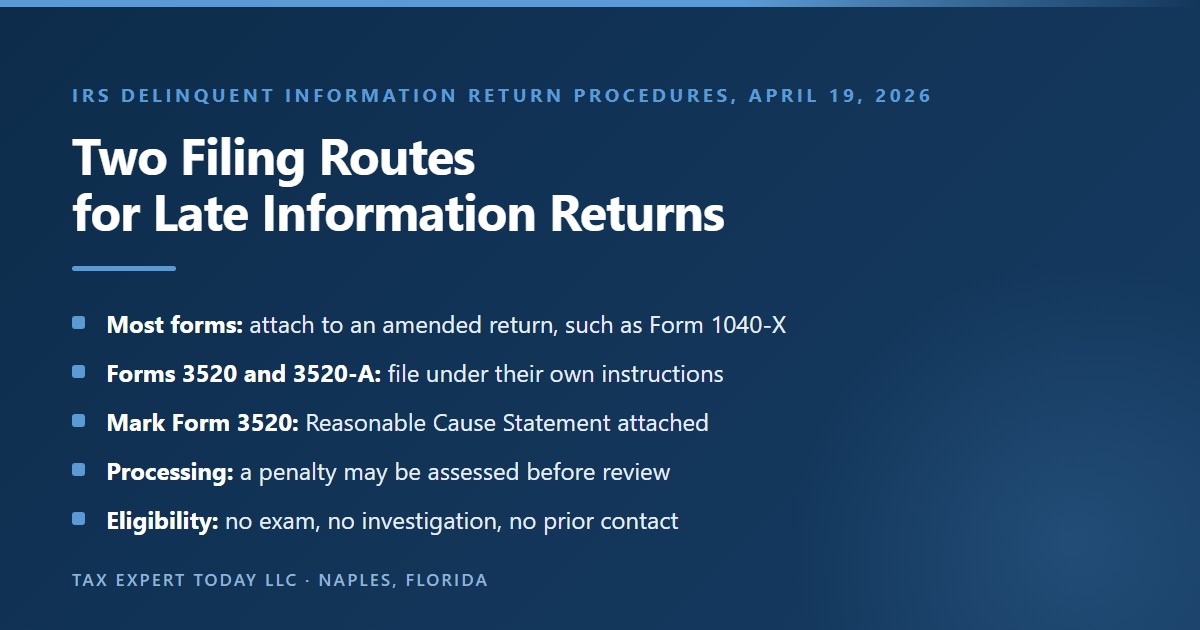
For every delinquent international information return other than Forms 3520 and 3520-A, the IRS says to attach the late form to an amended income tax return filed under that return’s instructions. For an individual that means Form 1040-X; for a corporation, Form 1120-X; for a partnership, its amended return or adjustment request process.
- Individuals: Form 1040-X with the late Form 5471, 8865, 8938, or 8621 attached.
- Corporations: Form 1120-X with the late form attached.
- One package per year: each tax year gets its own amended return and its own forms.
- Explain the change: the amended return explanation states that forms are being added.
- Reasonable cause: a separate statement may be attached to each late form.
The amended return requirement surprises people whose original return was correct. If nothing about the income or the tax changes, why amend? The answer is mechanical. The information return was supposed to be part of the original return, and the amended return is the IRS’s chosen vehicle for adding it. The amended return can show no change in tax. Its explanation section, Part II on Form 1040-X, is where you say that the return is being filed to include Form 5471 for a named foreign corporation, or Form 8938, that should have been attached to the original.
Practical steps for an individual filing a late Form 5471 through the amended return route generally look like this:
- Confirm the filing category for each year, because a Form 5471 filer can fall into different categories in different years as ownership changes.
- Gather the foreign corporation’s financial statements and convert them under the Form 5471 instructions, including the exchange rate rules.
- Prepare a complete Form 5471 and every required schedule for each year. An incomplete form can itself be treated as a failure.
- Prepare Form 1040-X for each year, with no change in tax if none applies, and an explanation stating that the form is being added.
- Prepare a reasonable cause statement for each form where reasonable cause is asserted, signed under penalties of perjury where the regulations require it.
- Assemble each year as its own package and file it where the Form 1040-X instructions direct, keeping proof of mailing or electronic acceptance.
- Calendar a follow up, because a penalty notice may arrive months later.
For Form 5471 the regulations add a specific requirement. The IRM notes that for failure to file Form 5471 the written reasonable cause statement must contain a declaration that it is made under the penalties of perjury, citing Treas. Reg. 1.6038-2(k)(3), and for Form 8865, Treas. Reg. 1.6038-3(k)(4). A statement without that declaration gives the IRS an easy reason to disregard it.
The IRM also notes that a late Form 5471 attached to a late corporate or partnership return can trigger a systemic penalty during processing, under penalty reference numbers 599 and 712, and that relief in that situation may be considered together with relief from the failure to file penalty on the related Form 1120 or Form 1065. That detail matters for small corporations that file the whole return late, because the two penalty questions can rise and fall together.
Why are Forms 3520 and 3520-A filed differently?
Forms 3520 and 3520-A are not attached to an amended return. The IRS says all delinquent Forms 3520 and 3520-A should be filed under the instructions for those forms, and that reasonable cause statements attached to them will be considered before a penalty is assessed, which is the one important exception to the assess first rule.
- Separate filing: Form 3520 goes to the address in its own instructions.
- Review first: reasonable cause is considered before assessment for these two forms.
- Mark the form: write “Reasonable Cause Statement attached” at the top of the first page.
- Owner responsibility: a United States owner can be liable when the foreign trust fails to file Form 3520-A.
- Large stakes: the penalty can be a percentage of the gift, transfer, or trust assets.
Form 3520 is never attached to the income tax return, even when it is filed on time. It is a separate return with its own due date and its own filing address, and Form 3520-A is the annual return of the foreign trust itself. The DIIRSP keeps that separation for late filings. The IRS page says that if you are attaching a reasonable cause statement to Form 3520 or Form 3520-A, you should write on the top of the first page of the form “Reasonable Cause Statement attached.” That small instruction is easy to miss, and it is the signal that routes the form for review.
The reason the IRS treats these two forms differently is not stated on the page, but the penalty structure suggests why it matters. Under section 6677(a), the penalty for a late Form 3520 reporting a transfer to or distribution from a foreign trust is the greater of $10,000 or 35 percent of the gross reportable amount. Under section 6677(b), the penalty for a foreign trust’s failure to file Form 3520-A, for which the United States owner is liable, uses 5 percent of the gross value of the portion of the trust’s assets treated as owned by that person. For a gift from a foreign person, section 6039F(c) imposes 5 percent of the gift for each month the failure continues, up to 25 percent. Those percentage penalties can be large relative to the underlying event, so a review before assessment is a meaningful difference.
The Form 3520 instructions add two limits on reasonable cause that matter for families with foreign trusts. They say that the fact that a foreign country would impose penalties for disclosing the required information is not reasonable cause, and that reluctance on the part of a foreign fiduciary, or provisions in the trust instrument that prevent disclosure, are not reasonable cause either. A statement that relies on those reasons is likely to fail.
For the mechanics of the form itself, including the $100,000 threshold that the instructions use for gifts and bequests from a nonresident alien individual or a foreign estate, see our Form 3520 guide.
What changed in the delinquent international information return procedures after 2020?
Before late 2020, the IRS page said penalties generally would not be imposed on delinquent information returns filed through the procedure with a reasonable cause statement. The current page says penalties may be assessed under existing procedures and may be assessed during processing without considering the attached reasonable cause statement, except for Forms 3520 and 3520-A.
- Earlier wording: reasonable cause statements were reviewed and penalties were generally not imposed.
- Current wording: penalties may be assessed in accordance with existing procedures.
- Processing step: a penalty may be assessed before the statement is read.
- Follow up: you may need to respond to correspondence and resubmit reasonable cause.
- Exception kept: Forms 3520 and 3520-A get review before assessment.
Many of the pages that still rank for this topic were written when the old wording applied, and they describe the procedure as if it were a near certain way to avoid penalties. Those descriptions no longer match the IRS text. The current page says: “During the processing of the delinquent information return, penalties may be assessed without considering the attached reasonable cause statement.” It continues that it “may be necessary for taxpayers to respond to specific correspondence from the IRS and submit or resubmit reasonable cause information.”
The practical result is a two stage process. Stage one is the filing, which should be complete, accurate, and accompanied by a well supported reasonable cause statement. Stage two is the response, if a penalty notice arrives, which uses the same statement and supporting documents to request abatement, and if needed, to take the matter to the IRS Independent Office of Appeals. Planning for stage two from the start, rather than treating it as a surprise, is the main difference between the procedure as it worked before 2020 and as it works in 2026.
| Feature | Older descriptions of the procedure | IRS page as updated April 19, 2026 |
|---|---|---|
| Penalty expectation | Generally no penalty if reasonable cause was shown | Penalties may be assessed under existing procedures |
| When reasonable cause is read | Before any penalty | Possibly only after assessment, except Forms 3520 and 3520-A |
| Taxpayer follow up | Rarely needed | May need to respond to correspondence and resubmit |
| Audit selection | Not automatic | Not automatic, but normal selection processes still apply |
| Forms 3520 and 3520-A | Filed separately | Filed separately, with review before assessment |
One part of the old description survives intact. The IRS page still says that amended returns, including amended information returns, will not be automatically subject to audit, but may be selected for audit through the existing audit selection processes that apply to any return. Filing late forms does not by itself open an examination.
Can penalties still be assessed when you file under the procedures?
Yes. Filing a delinquent international information return under the IRS procedures does not prevent a penalty. The IRS page says penalties may be assessed in accordance with existing procedures, and for most forms they may be assessed during processing, before anyone reads the reasonable cause statement you attached.
- No waiver: the page contains no promise that penalties will be waived.
- Automatic assessment: some late forms trigger a systemic penalty when processed.
- Notice: an assessed penalty generates a notice, often a CP15 for individuals or a CP215 for businesses.
- Relief still possible: reasonable cause can be raised after assessment.
- Forms 3520 and 3520-A: the review happens before assessment.
This is the single most important point for anyone planning a late filing in 2026. The procedure is still worth using, because the alternative is waiting for the IRS to find the missing forms, which removes the procedure entirely and often leaves the continuation penalty running. But the decision to file should be made with the expectation that a penalty notice is possible, and with a reasonable cause record ready to support a request for abatement.
IRM 20.1.9.3.2 describes the notices. Once a penalty for a late Form 5471 or 8865 is assessed, whether systemically, by a campus, or by an examiner’s Form 8278, a CP15, Notice of Penalty Charge, is generated for an individual, and a CP215 for a business. The notice is the start of the response stage, not the end of the matter.
What are the penalties for a late Form 5471, Form 8865, or Form 8938?
The initial penalty for a late Form 5471, Form 8865 under section 6038, or Form 8938 is $10,000 for each year. If the failure continues more than 90 days after the IRS mails a notice, an additional $10,000 applies for each 30 day period or fraction, up to $50,000 more, for a possible total of $60,000 per form per year.
- Initial penalty: $10,000 per annual accounting period or taxable year.
- Continuation penalty: $10,000 per 30 days after the 90 day notice period.
- Continuation cap: $50,000 for each failure.
- Form 5471 extra: a possible reduction of foreign tax credits under section 6038(c).
- Continuation reasonable cause: the IRM says there is no reasonable cause exception for the continuation penalty.
The figures come from the statutes. Section 6038(b)(1) imposes “a penalty of $10,000 for each annual accounting period” for failure to furnish the required information about a foreign business entity, and section 6038(b)(2) adds $10,000 for each 30 day period, or fraction, that the failure continues more than 90 days after the IRS mails notice, with the increase capped at $50,000. Section 6038D(d) uses the same structure for Form 8938. The Form 5471 instructions apply the penalty per foreign corporation, so an owner of three foreign companies who missed three years can face nine separate initial penalties.
The continuation penalty is the part to avoid at almost any cost, and it is the strongest argument for filing promptly. It begins only after the IRS mails a notice of the failure, and it runs only while the failure continues. A taxpayer who files before any notice is mailed does not reach it. A taxpayer who receives a notice and files within 90 days stops it before it starts. IRM 20.1.9.3.5 states that there is no reasonable cause exception for the continuation penalty, which makes the 90 day window very important.
Form 8938 has one additional rule worth knowing. Under section 6038D(e), if the IRS determines that you have an interest in specified foreign financial assets and you do not provide enough information to show their value, the assets are treated as exceeding the $50,000 threshold for purposes of the penalty. You cannot argue that you were under the threshold without records to show it. For the 2026 thresholds and who must file, see our guide comparing the FBAR and Form 8938; the Form 8938 instructions set the basic threshold for an unmarried taxpayer living in the United States at more than $50,000 on the last day of the year or more than $75,000 at any time during the year.
What are the penalty amounts for each late international information return?
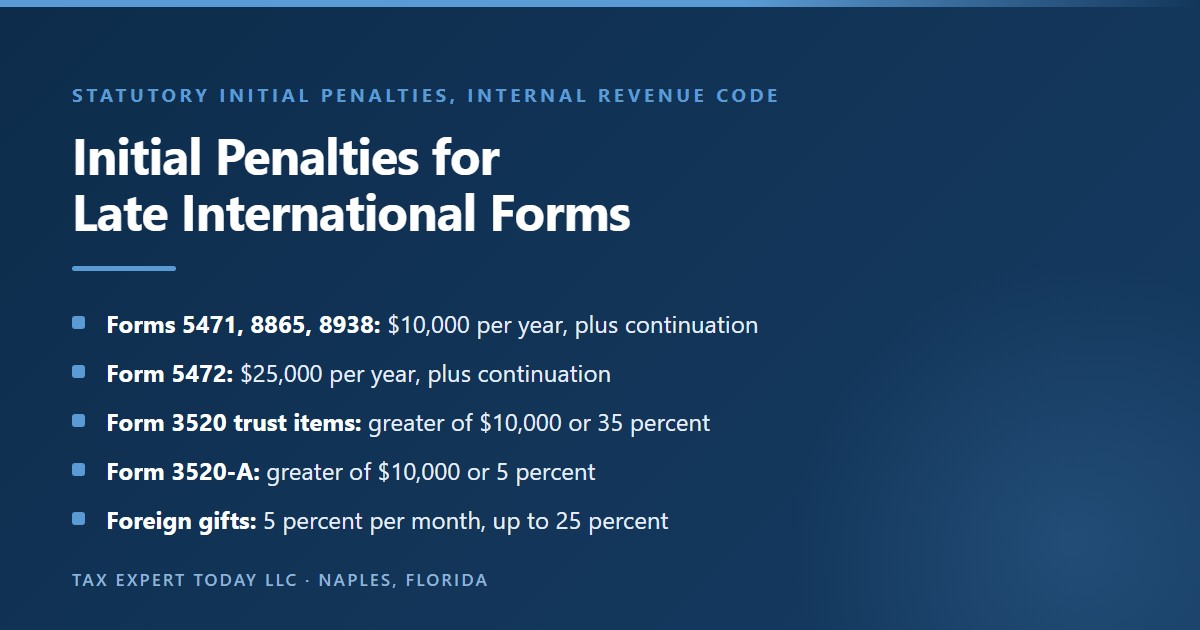
Penalties vary by form. Forms 5471, 8865, and 8938 carry a $10,000 initial penalty, Form 5472 carries $25,000, Form 3520 carries the greater of $10,000 or 35 percent of the reportable amount, Form 3520-A carries the greater of $10,000 or 5 percent of the owner’s share of trust assets, and unreported foreign gifts carry up to 25 percent.
- Fixed dollar penalties: Forms 5471, 5472, 8865, 8938, and 8858.
- Percentage penalties: Forms 3520 and 3520-A, and foreign gift reporting.
- Continuation penalties: most of these add amounts after a 90 day notice period.
- Per form, per year: each missing form and each year is generally a separate failure.
- Not tax: these penalties can apply even when no income tax is owed.
| Form | Initial penalty | Continuation after 90 days from notice | Source |
|---|---|---|---|
| Form 5471 (section 6038) | $10,000 per foreign corporation per year | $10,000 per 30 days, up to $50,000; plus foreign tax credit reduction | IRC 6038(b), (c) |
| Form 5471 Schedule O (section 6046) | $10,000 per reportable transaction | $10,000 per 30 days, up to $50,000 | IRC 6679(a) |
| Form 8865 (section 6038) | $10,000 per foreign partnership per year | $10,000 per 30 days, up to $50,000 | IRC 6038(b) |
| Form 8938 | $10,000 per year | $10,000 per 30 days, up to $50,000 | IRC 6038D(d) |
| Form 5472 | $25,000 per reporting corporation per year | $25,000 per 30 days, with no cap stated in the statute | IRC 6038A(d) |
| Form 3520 (trust transfers and distributions) | Greater of $10,000 or 35 percent of the gross reportable amount | $10,000 per 30 days, total limited to the gross reportable amount | IRC 6677(a), (c) |
| Form 3520-A (owner liable) | Greater of $10,000 or 5 percent of the owner’s share of trust assets | $10,000 per 30 days, total limited to the gross reportable amount | IRC 6677(a), (b) |
| Form 3520 Part IV (foreign gifts) | 5 percent of the gift for each month, up to 25 percent | Included in the monthly percentage | IRC 6039F(c) |
This table states the statutory structure only. Whether a penalty applies, and in what amount, depends on the facts, the filing category, the year, and any reasonable cause shown. For the FBAR side, which uses different penalty rules under Title 31, see our separate guide to FBAR penalties.
What is the penalty for a late Form 5472?
The penalty for a late or incomplete Form 5472 is $25,000 for each taxable year, with an additional $25,000 for each 30 day period the failure continues more than 90 days after IRS notice. Section 6038A(d) states no cap on the continuation penalty, which makes Form 5472 one of the most expensive forms to leave unfiled.
- Who files: 25 percent foreign owned United States corporations and foreign owned single member LLCs.
- Initial penalty: $25,000 per year, for tax years beginning after 2017.
- Continuation: $25,000 per 30 days after the 90 day period.
- Records too: the penalty also covers failure to maintain required records.
- Filed with Form 1120: including a pro forma Form 1120 for a disregarded entity.
Section 6038A(d)(1) imposes the $25,000 penalty when a reporting corporation fails to furnish the required information or fails to maintain the required records. Section 6038A(d)(2) adds $25,000 for each 30 day period the failure continues after the 90 day period. Unlike sections 6038, 6038D, and 6679, the text of section 6038A(d)(2) does not include a $50,000 limit. Section 6038A(d)(3) addresses reasonable cause by treating the time to furnish information, and the start of the 90 day period, as not earlier than the last day reasonable cause existed.
Form 5472 is common in Southwest Florida because many foreign buyers hold a condominium or rental home through a Florida or Delaware single member LLC. Since 2017, a foreign owned single member LLC is treated as a corporation for Form 5472 purposes and files the form with a pro forma Form 1120. IRM 20.1.9.5.1 notes that Form 5472 should not be filed independently and should be filed as an attachment to Form 1120, and IRM 20.1.9.5.5 addresses relief when a penalty is systemically assessed on a Form 5472 attached to a late Form 1120. For the details of who files and what counts as a reportable transaction, see our Form 5472 guide.
What is the penalty for a late Form 3520 or Form 3520-A?
A late Form 3520 reporting a transfer to or distribution from a foreign trust carries the greater of $10,000 or 35 percent of the gross reportable amount. A late Form 3520-A carries the greater of $10,000 or 5 percent of the owner’s share of trust assets. A late foreign gift report carries 5 percent per month, up to 25 percent.
- Transfers to a foreign trust: 35 percent of the gross value transferred.
- Distributions from a foreign trust: 35 percent of the gross distributions.
- Foreign grantor trust return: 5 percent of the owner’s portion of trust assets.
- Foreign gifts and bequests: 5 percent per month, capped at 25 percent.
- Reasonable cause: reviewed before assessment when filed under the procedures.
Section 6677(c) defines the gross reportable amount: the gross value of property involved in a transfer, the gross value of the portion of the trust’s assets treated as owned by the United States person for Form 3520-A failures, and the gross amount of distributions for distribution failures. The statute also limits the aggregate penalty so that it does not exceed the gross reportable amount, and requires a refund of any excess.
The foreign gift rule in section 6039F works differently. It does not tax the gift. It requires reporting, and if the gift is not reported on time, it allows the IRS to determine the tax consequences of the receipt and imposes 5 percent of the gift for each month the failure continues, up to 25 percent. Section 6039F(c)(2) provides that the penalty does not apply if the failure was due to reasonable cause and not willful neglect. A family in Naples receiving a large gift from a parent overseas has nothing to pay on the gift itself in most cases, but can face a significant penalty for not reporting it.
| Hypothetical event | Gross reportable amount | Statutory initial penalty before any relief |
|---|---|---|
| Transfer of $200,000 to a foreign trust, Form 3520 not filed | $200,000 | Greater of $10,000 or 35 percent, so $70,000 |
| Distribution of $20,000 from a foreign trust, not reported | $20,000 | Greater of $10,000 or 35 percent, so $10,000 |
| Foreign grantor trust holding $1,000,000, Form 3520-A not filed | $1,000,000 | Greater of $10,000 or 5 percent, so $50,000 |
| Gift of $400,000 from a parent abroad, reported 8 months late | $400,000 | 5 percent per month, capped at 25 percent, so $100,000 |
These figures are hypothetical illustrations of the statutory formulas and do not reflect any client’s matter or any result. They show why a reasonable cause statement that is reviewed before assessment, as the IRS page now promises for Forms 3520 and 3520-A, is worth preparing carefully.
What does the foreign tax credit reduction under section 6038(c) mean?
Section 6038(c) adds a second consequence for a late Form 5471. A person who fails to furnish the required information can lose 10 percent of the foreign taxes otherwise available for credit, with a further 5 percent for each three month period the failure continues after the 90 day notice period, subject to the limits in the statute.
- Initial reduction: 10 percent of foreign taxes available for credit under sections 901 and 960.
- Continuing reduction: 5 percent more for each 3 month period after the 90 days.
- Coordination: the dollar penalty and the credit reduction are coordinated under section 6038(c).
- Who feels it: owners of foreign corporations that pay meaningful foreign tax.
- Relief: the regulations provide for alleviation in certain cases.
The Form 5471 instructions describe the reduction: “Any person who fails to file or report all of the information required within the time prescribed will be subject to a reduction of 10% of the foreign taxes available for credit under sections 901 and 960.” They point to section 6038(c)(2) for limits and to Treas. Reg. 1.6038-1(j)(4) and 1.6038-2(k)(3) for alleviation in certain cases. For an individual whose foreign corporation pays a high rate of foreign tax, and who relies on the credit through the section 962 election or on distributions, this reduction can matter as much as the dollar penalty. Our guide to the foreign tax credit on Form 1116 explains how the credit itself works.
The hypothetical below shows only how the percentages in the Form 5471 instructions are applied. It ignores the coordination rules and limits in section 6038(c), which can reduce the result, and it does not describe any client matter.
| Hypothetical step | Foreign taxes available for credit | Reduction under the stated percentages |
|---|---|---|
| Form 5471 not filed when due | $40,000 | 10 percent, so $4,000 |
| Failure continues one 3 month period past the 90 days after notice | $40,000 | A further 5 percent, so $2,000 |
| Failure continues a second 3 month period | $40,000 | A further 5 percent, so $2,000 |
| Running total before statutory limits | $40,000 | $8,000 of credit lost, in addition to any dollar penalty |
Does first time abatement apply to international information return penalties?
No, not under the current IRM text. First time abatement under IRM 20.1.1.3.3.2.1 covers the failure to file penalties under sections 6651(a)(1), 6698(a)(1), and 6699(a)(1), the failure to pay penalties, and the failure to deposit penalty. The international information return penalties under sections 6038, 6038A, 6038D, 6039F, 6677, and 6679 are not on that list.
- Covered by first time abatement: failure to file, failure to pay, failure to deposit.
- Also covered: the partnership and S corporation late filing penalties under 6698 and 6699.
- Not listed: the international information return penalties.
- What remains: reasonable cause, and the statutory exceptions in each section.
- Related returns: relief on a late Form 1120 or 1065 can affect a systemic Form 5471 penalty.
The IRM section on first time abatement lists the penalties it reaches: the failure to file penalty under IRC 6651(a)(1), 6698(a)(1), or 6699(a)(1), the failure to pay penalty under 6651(a)(2) and 6651(a)(3), and the failure to deposit penalty under 6656. International information return penalties are handled in IRM 20.1.9 and rely on reasonable cause instead. That is why a person who has never had a penalty before cannot simply request a first time waiver of a $10,000 Form 5471 penalty. Our guide to first time penalty abatement explains when that waiver does apply.
There is one connection worth knowing. Where a Form 5471 penalty was systemically assessed because the form was attached to a late Form 1120 or Form 1065, IRM 20.1.9.3.5 says penalty relief may be considered in conjunction with the failure to file penalty relief granted on the related return. If the late corporate or partnership return penalty is abated for reasonable cause, the IRM describes considering the related Form 5471 penalty in the same way. This is a narrow rule, but it matters for small foreign owned or foreign owning entities that filed an entire return late.
What is a reasonable cause statement for a late information return?
A reasonable cause statement is a written explanation, attached to each late form, showing that the failure to file on time was due to reasonable cause and not willful neglect. It sets out the facts, dates, and steps taken after discovery, and for Forms 5471 and 8865 it must be made under penalties of perjury.
- One per form: the IRS page says a statement may be attached to each delinquent return.
- Facts, not conclusions: the IRM calls for an affirmative showing of all facts alleged.
- Perjury declaration: required for Forms 5471 and 8865 by the regulations.
- Ordinary business care: the standard is whether you exercised ordinary care and prudence.
- Reuse later: the same statement supports a response or an appeal if a penalty is assessed.
IRM 20.1.9.3.5 states the requirement for Form 5471: “To show that reasonable cause exists, the person required to report such information must make an affirmative showing of all facts alleged as reasonable cause for such failure in a written statement.” It adds that for failure to file Form 5471, the statement must contain a declaration that it is made under the penalties of perjury. The IRM also recommends that reasonable cause not be considered for any year until all delinquent returns have been filed, so a statement for one year is weaker if other years remain missing.
The reasonable cause standard for international information returns draws on the general framework the IRS uses for penalties: whether the taxpayer exercised ordinary business care and prudence and was nonetheless unable to comply. Our guide to reasonable cause for IRS penalties walks through that framework in general terms. For international forms, the most common facts that support reasonable cause are reliance on a qualified professional who was given complete information and did not advise that the form was required, a lack of knowledge of a complex filing requirement combined with prompt action once it was learned, and serious illness or disaster during the filing period.
Reliance on a professional is the fact pattern seen most often, and it is also the one the IRS examines most closely. Generally the statement should show who the adviser was, what qualifications they had, what information you gave them about the foreign company, trust, or account, what they told you, and that you followed their advice. A statement that says only that “my preparer did not tell me” without showing that the preparer was told about the foreign interest is weak.
What should a reasonable cause statement include?
A strong reasonable cause statement identifies the form, the year, and the entity; describes the facts that prevented timely filing; shows when and how the requirement was discovered; explains the steps taken to comply afterward; attaches supporting documents; and ends with a penalties of perjury declaration signed by the person required to file.
- Identification: form number, tax year, entity name, and identifying numbers.
- Timeline: when the foreign interest began and when the requirement was learned.
- The cause: the specific facts, not a general claim of confusion.
- The cure: what you did after discovery and how quickly.
- Evidence: engagement letters, emails, medical records, or other documents.
| Element | What it shows | Typical supporting document |
|---|---|---|
| Identification of the failure | Which form, which year, which foreign entity or trust | The late form itself and the amended return |
| History of the foreign interest | How and when you acquired it, and whether it produced income | Inheritance papers, share certificates, trust deed, account opening records |
| Income compliance | That the related income was reported on the original returns | Original returns and foreign statements |
| Reason for the failure | The specific facts that prevented filing despite ordinary care | Engagement letters, preparer questionnaires, correspondence |
| Discovery | When and how you learned of the requirement | An email, a new adviser’s letter, a bank notice |
| Prompt correction | That you filed every missing year without unreasonable delay | Dates of engagement and filing |
| Declaration | That the statement is true under penalties of perjury | Signed declaration by the person required to file |
The statement should be written plainly and honestly. It should not overstate. A reasonable cause statement that is later contradicted by documents can do more harm than no statement at all, and an untrue declaration made under penalties of perjury creates its own exposure. If the facts do not support reasonable cause, the right response is to understand that before filing, not to write around it.
What does not count as reasonable cause for a late international form?
Reasons that usually do not establish reasonable cause include a foreign country’s secrecy or privacy laws, a foreign trustee’s refusal to provide information, trust terms that bar disclosure, simple forgetfulness, and reliance on an adviser who was never told about the foreign interest. The Form 3520 instructions and section 6677(d) say the first three expressly.
- Foreign penalties for disclosure: expressly not reasonable cause under section 6677(d).
- Foreign fiduciary reluctance: expressly not reasonable cause under the Form 3520 instructions.
- Trust instrument limits: expressly not reasonable cause for Forms 3520 and 3520-A.
- Adviser not informed: reliance generally requires full disclosure to the adviser.
- No other filings fixed: the IRM suggests full compliance first.
The statutory language for foreign trust penalties is direct. Section 6677(d) provides that the fact that a foreign jurisdiction would impose a civil or criminal penalty on the taxpayer, or any other person, for disclosing the required information is not reasonable cause. The Form 3520 instructions repeat that point and add that reluctance on the part of a foreign fiduciary, or provisions in the trust instrument that prevent disclosure, are not reasonable cause either.
Ignorance of the law is a more nuanced area. Courts and the IRS have generally held that not knowing about a filing requirement is not, by itself, reasonable cause. But lack of knowledge can be one fact among others, such as limited education about tax, a complex and unusual requirement, reliance on a professional, and prompt action once the requirement became known. A statement that rests on ignorance alone is weak. A statement that shows ignorance plus ordinary care, such as giving the foreign information to a qualified preparer who did not advise filing, is stronger.
The table below sets the common explanations side by side with how they tend to be treated. It summarizes the statute, the Form 3520 instructions, and the general reasonable cause framework, and it is not a prediction for any particular case.
| Explanation offered | General treatment | Source or basis |
|---|---|---|
| Foreign law penalizes disclosure | Not reasonable cause for foreign trust penalties | IRC 6677(d); Form 3520 instructions |
| Foreign trustee would not provide information | Not reasonable cause | Form 3520 instructions |
| Trust instrument prevents disclosure | Not reasonable cause | Form 3520 instructions |
| Did not know the form existed, nothing more | Generally weak on its own | General reasonable cause framework |
| Relied on a qualified preparer who had full information | Can support reasonable cause, depending on the facts | General reasonable cause framework |
| Serious illness or disaster during the filing period | Can support reasonable cause, depending on the facts and timing | General reasonable cause framework |
| Some years still unfiled | Weakens the request under the IRM approach | IRM 20.1.9.3.5 and 20.1.9.2 |
Why does the open statute under section 6501(c)(8) matter?
Section 6501(c)(8) keeps the assessment period open for a tax return when a required international information return is missing. The IRS generally has until three years after the missing information is furnished to assess tax for the related return, event, or period. Filing the delinquent form is what starts that three year clock.
- Forms covered: information required under sections 6038, 6038A, 6038B, 6038D, 6046, 6046A, and 6048.
- PFIC items too: elections under section 1295(b) and reporting under section 1298(f).
- Start of the clock: three years after the IRS is furnished the required information.
- Scope: the whole return, unless the failure was due to reasonable cause.
- Practical effect: an old year with a missing form can stay open indefinitely.
The statute’s text reads that for information required to be reported under the listed sections, “the time for assessment of any tax imposed by this title with respect to any tax return, event, or period to which such information relates shall not expire before the date which is 3 years after the date on which the Secretary is furnished the information required to be reported under such section.” In practice this means a 2019 return with a missing Form 5471 can remain open in 2026 and beyond, not only for the foreign corporation items but potentially for the entire return.
That is one of the strongest reasons to file a delinquent international information return even when you expect a penalty notice. Without the filing, the year never closes. With the filing, the three year period begins and the year can eventually be closed. For families who want certainty before a sale, a move, an estate plan, or a gift, closing old years has value of its own. See our guide to Form 8865 for an example of how the same rule applies to foreign partnership interests.
Is the section 6501(c)(8) extension limited when there is reasonable cause?
Yes. Section 6501(c)(8)(B) provides that if the failure to furnish the information was due to reasonable cause and not willful neglect, the open assessment period applies only to the item or items related to the failure, rather than to the whole return. Reasonable cause therefore narrows the open statute as well as supporting penalty relief.
- Without reasonable cause: the whole return can stay open.
- With reasonable cause: only the related items stay open.
- Same facts, two benefits: one statement can support both results.
- Burden: the taxpayer generally needs to show the reasonable cause facts.
- Timing: the three year clock still starts only when the information is furnished.
This second benefit is often missed. A reasonable cause statement is usually thought of as a tool to avoid a penalty, but under section 6501(c)(8)(B) it also limits how much of an old return remains open to assessment. A taxpayer who reported all income correctly and who has a sound reasonable cause basis has a strong interest in documenting it, because it reduces both the penalty risk and the scope of the open year.
| Scenario | Assessment period for the related return | Scope of what stays open |
|---|---|---|
| Form timely filed and complete | Generally three years from the return filing | Normal rules |
| Form never filed | Open until three years after the form is furnished | Potentially the entire return |
| Form filed late, no reasonable cause | Three years after the late filing | Potentially the entire return until then |
| Form filed late, reasonable cause shown | Three years after the late filing | Only the items related to the failure |
What happens after you file a delinquent international information return?
After you file, the IRS processes the amended return and the late forms. For most forms, a penalty may be assessed during processing, which generates a notice such as a CP15 or CP215. For Forms 3520 and 3520-A, the reasonable cause statement is reviewed first. The return may also be selected for audit through ordinary selection processes.
- Processing: the amended return and forms are entered and reviewed.
- Possible penalty: assessed under existing procedures, sometimes systemically.
- Notice: a CP15 for individuals or CP215 for businesses, as the IRM describes.
- Correspondence: the IRS may ask for or re-request reasonable cause information.
- Audit: not automatic, but possible through normal selection.
Processing times for amended returns and paper information returns vary and can be long. Many people hear nothing for months. That silence is not a sign that the matter is closed. Keep the full package, proof of filing, and a dated file of everything sent, and keep the mailing address on file with the IRS current so that a notice reaches you. The 90 day window that matters for continuation penalties runs from the date the IRS mails a notice, not the date you read it.
If a notice arrives, read it carefully. It will identify the penalty reference, the form, the year, and the amount. Compare it with what you filed. Sometimes a notice reflects a form that was received but not matched, a missing schedule, or an assessment that did not consider the statement that was attached. Each of those calls for a slightly different response.
A simple file plan keeps the later steps manageable. The items below are what most representatives ask for first when a notice arrives on a matter they did not prepare.
| Keep in the file | Why it matters later |
|---|---|
| A full copy of each amended return and late form as filed | Shows exactly what the IRS received |
| The signed reasonable cause statement for each form | Restated in any abatement request or appeal |
| Proof of mailing or electronic acceptance | Fixes the date the information was furnished for 6501(c)(8) |
| Supporting documents cited in the statement | The evidence behind each factual claim |
| A dated log of IRS correspondence | Tracks response periods and the 90 day window |
| Form 2848 for any representative | Allows the representative to speak with the IRS |
How do you respond to an international information return penalty notice?
To respond to an international penalty notice, generally reply in writing by the date on the notice, request abatement based on reasonable cause, enclose the original reasonable cause statement and supporting documents, and ask for Appeals consideration if the request is denied. The IRM describes a prepayment, post assessment appeal process for all international penalties.
- Read the notice: confirm the form, year, penalty section, and amount.
- Respond on time: follow the response date and address on the notice.
- Request abatement: rely on the reasonable cause facts and documents.
- Preserve appeal rights: ask for Appeals if the request is not granted.
- Consider collection: an assessed penalty can move into collection if ignored.
A written response usually works better than a phone call for these penalties, because the IRS needs a record of the reasonable cause facts. Some practitioners use Form 843, Claim for Refund and Request for Abatement, where it applies; others respond directly to the notice by letter. The Form 843 instructions describe when that form is used to request abatement of a penalty. Either way, the response should restate the reasonable cause facts, attach the statement that was filed with the forms, and attach the supporting documents.
Ignoring a penalty notice is the worst option. An assessed penalty is a liability that can accrue interest and move into collection, including notices of intent to levy. If the matter reaches that stage, our guide to the collection due process hearing explains one of the procedural protections available. For a general view of how penalty relief requests are reviewed, see how IRS penalties are reviewed for relief. Outcomes depend on the facts, and no response can promise that a penalty will be abated.
Can you appeal an international information return penalty?
Yes. IRM 20.1.9 states that the IRS Independent Office of Appeals provides a prepayment, post assessment appeal process for all international penalties, and an accelerated process for certain international penalties. You generally do not have to pay the penalty first to ask Appeals to consider it.
- Prepayment: the appeal can be requested before the penalty is paid.
- Post assessment: the appeal comes after the penalty has been assessed.
- Accelerated track: IRM 8.11.5.14 describes accelerated Appeals consideration for certain penalties.
- Written request: the IRM refers to the taxpayer’s written request for appeal.
- Independent review: Appeals is separate from the function that assessed the penalty.
The IRM text is specific: “Appeals currently provides a prepayment, post assessment appeal process for all international penalties. See IRM 8.11.5, Penalties Worked in Appeals, International Penalties. Also, Appeals provides for an accelerated process for certain international penalties.” The IRS Independent Office of Appeals describes its role as resolving disputes without litigation on a basis that is fair and impartial to both the government and the taxpayer.
An appeal is where a well documented reasonable cause record does its most important work. Appeals officers review the facts, the law, and in appropriate cases the hazards of litigation. They are not bound by the systemic assessment. A reasonable cause statement written at filing time, supported by documents, and restated in the appeal request, gives the appeals officer something concrete to evaluate. Results vary with the facts, and an appeal is a review, not an assurance of any outcome.
Can the Tax Court review international information return penalties?
Generally not before assessment. International information return penalties are not subject to the deficiency procedures that allow a Tax Court petition before assessment. Review usually comes through Appeals, a collection due process hearing that can lead to Tax Court, or a refund suit after payment. The Farhy line of cases adds an open question for section 6038(b).
- No deficiency notice: section 6679(b) and the IRM confirm deficiency procedures do not apply.
- Appeals first: the administrative prepayment appeal.
- Collection hearing: a collection due process hearing can raise some challenges.
- Refund route: pay, claim a refund, and sue in a refund forum.
- Assessment authority: disputed for the section 6038(b) penalty in some circuits.
IRM 20.1.9.2 states that “deficiency procedures under Subchapter B of Chapter 63 … do not apply to penalties discussed in this section.” Section 6679(b) says the same for the section 6046 and 6046A penalty. That means the IRS can assess these penalties without first issuing a notice of deficiency, and the usual prepayment Tax Court petition is not available. A collection due process hearing, after a notice of federal tax lien or a notice of intent to levy, can sometimes allow a taxpayer to challenge the underlying liability if they did not have a prior opportunity to dispute it, and a determination in that hearing can be reviewed by the Tax Court. The rules on what counts as a prior opportunity are technical.
The routes for disputing an assessed international penalty are summarized below. Each has its own timing rules and procedural requirements, and the choice among them is usually made with a representative.
| Review path | When it is used | Payment first? |
|---|---|---|
| Abatement request to the assessing function | Right after a CP15, CP215, or similar notice | No |
| IRS Independent Office of Appeals | After assessment, if abatement is denied or as a direct request | No, under the prepayment process in IRM 20.1.9 |
| Collection due process hearing | After a lien notice or notice of intent to levy | No; Tax Court review of the determination may follow |
| Refund claim and refund suit | After paying the penalty and having the claim denied or not acted on | Yes |
What is the Farhy and Mukhi assessment question?
In Farhy v. Commissioner (2023), the Tax Court held that the IRS lacked statutory authority to assess the section 6038(b) penalty for a late Form 5471. The D.C. Circuit reversed in 2024. In Mukhi v. Commissioner (2024), the Tax Court kept its view for taxpayers whose appeals go to other circuits. The question is not settled nationally.
- Farhy, Tax Court, 2023: section 6038(b) penalty not assessable.
- Farhy, D.C. Circuit, 2024: reversed, penalty assessable.
- Mukhi, Tax Court, 2024: continued to hold the penalty not assessable outside the D.C. Circuit.
- Appeal: the government sought reversal in the Eighth Circuit.
- Status check: confirm the current law in your circuit before relying on it.
The issue is narrow. It concerns whether the IRS may assess the section 6038(b) penalty, as it does with most penalties, or must instead sue in court to collect it. It does not change whether Form 5471 is required or whether the penalty can be imposed at all. For a taxpayer in Florida, appeals go to the Eleventh Circuit, and we could not confirm a ruling from the Eleventh Circuit or the Eighth Circuit on this question as of November 22, 2026. Because the law can change quickly, treat this as a question for counsel to check at the time a penalty is disputed, not as a reason to delay filing. The section 6501(c)(8) open statute and the continuation penalty both still apply.
| Date | Development | Effect on taxpayers |
|---|---|---|
| 2023 | Tax Court decides Farhy: no assessment authority for the section 6038(b) penalty | Raised the question nationally |
| 2024 | D.C. Circuit reverses Farhy | Penalty treated as assessable for appeals to the D.C. Circuit |
| 2024 | Tax Court decides Mukhi, keeping its view for appeals outside the D.C. Circuit | Split continues |
| As of November 22, 2026 | No Eleventh Circuit ruling confirmed in our research | Florida taxpayers should have counsel check current status |
Should you use the delinquent information return procedures or the streamlined procedures?
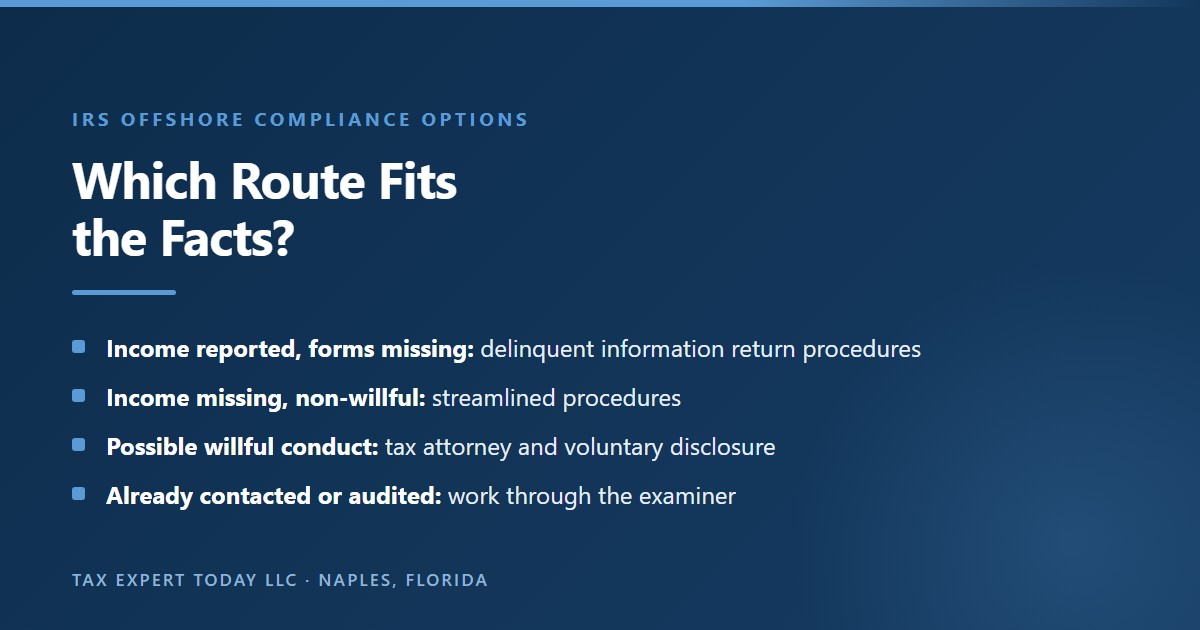
Use the delinquent international information return procedures when all income was reported and only forms are missing. Use the streamlined procedures when the failure also involved unreported foreign income and unpaid tax, and the conduct was non-willful. Streamlined requires a non-willful certification and, for domestic filers, a 5 percent miscellaneous offshore penalty.
- Missing forms only: delinquent information return procedures.
- Missing income, non-willful: streamlined domestic or foreign offshore procedures.
- Possible willful conduct: counsel and the voluntary disclosure practice.
- Individuals only: streamlined is designed for individuals and their estates.
- No examination: both routes are closed if a civil examination has started.
| Feature | Delinquent information return procedures | Streamlined filing compliance procedures |
|---|---|---|
| Core situation | Income reported, information returns missing | Foreign income unreported or tax unpaid, conduct non-willful |
| Who can use it | Individuals and entities | Individuals and estates of individuals |
| Certification | None required; reasonable cause statement optional | Non-willful certification under penalties of perjury |
| Penalty framework | Normal penalties may be assessed; reasonable cause may be asserted | Terms set out on the IRS streamlined page |
| Examination or contact | Not available after examination or contact about the forms | Not available after a civil examination of any year |
| Prior quiet disclosures | Not addressed | Prior penalty assessments will not be abated |
The IRS streamlined page, last reviewed July 11, 2026, says taxpayers using either streamlined route must certify that their failure to report all income, pay all tax, and submit all required information returns, including FBARs, was due to non-willful conduct, defined as negligence, inadvertence, or mistake, or conduct resulting from a good faith misunderstanding of the law. Streamlined is not a better version of the delinquent information return route. It is a different route for a different problem, and it should never be used to cover conduct that was not non-willful. Our streamlined procedures guide covers the certification, the look back period, and the miscellaneous offshore penalty in detail.
When is the voluntary disclosure practice the right conversation?
The IRS Criminal Investigation Voluntary Disclosure Practice is for taxpayers concerned that their failure to report income, pay tax, or file required returns was willful and who want to address potential criminal exposure. If willfulness is a real possibility, speak with a qualified tax attorney before filing anything through the delinquent information return or streamlined routes.
- Willfulness concern: the threshold question that routes the matter.
- Attorney first: privilege and strategy considerations apply.
- Preclearance: the practice begins with Form 14457, Part I.
- Not for missing forms only: most delinquent form cases do not need it.
- Do not self-certify: a non-willful certification must be true.
The IRS Criminal Investigation Voluntary Disclosure Practice page, last reviewed July 20, 2026, describes a process that begins with a preclearance request on Form 14457. It is a serious process with its own penalty framework, and it is not the subject of this guide. We mention it because the IRS lists it alongside the delinquent information return and streamlined procedures as one of the three offshore compliance options, and choosing the wrong route can cause lasting harm. Where facts suggest willful conduct, the right first step is a confidential conversation with a tax attorney, not a filing.
| Option listed by the IRS | Typical situation | First step |
|---|---|---|
| Delinquent international information return procedures | Income reported, information returns missing | Prepare complete forms and amended returns |
| Streamlined filing compliance procedures | Unreported foreign income or unpaid tax, non-willful conduct | Evaluate eligibility and the non-willful certification |
| Criminal Investigation Voluntary Disclosure Practice | Concern that the conduct was willful | Confidential consultation with a tax attorney |
How does this route relate to late FBARs now that the delinquent FBAR procedures ended?
The delinquent international information return procedures cover tax forms such as Forms 5471, 8938, and 3520. They have never covered the FBAR. The separate Delinquent FBAR Submission Procedures ended in 2026, and the IRS page for them now returns a not found error, so late FBARs follow the general late filing guidance instead.
- Tax forms: this guide, the delinquent information return procedures.
- FBAR: a separate report under Title 31, filed with FinCEN.
- DFSP: ended in 2026; the IRS page returned 404 when checked on November 22, 2026.
- Both late: two filings, two sets of rules, often one reasonable cause story.
- Unreported income: streamlined can address FBARs and tax forms together.
Many families have both problems at once: a late FBAR for a foreign account and a late Form 8938 for the same account, or a late Form 5471 and a late FBAR for the foreign company’s bank account over which they have signature authority. The two are filed separately. The FBAR goes to FinCEN through the BSA E-Filing System with the late filing reason explained on the form. The Form 8938 or 5471 goes to the IRS with an amended return. See our guides on filing a late FBAR and the FBAR deadline for 2026 accounts for the FBAR side, and our pillar guide Do I need to file an FBAR? if you are unsure whether an FBAR was ever required.
The two filings should tell a consistent story. If the reasonable cause statement for a late Form 8938 says the account was opened in 2021 and the late FBAR says 2019, the inconsistency will be noticed. Prepare both from the same documents and the same timeline.
What if the IRS has already contacted you about the missing forms?
If the IRS has already contacted you about the delinquent information returns, or has opened a civil examination or criminal investigation, the delinquent international information return procedures are not available. The forms usually still need to be filed, but through the examiner or in response to the contact, and the 90 day continuation penalty window may already be running.
- Route closed: prior contact about the forms ends eligibility.
- Exam open: work through the examiner on the missing forms.
- Clock running: continuation penalties begin 90 days after a notice is mailed.
- Representation: a Form 2848 lets a representative speak with the IRS.
- Reasonable cause still matters: it can be raised in the exam and in Appeals.
The IRM describes field examiners asserting these penalties on Form 8278 when they determine that the information return was required and was not timely or completely filed. At that stage the case is in the examination process, and the goal is usually to provide the complete forms quickly, document reasonable cause, and preserve appeal rights. The streamlined procedures are also unavailable once a civil examination of any year has begun, so the choice of route narrows considerably after contact. This is the clearest reason to act before contact rather than after.
How do you file a late Form 8938?
A late Form 8938 is attached to Form 1040-X for each year it was required, under the delinquent international information return procedures, with a reasonable cause statement if reasonable cause is asserted. The penalty is $10,000 per year under section 6038D, and the IRS can presume assets exceeded $50,000 if you cannot show their value.
- Vehicle: Form 1040-X with Form 8938 attached.
- Thresholds: more than $50,000 at year end or $75,000 at any time for an unmarried filer in the United States.
- Value proof: keep year end and maximum value records for each asset.
- Same accounts, two reports: many Form 8938 assets also appear on the FBAR.
- Open statute: section 6501(c)(8) lists section 6038D.
Form 8938 is the Foreign Account Tax Compliance Act report that individuals attach to the income tax return. It covers specified foreign financial assets, which include foreign bank and brokerage accounts but also some assets the FBAR does not cover, such as a directly held interest in a foreign partnership or foreign stock held outside an account. The thresholds are higher than the FBAR’s $10,000 aggregate test and depend on filing status and whether you live abroad. Because Form 8938 is part of the return, a late one goes through the amended return route like Form 5471.
The valuation records matter more than people expect. Under section 6038D(e), if the IRS determines that you have an interest in specified foreign financial assets and you do not provide enough information to demonstrate their aggregate value, the assets are treated as exceeding $50,000 for penalty purposes. An argument that you were under the threshold depends on having statements that show it. Our FBAR versus Form 8938 guide sets out the thresholds by filing status and the overlap between the two reports.
| Filer, per Form 8938 instructions | Last day of the year | Any time during the year |
|---|---|---|
| Unmarried, living in the United States | More than $50,000 | More than $75,000 |
| Married filing jointly, living in the United States | More than $100,000 | More than $150,000 |
| Married filing separately, living in the United States | More than $50,000 | More than $75,000 |
| Taxpayers living abroad | Higher thresholds set in the instructions | Higher thresholds set in the instructions |
Check the current Form 8938 instructions for the abroad thresholds and for specified domestic entities before relying on any figure, because the thresholds for those groups differ from the domestic individual figures above.
How do you file a late Form 8865?
A late Form 8865 for a foreign partnership interest is attached to an amended income tax return under the delinquent information return procedures. The section 6038 penalty is $10,000 per partnership per year, with the same continuation structure as Form 5471, and the reasonable cause statement for Form 8865 must carry a penalties of perjury declaration under Treas. Reg. 1.6038-3(k)(4).
- Vehicle: amended return with Form 8865 attached.
- Penalty: $10,000 per foreign partnership per year under section 6038(b).
- Transfers: section 6038B covers certain transfers to a foreign partnership.
- Acquisitions: section 6046A covers acquisitions and dispositions, with a separate penalty under section 6679.
- Canadian entities: classification questions often decide whether the form is required.
Form 8865 is common for Southwest Florida residents who hold interests in Canadian or European partnerships, including some foreign entities that are treated as partnerships under the United States classification rules even when they look like corporations locally. Whether a filing was required at all can depend on how the entity is classified, which is covered in detail in our Form 8865 guide. When a Form 8865 is late, the route is the same as for Form 5471: one amended return per year, a complete form for each partnership and year, and a signed reasonable cause statement for each.
How do you file a late Form 8621 for a PFIC?
A late Form 8621 for a passive foreign investment company is generally attached to an amended return for each year it was required. Section 1298(f) requires the annual report, and section 6501(c)(8) lists section 1298(f) and PFIC elections among the items that keep the assessment period open until the information is furnished.
- Common source: foreign mutual funds and pooled investment products.
- Open statute: the related return stays open until Form 8621 is filed.
- Tax may change: unlike many forms, a late PFIC filing can change the tax computation.
- Elections: late elections have their own rules and are a separate question.
- Amended return: the vehicle under the delinquent information return route.
Form 8621 is different from most of the forms in this guide because a PFIC often changes the income tax itself. If a foreign fund was held without an election, the excess distribution rules can apply when gains or distributions are recognized, and that changes the tax computation. That means a late Form 8621 filing can turn into an amended return that reports additional tax, which raises the question of whether the delinquent information return route or the streamlined route is the better fit. Our Form 8621 and PFIC guide explains the default rules and elections. Where tax was understated because of PFIC treatment and the conduct was non-willful, the streamlined procedures are often the route to evaluate.
Who has to file Form 5471 in the first place?
Form 5471 is generally required from United States persons in five categories: certain shareholders of section 965 specified foreign corporations, officers and directors of foreign corporations in which a United States person acquired 10 percent, United States persons who acquire 10 percent, persons who control a foreign corporation, and United States shareholders of controlled foreign corporations.
- Category 1: United States shareholders of section 965 specified foreign corporations, with sub-categories.
- Category 2: officers or directors when a United States person acquires the 10 percent stock ownership requirement.
- Category 3: United States persons who acquire stock meeting the 10 percent requirement.
- Category 4: United States persons who control the foreign corporation.
- Category 5: United States shareholders of controlled foreign corporations.
The categories decide which schedules are required, and a filer can fall into more than one category in the same year. A Naples resident who inherited 30 percent of a family company might be a Category 3 filer in the year of the inheritance and, depending on how much of the company other United States persons own, a Category 5 filer if the company is a controlled foreign corporation. The Form 5471 instructions describe each category in detail, and our Form 5471 guide walks through them with examples. Getting the category right matters for a late filing because an incomplete form can be treated as a failure in its own right.
| Category | Who it generally covers | Typical late filing situation |
|---|---|---|
| 1 | United States shareholders of section 965 specified foreign corporations | Older structures still carrying section 965 history |
| 2 | United States citizen or resident officers and directors, when a United States person acquires 10 percent | A director of a family company abroad |
| 3 | United States persons who acquire stock meeting the 10 percent requirement | An inheritance or purchase of 10 percent or more |
| 4 | United States persons who control the foreign corporation | A business owner who formed a foreign company |
| 5 | United States shareholders of controlled foreign corporations | Family members who together own more than 50 percent |
How is the 90 day continuation penalty window counted?
The continuation penalty window begins on the day the IRS mails a notice of the failure. If the failure continues more than 90 days after that date, an additional penalty applies for each 30 day period or fraction of a period. Filing complete information within 90 days of the mailing date generally prevents the continuation penalty from starting.
- Start date: the mailing date of the IRS notice, not the date you receive it.
- Grace period: 90 days to furnish the information.
- Increments: each 30 day period, or fraction, after the 90 days.
- Caps: $50,000 for sections 6038, 6038D, and 6679; no stated cap in section 6038A(d)(2).
- No reasonable cause: the IRM says the continuation penalty has no reasonable cause exception for Form 5471.
| Hypothetical timeline for one late Form 5471 | Date | Continuation penalty status |
|---|---|---|
| IRS mails notice of the failure | March 1 | 90 day period begins |
| Complete form furnished | May 15 | Within 90 days, no continuation penalty |
| Alternative: form furnished | June 10 | Past 90 days by about 11 days, one 30 day period, $10,000 |
| Alternative: form furnished | September 15 | About four 30 day periods or fractions, $40,000 |
| Alternative: form never furnished | Ongoing | Continues until the $50,000 cap is reached |
The dates in this table are hypothetical and are meant only to show the counting method under section 6038(b)(2). The exact count in a real case depends on the mailing date on the notice. Because the window is short and the IRM says there is no reasonable cause exception for the continuation penalty, a notice about a missing international form should be treated as urgent.
How far back should you file delinquent international information returns?
The IRS delinquent information return page sets no fixed look back period. Because section 6501(c)(8) keeps a year open until the required information is furnished, and the IRM recommends considering reasonable cause only after all delinquent returns are filed, filers often file every year for which the form was required, after professional review.
- No stated limit: the IRS page does not limit the years.
- Open years: any year with a missing form can remain open.
- Full compliance: the IRM points toward filing all delinquent years.
- Streamlined differs: streamlined has its own defined covered period.
- Judgment call: very old years may raise record and cost questions.
This is one of the practical differences between the two routes. The streamlined procedures define a specific covered period of recent tax returns and FBARs. The delinquent information return procedures do not. In theory, every year a form was required and not filed is a year whose assessment period remains open under section 6501(c)(8). In practice, filers and their advisers weigh the open statute, the availability of records, the size of potential penalties, and the IRM’s statement that reasonable cause is generally not considered until all delinquent returns are filed. This is a decision to make with a professional who has seen the full facts.
| Consideration | Points toward filing more years | Points toward caution |
|---|---|---|
| Open statute under 6501(c)(8) | Each unfiled year stays open | Not applicable |
| IRM full compliance guidance | Reasonable cause is weaker with years missing | Not applicable |
| Record availability | Records exist for the early years | Foreign records for early years are gone |
| Penalty exposure | Reasonable cause facts apply to all years | Each added year is another potential penalty |
| Future transactions | A sale, estate, or move needs closed years | Not applicable |
How does the IRS find missing international information returns?
The IRS can identify missing international forms through Foreign Account Tax Compliance Act reporting by foreign financial institutions, related returns that reference a foreign entity, Forms 1042-S and other third party reports, examinations of related parties, and information exchanged under tax treaties. Waiting does not make a missing form less visible.
- FATCA reporting: foreign institutions report accounts of United States persons.
- Related returns: a foreign entity’s own filings can point to its owners.
- Your own return: foreign dividends on Schedule B or a foreign tax credit claim.
- Exams of others: a relative’s or partner’s examination can surface the entity.
- Treaty exchange: information shared between tax authorities.
Many people with a missing Form 5471 have already reported the foreign company’s dividends on their return and claimed a foreign tax credit for the withholding. That reporting is correct, but it also tells the IRS that a foreign entity exists. The same is true of a foreign trust distribution that was reported as income without a Form 3520. The IRM notes that a filed return indicating information returns are due for prior or subsequent periods is one of the types of information that support a presumptive requirement to file. Acting before contact keeps the delinquent information return route available.
What IRS letters and notices might you receive about late international forms?
After a late filing or during an examination, common correspondence includes a CP15 Notice of Penalty Charge for individuals, a CP215 for businesses, and, for foreign trust penalties under section 6677, Letter 3804, which the IRM describes as an opening notice letter. Each starts a response period that should be calendared immediately.
- CP15: notice of penalty charge on an individual account.
- CP215: notice of penalty charge on a business account.
- Letter 3804: opening notice letter for section 6677 foreign trust penalties.
- Examination letters: where a field examiner is working the case.
- Collection notices: if an assessed penalty is not paid or resolved.
| Correspondence | What the IRM says it is | Typical next step |
|---|---|---|
| CP15 | Notice of Penalty Charge for penalties assessed on an individual module | Written abatement request with the reasonable cause record |
| CP215 | Notice of Penalty Charge for penalties assessed on a business module | Written abatement request for the entity |
| Letter 3804 | Opening notice letter mailed under section 6677(a) | Provide the information and reasonable cause facts promptly |
| Letter 3943 | Closing acceptance letter when no penalties will be asserted | Keep with the permanent file |
| Collection notices | Notices that follow an unpaid assessment | Respond, consider Appeals and collection due process rights |
Does interest accrue on international information return penalties?
Generally yes. Once a penalty is assessed and notice and demand is made, interest can accrue on the unpaid balance under the general interest rules until it is paid or abated. If a penalty is later abated, the related interest is generally abated with it. Prompt response to a notice limits both the penalty and the interest.
- From assessment: interest generally follows notice and demand on the penalty.
- Abatement: interest on an abated penalty is generally removed with it.
- Paying under protest: stops further interest but has its own procedural effects.
- Refund route: paying and claiming a refund is one way to reach a court.
- Collection: unpaid balances can move into the collection process.
Some taxpayers choose to pay an assessed international penalty and then seek a refund, either to stop interest or to reach a refund forum. Others rely on the prepayment Appeals process described in IRM 20.1.9 and do not pay while the appeal is pending. The right choice depends on the amount, the strength of the reasonable cause facts, the open court questions such as Farhy, and the taxpayer’s tolerance for collection activity. That is a decision to make with a representative.
Do state tax rules matter for late international forms in Florida?
For a Florida resident, there is no state personal income tax return to amend, so late international information returns are a federal matter. Residents who moved from a state with an income tax, such as New York or California, may still need to consider that state for years before the move if foreign income was involved.
- Florida residents: no state individual income tax return.
- Prior state years: a former state may still have open years.
- Foreign income: some states tax foreign income without a credit for foreign tax.
- Entities: Florida corporate income tax can apply to some corporations.
- Coordinate: federal changes can trigger state reporting in the former state.
Florida’s lack of a personal income tax is a reason many international families and foreign owners choose Southwest Florida, and it simplifies late international filings for years of Florida residence. For years before a move, a former state’s rules can still apply. Our guides on leaving California taxes and how to establish Florida residency cover the residency side.
How do late international forms differ when the IRS starts the contact?
When you file before contact, you choose the timing, the route, and the order of filings, and you avoid continuation penalties. When the IRS starts the contact, the delinquent information return and streamlined routes may close, the 90 day window may already be running, and the forms are worked within the examination.
- Timing: yours before contact, the IRS’s after.
- Route: the procedures are generally unavailable after contact about the forms.
- Continuation: starts 90 days after a notice is mailed.
- Exam scope: an examination may extend to other issues.
- Reasonable cause: still available, but the record is built under time pressure.
| Factor | Filed before IRS contact | Addressed after IRS contact |
|---|---|---|
| Delinquent information return route | Available if other conditions are met | Generally not available |
| Streamlined procedures | Available if eligible and no civil examination | Not available once a civil examination starts |
| Continuation penalty | Generally not reached | May already be running |
| Reasonable cause | Prepared with time and documents | Prepared under examination deadlines |
| Scope of review | Normal processing and selection | Examination may cover other issues |
How does a late Form 5471 work in practice?
In a typical late Form 5471 case, a shareholder who reported every dividend files Form 1040-X for each open year with complete Forms 5471 attached, a penalties of perjury reasonable cause statement for each form, and no change in tax. A $10,000 penalty notice may follow for each form and year, and the reasonable cause record supports the response.
- Facts first: confirm the category of filer for each year.
- Every year: the IRM suggests filing all delinquent years before reasonable cause is considered.
- Complete forms: an incomplete form can itself be a failure.
- No tax change: the amended return can show zero change.
- Follow up: plan for a possible notice and response.
Hypothetical example, not a client matter. Maria, a retired teacher living in Naples, Florida, inherited a 30 percent interest in her late father’s olive oil company in Italy in 2021. The company paid her small dividends each year, which her preparer reported on Schedule B, and she paid tax on them. No one told her about Form 5471. In 2026 a new adviser, reviewing her inheritance documents, explains that as a United States person owning at least 10 percent of a foreign corporation she likely had a Form 5471 requirement for 2021 through 2025.
Maria has not been contacted by the IRS and is not under examination. Her income was reported. She fits the delinquent information return route. Her adviser obtains the Italian company’s financial statements for each year, translates them, and prepares Form 5471 with the schedules required for her filing category. Five Forms 1040-X are prepared, each showing no change in tax, each with a Form 5471 attached, and each with a reasonable cause statement explaining the inheritance, the reliance on her preparer who had copies of the dividend statements, her lack of familiarity with foreign corporate reporting, and her prompt action once she learned of the requirement. Each statement carries a penalties of perjury declaration.
Several months later Maria may receive a CP15 notice for one or more years. If she does, her adviser responds in writing within the notice period, restates the reasonable cause facts, attaches the statements and the supporting documents, and asks for Appeals consideration if abatement is not granted. Whether the penalty is abated depends on the IRS’s view of the facts. What the filing has done in any event is start the three year assessment clock under section 6501(c)(8) for each year, so that her old returns can eventually close.
How does a late Form 3520 for a foreign gift work in practice?
For a late Form 3520 reporting a foreign gift or bequest, the filer completes Part IV for the year of the gift, writes “Reasonable Cause Statement attached” at the top of the first page, attaches the statement, and files it under the form’s instructions. Under the IRS procedures, the statement is considered before any penalty is assessed.
- Not with Form 1040-X: Form 3520 is filed on its own.
- Part IV: the section for gifts and bequests from foreign persons.
- Mark the form: the IRS asks for the specific notation on page one.
- Penalty exposure: up to 25 percent of the gift under section 6039F.
- Review before assessment: the exception the IRS page keeps for Form 3520.
Hypothetical example, not a client matter. James and Priya, a couple in Bonita Springs, received $250,000 from Priya’s mother in Canada in 2024 to help buy their home. Because the gift was not income, they did not mention it to their preparer, and no Form 3520 was filed. In 2026 they learn from a mortgage broker’s comment that large foreign gifts are reportable. They have not been contacted by the IRS.
The gift exceeded the $100,000 threshold that the Form 3520 instructions use for gifts from a nonresident alien individual. Priya completes Part IV of Form 3520 for 2024. The reasonable cause statement explains the timing of the gift, the documents showing it was a gift and not a loan, the couple’s understanding that gifts are not taxable income, the fact that they reported all of their actual income, and their prompt filing once they learned of the requirement. The form is marked at the top of the first page and filed under the Form 3520 instructions. The statutory penalty, if one were imposed, could reach 25 percent of the gift. Under the IRS procedures, the statement will be considered before any assessment. No outcome is assured, but the couple has done what the procedure asks and has put the facts on record.
How does a late Form 5472 for a foreign owned LLC work in practice?
For a foreign owned single member LLC that never filed Form 5472, the late filing is generally a pro forma Form 1120 with Form 5472 attached for each missed year, prepared under the Form 5472 instructions. The penalty is $25,000 per year, so the reasonable cause statement and the speed of filing both matter a great deal.
- Pro forma Form 1120: the vehicle for Form 5472 for a disregarded entity.
- Reportable transactions: include contributions and distributions with the foreign owner.
- EIN required: the LLC needs an employer identification number.
- Records: the penalty also covers failure to maintain records.
- Systemic assessment: the IRM addresses relief when assessed on a late Form 1120.
Hypothetical example, not a client matter. A retired couple from Germany bought a Marco Island condominium in 2022 through a Florida single member LLC. Their rental income was reported on Form 1040-NR, but the LLC never filed a pro forma Form 1120 with Form 5472. In 2026, a property manager’s accountant raises the issue. The LLC has no prior IRS contact. The couple engage a preparer who obtains the LLC’s records of the purchase funding, the rent deposits, and the expense payments, prepares Form 5472 for each year, and files a pro forma Form 1120 for each year with the reasonable cause statement attached.
Because the Form 5472 penalty is $25,000 per year, with a continuation penalty that section 6038A(d)(2) does not cap, prompt filing before any IRS notice is the most important single step. For the rest of the foreign owner’s picture, see our guides to Form 1040-NR and FIRPTA withholding, which apply when that condominium is later sold.
What documents should you gather before filing late international forms?
Before filing, gather the original returns for each year, the foreign entity’s financial statements or the account and trust statements, ownership and inheritance documents, records of transfers and gifts, any adviser engagement letters and correspondence, and a written timeline. Each late form and each reasonable cause statement is built from these records.
- Returns: original federal returns for every year at issue.
- Foreign records: financial statements, account statements, trust accounts.
- Ownership proof: share registers, wills, deeds of gift, trust instruments.
- Adviser file: engagement letters, questionnaires, emails.
- Timeline: a dated history from acquisition to discovery.
| Form | Core documents | Common gap |
|---|---|---|
| Form 5471 | Foreign corporation financial statements, share register, earnings and profits history | Statements in a foreign language or under foreign accounting rules |
| Form 5472 | LLC bank records, funding records, related party transaction list | No separate LLC bank account, so transactions must be reconstructed |
| Form 8865 | Partnership agreement, foreign partnership accounts, capital account records | No United States style capital accounts |
| Form 8938 | Year end and maximum values of each foreign asset | Missing maximum value records for closed accounts |
| Form 3520 | Gift letter, bank transfer records, trust distribution statements | No proof the transfer was a gift rather than a loan |
| Form 3520-A | Trust accounts, trustee information, owner statements | Foreign trustee slow to respond |
What are the most common mistakes with delinquent international information returns?
The most common mistakes are assuming the procedure prevents penalties, filing only one year when several are missing, filing incomplete forms, omitting the penalties of perjury declaration, attaching Form 3520 to an amended return, using this route when income was unreported, and ignoring a later penalty notice until the response period has passed.
- Wrong expectation: treating the route as an automatic penalty waiver.
- Partial filing: fixing one year and leaving others open.
- Thin statement: conclusions without facts or documents.
- Wrong route: using it when income was also missing.
- Missed notice: letting the 90 day continuation window run.
| Mistake | Why it causes trouble | Better approach |
|---|---|---|
| Expecting no penalty | The IRS page says penalties may be assessed on processing | Plan for a notice and keep the reasonable cause file ready |
| Filing one year only | The IRM recommends considering reasonable cause after all delinquent returns are filed | File every missing year together |
| Incomplete Form 5471 schedules | Incomplete information can be treated as a failure to furnish | Complete every schedule required for the filing category |
| No perjury declaration | Required for Forms 5471 and 8865 by the regulations | Sign the declaration on each statement |
| Form 3520 sent with Form 1040-X | The IRS page says Forms 3520 and 3520-A follow their own instructions | File separately and mark the first page |
| Using this route with unreported income | The route is built for missing forms, not missing income | Evaluate the streamlined procedures or counsel |
| Quiet amended returns without the forms | The 6501(c)(8) period stays open without the forms | Include every required information return |
| Ignoring a CP15 or CP215 | Assessed penalties can move into collection | Respond in writing and request Appeals if needed |
What is a step by step plan for filing late international forms in 2026?
A practical plan is to confirm you have not been contacted or examined, confirm all income was reported, list every missing form and year, gather documents, prepare complete forms and amended returns, write a reasonable cause statement for each form, file each package with proof, and calendar follow up for possible notices.
- Step one: confirm eligibility for the route.
- Step two: inventory every missing form and year.
- Step three: prepare complete forms and amended returns.
- Step four: write and sign reasonable cause statements.
- Step five: file, document, and watch for notices.
| Step | Action | Key source |
|---|---|---|
| 1 | Confirm no examination, no investigation, and no IRS contact about the forms | IRS delinquent information return page |
| 2 | Confirm all related income was reported; if not, evaluate streamlined or counsel | IRS streamlined page |
| 3 | List each missing form, each entity, and each year | Form instructions |
| 4 | Gather foreign records and convert amounts under the instructions | Form instructions |
| 5 | Prepare complete forms and Form 1040-X or 1120-X; Forms 3520 and 3520-A separately | IRS delinquent information return page |
| 6 | Write a reasonable cause statement for each form, with a perjury declaration where required | IRM 20.1.9.3.5; Treas. Reg. 1.6038-2(k)(3) |
| 7 | Mark Forms 3520 and 3520-A “Reasonable Cause Statement attached” | IRS delinquent information return page |
| 8 | File each package and keep proof of filing | Amended return instructions |
| 9 | Watch for a CP15 or CP215 and respond within the notice period | IRM 20.1.9.3.2 |
| 10 | Request Appeals consideration if abatement is denied | IRM 20.1.9; IRM 8.11.5 |
International Tax Help in Naples & Southwest Florida
Tax Expert Today LLC works with international filers from our office at 11983 Tamiami Trail N, Naples, FL 34110. Call (239) 441-2005, Monday through Friday, 10 a.m. to 5 p.m. Eastern. Many of our clients in Naples, Florida and across Collier and Lee counties have family companies, trusts, gifts, or property ties abroad, and many foreign owners hold Southwest Florida real estate through LLCs. Late information returns are one of the most common issues we see in those situations. Our international and expat tax services cover late Forms 5471, 5472, 8865, 8938, 3520, and 3520-A, as well as the related FBAR filings.
- International tax Naples FL: late information returns, amended returns, and reasonable cause statements.
- Foreign tax Naples: Forms 5471 and 8865 for family companies and partnerships abroad.
- Foreign owned LLCs: pro forma Form 1120 and Form 5472 for Southwest Florida properties.
- FBAR Naples: coordinating late FBARs with the tax side of the same accounts.
- Penalty notices: written responses and Appeals requests on international penalties.
For an overview of the local practice, see our page on international tax in Naples, FL, and for planning that connects these filings to residency and estate decisions, see Naples, FL tax planning.
Can a Naples, Florida resident file late international forms without going to an IRS office?
Yes. Late international information returns are filed by mail or electronically where the instructions allow, generally with an amended return, or for Forms 3520 and 3520-A under their own instructions. No in person visit is required. A local preparer can prepare the package, and a representative with a Form 2848 can respond to any later IRS notice.
When to Engage a Professional
Some people with a single straightforward late form, full records, and a clear reason for the delay can prepare the filing themselves. Professional help tends to be most useful in situations like these:
- Several years or forms: where multiple forms and years must be filed together and consistently.
- Percentage penalties: where a late Form 3520 or 3520-A involves a large gift, transfer, or trust.
- Form 5472 exposure: where a foreign owned LLC has missed several years at $25,000 each.
- Unreported income: where the question is whether the streamlined procedures are a better fit.
- Willfulness questions: where the facts call for a tax attorney before anything is filed.
- A penalty notice: where a CP15 or CP215 has arrived and a response or appeal is due.
Our firm includes tax advisors, enrolled agents, CPAs, and attorneys, and we work from the primary sources cited in this guide. Outcomes in any penalty matter depend on the facts, and nothing in this guide promises that a penalty will not be assessed or will be abated. If you would like a review of late international filings before you send anything to the IRS, call (239) 441-2005 or reach us through our contact page.
Frequently Asked Questions
What are the delinquent international information return submission procedures?
They are the IRS instructions for filing late international information returns, such as Forms 5471, 5472, 8865, 8938, 3520, and 3520-A, when you are not under examination or investigation and have not been contacted about the forms. Most forms are attached to an amended return. Penalties may still be assessed.
Does filing late Form 5471 through the procedures avoid the $10,000 penalty?
Not necessarily. The IRS page says penalties may be assessed during processing without considering the attached reasonable cause statement. A reasonable cause statement can still support a request for abatement and an appeal if a penalty notice arrives. No result is assured, and each case depends on its facts.
How do I file a late Form 3520?
File it under the Form 3520 instructions, not with an amended return. If you assert reasonable cause, write “Reasonable Cause Statement attached” at the top of the first page and attach the statement. Under the current IRS procedures, reasonable cause statements for Forms 3520 and 3520-A are considered before a penalty is assessed.
Does first time abatement apply to a late Form 5471 or Form 8938?
Not under the current IRM. First time abatement in IRM 20.1.1.3.3.2.1 covers the failure to file, failure to pay, and failure to deposit penalties, including sections 6698 and 6699. International information return penalties under sections 6038, 6038A, 6038D, 6039F, 6677, and 6679 rely on reasonable cause instead.
Can I appeal an international information return penalty without paying it first?
Yes, in general. IRM 20.1.9 states that the IRS Independent Office of Appeals provides a prepayment, post assessment appeal process for all international penalties, with an accelerated process for certain penalties. A written appeal request, supported by the reasonable cause record, is the usual starting point.
Why file a late international form if a penalty might follow anyway?
Because section 6501(c)(8) keeps the assessment period for the related return open until three years after the missing information is furnished. Filing starts that clock. Filing before any IRS notice also avoids continuation penalties, which begin 90 days after a notice is mailed and have no reasonable cause exception under the IRM.
Can Naples, Florida residents get help with late international forms locally?
Yes. Tax Expert Today LLC, at 11983 Tamiami Trail N in Naples, Florida, prepares late Forms 5471, 5472, 8865, 8938, 3520, and 3520-A and responds to international penalty notices. Call (239) 441-2005, Monday through Friday, 10 a.m. to 5 p.m. Eastern, to discuss your situation.
This guide is general information about federal international information return filing procedures as of November 22, 2026. It is not legal or tax advice for any particular situation, and reading it does not create a client relationship. The IRS can change its procedures at any time, court decisions on penalty assessment continue to develop, and penalty outcomes depend on individual facts. Consult a qualified professional about your circumstances before acting.
Published November 22, 2026 by Dr. Pellumb Kabashi « Back to Learning Center
Have a question this article touches on?
Tax Expert Today LLC, based in Naples, Florida and serving clients across the United States.
Schedule a Consultation (239) 441-2005