
By Dr. Pellumb Kabashi, DBA, MBA, CES, CFE, EA
Founder, Tax Expert Today LLC · Tax advisors, enrolled agents, CPAs, and attorneys · Serving clients in all 50 states
Quick Answer: The New York City residency tax is a separate city income tax of 3.078 to 3.876 percent on everything a city resident earns. A move to Florida ends it once domicile changes, but the move year is split on Form IT-360.1, income earned before the move is accrued to the city, and a kept apartment plus 184 city days can restore it. Call (239) 441-2005 for a free consultation.
What Is the New York City Residency Tax?
The New York City residency tax is the city personal income tax that applies only to residents of the five boroughs. It is reported on the New York State return, administered by the State Tax Department, and charged at graduated rates from 3.078 to 3.876 percent on city taxable income, on top of New York State tax and federal tax.
- Who pays: residents of the Bronx, Brooklyn, Manhattan, Queens and Staten Island, and nobody else.
- What it reaches: all income of a city resident, wherever it is earned, including investment income and gains.
- Where it is filed: on Form IT-201 for a full-year resident, with Form IT-360.1 in the year residency changes.
- What it is not: a tax on working in the city, which ended for nonresident commuters decades ago.
Most people who leave Manhattan for Naples think about one tax, the New York State income tax, and they think about it in one way: they move, they stop paying. The New York City residency tax is a second layer that follows its own test and its own form. It is easy to overlook because it never arrives as a separate bill. It sits on a few lines of the New York State return, and the State Tax Department collects it on behalf of the city. The Tax Department’s own page on the city tax puts it plainly: a New York City resident who must file a New York State return reports the city resident income tax on Form IT-201, and a person who changed city resident status during the year completes Form IT-360.1, Change of City Resident Status.
The rates look small next to the State rates, which reach 10.9 percent at the top. They are not small in dollars. A Manhattan couple with $600,000 of taxable income pays roughly $22,400 a year in city tax alone under the 2025 schedule, and that amount repeats every year the household remains a city resident. For a family with a large liquidity event, the New York City residency tax on a single year’s gain can exceed the cost of the move itself. For high earners, the New York City residency tax is often the second largest state or local tax they pay.
The 2025 rate schedule below comes directly from the Form IT-360.1 instructions, which reproduce the same city rates used on Form IT-201.
| Filing status | City taxable income | 2025 New York City tax |
|---|---|---|
| Married filing jointly | $0 to $21,600 | 3.078 percent |
| Married filing jointly | $21,600 to $45,000 | $665 plus 3.762 percent of the excess over $21,600 |
| Married filing jointly | $45,000 to $90,000 | $1,545 plus 3.819 percent of the excess over $45,000 |
| Married filing jointly | Over $90,000 | $3,264 plus 3.876 percent of the excess over $90,000 |
| Single or married filing separately | $0 to $12,000 | 3.078 percent |
| Single or married filing separately | Over $50,000 | $1,813 plus 3.876 percent of the excess over $50,000 |
| Head of household | Over $60,000 | $2,176 plus 3.876 percent of the excess over $60,000 |
Two cautions about the table. First, these are the published 2025 figures. The 2026 rate schedule appears in the 2026 instructions, and proposals to raise the city rate on very high incomes have been debated in Albany, so a 2026 computation should be checked against the instructions for that year before it is relied on. Second, the New York City residency tax is computed on city taxable income, which starts from New York adjusted gross income and is reduced by the New York standard or itemized deduction and dependent exemptions. It is not a tax on gross pay.
Who Counts as a New York City Resident for Tax Purposes?
You are a New York City resident for income tax purposes if your domicile is in the city, or if you maintain a permanent place of abode in the city and spend 184 days or more there during the year. The test mirrors the New York State test, with the city substituted for the State, and it is applied separately.
- Domicile test: the city is the permanent home you intend to return to whenever you are away.
- Statutory test: a permanent place of abode in the city for substantially all of the year, plus 184 or more days in the city.
- Same rules, new map: the State definitions are applied to the city by regulation.
- Burden on you: leaving a city domicile requires clear and convincing evidence.
The Tax Department answers the question directly in its residency FAQ: the requirements to be a New York City resident are the same as those needed to be a New York State resident. You are a city resident if your domicile is New York City, or if you have a permanent place of abode there and spend 184 days or more in the city. The regulation that makes this work is short. 20 NYCRR 290.2(b) provides that the State regulations on domicile, resident and nonresident apply in like manner to the City of New York by substituting City of New York for New York State wherever applicable. The city’s own definition sits in Administrative Code section 11-1705(b), and it tracks the State statute. In short, the New York City residency tax uses the State playbook on a smaller map.
That substitution is the key to everything that follows. Under 20 NYCRR 105.20(d), domicile is the place an individual intends to be the permanent home, the place to which the individual intends to return whenever absent, and a domicile once established continues until the individual moves to a new location with the bona fide intention of making it the fixed and permanent home. Read with the city substituted for the State, a Manhattan domicile continues until the move is real and the intent is provable. A statutory resident, under the same regulation, is someone who is not domiciled in the jurisdiction but maintains a permanent place of abode there for substantially all of the taxable year and spends more than 183 days there.
| Test | What it asks | How it ends after a Florida move |
|---|---|---|
| City domicile | Is New York City your permanent home, the place you intend to return to? | A move with the intent to make Florida your permanent home, proven by clear and convincing evidence |
| City statutory residency | Do you keep a permanent place of abode in the city for substantially all of the year, and spend 184 or more days there? | Give up the city abode, or keep city days at 183 or fewer, and keep the records that prove it |
| State domicile | Is New York State your permanent home? | The same Florida move, judged by the same factors |
| State statutory residency | Permanent place of abode in the State plus 184 or more days in the State | Every day in the city is also a day in the State, so the city count and the State count move together |
One practical difference matters for people who leave the city but not the State. The city statutory test counts days in the five boroughs, not days anywhere in New York. A Westchester domiciliary who keeps a pied-a-terre on the Upper East Side counts days in Manhattan against the city test, while every day of the year counts as a New York State day because Westchester is in the State. For a Florida mover, both counts tend to be the same set of days, because nearly every day spent in New York is spent in the city.
Is New York City Residency Separate From New York State Residency?
Yes. City residency and State residency are tested separately, even though the rules are the same. A move from Manhattan to Scarsdale or Long Island ends city residency but keeps State residency. A move to Florida ends both. A move to New Jersey ends both but adds New Jersey tax. Each destination changes a different layer.
- Within the State: leaving the five boroughs drops only the city layer of up to 3.876 percent.
- To Florida: both New York layers end once domicile changes, and Florida imposes no personal income tax.
- To another taxing state: New York layers end, and the new state taxes worldwide income.
- Two forms in the move year: Form IT-203 for the State change and Form IT-360.1 for the city change.
The Form IT-360.1 instructions build the filing rules around exactly this distinction. If you changed your New York City residence but not your New York State residence, you submit Form IT-360.1 with Form IT-201, the full-year resident return. If you changed both your New York State residence and your city residence in the same year, you complete Form IT-203, the nonresident and part-year resident return, and Form IT-360.1. A Florida move falls in the second group. That is why a Manhattan family leaving for Naples files two computations in the move year: a part-year State computation on Form IT-203 and a part-year city computation on IT-360.1.
| Moving from Manhattan to | New York State tax after the move | New York City residency tax after the move | New state tax |
|---|---|---|---|
| Brooklyn or Queens | Continues | Continues, because the five boroughs are one city | None |
| Westchester or Long Island | Continues as a resident | Ends once city domicile changes | None |
| Yonkers | Continues as a resident | Ends, but the Yonkers resident surcharge begins | None |
| New Jersey or Connecticut | Ends as a resident, New York source income still taxed | Ends | The new state taxes worldwide income |
| Florida | Ends as a resident, New York source income still taxed | Ends | None, Florida has no personal income tax |
The table explains a pattern auditors see often. Some households intend to leave the city for good but test the water first, keeping the Manhattan apartment and renting a house in Westchester for a year before deciding on Florida. That interim year still ends city domicile if the Westchester move is genuine, but the State layer continues, and the city statutory test remains open as long as the Manhattan apartment is kept. The Nonresident Audit Guidelines note that auditors compare residences within the metropolitan area when the issue is city residency only and the taxpayer claims a Westchester or Long Island domicile. The State exit itself is covered in our guide to the New York exit tax; this guide stays with the city layer. Only the city half of the move-year return computes the New York City residency tax. Households weighing New Jersey instead of Florida should also read our guide to the New Jersey exit tax, because New Jersey taxes the worldwide income of its residents. Families leaving other high-tax states face parallel exits, covered in our guides to the Illinois exit tax, the Massachusetts estate tax, the Connecticut estate tax and the Washington capital gains tax.
Does Moving to Florida End the New York City Residency Tax?
A Florida move ends the New York City residency tax from the day your domicile changes, provided you also stop being a city statutory resident. The change is recognized only if you definitely intended to leave your city home permanently and to establish a permanent home elsewhere, and the Tax Department weighs your actions more heavily than your statements.
- Two conditions: intent to leave the city permanently, and intent to make the new place your permanent home.
- Proof standard: clear and convincing evidence that the old domicile was abandoned.
- Effective date: the date of the move, which becomes the dividing line on Form IT-360.1.
- Second gate: no city abode kept for substantially all of the year together with 184 city days.
The IT-360.1 instructions state the rule in two lines. Your move into or out of New York City will be recognized as a change of resident status if, at the time of your move, you definitely intended to permanently leave your home and residence, and you definitely intended to establish a permanent home someplace else. The Tax Department will consider your actions as well as your statements in deciding whether you have met both conditions. The residency FAQ adds the standard of proof: your New York City domicile does not change until you can demonstrate with clear and convincing evidence that you have abandoned your city domicile and established a new domicile outside the city.
In practice, that means the date of the move needs to be a real date backed by real events. The closing on the Naples house, the moving company invoice, the Florida driver license, the voter registration, the declaration of domicile under Fla. Stat. §222.17, the change of address for brokerage and bank statements, and the movement of personal items all help fix the day the city domicile ended. A date picked to minimize tax, unsupported by those events, invites the auditor to pick a different one. The Florida side of building that record is covered in our guide to establishing Florida residency.
The second gate is easy to forget. Ending city domicile does not end the New York City residency tax if the household keeps a city apartment and spends 184 or more days in the city in a later year. That later year is taxed as if the household never left, on all income, because a city statutory resident is taxed as a city resident. The section on keeping an apartment, below, walks through that trap. It is the most common way the New York City residency tax returns after a genuine move.
How Does the New York City Residency Tax Work in the Move Year?
In the move year you are a part-year city resident. The State side goes on Form IT-203 and the city tax on Form IT-360.1, which taxes only the income you received while you were a city resident, plus income you earned in the city period but received later. Deductions and exemptions are prorated by full months of city residency.
- Column A: federal amounts for the whole year.
- Column B: the part of that income received from all sources while you were a city resident.
- Special accruals: income earned before the move but paid after it is pulled back into Column B.
- Rate schedule: the regular city rates apply to the resident period taxable income.
Form IT-360.1 is a period return inside the annual return. Part 1 lists the year’s income in Column A, as reported federally, and in Column B enters the part of that income received from all sources while you were a New York City resident. The instructions say exactly that: enter in Column B that part of the income included in Column A that you received from all sources while you were a New York City resident. New York modifications are split the same way. Part 2 handles itemized deductions for the city period, Part 3 handles dependent exemptions, and Part 4 computes the part-year city tax using the regular rate schedule.
The words “from all sources” matter. During the city resident period, the city taxes everything, including interest from a Florida bank, dividends from a national brokerage account, and gains on stock sold from a Naples hotel room before the domicile change is complete. After the change, the city taxes nothing, because New York City does not tax nonresidents on personal income. That clean break is what makes the move date so valuable, and it is also why the accrual rules exist: without them, a taxpayer could defer the receipt of income earned in the city until the day after the move.
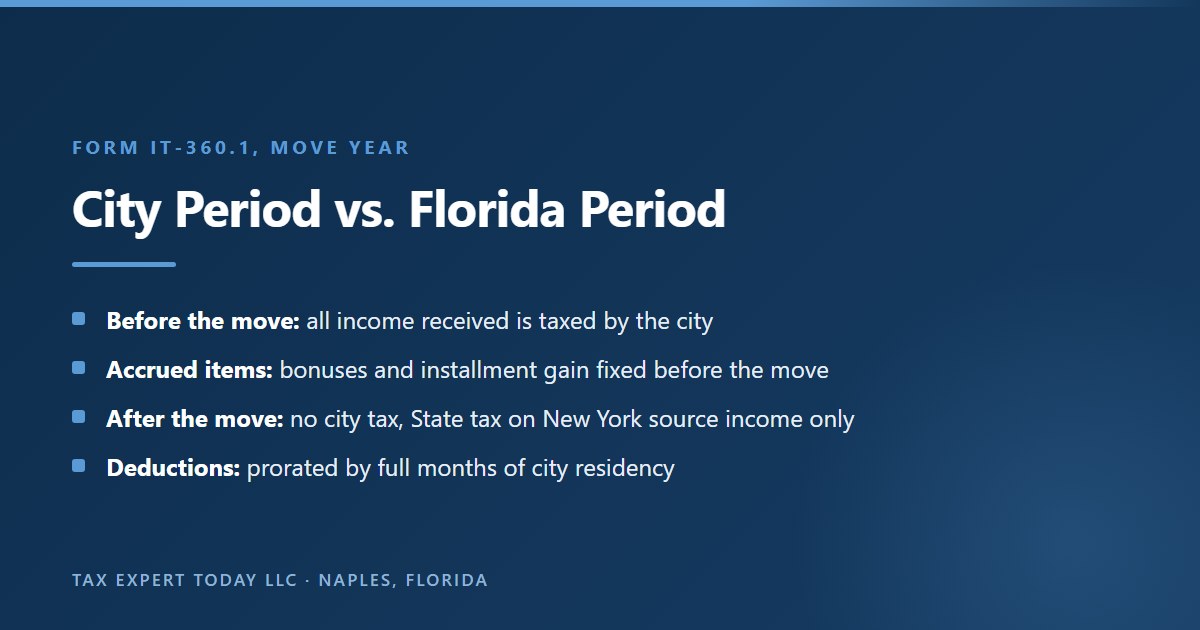
For a Florida mover, the State computation on IT-203 and the city computation on IT-360.1 run on the same move date, but they are not identical. The State continues to tax New York source income after the move, such as wages for days worked in New York or gain on New York real property. The city does not. A Naples resident who returns to Manhattan for client meetings in October owes New York State tax on that New York source wage income, but no New York City residency tax on it. Our guide to the nonresident state tax return explains the State side of that split.
How Do You Complete Form IT-360.1 When You Leave the City?
Form IT-360.1 has four parts for a New York City move: income and modifications split between the full year and the city period, itemized deductions for the city period, prorated dependent exemptions, and the part-year city tax. Mark Box A, enter your city resident dates and attach it to Form IT-203.
- Box A: a New York City change of residence requires Parts 1, 2, 3 and 4.
- Dates: the city resident period is entered as month and day, from January 1 to the move date.
- Attachments: a separate sheet listing each New York modification and its amount.
- Joint filers: one joint IT-360.1 if both spouses moved on the same day.
The IT-360.1 instructions are short, and they reward a careful read. The table below follows the order of the form for a Manhattan family moving to Florida mid-year and filing Form IT-203.
| Part of Form IT-360.1 | What goes in it | Common error after a Florida move |
|---|---|---|
| Change of status box | Box A for a New York City change of residence | Leaving the form off entirely because the State return already shows a part-year move |
| Part 1, Column A | Federal income, gains and adjustments for the full year | Using only New York source amounts from IT-203 instead of full federal amounts |
| Part 1, Column B | Income received from all sources during the city resident period, plus special accruals | Leaving out Florida bank interest or brokerage income received before the move |
| Line 19 | New York additions and subtractions for the city period, itemized on a separate sheet | Copying the full-year modification instead of the city-period amount |
| Part 2 | Itemized deductions incurred or paid during the city period | Claiming the full year of property tax and charitable gifts paid after the move |
| Part 3 | Dependent exemptions prorated by full months of city residency | Claiming the full exemption amount |
| Part 4 | City adjusted gross income, prorated deduction, city taxable income, tax and credits | Using the full-year standard deduction |
Column B is where most move-year mistakes live. The instruction is to enter income received while a city resident, which for a cash-method individual means the paychecks, dividends, interest and sale proceeds that actually arrived during the resident period, plus the special accruals described below. A spreadsheet that tracks each income item by receipt date, with the move date as a fixed line, makes the column easy to prepare and easy to defend. The same spreadsheet usually serves the IT-203 State allocation, although the two columns will differ because the State keeps taxing New York source income after the move. Column B is, in effect, the base of the New York City residency tax for the year.
Itemized deductions follow the same logic. The instructions direct you to enter in Column B the itemized deductions incurred or paid, determined as if your tax year were limited to the period you were a city resident. A charitable gift made in December from Naples does not belong in the city period. Property tax paid on the Manhattan apartment in January does. For high-income households, the instructions also impose the New York itemized deduction limits on the city period: when city-period New York adjusted gross income is more than $1,000,000 but not more than $10,000,000, the itemized deduction is generally 50 percent of the charitable contribution line, and above $10,000,000 it is 25 percent. The underlying worksheets are in the Form IT-196 instructions.
How Are Deductions and Exemptions Prorated on IT-360.1?
If you claim the standard deduction, it is prorated by the number of full months you were a city resident. More than half a month counts as a full month, and half a month or less does not. Dependent exemptions and the New York City household credit are prorated the same way, using the chart in the IT-360.1 instructions.
- Full month rule: more than half a month counts, half a month or less is dropped.
- Same method: a standard deduction on the State return requires a standard deduction on IT-360.1.
- Dependents: $1,000 per dependent for a full year, prorated by months.
- Itemizers: no proration chart, but only city-period items count.
The 2025 instructions print a proration chart for each filing status. The excerpt below shows the married filing jointly column, which most Florida movers use, along with the single column for comparison. The full-year 2025 New York standard deduction is $16,050 for married filing jointly and $8,000 for single filers who cannot be claimed as a dependent.
| Full months as a city resident | Standard deduction, married filing jointly | Standard deduction, single | One dependent exemption |
|---|---|---|---|
| 3 | $4,013 | $2,000 | $250 |
| 4 | $5,350 | $2,667 | $333 |
| 6 | $8,025 | $4,000 | $500 |
| 8 | $10,700 | $5,333 | $667 |
| 9 | $12,038 | $6,000 | $750 |
| 12 | $16,050 | $8,000 | $1,000 |
The half-month rule can shift a deduction by a month either way. A move on June 14 leaves five full months plus fourteen days of June, which is less than half the month, so the count is five. A move on June 17 counts June as a full month, and the count is six. The difference in the standard deduction is small, about $1,337 for a joint return, but the move date that produces it is the same date that ends city taxation of all income, so it should be the real date, not a date chosen for the proration. The New York City residency tax for the whole year turns on that one date.
The instructions also cover a joint State return where the spouses need separate city computations. If you are married and filing a joint New York State return but are separately computing your tax for New York City, you use the married filing separate column to find the prorated standard deduction. That situation comes up when one spouse moves to Florida before the other, which has its own section below.
What Income Must Be Accrued to the City When You Move?
When you move out of New York City, you must include in the city period any income, gain, loss or deduction that an accrual method would report by the move date. That includes income earned before the move but received after it, unpaid installment sale gain, and lump-sum distributions, unless you post a bond or other security.
- Accrued income: earned while a city resident, fixed and determinable, and paid after the move.
- Installment gain: the remaining deferred gain is accrued to the city period.
- Lump-sum distributions: the taxable amount subject to Form IT-230 is accrued.
- Alternative: Form IT-260 surety bond or Form IT-260.1 other security, then report later as if no move occurred.
The special accrual rule is the reason a well-timed move can still produce a city tax bill on income that arrives in Florida. The IT-360.1 instructions define the term: your accrued income as an individual moving out of New York City is income you earned in your city resident period but received after you became a nonresident of the city. Income accrues to you when the amount becomes fixed and determinable and you have an unrestricted right to receive it. If you moved out of the city, you must include on Form IT-360.1 any item of income, gain, loss or deduction which, under an accrual method of accounting, would be reportable at the time you changed your residence, including income or gain you elected to report on the installment basis.
The State rule is parallel. 20 NYCRR 154.10 requires an individual who changes from resident to nonresident to accrue, on the return for the resident period, items accruing before the change, and its example is the classic one: a resident sells a business at a gain on an installment contract, then moves, and must accrue the entire unpaid gain on the resident period return. Through 20 NYCRR 290.2, the same structure applies on the city side. Relief is available under 20 NYCRR 154.11 and the forms named in the city instructions: Form IT-260, the New York State and New York City surety bond for change of resident status, or Form IT-260.1 for other acceptable security. With a bond or security in place, the accrued items are reported in later years as if no change had occurred.
| Item received after a mid-year move to Florida | Accrued to the New York City period? | Why |
|---|---|---|
| Final paycheck for work through the move date, paid the next pay cycle | Generally yes | Earned in the city period and fixed before the move |
| Year-end bonus fixed by the employer before the move, paid after | Generally yes | Fixed and determinable with an unrestricted right to receive it |
| Discretionary bonus decided after the move | Usually no for accrual, but wage allocation rules still apply on the State return | Not fixed at the move date |
| Remaining gain on an installment sale closed before the move | Yes, unless a bond or security is posted | The instructions name installment gain specifically |
| Dividend declared with a record date before the move, paid after | Often yes | The right to the payment is fixed on the record date |
| Interest earned after the move on a Florida account | No | Earned in the nonresident period |
The installment row deserves attention from anyone who sells a business, a building or a partnership interest in the year before a move. Under federal law, IRC §453 lets the seller report gain as payments arrive. New York does not let the move cut off the deferred gain. The full unpaid amount is accrued to the city period unless security is posted, which can produce a city tax of up to 3.876 percent on gain the seller has not yet received. Our guide to moving to Florida before selling a business covers the timing question from the business side; the city accrual is one more reason to settle the domicile change before the sale contract is signed, not after. Accrued items are the part of the New York City residency tax that a move cannot outrun. Executives with equity awards should read the accrual rule together with our guide to Florida domicile for executives.
How Much New York City Tax Does a Mid-Year Move Save?
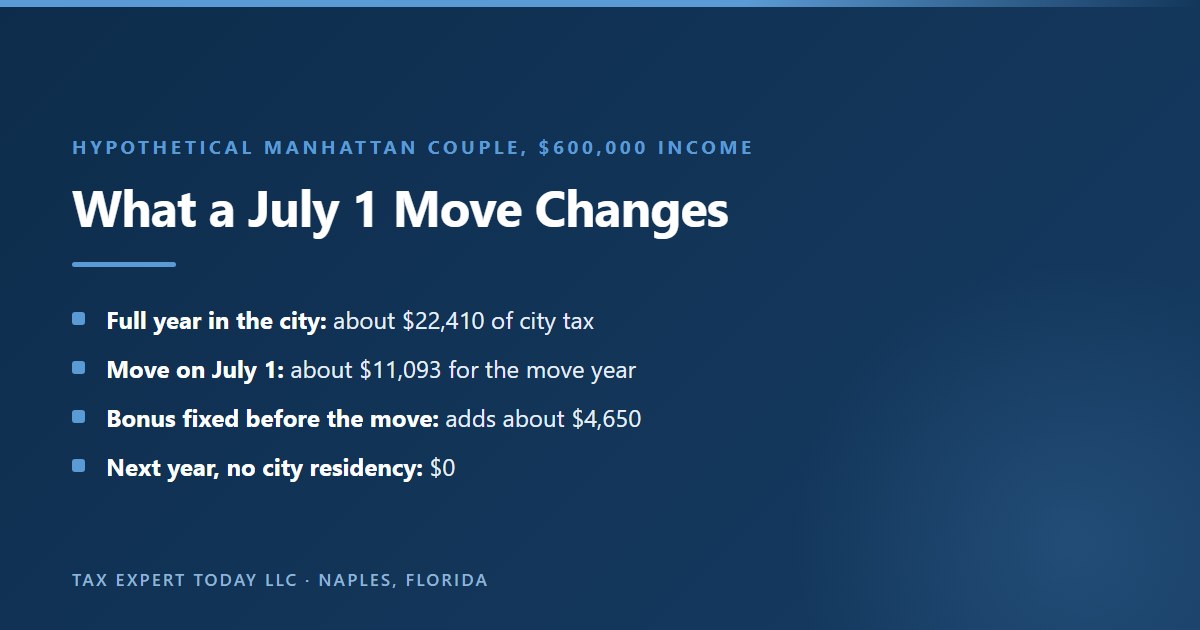
In a hypothetical, a Manhattan couple with $600,000 of income who change domicile to Florida on July 1 pays roughly $11,100 of city tax for the move year instead of about $22,400, and nothing in later years. The saving depends on when income is received, what must be accrued, and whether the household avoids city statutory residency afterward.
- Full-year city resident: about $22,410 of city tax on $583,950 of taxable income.
- Move on July 1: about $11,093 on six months of income with a prorated deduction.
- Later years: no city tax, provided no city abode plus 184 city days.
- The catch: accruals and a kept apartment can erase the saving.
The example below is hypothetical and simplified. It assumes a married couple filing jointly, $600,000 of New York adjusted gross income received evenly through the year, the standard deduction, no dependents, no accruals beyond normal wages and no credits. It uses the 2025 schedule from the IT-360.1 instructions, which reaches $3,264 at $90,000 of taxable income and adds 3.876 percent above that.
| Line | Full year in Manhattan | Move to Naples on July 1 |
|---|---|---|
| New York adjusted gross income in the city period | $600,000 | $300,000 |
| Standard deduction | $16,050 | $8,025 (six full months) |
| City taxable income | $583,950 | $291,975 |
| Tax on the first $90,000 | $3,264 | $3,264 |
| 3.876 percent of the excess | $19,145 | $7,829 |
| Approximate New York City residency tax | $22,410 | $11,093 |
| Following year, if no city statutory residency | $22,410 again | $0 |
Two changes to the facts show how fragile that result is. If the couple held a year-end bonus of $120,000 that was fixed before July 1 but paid in August, the accrual rule pulls it back into the city period and adds about $4,650 of city tax. If they kept their Manhattan apartment and returned for 190 days the following year, they would be city statutory residents for that year and the $22,410 would be due again, on all income, wherever earned. These are the two places where city savings are most often lost, and neither is visible on the State side of the return in a way that draws attention until an auditor asks. In both cases the New York City residency tax is computed exactly as if the move had saved nothing.
The State saving in the same example is several times larger, because the State rates are higher. The State side, including the allocation of income and the tax on New York source items after the move, is covered in our New York exit tax guide. Anyone building a combined estimate should run both computations on the same move date and the same receipt schedule.
Can Keeping a New York City Apartment Bring the Tax Back?
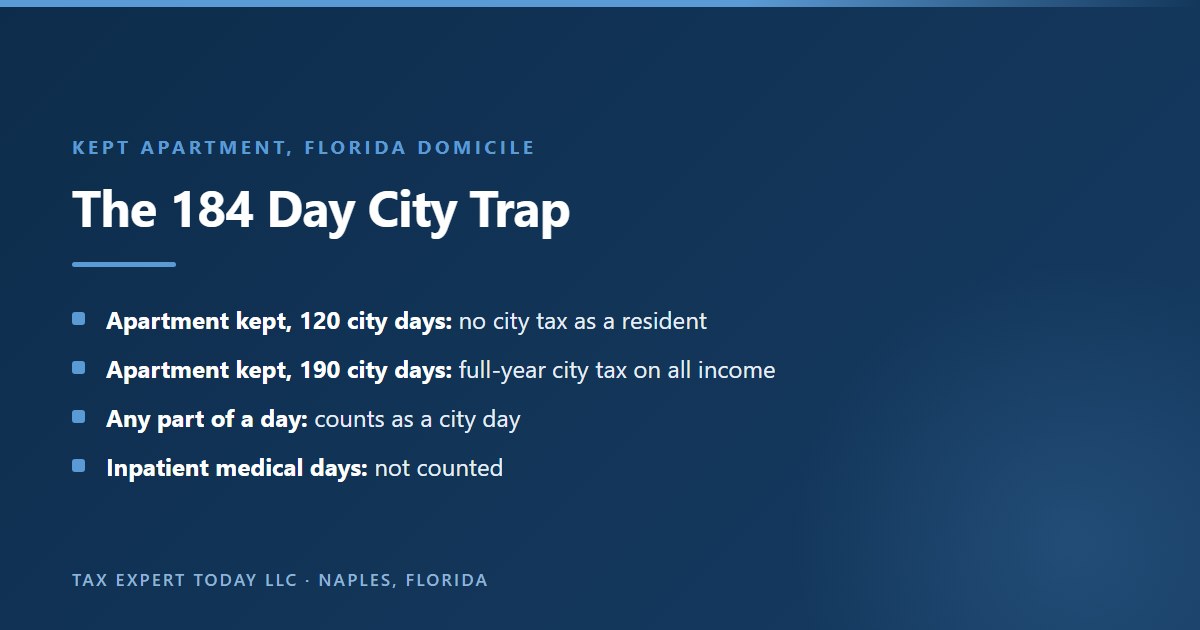
Yes. If you keep a city permanent place of abode for substantially all of a year and spend 184 or more days in the city, you are a city statutory resident for that year even with a Florida domicile. A statutory resident is taxed like a resident, on all income, so the full New York City residency tax returns.
- Both conditions: a city abode for substantially all of the year and 184 or more city days.
- Abode means a dwelling: a place you maintain that is suitable for year-round living, owned or rented.
- Spouse counts: a residence your spouse owns or leases usually counts as yours.
- Also a State resident: the same city days are State days, so State statutory residency follows.
The Tax Department’s income tax definitions describe a permanent place of abode as a residence you permanently maintain, whether you own it or not, that is suitable for year-round use, and note that it usually includes a residence your spouse owns or leases. A structure suitable only for vacation use is not a permanent place of abode, and neither is a place without the facilities ordinarily found in a dwelling. For a Manhattan apartment, the year-round test is almost always met. The Tax Department also reads “substantially all of the year” more broadly than many guides suggest: under the December 2021 audit guidelines, beginning with tax year 2022 the Audit Division generally treats a period exceeding 10 months as substantially all of the year, down from the earlier 11 month policy, in a year when a residence is acquired or disposed of. The open questions are usually whether the taxpayer maintained it, whether the taxpayer had a residential interest in it, and how many days were spent in the city.
The New York Court of Appeals narrowed the abode question in Matter of Gaied in 2014, holding that the taxpayer must have a residential interest in the dwelling, not simply own a building where relatives live. That decision helps some owners of family apartments, but it does not help a Florida resident who keeps a furnished Manhattan apartment with a closet full of clothes and a key on the key ring. For that household, the protection is the day count. Our guide to the dual-state residency trap explains statutory residency as a doctrine; the point for the New York City residency tax is that the 184-day line is counted in the five boroughs, and every one of those days is also a New York State day.
| Situation after the Florida move | City abode for substantially all of the year? | Days in the city | New York City residency tax for the year |
|---|---|---|---|
| Manhattan apartment sold at the move | No | Any number | None as a resident |
| Apartment kept, 120 city days | Yes | 120 | None as a resident, if domicile is Florida |
| Apartment kept, 190 city days | Yes | 190 | Full-year city tax on all income as a statutory resident |
| Apartment sold in March, 200 city days in hotels | Not for substantially all of the year | 200 | Generally none as a statutory resident, but domicile will be examined closely |
| Apartment rented to an unrelated tenant on a long lease, no access | Generally no | Any number | Generally none, if the lease is real and documented |
The middle rows explain why many Florida residents keep a Manhattan apartment comfortably. A city abode is not a problem on its own. It becomes a problem when it combines with a day count of 184 or more, or when it becomes evidence that the domicile never moved. A household that keeps the apartment should treat the city day count as a budget, track it monthly, and keep the records that prove each day outside the city. Our 183 day rule calculator is one way to keep that count in view through the year. Snowbirds in their first year should pair it with our first-year snowbird filing guide.
What Counts as a Day in New York City?
For the 184-day test, presence in the city for any part of a day generally counts as a city day. The main exception is confinement to a medical facility as an inpatient, which audit policy does not count. Outpatient visits still count. The taxpayer carries the burden of proving each day spent outside the city.
- Any part of a day: arriving at 9 p.m. or leaving at 7 a.m. still counts.
- Short visits: a same-day trip into Manhattan for a dinner or a meeting is a full city day.
- Medical stays: inpatient confinement days are excluded, outpatient care is not.
- Burden: anyone with a city abode who claims nonresidency must keep records to prove the count.
The Nonresident Audit Guidelines state the rule that drives day counting: presence within New York for any part of a calendar day constitutes a day spent within New York, a position the Appellate Division upheld in Leach v Chu. The guidelines add that common sense must prevail and that no audit is expected to turn on a single second across a border, but they are clear that brief visits normally count. On medical days, the guidelines follow Stranahan v State Tax Commission: confinement to a medical institution does not count as a day, and the exclusion does not extend to outpatient care. Read with 20 NYCRR 290.2, the same rule applies to days in the five boroughs for the city test.
The recordkeeping duty is written into the regulation itself. 20 NYCRR 105.20(c) provides that a person who maintains a permanent place of abode within the State during any taxable year and claims to be a nonresident must keep and have available for examination adequate records to substantiate that the person did not spend more than 183 days there. With the city substituted for the State, the same duty applies to anyone who keeps a city apartment and claims to be a city nonresident. Without those records, the New York City residency tax can be assessed for a full year on the strength of an incomplete day count.
| Record | What it proves | Weight in a city day audit |
|---|---|---|
| Cell phone location records | Where the phone was on each day | High, often the first record requested |
| Credit and debit card statements | Where purchases were made each day | High, especially for restaurants and local shops |
| Building access logs, doorman records, E-ZPass and MetroCard history | Entry to the apartment or travel in the city | High for presence in the city |
| Airline and rail tickets | Travel dates in and out of the New York area | Medium, since an arrival airport is not the city itself |
| Calendar and diary entries | Planned meetings and events | Medium, stronger when matched to other records |
| Medical and dental visits in Florida | Presence in Naples on specific dates | Medium, and helpful for the domicile analysis |
One distinction catches people who fly through the area. Arriving at Newark is not a day in New York City, while arriving at LaGuardia or Kennedy is a day in the city, because both airports are in Queens. A Naples resident who lands at JFK, takes a car to Midtown for dinner and leaves the next morning has two city days, while the same trip through Newark with a hotel in New Jersey has none. Connecting flights through a city airport are a gray area best documented with the boarding passes. Our Florida 183 day rule calculator can hold the city count and the Florida count side by side.
What Happens if One Spouse Moves Before the Other?
If one spouse changes city residence and the other remains a full-year city resident, the city tax is computed separately even on a joint State return. The spouse who stayed computes a full-year city tax on Form IT-201 or IT-203, and the spouse who moved files a separate Form IT-360.1 for the resident months using the married filing separate figures.
- Same move date: one joint Form IT-360.1.
- Different move dates: separate IT-360.1 forms for each spouse.
- One spouse stays all year: a full-year city computation for that spouse.
- Separate figures: the married filing separate column of the proration chart and household credit table 3.
Staggered moves are common. One spouse retires first and moves to Naples in March, while the other finishes a school year, a partnership year or a medical residency and follows in August. The IT-360.1 instructions handle the case through a short table: if you both changed your New York City resident status at the same time, you file one form jointly; if you each changed your status at different times, you file separately; and if one spouse was a full-year resident or full-year nonresident of the city while the other changed status, you file only for the spouse who changed city residence, and the city resident tax must be computed separately for the full-year city resident spouse.
The staggered move has consequences beyond paperwork. The spouse who remains in Manhattan is still a city resident, and a permanent place of abode maintained by a spouse usually counts for the other spouse as well. If the spouse who moved first spends enough days in Manhattan visiting, the city statutory test can apply to that spouse too. Auditors also read a staggered move as a family-connections question under the domicile factors, because the location of a spouse and minor children is one of the five primary factors in the Nonresident Audit Guidelines. A short, documented gap with a clear reason is normal. An open-ended gap with the family still in the city invites the question of whether the household ever moved. That question decides the New York City residency tax for both spouses, not only the one who stayed.
Does New York City Tax Wages Earned in the City After You Move?
Generally no. New York City taxes the personal income of residents only, and it has not taxed nonresident commuters on wages since the city nonresident earnings tax ended in 1999. A Florida resident who works in Manhattan owes New York State tax on that wage income but no New York City residency tax, with narrow exceptions for certain city employees.
- State tax continues: New York source wages remain taxable on Form IT-203.
- City tax stops: nonresidents are not liable for the city personal income tax.
- City employees: certain city employees who live outside the city file Form NYC-1127.
- Withholding: city tax withheld in error is claimed back on the State return.
The Tax Department’s FAQ is direct: nonresidents of New York City are not liable for the New York City personal income tax. That is the single biggest difference between the New York City residency tax and the State layer after a move. The State taxes a nonresident on New York source income, including wages for days worked in New York, and under the convenience of the employer rule it can also tax days worked from a Florida home for a New York employer. The city does neither. Our guide to the convenience of the employer rule explains the State side; on the city side, the rule has no application to a nonresident.
The exception concerns people employed by New York City itself. The city Department of Finance maintains a page on personal income tax and nonresident city employees, because certain city employees hired on or after January 4, 1973 who live outside the city agree, as a condition of employment, to pay an amount equal to the city resident tax, reported on Form NYC-1127. A retired city employee who moves to Florida is usually outside that rule for pension income, but a current city employee who relocates while still on the payroll should check the condition of employment before assuming the New York City residency tax ended.
Withholding is the practical issue for everyone else. Payroll systems often keep withholding city tax after an employee moves, because the employee never filed a new withholding certificate. The fix is described below, and any city tax withheld in error after the move is claimed as a credit on the State return, where it reduces State tax due or produces a refund.
Does New York City Tax the Sale of a Manhattan Home After You Move?
If you sell the Manhattan home after your Florida domicile is established, and you are not a city statutory resident that year, the gain is not subject to the New York City residency tax. New York State still taxes the gain as New York source income, and the city transfer tax still applies at the deed.
- Sale before the move: the gain falls in the city resident period and is taxed by the city.
- Sale after the move: no city income tax, but State tax on New York source gain.
- Federal exclusion: IRC §121 can exclude up to $250,000 or $500,000 of gain on a qualifying principal residence.
- At closing: Form IT-2663 estimated payment for a nonresident seller of New York real property.
The timing of the sale is one of the few places where the New York City residency tax creates a clear planning choice. A sale that closes in March, while the family still lives in the apartment and the Naples house is under construction, falls in the city resident period, and the gain above any federal exclusion is taxed at city rates of up to 3.876 percent. A sale that closes in September, after the domicile change on July 1, falls in the nonresident period. The city does not tax it, because the city personal income tax reaches only residents. The State does, because gain on New York real property is New York source income for a nonresident, and the seller makes an estimated payment at closing on Form IT-2663.
The federal exclusion under IRC §121 follows the home, not the move. A couple who lived in the apartment as a principal residence for two of the five years before the sale can generally exclude up to $500,000 of gain, and the two-of-five-year clock keeps running after the move for about three years. New York starts from federal income, so gain excluded federally is generally excluded for State and city purposes as well. The gain above the exclusion is what the move date affects. Our guide to selling your home after moving to Florida covers the exclusion clock and the closing mechanics in detail. The IRS explains the federal rules in Publication 523, Selling Your Home and Topic 701.
| When the Manhattan sale closes | New York City residency tax on gain above the exclusion | New York State tax | Watch for |
|---|---|---|---|
| Before the domicile change | Yes, at up to 3.876 percent | Yes, as a resident or part-year resident | A move date that slips past the closing |
| After the domicile change, apartment sold, no city statutory residency | No | Yes, as New York source gain | The IT-2663 payment at closing and the IT-203 filing |
| After the move, but the household is a city statutory resident that year | Yes, as a statutory resident taxed on all income | Yes, as a statutory resident | A kept apartment plus 184 city days in the sale year |
| Installment sale contracted before the move | Yes, through the special accrual, unless security is posted | Yes | Form IT-260 or IT-260.1 |
The real property transfer tax at the deed is a separate city tax on the transfer itself, not an income tax, and it applies whether the seller is a resident or not. Property tax proposals aimed at second homes in the city are also outside the scope of this guide, which deals only with the city income tax on residents. For a seller who has completed the move, the New York City residency tax is simply not part of the closing math. Other states run similar closing estimates for nonresident sellers, as our guide to the Maryland exit tax shows for Maryland property.
How Are RSUs, Bonuses and Deferred Compensation Treated by the City?
Compensation earned while you were a city resident can be pulled into the city period even when it is paid after the move, through the special accrual rule and the State allocation rules for stock awards. Qualifying deferred compensation and retirement income paid to a nonresident is protected from State and local tax by federal law.
- Fixed bonuses: accrued to the city period if fixed before the move.
- Equity awards: the State allocates RSU and option income by workdays, and the city period follows the receipt and accrual rules.
- Federal shield: 4 U.S.C. §114 bars State and local tax on qualifying retirement income of nonresidents.
- Plan matters: the shield depends on the plan type and the payout schedule.
Executives who leave Manhattan in the middle of a vesting cycle face the most complex city computation. The State side allocates equity compensation between New York and non-New York workdays over the vesting period, and our guide to Florida domicile for executives walks through those allocation rules and the federal timing under IRC §83. On the city side, the questions are simpler but just as important. Income received in the city resident period is taxed by the city in full. Income received after the move is taxed by the city only if it accrued before the move, which for compensation means the amount was fixed and determinable and the employee had an unrestricted right to it on the move date.
Deferred compensation that pays out after the move is in a different position. 4 U.S.C. §114 prohibits any State, a term the statute defines to include political subdivisions, from imposing income tax on the retirement income of an individual who is not a resident or domiciliary of that State. Qualifying retirement income includes distributions from qualified plans and IRAs, and payments from certain nonqualified plans paid in substantially equal periodic payments over the life of the recipient or over a period of at least ten years. A Florida resident receiving those payments owes neither State nor city tax on them. A lump-sum payout of nonqualified deferred compensation does not qualify, which is one more reason to review the payout election before the move rather than after. The payout schedule can decide whether the New York City residency tax reaches those payments at all.
What About Self-Employment, Partnerships and the MCTMT?
The New York City residency tax on a self-employed person or partner ends with city residency like any other income. Two other taxes do not depend on residency: the Metropolitan Commuter Transportation Mobility Tax on net earnings attributable to the commuter district, and the city unincorporated business tax on businesses carried on in the city.
- City personal income tax: ends for a nonresident partner or sole proprietor.
- MCTMT: applies to self-employment earnings attributable to the district above a threshold, regardless of where the owner lives.
- 2026 threshold: $150,000 of net earnings per zone, up from $50,000 for 2025 and prior years.
- Unincorporated business tax: a business tax on activity in the city, outside the scope of this guide.
The Tax Department’s city tax page lists the Metropolitan Commuter Transportation Mobility Tax alongside the city and Yonkers taxes because it is reported on the same returns. A self-employed individual, including an individual partner, with net earnings attributable to Zone 1 or Zone 2 of the Metropolitan Commuter Transportation District that exceed the threshold must report it. The threshold is $50,000 for tax years 2025 and prior, and $150,000 for tax year 2026 and after, computed separately for each zone. The MCTMT page covers the rates and zones. A consultant who moves to Naples but keeps billing Manhattan clients from a city office may still owe it, even though the city residency tax has ended.
For partners, the move year needs one more check. The Form IT-203 instructions require part-year residents to split a share of partnership, S corporation, or estate or trust income between the resident and nonresident periods using either the direct accounting method, which follows the entity’s own books, or the proration method, which allocates by the number of resident and nonresident days in the entity’s tax year. The method can be chosen separately for each entity. The city resident period on Form IT-360.1 follows the same move date, so a partner who leaves Manhattan on July 1 can see a very different city result depending on whether the large items in the partnership year arrived before or after that date. These are cases where a written computation of both methods is worth the time.
How Should You Fix Withholding and Estimated Tax After the Move?
File a new Form IT-2104 with each New York employer as soon as the move is complete, so payroll stops withholding city tax and adjusts State withholding to New York source wages. Then check estimated payments on Form IT-2105, because the move year can leave the city period underpaid or overpaid depending on when income arrived.
- Form IT-2104: the employee withholding certificate, including the city resident question.
- Nonresident employees: State withholding may continue on New York source wages, city withholding should stop.
- Estimated tax: Form IT-2105 vouchers carry a separate New York City amount.
- Refund of city tax withheld after the move: claimed as a credit on the State return.
Payroll departments do not know that an employee moved until the employee tells them. The Form IT-2104 Employee’s Withholding Allowance Certificate asks whether the employee is a resident of New York City and computes city withholding allowances separately, and the IT-2104 instructions explain how nonresidents complete it. A Florida resident who keeps working for a New York employer, whether in the city or remotely, should file a new certificate effective on the move date. If the employer keeps withholding city tax for the rest of the year, the extra amount is not lost. It is reported on the State return as city tax withheld and reduces the balance due or increases the refund, but it is an interest-free loan to the State until the return is processed. Correcting the certificate early keeps the New York City residency tax off every paycheck that follows.
Estimated tax works in the other direction. A household that sells stock, a business interest or real estate in the city period of the move year may owe city tax that no employer withheld. The Form IT-2105 estimated tax voucher covers New York State, New York City, Yonkers and MCTMT on one voucher, with a separate box for each, so the city amount is entered on its own line of the same payment. A quarterly payment schedule built before the move often overstates the New York City residency tax for the rest of the year, and one built without the accrual rule in mind can understate it.
| Step | When | Why it matters for the city tax |
|---|---|---|
| File a new Form IT-2104 with each New York employer | Effective on the move date | Stops city withholding on wages paid after the move |
| Review the remaining IT-2105 estimated payments | Before the next quarterly due date | Removes the city tax on post-move income from the estimate |
| Estimate accrued items | Before year end | Adds city tax on bonuses, installment gain and other accruals |
| Track city tax withheld after the move | At year end, from Form W-2 | Claimed back on the State return |
| Prepare Forms IT-203 and IT-360.1 | With the State return for the move year | Computes the part-year city tax on the resident period only |
Does the Resident Credit Offset the New York City Residency Tax?
No. The New York resident credit for taxes paid to another state reduces New York State tax only. It cannot be claimed against the New York City residency tax. Anyone who is a city resident or city statutory resident while also taxed elsewhere can pay full city tax on income already taxed by another state.
- State only: the credit under Tax Law section 620 applies to State tax.
- No city offset: city tax on the same income is not reduced.
- Florida movers: Florida has no income tax, so the issue arises only with income taxed by a third state.
- Dual residency: a statutory city resident domiciled in another taxing state faces full stacking.
The Nonresident Audit Guidelines say it in one sentence: the resident credit reduces New York State taxes only, and it may not be claimed against New York City resident taxes. For most Florida movers, the point is academic once the move is complete, because Florida has no personal income tax and there is nothing to credit. It matters in two places. The first is the household that spends a transition year domiciled in New Jersey or Connecticut while keeping a Manhattan apartment and enough city days to be a city statutory resident. That household can pay the new state’s tax and the full city tax on the same wages. New Jersey adds its own transfer and estate issues, including the New Jersey inheritance tax for nonresident decedents with New Jersey property. The second is income taxed by a third state during the city resident period, such as gain on a property in another state, where the State tax may be offset and the New York City residency tax is not.
That asymmetry is part of why the city statutory test deserves its own day budget. The State statutory test produces double taxation that the resident credit, claimed on Form IT-112-R, partly relieves. The city statutory test produces double taxation that nothing relieves. That is why the New York City residency tax deserves its own plan, separate from the State plan.
What Records Prove a New York City Residency Change?
The records that prove a city residency change are the same records that prove a State residency change: where the primary home is, where you work, where you spend your time, where your most cherished possessions are, and where your family lives. Day records matter most if a city apartment is kept.
- Home: the Naples purchase or lease, and what happened to the city apartment.
- Business: where active business involvement now takes place.
- Time: a day log supported by phone, card and travel records.
- Near and dear items: family heirlooms, art, collections and pets moved to Florida.
- Family: where the spouse and minor children live and attend school.
The five primary factors come from the Nonresident Audit Guidelines: home, active business involvement, time, items near and dear, and family connections. The guidelines describe the near and dear factor in concrete terms: the location of family heirlooms, works of art, collections of books, stamps and coins, and the personal items that enhance the quality of lifestyle, along with pets. A household that moves to Naples with suitcases and leaves the art collection, the piano and the dog in Manhattan has made a weaker record than one that moved them.
| Factor | Record that helps | Record that hurts |
|---|---|---|
| Home | Naples closing statement, homestead filing, Manhattan sale or long-term lease to an unrelated tenant | A larger, fully furnished Manhattan apartment kept unchanged |
| Active business | Retirement, or a role that is run from Florida | Continued daily management of a Manhattan business |
| Time | A day log showing most days in Florida, with supporting records | No log, or a log that does not match card and phone records |
| Items near and dear | Art, heirlooms, collections and pets moved to Naples | Valuables left in the city apartment or a city safe deposit box |
| Family | Spouse and minor children living in Florida and enrolled in Florida schools | Children enrolled in Manhattan schools with a parent staying behind |
Secondary records still help: the Florida driver license and voter registration, the Fla. Stat. §222.17 declaration of domicile, a Florida will, a change of address on brokerage and bank accounts, and medical providers in Naples. The guidelines treat many of these as less important than the five primary factors, but they make the overall record consistent, and an inconsistent record is what draws a closer look. The same record answers both the State question and the New York City residency tax question. Our New York residency audit guide shows how auditors weigh each of these records.
How Does New York Audit a New York City Residency Change?
The New York State Department of Taxation and Finance audits city residency together with State residency, using the same nonresident audit program and the same factors. An audit usually starts with a questionnaire and a request for day records, and it can cover the year of the move and several later years.
- One auditor: the State examines the city and State positions together.
- Two questions: did domicile change, and was the taxpayer a statutory resident in any year.
- City-only cases: moves to Westchester and Long Island are examined for city residency alone.
- Exposure: an adverse result can add city tax, interest and penalties for each year at issue.
Because the New York City residency tax is administered by the State, a Florida mover does not face two separate audits. The same auditor reviews the domicile change, the city and State statutory tests, the IT-203 allocation and the IT-360.1 computation. Our guide to the New York residency audit covers how the Department selects returns, what the questionnaire asks and how the burden of proof works. For a household that leaves New York entirely, the city result usually follows the State result: if domicile moved to Florida and no statutory residency applies, both layers end; if the auditor concludes domicile never moved, both layers come back.
The city layer becomes its own issue in two settings. The first is the household that moved within the State, from Manhattan to Westchester or Long Island, where the State tax never changed and the only question is whether city domicile ended. The guidelines direct auditors in those cases to compare the residences within the metropolitan area. The second is the household that clearly moved to Florida but kept a city apartment and returned often, where the domicile result can be favorable and the city statutory test still applies year by year. Our Florida residency audit guide covers how to defend the move itself. In both settings, the New York City residency tax is examined year by year rather than once.
What Mistakes Bring Back the New York City Residency Tax After a Move?
The most common mistakes are filing the State part-year return without Form IT-360.1, leaving accrued bonuses and installment gain out of the city period, keeping a city apartment without a day budget, letting payroll keep the old residency, and choosing a move date that the household records do not support.
- Missing form: IT-203 filed without IT-360.1.
- Missing accruals: income earned before the move left out of Column B.
- Day drift: a kept apartment and city days creeping past 183.
- Payroll lag: no new IT-2104 after the move.
- Unsupported date: a move date chosen for tax rather than set by events.
| Mistake | What happens | How to avoid it |
|---|---|---|
| No Form IT-360.1 in the move year | The city tax is computed incorrectly or not at all, and the return draws a notice | Attach IT-360.1 to IT-203 whenever city residence changed |
| Full-year standard deduction on IT-360.1 | City taxable income is understated | Use the proration chart by full months |
| Accrued items omitted | City tax on bonuses or installment gain is assessed later with interest | List items fixed before the move, or post an IT-260 bond |
| Apartment kept, 184 or more city days | Full-year city tax as a statutory resident | Track a monthly day budget with supporting records |
| Spouse stays in the city indefinitely | Separate city tax for that spouse, and a weaker domicile record for the other | A documented, time-limited plan for the second move |
| Manhattan sale closes before the move date | City tax on gain above the exclusion | Sequence the sale after the documented domicile change where practical |
None of these is unusual, and none requires an aggressive position to fix. They come from treating the New York City residency tax as a footnote to the State move. A move-year file that lists the move date, the events that support it, the receipt date of each income item, the accrued items, and the city day count for each later year answers most of the questions an auditor would ask before they are asked. It also turns the New York City residency tax from an open question into a documented result.
How Does the Florida Side Support the City Exit?
The Florida side supplies the new domicile that the city exit requires. A Florida home, a recorded declaration of domicile under Fla. Stat. §222.17, the homestead exemption, a Florida license and voter registration, and a life actually lived in Naples together show that the old city domicile was abandoned and a new one established.
- Declaration of domicile: a sworn statement filed with the clerk of the circuit court.
- Homestead: the property tax exemption application for the Florida home.
- Everyday life: doctors, clubs, worship, volunteering and banking in Southwest Florida.
- Estate documents: a Florida will and trust that name Florida as the domicile.
The Florida declaration of domicile statute lets a person who has established a domicile in Florida, or who intends to, file a sworn statement showing that the person resides in and maintains a place of abode in Florida and intends to maintain it as the permanent home. It is evidence, not a conclusion. New York auditors give it weight when the rest of the record agrees with it and little weight when it does not. The same is true of the homestead filing, the license and the voter card. Our Florida residency guide lists each step in order, and our guide to Florida asset protection for new residents explains what the homestead adds beyond tax.
The city exit also has an estate dimension. A Manhattan domicile at death exposes the estate to the New York estate tax on worldwide assets, and our guide to the New York estate tax cliff explains why that matters for larger estates. The income tax record and the estate tax record are built from the same facts, so a household that documents the city exit well for income tax purposes is also protecting the estate. Our estate and trust planning practice coordinates the documents, and the first-year snowbird filing guide covers the first Florida tax year as a whole. New residents who brought investment accounts with them can also check our note on the Florida intangible tax, which no longer applies, and families with trusts formed in New York should review trust situs after moving to Florida, because a trust can keep paying New York tax after its grantor leaves.
Frequently Asked Questions
What is the New York City residency tax rate?
For 2025, the New York City resident income tax runs from 3.078 percent to 3.876 percent of city taxable income. For married couples filing jointly, the top rate applies above $90,000, and for single filers above $50,000. It is charged in addition to New York State tax and is reported on the State return.
Do I still pay New York City tax after moving to Florida?
Not after your domicile changes, as long as you are not a city statutory resident. In the move year you pay city tax only on income received while you were a city resident, plus income earned before the move and paid later, computed on Form IT-360.1 with your Form IT-203.
Can I keep my Manhattan apartment and avoid the New York City residency tax?
Often yes, but only if your domicile is genuinely in Florida and you spend 183 or fewer days in the city. Keeping a permanent place of abode in the city for substantially all of the year and spending 184 or more days there makes you a city statutory resident, taxed on all income.
Do I pay New York City tax if I work in Manhattan but live in Florida?
Generally no. New York City does not tax the wages of nonresidents. You still owe New York State tax on wages for days worked in New York, and certain New York City government employees who live outside the city have a separate obligation under Form NYC-1127.
What is Form IT-360.1?
Form IT-360.1, Change of City Resident Status, computes the part-year New York City resident tax in the year you move into or out of the city. It splits income between the full year and the city period, prorates deductions and exemptions by full months, and is filed with Form IT-201 or Form IT-203.
Can a Naples firm help with my New York City move-year return?
Yes. The New York returns are filed electronically, so location is not a barrier. Tax Expert Today LLC, at 11983 Tamiami Trail N in Naples, Florida, helps Southwest Florida residents prepare Forms IT-203 and IT-360.1, identify accrued income, and build the day records that support a city residency change.
New York City Residency Tax Help in Naples & Southwest Florida
Tax Expert Today LLC works with families who have moved, or are moving, from Manhattan, Brooklyn and the other boroughs to Naples, Florida and across Southwest Florida on the city side of the move: the move-year split on Form IT-360.1, the accrual of bonuses and installment gain, the day count for a kept apartment, and the payroll and estimated tax changes that follow. The firm is multidisciplinary, with enrolled agents, CPAs and attorneys, and it handles residency and tax matters nationwide, coordinating with New York employers, counsel and closing attorneys when a sale, a partnership interest or a trust is involved. Our office is at 11983 Tamiami Trail N, Naples, FL 34110, open Monday through Friday, 10 a.m. to 5 p.m. ET, and reachable at (239) 441-2005.
- New York City residency tax help Naples: estimating the city tax for the move year and the years after it.
- Move-year returns: preparing Forms IT-203 and IT-360.1 with a receipt-date schedule and an accrual list.
- Kept apartments: building a city day budget and the records that support it.
- Domicile record: aligning the move date, the Florida declaration of domicile and the New York filings.
Our Naples tax planning practice describes the wider relocation planning work, and our Florida tax services page covers the ongoing filings that follow a move.
When to Engage a Professional
A renter who leaves Manhattan on a clear date, gives up the apartment, works for a single employer and has no unusual income may be able to prepare the move-year Forms IT-203 and IT-360.1 with good software. Professional help earns its cost when the household keeps a city apartment, when one spouse moves before the other, when a bonus, equity award or deferred compensation payment straddles the move, when a business or property was sold on the installment method, when a partnership interest makes the allocation method a real choice, or when the Manhattan home will be sold in the move year. It is also worth a conversation for anyone who has already received a New York residency questionnaire. Tax Expert Today LLC’s enrolled agents, CPAs and attorneys can model the city and State results on the same move date, prepare the move-year returns and build the record that supports them. Call (239) 441-2005 to schedule a consultation.
Published November 22, 2026 by Dr. Pellumb Kabashi « Back to Learning Center
Have a question this article touches on?
Tax Expert Today LLC, based in Naples, Florida and serving clients across the United States.
Schedule a Consultation (239) 441-2005