
By Dr. Pellumb Kabashi, DBA, MBA, CES, CFE, EA
Founder, Tax Expert Today LLC · Tax advisors, enrolled agents, CPAs, and attorneys · Serving clients in all 50 states
Quick Answer
Selling a business taxes are rarely a single capital gains calculation. The IRS treats a lump sum sale of a business as a sale of each individual asset, so one price splits into ordinary income, depreciation recapture, unrecaptured Section 1250 gain taxed at up to 25 percent, and long-term capital gain. Section 1202 can exclude qualifying C corporation stock gain entirely. Call (239) 441-2005 for a free consultation.
What Actually Determines Selling a Business Taxes?
The structure of the transaction determines almost everything. The IRS states that the sale of a trade or business for a lump sum is considered a sale of each individual asset rather than of a single asset. That one sentence is why two owners who both sell for the same headline price can face very different selling a business taxes.
Because the sale is tested asset by asset, the buyer and the seller are not allocating a price so much as allocating tax character. Inventory produces ordinary income. Equipment that has been depreciated produces recapture taxed at ordinary rates. A building produces a slice taxed at up to 25 percent. Goodwill produces long-term capital gain. Selling a business taxes are the sum of those parts, and the parts are set at the closing table, not on the tax return.
This article covers the federal mechanics. If the question is when to move to Florida relative to a sale, that timing analysis lives in our guide to moving to Florida before selling a business. If the question is how a departure state such as California sources the gain after a move, see the California exit tax rules. Both interact with what follows, and neither replaces it.
How Is the Purchase Price Allocated Across Asset Classes?
Both buyer and seller must allocate the consideration using the residual method under IRC Section 1060, and both report that allocation on Form 8594. Consideration is assigned to seven asset classes in order, and each class carries its own tax treatment. The allocation is not optional and the two sides are expected to agree.
Allocation is where selling a business taxes are actually decided. The class definitions below come directly from the Instructions for Form 8594 (Rev. 11-2021).
| Class | What it contains | Typical seller tax character |
|---|---|---|
| Class I | Cash and general deposit accounts | No gain |
| Class II | Actively traded personal property, certificates of deposit, foreign currency, US government securities, publicly traded stock | Capital gain or loss |
| Class III | Mark to market assets and debt instruments, including accounts receivable | Generally ordinary |
| Class IV | Stock in trade and inventory, or property held primarily for sale to customers | Ordinary income |
| Class V | All assets not in another class. The instructions name furniture and fixtures, buildings, land, vehicles, and equipment | Mixed: recapture, Section 1231, capital |
| Class VI | Section 197 intangibles other than goodwill, including workforce in place, customer based intangibles, licenses, and a covenant not to compete | Often ordinary |
| Class VII | Goodwill and going concern value | Long-term capital gain |
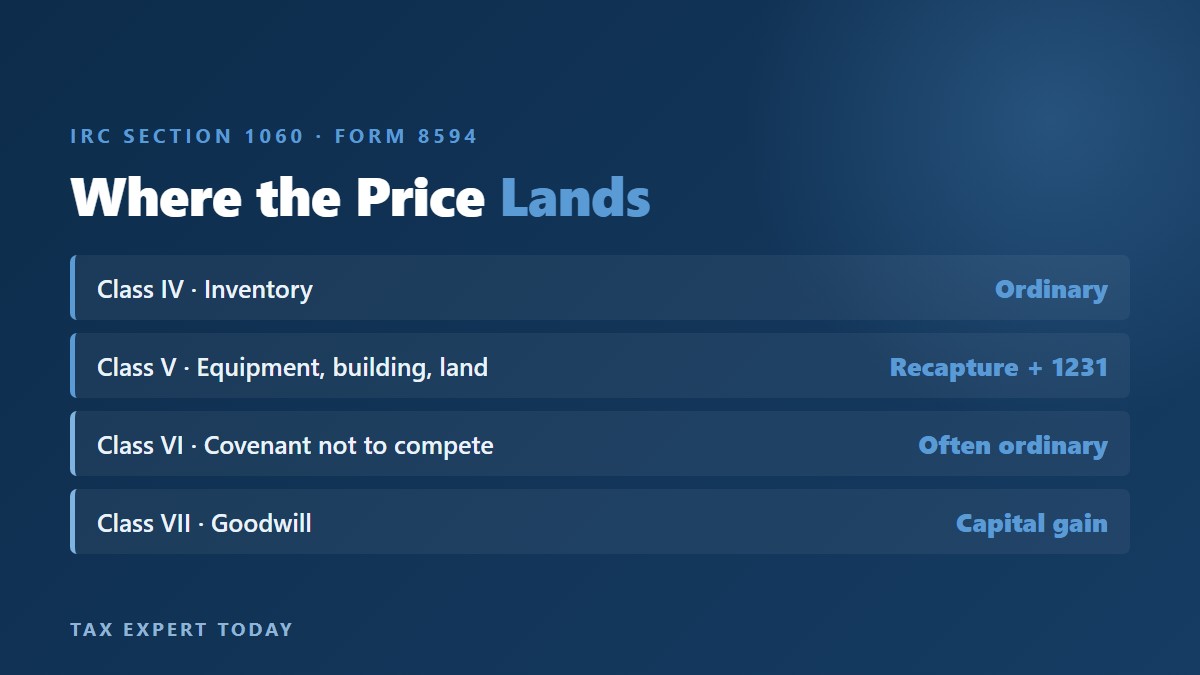
The buyer and the seller have opposing incentives here, which is why allocation is negotiated. A buyer generally prefers weight in Class IV and Class V, because inventory turns quickly and equipment can be depreciated on a short life. A seller generally prefers weight in Class VII, because goodwill is usually capital gain against a basis of zero. A covenant not to compete sits in Class VI and is generally ordinary income to the seller, which is why sellers often resist a large covenant allocation even when the buyer wants one.
One practical point that gets missed: the parties should record the allocation in the purchase agreement itself. Form 8594 asks whether the allocation was set out in the sales contract or another written document signed by both parties, and whether the values reported match it. Inconsistent filings invite questions.
What Is the Difference Between an Asset Sale and a Stock Sale?
In an asset sale the entity sells its assets and the residual method applies, producing the mixed character described above. In a stock sale the owner sells the equity itself, and the result is usually a single capital gain or loss. The IRS notes that when corporate stock certificates are sold, the seller usually realizes capital gain or loss.
That difference is not cosmetic. The asset sale versus stock sale choice is the largest single structural driver of selling a business taxes, because it changes who bears the tax cost and it decides whether Section 1202 is even on the table. For a seller operating through an S corporation, the years before a sale also raise the owner wage question, since compensation history is part of the record a buyer diligences and is addressed in our guide to S corp reasonable compensation.
| Asset sale | Stock sale | |
|---|---|---|
| Seller character | Split across ordinary, recapture, Section 1231, capital | Generally single capital gain |
| Buyer basis | Stepped up to allocated purchase price | Carryover inside basis, no step up |
| QSBS availability | Not available. Section 1202 applies to stock | Available if all Section 1202 tests are met |
| C corporation exposure | Possible tax at the corporate level and again on distribution | One level of tax at the shareholder |
| Liability transfer | Buyer generally selects the liabilities assumed | Buyer generally inherits the entity history |
Partnership interests deserve a separate note. A partnership interest is generally a capital asset, but the IRS is explicit that the part of any gain attributable to unrealized receivables or inventory items is treated as ordinary gain or loss. A partner who expects clean capital treatment on the whole interest may be surprised.
How Much Tax Does a Three Million Dollar Asset Sale Produce?
Worked math shows how selling a business taxes break down better than description does. The figures below are a hypothetical illustration only, not a client outcome and not a prediction. Actual results depend on entity type, basis history, filing status, other income for the year, and state rules.
Assume an owner sells a Southwest Florida operating business in an asset sale for total consideration of 3,000,000 dollars, with total adjusted basis of 1,120,000 dollars, producing 1,880,000 dollars of gain.
| Class and asset | Allocated price | Adjusted basis | Gain |
|---|---|---|---|
| Class IV inventory | $150,000 | $120,000 | $30,000 |
| Class V equipment (depreciation taken $600,000) | $400,000 | $100,000 | $300,000 |
| Class V building (depreciation taken $250,000) | $900,000 | $550,000 | $350,000 |
| Class V land | $350,000 | $350,000 | $0 |
| Class VI covenant not to compete | $100,000 | $0 | $100,000 |
| Class VII goodwill | $1,100,000 | $0 | $1,100,000 |
| Total | $3,000,000 | $1,120,000 | $1,880,000 |
Now convert that gain into tax character. The equipment gain of 300,000 dollars is fully recaptured as ordinary income under Section 1245 because depreciation taken (600,000 dollars) exceeds the gain. The building produces unrecaptured Section 1250 gain equal to the lesser of depreciation taken or gain, which is 250,000 dollars, with the remaining 100,000 dollars falling to Section 1231 and then to long-term capital gain.
| Character | Amount | Illustrative rate | Illustrative tax |
|---|---|---|---|
| Ordinary income (inventory $30,000 + Section 1245 recapture $300,000 + covenant $100,000) | $430,000 | 37% | $159,100 |
| Unrecaptured Section 1250 gain | $250,000 | 25% maximum | $62,500 |
| Long-term capital gain (building residual $100,000 + goodwill $1,100,000) | $1,200,000 | 20% | $240,000 |
| Subtotal | $1,880,000 | $461,600 | |
| Net investment income tax, if the gain is not excluded as active business gain | $1,450,000 | 3.8% | $55,100 |
| Total if NIIT applies | $516,700 |
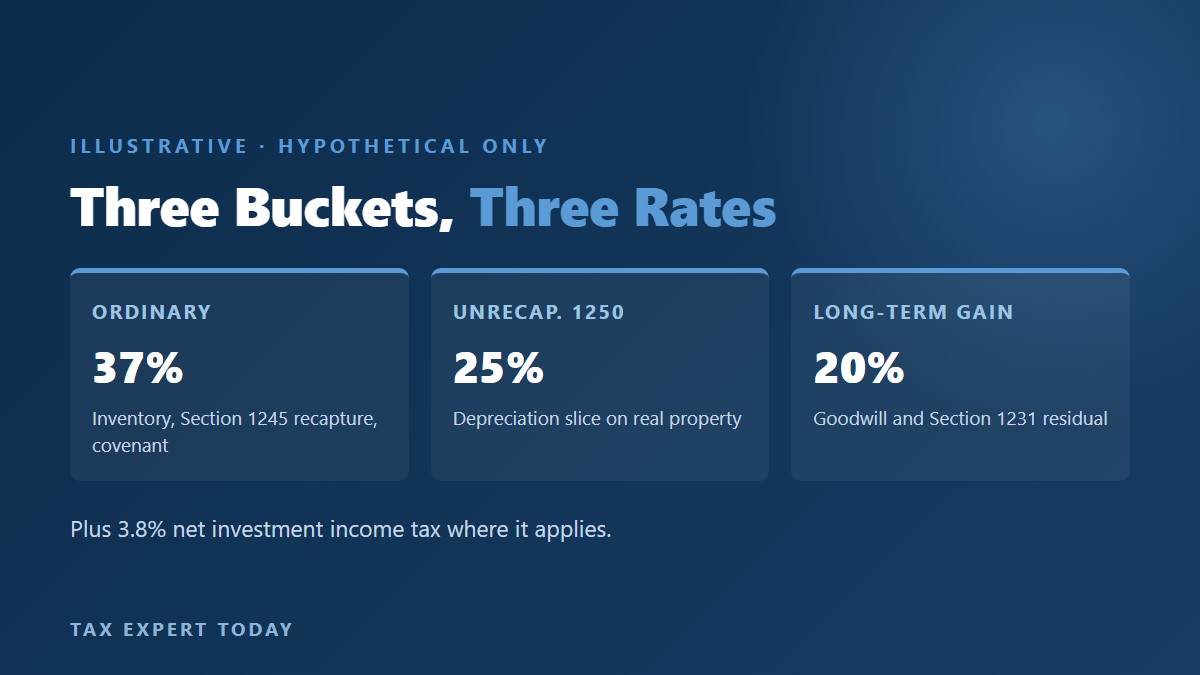
Here is the number that matters. An owner who assumed the whole 1,880,000 dollars would be taxed at a 20 percent capital gains rate would have budgeted 376,000 dollars. The illustration produces 461,600 dollars before the net investment income tax, roughly 85,600 dollars more, and 516,700 dollars if that tax applies, roughly 140,700 dollars more. The effective rate on the gain is about 24.6 percent, or about 27.5 percent with the net investment income tax, not 20 percent.
Nothing in that spread comes from a rate change. Selling a business taxes are not one rate applied to one number, and the difference here comes entirely from character, which is set by allocation.
How Does Depreciation Recapture Increase Selling a Business Taxes?
Depreciation recapture converts what feels like capital gain back into ordinary income. Under IRC Section 1245, gain on depreciable personal property is ordinary to the extent of depreciation previously allowed. Under IRC Section 1250 and the rate rules, the depreciation slice on real property is taxed at a maximum of 25 percent.
This is the single most common surprise in a business sale, and it is the largest reason selling a business taxes come in above the owner estimate. Every year of accelerated depreciation, every Section 179 election, and every bonus depreciation deduction lowered taxable income at ordinary rates in earlier years, and Section 1245 collects it back at ordinary rates on the way out. Owners who ran a cost segregation study should model the exit before they assume the acceleration was permanently free. It was a deferral with a defined settlement date, and the closing is that date.
The IRS confirms the rate structure in Topic No. 409: unrecaptured Section 1250 gain is taxed at a maximum 25 percent rate and collectibles at a maximum 28 percent rate. Sales and dispositions generally are covered in Publication 544, and the sale itself is reported on Form 4797.
Does the Section 1202 QSBS Exclusion Apply to Your Sale?
Section 1202 is the one provision that can reduce selling a business taxes to zero on qualifying stock, and the rules changed significantly. Public Law 119-21, enacted July 4, 2025, rewrote the exclusion percentages, raised the per issuer cap, and raised the size ceiling on the issuing corporation. Most articles still on the first page of Google describe the prior law.
Under IRC Section 1202(a)(5), stock acquired after the applicable date now uses a tiered schedule rather than a single five year cliff.
| Feature | Stock acquired on or before July 4, 2025 | Stock acquired after July 4, 2025 |
|---|---|---|
| Held 3 years | No exclusion | 50 percent |
| Held 4 years | No exclusion | 75 percent |
| Held 5 years or more | Up to 100 percent | 100 percent |
| Per issuer gain cap | $10,000,000 | $15,000,000, indexed for inflation for tax years beginning after 2026 |
| Married filing separately cap | $5,000,000 | One half of the applicable dollar limit |
| Issuer aggregate gross assets ceiling | $50,000,000 | $75,000,000, indexed after 2026 |
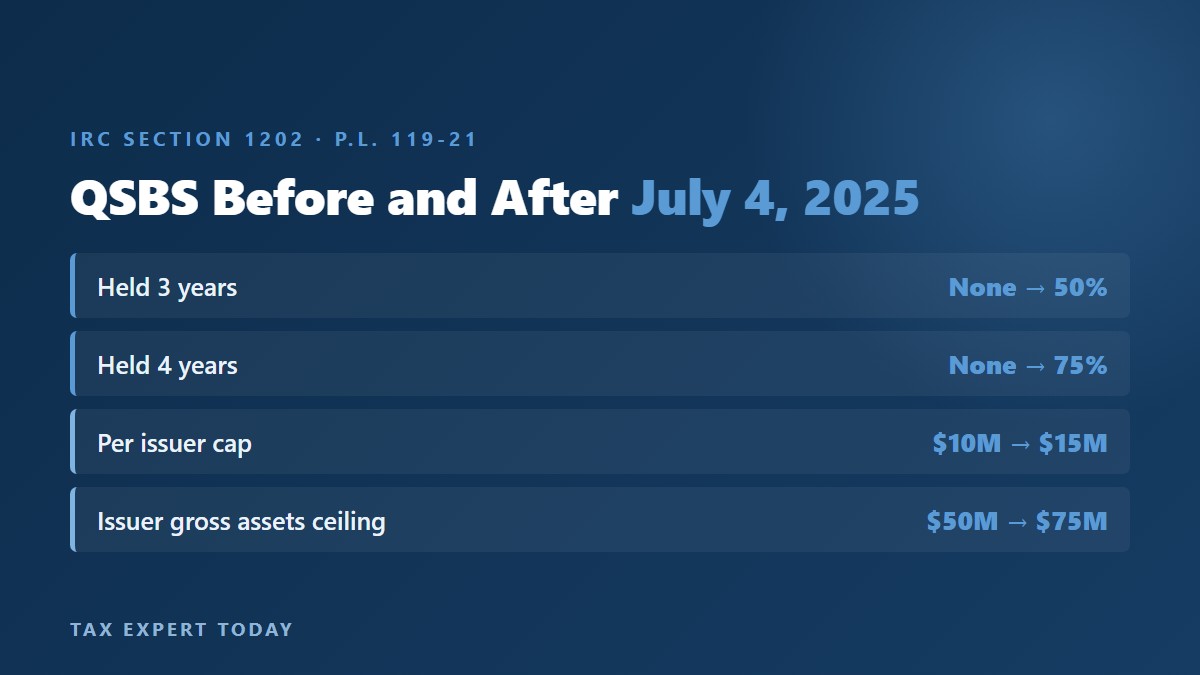
The effective dates are not uniform, and the distinction matters. The tiered percentages and the higher per issuer cap apply to taxable years beginning after July 4, 2025. The increase in the aggregate gross assets ceiling from 50,000,000 dollars to 75,000,000 dollars applies to stock issued after that date. A company that issued stock before July 4, 2025 is still tested against the 50,000,000 dollar ceiling for that issuance.
There is also a second cap that is easy to overlook. Section 1202(b)(1) allows the greater of the applicable dollar limit or ten times the aggregate adjusted bases of the qualified small business stock disposed of during the year. For a founder whose basis is near zero, the dollar cap governs. For an investor who contributed substantial capital, the ten times basis test may be far larger.
The threshold requirements that come first
Before any percentage applies, the stock has to qualify. Under Section 1202(c) and Section 1202(d), the stock must be stock in a domestic C corporation, acquired by the taxpayer at original issue in exchange for money, other property, or services, and the corporation must have had aggregate gross assets not exceeding the applicable ceiling both before and immediately after the issuance. Section 1202(e)(1) requires that at least 80 percent by value of the corporation assets be used in the active conduct of one or more qualified trades or businesses during substantially all of the holding period.
Two of those conditions eliminate most owners before the conversation starts. An LLC taxed as a partnership does not issue qualifying stock. Stock bought from another shareholder is not acquired at original issue.
Which Businesses Cannot Use the QSBS Exclusion?
Section 1202(e)(3) defines a qualified trade or business by exclusion, and the excluded list is long. This is where a great many profitable companies fail the test, and it is worth reading the actual statutory language rather than a summary.
A qualified trade or business means any trade or business other than:
- Any trade or business involving the performance of services in the fields of health, law, engineering, architecture, accounting, actuarial science, performing arts, consulting, athletics, financial services, or brokerage services
- Any trade or business where the principal asset is the reputation or skill of one or more of its employees
- Any banking, insurance, financing, leasing, investing, or similar business
- Any farming business, including the business of raising or harvesting trees
- Any business involving the production or extraction of products for which a depletion deduction is allowable under Section 613 or Section 613A
- Any business of operating a hotel, motel, restaurant, or similar business
Read that list against Southwest Florida. A medical practice, a law firm, an accounting firm, a wealth management practice, a restaurant group, and a hospitality operator are all outside the exclusion regardless of how well they are structured, which removes the single largest available lever on selling a business taxes for those owners. A manufacturer, a distributor, a software company, or a products business may well be inside it. Because the exclusion is the difference between a full and a near zero federal bill, owners who may qualify should confirm eligibility years before a sale, not during diligence, because the holding period and the original issue requirement cannot be created retroactively.
Where a sale is imminent and the holding period is short, IRC Section 1045 offers a related route. A taxpayer other than a corporation who has held qualified small business stock for more than six months may elect to roll the gain into other qualified small business stock purchased during the 60 day period beginning on the date of sale, recognizing gain only to the extent the amount realized exceeds that cost. Section 1045 does not apply to gain treated as ordinary income.
Can an Installment Sale Under Section 453 Defer the Tax?
Partly. An installment sale spreads selling a business taxes across several years, and the exception to that spreading is the part that causes problems. Under IRC Section 453, a disposition with at least one payment received after the year of sale is an installment sale, and gain is generally recognized as payments are received. That spreads the capital gain and can keep the seller out of the top bracket in a single year. A seller with charitable intent has a second spreading mechanism available, since a charitable remainder trust sells the asset inside a tax exempt trust and releases the gain across the payment term instead. A seller who wants deferral without a charitable gift can also compare a qualified opportunity fund, which accepts the gain from a stock or asset sale if that gain is invested within 180 days.
A third option addresses the deduction side rather than the gain side. Contributing appreciated shares to a sponsoring organization before a sale closes can produce a fair market value deduction with no capital gain recognized on the donated shares, which is the mechanism our guide to the donor advised fund tax deduction explains, along with the 0.5 percent floor that now applies to every charitable dollar.
Recapture is carved out. Section 453(i) defines recapture income as the amount that would be ordinary under Section 1245 or Section 1250 if all payments were received in the year of disposition, and that amount is recognized in the year of the sale regardless of when the cash arrives. In the illustration above, the 300,000 dollars of Section 1245 recapture would be taxable in year one even if the seller received very little cash that year.
That is the trap worth planning around. A seller who structures a note to spread the tax, and who has heavily depreciated equipment, can face an ordinary income bill in year one that exceeds the year one cash. The installment sale is reported on Form 6252. Section 453(k) also limits the method for certain sales, including installment obligations arising from the sale of stock or securities traded on an established securities market.
Does the 3.8 Percent Net Investment Income Tax Apply?
IRC Section 1411 imposes a 3.8 percent tax on the lesser of net investment income or the excess of modified adjusted gross income over a threshold amount. The thresholds are 250,000 dollars for a joint return or surviving spouse, one half of that for married filing separately, and 200,000 dollars in any other case. These thresholds are not indexed for inflation, so the tax adds 3.8 percent to selling a business taxes for a growing number of sellers each year.
Whether a business sale gain lands inside net investment income depends on participation. Gain from the disposition of property held in a trade or business in which the taxpayer materially participates, and which is not a trading business, is generally excluded from net investment income. An owner who has genuinely run the business day to day often keeps much of the gain outside the tax. A silent owner, or one whose participation has faded in the years before a sale, frequently does not.
The practical consequence is that participation records matter at exit, not only during operations. The IRS questions and answers on the net investment income tax set out the general framework, and the analysis is fact specific.
The 2026 breakpoints that apply to the capital gain portion
The long-term capital gain slice is not automatically taxed at 20 percent. Rate breakpoints are indexed annually, and the figures below are the maximum zero rate and maximum 15 percent rate amounts for taxable years beginning in 2026, published by the IRS in Revenue Procedure 2025-32. Taxable income above the 15 percent column is taxed at 20 percent.
| Filing status | Maximum zero rate amount | Maximum 15 percent rate amount |
|---|---|---|
| Married filing jointly and surviving spouse | $98,900 | $613,700 |
| Married filing separately | $49,450 | $306,850 |
| Head of household | $66,200 | $579,600 |
| All other individuals | $49,450 | $545,500 |
| Estates and trusts | $3,300 | $16,250 |
Where Florida changes the arithmetic
Florida imposes no individual income tax, which removes the state layer from selling a business taxes entirely for a Florida resident selling a Florida business, leaving the federal calculation alone at the individual level. That is a real advantage, and it is also the reason the timing and sourcing questions get attention. A recent arrival may still face tax in the former state on income that state sources to itself, which is why the departure state analysis in the California exit tax discussion and the timing analysis in moving to Florida before selling a business both belong in the plan.
Selling a Business Naples: Help in Southwest Florida
Tax Expert Today LLC advises business owners on selling a business taxes and sale structure from our office in Naples, Florida, and serves clients in all 50 states. The work that changes the outcome is done before a letter of intent is signed, when the allocation, the entity structure, and the participation record can still be shaped.
Owners across Naples, Bonita Springs, Fort Myers, Marco Island, and Estero engage us for pre sale modeling: running the allocation, quantifying recapture, testing Section 1202 eligibility, and comparing an installment structure against a lump sum. A large ordinary income year created by recapture is also the year in which a cash balance plan deduction may be worth modeling, if the owner will still have qualifying earned income. That analysis pairs naturally with broader Naples tax planning and with our tax planning services and business consulting work.
Tax Expert Today LLC
11983 Tamiami Trail N, Naples, FL 34110
Phone: (239) 441-2005
Hours: Monday through Friday, 10:00 a.m. to 5:00 p.m. ET
Local FAQ: I am selling a Naples business this year. When should I call?
Before the letter of intent, if possible. Once the allocation is agreed in a signed document, the character of the gain is largely fixed, and Form 8594 asks both parties to confirm that agreement. Owners who call after the purchase agreement is executed usually have far fewer options for managing selling a business taxes than owners who call during the modeling stage.
When to Engage a Professional
A business sale is generally the largest single tax event in an owner lifetime, and it is not reversible. Consider engaging a tax advisor when selling a business taxes are likely to exceed expectations, and specifically when any of the following is true:
- The business holds significantly depreciated equipment or real property, so recapture may be substantial
- The buyer has proposed an allocation, or a covenant not to compete, that shifts character toward ordinary income
- The entity is or could become a C corporation and Section 1202 eligibility is worth testing
- The shareholder is a California resident, because California disapplies Section 1202 entirely, as covered in our guide to California QSBS and the conformity gap
- An installment note is contemplated and the year one recapture may exceed year one cash
- Participation has declined in recent years, putting the net investment income tax exclusion in question
- You have moved between states recently, or plan to, and sourcing is unresolved
Outcomes depend on individual facts, and nothing here is a promise about any particular result. Tax Expert Today LLC brings tax advisors, enrolled agents, CPAs, and attorneys to the same file so the structure, the return, and the state analysis are considered together. To discuss a sale, call (239) 441-2005.
Frequently Asked Questions
What reduces selling a business taxes the most?
Structure decided before the letter of intent, not deductions claimed afterward. The largest levers are the asset class allocation, whether the transaction is an asset or stock sale, Section 1202 eligibility where the entity is a qualifying C corporation, and a documented material participation record that may keep the gain outside the net investment income tax.
How are selling a business taxes calculated on goodwill?
Goodwill and going concern value are Class VII assets under the residual method. Because internally generated goodwill usually carries a basis of zero, the entire allocation is generally long-term capital gain to the seller, which is why sellers typically prefer weight in that class.
Is a stock sale always better for the seller?
Often, but not always. A stock sale usually produces a single capital gain and preserves any Section 1202 opportunity. Buyers frequently pay less for stock because they receive no basis step up and inherit the entity history, so the comparison has to be made after tax and after price.
Can I avoid depreciation recapture with an installment sale?
No. Section 453(i) requires recapture income under Section 1245 or Section 1250 to be recognized in the year of disposition, even when the payments arrive over several years. Only the remaining gain is spread under the installment method.
Does the Section 1202 exclusion apply to an LLC?
Not as an LLC taxed as a partnership. Section 1202 applies to stock in a domestic C corporation acquired at original issue. Some owners may consider a conversion, but the holding period generally begins at the qualifying issuance, so the analysis needs years of lead time and depends heavily on facts.
What is the maximum tax rate on the sale of a business?
There is no single rate. Ordinary income portions are taxed at ordinary rates, unrecaptured Section 1250 gain at a maximum of 25 percent, long-term capital gain at 0, 15, or 20 percent depending on taxable income, and the net investment income tax may add 3.8 percent where it applies.
Do I owe Florida tax on the sale of my Florida business?
Florida imposes no individual income tax, so a Florida resident generally faces the federal calculation at the individual level. A former state may still assert tax on income it sources to itself, particularly following a recent move, so the departure state rules should be reviewed.
Published August 2, 2026 by Dr. Pellumb Kabashi « Back to Learning Center
Have a question this article touches on?
Tax Expert Today LLC, based in Naples, Florida and serving clients across the United States.
Schedule a Consultation (239) 441-2005