
By Dr. Pellumb Kabashi, DBA, MBA, CES, CFE, EA
Founder, Tax Expert Today LLC · Tax advisors, enrolled agents, CPAs, and attorneys · Serving clients in all 50 states
Quick Answer: In the S corp vs C corp comparison, an S corporation passes profit through to owners and is taxed once at individual rates, often with a 20 percent section 199A deduction, while a C corporation pays a flat 21 percent and owners pay tax again on dividends. A C corporation can win when profit is reinvested or a qualifying stock sale may be excluded under section 1202. Call (239) 441-2005 for a free consultation.
What is the difference between an S corp vs C corp?
The difference between an S corp vs C corp is how federal tax is collected. A C corporation pays a flat 21 percent tax on its own profit, and shareholders pay tax again on dividends. An S corporation generally pays no federal income tax, and its profit flows through to the owners’ individual returns each year.
- Same legal entity: both start as a corporation, or an LLC that elects corporate treatment, under state law.
- C corporation: the default tax classification, reported on Form 1120 under IRC section 11.
- S corporation: an elected classification, reported on Form 1120-S, with income passed through on Schedule K-1.
- Owner cash: in a C corporation, profit reaches the owner as salary or dividends; in an S corporation, as salary and distributions.
The S corp vs C corp question is not about which business form a state recognizes. Both are corporations for liability and governance purposes, and a limited liability company can be taxed as either one. The choice is a federal tax election. A corporation is a C corporation unless it files a valid election under IRC section 1362, and once that election is in place the rules of Subchapter S, beginning at IRC section 1361, decide how its income is reported.
Under IRC section 11(b) a C corporation pays tax at 21 percent of its taxable income. When it later pays a dividend, the shareholder reports that dividend under IRC section 301 and generally pays the qualified dividend rates in IRC section 1(h), plus the 3.8 percent net investment income tax under IRC section 1411 when income is high enough. That is the double tax that most comparisons stop at.
An S corporation follows a different path. Under IRC section 1366 each shareholder reports a pro rata share of the corporation’s income, deductions, and credits, whether or not any cash is distributed. Distributions are then generally tax free to the extent of the shareholder’s stock basis under IRC section 1368. The corporation itself files an information return and, in most cases, owes no federal income tax.
This guide is written for owners of closely held businesses who want the numbers behind the S corp vs C corp decision, not only the definitions. It works through the 2026 federal rates, the section 199A deduction, payroll tax, the Florida corporate income tax, the accumulated earnings tax, the built-in gains tax on a later conversion, and the qualified small business stock exclusion that the 2025 tax law expanded. Every dollar example is hypothetical. It is part of the planning material used by our Naples, Florida tax planning team.
| Feature | C corporation | S corporation |
|---|---|---|
| Default or elected | Default for a corporation | Elected on Form 2553 |
| Federal return | Form 1120 | Form 1120-S plus Schedule K-1 |
| Entity level federal income tax | 21 percent of taxable income | Generally none |
| Owner level tax on profit | When dividends are paid | Every year, distributed or not |
| Owner pay | Salary, bonus, dividends | Reasonable salary plus distributions |
| Shareholder limits | None | 100 shareholders, eligible persons only |
| Classes of stock | Unlimited | One class (voting differences allowed) |
| Section 199A deduction | Not available to shareholders | Potentially available on business income |
| Section 1202 QSBS exclusion | Potentially available | Not available |
| Florida corporate income tax | 5.5 percent above a $50,000 exemption | Generally not owed |
How is a C corporation taxed?
A C corporation is taxed as a separate taxpayer. It pays federal income tax at a flat 21 percent of taxable income on Form 1120, and when it pays dividends, shareholders generally pay up to 20 percent on qualified dividends plus 3.8 percent net investment income tax. Salary paid to an owner is deductible by the corporation.
- Entity tax: a flat 21 percent under IRC section 11(b), with no graduated brackets.
- Dividend tax: qualified dividends taxed at 0, 15, or 20 percent to the shareholder.
- Surtax: 3.8 percent net investment income tax above the statutory thresholds.
- Retention: profit left inside the company is taxed once, until it is distributed.
The flat rate is the starting point. IRC section 11(b) states that the tax is 21 percent of taxable income, and it applies from the first dollar. A company that earns $50,000 and a company that earns $50 million pay the same federal rate. That flat rate is lower than the top individual rate of 37 percent, which is why a C corporation can look attractive for profit that will stay in the business.
The second layer arrives when cash leaves the corporation as a dividend. Under IRC section 301 and IRC section 316 a distribution is a dividend to the extent of current or accumulated earnings and profits. A qualified dividend is taxed at the capital gain rates in IRC section 1(h). For 2026, Revenue Procedure 2025-32 sets the zero percent rate ceiling at $98,900 of taxable income and the 15 percent ceiling at $613,700 for married couples filing jointly. Above that, the rate is 20 percent.
The net investment income tax adds 3.8 percent on dividends when modified adjusted gross income exceeds $250,000 on a joint return or $200,000 for a single filer. Those thresholds are fixed in the statute and are not indexed for inflation.
Salary and bonus paid to an owner who works in the business are deductible by the corporation under IRC section 162 when they are reasonable for the services performed. That deduction is the main lever a C corporation owner has to avoid the second layer of tax, and it is limited by the reasonableness standard discussed later in this guide.
| Layer | Rule | Rate or threshold |
|---|---|---|
| Corporate income tax | IRC 11(b) | 21 percent of taxable income |
| Qualified dividend, joint filers | IRC 1(h), Rev. Proc. 2025-32 | 0 percent to $98,900; 15 percent to $613,700; 20 percent above |
| Qualified dividend, single filers | IRC 1(h), Rev. Proc. 2025-32 | 0 percent to $49,450; 15 percent to $545,500; 20 percent above |
| Net investment income tax | IRC 1411 | 3.8 percent above $250,000 joint or $200,000 single |
| Accumulated earnings tax | IRC 531 | 20 percent of accumulated taxable income, if triggered |
| Personal holding company tax | IRC 541 | 20 percent of undistributed income, if triggered |
How is an S corporation taxed?
An S corporation generally pays no federal income tax. It files Form 1120-S, and each shareholder reports a share of profit on a Schedule K-1 and pays tax at individual rates, whether or not cash is distributed. Owners who work in the business must take a reasonable salary subject to payroll tax before taking distributions.
- Pass-through: income, deductions, and credits flow to shareholders under IRC section 1366.
- Single layer: distributions are generally tax free up to stock basis under IRC section 1368.
- Salary: owner employees receive W-2 wages, which carry Social Security and Medicare tax.
- Exceptions: built-in gains tax and excess passive income tax can apply at the entity level.
Subchapter S treats the corporation largely like a partnership for income tax purposes while keeping corporate form. Under IRC section 1363(a) an S corporation is generally not subject to the income taxes imposed by chapter 1. Instead, under IRC section 1366, each shareholder takes into account a pro rata share of the corporation’s items for the corporation’s tax year ending with or within the shareholder’s year. Shares are allocated per share, per day under IRC section 1377.
Because tax follows the income rather than the cash, an S corporation owner can owe tax on profit the business kept to buy equipment or pay down debt. Many S corporations make tax distributions for that reason. The distribution itself is generally not taxed again: IRC section 1368 treats it as a recovery of stock basis, and only an amount above basis is treated as gain. A corporation that has accumulated earnings and profits from earlier C corporation years follows a more detailed ordering rule.
The main cost of the S election is payroll tax on owner wages. An owner who performs services must be paid a reasonable salary, and those wages carry the employer and employee shares of Social Security and Medicare tax. Profit above that salary passes through without self employment tax. That split is the source of most of the savings S corporation owners hear about, and it is also the point the IRS examines most often. Our guide to S corp reasonable compensation covers how that salary is set.
Two entity level taxes can still reach an S corporation that was once a C corporation: the built-in gains tax under IRC section 1374 and the excess passive investment income tax under IRC section 1375. Both are discussed below. The Form 1120-S instructions show where each is reported.
| Step | Where it happens | What the owner sees |
|---|---|---|
| Corporation computes ordinary income | Form 1120-S, page 1 | Net business income after owner wages |
| Items allocated per share, per day | Schedule K and K-1 | Box 1 ordinary income and separately stated items |
| Owner reports the K-1 | Form 1040, Schedule E | Income taxed at individual rates |
| Section 199A computed | Form 8995 or 8995-A | Up to 20 percent deduction on qualified business income |
| Distributions paid | Schedule K-1, box 16 code D | Reduce stock basis, generally not taxed |
| Owner wages paid | Form W-2 | Wages and payroll tax withheld |
Are an S corp and a C corp different kinds of companies?
No. An S corp and a C corp are federal tax classifications, not separate kinds of state entities. A corporation is a C corporation by default and becomes an S corporation only by filing Form 2553. An LLC can also elect either one, which makes the S corp vs C corp question a tax decision.
- State law: articles of incorporation, bylaws, and liability protection are the same for both.
- Federal default: a corporation is taxed under Subchapter C unless it elects Subchapter S.
- LLC route: an LLC can elect corporate treatment and then elect S status, often with one filing.
- Reversible: an S election can be revoked or terminated, subject to waiting periods.
The confusion is understandable, because owners talk about forming an S corp as if it were a separate filing with the state. In Florida and every other state, the entity is formed as a corporation or a limited liability company. The S designation is created only by the federal election under IRC section 1362, filed on Form 2553. The Form 2553 instructions note that an eligible entity that has not yet elected to be treated as a corporation is deemed to make that classification election when it files a timely Form 2553, so an LLC generally does not need a separate Form 8832.
That structure has a practical consequence. The decision is not locked in at formation. A business can start as a single member LLC taxed as a sole proprietorship, elect S status when profits justify payroll, and later revoke the election and operate as a C corporation if it raises outside capital or plans a sale that qualifies for the section 1202 exclusion. Each switch has its own tax cost, so the order of moves matters, and those costs are covered in later sections.
The legal documents can matter for the tax result. An S corporation may have only one class of stock under IRC section 1361(b)(1)(D). Differences in voting rights alone are allowed, but governing provisions that give different shareholders different rights to distributions or liquidation proceeds can create a second class of stock and end the election. An LLC operating agreement written for a partnership, with special allocations and capital account liquidation rules, needs review before an S election is filed.
| State law entity | Possible federal tax classifications | Election needed |
|---|---|---|
| Corporation | C corporation or S corporation | Form 2553 for S status |
| Single member LLC | Disregarded entity, C corporation, or S corporation | Form 8832 or Form 2553 |
| Multi member LLC | Partnership, C corporation, or S corporation | Form 8832 or Form 2553 |
| Professional association or PLLC | Same choices as its state law form | Same forms, plus licensing rules |
Which is better, a C or S corporation?
Neither is better in every case. An owner operated business that distributes most of its profit often pays less total tax as an S corporation, because profit is taxed once and may qualify for the section 199A deduction. A C corporation can pay less when earnings are reinvested for years or a qualifying stock sale is excluded under section 1202.
- S corporation often fits: owner operated, profitable, distributes most earnings, no outside investors.
- C corporation often fits: venture funding, many or foreign shareholders, long reinvestment horizon.
- QSBS factor: a qualifying C corporation stock sale held five years may exclude up to $15 million of gain.
- Service businesses: QSBS is unavailable, which removes the main exit advantage of a C corporation.
Most of the articles that rank for this question answer it with a list of pros and cons. That list is accurate, but it does not tell an owner how much each entity pays. The rest of this guide answers that question with numbers, using the same hypothetical company under each structure, and then weighs the annual result against the exit result.
The short version is that the annual math tends to favor the S corporation for owner operated businesses with moderate profit that the owners take home, while the exit math can favor the C corporation for businesses that qualify for section 1202 and expect a stock sale. A business that will be sold as assets, which is common for small companies, does not get the section 1202 benefit, and its C corporation structure can make the sale more expensive. Those two results often point in different directions, which is why the decision deserves a projection rather than a rule of thumb.
Nontax facts can decide the question before tax does. Venture investors generally require C corporation stock with preferred classes. An S corporation cannot have a nonresident alien shareholder, a corporate shareholder, or a partnership shareholder under IRC section 1361(b). A business that expects any of those owners has, in effect, already made its choice.
| Factor | Tends to favor S corporation | Tends to favor C corporation |
|---|---|---|
| Profit taken home each year | Most or all | Little; reinvested |
| Owner income level | Moderate | Already in the top bracket |
| Exit plan | Asset sale or no sale | Stock sale of a qualifying business |
| Type of business | Professional services | Product, technology, manufacturing |
| Investors | Few, U.S. individuals | Venture funds, entities, foreign owners |
| Section 199A | Eligible business income | Not available |
| State tax | No individual income tax, as in Florida | Varies by state |
How much tax does an S corp pay on $300,000 of profit?
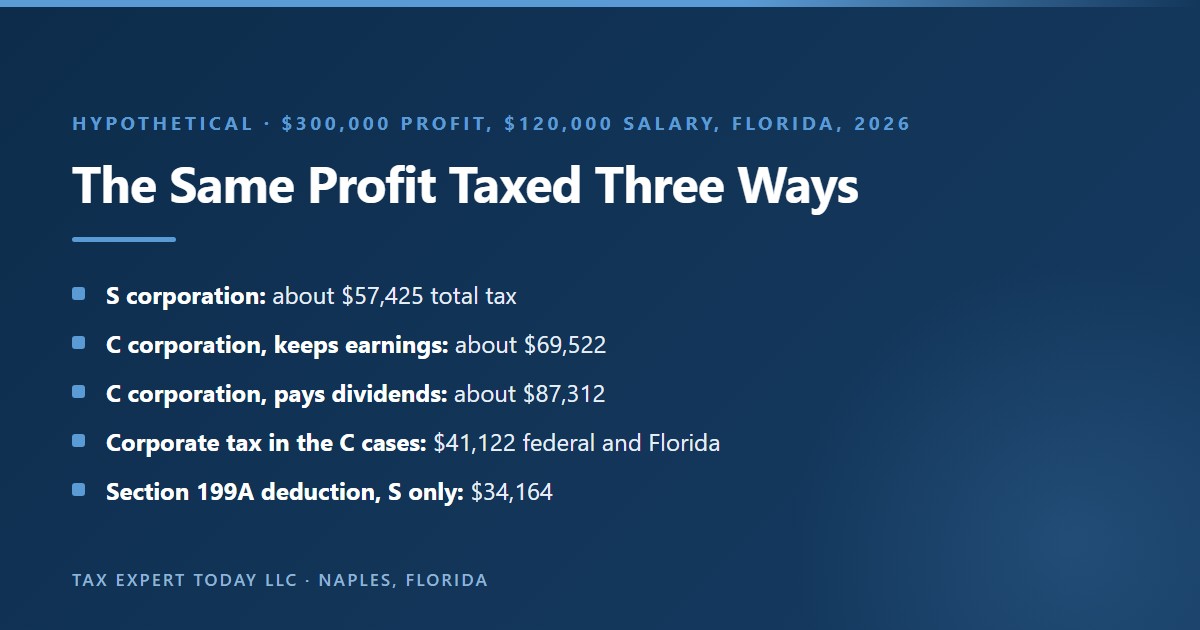
In a hypothetical Florida example, an S corporation earning $300,000 before owner pay, paying the owner a $120,000 salary, produces about $57,425 of total federal tax for a married owner in 2026: about $39,065 of income tax after a $34,164 section 199A deduction, plus $18,360 of combined payroll tax. Florida imposes no tax on that income.
- Salary: a hypothetical $120,000 W-2 wage, assumed reasonable for the owner’s role.
- Payroll tax: 7.65 percent employer plus 7.65 percent employee, $18,360 combined.
- Pass-through income: $170,820 on the K-1 after wages and the employer payroll tax.
- Section 199A: 20 percent of qualified business income, $34,164, below the 2026 threshold.
The example assumes a married couple filing jointly in Florida, with no other income, no retirement contributions, the 2026 standard deduction of $32,200 from Revenue Procedure 2025-32, and the 2026 Social Security wage base of $184,500 from IRS Topic 751. It ignores federal unemployment tax, state reemployment tax, and every other cost of running payroll, which are small but real. It is a hypothetical illustration, not a projection for any business.
The corporation deducts the $120,000 salary and the $9,180 employer share of payroll tax, leaving $170,820 of ordinary income on the Schedule K-1. The owner’s adjusted gross income is $290,820. After the standard deduction, taxable income before the section 199A deduction is $258,620. The deduction is 20 percent of qualified business income, which is $34,164, and that is less than 20 percent of taxable income, so it applies in full. Taxable income becomes $224,456, which falls in the 24 percent bracket for joint filers.
The salary assumption drives the result. A lower salary reduces payroll tax and raises the K-1 income, but a salary the IRS considers unreasonably low can be recharacterized as wages, with payroll tax, penalties, and interest. A higher salary does the reverse. The number used here is an illustration only.
| Line | Amount | Note |
|---|---|---|
| Profit before owner compensation | $300,000 | Hypothetical |
| Owner W-2 salary | $120,000 | Assumed reasonable |
| Employer payroll tax (7.65 percent) | $9,180 | Deducted by the corporation |
| Ordinary income on Schedule K-1 | $170,820 | Taxed to the owner |
| Adjusted gross income | $290,820 | Wages plus K-1 income |
| Standard deduction | $32,200 | Rev. Proc. 2025-32 |
| Section 199A deduction (20 percent of QBI) | $34,164 | Below the $403,500 threshold |
| Taxable income | $224,456 | 24 percent bracket |
| Federal income tax | $39,065 | 2026 joint rates |
| Employer plus employee payroll tax | $18,360 | Social Security and Medicare |
| Florida tax | $0 | No individual income tax; S corporation generally exempt |
| Total tax | $57,425 | About 19.1 percent of $300,000 |
How much tax does a C corp pay on $300,000 if it keeps the earnings?
Using the same hypothetical, a Florida C corporation that pays the owner a $120,000 salary and keeps the remaining $170,820 owes about $34,477 of federal tax and $6,645 of Florida tax. Adding the owner’s $10,040 of income tax and $18,360 of payroll tax brings the current year total to about $69,522, with $129,698 left inside the company.
- Corporate taxable income: $170,820 after salary and employer payroll tax.
- Florida tax: 5.5 percent on income above the $50,000 exemption, about $6,645.
- Federal tax: 21 percent on income after the Florida deduction, about $34,477.
- Deferred, not avoided: the $129,698 left inside is taxed again when distributed.
This is the scenario C corporation advocates usually have in mind: profit retained to fund growth, taxed once at a flat rate. For a business that genuinely needs that cash, the comparison with the S corporation is not $69,522 against $57,425, because the S corporation owner paid tax on all $170,820 of K-1 income whether or not the cash was kept in the business.
Florida is where the comparison departs from many national examples. Florida does not tax individual income, so an S corporation’s pass-through profit is generally untaxed by the state. A C corporation, however, pays the Florida corporate income tax under Florida Statutes section 220.11 at 5.5 percent, after the $50,000 exemption in section 220.14. The Florida Department of Revenue corporate income tax page confirms the 5.5 percent rate for tax years beginning on or after January 1, 2022, and explains that an S corporation generally files only when it owes federal tax at the entity level.
The owner in this scenario has a lower personal tax bill, because only the salary is taxed on the individual return. Taxable income is $87,800 after the standard deduction, which keeps the owner in the 12 percent bracket. That is a real difference in current cash tax. Whether it is a saving depends on what happens to the retained $129,698 later, which the next sections address.
| Line | Amount | Note |
|---|---|---|
| Profit before owner compensation | $300,000 | Same hypothetical |
| Owner W-2 salary | $120,000 | Deductible under IRC 162 |
| Employer payroll tax | $9,180 | Deductible |
| Corporate income before state tax | $170,820 | Florida base before exemption |
| Florida corporate income tax | $6,645 | 5.5 percent of $120,820 |
| Federal corporate income tax | $34,477 | 21 percent of $164,175 |
| Total corporate tax | $41,122 | About 24.1 percent of $170,820 |
| Owner federal income tax on salary | $10,040 | Taxable income $87,800 |
| Employer plus employee payroll tax | $18,360 | Same as the S corporation |
| Total current year tax | $69,522 | About 23.2 percent of $300,000 |
| After tax earnings retained | $129,698 | Taxed again if distributed |
What happens when a C corp distributes all its profit as dividends?
When the same hypothetical C corporation distributes its $129,698 of after tax earnings as a qualified dividend, the owner pays about $17,790 of additional federal tax at the 0 and 15 percent rates. Total tax rises to about $87,312, roughly $29,887 more than the S corporation on the same $300,000 of profit.
- Dividend: $129,698 of after tax corporate earnings paid to the owner.
- Rate: the first $11,100 falls in the zero percent band, the rest at 15 percent.
- Surtax: modified adjusted gross income stays just under $250,000, so no 3.8 percent tax here.
- Result: about 29.1 percent total tax, compared with about 19.1 percent in the S corporation.
This is the double tax in its plainest form. The corporation paid $41,122 on the profit, and the owner pays $17,790 on what is left. Combined with the salary tax and payroll tax, the owner who takes everything home pays about $87,312, compared with about $57,425 under the S corporation. The difference, about $29,887 in a single year, is mostly the corporate tax that an S corporation never pays, plus the section 199A deduction that only the S corporation owner receives.
The dividend rate in this example is low, because the owner’s ordinary taxable income is only $87,800 and the zero percent band for joint filers runs to $98,900 under Revenue Procedure 2025-32. An owner with other income, such as a spouse’s salary or investment income, would pay 15 or 20 percent on the full dividend and may owe the 3.8 percent net investment income tax as well. The double tax becomes heavier, not lighter, as income rises.
Owners sometimes try to avoid the dividend by paying a larger salary or bonus, which the corporation deducts. That shifts income from the corporate return to the individual return and adds payroll tax. It works only to the extent the compensation is reasonable for the services performed, a limit discussed below. Owners comparing the payroll side of each structure can test salary levels with our self-employment tax calculator, which shows the payroll cost a sole proprietor would pay on the same income.
| Line | S corporation | C corporation, retains | C corporation, distributes |
|---|---|---|---|
| Owner salary | $120,000 | $120,000 | $120,000 |
| Corporate tax, federal and Florida | $0 | $41,122 | $41,122 |
| Owner income tax | $39,065 | $10,040 | $27,830 |
| Payroll tax, both halves | $18,360 | $18,360 | $18,360 |
| Total current year tax | $57,425 | $69,522 | $87,312 |
| Cash left inside the company | $0 (all taxed to owner) | $129,698 | $0 |
| Effective rate on $300,000 | 19.1 percent | 23.2 percent | 29.1 percent |
How does the S corp vs C corp comparison change at other profit levels?
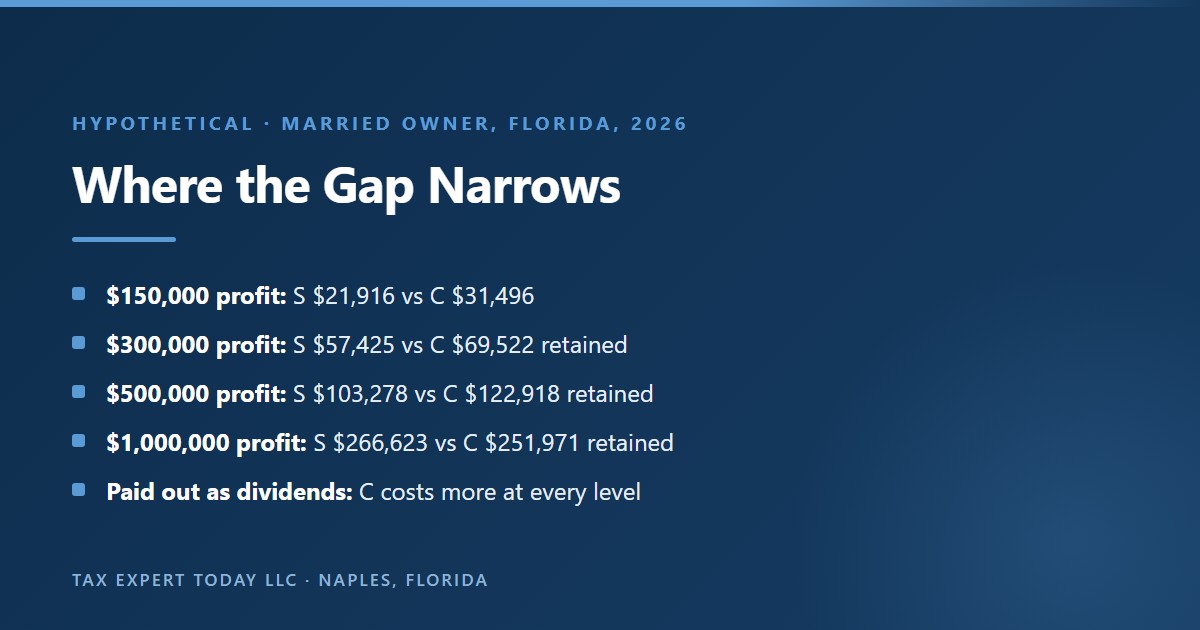
The S corp vs C corp gap narrows as profit rises. In hypothetical Florida examples for married owners in 2026, the S corporation produces less current tax at $150,000, $300,000, and $500,000 of profit. At $1,000,000 with a $200,000 salary, a C corporation that retains earnings produces slightly less, because the S owner reaches the highest brackets.
- Low profit: the S corporation advantage is large relative to income.
- High profit: individual rates of 35 and 37 percent overtake the 21 percent corporate rate.
- Distributed profit: the C corporation costs more at every level tested here.
- Retained profit: the C corporation can win at high income, if the cash truly stays inside.
The table below repeats the method of the $300,000 example at three other profit levels, with salaries assumed for illustration. Each row assumes a married couple filing jointly in Florida with no other income. At $500,000 the owner’s taxable income before the section 199A deduction exceeds the 2026 threshold of $403,500, so the wage limitation phases in; here it does not reduce the deduction because 50 percent of the $160,000 salary exceeds 20 percent of the business income. At $1,000,000 the owner is past the phase-in range that ends at $553,500, and the deduction is capped at 50 percent of W-2 wages, or $100,000.
The crossover at high income is the point many owners miss. Once the owner is in the top brackets, retaining profit in a C corporation can reduce the current year tax. The saving holds only if the cash stays inside for a business purpose. Profit retained beyond the reasonable needs of the business can trigger the accumulated earnings tax, and eventually the owner usually wants the cash, which brings the dividend tax back.
At $150,000, the C corporation dividend in the distributed column happens to fall entirely within the zero percent dividend band because the owner has no other income. That makes the two C corporation columns identical. It is a feature of this specific hypothetical, not a general rule.
| Profit before owner pay | Assumed salary | S corporation | C corporation, retains | C corporation, distributes |
|---|---|---|---|---|
| $150,000 | $70,000 | $21,916 | $31,496 | $31,496 |
| $300,000 | $120,000 | $57,425 | $69,522 | $87,312 |
| $500,000 | $160,000 | $103,278 | $122,918 | $165,908 |
| $1,000,000 | $200,000 | $266,623 | $251,971 | $367,889 |
What is the combined tax rate on C corporation profit that is paid out?
The combined federal rate on C corporation profit paid out as a dividend can reach about 39.8 percent: 21 percent at the corporation plus 23.8 percent on the remaining 79 percent at the shareholder level. In Florida, the 5.5 percent state corporate tax pushes the combined rate on profit above the exemption to roughly 43 percent.
- Federal corporate layer: 21 percent of each dollar of taxable income.
- Federal shareholder layer: 20 percent plus 3.8 percent on the 79 cents left.
- Combined federal: 21 plus 18.8, or about 39.8 percent.
- Florida layer: 5.5 percent, deductible federally, pushes the total to about 43 percent.
The arithmetic is simple once it is laid out. One dollar of corporate profit pays 21 cents of federal tax. The remaining 79 cents, paid as a qualified dividend to a top bracket shareholder, bears 20 percent tax under IRC section 1(h) plus 3.8 percent under IRC section 1411, or 18.8 cents. The total is 39.8 cents. With Florida corporate tax of 5.5 cents on the dollar, the federal corporate tax applies to 94.5 cents, and the combined rate comes to roughly 43 percent.
Compare that with the top individual rate of 37 percent, which an S corporation owner pays on K-1 income, reduced by the section 199A deduction when it applies. With a full 20 percent deduction, the effective top rate on qualified business income is 29.6 percent. Without it, as for a specified service business above the phase-in, it is 37 percent. An active S corporation owner generally does not owe the 3.8 percent net investment income tax on that income.
These figures are marginal rates at the top of the income scale. Most closely held businesses do not pay these exact rates on every dollar, which is why the dollar examples above matter more than the headline rate. The headline rate is still useful as a ceiling for owners whose income is already high.
| Structure and payout | Rate on the last dollar | Notes |
|---|---|---|
| C corporation, retained | 21 percent | Plus 5.5 percent Florida above the exemption |
| C corporation, paid as qualified dividend | About 39.8 percent federal | About 43 percent with Florida |
| S corporation, with full 20 percent 199A deduction | 29.6 percent | 37 percent times 80 percent |
| S corporation, no 199A deduction | 37 percent | Specified service business above the range |
| S corporation owner wages | 37 percent plus payroll tax | Medicare 2.9 percent plus 0.9 percent additional |
How does the section 199A deduction favor S corporation owners?
The section 199A deduction lets an S corporation owner deduct up to 20 percent of qualified business income from the K-1. A C corporation shareholder receives no such deduction on dividends or on corporate profit. The 2025 law made the deduction permanent, so it now belongs in every long term S corp vs C corp projection.
- Who qualifies: individuals with business income from an S corporation, partnership, or sole proprietorship.
- What it excludes: owner W-2 wages and C corporation dividends.
- Permanence: the 2025 law removed the scheduled 2025 expiration.
- Minimum: a $400 floor applies for taxpayers with at least $1,000 of active business income.
The deduction appears in IRC section 199A. Under section 199A(a) it is the lesser of the combined qualified business income amount or 20 percent of taxable income above net capital gain. The section 199A(c) definition of qualified business income excludes reasonable compensation paid to the shareholder, so the S corporation owner’s W-2 salary does not count. Only the K-1 income above salary does. Our guide to the qualified business income deduction covers the mechanics in more depth.
Before the 2025 law, the deduction was set to expire after 2025, which made it hard to weigh in a ten year projection. That law removed the expiration date and widened the phase-in range to $75,000 for single filers and $150,000 for joint filers, both visible in the current text of section 199A(b)(3). It also added a minimum deduction of $400 for taxpayers with at least $1,000 of qualified business income from businesses in which they materially participate, under section 199A(i).
For 2026, Revenue Procedure 2025-32 sets the threshold amount at $403,500 for joint returns and $201,750 for most other filers, with the phase-in ending at $553,500 and $276,750. Below the threshold, the full 20 percent applies regardless of wages or the type of business. The IRS explains the computation in the Form 8995 instructions and the Form 8995-A instructions.
The salary and the deduction pull against each other. A higher salary reduces K-1 income and therefore the deduction. Above the threshold, though, the W-2 wage limit needs salary to support the deduction. The interaction makes the salary decision a calculation rather than a guess.
| Item | Joint return | Other returns |
|---|---|---|
| Threshold amount | $403,500 | $201,750 |
| Phase-in range | $150,000 | $75,000 |
| Top of phase-in | $553,500 | $276,750 |
| Deduction rate | 20 percent of QBI | 20 percent of QBI |
| Wage limit above the range | Greater of 50 percent of W-2 wages or 25 percent plus 2.5 percent of UBIA | Same |
| Minimum deduction | $400 with at least $1,000 of active QBI | Same |
When does the wage limit or the service business rule shrink the S corp advantage?
Above the 2026 threshold of $403,500 for joint filers, the section 199A deduction is limited by W-2 wages, and for a specified service business such as law, accounting, health, or consulting it phases out completely by $553,500. At that point an S corporation owner in a service business pays up to 37 percent on K-1 income.
- Wage limit: the deduction cannot exceed the greater of 50 percent of W-2 wages or 25 percent of wages plus 2.5 percent of property basis.
- Service businesses: no deduction once taxable income passes the top of the phase-in range.
- Owner salary counts: the S corporation owner’s own W-2 wages count toward the wage limit.
- Effect: the S corporation still avoids the double tax, but its rate edge narrows.
The specified service trade or business rule in section 199A(d)(2) borrows the list from section 1202(e)(3): health, law, accounting, actuarial science, performing arts, consulting, athletics, financial services, brokerage services, and any business whose principal asset is the reputation or skill of its owners or employees, with engineering and architecture carved out. For those businesses, the deduction phases out between $403,500 and $553,500 of taxable income on a joint return in 2026.
That matters for the S corp vs C corp comparison in two ways. First, a high earning physician, lawyer, or consultant in an S corporation does not get the 20 percent deduction, so the S side of the comparison is taxed at full individual rates. Second, the same service business also cannot use the section 1202 exclusion if it is a C corporation, because section 1202(e)(3) uses the same list. Neither entity gets its signature benefit, and the comparison returns to the basic question of one layer of tax against two.
For a non service business above the range, the wage limit is the constraint. In the $1,000,000 hypothetical, the owner salary of $200,000 caps the deduction at $100,000, while 20 percent of the K-1 income would be about $157,000. Raising the salary raises the cap but also raises payroll tax and lowers K-1 income. A projection that tests several salary levels is the usual way to find a reasonable figure that also works for the deduction. Our qualified business income deduction guide and our reasonable compensation guide cover each side of that test.
| Taxable income before the deduction | Non service business | Specified service business |
|---|---|---|
| Up to $403,500 | Full 20 percent of QBI | Full 20 percent of QBI |
| $403,500 to $553,500 | Wage limit phases in | Deduction phases out, wage limit phases in |
| Above $553,500 | Limited by wages and property basis | No deduction |
How does reasonable compensation affect the S corp vs C corp decision?
Reasonable compensation pulls in opposite directions in the two entities. An S corporation owner is pressured to pay at least a reasonable salary, because distributions avoid payroll tax. A C corporation owner is pressured not to exceed a reasonable salary, because excess pay can be treated as a nondeductible dividend. Either way, the salary sets much of the tax result.
- S corporation risk: salary too low, recharacterized as wages with payroll tax and penalties.
- C corporation risk: salary too high, recharacterized as a dividend with no corporate deduction.
- Common standard: pay comparable to what a similar business would pay for similar services.
- Documentation: role descriptions, hours, market data, and board minutes support either position.
The IRS position for S corporations is stated on its S corporations page and in the Form 1120-S instructions: distributions and other payments to a corporate officer must be treated as wages to the extent they are reasonable compensation for services. Courts have repeatedly treated distributions as wages when an owner who works full time takes little or no salary. Our article on S corp reasonable compensation covers the factors used to set the figure, so this guide does not repeat them.
For a C corporation the concern runs the other way. Compensation is deductible under IRC section 162(a)(1) only if it is a reasonable allowance for personal services actually rendered. When an owner pays out the entire profit as a year end bonus to avoid corporate tax, the excess over a reasonable amount can be disallowed as a deduction and treated as a dividend. The corporation then pays the 21 percent tax on the disallowed amount, and the owner has already paid individual tax and payroll tax on it.
This asymmetry is why the same owner, doing the same work, may settle on different salaries depending on the entity. In the hypothetical tables in this guide the salary is held constant at each profit level so the comparison isolates the entity effect. In practice, the salary decision and the entity decision are made together.
| Issue | S corporation | C corporation |
|---|---|---|
| Direction of IRS concern | Salary too low | Salary too high |
| Consequence | Distributions treated as wages | Excess pay treated as a dividend |
| Tax added | Payroll tax, penalties, interest | Corporate tax on the disallowed deduction |
| Authority | Form 1120-S instructions, case law | IRC 162(a)(1), Reg. 1.162-7 |
| Planning lever | Salary plus distributions | Salary, bonus, retained earnings |
Does a C corporation owner still pay payroll tax?
Yes. A C corporation owner who works in the business is an employee, and wages carry the same Social Security and Medicare tax as in an S corporation. What differs is the rest of the profit: a C corporation owner receives it as a dividend, which has no payroll tax but carries corporate tax and dividend tax instead.
- Employer share: 6.2 percent Social Security up to the wage base plus 1.45 percent Medicare.
- Employee share: the same 7.65 percent, withheld from pay.
- 2026 wage base: $184,500 for the Social Security portion.
- Additional Medicare tax: 0.9 percent on wages above $250,000 for joint filers.
A common assumption is that payroll tax savings are unique to the S corporation. They are not. In both entities, the owner’s wages are subject to the Federal Insurance Contributions Act taxes, and in both entities the profit that is not paid as wages escapes payroll tax. The S corporation pays it out as a distribution with one layer of income tax. The C corporation pays it out as a dividend with two. The comparison that matters is between those two non wage paths, not between payroll tax and no payroll tax.
For 2026, IRS Topic 751 states that the Social Security wage base is $184,500. Wages above that amount carry only the 2.9 percent Medicare tax, plus the 0.9 percent additional Medicare tax under IRC section 3101(b)(2) on the employee side once wages exceed $250,000 on a joint return. Owners above the wage base therefore see a much smaller payroll cost on each additional dollar of salary, which changes the salary math in both entities.
Payroll tax is the cost of the salary; it is not the whole story. In both entities, the salary is also the base for retirement plan contributions such as a 401(k) profit sharing contribution, and it affects the section 199A wage limit for the S corporation owner. Those links are why the same salary can look expensive on payroll and still be worthwhile overall.
| Tax | Employer | Employee | Wage limit |
|---|---|---|---|
| Social Security | 6.2 percent | 6.2 percent | $184,500 |
| Medicare | 1.45 percent | 1.45 percent | None |
| Additional Medicare | None | 0.9 percent | Above $250,000 joint or $200,000 single |
| Federal unemployment | Small, on the first $7,000 | None | Credit for state contributions |
Why does QSBS make the C corporation more attractive after 2025?
Qualified small business stock under section 1202 can let a shareholder exclude gain on a sale of C corporation stock. For stock issued after July 4, 2025, the exclusion is 50 percent after three years, 75 percent after four, and 100 percent after five, up to $15 million per issuer. S corporation stock never qualifies.
- Entity: the issuer must be a domestic C corporation when the stock is issued and during the holding period.
- Size: aggregate gross assets of $75 million or less when the stock is issued.
- Cap: the greater of $15 million or ten times the shareholder’s basis, for post 2025 stock.
- Holding: graduated exclusion from three years, full exclusion at five.
The 2025 law changed IRC section 1202 for stock acquired after its enactment on July 4, 2025. Under section 1202(b)(5) as amended, the applicable percentage is 50 percent for stock held three years, 75 percent for four years, and 100 percent for five years or more. The per issuer cap in section 1202(b)(1) rose from $10 million to $15 million for that stock, indexed for inflation for years after 2026, and the gross asset test in section 1202(d) rose from $50 million to $75 million.
For an owner who expects to build a business and sell its stock, those numbers can dwarf the annual savings an S corporation provides. A $5 million stock gain that qualifies in full can be excluded entirely from federal income tax, while the same gain on S corporation stock would be taxed at capital gain rates. Our guide to qualified small business stock covers the qualification tests in detail, including the active business requirement and the original issuance rule, so this section keeps to how QSBS enters the entity choice.
Two conditions keep the comparison honest. The exclusion applies only to a sale of stock, not a sale of the company’s assets, and only to stock originally issued by a C corporation. A company that operates as an S corporation and later converts to a C corporation can issue qualifying stock after the conversion, but the holding period for that stock starts then, and the value built up as an S corporation does not qualify.
| Years held | Excluded share of gain | Taxable portion rate |
|---|---|---|
| Less than 3 | None | Regular capital gain rates |
| 3 years | 50 percent | Up to 28 percent on the included half, plus NIIT |
| 4 years | 75 percent | Up to 28 percent on the included quarter, plus NIIT |
| 5 years or more | 100 percent | None, within the cap |
| Per issuer cap | Greater of $15 million or 10 times basis | Indexed after 2026 |
| Gross asset test | $75 million at issuance | Indexed after 2026 |
Which businesses cannot use the QSBS exclusion?
Section 1202 excludes most service businesses and several other industries. A C corporation in health, law, engineering, architecture, accounting, actuarial science, performing arts, consulting, athletics, financial services, or brokerage, or one whose principal asset is the reputation or skill of its people, does not qualify. Banking, insurance, farming, mining, and hospitality are also excluded.
- Professional services: the same list as the section 199A service business rule, but without the engineering and architecture carve out.
- Finance: banking, insurance, financing, leasing, and investing businesses.
- Resources: farming and businesses claiming depletion under certain sections.
- Hospitality: hotels, motels, and restaurants.
The list sits in IRC section 1202(e)(3). A corporation must use at least 80 percent of its assets by value in the active conduct of a qualified trade or business during substantially all of the holding period, and a business on the excluded list is not a qualified trade or business. Engineering and architecture appear on the section 1202 list, even though the section 199A rule carves them out, so an engineering firm can still get the 199A deduction but not the QSBS exclusion.
For an owner in an excluded field, the entity choice is simpler. The C corporation exit advantage does not exist, so the decision usually turns on the annual math, where the S corporation often produces less tax for owner operated firms. That is one reason professional practices so often operate as S corporations or partnerships.
For businesses near the line, the classification can be uncertain. A software company that also provides implementation consulting, or a medical device company that also runs clinics, may need an analysis of where its revenue and its value come from. That analysis belongs before the entity choice, not at the time of sale.
| Business | Generally qualifies? | Reason |
|---|---|---|
| Software or technology product | Often yes | Not on the excluded list |
| Manufacturing or distribution | Often yes | Not on the excluded list |
| Medical or dental practice | No | Health |
| Law, accounting, or consulting firm | No | Listed services |
| Engineering or architecture firm | No | Listed under section 1202 |
| Restaurant or hotel | No | Hospitality exclusion |
| Bank, insurer, or lender | No | Financial business exclusion |
| Real estate holding company | Usually no | Asset tests and investment limits |
How does a business sale compare in an S corp vs C corp?
In a hypothetical $5 million stock sale by a married Florida owner in 2026, C corporation stock that fully qualifies under section 1202 owes no federal income tax on the gain. Without QSBS, the same sale costs about $1,128,540. S corporation stock held by an active owner costs about $948,040, generally without the 3.8 percent surtax.
- QSBS stock, five years: $0 federal tax on gain within the $15 million cap.
- C corporation stock without QSBS: capital gain rates plus the 3.8 percent surtax.
- S corporation stock: capital gain rates, usually without the surtax for an active owner.
- Florida: no individual income tax on any of the three stock sales.
The exit table assumes a married couple filing jointly, no other income in the year of sale, a $5,000,000 long term gain on the stock, and the 2026 standard deduction. Capital gain is taxed at zero percent to $98,900, 15 percent to $613,700, and 20 percent above, under Revenue Procedure 2025-32. Without QSBS, the C corporation shareholder also owes the 3.8 percent net investment income tax on the gain above the $250,000 threshold, about $180,500.
An S corporation shareholder who materially participates in the business is generally protected from that surtax by section 1411(c)(4), which limits the gain treated as investment income to the amount that would arise if the S corporation sold its assets, and gain on assets used in an active trade or business is not investment income for a material participant. The result in the table assumes all of the company’s assets are used in the active business.
The QSBS line assumes the stock was originally issued after July 4, 2025, by a C corporation that met the gross asset test, used at least 80 percent of its assets in a qualified business, and was held for five years. It also assumes a stock sale. If any of those assumptions fails, the C corporation falls back to the second line. Annual tax savings from the S corporation, about $12,000 to $30,000 a year in the $300,000 hypothetical, would take decades to match a $948,040 difference at exit, but only if the exit actually qualifies.
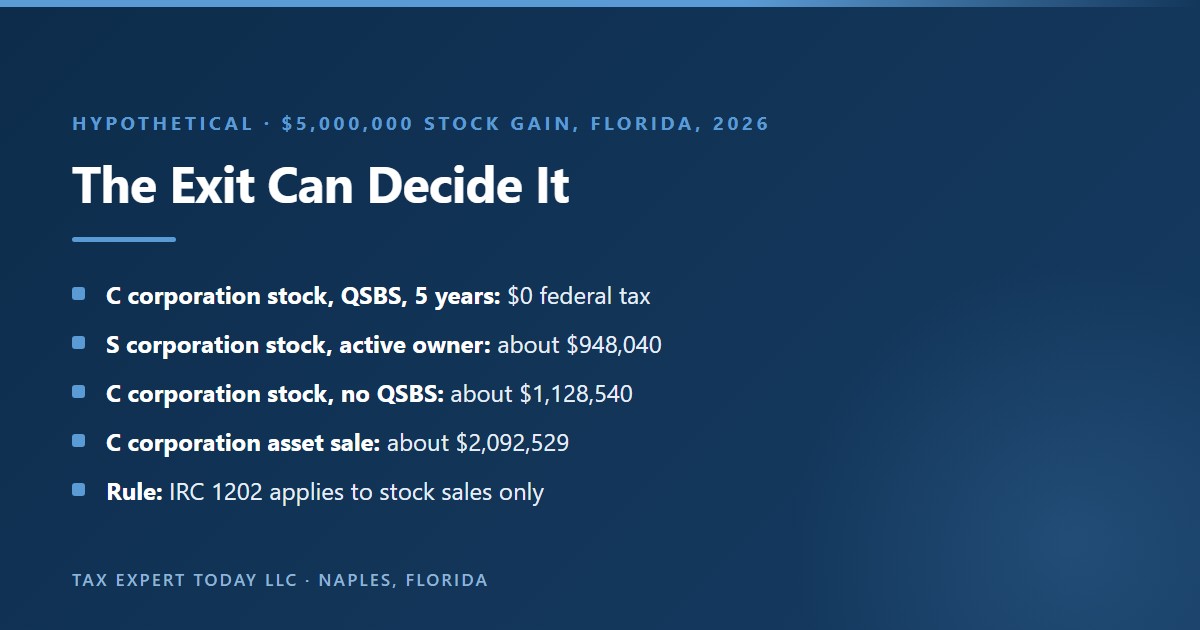
| Structure | Federal capital gain tax | Net investment income tax | Total federal tax |
|---|---|---|---|
| C corporation stock, QSBS, held 5 years or more | $0 | $0 | $0 |
| C corporation stock, QSBS, held 4 years (75 percent excluded) | Up to $350,000 at 28 percent | About $38,000 | Up to about $388,000 |
| C corporation stock, no QSBS | $948,040 | $180,500 | $1,128,540 |
| S corporation stock, active owner | $948,040 | Generally $0 | $948,040 |
| Florida income tax, any of the above | $0 | Not applicable | $0 |
Why do buyers prefer asset sales, and how does that hurt a C corporation?
Buyers often prefer to buy assets because they get a stepped up tax basis to depreciate or amortize. In a C corporation, an asset sale is taxed twice: the corporation pays tax on the gain, and the owner pays tax again when the proceeds are distributed in liquidation. In an S corporation, the gain generally passes through once.
- Buyer benefit: new basis in equipment, goodwill, and other assets, recovered through deductions.
- C corporation cost: 21 percent federal plus Florida corporate tax, then tax on the liquidating distribution.
- S corporation result: one layer of tax, with character passed through to the owner.
- QSBS: does not apply to an asset sale, only to a sale of qualifying stock.
When a C corporation sells its assets, the gain is corporate income taxed at 21 percent under IRC section 11(b), plus 5.5 percent Florida tax above the exemption. When the corporation then distributes the after tax proceeds to its shareholders and liquidates, IRC section 331 treats the distribution as payment in exchange for the stock, so the shareholder recognizes gain again. That combination is the main reason small C corporations are expensive to sell.
In the hypothetical below, a $5,000,000 asset gain inside a Florida C corporation produces about $272,250 of Florida tax and about $992,828 of federal corporate tax. The owner then receives about $3,734,922 and pays roughly $695,024 of capital gain tax and $132,427 of net investment income tax on the liquidation, assuming negligible stock basis. The total is about $2,092,529, compared with roughly $948,040 if the same gain passed through an S corporation to an active owner. The figures are illustrative and ignore depreciation recapture, which can apply in either structure.
This is why the C corporation exit case depends on a stock sale. Many buyers of small companies will not agree to buy stock, because they inherit the company’s history and liabilities. Sellers sometimes accept a lower price for a stock sale, or use a structure that gives the buyer some basis benefit. Our guide to selling a business and taxes covers asset and stock sale structures in more depth, and owners who plan to relocate before a sale can review moving to Florida before selling a business. Buyers value the basis step up partly because of bonus depreciation on purchased equipment.
| Line | C corporation | S corporation, active owner |
|---|---|---|
| Florida corporate tax | $272,250 | $0 |
| Federal corporate tax | $992,828 | $0 (generally) |
| Cash distributed to owner | $3,734,922 | Full proceeds |
| Owner capital gain tax | $695,024 | $948,040 |
| Owner net investment income tax | $132,427 | Generally $0 |
| Total tax on the gain | About $2,092,529 | About $948,040 |
| Section 1202 exclusion | Not available on an asset sale | Never available |
What is the accumulated earnings tax?
The accumulated earnings tax is a 20 percent penalty tax under IRC section 531 on a C corporation that keeps earnings beyond the reasonable needs of its business to help shareholders avoid dividend tax. Most corporations can accumulate $250,000 without justification, but service corporations in fields such as law, accounting, health, and consulting get only $150,000.
- Rate: 20 percent of accumulated taxable income, on top of the regular 21 percent tax.
- Safe amount: the accumulated earnings credit of $250,000, or $150,000 for listed service corporations.
- Defense: documented reasonable business needs, such as expansion, working capital, or debt retirement.
- Not self reported in practice: it is usually raised by the IRS on examination.
IRC section 531 imposes the tax on every corporation described in section 532, which is any corporation formed or availed of to avoid income tax for its shareholders by permitting earnings to accumulate instead of being distributed. The rate is 20 percent, matching the top qualified dividend rate, so the tax is designed to remove the advantage of keeping profit inside.
The minimum credit in IRC section 535(c)(2) allows a corporation to accumulate earnings and profits of $250,000 without showing a business need. A corporation whose principal function is services in health, law, engineering, architecture, accounting, actuarial science, performing arts, or consulting gets $150,000. Above those amounts, the corporation needs a reasonable business purpose for the accumulation. Plans to buy equipment, fund expansion, build working capital for a business cycle, or retire debt can support it when they are specific and documented.
This tax is the limit on the retained earnings strategy shown in the $1,000,000 hypothetical. A C corporation that retains $588,708 each year will cross the safe amount quickly. If the money is used to grow the business, the accumulation is usually defensible. If it is invested in a brokerage account for the owner’s retirement, the accumulation may be exposed to this tax. Board minutes that tie retained earnings to specific plans are the usual protection.
| Item | Rule | Source |
|---|---|---|
| Rate | 20 percent of accumulated taxable income | IRC 531 |
| Who can be subject | Corporations formed or availed of to avoid shareholder tax | IRC 532 |
| Minimum credit, most corporations | $250,000 of accumulated earnings and profits | IRC 535(c)(2)(A) |
| Minimum credit, listed service corporations | $150,000 | IRC 535(c)(2)(B) |
| Not applicable to | S corporations, personal holding companies, certain others | IRC 532(b) |
| Common defense | Specific, documented business needs | Reg. 1.537-2 |
What is the personal holding company tax?
The personal holding company tax is a separate 20 percent tax under IRC section 541 on undistributed income of a C corporation that is closely held and earns mostly passive income such as dividends, interest, rents, royalties, or certain personal service contract income. It stops owners from parking investment income in a C corporation to use the 21 percent rate.
- Ownership test: more than 50 percent owned by five or fewer individuals during the last half of the year.
- Income test: at least 60 percent of adjusted ordinary gross income is personal holding company income.
- Rate: 20 percent of undistributed personal holding company income.
- Relief: dividends paid, including certain deficiency dividends, reduce the tax base.
IRC section 541 imposes the tax. It is aimed at incorporated pocketbooks, meaning corporations that exist mainly to hold investments or to receive income from an owner’s personal services under a contract that names the owner. An operating business with real customers rarely meets the income test, but a holding company created to own investments or a consulting contract can.
For the S corp vs C corp comparison, the personal holding company tax rules out a strategy some owners consider: putting a portfolio inside a C corporation to pay 21 percent instead of 37 percent on the income. The 20 percent tax on undistributed income, plus the eventual dividend tax, removes most of the benefit. An S corporation is not subject to this tax.
A related rule affects former C corporations that elect S status. Under IRC section 1375, an S corporation with accumulated earnings and profits from C years pays tax on excess passive investment income when passive income exceeds 25 percent of gross receipts, and under section 1362(d)(3) the election terminates after three consecutive years of that pattern.
| Test | Requirement | Typical result for an operating business |
|---|---|---|
| Stock ownership | More than 50 percent owned by 5 or fewer individuals | Often met by closely held companies |
| Income | 60 percent or more is passive or listed service contract income | Usually not met |
| Tax | 20 percent of undistributed income | Avoided by paying dividends |
| S corporations | Not subject to the tax | Not applicable |
What is the built-in gains tax when a C corp converts to an S corp?
The built-in gains tax under IRC section 1374 is a corporate level tax, at 21 percent, on gain that existed when a C corporation became an S corporation and that is recognized during the five year recognition period. It prevents a C corporation from electing S status just before selling appreciated assets to avoid the double tax.
- Trigger: an S corporation that was a C corporation, or that received assets from one tax free.
- Measure: net unrealized built-in gain on the first day of the first S year.
- Period: five years beginning with the first day of the first S corporation year.
- Rate: the highest corporate rate, now 21 percent, on the net recognized built-in gain.
IRC section 1374 taxes an S corporation on its net recognized built-in gain for any year in the recognition period. Section 1374(d)(7) defines that period as the five year period beginning with the first day of the first taxable year for which the corporation was an S corporation. The tax is limited to the net unrealized built-in gain, which is the excess of the fair market value of the corporation’s assets over their adjusted basis on that first day.
This rule matters in two directions for the entity decision. An owner who starts as a C corporation to keep the QSBS option open and later decides to convert to S status will carry built-in gain for five years. A sale of assets during that window will be taxed at the corporate level and again as it passes through, the same double tax the election was meant to avoid. On the other hand, gain that accrues after the conversion is not built-in gain, and the tax disappears entirely after five years.
The practical step at conversion is an appraisal of the company’s assets, including goodwill, as of the first day of the S year. Without a valuation, the corporation may be unable to show that later gain arose after the conversion. The IRS computes the tax on Schedule D of Form 1120-S. Florida also taxes S corporations that owe this federal tax, as the next section on Florida explains.
| Date | Event | Built-in gains exposure |
|---|---|---|
| January 1, 2027 | First S corporation year begins; assets appraised | Net unrealized built-in gain fixed |
| 2027 to 2031 | Recognition period | Sales of built-in gain assets taxed at 21 percent |
| January 1, 2032 | Recognition period ends | No further section 1374 tax |
| Any year | Gain accrued after January 1, 2027 | Not built-in gain |
What other traps apply when a former C corporation elects S status?
Beyond the built-in gains tax, a former C corporation that elects S status may face LIFO recapture under section 1363(d), the excess passive investment income tax under section 1375, possible termination of the election after three years of excess passive income, and more complex distribution ordering because of accumulated earnings and profits from C years.
- LIFO recapture: inventory reserve added to income in the last C year, tax paid over four years.
- Passive income tax: applies when passive income exceeds 25 percent of gross receipts.
- Termination: three consecutive years of excess passive income with C earnings ends the election.
- Distributions: accumulated adjustments account and earnings and profits ordering under section 1368(c).
A corporation that used the last in, first out inventory method must include its LIFO reserve in income for its final C corporation year under IRC section 1363(d), with the resulting tax payable in four annual installments. Companies with large inventories built up over many years can face a meaningful cost on the day of conversion.
Accumulated earnings and profits from the C years also follow the corporation into S status. Under IRC section 1368(c), distributions come first from the accumulated adjustments account, which tracks S year income, and then from earnings and profits, which are taxed as dividends. Many converted corporations elect to distribute old earnings and profits first, or simply keep careful records so that a large distribution does not carry an unexpected dividend.
Those same earnings and profits are what make the passive income rules apply. A former C corporation that holds investments, rental property, or other passive assets after conversion should monitor the 25 percent test each year under IRC section 1375, because three consecutive years over the line with earnings and profits remaining ends the S election under section 1362(d)(3).
| Issue | Rule | Planning step |
|---|---|---|
| Built-in gain | IRC 1374, five year period | Appraise assets at conversion |
| LIFO reserve | IRC 1363(d) | Model the four year tax payment |
| Accumulated earnings and profits | IRC 1368(c) | Track AAA and E and P separately |
| Excess passive income | IRC 1375 | Monitor the 25 percent test yearly |
| Termination risk | IRC 1362(d)(3) | Distribute E and P or reduce passive income |
| Loss carryforwards | IRC 1371(b) | C year net operating losses generally cannot pass through |
What are the S corporation eligibility rules?
An S corporation must be a domestic corporation with no more than 100 shareholders, only one class of stock, and only eligible shareholders: U.S. citizen or resident individuals, estates, certain trusts, and certain exempt organizations. Partnerships, C corporations, and nonresident aliens cannot be shareholders, and some businesses such as certain financial institutions and insurers are ineligible.
- Shareholder count: 100, with family members able to elect treatment as one shareholder.
- Eligible owners: individuals who are citizens or residents, estates, and qualifying trusts.
- Ineligible owners: partnerships, corporations, most LLCs taxed as partnerships, and nonresident aliens.
- One class of stock: identical rights to distributions and liquidation proceeds.
The definition of a small business corporation is in IRC section 1361(b). The 100 shareholder limit is rarely the binding constraint for a closely held company. The ownership rules are. A single nonresident alien shareholder, an investment from another corporation, or a transfer of shares to a partnership ends the election. That can happen through an estate plan or a divorce settlement as easily as through a financing round.
Trusts are allowed only in specific forms: grantor trusts, qualified subchapter S trusts, and electing small business trusts, each with its own election and reporting rules under section 1361(c) and (d). A trust that holds S corporation stock without making the required election can terminate the S status. Estate planning documents for S corporation owners therefore need provisions that keep the stock in an eligible trust.
The one class of stock rule is applied to the governing provisions, meaning the articles, bylaws, and binding agreements. Voting and nonvoting shares are allowed. Distributions that are not proportionate to shares may be treated as evidence of a second class if they are required by a governing provision, so payroll, loans, and distributions should be handled in a way that keeps shareholder rights identical.
| Requirement | Allowed | Not allowed |
|---|---|---|
| Entity | Domestic corporation or eligible LLC | Foreign corporation, ineligible corporations |
| Shareholders | Up to 100; family members may count as one | More than 100 |
| Shareholder type | U.S. citizen or resident individuals, estates, certain trusts, certain exempt organizations | Partnerships, C corporations, nonresident aliens |
| Stock | One class; voting differences allowed | Preferred stock or unequal economic rights |
| Subsidiaries | Qualified subchapter S subsidiaries by election | Not applicable |
How do I elect S corporation status with Form 2553?
File Form 2553 no more than two months and 15 days after the start of the tax year the election is to take effect, or at any time during the preceding tax year. Every shareholder must sign a consent. For a calendar year corporation that wants S status for 2027, the deadline is March 15, 2027.
- Who signs: an officer of the corporation and every person who is a shareholder at the time of the election.
- Timing: within 2 months and 15 days of the start of the year, or during the prior year.
- Confirmation: the IRS sends an acceptance letter, commonly a CP261 notice.
- LLCs: a timely Form 2553 generally also serves as the election to be taxed as a corporation.
The Form 2553 instructions state the rule plainly: complete and file the form no more than two months and 15 days after the beginning of the tax year the election is to take effect, or at any time during the tax year preceding that year. The two month period begins on the day of the month the tax year begins. For a calendar year company, the window for a 2027 election closes on March 15, 2027. The IRS Form 2553 page lists the current form and filing addresses.
A newly formed corporation measures from the first day it has shareholders, acquires assets, or begins doing business, whichever is first. Filing the election during the prior year, for example in December 2026 for a January 1, 2027 effective date, removes the risk of a missed window and is common practice for existing companies.
The election is valid only if all shareholders consent, including spouses in community property states when they have an interest in the stock. A missing consent is one of the most frequent reasons an election fails. The IRS generally sends a letter accepting the election within about 60 days; owners should keep that letter with the corporate records, because it is the proof most lenders and buyers ask for.
| Desired first S year | File no later than | Earliest filing |
|---|---|---|
| 2027 | March 15, 2027 | Any time during 2026 |
| 2028 | March 15, 2028 | Any time during 2027 |
| New corporation whose first tax year begins February 1, 2027 | April 15, 2027 (2 months 15 days) | On formation |
What if the S corporation election was filed late?
A late S election can often be fixed under Revenue Procedure 2013-30 if the corporation intended to be an S corporation, failed only because the election was not timely, has reasonable cause, and files within three years and 75 days of the intended effective date. All shareholders must have reported consistently with S status.
- Relief window: generally within 3 years and 75 days of the intended effective date.
- Reasonable cause: a statement explaining why the election was late.
- Consistency: shareholders reported income as if the election had been in effect.
- Filing: Form 2553 marked as filed under Rev. Proc. 2013-30, often attached to a timely Form 1120-S.
Revenue Procedure 2013-30 consolidated the IRS late election relief procedures for S corporation elections, qualified subchapter S trust and electing small business trust elections, and related entity classification elections. The IRS summarizes the options on its late election relief page. When the conditions are met, relief is granted without a private letter ruling and without a user fee.
The most common late election situation is a business that started paying the owner through payroll and filed Form 1120-S without ever filing Form 2553, or filed it and never received an acceptance. The fix is usually manageable when caught within the window. When it is not caught, the corporation has been a C corporation all along, with corporate tax, penalties, and interest due for each year, and the owner’s distributions may be dividends.
That outcome is a direct, and avoidable, S corp vs C corp decision made by default. Owners who are not sure whether an election is in force can check the IRS acceptance letter in the company’s records, or request confirmation from the IRS business line, before the next return is filed.
| Condition | What it means in practice |
|---|---|
| Intent to be an S corporation | The company acted as an S corporation from the intended date |
| Only failure was timing | The company was otherwise eligible |
| Reasonable cause | A written explanation accompanies the late form |
| Time limit | Generally 3 years and 75 days from the intended effective date |
| Consistent reporting | All shareholders filed as S corporation owners |
How do I know if my company is a C corp or an S corp?
Check which federal return the company files and whether it holds an IRS acceptance letter for Form 2553. A corporation that files Form 1120 is a C corporation. One that files Form 1120-S and issues Schedule K-1 forms to its owners, and has an accepted S election on file, is an S corporation.
- Form 1120: C corporation, or an LLC that elected corporate treatment.
- Form 1120-S: S corporation, with K-1 forms issued to shareholders.
- Acceptance letter: the IRS notice confirming the Form 2553 election and its effective date.
- State records: the state filing shows corporation or LLC, not the tax status.
Owners often learn the answer from their tax preparer, but it is worth confirming independently. The state certificate of incorporation or articles of organization show the legal form only. The federal tax status depends on the elections filed with the IRS, and the evidence of an S election is the IRS acceptance letter. A company that has been filing Form 1120-S without an accepted election may need late election relief, as described above.
Florida records offer a second clue. The Florida Department of Revenue asks corporations that elect S status to notify the Department so that their corporate income tax account reflects that no Florida return is required, unless the S corporation owes federal tax at the entity level.
For an LLC, the question has three possible answers: disregarded entity or partnership, C corporation, or S corporation. An LLC that files Schedule C or Form 1065 has not elected corporate treatment, and the S corp vs C corp question for it is really a question of whether to elect at all.
| Evidence | Indicates |
|---|---|
| Files Form 1120 | C corporation |
| Files Form 1120-S and IRS acceptance letter on file | S corporation |
| Files Form 1120-S without an accepted election | Possible late election issue |
| Files Form 1065 | Partnership, including a multi member LLC |
| Owner reports on Schedule C | Sole proprietorship or single member LLC |
What are the disadvantages of an S corp?
The main disadvantages of an S corporation are the payroll and compliance cost of a reasonable salary, strict ownership rules that bar entity and foreign investors, the one class of stock limit, tax on income whether or not it is distributed, no section 1202 exclusion on a sale, and limits on deducting losses beyond stock and debt basis.
- Payroll: owner wages, withholding, quarterly payroll returns, and W-2 forms.
- Ownership: no partnerships, corporations, or nonresident alien shareholders.
- Phantom income: owners pay tax on profit the company keeps.
- Exit: S corporation stock never qualifies for the QSBS exclusion.
An S corporation also cannot make the special allocations that a partnership can, because income must follow ownership per share, per day. Debt financed by the company does not increase a shareholder’s basis unless the shareholder lends to the company directly, which can limit loss deductions in a start up year. Fringe benefits for owners who own more than 2 percent are treated less favorably than for regular employees, as discussed below.
In some states, the disadvantage is state tax. A handful of states do not recognize the federal S election or tax S corporations at the entity level. Florida does not tax individual income, and an S corporation generally owes no Florida corporate income tax, so for a Florida business the state picture favors the S corporation. That can change if the company has owners or operations in another state.
None of these disadvantages is unusual or unmanageable. They are the price of a single layer of tax, and for many owner operated businesses that price is worth paying. The point is to weigh them, not to discover them later. For owners comparing an S corporation with an LLC in a specific state, our Texas PLLC vs LLC and Georgia LLC taxes guides cover those state rules.
| Disadvantage | Common response |
|---|---|
| Payroll cost and compliance | Payroll service and a documented salary study |
| Ownership limits | Choose a C corporation if outside entity investors are expected |
| Tax on undistributed income | Tax distributions to shareholders |
| No QSBS | Model the exit before electing |
| Basis limits on losses | Direct shareholder loans, careful basis tracking |
| More than 2 percent shareholder fringe rules | Report health insurance in W-2 wages |
What are the disadvantages of a C corp?
The main disadvantages of a C corporation are the double tax on distributed profit, the 21 percent tax on profit even in years the owner needs the cash, the accumulated earnings and personal holding company taxes on excess retention, the absence of the section 199A deduction, entity level state income tax, and an expensive asset sale.
- Double tax: about 39.8 percent combined federal rate on profit paid out to a top bracket owner.
- No pass-through losses: losses stay inside as net operating losses.
- State tax: Florida taxes C corporation income at 5.5 percent above $50,000.
- Exit: an asset sale is taxed at the corporation and again on liquidation.
A C corporation’s losses do not flow to its owners. A start up C corporation that loses money in its first years carries those losses forward under IRC section 172 to offset its own future income, generally limited to 80 percent of taxable income for losses arising after 2017. Owners of an S corporation can use losses on their own returns to the extent of basis and the other loss limitations.
Capital losses are another difference. A C corporation can deduct capital losses only against capital gains under IRC section 1211(a), with a three year carryback and five year carryforward under section 1212(a). An individual can deduct up to $3,000 of net capital loss against ordinary income each year and carry the rest forward indefinitely.
For many small businesses, the C corporation disadvantages are mainly the double tax and the asset sale. For growth companies raising capital, they are often outweighed by investor requirements and the QSBS exclusion. The balance depends on the business, which is why the S corp vs C corp comparison does not have one answer.
| Disadvantage | Common response |
|---|---|
| Double tax on dividends | Reasonable salary, retained earnings with a business purpose |
| No section 199A deduction | Accept as the cost of the structure |
| Accumulated earnings tax | Document reasonable business needs |
| Losses trapped at the entity | Net operating loss carryforward |
| Florida corporate tax | Account for it in projections |
| Asset sale double tax | Negotiate a stock sale where possible |
How does Florida tax an S corp vs a C corp?
Florida taxes a C corporation at 5.5 percent of its Florida net income after a $50,000 exemption, under Florida Statutes sections 220.11 and 220.14. An S corporation generally owes no Florida corporate income tax and does not file a Florida corporate return, unless it owes federal tax at the entity level, such as the built-in gains tax.
- C corporation rate: 5.5 percent for tax years beginning on or after January 1, 2022.
- Exemption: the first $50,000 of Florida net income.
- S corporation: Florida return required only when federal entity level tax is owed.
- Owners: Florida has no individual income tax on wages, K-1 income, or dividends.
The Florida corporate income tax is imposed by Florida Statutes section 220.11 at 5.5 percent of net income, and section 220.14 exempts $50,000 of net income. The Florida Department of Revenue states the rate history: 5.5 percent before 2019, temporary reductions in 2019 through 2021, and 5.5 percent again for tax years beginning on or after January 1, 2022. Florida starts from federal taxable income, with Florida additions, subtractions, and apportionment under section 220.13.
An S corporation is in a different position. The Department of Revenue lists S corporations that pay federal income tax on line 23c of Form 1120-S, which is where the built-in gains tax and the excess passive income tax appear, among the entities subject to Florida corporate income tax. An S corporation that owes neither generally does not file, and its income reaches owners who pay no Florida individual income tax.
Combined with Florida’s lack of an individual income tax, that rule makes the S corporation’s single layer especially clean for a Florida business. A C corporation owner in Florida pays the 5.5 percent corporate tax on profit above the exemption, then federal dividend tax, with no state tax on the dividend. Owners who live or operate in other states should expect a different result.
| Structure | Entity level Florida tax | Owner level Florida tax |
|---|---|---|
| C corporation | 5.5 percent above $50,000 of net income | None |
| S corporation, no federal entity tax | None; no return required | None |
| S corporation owing built-in gains tax | Florida return required | None |
| Partnership or LLC taxed as partnership | Generally none | None |
| Sole proprietorship | None | None |
How do losses work in an S corp vs a C corp?
S corporation losses pass through to shareholders and can offset other income, subject to stock and debt basis, the at risk rules, the passive activity rules, and the excess business loss limitation. C corporation losses stay inside the corporation as net operating losses that offset only its own future income, generally up to 80 percent of taxable income.
- S corporation: losses limited first by the shareholder’s stock basis and direct loans to the company.
- Next limits: at risk rules, passive activity rules, then the excess business loss cap.
- C corporation: net operating losses carried forward indefinitely under section 172.
- Start up years: often favor the pass-through, when the owner has other income.
Under IRC section 1366(d), an S corporation shareholder can deduct losses only up to the adjusted basis of stock plus the basis of any loans the shareholder made directly to the corporation. Loans from a bank to the company, even if the owner personally backs them, generally do not create debt basis. Losses above basis are suspended and carried forward until basis is restored.
After the basis limit come the at risk rules, the passive activity rules, and the excess business loss limitation, which caps net business losses an individual can use against nonbusiness income in a year. Our guide to the excess business loss limitation explains that last step and the 2026 threshold.
A C corporation’s losses never reach the owner. Under IRC section 172, a net operating loss arising after 2020 generally carries forward indefinitely and offsets up to 80 percent of taxable income in a later year. That is a disadvantage for a founder with other income in the early years, and a neutral fact for a venture backed company whose owners have no use for the losses personally.
| Question | S corporation | C corporation |
|---|---|---|
| Where losses are used | Shareholder returns | Corporate return only |
| First limit | Stock and direct loan basis | Not applicable |
| Other limits | At risk, passive activity, excess business loss | 80 percent of taxable income |
| Carryforward | Suspended losses carried forward | Net operating loss carried forward |
| Bank debt the owner personally backs | Generally no basis | Not applicable |
How do fringe benefits compare in an S corp vs a C corp?
A C corporation can generally provide owner employees with tax free health insurance, medical reimbursement plans, and other fringe benefits on the same terms as other employees. In an S corporation, a shareholder owning more than 2 percent is treated like a partner, so health insurance premiums are added to W-2 wages and deducted on the owner’s return instead.
- C corporation: employer paid health coverage excluded from the owner’s income under sections 105 and 106.
- S corporation over 2 percent: premiums included in W-2 box 1 wages, generally not Social Security or Medicare wages.
- Owner deduction: the self-employed health insurance deduction may then apply on Form 1040.
- Other benefits: some benefits that are tax free to C corporation employees are taxable to 2 percent S shareholders.
IRC section 1372 provides that, for fringe benefit purposes, an S corporation is treated as a partnership and any shareholder who owns more than 2 percent of the stock is treated as a partner. The result is that employer paid accident and health coverage, which section 106 and section 105 exclude for ordinary employees, is taxable compensation to the 2 percent shareholder. The IRS guidance in the Form 1120-S instructions directs the corporation to report those premiums as wages.
The owner then usually recovers most of the tax through the self-employed health insurance deduction, which our article on the self-employed health insurance deduction walks through. Small employers that want to reimburse employee premiums can look at a qualified small employer health reimbursement arrangement, covered in our QSEHRA guide, though more than 2 percent S shareholders are treated differently there as well.
For most closely held businesses the fringe benefit difference is modest in dollars. It is real, however, and it is one of the few areas where a C corporation gives an owner a benefit the S corporation cannot match. Business expense reimbursements are a separate question; an accountable plan works the same way in both structures, and the Augusta rule can apply to a home rented to either kind of corporation.
| Benefit | C corporation owner employee | More than 2 percent S corporation shareholder |
|---|---|---|
| Group health insurance | Excluded from income | Included in W-2 wages; deduction on Form 1040 may apply |
| Health reimbursement arrangement | Generally available | Generally treated as wages |
| Group term life up to $50,000 | Excluded | Generally taxable |
| Accountable plan reimbursements | Excluded | Excluded |
| Retirement plan contributions | Based on W-2 wages | Based on W-2 wages |
How do retirement plans compare in an S corp vs a C corp?
Retirement plans work largely the same way in both. The owner is an employee, and employer contributions to a 401(k), profit sharing, SEP, or cash balance plan are based on W-2 wages. Because an S corporation owner often takes a smaller salary, the contribution base can be lower than in a C corporation that pays most profit as compensation.
- Base: W-2 wages only; S corporation distributions do not count.
- Employer deduction: contributions deducted by the corporation in both structures.
- 2026 limits: $72,000 total annual additions per participant under section 415(c), before catch up.
- Trade-off: a higher S corporation salary raises payroll tax and the contribution base together.
The tie between salary and retirement contributions is the most common reason S corporation owners raise their salary above the minimum they could defend. An owner who wants to contribute the full annual additions limit through a solo 401(k) needs enough W-2 wages to support the employer profit sharing contribution, generally 25 percent of compensation. Our comparison of the SEP IRA vs solo 401k shows that arithmetic for an S corporation owner.
For a C corporation owner, the contribution base is whatever salary the company pays, which is often higher because the owner is trying to avoid dividends. That can make the C corporation look better for retirement savings, but the comparison should net out the corporate deduction and the double tax avoided on the same dollars.
Owners who want larger deductions often add a defined benefit layer. Our guide to the cash balance plan for business owners covers that design, which works with either entity and uses the same W-2 wage base. Our guides to the safe harbor 401k and the profit sharing plan cover the plan designs most owners pair with that salary.
| Item | S corporation | C corporation |
|---|---|---|
| Contribution base | Owner W-2 wages | Owner W-2 wages |
| Distributions or dividends count? | No | No |
| Typical owner salary | Reasonable salary, often below profit | Often most of the profit |
| Employer contribution deduction | At the corporation, reduces K-1 income | At the corporation, reduces corporate tax |
| Plan types available | 401(k), profit sharing, SEP, cash balance | Same |
Can a business switch between S corp and C corp status later?
Yes, with limits. A C corporation can elect S status, subject to the built-in gains tax and other conversion rules. An S corporation can revoke its election with consent of shareholders holding more than half the shares, or lose it by becoming ineligible. After a revocation or termination, the corporation generally must wait five years to elect S status again.
- C to S: Form 2553, then the five year built-in gains recognition period.
- S to C: revocation with majority consent under section 1362(d)(1).
- Involuntary termination: an ineligible shareholder or second class of stock ends the election.
- Waiting period: five tax years before a new election, unless the IRS consents earlier.
IRC section 1362(d)(1) allows a revocation if shareholders holding more than one half of the shares consent. A revocation filed by the 15th day of the third month of the tax year is effective for that year; otherwise it is effective for the following year unless a prospective date is specified. Under section 1362(g), a corporation whose election was revoked or terminated cannot make a new election for five tax years without IRS consent.
Revoking an S election is the usual path for an S corporation that wants to issue QSBS. The QSBS clock starts only for stock issued after the conversion, and only the value created after that date benefits. A business that expects significant growth may convert early for that reason, and one that is near a sale gains little from converting.
Moving from C to S is common for a business that was incorporated by default or for an outside investor who has since been bought out. The built-in gains tax, LIFO recapture, and the passive income rules discussed above are the main costs to model before the election is filed.
| Move | How | Main tax consequence |
|---|---|---|
| C corporation to S corporation | File Form 2553 | Built-in gains tax for five years; LIFO recapture |
| S corporation to C corporation, voluntary | Revocation with majority consent | Five year wait to re-elect; QSBS clock starts for new stock |
| S corporation to C corporation, involuntary | Ineligible shareholder or second class of stock | Termination; possible relief for inadvertent terminations |
| LLC to S corporation | Form 2553, deemed corporate election | Generally tax free incorporation |
How does the S corp vs C corp choice affect basis at the owner’s death?
At death, the owner’s stock in either entity generally receives a basis equal to fair market value under section 1014, which can eliminate built-in gain on a later stock sale by the heirs. The assets inside the corporation do not get a new basis in either structure, so a later asset sale can still produce tax.
- Stock basis: stepped up to date of death value in both an S corporation and a C corporation.
- Inside basis: unchanged in both, without a further transaction.
- S corporation: an asset sale after death can produce K-1 gain and an offsetting loss on liquidation, depending on timing.
- C corporation: an asset sale after death is taxed at the corporate level.
IRC section 1014 gives inherited property a basis equal to its fair market value at the date of death. For corporate stock, that rule applies to the shares, not to the company’s equipment, real estate, or goodwill. Heirs who sell the stock can usually sell with little gain. Heirs who sell assets face the inside gain.
In an S corporation, the gain on an asset sale after death flows through to the heirs and increases their stock basis, and a liquidation in the same year can produce an offsetting capital loss. The timing and character of those items need care, but the result can approach a single layer of tax with no net gain. In a C corporation, the corporate tax on the asset gain is not offset at all, because the step up in the shares does nothing for the corporation’s own return.
Estate planning for an S corporation owner also needs eligible trusts to hold the stock after death, as noted in the eligibility section. A trust that fails to make a timely qualified subchapter S trust or electing small business trust election can end the S status at the worst possible time. Owners using lifetime gifts of company stock can review our guides to the lifetime gift tax exemption 2026 and the intentionally defective grantor trust, both of which hold closely held stock in common plans.
| Item | S corporation | C corporation |
|---|---|---|
| Owner’s shares | Stepped up under IRC 1014 | Stepped up under IRC 1014 |
| Company assets | Unchanged | Unchanged |
| Heirs sell stock | Little or no gain | Little or no gain |
| Company sells assets | Gain passes through; possible offset on liquidation | Corporate tax on the gain |
| Trust ownership | Must be an eligible trust with any required election | No restriction |
How do state taxes outside Florida change the S corp vs C corp math?
In states with an individual income tax, the S corporation’s pass-through profit is taxed to the owner at state rates, which can narrow its advantage. Some states also tax S corporations at the entity level or offer elective pass-through entity taxes. Florida owners with operations or residents elsewhere should model each state rather than assume the Florida result.
- Individual state tax: applies to K-1 income in most states that tax income.
- Entity level tax: some states impose a franchise or minimum tax on S corporations.
- Pass-through entity tax: an elective state tax that can shift the deduction to the entity.
- Nonresident owners: K-1 income from in-state operations is often taxed by that state.
The Florida examples in this guide assume no state tax on the owner. A business that operates in another state, or an owner who lives in one, will see different numbers. In a state with a high individual rate, an S corporation owner pays that rate on all K-1 income, while a C corporation that retains earnings pays only the state corporate rate until a dividend is paid. That can move the crossover point lower than the federal analysis suggests.
Many states now offer an elective pass-through entity tax, which allows an S corporation to pay state tax at the entity level and deduct it federally, working around the federal cap on the individual state and local tax deduction. Our guides to the Georgia pass-through entity tax and to California LLC vs S corp show how those rules look in two specific states. Texas, like Florida, has no individual income tax but has its own franchise tax, covered in our Texas LLC vs S corp guide.
Those state specific comparisons are separate from this federal and Florida analysis. An owner with multistate exposure should treat the entity choice as a multistate projection.
| State feature | Effect on S corporation | Effect on C corporation |
|---|---|---|
| No individual income tax, as in Florida | Pass-through income untaxed by the state | Corporate tax still applies in Florida |
| High individual income tax | State tax on all K-1 income | State tax on dividends when paid |
| Entity level tax on S corporations | Adds a layer | Not applicable |
| Elective pass-through entity tax | Federal deduction at the entity | Not applicable |
| Franchise or gross receipts tax | Often applies to both | Often applies to both |
What is the S corp vs C corp decision checklist for 2026?
A practical S corp vs C corp checklist for 2026 covers expected profit and how much the owner will take home, the type of business and whether it qualifies for QSBS, the likely exit as a stock or asset sale, the investor profile, the reasonable salary, section 199A eligibility, state taxes, and the timing of any Form 2553 election.
- Profit and payout: how much profit, and how much leaves the business each year.
- Business type: service business or qualified business for section 1202 and section 199A.
- Exit: stock sale, asset sale, or long term hold, and on what timeline.
- Investors: individuals only, or entities, funds, and foreign owners.
The checklist below turns the analysis in this guide into a set of questions. None of them alone decides the choice. A product company planning to raise venture capital and sell stock in five to ten years has a strong case for a C corporation, even though its annual taxes may be higher. A professional practice that distributes its profit and will never qualify for QSBS usually has a strong case for an S corporation.
Most businesses fall between those cases. For them, the usual approach is a projection over several years that includes the annual tax for each structure, the expected exit, and the cost of switching later. Our business advisory services and tax planning services pages describe how that kind of projection fits into broader planning.
The timing question has a firm date for calendar year companies. An S election for 2027 must be filed by March 15, 2027, and many owners file it in late 2026. A revocation effective for 2027 has the same March 15 deadline.
| Question | Points toward S corporation | Points toward C corporation |
|---|---|---|
| How much profit leaves the business each year? | Most of it | Little of it |
| Is the business a section 1202 qualified business? | No | Yes |
| How will the business be sold? | Asset sale or not at all | Stock sale, five years or more out |
| Who are the investors? | U.S. individuals only | Funds, entities, or foreign persons |
| Does the owner qualify for section 199A? | Yes, below or within the range | Not applicable |
| Owner state of residence | No income tax state | High tax state, retained profit |
| Does the owner need personal use of losses? | Yes | No |
What records support the S corp vs C corp decision?
The records that support the decision are the formation documents, the IRS acceptance letter for any Form 2553, shareholder consents, a written reasonable compensation analysis, board minutes approving salaries and retained earnings plans, a valuation at any C to S conversion, stock issuance records for QSBS, and the projection used to make the choice.
- Election proof: Form 2553, all consents, and the IRS acceptance letter.
- Compensation: market data and a written rationale for owner salary.
- Retained earnings: minutes tying accumulations to specific business needs.
- QSBS: issuance date, consideration paid, and gross asset records at issuance.
Many disputes over entity choice are really disputes over records. An S corporation that cannot produce its acceptance letter may struggle to prove its status to a lender or buyer. A C corporation that cannot show why it kept earnings may face the accumulated earnings tax. A founder who cannot document the gross assets of the company on the date stock was issued may be unable to claim the section 1202 exclusion years later, when the records are hardest to rebuild.
A valuation at the start of the first S year is the single most useful record for a converted C corporation, because it fixes the net unrealized built-in gain under section 1374. Without it, the IRS may treat later gain as built in.
These records cost little to create at the time and a great deal to reconstruct. They also make a later change of structure easier, because the next adviser can see what was decided and why. Owners who want ongoing help keeping these records current often use a fractional finance function; our article on what a fractional CFO does describes that role.
| Topic | Record | Why it matters |
|---|---|---|
| S election | Form 2553, consents, IRS acceptance letter | Proves status to IRS, lenders, buyers |
| Owner pay | Compensation study, board approval | Supports reasonableness |
| Retained earnings | Minutes and budgets | Defends against the accumulated earnings tax |
| Conversion | Asset appraisal at first S day | Measures built-in gain |
| QSBS | Stock ledger, issuance terms, balance sheet at issuance | Supports the section 1202 exclusion |
| Projection | Multi year model of both structures | Shows the basis for the choice |
What are common mistakes in the S corp vs C corp decision?
Common mistakes include comparing only the headline 21 percent corporate rate with individual rates, ignoring the dividend tax on profit that will eventually be distributed, assuming every C corporation qualifies for QSBS, ignoring that buyers often insist on asset sales, setting an S corporation salary too low, missing the Form 2553 deadline, and ignoring state tax.
- Rate comparison only: 21 percent looks low until the second layer is added.
- QSBS assumption: service businesses and asset sales do not qualify.
- Salary errors: too low in an S corporation, too high in a C corporation.
- Missed elections: no accepted Form 2553 means C corporation treatment.
The first mistake is the most frequent. Owners see 21 percent and compare it with their 32, 35, or 37 percent individual bracket, without accounting for dividend tax, the loss of the section 199A deduction, Florida corporate tax, or the cost of an asset sale. The tables in this guide are designed to put every layer on the page at once.
The second is treating QSBS as automatic. The exclusion depends on the type of business, the size of the company at issuance, the holding period, and a stock sale. Each of those conditions can fail, and if one does, the C corporation’s exit advantage disappears.
The third is treating the decision as permanent. The S election can be made, revoked, and in some cases made again. The right structure at formation may not be the right structure five years later, and the cost of changing can be planned for when the decision is revisited every few years.
| Mistake | Typical consequence |
|---|---|
| Comparing 21 percent to the owner’s bracket | Underestimates C corporation tax on distributed profit |
| Assuming QSBS will apply | Unexpected capital gain tax at exit |
| Ignoring buyer preference for assets | Double tax on a C corporation sale |
| S corporation salary too low | Payroll tax, penalties, and interest on examination |
| C corporation bonus too high | Disallowed deduction treated as a dividend |
| Late or missing Form 2553 | C corporation returns and tax for the years affected |
| Ignoring state rules | Projection that does not match the actual bill |
S Corp vs C Corp Help in Naples & Southwest Florida
Tax Expert Today LLC works with business owners in Naples, Florida and across Southwest Florida on the S corp vs C corp decision. That work can include projecting tax under each structure, setting a supportable owner salary, timing a Form 2553 election or revocation, and planning for the tax on a future sale. Results depend on each owner’s facts.
- S corp vs C corp help Naples: entity comparisons for owners in Collier and Lee counties.
- Projections: annual tax under each structure, plus the exit under stock and asset sale assumptions.
- Elections: Form 2553 timing, shareholder consents, revocations, and late election relief.
- Service area: an office in Naples, with clients served in all 50 states.
Our office is at 11983 Tamiami Trail N, Naples FL 34110. Call (239) 441-2005, Monday through Friday, 10 a.m. to 5 p.m. ET. Our Naples tax planning page and our tax planning services page describe how the firm works with business owners, and our business advisory services page covers entity, compensation, and growth questions.
Southwest Florida has a large number of owner operated businesses, including construction trades, property management, medical and professional practices, marine and hospitality businesses, and a growing group of founders who relocated from higher tax states. Each of those groups faces a different version of the S corp vs C corp question. A relocating founder may also hold stock in a company formed elsewhere, where the state of formation and the state of operations both matter.
Where can I get help comparing an S corp vs C corp in Naples, FL? Tax Expert Today LLC is based at 11983 Tamiami Trail N in Naples and works with owners on entity choice projections, reasonable compensation, S election timing, and planning for a future sale. The firm does not promise any particular tax result, and outcomes depend on the facts of each business and owner.
| Season | Typical activity | Entity related step |
|---|---|---|
| November and December 2026 | Year end review | Decide on a 2027 S election or revocation |
| January to March 2027 | Peak season for many local businesses | File Form 2553 by March 15, 2027 |
| April 2027 | Individual returns due | Confirm K-1 and W-2 reporting match the structure |
| Summer 2027 | Slower months for many seasonal businesses | Revisit salary, retained earnings, and exit plans |
When to Engage a Professional
Consider professional help before filing or revoking an S election, before raising outside capital, before converting a C corporation with appreciated assets, when setting or changing an owner salary, and well before a planned sale. Each of those steps can change the tax result for years, and some cannot be reversed for five years.
- Before an election: eligibility, consents, and the March 15 deadline.
- Before a financing round: investor requirements and the QSBS clock.
- Before a conversion: built-in gain valuation and LIFO recapture.
- Before a sale: stock or asset structure, QSBS documentation, and timing.
Tax Expert Today LLC is a Naples, Florida firm of tax advisors, enrolled agents, CPAs, and attorneys serving clients in all 50 states. To discuss the S corp vs C corp decision, an S election, or how entity choice fits a broader plan for your business, contact our Naples, Florida tax planning team, review our business advisory services, or call (239) 441-2005. Readers may also find our guides to S corp reasonable compensation, qualified small business stock, the qualified business income deduction, the accountable plan, selling a business and taxes, the Augusta rule, and the self-employment tax calculator useful, along with the full learning center.
| Situation | Why it matters |
|---|---|
| Profitable LLC considering an S election | Salary, payroll setup, and the March 15 deadline |
| Start up planning to raise capital | Investors usually require C corporation stock |
| C corporation with appreciated assets electing S status | Five year built-in gains exposure |
| Owner considering a sale within five years | Stock versus asset sale and QSBS eligibility |
| Business with owners or operations in other states | State tax can change the result |
This article is general information about the federal and Florida taxation of S corporations and C corporations and is not tax, legal, or investment advice for any specific business or person. Statutory and regulatory references were checked against the text of IRC sections 1, 11, 105, 106, 162, 172, 199A, 301, 316, 331, 531, 532, 535, 541, 1014, 1202, 1211, 1212, 1361, 1362, 1363, 1366, 1368, 1372, 1374, 1375, 1377, 1411, and 3101, Revenue Procedures 2025-32 and 2013-30, the Form 2553, Form 1120-S, Form 1120, Form 8995, and Form 8995-A instructions, IRS Topic 751, Florida Statutes sections 220.11, 220.13, and 220.14, and Florida Department of Revenue guidance on November 15, 2026. All dollar examples, including profit, salaries, sale prices, and tax amounts, are hypothetical illustrations prepared for this guide, simplified to omit unemployment taxes, retirement contributions, credits, and other items, and are not client outcomes or predictions for any taxpayer. Whether a salary is reasonable, whether stock qualifies under section 1202, and whether a business is a specified service business depend on facts not addressed here. Tax laws apply differently to each person’s facts. Consult a qualified professional about your situation before taking any action.
Published November 15, 2026 by Dr. Pellumb Kabashi « Back to Learning Center
Have a question this article touches on?
Tax Expert Today LLC, based in Naples, Florida and serving clients across the United States.
Schedule a Consultation (239) 441-2005