
By Dr. Pellumb Kabashi, DBA, MBA, CES, CFE, EA
Founder, Tax Expert Today LLC · Tax advisors, enrolled agents, CPAs, and attorneys · Serving clients in all 50 states
Quick Answer: A California 1031 exchange into property outside California defers the state gain but does not erase it. Revenue and Taxation Code section 18032 requires Form FTB 3840 for the exchange year and every later year until the California gain is recognized, even after you move to Florida. If you skip the filing and the return, the FTB may estimate and assess the gain. Call (239) 441-2005 for a free consultation.
A California 1031 exchange is usually planned around the federal deadlines: 45 days to identify, 180 days to close, a qualified intermediary holding the money. Those rules matter, and they are the same in every state. What catches California investors is the part that begins after the exchange closes. When California rental or investment real estate is exchanged for property in Florida, Texas, Arizona, or anywhere else, California keeps a claim on the gain that built up while the property was in California, and it keeps that claim through a move, a second exchange, and the passage of many years.
This guide is written for the investor who has already exchanged out of California, or who is about to, and who either lives in Florida now or is planning to. It explains the two statutes behind the California clawback, what Form FTB 3840 asks for and when it is due, what the Franchise Tax Board can do when the form is not filed, how the deferred California gain is measured, how California taxes that gain when a Florida resident finally sells, how Form 593 withholding applies on the California sale, what changed for personal property exchanges in 2025, and which events end the obligation. The federal exchange mechanics are covered in our separate guide to the 1031 exchange rules and deadlines; this page deals with the California overlay. Every example is a hypothetical illustration, not a description of any client.
How does a California 1031 exchange work?
A California 1031 exchange follows the federal rules. California adopts Internal Revenue Code section 1031 through Revenue and Taxation Code section 18031, so a valid federal exchange of real property held for investment or business use also defers the California gain. The California difference is reporting: an exchange into out of state property creates an annual Form 3840 filing.
- Same qualification rules: real property held for productive use in a trade or business or for investment, exchanged for like-kind real property.
- Same deadlines: 45 days to identify replacement property and 180 days, or the return due date if earlier, to receive it.
- Same intermediary structure: a qualified intermediary holds the proceeds in a deferred exchange.
- California addition: when the replacement property is outside California, an information return is required every year until the gain is recognized.
- California addition: Form 593 withholding rules apply on the California sale, with an exemption for a qualifying exchange.
The conformity is direct. Revenue and Taxation Code section 18031 provides that Subchapter O of the Internal Revenue Code, the subchapter on gain or loss on disposition of property, applies in California except as otherwise provided. Section 1031 sits inside Subchapter O, so the federal rules on what qualifies, how boot is taxed, and how basis carries over to the replacement property apply on the California return as well. The IRS instructions for Form 8824 describe the federal timing rule: the replacement property must be identified within 45 days after the relinquished property is transferred and received within 180 days or by the due date of the return, including extensions, whichever is earlier.
| Element | Federal rule | California rule |
|---|---|---|
| Qualifying property | Real property held for business or investment | Same, through R&TC 18031 and 18031.5 |
| Identification period | 45 days after the transfer | Same |
| Exchange period | 180 days or the return due date, if earlier | Same |
| Boot | Recognized to the extent of gain | Same, and it is California source gain on California property |
| Annual reporting | Form 8824 in the exchange year, and later only for related party rules | Form FTB 3840 every year while the replacement property is outside California |
| Withholding at the sale | None for a United States seller | Form 593, with an exemption for a qualifying exchange |
For an exchange that stays inside California, with California property given up and California property received, the information return requirement does not apply, because section 18032 is triggered only when the property acquired is located outside the state. The gain is still deferred, and it is still California gain, but California can see the replacement property on the county rolls and in its own records, so it does not need an annual report to follow it.
What is the California 1031 clawback?
The clawback is the shorthand for California’s position that gain realized on California property keeps its California source when the property is exchanged for out of state property. When the replacement property is later sold in a taxable sale, California taxes the deferred California gain, whether or not the seller still lives in California.
- Source is fixed at the exchange: the FTB instructions say the source of gain on California property is determined when the gain is realized.
- Source is preserved: the same instructions say that source is kept without regard to when the gain is recognized.
- Residence later does not change it: a nonresident is taxed on California source income, so a move does not remove the gain.
- Tracking is the annual Form 3840: the form is how the FTB keeps the gain in view while the property sits in another state.
The word clawback is a little misleading for a California 1031 exchange, because California is not taking back a benefit it granted. California never taxed the gain in the first place. It deferred the gain exactly as federal law did, and it reserves the right to tax it when federal law does. The 2025 Form FTB 3840 instructions state the principle in two sentences: the source of a gain or loss from the sale or exchange of property located in California is determined at the time the gain or loss is realized, and the source of that gain or loss is preserved without regard to when it may be recognized.
That principle sits on top of the general sourcing rule for real property. FTB Publication 1031, the residency and sourcing guide, says that real property is sourced and taxed based on where the property is located, and its examples treat a nonresident’s gain on the sale of California rental property as taxable by California. The exchange simply postpones the moment of taxation. It does not move the gain to Florida along with the investor.
| Stage | What happens federally | What happens in California |
|---|---|---|
| California property is exchanged for Florida property | Gain deferred under section 1031 | Gain deferred; source fixed in California; Form 3840 begins |
| Investor moves to Florida | No effect on the exchange | No effect on the source of the deferred gain; Form 3840 continues |
| Florida property is held for years | No tax | No tax; an Annual Form 3840 each year |
| Florida property is sold in a taxable sale | Full deferred and later gain taxed | Deferred California gain taxed as California source; Final Form 3840 |
The practical consequence is that a Florida resident who has exchanged out of California is not finished with California. That investor may owe nothing to California for a decade and then owe a substantial California tax in the year of a sale, on a return filed as a nonresident. Planning the exit from California, discussed in our guide to leaving California taxes, should include a list of every deferred exchange and its Form 3840 history.
What does Revenue and Taxation Code section 18032 require?
Section 18032 requires a taxpayer whose California 1031 exchange gain was not recognized, and whose replacement property is outside California, to file an information return for the exchange year and for each later year in which the gain has not been recognized. A parallel rule in section 24953 applies to corporations.
- Trigger: gain or loss on the exchange of property in California not recognized because of section 1031.
- Condition: the property acquired in the exchange is located outside California.
- Duty: file an information return for the exchange year and every later year until recognition.
- Consequence: if both the information return and the tax return are missing, the FTB may estimate income and propose an assessment.
- Effective date: exchanges in taxable years beginning on or after January 1, 2014.
The text of section 18032 is short. Subdivision (a) imposes the filing requirement in the form and manner the FTB prescribes, which is Form 3840. Subdivision (b) supplies the enforcement: if a taxpayer fails to file the information return and also fails to file a required tax return, the FTB may estimate net income from any available information, including the deferred gain, and propose to assess tax, interest, and penalties in the same manner as section 19087. Subdivision (c) exempts the FTB’s standards and procedures under the section from the state rulemaking statute, and subdivision (d) applies the section to exchanges in taxable years beginning on or after January 1, 2014. The section was added by Assembly Bill 92, Statutes of 2013, Chapter 26.
Section 24953 repeats the same four subdivisions word for word for the Corporation Tax Law, so a C corporation or an S corporation that exchanges California real property for out of state property has the same annual obligation. The FTB instructions apply the requirement to individuals, estates, trusts, partnerships, limited liability companies, and corporations, and they reach disregarded entities through the owner.
| Subdivision | Section 18032 (personal income tax) | Section 24953 (corporation tax) |
|---|---|---|
| (a) | Annual information return while the gain is unrecognized and the replacement property is outside California | Same requirement for corporations |
| (b) | If no information return and no tax return, FTB may estimate income and propose an assessment as under section 19087 | Same enforcement rule |
| (c) | FTB procedures under the section are exempt from the Administrative Procedure Act rulemaking chapter | Same |
| (d) | Applies to exchanges in taxable years beginning on or after January 1, 2014 | Same |
Exchanges completed in earlier taxable years are outside the information return requirement. The sourcing principle that California applies to realized gain on California property is a general rule rather than a creation of AB 92, so an older exchange should not be assumed to have left California behind. It simply did not come with an annual form. When an older exchange is in the history of a property, the records of the original California property, its adjusted basis, and the gain deferred on that exchange are worth reconstructing before the replacement property is sold.
Who must file Form FTB 3840?
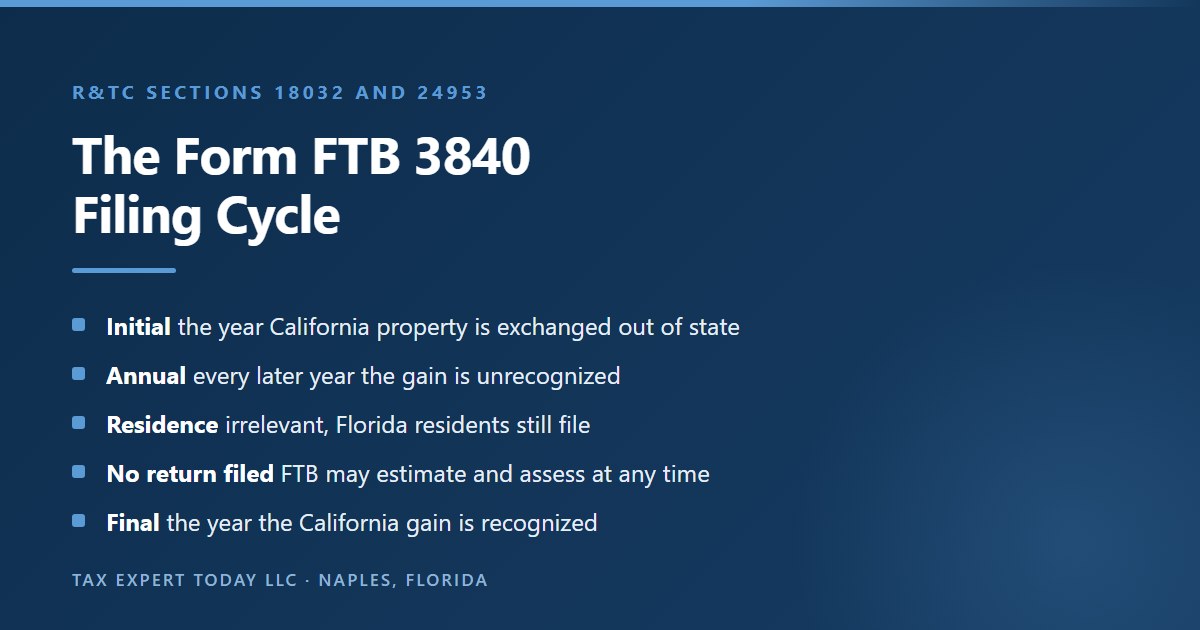
Every taxpayer that exchanged California real property for like-kind property outside California under section 1031 must file Form FTB 3840, regardless of residence or commercial domicile. That includes individuals, estates, trusts, partnerships, limited liability companies, and corporations. For a disregarded entity, the owner files the form.
- Residence is irrelevant: a Florida resident who exchanged California property files the same as a California resident.
- Entity type is broad: every entity type other than a disregarded entity is a taxpayer for this purpose.
- Disregarded entities: a single member LLC that holds the property does not file; its owner does.
- No other filing requirement: the taxpayer completes and signs the entire form and mails it on its own.
- One form per exchange: a separate Form 3840 is filed for each qualifying exchange.
The FTB instructions define taxpayer broadly, listing individuals, estates, trusts, general partnerships, limited partnerships, limited liability partnerships, limited liability companies, and corporations, and they add that all taxpayers who conduct a section 1031 exchange of California real property for property outside California must file, regardless of residence status or commercial domicile. That sentence matters for the reader of this guide. A move to Naples, Florida does not change who the taxpayer is, and the obligation follows the person or entity that made the exchange.
The disregarded entity rule for a California 1031 exchange follows federal classification. If a single member LLC held the Los Angeles property and the same LLC acquired the Florida replacement property, the owner reports the exchange and files Form 3840. If the owner is an individual, the form travels with the individual’s own return or is filed separately. If the owner is a partnership, the partnership files it. Partnership and LLC exchanges have their own complications, discussed later in this guide.
| Who made the exchange | Who files Form 3840 | How it is filed |
|---|---|---|
| Individual, California resident | The individual | Attached to Form 540 |
| Individual, Florida resident with other California income | The individual | Attached to Form 540NR |
| Individual, Florida resident with no other California filing requirement | The individual | Signed and mailed on its own |
| Single member LLC disregarded for tax | The LLC’s owner | With the owner’s return or on its own |
| Partnership or multi member LLC | The partnership | Attached to Form 565 or Form 568 |
| C corporation or S corporation | The corporation | Attached to Form 100 or Form 100S |
| Trust or estate | The trust or estate | Attached to Form 541 |
Two exchanges in one year mean two forms. The instructions say that if the taxpayer reported more than one exchange for federal purposes in which California property was given up and out of state property acquired, a separate Form 3840 is filed for each exchange. A taxpayer who sold a California duplex into a Florida property in March and a California warehouse into an Arizona property in October files two Initial forms that year and two Annual forms in each later year.
When is Form 3840 due, and where is it filed?
Form 3840 is due with the California return for the year, using the same due date and extension. For a calendar year individual, estate, or trust filing for 2025, that was April 15, 2026, extended to October 15, 2026. A taxpayer with no other California filing requirement signs the form and mails it to the FTB on its own.
- Individuals, estates, and trusts: April 15, extended to October 15, for a calendar year.
- Partnerships and S corporations: the 15th day of the third month, which was March 16, 2026 for a calendar year.
- C corporations: the 15th day of the fourth month, with a November extended date.
- Stand alone filing: sign Side 1 and mail to Franchise Tax Board, PO Box 1998, Rancho Cordova, CA 95741-1998.
- Attached filing: no separate signature is needed when the form is attached to a California return.
| Filer | Calendar year due date for 2025 forms | Extended due date |
|---|---|---|
| Individuals, estates, and trusts | April 15, 2026 | October 15, 2026 |
| C corporations and LLCs taxed as C corporations | April 15, 2026 | November 16, 2026 |
| S corporations and LLCs taxed as S corporations | March 16, 2026 | September 15, 2026 |
| Partnerships and LLCs taxed as partnerships | March 16, 2026 | October 15, 2026 |
| Exempt organizations | May 15, 2026 | November 16, 2026 |
The stand alone filing is the piece that most often goes missing after a move. A Florida resident whose only California connection is the deferred exchange has no Form 540NR to attach the form to, so there is no software prompt and no return that would remind anyone. The instructions anticipate this exactly: if the taxpayer is not otherwise required to file a California tax return, the taxpayer completes the entire form, including the signature area at the bottom of Side 1, and mails it to the address in General Information D. A calendar reminder each spring for every open exchange is a plain but effective control.
When a Florida resident does have other California income, such as rent from a California property that was not exchanged or California source wages from a final year of work, the form is attached to Form 540NR. Our guide to California source income explains which income keeps a nonresident in the California system, and our guide to California part-year resident tax explains the move year return.
What goes on Form 3840 each year?
Form 3840 repeats the federal Form 8824 information on the exchange, the realized gain, the recognized gain, and the basis of the property received, plus Schedule A detail on each property given up and received. The box checked at the top changes by year: Initial in the exchange year, Annual in each later year, Amended for corrections, and Final when the gain is recognized.
- Question A: the type of taxpayer, from individual through exempt organization.
- Question B: Initial, Amended, Annual, or Final, with the year of the exchange entered for Annual and Final forms.
- Question C: real property, personal property, and the related party box with the related party’s name and identification number.
- Parts I and II: the property descriptions and dates, then the federal Form 8824 Part III amounts.
- Schedule A: each property given up and received, its location, ownership percentage, price, and selling expenses.
| Box on Question B | When it is used | What must be attached |
|---|---|---|
| Initial FTB 3840 | The exchange occurred in the current taxable year | Both sides of the form completed |
| Annual FTB 3840 | A prior form was filed and the California gain is still unrecognized | The same information as the initial or most recent amended form, with the exchange year entered |
| Amended FTB 3840 | Correcting a previously filed form | A statement explaining the changes |
| Final FTB 3840 | The California gain has been recognized | A statement explaining how the gain was recognized |
The line map for a California 1031 exchange is mechanical. Lines 1 through 6 take the property descriptions and dates from federal Form 8824 Part I. Lines 7 through 20 take the federal amounts from Form 8824 Part III, lines 12 through 25, which covers the fair market value of other property given up, the realized gain, the recognized gain, the deferred gain, and the basis of the like-kind property received. Schedule A Part I lists each property given up, says whether it was located in California, gives the ownership percentage and the full address or the assessor’s parcel number, county, and state, and reports the sales price and selling expenses. The instructions note that an Annual filer completes both sides with the same information reported on the initial or most recently amended form.
The Annual form is therefore a copy, not a new computation, which is why the hardest year is the first one. If the Initial form is wrong, every Annual form repeats the error. When an exchange was reported by one preparer and the investor moved and changed preparers, it is worth confirming that the Initial form was filed at all and that the amounts on it match Form 8824. If no Initial form exists, an Amended or late Initial form, with a statement, is usually the cleaner path than continuing silence.
What happens if you do not file Form 3840?
If a taxpayer files neither Form 3840 nor a California tax return, section 18032(b) lets the FTB estimate net income, including the deferred gain, and propose to assess tax, interest, and penalties under section 19087. Section 19087 allows that assessment at any time when no return was filed, so time alone does not close the exposure.
- Estimated income: the FTB may build the income figure from any available information.
- Deferred gain included: the statute expressly names the deferred exchange gain as part of the estimate.
- Penalties and interest: the proposed assessment can include both, as with any delinquent tax.
- No time bar for a non-filer: section 19087 uses the words “at any time” for a taxpayer who files no return.
- Protest rights remain: the taxpayer can protest the proposed assessment and appeal.
The text of section 19087 provides that if any taxpayer fails to file a return, the FTB, at any time, may require a return or may make an estimate of the net income from any available information and propose to assess the tax, interest, and penalties due. The FTB instructions describe the same consequence in the context of Form 3840: for a taxpayer who fails to file the form for any year in which gain is deferred and who does not file an income tax return, the FTB may issue a Notice of Proposed Assessment to adjust income for the California sourced deferred gain.
The words “at any time” are the reason a missing filing is more than a paperwork lapse. The ordinary California assessment period runs from the filing of a return, and a taxpayer who files nothing never starts it. An investor who exchanged out of California in 2016, moved to Florida in 2018, and stopped filing Form 3840 has not let the claim expire. The California gain is still sitting in the replacement property, and the FTB’s ability to propose an assessment is still open.
| Situation | Statutory exposure | Practical note |
|---|---|---|
| Form 3840 filed every year | None until a taxable disposition | Keep copies of every filed form |
| Form 3840 missed, but a California return filed | Section 18032(b) estimate rule not triggered, but the filing duty was still missed | File the missing forms with a statement |
| Neither Form 3840 nor any return filed | FTB may estimate income including the deferred gain and assess at any time | Address it before the replacement property is sold |
| Replacement property sold and no California return filed | California source gain unreported; assessment open under section 19087 | File the nonresident return for the sale year |
The response to a Notice of Proposed Assessment is a written protest within the time stated on the notice, and the protest and appeal process is set out in sections 19041 through 19048, which section 19087(b) incorporates. A balance that becomes final can be addressed through the payment options in our guide to the FTB installment agreement, and penalty questions are covered in our guide to the California late payment penalty. The better course is to file the missing forms before a notice is issued, so the record shows the gain was never concealed.
How is the deferred California gain measured?
The deferred California gain is the gain realized on the California property, computed with California basis, minus any gain recognized in the exchange year. Because California does not follow federal bonus depreciation, the California adjusted basis is often higher than the federal one, which can make the California deferred gain smaller than the federal amount.
- Start with the amount realized: the price, less selling expenses, plus liabilities relieved.
- Subtract California adjusted basis: cost, plus improvements, less depreciation allowed under California law.
- Subtract gain recognized: boot received in the exchange is taxed in the exchange year.
- Check depreciation differences: bonus depreciation and other federal items that California did not adopt change the California basis.
- Track it as a separate number: the California deferred gain should be recorded on its own, not assumed equal to the federal figure.
For a California 1031 exchange, Form 3840 carries the federal Form 8824 amounts, but the California gain that is eventually taxed is a California computation. Revenue and Taxation Code section 17250 modifies section 168 for California purposes and provides that section 168(k), the federal special depreciation allowance, does not apply. A property improved with qualified assets that took bonus depreciation federally will therefore show more remaining basis on the California books, and the gain on its sale or exchange will be smaller in California. Our guide to bonus depreciation in 2026 explains the federal side.
| Hypothetical line | Federal amount | California amount |
|---|---|---|
| Amount realized on a Los Angeles fourplex | $2,000,000 | $2,000,000 |
| Adjusted basis at the exchange | $800,000 | $900,000 |
| Realized gain | $1,200,000 | $1,100,000 |
| Boot recognized in the exchange year | $0 | $0 |
| Deferred gain carried into the Florida property | $1,200,000 | $1,100,000 |
In this hypothetical, the $100,000 basis difference comes from depreciation that was taken federally but not in California. The federal deferred gain of $1,200,000 is what the IRS will see on the eventual sale. The California sourced deferred gain of $1,100,000 is what California will tax. Getting that number right years later depends on California depreciation schedules that many investors stop keeping once they leave the state. A copy of the California depreciation schedule for the relinquished property, kept with the Initial Form 3840, is the record that protects the smaller number.
Does moving to Florida end California’s claim on a 1031 exchange gain?
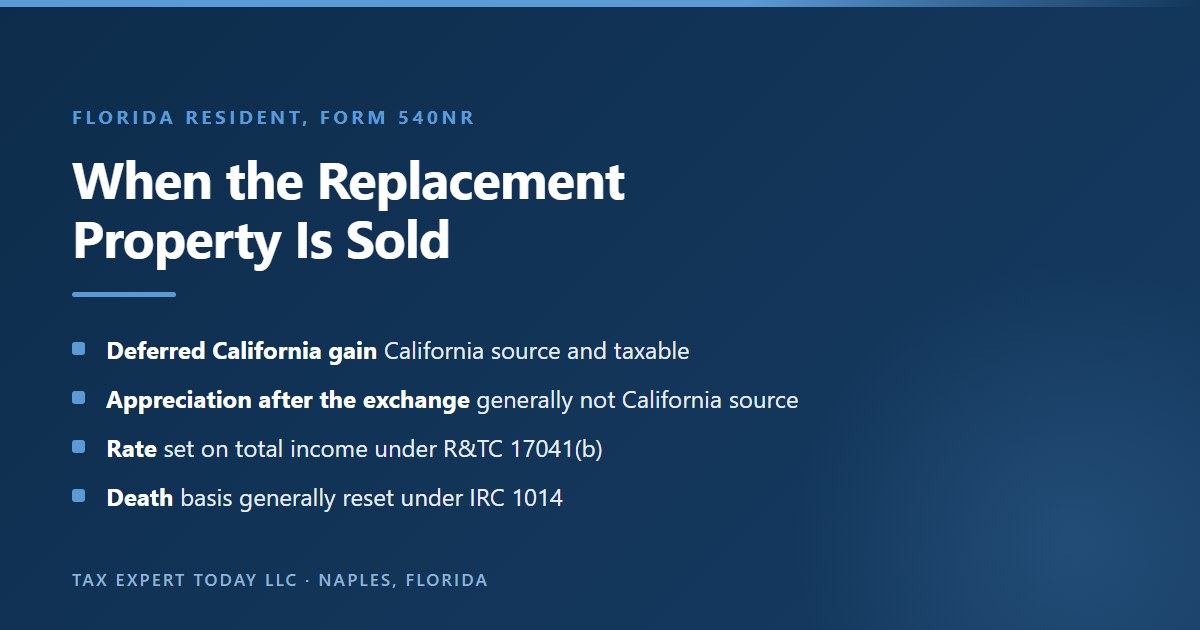
No. A change of residence does not change the source of gain that was realized on California property. The deferred California gain stays California source after the move, the annual Form 3840 continues, and California taxes that gain when the replacement property is sold, even though the seller is then a Florida resident.
- Residence governs most income: a Florida resident is generally not taxed by California on Florida wages, interest, or dividends.
- Source governs real property gain: gain on California real property is California source whoever owns it and wherever they live.
- The exchange preserves the source: the FTB instructions say the source is preserved without regard to when the gain is recognized.
- Later appreciation is different: gain that accrues on the Florida property after the exchange is generally Florida source.
Most of what a move to Florida accomplishes is a change in residence-based taxation. Once residency has genuinely changed, California generally stops taxing income that is sourced to residence, such as investment income from intangibles, and our guide to moving from California to Florida taxes explains that shift. Real property gain is not residence-based. FTB Publication 1031 says real property is sourced and taxed based on where it is located, and the exchange instructions extend that rule through the exchange to the replacement property.
That distinction also explains what California does not reach. The appreciation on the Florida replacement property after the exchange was earned on Florida real estate by a person who, after the move, is a Florida resident. That part of the eventual gain is generally outside California tax. The deferred gain that came across from the California property is the only part California claims, which is why measuring and documenting it at the exchange matters so much.
| Component of the eventual gain | Where it was earned | California treatment for a Florida resident seller |
|---|---|---|
| Deferred gain from the California property | California real estate | California source and taxable |
| Appreciation on the Florida property after the exchange | Florida real estate | Generally not California source |
| Depreciation recapture on the Florida property after the move | Florida real estate | Generally not California source |
| Boot recognized in the original exchange | California real estate | Taxed in the exchange year, not deferred |
Residency itself must also be real. If the FTB concludes that the investor never actually stopped being a California resident, every component of the gain becomes California income, not only the deferred portion. Our guides to establishing Florida residency and the California residency audit cover how that question is decided.
How does California tax the gain when a Florida resident sells the replacement property?
The Florida resident files Form 540NR for the year of the sale and reports the deferred California gain as California source income. California computes the tax as if all of the year’s income were California income, then applies the ratio of California income to total income, so the rate reflects the full gain and other income.
- Return: Form 540NR, the nonresident and part-year resident return.
- California amount: the California sourced deferred gain carried on Form 3840.
- Rate method: tax on total taxable income as if a resident, multiplied by California adjusted gross income over total adjusted gross income.
- Final form: a Final Form 3840 with a statement explaining how the gain was recognized.
- Surcharge: the 1 percent tax on taxable income above $1,000,000 is computed the same way.
The method comes from Revenue and Taxation Code section 17041(b), which taxes a nonresident’s California taxable income by first computing tax on total taxable income as though the person were a resident and then prorating it by the share of adjusted gross income that comes from California. The FTB Schedule CA (540NR) instructions build the two columns that produce that ratio. The result is that a large federal gain pushes the California rate up even though California only taxes part of it.
| Hypothetical sale year line | Amount |
|---|---|
| Sale price of the Florida replacement property | $2,600,000 |
| Federal gain recognized (deferred $1,200,000 plus later appreciation $600,000) | $1,800,000 |
| California sourced deferred gain from Form 3840 history | $1,100,000 |
| Other income, all Florida or residence-sourced | $200,000 |
| Total adjusted gross income used for the rate | $2,000,000 |
| California share of adjusted gross income | 55 percent |
In this illustration the California tax is the tax California would impose on $2,000,000 of income as a resident, multiplied by 55 percent. Because the rate is set by the full $2,000,000, most of the California gain is taxed at or near the top bracket of 12.3 percent, and the California mental health services tax adds 1 percent on the portion of taxable income above $1,000,000, prorated in the same way. The exact figure depends on deductions, the year’s brackets, and credits, but the order of magnitude is the point. A deferred California gain can produce a six figure California tax on a sale made years after the investor left.
The sale of the replacement property also has a federal side, which is unaffected by California and covered in our guide to selling rental property after a move. The California return is an additional filing in the sale year, not a substitute for anything federal, and it should be planned before the listing agreement is signed rather than discovered when the closing statement arrives.
Does a second exchange out of the replacement property end the Form 3840 filing?
No. If the out of state replacement property is itself exchanged in a later section 1031 exchange, the California gain is still not recognized, so the Annual Form 3840 continues. The deferred California gain moves into the next replacement property and keeps its California source through every exchange in the chain.
- Recognition is the test: the statute requires the form for each year in which the gain has not been recognized.
- Chains carry the gain: a Florida to Texas exchange carries the California gain into the Texas property.
- Records multiply: each link in the chain changes the property descriptions the form must follow.
- Partial recognition: boot in a later exchange recognizes part of the gain, and part of that may be California gain.
For a California 1031 exchange chain, section 18032(a) ties the filing duty to recognition, not to the property. It requires the information return “for each subsequent taxable year in which the gain or loss from that exchange has not been recognized.” A later exchange under section 1031 is, by definition, a transaction in which gain is not recognized, so the California gain from the first exchange simply flows through. The original Form 3840 continues, and the investor should keep a schedule that ties the California deferred gain to whichever property currently holds it.
Boot in a later exchange needs a decision about which gain is recognized. When an investor receives cash in a second exchange, federal law recognizes gain to the extent of the boot. Whether that recognized gain is treated as coming from the California deferred gain, from the later appreciation, or proportionately from both is a question that depends on the facts and the computation used, and it is one of the points where a written analysis protects the investor if the FTB later reviews the chain. The same is true of a partial disposition, such as selling one of several replacement properties that together received the California gain.
| Chain event | Federal result | California Form 3840 result |
|---|---|---|
| California property exchanged into Florida property | Gain deferred | Initial form |
| Florida property held | No event | Annual form each year |
| Florida property exchanged into Texas property, no boot | Gain deferred again | Annual form continues, property detail updated |
| Texas property exchanged with $100,000 of boot | Gain recognized up to the boot | Part of the California gain may be recognized; Annual form for the remainder |
| Final replacement property sold for cash | All remaining deferred gain recognized | California gain recognized; Final form |
What happens if you exchange back into California property?
If the out of state replacement property is later exchanged for California real property, the deferred California gain sits once again in property located in California. Section 18032 applies when the property acquired is outside California, so commentators generally treat the annual filing as ending, while the gain itself stays deferred and California source.
- The gain is still deferred: nothing has been recognized, so nothing is taxed in that year.
- The gain is now in California property: a later sale of that property is California source in any event.
- The filing purpose is met: California no longer needs a report to follow property that sits in the state.
- Document the change: a Final or explanatory filing for the year of the return exchange keeps the record clean.
The statute does not expressly address the round trip, and the instructions describe the Final form only for the year the gain is recognized. A cautious approach for the year of an exchange back into California is to file the form with a statement explaining that the California deferred gain is now carried in California property, identified by address or parcel number. That statement closes the out of state tracking and leaves no gap in the record. Investors who plan to return to California, or who might buy California property again, should consider this sequence before assuming the obligation has quietly lapsed.
Does Form 593 withholding apply to the California property you give up?
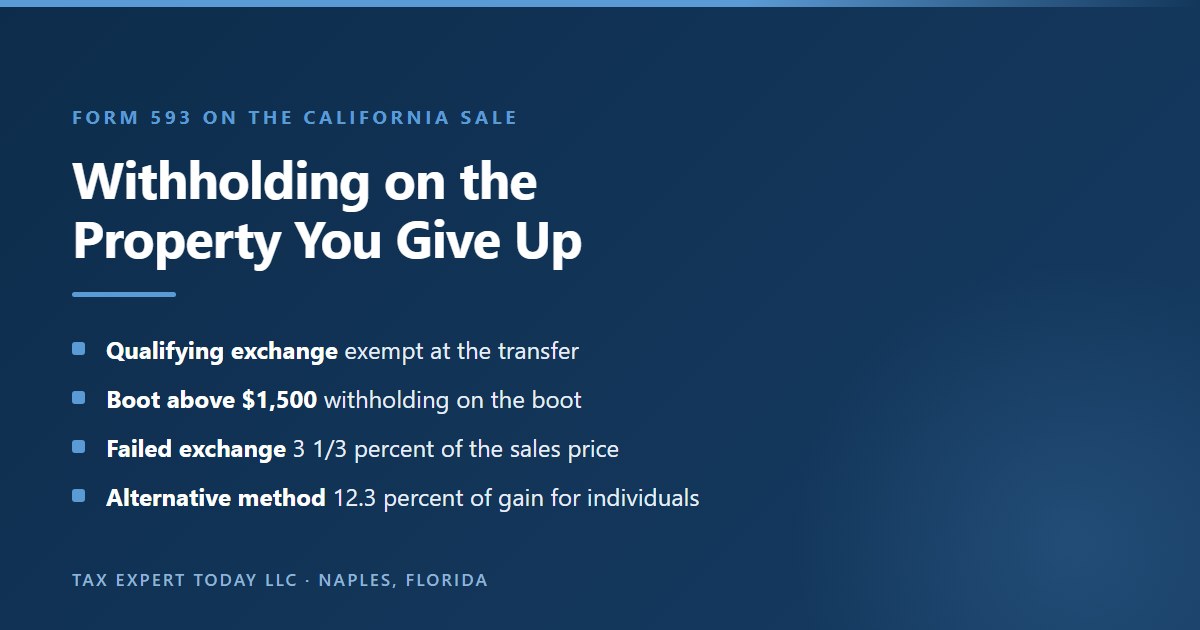
A California sale that is part of a qualifying section 1031 exchange is exempt from Form 593 withholding at the time of the transfer. Withholding applies if the seller receives more than $1,500 of money or other property besides the like-kind property, and it applies to the full price if the exchange fails.
- Simultaneous exchange: exempt, unless the seller receives more than $1,500 of other money or property.
- Deferred exchange: exempt at the initial transfer, with the qualified intermediary withholding on boot above $1,500.
- Failed exchange: the intermediary withholds 3 1/3 percent of the sales price, or the elected alternative amount on the gain.
- Alternative calculation: 12.3 percent of the gain for an individual, with other rates for entities.
- Nonresident seller: a Florida resident selling California property is subject to the same rules.
The 2026 Form 593 instructions address both kinds of exchange on line 10. A simultaneous like-kind exchange is exempt from withholding, but if the seller receives money or other property exceeding $1,500 in addition to the like-kind property, the real estate escrow person must withhold. A deferred exchange is exempt at the initial transfer, and if the seller receives boot exceeding $1,500, the qualified intermediary must withhold. Withholding is required by Revenue and Taxation Code section 18662, and our guide to California Form 593 covers the full withholding system.
| Exchange situation | Who withholds | Base for withholding |
|---|---|---|
| Simultaneous exchange, boot of $1,500 or less | No one | None |
| Simultaneous exchange, boot above $1,500 | Real estate escrow person | The boot, at 3 1/3 percent, or the alternative rate on recognized gain |
| Deferred exchange, completed with no boot above $1,500 | No one | None |
| Deferred exchange, completed with boot above $1,500 | Qualified intermediary | The boot, at 3 1/3 percent, or the alternative rate, not to exceed recognized gain |
| Deferred exchange that fails | Qualified intermediary | The sales price at 3 1/3 percent, or the gain at the alternative rate |
The seller in a California 1031 exchange certifies the exchange on Form 593 at escrow. That certification is under penalty of perjury and is made before anyone knows whether the 45 day and 180 day periods will be met, which is why the intermediary carries the follow up obligation. A California seller who is already a Florida resident should also review our guide to California nonresident withholding, because a nonresident who receives boot will usually have a Form 540NR filing in the exchange year to claim credit for whatever was withheld.
Georgia handles the same problem differently. A nonresident selling Georgia real property faces 3 percent withholding at closing under O.C.G.A. 48-7-128 unless an exemption applies, and the reviewed Georgia sources contain no tracking return comparable to Form 3840. Our guide to the 1031 exchange in Georgia compares the two approaches.
What happens to withholding if the exchange fails or produces boot?
If the deferred exchange fails or the seller receives boot, the qualified intermediary withholds and remits under Form 593, using the forms for the year the money is distributed. The seller claims the withholding as a credit on the California return for that year, and installment reporting generally lets the gain fall in that year too.
- Timing: the date entered is the date the boot was distributed or the date the exchange was determined to fail.
- Year of the form: the intermediary uses the forms for the distribution year, not the sale year.
- Credit: the withholding is a credit for the year it occurred, because installment reporting is available.
- Election out: a seller who reports the gain in the sale year contacts Withholding Services and Compliance.
- Cash poor transfers: the intermediary’s obligation is limited to available funds, with documentation.
The instructions explain the year mismatch directly. A failed exchange that starts in November and is determined to fail in May of the next year produces withholding in the second year, and the instructions say that withholding is shown as a credit for the taxable year the withholding occurred, since the seller qualifies for installment sale reporting. A seller who elects instead to report the gain in the year of the sale must contact Withholding Services and Compliance so that the credit can be moved to match. For a Florida resident, both the gain and the credit belong on Form 540NR.
| Event | Form 593 date entered | Return that claims the credit |
|---|---|---|
| Boot distributed at the close of a completed exchange | Date the boot was distributed | Return for the year of distribution |
| Exchange fails within the same taxable year | Date the failure was determined and cash distributed | Return for that year |
| Exchange fails in the following taxable year | Date the failure was determined and cash distributed | Return for the following year, unless the seller elects out of installment reporting |
| Failed exchange after boot was already withheld on | Date of the failure | Withholding reduced by the amount previously remitted |
A failed exchange is also the end of the Form 3840 story before it begins. If the exchange does not qualify for nonrecognition, there is no deferred gain and no information return, and the gain is reported as an ordinary sale of California property. The federal failure rules are discussed in our guide to the 1031 exchange rules.
Can personal property still qualify for a California 1031 exchange in 2026?
No. Since 2019 California has followed the federal rule limiting section 1031 to real property, except for individuals below income thresholds of $250,000, or $500,000 on a joint return. SB 711 ended that carve-out for taxable years beginning on or after January 1, 2025, so personal property exchanges no longer qualify in California.
- Conformity: section 18031.5 adopts the Tax Cuts and Jobs Act amendments that limit section 1031 to real property.
- Former carve-out: individuals below the income thresholds could still exchange personal property for California purposes.
- 2025 change: the carve-out does not apply for taxable years beginning on or after January 1, 2025.
- Form effect: the personal property box on Form 3840 is limited to individual exchanges before January 1, 2025.
- Older exchanges continue: pre-2025 multi-asset exchanges with California real and personal property still require the form.
Section 18031.5 as amended by SB 711, Statutes of 2025, Chapter 231, provides that the federal amendments limiting section 1031 to real property apply in California. Subdivision (b) limited that rule, for heads of household, surviving spouses, and joint filers, to taxpayers with adjusted gross income of $500,000 or more, and for single filers to taxpayers with adjusted gross income of $250,000 or more, in the year the exchange began. Subdivision (b)(2) now states that the income carve-out does not apply for taxable years beginning on or after January 1, 2025. The Form 3840 instructions reflect the change: the personal property box can only be checked if the taxpayer is an individual and the exchange occurred before January 1, 2025.
| Exchange date and taxpayer | Real property | Personal property |
|---|---|---|
| Before January 11, 2019 | Qualifies | Could qualify under prior law |
| 2019 through 2024, individual below the income threshold | Qualifies | Qualified for California purposes only |
| 2019 through 2024, individual at or above the threshold, or any entity | Qualifies | Does not qualify |
| Taxable years beginning on or after January 1, 2025 | Qualifies | Does not qualify for anyone |
For most corridor investors planning a California 1031 exchange this is a footnote, because the exchanges that matter are rental and commercial real estate. It does matter for older exchanges. An individual who exchanged California equipment or vehicles for out of state property in 2021 under the California only carve-out has a California deferred gain that has no federal counterpart, and that exchange still requires Form 3840 each year. Those are the exchanges most likely to be forgotten, because no federal form reminds anyone that they exist.
How do Delaware statutory trusts fit the Form 3840 rules?
An interest in a Delaware statutory trust that holds real property can be replacement property in a section 1031 exchange, and when the trust’s property is outside California, the California gain must be tracked on Form 3840. The instructions say to enter the trust name in place of a street address on Schedule A.
- Schedule A entry: the Delaware statutory trust name goes in the property address field, with city, state, and ZIP left blank.
- Tracking continues: the investor files the Annual form each year the trust interest is held.
- Exit events matter: a sale of the trust’s property or a cash out of the interest can recognize the California gain.
- Information flow: the investor depends on the sponsor’s reports to know when a sale has occurred.
The Form 3840 instructions address this structure specifically: if the property given up is a Delaware statutory trust, enter the trust name in the space for the property address and leave the city, state, and ZIP code spaces blank. The same practical point applies when a trust interest is the property received. An investor who exchanged a California rental into an interest in a trust that owns apartment buildings in several states has a California deferred gain inside an asset the investor does not manage. When the sponsor sells the underlying property, the investor may recognize the gain without having made any decision, and the California return for that year has to report it. Asking the sponsor at the outset how disposition notices are delivered is a sensible step.
What events end the California 1031 clawback?
The California obligation ends when the California deferred gain is recognized, usually through a taxable sale of the replacement property, which is reported on a Final Form 3840. Other events, such as death, a gift, or a charitable transfer, change the outcome in different ways and should be analyzed on their own facts.
- Taxable sale: recognizes the gain and ends the annual form with a Final filing.
- Installment sale: recognizes the gain as payments are received, so the filing story extends over the payments.
- Death: the heir’s basis is generally reset under section 1014, which can eliminate the deferred gain.
- Gift: the recipient generally takes the donor’s basis, so the deferred gain usually carries over.
- Charitable transfer: the treatment depends on the structure, and a charitable remainder trust follows its own rules.
| Event | Effect on the deferred California gain | Form 3840 effect |
|---|---|---|
| Taxable sale for cash | Recognized and California source | Final form with an explanation |
| Installment sale | Recognized as principal payments are received | Filing and reporting continue until recognition is complete |
| Further section 1031 exchange | Still deferred | Annual form continues |
| Exchange back into California property | Still deferred, now in California property | Out of state tracking generally ends; document the change |
| Death of the owner | Basis generally reset to fair market value under section 1014 | Facts specific; the estate should document the result |
| Lifetime gift | Basis generally carries over to the recipient | The deferred gain usually remains to be recognized |
| Transfer to a charitable remainder trust | Depends on the trust rules and later sales by the trust | Requires separate analysis |
The installment sale row deserves attention because it is a common exit for investors who want to spread a large gain. Publication 1031 explains that California taxes installment gains received by a nonresident from the sale of tangible property on a source basis and that real property is sourced where it is located. When the replacement property is outside California, the installment payments are on Florida or other out of state property, but the deferred California gain within them keeps its California source under the exchange rule, so each year’s installment gain may include a California portion until the deferred gain is fully recognized.
Does a step-up in basis at death end the California clawback?
Generally yes in effect. California conforms to Internal Revenue Code section 1014, so an heir’s basis in the replacement property is generally its fair market value at death. If the heir then sells near that value, little or no gain is recognized, and the deferred California gain built in before death is not taxed.
- Conformity: section 1014 is in Subchapter O, which section 18031 adopts.
- Basis reset: the heir’s basis generally equals fair market value at the date of death.
- Deferred gain disappears: the gain built in before death is generally not recognized on a later sale.
- Exceptions exist: certain property, including income in respect of a decedent, does not receive the reset.
- Community property: both halves of community property can receive a new basis at the first death.
Section 1014 provides that the basis of property acquired from a decedent is generally its fair market value at the date of death, and California applies it through section 18031. The California sourced deferred gain is part of the built in gain that the reset removes. That is why many corridor investors hold exchanged property for life rather than selling, and why the clawback is sometimes described as ending at death. The description is useful but incomplete. The estate and the heirs should still document the date of death value, consider whether a Final Form 3840 with an explanatory statement is the right way to close the record, and check whether any portion of the property falls outside the basis reset. Our guides to Florida estate planning for new residents and the California inheritance tax question cover the related estate issues.
A gift during life works differently. Under the general carryover basis rule, a recipient of a lifetime gift takes the donor’s basis, so the deferred California gain usually travels with the property to the recipient. A gift is not the same as a sale, and it is not the same as a transfer at death, and the obligation to track the California gain should be considered before property that holds a deferred California gain is given to children or to a trust. Our guide to trust situs after a move to Florida covers how a trust that receives such property is itself taxed by California.
How do partnerships and LLCs handle Form 3840?
When a partnership or a multi member LLC taxed as a partnership makes the exchange, the entity files Form 3840 with its Form 565 or Form 568, and the deferred California gain is recognized at the entity level when the replacement property is sold. The California source gain then flows to the partners, including partners who live in Florida.
- Entity files: the partnership or LLC is the taxpayer for Form 3840 purposes.
- Owner files for disregarded entities: a single member LLC is looked through to its owner.
- Flow through on sale: recognized California gain passes to partners on their Schedule K-1 (565 or 568).
- Nonresident partners: a Florida partner reports the California source share on Form 540NR.
- Entity level withholding: nonresident partner withholding rules may apply to the distributive share.
A partnership California 1031 exchange is common, because partnership exchanges are frequent in California real estate because many rental properties are held by family partnerships or multi member LLCs. The exchange is the entity’s exchange, and the Form 3840 obligation belongs to the entity. That has a useful side effect. A partner who moves to Florida does not personally carry the filing, because the partnership keeps filing each year as long as it holds the replacement property. It also has a less obvious consequence: when the partnership sells, every partner receives a share of California source gain, and the Florida partners will have a California filing for that year whether or not they have thought about California since the move.
Partnership exchanges also raise a structuring question that is outside the scope of this guide. When partners want to go separate ways, some of them exchanging and some taking cash, the transaction is often restructured before the sale so that each partner holds a direct interest. Those restructurings have their own federal holding period and qualification risks, and the California consequences follow the federal outcome. The entity questions that most often affect corridor investors, including the annual LLC tax and fee, are covered in our guides to the California LLC franchise tax and California LLC versus S corporation choices.
| Holder of the property | Form 3840 filer | Who reports the California gain on sale |
|---|---|---|
| Individual directly | The individual | The individual, on Form 540 or 540NR |
| Single member LLC | The owner | The owner |
| Multi member LLC taxed as a partnership | The LLC, with Form 568 | Each member, through Schedule K-1 (568) |
| Limited partnership | The partnership, with Form 565 | Each partner, through Schedule K-1 (565) |
| S corporation | The S corporation, with Form 100S | The corporation and its shareholders under the S corporation rules |
How does a related party exchange change California reporting?
A related party exchange requires the related party box on Form 3840 to be checked and the related party’s name and identification number to be entered. Federal law can undo the deferral if either party disposes of the property within two years, and California follows that federal result.
- Form 3840 Question C: check the related party box and give the related party’s name and SSN, ITIN, or FEIN.
- Who is related: spouse, child, grandchild, parent, grandparent, sibling, or a related corporation, partnership, trust, or estate.
- Two year rule: a disposition by either party within two years generally triggers the deferred gain under section 1031(f).
- Federal follow up: Form 8824 is filed for the two years after the exchange.
The instructions list the relationships that count and refer to section 1031(f) for the special rules. Under that subsection, if a taxpayer exchanges property with a related person and either party disposes of the property within two years, the gain that was deferred is generally recognized as of the date of the disposition, with exceptions for death, involuntary conversions, and transactions without a tax avoidance purpose. When that happens, the California sourced deferred gain is recognized as well, and the Final Form 3840 explains the event. Family exchanges are common in California real estate, which makes the two year window worth calendaring along with the Form 3840 due date.
Should you exchange out of California before or after moving to Florida?
The timing of the move does not change the source of the gain on California property, so moving first does not avoid California tax on that gain. The decision usually turns on where the replacement property should be, how the move year return will be prepared, and whether the investor wants to keep the deferral at all.
- Before the move: the exchange is reported on a resident return, and Form 3840 begins immediately.
- In the move year: the exchange is reported on a part-year return, with the date of the sale determining the column.
- After the move: the sale of California property is still California source, and the exchange is reported on Form 540NR.
- Selling instead: a taxable sale ends the California story in one year, at the cost of the deferral.
- Holding for life: the basis reset at death is the outcome many long term holders plan for.
Because the gain on California real property is California source whenever it is realized, a move does not create a better or worse California result for the gain itself. What changes is everything around it. A California resident who sells California property and receives boot is taxed on the boot as a resident. A Florida resident who does the same is taxed on the boot as California source income and will also have Form 593 withholding to recover. A part-year resident needs both columns of Schedule CA (540NR) to be right. Our guide to California exit tax myths explains why there is no general departure tax, and this is one of the specific places where California’s reach after departure is real.
| Approach | California result on the gain | Ongoing California filing |
|---|---|---|
| Sell California property for cash, then move | Taxed in the sale year as a resident | None after the sale year |
| Move, then sell California property for cash | Taxed in the sale year as California source to a nonresident | None after the sale year |
| Exchange into Florida property, then move | Deferred; taxed as California source on a later sale | Annual Form 3840 |
| Move, then exchange into Florida property | Deferred; taxed as California source on a later sale | Annual Form 3840 |
| Exchange and hold until death | Basis generally reset under section 1014 | Annual Form 3840 until death |
None of these California 1031 exchange approaches is right for everyone. A deferral of California tax at a top rate of 12.3 percent, plus the 1 percent surcharge where it applies, has real value, and it comes with a filing obligation that lasts as long as the property is held. A taxable sale costs the deferral and buys a clean break. The comparison depends on the size of the gain, the investor’s age and plans, the federal tax picture, and how much the investor values not having a California filing for the rest of the holding period. Our California tax services page describes how we approach that comparison.
What mistakes cause problems with a California 1031 exchange?
The most common problems are an Initial Form 3840 that was never filed, Annual forms that stopped after a move, a California deferred gain that was never computed separately from the federal one, a sale reported only on the federal return, and a failed exchange whose withholding credit was never claimed.
- No Initial form: the exchange was reported federally but California never received Form 3840.
- Stopped after the move: the Annual forms ended when the investor stopped filing California returns.
- Wrong gain: the federal deferred gain was used for California without adjusting for depreciation differences.
- Missing sale year return: the replacement property was sold and no Form 540NR was filed.
- Lost withholding: Form 593 withholding on boot or a failed exchange was never claimed as a credit.
| Mistake | Likely consequence | Corrective step |
|---|---|---|
| No Initial Form 3840 | No record of the exchange at the FTB | File a late Initial form with a statement |
| Annual forms stopped after a move | Exposure under sections 18032(b) and 19087 if no return is filed | File the missing Annual forms |
| Federal gain used for California | California gain overstated, or understated where basis is lower | Rebuild the California depreciation and basis schedule |
| Sale reported only federally | California source gain unreported | File Form 540NR for the sale year |
| Withholding never claimed | Overpayment left with the FTB | Claim the credit on the return for the year withheld |
| Delaware statutory trust sale not noticed | Gain recognized without a California return | Track sponsor notices and file for the sale year |
Each of these is easier to fix before the FTB acts than after. When a notice has already arrived, a representative can be authorized as described in our guide to the FTB power of attorney, and when the resulting balance is beyond what can be paid at once, our guide to the FTB offer in compromise explains the limited circumstances in which that program applies.
What records support the deferred California gain?
Keep the closing statements for the California sale and the replacement purchase, the qualified intermediary’s exchange agreement and ledger, federal Form 8824, every filed Form 3840, the California depreciation schedule for the relinquished property, and the Form 593 for the California sale. Keep them until several years after the gain is finally recognized.
- Closing statements: both legs, showing price, costs, liabilities, and any cash.
- Intermediary file: the exchange agreement, identification notice, and disbursement ledger.
- Tax forms: Form 8824, the Initial Form 3840, and every Annual form.
- California depreciation: the schedule that supports the California adjusted basis.
- Residency file: the records that establish when the investor became a Florida resident.
| Record | Supports the exchange | Supports the California gain | Supports the sale year return |
|---|---|---|---|
| Closing statements for both legs | Yes | Yes | Yes |
| Intermediary agreement and ledger | Yes | Partly | Partly |
| Federal Form 8824 | Yes | Partly | Yes |
| Every filed Form 3840 | Yes | Yes | Yes |
| California depreciation schedule | No | Yes | Yes |
| Form 593 for the California sale | Yes | No | Yes, for any credit |
| Florida residency records | No | No | Yes |
Residency records are part of this file because the sale year return depends on them. If the investor is a Florida resident when the replacement property is sold, only the California deferred gain is California income; if residency is in doubt, all of it may be. Our guides to Florida domicile for executives and the Florida 183 day rule calculator cover the evidence that supports the change.
Frequently Asked Questions
Does California tax a 1031 exchange?
Not in the exchange year if the exchange qualifies. California follows Internal Revenue Code section 1031 through Revenue and Taxation Code section 18031, so the gain is deferred. California taxes the deferred gain later, when the replacement property is sold in a taxable transaction, including when the seller has moved out of state.
What is Form FTB 3840?
Form FTB 3840 is the California Like-Kind Exchanges information return. It is required under Revenue and Taxation Code section 18032 when California property is exchanged for property located outside California. It is filed for the exchange year and for every later year until the California sourced deferred gain is recognized.
Do I still file Form 3840 after I move to Florida?
Yes. The FTB instructions say every taxpayer that exchanged California real property for out of state property must file, regardless of residence. A Florida resident with no other California filing requirement completes and signs the entire form and mails it to the Franchise Tax Board on its own.
What happens if I never filed Form 3840?
If you also filed no California return, section 18032(b) allows the FTB to estimate your income, including the deferred gain, and propose to assess tax, interest, and penalties as under section 19087, which applies at any time when no return was filed. Filing the missing forms with a statement is generally the better course.
Is withholding required when I sell California property in a 1031 exchange?
Generally not at the sale. The Form 593 instructions exempt a qualifying simultaneous or deferred exchange, but withholding applies if you receive more than $1,500 of money or other property besides the replacement property, and the intermediary withholds on the sales price if the exchange fails.
Can I exchange personal property in California in 2026?
No. Section 18031.5 adopts the federal rule limiting section 1031 to real property. Individuals below income thresholds were exempt from that limit for California purposes, but SB 711 ended the exemption for taxable years beginning on or after January 1, 2025.
Does California tax the gain if I die owning the replacement property?
Generally not. California conforms to Internal Revenue Code section 1014, so heirs generally take a basis equal to fair market value at death. A sale near that value recognizes little or no gain, so the deferred California gain built in before death is generally not taxed.
Can a Naples, Florida advisor help with a California 1031 exchange after a move?
Yes. The California rules depend on the exchange records, the Form 3840 history, and the residency dates, not on where the advisor works. A Naples, Florida advisor can review the filings, rebuild the California deferred gain, and plan the Form 540NR for a future sale.
California 1031 Exchange Help in Naples & Southwest Florida
California 1031 exchange help Naples investors can use starts with the exchange file and the Form 3840 history, not with the next sale. Tax Expert Today LLC advises on state residency and tax matters nationwide, including California departures and Florida arrivals, from our office in Naples, Florida. Our team includes tax advisors, enrolled agents, CPAs, and attorneys, and we review whether each exchange out of California was reported correctly, whether the Annual forms were filed after the move, how the California deferred gain should be measured, and what a future sale of the replacement property would mean on a California nonresident return.
We are located at 11983 Tamiami Trail N, Naples FL 34110. Call (239) 441-2005, Monday through Friday, 10:00 to 5:00 Eastern Time. Clients across Naples, Bonita Springs, Estero, Fort Myers, Marco Island, and the wider Southwest Florida region engage us on California exchange reporting, part-year returns, and residency questions. Our Naples tax planning page covers our local advisory work, and our tax planning services page explains how a planning engagement is structured.
- Form 3840 review Naples FL: confirming the Initial and Annual forms filed for every exchange out of California.
- California deferred gain schedule: rebuilding the California basis and depreciation behind the deferred gain.
- Sale year planning: estimating the Form 540NR result before the replacement property is listed.
- Exchange planning: reviewing a proposed exchange out of California alongside the timing of a move.
Local FAQ: I exchanged a Sacramento rental into a Naples condo before I moved here, and I have not filed anything with California since. Can a Naples advisor sort out the California side? Yes. The California obligation depends on the exchange records and the Form 3840 history, not on where your advisor is located. Bring the closing statements for both properties, the qualified intermediary file, your federal Form 8824, any Form 3840 and Form 593 you have, and your California depreciation schedule, and we can review what was filed, what may be missing, and how the deferred California gain should be documented before any sale.
When to Engage a Professional
Engage a professional when you have exchanged California property into out of state property and are not sure every Form 3840 was filed, when you plan to sell the replacement property, when a partnership or Delaware statutory trust holds the property, or when the FTB has asked about an exchange. The rules are short, but applying them across years is detailed work.
- Your Annual forms stopped when you moved to Florida and stopped filing California returns.
- You plan to sell the replacement property and want the California result known in advance.
- A partnership, LLC, or trust made the exchange and you are a partner, member, or beneficiary living in Florida.
- Your exchange failed or produced boot and Form 593 withholding was taken.
- You have received an FTB notice about an exchange or a deferred gain.
This article explains the law as it stands for 2026. It is not legal or tax advice for any specific situation, and outcomes depend on the dates and facts of each exchange, the property, the records available, and facts that only a full review can establish. The examples are hypothetical illustrations, not client results. Call (239) 441-2005 to arrange a review.
Published October 11, 2026 by Dr. Pellumb Kabashi « Back to Learning Center
Have a question this article touches on?
Tax Expert Today LLC, based in Naples, Florida and serving clients across the United States.
Schedule a Consultation (239) 441-2005