
By Dr. Pellumb Kabashi, DBA, MBA, CES, CFE, EA
Founder, Tax Expert Today LLC · Tax advisors, enrolled agents, CPAs, and attorneys · Serving clients in all 50 states
Quick Answer
The qualified business income deduction under section 199A lets owners of sole proprietorships, partnerships, S corporations, and some trusts deduct up to 20 percent of their qualified business income. Public Law 119-21 made it permanent, widened the 2026 phase-in ranges to $150,000 joint and $75,000 for other filers, and added a $400 minimum deduction. Call (239) 441-2005 for a free consultation.
What is the qualified business income deduction?
The qualified business income deduction is a federal deduction of up to 20 percent of the net profit from a qualified trade or business run as a sole proprietorship, partnership, S corporation, or LLC taxed as one of those. It is claimed on the owner’s individual return and is available whether or not the owner itemizes.
The qualified business income deduction lives in section 199A of the Internal Revenue Code and is often called the QBI deduction or the Section 199A deduction. It was created in 2017 as a counterweight to the lower flat corporate rate, so that business income earned through a pass-through entity would not be taxed at a meaningfully higher rate than income earned inside a C corporation. Section 199A(a) opens by allowing the deduction to “a taxpayer other than a corporation,” which is why a C corporation never qualifies.
- Who claims it: individuals, and estates and trusts that carry on or own interests in a qualified trade or business.
- Where the income comes from: Schedule C, Schedule E rental activity that rises to a trade or business, Schedule F, and the Schedule K-1 from a partnership or S corporation.
- What else it covers: 20 percent of qualified REIT dividends and qualified publicly traded partnership income, computed separately.
- What it is not: a deduction in computing adjusted gross income, and not a reduction of self-employment tax.
That last point is the one owners most often misunderstand. The QBI deduction lowers income tax only. A sole proprietor with $100,000 of net profit still computes self-employment tax on that profit, even when the QBI deduction removes $20,000 of it from taxable income. The self-employment tax calculator shows that separate computation.
What changed for the QBI deduction in 2026?
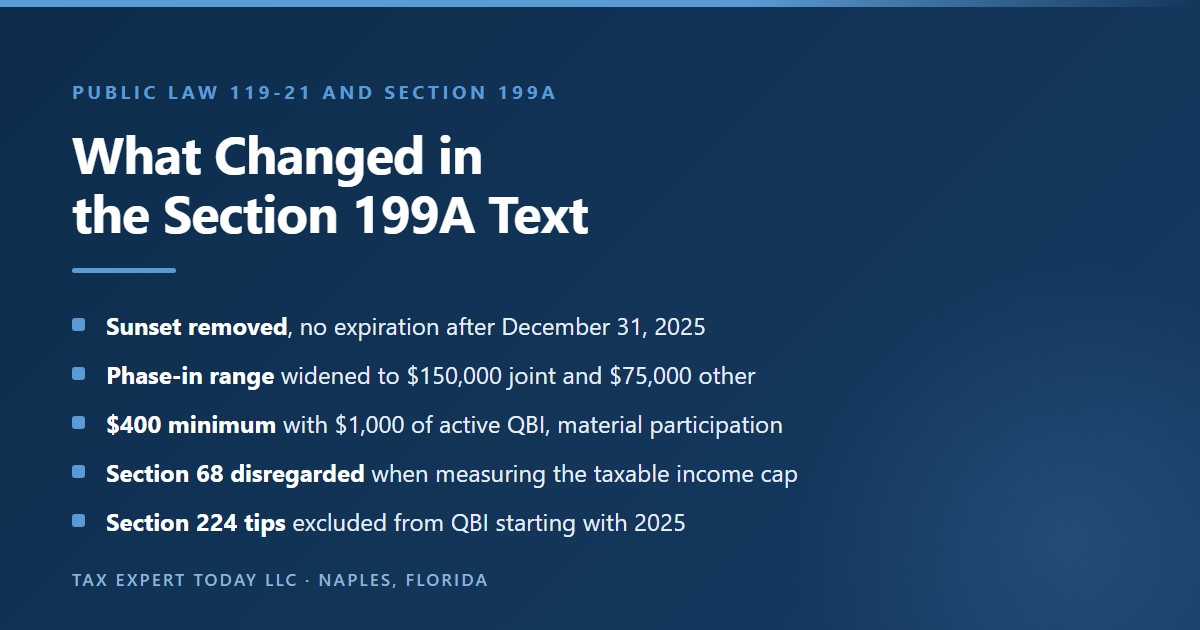
Three things changed for taxable years beginning after December 31, 2025. The deduction no longer expires, the phase-in ranges above the threshold widened from $100,000 to $150,000 for joint returns and from $50,000 to $75,000 for other filers, and a $400 minimum deduction now applies to owners with at least $1,000 of active qualified business income.
All three changes come from section 70105 of Public Law 119-21, the One, Big, Beautiful Bill Act, signed on July 4, 2025. The effective date provision reads that the amendments “shall apply to taxable years beginning after December 31, 2025,” which makes 2026 the first return that reflects them. Two further amendments touch the deduction at the edges and are rarely mentioned.
| Provision | Before Public Law 119-21 | After Public Law 119-21 | First year affected |
|---|---|---|---|
| Termination date, section 199A(i) | No deduction for taxable years beginning after December 31, 2025 | Termination removed; subsection (i) now holds the minimum deduction | 2026 |
| Phase-in range, sections 199A(b)(3)(B) and (d)(3) | $100,000 joint, $50,000 all others | $150,000 joint, $75,000 all others | 2026 |
| Minimum deduction, section 199A(i) | None | Greater of the computed deduction or $400, if active QBI is at least $1,000 | 2026 |
| Taxable income definition, section 199A(e)(1) | Computed without the QBI deduction | Also computed without regard to the section 68 itemized deduction limit | 2026 |
| QBI exclusions, section 199A(c)(4)(D) | None for tips | Amounts deductible under the section 224 qualified tips deduction are excluded from QBI | 2025 |
The last row is easy to miss because it carries an earlier effective date. The amendment adding section 199A(c)(4)(D) came from section 70201(d) of the Act and applies to taxable years beginning after December 31, 2024, so it already affects 2025 returns.
Is the QBI deduction permanent?
Yes. Before 2025 legislation, section 199A(i) stated that the section would not apply to taxable years beginning after December 31, 2025. Section 70105(b)(1) of Public Law 119-21 amended subsection (i) in its entirety, removing that termination and replacing it with the minimum deduction rule. No expiration date remains in the statute.
Much of the material written about the qualified business income deduction between 2022 and mid-2025 described a looming sunset and urged owners to accelerate income into 2025 before the deduction disappeared. That advice no longer applies. The deduction is now a permanent feature of the Code, subject to future legislation like any other provision.
- Planning horizon: multi-year entity and compensation decisions can now assume the deduction continues.
- Timing strategies built on the sunset: accelerating income into 2025 solely to capture the deduction is no longer a rationale.
- Inflation indexing continues: the threshold amounts adjust every year, and the new minimum deduction figures adjust for taxable years beginning after 2026.
What are the 2026 QBI deduction income thresholds?
For 2026, the threshold is $403,500 for married couples filing jointly, $201,775 for married filing separately, and $201,750 for all other filers. The phase-in range ends at $553,500, $276,775, and $276,750 respectively. Below the threshold, neither the wage limit nor the specified service rule applies. Above the top of the range, both apply in full.
These figures are taken directly from section 3.26 of Rev. Proc. 2025-32. The table compares them with the 2025 amounts in Rev. Proc. 2024-40. Taxable income here means taxable income before the QBI deduction.
| Filing status | 2025 threshold | 2025 top of range | 2026 threshold | 2026 top of range | 2026 range width |
|---|---|---|---|---|---|
| Married filing jointly | $394,600 | $494,600 | $403,500 | $553,500 | $150,000 |
| Married filing separately | $197,300 | $247,300 | $201,775 | $276,775 | $75,000 |
| All other returns | $197,300 | $247,300 | $201,750 | $276,750 | $75,000 |
One useful reference point: the 2026 joint threshold of $403,500 sits almost exactly where the 32 percent bracket begins for joint filers, at $403,550 under the same revenue procedure. In practical terms, a married owner whose taxable income stays inside the 24 percent bracket is below the threshold and never meets the wage limit or the specified service rule.
How do you calculate the QBI deduction?
Take 20 percent of qualified business income from each qualified business. Above the threshold, apply the W-2 wage and property limit and reduce any specified service business. Add 20 percent of qualified REIT dividends and PTP income. The qualified business income deduction is the lesser of that total or 20 percent of taxable income minus net capital gain.
Section 199A(a) builds the deduction in two layers. The first layer is the combined qualified business income amount under section 199A(b)(1). The second is the overall cap in section 199A(a)(2). For an owner below the threshold, the calculation is short.
- Step one: determine QBI for each trade or business after the deductions attributable to it.
- Step two: multiply each by 20 percent, applying the wage and property limit only if taxable income exceeds the threshold.
- Step three: add 20 percent of qualified REIT dividends and qualified PTP income.
- Step four: compare the total with 20 percent of taxable income minus net capital gain, and take the smaller figure.
- Step five: apply the $400 minimum if the owner is an applicable taxpayer.
A hypothetical married couple filing jointly illustrates the base case. One spouse operates a consulting practice that is not a specified service business for this example, producing $150,000 of qualified business income. Their taxable income before the deduction is $180,000, with no net capital gain.
| Line | Hypothetical amount | Source of the rule |
|---|---|---|
| Qualified business income | $150,000 | Section 199A(c)(1) |
| 20 percent of QBI | $30,000 | Section 199A(b)(2)(A) |
| Wage and property limit | Not applied, taxable income is below $403,500 | Section 199A(b)(3)(A) |
| Taxable income before the deduction | $180,000 | Section 199A(e)(1) |
| 20 percent of taxable income minus net capital gain | $36,000 | Section 199A(a)(2) |
| QBI deduction, the lesser amount | $30,000 | Section 199A(a) |
What is the taxable income limit on the QBI deduction?
The deduction can never exceed 20 percent of taxable income, computed before the QBI deduction, after subtracting net capital gain, which the Form 8995 instructions increase by qualified dividends. With large itemized deductions, a big retirement contribution, or substantial capital gains, this cap rather than 20 percent of QBI may decide the result.
Change one fact in the prior example. The couple now has taxable income of only $120,000 before the deduction, because of large deductions elsewhere on the return, and $20,000 of that taxable income is long-term capital gain.
| Line | Hypothetical amount |
|---|---|
| 20 percent of QBI of $150,000 | $30,000 |
| Taxable income before the deduction | $120,000 |
| Less net capital gain | ($20,000) |
| 20 percent of the remaining $100,000 | $20,000 |
| QBI deduction, the lesser amount | $20,000 |
Two points follow from the statutory text. First, capital gain is removed from the cap because it already receives preferential rates, so an owner who sells stock in the same year a business is profitable may see the deduction shrink. Second, section 199A(e)(1) now provides that taxable income is computed “without regard to section 68.” Section 68, as rewritten for 2026, reduces itemized deductions by 2/37 of the lesser of those deductions or the taxable income, increased by those deductions, above the start of the 37 percent bracket, which is $768,700 for joint filers in 2026. That reduction is disregarded when measuring the QBI cap, so it neither raises nor lowers the ceiling.
- Capital gain and qualified dividends: subtracted before the 20 percent is applied.
- The QBI deduction itself: not subtracted, which prevents a circular calculation.
- Section 68 limitation: ignored for this purpose beginning in 2026.
- Large retirement contributions: lower taxable income and therefore the cap, in addition to lowering QBI itself.
What counts as qualified business income, and what does not?
Qualified business income is the net amount of income, gain, deduction, and loss from a qualified trade or business conducted in the United States. It excludes capital gains and losses, most dividends and interest, reasonable compensation paid to an S corporation owner, guaranteed payments to partners for services, and, beginning in 2025, amounts deducted under the qualified tips deduction.
The definitions sit in section 199A(c). The effectively connected requirement means income from a business conducted abroad does not count, even for a United States citizen.
| Item | Included in QBI? | Authority |
|---|---|---|
| Schedule C net profit from a qualified trade or business | Yes | Section 199A(c)(1) |
| S corporation ordinary income passed through on Schedule K-1 | Yes | Section 199A(c)(1) |
| W-2 wages paid to the S corporation owner | No | Section 199A(c)(4)(A) |
| Guaranteed payments to a partner for services | No | Section 199A(c)(4)(B) |
| Short-term or long-term capital gain or loss | No | Section 199A(c)(3)(B)(i) |
| Dividends and interest not allocable to the business | No | Section 199A(c)(3)(B)(ii) and (iii) |
| Qualified tips deductible under section 224 | No | Section 199A(c)(4)(D) |
| Income from a business conducted outside the United States | No | Section 199A(c)(3)(A)(i) |
| Losses suspended under sections 465, 469, 704(d), or 1366(d) | Not until the year they are allowed | Instructions for Form 8995 |
The final row matters for owners with passive or at-risk limitations. The Form 8995 instructions state that losses suspended under other Code provisions “are not qualified losses or deductions” for the year they are suspended. They enter QBI in the later year they are actually used, which can reduce the deduction in a year when the business is profitable.
Which deductions reduce qualified business income?
Every deduction attributable to the business reduces QBI, including three that are claimed elsewhere on the return: the deductible half of self-employment tax, the self-employed health insurance deduction, and contributions to qualified retirement plans. Treasury regulations allocate each to the business in proportion to the gross income that produced it, so QBI is usually lower than Schedule C net profit.
The rule is in Treas. Reg. section 1.199A-3(b)(1)(vi), which treats the section 164(f) self-employment tax deduction, the section 162(l) health insurance deduction, and the section 404 retirement plan deduction as attributable to a trade or business “to the extent that the individual’s gross income from the trade or business is taken into account in calculating the allowable deduction.” Software handles this automatically only when the entries are linked correctly, and a manual QBI worksheet frequently skips it.
A hypothetical sole proprietor with $200,000 of Schedule C net profit in 2026 shows the effect. Self-employment earnings are 92.35 percent of net profit, the Social Security portion stops at the 2026 wage base of $184,500 stated in IRS Publication 15, and the owner pays $18,000 of health insurance premiums and contributes $30,000 to a retirement plan.
| Line | Hypothetical amount |
|---|---|
| Schedule C net profit | $200,000 |
| Self-employment earnings at 92.35 percent | $184,700 |
| Self-employment tax, 12.4 percent to $184,500 plus 2.9 percent on all earnings | $28,234 |
| Less deductible half of self-employment tax | ($14,117) |
| Less self-employed health insurance | ($18,000) |
| Less retirement plan contribution | ($30,000) |
| Qualified business income | $137,883 |
| 20 percent of QBI | $27,577 |
| 20 percent of net profit, the common error | $40,000 |
The gap of more than $12,000 in the deduction is the difference between reading the statute and reading the Schedule C bottom line. It also explains why a large retirement contribution costs some QBI deduction: each dollar contributed to a cash balance plan or 401(k) lowers QBI by a dollar and the deduction by up to 20 cents, so the net income tax benefit of the contribution is smaller than its face amount suggests.
What is the new $400 minimum QBI deduction?
Beginning in 2026, section 199A(i) sets the deduction at the greater of the normal computation or $400 for an applicable taxpayer. An applicable taxpayer has at least $1,000 of aggregate qualified business income from active qualified trades or businesses, meaning businesses in which the taxpayer materially participates under section 469(h). Both amounts are inflation adjusted after 2026.
The statutory language is specific. Subsection (i)(2)(A) looks to “aggregate qualified business income with respect to all active qualified trades or businesses,” and subsection (i)(2)(B) defines an active business by reference to material participation under section 469(h). The IRS summary in Rev. Proc. 2025-32 describes the change as a minimum deduction of $400 and confirms that both figures will be adjusted for taxable years beginning after 2026.
| Hypothetical single filer, 2026 | Aggregate active QBI | Normal computation | Applicable taxpayer? | Deduction |
|---|---|---|---|---|
| Materially participates in a side business | $1,500 | $300 | Yes | $400 |
| Passive investor in the same business | $0 active | $300 | No | $300 |
| Two active businesses, $3,000 profit and $2,200 loss | $800 | $160 | No, below $1,000 | $160 |
| Materially participates, QBI of $5,000 | $5,000 | $1,000 | Yes | $1,000 |
- Who it helps: owners of small side businesses whose normal deduction would be under $400, generally QBI between $1,000 and $2,000.
- Who it does not help: passive investors, because a business in which they do not materially participate is not active.
- The netting trap: the $1,000 test uses the aggregate of all active businesses, so a loss in one can disqualify the other.
- An open question: section 199A(a) now begins “except as provided in subsection (i),” and a literal reading lets the $400 floor apply even where the taxable income cap would produce less. We had not located Treasury guidance addressing this interaction as of September 17, 2026, so a return that relies on the literal reading should be prepared with care.
Who qualifies for the QBI deduction?
Individuals, estates, and trusts qualify when they have qualified business income from a trade or business other than working as an employee. C corporations never qualify. Partnerships and S corporations do not claim it themselves; they report each owner’s share of QBI, W-2 wages, and property basis on Schedule K-1.
The business must rise to the level of a trade or business under section 162, which the Form 8995 instructions describe as an activity whose primary purpose is income or profit, conducted “with continuity and regularity.” A hobby does not qualify, and neither does a single isolated transaction.
- Sole proprietors and single-member LLCs: qualify directly through Schedule C or Schedule F.
- Partners and LLC members: qualify on their distributive share, excluding guaranteed payments for services.
- S corporation shareholders: qualify on their share of ordinary income, excluding their own wages.
- Employees: do not qualify on wages, and section 199A(d)(1)(B) excludes “the trade or business of performing services as an employee.”
- Owners of specified service businesses: qualify fully below the threshold, partially within the range, and not at all above it.
Worker classification matters for the qualified business income deduction. A person who leaves employment and returns to perform substantially the same services for the same former employer as an independent contractor is presumed under Treas. Reg. section 1.199A-5(d)(3) to still be performing services as an employee for section 199A purposes for three years. The presumption can be rebutted, but it should be anticipated.
What is a specified service trade or business?
A specified service trade or business, often called an SSTB, is a business in health, law, accounting, actuarial science, performing arts, consulting, athletics, financial services, or brokerage services, or one that invests, manages investments, or trades or deals in securities, partnership interests, or commodities. Engineering and architecture are expressly excluded from the list.
Section 199A(d)(2) builds the list by cross-reference to section 1202(e)(3)(A), removing the words “engineering, architecture.” The ninth category, any business whose principal asset is the reputation or skill of its employees or owners, sounds broad, but Treas. Reg. section 1.199A-5(b)(2)(xiv) limits it to endorsement income, licensing of a person’s image, likeness, name, or voice, and appearance fees.
- Health: physicians, dentists, nurses, pharmacists, and similar professionals providing medical services directly to patients.
- Consulting: advice and counsel to clients, but not consulting embedded in the sale of goods where no separate fee is charged.
- Financial services: wealth management, financial planning, and investment advice.
- Reputation or skill: endorsements, name and likeness licensing, and appearance fees only.
The regulations also provide a de minimis rule in section 1.199A-5(c)(1). A business with gross receipts of $25 million or less is not an SSTB if less than 10 percent of its gross receipts come from a specified service field. Above $25 million, the threshold drops to 5 percent. A contractor that also bills small amounts for design consulting, or a retailer that sells a modest volume of advisory services, may fall under the line, but the test counts any activity “incident to the actual performance of services in the field.”
How does the wider phase-in range change the SSTB result?
Within the phase-in range, an SSTB owner counts only an applicable percentage of QBI, wages, and property basis, falling from 100 percent to zero across the range. Because the 2026 joint range is $150,000 wide instead of $100,000, the percentage falls more slowly, so owners keep more of the deduction than in 2025.
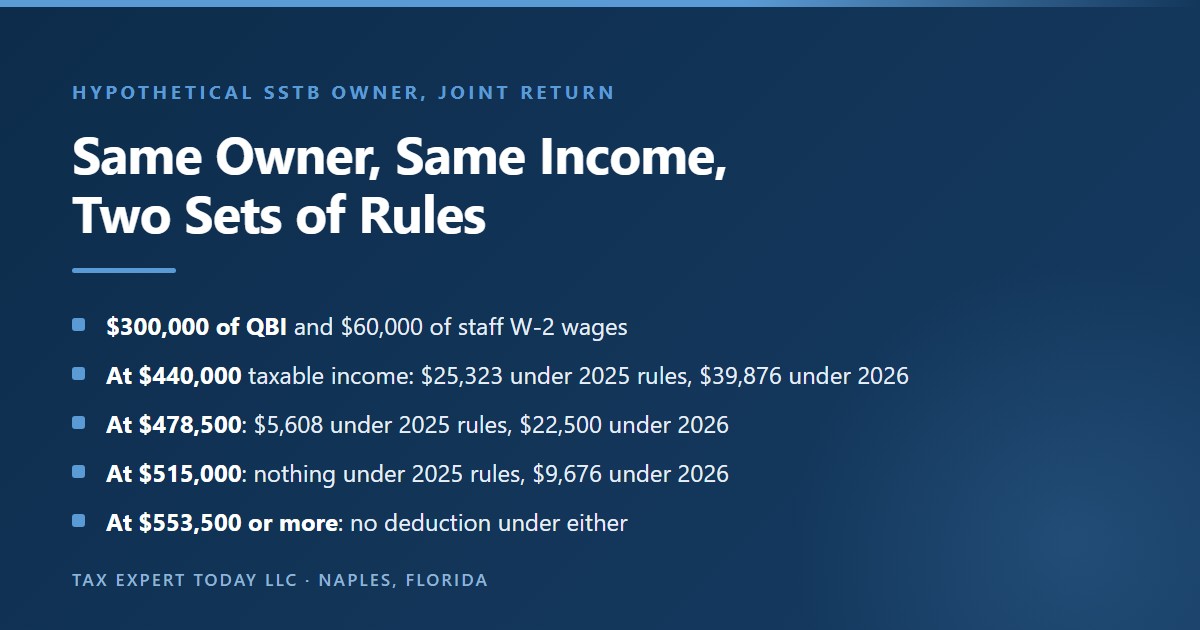
Section 199A(d)(3)(B) defines the applicable percentage as 100 percent reduced by the ratio of taxable income above the threshold to $150,000 for joint returns. Inside the range, section 199A(b)(3)(B) also phases in the wage limit gradually. The ladder below uses one hypothetical joint filing SSTB owner with $300,000 of QBI and $60,000 of W-2 wages paid to staff, at different levels of taxable income, and runs each level under both the 2025 and 2026 rules.
| Taxable income before the deduction | 2025 rules deduction | 2026 rules deduction |
|---|---|---|
| $403,500 | $52,228 | $60,000 |
| $440,000 | $25,323 | $39,876 |
| $478,500 | $5,608 | $22,500 |
| $515,000 | $0 | $9,676 |
| $553,500 or more | $0 | $0 |
At $478,500 of taxable income, which is $75,000 into the 2026 range, the applicable percentage is 50 percent. The owner counts $150,000 of QBI and $30,000 of wages. Twenty percent of $150,000 is $30,000, and 50 percent of $30,000 of wages is $15,000. The $15,000 excess is reduced by the same 50 percent ratio, leaving a deduction of $22,500. Under the 2025 rules, the same owner at the same distance above the 2025 threshold, $469,600, would have reached only $9,375.
- At or above the top of the range: an SSTB is not a qualified trade or business, so it produces no deduction and no QBI toward the $400 minimum.
- Within the range: both the applicable percentage and the wage limit phase in together.
- Below the threshold: an SSTB is treated exactly like any other business.
What is the W-2 wage and UBIA limit?
Above the threshold, each business’s deduction cannot exceed the greater of 50 percent of its W-2 wages, or 25 percent of those wages plus 2.5 percent of the unadjusted basis immediately after acquisition, or UBIA, of its qualified property. Profitable businesses with few employees and little equipment feel this limit most.
Section 199A(b)(2)(B) states the limit, and Treas. Reg. section 1.199A-2 supplies the details. W-2 wages include amounts paid to the owner of an S corporation, but not guaranteed payments to a partner or draws by a sole proprietor. UBIA is generally the original cost basis of tangible depreciable property held at year end and still inside its depreciable period, which runs until the later of 10 years after placement in service or the end of the recovery period.
| Hypothetical joint filer, taxable income $700,000, non-SSTB | Wages only | Wages plus $1,200,000 of UBIA |
|---|---|---|
| QBI | $400,000 | $400,000 |
| 20 percent of QBI | $80,000 | $80,000 |
| 50 percent of $60,000 of W-2 wages | $30,000 | $30,000 |
| 25 percent of wages plus 2.5 percent of UBIA | $15,000 | $45,000 |
| Wage and property limit, the greater | $30,000 | $45,000 |
| QBI deduction | $30,000 | $45,000 |
- Bonus depreciation does not shrink UBIA: the regulation states that additional first year depreciation “does not affect the applicable recovery period,” and UBIA is measured before depreciation.
- Land never counts: it is not depreciable, which limits the benefit for real estate held mostly as land value.
- Wages must be reported: amounts count only if properly included on a return filed with the Social Security Administration by the 60th day after its due date, including extensions.
- Recently purchased equipment: building improvements and equipment placed in service in the year count at full cost, which is one reason a cost segregation study and bonus depreciation in 2026 should be modeled together with the QBI result.
Can paying yourself a higher S corp salary increase the QBI deduction?
It can, when the owner is above the phase-in range and the wage limit is binding. Raising the salary lowers QBI but raises the 50 percent wage limit, and the deduction peaks where the two meet. Because the extra salary also costs payroll tax, the combined result must be modeled, and any salary must still satisfy the reasonable compensation standard.
Outside the qualified business income deduction, standard advice is to keep an S corporation owner’s salary at the low end of reasonable to save payroll tax. Above the phase-in range, that advice can reverse. The hypothetical below assumes a joint filing S corporation owner in a non-SSTB with $460,000 of profit before the owner’s salary, no other employees, no qualified property, taxable income well above $553,500, a 35 percent marginal income tax rate, and a salary below the Social Security wage base. The employer’s 7.65 percent share of payroll tax is deducted by the corporation and lowers QBI.
| Owner salary | QBI | QBI deduction | Total payroll tax | Income tax at 35 percent | Combined federal tax |
|---|---|---|---|---|---|
| $60,000 | $395,410 | $30,000 | $9,180 | $148,894 | $158,074 |
| $90,000 | $363,115 | $45,000 | $13,770 | $142,840 | $156,610 |
| $115,000 | $336,202 | $57,500 | $17,595 | $137,796 | $155,391 |
| $128,000 | $322,208 | $64,000 | $19,584 | $135,173 | $154,757 |
| $150,000 | $298,525 | $59,705 | $22,950 | $136,087 | $159,037 |
In this illustration, the combined tax is lowest near a $128,000 salary, where 50 percent of wages and 20 percent of QBI are roughly equal, and it is about $3,300 lower than at the $60,000 salary. Past that point, each additional salary dollar reduces the deduction and adds payroll tax, so the result worsens quickly. The figures change with every assumption, including state tax, the additional Medicare tax, retirement plan contributions tied to salary, and the taxable income cap, which is why this is a calculation to run rather than a rule to apply. The companion article on S corp reasonable compensation covers the floor that every salary must meet regardless of the QBI result.
How do tips deducted under section 224 affect QBI?
Section 199A(c)(4)(D) excludes from QBI any amount for which a deduction is allowable under section 224, the qualified tips deduction. A self-employed individual in a tipped occupation cannot deduct the tips under section 224 and also count the same dollars toward the 20 percent QBI computation. The rule applies to taxable years beginning after December 31, 2024.
The qualified tips deduction in section 224 is capped at $25,000 and phases down with modified adjusted gross income. It is limited to occupations that customarily received tips on or before December 31, 2024, and it is unavailable when the tips are received in a specified service trade or business. The 2025 Form 8995 instructions list “tip income under section 224 that is excluded from the net profit of the trade or business” among the items that are not QBI.
| Hypothetical self-employed single filer | Amount |
|---|---|
| Schedule C net profit including qualified tips | $60,000 |
| Qualified tips deducted under section 224 | $10,000 |
| Qualified business income after the exclusion | $50,000 |
| QBI deduction at 20 percent, before other adjustments | $10,000 |
Without the exclusion, the same $10,000 would have produced another $2,000 of QBI deduction. The two deductions are coordinated, not stacked, and software that computes them independently may overstate the combined result.
Does rental real estate qualify for the QBI deduction?
Rental real estate qualifies when the activity rises to a trade or business under section 162, or meets the Rev. Proc. 2019-38 safe harbor. The safe harbor generally requires separate books, 250 or more hours of rental services a year, and contemporaneous records. Triple net leases and personal residences are excluded.
Many landlords assume rental income is automatically QBI. It is not. A single long-term residential rental with a property manager and little owner involvement may fall short of a trade or business. Rev. Proc. 2019-38 offers a path that does not depend on the section 162 facts and circumstances test.
| Safe harbor requirement | What the revenue procedure says |
|---|---|
| Separate books and records | Maintained for each rental real estate enterprise, which may be consolidated from property level statements |
| 250 hours of rental services | Each year for enterprises in existence less than four years; in any three of the five most recent years otherwise |
| Contemporaneous records | Hours, description, and dates of all services, and who performed them |
| Excluded property | Real estate used as a residence under section 280A(d) and property rented under a triple net lease |
| Annual statement | A statement attached to a timely filed original return for each year the safe harbor is relied on |
- Hours by others count: services by employees, agents, and independent contractors count toward the 250 hours.
- Investor activity does not count: arranging financing, reviewing statements, and planning are not rental services.
- Short-term rentals: a property with average stays of seven days or less raises separate questions, covered in the article on the short term rental tax loophole.
- Renting to your own business: self-rental to a commonly controlled trade or business is generally treated as part of that business under the regulations.
How does aggregation work for the QBI deduction?
An owner above the threshold may elect to aggregate businesses and apply the wage and property limit to the group. The regulations require 50 percent common ownership for most of the year including year end, the same taxable year, no SSTB, and two of three operational connections. Once elected, aggregation must continue.
Aggregation under Treas. Reg. section 1.199A-4 solves a specific problem. An owner may hold a profitable operating company with no property and a real estate entity with substantial UBIA. Tested separately, the operating company hits the wage limit and the real estate entity has property basis it cannot use. Tested together, the property basis may support the operating company’s QBI.
- Common ownership: the same person or group owns 50 percent or more of each business, directly or by attribution.
- Two of three factors: the businesses provide related products or services, share facilities or centralized functions, or operate in coordination or reliance on one another.
- Consistency: the regulation states that the individual “must consistently report the aggregated trades or businesses in all subsequent taxable years.”
- No late aggregation: an individual who fails to aggregate generally may not do so on an amended return.
- Disclosure: a statement identifying each aggregated group is attached to the return each year.
What happens when qualified business income is negative?
When total QBI across all businesses is negative, the QBI component of the deduction is zero for the year and the net loss carries forward as a qualified business loss into the next year. When one business loses money and another profits, the loss is netted against the profit before the 20 percent applies.
Section 199A(c)(2) provides the carryover. It exists only inside the QBI computation and does not change how the loss is deducted elsewhere on the return. A hypothetical joint filer below the threshold shows the two-year effect.
| Hypothetical joint filer | Year one | Year two |
|---|---|---|
| Current year net QBI | ($30,000) | $80,000 |
| QBI loss carried in | $0 | ($30,000) |
| QBI used in the computation | ($30,000) | $50,000 |
| QBI deduction | $0 | $10,000 |
| QBI loss carried out | ($30,000) | $0 |
The carryforward is easy to lose when a return preparer changes, because it appears only on the Form 8995 or 8995-A worksheet and not on the face of the return. A negative combined amount of qualified REIT dividends and qualified PTP income carries forward separately under Treas. Reg. section 1.199A-1 and offsets only that category.
How do REIT dividends and PTP income fit into the QBI deduction?
Qualified REIT dividends and qualified publicly traded partnership income receive their own 20 percent component, added after the business computation. This component is never subject to the W-2 wage or property limit, and REIT dividends are not reduced by the specified service rules. The overall taxable income cap still applies to the total.
The regulations narrow what counts. A qualified REIT dividend under Treas. Reg. section 1.199A-3(c) excludes capital gain dividends and qualified dividend income, and it excludes dividends on shares held for 45 days or less during the 91-day window around the ex-dividend date. PTP income from a partnership engaged in a specified service business remains subject to the SSTB phase-out.
- Brokerage reporting: section 199A dividends appear in box 5 of Form 1099-DIV.
- Holding period: short holding periods can disqualify an otherwise eligible dividend.
- No wage limit: this component can support a deduction for a high-income investor with no operating business.
- Separate loss track: PTP losses carry forward within this component only.
Which form do you use, Form 8995 or Form 8995-A?
Form 8995 is the simplified computation. It may be used when taxable income before the QBI deduction is at or below the threshold and the taxpayer is not a patron of a specified agricultural or horticultural cooperative. Everyone else uses Form 8995-A, with Schedules A through D for specified service businesses, aggregation, loss netting, and cooperative patrons.
For 2026 returns the Form 8995 eligibility line becomes $403,500 for joint filers and $201,750 for most other filers, reflecting the amounts in Rev. Proc. 2025-32. The About Form 8995 and About Form 8995-A pages carry the current versions and any post-release changes.
| Situation | Form | Schedule |
|---|---|---|
| Taxable income at or below the threshold, no cooperative patronage | Form 8995 | None |
| Taxable income above the threshold | Form 8995-A | Part II for each business |
| SSTB owner within the phase-in range | Form 8995-A | Schedule A |
| Aggregating businesses | Form 8995-A | Schedule B |
| Netting losses across businesses above the threshold | Form 8995-A | Schedule C |
| Patron of a specified agricultural or horticultural cooperative | Form 8995-A | Schedule D |
Does Florida have a QBI deduction?
Florida has no personal income tax, so there is no Florida QBI deduction and no state decoupling to track. For a Florida resident who owns a sole proprietorship, partnership, or S corporation, the federal section 199A computation is the entire result. Owners with income sourced to another state may still face that state’s rules.
The Florida corporate income tax described by the Florida Department of Revenue applies to corporations, and the qualified business income deduction is not a corporate deduction in any event. The practical Florida question is usually a different one: an owner who relocated from a state with an income tax may still file there on business income sourced to that state, and each state sets its own treatment of pass-through income.
- Florida residents with Florida businesses: federal computation only.
- Owners with operations in other states: nonresident filing may still apply to income sourced there.
- Recent arrivals: the year of the move may involve part-year residency elsewhere, and the timing of a business sale relative to the move matters for gain, which is not QBI.
What are common QBI deduction mistakes?
The most common mistakes are computing 20 percent of Schedule C profit without subtracting self-employment tax, health insurance, and retirement deductions; treating a passive rental as a business; overlooking a QBI loss carryforward; ignoring the taxable income cap in a year with capital gains; and applying 2025 thresholds or phase-in widths to a 2026 return.
- Using net profit as QBI: the regulations require the three above-the-line deductions to be allocated back to the business.
- Stale thresholds: a 2026 return uses $403,500 joint and a $150,000 range, not $394,600 and $100,000.
- Lost carryforwards: negative QBI from a prior year must reduce current QBI.
- Double counting tips: amounts deducted under section 224 are not QBI.
- Misclassified SSTBs: a consulting component above the de minimis percentage can taint an entire business.
- Late W-2 filings: wages reported to the Social Security Administration after the 60 day window do not count toward the limit.
- Inconsistent aggregation: dropping an aggregation elected in a prior year without a change in facts is not permitted.
How can business owners plan around the QBI deduction in 2026?
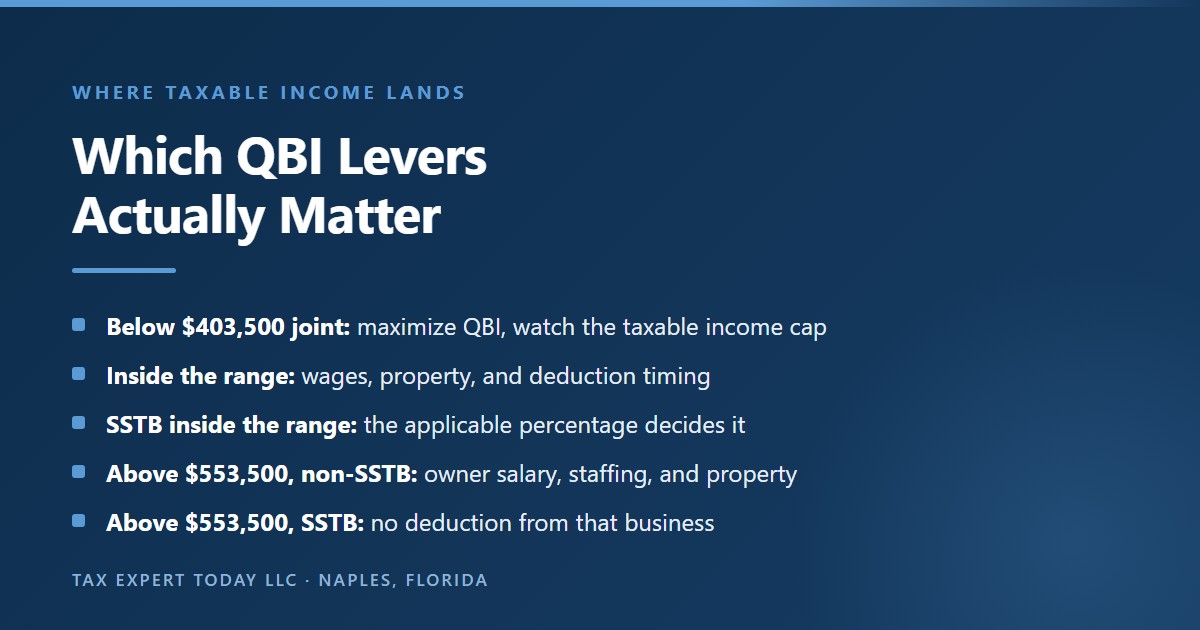
Planning starts with where taxable income will land against $403,500 and $553,500 for joint filers. Below the threshold, maximize QBI and protect the taxable income cap. Within or above the range, W-2 wages, property basis, structure, aggregation, and the timing of deductions and gains become the levers, and each should be modeled.
| Where taxable income lands | What decides the deduction | Planning levers to model |
|---|---|---|
| Below the threshold | 20 percent of QBI or the taxable income cap | Capital gain timing, retirement contribution size, allocation of above-the-line deductions |
| Within the phase-in range, non-SSTB | Partial wage limit | W-2 wages, qualified property purchases, aggregation, deduction timing |
| Within the phase-in range, SSTB | Applicable percentage and partial wage limit | Pre-tax retirement deferrals, charitable timing, separating non-SSTB activity where facts support it |
| Above the range, non-SSTB | Full wage and property limit | Owner salary level, staffing structure, qualified property, aggregation |
| Above the range, SSTB | No deduction | Whether income can be brought into the range, and whether any activity is genuinely separate |
Several related strategies interact with the qualified business income deduction. Renting a home to the business for a short meeting period under the Augusta rule creates a business deduction that also reduces QBI. Quarterly payments should reflect the deduction, and the quarterly estimated tax calculator can help size them. Owners weighing an entity change should model the QBI result alongside payroll tax, because the answer frequently differs from the rule of thumb.
- Project taxable income early: most QBI levers work only if chosen before year end.
- Keep the records the regulations require: rental service logs, aggregation statements, and timely W-2 filings.
- Revisit each year: thresholds adjust annually, and the minimum deduction figures begin adjusting after 2026.
QBI Deduction Help in Naples & Southwest Florida
QBI deduction help Naples business owners ask for usually turns on three questions: whether the activity is a qualified trade or business, where taxable income will land against the 2026 thresholds, and whether wages, property, or structure should change. Our office in Naples, Florida reviews all three for owners and their advisors.
Southwest Florida has a heavy concentration of medical practices, professional firms, contractors, hospitality operators, and real estate investors. That mix produces the full range of section 199A questions: specified service businesses near the phase-in range, construction and trade businesses constrained by the wage limit, and landlords deciding whether a rental portfolio meets the safe harbor.
- Qualified business income deduction review. Confirming QBI after the regulatory allocations and checking prior year carryforwards.
- SSTB classification. Testing each activity and the de minimis percentage before the return is built.
- Owner compensation modeling. Running the salary sweep against the wage limit and payroll tax.
- Rental safe harbor support. Setting up the books and service logs Rev. Proc. 2019-38 expects.
- Coordination with the wider plan. Fitting the deduction alongside retirement design, asset purchases, and any planned sale.
Tax Expert Today LLC
11983 Tamiami Trail N, Naples FL 34110
Phone: (239) 441-2005
Hours: Monday to Friday, 10:00 to 5:00 ET
Can a Naples medical or professional practice still claim the qualified business income deduction in 2026? It may, depending on taxable income. A practice in health, law, accounting, or consulting is a specified service business, so the owner receives the full deduction below $403,500 of joint taxable income, a partial deduction up to $553,500, and none above that. The wider 2026 range lets more Naples practice owners keep part of the deduction than under the prior rules.
When to Engage a Professional
An owner below the threshold with one profitable business and no carryforwards can often complete Form 8995 directly. The situations below involve limits, elections, or classifications that are difficult to correct after a return is filed, and each is worth modeling before year end rather than after.
- Taxable income near or above $403,500 joint. The wage limit and SSTB rules begin to apply.
- A specified service business with any non-service revenue. The de minimis test and activity separation need analysis.
- An S corporation owner above the range. The salary level can change the combined tax meaningfully.
- Multiple entities with common ownership. Aggregation is an election that must then be kept.
- A rental portfolio. Trade or business status or the safe harbor should be established, not assumed.
- A prior year QBI loss. The carryforward must be tracked and applied.
Tax Expert Today LLC is a multidisciplinary practice of tax advisors, enrolled agents, certified public accountants, and attorneys serving clients in all 50 states. To discuss how the qualified business income deduction fits within a broader Naples tax planning approach, our tax planning services, or a business advisory relationship where entity, compensation, and fractional CFO decisions are planned together, call (239) 441-2005.
This article is general information about federal and Florida tax provisions and is not tax advice for any specific taxpayer. Figures were verified against primary sources on September 17, 2026 and are subject to change. Every illustration is hypothetical and outcomes depend entirely on individual facts. Consult a qualified professional before acting.
Published September 17, 2026 by Dr. Pellumb Kabashi « Back to Learning Center
Have a question this article touches on?
Tax Expert Today LLC, based in Naples, Florida and serving clients across the United States.
Schedule a Consultation (239) 441-2005