
By Dr. Pellumb Kabashi, DBA, MBA, CES, CFE, EA
Founder, Tax Expert Today LLC · Tax advisors, enrolled agents, CPAs, and attorneys · Serving clients in all 50 states
Quick Answer
What does a fractional CFO do? A fractional CFO gives a business owner senior financial leadership on a part-time basis, working on a recurring cadence rather than a one-time project. In a typical month that means a weekly cash review, a monthly close and management report, a quarterly reforecast, and an annual budget. The role looks forward and turns the numbers into decisions, which separates it from bookkeeping or controllership. Call (239) 441-2005 for a free consultation.
Primary Sources
- U.S. Bureau of Labor Statistics, Occupational Outlook Handbook: Financial Managers (duties of the CFO role)
- AICPA & CIMA: Management Accounting (the discipline behind CFO reporting and forecasting)
- U.S. Small Business Administration: Manage Your Finances (cash flow and budgeting fundamentals)
- IRS: Small Businesses and Self-Employed Tax Center (recordkeeping and filing obligations a CFO coordinates)
- IRS: Estimated Taxes (the quarterly cash planning a CFO ties to the forecast)
Most articles answer the question with a bullet list of responsibilities. That list is accurate, and it is also the same list on every page. What it does not show is the part owners actually care about, which is the rhythm of the work and what changes for the business once a fractional CFO is engaged. This guide walks through the operating cadence week by week, month by month, and quarter by quarter, and then explains how a fractional CFO differs from a bookkeeper or controller and how the role connects to your tax plan. All figures below are illustrative and depend on individual facts.
What does a fractional CFO do in a typical month?
In a typical month a fractional CFO runs a fixed cadence: a short weekly cash review, a monthly close that produces a management report and a variance review, a quarterly reforecast of the full year, and once a year a budget and capital plan. The point of the cadence is that decisions get made on a schedule, not only when a problem forces them. The quarterly slot is usually where the margin and pricing review lands, and our guide to how to improve gross margin covers what that review actually involves.
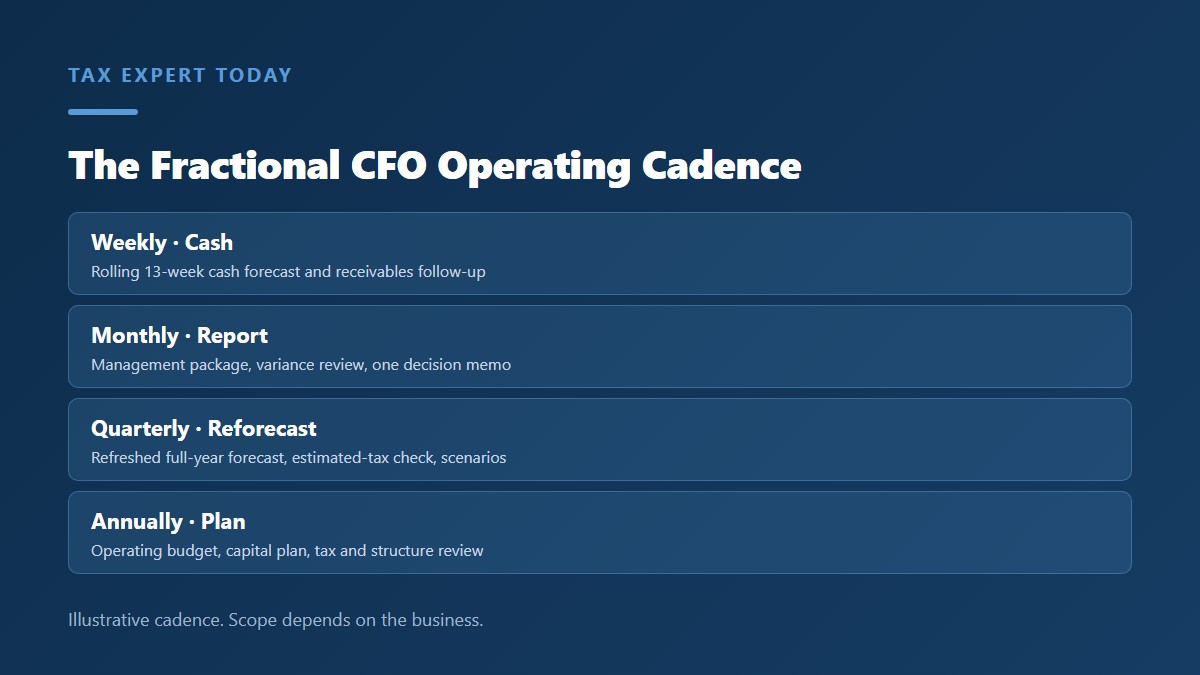
A part-time engagement does not mean occasional attention. It means the CFO-level work is sized to what the business needs and delivered on a predictable calendar. The table below shows the standard rhythm.
| Cadence | Primary focus | Typical outputs |
|---|---|---|
| Weekly | Cash | Updated 13-week cash forecast, receivables follow-up list, near-term payment plan |
| Monthly | Close and report | Management package, budget-to-actual variance review, one decision memo |
| Quarterly | Reforecast | Refreshed full-year forecast, estimated-tax check, one or two scenarios |
| Annually | Plan | Operating budget, capital plan, entity and compensation review with tax planning |
What does a fractional CFO do each week?
Each week a fractional CFO protects cash. The core deliverable is a rolling 13-week cash forecast that projects money in and money out, so the owner sees a shortfall weeks before it arrives rather than the day a payment bounces. Alongside it come a receivables follow-up list and a short view of upcoming obligations.
The weekly touch is deliberately light. It is not a full close and it is not a meeting for its own sake. It answers three questions: how much cash is on hand, what is coming in and going out over the next quarter, and what needs a decision this week. The U.S. Small Business Administration lists cash flow management as a core survival skill for small businesses, and the 13 week cash flow forecast is where that skill lives. When a line of credit draw or a large payment timing choice comes up, the weekly forecast is the evidence behind the call.
What does a fractional CFO do at month end?
At month end a fractional CFO closes the books with the bookkeeping team, then translates the results into a management package: a small set of numbers that tell the owner what happened and what to do about it. A good package is short. It is the five to ten figures that drive the business, each shown against budget and against the prior period.
The management package is the single most useful thing many owners receive, because it replaces a raw profit-and-loss export with a decision-ready summary. The table below is a representative set of the numbers a CFO typically tracks.
| Number | What it shows | Why it matters |
|---|---|---|
| Cash and 13-week runway | Liquidity and how long it lasts | The first question in any downturn |
| Revenue vs forecast | Top-line performance | Signals whether the plan still holds |
| Gross margin percent | Profit per dollar of sale | Where pricing and cost problems surface first |
| Operating expenses vs budget | Spending discipline | Catches creep before it compounds |
| Net income and EBITDA | Bottom-line result | The number lenders and buyers read |
| Days sales outstanding | How fast customers pay | Turns sales into usable cash |
| Pipeline or backlog | Committed future revenue | The forward-looking KPI most owners lack |
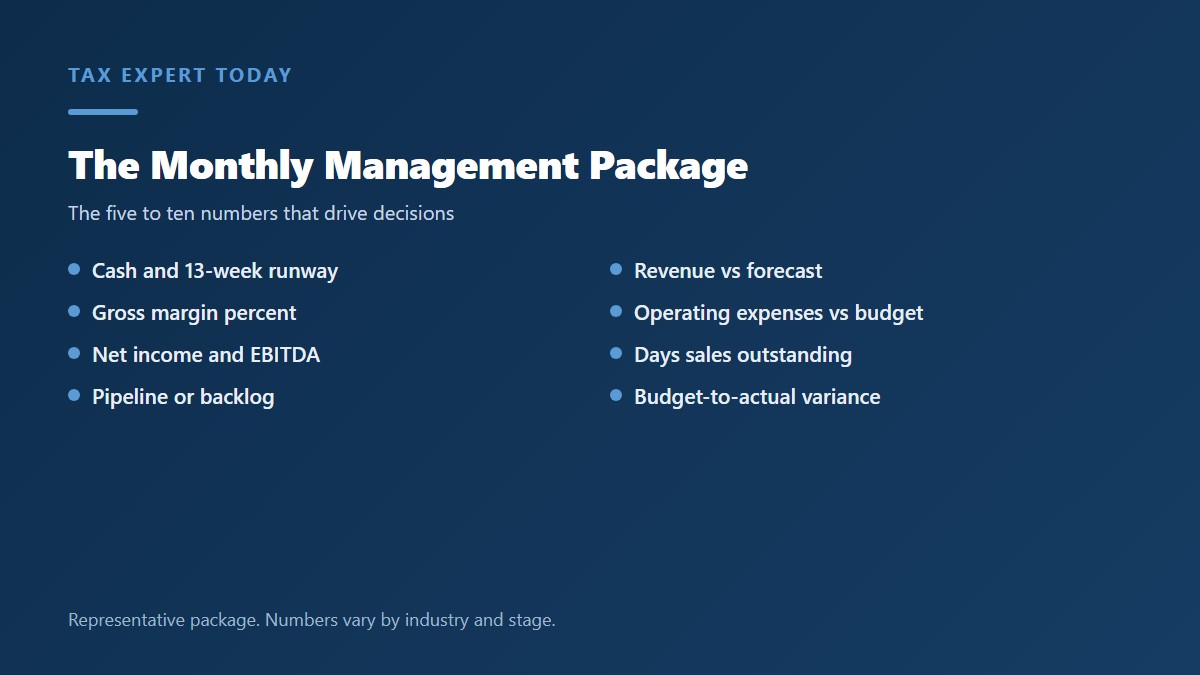
With the package in hand, the CFO runs a variance review, meaning a comparison of actual results to the budget, and writes a short decision memo. If gross margin slipped two points, the memo names the cause and the fix rather than leaving the owner to interpret a spreadsheet.
What does a fractional CFO do each quarter?
Each quarter a fractional CFO rebuilds the forecast for the rest of the year using the actual results to date, so the plan reflects reality instead of a January guess. The quarterly reforecast also drives two practical checks: whether estimated tax payments still match projected income, and how the business would hold up under one or two what-if scenarios.
The estimated-tax check matters because surprises there are cash surprises. Owners of pass-through businesses generally pay tax through quarterly estimates, and the IRS explains that estimated taxes are the method for income not subject to withholding. A CFO who has already built the forecast can true up those payments before a deadline rather than after, which keeps the quarterly tax outflow from colliding with payroll or a growth investment. Scenario planning is the other quarterly habit: modeling a slower sales quarter, a new hire, or a price change so the owner sees the cash effect before committing.
What does a fractional CFO do over a full year?
Over a full year a fractional CFO builds the operating budget, sets the capital plan, and coordinates the annual tax and structure review. The budget is the anchor that every monthly variance review measures against, and the capital plan sequences the larger spending decisions, such as equipment, hiring, or a facility, against the cash the forecast says will be available. When one of those decisions is a building, the capital plan is also the right place to evaluate a cost segregation study before the first return is filed.
The annual cycle is also where finance and tax decisions are most usefully planned together. Entity choice, owner compensation, retirement plan design, and the timing of large purchases all have both a cash and a tax dimension. Deciding them once a year, with the forecast and the tax picture on the same table, tends to produce cleaner outcomes than deciding them in isolation. This is the point where a multidisciplinary firm, with tax advisors and CFO-level support under one roof, can keep the two sides aligned.
What happens in the first 90 days with a fractional CFO?
In the first 90 days a fractional CFO stabilizes the basics before adding anything new. The typical arc is to clean up the reporting and build the cash forecast first, then stand up the monthly management package, and only then move to forward planning. The goal of the first quarter is trust in the numbers, because every later decision rests on them.
A representative first-90-days sequence looks like this. In month one the CFO reviews the historical financials, fixes the chart of accounts if needed, and builds the 13-week cash forecast. In month two the first full management package ships and the variance review begins. By month three the reforecast and a first-pass budget take shape, along with an initial read on tax posture. None of this promises a specific result; it describes the mechanism most engagements follow.
| Window | Focus | What changes for the owner |
|---|---|---|
| Month 1 | Clean data and cash visibility | Reliable books and a forward cash view |
| Month 2 | Management reporting | A monthly package and variance review |
| Month 3 | Forward planning | A reforecast, a draft budget, a tax read |
What does a fractional CFO do for fundraising or a sale?
When a business is raising capital or preparing to sell, a fractional CFO leads the financial side of the process. That means assembling clean historical financials, building the forecast and model that a lender, investor, or buyer will test, organizing the due-diligence materials, and sitting across the table to answer financial questions with authority. Many owners bring in fractional support specifically for a raise or an exit, because the reporting standard those events demand is higher than day-to-day operations require.
The work is the same discipline as the monthly cadence, applied to a one-time event. The forecast that already runs every quarter becomes the base case in the model. The management package that owners already trust becomes the reporting a buyer reviews. This is one reason the monthly rhythm matters even in quiet years: it produces the track record that makes a future raise or sale far less painful. As always, outcomes depend on the business and the market, and nothing here promises a particular valuation or result.
How is a fractional CFO different from a bookkeeper or controller?
A fractional CFO is different because of time horizon. A bookkeeper records what already happened, a controller makes sure the books are accurate and closed on time, and a CFO looks forward and decides what to do next. The Bureau of Labor Statistics describes financial managers as directing an organization’s financial strategy and long-term goals, which is the forward-looking work a bookkeeper and controller support but do not own.
| Role | Time horizon | Core question it answers |
|---|---|---|
| Bookkeeper | The past | Are the transactions recorded correctly? |
| Controller | The present | Are the books accurate and closed on time? |
| Fractional CFO | The future | What should we do next, and what do the numbers say? |
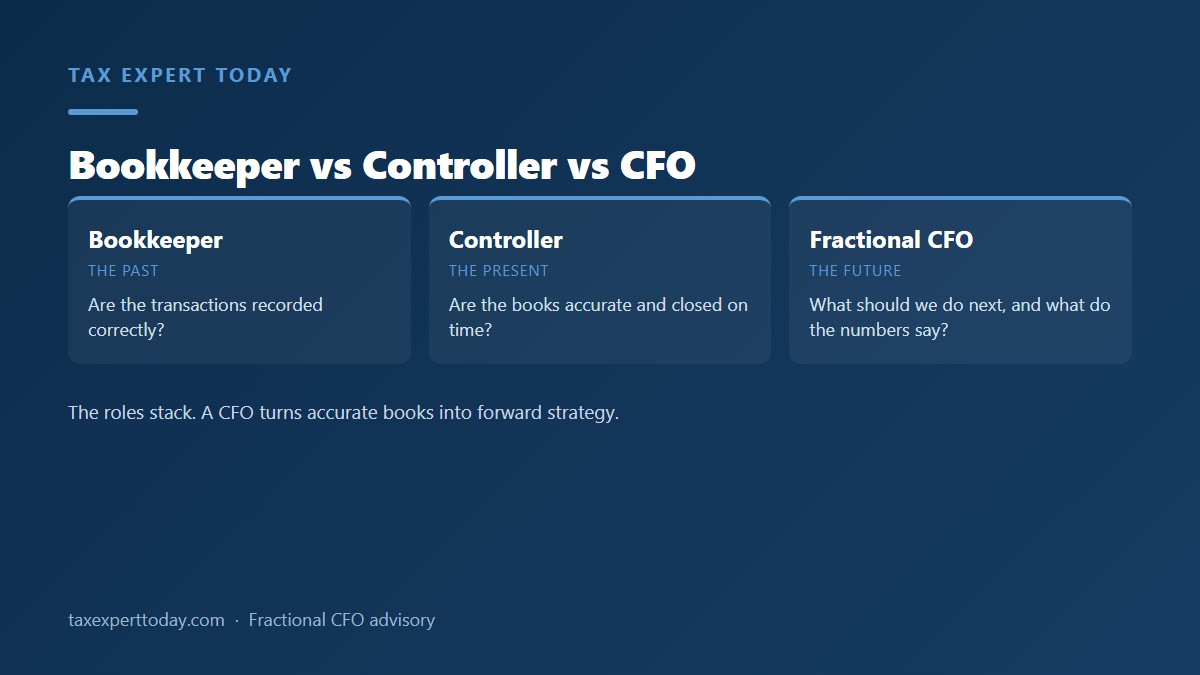
The roles stack rather than compete. A fractional CFO usually oversees the bookkeeper or controller and turns their accurate records into strategy, which is why hiring a CFO does not replace the accounting function. The management discipline behind that translation is management accounting, the field the AICPA and CIMA define and support.
How does a fractional CFO work with your tax plan?
A fractional CFO connects the operating forecast to the tax plan, so cash decisions and tax decisions are made with the same information. Because the CFO already tracks projected income each quarter, estimated tax payments can be trued up on schedule, and larger moves such as equipment purchases, owner compensation, or a retirement plan contribution can be timed with both their cash effect and their tax effect in view.
Consider an illustrative example. A service business projects roughly $3 million in revenue and is weighing a year-end equipment purchase. Looked at only through cash, the purchase competes with payroll. Looked at only through tax, it might be accelerated for a deduction. A CFO working with the tax team weighs both at once and recommends the timing that fits the forecast and the return together. This is a mechanism, not a promise; the right answer depends entirely on the facts. For the specific tax rules that shape these calls, see our Naples tax planning overview, and for how the engagement itself is scoped, see how fractional CFO cost compares to a full-time hire.
Fractional CFO Naples: Help in Naples, Florida and Southwest Florida
Fractional CFO Naples: Tax Expert Today provides fractional CFO services in Naples, Florida and coordinated tax planning to business owners in Naples, Bonita Springs, Fort Myers, Marco Island, and across Southwest Florida, as well as clients in all 50 states. Because the same firm handles both the finance cadence and the tax work, the monthly management package and the annual tax plan stay aligned rather than living in two disconnected offices. Fees are scoped and quoted after a consultation, sized to what the business actually needs. You can learn more about our fractional CFO services in Naples or our broader business consulting support.
Tax Expert Today LLC
11983 Tamiami Trail N, Naples, Florida 34110
Phone: (239) 441-2005
Hours: Monday to Friday, 10:00 a.m. to 5:00 p.m. ET
Do I need to be in Naples to work with a fractional CFO?
No. Tax Expert Today serves clients in all 50 states, and the fractional CFO cadence runs the same way remotely: a weekly cash review, a monthly management package, and quarterly and annual planning are all delivered on a schedule regardless of location. Local Southwest Florida owners can also meet in person at the Naples office.
When to Engage a Professional
Consider engaging a fractional CFO when the business has outgrown the owner’s ability to run the numbers by feel, when cash timing has become a recurring worry, when a lender, investor, or buyer is asking for cleaner reporting, or when finance and tax decisions keep being made separately. A fractional CFO fits the common case of a business that needs executive-level financial leadership but does not yet need, or want to pay for, a full-time hire that can run from roughly $250,000 to $450,000 in salary, benefits, and equity. Whether the fit is right, and the scope, depend on your facts. To talk it through, contact Tax Expert Today at (239) 441-2005.
This article is for general educational purposes and does not constitute tax, accounting, or financial advice. Consult a qualified professional about your specific situation.
Published July 24, 2026 by Dr. Pellumb Kabashi « Back to Learning Center
Have a question this article touches on?
Tax Expert Today LLC, based in Naples, Florida and serving clients across the United States.
Schedule a Consultation (239) 441-2005