
By Dr. Pellumb Kabashi, DBA, MBA, CES, CFE, EA
Founder, Tax Expert Today LLC · Tax advisors, enrolled agents, CPAs, and attorneys · Serving clients in all 50 states
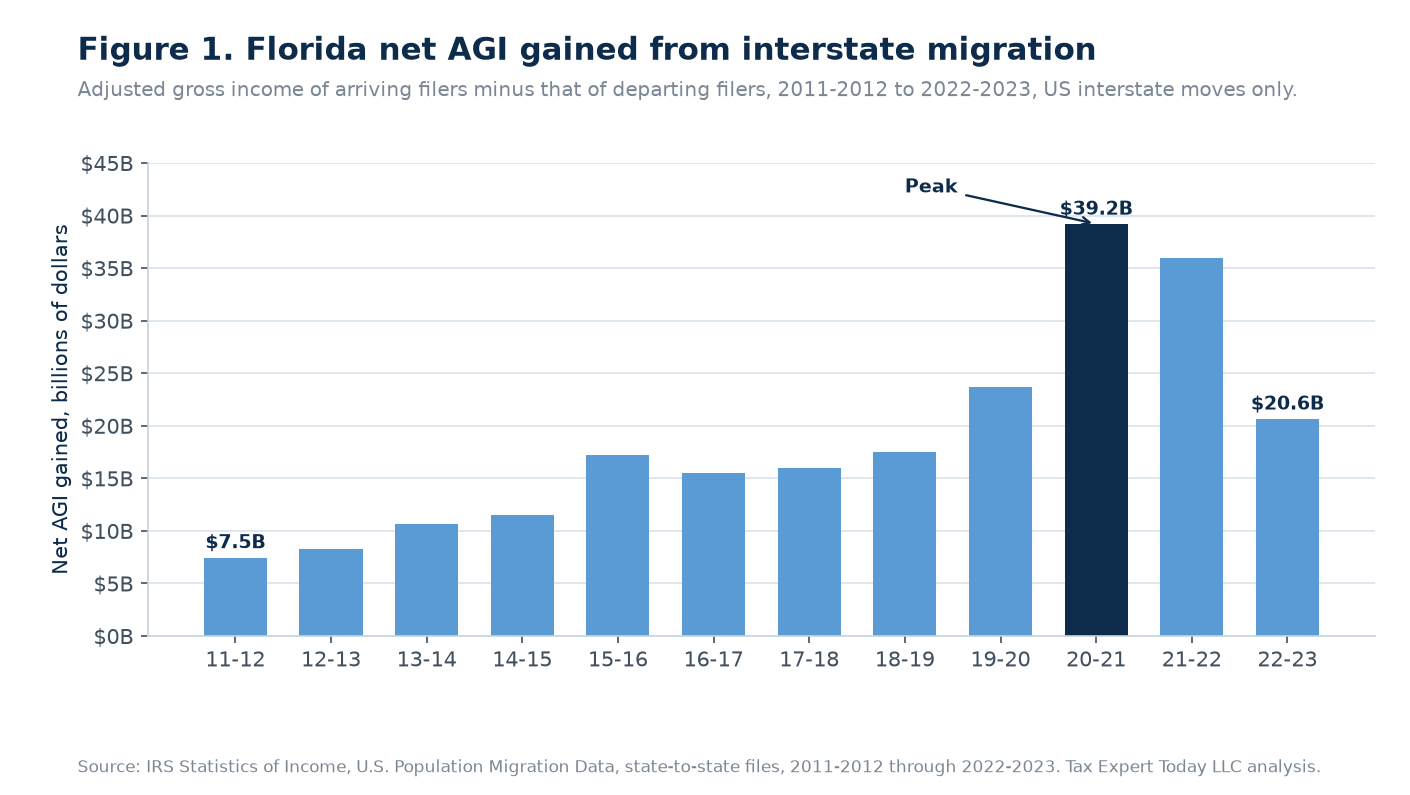
Quick Answer: IRS migration files show Florida wealth migration delivered a net gain of $20.65 billion of adjusted gross income in 2022-2023, the largest of any state but 47 percent below the 2020-2021 peak of $39.19 billion. The households still arriving reported an average AGI of $122,539 against $76,133 for those leaving, a gap of 61 percent that has held every year since 2011. Call (239) 441-2005 for a free consultation.
Published: September 2, 2026
Tax Expert Today Research · Report 2026-03
The Florida Wealth Migration Report, 2011-2012 to 2022-2023. An original analysis of twelve consecutive editions of the IRS migration files, at both state and county level. Every figure was computed directly from IRS source data and cross checked against the official IRS Excel edition. This report is updated annually when the IRS releases a new migration file. Download the PDF edition or browse all TET Research reports.
Every year the IRS matches individual income tax returns across two filing years and records where taxpayers moved and how much income they reported after moving. The result is the closest thing the United States has to a ledger of where income relocates. Florida has led that ledger for more than a decade. Tax Expert Today analyzed twelve consecutive editions of those files, covering 2011-2012 through 2022-2023, to build a verified series on how much income Florida gains, who sends it, which counties receive it, and whether the pattern is still intensifying. The headline is that the volume has fallen sharply from its pandemic era peak while the income selectivity has not moved at all. For the residency rules that decide whether a move actually changes where income is taxed, our guide to the Florida residency audit covers the standard and the evidence.
How Much Income Did Florida Gain From Migration?
Florida gained a net $20.65 billion of adjusted gross income from interstate migration in 2022-2023, the largest net gain of any state. Households arriving from other states reported $43.39 billion of AGI while households leaving for other states reported $22.75 billion. On a count basis 354,112 tax returns arrived and 298,763 departed, a net gain of 55,349 households and 111,742 individuals.
- Net AGI, $20.65 billion. The difference between $43.39 billion arriving and $22.75 billion departing, interstate moves only.
- Net households, 55,349. A far smaller net figure than the gross flows, because Florida also loses close to 300,000 filing households a year.
- Twelve year cumulative total, $223.7 billion. The sum of net AGI across every edition from 2011-2012 forward.
- Still 2.8 times the 2011-2012 level. The series began at a net gain of $7.46 billion, so the recent decline has not returned Florida to where it started.
Two independent publishers report the same measure from the same release. The Tax Foundation puts the figure at $20.6 billion, and an analysis by the Miami Association of Realtors puts it at $20.65 billion. This report computes $20.647 billion directly from the IRS files. There is no meaningful disagreement about the headline number, which is worth stating plainly, because the interesting divergences in this subject lie elsewhere and are addressed below.
Has Florida Wealth Migration Peaked?
On every measure in the IRS files, yes. Net AGI peaked at $39.19 billion in 2020-2021 and fell 47.3 percent to $20.65 billion by 2022-2023. Net households peaked at 128,228 in the same year and fell 56.8 percent to 55,349. The decline is steeper in household terms than in dollar terms, which means the flow thinned faster than it cooled in value.
The pattern is not a gentle plateau. Florida added more net AGI in the single year 2020-2021 than in the first three years of this series combined. Two years later roughly half of that annual gain was gone. The fall is driven by both sides of the ledger: arrivals dropped from 388,233 returns in 2020-2021 to 354,112, while departures rose from 260,005 to 298,763. Florida is receiving fewer households and losing more of them at the same time.
- Arrivals fell 8.8 percent from the 2020-2021 peak of 388,233 returns to 354,112.
- Departures rose 14.9 percent over the same two years, from 260,005 to 298,763.
- The net compressed far more than either gross flow, because the two moved in opposite directions at once.
Census Bureau estimates, which measure a different population on a different calendar and are discussed in detail below, point the same way and extend past the end of the IRS data. Florida net domestic migration was 310,892 people in the year to July 2022, 183,646 to July 2023, 58,411 to July 2024, and 22,517 to July 2025, a fall of 92.8 percent across three years. The IRS series ends in 2022-2023 and therefore captures only the first part of that decline.
Do People Moving to Florida Earn More Than Those Leaving?
Substantially, and by a margin that has not narrowed. In 2022-2023 households arriving in Florida reported an average AGI of $122,539 while households leaving reported $76,133, a gap of 61.0 percent. That gap has appeared in all twelve years studied, ranging from 36.0 percent in 2012-2013 to 107.0 percent in 2020-2021. Arriving households also out-earned Florida residents who did not move, who averaged $97,369.
This is the finding that survives the downturn. Volume is a cyclical story tied to remote work, housing costs, and mortgage rates. Selectivity is a structural one. Even in the weakest recent year, the composition of who arrives and who leaves is unchanged in character: Florida keeps attracting households at a higher income level than the ones it loses, and at a higher level than its own existing filers.
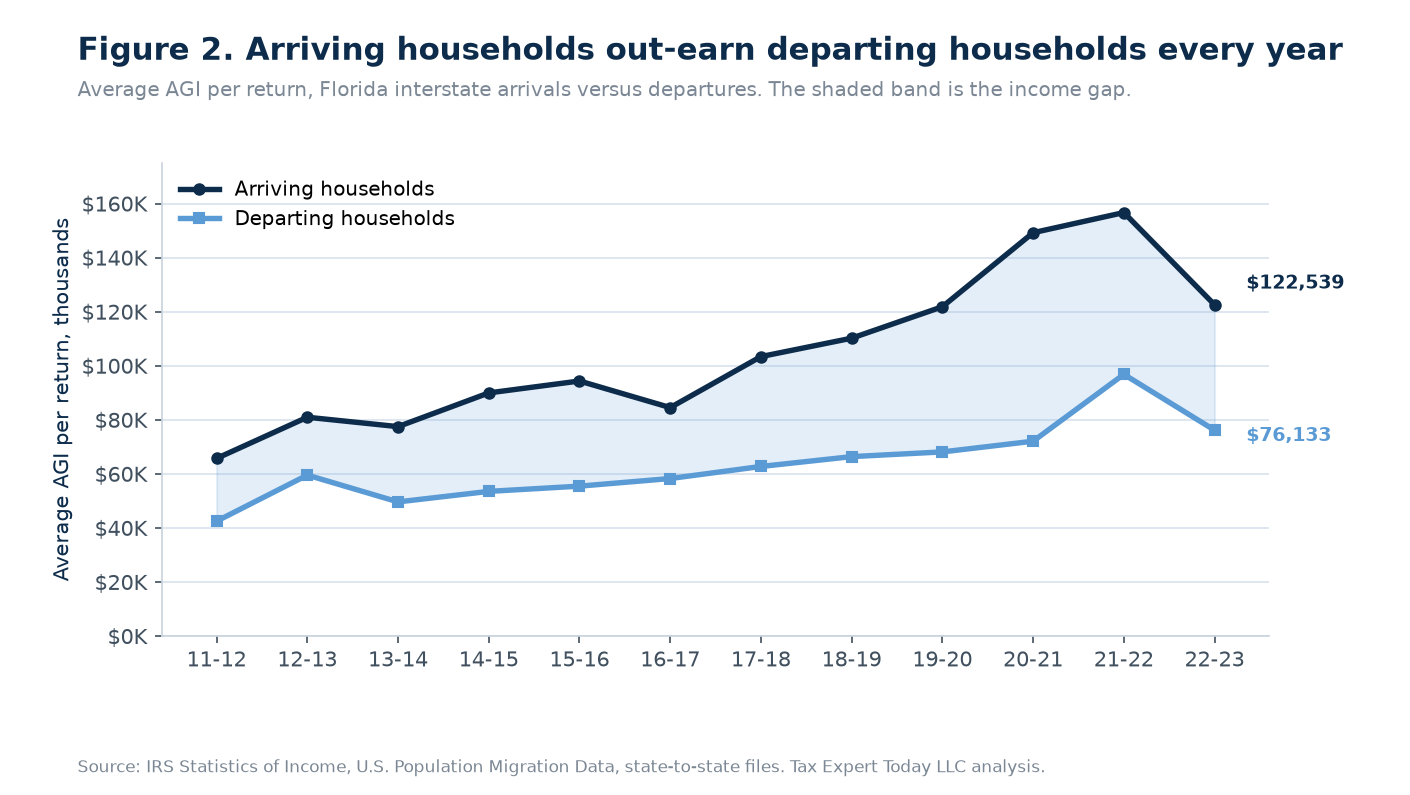
One caution belongs with the gap, and it follows from how the IRS builds these files. The AGI attached to a departing household is taken from the return it filed after moving, so it reflects income reported from the new state rather than income earned in Florida. The gap is therefore a comparison of what arrivals report on arrival against what leavers report after leaving. It is a real and consistent difference in the two populations. It is not a measure of income physically removed from the state.
Florida Wealth Migration, 2011-2012 to 2022-2023
The full verified series appears below. Net AGI grew steadily through the middle of the last decade, accelerated sharply in 2019-2020 and 2020-2021, and then gave back roughly half of the peak in two years. The income gap column shows how little the selectivity moved across the same period.
| Migration year | Returns in | Returns out | AGI in | AGI out | Net AGI | Avg AGI in | Income gap |
|---|---|---|---|---|---|---|---|
| 2011-2012 | 308,884 | 302,232 | $20.29B | $12.84B | $7.46B | $65,697 | 54.7% |
| 2012-2013 | 306,663 | 278,657 | $24.82B | $16.59B | $8.23B | $80,936 | 36.0% |
| 2013-2014 | 286,271 | 231,747 | $22.17B | $11.50B | $10.68B | $77,460 | 56.1% |
| 2014-2015 | 229,625 | 169,965 | $20.65B | $9.09B | $11.56B | $89,933 | 68.1% |
| 2015-2016 | 307,022 | 211,950 | $28.97B | $11.75B | $17.21B | $94,342 | 70.2% |
| 2016-2017 | 390,012 | 299,072 | $32.96B | $17.42B | $15.54B | $84,507 | 45.1% |
| 2017-2018 | 307,196 | 251,255 | $31.76B | $15.76B | $16.00B | $103,372 | 64.8% |
| 2018-2019 | 305,383 | 243,510 | $33.65B | $16.16B | $17.49B | $110,180 | 66.0% |
| 2019-2020 | 337,589 | 256,188 | $41.13B | $17.45B | $23.68B | $121,820 | 78.9% |
| 2020-2021 | 388,233 | 260,005 | $57.92B | $18.74B | $39.19B | $149,201 | 107.0% |
| 2021-2022 | 398,307 | 272,756 | $62.40B | $26.40B | $36.00B | $156,658 | 61.8% |
| 2022-2023 | 354,112 | 298,763 | $43.39B | $22.75B | $20.65B | $122,539 | 61.0% |
Source: IRS Statistics of Income, U.S. Population Migration Data, state-to-state inflow and outflow files, 2011-2012 through 2022-2023 editions. Figures cover US interstate migration only and exclude foreign moves and moves within Florida. Income gap is the average AGI of arriving returns divided by that of departing returns, less one. A migration year label such as 2022-2023 refers to returns filed in calendar 2022 and 2023, reporting income earned in 2021 and 2022 respectively.
Which States Send Florida the Most Income?
New York is the largest single source by a wide margin, sending 43,187 households reporting $5.75 billion of AGI and producing a net gain to Florida of $3.78 billion. Illinois sends fewer households but far wealthier ones, at an average AGI of $223,120 per return. Florida gains net AGI from every state except North Carolina, South Carolina, Tennessee, and New Mexico.
The concentration is notable. The four largest net contributors, New York, Illinois, New Jersey, and Massachusetts, together account for $10.23 billion of net AGI, which is roughly half of Florida’s entire net gain from a country of fifty states. The three states that take a meaningful amount of net AGI from Florida are all in the Southeast, which points to movement within the region rather than a competing national draw. The fourth, New Mexico, is a rounding level $5 million.
| Origin state, 2022-2023 | Households arriving | AGI arriving | Average AGI | Net AGI to Florida |
|---|---|---|---|---|
| New York | 43,187 | $5.75B | $133,218 | +$3.78B |
| Illinois | 14,834 | $3.31B | $223,120 | +$2.41B |
| New Jersey | 20,113 | $2.96B | $147,067 | +$2.17B |
| Massachusetts | 12,159 | $2.54B | $209,015 | +$1.88B |
| California | 20,241 | $2.64B | $130,398 | +$1.31B |
| Pennsylvania | 16,395 | $1.97B | $120,372 | +$1.17B |
| North Carolina | 14,530 | $1.40B | $96,279 | −$0.19B |
Source: IRS state-to-state inflow and outflow files, 2022-2023. Net AGI is Florida’s inflow from that state less its outflow to that state. North Carolina is shown as the largest of the four states to which Florida loses net AGI.
The states at the top of this table are also the states whose revenue departments run the most active residency examinations, which is why a move recorded in these files is not the same thing as a change in tax residency. A taxpayer whose mailing address changed but whose domicile did not can appear in the IRS inflow file and still owe tax to the former state. That gap between an address and a domicile is the subject of our guides to the New York residency audit and the New Jersey exit tax.
Which Florida Counties Gain the Most Income?
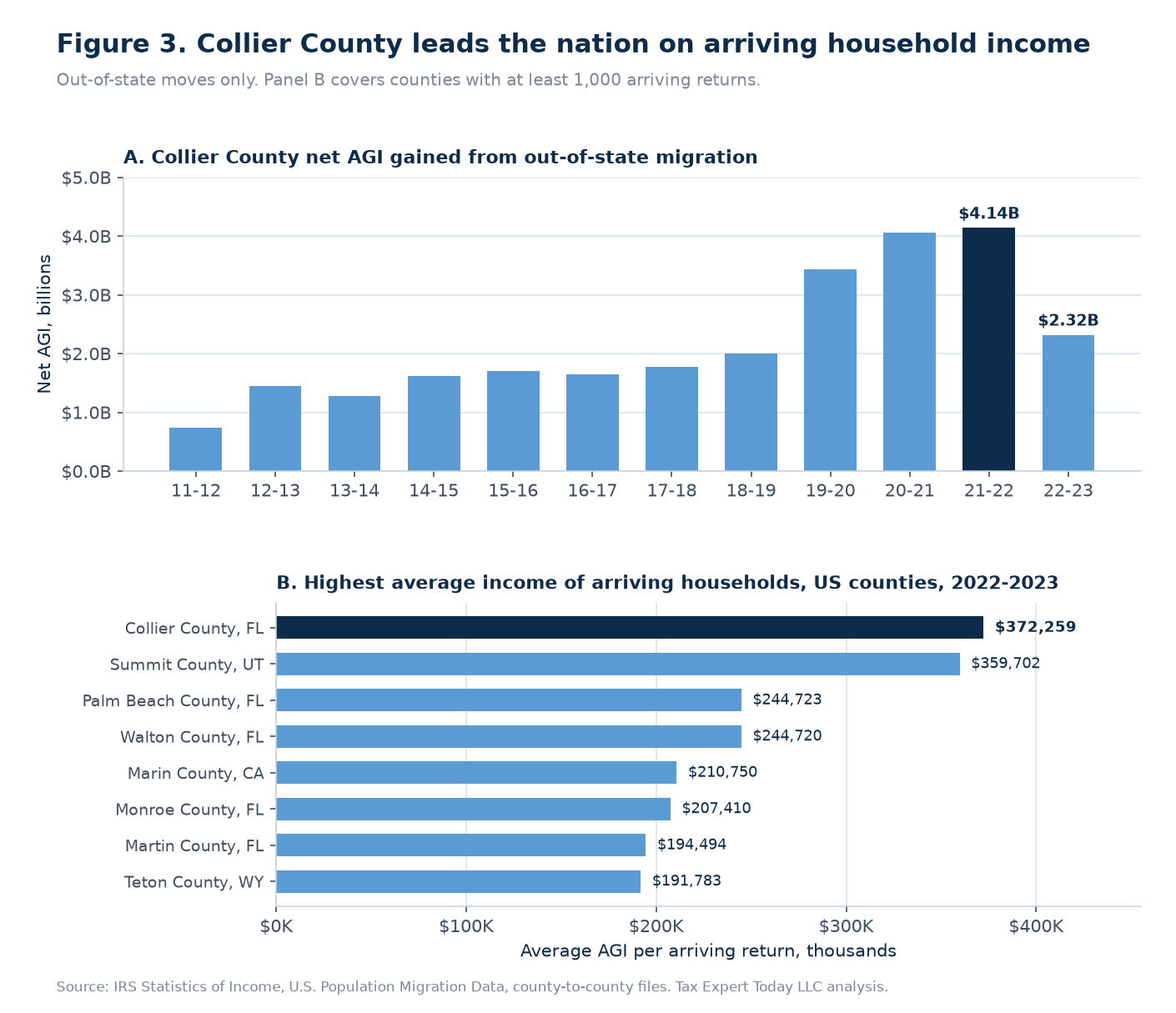
Palm Beach County ranks first in the United States for net AGI gained at $3.04 billion, and Collier County, which contains Naples, ranks second at $2.25 billion. Collier ranks first in the entire country on a different measure: the average income of the households arriving there, at $284,082 including in-state moves and $372,259 counting only arrivals from other states. Six of the ten highest gaining counties in the nation are in Florida.
Collier is the outlier in the national data. Its $2.25 billion net gain represents 10.9 percent of the entire state’s net AGI, which is far out of proportion to its size. The average out-of-state household arriving in Collier reported three times the AGI of the average household arriving anywhere in Florida. No other county in the United States with at least a thousand arriving returns reports a higher figure, on either basis.
Lee County, immediately north of Collier, draws a different arrival profile, built around the trades, healthcare, and seasonal residents rather than concentrated high-income relocation. Our Fort Myers tax advisor guide sets out the federal filings a household or business meets after a move into that county, and our guide to Cape Coral tax preparation works the retiree and remote-worker side of the same county, where the move-year return and the source-tax bar on retirement income do most of the work.
| County, 2022-2023 | Net AGI | Net households | Avg AGI arriving | US rank, net AGI |
|---|---|---|---|---|
| Palm Beach County, FL | +$3.04B | −1,218 | $178,085 | 1 |
| Collier County, FL | +$2.25B | +742 | $284,082 | 2 |
| Maricopa County, AZ | +$1.39B | +5,607 | $88,570 | 3 |
| Lee County, FL | +$1.26B | +2,217 | $123,824 | 4 |
| Sarasota County, FL | +$1.15B | +1,881 | $141,654 | 7 |
Source: IRS county-to-county inflow and outflow files, 2022-2023. Figures on the all-US county basis, which includes moves from elsewhere in Florida. National ranks computed across the 3,087 counties reporting both an inflow and an outflow total. Collier also ranks second nationally on the out-of-state-only basis, at a net $2.32 billion.
Palm Beach deserves a note of its own, because it illustrates why counting households and counting dollars give different answers. Palm Beach gained $3.04 billion of net AGI while losing 1,218 households on net. It gained income and lost population in the same year. A county can top the national income table while its headcount goes backwards, provided the households arriving are wealthy enough and the ones leaving are not.
Why Do Census and IRS Migration Numbers Differ?
Because they count different people over different periods. The IRS recorded a net gain of 111,742 individuals moving into Florida from other states in 2022-2023, while the Census Bureau estimates Florida net domestic migration of 183,646 people in the year to July 2023. The IRS figure is 60.8 percent of the Census figure. Neither is wrong; they are different measures and should never be quoted interchangeably.
| Basis | Florida net gain | Population counted | Period |
|---|---|---|---|
| IRS migration files, individuals (this report) | 111,742 | People on matched individual income tax returns | Filing years 2022 and 2023 |
| IRS migration files, returns | 55,349 | Tax returns, a proxy for households | Filing years 2022 and 2023 |
| Census Bureau, net domestic migration | 183,646 | All residents, filers and non-filers alike | July 2022 to July 2023 |
Three structural differences drive the gap. The IRS Migration Data Users Guide states that the data “do not represent the full U.S. population because many individuals are not required to file an individual income tax return,” which removes lower income households, many retirees living on non-taxable income, and others from the count entirely. The IRS also excludes anyone claimed as a dependent on another return in the second year. And the two run on different calendars: the IRS compares returns filed in consecutive calendar years, while Census estimates run July to July.
A third figure circulates widely and is worth naming, because it is easy to misread. Some analyses report Florida gaining roughly $184,771 per new resident. That figure divides net AGI by net individuals, so it is a ratio of two net quantities rather than anybody’s income. The average AGI actually reported by an arriving Florida household is $122,539. Both numbers are computable from the same file and they describe entirely different things.
What Do These Numbers Not Show?
They do not show why anyone moved, they do not measure income permanently transferred between states, and they do not establish tax residency. The IRS files record an address change between two tax returns and the income reported on the second one. Every causal explanation applied to them, including tax policy, housing costs, and remote work, comes from outside the data.
- AGI is measured after the move, not before. The Users Guide states that “AGI is based on the year 2 tax return” for both the inflow and the outflow files, so a departing household’s income is what it reported from its new state.
- A net gain is not a permanent transfer. Once a household has been in Florida for a full year it becomes a non-migrant and its income leaves this series entirely. The $20.65 billion is a single year flow, not an addition to a stock.
- The address is a mailing address. The Users Guide warns it “may not reflect the taxpayer’s actual residence” and that income “may have been earned in two locations.”
- The 2022-2023 file changed method. The IRS reports that updates to return matching produced “about a 5 percent increase in the number of returns included in the data, compared to the prior method,” so the final year sits on a slightly broader basis than the years before it.
That last point cuts in a specific direction and this report states it rather than leaving it buried. Because the 2022-2023 counts are inflated by roughly 5 percent relative to the prior method, the decline measured from the 2020-2021 peak is if anything understated here. A like-for-like comparison would show a somewhat steeper fall, not a shallower one.
What This Means If You Are Planning a Move to Florida
The data supports a sequencing point rather than a prediction. Appearing in the IRS inflow file requires only that the address on a tax return changed. Changing where income is taxed requires considerably more, and the states at the top of the origin table above are precisely the ones that examine the question hardest. New York, Illinois, New Jersey, and California all apply domicile tests that look past a mailing address to where a taxpayer keeps their home, their family, their business involvement, and their time.
The practical consequence is that the evidence for a residency position is assembled during the year of the move, not afterwards. Day counts, the disposition or retention of a former residence, the location of professional advisors, and where a business is actually directed are all far easier to document contemporaneously than to reconstruct under examination two or three years later. In qualifying cases the difference between a well documented move and a poorly documented one is the difference between one state return and two.
There is also a timing dimension that this year’s data makes concrete. Florida’s inbound flow is thinner than it was, and the departing side of the ledger has grown for two consecutive years. A household that moves and then moves again, or that keeps meaningful ties to the former state, can find itself claimed by both. For taxpayers weighing that question our guide to nonresident state tax returns covers how income gets sourced when the answer is not clean.
How Was This Report Prepared?
Methodology. Tax Expert Today extracted the Florida records from the state-to-state inflow and outflow files in twelve consecutive editions of the IRS Statistics of Income U.S. Population Migration Data, covering 2011-2012 through 2022-2023, together with the county-to-county files for the same twelve editions. The series begins at 2011-2012 because the IRS Migration Data Users Guide records that editions for 2010-2011 and earlier matched returns on the primary filer only, while later editions match on primary, secondary, and dependent filers; splicing across that change would not be sound. State level figures use the “Total Migration-US” record, which covers interstate moves and excludes both foreign moves and moves within Florida. County figures are reported on two bases because the county files define the same-named record differently from the state files: the all-US county basis includes moves from elsewhere in Florida, while the different-state basis excludes them. Both are shown, and both produce the same national rankings for Collier County.
Two independent checks were run. First, for each of the twenty-four file-years the individual partner state detail rows were summed and compared against the published Florida total: return counts matched exactly in every file-year, and AGI matched to within four thousand dollars on totals ranging from $9.09 billion to $62.40 billion, a rounding artifact of the thousand-dollar reporting unit. Second, all fifty-six Florida rows in each sheet of the official IRS Florida Excel workbook were compared row by row against the corresponding CSV files, with zero value mismatches. Every Florida record in all twenty-four file-years was also scanned for the IRS suppression flag; none was suppressed, so no figure here rests on an imputed value. AGI is reported by the IRS in thousands of dollars and is taken from the year 2 return for both inflows and outflows. A corroboration sweep covering the Tax Foundation, the Miami Association of Realtors, Florida Realtors, the U.S. Census Bureau, the National Taxpayer Advocate Annual Report to Congress, TIGTA, and GAO found no competing figure for the headline measure; only a handful of sources publish this series, and where a different number circulates the divergence traces to basis and is disclosed above. All source files, extraction scripts, and a workpaper mapping every published figure to its source and calculation are retained and available on request. The full verified series is downloadable as a machine readable file: tet-florida-migration-series-2011-2023.csv. The data may be reused with attribution to Tax Expert Today LLC.
Florida Residency Planning Naples: Local Help With a Move
Tax Expert Today LLC advises individuals, retirees, and business owners in Naples, Florida and across Southwest Florida on the tax side of relocating, from documenting a change of domicile through the nonresident filings a former state may still require. The firm is multidisciplinary, with enrolled agents, CPAs, and attorneys, and it works on residency and tax matters nationwide rather than treating a move as a single-state question. Collier County receives the highest income arrivals of any county in the United States, and the households in that data are frequently the ones with the most complex former-state exposure. The office is at 11983 Tamiami Trail N, Naples, FL 34110, and the team can be reached at (239) 441-2005, Monday through Friday, 10am to 5pm ET.
Frequently Asked Questions
How much income does Florida gain from migration each year?
Florida gained a net $20.65 billion of adjusted gross income from interstate migration in 2022-2023, the largest net gain of any state, according to IRS migration files. Arriving households reported $43.39 billion of AGI and departing households reported $22.75 billion. Across the twelve years from 2011-2012 through 2022-2023 the cumulative net gain totals $223.7 billion.
Is Florida wealth migration slowing down?
Yes. Net AGI from interstate migration peaked at $39.19 billion in 2020-2021 and fell 47.3 percent to $20.65 billion by 2022-2023, while net households fell 56.8 percent from 128,228 to 55,349. Census Bureau estimates, which run later than the IRS data, show Florida net domestic migration falling from 310,892 people in 2022 to 22,517 in 2025.
Which state sends the most income to Florida?
New York, by a wide margin. In 2022-2023 New York sent 43,187 households reporting $5.75 billion of adjusted gross income, producing a net gain to Florida of $3.78 billion after accounting for movement in the other direction. Illinois sends the highest income households of any major origin state, averaging $223,120 of AGI per return.
Which county in Florida attracts the wealthiest movers?
Collier County, which contains Naples, ranks first in the entire United States. Households arriving there from other states reported an average AGI of $372,259 in 2022-2023, three times the Florida statewide average of $122,539 for out-of-state arrivals. Collier also ranks second among all US counties for net AGI gained, at $2.25 billion.
Do IRS migration figures prove people move to Florida for tax reasons?
No. The IRS files record an address change between two consecutive tax returns and the income reported on the later one. They contain no information about motive. Any explanation involving tax policy, housing costs, employment, or remote work is applied from outside the data, and this report does not attribute the flows to any single cause.
Where can I get help documenting a move to Florida for tax purposes?
Tax Expert Today LLC, located at 11983 Tamiami Trail N, Naples, FL 34110, advises taxpayers in Naples and across Southwest Florida on establishing Florida residency and on the nonresident filings a former state may still require. The firm is multidisciplinary, with enrolled agents, CPAs, and attorneys, and represents clients on residency and tax matters nationwide. Consultations can be arranged at (239) 441-2005.
When to Engage a Professional About a Florida Move
A straightforward relocation with a clean break rarely needs professional help. A move that leaves ties behind usually does, because the former state decides the question on evidence rather than on intent. The value is in identifying before year end which ties matter under the former state’s own domicile test, documenting day counts and the disposition of the prior residence while the records still exist, sequencing the sale of appreciated assets against the date residency actually changes, and confirming which nonresident returns remain due for income still sourced to the old state. With Florida drawing households at an average of $122,539 of AGI against $76,133 for those it loses, the taxpayers in this data are frequently the ones with equity compensation, closely held business interests, or deferred income that does not simply follow an address. Tax Expert Today LLC advises individuals and businesses on residency and multistate tax matters nationwide, and Dr. Kabashi, the firm’s founder, leads the practice. Our companion research on the IRS offer in compromise acceptance rate and on IRS civil penalties assessed and abated applies the same method to federal enforcement data.
Call (239) 441-2005 or schedule a consultation to review the residency and multistate exposure attached to a move. Tax advisors, enrolled agents, CPAs, and attorneys serving clients in all 50 states.
Published September 2, 2026 by Dr. Pellumb Kabashi « Back to Learning Center
Have a question this article touches on?
Tax Expert Today LLC, based in Naples, Florida and serving clients across the United States.
Schedule a Consultation (239) 441-2005