
By Dr. Pellumb Kabashi, DBA, MBA, CES, CFE, EA
Founder, Tax Expert Today LLC · Tax advisors, enrolled agents, CPAs, and attorneys · Serving clients in all 50 states
Quick Answer: The Florida intangible tax on stocks, bonds and mutual funds no longer exists. Florida repealed the annual intangible personal property tax effective January 1, 2007, so a new resident owes nothing on an investment portfolio. What survives is a one-time 2 mill tax on loans secured by Florida real estate, plus documentary stamp tax on notes, mortgages and deeds at closing. Call (239) 441-2005 for a free consultation.
Published: October 2026
Ask ten people who moved to Naples in the last few years whether Florida taxes their investment portfolio, and a surprising number will say yes. Some heard it from a neighbor who has lived here since the 1990s. Some read an old law firm memo that still ranks in search results. Some saw a line labelled “intangible tax” on the closing statement for their new home and assumed it was the first installment of something annual. All three are reacting to the same word, and the word now describes a very different tax than it did twenty years ago.
The Florida intangible tax that people remember was an annual tax on stocks, bonds, mutual funds and similar financial assets owned on January 1 of each year. It was repealed effective January 1, 2007. The tax that still carries the name is a one-time charge on loans secured by Florida real estate, and it sits on the same closing statement as a separate levy, the documentary stamp tax, which applies to deeds, promissory notes and recorded mortgages. None of these is a tax on wealth, and none of them is a tax on income. Florida’s constitution bars the state from taxing the income of individual residents beyond the amount that could be credited against a similar federal or state tax, which in practice means Florida levies no personal income tax at all.
This guide is written for the person arriving in Florida, or about to. It separates the repealed annual tax from the two transaction taxes that are still live, shows how each one is computed with worked numbers, and walks through the situations where new residents are actually caught: buying with a mortgage, refinancing, opening a credit line against a Florida property, moving a Florida home into a revocable trust, and selling with owner financing. The rules below were checked against the current text of Florida Statutes chapters 199 and 201 and the Florida Department of Revenue’s published guidance on the date of publication. The examples are hypothetical illustrations of the statutory arithmetic, not a quote for any particular closing. If you are still building the residency side of the move, start with our guide on how to establish Florida residency; this page covers the intangible and documentary stamp taxes only.
What Is the Florida Intangible Tax?
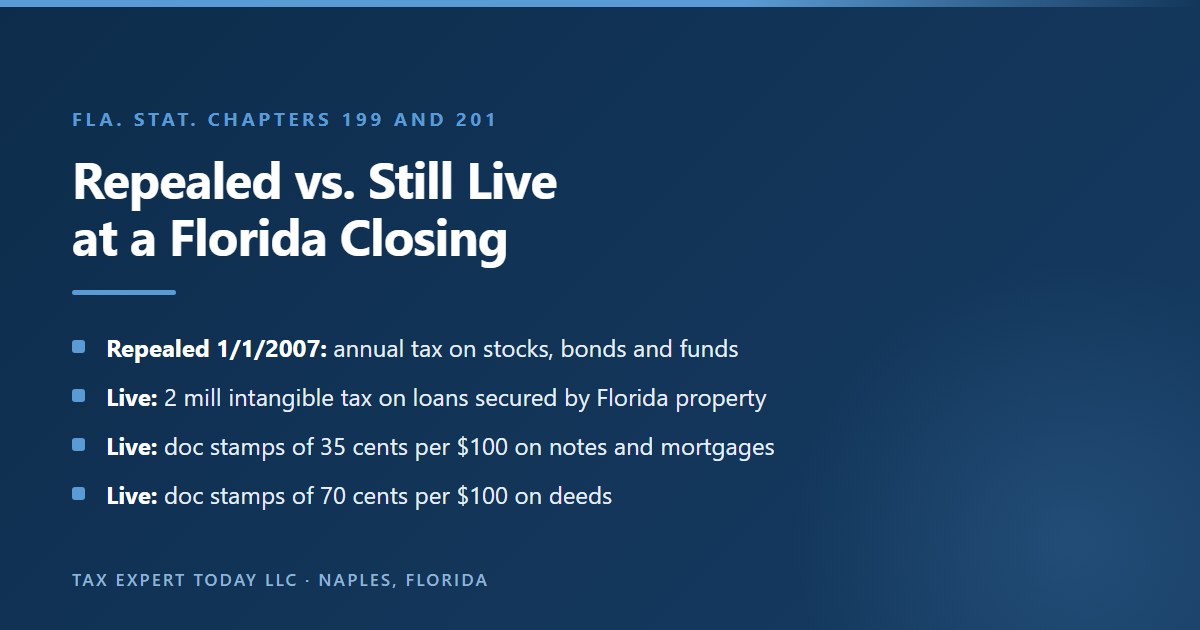
Today the Florida intangible tax means the nonrecurring intangible tax: a one-time charge of 2 mills, or $2 per $1,000, on a loan to the extent it is secured by a mortgage or lien on Florida real property. It is paid once, usually at recording. The old annual tax on stocks, bonds and funds was repealed effective January 1, 2007.
- What it taxes now: notes, bonds and other obligations to pay money secured by Florida real estate, under Fla. Stat. §199.133
- Rate: 2 mills on each dollar of the secured obligation, which is 0.2 percent
- How often: once, when the obligation is created or the mortgage is recorded, never annually
- What it no longer taxes: brokerage accounts, mutual funds, bonds and other financial assets a resident owns
- Who is liable: the lender, which may pass the cost to the borrower
The name causes the confusion. Chapter 199 of the Florida Statutes is still titled “Intangible Personal Property Taxes,” and the Department of Revenue still administers a tax under it. But the 2006 legislation that repealed the annual tax, chapter 2006-312, Laws of Florida, stripped the chapter down to the nonrecurring levy and its administrative sections. A current reading of chapter 199 shows sections on the nonrecurring tax, its due date, future advances, refinancing, valuation, exempt taxpayers and administration. There is no longer an annual levy, no January 1 valuation date for individuals and no annual return.
For a new resident the practical meaning is simple. If you never borrow against Florida real estate, the Florida intangible tax will never touch you. If you do, it touches you once per loan, as a closing cost, at a rate that is modest relative to the loan. It is not an ongoing tax on what you own.
Does Florida Still Have an Intangible Tax on Stocks and Bonds?
No. Florida’s annual intangible personal property tax on stocks, bonds, mutual fund shares and similar assets was repealed effective January 1, 2007. The last annual return covered 2006. A new resident who moves a brokerage account, bond portfolio or fund holdings to Florida owes no Florida tax on their value, now or on any future January 1.
- Repealing law: chapter 2006-312, Laws of Florida (House Bill 209 of the 2006 session)
- Effective date: January 1, 2007, the first valuation date that would otherwise have applied
- Final return: the 2006 return, which was due June 30, 2006
- What replaced it: nothing, as no new annual tax on financial assets was enacted
The Connecticut Office of Legislative Research summarized the repeal in a February 2007 report that remains one of the clearest short accounts of the old tax. It describes the intangibles tax as an annual tax on the market value of intangible property owned by Florida residents and businesses, states that the 2006 legislature repealed most of it effective January 1, 2007, and notes that two pieces were retained: the one-time tax on obligations secured by real property and an annual tax on certain leasehold interests in government property held by nongovernmental entities. The second of those is a niche business item that individuals moving to Florida do not encounter. The first is the tax this guide calls the nonrecurring intangible tax.
Some pages that still rank for this topic were written before the repeal and describe the annual tax in the present tense. A memo that says Florida imposes an annual tax on all intangible personal property owned by a resident was accurate in 2005. It has not been accurate since January 1, 2007, and nothing in the current statutes revives it.
| Feature | Annual intangibles tax (repealed) | Nonrecurring intangible tax (live) | Documentary stamp tax (live) |
|---|---|---|---|
| What it reaches | Stocks, bonds, fund shares and similar assets owned on January 1 | Loans secured by Florida real property | Deeds, promissory notes, written obligations and recorded mortgages |
| How often | Every year until 2006 | Once per obligation | Once per taxable document or renewal |
| Rate | $0.50 per $1,000 in 2006 | 2 mills ($2 per $1,000) | Deeds 70 cents per $100; notes and mortgages 35 cents per $100 |
| Statute today | Repealed by ch. 2006-312 | Fla. Stat. §199.133 | Fla. Stat. §201.02 and §201.08 |
| Who is liable | The owner of the assets | The lender, which may pass it on | All parties to the document |
| Affects a portfolio? | Yes, before 2007 | No | No |
What Did the Old Florida Intangibles Tax Cover?
The repealed tax applied each year to the market value of stocks, corporate bonds, out-of-state government bonds, fund shares and unsecured receivables owned on January 1. In its final year the rate was 50 cents per $1,000, after an exemption of $250,000 per person or $500,000 for joint filers. Cash, CDs, retirement accounts and annuities were already exempt.
- Valuation date: January 1 of each year, which drove a whole planning industry around that date
- 2006 rate: $0.50 per $1,000 of value, reduced from $1.00 per $1,000 in earlier years
- Exemption: the first $250,000 for single filers, businesses and trusts, and $500,000 for joint filers
- Common exclusions: cash, certificates of deposit, annuities, IRAs, employer retirement plan assets and Florida and U.S. government bonds
The history matters for one reason: it explains why the belief persists. For decades, wealthy retirees who moved to Florida did pay an annual tax on their portfolios, and the tax was visible because it required its own return. Estate planning attorneys built so-called intangibles tax trusts that held assets over January 1 and returned them shortly afterward, with the Department of Revenue’s blessing. People who lived through that era still describe it to newer arrivals, and the description is now about twenty years out of date.
| Item | Rule in the final year of the annual tax (2006) |
|---|---|
| Rate | 50 cents per $1,000 of market value ($500 per $1 million) |
| Individual exemption | First $250,000 of taxable intangibles |
| Joint filer exemption | First $500,000 |
| Valuation date | January 1 |
| Return due | June 30 |
| Typical exclusions | Cash, CDs, annuities, IRAs, retirement plan assets, Florida and U.S. government bonds, notes secured by real property |
| Status today | Repealed effective January 1, 2007; no return, no tax |
To put the old tax in perspective, a married couple with a $5,000,000 taxable brokerage account on January 1, 2006 would have computed the tax on $4,500,000 after the joint exemption, which at 50 cents per $1,000 comes to $2,250. That same couple moving to Naples in 2026 computes the Florida intangible tax on the same account as zero. If you held an intangibles tax trust years ago and never formally closed it, that is a records and trust administration question for your estate counsel rather than a tax exposure, since there is no longer a tax for the trust to avoid.
What Is the Nonrecurring Intangible Tax on a Florida Mortgage?
The nonrecurring intangible tax is a one-time levy of 2 mills on each dollar of a note or other obligation to pay money, to the extent it is secured by a mortgage or lien on Florida real property. It applies even if the mortgage is never recorded here and never exceeds the value of the Florida property securing the debt.
- Trigger: creation of an obligation secured by Florida real estate, not ownership of anything
- Base: the secured obligation, capped at the value of the Florida real property that secures it
- Recording not required: the Department states the tax is due even if the mortgage or lien is not recorded or filed in Florida
- Mixed collateral: only the Florida share is taxed, apportioned by value under §199.133(2)
The statute says it directly. Section 199.133(1) imposes “a one-time nonrecurring tax of 2 mills” on each dollar of the just valuation of all notes, bonds and other obligations for payment of money secured by mortgage, deed of trust or other lien upon real property situated in Florida. Subsection (2) limits the tax to the extent of that security, prorates it when the same debt is secured by property elsewhere, and provides that the taxable portion may never exceed the value of the Florida real property that is the security.
Notice what this means for the new resident. The tax follows the location of the collateral, not the location of the borrower or the lender. A Florida resident who borrows against a house in Connecticut does not owe this tax. A New York resident who borrows against a condominium in Naples does. Whether you have changed your domicile is irrelevant to this levy; what matters is whether a Florida parcel secures the loan. That is the opposite of how residency-based taxes work, and it is why the mortgage tax and the repealed portfolio tax have nothing in common beyond the chapter number.
The nonrecurring tax also has a short list of exempt taxpayers in Fla. Stat. §199.183, chiefly the state and its political subdivisions and qualifying nonprofit religious, educational and charitable institutions. Because the lender is the taxpayer, those exemptions matter mainly when the lender itself is exempt, and they rarely affect an individual buying a home.
How Is the Florida Intangible Tax on a Mortgage Calculated?
Multiply the amount of the obligation secured by Florida real property by 0.002. A $500,000 mortgage carries $1,000 of nonrecurring intangible tax. If the loan exceeds the value of the Florida property, the tax is computed on the property value instead, and if property outside Florida also secures the loan, only the Florida share is taxed.
- Basic formula: secured amount × 0.002
- Value cap: the taxable amount never exceeds the value of the Florida real property securing the loan
- Proration: when Florida and non-Florida property both secure the debt and neither must be looked to first, the tax follows the ratio of Florida value to total security
- Rule of thumb: $200 of intangible tax for every $100,000 borrowed against Florida real estate
The Department of Revenue publishes three examples on its nonrecurring intangible tax page: a loan smaller than the property value taxed on the loan amount, a loan larger than the property value taxed on the property value, and a loan secured by equal-value property inside and outside Florida taxed on half the loan. The table below applies the same method to amounts typical of a Southwest Florida purchase. The documentary stamp tax column is explained in the next sections and is shown here because the two always appear together when a mortgage is recorded.
| Mortgage secured by Florida real estate | Nonrecurring intangible tax (0.2%) | Documentary stamp tax on the mortgage (35 cents per $100) | Combined |
|---|---|---|---|
| $400,000 | $800 | $1,400 | $2,200 |
| $750,000 | $1,500 | $2,625 | $4,125 |
| $1,000,000 | $2,000 | $3,500 | $5,500 |
| $2,500,000 | $5,000 | $8,750 | $13,750 |
Two adjustments come up often enough with relocating families to deserve their own examples. First, the value cap. Suppose a buyer finances a $900,000 loan against a Florida property worth $800,000. Section 199.133(2) limits the taxable portion to the $800,000 property value, so the nonrecurring tax is $1,600 rather than $1,800. Second, mixed collateral. Suppose a lender makes a $2,000,000 loan secured by both a Naples condominium worth $1,500,000 and a Connecticut house worth $1,500,000, with neither property designated to be looked to first. The Florida share of the security is one half, so the taxable portion is $1,000,000 and the nonrecurring intangible tax is $2,000. The documentary stamp tax has its own rules for a recorded mortgage, and on a multistate loan the closing agent should confirm the base for that levy separately rather than assume the same proration applies.
Who Pays the Florida Intangible Tax at Closing?
The lender is the taxpayer for the nonrecurring intangible tax, but section 199.135(4) lets the lender pass the amount to the borrower, and on residential loans it usually does. The buyer sees it as a closing cost. It is paid to the clerk when the mortgage is recorded, or to the Department within 30 days if it is not.
- Legal liability: the lender, which the statute calls the taxpayer
- Economic cost: usually passed through to the borrower on the closing statement
- Where paid: to the clerk of the circuit court at recording, under Fla. Stat. §199.135
- Unrecorded loans: paid directly to the Department, and delinquent after the 30th day following creation of the obligation
Section 199.135 sets the timing. The tax is due and payable when the instrument is presented for recording. If there is no written instrument, or it is not presented within 30 days after the obligation is created, the tax is due within 30 days after creation. When the mortgage is recorded, the person recording it pays the clerk, and the clerk notes the payment on the instrument. If a mortgage covers property in more than one county, payment may be made in any one of them. The Department’s guidance adds that the payment made directly to it should include a statement with the names of the parties, the date and the amount of the note, and it points to Rule 12C-2.011 of the Florida Administrative Code.
For a buyer, the operational point is that the closing agent handles this. The line on the settlement statement is usually labelled “intangible tax” or “intangible tax on mortgage,” and it is computed on the loan amount. If you are paying cash, the line simply does not appear. If you see an intangible tax on a cash purchase, ask the closing agent why, because the levy only exists where a loan is secured by the property.
What Is the Florida Documentary Stamp Tax on a Note and Mortgage?
Florida’s documentary stamp tax on a note or recorded mortgage is 35 cents per $100 of the debt, or fraction of $100. Under section 201.08, an unsecured promissory note is capped at $2,450 of tax, but a recorded mortgage has no cap. When a note and mortgage are signed together, the tax is paid once, on the mortgage, at recording.
- Rate: 35 cents per $100, or $3.50 per $1,000, of the indebtedness evidenced
- Unsecured notes: tax capped at $2,450 per document under §201.08(1)(a)
- Recorded mortgages: no cap, taxed on the full amount secured under §201.08(1)(b)
- One payment, not two: where both a note and a mortgage exist, the tax is paid on the mortgage and the note is marked as paid
- Who is liable: all parties to the document, regardless of who agreed to pay
This is the levy many new residents mistake for the old intangibles tax, because it shows up on the same closing statement, is computed on the same loan, and appears right next to the intangible tax line. It is a different tax under a different chapter. Chapter 201 is an excise on documents: deeds that transfer Florida real property, and written obligations to pay money that are made, executed, delivered or assigned in Florida, along with mortgages filed or recorded here. The Department of Revenue’s documentary stamp tax page describes it exactly that way, as an excise tax imposed on certain documents executed, delivered or recorded in Florida.
The rate on notes and mortgages is the same 35 cents per $100. The difference is the cap. Section 201.08(1)(a) provides that the tax on a promissory note or other written obligation to pay money “may not exceed $2,450.” Section 201.08(1)(b), which covers mortgages, trust deeds and security agreements filed or recorded in Florida, contains no cap, and the Department’s guidance states plainly that there is no cap on the amount of tax due on a mortgage. So a $2,000,000 unsecured business note signed in Florida carries $2,450 of documentary stamp tax, while a $2,000,000 mortgage recorded against a Naples residence carries $7,000.
Future advances are handled separately. When a recorded mortgage secures future advances, the tax is paid at recording on the initial debt, and then again each time a future advance is made, on the amount advanced. The nonrecurring intangible tax follows the same pattern under Fla. Stat. §199.143, with a special rule for lines of credit discussed below.
What Is the Documentary Stamp Tax on a Florida Deed?
A deed transferring Florida real property carries documentary stamp tax of 70 cents per $100 of consideration under section 201.02, in every county except Miami-Dade, which uses 60 cents plus a 45 cent surtax on most non-single-family transfers. Consideration includes any mortgage on the property, whether or not the buyer assumes it, so even a no-cash transfer can be taxed.
- Statewide rate: 70 cents per $100, or $7 per $1,000, of consideration under Fla. Stat. §201.02
- Miami-Dade: 60 cents per $100, plus a 45 cent surtax that does not apply to a document transferring only a single-family dwelling
- Consideration includes debt: money paid, a discharged obligation and any mortgage or lien on the property, assumed or not
- Taxed whether recorded or not: an unrecorded deed is still taxable, and the tax is then remitted to the Department
- Liability: every party to the deed is liable, whatever the contract says about who pays
The deed tax is the largest of the three levies on most purchases, and it is the one with the broadest definition of what is being taxed. The Department’s guidance gives worked examples that are worth reading before any transfer: a $2,500,000 purchase by an LLC with no other consideration produces $17,500 of tax; a deed in lieu of foreclosure is taxed on the debt forgiven, even if the property is worth less; and a deed reflecting only nominal consideration, such as “love and affection and $1,” carries the minimum $0.70 of tax when the property is unencumbered.
Who bears the deed tax on a sale is a matter for the purchase contract and local custom, not the statute. The statute makes all parties liable to the state, and the Department notes that if one party is exempt the tax must be paid by a non-exempt party. A relocating buyer should read the contract’s closing cost allocation rather than assume a convention from the state they left.
Section 201.02(1)(b) also contains a conduit entity rule that surprises investors. If real property is conveyed to an entity without full consideration by a grantor who owns an interest in it, and some or all of that interest is then transferred for consideration within three years, the later transfer of the entity interest is taxed at 70 cents per $100 of the consideration paid, prorated where the entity owns other assets. Families who place Florida property into an LLC as part of a move, and then restructure ownership soon after, should check this rule before the second step.
How Much Do Florida Closing Taxes Add Up to on a Purchase?
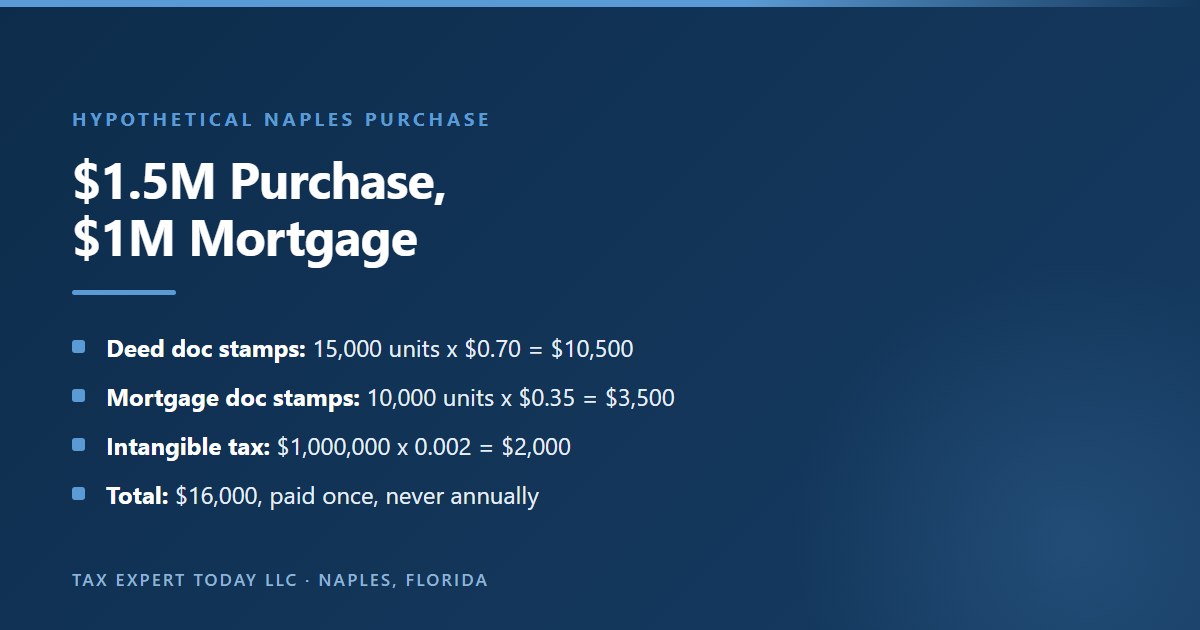
On a $1,500,000 Naples purchase financed with a $1,000,000 mortgage, the three state levies total $16,000: $10,500 of documentary stamp tax on the deed, $3,500 of documentary stamp tax on the mortgage, and $2,000 of nonrecurring intangible tax. A cash purchase at the same price owes only the $10,500 deed tax. None of the three recurs annually.
- Deed: 15,000 taxable units of $100 × $0.70 = $10,500
- Mortgage documentary stamp tax: 10,000 units × $0.35 = $3,500
- Nonrecurring intangible tax: $1,000,000 × 0.002 = $2,000
- Allocation: the contract decides who bears the deed tax; the two loan taxes usually fall on the borrower
The table below runs the same arithmetic across four purchase profiles. It is limited to the three state levies discussed in this guide. It does not include recording fees, title charges, lender fees or any local charges, and it assumes a county other than Miami-Dade.
| Purchase price / loan | Deed documentary stamp tax (70 cents per $100) | Mortgage documentary stamp tax (35 cents per $100) | Nonrecurring intangible tax (0.2%) | Total state levies |
|---|---|---|---|---|
| $800,000 / cash | $5,600 | $0 | $0 | $5,600 |
| $800,000 / $500,000 loan | $5,600 | $1,750 | $1,000 | $8,350 |
| $1,500,000 / $1,000,000 loan | $10,500 | $3,500 | $2,000 | $16,000 |
| $3,000,000 / $2,000,000 loan | $21,000 | $7,000 | $4,000 | $32,000 |
Two observations follow from the numbers. First, the loan taxes together run $550 for every $100,000 borrowed against Florida real estate, which is why some relocating buyers who have the liquidity choose to buy with cash and decide later whether to borrow. That is a financing decision with many other inputs, including the opportunity cost of the cash, and the tax is rarely the deciding factor. Second, none of these amounts repeats. Once the deed is recorded and the loan is in place, the state has collected everything chapter 199 and chapter 201 will collect on that transaction unless the loan is later increased, renewed in a taxable way or replaced.
Does Refinancing a Florida Mortgage Trigger the Intangible Tax Again?
It depends on the lender and the balance. Under section 199.145(4), a refinance with the original lender or its assignee owes no additional nonrecurring tax if the new principal does not exceed the old unpaid principal plus accrued interest; only the excess is taxed. A refinance with a new lender is a new obligation and is generally taxed in full.
- Same lender, same or lower balance: no additional nonrecurring intangible tax
- Same lender, cash-out: tax only on the amount above the old unpaid principal plus accrued interest
- Original borrower released: if the original obligor is not liable under the new loan, tax is computed on the entire new principal
- Assumptions and assignments: no additional tax on an assumption at the same balance or on a lender’s assignment of a loan already taxed
- Documentary stamp tax: governed separately by the renewal rules in Fla. Stat. §201.09
Section 199.145 collects the relief provisions for the nonrecurring tax. A corrective mortgage replacing a defective one, covering the identical property and securing the identical note, may be recorded without additional tax on proof of the original payment. No additional tax is due when the lender assigns a note on which the tax was paid. No additional tax is due on the assumption of a loan if the tax was previously paid and the indebtedness remains the same, whether or not the original borrower is released. And the refinancing rule in subsection (4) is the one that matters most to homeowners: the exemption is available only when the refinance is “with the original obligee or its assignee.”
The documentary stamp tax has a parallel, but narrower, renewal exemption. Section 201.09 exempts a renewal note that only extends or continues the identical obligation, signed by the original obligor, without enlarging the original contract, provided the original note is attached with the required notation. A renewal that increases the unpaid balance is taxable only on the increase. The Department lists several modifications that generally are not taxable renewals, including documents that correct errors, change covenants unrelated to the debt, substitute collateral, consolidate debt or collateral, add or remove guarantors, or substitute a new mortgagee. Whether a particular refinance qualifies turns on the documents, so the closing agent’s analysis controls; the point for a new resident is that refinancing with your existing lender can be meaningfully cheaper in state tax than moving the loan elsewhere, and that difference is worth asking about before choosing a lender.
Does a Line of Credit Secured by Florida Real Estate Trigger the Tax?
Yes. Under section 199.143(3), a line of credit secured by a mortgage on Florida real property is subject to the nonrecurring intangible tax, and once the tax is paid on the full line, later draws add no further tax. A credit line secured by a brokerage account has no Florida real estate behind it and owes no nonrecurring intangible tax.
- Home equity line: taxed under chapter 199 to the extent secured by Florida real estate
- Paid on the full line: no further nonrecurring tax on subsequent advances
- Portfolio-backed credit line: no Florida real estate security, so no nonrecurring intangible tax
- Documentary stamp tax: a written obligation signed or delivered in Florida is still generally subject to the 35 cent rate, capped at $2,450 when no mortgage is recorded
Lines of credit are common among relocating households. Some use a home equity line on the new Florida residence as a bridge while the old home sells. Others borrow against an investment account to avoid selling appreciated securities. The two are treated differently. The home equity line is a lien on Florida real property, so chapter 199 applies, and the documentary stamp tax applies to the recorded mortgage securing it. The securities-backed line has no Florida real estate behind it, so the nonrecurring intangible tax does not reach it at all; the documentary stamp tax on the note itself may still apply if the note is made, executed or delivered in Florida, and in that case it is capped at $2,450 because no mortgage is recorded.
This is also the clearest illustration of why the repealed portfolio tax and the surviving mortgage tax are unrelated. Borrowing against the very same brokerage account that the old annual tax used to reach now produces no chapter 199 tax, while borrowing against the house does.
Does Moving a Florida Home Into a Revocable Trust Trigger Documentary Stamp Tax?
It can. The Department of Revenue states there is no specific exemption for transfers of Florida real property made for estate planning purposes. An unencumbered property deeded to a revocable trust for nominal consideration owes the minimum $0.70. A mortgaged property is taxed on the mortgage balance attributable to the interest transferred, at 70 cents per $100.
- No estate planning exemption: the Department’s guidance says so in terms
- Unencumbered property: nominal consideration such as “$10 or other good and valuable consideration” produces $0.70 of tax
- Mortgaged property: the mortgage balance counts as consideration, prorated by the share of the property transferred
- No new intangible tax: the deed tax applies to the transfer; the nonrecurring intangible tax applies to loans, not to deeds
Revocable trust funding is one of the first estate planning steps many new residents take, often on the advice of the Florida estate attorney who updates their documents after the move. Our guide to Florida estate planning for new residents explains why. The documentary stamp tax is a small but real cost of that step when the property carries a mortgage, because section 201.02 counts the mortgage as consideration whether or not the transferee assumes it.
The Department’s own example makes the arithmetic concrete. A married couple transfers jointly owned property encumbered by a $100,000 mortgage to a trust of which the wife is the sole current beneficiary. The consideration is $50,000, the mortgage multiplied by the percentage of the interest transferred, and the tax is $350. Applied to a larger Naples residence, a couple deeding a property with a $1,200,000 mortgage into a revocable trust in which both spouses are the current beneficiaries should not assume the transfer is free. How much of the mortgage is attributed to the interest transferred depends on how title and the beneficial interests are structured before and after the deed, so the estate attorney preparing the deed and the closing agent recording it should compute the tax on the actual documents.
The same logic reaches transfers to an LLC and transfers between related entities. The Department’s examples include a corporation transferring mortgaged property to a subsidiary, taxed on the $3,000,000 mortgage plus a $700,000 credit line balance secured by the property, for $25,900 of tax. A deed to a wholly owned entity of unencumbered property with only nominal consideration carries $0.70. When the property is encumbered, the debt is the consideration.
Do These Taxes Apply When You Sell With Owner Financing?
Yes. When a seller takes back a note and mortgage on Florida real estate, the deed is taxed on the full price including the financed portion, the recorded mortgage carries 35 cents per $100, and the secured note carries the 2 mill nonrecurring intangible tax. Holding that note afterward creates no annual Florida tax for the seller.
- Deed tax base: the cash paid plus the purchase money mortgage, per the Department’s own seller-financing example
- Mortgage documentary stamp tax: 35 cents per $100 on the amount the purchase money mortgage secures
- Nonrecurring intangible tax: 2 mills on the note, because it is secured by Florida real property
- The note you hold: under the old annual tax a note was a taxable intangible; today it is not taxed annually at all
The Department’s documentary stamp tax guidance includes exactly this fact pattern. A buyer pays $30,000 down and the seller takes back a $150,000 note and mortgage. The deed is taxed on $180,000, the full consideration including the amount to be paid later, which at 70 cents per $100 is $1,260. The purchase money mortgage is then subject to its own documentary stamp tax and to the nonrecurring intangible tax when it is recorded.
For a seller who has moved to Florida and is selling a Florida investment property with owner financing, the federal side of the transaction is governed by the installment sale rules of IRC §453, and the state tax picture for a sale of property in the state you left is covered in our guide to selling rental property after a move. The point here is narrower: the note you receive does not become a Florida tax problem by sitting in your portfolio. The chapter 199 tax was collected once, at creation, and the annual tax that would once have reached the note no longer exists.
Does Florida Tax My Investment Portfolio or Investment Income?
No. Florida imposes no annual tax on the value of a resident’s stocks, bonds, funds or notes, and Article VII, Section 5 of the Florida Constitution bars a tax on residents’ personal income beyond the amount creditable against a similar federal or state tax. Florida does not tax a resident’s dividends, interest or capital gains.
- Portfolio value: no annual Florida tax since January 1, 2007
- Investment income: no Florida personal income tax on dividends, interest or gains
- Constitutional, not statutory: the income tax bar sits in Article VII, Section 5(a) and would take a constitutional amendment to change
- Estates and inheritances: the same section limits estate and inheritance taxes, and Florida imposes neither
Section 5(a) of Article VII reads, in relevant part, that no tax upon estates or inheritances or upon the income of natural persons who are residents or citizens of the state shall be levied by the state in excess of the aggregate of amounts which may be allowed to be credited upon or deducted from any similar tax levied by the United States or any state. Because there is no federal credit for a state personal income tax, the practical result is that Florida does not tax the income of individual residents. Section 5(b) allows a tax on the income of entities other than natural persons, which is why Florida has a corporate income tax, but that is a business entity matter and does not reach an individual’s investment account.
The repeal of the annual intangibles tax closed the last gap. Before 2007, a Florida resident with a large portfolio paid no income tax on the earnings but did pay a small annual tax on the principal. Since 2007, neither the principal nor the earnings is taxed by Florida. That combination is one of the strongest financial reasons high-net-worth households move here, and it is precisely why the old state they left examines the move closely.
The investment portfolio is rarely the only asset that follows a household across the state line, and each one has its own rule in the former state. Retirement income has a federal shield under 4 U.S.C. §114, covered in our guide to retiring to Florida. Equity compensation earned while working in the old state is sourced by workdays, as explained for Florida domicile for executives, and remote employees of a New York employer should read about the convenience of the employer rule. A business sale timed around the move turns on the domicile date, and a trust drafted in the old state may still be taxed there after every person involved has moved. The mechanics of the return that reports the remaining old-state income are in our guide to the nonresident state tax return.
Can the State You Left Still Tax Your Investment Income?
Yes, until the move is complete and provable. The former state taxes investment income earned while you were domiciled there, may treat you as a full-year resident if the domicile change is not established, and may apply statutory residency rules if you keep a home there. Florida’s lack of these taxes does not limit the former state.
- Move-year split: investment income before the domicile change is generally taxed by the former state on a part-year return
- Burden of proof: states such as New York require you to prove the change of domicile by clear and convincing evidence
- Statutory residency: a home kept in the former state plus enough days there can create resident status even after the move
- Record: a Fla. Stat. §222.17 declaration of domicile is one useful fact, not the whole case
This is where the real money is for most relocating investors, and it is the reason a question about the Florida intangible tax so often opens a wider conversation. The repealed tax would have cost a couple with a $5,000,000 portfolio about $2,250 a year. A former state’s income tax on the gains and dividends from that same portfolio can be many times that, and it continues for as long as the former state can argue that domicile never moved. Our guides on the dual-state residency trap, the Florida residency audit and the first-year snowbird filing work through those rules, and the 183-day rule calculator helps you keep the day count that statutory residency tests depend on. If you are leaving New York specifically, the New York exit tax guide explains what follows a departing resident. The same is true of the New Jersey exit tax, the Illinois exit tax and the California exit tax, none of which is a tax on leaving but each of which shapes the move-year return. Estate and inheritance taxes on property left behind are a separate layer again, covered state by state in guides such as the Connecticut estate tax, the Maryland estate tax and the New Jersey inheritance tax after a move.
What Do New Residents Get Wrong About the Florida Intangible Tax?
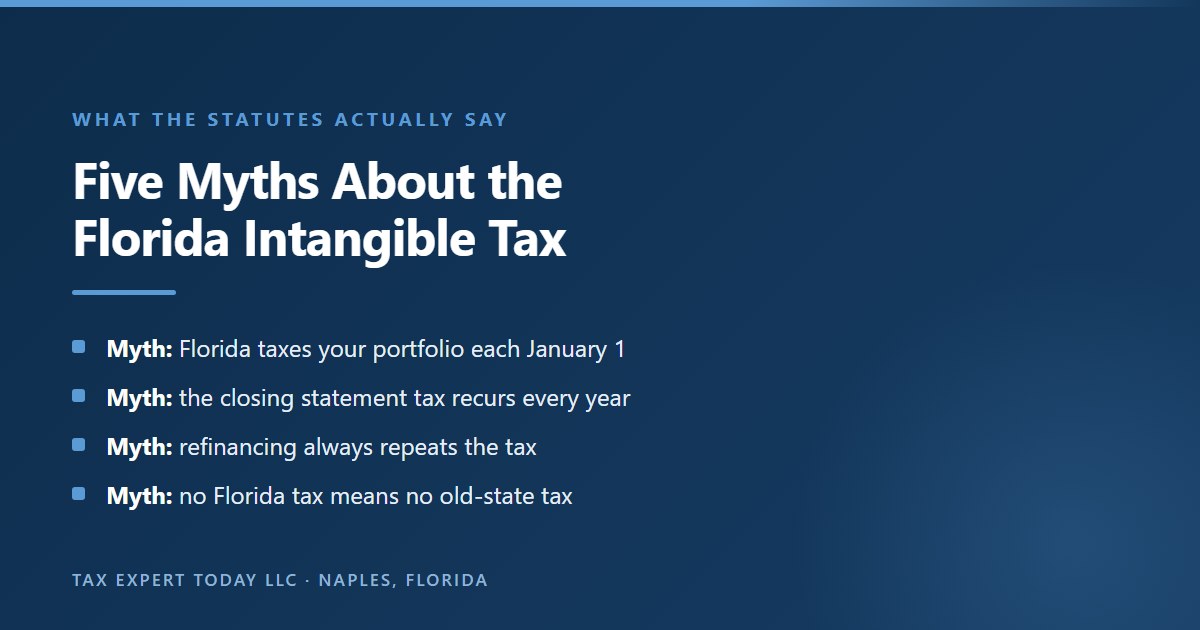
The common mistakes are treating the closing statement line as an annual tax, assuming a brokerage account must be reported or shielded in Florida, confusing documentary stamp tax with intangible tax, assuming an estate planning deed is always tax free, and treating Florida’s lack of taxes as protection from the former state.
- Myth: the closing statement “intangible tax” will recur every year
- Myth: a portfolio needs an intangibles tax trust or a January 1 strategy
- Myth: intangible tax and documentary stamp tax are the same charge
- Myth: deeding a home to a revocable trust is always free of tax
- Myth: no Florida tax means no state tax on the move year
| What new residents hear | What the current law says | Authority |
|---|---|---|
| Florida taxes your stocks and bonds every January 1 | Repealed effective January 1, 2007; no annual tax and no return | Ch. 2006-312, Laws of Florida |
| The intangible tax on my closing statement is annual | One-time 2 mill tax on the loan, paid at recording | Fla. Stat. §199.133, §199.135 |
| Intangible tax and doc stamps are the same thing | Different chapters, different rates, different bases; both can apply to one mortgage | Chapters 199 and 201 |
| Refinancing always means paying the intangible tax again | Not with the original lender at the same or lower balance; only the excess is taxed | Fla. Stat. §199.145(4) |
| A deed to my revocable trust is always exempt | No estate planning exemption; a mortgage on the property counts as consideration | Fla. Stat. §201.02; Department guidance |
| Florida has no income tax, so my old state cannot tax me | The former state taxes income earned while domiciled there and may contest the move | Former state residency law; Fla. Const. Art. VII, §5 limits Florida only |
What Should a New Florida Resident Check at Closing?
Before closing, confirm which of the three levies apply, what base each uses, and who bears each under the contract. Check that the intangible tax is computed only on the loan secured by Florida property, that the note is not taxed separately from the mortgage, and whether refinancing with your current lender would reduce the state tax.
- Cash or financed: a cash purchase should show only the deed documentary stamp tax
- One loan tax, not two on the same paper: the note is marked as paid when tax is paid on the mortgage
- Collateral outside Florida: ask for the proration under §199.133(2) if out-of-state property also secures the loan
- Trust or LLC title: compute the deed tax on any mortgage before funding a trust or entity
- Keep the statement: the closing statement is also part of the record that supports your Florida domicile
Two further points help families who are buying and selling in the same year. If the old home sells after you have moved, the closing in the former state is governed by that state’s law, and some states withhold tax at closing from nonresident sellers; our guide to selling your home after moving to Florida covers that side. And if the Florida purchase is financed with a bridge loan or a line of credit secured by the new property, the chapter 199 and chapter 201 taxes apply to that loan as well, so the cost of carrying two properties briefly includes a small state tax component that is easy to estimate in advance with the rates above.
None of these steps calls for avoiding a tax that is properly due. The documentary stamp tax and the nonrecurring intangible tax are modest, predictable and set by statute, and the Department publishes clear examples. The value in checking is accuracy: making sure the base is right, the proration is applied where the statute allows it, and the refinancing relief is used where it is available.
Florida Intangible Tax Help in Naples & Southwest Florida
Tax Expert Today LLC works with families who have moved, or are moving, to Naples, Florida and across Southwest Florida on the tax side of the relocation, including the questions that arrive at the closing table and the larger question of what the former state can still reach after the move. The firm is multidisciplinary, with enrolled agents, CPAs and attorneys, and it handles residency and tax matters nationwide, coordinating with your closing agent and Florida estate counsel where a transfer or a trust funding is involved. Our office is at 11983 Tamiami Trail N, Naples, FL 34110, open Monday through Friday, 10 a.m. to 5 p.m. ET, and reachable at (239) 441-2005.
- Florida intangible tax help Naples: review of the intangible tax and documentary stamp tax on a purchase, refinance, credit line or seller-financed sale.
- Trust and entity transfers: the deed tax on funding a revocable trust or LLC with mortgaged Florida property, coordinated with your attorney.
- Residency and the former state: the domicile record and move-year filings that decide whether the old state still taxes your investment income.
Our Naples tax planning practice and our Florida tax services page describe the wider planning work, and our estate and trust planning services cover the documents that should change with the move. For the protective side of Florida ownership, see our guide to Florida asset protection for new residents.
We just bought a condominium in Naples with a mortgage and saw an “intangible tax” on the closing statement. Will we pay it again next year?
No. The intangible tax on a Naples closing statement is the one-time nonrecurring tax of 2 mills on the mortgage loan, computed when the mortgage is recorded with the Collier County clerk. It does not recur. You would see it again only if you later increase the loan, take a new loan from a different lender, or add a credit line secured by the condominium.
When to Engage a Professional
A straightforward purchase with a conventional mortgage rarely needs anything beyond a careful read of the closing statement, since the title company computes the documentary stamp tax and the nonrecurring intangible tax as a matter of routine. Professional help earns its cost when the loan is secured by property in more than one state, when Florida property is being moved into a revocable trust or an LLC while it carries a mortgage, when ownership of an entity holding Florida property will change within three years of a contribution, when a sale involves seller financing, or when a refinance could be structured with the existing lender to reduce the state tax. It is also worth a conversation when a question about the Florida intangible tax is really a question about whether your investment income is still taxable in the state you left, because that is where the larger amounts sit. Tax Expert Today LLC’s enrolled agents, CPAs and attorneys can review the transaction, coordinate with your closing agent and estate counsel, and help build the residency record that supports the move. Call (239) 441-2005 to schedule a consultation.
Frequently Asked Questions
Does Florida still have an intangible tax?
Only in a narrow form. The annual intangible personal property tax on stocks, bonds and funds was repealed effective January 1, 2007. What remains is a one-time nonrecurring tax of 2 mills on loans to the extent they are secured by Florida real property, under Fla. Stat. section 199.133, usually paid when the mortgage is recorded.
How much is the Florida intangible tax on a mortgage?
The rate is 2 mills, or $2 per $1,000 of the loan secured by Florida real property. A $500,000 mortgage carries $1,000 of nonrecurring intangible tax. The taxable amount never exceeds the value of the Florida property securing the loan, and only the Florida share is taxed when other property also secures it.
Who pays the intangible tax on a Florida mortgage?
The lender is the taxpayer under Fla. Stat. section 199.135(4), but the statute allows the lender to pass the cost to the borrower, and on residential loans it usually does. The tax is paid to the clerk at recording, or directly to the Department of Revenue within 30 days if the mortgage is not recorded.
Is the documentary stamp tax the same as the intangible tax?
No. The documentary stamp tax under chapter 201 is an excise on documents: 70 cents per $100 on deeds and 35 cents per $100 on notes and recorded mortgages. The nonrecurring intangible tax under chapter 199 is 2 mills on loans secured by Florida real property. A financed purchase usually pays both.
Does Florida tax my brokerage account after I move?
No. Florida has not taxed the value of stocks, bonds or fund shares since the annual intangibles tax was repealed effective January 1, 2007, and Article VII, Section 5 of the Florida Constitution prevents a personal income tax on residents. The state you left may still tax income earned before your domicile changed.
Do I pay intangible tax again when I refinance?
Not always. Under Fla. Stat. section 199.145(4), a refinance with the original lender or its assignee owes no additional nonrecurring tax if the new principal does not exceed the old unpaid principal plus accrued interest, and only the excess is taxed. A refinance with a new lender is generally taxed on the full new loan.
Published October 18, 2026 by Dr. Pellumb Kabashi « Back to Learning Center
Have a question this article touches on?
Tax Expert Today LLC, based in Naples, Florida and serving clients across the United States.
Schedule a Consultation (239) 441-2005