
By Dr. Pellumb Kabashi, DBA, MBA, CES, CFE, EA
Founder, Tax Expert Today LLC · Tax advisors, enrolled agents, CPAs, and attorneys · Serving clients in all 50 states
Quick Answer: California Form 568 is the annual return for an LLC taxed as a partnership or disregarded entity that is registered or doing business in California. Moving to Florida does not end it. Once an owner becomes a nonresident, the LLC needs a signed FTB 3832 or the single member consent, or it pays that owner’s tax at 12.3 percent on Schedule T. Call (239) 441-2005 for a free consultation.
What Is California Form 568 and Who Has to File It?
California Form 568 is the Limited Liability Company Return of Income. An LLC classified as a partnership, or a single member LLC disregarded for federal tax purposes, files it every year it is registered with the California Secretary of State or doing business in California, whether or not it earned money or still operates there.
- Multiple member LLC taxed as a partnership: files California Form 568 with a Schedule K-1 (568) for every member.
- Single member LLC disregarded federally: still files California Form 568, completing Sides 1, 2, 3 and Schedule IW at a minimum.
- LLC taxed as a corporation: files Form 100 or Form 100S instead, not Form 568.
- Registered foreign LLC: a Florida or Delaware LLC registered in California files California Form 568 on the same terms as a California LLC.
- Trigger: registration or doing business, not profit and not where the owner lives.
The 2025 Limited Liability Company Tax Booklet begins from classification. An LLC may be classified for tax purposes as a partnership, a corporation or a disregarded entity, and the booklet tells the LLC to file the California return that matches that classification. California follows the federal check-the-box regulations for this purpose, so an LLC that is a partnership on its federal Form 1065 is a partnership for California, and an LLC that is disregarded on its owner’s federal return is disregarded for California too. The difference is that a disregarded LLC does not disappear from the California filing system. The booklet states that a single member LLC must still complete Form 568 and pay the annual tax and the LLC fee where one applies.
The filing obligation attaches to the entity, not to the owner’s address. That is the point most people who leave California miss. An owner who sells a house in Los Angeles, signs a lease in Naples, Florida, and moves the family often assumes the California paperwork follows the people. For the individual return it largely does, through the part-year Form 540NR covered in our California part-year resident tax guide. For the LLC it does not. The LLC stays on the Secretary of State roll, and as long as it is there, or as long as it keeps doing business in California, the Franchise Tax Board expects California Form 568.
This guide follows California Form 568 through an owner’s move. It covers the return itself: who signs, what the LLC owes when a departed owner does not sign, how the Schedule K-1 (568) splits a member’s move year, what changes on the return when a member becomes a Florida resident, and how the final return works if the LLC is wound down. The annual $800 tax, the gross receipts fee tiers, the dormant year rules and the cancellation procedure belong to our separate guide to the California LLC franchise tax, and this page links there rather than repeating those figures.
| LLC situation | California return | Source |
|---|---|---|
| Multiple member LLC classified as a partnership, registered or doing business in California | Form 568 with Schedule K-1 (568) for each member | 2025 Form 568 booklet, General Information A |
| Single member LLC disregarded for federal purposes, registered or doing business in California | Form 568, Sides 1, 2, 3 and Schedule IW at a minimum | 2025 Form 568 booklet, General Information S |
| LLC that elected to be taxed as a C corporation | Form 100 | 2025 Form 568 booklet, General Information A |
| LLC that elected to be taxed as an S corporation | Form 100S | 2025 Form 568 booklet, General Information A |
| Nonregistered foreign multiple member LLC not doing business but deriving California income | Form 565 instead of Form 568 | 2025 Form 568 booklet, General Information A |
| Nonregistered foreign single member LLC not doing business in California | No Form 565 and no Form 568 | 2025 Form 568 booklet, General Information A |
Does Moving to Florida End the California Form 568 Filing Requirement?
No. Moving to Florida changes the owner’s residency, not the LLC’s status. If the LLC remains registered with the California Secretary of State or keeps doing business in California, California Form 568 stays due every year. Only cancellation with the Secretary of State, or a change that ends both registration and California business, stops it.
- Owner moves, LLC stays registered: Form 568 continues, now with a nonresident owner.
- Owner moves, LLC keeps California customers or property: Form 568 continues because the LLC is doing business in California.
- LLC cancels after a timely final return: the filing obligation ends with that final year.
- LLC converts or is replaced by a Florida entity: depends on whether the California registration is also ended.
An owner’s move to Florida is a change in the owner’s tax status. California Form 568 is a return for the entity. The two run on separate tracks. The Form 568 booklet says that, in general, LLCs are required to pay the $800 annual tax and file a California return until the appropriate papers are filed with the Secretary of State. A domestic California LLC remains a California LLC no matter where its members live. A Florida LLC that registered in California to operate there remains registered until it files to surrender or cancel that registration.
The second independent trigger is doing business in California. Even an LLC that was never registered in California, or one that has cancelled its registration, can still be required to file if it is doing business in the state under the tests in R&TC section 23101, which look at activity in the state and at California sales, property and payroll measured against thresholds that the Franchise Tax Board adjusts each year. The detailed thresholds and the two independent doors to the annual tax are set out in our California LLC franchise tax guide. For this page the practical rule is simple: if a Florida owner’s LLC still has a California office, California employees, a California rental building or meaningful California sales, assume California Form 568 is still due and check the thresholds before deciding otherwise.
The booklet also warns about the cost of guessing wrong. The Franchise Tax Board will assess a $2,000 penalty against a nonqualified foreign LLC that is doing business in California while not registered, or while suspended or forfeited. A Florida LLC that quietly continues to serve California clients after the owner moves, without registering, can therefore face that penalty on top of the annual tax and any return penalties. Our broader leaving California taxes checklist places this LLC decision alongside the personal residency steps.
| After the owner moves to Florida | Is California Form 568 still due? | Why |
|---|---|---|
| California LLC, still active with the Secretary of State, no California activity | Yes | Registration alone keeps the filing and annual tax obligation alive |
| Florida LLC registered in California, still registered | Yes | Registration with the California Secretary of State continues |
| Florida LLC never registered in California, still serving California customers above the doing business thresholds | Yes, and a $2,000 penalty may apply for not registering | Doing business in California under R&TC 23101 |
| California LLC filed a timely final Form 568 and cancelled within 12 months | No, after the final year | 2025 Form 568 booklet, General Information Q |
| Florida LLC with no California registration and no California activity | Generally no | Neither trigger applies |
Who Signs California Form 568 After the Owner Leaves California?
The same people who signed before: a member or manager authorized to sign for the LLC, plus any paid preparer. What changes is the consent. A nonresident member must sign form FTB 3832, and a nonresident single member owner signs the Single Member LLC Information and Consent on Side 3 of California Form 568.
- Return signature: an authorized member or manager signs the return for the LLC.
- Multiple member LLC with a nonresident member: each nonresident member signs FTB 3832, and a spouse or registered domestic partner signs too.
- Single member LLC with a nonresident owner: the owner signs the consent on Side 3 of the return.
- Unsigned consent: the LLC must compute and pay that owner’s tax on Schedule T.
The signature on the return itself is the ordinary one. An LLC return is signed by a person authorized to sign for the LLC, and where a paid preparer is involved the preparer signs and identifies the firm. The booklet’s paid preparer authorization checkbox lets the Franchise Tax Board call the preparer about processing questions, and that authorization ends no later than the due date of the following year’s return. None of that is new when an owner moves.
The new signature is the consent. California taxes a nonresident member on the member’s distributive share of LLC income from California sources, and California law asks the nonresident to agree, in writing, that California has jurisdiction to tax that share. For a multiple member LLC the vehicle is form FTB 3832, Limited Liability Company Nonresident Members’ Consent. The 2025 Instructions for Form FTB 3832 say the form lists the names and identification numbers of the nonresident members and obtains the signature of each nonresident member evidencing consent to California’s jurisdiction to tax that member’s distributive share of income attributable to California sources. If the nonresident member has a spouse or registered domestic partner, the spouse or partner must also sign.
For a single member LLC, form FTB 3832 is not used. The instructions say the owner of a single member LLC consents by signing the Single Member LLC Information and Consent on Side 3 of California Form 568. That one signature is easy to miss on a single member return, especially when the owner used to be a California resident and the box never seemed to matter. After the move it matters a great deal, because the booklet treats the failure of the sole owner to sign the consent in the same manner as the failure of a nonresident member to sign FTB 3832.
| Who | What they sign | When it matters |
|---|---|---|
| Authorized member or manager | California Form 568 itself | Every year |
| Paid preparer | Preparer declaration on Form 568 or FTB 8453-LLC for e-file | Every year a preparer is used |
| Nonresident member of a multiple member LLC | Form FTB 3832 | First year the LLC has that nonresident member, and any year a nonresident member has not signed |
| Spouse or registered domestic partner of a nonresident member | Form FTB 3832 | Same years as the member |
| Nonresident owner of a single member LLC | Single Member LLC Information and Consent, Side 3 of Form 568 | Every return filed while the owner is a nonresident |
When Does a Member Who Moves Need Form FTB 3832?
Form FTB 3832 is filed for the first taxable period in which the LLC has a nonresident member, and for any later period in which a nonresident member has not yet signed. A member who moves to Florida during the year generally becomes a new nonresident member for that year’s return, so the LLC should collect the signature then.
- First period rule: file FTB 3832 for the first taxable period the LLC became subject to tax with nonresident members.
- Catch up rule: file it for any period in which a nonresident member has not signed.
- Separate forms allowed: one form per member or per group of members is permitted.
- Record keeping: the LLC must keep a signed FTB 3832 for each nonresident member available for examination.
The FTB 3832 instructions give two filing occasions. The form is filed for the first taxable period for which the LLC became subject to tax with nonresident members, and for any taxable period during which the LLC had a nonresident member who has not signed FTB 3832. The booklet repeats the same two rules and adds that separate forms for an individual or groups of individuals are permissible, and that the LLC must maintain and have available for examination a form FTB 3832 signed by each nonresident member.
A member who moves during the year raises a practical timing question that the forms do not answer in a sentence. Residency is determined at the member level, not by the LLC. The Schedule K-1 (568) instructions make this point directly: the final determination of residency is made at the member level, and if the LLC is uncertain about a member’s residency status it should treat the member as needing California source reporting. In practice, an LLC that knows a member left California during 2026 should treat that member as a nonresident member for the 2026 return and obtain an FTB 3832 signature before the return is filed. Waiting for a later year invites the second filing occasion, a period with a nonresident member who has not signed, and the Schedule T consequences that come with it.
Collecting the signature is also the cleanest way to document what the LLC knew. If the Franchise Tax Board later questions whether a departed member was in fact a nonresident, the LLC’s own records showing that it treated the member as nonresident, reported California source income in column (e) and obtained the consent are consistent with the member’s own part-year return. Our California residency audit guide explains why consistent records across the individual and entity returns matter when residency is examined.
| Member situation for the 2026 return | FTB 3832 needed? | Practical step |
|---|---|---|
| All members California residents all year | No | No consent form; residents report all income |
| A member moved to Florida during 2026 | Yes, for 2026 if this is the first period with that nonresident member | Collect the signature before filing the 2026 return |
| A member moved in 2024 and signed FTB 3832 for 2024 | Not again for that member, unless a new unsigned nonresident member appears | Keep the signed 2024 form in the LLC records |
| A member moved in 2024 and never signed | Yes, for each period without a signature | Obtain the signature or compute Schedule T |
| A new nonresident member joined in 2026 | Yes | Collect at admission, not at filing time |
What Happens If a Nonresident Member Will Not Sign Form FTB 3832?
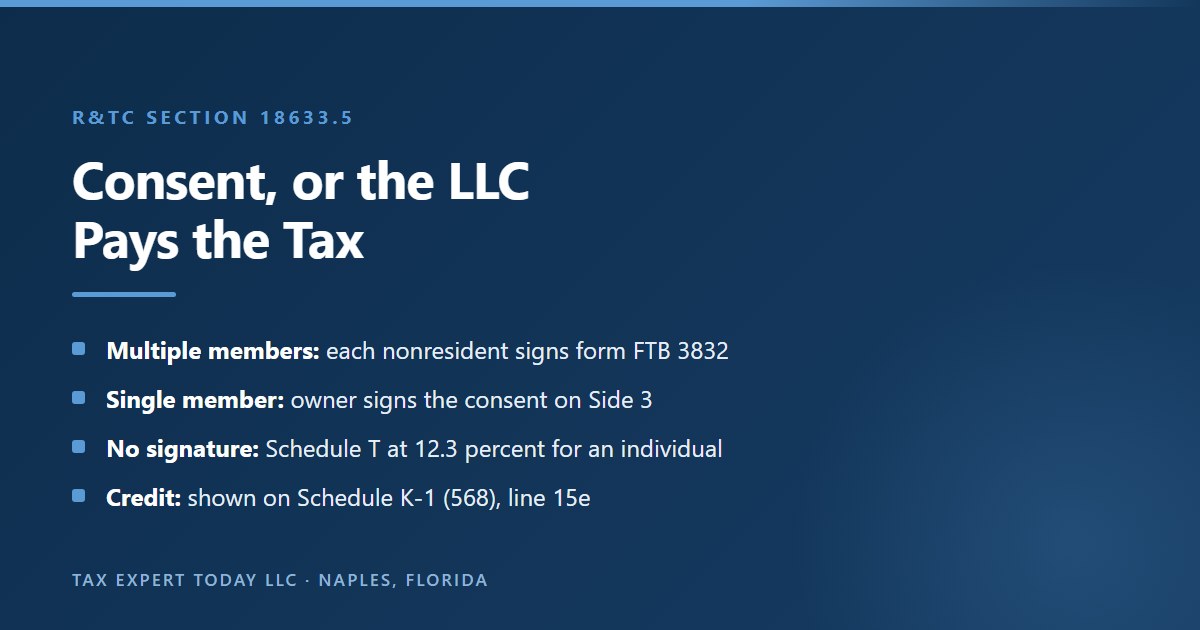
The LLC must pay tax on that member’s distributive share of income at the member’s highest marginal rate, computed on Schedule T and reported on line 5 of California Form 568. Under R&TC section 18633.5 the amount is treated as a payment by the member, and the LLC may recover it from the member.
- Who pays: the LLC, on behalf of the nonconsenting nonresident member.
- Where: Schedule T on Side 4, carried to Form 568, line 5.
- Credit to the member: the amount is a payment made by the member, shown on the member’s Schedule K-1 (568), line 15e.
- Recovery: the LLC may recover from the member the tax it paid.
- Timing: due by the original due date of the return, not the extended date.
The consent is not optional in effect, even though nobody is forced to sign. The FTB 3832 instructions state that if a member fails to sign, the LLC is required to pay tax on the member’s distributive share of income at that member’s highest marginal rate, and that any amount paid by the LLC is considered a payment made by the member, citing R&TC section 18633.5. The booklet adds the operational detail: the LLC lists the nonconsenting member on Schedule T, Nonconsenting Nonresident Members’ Tax Liability, computes the tax, and carries the total to line 5 of Form 568.
This tax is distinct from nonresident withholding. The booklet goes out of its way to say so: the nonresident withholding requirements are not related to the nonconsenting nonresident members’ tax paid by an LLC on behalf of nonresident members. Withholding under R&TC section 18662 is a 7 percent prepayment on distributions, covered in our guide to California nonresident withholding. The nonconsenting member tax is a tax on the member’s distributive share, whether or not any cash was distributed. The two interact only in one direction: Schedule T lets the LLC reduce each nonconsenting member’s tax by the amount it already withheld and paid for that member under section 18662.
The member is not taxed twice. The amount the LLC pays on Schedule T is a payment toward the member’s own California liability. The booklet says that to claim credit the nonresident member needs to attach a copy of the Schedule K-1 (568) to the member’s California income tax return, and the line instructions place the amount on Schedule K-1 (568), line 15e, which is not a distributive share item but a line reported only on that specific member’s K-1. The member still has to file. The booklet repeats that completing Schedule T or FTB 3832 does not satisfy the member’s California filing requirement.
| Step | Where it happens | Result |
|---|---|---|
| Identify nonresident members who have not signed FTB 3832 or the Side 3 consent | LLC records | List of nonconsenting nonresident members |
| List each member and the member’s distributive share | Schedule T, columns (a) to (c) | Income base for the tax |
| Apply the rate for the member type | Schedule T, column (d) | 12.3, 8.84 or 1.5 percent |
| Subtract section 18662 withholding already paid for the member | Schedule T, column (f) | Net tax in column (g), never below zero |
| Carry the total | Form 568, line 5 | Paid with the return or with FTB 3537 |
| Report to the member | Schedule K-1 (568), line 15e | Credit on the member’s own California return |
What Rate Does Schedule T Apply to a Nonconsenting Member?
Schedule T multiplies the nonconsenting member’s distributive share by 12.3 percent for an individual, partnership, LLC, estate or trust, by 8.84 percent for a C corporation, and by 1.5 percent for an S corporation. The result is reduced by any section 18662 withholding already paid for that member and cannot fall below zero.
- Individual members: 12.3 percent of the distributive share.
- Partnership, LLC, estate or trust members: 12.3 percent.
- C corporation members: 8.84 percent.
- S corporation members: 1.5 percent.
- Reduction: tax previously withheld and paid under R&TC 18662 for that member.
The 2025 Form 568 booklet prints the Schedule T rates in its specific instructions. To compute the amount the LLC must pay on behalf of a nonconsenting nonresident member, the LLC multiplies that member’s distributive share of income by 8.84 percent if the member is a C corporation, 12.3 percent if the member is an individual, partnership, LLC, estate or trust, and 1.5 percent if the member is an S corporation. Column (c) times column (d) goes in column (e), column (f) holds prior withholding, and the net in column (g) cannot be less than zero.
The 12.3 percent rate is the top bracket of California’s personal income tax rate schedule. It is applied flat to the whole distributive share on Schedule T, without the lower brackets, the standard deduction or any credits the member might have on a personal return. That is why the nonconsenting member tax usually overstates what a nonresident would owe on a properly filed Form 540NR. The excess is not lost, because the payment is credited to the member, but it is cash that leaves the LLC early and must then be recovered from the member or reconciled through the member’s own return. The separate 1 percent behavioral health services tax on income over $1 million, discussed in our California mental health tax guide, is not part of the Schedule T rate list in the booklet.
The base matters as much as the rate. The booklet describes the tax as computed on the member’s distributive share of income, and the FTB 3832 instructions describe the consent as covering the member’s distributive share of income attributable to California sources. For an LLC that operates entirely in California the two figures are the same. For an apportioning LLC with operations in several states, the California source portion shown in column (e) of the member’s Schedule K-1 (568) is the figure that a nonresident member’s California liability is built from, and practitioners generally compute Schedule T from that California source share. Where the LLC’s records are unclear, this is a point to confirm on the current year form before filing.
| Nonconsenting member type | Schedule T rate | Hypothetical $200,000 distributive share |
|---|---|---|
| Individual | 12.3 percent | $24,600 |
| Partnership or LLC | 12.3 percent | $24,600 |
| Estate or trust | 12.3 percent | $24,600 |
| C corporation | 8.84 percent | $17,680 |
| S corporation | 1.5 percent | $3,000 |
The figures in the last column are hypothetical arithmetic only, before any reduction for section 18662 withholding already paid. They illustrate the rate, not a liability for any particular LLC.
How Does a Single Member LLC Owner in Florida Complete California Form 568?
A single member LLC owned by a Florida resident completes Form 568 Sides 1, 2 and 3 and Schedule IW, pays the annual tax and any LLC fee, and the owner signs the Single Member LLC Information and Consent on Side 3. Without that signature, the LLC must also complete Schedule T on Side 4.
- Minimum pages: Side 1, Side 2, Side 3 and Side 7 (Schedule IW).
- Owner consent: signed on Side 3, in place of form FTB 3832.
- Schedules B and K: required only when income or loss items reach $3,000,000 or more.
- Owner identification: the TIN or FEIN of the entity that reports the LLC’s income.
- No K-1: single member LLCs are excluded from providing a Schedule K-1 (568).
The single member LLC is the most common structure among owners who leave California, and it is also the one where California Form 568 looks thinnest. The booklet lists the required pieces: an SMLLC completes Form 568, Side 1, Side 2, Side 3, Side 7 (Schedule IW), and pays the annual tax and LLC fee if applicable. If a nonresident has not signed the single member LLC consent on Side 3, the SMLLC is required to complete Schedule T on Side 4. Schedules B and K are required when the income or loss amount on Schedule B, line 1 or lines 3 through 11, is $3,000,000 or more, or when the total distributive income on Schedule K, line 21a, is $3,000,000 or more or negative $3,000,000 or less.
The Side 3 section asks for the identification number of the entity that will report the LLC’s income, deductions and credits, which for an individual owner is usually the owner’s Social Security number, and asks the LLC to check the box for the type of entity that ultimately owns the LLC. The booklet notes that the owner will be responsible for limiting any credits attributable to the disregarded entity. The consent signature sits in the same section. The booklet then says plainly that the LLC must treat the failure of the sole owner to sign this consent in the same manner as the failure of a nonresident member to sign FTB 3832, and that if the single member signs the consent, the LLC completes only Sides 1, 2, 3 and 7 and pays the amount due.
For a Florida owner, California Form 568 is not where the owner’s income tax is computed. The income of a disregarded LLC is reported on the owner’s own return, which for a former Californian is Form 540NR in the move year and, if California source income continues, in later years. The LLC return reports the entity level items, computes total California income on Schedule IW for the fee, and records the owner’s consent. Our guide to California source income explains which income of a Florida resident California can still reach.
| Part of California Form 568 | Single member LLC with Florida owner | Note |
|---|---|---|
| Side 1 (tax, fee, payments) | Required | Line 1 is total California income from Schedule IW |
| Side 2 (questions) | Required | Including Question I on real property control changes |
| Side 3 (Single Member LLC Information and Consent) | Required, with owner signature | Unsigned consent triggers Schedule T |
| Side 4, Schedule T | Only if the owner has not signed the consent | 12.3 percent for an individual owner |
| Schedules B and K | Only at the $3,000,000 thresholds | Otherwise Schedule IW still required |
| Side 7, Schedule IW | Required | Computes total California income for the fee |
| Schedule K-1 (568) | Not provided | SMLLCs are excluded from providing a K-1 |
What Is the California Form 568 Due Date for 2026 Returns?
For a calendar year LLC classified as a partnership, the 2026 California Form 568 is due March 15, 2027, the 15th day of the 3rd month. For a single member LLC owned by an individual, it is due April 15, 2027, the 15th day of the 4th month after the owner’s year ends.
- LLC classified as a partnership: 15th day of the 3rd month after year end.
- SMLLC owned by a pass-through entity: 15th day of the 3rd month.
- All other SMLLCs, including those owned by individuals: 15th day of the 4th month after the owner’s year end.
- Weekend or holiday: the deadline moves to the next business day.
- Payments due by the original date: any unpaid LLC fee and any nonconsenting member tax.
The 2025 booklet sets out three due date rules. For LLCs classified as partnerships, the original due date is the 15th day of the 3rd month following the close of the taxable year. For SMLLCs owned by pass-through entities, meaning S corporations, partnerships and LLCs classified as partnerships, the original due date is the same 15th day of the 3rd month. For all other SMLLCs the original due date is the 15th day of the 4th month following the close of the owner’s taxable year. When the due date falls on a weekend or holiday, the deadline to file and pay without penalty moves to the next business day.
Applied to the 2026 tax year, a calendar year LLC taxed as a partnership files by Monday, March 15, 2027. A single member LLC owned by an individual on a calendar year files by Thursday, April 15, 2027, the same day as the owner’s Form 540NR. The booklet is explicit that the LLC must file Form 568, pay any nonconsenting nonresident members’ tax and pay any LLC fee not already paid with the estimated fee form FTB 3536 by the original due date of the LLC’s return. The 2026 forms had not been released when this guide was written, so the dates above apply the rules in the 2025 booklet to the 2026 calendar, and the 2026 booklet should be checked when it is published.
Other dates sit around the return. The $800 annual tax for a taxable year is a prepayment due by the 15th day of the 4th month of that year, using form FTB 3522, and the estimated LLC fee is due by the 15th day of the 6th month of the year, using form FTB 3536. Those payments, the fee tiers and what happens in a first or last year are covered in the franchise tax guide. The point here is that a Florida owner should not assume the LLC’s California calendar ends when the owner’s California residency does.
| Item for the 2026 tax year (calendar year LLC) | Due date | Form |
|---|---|---|
| Form 568, LLC classified as a partnership | March 15, 2027 | Form 568 |
| Form 568, SMLLC owned by an individual | April 15, 2027 | Form 568 |
| Nonconsenting nonresident members’ tax | Original due date of the return | Form 568 line 5, or FTB 3537 if extended |
| Any LLC fee not paid as an estimate | Original due date of the return | FTB 3536 |
| Extended due date, both cases | October 15, 2027 | Automatic, no application |
| 2027 annual tax prepayment | April 15, 2027 | FTB 3522 (2027 version) |
Does the California Form 568 Extension Give More Time to Pay?
No. California grants an automatic extension to file California Form 568, seven months for an LLC classified as a partnership and six months for most single member LLCs, but the extension does not extend the time to pay the LLC fee or the nonconsenting nonresident members’ tax. Those payments go with form FTB 3537 by the original date.
- No application: California does not require a written extension request.
- Partnership LLCs: seven month automatic extension, a change from six months.
- SMLLCs: six months, except SMLLCs owned by a partnership or partnership LLC, which get seven.
- Good standing required: the extension is available to LLCs in good standing.
- Payment voucher: FTB 3537, Payment for Automatic Extension for LLCs.
The booklet flags the change at the front of its 2025 instructions: the extension period for an LLC classified as a partnership to file its tax return has changed from six months to seven months. It then explains that California does not require written applications for extensions, that all LLCs in good standing that are classified as partnerships have an automatic seven month extension, and that SMLLCs disregarded for tax purposes are granted an automatic six month extension, except an SMLLC owned by a partnership or by an LLC classified as a partnership, which gets seven months, citing R&TC section 18567.
The same paragraph carries the payment rule that matters most after a move: the automatic extension does not extend the time to pay the LLC fee or the nonconsenting nonresident members’ tax. An LLC that expects to owe Schedule T tax for a departed member, and that will not have its return ready by March 15, 2027, pays that tax with form FTB 3537 by the original date. The booklet’s Schedule T discussion adds that if the LLC owes nonconsenting member tax and cannot complete Form 568 by the original due date, it must complete FTB 3537.
The extension also does not stop interest. The booklet states that the automatic extension of time to file does not stop interest from accruing on tax not paid by the original due date. For a Florida owner who is waiting on Schedules K-1 from other entities or on a residency determination, the safer approach is usually to estimate and pay by the original date and finish the return later. Our guide to the California late payment penalty explains how the payment and filing penalties combine when they do not line up.
| LLC type | Automatic extension to file | Extends time to pay? |
|---|---|---|
| LLC classified as a partnership, in good standing | Seven months | No |
| SMLLC owned by an individual | Six months | No |
| SMLLC owned by a corporation | Six months | No |
| SMLLC owned by a partnership or partnership LLC | Seven months | No |
| LLC not in good standing | Not available on the booklet’s terms | No |
How Does Schedule K-1 (568) Report a Member Who Moved Mid-Year?
Schedule K-1 (568) gives each member federal amounts, California adjustments in column (c), totals under California law in column (d) and California source amounts in column (e). A member who moved mid-year uses column (d) for the resident period and column (e) for the nonresident period, splitting the year by actual date of realization or by days.
- Column (c): the difference between federal and California amounts.
- Column (d): total amounts using California law, the figure a resident reports.
- Column (e): California source amounts, the figure a nonresident reports.
- Move year: resident period taxed on all income, nonresident period on California source income only.
- Method: actual date of realization where known, otherwise daily pro rata.
The Schedule K-1 (568) instructions explain the columns. All LLCs complete columns (c) and (d). Apportioning LLCs, those with activity both inside and outside California, also complete column (e). Nonresident, corporate and other entity members report their distributive share of income apportioned or allocated to California as shown in column (e). A nonapportioning LLC does not need to complete column (e) for a member it treats as a resident, but the instructions warn that the final determination of residency is made at the member level and that an LLC uncertain about a member’s residency should complete column (e) for that member.
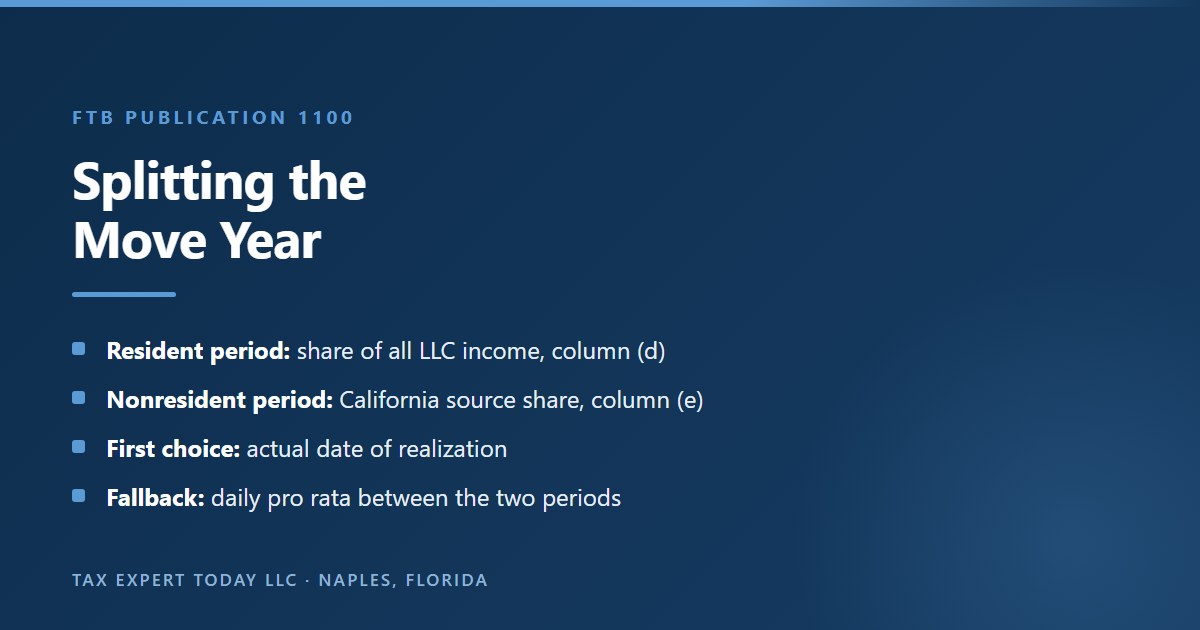
The move year combines both. The K-1 instructions say part-year resident members must consider their period of residency and nonresidency in computing total California income, and that nonresident and part-year members should take information from columns (c), (d) and (e) and apply it to the lines for total income and California source income. They also direct the reader to FTB Publication 1100, which supplies the method. Publication 1100 says that if you changed residency, California taxes your distributive share of partnership income based on your period of California residency and your period of nonresidency during the partnership’s taxable year. The allocation must reflect the actual date of realization, and in the absence of that information the annual amount is allocated between the two periods on a daily pro rata basis.
Publication 1100 works an example. A member of a calendar year Texas partnership becomes a California nonresident on April 1 and receives a K-1 showing $10,000 of income, $4,000 from California sources and $6,000 from Texas sources. The resident period runs 90 days and the nonresident period 275 days. California taxes 90 of 365 of the full $10,000 for the resident period, about $2,466, and 275 of 365 of the $4,000 California source share for the nonresident period, about $3,014. The member’s Form 540NR includes roughly $5,480 of this K-1 in California income, not $10,000 and not $4,000. The same arithmetic applies to a Schedule K-1 (568).
| Period in the move year | Which K-1 column the member draws on | What California taxes |
|---|---|---|
| Resident period (January 1 to the day before the move) | Column (d), total amounts using California law | The member’s share of all LLC income for that period |
| Nonresident period (move date to December 31) | Column (e), California source amounts | Only the California source share for that period |
| Split method, first choice | Interim statements or transaction dates | Actual date of realization |
| Split method, fallback | Annual K-1 amounts | Daily pro rata between the two periods |
| Where it lands | Schedule CA (540NR), with column E for California amounts | California adjusted gross income on Form 540NR |
Can a Departed Member Use Actual Dates Instead of the Day Count?
Yes, and it is the preferred method. Publication 1100 requires an allocation that reflects the actual date of realization, and only falls back to a daily pro rata split when that information is not available. A member whose LLC realized a large gain after the move date often benefits from interim figures.
- Actual realization first: the rule is the date income was actually realized.
- Daily pro rata second: used only in the absence of information on actual dates.
- Interim statements: the Publication 1100 S corporation example uses them.
- Transaction dates: the partnership example splits capital gains by sale date.
- LLC cooperation needed: the member must obtain the data from the LLC.
Publication 1100 gives two examples of actual date allocation. In one, a member of a fiscal year S corporation who became a nonresident on June 10 obtained interim statements from the company, showing net income for the resident period and California net income for the nonresident period, and computed the California taxable share from those figures. In the other, a 60 percent partner who became a nonresident on September 22 obtained the partnership return, which listed capital gains on specific sales. Gains on items sold during the resident period were taxable in full, while for the nonresident period only the gain from the sale of California real property was California income.
The planning lesson is plain. If a member moves on a known date and the LLC has a lumpy year, with a large sale, a large fee or a large contract closing on one side of the move date, the daily pro rata method can misstate the result in either direction. A sale of a non-California asset closed after the move is, on the actual date method, income of the nonresident period and generally outside California’s reach unless it is California source. A California sale closed after the move remains California source either way. Interim closing of the books at the move date, or at least a transaction level schedule, gives the member the data to apply the preferred method. The broader timing question for business sales is covered in our guide to moving to Florida before selling a business.
The LLC has to be willing to provide the data. Nothing in Form 568 requires an interim closing for a departing member, so the request is commercial as much as it is a tax matter. Multiple member LLCs whose operating agreements are silent on this point sometimes add a provision so that a member who changes residency can obtain the information needed for an actual date allocation, at the member’s cost if the LLC prefers.
| Hypothetical LLC year (member moves July 1) | Daily pro rata result | Actual date result |
|---|---|---|
| Even income all year, all from non-California customers | About half taxed as resident income | About half taxed as resident income |
| Large non-California asset sale in November | About half of the gain treated as resident period income | Gain falls in the nonresident period and is generally not California source |
| Large non-California asset sale in March | About half of the gain treated as nonresident period income | Whole gain falls in the resident period and is taxable |
| Sale of California real property in November | Gain taxable as California source in either period | Gain taxable as California source |
The table is illustrative only. The actual date method does not always produce a lower result; it produces the result that matches when the income was realized, which is what the publication requires.
Does California Tax a Florida Member on LLC Interest and Dividends?
Generally not on nonbusiness interest and dividends earned after the move. The K-1 instructions say income from nonbusiness intangible property is generally sourced at the residence of the individual member, so it is reported only in Table 1 and the member determines the source. Business income of the LLC follows the LLC’s California apportionment instead.
- Business income: apportioned or allocated at the LLC level, shown in column (e).
- Nonbusiness income from California real or tangible property: California source, such as rents and gains.
- Nonbusiness intangible income: generally sourced to the member’s residence.
- Where it appears: Table 1 of the K-1, not column (e).
- Characterization: the business or nonbusiness decision is made at the LLC level.
The Schedule K-1 (568) instructions separate business income from nonbusiness income. The determination of whether LLC income is business income or nonbusiness income is made at the LLC level. Nonbusiness income from real or tangible personal property located in California, such as rents, royalties, gains or losses, is California source income. If the LLC has income from nonbusiness intangibles, the source is determined at the member level, and in most cases that income is sourced at the residence or commercial domicile of the member. Because the source depends on the member, it is not included in column (e) and appears only in Table 1.
For a member who has moved to Florida, this matters most for LLCs that hold investment portfolios or cash reserves alongside an operating business. Interest and dividends that are nonbusiness income of the LLC follow the member to Florida after the move date. The same interest earned while the member was a California resident is taxable as resident period income. An LLC that classifies its investment income as business income, because the investments are part of the business operations, sources that income through its apportionment instead, and some of it may remain California source.
A related rule applies to investment partnerships. The booklet explains that income of nonresident members derived from qualifying investment securities of an LLC that qualifies as an investment partnership is considered income from sources other than California, subject to exceptions where the investment activity is interrelated with other California business of the member. The K-1 flags this in box F(2). Florida members of family investment LLCs should check that box on their K-1 and the explanation that accompanies it.
| Type of LLC income after the member moves to Florida | Source rule | Where on the K-1 |
|---|---|---|
| Business income of a California operating LLC | California source through LLC apportionment | Column (e) |
| Rent from California real property | California source | Column (e) |
| Gain on sale of California real property | California source | Column (e) |
| Nonbusiness interest and dividends | Generally the member’s residence, Florida after the move | Table 1 only |
| Income from qualifying investment securities of an investment partnership | Generally not California source for nonresidents | Box F(2) and explanation |
Does Signing Form FTB 3832 Satisfy the Member’s Own California Filing?
No. The FTB 3832 instructions say completing the consent does not satisfy a nonresident member’s California filing requirement. A Florida member with California source income from the LLC still files Form 540NR, or joins a group nonresident return where the LLC files one, and claims credit there for any tax the LLC paid.
- Consent: agreement that California may tax the California source share.
- Return: a separate obligation, usually Form 540NR for an individual.
- Group option: eligible nonresident individuals may be included in a group Form 540NR.
- Credit for LLC payments: attach the Schedule K-1 (568) to the member’s return.
- Corporate members: are considered doing business in California and may have additional filings.
The FTB 3832 instructions put it in one sentence: the completion of form FTB 3832 does not satisfy a nonresident member’s California filing requirement, whether the member is an individual, estate, trust, corporation, partnership or LLC, and nonresident members are required to file the appropriate California tax returns in addition to signing the consent. The booklet repeats the reminder in its Schedule T instructions, adding that corporate members are also considered doing business in California and may have additional filing requirements.
Whether a Florida individual must actually file Form 540NR in a given year depends on the California filing thresholds, which measure gross income and adjusted gross income from all sources against amounts that vary with filing status, age and dependents. The 2025 Form 540NR booklet prints the tables. A member with meaningful California source income from an operating LLC will usually be over them. The individual mechanics, including how Schedule CA (540NR) uses column E for California amounts, are covered in our guide to the California part-year resident tax for the move year and in our nonresident state tax return guide for later years.
The member’s return is also where the LLC’s payments are credited. Tax the LLC paid on Schedule T for the member appears on Schedule K-1 (568), line 15e, and the booklet says members must attach a copy of the K-1 to their California return to claim it. Withholding the LLC paid under section 18662 is reported to the member on Form 592-B. A Florida member who receives both should expect both to appear as payments on Form 540NR, and should check that the LLC did not reduce one by the other twice.
| Filing piece | Who files | What it does |
|---|---|---|
| California Form 568 | The LLC | Entity return, annual tax, fee, consents and Schedule T |
| Form FTB 3832 | Each nonresident member, through the LLC | Consent to California jurisdiction over the California source share |
| Form 540NR | Each nonresident or part-year resident individual member with a filing requirement | Computes the member’s own California tax |
| Group Form 540NR | The LLC, for electing nonresident individuals | One composite return in place of individual 540NRs |
| Form 592-B | Issued by the LLC to the member | Reports section 18662 withholding credited to the member |
Can the LLC File a Group Form 540NR for Its Florida Members?
Yes. Under R&TC section 18535, nonresident individual members of an LLC doing business or deriving California income may elect to be included in a group Form 540NR filed by the LLC. The booklet says a group return may include fewer than two individuals and that members with more than $1,000,000 of California taxable income are eligible.
- Authority: R&TC section 18535 and FTB Publication 1067.
- Who may be included: electing nonresident individuals.
- Minimum size: a group return may include fewer than two nonresident individuals.
- High earners: members with more than $1,000,000 of California taxable income are eligible.
- Amendments: if the LLC amends Form 568, it amends the group return too.
The Form 568 booklet summarizes the group return in three statements: nonresident members of an LLC doing business or deriving income from sources in California may elect to file a group nonresident return under R&TC section 18535, group nonresident returns may include less than two nonresident individuals, and nonresident individuals with more than $1,000,000 of California taxable income are eligible to be included. The detailed rules, including who is excluded, how the tax is computed and what the electing members give up, are in FTB Publication 1067, Guidelines for Filing a Group Form 540NR.
A group return is a convenience with tradeoffs. It can spare a Florida member whose only California income is the LLC share from preparing a separate Form 540NR, and it gives the LLC one place to report and pay for all its electing nonresidents. But a group return does not carry the member’s personal deductions and credits the way an individual return does, and a member with other California income, such as California rental property or wages for days worked in California, generally needs an individual return anyway. Publication 1067 sets out those limits and should be read before an LLC offers the election to its members.
For the move year itself, a group return is usually a poor fit. A member who was a California resident for part of the year has resident period income from all sources to report, and the group return is designed for nonresidents. The part-year member files an individual Form 540NR, and the group election becomes relevant from the first full year of nonresidency.
| Member profile | Group Form 540NR a reasonable option? | Reason |
|---|---|---|
| Florida resident all year, only California income is the LLC share | Often yes | The return exists for this case |
| Florida resident all year, also owns California rental property | Usually no | Other California income needs an individual return |
| Moved from California to Florida during the year | Usually no | Resident period income from all sources must be reported |
| Florida resident with more than $1,000,000 of California taxable income | Eligible on the booklet’s terms | Booklet confirms eligibility |
| Corporate member | Not on a group 540NR | The group return is for individuals |
How Does the 7 Percent Withholding Interact With California Form 568?
They are separate. Withholding under R&TC section 18662 is a 7 percent prepayment on distributions of California source income to domestic nonresident members above $1,500 a year, reported on Forms 592 and 592-B. Schedule T is a tax on the unconsented distributive share. Withholding already paid reduces Schedule T, never the other way around.
- Withholding base: distributions of California source income to domestic nonresident members.
- Rate: 7 percent of distributions, including property.
- Threshold: no withholding if California source distributions to the member are $1,500 or less in the calendar year.
- Schedule T base: the distributive share, whether distributed or not.
- Coordination: Schedule T column (f) subtracts prior section 18662 withholding.
The booklet describes the withholding rule for domestic nonresident members: an LLC is required to withhold when it makes a distribution of income to a domestic nonresident member, at 7 percent of distributions, including property, of income from California sources, but withholding is not required if distributions of income from California sources to the member are $1,500 or less during the calendar year. LLCs with income inside and outside California apply a reasonable estimate of the California ratio, and the prior year ratio is generally accepted. The withholding is reported on Forms 592 and 592-B and remitted with Forms 592-V, 592-Q or 592-A as applicable, and waivers can be requested on Form 588. FTB Publication 1017 has the detail.
The booklet is explicit that these rules are not related to the nonconsenting member tax. In practice the two can both apply to the same member in the same year. A Florida member who refuses to sign FTB 3832 and also receives distributions will see 7 percent withheld on the distributions and the balance of the 12.3 percent Schedule T tax charged to the LLC at return time. Because Schedule T column (f) subtracts the withholding, the total cash the LLC sends for the member is the higher of the two amounts, not the sum. Our nonresident withholding guide covers Form 592 mechanics, waivers and the separate rules for foreign members under R&TC section 18666.
The booklet adds one more nuance that catches departed members: the taxable income of nonresident members is the distributive share of California sourced LLC income, not the distributed amount. Withholding is a prepayment measured by cash, while the member’s liability and the Schedule T tax are measured by the share. An LLC that retains its earnings can owe Schedule T tax for a nonconsenting member even though it distributed nothing and withheld nothing.
| Feature | Section 18662 withholding | Schedule T nonconsenting member tax |
|---|---|---|
| Triggered by | A distribution of California source income | A nonresident member who has not consented |
| Measured by | The distribution | The distributive share |
| Rate for an individual | 7 percent | 12.3 percent |
| Threshold | $1,500 of California source distributions a year | None stated |
| Forms | 592, 592-B, 592-V, 592-Q, 592-A, 588 waiver | Schedule T, Form 568 line 5, FTB 3537 |
| Credit to the member | Form 592-B | Schedule K-1 (568), line 15e |
Does Total California Income on Schedule IW Change After the Owner Moves?
Not because of the move itself. Schedule IW measures the LLC’s total income from California sources, which drives the LLC fee on Form 568, line 1. The owner’s residency is not part of that calculation, so an LLC whose customers and operations stay in California reports the same Schedule IW figure after the owner moves.
- Purpose: computes total California income for the LLC fee.
- Base: amounts from sources derived from or attributable to California.
- Owner residency: not an input.
- Wholly California business: all total income is assigned to California.
- Multistate business: uses the LLC’s California assignment rules.
The booklet’s Schedule IW instructions tell the LLC to use only amounts that are from sources derived from or attributable to California when completing lines 1 through 17. If the LLC business is wholly within California, the total income amount is assigned to California. If the LLC conducts business inside and outside California, the LLC assigns its income using the California rules. The booklet also says the LLC fee is based on total California source income rather than worldwide total income. The resulting line 17 figure becomes Form 568, line 1, which cannot be negative.
Nothing in that calculation looks at where the members live. An owner who moves to Naples, Florida while the LLC keeps its California customers, employees and premises will see the same total California income on Schedule IW as before. What can change Schedule IW is a change in the business: moving operations out of California, shifting customers, or ending California property and payroll. The fee tiers and the planning around them belong to our franchise tax guide, which also explains the anti abuse rule that lets the Franchise Tax Board aggregate commonly controlled LLCs formed to reduce fees.
For a disregarded SMLLC, the booklet adds that Schedule IW is required even when the $3,000,000 thresholds for Schedules B and K are not met, and that the owner of a disregarded entity prepares Schedule IW from the California amounts attributable to the LLC’s activities. A Florida owner who simply copies the prior year Schedule IW forward after moving should confirm that the business mix did not change with the move.
| Change after the owner moves | Effect on Schedule IW total California income |
|---|---|
| Owner becomes a Florida resident; business unchanged | No change |
| Business moves its office and staff to Florida | May fall, depending on where income is then sourced |
| Business keeps California customers, serves them remotely | Depends on California’s sourcing of the receipts |
| LLC sells its California rental property | The sale enters the year of sale; later years fall |
| LLC adds a second California location | Rises |
What Do Form 568 Questions K and I Ask After a Membership Change?
Question K asks for the maximum number of members at any time during the year, and the number of Schedules K-1 (568) attached must match. Question I asks about changes in control or ownership of entities that own California real property, which may require form BOE-100-B within 90 days.
- Question K: maximum member count during the year, no abbreviations such as various.
- K-1 count: must equal the Question K figure for multiple member LLCs.
- Question I: three questions on control and ownership changes involving California real property.
- BOE-100-B: filed with the State Board of Equalization within 90 days of a yes event.
- Penalty math: the late filing penalty multiplies by the Question K member count.
The booklet’s Question K instructions tell the LLC to enter the maximum number of members in the LLC at any time during the taxable year, and for multiple member LLCs the number of Schedules K-1 (568) attached must equal that number. When an owner’s move is accompanied by a buyout, a gift of interests to children, or the admission of a new partner, the count changes, and the K-1s need to follow. The member count also matters for penalties, because the late filing penalty under R&TC section 19172 is computed per member.
Question I has nothing to do with residency but often comes up in the same year. All LLCs must answer three questions about changes in control or ownership of legal entities that own, or in some cases lease, California real property, under R&TC section 64. If any answer is yes, a Statement of Change in Control and Ownership of Legal Entities, form BOE-100-B, must be filed with the State Board of Equalization, and failure to file within 90 days of the event results in penalties. Owners who leave California and restructure the LLC that holds a California building, for example by transferring interests to a trust or to family members as part of a move, should check Question I before filing.
These are not technicalities to fill in at the last minute. A wrong member count produces mismatched K-1s and a penalty computed on the wrong number, and a missed BOE-100-B can lead to a property tax reassessment issue that has nothing to do with income tax. Our guide to selling rental property after moving covers the income tax side of California buildings held after a move.
| Form 568 question | What it asks | Why it matters after a move |
|---|---|---|
| Question K | Maximum number of members during the year | Must match the K-1 count and drives the per member penalty |
| Question I(1) to I(3) | Changes in control or ownership of entities with California real property | A yes answer requires BOE-100-B within 90 days |
| Schedule K-1 (568), Question H | Whether the member is a California resident | Affects column (e) reporting on the K-1 |
| Question P | Whether withholding was required on payments or allocations | Points to Form 592 obligations for nonresident members |
| Item H(2) | Final return | Checked only in the LLC’s last year |
What Penalties Apply If California Form 568 Is Filed Late After a Move?
A late Form 568 can draw a penalty of $18 per member per month, for up to 12 months, under R&TC section 19172, plus a 5 percent per month late filing penalty on unpaid tax up to 25 percent, a late payment penalty and interest. The LLC can also be suspended or forfeited for failing to file.
- Per member penalty: $18 times total members, per month, up to 12 months.
- Late filing penalty on unpaid tax: 5 percent per month, capped at 25 percent.
- Late payment penalty: 5 percent plus 0.5 percent per month, up to 25 percent.
- Estimated fee underpayment: 10 percent of the shortfall.
- Suspension: powers, rights and privileges may be suspended or forfeited.
The booklet lists the penalties. Unless the failure is due to reasonable cause, an LLC that is required to file Form 568 and files late, including extensions, is penalized $18 multiplied by the total number of members during any part of the year, for each month or part of a month the failure continues, up to twelve months. The booklet adds that the federal small partnership exception does not apply for California, citing R&TC section 19172. Separately, an LLC that fails to file by the extended due date is assessed 5 percent of the unpaid tax, including the LLC fee and the nonconsenting member tax, for each month the return remains unfiled, capped at 25 percent, and the automatic extension is lost.
The failure to pay penalty starts at 5 percent and grows by 0.5 percent each month, up to 40 months and a maximum of 25 percent, under R&TC section 19132. Where both the filing and payment penalties apply, their combination is capped at 25 percent of the unpaid tax, though the per member penalty is separate. Underpaying the estimated LLC fee adds a 10 percent penalty. Interest runs on unpaid tax from the original due date. Our guides to reasonable cause penalty abatement and to the California late payment penalty explain how requests for relief are framed.
The heavier risk is suspension. The booklet warns that if an LLC does not file Form 568 or does not pay tax, penalties or interest, its powers, rights and privileges may be suspended, for a domestic LLC, or forfeited, for a foreign LLC, and that contracts entered into during suspension or forfeiture are voidable at the request of any party other than the LLC. An owner in Florida who stops opening California mail can end up with a suspended LLC that still owns a California asset or holds a California lease.
| Penalty | Amount | Authority named in the booklet |
|---|---|---|
| Late filing, per member | $18 times members, per month, up to 12 months | R&TC 19172 |
| Late filing, percentage | 5 percent of unpaid tax per month, up to 25 percent | Booklet, penalties and interest section |
| Late payment | 5 percent plus 0.5 percent per month, up to 25 percent | R&TC 19132 |
| Estimated fee underpayment | 10 percent of the underpaid fee | Booklet, penalties and interest section |
| Nonregistered foreign LLC doing business | $2,000 | Booklet, items new for 2025 |
| Interest | From the original due date | Booklet, penalties and interest section |
Hypothetical illustration only: a three member LLC whose 2026 return is treated as five months late faces a per member penalty of $18 times 3 times 5, or $270, before any percentage penalties on unpaid tax and before interest.
How Do You File a Final California Form 568 After Moving to Florida?
Check Final Return in Item H(2) on Side 1, check A final Schedule K-1 (568) in Item G(1) on each K-1, and attach a statement explaining the termination or liquidation. Pay the $800 annual tax for the final year, then file the cancellation papers with the Secretary of State within 12 months.
- Item H(2): the Final Return box on Form 568, Side 1.
- Item G(1): the final Schedule K-1 (568) box on each member’s K-1.
- Statement: explains the reason for the termination or liquidation.
- Annual tax: the $800 tax is paid for the taxable year of the final return.
- Secretary of State: cancellation documents filed within 12 months of the timely final return.
The booklet’s Item H(2) instruction is short: if the LLC is filing a final year tax return, check the Final Return box on Form 568, Side 1, Item H(2), check the box for A final Schedule K-1 (568) in Item G(1) on each Schedule K-1 (568), and attach a statement that explains the reason for the termination or liquidation of the partnership. The cancellation section of the booklet lists what has to accompany the final return: file a timely final California Form 568 and pay the $800 annual tax for the taxable year of the final return, and file Form LLC-4/7, Certificate of Cancellation, with the Secretary of State, which also requires a domestic LLC to file Form LLC-3, Certificate of Dissolution.
The booklet then states the condition that keeps the final year from becoming a second to last year. The annual tax relief for the year after the final return applies when the LLC files a timely final return for the preceding year, including extension, and files the cancellation documents with the Secretary of State within 12 months of that timely final return. A Florida owner who files the final Form 568 in October and then forgets the Secretary of State filing until the following winter can find the LLC still active and the next year’s annual tax still due. The full cancellation path, including the short form cancellation available to some domestic LLCs and the dormant year considerations, is set out in our California LLC franchise tax guide and in FTB Publication 1038.
A final return is often a short period return. The booklet notes that LLC returns normally cover 12 full months, but a short period return must be filed if the LLC is created or terminated within the taxable year, with Short Period written at the top of Form 568, Side 1. If the LLC is filing a short period return for 2026 and the 2026 forms are not yet available, the booklet’s rule for the parallel 2025 situation is to use the prior year form and change the taxable year.
| Final year step | Where | Source |
|---|---|---|
| Check Final Return | Form 568, Side 1, Item H(2) | Booklet, Item H(2) instructions |
| Check final K-1 for each member | Schedule K-1 (568), Item G(1) | Booklet, Item H(2) instructions |
| Attach termination or liquidation statement | With Form 568 | Booklet, Item H(2) instructions |
| Pay the annual tax for the final year | FTB 3522 for that year | Booklet, General Information Q |
| Write Short Period if applicable | Top of Form 568, Side 1 | Booklet, short period rule |
| File LLC-3 and LLC-4/7, or LLC-4/8 short form | California Secretary of State, within 12 months | Booklet, General Information Q |
What Happens to California Form 568 When a Florida Member Sells the Interest?
The LLC keeps filing. A departing member receives a final Schedule K-1 (568) showing the share for the part of the year the member held the interest, and Question K counts that member. Whether the member’s gain on the sale is California source depends on the asset mix and sourcing rules, so it is analyzed on the member’s own Form 540NR.
- LLC return: continues for the remaining members.
- Departing member: receives a final K-1 with Item G(1) checked.
- Question K: includes the departing member in the maximum member count.
- Gain on the interest: sourced under the rules for intangibles and any look through rules, on the member’s return.
- Withholding: may arise on distributions in redemption, under section 18662.
A sale of an LLC interest by a Florida member is a member level event. The LLC itself does not stop filing, and its California Form 568 reports the departing member’s share of income for the part of the year the member held the interest. The departing member’s K-1 is marked final under Item G(1). If the LLC has a section 754 election in effect, or makes one, the booklet’s Question N directs the LLC to the federal partnership instructions on basis adjustments.
The member’s gain is a separate question. California generally sources income from intangible property to the residence of the owner under R&TC section 17952, unless the intangible has acquired a business situs in California. A partnership interest is an intangible, but the analysis of a nonresident’s sale of an interest in an LLC with California operations can involve the character of the underlying assets, ordinary income attributable to inventory and receivables, and the installment rules if payments run over several years. These points are fact specific and are not settled by Form 568. Our guides to California source income and selling a business walk through the federal and state framework, and the timing of a sale relative to a move is covered in our guide to moving before selling a business.
When the buyer is the LLC itself, the redemption payments are distributions. If they carry California source income to a domestic nonresident member above the $1,500 annual threshold, the LLC’s section 18662 withholding obligations apply to them, as described in Publication 1017.
| Event | Effect on the LLC’s Form 568 | Effect on the Florida member |
|---|---|---|
| Member sells interest to an outside buyer | Final K-1 for the seller, new K-1 for the buyer, Question K counts both | Gain analyzed on Form 540NR under sourcing rules |
| LLC redeems the member | Final K-1 for the member; distribution may require withholding | Withholding credited on Form 592-B |
| Member gifts interest to a family trust | Question K and possibly Question I if California real property is held | Gift tax and basis questions, not Form 568 items |
| Member dies in Florida | K-1 issued to the estate or successor for the remaining period | Estate becomes the member for California purposes |
How Do You Amend California Form 568 After a Residency Change?
File an amended Form 568 with the amended box checked in Item H(3), and give each affected member a corrected Schedule K-1 (568) with box G(2) checked and labeled Amended. If the LLC filed a group Form 540NR for its nonresidents, it amends that return too. Members then amend their own returns.
- Item H(3): the amended return box on Form 568, Side 1.
- Corrected K-1s: box G(2) checked and labeled Amended.
- Group return: amended Form 540NR if the LLC filed one.
- Member returns: each affected member amends Form 540NR or Form 540.
- Common trigger: a member treated as a resident who was in fact a nonresident, or the reverse.
The booklet covers amendments in one paragraph. If, after the LLC files its return, it becomes aware of changes it must make, the LLC should file an amended Form 568 and an amended Schedule K-1 (568) for each member if applicable, check the amended return box in Item H(3), and give a corrected K-1 with box G(2) checked and labeled Amended to each affected member. If the LLC originally filed a Form 540NR group nonresident member return, it should file an amended Form 540NR.
Residency changes are a common reason to amend. An LLC that did not know a member had moved will have reported that member as a resident, often leaving column (e) blank, and may not have obtained FTB 3832. Once the move is known, the corrected K-1 supplies the California source figures the member needs for an accurate part-year return, and the LLC can collect the consent so that no Schedule T issue arises for the year. The reverse also happens, where an LLC treated a member as a nonresident on a move date that the member’s own residency analysis does not support. Because residency is decided at the member level, the K-1 should follow the member’s position, and our guide to the dual state residency trap explains why a mismatch between the LLC’s records and the member’s return can draw attention.
The member’s own amended return follows the corrected K-1. The individual amendment process, including Schedule X and the time limits for refund claims, is covered in our California amended tax return guide.
| Amendment step | Who | Form or box |
|---|---|---|
| Amend the LLC return | The LLC | Form 568, Item H(3) |
| Issue corrected K-1s | The LLC | Schedule K-1 (568), box G(2), labeled Amended |
| Amend the group nonresident return | The LLC, if it filed one | Amended Form 540NR (group) |
| Amend the member’s return | Each affected member | Form 540NR or Form 540 with Schedule X |
| Collect a missing consent | The LLC and the nonresident member | Form FTB 3832 or the Side 3 consent |
How Long Can the FTB Review a California Form 568?
Generally four years from the due date of the return or from the date it was filed, whichever is later, according to the Form 568 booklet. The period can be extended in some situations, and it is a separate clock from the member’s own return, which a residency examination may reach through the K-1.
- General rule: four years from the later of the due date or the filing date.
- Extensions of the period: apply in certain situations described by the FTB, including federal changes.
- Federal examinations: the FTB may request copies of returns related to a federal audit.
- Member returns: have their own limitations periods.
- Records: keep signed consents and K-1 support for at least the same period.
The booklet states that generally the California statute of limitations is four years from the due date of the return or from the date filed, whichever is later, and that the statute is extended in some situations, such as when federal changes must be reported to California. The Franchise Tax Board may also request copies of California or federal returns that are subject to or related to a federal examination. These rules apply to the LLC return. A departed member’s own Form 540NR has its own clock, discussed with the related assessment windows in our California residency audit guide and in our guide to audit statutes of limitations.
For a Florida owner, the practical implication is record keeping. The signed FTB 3832, the Side 3 consent, the interim statements or transaction schedules used to split the move year, the Schedule IW workpapers and the K-1 support should be kept at least for the life of the LLC return’s limitations period, and longer where carryovers or basis figures from those years affect later returns. The e-file rules discussed below add an explicit retention requirement for the consent.
| Record | Why keep it | Suggested minimum |
|---|---|---|
| Signed FTB 3832 for each nonresident member | The LLC must have it available for examination | Life of the LLC plus the open period for its last return |
| Signed Side 3 consent (SMLLC) | Shows the owner consented, avoiding Schedule T | Same as the return |
| Move year allocation support | Supports actual date or daily pro rata split | Open period for both the LLC and member returns |
| Schedule IW workpapers | Support total California income and the fee | Open period for the return |
| California basis records | California basis can differ from federal | Until the interest or asset is disposed of, plus the open period |
What Does E-Filing California Form 568 Require for a Nonresident Member?
When the return is e-filed, the LLC attaches the signed FTB 3832 to form FTB 8453-LLC, the California e-file Return Authorization for Limited Liability Companies, and keeps the signed copy with the return, as the FTB 3832 instructions direct. The Single Member LLC consent is part of the Form 568 itself.
- Authorization form: FTB 8453-LLC, the e-file return authorization.
- FTB 3832: signed copy attached to FTB 8453-LLC.
- Retention: signed copy kept in the LLC’s records with the return.
- Handbook: FTB Publication 1345 covers record keeping for e-file providers.
- Spouse signature: a nonresident member’s spouse or registered domestic partner also signs FTB 3832.
The FTB 3832 instructions address e-file directly: if you e-file, attach the signed copy of form FTB 3832 to form FTB 8453-LLC, and retain the signed copy in the LLC’s records along with a copy of the return and other associated forms, schedules and documents, as required by the Franchise Tax Board e-file program, with a reference to FTB Publication 1345, the handbook for authorized e-file providers. For a member who lives in Florida, that means the signature has to be gathered before the return is transmitted, not after.
Gathering signatures from members in different states is the practical difficulty. Many LLCs build the FTB 3832 into the annual K-1 cycle: the preparer sends each nonresident member a draft K-1 and the consent together, and the return is transmitted only after the signed consent comes back. Where a member is slow to sign, the LLC has to decide by the original due date whether to pay Schedule T tax for that member or to extend and pay with FTB 3537. Both choices are legitimate, but the decision should be made deliberately, because the extension does not move the payment date for Schedule T.
| E-file item | What the LLC does |
|---|---|
| FTB 8453-LLC | Signed authorization for the electronic return |
| FTB 3832 | Signed copy attached to FTB 8453-LLC and retained |
| Side 3 consent (SMLLC) | Completed within the Form 568 data |
| Payment | Web Pay, credit card, electronic funds withdrawal, or FTB 3588 voucher for e-filed returns |
| Records | Copy of the return and all schedules kept with the signed consents |
Does the California PTET Election Change Form 568 for a Florida Member?
The elective pass-through entity tax is a separate annual decision made by the LLC, with its own form and payment schedule. It does not replace FTB 3832 or Schedule T. Whether an election still helps a member who now lives in Florida depends on that member’s remaining California liability.
- Separate regime: the elective tax has its own form, FTB 3804, and instructions.
- Member credit: 9.3 percent of the member’s qualified net income share, per the booklet summary.
- Not a consent: the election does not satisfy the FTB 3832 requirement.
- Florida members: the benefit depends on California tax the member still owes.
- Detail: our California PTET guide.
The 2025 booklet summarizes the elective tax: the law allows a credit against the personal income tax to a partner, shareholder or member of a qualified entity that elects to pay the elective tax, equal to 9.3 percent of the member’s share of qualified net income. The rules are in the FTB 3804 instructions. The election is made by the entity and has deadlines and payment requirements of its own that are not discussed in this guide.
For a Florida member, the elective tax is a planning question rather than a Form 568 compliance question. A member who no longer owes California tax on much of the LLC income may get less value from a credit against California personal income tax, while a member whose California source share is large may still benefit. The interaction is covered, with the current law and the federal side, in our California PTET guide. The point for this page is narrower: an LLC that makes the election still needs its nonresident consents and still faces Schedule T for any nonresident member who does not sign.
| Item | Elective PTET | Nonconsenting member tax |
|---|---|---|
| Who decides | The LLC elects annually | Arises automatically if a nonresident does not consent |
| Form | FTB 3804 | Schedule T on Form 568 |
| Member benefit | Credit against personal income tax | Credit for tax paid on the member’s behalf |
| Applies to residents | Yes, if they are qualified taxpayers | No, nonresidents only |
| Replaces the other | No | No |
Does Florida Tax the LLC That Files California Form 568?
Generally not, if the LLC is classified as a partnership or is disregarded. Florida imposes no personal income tax, and Fla. Stat. section 220.02 states the Legislature’s intent that an LLC classified as a partnership for federal purposes not be subject to the Florida corporate income tax. LLCs taxed as corporations are a different case.
- Individual members: Florida has no personal income tax on the LLC share.
- Partnership LLCs: outside the Florida corporate income tax, per section 220.02.
- Disregarded SMLLC owned by an individual: treated as the individual for this purpose.
- LLC taxed as a corporation: can be subject to the Florida corporate income tax.
- California side unchanged: Florida’s treatment does not affect California Form 568.
Florida Statutes section 220.02 sets out the intent of the Florida income tax code: to tax corporations and other artificial entities, but not any limited liability company that is classified as a partnership for federal income tax purposes and is organized under chapter 605 or qualified to do business in Florida as a foreign LLC. The same section says the code is not intended to tax any natural person who engages in business individually, in partnership with others, or as a member or manager of an LLC classified as a partnership. Florida’s lack of a personal income tax is the reason most owners leaving California choose it, and it is discussed with the residency steps in our guide to establishing Florida residency.
That Florida position has no bearing on California. California Form 568 is required because of the LLC’s California registration or activity, not because of where the owner lives, and the California source share of a Florida member remains taxable by California whatever Florida does. There is also no Florida credit mechanism to offset California tax, because there is no Florida personal income tax to credit against. For a former Californian this is the core arithmetic of the corridor: California source income from the LLC is taxed by California, and nothing else is taxed by either state at the individual level.
| LLC classification | California | Florida |
|---|---|---|
| Partnership (multiple members) | Form 568, annual tax, fee, member taxation of California source share | Not subject to the corporate income tax, per section 220.02 intent |
| Disregarded SMLLC owned by an individual | Form 568, annual tax, fee, owner taxed on California source income | No personal income tax |
| Taxed as a C corporation | Form 100 | Florida corporate income tax may apply |
| Taxed as an S corporation | Form 100S | Generally not taxed at the entity level, with exceptions |
Should a Florida Owner Keep the California LLC or Form a Florida LLC?
It depends on whether the business will keep doing business in California. A Florida LLC that operates in California must register there and file California Form 568 anyway, so switching entities alone rarely ends the filing. Where California activity truly stops, cancelling the California LLC after a timely final return does end it.
- Still operating in California: either entity files Form 568; the choice turns on non-tax factors.
- California activity ending: a timely final return and cancellation end the California filing.
- Converting: file the appropriate Secretary of State documents for the conversion.
- Two entities: running both can mean two California returns for a period.
- Detail: our guide to moving an LLC out of California.
The tempting shortcut is to form a new Florida LLC and let the California LLC lapse. That does not work if the business continues to serve California customers, employ California workers or hold California property above the doing business thresholds, because the new Florida LLC is then doing business in California and must register and file California Form 568 itself, and the lapsed California LLC is still on the roll until it files a final return and cancels. The booklet’s $2,000 penalty for an unregistered foreign LLC doing business in California applies to exactly this pattern.
Where the business genuinely leaves California, the cleaner route is usually the one the booklet describes for cancellation: a timely final California Form 568, payment of the final year annual tax and the cancellation filings with the Secretary of State within 12 months. The booklet adds that if the LLC is being cancelled to be converted to another type of business entity, the appropriate forms should be filed with the Secretary of State. The legal choice between a conversion, a merger and a new entity with an asset transfer has property, contract and tax consequences beyond Form 568, and our guide to Florida asset protection for new residents covers some of the non-tax factors owners weigh.
| Plan after moving to Florida | California Form 568 outcome |
|---|---|
| Keep the California LLC, keep California operations | Form 568 continues with nonresident owner consents |
| New Florida LLC, keep California operations | New LLC must register and file Form 568; old LLC files until cancelled |
| Keep the California LLC, end California operations | Form 568 continues while registered, even with no activity |
| Cancel the California LLC after a timely final return, end California operations | Filing ends after the final year |
| Convert the California LLC to a Florida LLC | Depends on Secretary of State filings and any remaining California activity |
Does an LLC Taxed as an S Corporation File California Form 568?
No. An LLC that elected S corporation treatment files Form 100S, not California Form 568, and pays the 1.5 percent S corporation tax with a minimum of $800. Its nonresident shareholder rules are different from FTB 3832 and Schedule T, so owners who change classification change their California filing too.
- Return: Form 100S for an LLC classified as an S corporation.
- Entity tax: 1.5 percent of net income, minimum franchise tax $800, per the 100S booklet.
- No Form 568: the booklet sends S corporation LLCs to Form 100S. See our guide to California Form 100S for shareholders in Florida.
- Consents: Form 100S has its own nonresident shareholder rules.
- Comparison: our California LLC vs S corp guide.
The Form 568 booklet sends LLCs classified as S corporations to Form 100S, California S Corporation Franchise or Income Tax Return, and LLCs classified as C corporations to Form 100. The 2025 Form 100S booklet carries the S corporation rules, including the 1.5 percent tax on net income and the minimum franchise tax. The choice between the two classifications, and the way the LLC fee compares with the 1.5 percent tax at different income levels, is the subject of our California LLC vs S corp guide. For S corporation owners, the reasonable compensation issue discussed in our S corp reasonable compensation guide also changes how much of the owner’s income flows through as wages rather than distributions.
For this guide, the point is that FTB 3832 and Schedule T are Form 568 features. A Florida owner whose LLC is an S corporation for tax purposes will not see them, and a Florida owner who changes the LLC’s classification from partnership to S corporation, or the reverse, changes which California return and which consent rules apply from the year of the change.
| Feature | LLC filing Form 568 | LLC filing Form 100S |
|---|---|---|
| Entity level tax | $800 annual tax plus LLC fee on total California income | 1.5 percent of net income, $800 minimum |
| Nonresident owner consent | FTB 3832 or Side 3 consent | S corporation rules in the 100S booklet |
| Owner statement | Schedule K-1 (568) | Schedule K-1 (100S) |
| Nonconsenting owner tax | Schedule T | Not a Schedule T item |
| Original due date, calendar year | March 15 for partnership LLCs | March 15 |
Can a Part-Year Member Claim a Schedule S Credit for LLC Income?
Sometimes. The K-1 instructions say residents, part-year residents and some nonresidents may qualify for a credit for taxes paid to other states on income apportioned or allocated to a state other than California. For a member who moved to Florida, the credit can matter for the resident period share taxed by another state.
- Who: residents, part-year residents and some nonresidents, per the K-1 instructions.
- What: tax paid to another state on LLC income apportioned or allocated there.
- Form: Schedule S, Other State Tax Credit.
- Florida: no Florida personal income tax, so no Florida tax to credit.
- Other states: LLCs with operations in income tax states may produce a credit.
The Schedule K-1 (568) instructions point members to the credit: residents, part-year residents and some nonresidents may qualify for a credit for taxes paid to other states on income that is apportioned or allocated to a state other than California, with a reference to Schedule S. A member who moved to Florida in 2026 and whose LLC operates in, for example, Oregon or Arizona may have paid tax to that state on the resident period share that California also taxes in full. The Schedule S instructions govern whether and how the credit applies.
Florida itself produces no credit, because there is no Florida personal income tax. The credit question therefore arises only where the LLC’s business reaches a third state with an income tax. The detailed rules, including the difference between the resident and nonresident versions of the credit and the states for which California denies it, are in our guide to the California other state tax credit.
| LLC income of a part-year member | Taxed by California? | Other state tax credit possible? |
|---|---|---|
| Resident period, income from Florida operations | Yes, resident period income from all sources | No, Florida has no personal income tax |
| Resident period, income from an income tax state | Yes | Possibly, under Schedule S rules |
| Nonresident period, California source income | Yes | Generally not a resident credit question |
| Nonresident period, non-California income | No | Not needed |
Why Do California K-1 Amounts Differ From the Federal K-1?
Because California does not follow every federal rule. Column (c) of Schedule K-1 (568) reports the difference between federal and California amounts, and column (d) shows totals under California law. Depreciation, section 179 and bonus depreciation are the usual sources of difference, and those differences carry into the member’s California basis after the move.
- Column (c): California adjustments to federal amounts.
- Column (d): totals using California law.
- Common causes: the $25,000 California section 179 limit and no bonus depreciation.
- Basis: California basis in the LLC follows California amounts.
- Conformity date: the 2025 forms use the IRC as of January 1, 2025.
The booklet notes that for taxable years beginning on or after January 1, 2025, California conforms to the Internal Revenue Code as of January 1, 2025, with continuing differences, and that California does not always adopt all federal changes. The K-1 instructions tell individual members to report column (c) adjustments on Schedule CA (540) or Schedule CA (540NR). The most frequent differences for operating LLCs are depreciation related: California caps section 179 at $25,000 and allows no federal bonus depreciation, as explained in our guide to California section 179.
The differences do not stop at the move. Publication 1100 explains that a member’s California basis in a pass-through entity equals the federal basis adjusted for differences between federal and California law, such as depreciation, and works examples for members who move into and out of California. A Florida member who later sells the LLC interest or receives a liquidating distribution needs the California basis, not just the federal one, to compute any California source gain correctly. Carryover items such as passive losses and capital losses have their own move rules, discussed in our guide to the California capital loss carryover.
| Item | Federal treatment | California treatment |
|---|---|---|
| Section 179 limit | Federal limit in IRS Publication 946 | $25,000, phase-out from $200,000 |
| Bonus depreciation | Allowed under IRC 168(k) | Not allowed |
| Conformity date for 2025 forms | Current IRC | IRC as of January 1, 2025, with exceptions |
| Member basis in the LLC | Federal basis | Federal basis adjusted for California differences |
| Where the member reports differences | Not applicable | Schedule CA (540) or Schedule CA (540NR) |
What Is a Hypothetical Example of California Form 568 After One Member Moves?
Consider a hypothetical two member California LLC with $400,000 of income, all from California customers. One member moves to Naples, Florida on July 1, 2026 and signs FTB 3832. The LLC files Form 568 as before, column (e) shows $200,000 of California source income for that member, and the member’s Form 540NR includes it.
- Facts: hypothetical, two equal members, $400,000 of California source income.
- Move: Member B moves to Florida July 1, 2026, Member A stays.
- Consent: Member B signs FTB 3832 for 2026.
- Result: no Schedule T, Member B’s full share remains California taxable.
- If B had not signed: Schedule T at 12.3 percent of B’s share, credited to B.
The facts are invented for illustration. The LLC is a California consulting firm whose customers and staff are all in California. Member B moves to Naples, Florida on July 1, 2026 and becomes a Florida domiciliary. The LLC’s 2026 income is $400,000 and every dollar is California source. Because all the income is California source, the resident and nonresident period allocations under Publication 1100 produce the same answer for Member B: $200,000 of California income, whether earned before or after the move. B’s move does not reduce California tax on the LLC share, because California taxes nonresidents on California source income. The move matters for B’s other income, such as investment income and wages from non-California work after July 1, which our California to Florida tax guide covers.
On the LLC side, the 2026 California Form 568 looks almost the same as the 2025 return. The Schedule IW total does not change, so the fee does not change. What changes is that B’s Schedule K-1 (568) shows California source amounts in column (e), the LLC collects B’s FTB 3832 signature before filing, and, if B receives distributions above the threshold, the LLC applies section 18662 withholding unless a waiver or exception applies. If B declined to sign, the LLC would list B on Schedule T and pay 12.3 percent of B’s $200,000 share, $24,600 in this hypothetical, by March 15, 2027, reduced by withholding already paid, and report it on line 15e of B’s K-1.
| 2026 item, hypothetical LLC | Member A (California resident) | Member B (moved to Florida July 1) |
|---|---|---|
| Distributive share | $200,000 | $200,000 |
| California source share (column e) | Not required for a resident on a nonapportioning LLC | $200,000 |
| California taxable share | $200,000 | $200,000 (resident period share plus California source nonresident share) |
| Consent needed | No | FTB 3832 |
| Schedule T if B does not sign | Not applicable | $24,600 before withholding credit |
| Individual return | Form 540 | Form 540NR (part-year) |
What Changes in the Example If the Business Moves With the Owner?
If the same hypothetical LLC moves its operations to Florida on July 1 and stops serving California customers, its California source income falls for the second half, and the daily pro rata or actual date method splits the departing member’s year. The LLC still files California Form 568 while registered, but total California income on Schedule IW shrinks.
- Operations move: office and staff in Florida from July 1.
- Income split: $200,000 before July 1, $200,000 after, the second half from Florida customers.
- Schedule IW: total California income falls with the business, not with the owner.
- Member B: resident period share plus California source nonresident share.
- Registration: Form 568 continues until the LLC cancels or ends California registration and activity.
Change one fact in the hypothetical. On July 1 the LLC closes its California office and serves only Florida customers from Naples. Of its $400,000 for 2026, $200,000 is earned from California customers before July 1 and $200,000 from Florida customers after. Using the actual date method from Publication 1100, Member B’s resident period share is half of the first $200,000, or $100,000, all taxable. B’s nonresident period share is half of the second $200,000, or $100,000, none of it California source. B’s California taxable LLC income for 2026 is about $100,000 rather than $200,000. A daily pro rata method gives a similar figure here because the income is spread evenly, but the two methods diverge when income is uneven.
The LLC’s own return also changes. Total California income on Schedule IW falls to the California source portion, so the fee base falls. The LLC is still registered with the California Secretary of State, so California Form 568 and the annual tax continue until it cancels or, for a foreign LLC, surrenders its registration and stops doing business in California. Whether the remaining California receipts and activity in later years exceed the doing business thresholds is the question that decides whether a Florida replacement entity would have to register in California at all. Our guide to California remote work tax covers a related sourcing issue for owners who keep doing some work for California clients from Florida.
| 2026 item | Business stays in California | Business moves to Florida July 1 |
|---|---|---|
| LLC total income | $400,000 | $400,000 |
| Total California income (Schedule IW) | $400,000 | $200,000 |
| Member B California taxable share | $200,000 | About $100,000 |
| Form 568 for 2026 | Required | Required while registered |
| Form 568 for 2027 | Required | Required unless cancelled or registration and activity end |
What Are the Most Common California Form 568 Mistakes After a Move?
The most common mistakes are assuming the move ends the LLC return, leaving the Side 3 consent unsigned on a single member return, missing FTB 3832 for a departed member, treating the extension as extra time to pay Schedule T, splitting the move year by days when actual dates were available, and copying Schedule IW forward unchanged.
- Stopping the return: the LLC is still registered or doing business.
- Unsigned Side 3: treated like an unsigned FTB 3832.
- Missing FTB 3832: triggers Schedule T at 12.3 percent for an individual.
- Extension confusion: the extension does not extend payment of Schedule T or the fee.
- Wrong split method: daily pro rata used when actual dates were available.
Each of these mistakes traces back to the same root: treating the owner’s move as if it were an entity event. The return, the consent, the Schedule IW figure and the payment dates are all entity level, and they keep running on the entity’s calendar. The booklet and the FTB 3832 instructions are clear on each point, which is why they are worth reading in the first year after a move even for owners who have filed California Form 568 for years.
A second group of mistakes involves the member’s own return. Members sometimes report the whole K-1 as resident income, or report only column (e) for the whole year, when the move year requires both. Others forget to attach the K-1 when claiming credit for Schedule T tax, or treat Form 592-B withholding as if it were Schedule T credit. Our Florida residency audit guide covers the Florida side of the documentation, and our Florida 183 day rule calculator helps track the days that often support a move date.
| Mistake | Consequence | Fix |
|---|---|---|
| Stopping Form 568 after the move | Per member penalty, percentage penalties, possible suspension | File every year while registered or doing business |
| Unsigned Side 3 consent | Schedule T tax on the owner’s share | Owner signs before filing |
| No FTB 3832 for a departed member | Schedule T tax at 12.3 percent for an individual | Collect the signature with the draft K-1 |
| Extension treated as payment extension | Late payment penalty and interest | Pay Schedule T and the fee with FTB 3537 by the original date |
| Day count used despite available dates | Misstated California income in either direction | Use interim statements or transaction dates |
| Schedule IW copied forward | Wrong fee if the business changed | Recompute from current California source amounts |
| K-1 not attached to member return | Credit for LLC payment not allowed until supported | Attach Schedule K-1 (568) to Form 540NR |
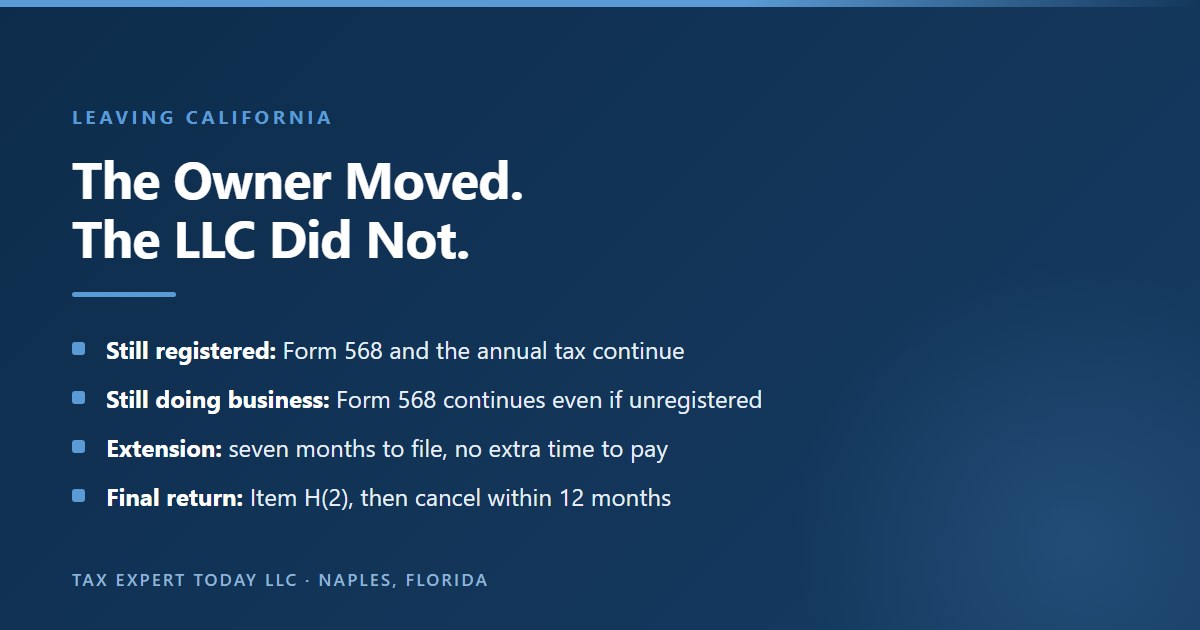
What Is the Checklist for the First California Form 568 After You Move?
Confirm the LLC still must file, fix the member’s move date, collect FTB 3832 or the Side 3 consent, choose the actual date or daily pro rata split, complete column (e) for the departed member, recompute Schedule IW, decide on Schedule T and FTB 3537 by the original date, and file.
- Step 1: confirm registration and doing business status.
- Step 2: fix the member’s move date from the member’s residency records.
- Step 3: collect the consent before the return is transmitted.
- Step 4: prepare the K-1 with California source amounts and the move year split support.
- Step 5: pay any Schedule T tax and unpaid fee by the original due date.
The checklist below follows the order in which the questions usually arise. It assumes a calendar year LLC and a 2026 move. Each step points to the part of the Form 568 booklet, the FTB 3832 instructions, the K-1 instructions or Publication 1100 where the rule sits. The same steps apply to later years, except that the move year split disappears once the member has been a nonresident for a full year.
The most useful single habit is to send the FTB 3832 with the draft K-1. Members who receive both together tend to sign, and members who receive the consent alone months after the K-1 tend not to. Owners of single member LLCs can apply the same habit to themselves: review and sign the Side 3 consent at the time the return is reviewed, rather than leaving it to the preparer’s e-file signature packet.
| Step | Action | Rule source |
|---|---|---|
| 1 | Confirm the LLC is still registered or doing business in California | Booklet, General Information A and Q; R&TC 23101 |
| 2 | Fix each member’s residency status and move date | K-1 instructions, residency determined at member level |
| 3 | Collect FTB 3832 (multiple members) or the Side 3 consent (single member) | FTB 3832 instructions; booklet, Single Member LLC Information and Consent |
| 4 | Gather interim figures or transaction dates for the move year | Publication 1100, actual date of realization |
| 5 | Complete K-1 columns (c), (d) and (e) for the departed member | K-1 instructions |
| 6 | Recompute Schedule IW from current California source amounts | Booklet, Schedule IW instructions |
| 7 | Compute Schedule T for any nonconsenting nonresident | Booklet, Schedule T instructions |
| 8 | Pay Schedule T tax and any unpaid fee by the original due date, with FTB 3537 if extending | Booklet, extensions |
| 9 | Check Questions I and K for ownership changes | Booklet, Questions I and K |
| 10 | E-file with FTB 8453-LLC and the signed FTB 3832 retained | FTB 3832 instructions, e-file |
Can a Florida Preparer File California Form 568 for a California LLC?
Yes. California Form 568, its schedules and form FTB 3832 are filed with the Franchise Tax Board, electronically in most cases, and nothing in the booklet requires the preparer to be located in California. A Naples, Florida firm can prepare the LLC return and the members’ Forms 540NR together, which keeps the K-1 and the individual returns consistent.
- Filing method: e-file with FTB 8453-LLC, or paper where permitted.
- Preparer location: not a condition in the Form 568 booklet.
- Consistency: one firm handling both the LLC and member returns can align the move year split.
- Authorization: the paid preparer checkbox lets the FTB contact the preparer on processing questions.
- Representation: broader FTB representation uses the FTB power of attorney process.
The booklet does not tie Form 568 to a California preparer. It describes the paid preparer authorization on the return, which allows the Franchise Tax Board to call the preparer about processing questions until the due date of the following year’s return, and points LLCs that want to expand that authorization to the FTB power of attorney process. California returns are filed with the Franchise Tax Board regardless of where the LLC’s owners or advisors are based.
The advantage of handling the LLC and the members’ returns together is consistency. The move date the LLC uses for column (e), the allocation method the member uses on Schedule CA (540NR), the consent the LLC collects and the Florida residency records the member keeps all need to tell the same story. Tax Expert Today is a multidisciplinary firm of tax advisors, enrolled agents, CPAs and attorneys that handles state residency and tax matters nationwide, including California returns for owners who have moved to Florida, as described on our California tax services page.
| Return | Filed with | Typical preparer for a Florida owner |
|---|---|---|
| California Form 568 | Franchise Tax Board | The LLC’s tax advisor, wherever located |
| Form FTB 3832 | With Form 568, or retained with FTB 8453-LLC on e-file | Collected by the LLC’s preparer |
| Form 540NR | Franchise Tax Board | The member’s tax advisor |
| Federal Form 1065 or Schedule C | IRS | Often the same advisor |
California Form 568 Help in Naples & Southwest Florida
California Form 568 help Naples FL: Tax Expert Today works with business owners who have moved from California to Naples, Florida and the rest of Southwest Florida and who still own California LLCs, Florida LLCs registered in California, or interests in California partnerships. We prepare California Form 568 with the nonresident consents, Schedule T where it cannot be avoided, the move year K-1 split and the final return when an LLC winds down, and we prepare the members’ Form 540NR returns so the two sides match.
Our office is at 11983 Tamiami Trail N, Naples FL 34110. You can reach us at (239) 441-2005, Monday through Friday, 10:00 to 5:00 Eastern Time. Owners who are still deciding whether to keep, convert or cancel a California LLC can start with our Naples tax planning team, and owners whose businesses need ongoing financial management after the move can look at our fractional CFO services in Naples. For the Florida side of a move, our Florida tax services page describes the residency and planning work we do.
- California LLC returns for Florida owners: Form 568, Schedule IW, Schedule K-1 (568) and FTB 3832.
- Move year allocations: actual date and daily pro rata splits under Publication 1100.
- Final returns and cancellation: coordinated with the Secretary of State filings.
- Member returns: Form 540NR, group Form 540NR and Florida residency documentation.
| Naples office detail | Information |
|---|---|
| Address | 11983 Tamiami Trail N, Naples FL 34110 |
| Phone | (239) 441-2005 |
| Hours | Monday through Friday, 10:00 to 5:00 Eastern Time |
| Service area | Naples, Southwest Florida and clients in all 50 states |
Local FAQ: I moved from Orange County to Naples in 2026 and kept my single member California LLC, which still has California clients. Do I still file California Form 568? Yes. The LLC is still registered in California and still doing business there, so California Form 568 is due for 2026 and later years, along with the annual tax and any LLC fee. Because you are now a nonresident owner, sign the Single Member LLC Information and Consent on Side 3 of the return; otherwise the LLC must compute tax on your share on Schedule T. Your own 2026 return becomes a part-year Form 540NR, and the LLC income from California clients stays California source after the move. Bring the LLC records and your move date documentation to our Naples office and we can prepare both returns together.
When to Engage a Professional
Many single member LLC owners prepare California Form 568 themselves for years without difficulty. The year of a move is different, because the return, the consent, the K-1 split and the member’s own Form 540NR all have to be built from the same facts. It is worth engaging a professional when any of the following apply.
- A member moved during the year and the LLC has uneven income, a large sale or a contract that closed near the move date.
- A nonresident member will not sign FTB 3832, or the LLC has never collected consents from members who left in earlier years.
- The LLC has operations in several states and must apportion income for column (e) and Schedule IW.
- The owner is deciding whether to keep, convert or cancel the California LLC after moving to Florida.
- Returns were missed after the move, or the LLC has received notices about penalties or suspension.
- A member is selling or redeeming an interest after becoming a Florida resident.
The analysis in this guide is general information based on the 2025 Form 568 booklet, the FTB 3832 and Schedule K-1 (568) instructions and FTB publications available on the date of writing. It is not advice for any specific LLC or member, and the 2026 forms should be checked when the Franchise Tax Board releases them. Results depend on the facts of each case. Our related guides on leaving California, the California exit tax, Florida domicile for executives and nonresident withholding cover the adjacent questions. To talk through your LLC’s situation, call (239) 441-2005.
Frequently Asked Questions About California Form 568
Do I still file California Form 568 after moving to Florida?
Yes, if the LLC is still registered with the California Secretary of State or is doing business in California. The filing obligation belongs to the LLC, not to the owner, so a move to Florida changes the owner’s residency but not the LLC’s California return. It ends only after a timely final return and cancellation, or when registration and California activity both end.
What is form FTB 3832?
Form FTB 3832 is the Limited Liability Company Nonresident Members’ Consent. A multiple member LLC files it when it has nonresident members, and each nonresident member, plus any spouse or registered domestic partner, signs to consent to California taxing the member’s distributive share of California source income.
What happens if a nonresident member does not sign FTB 3832?
The LLC must pay tax on that member’s distributive share at the member’s highest marginal rate, computed on Schedule T and reported on Form 568, line 5. Under R&TC section 18633.5 the payment is treated as made by the member, who claims credit by attaching the Schedule K-1 (568) to the member’s California return.
What rate does Schedule T use?
The 2025 Form 568 booklet lists 12.3 percent for an individual, partnership, LLC, estate or trust, 8.84 percent for a C corporation and 1.5 percent for an S corporation. The tax is reduced by any section 18662 withholding already paid for that member and cannot fall below zero.
Does a single member LLC owner sign FTB 3832?
No. A single member LLC does not use form FTB 3832. The owner consents by signing the Single Member LLC Information and Consent on Side 3 of California Form 568. If the owner does not sign, the LLC treats the failure the same way as an unsigned FTB 3832 and completes Schedule T.
When is California Form 568 due for 2026?
For a calendar year LLC classified as a partnership, March 15, 2027. For a single member LLC owned by an individual, April 15, 2027. Both have automatic extensions to file, seven months and six months respectively, but the extension does not extend the time to pay the LLC fee or the nonconsenting member tax.
How does Schedule K-1 (568) handle a member who moved during the year?
The member uses column (d) amounts for the resident period and column (e) California source amounts for the nonresident period. FTB Publication 1100 requires an allocation that reflects the actual date of realization, and only where that is not available a daily pro rata split between the two periods.
Is the 7 percent nonresident withholding the same as Schedule T?
No. Section 18662 withholding is a 7 percent prepayment on distributions of California source income to domestic nonresident members above $1,500 a year. Schedule T is a tax on the distributive share of a nonresident member who has not consented. Withholding already paid reduces the Schedule T tax for that member.
How do I file a final California Form 568?
Check Final Return in Item H(2), check the final K-1 box in Item G(1) on each Schedule K-1 (568), attach a statement explaining the termination, pay the annual tax for the final year, and file the cancellation documents with the Secretary of State within 12 months of the timely final return.
Can a Naples, Florida firm prepare my California Form 568?
Yes. California Form 568 and its schedules are filed with the Franchise Tax Board, usually electronically, and the booklet does not require the preparer to be in California. A Naples, Florida firm can prepare the LLC return and the members’ Forms 540NR together so the move date and allocations match.
Published November 24, 2026 by Dr. Pellumb Kabashi « Back to Learning Center
Have a question this article touches on?
Tax Expert Today LLC, based in Naples, Florida and serving clients across the United States.
Schedule a Consultation (239) 441-2005