
By Dr. Pellumb Kabashi, DBA, MBA, EA, CFE, CES
Founder, Tax Expert Today LLC · Tax advisors, enrolled agents, CPAs, and attorneys · Serving clients in all 50 states
Quick Answer: The IRS audit statute of limitations is generally three years from the date the return was filed. It extends to six years when more than 25 percent of gross income was omitted, and it never expires at all when no return was filed or when the return was fraudulent. Several narrower exceptions can hold a year open far longer than most taxpayers expect. Call (239) 441-2005 for a free consultation.
How Far Back Can the IRS Audit Your Tax Return?
The IRS audit statute of limitations is three years under IRC §6501(a), measured from the date the return was filed. Two well known exceptions extend it: six years where gross income was substantially omitted, and an unlimited period where the taxpayer filed a fraudulent return or filed no return at all. Several narrower provisions extend it further in specific circumstances.
The statute does not describe an audit deadline as such. It describes an assessment deadline, which is the point at which the IRS loses the power to formally record additional tax against you. That distinction matters in practice, because an examination that begins comfortably inside the window still has to produce an assessment before the window closes. This is the reason examiners become preoccupied with the statute date as it approaches, and the reason they ask for extensions. For the sequence the examination itself follows once it opens, see our guide to what happens if you get audited by the IRS. The same clock explains why published IRS audit rates for recent tax years look low: our research on IRS audit rates by income shows the rate for a tax year can keep rising for years after the IRS first reports it.
- Three years is the default. It applies to the ordinary return with no omission, no fraud, and no foreign reporting failure.
- Six years is an exception, not a second default. It requires a specific omission threshold to be met, and the IRS carries the burden of establishing it.
- Unlimited means unlimited. A year in which no return was ever filed stays open indefinitely, with no outer boundary at seven years, ten years, or any other number.
- The clock runs per year and per return. One open year does not open the years around it, and one closed year does not close a neighbouring year that qualifies for an exception.
| Window | Statute | What triggers it |
|---|---|---|
| 3 years | §6501(a) | The default period for a filed, non fraudulent return |
| 6 years | §6501(e)(1)(A)(i) | Omission of gross income exceeding 25 percent of the gross income stated on the return |
| 6 years | §6501(e)(1)(A)(ii) | Omission over $5,000 attributable to a specified foreign financial asset reportable under §6038D, with no 25 percent test |
| Unlimited | §6501(c)(1) | A false or fraudulent return filed with intent to evade tax |
| Unlimited | §6501(c)(3) | Failure to file a return at all |
| Open until filed, then 3 years | §6501(c)(8) | A required foreign information return, such as Form 5471, 8938, or 3520, was never furnished |
When Does the IRS Audit Statute of Limitations Actually Start?
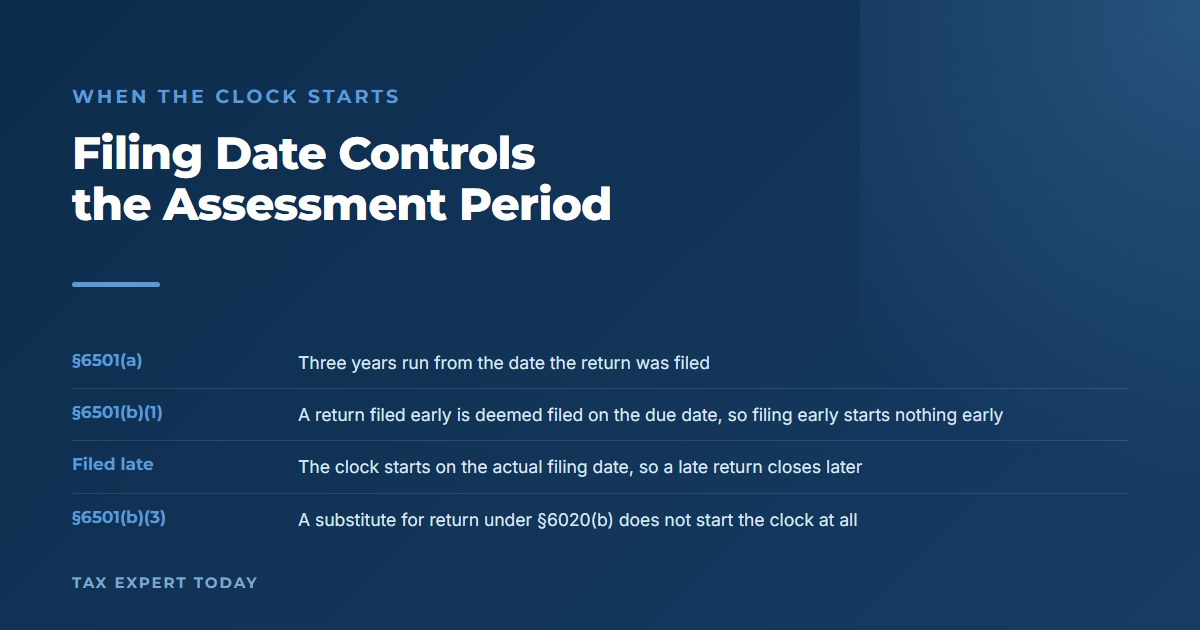
The three year period runs from the date the return was filed, but §6501(b)(1) treats a return filed before the due date as filed on the due date. Filing early therefore does not start the clock early. Filing late does start it, on the actual filing date, which means a late filed return closes later than a timely one.
Two consequences follow, and they run in opposite directions. A taxpayer who files in February gains nothing on the statute, because the clock still starts on the April due date. A taxpayer who files two years late has effectively pushed the closing date two years out, which is a point rarely made on pages that simply repeat the three year headline.
- Early filing is deemed due date filing. Under §6501(b)(1) a return filed before the last day prescribed is considered filed on that last day.
- An extension moves the due date. Where a valid extension is in place, the prescribed last day moves with it, so a return filed within the extension period is generally treated as filed when it was actually filed.
- A late return starts the clock on receipt. The statute measures three years after the return was filed, whether or not it was filed on time.
- A substitute for return does not start the clock. This is the most consequential rule in the paragraph, and it is covered next.
| Filing scenario | Deemed filing date | Three year period closes |
|---|---|---|
| 2022 return filed February 10, 2023 | April 18, 2023, the due date, under §6501(b)(1) | April 18, 2026 |
| 2022 return filed on the April 2023 due date | The due date | April 2026 |
| 2022 return filed October 2023 on a valid extension | October 2023, the actual filing date | October 2026 |
| 2022 return filed late in March 2027 | March 2027, the actual filing date | March 2030 |
| 2022 return never filed | No filing date exists | Never, under §6501(c)(3) |
| Substitute for return prepared by the IRS | Does not count as a filing | Never, under §6501(b)(3) |
That last row deserves emphasis. Under §6501(b)(3), the execution of a return by the Secretary under §6020(b) does not start the running of the period of limitations on assessment and collection. When the IRS prepares a substitute for return because a taxpayer did not file, that document does not close the year. The year remains open until the taxpayer files an actual return, which is one of the strongest practical arguments for filing even very old delinquent years. Our guide to unfiled tax returns and the substitute for return process covers how that catch up is sequenced.
What Triggers the Six Year IRS Audit Statute of Limitations?
The six year period under §6501(e)(1)(A)(i) applies when a taxpayer omits from gross income an amount exceeding 25 percent of the gross income stated on the return. The test measures omitted gross income against reported gross income. It is not a test of understated tax, and it is not a test of overstated deductions.
The measurement rule is where most readers go wrong. The comparison is made against gross income stated in the return, not against corrected or actual gross income, and §6501(e)(1)(B)(i) defines gross income for a trade or business as total amounts received or accrued from the sale of goods or services before any reduction for the cost of those sales or services. For a business, then, the denominator is gross receipts rather than net profit, which usually makes the 25 percent threshold considerably harder for the IRS to reach.
- Deductions do not count. An inflated deduction reduces taxable income, but it is not an omission from gross income, so it does not trigger the six year rule on its own.
- Gross receipts are the business measure. Under §6501(e)(1)(B)(i) the cost of goods or services is not subtracted first.
- Adequate disclosure can defeat the test. Under §6501(e)(1)(B)(iii), an amount disclosed in the return, or in a statement attached to it, in a manner adequate to apprise the Secretary of the nature and amount of the item is not counted as omitted. There is now one carve out from this escape, discussed in the next section.
- Subpart F income has its own rule. §6501(e)(1)(C) applies the six year period to amounts includible under §951(a) without reference to the 25 percent threshold.
Does Overstating Basis Trigger the Six Year Rule After Home Concrete?
Yes, and this is where most competing pages are out of date. In United States v. Home Concrete & Supply, 566 U.S. 478 (2012), the Supreme Court held that an overstatement of basis was not an omission from gross income. Congress reversed that result by statute in 2015, so an overstated basis now does trigger the six year period.
The mechanism is worth stating precisely, because it is verifiable in the text of the Code. Section 6501(e)(1)(B)(ii) now reads that an understatement of gross income by reason of an overstatement of unrecovered cost or other basis is an omission from gross income. That clause was added by Pub. L. 114-41, title II, §2005(a)(1), enacted July 31, 2015. The same act redesignated the former clause (ii) as clause (iii) and inserted the words “other than in the case of an overstatement of unrecovered cost or other basis” into it.
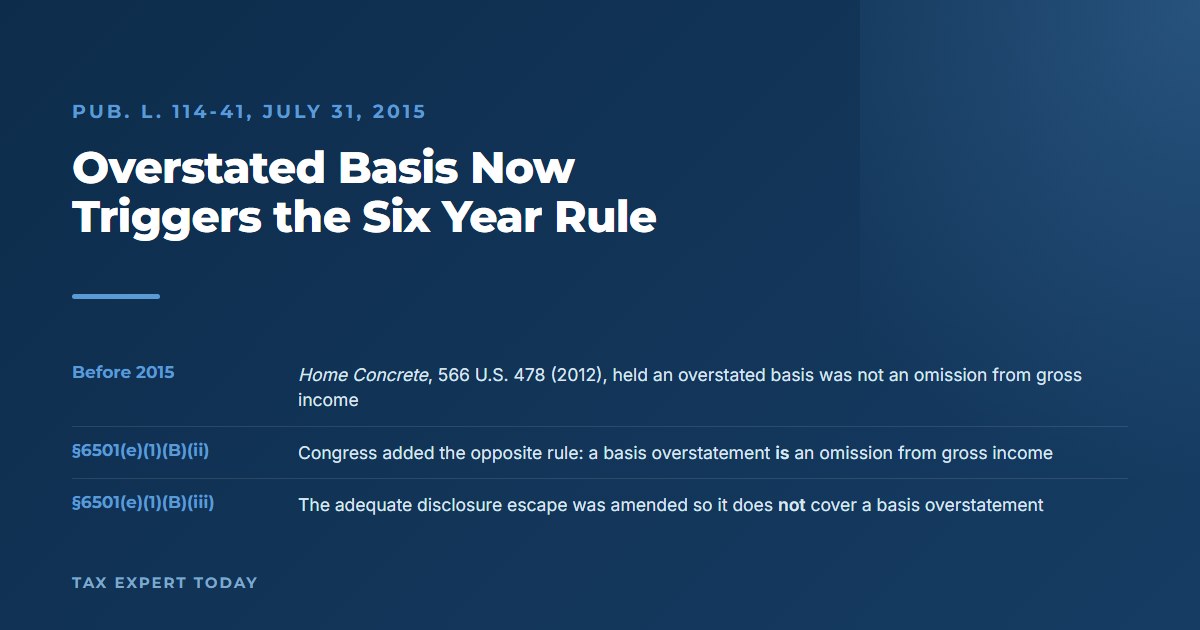
That second change is the one practitioners should not miss. It means the adequate disclosure escape in clause (iii), which otherwise lets a taxpayer neutralize the 25 percent test by disclosing the item, does not apply to a basis overstatement. Disclosure will not save the year. The effective date provision at §2005(b) applies the amendments to returns filed after July 31, 2015, and also to returns filed on or before that date if the §6501 period had not yet expired as of that date.
- Home Concrete is no longer the operative rule. The case remains good law as to the pre amendment statute it construed, and it is still cited for that narrow historical purpose.
- Basis overstatements now count toward the 25 percent test. This most often reaches sales of real estate, closely held business interests, and securities with poorly documented cost.
- Disclosure does not cure a basis overstatement. The carve out in clause (iii) removes that option specifically.
- Cost documentation is therefore a statute issue, not only a valuation issue. Weak basis records can extend the audit window, not merely change the amount of gain.
When Does the IRS Have Unlimited Time to Assess?
Three situations remove the deadline entirely. Under §6501(c)(1) a false or fraudulent return filed with intent to evade tax may be assessed at any time. Under §6501(c)(2) a willful attempt to defeat or evade certain taxes may be assessed at any time. Under §6501(c)(3) a failure to file a return leaves the year open at any time.
Fraud under §6501(c)(1) requires intent, and the IRS generally bears the burden of proving it by clear and convincing evidence. An error, an aggressive position, or even a substantial understatement is not by itself fraud. The unlimited period in the non filing case is different in character, because it does not require the IRS to prove anything about the taxpayer’s state of mind. The year simply never closes until a return is filed.
- Fraud requires intent to evade. Negligence and error do not open the unlimited window.
- Non filing needs no intent at all. §6501(c)(3) applies on the fact of the missing return.
- Filing a return closes the open window prospectively. Once an actual return is filed, the ordinary period begins to run from that filing date.
- Unreported gifts follow a parallel rule. Under §6501(c)(9), gift tax on a gift required to be shown and not shown on a gift tax return may be assessed at any time, unless the item was adequately disclosed.
Where fraud is alleged rather than established, and where an examination has already produced an assessment the taxpayer believes is wrong, audit reconsideration is sometimes the route back into the file.
How Do Unfiled Forms 5471, 8938, and 3520 Keep a Return Open?
Under §6501(c)(8), when information required under a listed international reporting provision is not furnished, the assessment period for the return does not expire before three years after the IRS receives that information. Because the clock cannot start until the form is filed, an unfiled international form can hold a year open indefinitely.
The provisions named in the statute include §6038 and §6038A, §6038B, §6038D, §6046 and §6046A, §6048, and elections under §1295(b) or §1298(f). In practical terms this reaches Form 5471 for foreign corporations, Form 8938 for specified foreign financial assets, Form 3520 for foreign gifts and trusts, and Form 8865 for foreign partnerships, among others.
- The default reach is the whole return. §6501(c)(8)(A) suspends the period for any tax with respect to any return, event, or period to which the unreported information relates.
- Reasonable cause narrows it. Under §6501(c)(8)(B), if the failure was due to reasonable cause and not willful neglect, the extension applies only to the item or items related to the failure, not to the entire return.
- A separate six year rule also exists. §6501(e)(1)(A)(ii) imposes a six year period where an omission over $5,000 is attributable to a §6038D reportable asset, with no 25 percent threshold to satisfy.
- FBAR is not part of this. The FBAR is filed with FinCEN rather than the IRS and runs on its own limitations rules, as explained in our comparison of FBAR and Form 8938 obligations.
Is There Really an IRS 7 Year Rule?
No. There is no seven year assessment period anywhere in §6501. The seven year figure is a records retention convention, not a statute of limitations, and it circulates widely because keeping records for seven years comfortably covers the three year default and the six year omission period with a margin.
The confusion is understandable but it has a cost, because a taxpayer who believes an old year is automatically closed at seven years may discard the documentation that would defend it. Where no return was filed, or where an international form was never furnished, the year can remain open well past seven years and the records are the only defence available.
- Seven years is guidance about paper, not about exposure. It has no statutory basis in §6501.
- Retention should follow the longest applicable window. Property records generally need to survive until the statute runs on the year the property is sold.
- Basis records now carry statute consequences. Following the 2015 amendment discussed above, thin cost records can extend the assessment period rather than only affecting the computed gain.
Should You Sign a Form 872 to Extend the Assessment Period?
It depends on the facts, and it is a decision that should be made deliberately rather than reflexively. §6501(c)(4)(A) permits the IRS and the taxpayer to consent in writing to a later assessment date. §6501(c)(4)(B) requires the IRS to notify the taxpayer of the right to refuse the extension, or to limit it to particular issues or a particular period.
That statutory right to refuse or to limit is the part most taxpayers do not know they have. A consent is an agreement, not an order, and Publication 1035 is the IRS publication describing the process and the forms used, including the consent to extend the time to assess tax, the version for miscellaneous excise taxes, and the version for employment taxes.
- Refusing is not neutral. Where the statute is close to expiring and the examiner cannot finish, refusal commonly prompts an immediate assessment on the information then available, which shifts the dispute to the appeals and petition stages.
- A restricted consent is often the middle path. Limiting the extension to the specific issues still under examination keeps the remaining items closing on schedule.
- Fixed date and open ended consents differ. A fixed date consent expires on a stated date, while an open ended consent runs until it is terminated under its own procedure.
- Consents can be extended again. §6501(c)(4)(A) permits subsequent written agreements made before the previously agreed period expires.
How Is the Audit Clock Different From the IRS 10 Year Collection Clock?
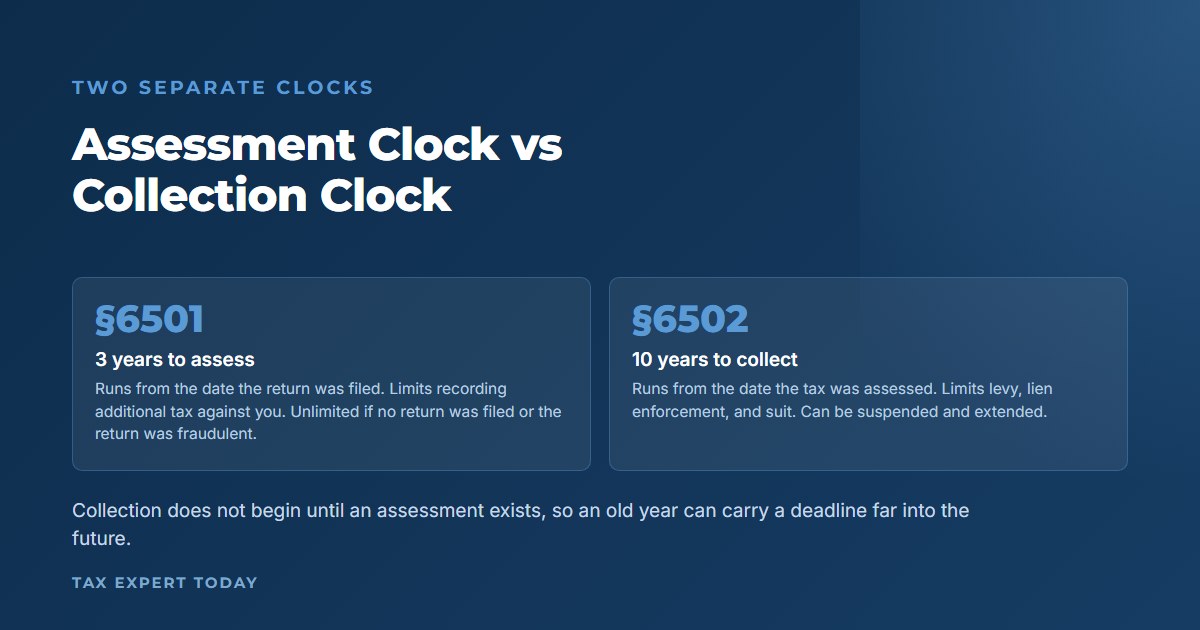
They are two separate clocks that run in sequence. §6501 governs how long the IRS has to assess a tax, and it usually runs three years. §6502 governs how long the IRS has to collect a tax after it has been assessed, and it runs ten years from the assessment date.
Because the collection period does not begin until an assessment exists, an old year can produce a collection exposure that reaches far into the future. A 2019 return assessed following a 2025 examination carries a collection statute expiration date around 2035, even though the return itself is more than a decade old by then. Our guide to the IRS 10 year rule and when tax debt expires covers how that date is computed and what suspends it.
| Question | Assessment clock | Collection clock |
|---|---|---|
| Statute | §6501 | §6502 |
| Standard length | 3 years | 10 years |
| Starts when | The return is filed, or is deemed filed on the due date | The tax is assessed |
| What it limits | Recording additional tax against you | Levy, lien enforcement, and suit to collect |
| Unlimited if | No return filed, or fraud | Never unlimited, but it can be suspended and extended |
| Commonly extended by | A written consent under §6501(c)(4) | Pending collection alternatives, bankruptcy, and time abroad |
What Other Exceptions Extend the Assessment Period?
Beyond the headline three, six, and unlimited windows, §6501 contains a set of narrower provisions that suspend or extend the period in defined circumstances. These are the provisions that most often surprise a taxpayer who assumed a year had closed.
- Late amended returns showing more tax. Under §6501(c)(7), where a signed document showing additional tax arrives within the 60 day period ending on the expiration date, the period does not expire before 60 days after the IRS receives it.
- Listed transactions. Under §6501(c)(10), failure to include required information on a listed transaction holds the period open until one year after the information is furnished.
- Estate and gift omissions. §6501(e)(2) applies a six year period where items exceeding 25 percent of the stated gross estate or total gifts were omitted.
- Excise tax omissions. §6501(e)(3) applies a six year period where the omitted excise tax exceeds 25 percent of the amount reported.
- Personal holding company returns. §6501(f) applies a six year period where the required schedule of gross income and shareholders was not filed with the return.
- Summons disputes. Under §7609(e), a taxpayer's proceeding to quash a third-party IRS summons suspends the period while it is pending, and an unresolved third-party response suspends it beginning six months after service.
- Deficiency notice suspension. Issuing a statutory notice of deficiency suspends the running of the period while the taxpayer’s window to petition the Tax Court is open, and for a period afterward.
An IRS CP2000 notice, which proposes changes from automated underreporter matching rather than a full examination, is also subject to these same assessment deadlines. A CP2000 that arrives late in the cycle is frequently a signal that the statute date is approaching.
IRS Audit Statute of Limitations Help in Naples and Southwest Florida
Tax resolution Naples clients often contact our office in Naples, Florida holding a letter about a year they assumed was long closed. The first question is almost always the same, and it is a factual one rather than a legal one: what exactly was filed, and when. The answer usually comes from the account and return transcripts rather than from memory, because the statute turns on filing dates, assessment dates, and prior consents that a taxpayer may not recall signing.
Tax Expert Today LLC
11983 Tamiami Trail N, Naples, FL 34110
Phone: (239) 441-2005
Hours: Monday through Friday, 10:00 to 5:00 ET
Does living in Florida change the IRS audit statute of limitations? No. Section 6501 is federal law and it applies identically in every state, so a Naples or Fort Myers taxpayer faces the same three, six, and unlimited windows as a taxpayer anywhere else. Florida residency does simplify the picture in one respect, because Florida imposes no state individual income tax and there is therefore no parallel state assessment period running alongside the federal one. Taxpayers who moved to Southwest Florida from another state should still expect the former state’s own limitations rules to apply to the years they lived there, and those rules are frequently longer than the federal three year period. Our IRS resolution and audit support service page and our Naples tax resolution page describe how we handle these matters.
When to Engage a Professional
A statute question is worth professional review when the answer is not obvious from the face of the return. Consider engaging a representative when an examiner has asked you to sign a consent extending the assessment period, when a year you believed closed is being examined, when the six year rule may be in play because of a large sale with uncertain basis, when an international information return was never filed, when no return was filed for one or more years, or when fraud has been raised in any form. Where the underlying issue is a balance that has already been assessed, the collection statute expiration date rather than the assessment statute will usually drive the strategy. Statute computations depend on the actual transcript dates for the specific year at issue, and general rules are not a substitute for that record.
This article is educational and general in nature. It does not constitute tax advice for any particular taxpayer, and outcomes depend on individual facts and circumstances.
Published August 24, 2026 by Dr. Pellumb Kabashi « Back to Learning Center
Have a question this article touches on?
Tax Expert Today LLC, based in Naples, Florida and serving clients across the United States.
Schedule a Consultation (239) 441-2005