
By Dr. Pellumb Kabashi, DBA, MBA, EA, CFE, CES
Founder, Tax Expert Today LLC · Tax advisors, enrolled agents, CPAs, and attorneys · Serving clients in all 50 states
Quick Answer: The Georgia voluntary disclosure program lets a business or individual with unfiled or underreported Georgia taxes come forward before the Department of Revenue makes contact. In return, the Department generally waives penalties and limits the lookback period, usually to three years. Tax and interest are still owed. Call (239) 441-2005 for a free consultation.
Most Georgia tax problems that reach a professional start with a letter. The Georgia voluntary disclosure program exists for the opposite situation: the taxpayer finds the problem first. A company realizes it has been selling into Georgia for years without collecting sales tax. An employer learns that a remote employee in Atlanta created a withholding obligation that nobody registered for. An individual who filed federal returns every year discovers that Georgia returns were also required. In each case, no notice has arrived, and that fact is the most valuable thing the taxpayer has.
The Georgia Department of Revenue runs the program through its Audits Division under the name Voluntary Disclosure Agreement, usually shortened to VDA. The published rules are short. The Department’s program page runs only a few hundred words, and it leaves many of the practical questions unanswered: what counts as contact, how the lookback period is counted, what happens to tax that was collected and never sent in, how the direct route compares with the multistate route, and what a taxpayer who does not qualify can do instead. This guide works through each of those questions using the Department’s own pages and the Georgia Code.
One note on scope. This is a Georgia state tax program administered by the Georgia Department of Revenue. It is not an Internal Revenue Service program, and an agreement with Georgia does not settle any federal tax question. Nothing here describes or predicts the outcome of any specific application. The Department decides each request on its own facts.
What Is the Georgia Voluntary Disclosure Program?
The Georgia voluntary disclosure program is a Department of Revenue process that encourages taxpayers with unfiled or underreported Georgia tax liabilities to come forward before the Department contacts them. A qualified applicant signs a Voluntary Disclosure Agreement, files the returns for a limited lookback period, and pays the tax and interest, and the Department generally waives the penalties.
- Who runs it: The Audits Division of the Georgia Department of Revenue, reachable at vda@dor.ga.gov or 404-417-6501.
- Who can use it: Individuals and businesses. The program page states that the taxpayer may be either.
- What it trades: The taxpayer gives up the chance that the liability is never found. The state gives up penalties and, in most cases, the years before the lookback period.
- What it does not waive: The tax itself for the lookback period, and interest on that tax.
- What form it takes: A written agreement. The terms that matter are the ones in the signed document, not the general description on the website.
The logic of the program is easier to see next to the default rules. Under O.C.G.A. 48-2-49, Georgia generally has three years from the date a return is filed to assess additional tax. When no return is filed at all, the statute says the tax may be assessed at any time. A business that should have started filing Georgia sales tax returns ten years ago therefore has ten open years, and it will keep adding open years for as long as it stays silent. On top of the tax, each of those years carries late filing and late payment penalties and interest that has been running since the original due dates.
A Voluntary Disclosure Agreement replaces that open-ended exposure with a defined one. The Department describes two benefits: a waiver of penalties, and a limit on how far back the taxpayer must file and pay. Everything else in this guide is detail about how to qualify for those two benefits and how to avoid losing them.
Who Qualifies for the Georgia Voluntary Disclosure Program?
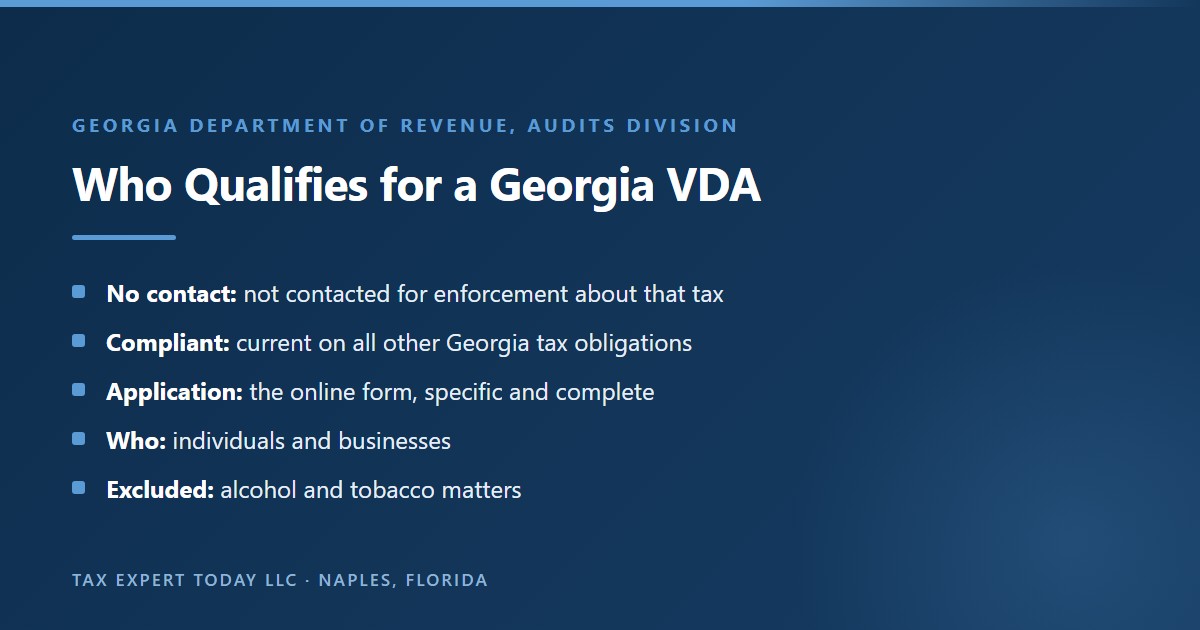
To qualify for the Georgia voluntary disclosure program, a taxpayer must not have been contacted by the Department of Revenue for enforcement purposes about the tax being disclosed, must be compliant with all other Georgia tax obligations that the agreement will not cover, and must submit the Department’s online application. Individuals and businesses are both eligible.
- No prior enforcement contact: The test applies to the specific tax obligation being disclosed. Contact about one tax does not automatically bar disclosure of a different tax.
- Compliance elsewhere: Taxes outside the agreement must be current, or the gaps must be disclosed in the same application.
- A complete application: The Department warns that vagueness or ambiguity will only delay processing.
- More than one tax type: An applicant that is behind on several taxes may apply for agreements on multiple tax types in one application.
- Other noncompliance: An outstanding prior liability should be listed, and the Department says it may be resolved in conjunction with the agreement.
The second requirement deserves attention because it catches applicants by surprise. A company that wants to disclose three years of uncollected sales tax, and that also has an unfiled corporate income tax return, is not compliant with its other Georgia tax obligations. The answer is not to hide the second problem. The Department’s page says that if the applicant is not compliant with more than one tax type, it may apply for agreements for multiple tax types in one application, and that other areas of noncompliance should be listed so they can be resolved together. A full inventory of every Georgia tax the taxpayer touches is therefore the first step, before anything is submitted.
That inventory usually includes more than the tax that prompted the call. A business with employees in Georgia should check Georgia withholding tax. A business with Georgia customers should check sales tax collection and Georgia use tax on its own purchases. A corporation or an entity taxed as one should check income tax and the Georgia net worth tax. A partnership or S corporation with nonresident owners should check the withholding and Georgia composite return rules. Each of these is a separate tax type with its own penalty schedule.
What Counts as Contact by the Department of Revenue?
The Department’s rule is that the taxpayer must not have been contacted for enforcement purposes about the tax obligation being disclosed. The program page does not list every form of contact. In practice an audit notice, a nexus inquiry, or a letter asking why returns were not filed is the kind of contact that can end eligibility for that tax.
- Tax by tax: The Department’s wording ties the contact to “that tax obligation,” so the question is asked separately for each tax type.
- Enforcement, not routine mail: The published test refers to contact for enforcement purposes. General mailings are a different matter, though the Department decides close cases.
- Timing: Eligibility is measured when the taxpayer comes forward. A notice that arrives the week before an application is submitted can change the answer.
- The multistate standard is stricter: Under the Multistate Tax Commission process, contact includes filing a return, paying tax, or receiving an inquiry from the state about that tax type.
The difference between the two standards matters. The Georgia page asks whether the Department has contacted the taxpayer for enforcement purposes. The Multistate Tax Commission program, which Georgia participates in, states that prior contact between a state and the taxpayer concerning a tax type disqualifies the taxpayer for that tax type, and it defines contact to include filing a tax return, paying tax, or receiving an inquiry. A business that has already been filing Georgia returns and has simply underreported is described as eligible on the Georgia page, which speaks of “unfiled or underreported” liabilities, but it may not fit the multistate definition. Route selection is covered later in this guide.
Because the test is applied at the moment of disclosure, delay is the main risk. Georgia receives information from many sources, including other states, federal return data, marketplace reporting, and its own audits of customers and vendors. A taxpayer who has identified an exposure and waits a year to act is betting that none of those sources produces a letter first. Once a letter about that tax arrives, the voluntary program is generally no longer available for it, and the conversation moves to ordinary penalty waiver requests and audit defense.
Which Georgia Taxes Can a Voluntary Disclosure Agreement Cover?
The Department’s page refers to “all tax types” when it describes the lookback period, and it names sales and use tax and withholding tax specifically. Income tax and corporate net worth tax are also taxes the Department administers. Alcohol and tobacco licensing, registration, and tax matters are expressly excluded from the program and go to a separate division.
- Sales and use tax: The most common subject, including uncollected sales tax and unpaid use tax on purchases.
- Withholding tax: Employer withholding that was never registered for, or was withheld and not sent in.
- Income tax: Individual and corporate income tax, including nonresidents with Georgia source income.
- Corporate net worth tax: Usually disclosed together with corporate income tax because both ride on the same return family.
- Excluded: Alcohol and tobacco matters. The Department directs those businesses to the Alcohol and Tobacco Division at 877-423-6711.
| Tax type | Typical disclosure situation | Handled by this program? |
|---|---|---|
| Sales and use tax | Out-of-state seller never registered; buyer never accrued use tax | Yes, named on the program page |
| Withholding tax | Remote employees in Georgia; nonresident owner withholding | Yes, named on the program page |
| Individual income tax | Resident or nonresident who never filed Form 500 | Yes, individuals are eligible applicants |
| Corporate income and net worth tax | Entity doing business in Georgia without filing Form 600 or 600S | Yes, as a Department administered tax |
| Alcohol and tobacco taxes and licenses | Unlicensed or unreported activity | No, referred to the Alcohol and Tobacco Division |
| Taxes run by other agencies or local governments | State unemployment tax, local business licenses, county property tax | Not a Department of Revenue VDA matter |
The last row is a practical boundary rather than a quotation from the program page. A Voluntary Disclosure Agreement is a contract with the Department of Revenue, so it reaches the taxes that Department administers. The Georgia unemployment tax is administered by the Georgia Department of Labor, and local occupation taxes and property taxes belong to cities and counties. A business cleaning up its Georgia footprint needs a separate plan for each of those. The excluded alcohol and tobacco matters have their own rules, which our guides to the Georgia alcohol tax and the Georgia tobacco tax cover.
What Are the Benefits of a Georgia Voluntary Disclosure Agreement?
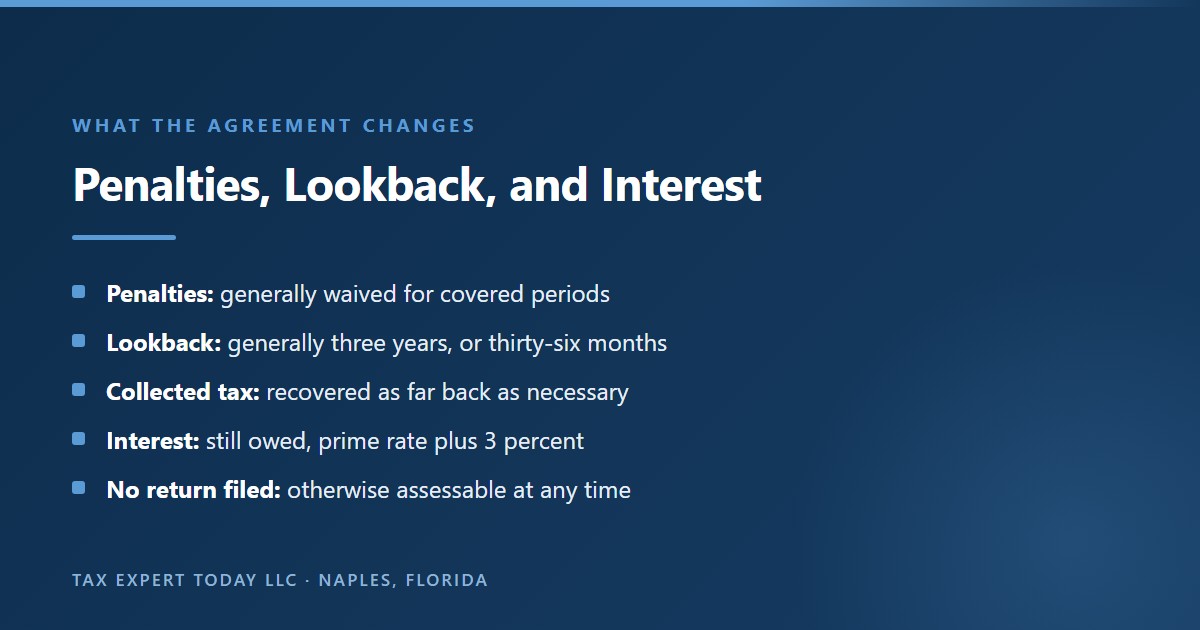
A qualified participant will usually receive a waiver of all penalties and a limit on the length of time for which returns must be filed and tax paid. The Department generally waives penalties for every period included in the agreement. Interest is still imposed on all amounts due, and the tax itself is not reduced.
- Penalty waiver: Late filing and late payment penalties for the covered periods are generally waived.
- Limited lookback: Periods before the lookback period are generally not pursued for a taxpayer that never filed.
- Certainty: The agreement fixes the periods, the tax types, and the terms in writing.
- A path to payment terms: The Department states that an applicant unable to pay the total may request a payment plan.
- No interest waiver: The program page states that interest will still be imposed on all amounts due.
The size of the penalty waiver depends on the tax. Georgia does not have one late penalty. It has a separate schedule for each tax type, published on the Department’s Penalty and Interest Rates page. For a taxpayer that never filed, both the late filing and the late payment penalty are normally in play for every period, and the Department’s schedule lists a 25 percent ceiling for each on the sales and use tax table.
| Tax type | Late filing penalty | Late payment penalty | Statute (O.C.G.A.) |
|---|---|---|---|
| Income tax (individual and corporate) | 5 percent of unpaid tax per month, up to 25 percent | 0.5 percent per month, up to 25 percent; the two combined cannot exceed 25 percent | 48-7-57 and 48-7-86 |
| Sales and use tax | Greater of 5 percent or $5 per month, up to the greater of 25 percent or $25 | Greater of 5 percent or $5 per month, up to the greater of 25 percent or $25 | 48-8-66 |
| Withholding tax | $25 plus 5 percent of tax withheld per month, up to $25 plus 25 percent | $25 plus 5 percent per month, up to $25 plus 25 percent | 48-7-126 |
| Corporate net worth tax | 10 percent of the tax due | 10 percent of the tax due | 48-13-79 |
These are the Department’s published rates as of the date of this guide. Other penalties can stack on top, such as the electronic filing and electronic payment penalties that apply when more than $500 of sales, withholding, or motor fuel distributor tax is due on a return. A fraud penalty of 50 percent applies to false or fraudulent returns under O.C.G.A. 48-8-66 for sales tax and under the income tax penalty provisions. The program page speaks of penalties generally, and whether any particular penalty is waived is a term of the specific agreement.
How Far Back Does the Georgia Lookback Period Reach?
The lookback period is generally three years but can be shorter or longer depending on the taxpayer’s circumstances. The Department states that it will usually be a minimum of three years for all tax types. For sales and use tax or withholding tax it is usually thirty-six months, extended as far back as necessary for tax collected and not remitted.
- General rule: Three years for annual taxes such as income tax.
- Monthly and quarterly taxes: Thirty-six months for sales and use tax and for withholding tax.
- Factors the Department names: The nature of the taxpayer’s activities and the other information submitted in the application.
- The exception: No limit for tax that was collected from customers or withheld from employees and never paid over.
- Negotiated, not automatic: The Department says the period “can be shorter or longer,” so the number is a term of the agreement.
To see what the limit is worth, compare it with the statute. Under O.C.G.A. 48-2-49(c), a failure to file a return leaves the tax open to assessment at any time. A business that has had Georgia nexus since 2015 and never filed has every period since 2015 exposed. With a thirty-six month lookback, the periods before the lookback window are generally left alone. For a non-filer, the lookback limit is often worth far more than the penalty waiver.
The program page does not publish a formula for counting the months. The Multistate Tax Commission’s frequently asked questions describe the method that many states use: the lookback period covers the complete filing periods before the date the application is received, plus the current incomplete period, which must then be filed and paid on time. For an annual income tax return, a three-year lookback means the three most recent tax years for which returns are already delinquent on the application date. The Commission also notes that each state’s laws and policies control, so the dates in a Georgia agreement should be confirmed in the draft agreement itself and not assumed.
| Situation | Exposure with no agreement | Usual exposure under a VDA |
|---|---|---|
| Never filed a return for the tax | All periods, with no time limit on assessment | Generally three years or thirty-six months |
| Filed returns but underreported | Generally three years from filing; longer in some income tax cases | Generally three years, with penalties waived |
| Collected sales tax or withheld wages and kept it | All periods, plus possible personal liability | As far back as necessary to recover the tax |
| Penalties | Full schedule for each period | Generally waived |
| Interest | Runs from each original due date | Still owed for the lookback periods |
The second row shows that the lookback limit matters less for a taxpayer that has been filing. A filed return already starts the three-year assessment clock, so the agreement mostly delivers the penalty waiver and a clean, agreed correction. One caution applies to income tax: under O.C.G.A. 48-7-82, an omission of more than 25 percent of the gross income stated on the return extends the assessment period to six years, so an underreporting filer may have more open years than the general rule suggests.
What Happens to Sales Tax or Withholding That Was Collected but Not Remitted?
Tax that a business collected from customers or withheld from employees and did not send in is treated differently. The Department states that the lookback period for sales and use tax or withholding tax will be extended as far back as necessary to recover taxes that a taxpayer collected yet did not remit. The three-year limit does not protect it.
- Trust fund character: The Department describes sales tax and withholding as money that belongs to the state and is held in trust.
- No lookback shelter: Every period in which tax was collected and kept is included, however old.
- Personal exposure: Georgia law can hold responsible individuals personally liable for these taxes.
- Disclosure still helps: The penalty waiver and an orderly resolution remain possible, subject to the Department’s decision.
The distinction is between tax that should have been collected and was not, and tax that was collected and not paid over. A remote seller that never charged Georgia sales tax owes the tax out of its own pocket for the lookback period, and the earlier years generally fall away. A seller that charged its customers Georgia tax on every invoice for seven years and kept the money has seven years to repay. The Department’s penalty waiver page explains the reasoning in plain terms: the money collected or withheld belongs to the state, and it cannot be used by a business as operating capital.
The personal side comes from O.C.G.A. 48-2-52. An officer or employee of a corporation, a member, manager, or employee of a limited liability company, or a partner or employee of a limited liability partnership who has control or supervision of collecting and paying over these taxes, and who willfully fails to do so, is personally liable for the amount not paid. Owners sometimes assume the entity shields them. For collected sales tax and withheld income tax, it may not. This is one reason a disclosure involving trust taxes should be planned with care before any facts are sent to the Department.
How Much Interest Is Owed Under a Georgia Voluntary Disclosure Agreement?
Interest is not waived. The Department states that interest will still be imposed on all amounts due. Georgia interest accrues monthly from the date the tax was due until it is paid, at an annual rate equal to the Federal Reserve prime rate plus 3 percent, a rate the Department reviews each January.
- Rate formula: Prime plus 3 percent for interest accruing on or after July 1, 2016, under O.C.G.A. 48-2-40.
- Older periods: 12 percent a year, 1 percent a month, for months before July 1, 2016.
- Accrual: Monthly, from the original due date of each return in the lookback period.
- Annual reset: The rate may be adjusted in January of each calendar year, so different years in one agreement can carry different rates.
Because the rate floats with the prime rate, an estimate prepared for an application should use the rate in effect for each calendar year in the lookback period and should be labeled as an estimate. The Department computes the final figure. An estimate that is honest about its method is more useful than one that claims precision.
A hypothetical shows how the pieces fit. Assume an out-of-state furniture retailer should have been collecting Georgia sales tax for six years and never registered. Its Georgia tax would have been $20,000 a year. With no agreement, all six years are open because no return was filed: $120,000 of tax, late filing and late payment penalties under the schedule above for every period, and interest from each due date. Under a typical thirty-six month lookback, the retailer would file for the last three years and pay $60,000 of tax plus interest on that amount, with penalties generally waived and the earlier three years generally not pursued. The figures are illustrative only. The actual lookback, the treatment of each penalty, and the interest are set by the Department in the agreement.
How Do You Apply for the Georgia Voluntary Disclosure Program?
An applicant submits the Voluntary Disclosure Agreement application online through the Department of Revenue website. The form has five sections: applicant information, company or individual tax filing information, a statement of estimated tax liability, an additional statement of estimated tax liability, and supporting document uploads. The Department asks applicants to be specific.
- Applicant information: Contact name, company, email, phone, and address. Email and phone are required fields.
- Tax filing information: The company or individual facts the Department needs to identify the tax types and filing history.
- Statement of estimated tax liability: The applicant’s own estimate of tax due, by tax type and period.
- Supporting documents: Uploads that back up the estimate and the description of activities.
- Not every question applies: The form notes that some questions relate only to specific tax types.
The application carries a privacy instruction that is easy to miss. The Department says that information sent electronically through the form is not secure, and it recommends that applicants not include a Social Security number, a federal employer identification number, or a Georgia tax identification number in the correspondence. The application is the opening of a conversation, not the place to send a full identity file.
The quality of the estimate drives the rest of the process. The Department’s page says the length of the lookback period depends on factors that include the nature of the taxpayer’s activities and other information submitted in the application. An applicant that describes its Georgia activity precisely, states when that activity began, and provides a supportable estimate by period gives the Audits Division what it needs to draft terms. For sales and use tax, the Department publishes a sample spreadsheet for reporting transactions with county codes, because Georgia sales tax is reported by jurisdiction and the local rates differ by county.
The program page does not publish a processing timeline or a standard form of agreement. In general terms, the sequence that follows an application is a review by the Audits Division, a proposed agreement that states the tax types, the lookback period, and the terms, signature by both sides, and then the filing of the back returns or schedules and payment. For businesses that were never registered, registration through the Georgia Tax Center is part of coming into compliance; our guide to the Georgia tax ID number explains the account types. Applicants should expect the Department to ask follow-up questions, and should treat every answer as a representation the Department will rely on.
Can You Apply Anonymously?
Yes. The Department of Revenue states that anonymous requests will be accepted as long as the request includes the name and contact information of a taxpayer representative. The representative submits the application and deals with the Audits Division, and the taxpayer’s identity is disclosed when the taxpayer decides to go forward with an agreement.
- Who can be anonymous: The taxpayer, not the representative. The Department needs a named person to correspond with.
- Why it matters: The taxpayer can learn the likely terms before committing its name to the file.
- What still must be accurate: Every fact in the application. Anonymity does not loosen the duty to describe the activity truthfully.
- The multistate route: The Multistate Tax Commission identifies the applicant to a state only by case number until an agreement is signed.
Anonymity is the feature that makes the program usable in practice. A business that is unsure whether it qualifies, or unsure how the Department will treat an unusual fact, can have its representative describe the situation and see a proposed lookback period before its name is attached. If the terms are not acceptable, the taxpayer has learned something without having identified itself. That said, an anonymous inquiry does not stop the clock on eligibility. If the Department contacts the taxpayer about that tax through an unrelated channel while the inquiry is pending, the position can change, and how the Department treats that timing is a question to raise at the start.
The facts given during the anonymous stage carry forward. An agreement is built on the applicant’s representations about what it does in Georgia, when it started, and how much tax is involved. If those representations turn out to be materially wrong, the taxpayer should expect the Department to treat the agreement as not covering the true facts. The estimate does not have to be exact to the dollar, but it must be made in good faith and the description of activity must be complete.
Can You Get a Payment Plan With a Georgia Voluntary Disclosure Agreement?
The Department’s program page states that an applicant unable to pay the total amount due may request a payment plan. Georgia payment plans cannot exceed 60 months, carry a minimum monthly payment of $25, and require that the last five years of state tax returns be filed. Approval is a separate decision by the Department.
- Maximum length: 60 months under the Department’s published payment plan requirements.
- Basic bars: The taxpayer cannot be in bankruptcy and cannot have a pending offer in compromise.
- Filing requirement: The last five years of state tax returns must be filed.
- Interest continues: Interest keeps accruing on the unpaid balance while a plan runs.
- Not available through the multistate route: The Multistate Tax Commission states that full payment is due when the agreement is entered.
This is one of the clearest differences between the two routes into the program. The Multistate Tax Commission’s guidance says that a payment plan with a state is not available through its program, that the full back tax liability must be paid when the taxpayer and the state enter into the agreement, and that a taxpayer seeking installment arrangements must contact the state directly. A business that already knows it cannot fund three years of tax and interest in one payment should weigh that before choosing the multistate route for Georgia. The requirements and request process for the state plan are on the Department’s payment plans page, and our guide to the Georgia Department of Revenue payment plan walks through the terms.
Should a Multistate Business Apply Directly or Through the Multistate Tax Commission?
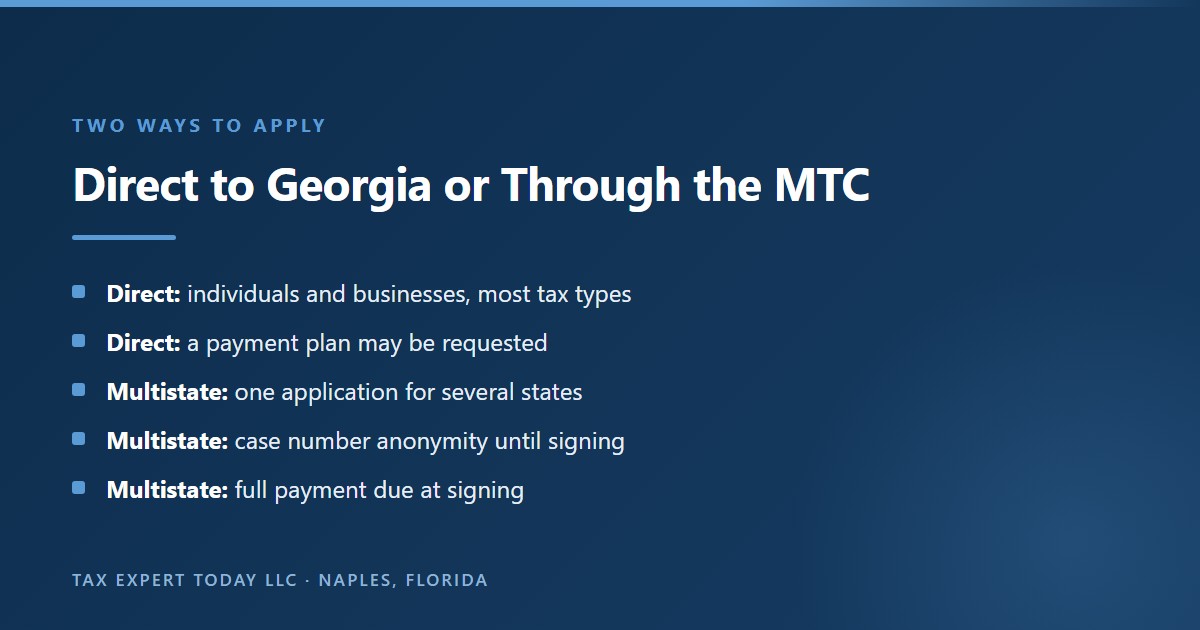
A business with exposure only in Georgia normally applies directly to the Department of Revenue. A business with exposure in several states may use the Multistate Tax Commission’s Multistate Voluntary Disclosure Program, which coordinates agreements with participating states, including Georgia, through one application and one staff contact at no charge to the taxpayer.
- Georgia participates: The Commission lists Georgia as a member of its National Nexus Program.
- Taxes covered: The Commission states that sales and use tax and income or franchise tax are the types generally handled.
- Minimum size: Commission staff do not process applications when the estimated tax due to a state for the lookback period is under $500.
- Identity protection: The state knows the applicant only by case number until an agreement is signed.
- Each state still decides: A state may sign the draft agreement or respond with its own required terms.
| Feature | Direct to Georgia Department of Revenue | Multistate Tax Commission program |
|---|---|---|
| Best fit | Georgia only, or Georgia plus one or two states | Exposure in several member states at once |
| Who may apply | Individuals and businesses | Taxpayers with potential liability in multiple states |
| Tax types | All Department tax types except alcohol and tobacco matters | Generally sales and use tax and income or franchise tax |
| Prior contact test | Not contacted for enforcement purposes about that tax | No prior contact, which includes filing a return or paying the tax |
| Underreported filers | Described as eligible on the program page | Generally not eligible for that tax type |
| Anonymity | Through a named taxpayer representative | By case number until the agreement is signed |
| Payment plan | May be requested | Not available; full payment at signing |
| Cost to apply | No application fee is stated on the program page | No charge to the taxpayer |
The Commission describes its process in steps. The taxpayer or representative completes one online application that lists the states to receive proposals, describes the activities in each state, and gives a best estimate of tax due by tax type and year. Commission staff prepare a draft agreement for the taxpayer to approve and then forward it to each state with identifying details removed. The state signs or counters. Once the state has signed, the taxpayer signs and returns the agreement to the state with the registration, the returns, and the payment. The Commission notes that the taxpayer may withdraw or supplement an application before an agreement is executed.
The right route is a planning decision. The Commission’s process saves effort when five or ten states are involved, and its case number system is a strong form of anonymity. The direct route fits individuals, taxpayers that have filed and underreported, taxpayers disclosing withholding tax, and anyone who may need payment terms. Businesses with a parallel exposure in Texas can compare the rules in our guide to the Texas voluntary disclosure agreement, since Texas runs its own program with different terms.
Does Georgia Have a Tax Amnesty Program in 2026?
No general Georgia tax amnesty is open in 2026. Georgia ran a one-time amnesty in late 1992 under the Tax Amnesty Program Act, covering periods ending on or before December 31, 1990, and the General Assembly wrote into the law that it should not be repeated. The Voluntary Disclosure Agreement is the standing alternative.
- The 1992 program: It began by October 31, 1992 and was completed no later than December 31, 1992.
- What it waived: Penalties, in return for voluntary filing and payment of tax and interest.
- What it excluded: Property taxes levied or administered under Chapters 5 and 6 of Title 48.
- Legislative intent: A one-time occurrence that “shall not be repeated in the future.”
- Today: Penalty relief comes through a Voluntary Disclosure Agreement or an ordinary penalty waiver request, not an amnesty window.
People searching for a Georgia tax amnesty are usually looking for exactly what the voluntary disclosure program provides: a way to come forward and have penalties set aside. The difference is structural. An amnesty is a short window, open to nearly everyone, created by a special act. The 1992 act is still in the Georgia Code at O.C.G.A. 48-16-4, and its statement of purpose says taxpayers’ expectations of future amnesty programs could have a counterproductive effect on compliance. A taxpayer waiting for the next amnesty is waiting for something the legislature said it did not intend to offer again, although a future General Assembly could always enact a new program.
The voluntary disclosure program has no window. It is open all year, it is individual, and it has an eligibility test that an amnesty typically lacks: the taxpayer must act before the Department makes contact. In one respect it can be more generous than the 1992 amnesty, because that program waived penalties while the tax and interest for every open period remained due, and a Voluntary Disclosure Agreement can also limit the periods. Any website or promoter describing a current Georgia amnesty deadline should be checked against the Department of Revenue’s own pages before anyone relies on it.
How Is Voluntary Disclosure Different From Filing Late Returns or Asking for a Penalty Waiver?
A taxpayer can always file delinquent returns without an agreement and then request a penalty waiver. That path has no eligibility test, but it has no lookback limit either, and the waiver depends on showing reasonable cause under O.C.G.A. 48-2-43. A Voluntary Disclosure Agreement settles the periods and the penalties before the returns are filed.
- Late returns without an agreement: Every unfiled period remains open, and penalties are assessed first and argued afterward.
- Penalty waiver standard: Reasonable cause and not gross or willful neglect or disregard of the law.
- How a waiver is requested: Through the Georgia Tax Center using the Letter ID from the assessment, or by mail on Form TSD-3.
- Voluntary disclosure: The penalty treatment and the lookback period are agreed up front.
- Amended returns: A filer correcting one or two years may simply amend; the program matters most when the problem is larger or older.
| Option | Available after Department contact? | Penalties | Periods | Reduces the tax? |
|---|---|---|---|---|
| Voluntary Disclosure Agreement | No, for the tax contacted about | Generally waived | Generally limited to three years | No |
| File late returns, then request a waiver | Yes | Waived only on reasonable cause, in whole or in part | All unfiled periods | No |
| Amended return | Yes | May apply to the added tax | The years amended | No |
| Payment plan | Yes | Not affected | Not affected | No, it spreads payment up to 60 months |
| Offer in compromise | Yes, it addresses assessed liabilities | Part of the compromise | Not affected | Possibly, on doubt as to liability or collectability |
The Department’s penalty waiver guidance says each request is decided on its own merits, taking into account the documentation and the taxpayer’s compliance history, and that a partial waiver is possible. For a taxpayer with many unfiled periods, that is a weaker position than an agreement, because the compliance history is the problem. For a taxpayer who missed a single return because of a documented illness or a casualty, an ordinary waiver request may be all that is needed, and our guide to the Georgia amended tax return covers corrections to returns already filed.
An offer in compromise is a different tool for a different stage. Under O.C.G.A. 48-2-18.1, the commissioner may settle a proposed assessment, a final assessment, or a tax execution where there is doubt as to liability or doubt as to collectability and the compromise is in the best interests of the state, with a $100 nonrefundable application fee unless the applicant’s income is at or below the poverty guidelines. Voluntary disclosure is for liabilities the state has not yet assessed. The Georgia offer in compromise is for liabilities it has. The two are not substitutes, and the published payment plan rules bar a plan while an offer is pending.
Who Typically Uses the Georgia Voluntary Disclosure Program?
The program is most often used by out-of-state businesses that created Georgia nexus without registering, employers with workers in Georgia, owners and entities with unreported Georgia source income, and individuals who lived or worked in Georgia without filing. The common thread is a liability that built up over several years before anyone noticed.
- Remote sellers: Businesses whose Georgia sales passed the economic nexus threshold and that never began collecting.
- Businesses with physical presence: Inventory in a Georgia warehouse, a salesperson, installation crews, or trade show activity.
- Employers of remote workers: One employee working from a Georgia home can create withholding and income tax filing obligations.
- Buyers: Georgia businesses that bought equipment or software from out-of-state vendors and never accrued use tax.
- Pass-through entities and nonresident owners: Georgia source income from partnerships, S corporations, and rental property.
- Individuals: Former and part-year residents who filed federal returns and no Georgia return.
The remote seller case is the classic one. Since the states gained authority to require collection from sellers with no physical presence, a business can owe Georgia sales tax purely because of its sales volume into the state. The Department’s guidance for out-of-state sellers covers when registration is required. Before estimating a liability, the seller should confirm which of its sales were taxable at all, because exempt sales and sales for resale shrink the number; our guide to the Georgia sales tax exemption rules explains the certificates that support those sales.
The employer case has grown with remote work. A company with no office in Georgia hires an employee who lives in Savannah, or an existing employee moves there. Wages for work performed in Georgia are generally subject to Georgia withholding, and the employee’s presence can also bring the company within Georgia income tax and net worth tax. Often the wages were withheld for the wrong state, which means the employee has a mismatch too. A disclosure for the employer should be planned alongside the employee’s own filing position.
Individuals use the program less often than businesses, yet the Department’s page is explicit that the taxpayer may be an individual. The typical case is a person who moved into or out of Georgia midyear and never filed, or a nonresident with Georgia rental or business income. The Georgia part-year resident tax return rules decide how much income belongs to Georgia, and the current flat rate, which the Department’s tax updates page lists as 4.99 percent, applies only to recent years. Earlier years in a lookback period carry the rates that were in effect then.
Is Voluntary Disclosure the Right Choice for Every Taxpayer?
No. Voluntary disclosure fits a taxpayer with a real, multi-period Georgia liability that the Department has not raised. It may be the wrong tool when the liability is small, when only one recent period is involved, when the Department has already made contact, or when the facts raise fraud concerns that call for legal counsel first.
- Small liabilities: A taxpayer with minimal tax due may simply register, file, and pay; the multistate program will not process estimates under $500 per state.
- Short histories: When exposure began within the lookback period, the limit adds nothing and only the penalty waiver is at stake.
- After contact: The program is closed for that tax, and the work shifts to the audit, the protest, and penalty waiver requests.
- Possible fraud: Willful conduct changes the analysis and belongs with an attorney before any disclosure.
- Refund positions: If the taxpayer overpaid in some periods, refund claim deadlines need to be reviewed before terms are fixed.
The fraud point needs to be stated carefully. The program page does not promise protection from criminal referral. Georgia law makes it a misdemeanor under O.C.G.A. 48-1-6 to file a false return or evade tax willfully and with intent to defraud the state, and the 50 percent fraud penalties sit outside the ordinary late penalties. A taxpayer whose history involves deliberate concealment, altered records, or tax collected and knowingly kept should speak with a tax attorney, under privilege, before anything is submitted. A firm like ours coordinates with counsel in those cases.
There is also a cost on the other side of the ledger. A taxpayer that enters the program becomes a registered Georgia filer from that point forward, with returns due every period. For most businesses that is simply the law catching up with reality. For a business whose Georgia activity has already ended, the calculation is narrower: the question is whether the closed periods are worth resolving now, with certainty, or left open with no statute of limitations running. A business planning a sale, a financing, or a dissolution usually resolves them, because buyers and lenders ask, and because a clean record is needed for documents such as a Georgia tax clearance letter.
If the Department has already issued an assessment, the taxpayer’s rights run through the protest and appeal process, which our guide to the Georgia Tax Tribunal explains. That path has deadlines of its own, and it is separate from anything described here.
What Records Should You Gather Before Applying?
Before applying, a taxpayer should assemble the records that establish when Georgia activity began, what the tax would have been for each period, and whether any tax was collected or withheld. The application asks for an estimate of liability and supporting documents, and the Department relies on those figures when it sets the terms.
- Start date evidence: First Georgia sale, first Georgia employee, lease or warehouse agreements, and registration records in other states.
- Sales detail: Georgia sales by month and by county, with exempt and resale sales separated and certificates on file.
- Tax collected: Invoices and account ledgers showing whether Georgia tax was charged to customers.
- Payroll: Wages by employee for work performed in Georgia, and any tax withheld for Georgia or for another state.
- Income tax workpapers: Federal returns, apportionment data, and owner information for pass-through entities.
- Prior correspondence: Every letter or email from the Department, to confirm that no enforcement contact has occurred.
The county detail is specific to Georgia sales tax. The state rate is combined with local rates that vary by county, and the Department’s sample spreadsheet for voluntary disclosure reports transactions with county codes for that reason. A seller that kept only a statewide total will need to rebuild its sales by destination. Doing that work before the application, and not after an agreement is signed, makes the estimate reliable and shortens the time between signing and filing.
The correspondence review is not a formality. Mail goes to old addresses, to registered agents, and to former employees. A nexus questionnaire that sat unopened for six months may still count as contact. A careful applicant checks every channel the Department might have used, including any Georgia Tax Center account opened for a different tax, before representing that it has not been contacted.
What Are the Most Common Georgia Voluntary Disclosure Mistakes?
The most common mistakes are waiting until a notice arrives, registering or filing before the agreement is in place, disclosing one tax while ignoring another, underestimating the liability, and treating collected sales tax like uncollected tax. Each one can cost the penalty waiver, the lookback limit, or both.
- Waiting: Eligibility ends for a tax when the Department makes enforcement contact about it.
- Registering first: Opening an account and filing current returns before applying can invite questions about earlier periods.
- Partial disclosure: The program requires compliance with all other Georgia tax obligations.
- Loose estimates: Vague applications are delayed, and wrong ones undermine the agreement.
- Ignoring the future: An agreement resolves the past only if returns are filed on time from then on.
| Mistake | Why it hurts | Better approach |
|---|---|---|
| Answering a Department inquiry, then trying to apply | The inquiry is contact for that tax | Review exposure and apply before any letter arrives |
| Registering in the Georgia Tax Center with a backdated start date | Creates delinquent periods with no agreement in place | Let the agreement set the registration date and the periods |
| Disclosing sales tax and leaving income tax unfiled | Fails the compliance requirement for other taxes | Inventory every tax type and list all of them |
| Assuming a three-year limit on tax that was collected | Collected tax is recovered as far back as necessary | Separate collected from uncollected tax in the estimate |
| Sending identification numbers through the web form | The Department warns the channel is not secure | Follow the form’s privacy instruction |
| Using the multistate route when cash is short | Full payment is due at signing on that route | Apply directly and request a payment plan |
| Treating the agreement as covering federal tax | Georgia cannot bind the Internal Revenue Service or other states | Review federal and other state effects separately |
The registration mistake is a frequent one. A business learns it has nexus, and someone in accounting does the responsible-seeming thing and registers for a sales tax account, entering the true start date from years ago. The system now shows years of missing returns, and the business has made itself known without the protection of an agreement. Whether the Department would still accept a voluntary disclosure at that point depends on the facts and on whether enforcement contact has occurred. The safer order is to analyze first, apply second, and register as the agreement directs.
Step by Step: How a Georgia Voluntary Disclosure Usually Unfolds
A Georgia voluntary disclosure usually moves through seven stages: confirm that no contact has occurred, inventory every Georgia tax type, quantify the liability by period, choose the direct or multistate route, apply through a representative, review and sign the agreement, and then file, pay, and stay current.
- Confirm eligibility. Search all mail, email, and online accounts for any Department contact about the tax.
- Inventory the taxes. Sales and use, withholding, income, net worth, and any other Department tax the activity touches.
- Quantify. Build the tax by period, separate collected from uncollected amounts, and estimate interest.
- Choose the route. Direct to the Department, or through the Multistate Tax Commission when several states are involved.
- Apply. Submit the online application, anonymously through a named representative if desired.
- Review the agreement. Check the tax types, the lookback dates, the penalty language, and the payment terms before signing.
- Perform. Register, file the lookback returns or schedules, pay or begin the payment plan, and file every later return on time.
The last step is where agreements succeed or fail. The benefits are tied to the taxpayer doing what it agreed to do. A business that signs, files the back periods, and then misses its first three current returns has traded an unknown exposure for a known delinquency in front of the same division that approved its agreement. Setting up the filing calendar, the Georgia Tax Center access, and the internal process for collecting tax going forward belongs in the project plan from the first day.
Georgia Voluntary Disclosure Program Help in Naples & Southwest Florida
Tax Expert Today LLC advises businesses and individuals on the Georgia voluntary disclosure program from its office in Naples, Florida, and serves Georgia clients nationwide and remotely. We review eligibility, quantify exposure by tax type and period, compare the direct and multistate routes, prepare the application, and handle the returns that follow.
- Office: 11983 Tamiami Trail N, Naples FL 34110.
- Phone: (239) 441-2005.
- Hours: Monday through Friday, 10 a.m. to 5 p.m. Eastern.
- Georgia voluntary disclosure help Naples: Naples and Southwest Florida in person, Georgia and all 50 states remotely.
Many Southwest Florida business owners have a Georgia footprint they did not plan for. A Naples company ships product to Atlanta customers, keeps a sales representative in Augusta, or stores inventory with a fulfillment provider near Savannah. A Florida resident owns a share of a Georgia partnership or a rental property north of the state line. Florida has no personal income tax, so the Georgia filing obligation is often the first state income tax question these owners have faced, and it can go unnoticed for years. We work as tax advisors on state tax matters nationwide, and a Georgia review usually connects to the owner’s federal return and to sales tax positions in other states. For the full range of our Georgia work, see the Georgia tax services page, and for the rate and filing rules behind an income tax estimate, our guide to the Georgia state income tax.
When to Engage a Professional
Engage a professional before any contact with the Department when the exposure spans several years, involves more than one tax type or state, includes tax that was collected or withheld, or will be reviewed by a buyer or lender. The value of representation is highest before the application, when anonymity and route selection are still open.
- Multi-year or multi-state exposure: The lookback analysis and the route decision carry real money.
- Trust taxes: Collected sales tax and withheld wages raise personal liability questions.
- Anonymous applications: The Department accepts them only through a named taxpayer representative.
- Transactions: A pending sale, merger, or financing sets a deadline for cleaning up state exposure.
- Possible willfulness: Legal counsel should be involved first.
Tax Expert Today LLC is a multidisciplinary firm of tax advisors, enrolled agents, CPAs, and attorneys. For a Georgia voluntary disclosure we typically begin with a confidential exposure review, and we tell a client plainly when a simpler path, such as filing one late return with a waiver request, may serve as well. Results depend on each taxpayer’s facts and on the Department’s decision, and no outcome can be promised in advance. To discuss a Georgia matter, call (239) 441-2005 or start from our Georgia tax services page.
Frequently Asked Questions About the Georgia Voluntary Disclosure Program
What is the Georgia voluntary disclosure program?
It is a Georgia Department of Revenue program for taxpayers with unfiled or underreported Georgia taxes who have not been contacted by the Department. A qualified applicant signs a Voluntary Disclosure Agreement, files and pays for a limited lookback period, and generally receives a waiver of penalties. Interest is still owed.
How far back does a Georgia Voluntary Disclosure Agreement go?
The lookback period is generally three years and is usually a minimum of three years for all tax types. For sales and use tax and withholding tax it is usually thirty-six months, extended as far back as necessary to recover tax that was collected and not remitted.
Does Georgia waive interest in a voluntary disclosure?
No. The Department states that penalties will generally be waived for all periods in the agreement and that interest will still be imposed on all amounts due. Georgia interest accrues monthly at the Federal Reserve prime rate plus 3 percent, reviewed each January.
Can I apply for Georgia voluntary disclosure anonymously?
Yes. The Department accepts anonymous requests as long as the request includes the name and contact information of a taxpayer representative. The representative submits the online application and communicates with the Audits Division on the taxpayer’s behalf.
Is there a Georgia tax amnesty in 2026?
No general amnesty is open. Georgia held a one-time amnesty in late 1992 for periods ending on or before December 31, 1990, and the statute describes it as a program not to be repeated. The Voluntary Disclosure Agreement program is the standing way to obtain penalty relief by coming forward.
What if the Georgia Department of Revenue has already contacted me?
The program requires that the taxpayer has not been contacted for enforcement purposes about that tax obligation. After contact, the usual options are filing the returns, requesting a penalty waiver for reasonable cause, a payment plan, or, for assessed liabilities, an offer in compromise.
Which taxes are excluded from the Georgia voluntary disclosure program?
Alcohol and tobacco licensing, registration, and tax matters are not handled by the program and are referred to the Alcohol and Tobacco Division. Taxes administered by other agencies or by local governments are also outside a Department of Revenue agreement.
Can I pay a Georgia voluntary disclosure liability over time?
The Department states that an applicant unable to pay the total amount due may request a payment plan. Georgia payment plans cannot exceed 60 months and have a $25 minimum monthly payment. A payment plan is not available through the Multistate Tax Commission route.
Can a Naples, Florida firm help with the Georgia voluntary disclosure program?
Yes. Tax Expert Today LLC works from 11983 Tamiami Trail N in Naples, Florida, and serves businesses and individuals with Georgia state tax matters remotely, including Southwest Florida owners with Georgia sales, employees, or property. Call (239) 441-2005, Monday through Friday, 10 a.m. to 5 p.m. Eastern.
Published November 27, 2026 by Dr. Pellumb Kabashi « Back to Learning Center
Have a question this article touches on?
Tax Expert Today LLC, based in Naples, Florida and serving clients across the United States.
Schedule a Consultation (239) 441-2005