
By Dr. Pellumb Kabashi, DBA, MBA, CES, CFE, EA
Founder, Tax Expert Today LLC · Tax advisors, enrolled agents, CPAs, and attorneys · Serving clients in all 50 states
Quick Answer: A composite tax return is one state return a partnership or S corporation files for its nonresident owners, so they do not file individually. For a Florida owner the price is usually the top rate with no deductions or credits: 10.9 percent in New York, 10.75 percent in New Jersey, a flat 3.07 percent in Pennsylvania. Call (239) 441-2005 for a free consultation.
What Is a Composite Tax Return?
A composite tax return is a single state income tax return that a partnership, limited liability company or S corporation files on behalf of its nonresident owners who elect to be included. The entity reports each owner’s share of in-state income, pays the tax, and the included owners are relieved of filing their own nonresident returns in that state.
- Who files it: the pass-through entity, signed by a partner, officer or group agent.
- Who is on it: nonresident individual owners who qualify and who elect in, usually every year.
- What it replaces: each included owner’s individual nonresident return in that state.
- What it costs: in most states, the highest rate with no deductions, exemptions or credits.
States do not agree on the name. New York calls it a group return and uses Form IT-203-GR for partnerships and Form IT-203-S for S corporations. New Jersey calls it a composite return and uses Form NJ-1080-C. Pennsylvania calls it a nonresident consolidated return and uses Form PA-40 NRC. Other states say block return or combined nonresident return. The idea is the same in each. The state would rather receive one return and one check from the business than chase dozens of out-of-state owners for small individual filings.
The New York instructions state the legal effect plainly. A group return “is considered a group of individual returns” that meet the filing requirements, and a qualified partner who elects in “is not required to file an individual New York State personal income tax return” for the year. New Jersey says the same thing in its regulation, N.J.A.C. 18:35-5.2, which treats the composite return as a group of separate returns meeting each participant’s individual filing requirement. Pennsylvania’s instructions describe the PA-40 NRC as a return filed on behalf of a group of qualifying electing nonresident individual owners.
That legal effect is the whole attraction. An owner with a K-1 from a business that operates in four states can face four nonresident returns every spring. A composite tax return in each state reduces that to none. The trade is that the owner accepts a simplified, and usually harsher, tax calculation. Whether that trade is worth making is the real question, and for someone who has moved to Florida the answer is different than it is for an owner who lives in another income tax state.
| State | Name of the return | Form | Who files |
|---|---|---|---|
| New York | Group return for nonresident partners or shareholders | IT-203-GR (partnerships), IT-203-S (S corporations) | The entity, through a group agent |
| New Jersey | Nonresident composite return | NJ-1080-C, with an NJ-1080E election from each participant | The entity |
| Pennsylvania | Nonresident consolidated income tax return | PA-40 NRC | The entity |
| Illinois | No composite return for current years | Pass-through withholding on Form IL-1065 or IL-1120-ST | The entity withholds; the owner may still file |
Why Does a Composite Tax Return Matter More After a Move to Florida?
Florida has no personal income tax, so a Florida resident has no home state return on which to claim a credit for tax paid to another state. Every dollar of New York, New Jersey or Pennsylvania tax paid through a composite tax return is a final cost. The rate on that return therefore decides the result.
- No resident credit: Florida imposes no individual income tax, so nothing offsets the old state’s tax.
- Rate becomes the cost: a top-rate composite calculation is not washed out anywhere else.
- Eligibility changes: the move itself can switch composite eligibility off for one year and on for the next.
Consider two partners in the same New York consulting partnership, each with a $150,000 share of New York source income. One lives in Connecticut. One lives in Naples. If both join the group return, both pay New York at 10.9 percent. The Connecticut partner then claims a credit on the Connecticut resident return for tax paid to New York, limited by Connecticut’s own rules, so part of the excess New York tax may be absorbed. The Naples partner has no state return at home and no credit to claim. The full difference between the group rate and the rate an individual New York nonresident return would have produced is simply gone.
This is why advice written for owners in general does not fit Florida owners. The common practitioner shorthand is that composite returns are a convenience with a modest rate cost. For a Florida resident with a large K-1 and little other income, the rate cost can be several thousand dollars a year, every year, for the life of the investment. For a Florida resident with very high total income, the cost can be close to zero, because the individual return would have reached nearly the same rate anyway. The decision has to be run on the numbers.
The move also changes who is allowed on the return. Each of the three states covered here requires that a participant be a nonresident for the entire year. A partner who moved from Manhattan to Naples in June is a part-year resident of New York for that year and cannot be on the group return at all. Our guide to the nonresident state tax return covers the individual filing that replaces it, and our walk-through of snowbird taxes in year one explains the part-year return. This page stays on the composite choice.
Who Can Be Included on a Composite Tax Return?
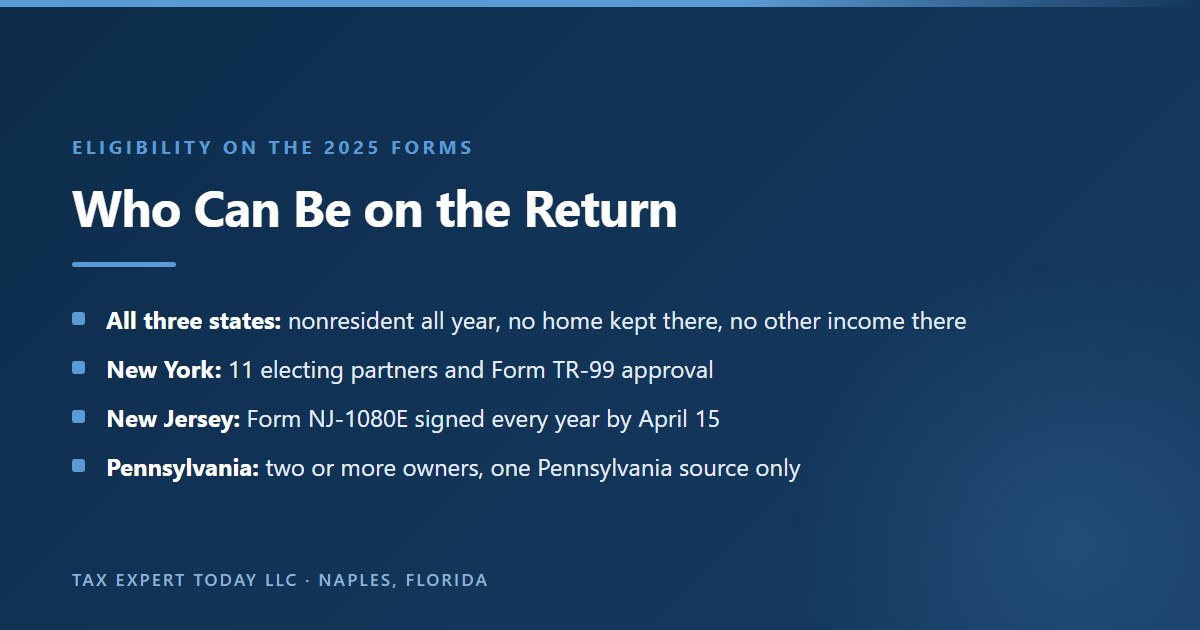
Only a nonresident individual who was a nonresident for the entire year, kept no permanent place of abode in the state, and had no other income from that state generally qualifies. Trusts, estates, corporations and other partnerships are usually excluded. The owner must also elect in, in writing, every year.
- Full-year nonresident: part-year residents are out in New York, New Jersey and Pennsylvania.
- No permanent place of abode: a retained apartment or house in the old state disqualifies the owner.
- No other source income: wages, rent or a property sale in the state generally disqualifies the owner.
- Individuals only: a trust that holds the interest is not a qualified participant.
- Annual election: participation is never automatic and never permanent.
The three states use nearly the same words. New York’s Form IT-203-GR instructions define a qualified nonresident partner as a nonresident individual for the entire tax year who did not maintain a permanent place of abode in New York at any time during the year, and they add that neither the partner nor the partner’s spouse may have New York source income other than the distributive share from the partnership. New Jersey’s Form NJ-1080E asks the owner to declare the same things under penalties of perjury. Pennsylvania’s instructions require that the owner, along with his or her spouse, be domiciled outside Pennsylvania for the entire calendar year and maintain no permanent place of abode there.
| Requirement | New York (IT-203-GR) | New Jersey (NJ-1080-C) | Pennsylvania (PA-40 NRC) |
|---|---|---|---|
| Nonresident for the entire year | Yes | Yes | Yes, owner and spouse |
| No permanent place of abode in the state | Yes | Yes | Yes, owner and spouse |
| No other income from the state | Yes, tested for the partner and the spouse; other group returns allowed, up to 10 | Yes, except income on this or another composite return | Yes; a second Pennsylvania pass-through interest disqualifies |
| Individuals only | Yes; a trust is not qualified | Yes; estates, trusts, partnerships and corporations are out | Yes; estates, trusts and entities are non-qualifying owners |
| Minimum number of participants | 11 qualified electing partners | None stated on the form | Two |
| Advance approval from the state | Yes, Form TR-99 | No | No |
| Calendar year owner | Same accounting period as the group | Yes; fiscal year filers are out | Yes |
Two differences in that table do most of the work in practice. New York requires at least 11 qualified electing partners and prior approval, so the three or four member family LLC that many relocating owners hold cannot file a New York group return at all. Pennsylvania disqualifies an individual who owns more than one pass-through entity with Pennsylvania source income, while New York expressly lets a partner take part in up to 10 group returns and New Jersey lets an individual participate in more than one composite return.
What Do You Give Up by Joining a Composite Tax Return?
An owner who joins a composite tax return usually waives the standard or itemized deductions, personal and dependent exemptions, graduated rates, state credits and loss carryovers for that year. The tax is figured on the owner’s share of in-state income alone, at the top rate, with nothing subtracted and nothing carried forward.
- Deductions and exemptions: waived in New York and New Jersey.
- Credits: waived, including credits that would have carried forward from that year.
- Losses: a New York loss cannot be carried to or from a group return year.
- Graduated brackets: replaced by a single top rate.
New York lists the waivers in its instructions. The partner “must waive the right to claim the New York standard deduction or itemized deduction, the New York dependent exemption, any New York State personal income tax credits,” and any carryback or carryover of a New York net operating loss or capital loss. The credit waiver reaches forward: a credit that originates in a group return year cannot be carried to a later year, even a later year in which the partner files individually.
New Jersey’s election form puts the waiver in the owner’s own voice: “I waive the right to claim New Jersey personal exemptions, credits, or deductions, and I agree that the tax due on my share of the composite income will be calculated at the highest tax rate in effect this year for single taxpayers.” The same form states that the election binds the owner’s heirs, representatives and executors, and that it is an express consent to personal jurisdiction in New Jersey for income tax purposes under the regulation.
Pennsylvania gives up less, because there is less to give. Pennsylvania’s personal income tax is a flat 3.07 percent with no standard deduction and no personal exemption, so the PA-40 NRC rate is the same rate the owner would pay on a PA-40. What the Pennsylvania owner gives up is the ability to change course: the instructions state that owners qualifying for a PA-40 NRC “cannot change their election to file a PA-40 or vice versa after filing either Pennsylvania tax return.”
| Item waived | New York | New Jersey | Pennsylvania |
|---|---|---|---|
| Standard or itemized deduction | Waived | Waived | Not applicable; none exists |
| Personal and dependent exemptions | Waived | Waived | Not applicable; none exists |
| Graduated rates | Replaced by 10.9 percent | Replaced by 10.75 percent | Not applicable; flat 3.07 percent either way |
| State income tax credits | Waived, including carryovers that start in that year | Waived, except the entity tax credit on line 24 | Credits reported on the return as the form allows |
| Loss carryovers | No carryback or carryover to or from a group year | Not addressed on the election form | Losses are not included in the taxable total |
| Right to change the election | Fixed after the 15th day of the fourth month | Fixed after April 15 | Fixed once either return is filed |
What Rate Applies on a Composite Tax Return?
For 2025 returns filed in 2026, New York computes group return tax by multiplying each partner’s New York taxable income by 10.9 percent, New Jersey multiplies composite income by 10.75 percent, and Pennsylvania applies its flat 3.07 percent. New York and New Jersey use their highest individual rate regardless of the owner’s actual income.
- New York: Schedule A, column I, “multiply column H by 0.1090.”
- New Jersey: Form NJ-1080-C, line 18, “Multiply line 17 by 10.75%.”
- Pennsylvania: the same flat 3.07 percent as an individual return.
The New York figure comes from the form itself. Form IT-203-GR-ATT-A, Schedule A, lists each partner on one line and instructs the preparer to multiply New York taxable income in column H by 0.1090 to reach the tax in column I. No rate table is consulted. The 10.9 percent rate is the top of New York’s individual rate schedule, a bracket that an individual filer reaches only at very high levels of income.
The New Jersey figure is on the face of the 2025 Form NJ-1080-C: line 17 is total New Jersey taxable income, and line 18 reads “Tax (Multiply line 17 by 10.75%).” The 2025 Form NJ-1065 instructions confirm the point, stating that composite tax “will be calculated at the highest rate, which is 10.75%, without regard to each partner’s filing status, dependent exemptions, or any deductions.” Any practitioner note or software screen that still shows a lower composite rate for smaller New Jersey shares is describing an earlier year’s form and should not be relied on for the 2025 return.
These rates have to be read against what the individual alternative would produce. Both New York and New Jersey compute a nonresident’s individual tax by figuring tax on income from all sources as if the person were a resident and then multiplying by the fraction of income that comes from the state. Our nonresident state tax return guide explains that method and why Florida income pushes the rate up. The result for most owners is an effective rate well below the top bracket. The gap between that effective rate and the composite rate, multiplied by the K-1 share, is the annual price of convenience.
| State | Composite rate (2025 forms) | Where the rate appears | Individual alternative |
|---|---|---|---|
| New York | 10.9 percent | IT-203-GR-ATT-A, Schedule A, column I | Form IT-203, graduated rates applied through the income percentage |
| New Jersey | 10.75 percent | NJ-1080-C, line 18 | Form NJ-1040NR, graduated rates applied through the income percentage |
| Pennsylvania | 3.07 percent | PA-40 NRC | Form PA-40, the same flat 3.07 percent |
How Does the New York Group Return on Form IT-203-GR Work?
A partnership with New York source income and at least 11 qualified nonresident partners who elect in may ask permission on Form TR-99 to file a group return. Once approved, the State issues a special identification number, a group agent signs for everyone, and tax is paid at 10.9 percent on each included partner’s New York income.
- Threshold: 11 or more qualified electing partners with the same accounting period.
- Permission: Form TR-99, due no later than 30 days after the close of the first group year.
- Group agent: one partner with authority to sign and receive notices for all participants.
- Powers of attorney: one from each participant, or accepted substitute evidence such as Form DTF-350.
- S corporations: a parallel group return on Form IT-203-S, also with an 11 shareholder minimum.
New York is the strictest of the three states about getting onto the return in the first place. The instructions warn that prior approval is mandatory: “If you file a group return without prior approval, the return will be rejected and the participating partners could be subject to late-filing or late-payment penalties, or both.” Approval is requested on Form TR-99, Application for Permission to File a Group Return, which must be submitted no later than 30 days following the close of the initial tax year for which the group wants to file. For a calendar year partnership seeking a first group return for 2026, that points to the end of January 2027.
Once granted, approval continues from year to year without a new application, as long as the partnership keeps filing and keeps at least 11 qualified electing partners. If the group skips a year, it must apply for reinstatement on Form TR-99 and collect new powers of attorney. A partnership that decides not to file a group return for a year is told to notify the Department in writing.
The partner’s own step is small and time limited. The partner tells the group agent that he or she wants to participate, and must do so by the fifteenth day of the fourth month after the close of the tax year, which is April 15 for a calendar year. After that date the election cannot be changed. The instructions add one important exception: if it is later determined that an included partner was not a qualified nonresident partner, that partner “will be required to file an amended return on an individual basis.”
| New York group return fact | Rule in the 2025 instructions |
|---|---|
| Minimum participants | 11 qualified electing nonresident partners or shareholders |
| Permission | Form TR-99, no later than 30 days after the close of the initial tax year |
| Rate | 10.9 percent of New York taxable income, per partner |
| Partner’s election deadline | 15th day of the fourth month after year end; not changeable afterward |
| Return due date | April 15, 2026 for 2025; extension on Form IT-370 |
| Overpayment | Applied to next year’s estimated tax; the form states it cannot be refunded |
| Other group returns | A partner may participate in up to 10 group returns for the year |
| Local layers | Yonkers nonresident earnings tax and the metropolitan commuter transportation mobility tax ride on the same group return |
The overpayment line deserves a second look from anyone leaving a partnership. Line 13 of Form IT-203-GR is the “amount overpaid applied to 2026 estimated tax,” and the instructions say this amount “cannot be refunded.” A partner who was over-paid through the group in the last year before retiring from the firm should ask the group agent how that credit will be handled, because the form itself only rolls it forward.
New York also layers two local taxes onto the same return. If the partnership has Yonkers source income or does business in the metropolitan commuter transportation district, a group Yonkers return or group mobility tax return must be filed for the same participants. A participant must waive the $50,000 net earnings threshold that would otherwise apply before the mobility tax is imposed. Owners who used to live in the five boroughs sometimes confuse this with the city income tax; our guide to the New York City residency tax explains why the city tax itself does not follow a nonresident.
What Does New York Collect if You Stay Off the Group Return?
If a nonresident partner is not on a group return, New York Tax Law section 658(c)(4) generally requires the partnership or S corporation to make estimated tax payments on that partner’s behalf, figured at 10.9 percent less expected credits. The partner then files Form IT-203 and claims the payments, or avoids them with Form IT-2658-E.
- Entity payments: reported on Form IT-2658, due April 15, June 15, September 15 and January 15.
- Small amounts: no payment when the partner’s estimated tax for the year is $300 or less.
- Exemption certificate: Form IT-2658-E, given to the entity, not to the State.
- Group participants: no entity estimated payments under this rule once the partner has elected into an approved group return.
Declining the group return does not mean New York collects nothing during the year. The Form IT-2658 instructions describe a separate system under which partnerships and New York S corporations with New York source income pay estimated personal income tax for their nonresident individual owners. The worksheet in those instructions multiplies the partner’s estimated New York share by 10.9 percent and subtracts the credits the partner is expected to claim from the entity. The entity pays in four installments and tells each partner how much was paid.
The difference from the group return is that these payments are a deposit, not a final tax. The partner files an individual Form IT-203, computes tax at graduated rates through the income percentage, claims the estimated payments made on his or her behalf, and receives any excess as a refund. An owner whose true New York liability is well below 10.9 percent of the K-1 share is lending the State the difference until the refund arrives.
An owner who would rather manage the payments personally can do so. The instructions for Form IT-2658-E explain that a nonresident individual may certify to the entity that he or she will comply individually with New York estimated tax and return filing requirements. The certificate is kept by the entity and is not sent to the Tax Department. The version dated December 2025 covers tax years 2026 and 2027. A partner who signs it has taken on the quarterly estimates personally and should calendar them.
| New York path | What the entity does | What the owner does | Rate applied during the year |
|---|---|---|---|
| Group return | Files IT-203-GR and may pay group estimates on Form IT-2105 | Elects in by April 15; files nothing individually | 10.9 percent, final |
| Entity estimated payments | Pays on Form IT-2658 for each nonresident individual | Files IT-203 and claims the payments | 10.9 percent less expected credits, refundable on the return |
| Exemption certificate | Keeps Form IT-2658-E on file and pays nothing for that owner | Pays own quarterly estimates and files IT-203 | The owner’s own estimate |
How Does the New Jersey Composite Return on Form NJ-1080-C Work?
A partnership, limited liability company, New Jersey S corporation, estate or trust with New Jersey source income may file Form NJ-1080-C for qualified nonresident individuals who each sign Form NJ-1080E. Tax is 10.75 percent of each participant’s New Jersey income, with credit for tax the entity already paid, including Business Alternative Income Tax.
- Election form: NJ-1080E, signed every year and kept in the entity’s files.
- Cutoff: for 2025, the election cannot be made or revoked after April 15, 2026.
- Rate: 10.75 percent, the highest rate for single taxpayers.
- Credits on the return: withholding, composite estimates, tax paid by the partnership and the entity tax credit.
- No approval step: New Jersey has no equivalent of New York’s Form TR-99.
New Jersey’s system is the easiest of the three to enter. There is no application for permission and no minimum head count printed on the form. The entity collects a signed Form NJ-1080E from each owner who wants in, keeps those forms, and files the composite return with a Schedule A listing participants and a Schedule B listing every owner who is not participating. The regulation, N.J.A.C. 18:35-5.2, requires both lists.
The five declarations on the election form are worth reading slowly, because the owner signs them under penalties of perjury. The owner states that he or she was a nonresident of New Jersey for the entire year, did not maintain a permanent place of abode in New Jersey at any time during the tax year, does not file a fiscal year federal return, had no New Jersey source income other than income reported on this or another composite return, and waives exemptions, credits and deductions in exchange for tax at the highest single rate.
The return itself is short. Lines 8 through 16 gather the participants’ New Jersey income by category, line 17 totals it, and line 18 applies 10.75 percent. Lines 21 through 24 then give credit for New Jersey tax withheld, estimated payments and the prior year composite credit, “Tax Paid on Partners’ Behalf by Partnership,” and the “Pass-Through Business Alternative Income Tax Credit.” Unlike New York, New Jersey refunds an overpayment on the composite return or credits it to the next year, at the entity’s choice on lines 28 and 29.
| NJ-1080-C line (2025) | What it does |
|---|---|
| Lines 8 to 16 | Participants’ income from New Jersey sources, by category |
| Line 17 | Total New Jersey taxable income, carried from Schedule A |
| Line 18 | Tax: line 17 multiplied by 10.75 percent |
| Line 22 | Estimated payments and credit from the 2024 composite return |
| Line 23 | Tax paid on partners’ behalf by the partnership |
| Line 24 | Pass-Through Business Alternative Income Tax credit |
| Lines 28 and 29 | Refund, or credit to 2026 tax |
Three procedural points catch entities that are new to the form. First, a composite return filed for 25 or more participants must be filed electronically or on disc under the regulation. Second, when the entity filed a composite return in the prior year and expects the composite liability to exceed $100, it must make quarterly estimated payments under its own identification number, and the regulation states that credit “will not be given on the composite return for individual estimated tax payments made by, or on behalf of,” a participant. A new Florida resident who kept paying personal New Jersey estimates out of habit can find those payments stranded on an individual account. Third, an extension is available on a composite basis only, on Form NJ-630 under the entity’s number.
What Does a New Jersey Partnership Pay for You if You Do Not Join?
A New Jersey partnership generally remits tax on each nonresident individual partner’s share of New Jersey income at 6.37 percent and reports it on Schedule NJK-1. The partner files Form NJ-1040NR, computes tax at graduated rates, and claims that payment and any Business Alternative Income Tax credit against the result.
- Partnership payment: 6.37 percent for nonresident noncorporate partners, on the Partners Directory of Form NJ-1065.
- Owner’s credit: claimed on the 2025 Form NJ-1040NR, line 52.
- Entity tax credit: claimed on the 2025 Form NJ-1040NR, line 56.
- Relief since 2022: no remittance for a partner who reasonably expects a full refund because of the entity tax credit.
New Jersey has its own backstop for owners who stay off the composite return. The Form NJ-1065 instructions direct the partnership to multiply each nonresident noncorporate partner’s share of New Jersey income by 6.37 percent and report the result as that partner’s share of tax. The Division’s entity tax FAQ adds that the obligation exists even when the partnership as a whole has a net loss, so long as a nonresident partner has a positive share of New Jersey source income.
For the Florida owner this payment is, again, a deposit. The 2025 Form NJ-1040NR instructions tell the owner to total the tax paid on his or her behalf by partnerships and include it on line 52, and to enter the share of Business Alternative Income Tax on line 56. Whatever exceeds the tax computed on the nonresident return is refunded. The comparison that matters is therefore 10.75 percent final on the composite return against a 6.37 percent deposit followed by a true-up at graduated rates on Form NJ-1040NR.
The same FAQ records a change that many K-1 recipients have not noticed. For tax years before 2022, a partnership that elected the entity tax still had to remit the nonresident partner tax. Beginning with tax year 2022, a partnership “is not required to remit tax on behalf of any nonresident partner who reasonably expects to receive a full refund of that tax based on their share of the BAIT credit.” A Florida partner in an electing New Jersey partnership may therefore see no partner-level remittance at all and should not assume one exists when preparing the return.
| New Jersey path | Paid during the year | Final tax | Where the owner’s credit goes |
|---|---|---|---|
| Composite return | Composite estimates under the entity’s number | 10.75 percent of New Jersey income | Nothing to claim; no individual return |
| Individual return, no entity tax election | 6.37 percent remitted by the partnership | Graduated rates on Form NJ-1040NR | Line 52 |
| Individual return, entity tax elected | Entity tax paid by the business | Graduated rates on Form NJ-1040NR | Line 56, refundable against the tax computed |
How Does the Pennsylvania Consolidated Return on Form PA-40 NRC Work?
A pass-through entity with two or more qualifying electing nonresident individual owners may file Form PA-40 NRC on their behalf at Pennsylvania’s flat 3.07 percent rate. Each owner must have a calendar tax year, be domiciled outside Pennsylvania all year with his or her spouse, and have no other Pennsylvania taxable income.
- Minimum: two qualifying electing owners; an entity with only one cannot file.
- Rate: 3.07 percent, the same as an individual PA-40.
- Disqualifier: any other Pennsylvania source income, including a second pass-through interest.
- Records: a signed annual statement from each owner, kept by the entity and not sent to the Department.
- Due date: April 15, 2026 for 2025, or October 15, 2026 with Form REV-276.
Pennsylvania is the state where a composite tax return carries the least rate risk, because the rate does not change. The 2025 PA-40 NRC instructions describe the form as a return used to combine and report the income, tax withheld and credits “of TWO OR MORE qualifying electing nonresident individual owners.” With a flat tax and no personal exemptions, the consolidated calculation and the individual calculation generally arrive at the same figure for an owner whose only Pennsylvania income is the K-1.
The Pennsylvania risk is eligibility. The instructions define a non-qualifying owner to include “individuals who own more than one pass-through entity with Pennsylvania-source income or who may have any other Pennsylvania sourced income,” and they list compensation, business income, gains from the sale of property, rental income, estate or trust income and gambling winnings as examples. A Naples retiree with an interest in a Philadelphia medical practice and a second interest in the building partnership that owns the office is a non-qualifying owner for both, and must file a PA-40.
Pennsylvania also keeps its withholding system running underneath. The Department’s Personal Income Tax Guide chapter on pass-through entities explains that a partnership or Pennsylvania S corporation with nonresident individual owners must withhold and pay Pennsylvania tax on each owner’s expected share of Pennsylvania source income in quarterly installments, with a final catch-up payment due with the information return, the PA-40 NRC, or an extension request. Filing the consolidated return does not remove the requirement to file the PA-20S/PA-65 information return and issue Schedule NRK-1 to each owner. The Department’s nonresident withholding page states the current rate as 3.07 percent.
| Pennsylvania point | Rule in the 2025 instructions |
|---|---|
| Who may not file | An entity with only non-qualifying owners, or with only one qualifying electing owner |
| Owner’s tax year | Calendar year; fiscal year filing of the PA-40 NRC is not permitted |
| Changing the election | Not allowed after either a PA-40 NRC or a PA-40 is filed |
| Extension | Form REV-276, six months; it does not extend the time to pay |
| Supporting schedule | PA Schedule NRK-1, not the federal Schedule K-1 |
| Department’s reserved power | May require a PA-40 from any individual owner at any time |
One note on what Pennsylvania does not offer. The 2025 Pennsylvania forms reviewed for this guide contain no elective entity-level income tax of the kind New York and New Jersey have, although bills proposing one have been introduced in the General Assembly. A Pennsylvania comparison therefore has two branches, consolidated or individual. Owners should confirm current law before the filing season, because this is an area where legislation could change the picture.
Does Illinois Still Allow a Composite Tax Return?
No. Illinois composite returns ended for tax years ending on or after December 31, 2014. Illinois now uses pass-through withholding: the partnership or S corporation pays tax for nonresident owners who have not submitted Form IL-1000-E, and an owner whose withholding satisfies the liability is not required to file an Illinois return.
- Regulation: 86 Ill. Adm. Code 100.5100 limits composite returns to years ending before December 31, 2014.
- Replacement: pass-through withholding reported on Schedule K-1-P and Illinois Schedule B.
- Opt-out: Form IL-1000-E, Certificate of Exemption for Pass-through Withholding.
- Entity tax: an elective tax equal to 4.95 percent of the entity’s calculated net income.
Illinois is included here because the search results for this topic are still full of Illinois composite return material, including a note from 2014 and the old regulation. The regulation itself, 86 Ill. Adm. Code 100.5100, states that the right to file a composite return applies to taxable years ending on or after December 31, 1987 “and prior to December 31, 2014.” A Florida owner of a Chicago business who is told by an old engagement letter to expect a composite filing is reading a description of a system that no longer exists.
The current Form IL-1065 instructions describe what replaced it. Pass-through withholding is the amount a pass-through entity that has not elected the entity tax must report and pay on behalf of nonresident partners who have not submitted Form IL-1000-E. The same instructions tell the owner what that means: “If you are a nonresident and the pass-through withholding reported to you satisfies your Illinois Income Tax liability, you are not required to file an Illinois Income Tax return.” If the owner has other Illinois income that the withholding does not cover, a return is required and the withholding is claimed as a credit.
In practical terms Illinois gives a Florida owner much of the convenience of a composite tax return without an election and without a top-rate penalty, because Illinois taxes individuals at a single flat rate. The owner’s remaining decisions are whether to give the entity Form IL-1000-E and take over the payments personally, and whether the entity’s election to pay the 4.95 percent entity tax changes the federal picture. Our guide to the Illinois exit tax question covers the move itself.
| Illinois | Before 2014 year ends | Current years |
|---|---|---|
| Composite return | Available by election | Not available |
| Entity-level payment for nonresidents | Composite tax or pass-through payments | Pass-through withholding, unless Form IL-1000-E is on file or the entity tax is elected |
| Owner’s own return | Not required if included in the composite return | Not required if withholding satisfies the liability |
Composite, Individual Nonresident Return or Entity Tax Election: Which Fits?
The composite tax return fits an owner with a small share, no other ties to the state and a low tolerance for filings. The individual nonresident return fits an owner whose share is large relative to total income. An entity tax election is the business’s decision, and it mainly changes the federal deduction, not the state rate.
- Composite: lowest effort, highest rate in New York and New Jersey, no rate cost in Pennsylvania.
- Individual return: more effort and more disclosure, usually a lower effective rate.
- Entity tax election: made by the entity for all owners; produces a credit the owner claims.
- Florida factor: no home state credit, so the state rate difference is never recovered.
The three options are not a menu the owner orders from alone. The entity decides whether to offer a composite tax return and whether to elect the entity tax. The owner decides only whether to join the composite return when it is offered, and how to file when it is not. The decision goes more smoothly when an owner raises the question with the managing partner before the entity’s own deadlines, since an entity that has already made or missed an election has fixed part of the answer.
| Factor | Composite tax return | Individual nonresident return | Entity tax election plus individual return |
|---|---|---|---|
| Who decides | Entity offers; owner elects in each year | Owner, by default | Entity elects; owner files |
| State rate, New York and New Jersey | Top rate on the K-1 share | Graduated rates through the income percentage | Graduated rates, with the entity tax as a credit |
| Deductions, exemptions, credits | Waived | Available as the state allows nonresidents | Available |
| What the state sees | The K-1 share only | Total income from all sources, to set the rate | Total income from all sources |
| Owner’s filing burden | One signed election | A full nonresident return per state | A full nonresident return per state |
| Federal treatment of the state tax | Owner’s state tax, subject to the individual cap | Owner’s state tax, subject to the individual cap | Deducted by the entity in computing its income, under Notice 2020-75 |
| Year of the move | Not available | Part-year or nonresident return required | Available if the entity elects |
One row in that table explains why some owners accept the composite rate on purpose. An individual New York or New Jersey nonresident return starts with income from all sources, because the state uses total income to set the rate before prorating. An owner with a substantial investment portfolio, a pension and other business interests may prefer that a state he or she has left receives a one-line entry on a group schedule in place of a complete picture of household income. That is a legitimate preference, and it has a price that can be calculated.
How Does a Pass-Through Entity Tax Election Change the Choice?
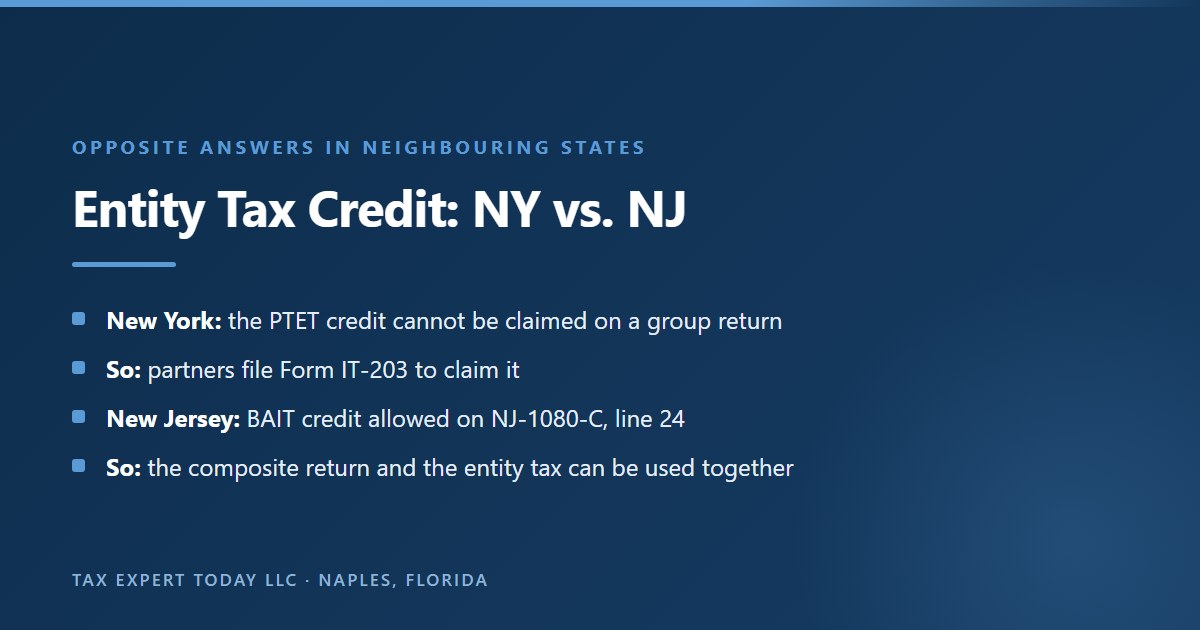
In New York, an entity tax election effectively ends the group return for owners who want the credit, because the credit cannot be claimed on Form IT-203-GR. In New Jersey the opposite is true: Form NJ-1080-C has a line for the Business Alternative Income Tax credit, so both can be used together.
- New York: “The PTET credit cannot be claimed on a group return.”
- New Jersey: the composite return allows credit for entity tax paid on the participant’s share.
- Election timing: New York’s opt-in window runs from January 1 to March 15 of the tax year.
- Scope: an electing New York entity must include all partners subject to the personal income tax.
This is the single most important interaction on the page, and the two neighbouring states answer it in opposite ways. New York’s entity tax FAQ addresses the exact situation: a partnership files group returns for several nonresident partners and then opts in to the entity tax. The Department’s answer is that partners reporting income on Form IT-203-GR “may not claim any New York State income tax credits, including the PTET credit,” and that the nonresident partners “must file individual New York State personal income tax returns” on Form IT-203 to claim it.
The consequence is a real fork. If the entity has paid entity tax on a Florida partner’s share and that partner stays on the group return, the partner pays 10.9 percent on the group return and forfeits the credit for the tax the entity already paid on the same income. No rational owner chooses that, so in practice an electing New York partnership moves its nonresident partners off the group return and onto individual Forms IT-203. The Department’s entity tax page notes that the election is made online each year, on or after January 1 and no later than March 15, and that it is irrevocable after the due date of the first estimated payment. The partner should know which way the entity went before April.
New Jersey resolved the same question the other way. The Division’s FAQ asks whether an electing entity can still file a composite return and answers yes, adding that “a line has been added to the composite return allowing credit for the amount of tax paid by the pass-through entity on the participating member’s share of distributive proceeds.” That is line 24 of the 2025 Form NJ-1080-C. The Division’s entity tax page lists the rates as 5.675 percent on the first $250,000 of distributive proceeds, 6.52 percent from $250,001 to $1,000,000, and 10.9 percent above $1,000,000. An overpayment on the composite return cannot be moved to the entity’s own tax account, according to the same FAQ, because the two are separate taxes.
| Question | New York | New Jersey | Illinois |
|---|---|---|---|
| Name of the entity tax | Pass-through entity tax (PTET), Tax Law Article 24-A | Pass-Through Business Alternative Income Tax (BAIT) | Pass-through entity (PTE) tax |
| Can the credit be used on a composite or group return? | No | Yes, line 24 of NJ-1080-C | No composite return exists |
| What the nonresident owner files to use the credit | Form IT-203 | NJ-1080-C participation, or Form NJ-1040NR line 56 | An Illinois return when one is required |
| Effect on entity payments for nonresidents | The entity may take the credit into account in its Form IT-2658 estimates | No partner remittance where a full refund is reasonably expected | Pass-through withholding applies to entities that do not elect |
This page uses the entity tax only as the third branch of the composite decision. The mechanics of an election in a particular state are a separate subject; our guide to the Georgia pass through entity tax shows how one state’s election works from start to finish, and our Georgia composite return guide covers that state’s Form IT-CR for owners with Georgia interests.
Why Can You Not Use a Composite Tax Return in the Year You Move?
New York, New Jersey and Pennsylvania each require a participant to be a nonresident for the entire tax year. An owner who changes domicile to Florida partway through the year was a resident for part of it, so the owner fails the test and must file an individual part-year or nonresident return for that year.
- New York: “a nonresident individual of New York State for the entire tax year.”
- New Jersey: “I was a nonresident of New Jersey for the entire year.”
- Pennsylvania: domiciled elsewhere “during the entire calendar year,” owner and spouse.
- Practical effect: the first composite year is the first full calendar year after the move.
The move year is where relocating owners most often sign something they should not. The partnership sends its usual election package in February or March. The owner, who has signed it for years as a resident of some third state or who is new to it, signs again. But an owner who lived in Hoboken until May and in Naples from June was a New Jersey resident for five months of that year. The first declaration on Form NJ-1080E is false for that owner, and the form is signed under penalties of perjury.
The correct filing for the move year is individual. In New York it is Form IT-203 as a part-year resident. In New Jersey the resident period and the nonresident period are reported separately; the 2025 nonresident instructions tell part-year nonresidents to prorate the distributive share of partnership income based on the number of days in the partnership’s fiscal year that the owner was a nonresident. In Pennsylvania a part-year resident files a PA-40. Our article on snowbird taxes in year one walks through the part-year return, and the New York exit tax and New Jersey exit tax guides cover what each state collects on the way out.
The move year also deserves care for a second reason. A composite tax return in a later year quietly asserts that the owner is a nonresident. If the old state later challenges the change of domicile, a composite election signed for a year in which the owner was still arguably a resident does not help. The individual return, with its residency schedule completed accurately, is the better record for the transition year. Our checklist for how to establish Florida residency and the Florida 183 day rule calculator cover the proof side, starting with the declaration of domicile under Fla. Stat. §222.17.
| Year | Owner’s status in the old state | Composite or group return? | What to file |
|---|---|---|---|
| Last full year before the move | Resident | No; residents do not qualify | Resident return |
| Year of the move | Part-year resident | No; not a nonresident for the entire year | Part-year or separate resident and nonresident returns |
| First full year in Florida | Nonresident, if no permanent place of abode and no other source income | Yes, if the entity offers one and the owner elects | Composite election, or an individual nonresident return |
| Any later year with a retained home or other source income | Nonresident, but not qualified | No | Individual nonresident return |
Does Keeping a Home in the Old State Disqualify You?
Yes. All three states bar an owner who maintained a permanent place of abode in the state at any time during the year. A Florida resident who kept the Manhattan apartment, the New Jersey shore house or the Pennsylvania family home generally cannot join the composite tax return, whatever the day count.
- The test is the dwelling, not the days: eligibility fails even with very few days in the state.
- Spouse counts in Pennsylvania: the owner “along with his or her spouse” must maintain no permanent place of abode.
- Signed statement: the owner declares the fact on the election, under penalties of perjury in New Jersey.
This condition surprises owners because it is stricter than the residency test itself. In New York, keeping a permanent place of abode makes a person a statutory resident only when combined with more than 183 days in the state. For the group return, the permanent place of abode alone is enough to disqualify, with no day count. The owner is still a nonresident for income tax purposes and still owes New York tax only on New York source income, but must file Form IT-203 individually to report it.
An owner in this position should treat the individual return as the safer course in any case. The New York nonresident return asks whether the taxpayer maintained living quarters in the state, and a truthful yes is the kind of answer that draws a residency inquiry. Our guides to the dual state residency tax trap and the New York residency audit explain how the retained home and the day count interact, and our guide to the Florida residency audit explains how the old state tests the move itself. A group return election signed by someone who kept an apartment is an incorrect statement that also hides the apartment, which is a poor combination to defend later.
The permanent place of abode question is factual, and it turns on whether the dwelling is suitable for year-round use and available to the owner, not on whose name is on the deed. An owner who is unsure whether a retained property counts should resolve that question before signing any election that says no such property exists.
What Other Income in the Old State Disqualifies You?
Any income from the state other than the pass-through share generally disqualifies the owner: wages for work performed there, rent from a retained property, gain on a sale of real estate, or income from a second business. New York also tests the spouse’s income, and Pennsylvania counts a second pass-through interest as other income.
- Retained rental property: rent is source income and ends eligibility in all three states.
- Wages or director fees: compensation for services performed in the state is other source income.
- Spouse’s income: in New York, neither the partner nor the partner’s spouse may have other New York source income.
- Second entity: permitted through other group or composite returns in New York and New Jersey, disqualifying in Pennsylvania.
- Sale year: gain on old-state real estate is source income in the year of sale.
The other-income condition is the one most often broken by accident, because Florida movers tend to leave something behind. The most common pattern is the former home converted to a rental. Rent from real property is sourced to the state where the property sits, so the owner has other source income every year the rental continues and is off the composite return for all of those years. Our guide to selling a rental property after moving covers the sale year, when the gain adds to the problem.
The second common pattern is continued pay from the old state. A partner who also receives a salary, a consulting fee or a fixed payment for services performed in the old state has to look at how that income is characterized. In New York, the convenience of the employer rule can treat days worked from a Naples home office as New York workdays for an employee of a New York employer, which creates New York wage income the owner may not have expected. Our guide to the convenience of the employer rule explains the test, and our guide to Florida domicile for executives covers deferred pay and equity awards that keep paying after the move.
New York softens the rule in one direction. A partner whose only other New York income comes from another partnership, New York S corporation or professional athletic team that also files a group return may be included, so long as the partner participates in those other group returns and in no more than 10 for the year. New Jersey’s election likewise permits income “reported on the composite return being filed by this or any other entity.” Pennsylvania has no such allowance.
| Other income in the old state | New York group return | New Jersey composite return | Pennsylvania consolidated return |
|---|---|---|---|
| Rent from a retained property | Disqualifies | Disqualifies | Disqualifies |
| Wages for work performed in the state | Disqualifies | Disqualifies | Disqualifies |
| Gain on sale of real estate in the state | Disqualifies for that year | Disqualifies for that year | Disqualifies for that year |
| Second pass-through interest with in-state income | Allowed if it also files a group return and the partner joins it | Allowed if reported on another composite return | Disqualifies |
| Spouse’s separate in-state income | Disqualifies | Not addressed on the election form | Spouse’s domicile and abode are tested |
| Interest and dividends from investments | Generally not source income of a nonresident | Generally not source income of a nonresident | Generally not source income of a nonresident |
New Jersey’s regulation also covers the case where the problem is discovered late. If, after the composite return has been filed, a participant discovers New Jersey source income from somewhere other than the filing entity, the participant must file Form NJ-1040NR reporting all New Jersey source income. A Florida owner who sells New Jersey business real estate in the same year should also read our guide to the New Jersey bulk sale rules, because that sale brings its own notice and escrow process.
What Does the Choice Cost in Dollars? A Hypothetical
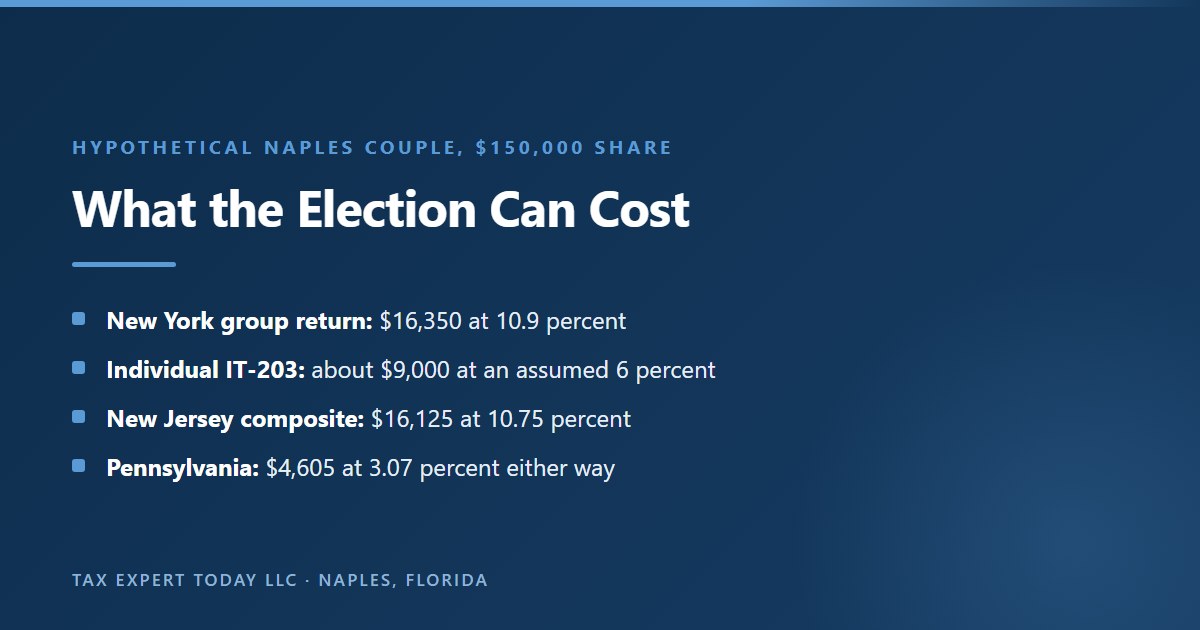
On a hypothetical $150,000 share of New York income, a group return costs $16,350 at 10.9 percent. If the same owner’s individual return would have produced an effective rate of 6 percent, the tax would be about $9,000, so the group return costs about $7,350 more, with no Florida credit to recover it.
- New York group return: $150,000 multiplied by 10.9 percent equals $16,350.
- New Jersey composite return: $150,000 multiplied by 10.75 percent equals $16,125.
- Pennsylvania consolidated return: $150,000 multiplied by 3.07 percent equals $4,605, the same as an individual return.
- The assumption that drives the answer: the owner’s effective rate on an individual return.
The figures below are hypothetical math to show how the comparison works. They are not a prediction for any taxpayer. The composite figures are exact, because the rate is fixed by the form. The individual figures depend on an assumed effective rate, which in real life comes from running the owner’s actual numbers through the state’s rate schedule and income percentage.
Take a married couple living in Naples with $400,000 of total income, of which $150,000 is one spouse’s share of income from a New York partnership. Assume the couple has no other New York income and no New York home, so the partner qualifies for the group return. Assume also, for illustration only, that New York tax computed on the couple’s entire income as if they were residents would equal 6 percent of that income, or $24,000. The New York income percentage is $150,000 divided by $400,000, or 37.5 percent, so the individual nonresident tax would be about $9,000.
| New York hypothetical, $150,000 share | Group return | Individual Form IT-203 |
|---|---|---|
| Tax base | $150,000 | $400,000 of total income, then prorated |
| Rate | 10.9 percent, fixed | 6 percent effective, assumed for illustration |
| New York tax | $16,350 | About $9,000 |
| Florida credit for tax paid to New York | None | None |
| Difference | About $7,350 more on the group return | |
Now run the same couple through New Jersey, with a $150,000 share from a New Jersey partnership in place of the New York one, and assume an effective rate of 5 percent on an individual return. The composite tax is $16,125. The individual tax would be about $7,500. If the partnership remitted 6.37 percent on the partner’s behalf during the year, that deposit is $9,555, and the individual return would produce a refund of about $2,055.
| Hypothetical $150,000 share | New Jersey | Pennsylvania |
|---|---|---|
| Composite or consolidated tax | $16,125 at 10.75 percent | $4,605 at 3.07 percent |
| Individual return tax | About $7,500, at an assumed 5 percent effective rate | $4,605 at 3.07 percent |
| Paid in by the entity if the owner does not join | $9,555 at 6.37 percent | Quarterly nonresident withholding at 3.07 percent |
| Result of filing individually | Refund of about $2,055 | No difference in tax |
| Annual cost of the composite election | About $8,625 | None in tax; only the lost flexibility |
Two lessons follow from the arithmetic. The first is that the cost of a composite tax return is a function of the gap between the top rate and the owner’s own effective rate, so it shrinks as total income rises. An owner whose income would reach the top bracket anyway gives up very little. The second is that the cost has to be weighed against the real cost of the individual return: preparation fees, the time involved, and the disclosure of total income. For a $4,000 K-1 share, the excess tax on a group return may be less than the fee for one more state return. For a $150,000 share, it rarely is.
How Is a Composite Payment Treated on Your Federal Return?
A composite payment is generally the owner’s own state income tax, paid by the entity and charged to the owner as a distribution. On the federal return it falls under the individual limit on state and local tax deductions, which is $40,400 for 2026. An entity tax under Notice 2020-75 is deducted by the business.
- Composite payment: treated as paid by the owner; deductible only on Schedule A within the cap.
- The cap for 2026: $40,400 under IRC 164(b)(6), with a phase-down for higher incomes.
- Entity tax: a specified income tax payment deducted in computing the entity’s income.
- Florida factor: with no state income tax at home, property tax is usually the main item competing for the cap.
The state rate is only half the comparison. The other half is what the payment does on the federal return. When a partnership pays tax on a composite tax return, it is paying the individual owners’ liabilities, not its own. The payment is ordinarily charged to each participating owner’s capital account as a distribution, and the owner is treated as having paid state income tax. That tax is deductible only as an itemized deduction, and only within the limit in IRC §164(b)(6).
That limit changed in 2025. The statute now sets the applicable limitation amount at $40,000 for tax years beginning in 2025 and $40,400 for tax years beginning in 2026, with 1 percent annual increases through 2029 and a return to $10,000 after that. The amount is reduced by 30 percent of modified adjusted gross income above a threshold, which is $505,000 for 2026. A Florida couple with significant property tax on a Naples home and income above the threshold may have little or no room left under the cap for a composite payment to another state.
An entity tax works differently. In Notice 2020-75 the IRS announced that a partnership or S corporation may deduct specified income tax payments, meaning state income taxes imposed on and paid by the entity itself, in computing its non-separately stated income, and that those payments are not taken into account in applying the individual limit to the owners. The owner receives the benefit through a lower federal K-1 amount, with no itemizing required. A composite payment made to satisfy the owners’ liabilities is generally not that kind of payment.
| Federal question | Composite or group payment | Entity tax payment |
|---|---|---|
| Whose tax is it? | The owner’s, paid by the entity on the owner’s behalf | The entity’s own tax |
| Where is it deducted? | Schedule A, if the owner itemizes | In computing the entity’s ordinary income |
| Subject to the individual cap? | Yes | No, under Notice 2020-75 |
| Effect on the federal K-1 | Shown as a distribution or withdrawal | Reduces the owner’s share of income |
This is why the entity tax election and the composite return are often discussed together, and why owners should not look at the state rate alone. A New Jersey composite election that costs more in state tax may sit alongside an entity tax election that returns part of the difference on the federal return, since New Jersey allows the entity tax credit on the composite return. In New York the two cannot be combined, so the federal benefit of the entity tax is available only to partners who file individually.
Does a Composite Payment Put an S Election at Risk?
Generally not. Treasury Regulation 1.1361-1(l)(2)(ii) disregards state laws that require an S corporation to pay or withhold state income tax for some shareholders, provided the shares still confer identical rights once the resulting constructive distributions are taken into account. A timing difference alone does not create a second class of stock.
- The rule: an S corporation may have only one class of stock.
- The safe harbor: state-required tax payments for some shareholders are disregarded if distributions are equalized.
- The practical step: the corporation tracks composite payments and makes true-up distributions to the other shareholders.
Shareholders of an S corporation that files a New York Form IT-203-S or a New Jersey composite return for its nonresident owners sometimes ask whether paying tax for some shareholders and not others endangers the election. The regulation addresses the situation directly. State laws that require a corporation to pay or withhold state income taxes on behalf of some or all shareholders are disregarded in testing for identical rights, “provided that, when the constructive distributions resulting from the payment or withholding of taxes by the corporation are taken into account, the outstanding shares confer identical rights to distribution and liquidation proceeds.”
The regulation adds that a difference in timing between the constructive distributions and the actual distributions to the other shareholders does not cause the corporation to be treated as having more than one class of stock. The working discipline is bookkeeping. The corporation should record each composite or withholding payment as a distribution to the shareholder it was paid for and keep total distributions proportionate to share ownership over time. Shareholders’ agreements for multistate S corporations commonly say so in terms. Our comparison of the S corp vs C corp choice covers the wider consequences of the election, and the legal drafting of a shareholders’ agreement belongs with a business attorney.
What Deadlines Apply to the Election Each Year?
For a calendar year 2025 return, the New York partner’s election and the New Jersey Form NJ-1080E must both be settled by April 15, 2026, and neither can be changed afterward. New York’s first-time Form TR-99 is due within 30 days after year end. Pennsylvania’s election is fixed once a return is filed.
- January: New York Form TR-99 for a first group year, within 30 days after the close of that year.
- February 15: New York’s date for telling the Department that a partner in the group estimates is dropping out.
- March 15: the close of New York’s entity tax opt-in window for the current year.
- April 15: elections become fixed in New York and New Jersey; returns and Pennsylvania’s PA-40 NRC are due.
| Date (calendar year entity) | State | What happens |
|---|---|---|
| About January 30 | New York | Form TR-99 due for a first group return year: no later than 30 days after the close of the initial tax year |
| February 15 | New York | Group agent should notify the Department if a partner included in group estimates will not participate, so payments can be moved to the partner’s own account |
| March 15 | New York | Last day for the entity to opt in to the entity tax for the current year |
| April 15 | New York | Partner’s election to participate must be made and cannot be changed afterward; group return due |
| April 15 | New Jersey | Form NJ-1080E cannot be made or revoked after this date; NJ-1080-C due |
| April 15 | Pennsylvania | PA-40 NRC due; the choice between the PA-40 NRC and a PA-40 is fixed once either is filed |
| October 15 | All three | Extended due dates, on Form IT-370, Form NJ-630 or Form REV-276; an extension does not extend the time to pay |
The February 15 date in New York protects partners who change their minds. A partnership approved for group filing may make group estimated payments for its electing partners during the year. If a partner then decides not to participate, the instructions ask the group agent to notify the Department no later than February 15 of the filing year so that the partner’s share of those payments can be transferred to an individual estimated tax account. The instructions caution that the transfer “could take two to three weeks to become effective” and that a partner who files an individual return before the transfer is complete “will not get credit for these payments when the return is processed.” A partner leaving the group late may want an extension for exactly that reason.
What Happens if Your Interest Is Held in a Trust?
An interest held by a trust generally cannot be on a composite tax return. New York says a partner that is a trust is not a qualified nonresident partner, New Jersey excludes estates and trusts as participants, and Pennsylvania lists trusts as non-qualifying owners regardless of how the trust is taxed.
- New York: “a partner that is a trust is not a qualified nonresident partner.”
- New Jersey: a partner cannot participate if the partner is an estate or trust.
- Pennsylvania: trusts are non-qualifying owners “regardless of how the trust is taxed.”
- Florida planning link: retitling a business interest into a revocable trust can end composite eligibility.
This rule matters to Florida movers more than to most owners, because a move to Florida is usually the moment the estate plan is rebuilt. New Florida residents are routinely advised to sign a Florida revocable living trust and to retitle assets into it, and a membership interest in a family LLC or a partnership interest is often on the list. For federal income tax purposes nothing changes, since a revocable trust is ignored during the grantor’s life. For composite eligibility, the owner of record is now a trust.
The Pennsylvania wording is the bluntest of the three. Its list of non-qualifying owners includes trusts as owners of the pass-through entity “regardless of how the trust is taxed,” which reaches a grantor trust. New York’s instructions state the exclusion in a parenthetical to the first qualification. The New Jersey partnership instructions list the estate or trust partner first among those who cannot participate in the composite return.
The planning response is coordination, not avoidance. Before an interest is assigned to a trust, the owner should ask the entity how it will treat the new holder for state filing purposes, and should expect that an individual or fiduciary nonresident return may replace the composite election from that year forward. Our guide to Florida estate planning for new residents covers the retitling decision, and our estate and trust planning practice works with the client’s Florida attorney on the tax side of it.
| Holder of the interest | New York | New Jersey | Pennsylvania |
|---|---|---|---|
| Individual, full-year nonresident | May qualify | May qualify | May qualify |
| Trust, including a revocable trust | Not qualified | Cannot participate | Non-qualifying owner |
| Estate of a deceased owner | Not an individual partner | Cannot participate | Non-qualifying owner |
| Another partnership or LLC (tiered ownership) | Not an individual partner | Cannot participate | Non-qualifying owner |
| Corporation | Not an individual partner | Cannot participate | Non-qualifying owner |
What Happens to Losses and Credits on a Composite Tax Return?
Losses are largely wasted in composite years. In New York a net operating loss or capital loss cannot be carried back or forward to a group return year, and credits that originate in a group year are waived permanently. An owner expecting losses or holding carryovers should usually file individually.
- Loss year on a group return: the loss does not reduce tax in other group years.
- Carryovers from individual years: usable only in years the owner files individually.
- Carryover clock: group years still count toward limited carryover periods.
- Credits: those originating in a group year are waived, including their carryovers.
New York’s special rule for losses is detailed and easy to misread. A New York net operating loss or capital loss is determined for each electing partner as if the partner were filing individually. But whether the loss arises in a group year or an individual year, “the partner may not carry the net operating or capital loss back or over to a year for which the partner elects to file on a group return.” The partner may use the loss only in a previous or subsequent year in which the partner files an individual return, and the instructions add that group years are counted in determining the allowable carryback or carryover period.
The effect on a real ownership cycle can be significant. Suppose a partnership has two start-up loss years followed by profitable years. A Florida partner who joins the group return in the profitable years cannot bring the earlier losses onto it. The losses are stranded unless the partner switches to individual filing while the carryover period is still open. For an investment expected to swing between loss and profit, the individual return is usually the better standing choice, even when the composite election looks harmless in any single year.
Credits follow the same pattern. A New York credit that originates in a group year is waived, and so is any carryover of that credit to later years, “whether the partner subsequently files on a group return or files an individual personal income tax return.” A credit that originated in an earlier individual year survives and can be claimed in a later individual year, with the intervening group years counted against any carryover limit. Owners in businesses that generate New York credits should ask for the credit schedule before electing.
Pennsylvania reaches a similar place by a different route. Pennsylvania does not allow net operating loss carryovers for individuals in the first place, and it taxes income by separate classes without netting one class against another. The consolidated return reports taxable income without including losses. An owner with a loss in one Pennsylvania activity and income in another is, in any case, a non-qualifying owner, because that owner has more than one Pennsylvania source.
Can the State Still Require an Individual Return After a Composite Filing?
Yes. Each state reserves the right to require an individual return from any participant. New Jersey’s regulation also makes each participant personally liable for the tax, including an audit assessment on the composite return, and treats the election as consent to personal jurisdiction in New Jersey for income tax purposes.
- New York: approval is “subject to revocation upon audit”; an unqualified partner must file an amended individual return.
- New Jersey: the Director may require Form NJ-1040NR from any participant.
- Pennsylvania: the Department may require a PA-40 from any individual owner “at any time.”
- Notices: in New York, a notice of deficiency goes to the group agent and to the individual partner.
A composite tax return does not make the owner invisible to the state. It makes the owner a participant in a return the state can audit. The New Jersey regulation is explicit about what the participant has agreed to. Each participant “is personally liable for the timely filing of returns and payment of such individual’s liability, including, but not limited to, any assessment resulting from an audit of the composite return.” Each participant also adopts, as his or her own, any actions of the filing entity that affect the return, “including, but not limited to, a waiver of the statute of limitations for assessment or any decision to accept the results of an audit by the Division.”
That last clause is worth pausing on. A managing partner can extend the assessment period or settle an audit of the composite return, and a participant in Naples is bound by it without having been consulted. An individual filer keeps those decisions. For most owners with clean K-1 income this is a theoretical risk. For an owner in a business with aggressive sourcing positions, it is a reason to prefer the individual return.
New York builds the same reservation into its approval. Permission to file as a group is contingent on the return being filed and “is subject to revocation upon audit.” If a partner is later found not to have been a qualified nonresident partner, perhaps because of a retained apartment or other New York income, the partner must file an amended return individually. Interest and penalties on the difference follow the ordinary rules. When a state tax assessment grows out of a residency or sourcing dispute, our Florida tax services team handles the response, and the individual return guide at nonresident state tax return explains what a late-required return involves.
What Are the Most Common Composite Return Mistakes Florida Owners Make?
The most common mistakes are signing the election in the year of the move, signing it while still owning a home or rental in the old state, staying on a New York group return after the partnership elects the entity tax, and assuming the composite rate is the same as an individual rate.
- Move-year election: a part-year resident does not qualify in any of the three states.
- Retained property: a permanent place of abode or a rental breaks eligibility.
- Lost New York entity tax credit: the credit cannot be claimed on Form IT-203-GR.
- Stranded estimates: personal New Jersey estimates are not credited on a composite return.
- Trust retitling: a new Florida revocable trust becomes the owner and ends eligibility.
| Mistake | Why it happens | Better approach |
|---|---|---|
| Electing in the move year | The election package arrives as usual and is signed from habit | File the part-year return individually; start composite filing, if at all, the next full year |
| Electing with a retained home | The owner knows the day count is low and assumes that is the test | Read the permanent place of abode condition; file individually while the home is kept |
| Electing with a rental or wages in the state | The other income feels unrelated to the partnership | Any other source income generally disqualifies; report everything on one nonresident return |
| Staying on a New York group return after an entity tax election | No one tells the limited partners the entity opted in | Ask each January whether the entity will elect; file Form IT-203 to claim the credit |
| Paying personal New Jersey estimates and then joining the composite return | Old resident habits continue after the move | Stop personal estimates, or stay off the composite return and claim them on Form NJ-1040NR |
| Ignoring loss carryovers | The election is evaluated one year at a time | File individually while carryovers remain |
| Assuming Illinois still has a composite return | Old engagement letters and search results | Expect pass-through withholding and decide whether Form IL-1000-E makes sense |
| Assigning the interest to a trust without checking | Estate planning and tax compliance are handled separately | Confirm the entity’s treatment of the trust before the assignment |
A quieter mistake runs the other way: refusing the composite election on principle when it costs nothing. A Florida owner whose only Pennsylvania connection is one K-1 pays the same 3.07 percent either way, and joining the PA-40 NRC removes a state return from the household’s filing season. The same can be true of a very small New York or New Jersey share, where the excess tax at the top rate is less than the cost of preparing another return. The point of running the numbers is to find out which case applies.
What Should You Ask the Partnership Before You Sign the Election?
Ask whether the entity has elected or will elect the state’s entity tax, what rate the composite tax return will use, what was paid on your behalf during the year, whether an overpayment is refunded or carried forward, and whether the entity will support an individual filing if you decline.
- Entity tax status: decides whether a New York group return forfeits a credit.
- Payments already made: group estimates, partner remittances or withholding, by state and by date.
- Overpayment handling: New York rolls it forward; New Jersey can refund it to the entity.
- State K-1 package: Form IT-204-IP, Schedule NJK-1 or PA Schedule NRK-1, needed for an individual return.
| Question for the managing partner or tax department | Why it matters to a Florida owner |
|---|---|
| Did the entity opt in to the state entity tax this year? | In New York the credit cannot be used on the group return; in New Jersey it can |
| Which states will have a composite or group return, and at what rate? | The rate is the entire cost, since Florida gives no credit |
| How much was paid on my behalf, to which state, on which dates? | Needed to claim payments on an individual return and to avoid underpayment interest |
| How is a composite payment charged to me? | It is normally a distribution; it affects capital accounts and S corporation distribution true-ups |
| If the composite return shows an overpayment for me, how do I get it back? | New York applies it to next year’s group estimates; a departing partner needs a settlement |
| When do you need my election, and can I see last year’s? | Elections are annual and fixed after April 15 in New York and New Jersey |
| Will you issue the state schedules I need if I file individually? | The state K-1 schedule, not the federal K-1, supports the individual return |
| Has the entity extended any statute of limitations or settled an audit for a composite year? | Participants in New Jersey adopt those actions as their own |
Owners who are selling or winding down the business around the move have additional timing to consider. Income from a sale of the business or its assets can be far larger than a normal year’s share, which magnifies the top-rate cost of a composite election in the sale year. Our guide to moving to Florida before selling a business covers the federal and state timing of the exit, our note on the Florida intangible tax explains why the proceeds carry no Florida tax once invested, our guide to Florida asset protection for new residents covers how those proceeds are held, and our business consulting practice works through the entity-level elections with the owner group.
Frequently Asked Questions
What is a composite tax return?
A composite tax return is a single state income tax return that a partnership, limited liability company or S corporation files for its nonresident owners who elect to be included. The entity pays the tax, usually at the state’s highest individual rate, and the included owners do not file their own nonresident returns in that state.
What rate applies on a New York group return or New Jersey composite return?
On the 2025 forms, New York Form IT-203-GR computes tax at 10.9 percent of each partner’s New York taxable income, and New Jersey Form NJ-1080-C computes tax at 10.75 percent. Both use the highest individual rate with no deductions, exemptions or graduated brackets. Pennsylvania Form PA-40 NRC uses the flat 3.07 percent rate.
Can I join a composite tax return in the year I move to Florida?
Generally no. New York, New Jersey and Pennsylvania each require a participant to be a nonresident for the entire tax year. An owner who changed domicile during the year was a resident for part of it and files an individual part-year or nonresident return for that year.
Does a Florida resident get a credit for tax paid on a composite return?
No. Florida has no personal income tax, so there is no Florida return on which to claim a credit for tax paid to another state. The tax paid through a composite return is a final cost, which is why the composite rate matters more to a Florida owner than to an owner living in another income tax state.
Can I claim the New York PTET credit on a group return?
No. The New York Department of Taxation and Finance states that the PTET credit cannot be claimed on a group return. Nonresident partners must file an individual Form IT-203 to claim it. New Jersey is different: Form NJ-1080-C has a line for the Pass-Through Business Alternative Income Tax credit.
Does Illinois still have a composite return?
No. The Illinois regulation limits composite returns to taxable years ending before December 31, 2014. Illinois now uses pass-through withholding, and a nonresident whose withholding satisfies the Illinois liability is not required to file an Illinois return.
Can a Naples firm help with composite return decisions for a business in another state?
Yes. The analysis is done on the owner’s numbers and the state forms, so location is not a barrier. Tax Expert Today LLC, at 11983 Tamiami Trail N in Naples, Florida, helps Southwest Florida residents compare composite, individual nonresident and entity tax outcomes and prepares the nonresident returns when filing individually is the better course.
Composite Tax Return Help in Naples & Southwest Florida
Tax Expert Today LLC works with business owners and investors who have moved, or are moving, to Naples, Florida and across Southwest Florida while keeping an interest in a partnership, limited liability company or S corporation in the state they left. The work is the annual decision this guide describes: reading the election package, testing eligibility against the move date, the retained home and any other source income, comparing the composite tax return with an individual nonresident return on the owner’s real numbers, and coordinating with the entity’s own tax department. The firm is multidisciplinary, with enrolled agents, CPAs and attorneys, and it handles residency and tax matters nationwide. Our office is at 11983 Tamiami Trail N, Naples, FL 34110, open Monday through Friday, 10 a.m. to 5 p.m. ET, and reachable at (239) 441-2005.
- Composite tax return help Naples: a side by side projection of composite, individual and entity tax outcomes for each state on the K-1.
- Move-year filings: part-year and nonresident returns for New York, New Jersey, Pennsylvania and other states.
- Election reviews: checking Form NJ-1080E, New York group elections and Pennsylvania owner statements before they are signed.
- Entity coordination: working with the partnership’s preparers on entity tax elections, estimates and state K-1 schedules.
Our Naples tax planning practice describes the wider relocation planning work, our tax planning services page covers multistate owners in particular, and our Florida tax services page covers the ongoing filings that follow a move.
When to Engage a Professional
An owner with one small K-1 from one state, no property and no other income there, and an entity that has not elected an entity tax may reasonably sign the composite election and move on. Professional help earns its cost when the share is large relative to total income, when the move happened during the year, when a home or rental remains in the old state, when the entity has elected or is considering an entity tax, when losses or credits carry over, when the interest is being moved into a trust, or when a state has asked for an individual return for a year that was filed on a composite basis. Tax Expert Today LLC’s enrolled agents, CPAs and attorneys can project the alternatives before the April 15 election cutoff, prepare the nonresident returns, and coordinate with the entity. Results depend on each owner’s facts, and no particular outcome can be promised. Call (239) 441-2005 to schedule a consultation.
Published November 28, 2026 by Dr. Pellumb Kabashi « Back to Learning Center
Have a question this article touches on?
Tax Expert Today LLC, based in Naples, Florida and serving clients across the United States.
Schedule a Consultation (239) 441-2005