
By Dr. Pellumb Kabashi, DBA, MBA, CES, CFE, EA
Founder, Tax Expert Today LLC · Tax advisors, enrolled agents, CPAs, and attorneys · Serving clients in all 50 states
Quick Answer: California Form 100S is the S corporation franchise or income tax return. The corporation pays 1.5 percent of California net income or the $800 minimum, and each shareholder receives a Schedule K-1 (100S). Moving to Florida does not end the filing. A departed shareholder reports the California source column on Form 540NR, and distributions may carry 7 percent withholding. Call (239) 441-2005 for a free consultation.
What Is California Form 100S and Who Has to File It?
California Form 100S is the California S Corporation Franchise or Income Tax Return. Every corporation with a federal S election that is incorporated in California, registered with the California Secretary of State, doing business in California or receiving California source income files it each year, whether or not the corporation earned a profit.
- Incorporated in California: files California Form 100S every year until it formally dissolves.
- Qualified or registered foreign corporation: a Florida, Delaware or Nevada corporation registered in California files on the same terms.
- Doing business in California: files even if it never registered with the Secretary of State.
- California source income only: files and pays the 1.5 percent income tax even when it is not doing business in the state.
- LLC taxed as an S corporation: files California Form 100S, not Form 568.
The 2025 S Corporation Tax Booklet opens its general information with a short rule: all federal S corporations subject to California laws must file California Form 100S and pay the greater of the minimum franchise tax or the 1.5 percent income or franchise tax. The Franchise Tax Board S corporations page lists the same four triggers in plain terms, which are incorporation in California, doing business in California, registration with the Secretary of State and receipt of California source income.
California does not require a separate state S election. The booklet states that a corporation that elects federal S status and has a California filing requirement is deemed to have made a California S election effective on the same date. The reverse is also true. Terminating the federal election terminates the California election at the same moment, and the corporation then files short period returns for the S corporation short year and the C corporation short year.
An LLC that has elected to be taxed as an S corporation is treated as a corporation for this purpose. The booklet directs that entity to file California Form 100S, Form 100-ES and form FTB 3539 and to follow the Corporation Tax Law. This matters to owners who formed an LLC and later made an S election, because the return they need is not the one described in our guide to California Form 568, and the LLC fee based on total income does not apply to them.
| Entity | California return | Entity level tax |
|---|---|---|
| Corporation with a federal S election | California Form 100S | 1.5 percent of net income, $800 minimum |
| LLC that elected S corporation treatment | California Form 100S | 1.5 percent of net income, $800 minimum |
| LLC taxed as a partnership or disregarded | Form 568 | $800 annual tax plus the LLC fee |
| C corporation | Form 100 | 8.84 percent of net income, $800 minimum |
| Financial S corporation | California Form 100S | 3.5 percent of net income |
The comparison between the LLC and S corporation structures, including the point at which the 1.5 percent tax costs less than the LLC fee, is covered in our guide to the California LLC versus S corporation decision. This guide stays with the return itself and with what happens to it once a shareholder leaves the state.
Does Moving to Florida End the California Form 100S Filing?
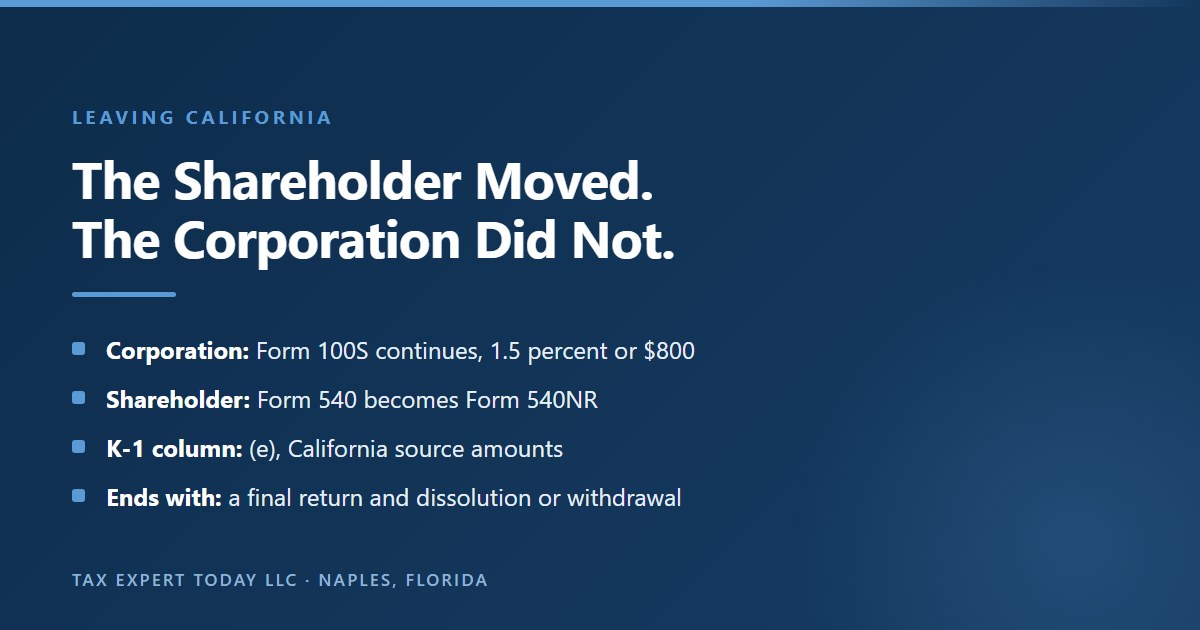
No. California Form 100S is the corporation’s return, and the filing requirement follows the corporation’s registration, activity and income, not the shareholder’s home address. When an owner moves to Florida, the owner’s personal return changes from Form 540 to Form 540NR, but the corporation keeps filing until it dissolves, withdraws or has no California connection left.
- Owner moves, corporation stays registered: California Form 100S and the $800 minimum continue.
- Owner moves, corporation still serves California customers: California Form 100S continues, and income is apportioned.
- Owner moves, corporation reincorporates in Florida but keeps California sales: the doing business thresholds decide the result.
- Owner moves, corporation dissolves or withdraws on time: a final California Form 100S ends the cycle.
The most common misunderstanding we see in Naples is the belief that a change of personal residency also relocates the business for tax purposes. It does not. The booklet says the minimum franchise tax must be paid by corporations incorporated in California or qualified or registered under California law whether the S corporation is active, inactive, not doing business or operating at a loss. Nothing in that sentence refers to where the shareholders live.
What changes is the shareholder side. A California resident shareholder is taxed on the entire pro rata share of the corporation’s income, wherever earned. A nonresident shareholder is taxed only on the California source portion. The S corporation therefore has to compute and report a California source figure for every line of the Schedule K-1 (100S), and for a shareholder who moved during the year it has to supply enough information to split the year. Our guide to leaving California covers the personal side of the move, and the guide to the California part-year resident return covers the Form 540NR that reports the split.
| Item | Before the move | After the move to Florida |
|---|---|---|
| Corporation return | California Form 100S | California Form 100S, unchanged |
| Entity tax | 1.5 percent, $800 minimum | 1.5 percent of California net income, $800 minimum if registered or doing business |
| Shareholder return | Form 540 | Form 540NR |
| K-1 column used | Column (d), total amounts | Column (e), California source amounts |
| Withholding on distributions | None for a resident | 7 percent of California source distributions above $1,500 a year |
A second point follows from the first. Because the corporation keeps filing, the Franchise Tax Board keeps receiving a Schedule K-1 (100S) with the departed shareholder’s name on it every year. A missing Form 540NR is therefore easy for the state to detect. Shareholders who assume the California chapter is closed are usually the ones who later receive a request for a return.
How Is the 1.5 Percent Tax on California Form 100S Calculated?
The S corporation multiplies its California net income by 1.5 percent and pays that amount or the $800 minimum franchise tax, whichever is greater. Net income for this purpose is computed under corporation rules, starting from federal ordinary income, adding and subtracting state adjustments, and then apportioning to California when the business operates in more than one state.
- Line 1: ordinary income or loss from the federal Form 1120-S.
- Lines 2 through 13: state adjustments, including taxes not deductible and depreciation differences.
- Line 15: net income for state purposes, after Schedule R apportionment where required.
- Line 21: tax at 1.5 percent, never less than the minimum franchise tax plus any QSub annual tax.
The line instructions in the 2025 booklet state the rate directly. S corporations must use a tax rate of 1.5 percent, financial S corporations must use 3.5 percent, and the tax on line 21 may not be less than the sum of the minimum franchise tax and any qualified subchapter S subsidiary annual tax. The return form itself is the 2025 Form 100S.
The federal reconciliation method is the usual route. The corporation transfers page 1 of the federal Form 1120-S to Schedule F, enters federal ordinary income on line 1, and then works through the state adjustments. Several of those adjustments matter in practice. The 1.5 percent tax and other income taxes deducted on the federal return are added back on line 2. Depreciation is recomputed because California does not follow federal bonus depreciation and applies its own section 179 limit, a difference we explain in our guide to California section 179. Separately stated items such as capital gains and portfolio income are also pulled into the corporate level computation, because the 1.5 percent tax applies to all of the corporation’s net income and not only to ordinary business income.
| Hypothetical computation | Amount |
|---|---|
| Federal ordinary business income | $400,000 |
| Add back California tax deducted federally | $6,000 |
| Add back federal bonus depreciation in excess of California depreciation | $54,000 |
| Net income after state adjustments | $460,000 |
| California apportionment percentage (Schedule R) | 60 percent |
| Net income for state purposes | $276,000 |
| Tax at 1.5 percent | $4,140 |
The figures above are hypothetical and are shown only to illustrate the order of the computation. In this example the 1.5 percent tax exceeds $800, so the minimum does not apply. If the same corporation had a loss, it would still owe $800 as long as it remained incorporated, registered or doing business in California.
The entity level tax is paid by the corporation and is not a credit on the shareholder’s return. A Florida shareholder therefore bears California tax twice in an economic sense on the same income: once through the corporation at 1.5 percent and again personally on the California source share reported in column (e). That layering is one of the reasons owners revisit the entity structure after a move, a subject we return to below.
What Is the $800 Minimum Franchise Tax and When Is It Waived?
The minimum franchise tax is $800 a year, owed by every S corporation that is incorporated in California, registered there or doing business there, even with no income and even for a short year. A corporation that newly incorporates or qualifies through the Secretary of State is not subject to the minimum for its first taxable year.
- Active or inactive: the $800 applies either way.
- Loss year: the $800 still applies.
- First taxable year: no minimum, but 1.5 percent of any net income is still due.
- Second year onward: the minimum applies and is paid with the first estimated tax installment.
- Each QSub: a separate $800 annual tax paid by the parent.
The booklet states that the minimum franchise tax is $800 and must be paid whether the S corporation is active, inactive, operates at a loss or files a return for a short period of less than 12 months. The first year rule is equally specific. A corporation that incorporated or qualified through the California Secretary of State is not subject to the minimum franchise tax for its first taxable year and computes its liability by multiplying state net income by the rate. The exception does not extend to qualified subchapter S subsidiaries, to corporations that are not qualified by the Secretary of State, or to corporations that reorganize solely to avoid the minimum.
The booklet also lists entities with no minimum franchise tax at all. The entry that matters to a Florida owner is the first: a corporation that is not incorporated in California, not qualified under California law and not doing business in California owes no minimum even though it derives income from California sources. That corporation pays the 1.5 percent corporation income tax on its California source income and nothing more at the entity level. The booklet adds a caution that a corporation meeting the sales, property or payroll thresholds for doing business may still be subject to the minimum.
| Situation | $800 minimum owed? | 1.5 percent tax owed? |
|---|---|---|
| California corporation, inactive all year | Yes | No income, so no |
| California corporation, first taxable year | No | Yes, on any net income |
| Florida corporation registered in California | Yes | Yes, on California net income |
| Florida corporation, unregistered, over a doing business threshold | Yes | Yes |
| Florida corporation, unregistered, California source income below every threshold | No | Yes, as income tax |
One narrow exemption is worth knowing. For taxable years beginning in 2020 through 2029, a small business corporation solely owned by a deployed member of the United States Armed Forces is not subject to the minimum if the owner is deployed during the year and the corporation operates at a loss or ceases operation. The booklet defines small business for this purpose as $250,000 or less of total income from California sources.
The FTB Publication 1060, the guide for corporations starting business in California, repeats the first year rule and explains how the first return is dated. The same $800 figure, the same first year waiver and the comparison with the LLC annual tax appear in our guide to the California LLC franchise tax, which is the counterpart to this section for owners whose entity never made an S election.
When Is an S Corporation Doing Business in California?
An S corporation is doing business in California if it actively engages in any transaction for financial gain in the state, or if it is organized or commercially domiciled there, or if its California sales, property or payroll exceed the annual thresholds. For 2025 those thresholds are $757,070 of sales, $75,707 of property and $75,707 of compensation, or 25 percent of the total.
- Sales test: California sales above the lesser of $757,070 or 25 percent of total sales.
- Property test: California real and tangible property above the lesser of $75,707 or 25 percent of the total.
- Payroll test: California compensation above the lesser of $75,707 or 25 percent of the total.
- Organization test: organized or commercially domiciled in California.
- Activity test: actively engaging in any transaction for financial or pecuniary gain in California.
The definition comes from R&TC section 23101 as quoted in the 2025 booklet. The dollar figures are indexed each year, so the amounts for 2026 returns should be taken from the 2026 booklet when the Franchise Tax Board releases it. The booklet also warns that it is not necessary for the corporation to conduct business in the state on a regular basis. Even an isolated transaction during the taxable year may be enough.
The payroll test is the one that surprises owners who move. Compensation is assigned to the state where the employee works. If the only shareholder employee moves to Naples and performs all services from Florida, California payroll may fall to zero. But if the corporation keeps one employee in California earning more than the threshold, the corporation is doing business in California on that fact alone, regardless of where the owner sleeps. The sales test works the same way for service companies, because sales of services are assigned under market rules to the place where the customer receives the benefit.
| Hypothetical Florida based S corporation | California figure | Doing business? |
|---|---|---|
| $300,000 California sales of $2,000,000 total, no property or payroll | 15 percent, below $757,070 | No, on the sales test alone |
| $600,000 California sales of $2,000,000 total | 30 percent, above 25 percent | Yes |
| One remote employee in San Diego paid $90,000 | Above $75,707 | Yes |
| Leased equipment in Los Angeles valued at $40,000 of $100,000 total | 40 percent, above 25 percent | Yes |
| Still incorporated in California | Organized in California | Yes |
The booklet adds two attribution rules. In counting sales, property and payroll, the taxpayer includes its pro rata share of amounts from partnerships and S corporations, and an S corporation that is a general partner of a partnership or a member of an LLC doing business in California is itself doing business in California. Table 2 of the Schedule K-1 (100S) exists partly so that shareholders that are themselves business entities can run the same test.
The examples in the table are hypothetical and simplified. The actual determination depends on how the sales factor rules assign each receipt, a question that often needs a close reading of the contracts. Our guide to California source income explains the sourcing rules that sit behind these tests.
Why Does California Compute S Corporation Income Two Ways?
California computes S corporation income once under corporation rules to measure the 1.5 percent tax, and a second time under federal pass-through rules to prepare the Schedule K-1 (100S). The two numbers are often different, and the booklet states plainly that amounts on the K-1 may not add up to the amounts on California Form 100S.
- Entity computation: Corporation Tax Law, used on Form 100S, Side 1 and Side 2.
- Shareholder computation: Personal Income Tax Law, used on Schedule K and Schedule K-1 (100S).
- Typical differences: charitable contributions, depreciation methods, credits and loss limitations.
- Result: the shareholder should not expect the K-1 to tie to line 15 of the return.
The general information section of the booklet describes the design in two sentences. The taxable income of the S corporation is calculated in the same manner as for C corporations, with certain modifications, for purposes of computing the 1.5 percent tax. Second, it is calculated using federal rules for the pass through of income and deductions for purposes of pass through to the shareholders.
This two track design explains several things that puzzle shareholders. A charitable contribution is limited at the corporate level under corporation rules but passes through in full on the K-1. A credit allowed only under the Corporation Tax Law is cut to one third and stays with the corporation, while a credit allowed under the Personal Income Tax Law passes to the shareholders in full. Net operating losses from C corporation years cannot offset the 1.5 percent tax, although the booklet allows them against the built-in gains tax.
| Item | California Form 100S (entity) | Schedule K-1 (100S) (shareholder) |
|---|---|---|
| Governing law | Corporation Tax Law | Personal Income Tax Law, following federal subchapter S |
| Rate | 1.5 percent | Shareholder’s own rate |
| Apportionment | Schedule R, single sales factor | Column (e), California source amounts |
| Loss limitations | NOL rules, with the 2024 to 2026 suspension | Basis, at-risk and passive activity limits |
| Credits | One third of corporation law credits | Full personal income tax law credits |
For a Florida shareholder the practical lesson is that two separate California source figures exist. The corporation’s apportioned net income drives the 1.5 percent tax. The shareholder’s column (e) figure drives the personal tax on Form 540NR. They start from the same apportionment percentage but can diverge because of the different rules applied on each track. When we review a return for a departed shareholder, we reconcile the two so that a difference is explained by a known adjustment and not by an error.
When Is California Form 100S Due for 2026?
California Form 100S is due on the 15th day of the third month after the close of the taxable year. For a calendar year S corporation, the 2026 return is due March 15, 2027, and the automatic extension runs to the 15th day of the ninth month, which is September 15, 2027. Payment is still due on the original date.
- Calendar year return: March 15, 2027 for the 2026 taxable year.
- Automatic extension to file: September 15, 2027, with no written request.
- Payment: March 15, 2027, with form FTB 3539 if paid by check.
- Schedule K-1 (100S) to shareholders: on or before the due date of the return.
- Weekend or holiday: the deadline moves to the next business day.
The filing rule appears in General Information E of the 2025 S Corporation Tax Booklet, and the extension rule in General Information F. The Franchise Tax Board business due dates page gives the same 15th day of the third month rule for S corporations. The 2026 dates above apply those rules to the 2026 calendar. The 2026 booklet has not been released as of the date of this guide, so the dates should be confirmed against it when it appears.
The shareholder deadline is tied to the corporate one. The booklet instructs the corporation to give each shareholder a copy of Schedule K-1 (100S) on or before the due date of California Form 100S, together with the shareholder instructions. In practice a corporation on extension often delivers the K-1 in late summer, which pushes the shareholder’s own Form 540NR onto extension as well. A Florida shareholder who has no Florida personal return to file sometimes forgets that a California extension payment may still be needed in April.
| Event for a 2026 calendar year S corporation | Date |
|---|---|
| First estimated tax installment, including the $800 minimum | April 15, 2026 |
| Second estimated tax installment | June 15, 2026 |
| Fourth estimated tax installment | December 15, 2026 |
| Form 592-PTE for 2026 withholding | January 31, 2027 |
| California Form 100S original due date and payment date | March 15, 2027 |
| Shareholder Form 540NR original due date | April 15, 2027 |
| California Form 100S extended due date | September 15, 2027 |
Short period returns follow a different rule. The booklet says the due date of a short period return is generally the same as the due date of the federal short period return. A corporation that converts to an LLC or limited partnership during the year generally files two short period California returns, unless the successor elects to be classified as an S corporation as of the conversion date and the conversion qualifies as a reorganization, in which case a single California Form 100S covers the year.
A final return has its own clock, covered later in this guide. The return for the final taxable period is due on or before the 15th day of the third full month after the month during which the S corporation withdrew or stopped doing business in California.
Does the California Form 100S Extension Give More Time to Pay?
No. The automatic extension for California Form 100S extends the time to file to the 15th day of the ninth month, but the full tax must be paid by the original due date. Unpaid tax accrues interest from that date, and a late payment penalty applies unless at least 90 percent of the tax shown, and not less than the minimum, was paid on time.
- Extension to file: automatic, no form required.
- Extension to pay: none.
- Payment voucher: form FTB 3539 when paying by check.
- Suspended corporations: no automatic extension at all.
- Missed extended date: the extension is disregarded and the late filing penalty runs from the original due date.
The booklet states that an automatic extension does not extend the time for payment and that the full amount of tax must be paid by the original due date of California Form 100S. If there is an unpaid liability on the original due date, the corporation completes form FTB 3539, Payment for Automatic Extension for Corporations and Exempt Organizations, and sends it with the payment. A corporation that pays electronically keeps the worksheet for its records and does not mail the voucher.
Two conditions can remove the extension. First, the booklet says there is no automatic extension period for business entities suspended on or after the original due date. A corporation that has fallen out of good standing therefore has only the original deadline. Second, if the corporation does not file by the extended due date, the automatic extension will not apply and the late filing penalty is assessed from the original due date of the return.
| Payment method | When it is mandatory | Voucher mailed? |
|---|---|---|
| Web Pay for Businesses | Optional for any corporation | No |
| Electronic funds withdrawal through tax software | Optional where the software supports it | No |
| Electronic funds transfer | After an estimated or extension payment above $20,000 or a total liability above $80,000 | No |
| Credit card | Optional, with a convenience fee | No |
| Check with form FTB 3539 | Only if not required to pay electronically | Yes |
The electronic payment rule deserves attention from growing companies. Once a corporation remits an estimated tax or extension payment in excess of $20,000, or has a total tax liability in excess of $80,000, all later payments must be made electronically regardless of amount, tax type or taxable year. The booklet sets the penalty for a payment that should have been electronic at 10 percent of the amount not paid electronically. With the pass-through entity elective tax now running through the same payment system, more S corporations cross these lines than did a few years ago.
Interest is separate from penalties and cannot be waived for reasonable cause. The booklet says interest is due on any tax not paid by the original due date and that the automatic extension does not stop interest from accruing. Our guide to the California late payment penalty explains how the penalty and the interest are computed on the personal side, which follows a similar pattern.
How Do Estimated Tax Payments Work for a California S Corporation?
An S corporation pays estimated tax with Form 100-ES in four installments due on the 15th day of the fourth, sixth, ninth and twelfth months of the taxable year. The required percentages are 30, 40, zero and 30, and the first payment may not be less than the $800 minimum franchise tax plus any QSub annual tax.
- First installment: 30 percent, and at least $800.
- Second installment: 40 percent.
- Third installment: no payment required.
- Fourth installment: 30 percent.
- Underpayment penalty: computed on form FTB 5806.
These percentages come from General Information K of the booklet. The form used is Form 100-ES, Corporation Estimated Tax. The uneven schedule is deliberate. California front loads the first half of the year, so 70 percent of the estimated liability is due by the 15th day of the sixth month. A corporation that pays four equal installments of 25 percent, as it would for federal purposes if it owed federal tax, will be underpaid for the first two periods.
For most small S corporations the estimated tax is modest, because 1.5 percent of net income is a small number. A corporation with $200,000 of California net income owes $3,000 for the year, and its first installment is the greater of 30 percent of that amount, which is $900, or the $800 minimum. The arithmetic becomes material only for larger companies, or where the corporation has built-in gains or excess net passive income taxed at 8.84 percent.
| Installment | Calendar year due date | Required share | Hypothetical $3,000 annual tax |
|---|---|---|---|
| First | April 15 | 30 percent, not less than $800 | $900 |
| Second | June 15 | 40 percent | $1,200 |
| Third | September 15 | None | $0.00 |
| Fourth | December 15 | 30 percent | $900 |
The underpayment penalty is described in General Information M. Any S corporation that fails to pay, pays late or underpays an installment is assessed a penalty on the underpayment for the period from the installment due date until the date paid or the original due date of the return, whichever is earlier. The corporation uses form FTB 5806 to compute it, and attaches the form only when it relies on Exception B or Exception C.
These entity payments should not be confused with two other streams of money that move through the same corporation. The elective pass-through entity tax has its own June 15 prepayment and its own voucher. Withholding on distributions to nonresident shareholders is remitted on the Form 592-Q schedule. The booklet is explicit that the elective tax payment cannot be combined with the entity’s other tax payments. Keeping three ledgers, one for each stream, prevents payments from being applied to the wrong account.
What Are the Penalties for a Late California Form 100S?
A late California Form 100S can draw two filing penalties at once: 5 percent of the unpaid tax per month up to 25 percent, and a separate $18 per shareholder per month for up to 12 months. A late payment penalty of 5 percent plus 0.5 percent per month also applies, and a corporation that keeps operating while suspended may owe $2,000 per year.
- Delinquent filing penalty: 5 percent of the tax due per month, 25 percent maximum.
- Per shareholder penalty: $18 times the number of shareholders, per month, up to 12 months.
- Late payment penalty: 5 percent of the unpaid tax plus 0.5 percent per month, 25 percent maximum.
- Electronic payment penalty: 10 percent of the amount not paid electronically.
- Operating while suspended or forfeited: $2,000 per taxable year.
All of these figures are taken from General Information M and Q of the 2025 booklet. The per shareholder penalty, which the booklet ties to R&TC section 19172.5, is the one small corporations overlook. It applies when the corporation fails to file by the due date including extensions, or files a return that fails to show all of the required information. It is not measured by tax, so it applies in a loss year and in a year when the only tax is the $800 minimum that was paid on time.
| Hypothetical: two shareholders, return filed five months after the extended due date, $800 paid on time | Amount |
|---|---|
| Delinquent filing penalty on unpaid tax of zero | $0.00 |
| Per shareholder penalty: $18 x 2 shareholders x 5 months | $180 |
| Late payment penalty | $0.00 |
| Total | $180 |
The example is hypothetical arithmetic. With unpaid tax the result changes quickly. The booklet explains that where the S corporation does not file by the extended due date, the automatic extension does not apply and the late filing penalty is assessed from the original due date. A return filed in February of the following year, eleven months after an original March due date, is therefore well past the five months needed to reach the 25 percent maximum.
The late payment penalty has a built-in relief rule. The booklet says the Franchise Tax Board may waive the penalty based on reasonable cause, and that reasonable cause is presumed when 90 percent of the tax shown on the return, but not less than the minimum franchise tax if applicable, is paid by the original due date. Where both the filing and payment penalties apply, the booklet says a combination may be assessed but the total will not exceed 25 percent of the unpaid tax.
Relief from the filing penalties depends on showing reasonable cause, and the facts that count are narrower than many owners expect. A move across the country, by itself, is usually not treated as a reason the corporation could not file. Our guide to reasonable cause penalty abatement explains the federal standard, which California generally follows in concept, and the kinds of documentation that support a request. Any request is decided on its facts, and no result can be promised.
What Does Schedule K-1 (100S) Show a Shareholder?
Schedule K-1 (100S) reports each shareholder’s pro rata share of the S corporation’s income, deductions and credits in four working columns: federal amounts in column (b), California adjustments in column (c), total amounts under California law in column (d) and California source amounts in column (e). It also carries withholding, basis items and two sourcing tables.
- Column (b): amounts from the federal Schedule K-1 (Form 1120-S).
- Column (c): adjustments for differences between California and federal law.
- Column (d): total amounts using California law, used by residents.
- Column (e): California source amounts and credits, used by nonresidents.
- Tables 1 and 2: nonbusiness intangible income and apportionment data.
The schedule is the 2025 Schedule K-1 (100S), and the shareholder instructions explain each column. Column (c) is not a sourcing column. The booklet instructs the corporation to enter there the adjustments resulting from differences between California and federal law, and specifically not adjustments relating to California source income. Typical entries are depreciation differences and gain or loss differences that flow from different depreciation or basis.
Column (d) is the worldwide figure under California law. Column (e) is the portion of column (d) that has a California source. For a corporation that operates only in California, columns (d) and (e) are the same for business income. For a corporation that apportions, column (e) is smaller. For a corporation with no California business at all, column (e) can be zero even though the corporation still files because it is incorporated in California.
| K-1 line | What it reports | Where a nonresident carries it |
|---|---|---|
| Line 1 | Ordinary business income or loss | Schedule CA (540NR), with form FTB 3801 if passive |
| Lines 4 to 6 | Interest, dividends and royalties | Schedule CA (540NR), Part II, column (e) amounts |
| Lines 7 and 8 | Net capital gain or loss | Schedule D (540NR) |
| Line 13d | Other credits, including the elective tax credit | Form FTB 3804-CR |
| Line 14 | Total withholding | Form 540NR, line 83, with Form 592-B attached |
| Line 16d | Property distributions including cash | Basis computation |
| Line 17c | Taxable dividend distributions | Reported as a dividend, with Form 1099-DIV |
The instructions impose a consistency rule that mirrors the federal one. Shareholders must generally report the items on the K-1 the same way the corporation treated them on its return. If the treatment on the shareholder’s return is inconsistent, or the corporation has not filed, the shareholder attaches a statement identifying and explaining the inconsistency, and a shareholder who fails to do so may be subject to an accuracy related penalty.
The K-1 is also not the document that claims withholding. The instructions say that shareholders must attach Form 592-B to the front of the California return to claim the withholding credit and that the Schedule K-1 (100S) is not used for that purpose. We cover the withholding forms in detail in a later section.
Which K-1 Column Does a Florida Shareholder Use?
A full year Florida resident shareholder uses column (e), the California source column, to compute California taxable income on Form 540NR, and uses column (d) for the total income figures the return also requires. Table 1 items are sourced to the shareholder’s state of residence, so for a Florida resident they generally fall outside California tax.
- California resident: column (d), because residents are taxed on income from all sources.
- Nonresident, no unitary business: columns (c), (d) and (e), plus Table 1.
- Nonresident with a unitary business: Table 2 data, not column (e).
- Part-year resident: column (d) for the resident period and column (e) for the nonresident period.
The shareholder instructions state the rule in section E. Shareholders who are California residents use the amounts in column (d) because California resident individuals are subject to personal income tax on all income from whatever source derived, citing R&TC section 17041. Nonresident shareholders who do not conduct a trade or business that is unitary with the S corporation use column (c), column (d) for total income purposes, column (e) for California source income purposes and Table 1.
Form 540NR needs both totals because of how the nonresident tax is computed. California first figures tax on total taxable income as if the person were a resident, then multiplies by the ratio of California taxable income to total taxable income. Column (d) feeds the first number and column (e) feeds the second. A Florida shareholder with large income from other sources will therefore pay California tax on the K-1 income at a higher effective rate than the K-1 income alone would suggest. Our guide to the nonresident state tax return explains this ratio method across states, and the 2025 Form 540NR booklet contains the California worksheet.
| Hypothetical K-1 for a 50 percent shareholder | Column (d) | Column (e) |
|---|---|---|
| Ordinary business income | $230,000 | $138,000 |
| Interest income from working capital | $2,000 | $1,200 |
| Net long-term capital gain on business equipment | $10,000 | $6,000 |
| Table 1 nonbusiness dividends | $4,000 | Not entered |
| California source total for a Florida resident | $145,200 |
The figures are hypothetical and assume a 60 percent California apportionment percentage. The Table 1 dividends are left out of column (e) because, as the instructions put it, the source of that income must be determined at the shareholder level, and amounts in Table 1 should be sourced to the residence or commercial domicile of the shareholder. For a shareholder domiciled in Naples, that points to Florida.
The nonresident also considers the higher rate layer. California’s 1 percent mental health services tax applies to taxable income above $1,000,000, and the booklet notes that an additional 1 percent tax is assessed on nonresident individuals with California taxable income over $1 million in the group return context. A shareholder whose column (e) income approaches that level should read our guide to the California mental health services tax.
How Does Schedule K-1 (100S) Work in the Year You Move?
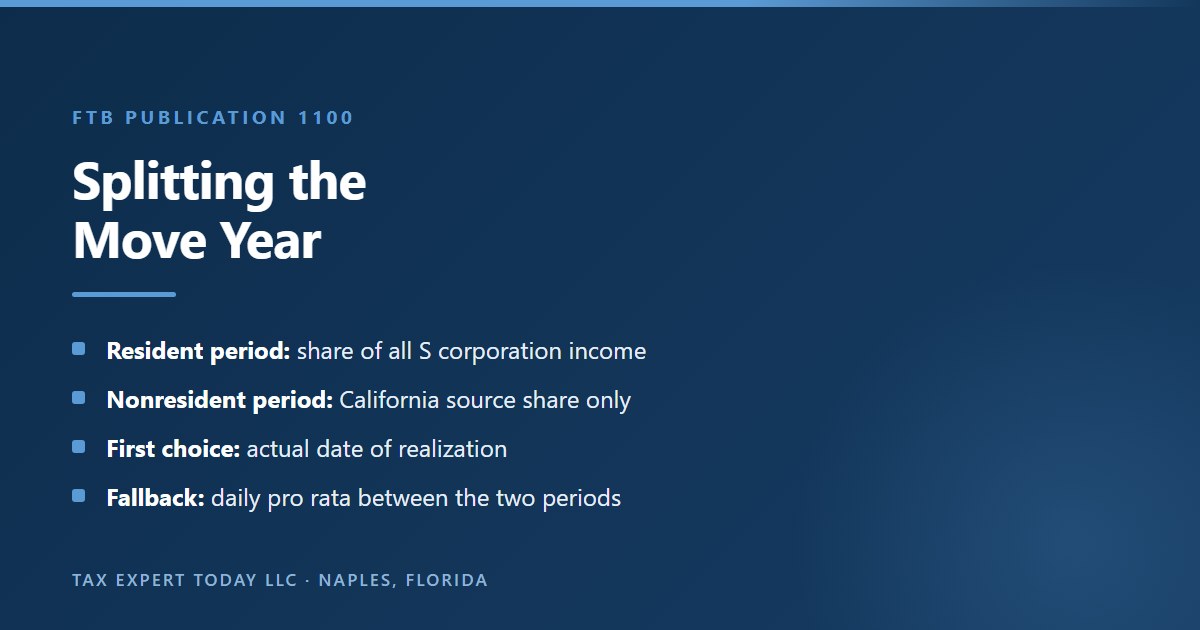
In the move year the shareholder is a part-year resident. California taxes the pro rata share of all S corporation income for the period of residency and only the California source share for the period of nonresidency. The split is measured over the corporation’s taxable year and must reflect the actual date income was realized where that information exists.
- Resident period: share of total income, the column (d) concept.
- Nonresident period: share of California source income, the column (e) concept.
- Measuring year: the S corporation’s taxable year, not only the calendar year.
- First choice of method: actual date of realization.
- Fallback method: daily pro rata between the two periods.
The rule is stated in section L of FTB Publication 1100. If you changed your residency, California taxes your distributive share of partnership, S corporation and certain trust income based upon your period of California residency and your period of nonresidency during the entity’s taxable year. The allocation between the two periods must be made in a manner that reflects the actual date of realization. In the absence of information that reflects the actual date of realization, the annual amount is allocated on a proportional basis between the two periods using a daily pro rata method.
Publication 1100 illustrates this with an S corporation example. A taxpayer holds a 50 percent interest in a Washington S corporation with a fiscal year ending October 31 and becomes a nonresident of California on June 10. Interim statements show the corporation’s income before and after that date. For the period of residency the taxpayer includes 50 percent of total net income of $9,600, which is $4,800. For the period of nonresidency the taxpayer includes 50 percent of California net income of $2,000, which is $1,000. The California figure for the year is $5,800.
| Publication 1100, Example 38 | Resident period | Nonresident period |
|---|---|---|
| Washington source net income | $5,600 | $4,400 |
| California source net income | $4,000 | $2,000 |
| Total net income | $9,600 | $6,400 |
| Amount California reaches | $9,600 total | $2,000 California source |
| Shareholder’s 50 percent share | $4,800 | $1,000 |
Two features of the example carry over to a move to Florida. First, the corporation in the example is not a California corporation, which confirms that the rule is about the shareholder’s residency and the source of the income, not the state of incorporation. Second, the taxpayer obtained interim statements from the S corporation. The Schedule K-1 (100S) itself has no separate pair of columns for a mid-year move, so the shareholder and the corporation’s preparer have to produce the split from the books.
Where the corporation and the shareholder use different taxable years, the measuring period is the corporation’s year that ends within the shareholder’s year. Publication 1100 includes a second S corporation example with a fiscal year ending May 31 in which the days of residency and nonresidency are counted across the fiscal year and not across the calendar year. Most closely held S corporations use the calendar year, which keeps the count simple, but an owner of a fiscal year corporation should not assume the split follows the calendar.
The move year return is Form 540NR, completed as a part-year resident. Our guide to the California part-year resident return walks through Schedule CA (540NR) and explains how the resident period and nonresident period figures are combined on one form.
Which Is Better in a Move Year: Actual Date or Daily Pro Rata?
Neither method is elective in the ordinary sense. Publication 1100 requires an allocation that reflects the actual date of realization and permits the daily pro rata method only in the absence of that information. In practice the outcome depends on what the corporation’s books can show, so the records kept around the move date often decide the tax.
- Income earned evenly: the two methods give similar answers.
- Large item before the move: actual date places it in the resident period.
- Large item after the move: actual date places it in the nonresident period, taxed only if California source.
- No interim records: daily pro rata applies by default.
The difference between the methods is largest when income is uneven. Consider a hypothetical S corporation that earns $100,000 of non-California income in the year, of which $80,000 comes from a single contract completed in November. A sole shareholder moves from San Jose to Naples on July 1. Under a daily pro rata split, about half of the $100,000 falls in the resident period and is taxed by California. Under an actual date allocation supported by interim books, only the $20,000 earned before July 1 falls in the resident period.
| Hypothetical: $100,000 of non-California income, move on July 1 | Daily pro rata | Actual date with interim books |
|---|---|---|
| Income assigned to the resident period | $49,589 (181 of 365 days) | $20,000 |
| Income assigned to the nonresident period | $50,411 | $80,000 |
| Taxed by California as resident period income | $49,589 | $20,000 |
| Taxed by California as nonresident period income | None, not California source | None, not California source |
The example is hypothetical and deliberately simple. The reverse case is just as real. If the large contract had closed in March, the actual date method would place $80,000 in the resident period, and a shareholder could not choose the daily method to dilute it. The publication’s wording, that the allocation must reflect the actual date of realization, runs in both directions.
The records that support an actual date allocation are ordinary accounting records, prepared with care. The corporation closes its books as of the move date, or produces a monthly income statement that brackets it. Revenue is recognized under the corporation’s regular method of accounting, so a cash basis corporation looks at when payment was received and an accrual basis corporation at when the income was earned. Invoices, contracts and bank statements should agree with the interim statement. We suggest that owners planning a move tell the bookkeeper the intended date in advance, because reconstructing a mid-year cutoff a year later is harder and less persuasive.
Timing a transaction around a move is a separate and more sensitive subject. California examines whether the move itself was real and when it took effect, using the closest connections factors described in our guide to the California residency audit. An allocation is only as strong as the residency change date underneath it. Our guide to moving to Florida before selling a business covers the Florida side of that timing question.
What Is Table 1 on Schedule K-1 (100S) and Why Does It Matter in Florida?
Table 1 reports the shareholder’s pro rata share of the S corporation’s nonbusiness income from intangibles, such as interest, dividends, royalties and gains that are not part of the regular business. That income is not entered in column (e). It is sourced at the shareholder level, generally to the shareholder’s residence, which for a Florida resident means outside California.
- What goes in Table 1: nonbusiness interest, dividends, royalties and capital gains from intangibles.
- What stays out of column (e): every Table 1 amount.
- Who sources it: the shareholder, not the corporation.
- General result for a Florida resident: sourced to Florida.
- Exception to watch: intangibles that have acquired a business situs in California.
The booklet tells the corporation to enter in Table 1 the shareholder’s pro rata share of nonbusiness income from intangibles and adds that because the source of this income must be determined at the shareholder level, the corporation does not enter income in this category in column (e). The shareholder instructions complete the thought: the shareholder must make a determination whether the nonbusiness intangible income item is from a California source, and amounts in Table 1 should be sourced to the residence or commercial domicile of the shareholder.
The dividing line is the definition of business income. The booklet describes business income as income arising in the regular course of the taxpayer’s trade or business, including income from tangible and intangible property if the acquisition, management and disposition of the property constitute integral parts of the regular trade or business. Interest on working capital held for operations is generally business income and is apportioned. Dividends on a brokerage account the corporation holds as a long-term investment unrelated to operations are generally nonbusiness income and belong in Table 1.
| Income item inside the S corporation | Usual classification | Where reported for a nonresident |
|---|---|---|
| Interest on operating cash accounts | Business | Column (e), apportioned |
| Dividends on an unrelated investment portfolio | Nonbusiness intangible | Table 1, sourced to residence |
| Rent from a California building not used in the business | Nonbusiness, real property | Table 2, Item B and column (e) |
| Gain on sale of equipment used in operations | Business | Column (e), apportioned |
| Gain on sale of unrelated marketable securities | Nonbusiness intangible | Table 1, sourced to residence |
The classifications in the table are the usual ones and can change with the facts. Whether an investment account is integral to the business is a judgment that the corporation’s preparer makes each year, and the Franchise Tax Board can disagree. A Florida shareholder should look at Table 1 before assuming that every dollar on the K-1 is taxable in California, and should also resist the opposite temptation of pressing ordinary operating income into Table 1.
In a move year Table 1 income follows the same resident and nonresident split as everything else. During the period of California residency the shareholder was taxable on all income, including nonbusiness intangible income, so the Table 1 amount realized in that period is California taxable. Only the portion realized after the move is sourced to Florida. Our guide to California source income explains the business situs exception that can pull intangible income back into California.
What Is Table 2 and When Does a Shareholder Need It?
Table 2 reports the shareholder’s share of the S corporation’s business income and its California and total property, payroll and sales. A shareholder that conducts a unitary business with the corporation uses it to combine and apportion income, and every shareholder that is a business entity uses Item C to test whether it is doing business in California.
- Item A: the shareholder’s share of the corporation’s business income.
- Item B: nonbusiness income from real and tangible property located in California.
- Item C: the shareholder’s share of property, payroll and sales, in California and in total.
- Unitary shareholders: use Table 2 in place of column (e).
Most individual shareholders never use Table 2 for computation. The shareholder instructions reserve it for the case where the nonresident shareholder conducts a unitary business with the S corporation. In that case column (e) should not be used. The shareholder combines its share of the S corporation’s income with the income from its own trade or business and apportions the total using a percentage built from its own factors and its share of the corporation’s factors.
An example shows when this arises. Suppose a Florida resident owns a sole proprietorship that designs equipment and also owns 60 percent of a California S corporation that manufactures the same equipment, with shared management and shared customers. If the two operations are unitary, the shareholder does not simply pick up column (e). The combined business income is apportioned with a combined sales factor. The result can be higher or lower than column (e), depending on where the proprietorship’s sales land.
| Table 2 item | What it contains | Who relies on it |
|---|---|---|
| Item A | Share of business income before apportionment | Unitary shareholders |
| Item B | Nonbusiness income from California real and tangible property | All nonresident shareholders, also shown in column (e) |
| Item C, property | Share of property, California and total | Unitary shareholders and entity shareholders |
| Item C, payroll | Share of payroll, California and total | Unitary shareholders and entity shareholders |
| Item C, sales | Share of sales, California and total | Unitary shareholders and entity shareholders |
Item C has a second job. The booklet says all S corporations complete it to report the shareholder’s share of property, payroll and sales within California, and that shareholders use it to determine whether they meet the threshold amounts for doing business. For an individual this rarely matters, because individuals are taxed on source income regardless of the doing business test. It matters for a trust or estate that holds S corporation stock alongside other business interests, and it matters when the K-1 recipient is a grantor trust whose owner has other California activity.
Even when Table 2 is not used for computation, it is a useful audit trail. The California share of sales in Item C divided by total sales should approximate the apportionment percentage behind column (e). When the two do not agree, the K-1 deserves a second look before the shareholder files.
How Is S Corporation Business Income Apportioned to California?
An S corporation with business income from sources inside and outside California apportions that income on Schedule R using a single sales factor: California sales divided by total sales. Sales of services and intangibles are assigned by market, generally to the state where the customer receives the benefit, not to the state where the owner performs the work.
- Formula: single sales factor for most businesses.
- Tangible goods: generally assigned by destination.
- Services: assigned to where the purchaser receives the benefit.
- Return mechanics: Schedule R attached behind California Form 100S, with Question P answered yes.
- Effect of the owner’s move: usually none on the sales factor.
The 2025 booklet summarizes the rules in General Information R. R&TC section 25128.7 requires all business income of an apportioning trade or business, other than certain businesses under section 25128(b), to be apportioned using the single sales factor formula. R&TC section 25136 requires all taxpayers to assign sales, other than sales of tangible personal property, using market assignment. The booklet points to the regulation under section 25136 and to Legal Ruling 2022-01 for more detail.
This is the rule that most often disappoints owners after a move. A consultant who incorporated in California, moved to Naples and kept the same Los Angeles clients may expect the income to become Florida income because the work is now done at a desk in Florida. Under market assignment the receipts are generally assigned to California if that is where the clients receive the benefit of the service. The sales factor may stay at or near 100 percent, and column (e) may barely change.
| Hypothetical service S corporation after the owner moves to Naples | California sales | Total sales | Apportionment |
|---|---|---|---|
| All clients remain in California | $900,000 | $900,000 | 100 percent |
| One third of clients replaced by Florida clients | $600,000 | $900,000 | 66.67 percent |
| Client base rebuilt nationally over three years | $180,000 | $900,000 | 20 percent |
| No California clients, corporation still incorporated there | $0.00 | $900,000 | Zero, $800 minimum still due |
The table is hypothetical and assumes each client receives the benefit of the service in its home state, which is a simplification. Real contracts with multistate customers call for a closer analysis under the cascading rules of the regulation. The broad point holds: for a service business the customer’s location, not the owner’s, drives the California share.
Apportionment applies to business income. Nonbusiness income is allocated instead: nonbusiness income from California real and tangible property is assigned entirely to California, and nonbusiness intangible income is handled through Table 1 as described above. An S corporation whose entire income comes from California sources skips Schedule R, and the booklet tells it to carry line 14 straight to line 15. The related question of how an employee owner’s own remote work is sourced is covered in our guide to the California remote work tax rules.
Are a Shareholder’s Wages From the S Corporation California Source After the Move?
Wages follow a different rule from K-1 income. Compensation for services is sourced to the place where the services are performed. A shareholder employee who performs all services from Florida after the move generally has no California source wages, even though the K-1 income from the same corporation may remain largely California source under market assignment.
- Wages: sourced by where the employee physically works.
- K-1 business income: sourced by the corporation’s apportionment.
- California workdays after the move: create California source wages for those days.
- Payroll records: should show the work state changing on the move date.
FTB Publication 1100 applies the wage rule for nonresidents throughout its compensation examples: compensation has its source in the state where the taxpayer performed the services, and the publication reaches that result without regard to where the employer is located. The same shareholder therefore holds two streams from one corporation that are sourced by two unrelated tests. This is one of the less intuitive features of S corporation taxation across state lines.
| Hypothetical sole shareholder living in Naples, all clients in California | Amount | California source? |
|---|---|---|
| W-2 salary for services performed entirely in Florida | $150,000 | No |
| W-2 salary for 20 workdays spent at client sites in California | Allocated by workdays | Yes, for those days |
| K-1 ordinary income, 100 percent California sales factor | $250,000 | Yes |
| Distribution of the same year’s earnings | $200,000 | Not taxed again, but subject to withholding |
The mix of salary and K-1 income therefore affects the California bill of a departed shareholder. That observation has to be handled with care, because the salary of a shareholder employee must be reasonable for the services performed, for federal employment tax purposes and as a matter of sound practice. Raising salary only to shift income out of the California source column invites scrutiny on both the state and federal side. Our guide to S corporation reasonable compensation explains how a defensible figure is set. The example above is hypothetical and is not a recommendation to adopt any particular split.
Payroll administration should change on the move date as well. The corporation stops California income tax withholding and state disability insurance on wages for services performed in Florida, and registers as a Florida employer for reemployment tax where required. If the shareholder continues to travel to California for work, the corporation tracks those days and withholds California tax on the wages attributable to them. A clean payroll record that changes on the same date as the driver license, voter registration and home is also supporting evidence for the residency change itself, a point developed in our guide on how to establish Florida residency.
Does the S Corporation Withhold 7 Percent on Distributions to a Florida Shareholder?
Yes, in most cases. An S corporation must withhold 7 percent on distributions of California source income to a domestic nonresident shareholder once total distributions to that shareholder exceed $1,500 in the calendar year. The withholding is a prepayment of the shareholder’s own California tax, claimed on Form 540NR with Form 592-B attached.
- Rate: 7 percent of the distribution of California source income.
- Threshold: optional on the first $1,500 in a calendar year, required after that.
- What is covered: current year income and prior year income not yet reported to California by the shareholder.
- What is not covered: return of capital and income that is not California source.
- Who is exempt: California resident shareholders.
The rule is in FTB Publication 1017. The publication states that R&TC section 18662 and the related regulations require S corporations and partnerships to withhold income taxes when distributing current or prior year income to domestic S corporation shareholders and partners, and that withholding is not required if distributions to a shareholder are $1,500 or less during the calendar year. The rate table in the same publication lists 7 percent for distributions of California source income to domestic nonresident S corporation shareholders and partners.
The base is distributions, not allocations. This distinguishes the domestic rule from the rule for foreign partners, where withholding is computed on the allocable share of income whether or not it is distributed. For a Florida shareholder the consequence is that a year in which the corporation retains its earnings produces no withholding, even though the K-1 reports California source income and the shareholder owes tax on it. The shareholder then needs estimated payments to avoid an underpayment penalty on the personal return.
| Hypothetical distribution to a Naples shareholder | California source portion | Withholding at 7 percent |
|---|---|---|
| $1,200 in the whole calendar year | $1,200 | None required |
| $100,000 from a corporation with 100 percent California income | $100,000 | $7,000 |
| $100,000 from a corporation with 60 percent California income | $60,000 | $4,200 |
| $50,000 that is entirely a return of capital | None | None required |
| $40,000 of prior year income already reported, with Form 590-P on file | Previously reported | None required |
The amounts are hypothetical. Publication 1017 also answers a timing question that corporations ask in the first year after a move. Withholding is at the discretion of the withholding agent until payments exceed $1,500 during the calendar year. Once total payments exceed that amount, the agent is required to withhold, and the publication says catch-up withholding on the earlier payments is not required where the agent reasonably believed the total would stay under the threshold.
Two further answers in the publication close off common arguments. Withholding is required on distributions of California source income even though net operating losses generated in prior years produce carryovers for the shareholder, because those carryovers are determined at the shareholder level. And a corporation that distributes California source income must withhold even though the shareholder has losses from other California S corporations and partnerships. In both cases the shareholder’s remedy is a waiver request or a refund claim on Form 540NR, not a self-help reduction by the corporation. Our guide to California nonresident withholding covers the full regime, including payments for services and rents.
What Are Forms 592-PTE, 592-Q and 592-B?
They are the three forms an S corporation uses to handle nonresident withholding. Form 592-Q is the voucher that carries each payment to the Franchise Tax Board, Form 592-PTE is the annual return that allocates the year’s withholding among the shareholders, and Form 592-B is the statement each shareholder attaches to a California return to claim the credit.
- Form 592-Q: payment voucher, due April 15, June 15, September 15 and January 15.
- Form 592-PTE: annual return, due January 31 after the year of withholding.
- Form 592-B: payee statement, given to each shareholder, not filed by the corporation.
- Form 592: used by payers that are not pass-through entities.
Publication 1017 explains that Form 592-PTE has been the annual form for pass-through entities since January 1, 2020, and that withholding payments associated with it are still due each payment period and are submitted with Form 592-Q. The 2025 Instructions for Form 592-PTE confirm that the return must be filed no later than January 31 of the year following the year for which the withholding was required to be remitted, and that S corporations are among the pass-through entities that use it.
| Distribution made during | Form 592-Q payment due |
|---|---|
| January 1 through March 31 | April 15 |
| April 1 through May 31 | June 15 |
| June 1 through August 31 | September 15 |
| September 1 through December 31 | January 15 |
| Annual Form 592-PTE with the schedule of payees | January 31 |
The payment periods are uneven, matching the individual estimated tax calendar. A corporation that makes one large distribution in December has until January 15 to remit the 7 percent and until January 31 to file the annual return and furnish the Form 592-B. The instructions describe Form 592-B as the statement the withholding agent must provide to each payee showing the total amount withheld and reported for the tax year, and note that the agent does not submit it to the Franchise Tax Board.
The same forms serve a second purpose. When the S corporation itself has been withheld upon by someone else, for example by a customer that withheld on a payment or by a lower tier partnership, the corporation uses Form 592-PTE to pass that credit to its shareholders. The Form 100S booklet gives the corporation a choice here. It can allocate the entire withholding credit to its shareholders, or claim a portion on line 33 of California Form 100S, not to exceed the total tax due, and allocate the remainder. The booklet adds that S corporations may not receive a refund of withholding on California Form 100S.
Failure carries a cost for the corporation, not only for the shareholder. Publication 1017 says any person who fails to remit or under remits withholding is liable for the greater of the amount actually withheld or the amount of taxes due from the nonresident, capped at the amount required to be withheld, plus interest. The publication lists information return penalties of up to $130 per form for returns filed on or after January 1, 2025 and up to $340 per form for returns filed on or after January 1, 2026, with the same figures for a failure to furnish a correct and timely Form 592-B. The instructions to Form 592-PTE should be checked for the tier that applies to a particular late filing.
How Does a Florida Shareholder Claim the California Withholding?
The shareholder files Form 540NR, reports the total withholding on line 83 and attaches Form 592-B to the front of the return. The Schedule K-1 (100S) shows the withholding on line 14 for information, but the K-1 is not the document that supports the credit. A return is required to claim the withholding even if no tax is otherwise due.
- Form used: Form 540NR, California Nonresident or Part-Year Resident Income Tax Return.
- Line: Form 540NR, line 83.
- Proof: Form 592-B attached to the front of the return.
- K-1 line 14: informational only.
- Excess withholding: refunded through the personal return.
The shareholder instructions say that line 14 includes withholding from payments made to the S corporation allocated to all shareholders based on stock ownership, payments withheld on nonresident shareholders and backup withholding, and that shareholders must attach Form 592-B to the front of the California return to claim the credit. They direct the total to the payments section of Form 540, line 73, or Form 540NR, line 83. The booklet adds, in its section on group returns, that nonresident shareholders must file Form 540NR to claim the withholding even if there are no filing requirements.
| Hypothetical Naples shareholder, 2026 | Amount |
|---|---|
| Column (e) California source income from the K-1 | $138,000 |
| California tax computed on Form 540NR under the ratio method | $9,400 |
| Withholding on distributions, per Form 592-B | $7,000 |
| Elective tax credit from form FTB 3804-CR | None in this example |
| Balance due with the return | $2,400 |
The tax figure in the table is a placeholder chosen to show the mechanics, not a computed liability. The actual tax depends on the shareholder’s total income from all sources, filing status and deductions, because Form 540NR applies the rate determined on total income to the California share. The 2025 Form 540NR booklet has the worksheet.
Three practical problems recur. The first is a missing Form 592-B. If January 31 passes without one, the shareholder should ask the corporation, because the Franchise Tax Board matches the credit to the corporation’s Form 592-PTE and a claim without the statement is likely to be questioned. The second is a mismatch between the Form 592-B and line 14 of the K-1, usually because the corporation claimed part of an upstream credit on its own return. The third is timing. Withholding remitted in January for a December distribution belongs to the year of the distribution, and the Form 592-B will say so.
A shareholder who also made California estimated tax payments reports those separately. Withholding and estimates are different lines on the return and are tracked in different Franchise Tax Board systems. Where withholding consistently exceeds the actual tax, the better long-term answer is a waiver, discussed next, not an annual refund claim.
Can the 7 Percent Withholding Be Waived or Reduced?
Yes, in defined situations. A nonresident shareholder or the corporation can request a waiver on Form 588, generally available when the shareholder has California returns on file for the two most recent years and is current on tax obligations. No withholding applies to prior year income covered by a signed Form 590-P, to a return of capital, or to income that is not California source.
- Form 588: nonresident withholding waiver request.
- Form 590-P: exemption certificate for previously reported income.
- Return of capital: no withholding and no waiver needed.
- No California source income: no withholding and no waiver needed.
- Duration: waivers are generally granted for fixed periods of up to two years.
Publication 1017 describes the waiver standard. The Franchise Tax Board may authorize a waiver of withholding if the payee has California tax returns on file for the two most recent taxable years in which the payee has a filing requirement and is considered current on any outstanding tax obligations. If the payee does not have a current filing history but is making estimated tax payments for the current year and is current on outstanding obligations, a shorter waiver may be issued. The publication adds that withholding agents must honor authorized waivers.
The Form 590-P certificate addresses a specific S corporation pattern. Earnings are taxed to the shareholder in the year earned, whether or not distributed. When the corporation distributes those earnings in a later year, a second 7 percent would be withheld on income the shareholder has already reported. Publication 1017 says withholding is not required on distributions of prior year California source income if the shareholder provides a signed Form 590-P certifying that the income was previously reported on the shareholder’s California return, and that the corporation may rely on that certification.
| Situation | Form | Who acts | Result |
|---|---|---|---|
| Shareholder has filed Form 540NR for the last two years and is current | Form 588 | Shareholder or corporation | Waiver may be authorized |
| Distribution of earnings taxed in an earlier year | Form 590-P | Shareholder signs, corporation keeps it | No withholding on that income |
| Distribution is a return of capital | None | Corporation documents it | No withholding |
| Corporation has no California source income | None | Corporation documents it | No withholding |
| First year after the move, no filing history as a nonresident | Form 588 with estimated payments | Shareholder | Shorter waiver may be issued |
The first year after a move is the awkward one. A shareholder who was a California resident last year has California returns on file, which helps, but those were resident returns filed under different facts. We generally suggest that a departing shareholder set up California estimated payments for the nonresident year, keep them current and then file the waiver request, so that the request rests on the second branch of the standard if the first is questioned. Whether a waiver is granted is the Franchise Tax Board’s decision on the facts presented.
Corporations should be careful about deciding on their own that a distribution is not California source. For an apportioning corporation, some part of each distribution of current earnings usually is. A written computation tying the California share of the distribution to the apportionment percentage on Schedule R, kept in the corporate records, is the support an examiner will ask for.
Does California Require a Nonresident Shareholder Consent on California Form 100S?
The 2025 Form 100S booklet does not contain a nonresident shareholder consent form or a tax on nonconsenting shareholders. That is a real difference from the LLC return, where each nonresident member signs form FTB 3832 or the LLC pays tax on that member’s share. For S corporations, California relies on distribution withholding and the Schedule K-1 (100S).
- LLC taxed as a partnership: form FTB 3832, with Schedule T tax for a member who does not sign.
- Single member LLC: owner consent on Side 3 of Form 568.
- S corporation: no equivalent consent schedule in the 2025 booklet.
- S corporation enforcement tools: 7 percent withholding, Form 592-PTE and K-1 matching.
We read the 2025 S Corporation Tax Booklet and the Schedule K-1 (100S) instructions specifically for this point, because older commentary describes a consent requirement for nonresident S corporation shareholders. Neither current document refers to one. The only consent mechanics the booklet mentions for shareholders are federal style elections about the order of distributions, discussed later, and the consent each shareholder gives to be included in the elective pass-through entity tax.
The booklet does mention the LLC regime, but from the other direction. If the S corporation is itself a nonconsenting nonresident member of an LLC and the LLC paid tax on its behalf, the corporation includes that amount with its payments on line 32 and attaches the Schedule K-1 (568). That is the S corporation as a member of an LLC, not the S corporation’s own shareholders.
| Feature | LLC on Form 568 | S corporation on California Form 100S |
|---|---|---|
| Nonresident owner consent form | Form FTB 3832 or Side 3 consent | None in the 2025 booklet |
| Entity pays tax for an owner who does not sign | Yes, on Schedule T | No equivalent schedule |
| 7 percent withholding on distributions | Yes | Yes |
| Annual withholding return | Form 592-PTE | Form 592-PTE |
| Group nonresident return available | Yes | Yes |
We state this conclusion with a limit. It rests on the 2025 forms and instructions as published by the Franchise Tax Board, read on the date of this guide. We were not able to open the legislative text of the Revenue and Taxation Code on the state’s website on that date, so we do not cite a code section for the absence of a requirement. A corporation with nonresident shareholders should confirm the point against the booklet for the year it is filing.
For an owner comparing structures after a move, the difference is practical. A multi-member LLC with a departed member who will not sign a consent has a cash cost at the entity level at the highest marginal rate. An S corporation in the same position does not, although it still has the withholding duty on distributions. Our guide to California Form 568 explains the LLC consent and Schedule T in detail.
Can Nonresident Shareholders File a California Group Return?
Yes. Nonresident individual shareholders of an S corporation doing business in California may elect to be included in a group nonresident return on Form 540NR filed by the corporation on their behalf. The group return is a convenience that trades a simpler filing for tax at the highest rate, without the deductions and credits an individual return would allow.
- Who can join: nonresident individual shareholders.
- Who files: the S corporation, as agent for the electing shareholders.
- Group size: a group may include fewer than two nonresident individuals.
- High earners: individuals with more than $1 million of California taxable income may be included, with an additional 1 percent tax.
- Guidance: FTB Publication 1067.
General Information CC of the booklet states the election, and the Important Information section adds that group nonresident returns may include less than two nonresident individuals and nonresident individuals with more than $1 million of California taxable income, with an additional 1 percent tax assessed on those individuals. The detailed rules are in FTB Publication 1067, Guidelines for Filing a Group Form 540NR, which sets the conditions for participation, the rate applied and the items that cannot be claimed on a group return.
| Consideration | Individual Form 540NR | Group Form 540NR |
|---|---|---|
| Who prepares and files | The shareholder | The corporation |
| Rate | Graduated, by the ratio method | Highest marginal rate under Publication 1067 |
| Deductions and most credits | Allowed | Generally not allowed |
| Other California source income | Reported on the same return | Generally must not exist |
| Suited to | Most shareholders with meaningful income | Small holdings where simplicity outweighs rate |
The table summarizes the general trade and should be checked against the current Publication 1067 before an election is made. For a founder who moved to Naples and still holds a large share of the corporation, the group return is rarely the lower cost choice, because the individual return applies graduated rates and the standard or itemized deduction through the ratio method. The group return tends to suit a corporation with several small out of state investors, each of whom would otherwise file a California return for a few thousand dollars of income.
A group return does not change the withholding rules, and it does not remove the K-1. Each electing shareholder still receives a Schedule K-1 (100S), and withholding on distributions still applies unless waived. The year a shareholder changes residency is also a poor fit, because the publication is written for nonresidents and a part-year resident has resident period income that belongs on an individual return.
How Does the California PTET Appear on California Form 100S for a Florida Shareholder?
An S corporation can elect to pay the pass-through entity elective tax at 9.3 percent of the qualified net income of consenting shareholders. The tax is reported on Form 100S, line 29, and each consenting shareholder, including a nonresident, receives a credit against California personal income tax. The election has been extended through taxable years beginning before January 1, 2031.
- Rate: 9.3 percent of qualified net income.
- Election: made on an original, timely filed return and irrevocable for the year.
- Who can be a qualified taxpayer: a resident, nonresident or part-year resident individual, fiduciary, estate or trust that consents.
- Return lines: line 29 for the tax, line 35 for the payments, form FTB 3804 for the computation.
- From 2026: a missed or short June 15 prepayment reduces the credit and no longer bars the election.
The 2025 Instructions for Form FTB 3804 define a qualified taxpayer as an individual, fiduciary, estate or trust that is a shareholder of an electing entity and consents to have its pro rata share of income included in the qualified net income subject to the elective tax, and they state that the qualified taxpayer may be a resident, nonresident or part-year resident. A shareholder that does not consent does not prevent the corporation from electing for the others. The Franchise Tax Board elective tax page carries the current guidance.
The same instructions announce the extension. For taxable years beginning on or after January 1, 2026, and before January 1, 2031, the elective tax and credit are extended. For those years a qualified entity that does not make the required June 15 prepayment, or makes a prepayment less than the amount due, can still make the election, but the credit allowed to the qualified taxpayer is reduced by 12.5 percent of the taxpayer’s pro rata share of the unpaid amount due. Under the earlier rules a missed prepayment closed the election for the year, so this is a meaningful change for 2026 returns.
| Hypothetical: Florida shareholder, $138,000 of California source qualified net income | Amount |
|---|---|
| Elective tax paid by the corporation at 9.3 percent | $12,834 |
| Credit shown on Schedule K-1 (100S), line 13d | $12,834 |
| California tax on Form 540NR before the credit (placeholder) | $9,400 |
| Credit used this year | $9,400 |
| Credit not used this year | $3,434, subject to the carryover rules |
The example is hypothetical and uses a placeholder tax figure. It illustrates a point that matters more to nonresidents than to residents. The elective tax is computed at a flat 9.3 percent, while a nonresident’s actual California tax on the same income may be lower once the ratio method is applied. The elective tax can therefore exceed the tax it is meant to prepay, leaving a credit that carries forward and is not refunded. For a Florida shareholder whose only California income is the K-1, the election can tie up cash in California.
The reason owners make the election anyway is federal. The elective tax is deducted by the corporation in computing federal ordinary income, which sidesteps the federal limit on the individual deduction for state and local taxes. Whether that federal benefit outweighs the state side cost depends on the shareholder’s federal bracket, the current federal limit and the amount of unused credit. Our guide to the California PTET works through the prepayment amounts, the credit ordering and the carryover period. The decision is made each year on the numbers, and there is no single answer that fits every departed shareholder.
One mechanical caution comes straight from the booklet. The elective tax payment cannot be combined with the entity’s other tax payments. A payment meant for the elective tax that is sent as an estimated tax payment, or the reverse, will be applied where it was sent, and correcting it takes correspondence.
Are Distributions From the S Corporation Taxed by California After the Move?
Generally no, not a second time. S corporation income is taxed to the shareholder when earned and reported on the K-1, and a later distribution of those earnings reduces stock basis without creating new income. California taxes a distribution to a nonresident only in limited cases, such as a taxable dividend from old C corporation earnings or a distribution in excess of basis, and sourcing then matters.
- Distribution from the accumulated adjustments account: not income, reduces basis.
- Distribution from C corporation earnings and profits: a taxable dividend, reported on line 17c.
- Distribution in excess of stock basis: gain from the sale or exchange of property.
- Withholding: may still apply to distributions of California source income, as a prepayment.
The ordering rules are in the Schedule M-2 instructions of the booklet, which follow Internal Revenue Code section 1368 using California amounts. Distributions first reduce the accumulated adjustments account, then accumulated earnings and profits from C corporation years, then the other adjustments account, then any remaining shareholders’ equity. The shareholder instructions add that the shareholder reduces stock basis by the distributions on line 16d and that, if the distributions exceed basis, the excess is treated as gain from the sale or exchange of property and reported on Schedule D (540 or 540NR).
| Layer the distribution comes from | Tax character to the shareholder | K-1 line |
|---|---|---|
| Accumulated adjustments account | Return of previously taxed income, reduces basis | Line 16d |
| Accumulated earnings and profits from C corporation years | Taxable dividend | Line 17c, with Form 1099-DIV |
| Other adjustments account | Generally tax exempt, reduces basis | Line 16d |
| Amount in excess of stock basis | Capital gain | Reported by the shareholder on Schedule D |
For a Florida resident the sourcing of the two taxable categories is the question. A dividend and a gain measured by stock basis are both income from an intangible, the stock. Under the general rule of R&TC section 17952, income of a nonresident from intangible personal property is not California source unless the property has acquired a business situs in the state. On that reasoning a dividend from old earnings and profits, or an excess distribution, received after the move would generally be sourced to Florida. That is a general statement of the rule and the facts of a particular case, especially where the shareholder pledged or used the stock in a California business, can change the answer.
California’s accounts are not always the same as the federal ones. The booklet notes that the computation of the California accumulated adjustments account is similar to the federal computation applying California amounts, that the account is reduced by the California built-in gains tax and the minimum franchise tax, and that California S corporations never have undistributed previously taxed income. A corporation may also make the elections that change the order of distributions for California purposes only, by attaching a statement to a timely filed California Form 100S, even if it does not make the same election federally.
The move year adds one wrinkle. A distribution is not itself allocated between the resident and nonresident periods, because it is generally not income. But the earnings behind it were allocated when the K-1 income was split. A shareholder who takes a large distribution of prior earnings shortly after the move has not shifted any income to Florida by doing so. The income was taxed, by California, in the year and period in which the corporation earned it.
What Happens to Basis and Suspended Losses After the Move?
A shareholder’s stock basis, at-risk amount and suspended passive losses continue after the move, but for a nonresident California recomputes them using only California source items. Losses that were suspended while a resident are not simply carried over at their old amounts, and a loss that is not California source does not offset California source income on Form 540NR.
- Basis limit: losses cannot exceed stock and debt basis.
- At-risk limit: applies after basis.
- Passive activity limit: computed on form FTB 3801.
- Nonresident recomputation: carryovers are restated on a California source basis.
- Entity level: the corporate NOL deduction is suspended for 2024 through 2026 at $1,000,000 or more of income.
The shareholder instructions list the three limits in order. Generally a shareholder may not claim a share of S corporation loss that is greater than the adjusted basis of the shareholder interest at the end of the corporation’s taxable year, and the instructions refer to federal Form 7203 and Internal Revenue Code section 1366 for the basis limitation. The at-risk rules and the passive activity rules then apply, with form FTB 3801 used to compute the allowable passive loss.
FTB Publication 1100 explains what a change of residency does to carryovers. Its passive activity examples follow a taxpayer who is a nonresident with California source S corporation losses, becomes a resident and then becomes a nonresident again, and they recompute the suspended loss at each step. The principle is that a nonresident’s carryover items are determined as if the person had been a nonresident for all prior years, counting only California source income and loss. A resident’s are determined as if the person had always been a resident.
| Item carried into the first Florida year | How California treats it for a nonresident |
|---|---|
| Suspended passive loss from a California source activity | Carried forward, available against California source passive income |
| Suspended passive loss from a non-California activity | Not counted in the nonresident California computation |
| Capital loss carryover | Restated on a California source basis |
| Stock basis | Continues, with California adjustments tracked separately |
| Loss in excess of basis | Suspended until basis is restored |
The practical effect is a second set of carryover schedules. A shareholder who moved with a federal suspended loss of one amount may have a California nonresident suspended loss of a different amount, and both differ from the California resident figure on last year’s return. We rebuild these schedules in the first nonresident year, because an error at that point repeats every year afterward. Our guide to the California capital loss carryover shows the same recomputation for capital losses.
California basis can also differ from federal basis. Column (c) adjustments, most often depreciation, change the income and loss that pass through for California purposes, and basis follows those California amounts. A shareholder who has held stock through years of bonus depreciation will usually have higher California basis than federal basis, because California allowed less depreciation. That difference surfaces when the stock is sold or when distributions approach basis.
At the entity level a separate limit applies. The booklet states that for taxable years beginning on or after January 1, 2024, and before January 1, 2027, California has suspended the net operating loss carryover deduction for corporations with taxable income of $1,000,000 or more, with the carryover period extended for the suspended years. This affects the 1.5 percent tax computation, not the shareholder’s K-1.
Is Gain on Selling S Corporation Stock California Source After Moving?
Generally not. Stock is intangible property, and a nonresident’s gain from selling an intangible is generally sourced to the seller’s state of residence, not to California. The exceptions are significant: stock with a California business situs, a sale structured or treated as an asset sale, installment gain from a sale made while a resident, and a move that California does not accept as complete.
- Straight stock sale by a Florida resident: generally not California source.
- Asset sale by the corporation: gain is apportioned and flows through column (e).
- Stock sale treated as an asset sale by election: generally follows the asset sale result.
- Installment sale made while a California resident: later payments can remain taxable.
- Residency not yet changed: the entire gain is taxable to a resident.
The general rule is the intangible sourcing rule of R&TC section 17952, which Publication 1100 applies to nonresidents’ stock gains. It is the same rule that places Table 1 income at the shareholder’s residence. The exceptions follow from how the transaction is taxed. If the corporation sells its assets, the gain is the corporation’s income, classified as business or nonbusiness, apportioned or allocated, and reported to each shareholder in column (e). A nonresident shareholder is taxed on that California source share no matter where the shareholder lives.
| Transaction after the owner becomes a Florida resident | General California result |
|---|---|
| Sale of 100 percent of the stock, no election | Gain generally sourced to Florida |
| Corporation sells its assets and liquidates | Gain apportioned, California source share taxed through the K-1 |
| Stock sale with an election to treat it as an asset sale | Generally treated like the asset sale |
| Sale of California real estate held by the corporation | California source, with real estate withholding rules |
| Installment payments on a sale closed while a California resident | Remaining gain can stay taxable by California |
These are general outcomes. Buyers of closely held businesses often prefer an asset purchase or an election that produces a stepped up basis, and that preference frequently overrides the seller’s sourcing position. The booklet notes that California requires taxpayers to use their federal Internal Revenue Code section 338 election treatment and does not allow a separate state election. A seller who assumes stock sale treatment for California while agreeing to an asset sale election federally will be disappointed.
The corporation’s own exposure also changes in a sale. Gain on the corporation’s assets is subject to the 1.5 percent entity tax, and for a corporation that converted from C status within the recognition period the built-in gains tax can apply at 8.84 percent. Both are computed on the California apportioned share.
Because the stakes in a sale are usually the largest of the owner’s career, residency timing receives the closest attention from the Franchise Tax Board. A move completed a few weeks before closing will be examined. Our guides to selling a business, moving to Florida before selling a business and the California exit tax questions that owners ask cover the planning and the limits. Nothing in this section is a prediction about any particular sale, and outcomes depend on the documents and the facts.
What Are the Built-In Gains and Excess Net Passive Income Taxes?
They are two entity level taxes at 8.84 percent that apply only to S corporations that were once C corporations. The built-in gains tax reaches appreciation that existed at the time of the S election, and the excess net passive income tax reaches corporations with old C corporation earnings and passive income above 25 percent of gross receipts.
- Built-in gains tax: 8.84 percent, reported from Schedule D (100S) on line 27.
- Excess net passive income tax: 8.84 percent, reported on line 28.
- Financial corporations: two percentage points higher.
- Always an S corporation: neither tax applies.
- Deduction: income subject to these taxes is deducted on line 16 before the 1.5 percent tax.
General Information J of the booklet describes the built-in gains tax. When a C corporation elects to be an S corporation, certain items of gain or loss recognized in S corporation years are subject to the C corporation rate of 8.84 percent instead of 1.5 percent. The booklet states that this provision applies for a period of ten years following the election. Owners familiar with the shorter federal recognition period should note the California statement, and the Schedule D (100S) instructions should be consulted for the computation. Examples the booklet gives include accounts receivable of cash basis taxpayers from C corporation years, deferred income from installment sales made in C corporation years and recapture of depreciation from C corporation years.
| Tax | Who it applies to | Rate | Form 100S line |
|---|---|---|---|
| Franchise or income tax | All S corporations | 1.5 percent | Line 21 |
| Minimum franchise tax | Incorporated, registered or doing business | $800 | Included in line 21 |
| Built-in gains tax | Former C corporations within the recognition period | 8.84 percent | Line 27 |
| Excess net passive income tax | Former C corporations with old earnings and profits | 8.84 percent | Line 28 |
| Elective pass-through entity tax | Electing corporations | 9.3 percent | Line 29 |
The excess net passive income tax is described in General Information S. If at the close of the taxable year an S corporation has undistributed earnings and profits from C corporation years and passive investment income of more than 25 percent of total gross receipts, it may be subject to tax on the excess net passive investment income at 8.84 percent. The booklet states that if the corporation has no excess net passive investment income for federal purposes, it has none for California purposes.
These taxes matter to departed owners in one common situation. A corporation winds down active operations after the founder moves, sells its operating assets and is left holding investments and a note. Its receipts become mostly passive, and if it carries old C corporation earnings and profits, the passive income tax can apply. If it converted from C status within the recognition period, the asset sale can trigger the built-in gains tax as well. For apportioning corporations the booklet says all recognized built-in gains and losses are apportioned and allocated to California according to the current year Schedule R.
The line 16 deduction prevents the same income from bearing both 8.84 percent and 1.5 percent. Net operating loss carryovers from C corporation years, which cannot be used against the 1.5 percent tax, may be used in computing the tax on built-in gains.
How Do Tax Credits Work on California Form 100S?
An S corporation may use only one third of a credit allowed under the Corporation Tax Law against its 1.5 percent tax, and the other two thirds are disregarded. A credit allowed under the Personal Income Tax Law passes through to shareholders in full. Credits cannot reduce the $800 minimum, and for 2024 through 2026 total credits are capped at $5,000,000.
- Corporation law credit only: one third usable by the corporation, none to shareholders.
- Personal income tax law credit only: full amount to shareholders, none to the corporation.
- Credit under both laws: one third to the corporation and the full personal amount to shareholders.
- Floor: credits cannot reduce the minimum franchise tax, built-in gains tax or passive income tax.
The rules are in General Information BB of the booklet. Carryovers from C corporation years were reduced to one third when the corporation elected S status and may not be passed through. Credits and carryovers may not reduce the minimum franchise tax, the QSub annual tax, the built-in gains tax, the excess net passive income tax, credit recaptures or certain add-on taxes.
| Hypothetical $30,000 credit | Usable by the S corporation | Passed to shareholders |
|---|---|---|
| Allowed only under the Corporation Tax Law | $10,000 | None |
| Allowed only under the Personal Income Tax Law | None | $30,000 |
| Allowed under both laws | $10,000 | Full amount as computed under the Personal Income Tax Law |
For a nonresident shareholder a passed through credit is useful only against California tax. A Florida shareholder with modest column (e) income may not be able to absorb a large research or other credit and will carry it forward where the credit’s own rules allow. The temporary $5,000,000 limit described in the booklet, for taxable years beginning on or after January 1, 2024, and before January 1, 2027, extends the carryover period for credits disallowed by the limit.
The elective tax credit is a separate item. The shareholder instructions state that it is not a pass-through item, although it is reported on line 13d of the K-1, and it is claimed on form FTB 3804-CR under its own ordering rules.
Does Florida Tax S Corporation Income?
Florida has no personal income tax, so a Florida resident pays no Florida tax on the K-1 income, wages or distributions from an S corporation. That also means there is no Florida tax for California to credit. The California tax on column (e) income is a net cost to a Florida shareholder, not a tax that is offset somewhere else.
- Florida personal income tax: none.
- Other state tax credit: nothing to claim against Florida.
- Federal return: unchanged by the move.
- Florida entity filings: a separate question for a corporation operating in Florida.
A California resident shareholder with income taxed by another state generally receives a credit, and line 18 of the K-1 exists to report taxes the S corporation paid to other states. The shareholder instructions say residents are taxed on their pro rata share of all income and generally receive a credit for taxes paid to other states, while nonresidents and part-year residents use column (e). A Florida resident sits on the other side of that sentence. Our guide to the California other state tax credit explains why a move to a state without an income tax removes the credit from the picture.
| Income of a Naples resident shareholder | California | Florida |
|---|---|---|
| K-1 column (e) business income | Taxed on Form 540NR | No personal income tax |
| K-1 income that is not California source | Not taxed | No personal income tax |
| Wages for work performed in Florida | Not taxed | No personal income tax |
| Table 1 nonbusiness intangible income | Generally not taxed | No personal income tax |
| Entity level tax | 1.5 percent on California net income | Depends on the corporation’s Florida filing position |
Whether the corporation itself has a Florida corporate income tax filing is a separate matter that turns on Florida law and the corporation’s activity in the state, and we review it case by case when a corporation relocates. The personal result does not depend on it.
The Florida side of the move still needs to be documented, because the California nonresident position depends on it. A declaration of domicile under Florida Statutes section 222.17 is one piece of evidence among many. Our guides on establishing Florida residency, the Florida 183 day rule calculator and the dual state residency trap cover the steps and the mistakes. For a broader comparison of the two states, see our guide to taxes when moving from California to Florida.
How Do You File a Final California Form 100S?
The corporation checks the dissolution, merger or withdrawal box in Question A1 on Side 1, files the return for its final taxable period, pays at least the $800 minimum for that period and files the dissolution or surrender documents with the California Secretary of State within 12 months of a timely final return. Missing any step keeps the $800 running.
- Question A1: check the applicable box and enter the Secretary of State filing date.
- Final period return: due the 15th day of the third full month after the month the corporation withdrew or stopped doing business.
- Final year tax: not less than the minimum franchise tax, if applicable.
- Secretary of State filing: within 12 months of the timely filed final return.
- No business afterward: the corporation must not do business in California after the final year.
General Information O of the booklet lists three conditions for the minimum franchise tax to stop. The corporation files a timely final franchise tax return for the preceding taxable year, including extension. The corporation did not do business in California after the final taxable year. And the corporation files the appropriate documents for dissolution or surrender with the Secretary of State within 12 months of the timely filed final return. The booklet adds that the corporation must be in good standing to have an extension to file. FTB Publication 1038 is the Franchise Tax Board guide to dissolving, surrendering or canceling a California business entity.
| Step | Document | Filed with |
|---|---|---|
| Bring all prior returns and balances current | Forms 100S for open years | Franchise Tax Board |
| File the final return with Question A1 checked | California Form 100S, final K-1s | Franchise Tax Board |
| File the final annual withholding return, if any | Form 592-PTE | Franchise Tax Board |
| Dissolve a California corporation | Certificate of dissolution | Secretary of State |
| Withdraw a registered foreign corporation | Certificate of surrender | Secretary of State |
The final year can carry more income than an ordinary year. General Information P states that unreported income on installment obligations, distribution of notes and distribution of corporate assets such as land and buildings at a gain must be included in income in the year of cessation, and it notes that there is no federal law counterpart regarding this issue. A corporation that sold assets on the installment method and then dissolves may therefore have to report the deferred gain for California in its final year, even though the federal deferral continues at the shareholder level in some structures. This should be modeled before the dissolution date is chosen.
The booklet also states that a domestic or qualified S corporation remains subject to the minimum franchise tax for each taxable year it is in existence until a certificate of dissolution, withdrawal or surrender is filed with the Secretary of State. Owners who stop operating and simply stop filing do not end the liability. They convert an $800 annual cost into an $800 annual cost with penalties, interest and eventually suspension.
For a Florida owner there is a decision behind the paperwork: whether the business itself is ending or only its California registration. A corporation that will keep serving California customers above the doing business thresholds cannot withdraw its way out of the minimum, because doing business in California independently supports the tax. Withdrawal fits a corporation whose California activity has really ended or fallen below every threshold.
What Happens If the Corporation Just Stops Filing California Form 100S?
The Franchise Tax Board can suspend a California corporation or forfeit a foreign corporation’s right to do business. A suspended or forfeited corporation loses the automatic filing extension, may owe a $2,000 penalty for each year it operates in that status, and its contracts made during the period are voidable by the other party until relief is granted.
- Trigger: failure to file California Form 100S or to pay tax, penalty or interest.
- Domestic corporation: suspension of powers, rights and privileges.
- Foreign corporation: forfeiture of the same.
- Penalty for operating anyway: $2,000 per taxable year.
- Contracts: voidable at the request of the other party.
General Information Q of the booklet sets out these consequences and refers to the revivor process for returning to good standing. The contract rule is the one with commercial bite. The booklet says contracts entered into during suspension or forfeiture are voidable at the request of any party other than the suspended or forfeited corporation, and remain voidable and unenforceable unless the corporation applies for relief from contract voidability and the Franchise Tax Board grants it.
| Years of neglect (hypothetical, two shareholders, no income) | Minimum tax | Per shareholder penalty | Running total before interest |
|---|---|---|---|
| Year 1, return never filed | $800 | $432 ($18 x 2 x 12) | $1,232 |
| Year 2, return never filed | $800 | $432 | $2,464 |
| Year 3, return never filed | $800 | $432 | $3,696 |
The table is hypothetical arithmetic using the booklet’s penalty rates, and it leaves out the delinquent filing penalty on the unpaid minimum, the late payment penalty, interest and any penalty for operating while suspended, all of which would add to it. The point is the direction. A dormant corporation that could have been closed with one final return and one Secretary of State filing accumulates a balance every year it is ignored.
The shareholder is affected as well. A corporation that is not filing is not issuing Schedules K-1 (100S). The shareholder instructions say that when the corporation has not filed a return, the shareholder must attach a statement to the shareholder’s own return noting that fact. A departed shareholder with California source income from the corporation still has a Form 540NR to file and must estimate the figures the corporation failed to supply.
Cleaning up is usually possible. The corporation files the missing returns, pays the balances, applies for revivor and then either continues in good standing or files a final return and dissolves. Penalty relief requests are available for some of the penalties where reasonable cause exists, and each request is decided on its facts. Our guide to the California amended tax return covers the shareholder side when earlier personal returns need to be corrected to match.
Should a Florida Owner Keep, Move or Close the California S Corporation?
It depends on where the customers, employees and assets will be. Keeping the California corporation is simplest and costs at least $800 a year. Moving the corporation to Florida changes the registration but not the tax on California source income. Closing it ends the California filing only if California activity ends too. No structure removes tax on income that remains California source.
- Keep: lowest transaction cost, continuing minimum and California Form 100S.
- Convert or reincorporate in Florida: can end the minimum only if the corporation is also below every doing business threshold.
- Register the Florida corporation in California: same $800 and same return as before.
- Close and start new: a taxable liquidation unless structured as a reorganization.
| Option | California Form 100S continues? | $800 minimum? | Main caution |
|---|---|---|---|
| Keep the California corporation | Yes | Yes | Withholding and nonresident returns every year |
| Reincorporate in Florida, register in California | Yes | Yes | Cost with no California tax change |
| Reincorporate in Florida, do not register, over a threshold | Yes | Yes | Penalties for doing business without qualifying |
| Reincorporate in Florida, below every threshold, some California sales | Yes, as an income tax return | No | Thresholds are tested every year |
| End all California activity and dissolve | No, after the final return | No, after the final year | Final year income inclusions |
The table summarizes general outcomes under the rules described in this guide and is not a recommendation for any business. The fourth row is the one owners find most interesting, and it is narrower than it looks. A Florida corporation with California customers avoids the minimum only while its California sales stay at or below the lesser of the indexed dollar threshold or 25 percent of total sales, and while it has no meaningful California property or payroll. A single employee left in California can defeat it.
The method of moving the corporation matters for federal tax. A properly structured reincorporation can qualify as a reorganization in which the corporation’s tax attributes and S election continue. The booklet recognizes the same idea for conversions, stating that only a single California Form 100S is required where the conversion qualifies as a reorganization under Internal Revenue Code section 368(a)(1)(F) and the successor satisfies the requirements to be an S corporation. A liquidation followed by a new corporation is a different transaction, generally taxable to the corporation and its shareholders.
Entity choice can be reopened at the same time. An owner whose income will remain mostly California source may compare the S corporation with an LLC taxed as a partnership, weighing the 1.5 percent tax against the LLC fee and the consent regime. Our guide to the California LLC versus S corporation comparison sets out that analysis. Owners who want ongoing help managing the numbers after the move can read about our fractional CFO service in Naples.
How Do You Amend California Form 100S?
The corporation files Form 100X, Amended Corporation Franchise or Income Tax Return, to correct a previously filed California Form 100S. When the change follows an amended federal return or a final federal determination after an IRS examination, the booklet directs the corporation to file Form 100X within six months.
- Form: the most current Form 100X.
- Federal change: file within six months after the amended federal return or the final federal determination.
- K-1 changes: corrected Schedules K-1 (100S) go to each shareholder.
- Shareholder follow-up: each affected shareholder amends the personal California return.
- E-file: Form 100X can be filed electronically.
General Information U gives the rule, and the Important Information section confirms that the Franchise Tax Board offers e-filing for corporations filing Form 100X. The booklet warns that using an incorrect form may delay processing of the amended return.
| Reason for the change | Corporation files | Shareholder files |
|---|---|---|
| Error in the apportionment percentage | Form 100X with corrected Schedule R and K-1s | Amended Form 540NR |
| IRS examination changed ordinary income | Form 100X within six months of the final determination | Amended Form 540 or 540NR |
| Amended federal Form 1120-S | Form 100X within six months | Amended personal return |
| Wrong resident and nonresident split for a shareholder | Often no entity change, revised allocation statement | Amended Form 540NR |
The last row is common after a move. The entity return may be entirely correct, with accurate column (d) and column (e) figures, and the error lies in how the shareholder split the year. In that case the correction is made on the shareholder’s return, supported by interim statements from the corporation. Our guide to the California amended tax return explains the personal form and the claim for refund deadlines. The federal side of time limits is covered in our guide to the IRS audit statute of limitations, which matters here because a federal change to the S corporation restarts a California clock.
Amending upward voluntarily, before the Franchise Tax Board finds the error, generally limits penalties to interest and any late payment penalty on the added tax. Because every shareholder’s return depends on the K-1, we recommend that the corporation notify all shareholders in writing when it files Form 100X, including shareholders who have since sold their stock.
What Mistakes Do Departed Shareholders Make With California Form 100S?
The most frequent mistakes are assuming the move ended the filing, ignoring the column (e) figure, failing to claim withholding with Form 592-B, splitting the move year by calendar days when the books would support actual dates or the reverse, and letting a dormant corporation lapse instead of dissolving it.
- No Form 540NR filed: the K-1 is on file with the state, so the gap is visible.
- Column (d) used by a nonresident: overstates California income.
- Table 1 ignored: intangible income taxed that should have been sourced to Florida.
- Withholding claimed without Form 592-B: credit delayed or denied.
- Distributions made without withholding: the corporation becomes liable.
- Dormant corporation abandoned: minimum tax, penalties and suspension.
| Mistake | Who bears the cost | How it is corrected |
|---|---|---|
| Shareholder did not file Form 540NR | Shareholder | File the delinquent return with the K-1 and Form 592-B |
| Corporation did not withhold on distributions | Corporation | Remit, or show the shareholder paid the tax, and request relief |
| Corporation used 100 percent apportionment out of habit | Both | Form 100X with Schedule R and corrected K-1s |
| Elective tax payment sent as an estimate | Corporation | Contact the Franchise Tax Board to reapply the payment |
| Move year split with no interim books | Shareholder | Daily pro rata applies unless actual dates can be shown |
A quieter mistake is inconsistency between the corporation and the shareholder about the move date. The corporation changes payroll withholding in March, the shareholder’s Form 540NR says the move happened in January, and the Form 592-B shows no withholding on a February distribution because the corporation still treated the shareholder as a resident. Each document is defensible alone. Together they invite questions. We ask clients to fix one date, supported by evidence, and use it everywhere.
Another is treating California conformity as automatic. The booklet states that, in general, for taxable years beginning on or after January 1, 2025, California law conforms to the Internal Revenue Code as of January 1, 2025, and it lists the 2025 federal legislation among the items California generally does not follow. Federal changes enacted after that date do not flow into the California return by themselves, which is why column (c) exists.
Most of these errors come from treating California Form 100S as a formality once the owner has left. It remains the document from which the state builds its view of every shareholder.
What Should a Shareholder Do in the Year of the Move?
Fix the move date and document it, tell the corporation’s bookkeeper to close the books as of that date, change payroll to Florida, decide whether distributions will be made and how withholding will be handled, set up California estimated payments for the nonresident period, and review whether the corporation’s California registration still matches its activity.
- Before the move: review pending contracts and expected income timing.
- On the move date: interim close of the books, payroll state change.
- After the move: Form 588 waiver request if appropriate, estimated payments.
- At year end: elective tax decision, Form 592-PTE, K-1 review.
- At filing: part-year Form 540NR with the allocation statement.
| Timing | Action | Document produced |
|---|---|---|
| One to three months before | Map contracts and large receipts against the planned date | Planning memo |
| Move date | Close the books, change payroll work state | Interim income statement, payroll records |
| First month after | Florida domicile steps, California estimated payments | Declaration of domicile, payment confirmations |
| Before the first distribution | Compute the California source share, apply or waive withholding | Withholding computation, Form 588 or 590-P |
| By January 31 | File the annual withholding return | Form 592-PTE, Forms 592-B |
| By March 15 | File or extend California Form 100S and pay | California Form 100S, Schedules K-1 (100S) |
| By April 15 | File or extend the shareholder return and pay | Form 540NR |
The sequence is a general checklist and not every step applies to every shareholder. The interim close is the step most often skipped and the hardest to recreate. The residency documentation is the step most often examined. Executives and owners with equity or deferred compensation in addition to the S corporation should also read our guide to Florida domicile for executives, and anyone concerned about how the Franchise Tax Board tests a claimed move should read our guide to the Florida residency audit from the Florida side.
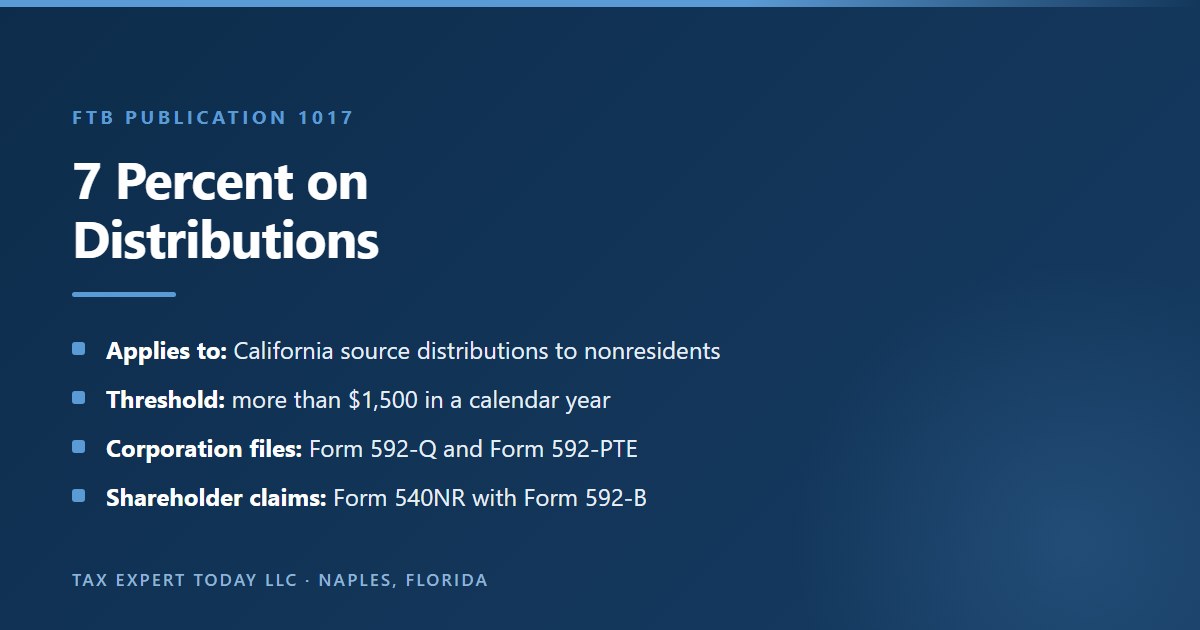
California Form 100S Help in Naples & Southwest Florida
Tax Expert Today LLC works with business owners who have moved from California to Naples, Florida and still own a California S corporation or receive a Schedule K-1 (100S). Our firm is a multidisciplinary team of tax advisors, enrolled agents, CPAs and attorneys that handles state residency and tax matters nationwide, and we prepare the corporation’s California Form 100S together with the shareholder’s Form 540NR so that the move date, the apportionment and the withholding agree. You can read about our California work on our California tax services page and about planning for new Florida residents on our Naples tax planning page. For the Florida side of a move, our Florida tax services page describes the residency and planning work we do.
- California Form 100S help Naples FL: the S corporation return, Schedule R and Schedules K-1 (100S) for Florida owners.
- Move year allocations: interim closings and actual date or daily pro rata splits under Publication 1100.
- Withholding: Forms 592-PTE, 592-Q and 592-B, waiver requests and Form 590-P certificates.
- Shareholder returns: Form 540NR, elective tax credits and Florida residency documentation.
- Final returns: dissolution and withdrawal coordinated with the Secretary of State filings.
| Naples office detail | Information |
|---|---|
| Address | 11983 Tamiami Trail N, Naples FL 34110 |
| Phone | (239) 441-2005 |
| Hours | Monday through Friday, 10:00 to 5:00 Eastern Time |
| Service area | Naples, Southwest Florida and clients in all 50 states |
Local FAQ: I moved from San Diego to Naples in 2026 and still own my California S corporation, which serves California clients. Do I still deal with California Form 100S? Yes. The corporation is still incorporated in California and still doing business there, so California Form 100S is due for 2026 and later years, with the 1.5 percent tax or the $800 minimum. Your own 2026 return becomes a part-year Form 540NR: your share of all corporate income for the months you lived in California, and the California source share for the months after the move. Distributions the corporation pays you after the move may carry 7 percent withholding, which you claim with Form 592-B. Bring the corporate books and your move date documentation to our Naples office and we can prepare both returns together.
When to Engage a Professional
Many owners of small S corporations have a preparer who files California Form 100S each year without difficulty. The year of a move is different, because the corporate return, the K-1 split, the withholding and the shareholder’s own Form 540NR all have to be built from the same facts. It is worth engaging a professional when any of the following apply.
- A shareholder moved during the year and the corporation has uneven income, a large contract or a sale near the move date.
- The corporation has never apportioned and now has customers, employees or property in more than one state.
- Distributions were made to a nonresident without withholding, a waiver or a Form 590-P.
- The owner is deciding whether to keep, move or dissolve the California corporation.
- Returns were missed after the move, or the corporation has received notices about penalties or suspension.
- A sale of the stock or the assets is being discussed.
The analysis in this guide is general information based on the 2025 Form 100S booklet, the Schedule K-1 (100S) instructions and the Franchise Tax Board publications available on the date of writing. It is not advice for any specific corporation or shareholder, and the 2026 forms should be checked when the Franchise Tax Board releases them. Results depend on the facts of each case. Our related guides on leaving California, the California residency audit, nonresident withholding and selling California rental property after moving cover the adjacent questions. To talk through your corporation’s situation, call (239) 441-2005.
Frequently Asked Questions About California Form 100S
Do I still file California Form 100S after moving to Florida?
The corporation does, if it is still incorporated in California, registered with the California Secretary of State, doing business in California or receiving California source income. The filing obligation belongs to the corporation, not the shareholder. The shareholder’s own return changes from Form 540 to Form 540NR, which reports the California source share of the Schedule K-1 (100S).
What is the tax rate on California Form 100S?
The 2025 S Corporation Tax Booklet lists 1.5 percent of California net income for S corporations and 3.5 percent for financial S corporations, with built-in gains and excess net passive income taxed at 8.84 percent. The tax cannot be less than the $800 minimum franchise tax when the corporation is incorporated, registered or doing business in California.
When is California Form 100S due for 2026?
For a calendar year S corporation, March 15, 2027, which is the 15th day of the third month after the close of the taxable year. An automatic extension to file runs to September 15, 2027, but it does not extend the time to pay. The tax is due on the original date.
Which column of Schedule K-1 (100S) does a nonresident use?
A nonresident shareholder who does not conduct a unitary business with the corporation uses column (e), California source amounts, for California taxable income, and column (d) for the total income figures that Form 540NR also requires. Nonbusiness intangible income in Table 1 is sourced at the shareholder level, generally to the shareholder’s state of residence.
Does a California S corporation withhold on distributions to a Florida shareholder?
Generally yes. FTB Publication 1017 states that S corporations must withhold 7 percent on distributions of California source income to domestic nonresident shareholders once payments exceed $1,500 in a calendar year, unless a waiver has been authorized. The shareholder claims the amount on Form 540NR with Form 592-B attached.
How is S corporation income split in the year I move?
FTB Publication 1100 taxes the shareholder’s share of all income for the period of California residency and the California source share for the period of nonresidency, measured over the corporation’s taxable year. The split must reflect the actual date of realization, and a daily pro rata method applies only where that information is not available.
Is there a nonresident shareholder consent form for California S corporations?
The 2025 Form 100S booklet does not contain one. The nonresident consent on form FTB 3832 and the tax on nonconsenting members apply to LLCs filing Form 568. For S corporations, California relies on the 7 percent distribution withholding and the Schedule K-1 (100S). Confirm against the booklet for the year being filed.
Can a nonresident shareholder claim the California PTET credit?
Yes. The form FTB 3804 instructions state that a qualified taxpayer may be a resident, nonresident or part-year resident who consents to be included in the election. The credit offsets California personal income tax only, so a nonresident with a low California liability may be left with unused credit that is carried forward under the rules for that credit.
How do I stop the $800 minimum franchise tax after leaving California?
The corporation files a timely final Form 100S, does no business in California after the final year, and files dissolution or surrender documents with the California Secretary of State within 12 months of the timely final return. A corporation that keeps doing business in California remains subject to the tax even if it withdraws its registration.
Can a Naples, Florida firm prepare California Form 100S?
Yes. California Form 100S is filed with the Franchise Tax Board, usually electronically, and the booklet does not require the preparer to be located in California. A Naples, Florida firm can prepare the corporate return and the shareholder Forms 540NR together so that the move date, apportionment and withholding agree.
Published November 28, 2026 by Dr. Pellumb Kabashi « Back to Learning Center
Have a question this article touches on?
Tax Expert Today LLC, based in Naples, Florida and serving clients across the United States.
Schedule a Consultation (239) 441-2005