
By Dr. Pellumb Kabashi, DBA, MBA, EA, CFE, CES
Founder, Tax Expert Today LLC · Tax advisors, enrolled agents, CPAs, and attorneys · Serving clients in all 50 states
Quick Answer: Form 6166 is the IRS letter that certifies you were a United States resident for tax purposes in a given year, so a foreign country will apply a treaty rate or a VAT exemption. You request Form 6166 by filing Form 8802 with a $105 or $230 user fee, at least 45 days before you need it. Call (239) 441-2005 for a free consultation.
What is Form 6166?
Form 6166 is a letter of United States residency certification. The IRS prints it on Department of the Treasury letterhead to certify that the person or entity named was a resident of the United States for federal income tax purposes during a stated year. Foreign tax authorities and payers accept it as proof of treaty residence.
- What it is: a computer generated IRS letter, not a form you fill in.
- Who issues it: the Philadelphia Accounts Management Center of the IRS.
- How you request it: by filing Form 8802 and paying a user fee.
- What it covers: one certification year per letter, for one named country.
- What it supports: income tax treaty claims and foreign VAT exemptions.
The name confuses almost everyone who meets it for the first time. A foreign bank, a paying agent, a customer abroad, or a foreign tax office asks for “Form 6166,” and the natural reaction is to look for a blank form to download. There is none. According to the Instructions for Form 8802, Form 6166 is a computer generated letter printed on stationery bearing the Department of the Treasury letterhead, with the facsimile signature of the Field Director of the Philadelphia Accounts Management Center. The only document a taxpayer completes is the application, Form 8802.
The letter exists because of how tax treaties work. Many countries withhold tax when they pay dividends, interest, royalties, pensions, or service fees to someone outside the country. The rate is set by that country’s own law. An income tax treaty with the United States often lowers that rate, sometimes to zero, for residents of the United States. The foreign country then needs a reliable way to know that the person claiming the lower rate really is a United States resident. The IRS explains that many treaty partners require the IRS itself to certify that fact, and Form 6166 is how the IRS does it.
The letter is short. It names the taxpayer, gives the taxpayer identification number, states the year, and certifies residence for purposes of United States taxation. For some applicants the wording changes, because some applicants are not “residents” in the treaty sense at all. A partnership, an S corporation, and a single member LLC are examples, and each is covered later in this guide.
| Feature | Form 6166 |
|---|---|
| Official name | Letter of U.S. residency certification |
| Issued by | IRS, Philadelphia Accounts Management Center |
| Requested on | Form 8802, Application for United States Residency Certification (Rev. October 2026) |
| User fee from October 1, 2026 | $105 per Form 8802 for an individual, $230 per Form 8802 for any other applicant |
| Period certified | Generally one calendar year per letter |
| Recommended lead time | At least 45 days before the certificate is needed |
| Where it goes | To the foreign withholding agent or tax authority, not back to the IRS |
What does Form 6166 certify, and what does it leave out?
Form 6166 certifies one fact: that for the certification year the applicant was a resident of the United States for purposes of United States taxation. It does not certify that tax was paid, that the applicant owns the income, or that the applicant meets the limitation on benefits article of a treaty.
- Certified: United States tax residence for the year named in the letter.
- Not certified: the amount of United States tax paid on any income.
- Not certified: beneficial ownership of the foreign payment.
- Not certified: the limitation on benefits test in the treaty.
- Not certified: any other condition a foreign country sets for a VAT exemption.
The limits matter in practice because foreign payers sometimes expect the letter to do more than it can. The instructions say plainly that the IRS cannot certify whether you are the beneficial owner of an item of income or whether you meet the limitation on benefits article, and that a foreign withholding agent may require you to establish those points directly. A taxpayer who sends the letter abroad and hears nothing back has often run into this gap: the residence question is answered, and the payer is waiting for a separate ownership or treaty eligibility declaration on its own local form.
The instructions also draw a hard line around the foreign tax credit. You cannot use Form 6166 to substantiate that United States taxes were paid for purposes of claiming a foreign tax credit. The letter proves where you are resident. It says nothing about how much you paid. Readers who need to document tax paid to a foreign country for a United States credit are dealing with a different problem, which we cover in our guide to Form 1116.
For pass-through applicants the certification is narrower still. For a fiscally transparent entity, the instructions state that the letter certifies that the entity, when required, filed an information return and that its partners, members, owners, or beneficiaries filed income tax returns as residents of the United States. For a disregarded entity, it certifies that the single owner filed an income tax return as a resident of the United States. The entity itself is not certified as a resident.
| Question a foreign payer may ask | Does Form 6166 answer it? | What usually answers it instead |
|---|---|---|
| Is this person a United States tax resident for the year? | Yes | Form 6166 itself |
| Is this person the beneficial owner of the payment? | No | The foreign country’s own claim form or declaration |
| Does this person satisfy the treaty limitation on benefits article? | No | A statement or form required by the foreign payer |
| How much United States tax did this person pay? | No | Not covered by this procedure |
| Does this business qualify for a VAT exemption? | Only the federal income tax status part | The foreign VAT authority’s own requirements |
Who needs Form 6166?
You need Form 6166 when a foreign payer or tax authority asks for IRS proof of United States tax residence before it applies a treaty rate, refunds tax already withheld, or grants a VAT exemption. Individuals, corporations, partnerships, LLCs, trusts, estates, retirement plans, and exempt organizations can all be asked for one.
- Investors: foreign dividends or interest taxed at a statutory rate above the treaty rate.
- Retirees: a foreign pension or annuity paid to a United States resident.
- Service businesses: a foreign customer that withholds on fees or royalties.
- Exporters and software sellers: a foreign VAT office that wants proof of status.
- Funds and plans: retirement trusts and IRAs that reclaim foreign dividend tax.
The request rarely comes from the IRS. It comes from the other side of the transaction. A German bank, a Mexican customer, an Indian licensee, or a Spanish tax office tells the United States person that the treaty rate is available only with a residency certificate from the home country tax authority. For a United States person, that certificate is Form 6166.
The instructions describe two ways foreign countries handle the timing. Some countries withhold at the treaty rate at the time of payment once they have the certificate. This is often called relief at source. Other countries withhold at their full statutory rate first and refund the excess after they receive proof of United States residence. Under the second model the certificate arrives after the fact, as part of a refund claim, and the claim period set by the foreign country controls how long the taxpayer has to act.
| Typical situation | Who asks for the letter | What the letter supports |
|---|---|---|
| United States retiree receives a pension from a former employer abroad | The foreign pension payer or tax office | The treaty rule for pensions paid to a United States resident |
| United States investor holds foreign shares that pay dividends | The custodian, paying agent, or foreign tax office | A reduced treaty rate or a refund of excess withholding |
| Florida LLC licenses software to a customer in a treaty country | The customer’s finance department | The treaty royalty rate in place of the statutory rate |
| United States consultant invoices a foreign client for services | The client, before it releases payment | Relief from local withholding on service fees where the treaty allows it |
| United States company registers for or reclaims foreign VAT | The foreign VAT authority | Proof of United States federal income tax status |
| IRA or retirement plan holds foreign stock | The global custodian | The treaty rate for pension funds, where the treaty has one |
The letter runs in one direction only. It helps a United States resident claim a benefit from a foreign country. A foreign person who wants a reduced rate on United States source income uses a withholding certificate instead, such as the one covered in our guide to Form W-8BEN for individuals or Form W-8BEN-E for entities. The year end statement that a foreign payee receives from a United States payer is covered in our guide to Form 1042-S.
How do you get Form 6166?
You get Form 6166 by filing Form 8802 with the IRS. The steps are to complete the application, pay the user fee through Pay.gov, write the payment confirmation number on page 1, add any required penalties of perjury statement, and send everything to the IRS in Philadelphia by mail, private delivery service, or fax.
- Step 1: confirm the country, the year, and the number of letters the foreign payer needs.
- Step 2: complete Form 8802 so the name and number match the filed return.
- Step 3: pay the user fee on Pay.gov and upload a copy of the form.
- Step 4: enter the confirmation number on page 1 and sign the form.
- Step 5: mail or fax the form and attachments to Philadelphia.
The IRS states that use of Form 8802 is mandatory. There is no letter request, phone request, or online account route that replaces it. The application is three pages: page 1 identifies the applicant and the applicant type, page 2 covers the return filed, the years, the purpose, and the perjury statements, and page 3 is a worksheet that lists treaty countries with a box for the number of letters requested for each.
One detail trips up many first time filers. Uploading the form to Pay.gov does not file it. The IRS says the upload is only to validate the payment, and that applications uploaded to Pay.gov will not be processed. The complete application still has to reach the residency certification unit by mail, private delivery service, or fax.
| Step | What you do | Where the rule comes from |
|---|---|---|
| 1. Scope the request | List each country, each year, and the number of originals needed | Form 8802, lines 7, 11, and 12 |
| 2. Complete Form 8802 | Enter the name and TIN exactly as on the return for the base tax period | Instructions, Applicant’s Name and U.S. Taxpayer Identification Number |
| 3. Add statements | Enter the Table 2 statement on line 10 for a current year request | Instructions, line 7 and line 10 |
| 4. Pay | Pay through Pay.gov under “IRS Certs” and upload a copy of the form | Instructions, Electronic Payment |
| 5. Record the payment | Write the confirmation number on page 1 of every Form 8802 it covers | Instructions, Electronic Payment caution |
| 6. Submit | Mail, send by private delivery service, or fax to the IRS in Philadelphia | Instructions, Where To File |
| 7. Use the letter | Send Form 6166 to the foreign withholding agent or tax office | Instructions, U.S. Residency Certification |
Form 6166 vs Form 8802: what is the difference?
Form 8802 is the application and Form 6166 is the result. You complete, sign, and pay for Form 8802. The IRS reviews it against your filed returns and, if it can verify residence, mails back one Form 6166 letter for each certification you requested. You never fill in a Form 6166 yourself.
- Form 8802: three page application signed by the taxpayer.
- Form 6166: one page certification letter signed in facsimile by the IRS.
- Fee: charged per Form 8802, not per letter.
- Quantity: one Form 8802 can request many letters for many countries.
Searches for a “Form 6166 template” or a “Form 6166 PDF” come from this confusion. Any fillable document offered under that name is not the IRS letter, and a foreign tax office will not accept a self prepared version. The only path to a genuine letter is the application.
| Point | Form 8802 | Form 6166 |
|---|---|---|
| What it is | Application for United States Residency Certification | Letter of U.S. residency certification |
| Who prepares it | The taxpayer or an authorized representative | The IRS |
| Who signs it | The applicant, under penalties of perjury | Facsimile signature of the IRS Field Director |
| Who receives it | The IRS in Philadelphia | The applicant or a named appointee, then the foreign payer |
| Cost | $105 or $230 per application | No separate charge per letter |
| Current revision | October 2026 | Generated for each request |
Is Form 6166 the same as Form W-9 or Form W-8BEN?
No. Form W-9 and Form W-8BEN are self certifications that a taxpayer signs and hands to a payer. Form 6166 is a certification by the IRS itself. Foreign tax authorities ask for Form 6166 because they want the United States government, not the taxpayer, to confirm residence.
- Form W-9: a United States person gives its number to a United States payer.
- Form W-8BEN: a foreign individual certifies foreign status to a United States payer.
- Form 6166: the IRS certifies United States residence to a foreign payer.
Some foreign payers will accept a Form W-9 as informal evidence that a customer is American, but a W-9 carries no government verification and generally does not satisfy a foreign tax authority that conditions treaty relief on a certificate of residence. When the request uses the words “certificate of residence,” “tax residency certificate,” or “certificate of fiscal residence,” the document being asked for is Form 6166.
| Document | Who signs | Direction | Verified by a government? |
|---|---|---|---|
| Form W-9 | United States person | To a United States payer | No, self certified |
| Form W-8BEN or W-8BEN-E | Foreign person | To a United States payer | No, self certified |
| Form 6166 | IRS | To a foreign payer or tax office | Yes, issued by the IRS |
| Foreign certificate of residence | Foreign tax authority | To a United States payer, in support of a W-8 treaty claim where requested | Yes, issued by the foreign authority |
How much does Form 6166 cost in 2026?
The user fee is $105 per Form 8802 for an individual applicant and $230 per Form 8802 for any applicant that is not an individual, for applications postmarked on or after October 1, 2026. The fee is charged for each application, not for each letter, each country, or each year requested.
- Individuals: $105 per Form 8802, up from $85.
- Corporations, partnerships, trusts, and other entities: $230 per Form 8802, up from $185.
- Pass-through entities: one $230 fee covers all letters issued under the entity’s EIN.
- Custodial accounts: one fee for each account holder TIN.
- Refunds: the fee is nonrefundable in general.
The increase is recent. The IRS residency certification page announces the change, and the IRS user fee fact sheet explains that the IRS raised the fees based on the cost of processing applications, and that the new amounts apply to applications postmarked on or after October 1, 2026. Any article, video, or forum post that still quotes $85 and $185 was written before that date.
Because the fee attaches to the application, the instructions encourage each applicant to include all requests on a single Form 8802. An individual who needs letters for Germany, Spain, and Canada for 2025 and 2026 pays $105 once if everything is on one application. The same individual who sends three separate applications pays $315. The instructions add one qualifier: requests for an individual and requests for an entity go on separate applications, each with its own fee.
| Applicant | Fee before October 1, 2026 | Fee on or after October 1, 2026 | What one fee covers |
|---|---|---|---|
| Individual (citizen or resident under section 7701(b)(1)(A)) | $85 | $105 | One Form 8802, any number of countries and years |
| Corporation, exempt organization, estate, complex trust, plan | $185 | $230 | One Form 8802, any number of countries and years |
| Partnership, S corporation, grantor trust, other fiscally transparent entity | $185 | $230 | All letters issued under the entity’s EIN, even though each owner is verified |
| Custodian for account holders | $85 or $185 per account holder TIN | $105 or $230 per account holder TIN | One account holder |
| Additional request on a separate Form 8802 | $85 or $185 | $105 or $230 | The new application |
The fact sheet also gives the transition rule for applications that crossed the effective date. An application received with a postmark before October 1, 2026 is processed at the old fee. The same treatment applies to an application sent through an IRS designated private delivery service before that date, or faxed before that date after an electronic payment. Anything postmarked on or after October 1 needs the new amount. An application sent with the old amount after the change should expect a request for a supplemental payment, which the instructions say can be made on the same Pay.gov page by checking the supplemental payment box.
The fact sheet describes the fee as generally nonrefundable, with an exception for overpayments caused by a mathematical error or mistake. A denied application does not bring the fee back, which is one more reason to confirm eligibility before paying.
How do you pay the Form 8802 user fee on Pay.gov?
Go to Pay.gov, search for “IRS Certs,” and follow the prompts. You enter the applicant’s name and taxpayer identification number, the submitter’s name, contact details, and the number of Forms 8802, upload a PDF copy of the application, and pay by bank account, debit card, or credit card. The fee populates automatically.
- Search term: “IRS Certs” in the Pay.gov search box.
- Upload: a copy of Form 8802, required since September 29, 2024.
- File limit: one combined PDF under 15MB.
- Payment methods: ACH from a bank account, or a debit or credit card.
- Result: an e-payment confirmation number to write on page 1.
The October 2026 instructions describe only the electronic route under the heading Electronic Payment, and the section on new developments states that the IRS requires paying electronically whenever possible. A separate IRS page on additional certification requests, last reviewed September 30, 2026, still lists a mailing address for payment by check or money order. Because the two sources do not line up exactly, a filer who wants to pay by check should confirm with the residency certification unit at 267-941-1000 before mailing one. Paying on Pay.gov avoids the question.
The instructions list the information the payment page asks for:
| Pay.gov field | What to enter |
|---|---|
| Applicant’s name | The name on Form 8802, matching the tax return |
| Applicant’s TIN or EIN | The Social Security number, ITIN, or EIN on the application |
| Submitter’s name | The person or firm making the payment, which can differ from the applicant |
| Contact email and phone | Where the payment receipt and any questions should go |
| Number of Forms 8802 | The count of applications covered by this payment |
| Payment account | Bank account (ACH), debit card, or credit card |
| Supplemental payment box | Checked only when the unit has asked for an additional amount |
After the payment goes through, Pay.gov returns a confirmation. The instructions allow either the Agency Tracking ID or the Pay.gov ID to be used as the e-payment confirmation number. That number goes in the box at the top of page 1 of Form 8802. When one payment covers several applications, the same number goes on each one. The instructions carry a caution on this point: the IRS will not process Form 8802 if the application does not include the e-payment confirmation number.
The order of operations creates a small loop. Pay.gov wants a copy of the application before you have the confirmation number that belongs on the application. The practical sequence is to complete the form, upload that version for payment validation, add the confirmation number to page 1, and then submit the numbered version to Philadelphia.
When should you file Form 8802?
File Form 8802, with the user fee paid in full, at least 45 days before the date you need to hand over Form 6166. For a certificate covering the current calendar year, the IRS will not accept an application postmarked before December 1 of the prior year, and returns early requests to the sender.
- Lead time: at least 45 days before the foreign deadline.
- Delay notice: the IRS says it will contact you after 30 days if processing will be delayed.
- Earliest date for a 2027 letter: a postmark on or after December 1, 2026.
- Prior years: can be requested at any time, in any number.
- Status questions: 267-941-1000, the U.S. residency option, not toll free.
The December 1 rule matters most to taxpayers whose foreign payers want a fresh certificate at the start of each year. The instructions give the example for 2026: a request received with a postmark before December 1, 2025 cannot be processed, and a request postmarked on or after December 1, 2025 can be processed with the appropriate documentation. The same rule, applied one year forward, means an application for a 2027 certificate can be postmarked starting December 1, 2026.
An application sent in that early window is by definition a current year request, because the year it covers has not ended and no return for that year exists. That brings in the penalties of perjury statement on line 10, covered in detail below. An early application without the statement is incomplete.
| Certificate year wanted | Earliest acceptable postmark | Extra requirement |
|---|---|---|
| 2027 (current year request made in advance) | December 1, 2026 | Table 2 penalties of perjury statement on line 10 |
| 2026 (current year, return not yet due) | Already open | Table 2 penalties of perjury statement on line 10 |
| 2025 (return filed and posted) | Any time | None beyond the standard application |
| 2025 (return filed recently, not yet posted) | Any time | A signed copy of the return marked “COPY, do not process” may speed review |
| Earlier years | Any time | The return for that year must be on file |
Foreign deadlines drive the calendar more than the IRS does. A relief at source country needs the letter before the payment date. A refund country sets a claim period under its own law. Neither date appears anywhere in the IRS instructions, so the first step in any request is to ask the foreign payer or adviser for the date by which the original letter must be in hand, and to count back at least 45 days plus international delivery time.
How long does Form 6166 take to arrive?
The IRS asks for at least 45 days and says it will contact you after 30 days if there will be a delay. It publishes no fixed turnaround. Its processing status page, last updated November 20, 2026, reported that it was working on Forms 8802 received in October 2026.
- Planning figure: 45 days at a minimum, more for international delivery.
- Live indicator: the IRS processing status page for tax forms.
- Common delay: the base year return has not posted to IRS records.
- Common delay: a missing perjury statement or confirmation number.
- Delivery: regular mail unless you supply a prepaid courier label.
The IRS processing status page is the closest thing to a tracker. It lists Form 8802 among “other forms” and names the month of receipt currently being worked. It does not show the status of an individual application. For that, the instructions give the residency certification unit’s number, 267-941-1000, and note that it is not toll free.
Several things inside the taxpayer’s control shorten the wait. The first is the return. The IRS verifies residence against its own records, so an application that arrives before the base year return has posted generates a letter asking for a signed copy. The instructions suggest heading that off: if you filed recently, include a copy of the income tax return, without the accompanying forms and schedules, and write “COPY, do not process” on it. By including the copy you are confirming that the filed return contains exactly the same information.
The second is the phone number. The instructions say a daytime phone number speeds processing because the unit may be able to resolve a question about the NAICS code or the applicant type by phone without mailing a letter. The third is delivery. Form 6166 goes out by regular mail by default. For faster delivery inside the United States, the applicant must provide a prepaid UPS or FedEx label and envelope. For delivery to a foreign address by express courier, the instructions require a prepaid DHL label and envelope.
Where do you send Form 8802?
After paying on Pay.gov and writing the confirmation number on page 1, send Form 8802 and all attachments to the IRS in Philadelphia by mail, by private delivery service, or by fax. A fax can carry up to 10 Forms 8802 and no more than 100 pages, with a cover sheet stating the page count.
- Mail: Department of the Treasury, Internal Revenue Service, Philadelphia, PA 19255-0625.
- Private delivery: Internal Revenue Service, 2970 Market Street, BLN# 3-E08.123, Philadelphia, PA 19104-5016.
- Fax inside the United States: 877-824-9110, toll free.
- Fax from anywhere: 304-707-9792, not toll free.
| Method | Destination | Limits and notes |
|---|---|---|
| United States mail | Department of the Treasury, Internal Revenue Service, Philadelphia, PA 19255-0625 | Postmark date controls the December 1 rule and the fee transition |
| Private delivery service | Internal Revenue Service, 2970 Market Street, BLN# 3-E08.123, Philadelphia, PA 19104-5016 | The street address the instructions give for private delivery services |
| Fax, domestic | 877-824-9110 | Up to 10 applications, 100 pages maximum, cover sheet with page count |
| Fax, domestic or foreign | 304-707-9792 | Same limits, not toll free |
| Pay.gov upload | Not a filing method | Validates payment only, and the IRS does not process uploaded applications |
A request for competent authority assistance, discussed near the end of this guide, goes to a different office in Washington. The instructions warn against sending Form 8802 to that address.
Can you e-file Form 8802?
Not through tax software. Form 8802 is not part of the e-file system used for returns, and the instructions direct applicants to mail or fax it after paying online. The IRS has added a mobile-friendly version of Form 8802, which its form page says is currently available for individual applications only.
- Payment: online, through Pay.gov.
- Submission: mail, private delivery service, or fax under the Where To File rules.
- Signature: Form 8802 may be signed digitally.
- Not digital: Form 2848 and Form 8821 do not accept digital signatures here.
- Mobile-friendly form: listed by the IRS for individual applicants.
The IRS page for Form 8802 reports that a digital mobile adaptive version of the form became available on September 28, 2025, and that it is currently available only for individual applications and not for business entities. The October 2026 instructions mention the same option in a reminder and point to IRS.gov/MFF. The same instructions also state, in the payment section, that taxpayers still need to submit Form 8802 for processing to the residency certification function by mail or fax. An individual who wants to use the mobile-friendly route should follow the on-screen directions on the IRS mobile-friendly forms page and confirm how the user fee and any attachments are handled before relying on it for a deadline.
The instructions do loosen one requirement that used to slow these applications down. A note under Signature and Date says Form 8802 may be signed digitally. The same note says digital signatures are not accepted on Form 2848 and Form 8821 submitted with it, so a representative’s authorization still needs a handwritten signature.
How long is Form 6166 valid?
Form 6166 has no expiration date printed by rule. It certifies residence for the specific certification year named in the letter, generally one calendar year. How long a foreign payer will rely on it is decided by that country’s law and the payer’s policy, and many ask for a new letter every year.
- Certification period: generally one year, per the line 7 instructions.
- Multiple years: the current year and any number of prior years can be requested together.
- Fiscal year filers: request each calendar year the fiscal year touches.
- Acceptance window: set by the foreign country, not by the IRS.
The IRS materials do not say how long a foreign payer must honor a letter, because that is not a United States rule. In practice the answer comes from the country asking. Some treat a certificate for the year of payment as sufficient for all payments in that year. Some want a certificate dated within a set number of months before the claim. The safest approach is to ask the foreign payer two questions in writing before applying: which year must the letter name, and how recent must the issue date be.
Fiscal year taxpayers face one extra wrinkle. The instructions require a four digit calendar year on line 7 even for fiscal year filers, and state that you must request a separate calendar year certification for any part of a fiscal tax year that falls outside the calendar year. A corporation with a September 30 year end that needs coverage for its full fiscal year therefore requests two calendar years.
Who is eligible for Form 6166?
An individual or entity is eligible when it is subject to United States tax by reason of residence, citizenship, place of incorporation, or similar criteria, and the IRS can verify that it filed the appropriate return for the year, or for the most recent year due, or was not required to file and supplies other documentation.
- Citizens and resident aliens: taxed on worldwide income, verified against Form 1040.
- Domestic corporations: verified against Form 1120.
- Tax-exempt bodies: pension funds and charities can still be residents.
- Low income individuals: eligible even when income is below the filing threshold.
- Return not yet due: the IRS looks to the most recent year for which a return was due.
The instructions start from the treaty definition. Under an income tax treaty, a resident of the United States is a person subject to United States tax by reason of residence, citizenship, place of incorporation, or other similar criteria. United States residents are taxed on worldwide income. The instructions then add two clarifications that widen the group. An entity can be considered subject to tax on its worldwide income even if it is exempt by statute, such as a pension fund or a charity. An individual is considered subject to tax even if the individual’s income is less than the amount that would require a return.
For individuals, the statutory test of residence sits in section 7701(b). An alien individual is a resident for a calendar year if the individual is a lawful permanent resident at any time during the year, meets the substantial presence test, or makes the first year election. We cover the day count in our guide to the substantial presence test. A United States citizen is taxed as a resident regardless of where the citizen lives, although a citizen who lives abroad faces extra documentation for this certificate, as the next sections explain.
The IRS then verifies. The instructions say the IRS will generally issue the letter only when it can verify one of three things for the year requested:
| Verification route | When it applies | What the IRS looks at |
|---|---|---|
| Return filed for the certification year | Prior year requests | The posted return, for example Form 1040 or Form 1120 |
| Return filed for the most recent year due | Current year requests, where the return for the year is not yet due | The latest required return, plus the line 10 perjury statement |
| No return required | Applicants below a filing threshold or exempt from filing | The Table 1 documentation, such as proof of income and a written explanation |
Who is not eligible for Form 6166?
You are generally not eligible if, for the tax period the certificate is based on, you did not file a required return, filed as a nonresident, are a dual resident who has claimed treaty residence in the other country, or are a domestic pass-through entity with no United States owners.
- No return: a required United States return was never filed.
- Nonresident return: Form 1040-NR, Form 1120-F, or a territory tax form was filed.
- Treaty tie-breaker: you chose, or intend to choose, residence in the other country.
- No United States owners: a domestic partnership, grantor trust, or disregarded LLC owned entirely by foreign persons.
- Foreign exempt organization: one not organized in the United States.
Each exclusion follows from what the letter certifies. A person who has not filed a required return gives the IRS nothing to verify. A person who filed as a nonresident has told the IRS, on the return itself, the opposite of what the certificate would say. Our guide to Form 1040-NR covers who files that return. A person who filed a part year resident return falls in between and is handled through the dual-status boxes on line 4a, described below and in our guide to the dual status tax return.
| Reason listed in the instructions | Why it blocks the letter | What might change the answer |
|---|---|---|
| Required return not filed | Residence cannot be verified against IRS records | Filing the missing return, then applying |
| Return filed as a nonresident (Form 1040-NR, 1120-F, 1120-FSC, or a territory form) | The filing position contradicts United States residence | A different year in which a resident return was filed |
| Dual resident who claims residence in the other treaty country | The individual is treated as a nonresident for computing United States tax | Evidence that the tie-breaker points to the United States |
| Domestic fiscally transparent entity with no United States partners, beneficiaries, or owners | There is no United States resident behind the entity | Nothing, unless a United States owner exists |
| Exempt organization not organized in the United States | It is not a United States resident | Not applicable |
| Employee benefit plan trust in the plan’s first year, not administered by a qualified custodian bank | A specific exclusion in the instructions | Administration by a qualified custodian bank under 17 CFR 275.206(4)-2(d)(6)(i), or a later year |
The first row is the one that surprises people. A taxpayer who is behind on returns cannot obtain a residency certificate for the missing years until the returns are filed. Where the late returns carry penalties, the certificate project and the penalty project end up linked. Our guide to reasonable cause penalty abatement explains how relief requests are evaluated, and our guide to delinquent international information returns covers the late filing routes for the foreign reporting forms.
Can a U.S. citizen living abroad get Form 6166?
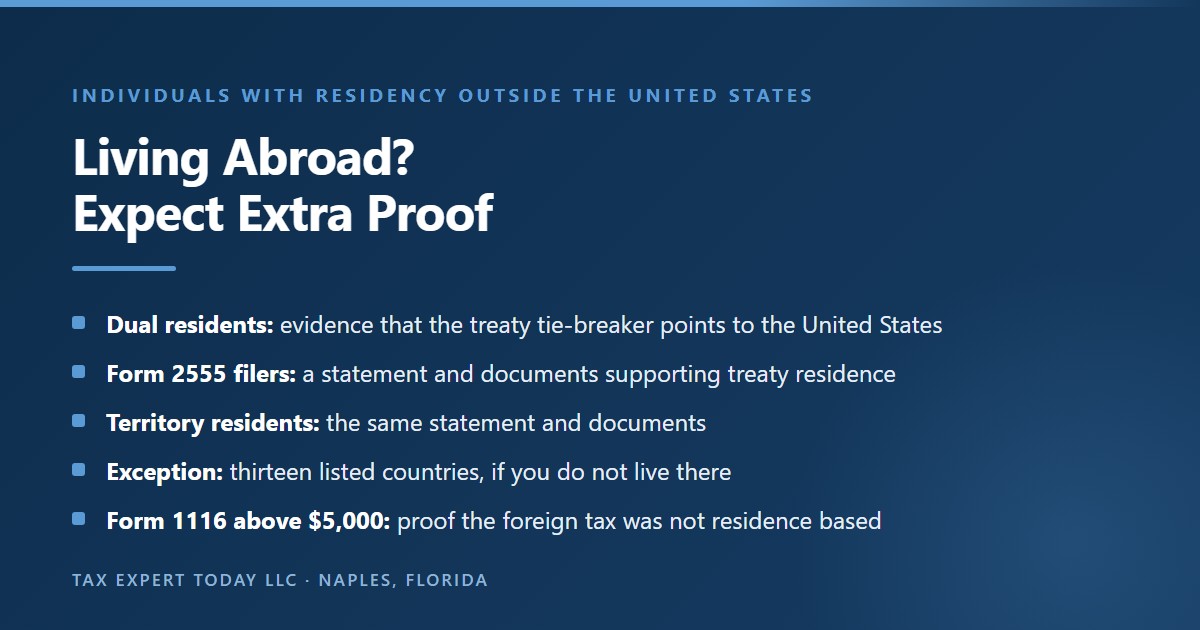
Sometimes. A United States citizen or green card holder who filed Form 2555 must attach a statement and documentation explaining why the applicant should be certified as a resident for the specific treaty. Under many treaties, a citizen with no substantial presence, permanent home, or habitual abode in the United States is not entitled to treaty benefits.
- Trigger: Form 2555 filed for the current or prior year of the request.
- Requirement: a statement plus documentation supporting treaty residence.
- Risk: the request may be denied if the treaty does not treat the applicant as a resident.
- Exception: thirteen listed countries, when you do not live in that country.
- Also covered: bona fide residents of a United States territory.
This is the part of the instructions that most published guides skip, and it is the part that matters most to Americans overseas. Citizenship makes a person a United States taxpayer. It does not automatically make the person a United States resident under a treaty. Most treaties define a resident by reference to where a person is liable to tax by reason of domicile or residence, and many then limit the treatment of citizens who live in a third country. The instructions summarize the result: under many United States treaties, citizens or green card holders who do not have a substantial presence, permanent home, or habitual abode in the United States during the tax year are not entitled to treaty benefits.
The instructions sort affected individuals into three categories under the heading Individuals With Residency Outside the United States. Anyone in one of them, for the current year or the prior year of the request, must send a statement and documentation with Form 8802.
| Category | Who is in it | What must be attached | What the IRS says may happen |
|---|---|---|---|
| 1. Dual resident | A resident under the internal laws of both the United States and the treaty country named in the request | Evidence that the tie-breaker in the treaty’s residence article makes you a United States resident | The request may be denied without that evidence |
| 2. Form 2555 filer | A green card holder or United States citizen who filed Form 2555 | A statement and documentation showing why you believe you are entitled to certification for the relevant treaty | The applicant must examine the specific treaty to determine eligibility |
| 3. Territory resident | A bona fide resident of a United States territory | The same statement and documentation as category 2 | The applicant must examine the specific treaty to determine eligibility |
Filing Form 2555 is the flag because it is a sworn statement that the filer’s tax home is in a foreign country. A person claiming the foreign earned income exclusion under the bona fide residence test has told the IRS that the person is a resident of a foreign country for an uninterrupted period that includes a full tax year. Asking the IRS, for the same year, to certify United States residence to a treaty partner requires an explanation. Our line by line guide to Form 2555 covers what that form asserts.
Bona fide residents of Puerto Rico are in the third category, and the federal rules that apply to them are covered in our guide to Act 60 and Puerto Rico. The form itself has a box for the mixed case. On line 4a, an individual who filed a Form 2555 covering only part of a year checks “Partial-year Form 2555 filer” and enters the dates, in YYYYMMDD format, of the period the individual was a resident of the United States. The certificate then covers that period, not the full year.
What statement does a Form 2555 filer attach to Form 8802?
The instructions do not supply fixed wording for most Form 2555 filers. They require a statement and documentation establishing why you believe you should be certified as a United States resident for purposes of the relevant treaty. Fixed Table 2 wording exists only for teaching or research claims.
- Content: the treaty, the residence article, and the facts that satisfy it.
- Facts that matter: permanent home, habitual abode, and time spent in the United States.
- Form: entered on line 10 or attached, signed and dated under penalties of perjury.
- Teachers and researchers: use the specific Table 2 statement.
Because the instructions point the applicant to the treaty, a useful statement is built from the treaty outward. It identifies the country, quotes or cites the residence article and any paragraph that addresses United States citizens, and then states the facts that meet it. Documentation follows the facts: evidence of a home kept available in the United States, records of days spent in the country, and anything else the particular treaty treats as relevant. The instructions do not promise that any particular set of facts will be accepted, and the result depends on the treaty and the individual circumstances.
Two groups have an easier path. The first is teachers and researchers. Where a Form 2555 filer is claiming benefits under a treaty provision for payments received for teaching or research, Table 2 of the instructions supplies the wording. For countries other than Japan, the statement says that the individual was a United States resident within the meaning of the named treaty article immediately before entering the country, gives the start and end dates of the assignment, and states that the article provides a two or three year exemption. For Japan, the statement says the individual is and will continue to be a United States resident within the meaning of Article 4(1) of the treaty, gives the assignment dates, and cites the two year exemption in Article 20.
The second group is covered by the Exceptions paragraph of the instructions. You do not need the additional statement or documentation if all three of these conditions are met:
| Condition | Detail from the instructions |
|---|---|
| Status | You are a United States citizen or green card holder |
| Country requested | You are requesting certification only for Bangladesh, Bulgaria, Cyprus, Hungary, Iceland, India, Kazakhstan, Malta, New Zealand, Russia, South Africa, Sri Lanka, or Ukraine |
| Country of residence | The country for which you request certification and your country of residence are not the same |
Two of the listed countries carry their own notes. The treaty with Hungary was terminated, so the instructions allow a letter for Hungary only for a tax period ending before January 1, 2024. The treaty with Russia is partially suspended, and a letter for Russia can be issued for a tax period ending before August 16, 2024. An American who lives in Portugal and needs a letter for India fits the exception. An American who lives in India and needs a letter for India does not.
What if you claim a foreign tax credit on Form 1116?
If you filed or intend to file Form 1116 claiming a foreign tax credit above $5,000, or a credit for any amount of foreign earned income, for the certification period, you must submit evidence that you were a United States resident and that the foreign taxes were not imposed because you were a resident of the foreign country.
- Trigger one: a foreign tax credit above $5,000 on Form 1116.
- Trigger two: any credit for tax on foreign earned income.
- Evidence: United States residence, and the basis on which the foreign tax was imposed.
- If already filed: a copy of the return with Form 1116 and the income information returns.
- Consequence: the request may be denied without the materials.
The logic is the same as for Form 2555. A large foreign tax credit, or any credit on wages earned abroad, suggests that a foreign country is taxing the applicant as one of its own residents. If that is what happened, the applicant may be a resident of the other country under the treaty. The IRS wants to see that the foreign tax was imposed for another reason, for example because the income had its source there.
The instructions are specific about what an applicant who has already filed must send: a copy of the federal income tax return, including any information returns relating to income such as Form W-2 or Form 1099, along with the Form 1116. A current year applicant who intends to claim the credit must show that the applicant will be a resident. Readers choosing between the exclusion and the credit will find the comparison in our guide to the foreign earned income exclusion versus the foreign tax credit. The choice affects this application either way, because both routes trigger extra documentation.
Can a dual resident get Form 6166?
Only if the treaty tie-breaker makes the person a United States resident. A dual resident who has determined, or intends to determine, under the tie-breaker that the person is a resident of the other country is not eligible. A dual resident who claims United States residence must submit evidence supporting that result.
- Dual resident: a resident under the domestic law of both countries.
- Tie-breaker order: typically permanent home, then center of vital interests, then habitual abode, then nationality.
- Foreign result: no Form 6166, and a Form 1040-NR with Form 8833.
- United States result: Form 6166 is possible with supporting evidence.
- Unresolved: the competent authorities may settle it by mutual agreement.
The instructions cite Treasury Regulation 301.7701(b)-7 for this rule. The regulation defines a dual resident taxpayer as an individual who is a resident of the United States under its internal law and also a resident of a treaty country under that country’s internal law. If the individual determines that the individual is a resident of the foreign country for treaty purposes and claims a treaty benefit as a nonresident, the individual is treated as a nonresident alien for computing United States income tax. The regulation requires a return on Form 1040-NR with a completed Form 8833 attached. Our guide to Form 8833 walks through that disclosure.
The two positions cannot coexist for the same period. A person cannot tell the IRS on Form 8833 that the person is a resident of Canada under the treaty and then ask the same IRS to certify to Canada, or to any other country, that the person was a United States resident. Our guide to the Canada and United States tax treaty covers how the residence article works for people who live in both countries.
Green card holders should think carefully before taking the foreign residence position at all. Under section 7701(b)(6), an individual ceases to be treated as a lawful permanent resident for tax purposes if the individual commences to be treated as a resident of a foreign country under a treaty, does not waive the treaty benefits, and notifies the IRS. For a long term resident, that can raise the expatriation rules discussed in our guide to Form 8854. The regulation also warns that filing Form 1040-NR may affect the immigration determination of whether the individual qualifies to keep a residency permit.
Where the tie-breaker tests do not settle the question, the instructions explain that the competent authorities of the two countries will endeavor to settle it by mutual agreement after the taxpayer submits a competent authority request. The wording and order of the tests vary by treaty, and the instructions refer readers to Publication 519 for more on residence and tie-breaker provisions.
What do green card holders, new residents, and visa holders attach?
An individual checks every box on line 4a that applies and attaches proof of status when no return has been filed yet. A recently arrived green card holder attaches a copy of Form I-551. A resident under the substantial presence test attaches a copy of the current Form I-94 and enters the date status changed.
- Green card holder, no return yet: current Form I-551 or a USCIS statement.
- Substantial presence resident, no return yet: current Form I-94 and the date of change.
- F-1, J-1, M-1, or Q-1 visa holder who filed Form 1040: two explanatory statements.
- First year election: the election statement, or a statement of intent to file one.
- Dual-status year: the dates of United States residence in YYYYMMDD format.
| Line 4a box or situation | Who it describes | What the instructions require |
|---|---|---|
| U.S. citizen | A citizen, wherever resident | Nothing extra unless the Form 2555, Form 1116, or dual resident rules apply |
| U.S. lawful permanent resident | A green card holder | If recently arrived with no return filed, a copy of the current Form I-551, or a USCIS statement giving the alien registration number, date and port of entry, date of birth, and classification |
| Other U.S. resident alien | A resident under the substantial presence test | The type of entry visa, current nonimmigrant status, and date of change, plus a copy of the current Form I-94 if no return has been filed for the year |
| Student, teacher, or trainee who filed Form 1040 | A person on an F-1, J-1, M-1, or Q-1 visa | A statement explaining why Form 1040 was filed, and a statement with documentation showing worldwide income was reported |
| First year election | A person electing residence under section 7701(b)(4) | The date residence begins, and the election statement or a statement of intent and eligibility |
| Dual-status U.S. resident | A part year resident and part year nonresident | The beginning and ending dates of the period of United States residence |
| Partial-year Form 2555 filer | A person whose Form 2555 covered only part of the year | The beginning and ending dates of United States residence for each year |
| Sole proprietor | An individual who files Schedule C | On line 6, the return type, name, TIN, and other information required for the individual owner |
The student and trainee rule exists because of a common filing error. A nonresident alien on one of those visas is usually an exempt individual for the substantial presence test for a period of years, as the instructions note with a reference to section 7701(b)(5), and should be filing as a nonresident. When such a person has filed Form 1040, the IRS wants to know why before it certifies residence on the strength of that return. A person who filed a joint return with a citizen spouse under the election described in our guide to the nonresident alien spouse rules has a ready explanation. A person who simply used the wrong form has a return problem to fix first.
How do you complete Form 8802 line by line?
Enter the applicant’s name and taxpayer identification number exactly as on the return for the base period, give a street address, check the applicant type on line 4, identify the return on line 5, list the years on line 7 and the tax period on line 8, state the purpose on line 9, and count the letters on line 11.
- Top of page 1: the two checkboxes and the e-payment confirmation number.
- Lines 1 to 3: name as it should appear, address, mailing address, and appointee.
- Line 4: ten applicant types, 4a through 4j.
- Lines 5 to 9: return filed, owner information, years, tax period, and purpose.
- Lines 10 to 12: perjury statements, signature, and the country worksheet.
The October 2026 revision of Form 8802 runs three pages. The table below follows the form in order and summarizes what the instructions say about each entry.
| Line | What to enter | Point to watch |
|---|---|---|
| Additional request box | Check only when asking for more letters for a period the IRS already certified | No changes to the original tax information, and within 12 months of the last letter |
| Foreign claim form box | Check if a foreign country’s claim form is enclosed | The IRS processes it only where it has an agreement with that country, and otherwise mails it back |
| Electronic payment confirmation no. | The Pay.gov ID or Agency Tracking ID | Without it the application is not processed |
| Applicant’s name and TIN | Exactly as on the return for the base tax period | For a joint return, the spouse’s name and TIN exactly as filed |
| Line 1 | Name and TIN as they should appear on the certificate, if different | Used when the foreign payer needs a particular presentation of the name |
| Line 2 | Address during the calendar year of the request | No P.O. box or “care of” address, which may cause a denial |
| Line 3a | Mailing address for the letter | If blank, the letter goes to the line 2 address |
| Line 3b | Third-party appointee name, CAF number, phone, and fax | Or “See attached authorization” with Form 2848 or Form 8821 |
| Line 4 | Applicant type, 4a through 4j | Check all boxes that apply within the type |
| Line 5 | Whether a return was required, and which form was filed | If no, check the reason and attach the Table 1 statement |
| Line 6 | Parent or owner information | Completed only when line 5 is “No” |
| Line 7 | Calendar year or years requested, in YYYY format | Dual-status individuals enter eight digit dates |
| Line 8 | Tax period the certification is based on, in YYYYMM format | For a current year, the latest return required to have been filed |
| Line 9 | Purpose: income tax, VAT with NAICS codes, or other | An application with no purpose is returned |
| Line 10 | Penalties of perjury statements and additional information | Required for current year, VAT, and several entity types |
| Signature | The person with authority under Table 3 | Both spouses sign a joint application |
| Line 11 | Number of letters for each country | Total across all years for that country |
| Line 12 | Total letters requested | Sum of columns A through D |
The name match is the most common source of trouble. The instructions explain that the IRS must be able to match the name and TIN on the application to those verified on the return for the base period or on other documentation. A taxpayer whose name has changed must submit the application under the new name, include documentation of the change, and make sure the change has been updated in the IRS database, because the instructions state that certification will not be issued otherwise. Individuals report a name change to the Social Security Administration on Form SS-5 and can notify the IRS of a name and address change on Form 8822.
The address rule on line 2 is strict. The instructions caution against a P.O. box or a “care of” address and say certification may be denied if one is entered. Line 2 asks where the applicant was during the year being certified. Line 3a is the place for a different mailing address, including a representative’s office.
Joint filers have a choice. If a joint return was filed, the spouse’s name and TIN go on the application as filed. A box near the top lets a couple request a separate certification for the spouse. When both spouses need letters, the application is a joint application, and Table 3 requires both to sign.
What goes on line 7 and line 8 of Form 8802?
Line 7 takes the calendar year or years you want certified, in four digit format. Line 8 takes the tax period the IRS should base the certification on, as year and month. For a year whose return is not yet due, line 8 is the latest return that was required to have been filed.
- Line 7: the certification year, for example 2027.
- Line 8: the base tax period, for example 202512.
- Prior year request: both lines point to the same year.
- Current year request: line 8 points back to the last return that was due.
- No return required: add “(not required to file)” after the period.
The two lines answer different questions, and the instructions give four examples to show how they diverge. The examples assume no extension unless stated.
| IRS example | Filer | Date Form 8802 is completed | Line 7 (year certified) | Line 8 (base period) | Why |
|---|---|---|---|---|---|
| Example 1 | Form 1040 filer | January 1, 2026 | 2026 | 202412 | The 2024 return is the latest one required to have been filed |
| Example 2 | Same filer | August 1, 2026 | 2026 | 202512 | The 2025 return was due before August 1, 2026 |
| Example 2, with an extension for 2025 | Same filer | August 1, 2026 | 2026 | 202412 | With the extension, the 2024 return is still the latest one required |
| Example 3 | Form 1040 filer | January 1, 2026 | 2023 | 202312 | A prior year request uses the end of that year |
| Example 4 | Form 1120 filer, September 30 year end | February 15, 2026 | 2026 | 202409 | The 2024 Form 1120 for the year ending September 30, 2025 is the latest return required to have been filed |
Applying the first example one year forward gives the entry most early filers need now. A calendar year individual who completes Form 8802 in December 2026 or January 2027 for certification year 2027 has not yet reached the due date of the 2026 return. The latest return required to have been filed is the 2025 Form 1040, so line 7 is 2027 and line 8 is 202512. That is an application of the rule in Example 1, and the instructions should be checked again if the revision changes.
The gap between the two lines is the reason a current year application needs a sworn statement. The IRS is being asked to certify 2027 on the strength of a 2025 return. The statement on line 10 fills the gap by having the applicant swear to continued residence.
What penalties of perjury statement goes on line 10?
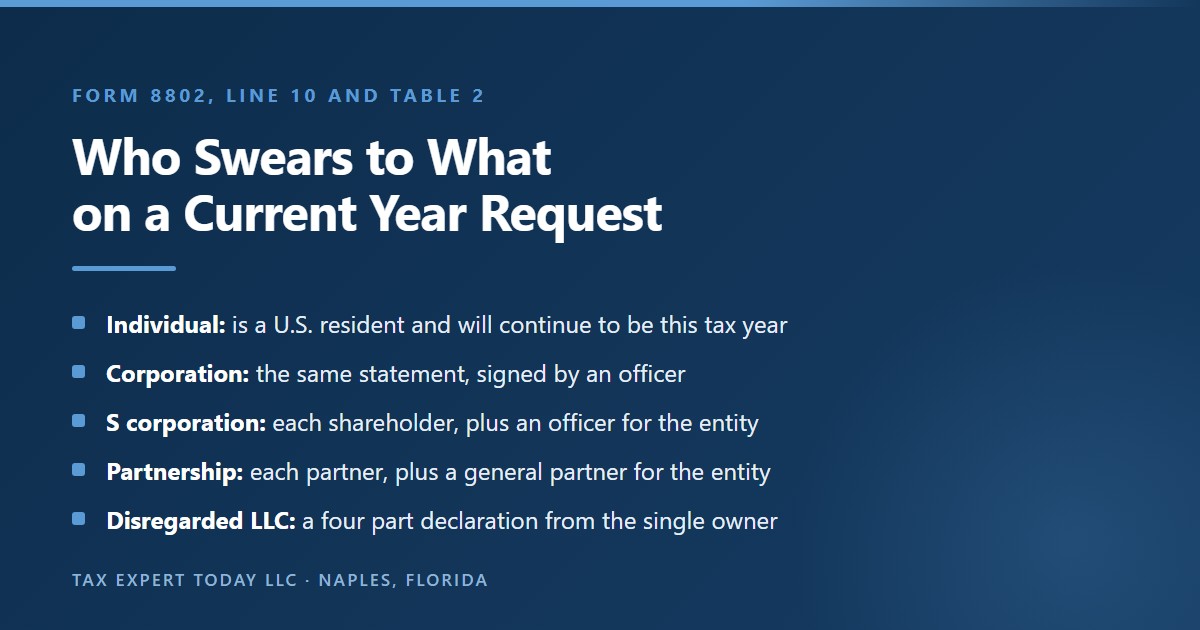
For a current year request, line 10 must carry the Table 2 statement for the applicant type. For an individual it reads: “[name and TIN] is a U.S. resident and will continue to be throughout the current tax year,” followed by the sentence that the certification is given under penalties of perjury.
- When required: a certification for the current year or a year whose return is not yet due.
- Closing sentence: “This certification is given under penalties of perjury and to the best of my knowledge and belief, the statements are true, correct, and complete.”
- Entities: an officer, general partner, trustee, or personal representative signs.
- Pass-through entities: each owner gives a statement, plus one for the entity.
- VAT requests: add that the business activity has not changed since the last return.
The instructions set the trigger in the line 7 discussion. If the applicant requests certification for any period during the current calendar year, or for a year for which a return is not yet required to be filed, the applicant must include penalties of perjury statements stating that the applicant is a United States resident and will continue to be so throughout the current tax year. The form repeats the point in a note under line 7.
Table 2 then gives the wording by applicant type. The table below condenses it. The bracketed parts are filled in with the actual name and number.
| Applicant | Who gives the statement | What it must say |
|---|---|---|
| Individual | The individual | [Name and TIN] is a U.S. resident and will continue to be throughout the current tax year |
| Corporation | An officer with authority to legally bind the corporation | [Name and EIN] is a U.S. resident and will continue to be throughout the current tax year |
| S corporation | Each individual shareholder to be certified, and an officer of the corporation | Shareholder: [name and TIN] is a U.S. resident and will continue to be throughout the current tax year. Officer: [name and EIN] has filed its required return and the entity classification has not changed since the return was filed |
| Partnership | Each individual partner to be certified, and a general partner | Partner: the residence statement. General partner: [name and EIN] has filed its required return and the entity classification has not changed since the return was filed |
| Common trust fund, grantor trust, or simple trust | Each individual participant, owner, or beneficiary to be certified, and the trustee | Owner or beneficiary: the residence statement. Trustee: the trust has filed its required return and the entity classification has not changed |
| Any other trust | The trustee with authority to legally bind the trust | [Name and EIN] is a U.S. resident and will continue to be throughout the current tax year |
| Estate of a decedent | The personal representative | [Name of estate and EIN] is a U.S. resident and will continue to be throughout the current tax year |
| Exempt organization | An officer with authority to legally bind the organization | [Name and EIN] is a U.S. resident and will continue to be throughout the current tax year |
| Employee benefit plan or trust | An officer of the plan or trust | [Name and EIN] is a U.S. resident and will continue to be throughout the current tax year |
| Disregarded entity | The owner of the entity | A four part declaration covering single ownership, the owner’s classification, reporting of the entity’s items, and the owner’s residence |
| Nominee | Each individual or entity the nominee acts for | [Name and TIN] is a U.S. resident and will continue to be throughout the current tax year |
| Partnership with a section 761(a) election | Each partner to be certified, and a general partner | Partner: the residence statement. General partner: the partnership made the election, is not required to file Form 1065 annually, the partners report their shares, and the classification has not changed |
When the owner, participant, or beneficiary of a pass-through entity is itself an entity, Table 2 says to use the statement that corresponds to that type of entity. A partnership whose partner is a corporation therefore collects the corporate statement from that partner.
The statement can sit in the space under line 10 or on an attachment. If it is on a separate attachment, the instructions require a valid signature and date on the attachment itself. If someone other than the signer of Form 8802 prepared the attachment, a person with authority to sign Form 8802 must sign and date it under penalties of perjury. An unsigned attachment clipped to a signed form is a frequent reason for a returned application.
What if last year’s return is not filed yet?
If the prior year return has not been filed and is not yet required, the IRS says the statement must also address the prior year: “[Taxpayer name], (TIN) was a U.S. resident for [prior year] and will continue to be throughout the current tax year.” The IRS describes this as required of all taxpayers in that situation.
- When it applies: early in the year, before the prior year return is due or filed.
- What changes: the statement covers two years, the prior year and the current year.
- New residents: attest to the current year only, if not a resident for the prior year.
- Where it comes from: the IRS page on Form 6166, under current year requests.
This variation appears on the IRS page for Form 6166, not in Table 2, which is why applicants miss it. The IRS example on that page uses an old year as a placeholder. The pattern is what matters. A calendar year individual who applies in January 2027 for a 2027 certificate has a 2025 return on file and a 2026 return that is not yet due. The statement for that applicant covers both gaps by saying the applicant was a United States resident for 2026 and will continue to be throughout the current tax year.
The IRS adds that in some instances the taxpayer will not have been a resident for the prior year and therefore will attest only to residency status in the current year. A person who arrived in the United States during the current year fits that description, and line 4a asks that person for immigration documents in place of a return.
The same IRS page notes a habit that causes rejections. Applicants sometimes send additional information on a standalone basis, apart from a signed Form 8802. In that case the applicant must sign the standalone submission under penalties of perjury, following the Form 8802 rules on who must sign.
Who can sign Form 8802?
The applicant signs, or a person with authority under Table 3 of the instructions. An individual signs personally, both spouses sign a joint application, an authorized officer signs for a corporation, a duly authorized partner signs for a partnership, and a fiduciary signs for a trust or estate. An unsigned application is not complete.
- Individual: the individual.
- Married couple: both spouses.
- Corporation or S corporation: an officer authorized under state law.
- Partnership: a general partner or the partnership representative.
- Representative: only with documentation such as Form 2848 attached.
| Applicant | Person with authority to sign |
|---|---|
| Individual | The individual |
| Married couple | Both spouses |
| Minor child who cannot sign | Either parent, signing the child’s name and adding “By (signature), parent for minor child” |
| Child whose income was reported on Form 8814 | The parent who filed Form 8814 |
| Partnership, including one with a section 761(a) election | Any partner duly authorized to act, such as a general partner or the partnership representative, who certifies that authority |
| Corporation or S corporation | Any officer, such as the president, vice president, treasurer, or chief accounting officer, duly authorized under state law |
| Trust of any kind | The fiduciary: trustee, executor, administrator, receiver, or guardian |
| Estate of a decedent | The personal representative, executor, or administrator |
| Employee benefit plan or trust, or exempt organization | An officer duly authorized to bind the plan, trust, or organization |
| Governmental organization | An officer with authority in the course of official duties to bind the organization |
The instructions give a way to prevent a rejection when the signer does not fit the table neatly. If an individual who is not identified in the instructions signs, enter a statement on line 10 and attach documentation showing that person’s authority. The signature block on the form also carries its own declaration: the signer declares under penalties of perjury that the application and attachments are true, correct, and complete, and that if a third party is designated to receive the certifications, they will be used only for matters designated on line 9.
Can a tax professional file Form 8802 for you?
Yes. Line 3b names a third-party appointee the IRS may contact and send the letter to. Form 8821 lets a designee receive your tax information but not sign for you. Form 2848 lets an attorney, CPA, or enrolled agent represent you and, with the authorization attached, sign Form 8802.
- Line 3b alone: authorizes the IRS to communicate with the named appointee.
- Form 8821: disclosure only, with no signing or representation authority.
- Form 2848: representation by a person recognized to practice before the IRS.
- CAF number: entered on line 3b if the appointee has one.
- Signatures: handwritten on Form 2848 and Form 8821.
| Authorization | What it allows | What it does not allow |
|---|---|---|
| Line 3b of Form 8802 | The IRS may communicate with the appointee about the application and mail the letter to the line 3a address | Signing Form 8802 for the applicant |
| Form 8821, Tax Information Authorization | Disclosure of tax information to a designee | Signing Form 8802, or representing the taxpayer before the IRS |
| Form 2848, Power of Attorney and Declaration of Representative | Representation before the IRS by an attorney, CPA, enrolled agent, or other recognized individual | Use by a person who is not recognized to practice before the IRS |
The instructions say that in general line 3b does not need to be filled out if Form 2848 or Form 8821 is attached. The applicant writes “See attached authorization” on line 3b and attaches one form for each third party. The appointee should be someone who knows the application and can answer the unit’s questions. If an entity is named, the instructions ask for a specific individual at the entity, and state that otherwise the IRS is authorized to communicate with any person employed by it.
Form 8821 has a limit worth knowing. Citing section 6103(c), the instructions say an authorization on Form 8821 will not be accepted if it covers matters other than federal tax matters. Pass-through entities collect one of these from every owner, and a single authorization drafted too broadly can stall the whole application.
An appointee who expects to ask for more letters later should plan for it on the first application. The instructions say third-party appointees cannot use the additional request procedure for countries the taxpayer did not originally authorize, unless the taxpayer included on line 10 a written statement authorizing the appointee to request Form 6166 covering the same tax period for any country.
How do you fill in the country worksheet on line 11?
On page 3, enter beside each country the number of Form 6166 letters you need for that country. If you need letters for more than one year, enter the total for all years and attach a statement listing the country, the year, and the number of letters per year. Line 12 is the grand total.
- Listed countries: treaty partners in columns A through D, each with a two letter code.
- Unlisted countries: written in the blank spaces at the bottom of column D.
- Multi-year requests: one total per country, plus an attached breakdown.
- Extra originals: request as many as the foreign payers need.
The instructions give an example. You need three certifications for Germany for 2023, two for 2024, and four for 2025. You enter nine as the total for Germany and attach a statement showing the split by year. The total on the attachment must agree with the number entered beside the country code.
Because the fee is per application and not per letter, there is no cost reason to under order. A taxpayer with accounts at two custodians and a pension payer in the same country may need three originals for that country for the same year. Asking for them on the first application avoids a second fee later.
The worksheet marks four countries with an asterisk: Belarus, Chile, Hungary, and Russia. The instructions explain each. The treaty with Chile entered into force on December 19, 2023, with withholding provisions effective for amounts paid or accrued on or after February 1, 2024. The treaty with Hungary was terminated, and ceased to have effect for withholding taxes on amounts paid or credited on or after January 1, 2024. The treaty with Russia has been partially suspended since August 16, 2024. One provision of the former USSR treaty has been suspended as it relates to Belarus since December 17, 2024, through December 31, 2026 unless the two governments agree otherwise. A request for an income tax treaty certification that names a country with no treaty is returned for correction.
Can an LLC get Form 6166?
It depends on how the LLC is taxed. An LLC taxed as a corporation is certified as a resident in its own right. An LLC taxed as a partnership, as an S corporation, or as a disregarded entity is not a treaty resident, and the IRS certifies the United States owners behind it instead.
- Single member LLC, disregarded: line 4i, with the owner’s information on line 6.
- Multi-member LLC, partnership: line 4b, with the LLC box checked.
- LLC with an S election: line 4f, certified through its shareholders.
- LLC taxed as a C corporation: line 4e, certified as an association taxable as a corporation.
- Fee: $230 in every case.
The state law label does not decide the question. An LLC formed in Florida, Delaware, or Wyoming can be any of four things for federal tax purposes, and the application follows the federal classification. The instructions put the principle in three places, each using almost the same sentence: partnerships, S corporations, and disregarded entities are not considered United States residents within the meaning of the residence article of United States income tax treaties. Treaty benefits are available only to the partner, shareholder, or owner who is a United States resident.
| How the LLC is taxed | Form 8802 line | Who is certified | Extra items the instructions require |
|---|---|---|---|
| Disregarded entity (one owner, no election) | 4i, with line 5 “No, U.S. DRE” and line 6 for the owner | The single owner | The owner’s name, entity type, and TIN, the certification information for the owner’s type, and the Table 2 owner declaration if no Form 8832 was filed |
| Partnership (two or more members, no election) | 4b, with the U.S. and LLC boxes | The members who are United States residents, listed on an attachment to the letter | Name and TIN of each member to be certified, and an authorization such as Form 8821 from each |
| S corporation | 4f | The shareholders who are United States residents | Name and TIN of each shareholder to be certified, and an authorization from each |
| C corporation (association election) | 4e | The LLC itself | Nothing beyond the standard corporate application |
The practical consequence is that the letter a foreign customer receives for a Florida LLC may not say what the customer expected. For a disregarded LLC, the instructions state that Form 6166 certifies that the single owner filed an income tax return as a resident of the United States. The foreign payer sees the owner’s name, and the link between the owner and the LLC that signed the contract is made by the application and, where the payer asks, by a copy of the owner declaration.
How does an S corporation get Form 6166?
An S corporation checks line 4f and is certified at the shareholder level. It must provide the name and taxpayer identification number of each shareholder to be certified, an authorization such as Form 8821 from each of them, and for a current year request, a Table 2 statement from each shareholder and from a corporate officer.
- Treaty status: the S corporation itself is not a treaty resident.
- Shareholder list: name and TIN for each shareholder to be certified.
- Authorizations: one from each shareholder, limited to federal tax matters.
- Corporate authorization: from an officer, unless the requester is a shareholder.
- Fee: one $230 fee for all letters under the corporation’s EIN.
The S corporation is the entity most often caught off guard, because its owners think of it as a corporation. For treaty purposes it is transparent. The instructions state that treaty benefits are available only to a shareholder who is a United States resident for purposes of the applicable treaty, and they require the same information for each shareholder that would be required if the shareholder were applying alone. A shareholder who filed Form 2555, or who claims a large foreign tax credit, brings those extra documentation rules into the corporation’s application.
The authorization rules have two layers. Each shareholder must give an authorization, for example on Form 8821, that explicitly allows the third-party requester to receive the shareholder’s tax information and does not address anything other than federal tax matters. Then, unless the requester is a shareholder during the tax year in question, an officer with legal authority to bind the corporation must give an authorization that explicitly allows the requester to receive the corporation’s tax information.
For a current year request, Table 2 requires two kinds of sworn statement. Each individual shareholder to be certified states that the shareholder is a United States resident and will continue to be throughout the current tax year. An officer with authority to legally bind the corporation states that the S corporation has filed its required return and that the entity classification has not changed since the return was filed.
A qualified subchapter S subsidiary is handled through its parent. Table 1 says a QSub includes the parent S corporation’s information on line 6, attaches proof of the election made on Form 8869, and meets all the line 4f requirements that apply to the parent.
How does a partnership get Form 6166?
A partnership checks line 4b and is certified through its partners. The IRS issues a letter with an attached list of the partners that are United States residents. The partnership supplies each such partner’s name and taxpayer identification number and an authorization from each, including partners inside tiered partnerships.
- Treaty status: a domestic partnership is not a resident, even if every partner is.
- The letter: lists the resident partners, without ownership percentages.
- Tiers: authorizations are needed from partners at every level.
- Foreign partnerships: can apply for their United States partners.
- Nominee partnerships: use line 4j, not line 4b.
The instructions are direct: a domestic partnership is not considered a United States resident, even if all partners are United States residents. Treaty benefits are available only to a partner who is a United States resident and whose distributive share of partnership income includes the item of income paid to the partnership. The IRS certifies the first half of that sentence and leaves the second to the partnership. A note states that the IRS does not certify the percentage of ownership interest of the listed partners, and that it is the responsibility of the partnership to provide that information to the withholding agent.
A partnership with foreign investments is usually already tracking this information for another reason. The partner level foreign tax and treaty data it reports is covered in our guide to Schedule K-3, and a United States person’s reporting for an interest in a foreign partnership is covered in our guide to Form 8865. The same partner list feeds all three.
Two special cases appear in the instructions. A foreign partnership that is not required to file Form 1065 under Regulations section 1.6031(a)-1(b) checks “No” on line 5, marks the foreign partnership box, supplies the line 4b information for each partner requesting certification, and adds a general partner’s statement that the partnership is not required to file and that its classification has not changed. A partnership that elected out of the partnership rules under section 761(a) attaches a copy of the election or a signed statement from a general partner.
How does a disregarded entity apply for Form 6166?
A disregarded entity checks line 4i, answers “No” on line 5 with the U.S. DRE or Foreign DRE box, and puts its single owner’s name, address, and taxpayer identification number on line 6. If the entity never filed Form 8832, the owner adds the Table 2 declaration signed under penalties of perjury.
- Line 4i: the type of entity: LLC, LP, LLP, or other.
- Line 5: “No,” because the entity itself files no income tax return.
- Line 6: the owner, with the box for the return the owner files.
- Line 10: the four part owner declaration when no Form 8832 is on file.
- Foreign DRE: a copy of the Form 8858 filed with the owner’s return.
Most single member LLCs have never filed Form 8832, because an LLC with one owner is disregarded by default and has no election to make. For those entities the Table 2 declaration is not optional. It reads, with the blanks filled in:
| Part of the declaration | What the owner declares under penalties of perjury |
|---|---|
| (i) Ownership | The named owner, with its TIN, is the single owner of the named entity, which is an LLC, LP, LLP, or other entity classified as a disregarded entity for United States income tax purposes |
| (ii) Owner’s classification | The single owner is a corporation, partnership, individual, or other stated federal tax classification |
| (iii) Reporting | The owner is required to take into account all the income, gain, losses, deductions, and credits against tax of the disregarded entity on its federal income tax or information return |
| (iv) Residence | The single owner is a United States resident and will continue to be throughout the current tax year |
| Signer’s capacity | The signer is an officer, manager, or member of the disregarded entity with authority to legally bind it, and the statements are true, correct, and complete to the best of the signer’s knowledge and belief |
The owner’s own type then controls the rest. Table 1 requires the entity’s application to include all other certification information required for the owner’s type of entity. If the owner is an individual, the individual rules apply, including the Form 2555 and Form 1116 rules. If the owner is an S corporation, the shareholder rules apply. If the owner is a partnership, the partner rules apply. A disregarded LLC owned by a partnership of five individuals needs information and authorizations for the partners being certified.
A foreign disregarded entity follows the same pattern with one more attachment. Table 1 requires a copy of the Form 8858 filed with the United States owner’s income tax return for the calendar years requested, and adds that if the owner has not identified the foreign entity on Form 8858, the IRS cannot certify it. Our guide to Form 8858 covers that filing.
How do trusts, estates, and IRAs get Form 6166?
A domestic complex trust is certified as a resident in its own right. Grantor trusts and simple trusts are certified only to the extent their owners or beneficiaries are United States residents. An estate is certified on the decedent’s tax information. An IRA can be certified without regard to where the IRA holder lives.
- Domestic complex trust: certified regardless of the residence of the settlor or beneficiaries.
- Grantor trust: certified through each owner.
- Simple trust: certified through each beneficiary.
- Estate: proof that the applicant is the executor or administrator.
- IRA: the holder or the trustee can apply.
| Applicant on line 4c or 4d | Level at which residence is certified | What must be included |
|---|---|---|
| Grantor trust, domestic or foreign | Each owner who is a United States resident | Name and TIN of each owner, an authorization from each owner, and for a foreign grantor trust, a copy of Form 3520-A with the foreign grantor trust owner statement completed |
| Simple trust | Each beneficiary who is a United States resident | Name and TIN of each beneficiary and an authorization from each |
| Domestic complex trust | The trust | An authorization from the trust if the requester is not a trustee |
| IRA, requested by the holder | The IRA | The account name and number, the holder’s TIN, and a copy of Form 8606 or Form 5498 |
| IRAs, requested by a bank or institution as trustee | Each listed IRA | A list of account names and numbers, a statement that each is an IRA under section 408(a) or 408A, and a statement that the institution is the trustee |
| Common trust fund under section 584 | Each participant | Name and TIN of each participant and an authorization from each, looking through any pass-through participant |
| Group trust under Revenue Ruling 81-100 | The trust | A copy of its determination letter |
| Estate of a decedent | The decedent | Proof of appointment as executor or administrator, such as a court certificate |
The instructions define the dividing line for trusts. A trust is domestic if a court within the United States is able to exercise primary supervision over its administration and one or more United States persons have authority to control all substantial decisions. A simple trust is not a resident, the instructions explain, because all of its income is required to be distributed currently to its beneficiaries, so it must be certified at the beneficiary level. A foreign trust with a United States owner has its own annual reporting, which we cover in our guide to Form 3520 and Form 3520-A.
The IRA rule is helpful to retirees. An individual retirement account under section 408(a), including a Roth IRA, can be certified as a resident without regard to the residence of the IRA holder. A holder applying on behalf of the IRA completes the rest of the form as if the IRA were the applicant. That lets an IRA that holds foreign dividend stocks pursue a treaty rate on its own account.
An estate can apply for the year of the taxpayer’s death or any prior year, and certification is based on the tax information and residency of the decedent. Families settling an estate with foreign assets sometimes need the letter to release a foreign account or to claim treaty treatment on a final pension payment. Estates with a surviving spouse who is not a citizen face a separate set of rules covered in our guide to the qualified domestic trust.
What do corporations, exempt organizations, and benefit plans attach?
A corporation incorporated in the United States completes the standard application. A consolidated group attaches a subsidiary list and Form 851. An exempt organization attaches its IRS determination letter, and an employee benefit plan attaches its signed Form 5500 or determination letter. Estates, plans, and exempt organizations may use a three year procedure.
- Domestic corporation: line 4e, then straight to line 5.
- Consolidated subsidiaries: a list of subsidiaries and the Form 851 filed with the return.
- Exempt organization: Form 990 series filings current, plus the determination letter.
- Employee benefit plan: a copy of the signed Form 5500.
- Government agency: a determination letter or a signed letter on official letterhead.
| Applicant | Line | Attachment required by the instructions |
|---|---|---|
| Corporation incorporated in the United States | 4e | None beyond the application, and the Table 2 officer statement for a current year |
| Subsidiary included in a consolidated return | 4e | A list of the subsidiaries and Form 851, and page 1 of Form 1120 per the form |
| Foreign corporation treated as domestic under section 269B, 953(d), 1504(d), or 7874(b) | 4e | Evidence that it is covered by the Code section, and the country of incorporation |
| Dual-resident corporation | 4e | The other country of residence, and competent authority agreement first if the treaty requires one |
| Exempt organization with a determination letter | 4h | A copy of the letter, or the central organization’s letter for a subordinate |
| Exempt organization without a determination letter | 4h | A letter under penalties of perjury from an authorized official citing the exemption provision, with the required acknowledgment |
| Employee benefit plan required to file Form 5500 | 4g | A copy of the signed Form 5500 |
| Plan not required to file Form 5500 | 4g | The plan determination letter, or evidence of entitlement with a sworn explanation |
| Federal, state, or local government agency | 4h | A determination letter, ruling, or a sworn letter on official letterhead from an authorized official |
The instructions state the general corporate rule in one sentence: a corporation is a resident entitled to certification only if it is incorporated in the United States, with an unincorporated domestic entity such as an LLC qualifying if it is an association taxable as a corporation. A foreign corporation that files Form 1120-F has filed as a nonresident and is not eligible. The narrow exception is a foreign corporation treated as domestic under one of four Code sections, and the instructions note that only Canadian and Mexican corporations are eligible under section 1504(d).
The three year procedure reduces paperwork for three applicant types: estates, employee benefit plans and trusts, and exempt organizations. It does not reduce the fee.
| Year | What is filed | Perjury statement and signature |
|---|---|---|
| Year 1 | A complete Form 8802 with “Filed Under the 3-Year Procedure” written at the top of page 1, the current year on line 7, and Form 2848 or Form 8821 covering all three years | Signed and dated, with the Table 2 statement that the applicant is a resident and will continue to be throughout the current tax year and the following 2 tax years |
| Year 2 | A new Form 8802 for year 2 with a copy of the year 1 Form 8802 attached | Not required, and line 10 reads “See attached year 1 Form 8802 filed under the 3-year procedure” |
| Year 3 | A new Form 8802 for year 3 with a copy of the year 1 Form 8802 attached | Not required, with the same line 10 entry |
The procedure is not available if there is a material change of fact, including a change of name or permanent address, during the period. The applicable user fee is due for each Form 8802 submitted under it.
What if the applicant was not required to file a return?
Check “No” on line 5, mark the box for the reason, and attach the Table 1 item for that applicant type. An individual attaches proof of income and a written statement explaining why no return was required. If the individual is a United States citizen, that statement must be made under penalties of perjury.
- Individual below the filing threshold: proof of income and an explanation.
- Child on a parent’s return: a signed copy of Form 8814.
- Trust or estate: an explanation of why Form 1041 is not required.
- Line 8: the period that would have applied, followed by “(not required to file).”
- Line 6: the parent or owner’s return information.
| Applicant not required to file | Table 1 requirement |
|---|---|
| Individual | Proof of income, such as an income statement, Form W-2, or Form 1099, and a written statement explaining why no return is required, under penalties of perjury if the individual is a citizen |
| Child under 19, or under 24 if a full-time student, whose parents elected to report the child’s income | A signed copy of Form 8814 |
| Qualified subchapter S subsidiary | Proof of the Form 8869 election and the line 4f requirements for the parent |
| Trust or estate | An explanation of why Form 1041 is not required |
| Common trust fund | A copy of the determination letter or proof that a participant is not required to file |
| Group trust | A copy of the determination letter or private letter ruling |
| Partnership with a section 761(a) election | A copy of the election submitted with Form 1065, or a general partner’s signed statement |
| Government entity | A signed explanation on official letterhead with the required acknowledgment |
| Foreign partnership | The line 4b information for each partner requesting certification |
| Domestic or foreign disregarded entity | The owner’s information on line 6, and Form 8858 for a foreign entity |
The individual rule protects retirees and others with modest income. The eligibility section of the instructions confirms that individuals are considered subject to tax even if their income is less than the amount that would require a return. A retired couple in Florida whose only income is below the filing threshold can still be certified, provided they document the income and explain in writing why no return was due.
How does Form 6166 work for a VAT exemption?
Form 6166 can serve as proof of United States tax residency for a foreign value added tax exemption. On line 9 the applicant checks VAT and enters its NAICS codes, and the line 10 statement must add that the business activity has not changed since the last filed return.
- Line 9: the VAT box, with the North American Industry Classification System code.
- Code source: the instructions for the tax return, such as Form 1120 or Schedule C.
- Matching code: the letter certifies the return was filed with that code.
- Different code: the letter says only that you represent the code.
- Limit: the IRS certifies federal income tax status and nothing else.
The VAT use is common for United States businesses that sell into, or incur costs in, countries with a value added tax. A foreign VAT authority may ask for proof that the business is established and taxed in the United States before it registers the business or refunds VAT. The instructions limit what the IRS will say: in connection with a VAT request, the United States can certify only to certain matters in relation to your federal income tax status, and not that you meet any other requirements for a VAT exemption in a foreign country.
The NAICS code deserves a moment of care. The instructions state that if you do not provide a code on Form 8802 and one was not provided on the return you filed, one will not be entered automatically. The letter will certify that you filed a return with a particular code only if it matches the code on the application. If the codes differ, the letter will state that you represent that your code is as stated on Form 8802. A foreign VAT office that wanted IRS confirmation of the business activity may not accept a letter that merely repeats the applicant’s own claim.
What do you do with Form 6166 once it arrives?
Send the original Form 6166 to the foreign withholding agent or other appropriate person in the foreign country, unless directed otherwise. You do not file it with the IRS or attach it to your United States return. Keep a copy, and check the name, year, and country before it leaves your hands.
- Recipient: the foreign payer, custodian, or tax office that asked for it.
- Relief at source countries: deliver it before the payment date.
- Refund countries: include it with the refund claim.
- Foreign claim forms: often required alongside the letter.
- Other conditions: beneficial ownership and limitation on benefits are proved separately.
The instructions describe the handoff in one sentence: upon receiving Form 6166 from the IRS, unless otherwise directed, you should send it to the foreign withholding agent or other appropriate person in the foreign country to claim treaty benefits. What happens next depends on the country. The IRS materials single out a few.
| Country | What the IRS materials say |
|---|---|
| United Kingdom | For relief at source or a repayment claim, you may need a UK certification form, US-Individual 2002 or US-Company, in addition to Form 8802. The completed UK form is sent to the IRS with Form 8802 |
| Indonesia | A Form 6166 replaces Part III of Indonesia Form DGT-1 or the last part of Form DGT-2, so the United States competent authority does not need to sign and stamp those forms. The taxpayer completes the remaining parts |
| Switzerland | Group trusts and common trust funds seeking benefits on Swiss dividends must add a statement about the pension funds that benefit |
| Japan | Teaching and research claims use a Japan specific Table 2 statement citing Article 4(1) and Article 20 of the treaty |
| Hungary, Russia, Belarus, Chile | Treaty changes limit or date the periods for which a letter can be issued, as noted on the line 11 worksheet |
| Any country with an IRS agreement on claim forms | The IRS will date stamp or otherwise process the foreign claim form. Without an agreement it mails the claim form back unprocessed |
The foreign claim form box at the top of Form 8802 exists for the last row. The instructions say that submitting or omitting a foreign claim form will not affect the residency certification, and that the unit at 267-941-1000 can say which countries have a processing agreement. Sending a claim form for a country with no agreement costs time and gains nothing.
A United States resident whose foreign income is taxed abroad has usually also dealt with social security coverage on the same income. That question runs through a separate certificate under a different agreement, which we cover in our guide to the totalization agreement. A certificate of coverage and a certificate of residence are not interchangeable.
Does Form 6166 need an apostille?
The IRS does not require or issue an apostille, and the Form 8802 instructions never mention one. Whether an apostille is needed is decided by the foreign country or payer receiving the letter. Where one is requested, it is a separate authentication step that takes place after the IRS issues Form 6166.
- IRS role: issues the letter, and nothing further.
- Who decides: the foreign authority or payer.
- Timing: added on top of the IRS processing time.
- Planning step: ask the foreign payer in writing before applying.
An apostille is a certificate under the Hague Apostille Convention that authenticates the origin of a public document for use in another member country. The status table kept by the Hague Conference lists the countries that are parties. Many tax authorities accept Form 6166 as issued, because it is a government to government certification under a tax treaty. Some payers and some countries ask for an apostille anyway, and countries outside the convention may ask for a different form of legalization.
Because the IRS materials are silent on the point, the procedure for authenticating a federal document should be confirmed with the receiving country and with the United States Department of State before a deadline depends on it. Two planning points follow from the IRS rules that do exist. First, authentication can begin only after the original letter is in hand, so its time is added to the 45 day minimum. Second, if several originals are needed for several payers, each one that must be authenticated has to be requested on line 11 at the start.
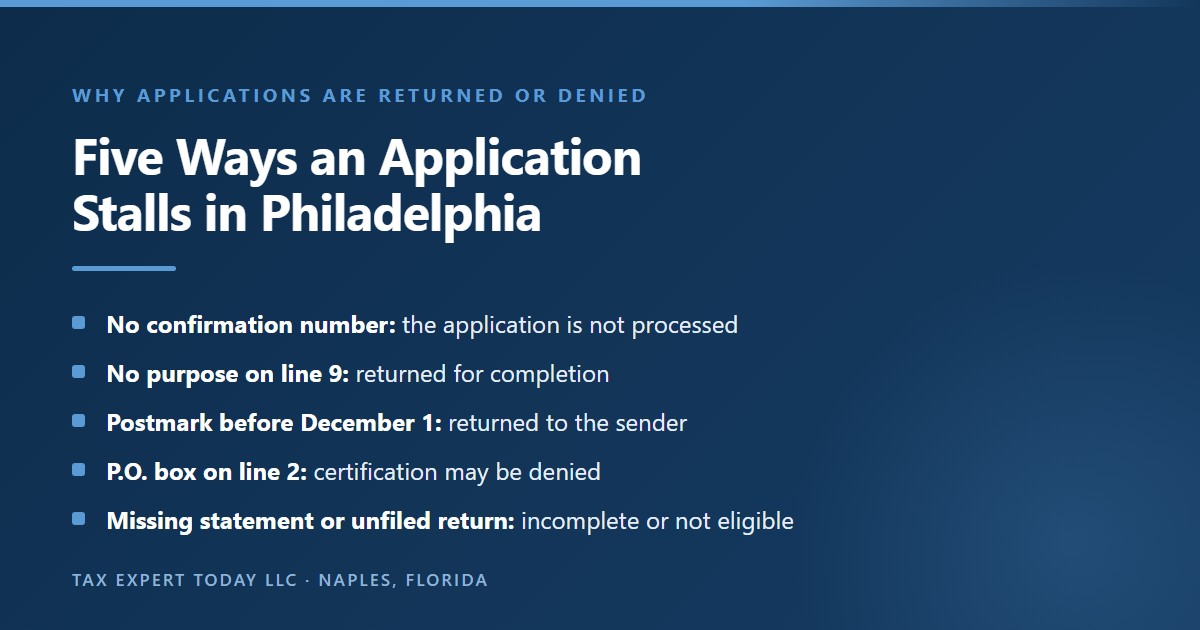
Why does the IRS deny or return Form 8802?
The IRS returns or denies applications that are incomplete or cannot be verified. Common reasons in the instructions are a missing e-payment confirmation number, no purpose on line 9, a P.O. box address, a name that does not match IRS records, a missing penalties of perjury statement, and an unfiled or nonresident return.
- Not processed: no fee paid, or no confirmation number on page 1.
- Returned: no purpose on line 9, or a nontreaty country for a treaty request.
- Returned: a current year postmark before December 1 of the prior year.
- May be denied: a P.O. box or “care of” address on line 2.
- May be denied: missing Form 2555, Form 1116, or dual resident documentation.
The instructions use three different outcomes, and the difference matters for timing. An application that is “not processed” sits until the missing item arrives. An application that is “returned” comes back in the mail and starts over. A request that is “denied” has been considered and refused. The table collects each trigger the instructions name.
| Problem | What the instructions say happens | How to prevent it |
|---|---|---|
| User fee not paid | The application will not be processed | Pay on Pay.gov before submitting |
| No e-payment confirmation number on page 1 | The IRS will not process Form 8802 | Write the Pay.gov ID or Agency Tracking ID on every application the payment covers |
| No purpose checked on line 9 | The application is returned for completion | Check income tax, VAT, or other |
| Treaty certification requested for a nontreaty country | The application is returned for correction | Confirm the country has an income tax treaty in force |
| Current year request postmarked before December 1 of the prior year | Returned to the sender | Wait for December 1 |
| P.O. box or “care of” address on line 2 | Certification may be denied | Use the street address for the year, and line 3a for mail |
| Name changed and not updated with the IRS | Certification will not be issued | Update the name first and attach documentation of the change |
| Unsigned application, or signed by a person without authority | Not considered complete and valid | Follow Table 3, and document any unusual signer on line 10 |
| Return for the base period not posted | A request for a signed copy of the most recent return | Enclose a copy marked “COPY, do not process” |
| Dual resident without tie-breaker evidence | The request may be denied | Attach evidence under the treaty’s residence article |
| Form 1116 triggers met, materials missing | The request may be denied | Attach the residence evidence and the return copy |
| Required return never filed, or a nonresident return filed | Not eligible | Resolve the filing first |
Most of these are preventable with a careful first submission. The eligibility problems in the last three rows are different. They are not clerical, and no amount of resubmitting fixes them. An applicant in one of those rows needs to settle the underlying residence or filing question before paying a nonrefundable fee.
What can you do if Form 6166 is denied?
If the request is denied, or a treaty partner denies you treaty benefits, and you believe you are entitled to them under a specific treaty article, you can request United States competent authority assistance under Revenue Procedure 2015-40. The competent authority does not decide residence on its own. It consults the other country.
- Procedure: Revenue Procedure 2015-40 or successor guidance.
- Threshold: the issue must require consultation with the foreign competent authority.
- Decision: residence is determined by mutual agreement of the two authorities.
- Limit: no help for countries with no United States income tax treaty.
- Address: a Washington office, separate from the Philadelphia unit.
The instructions set out the conditions under the heading When To Seek U.S. Competent Authority Assistance. A request regarding a residency issue will be accepted for consideration only if it is established that the issue requires consultation with the foreign competent authority to ensure consistent treatment by the United States and the treaty partner. The United States competent authority does not make unilateral determinations with respect to residency. The procedure is published in Internal Revenue Bulletin 2015-35.
The IRS page on Form 6166 frames the same route around double taxation: where double taxation has occurred, or is expected to occur, in a treaty jurisdiction and the taxpayer believes it is a resident of the United States for treaty purposes, requests for relief may be submitted to the competent authority. The process involves two governments and is not quick. For many applicants the more practical step after a denial is to find out exactly which requirement was not met and whether a corrected application can meet it.
The instructions give the mailing address for competent authority requests in Washington and add a pointed note: do not send Form 8802 to that address.
How do you request additional copies of Form 6166?
Check the Additional request box at the top of Form 8802 and file a new application within 12 months of the most recently issued letter for the same tax period. The procedure is available only if nothing in your original tax information has changed, and the applicable user fee is due again.
- Time limit: within 12 months of the last Form 6166 for that period.
- Condition: no changes to the tax information on the original Form 8802.
- Countries: any country, whether or not named on the original.
- Signature line: “See attached copy of the original Form 8802” for a previously named country.
- Fee: $105 or $230 for the separate application.
The additional request procedure saves documentation, not money. For a country named on the original application, supporting documents that were needed the first time do not have to be sent again. The applicant writes “See attached copy of the original Form 8802” on the signature line and attaches a copy of the original. For a new country that requires documentation not previously submitted, the applicant includes that documentation, signs and dates the additional request, and attaches a copy of the original.
The cheaper course is to anticipate. Each application carries its own fee, so an applicant who thinks more originals or more countries may be needed during the year can ask for them on the first Form 8802 at no added cost.
Does Form 6166 affect your foreign tax credit?
It can. You cannot claim a foreign tax credit for foreign taxes that a treaty reduced or eliminated. If you use Form 6166 to obtain a refund of foreign tax you already credited, the instructions say you may need to file an amended United States return to adjust the credit.
- Rule: no United States credit for foreign tax a treaty removes.
- After a refund: the credit claimed for the refunded tax may need to be reduced.
- How: an amended return for the year the credit was claimed.
- Not a substitute: the letter never proves tax paid.
The Purpose of Form paragraph of the instructions makes both points. You cannot claim a foreign tax credit to reduce your United States tax liability with respect to foreign taxes that have been reduced or eliminated by reason of a treaty. If you receive a refund of foreign taxes paid with the benefit of Form 6166, you may need to file an amended return with the IRS to adjust any foreign tax credits previously claimed for those taxes.
The interaction creates a real choice for investors. A foreign country withholds 25 percent on a dividend where the treaty rate is 15 percent. The investor can leave the extra 10 percent with the foreign country, but that excess is generally not creditable, because it is tax the treaty did not require. Or the investor can obtain Form 6166, reclaim the excess from the foreign country, and credit only the 15 percent. The figures here are hypothetical and are used only to show the mechanics. The credit computation itself is covered in our guide to Form 1116.
What do typical Form 6166 requests look like?
Most requests fall into a few patterns: an individual with a foreign pension or foreign dividends, a single member LLC or S corporation billing a foreign customer, a United States company dealing with foreign VAT, and a citizen abroad who needs the letter for a third country. Each pattern has its own line 4 box and attachments.
- Individual in the United States: the simplest application, at $105.
- Single member LLC: certified through its owner, at $230.
- S corporation: certified through its shareholders, at $230.
- Citizen abroad: possible only with treaty support and documentation.
The scenarios below are hypothetical examples, not client matters. They are simplified to show which rules apply, and the result in any real case depends on the facts and the treaty involved.
| Hypothetical applicant | Form 8802 entries | Statements and attachments | Fee |
|---|---|---|---|
| A retired couple in Florida who file a joint Form 1040 and receive a pension from a treaty country. They apply in December 2026 for 2027 | Line 4a, U.S. citizen. Line 5, Form 1040. Line 7, 2027. Line 8, 202512. Line 9, income tax. Line 11, the pension country | Line 10 statement covering 2026 and the current tax year for each spouse. Both spouses sign | $105 |
| A single member Florida LLC, owned by an individual, that licenses software to a customer in a treaty country | Line 4i, LLC. Line 5, No, U.S. DRE. Line 6, the owner and Form 1040. Line 9, income tax | The four part owner declaration from Table 2, because no Form 8832 was filed | $230 |
| An S corporation with two shareholders that invoices a foreign client for consulting | Line 4f. Line 5, Form 1120-S. Line 9, income tax | Names and TINs of both shareholders, Form 8821 from each, a resident statement from each, and an officer statement that the return was filed and the classification has not changed | $230 |
| A United States citizen who lives in Portugal, files Form 2555, and needs a letter for India | Line 4a, U.S. citizen. Line 5, Form 1040. Line 11, India | Within the Exceptions paragraph, because India is on the list and is not the country of residence | $105 |
| A United States citizen who lives in Germany, files Form 2555, and needs a letter for Germany | Line 4a, U.S. citizen. Line 5, Form 1040. Line 11, Germany | A statement and documentation showing why the treaty treats the applicant as a United States resident. The request may be denied | $105 |
| A domestic corporation that needs proof of status for a foreign VAT registration | Line 4e. Line 5, Form 1120. Line 9, VAT with the NAICS code from the return | For a current year, the officer statement plus the sentence that the business activity has not changed since the last return | $230 |
Does Florida issue its own tax residency certificate?
Foreign tax authorities applying a United States income tax treaty look for the federal certificate, Form 6166. Florida has no personal income tax, so there is no Florida income tax return for the state to certify. Florida domicile documents prove something different and do not replace the IRS letter.
- Treaty residence: a federal question, certified by the IRS.
- Florida domicile: a state law question, shown by state documents.
- Line 2 of Form 8802: the Florida street address during the certification year.
- Seasonal residents: federal status, not days in Florida, controls the letter.
The two ideas of residence serve different purposes. A declaration of domicile, a Florida driver license, and voter registration help show another state that a person has moved, as our guide on how to establish Florida residency explains. None of them tells a foreign tax office whether the person is a resident of the United States under a treaty. Form 6166 does that, and it does not mention any state.
Southwest Florida has many people who sit on the federal line. A Canadian or European visitor who spends winters in Naples may or may not be a United States resident under the day count, and a visitor who files Form 8840 to claim a closer connection to the home country is taking the position that the visitor is a nonresident. That person is not a candidate for Form 6166. A person who has become a United States resident, files Form 1040 on worldwide income, and still receives a pension or dividends from the former home country is the typical local applicant. That person often still holds bank accounts in the former home country as well, which raises the separate reporting question covered in our guide on whether you need to file an FBAR.
Form 6166 Help in Naples & Southwest Florida
Tax Expert Today LLC is located in Naples, Florida, and works with individuals and business owners across Collier and Lee counties who receive income from abroad or do business with foreign customers. Requests for a residency certificate tend to arrive with a deadline attached, set by a foreign payer, and with very little explanation of what the payer needs.
The situations we see most often in this region follow from who lives here:
- Form 6166 help Naples FL: retirees who have become United States residents and receive a pension, annuity, or dividends from Canada, Germany, the United Kingdom, or another treaty country, and whose foreign payer wants an IRS certificate each year.
- International tax Naples FL: owners of Florida LLCs and S corporations with customers abroad, where the application has to be built around the owners and not the entity.
- Foreign tax Naples: investors whose foreign shares were taxed at a statutory rate and who are weighing a reclaim against the foreign tax credit.
- Citizens and green card holders abroad: people with ties to Naples who live overseas, file Form 2555, and need to know whether a treaty supports certification before paying the fee.
Our multidisciplinary team of tax advisors, enrolled agents, CPAs, and attorneys prepares Form 8802 applications, the line 10 statements, and the owner authorizations for pass-through entities, and can act as the third-party appointee with a Form 2848 on file. Where the residence question itself is uncertain, the work starts with the treaty and the filed returns, and whether an application is appropriate depends on the individual circumstances. More about this work is on our international and expat tax services page and our Naples international tax page, and related planning is described on our Naples tax planning page.
| Office detail | Information |
|---|---|
| Firm | Tax Expert Today LLC |
| Address | 11983 Tamiami Trail N, Naples, FL 34110 |
| Phone | (239) 441-2005 |
| Hours | Monday through Friday, 10 a.m. to 5 p.m. Eastern Time |
| Service area | Naples, Bonita Springs, Estero, Fort Myers, Marco Island, and clients in all 50 states |
Frequently Asked Questions
What is Form 6166 used for?
Form 6166 is used to prove to a foreign country that a person or entity was a United States resident for tax purposes in a given year. Foreign payers and tax authorities ask for it before applying a reduced income tax treaty rate, refunding excess withholding, or granting a value added tax exemption.
How do I get Form 6166 from the IRS?
File Form 8802, Application for United States Residency Certification. Pay the user fee on Pay.gov, write the confirmation number on page 1, add any required penalties of perjury statement on line 10, and mail or fax the application to the IRS in Philadelphia at least 45 days before you need the letter.
How much is the Form 8802 fee?
For applications postmarked on or after October 1, 2026, the user fee is $105 per Form 8802 for an individual and $230 per Form 8802 for a corporation, partnership, trust, or other applicant that is not an individual. One fee covers every country and year requested on that application.
How long does it take to receive Form 6166?
The IRS asks applicants to file at least 45 days before the letter is needed and says it will make contact after 30 days if processing will be delayed. It does not publish a fixed turnaround. Applications that are missing a statement or a posted return take longer.
Can a U.S. citizen living abroad get Form 6166?
Possibly. A citizen who filed Form 2555 must attach a statement and documentation showing why the relevant treaty treats the citizen as a United States resident. Under many treaties a citizen with no substantial presence, permanent home, or habitual abode in the United States does not qualify, and the request may be denied.
Can a single member LLC or S corporation get Form 6166?
Yes, but not in its own name as a treaty resident. A disregarded LLC is certified through its single owner and an S corporation through its shareholders. Each must supply owner information, and a current year request needs the Table 2 penalties of perjury statements from the owners and the entity.
When can I apply for a 2027 Form 6166?
The IRS will not accept a current year request postmarked before December 1 of the prior year. An application for a 2027 certificate can therefore be postmarked on or after December 1, 2026, and it must include the penalties of perjury statement required for a current year certification.
Where can I get help with Form 6166 in Naples, Florida?
Tax Expert Today LLC, at 11983 Tamiami Trail N in Naples, Florida, prepares Form 8802 applications for individuals and businesses in Southwest Florida and across the country. The office is open Monday through Friday, 10 a.m. to 5 p.m. Eastern Time, at (239) 441-2005.
When to Engage a Professional
An individual who lives in the United States, files Form 1040 every year, and needs one letter for one country can often complete Form 8802 without help by following the instructions closely. The application becomes harder, and a mistake becomes more expensive in time, in several situations:
- You filed Form 2555 or live outside the United States. The request turns on the residence article of a specific treaty, and the statement has to be built from that article.
- You are a dual resident or hold a green card and spend substantial time abroad. The tie-breaker analysis affects more than this certificate, including how you file your return.
- The applicant is an LLC, S corporation, partnership, or trust. Owner level statements and authorizations must be collected and worded within the limits the IRS sets.
- You claimed a foreign tax credit above $5,000 or on foreign earned income. Additional evidence is required, and a later foreign refund may call for an amended return.
- A return for the base period is late or was filed on the wrong form. The filing issue has to be resolved before the certificate can be issued.
- A foreign deadline is close. A returned application restarts the clock, and the user fee is generally nonrefundable.
Tax outcomes depend on individual facts, and nothing in this guide predicts the result of any application. To discuss a residency certification request, call (239) 441-2005 or use our contact page. We do not publish fees. Engagements are quoted after a review of the facts.
Published November 27, 2026 by Dr. Pellumb Kabashi « Back to Learning Center
Have a question this article touches on?
Tax Expert Today LLC, based in Naples, Florida and serving clients across the United States.
Schedule a Consultation (239) 441-2005