
By Dr. Pellumb Kabashi, DBA, MBA, CES, CFE, EA
Founder, Tax Expert Today LLC · Tax advisors, enrolled agents, CPAs, and attorneys · Serving clients in all 50 states
Quick Answer: Is alimony taxable in California? It depends on the date your divorce or separation instrument was executed. Under SB 711, support paid under an instrument executed on or after January 1, 2026 is not taxable to the recipient or deductible by the payer. Under a 2019 to 2025 instrument, California still taxes the recipient and allows the payer a deduction. Call (239) 441-2005 for a free consultation.
Is Alimony Taxable in California in 2026?
Is alimony taxable in California in 2026? Only under older instruments. Support paid under a divorce or separation instrument executed on or after January 1, 2026 is neither taxable to the recipient nor deductible by the payer, which matches federal law. Support paid under an instrument executed from 2019 through 2025 is still taxable and deductible for California purposes.
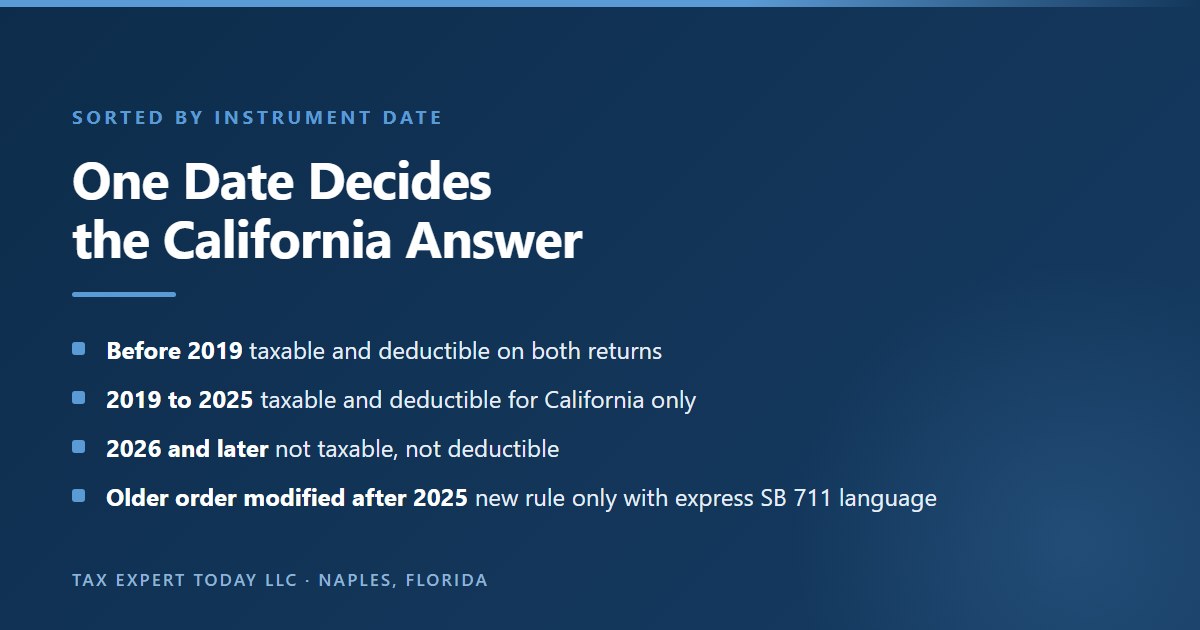
- Executed on or after January 1, 2026: not income to the recipient, not deductible by the payer, no California adjustment.
- Executed January 1, 2019 through December 31, 2025: taxable and deductible for California, but not for federal, so Schedule CA carries an adjustment.
- Executed on or before December 31, 2018: taxable and deductible on both returns, with no adjustment.
- Older instrument modified after 2025: moves to the new rule only if the modification expressly says the SB 711 amendments apply.
The short version on the Franchise Tax Board alimony page fits on one screen, but the consequences do not. The date your instrument was signed now decides whether a monthly support check is a deduction worth up to 13.3 percent of each dollar to the payer, or income that carries the same rate for the recipient. It also decides what happens when one of you leaves the state. This guide maps all three regimes, explains the modification rule that can move an older order from one regime to another, and then works through the case most other guides skip: what California does with alimony once the payer or the recipient becomes a Florida resident.
If you only need the federal rule, our guide to alimony taxes after divorce covers the 2017 Tax Cuts and Jobs Act change on its own. This guide is about the California layer that sits on top of it, which is where most of the confusion lives.
What Did SB 711 Change About California Alimony Taxes?
SB 711, signed on October 1, 2025 as Chapter 231 of the Statutes of 2025, ended California’s separate alimony rule for new instruments. It added R&TC sections 17091 and 17201.3, which keep the old California treatment for instruments executed through December 31, 2025 and switch instruments executed after that date to the federal rule.
Before SB 711, California followed the Internal Revenue Code as it read on January 1, 2015 for most purposes. That date predates the 2017 federal repeal of IRC sections 71 and 215, so California kept taxing alimony to the recipient and allowing the payer a deduction for every instrument, old and new. The federal change applied to instruments executed after December 31, 2018, which opened a gap between the two returns that lasted seven years.
SB 711 is a broad conformity bill. It moved the general California conformity date forward and rewrote dozens of sections, but on alimony it did something narrower. Rather than simply adopting the current federal law and letting the federal effective date control, it wrote a California transition rule into two new sections:
- R&TC section 17091: IRC section 71 (inclusion by the recipient) as it read on January 1, 2015 applies, except for instruments executed after December 31, 2025 and older instruments modified to opt in.
- R&TC section 17201.3: IRC section 215 (deduction by the payer) as it read on January 1, 2015 applies on the same terms.
- R&TC section 17302: the existing nonresident and part-year proration rule for the deduction was amended to carry the same cutoff.
The practical result is a California transition date of January 1, 2026, seven years after the federal transition date of January 1, 2019. Everything in this guide follows from those two dates.
| Item | Federal law | California law after SB 711 |
|---|---|---|
| Transition date | Instruments executed after December 31, 2018 | Instruments executed after December 31, 2025 |
| Statutory source | Tax Cuts and Jobs Act section 11051, repeal of IRC 71 and 215 | R&TC 17091, 17201.3 and 17302 as amended |
| Older instrument modified later | New rule only if the modification expressly adopts the TCJA amendments | New rule only if the modification expressly adopts the SB 711 amendments |
| Return where the difference shows up | Schedule 1 (Form 1040), lines 2a and 19a | Schedule CA (540) or (540NR), Section B line 2a and Section C line 19a |
Did SB 1435 Change the SB 711 Alimony Rules?
SB 1435, chaptered as Chapter 236 of the Statutes of 2026 and effective September 14, 2026, amended all three alimony sections. As SB 711 enacted them, sections 17091, 17201.3 and 17302 each said they would be repealed on December 1, 2027. The current text of each section, read on leginfo on November 7, 2026, contains no repeal date.
This matters more than it might look. As first enacted, each of the three sections closed with a subdivision (c) stating that the section “shall remain in effect only until December 1, 2027, and as of that date is repealed.” Read alone, that sunset raised an obvious question for anyone paying or receiving support under a 2019 to 2025 instrument: what would happen to the California deduction and inclusion after the sections disappeared?
The annual conformity cleanup bill answered it by amending the sections again. The history notes on section 17091, section 17201.3 and section 17302 now read “Amended by Stats. 2026, Ch. 236 (SB 1435). Effective September 14, 2026. Applicable to taxable years beginning on or after January 1, 2025.” The subdivision (c) sunset no longer appears in any of them.
- What this means for older instruments: the California treatment of 2019 to 2025 instruments no longer has an end date written into the statute.
- What it does not change: the January 1, 2026 cutoff and the express opt in rule for modifications are unchanged.
- Why some sources disagree: articles written between October 2025 and September 2026 may still mention the December 1, 2027 repeal date, because it was in the law when they were written.
| Section | As enacted by SB 711 (October 2025) | As amended by SB 1435 (September 2026) |
|---|---|---|
| 17091 (inclusion) | Old rule for pre-2026 instruments, repealed December 1, 2027 | Old rule for pre-2026 instruments, no repeal date |
| 17201.3 (deduction) | Old rule for pre-2026 instruments, repealed December 1, 2027 | Old rule for pre-2026 instruments, no repeal date |
| 17302 (nonresident proration) | Proration for pre-2026 instruments, repealed December 1, 2027 | Proration for pre-2026 instruments, no repeal date |
Statutes change. If you are relying on the older treatment for a multi-year support schedule, it is worth rechecking the section text each filing season rather than assuming this year’s answer carries forward.
What Are the Three California Alimony Tax Regimes by Instrument Date?
California now has three alimony regimes, sorted by the date the divorce or separation instrument was executed. Pre-2019 instruments are taxable and deductible on both returns. 2019 to 2025 instruments are taxable and deductible only on the California return. Instruments executed in 2026 or later are taxable and deductible on neither return.
The FTB page lays the regimes out as reporting instructions, which is the most useful way to read them because each one tells you what your return actually has to show.
| Instrument executed | Federal return | California return | Schedule CA adjustment? |
|---|---|---|---|
| On or before December 31, 2018 | Recipient reports, payer deducts | Flows through federal AGI | No |
| January 1, 2019 to December 31, 2025 | Not reported, not deducted | Recipient reports, payer deducts | Yes, column C on line 2a or line 19a |
| On or after January 1, 2026 | Not reported, not deducted | Not reported, not deducted | No |
Two modification paths cut across those rows, and they are what trip people up:
- A pre-2019 instrument modified from 2019 through 2025 that expressly adopted the federal TCJA amendments became nondeductible federally, but the 2025 Schedule CA (540NR) instructions treat it as still taxable and deductible for California. It sits in the middle row.
- Any pre-2026 instrument modified after 2025 that expressly adopts the SB 711 amendments moves to the bottom row, on both returns.
- A modification that says nothing about tax treatment leaves the instrument where it was, even if the payment amount changes.
Which row you are in is a question about one document and one date. It is not about when you separated, when you filed for divorce, or when payments began. Those dates can all differ from the execution date, and the execution date is the one the statute uses.
Is Alimony Under a 2019 to 2025 Instrument Still Taxable in California?
Yes. If your divorce or separation instrument was executed from January 1, 2019 through December 31, 2025 and was not later modified to adopt SB 711, the recipient still reports the support as California income and the payer still deducts it on the California return, even though neither appears on the federal return.
This is the largest group of people affected, and it is where most stale advice comes from. Several pages that rank for this question were written before October 2025 and say simply that “California does not conform.” That was true for every instrument until SB 711. It is now true only for this middle group.
For a recipient in this group, the support is ordinary income at California rates. For a payer, it is an above the line deduction that lowers California adjusted gross income, which can also affect other AGI based items on the California return. The federal return shows nothing for either of you, so the California return has to add or subtract the full amount on Schedule CA.
| Hypothetical, 2026, single filers, California residents | Payer | Recipient |
|---|---|---|
| Support paid under a 2023 instrument | $48,000 a year | $40,000 a year |
| Other California taxable income | $260,000 | $70,000 |
| California tax without the support item | $20,498 | $2,895 |
| California tax with the support item | $16,034 (after deduction) | $6,548 (after inclusion) |
| Effect of the 2019 to 2025 rule | About $4,464 less tax | About $3,652 more tax |
The figures above are hypothetical, computed from the 2026 California Tax Rate Schedules for single filers, with credits ignored and the support amounts chosen only to illustrate the rule. Your own numbers depend on filing status, other income, deductions and credits.
Notice that the payer’s deduction is worth more per dollar than the recipient’s inclusion costs. That is because the payer sits in the 9.3 percent bracket while much of the recipient’s added income falls in lower brackets. That asymmetry is one reason the old rule was attractive in negotiations, and it is one reason a payer and recipient may see an SB 711 modification very differently.
Is Alimony Under a Pre-2019 Instrument Taxable in California?
Yes, and it is taxable on the federal return too. Support paid under an instrument executed on or before December 31, 2018 that was never modified to adopt the federal or California amendments is income to the recipient and deductible by the payer on both returns. It flows into federal adjusted gross income, so California needs no separate adjustment.
These are the oldest and, in some ways, simplest orders. Because the federal return already includes the support, Schedule CA starts from a federal AGI that is correct for California, and nothing has to be added or subtracted. The recipient reports the support on Schedule 1 (Form 1040), line 2a, and the payer deducts it on line 19a with the recipient’s identifying number.
- Recipient: taxed on both returns, so California estimated payments are often needed because nobody withholds on support.
- Payer: deducts on both returns, and the deduction lowers federal and California AGI.
- Schedule CA: no column B or column C entry for the alimony line.
- Risk point: a later modification can move the instrument into a different regime, so keep every amendment.
The same IRC section 71 definitions apply to these instruments on both returns: cash payments, no requirement to continue after the recipient’s death, not designated as excluded, and not child support. Those definitions are covered later in this guide, because they also decide whether a 2019 to 2025 payment qualifies for the California treatment.
Is Alimony Under a 2026 Instrument Taxable in California?
No. Support paid under a divorce or separation instrument executed on or after January 1, 2026 is not included in the recipient’s California income and is not deductible by the payer. The FTB says California now conforms for these instruments and no adjustment is needed on Schedule CA.
For new divorces, the tax result is now the same on both returns. The recipient receives support tax free and the payer pays with after tax dollars. That has an effect beyond the return itself. California family courts set temporary support with guideline software and set long term support under Family Code section 4320, which lists the tax consequences to each party among the factors the court considers. When the deduction disappears, the after tax cost of a given dollar of support rises for the payer and the after tax value rises for the recipient.
| Hypothetical: $60,000 a year of support | Under a 2019 to 2025 instrument | Under a 2026 instrument |
|---|---|---|
| Payer in the 9.3 percent bracket | Deduction worth about $5,580 of California tax | No deduction |
| Payer in the 11.3 percent bracket | Deduction worth about $6,780 | No deduction |
| Payer in the 12.3 percent bracket | Deduction worth about $7,380 | No deduction |
| Payer over $1,000,000 of taxable income | Deduction worth about $7,980 at 13.3 percent | No deduction |
| Recipient | Taxed at their own California rates | Not taxed |
The amounts are marginal rate approximations that assume the full deduction falls inside one bracket. They show the order of magnitude, not a computed liability. The top line includes the extra 1 percent that applies to taxable income over $1,000,000.
A 2026 instrument also changes estimated tax planning for both sides. The recipient no longer needs California estimates on the support, and the payer can no longer count on the deduction to reduce California estimates. Our guide to quarterly estimated taxes walks through how to reset payments when a large item drops out of the calculation.
What Counts as the Execution Date of a Divorce or Separation Instrument?
The execution date is the date the instrument itself became effective as a signed agreement or an entered court order. For a judgment of dissolution, that is generally the date the judgment is entered. For a written separation agreement, it is generally the date the parties sign it. Temporary orders are separate instruments with their own dates.
The statute uses the federal term “divorce or separation instrument,” which IRC section 71(b)(2), as it read on January 1, 2015, defined as a decree of divorce or separate maintenance or a written instrument incident to such a decree, a written separation agreement, or a decree requiring a spouse to make payments for the support or maintenance of the other spouse. IRS Publication 504 uses the same categories. A single divorce can produce several of these documents over time.
| Document | Is it an instrument? | Date that usually controls |
|---|---|---|
| Written marital settlement agreement | Yes | Date signed by both parties |
| Judgment of dissolution or legal separation | Yes | Date the judgment is entered |
| Temporary (pendente lite) support order | Yes, a decree for support | Date the order is made |
| Stipulated order modifying support | A modification of an existing instrument | Original date unless the modification expressly opts in |
| Informal email or text agreement | Generally no | Not an instrument |
The hard cases sit at the year boundary. A couple who signed a marital settlement agreement in December 2025 and had the judgment entered in February 2026 has two dates in play. Whether the support is paid “under” the 2025 agreement or the 2026 judgment can turn on how the judgment incorporates the agreement. That is a document reading question that a family law attorney and a tax advisor should answer together before the first return is filed, because the answer sets the treatment for every year of support that follows.
Both Schedule CA (540) and Schedule CA (540NR) now ask for the month and year of the original divorce or separation agreement on line 2b for alimony received and on line 19c for alimony paid. If you have more than one agreement, the instructions ask for the one under which you received the most income and an attached statement listing the others.
Can You Modify an Older Order to Opt Into the SB 711 Rule?
Yes. An instrument executed on or before December 31, 2025 moves to the new California rule if it is modified after that date and the modification expressly provides that the SB 711 amendments apply. Without that express statement, a modification changes the payment terms but leaves the older California tax treatment in place.
The opt in language is the same in all three sections. Each says the older rule “shall not apply” for an instrument executed on or before December 31, 2025 “and modified after that date, if the modification expressly provides that the amendments made by this subdivision apply to such modification.” Two conditions must both be met:
- Timing: the modification is made after December 31, 2025. A 2025 modification cannot opt into SB 711.
- Express statement: the modification itself says the SB 711 amendments apply. Silence, or a general reference to “current tax law,” is a weak foundation.
- Both returns: an instrument that opts in becomes nontaxable and nondeductible on the California return. Federal treatment depends on its own history.
- One way: the statute describes moving into the new rule. Nothing in it describes moving a 2026 instrument back to the old one.
The federal rule works the same way, which is why many family law drafters already have language for it. For federal purposes, IRS Publication 504 explains that a pre-2019 instrument modified after 2018 is treated under the new rule only if the modification expressly states that the TCJA repeal applies. California borrowed that structure and moved the date.
| Starting instrument | Modified after 2025 with express SB 711 language | Modified after 2025 without it |
|---|---|---|
| Executed in 2017, never modified | Not deductible or taxable for California. Federal treatment stays deductible and taxable unless the modification also adopts the TCJA repeal | Stays taxable and deductible on both returns |
| Executed in 2021 | Not deductible or taxable on either return | Stays taxable and deductible for California only |
| Executed in 2017, modified in 2020 to adopt TCJA | Not deductible or taxable on either return | Stays in the California only regime |
A pre-2019 instrument creates the most complicated case. If it is modified after 2025 and the modification adopts only the SB 711 amendments, California treatment changes but the federal treatment does not, which flips the old mismatch around: deductible and taxable federally, but not for California. A modification that intends full conformity on both returns would generally need to adopt both sets of amendments expressly. That drafting point belongs with the family law attorney, but the tax consequence is something both sides should model before they sign.
Should You Opt Into SB 711 When You Modify Support?
It depends on which side you are on and where each of you lives. Opting in removes the payer’s California deduction and the recipient’s California income. A payer in a high bracket loses the most. A recipient still in California gains the most. If one of you has left California, the deduction or inclusion may already be worth little, which changes the trade.
Because the election is part of the modification document, both parties, or the court, have to agree to it. In practice it becomes one more term in the negotiation, alongside the amount and duration of support. The useful question is how much the California tax treatment is actually worth to each of you in the years ahead.
| Situation | Opting in usually helps | Opting in usually hurts |
|---|---|---|
| Both still California residents, payer in a high bracket | Recipient | Payer |
| Payer has moved to Florida with little California source income | Recipient, at little cost to the payer | Payer only slightly |
| Recipient has moved to Florida | Neither side much, because a nonresident recipient is not taxed on support | Payer, who loses a deduction |
| Both have left California | Small effect either way | Small effect either way |
This table is a starting point for analysis, not a recommendation. The value of the old treatment also depends on how long support will last, whether it steps down, whether either of you expects to move, and whether a payment term is being traded against the tax term. A modification that removes a payer’s deduction is often paired with a lower nominal payment, so that the after tax result is closer to where it was. Those are negotiated outcomes, and the tax projection is what gives each side a number to negotiate with.
- Model several years: a deduction that is worth a lot this year may be worth little after a planned move.
- Price the trade: compare the after tax cost to the payer and the after tax value to the recipient under each version.
- Write it down: if the parties intend to opt in, the modification should say so expressly and cite the amendments.
- Keep the original: the original instrument date still has to be reported on Schedule CA, even after a modification.
What Payments Qualify as Alimony for California Tax Purposes?
For instruments that still follow the older rule, California uses the IRC section 71 definition as it read on January 1, 2015. A payment qualifies only if it is made in cash under a divorce or separation instrument, the instrument does not designate it as excluded, the spouses are not members of the same household after a decree, there is no liability to pay after the recipient’s death, and it is not child support.
This matters only for pre-2026 instruments, because only those still have a deduction or inclusion to claim. If a payment fails the definition, it is not alimony for tax purposes even if the instrument calls it spousal support, and neither the deduction nor the inclusion applies. IRS Publication 504 still explains these requirements for pre-2019 instruments, and the same rules carry over to California’s treatment of 2019 to 2025 instruments through section 17091.
| Requirement under IRC 71 (as of January 1, 2015) | What it means in practice |
|---|---|
| Cash payment | Checks, transfers and money orders count. Property transfers and services do not |
| Under a divorce or separation instrument | Voluntary payments beyond what the instrument requires do not count |
| Not designated as excluded | The instrument can say the payments are not alimony for tax purposes |
| Not members of the same household | After a decree, payments while living together in one home generally do not count, with a one month exception for a spouse preparing to leave |
| No liability after the recipient’s death | If any part must continue after death, that part is not alimony |
| Not child support | Amounts fixed as child support, or reduced on a child contingency, are excluded |
California family law helps with the death requirement. Under Family Code section 4337, unless the parties agree otherwise in writing, a spousal support obligation ends on the death of either party or the remarriage of the supported party. Publication 504 notes that an instrument does not have to state that payments end at death if state law ends them, so a standard California order usually satisfies this requirement without special language.
Payments to third parties can qualify too. Rent, mortgage, tuition or medical bills paid on behalf of the recipient under the terms of the instrument are generally treated as cash payments to the recipient. Payments on a home the payer owns, however, are generally not alimony because they build the payer’s own equity. These are the kinds of details that matter when the amounts are large, and they should be sorted out once and then applied the same way on both former spouses’ returns.
Is Child Support Taxable in California?
No. Child support is never taxable to the recipient and never deductible by the payer, on the California return or the federal return, regardless of when the instrument was executed. SB 711 did not change this. The only question is whether a payment labeled spousal support is really child support in disguise.
The disguise rule is the part that matters for California taxes under a 2019 to 2025 instrument. Under section 71(c), as California still applies it to those instruments, any part of a payment that is reduced on a contingency relating to a child, such as the child turning 18, leaving school, marrying or dying, is treated as child support. The same is true of a reduction clearly associated with such a contingency.
- Fixed child support: never alimony, on any return.
- Combined family support: the part treated as child support is excluded, and the rest may qualify.
- Step down tied to a child’s birthday: the reduction amount can be recharacterized as child support from the start.
- Underpayment: under Publication 504, a partial payment is applied to child support first.
| Payment type | Pre-2019 instrument | 2019 to 2025 instrument | 2026 instrument |
|---|---|---|---|
| Spousal support meeting IRC 71 | Taxable and deductible, both returns | Taxable and deductible, California only | Neither |
| Child support | Neither | Neither | Neither |
| Property settlement payment | Generally neither | Generally neither | Generally neither |
| Support reduced on a child contingency | Reduction amount treated as child support | Reduction amount treated as child support for California | Neither |
The practical lesson: for a 2019 to 2025 instrument, the California deduction depends on how the support is structured, not just what it is called. A payer who claims the full amount as a California deduction when part of it is effectively child support is exposed to an FTB adjustment, and a recipient who reports it all may be overpaying.
Are Property Settlements in a California Divorce Taxable?
Generally no. A transfer of property between spouses, or between former spouses incident to divorce, is generally a nontaxable transfer under IRC section 1041, which California follows through R&TC section 18031. The receiving spouse takes the transferor’s tax basis, so the tax is deferred until the property is later sold.
This is the main reason the line between support and property matters. Equalization payments, buyouts of a spouse’s share of the house, and transfers of investment accounts are generally property settlement, not alimony, on every return. They are not deductible and not income, but the carryover basis means the recipient can inherit a built in gain. R&TC section 18031 adopts Subchapter O of the Internal Revenue Code, which contains section 1041.
- Carryover basis: the recipient of appreciated stock or a rental owns the old basis and the future gain.
- Retirement accounts: division by qualified domestic relations order or IRA transfer incident to divorce generally avoids current tax.
- Stock options and RSUs: transfers can shift who reports the income, with California sourcing questions if either of you moves. See our guide to dividing stock options in divorce.
- Front loaded cash: very large early support payments can be partly recaptured, which is covered next.
Our guide to whether a divorce settlement is taxable covers property settlement in more depth, including the home sale exclusion and retirement account transfers. For California purposes, the important point is that property settlement treatment did not change under SB 711. Only the treatment of support changed.
Does the Alimony Recapture Rule Still Apply for California?
For pre-2026 instruments that still use the older California treatment, it generally does. Section 17091 adopts IRC section 71 as it read on January 1, 2015, and that version includes the section 71(f) recapture rule for excess front loaded payments. If support drops by more than $15,000 in the third post-separation year, part of earlier deductions can be recaptured.
Federally, recapture now matters only for pre-2019 instruments, so most federal guidance has stopped discussing it. California’s adoption of the 2015 version of section 71 for 2019 to 2025 instruments means the same calculation can still affect the California return for those years. Publication 504 explains the test in detail. In outline:
| Recapture element | Rule under IRC 71(f) |
|---|---|
| Trigger | Payments in year three fall more than $15,000 below year two, or years two and three fall significantly below year one |
| Measuring period | The first calendar year of qualifying payments and the next two calendar years |
| Excluded from the test | Temporary support orders, payments that vary with business or employment income, and drops caused by death or the recipient’s remarriage |
| Payer’s result | Includes the recaptured amount in income in year three |
| Recipient’s result | Deducts the recaptured amount in year three |
This is an inference from the statutory text rather than an FTB published position, and the FTB alimony page does not discuss recapture. It is most likely to matter where a 2024 or 2025 instrument scheduled large support payments early and smaller ones later, which is a common way to deliver part of a property settlement as deductible support. If your instrument looks like that, it is worth testing before the third year’s return is filed.
How Do You Report Alimony on Schedule CA (540)?
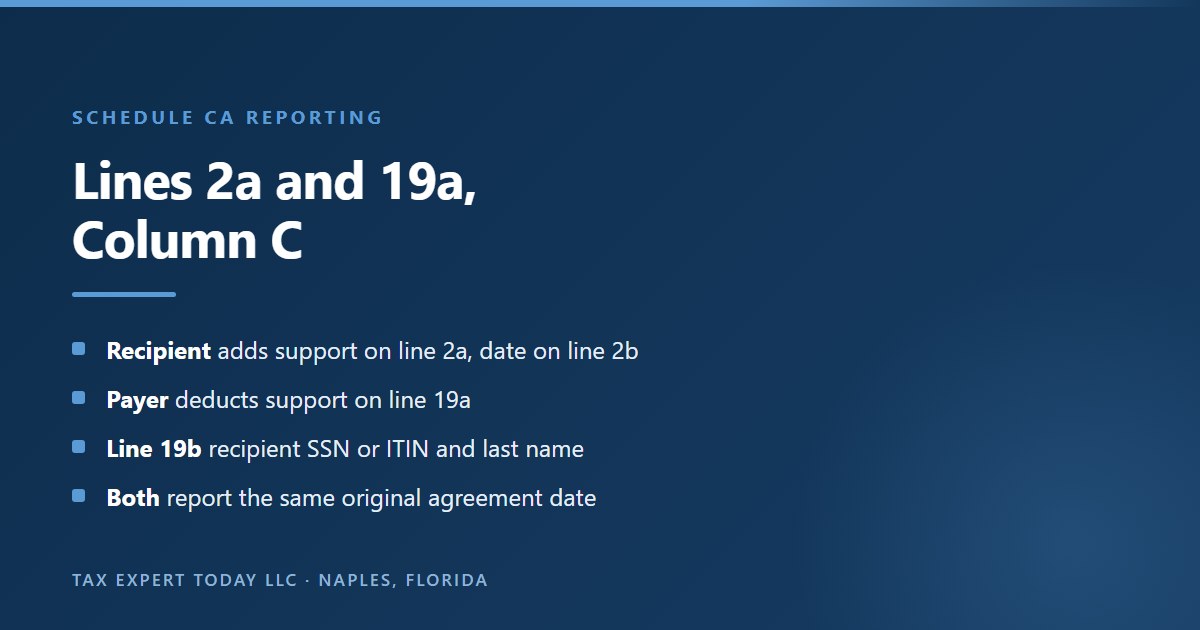
California residents report alimony differences on Schedule CA (540). For a 2019 to 2025 instrument, the recipient enters the support received in column C of Section B, line 2a, and the payer enters the support paid in column C of Section C, line 19a. Both also enter the month and year of the original agreement, on line 2b and line 19c.
The 2025 Schedule CA (540) instructions start each alimony line from the federal amount. Column A repeats what the federal Schedule 1 shows. Column B is for subtractions and column C is for additions needed because California law differs.
| Schedule CA (540) line | Pre-2019 instrument | 2019 to 2025 instrument | 2026 instrument |
|---|---|---|---|
| Section B, line 2a, alimony received | Column A only, from the federal return | Column C addition for the full amount | Nothing |
| Line 2b, date of original agreement | Month and year | Month and year | Month and year if any amount is reported |
| Section C, line 19a, alimony paid | Column A only, from the federal return | Column C entry for the full amount | Nothing |
| Lines 19b and 19c | Recipient’s SSN or ITIN, last name, agreement date | Recipient’s SSN or ITIN, last name, agreement date | Not applicable |
The payer’s entry on line 19a sits in the adjustments section, so a column C amount there increases California adjustments and reduces California AGI. That is the mechanism of the deduction. The recipient’s column C entry on line 2a increases California income. If you have payments under more than one agreement, the instructions ask you to report the date of the agreement under which you received or paid the most and attach a statement listing the others.
- Match the other side: the payer reports the recipient’s identifying number, which lets the FTB match the deduction to an inclusion.
- Use the original date: the line asks for the original agreement, not the latest modification.
- Keep the opt in document: if a modification adopted SB 711, keep the signed version with the return records.
Do Alimony Recipients Need to Make California Estimated Payments?
Often, yes, under a pre-2026 instrument. Nobody withholds California tax on spousal support, so a California resident recipient taxed on support usually has to cover that tax with estimated payments or extra wage withholding. California estimates are due in 30, 40, 0 and 30 percent installments in April, June, September and January.
California’s installment schedule is front loaded, which surprises people who are used to four equal federal payments. The FTB estimated tax payments page sets out the percentages. A recipient under a 2019 to 2025 instrument who receives $4,000 a month and owes roughly 9 percent of it to California is carrying more than $4,000 of California tax a year with no withholding at all.
| Installment | Due date for a calendar year filer | Share of the required annual payment |
|---|---|---|
| First | April 15 | 30 percent |
| Second | June 15 | 40 percent |
| Third | September 15 | 0 percent |
| Fourth | January 15 of the following year | 30 percent |
- Wage earners: increasing California withholding on a DE 4 can cover the support tax and avoids quarterly payments.
- Safe harbors: paying 100 percent of the prior year tax, or 110 percent at higher incomes, generally avoids the underpayment penalty, except when AGI reaches $1,000,000.
- First year of support: the prior year safe harbor is useful because the prior year had no support income.
- After a move: a recipient who leaves California stops owing California tax on support and can usually stop the estimates.
Our California estimated tax penalty calculator shows how a missed installment is priced, and our guide to the California late payment penalty covers what happens when the balance is paid after the return deadline.
Do the Alimony Rules Apply to Registered Domestic Partners in California?
The FTB applies its alimony guidance to spouses and registered domestic partners alike, using the term “spouse/RDP” throughout. For California purposes, registered domestic partners generally follow the same three regimes. The federal return can be different, because federal law does not treat registered domestic partners as spouses.
California law generally gives registered domestic partners the same state tax treatment as married couples, and the FTB alimony page refers to support ordered for a former “spouse/RDP.” The federal side is more complicated, since the federal alimony rules are written for spouses and former spouses. A registered domestic partner whose support is not alimony federally can therefore have a California adjustment that does not mirror a federal entry in the way the Schedule CA instructions assume.
This situation is narrow, and the Schedule CA line instructions do not address it separately. If you are dissolving a registered domestic partnership, have the instrument reviewed by both a family law attorney and a tax advisor so the support is reported consistently by both partners from the first year.
Is Alimony Taxable in California After You Move to Florida?
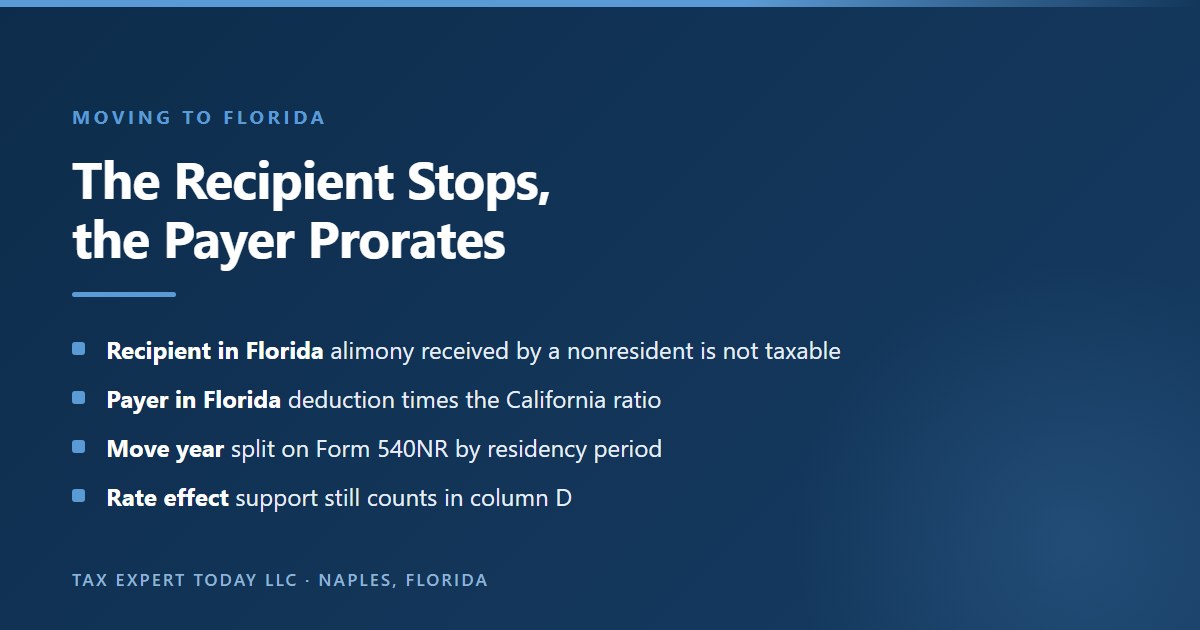
Not for the recipient. The 2025 Schedule CA (540NR) instructions state that alimony received by a nonresident is not taxable. Once the recipient becomes a Florida resident, support received after the move drops out of California income, whatever the instrument date. A payer who moves keeps only a prorated California deduction under a pre-2026 instrument.
This is the corridor case, and it is the gap in most of what ranks for this question. California taxes residents on all income and taxes nonresidents only on California source income. Alimony is not tied to work performed or property located in California, and the FTB treats it as not taxable to a nonresident. The 2025 Schedule CA (540NR) instructions say so in one line under alimony received: “Alimony received by a nonresident is not taxable.”
| Who moves to Florida | Pre-2019 instrument | 2019 to 2025 instrument | 2026 instrument |
|---|---|---|---|
| Recipient, after the move | Not taxed by California | Not taxed by California | Not taxed by anyone |
| Payer, after the move | California deduction prorated by the California ratio | California deduction prorated by the California ratio | No deduction |
| Both, after the moves | No California tax on support, deduction relevant only against California source income | Same | No effect |
Florida has no personal income tax under Article VII, section 5 of the Florida Constitution, so a recipient who moves to Naples under a 2019 to 2025 instrument goes from paying California tax on support to paying no state tax on it at all, and no federal tax either. For many recipients that is the single largest tax effect of the move. It is also an effect that starts only on the date residency actually changes, which is why the move date and the residency evidence matter as much as the instrument date.
Our guide to moving from California to Florida covers the broader checklist, and our guide to leaving California taxes covers what California can still reach after you go.
How Does the Recipient’s Move Change the California Return?
In the year of the move, a recipient files Form 540NR as a part-year resident. Support received while still a California resident is California income under a pre-2026 instrument. Support received after the move is not. The support still counts in total income on the 540NR, which can raise the rate California applies to other California income.
Form 540NR computes tax in two steps. First it figures tax on all of your income as if you were a full-year resident, then it multiplies that tax by the share of your income that is California income. The Schedule CA (540NR) shows this with two columns: column D for total amounts under California law and column E for the California amounts.
- Column D: includes all support received in the year under a pre-2026 instrument, because California law treats it as income.
- Column E: includes only support received while you were a California resident.
- Rate effect: the support in column D raises the average rate applied to your column E income.
- Later years: as a full-year nonresident with no California source income, you generally have no California filing requirement at all.
The rate effect is easy to miss. It only matters if the recipient still has some California source income after the move, such as rent from a California property. In that case the support is not taxed directly, but it can raise the tax on the rent.
| Hypothetical: nonresident recipient, 2026, single | 2022 instrument | 2026 instrument |
|---|---|---|
| California rental income (column E) | $30,000 | $30,000 |
| Florida income | $40,000 | $40,000 |
| Spousal support received (column D only) | $60,000 | Not income |
| Total income used for the rate | $130,000 | $70,000 |
| Average rate on total income | About 6.47 percent | About 4.14 percent |
| California tax on the $30,000 of rent | About $1,940 | About $1,241 |
The figures treat total income as taxable income, ignore deductions and credits, and use the 2026 single schedule, so they illustrate the mechanism rather than compute a real liability. Under the 2022 instrument the support itself is not taxed, but it costs the recipient about $699 of California tax on the rent by raising the rate. The FTB residency guidance in Publication 1100 and our guide to nonresident state tax returns explain the method in more depth.
How Is the Payer’s California Deduction Prorated After a Move?
Under R&TC section 17302, a nonresident or part-year resident payer deducts alimony under a pre-2026 instrument in the same ratio, not more than 1.00, that California AGI bears to total AGI, both computed without the alimony deduction. A payer with little California income after a move keeps only a small slice of the deduction.
The ratio rule has been in California law for years. SB 711 amended section 17302 to apply it only to instruments that still follow the older rule. The Schedule CA (540NR) instructions turn it into a worksheet:
| Step | Schedule CA (540NR) instruction for line 19a |
|---|---|
| 1. Compute the California ratio | California AGI (line 27, column E) divided by total AGI (line 27, column D), both without the alimony deduction |
| 2. Nonresident | Multiply the deduction in column D by the ratio and enter the result in column E |
| 3. Part-year resident | Alimony paid while a resident is deducted in full. Alimony paid while a nonresident is multiplied by the ratio. Add the two |
| 4. Limits | A ratio over 1.00 is treated as 1.00. A ratio below zero is treated as zero |
Here is how it plays out for a full-year nonresident who kept a California rental.
| Hypothetical: nonresident payer, 2026, single | 2022 instrument | 2026 instrument |
|---|---|---|
| California source rental income | $50,000 | $50,000 |
| Total income before support | $400,000 | $400,000 |
| Support paid | $60,000 | $60,000 |
| California ratio | 0.125 | Not applicable |
| California deduction (column E) | $7,500 | None |
| California tax | About $3,492 | About $4,210 |
The difference between the two columns is about $717 of California tax, a fraction of what the same deduction was worth while the payer lived in California. The figures are hypothetical, treat AGI as taxable income, ignore other deductions and credits, and use the 2026 single schedule. The full deduction also lowers total AGI in column D, which lowers the rate applied to the California income, and the computation above includes that effect.
What Happens to Alimony in the Year You Move?
In the year of the move, the payer deducts support paid while a California resident in full and prorates support paid after the move by the California ratio. The recipient includes only support received while a California resident. The dividing line is the date residency actually changed, not the date a lease was signed or a moving truck arrived.
A part-year return is where the date of residency change does real work. The FTB looks at the whole picture of where you live, work, keep your home, register to vote and spend your time. Our guide to the California part-year resident tax walks through how that date is established and what the part-year return looks like.
| Hypothetical: payer moves to Naples on July 1, 2026, single | 2022 instrument | 2026 instrument |
|---|---|---|
| Income January to June, while a resident | $180,000 | $180,000 |
| California source income July to December | $20,000 | $20,000 |
| Florida income July to December | $160,000 | $160,000 |
| Support paid, $5,000 a month | $60,000 | $60,000 |
| California ratio without the deduction | About 0.556 | Not applicable |
| California deduction: $30,000 in full plus $30,000 times the ratio | About $46,667 | None |
| California tax | About $12,378 | About $16,554 |
Under the 2022 instrument, the payer saves about $4,176 of California tax for 2026 compared with a 2026 instrument, most of it from the six months of support paid as a resident. From 2027 on, with only $20,000 or so of California income a half year, the deduction is worth much less. Again, the figures are hypothetical and simplified, with AGI treated as taxable income and credits ignored.
- Payment timing: support paid before the move date is a resident payment, so a large catch up payment just before or just after the move can shift the result.
- Recipient side: the same date logic applies, so support received just before the recipient’s move is taxable, and just after it is not.
- Documentation: keep bank records showing the date each payment was made or received.
Does California Tax a Payer Who Stays While the Recipient Leaves?
Under a pre-2026 instrument, a California resident payer keeps the full California deduction even after the recipient moves to Florida. The recipient, as a nonresident, is not taxed by California on the support. The result is a deduction on one side with no matching California inclusion on the other.
Nothing in sections 17201.3 or 17302 conditions the payer’s deduction on where the recipient lives. The resident payer deducts alimony paid while a resident, and the nonresident recipient is not taxed on alimony received while a nonresident. For a high earning payer who stays in the Bay Area or Los Angeles while a former spouse moves to Naples, this can be the most favorable combination available under California law.
| Where each former spouse lives | Payer’s California deduction (pre-2026 instrument) | Recipient’s California tax on support |
|---|---|---|
| Both in California | Full | Full |
| Payer in California, recipient in Florida | Full | None |
| Payer in Florida, recipient in California | Prorated by the California ratio | Full |
| Both in Florida | Prorated, often small | None |
The reverse case is the worst for the pair as a whole: a payer who leaves California loses most of the deduction while a recipient who stays keeps paying full California tax on the support. That is the situation in which an SB 711 opt in, perhaps paired with an adjustment to the amount, is most likely to interest both sides, because the payer has little left to lose and the recipient has a real tax to remove.
Can a Florida Court Modify a California Spousal Support Order?
Generally no. Under the Uniform Interstate Family Support Act as adopted in both states, the California court that issued a spousal support order keeps continuing, exclusive jurisdiction to modify it for as long as the obligation exists. Florida courts may not modify it. A modification that opts into SB 711 must generally come through California.
Spousal support jurisdiction works differently from child support jurisdiction, which can move when the parents and child leave the issuing state. For spousal support, California Family Code section 5700.211 gives the issuing California tribunal continuing, exclusive jurisdiction “throughout the existence of the support obligation,” and Florida Statutes section 88.2111 says a Florida tribunal may not modify a spousal support order issued by another state that has continuing, exclusive jurisdiction.
- Enforcement can move: a California order can be registered and enforced in Florida.
- Modification generally stays: changes to the amount, duration or tax terms are generally made by the California court or by written agreement of the parties.
- Florida law does not take over: Florida’s own alimony statute, section 61.08, governs Florida orders, not a California order a Florida resident brought with them.
- Tax election follows the document: whatever court or agreement makes the modification, the SB 711 opt in has to appear expressly in it.
Jurisdiction questions are family law questions, and the answer for a specific order should come from a family law attorney licensed in the relevant state. The tax point is simpler: moving to Florida does not, by itself, give either of you a new forum to rewrite a California order, so any plan to change the California tax treatment usually runs through the original California case.
Does Receiving or Paying Alimony Affect California Residency?
Not directly. Paying or receiving support does not decide whether you are a California resident. Residency turns on where you are domiciled and whether you are in California for other than a temporary or transitory purpose. The FTB weighs your home, family, work, finances and time in each state, and a support arrangement is at most one fact among many.
Divorce often comes up in residency audits for a different reason. It can explain why someone sold a California home, why a spouse and children stayed behind, or why a move happened at a particular time. Under FTB Publication 1031, the location of your spouse or registered domestic partner and dependent children is one of the factors the FTB considers. Once a divorce is final, a former spouse who stays in California is generally no longer that kind of tie, but minor children who stay can be.
| Fact after a divorce | How it tends to read in a residency review |
|---|---|
| Former spouse stays in California | Generally not a spouse tie once the divorce is final |
| Minor children live in California with the other parent | Can be a significant California connection, depending on custody and time spent |
| Payer sold the marital home and bought in Florida | Supports a change of domicile |
| Frequent trips to California for custody time | Days in California are counted and weighed with other facts |
If your move and your divorce overlap, assume the timeline will be read closely. Our guides to the California residency audit and the dual state residency tax trap explain how the FTB builds a residency case, and our guide on how to establish Florida residency covers the steps on the Florida side.
Is a Lump Sum Alimony Payment Taxable in California?
It depends on whether the lump sum is support or property settlement, and on the instrument date. A lump sum that meets the IRC section 71 definition under a pre-2026 instrument is taxable and deductible for California like any other support payment. A lump sum that is really a division of property is generally neither. Under a 2026 instrument it is neither in either case.
Lump sum buyouts of future support are common when a payer wants a clean break before a move. The tax result turns on the details:
- Buyout of future support under a pre-2026 instrument: if the payment is cash, required by the instrument and ends at the recipient’s death, it can qualify as alimony, so the payer may deduct it for California and the recipient may have to include it.
- Recapture exposure: a large lump sum early in the support period can trigger the section 71(f) recapture computation discussed above.
- Payment after a move: a recipient who has already moved to Florida is not taxed by California on it, and a payer who has moved deducts only the prorated share.
- Property settlement: a payment that equalizes the division of community property is generally not alimony on any return.
Because the residence of each party on the payment date affects the California result, a lump sum is one of the few places in this area where timing can be planned. A buyout paid while the payer is still a California resident and after the recipient has moved can produce a full California deduction with no California inclusion, under a pre-2026 instrument. Whether that is appropriate depends on the negotiation, the family law terms and the documentation, not on the tax result alone.
How Do Federal and California Alimony Rules Compare Side by Side?
Federal law and California law now use the same rule for new instruments and different rules for instruments executed from 2019 through 2025. The federal transition date is January 1, 2019, and the California transition date is January 1, 2026. Both allow an older instrument to opt in by an express modification, and both use the IRC section 71 definitions for older instruments.
A side by side view is the clearest way to see where the two returns line up and where they part ways. The federal rule is summarized on IRS Topic 452, and the California rule on the FTB alimony page.
| Question | Federal answer | California answer |
|---|---|---|
| Is support under a 2016 instrument taxable? | Yes | Yes |
| Is support under a 2021 instrument taxable? | No | Yes |
| Is support under a 2026 instrument taxable? | No | No |
| Can an old instrument opt in? | Yes, modification after 2018 expressly adopting the TCJA amendments | Yes, modification after 2025 expressly adopting the SB 711 amendments |
| Is child support ever taxable? | No | No |
| Is a nonresident recipient taxed? | Federal tax does not depend on state residence | No, alimony received by a nonresident is not taxable |
| Is the payer’s deduction prorated after a move? | No | Yes, under R&TC 17302 |
| Where does the difference show up? | Schedule 1 (Form 1040) | Schedule CA (540) or (540NR) |
For anyone filing both returns under a 2019 to 2025 instrument, the gap between the two answers is the whole job. The federal return shows nothing, so the California return has to add or subtract the support in full, every year, for as long as support continues. Software usually handles it only if the preparer enters the agreement date and tells it the instrument falls in the middle regime.
What Are the Most Common Mistakes With California Alimony Taxes?
The most common mistakes are dropping the California adjustment because the federal return shows nothing, applying the new SB 711 rule to an older order that was never expressly modified, reporting support received after a move to Florida as California income, and claiming the full deduction on Form 540NR without the California ratio.
Each of these comes from treating the two returns as if they used the same rule. Most can be caught by asking two questions before any return is filed: what is the original instrument date, and was either of you a California resident when each payment was made?
| Mistake | Why it happens | Likely consequence |
|---|---|---|
| No Schedule CA addition for support received under a 2019 to 2025 instrument | Federal Schedule 1 is blank, so nothing carries over | Understated California income, a possible FTB notice of proposed assessment |
| Payer skips the California deduction under a 2019 to 2025 instrument | Same blank federal line | Overpaid California tax, recoverable by amended return within the claim period |
| Treating a 2023 order as nontaxable in 2026 | Reading only the headline that California now conforms | Understated or overstated California tax, depending on the side |
| Reporting support received after moving to Florida | Carrying the resident pattern onto the 540NR | Overpaid California tax |
| Full deduction on Form 540NR | Ignoring the R&TC 17302 ratio | Overstated California deduction |
| Deducting payments that are effectively child support | Step downs tied to a child’s age | Disallowed deduction for the recharacterized portion |
If a mismatch has already been filed, the fix is usually an amended return rather than waiting for the FTB to find it. Our guide to the California amended tax return explains how to file Form 540X or an amended 540NR, and our guide to the FTB notice of proposed assessment explains what to do if the FTB has already sent one.
Can the FTB Match Alimony Between Former Spouses?
The FTB has the information to try. Schedule CA asks the payer for the recipient’s Social Security number or ITIN and last name, and both former spouses report the month and year of the original agreement. A deduction claimed by a payer with no matching inclusion by the recipient is the kind of difference that can lead to a notice to one or both.
The federal system worked the same way for decades, with the payer’s deduction tied to the recipient’s identifying number. California’s Schedule CA lines 19b and 19c carry the same data. The FTB does not publish its matching criteria, so it is an inference rather than a known rule that a mismatch will be flagged, but there is little reason to assume it will not be.
- Consistency between former spouses: the deduction and the inclusion should use the same agreement date and the same amount.
- Corridor exception: a deduction with no matching inclusion can be correct when the recipient was a nonresident, so the recipient’s 540NR, or the absence of a California return, explains the gap.
- Records to keep: the instrument, every modification, payment records and evidence of each party’s residence change date.
- Notice response: if a notice arrives, answer with the instrument and the residency facts rather than a general explanation.
Our guides to the FTB power of attorney and to FTB installment agreements cover the practical steps if a balance is assessed and needs to be paid over time.
How Far Back Can You Fix a California Alimony Reporting Error?
A claim for refund on a California return is generally timely if filed within four years of the original due date of the return, or one year from the date of overpayment, whichever is later, under R&TC section 19306. A payer who missed the California deduction in prior years can often recover several years of overpaid tax by amended return.
The refund claim rule in section 19306 sets the outer limit. For a payer under a 2019 or 2020 instrument who never claimed the California deduction, the oldest years may already be closed, but the more recent ones are generally still open. A recipient who never reported the support has the opposite problem, and the FTB’s general assessment period is also four years from filing in most cases.
| Error | Who it affects | Usual fix |
|---|---|---|
| Missed California deduction | Payer | Amended return for each open year, claiming the column C deduction |
| Missed California inclusion | Recipient | Amended return reporting the income, with interest on the tax |
| Support taxed after a move to Florida | Recipient | Amended 540NR removing the post-move support from column E |
| Full deduction on a 540NR | Payer | Amended 540NR applying the California ratio |
Before amending, confirm the instrument date and any modification. A payer who amends to claim a deduction the instrument does not support creates a new problem rather than solving an old one.
How Does Alimony Interact With Other California Tax Items?
Under a pre-2026 instrument, the California alimony deduction lowers California AGI and taxable income, and California income from support raises them. Items computed from California figures move with it, including the 1 percent tax over $1,000,000 of taxable income, California estimated tax planning, and the rate applied on Form 540NR.
Because the alimony adjustment sits above the line, it changes more than the alimony line. A few interactions come up often:
- Exemption credits: the Form 540 exemption credit phaseout is measured from federal AGI on line 13, so a California only alimony adjustment generally does not change it.
- $1,000,000 threshold: under R&TC section 19136.3, AGI of $1,000,000 or more removes the prior year estimated tax safe harbor. Whether a California only deduction moves a payer below that line depends on which AGI figure the test uses, so confirm it before relying on the safe harbor.
- Behavioral Health Services Tax: the extra 1 percent on taxable income over $1,000,000 applies after the deduction, so the deduction is worth 13.3 percent of each dollar at the top.
- 540NR rate: as shown above, the support counts in column D whether or not California taxes it directly.
| California item | Effect of the payer’s deduction | Effect of the recipient’s inclusion |
|---|---|---|
| California AGI | Lower | Higher |
| Exemption credit phaseout | Generally no change, measured from federal AGI | Generally no change |
| Prior year safe harbor test near $1,000,000 | Confirm the AGI measure before relying on it | Confirm the AGI measure before relying on it |
| 1 percent tax over $1,000,000 | Less exposure | More exposure |
| 540NR average rate | Lower total income in column D | Higher total income in column D |
Our guide to the California mental health tax covers the 1 percent tax over $1,000,000, and our guide to California source income explains which income stays taxable after a move.
What Should You Gather Before Filing a California Return With Alimony?
Gather the original divorce or separation instrument with its execution date, every later modification, a record of each support payment with its date, the other party’s name and identifying number if you are the payer, and evidence of the date either of you changed residence. Those documents decide every California alimony question.
A short checklist prevents most of the errors described above:
| Document | Why it matters for California |
|---|---|
| Original instrument | Sets the regime: pre-2019, 2019 to 2025, or 2026 and later |
| Each modification | Shows whether an express SB 711 or TCJA opt in was made |
| Payment records by date | Splits resident and nonresident periods on a part-year return |
| Recipient’s SSN or ITIN and last name | Required on Schedule CA line 19b for the payer |
| Residency change evidence | Sets the date support stops being California income for the recipient |
| Child support terms | Identifies amounts that cannot be deducted or taxed |
- Agree on the date: both former spouses should report the same original agreement date.
- Do not rely on labels: “spousal support” in the order is not enough if part of it is treated as child support.
- Keep it all: the FTB can ask for the instrument years later, especially after a move.
How Does a California Alimony Plan Fit Into a Move to Florida?
For a payer or recipient planning a move to Florida, alimony is one line in a larger residency plan. The instrument date decides whether California taxes the support at all, the move date decides when that stops for the recipient, and the payer’s remaining California income decides how much of the deduction survives.
Alimony rarely drives a move on its own, but it can change the numbers enough to affect timing. A recipient under a 2019 to 2025 instrument stops paying California tax on support from the day residency changes. A payer under the same instrument loses most of a deduction. Our guides on retiring to Florida, Florida domicile for executives and selling rental property after moving cover the other pieces that usually move at the same time.
| Planning question | Where the answer comes from |
|---|---|
| Is the support taxable to California at all? | Instrument date and any express modification |
| When does California stop taxing the recipient? | The recipient’s residency change date |
| How much of the payer’s deduction survives? | The payer’s California ratio after the move |
| Should the parties opt into SB 711? | A multi-year projection for both sides |
| Can the order be changed in Florida? | Generally no, the California court keeps jurisdiction |
If you still hold California property or California source income after the move, the 540NR rate effects described above will follow you. Our guide to the California exit tax debate and our guide to the California nonresident withholding rules explain the other ways California can still reach a former resident’s income.
Who Has to File a California Return Because of Alimony?
A California resident files Form 540 whenever income exceeds the filing threshold, and support taxable under a pre-2026 instrument counts toward that income. A nonresident recipient is not taxed on support and generally has no California filing requirement unless there is other California source income. A nonresident payer needs a California deduction only if a Form 540NR is otherwise required.
Alimony rarely creates a California filing requirement on its own after a move, because support received by a nonresident is not California income. The question is usually whether some other California income, such as rent, a business interest or deferred pay, already requires a return. If it does, the alimony lines on Schedule CA (540NR) then have to be completed correctly for both the rate and the deduction.
| Person | Usual California filing position |
|---|---|
| Resident recipient under a 2019 to 2025 instrument | Form 540, with the support added on Schedule CA |
| Resident payer under a 2019 to 2025 instrument | Form 540, with the support deducted on Schedule CA |
| Recipient who moved to Florida, no other California income | Part-year Form 540NR in the move year, then generally no California return |
| Recipient who moved to Florida, still owns a California rental | Form 540NR each year for the rent, with support in column D only |
| Payer who moved to Florida, no California source income | Generally no California return after the move year, so the deduction has no effect |
| Payer who moved to Florida, still has California source income | Form 540NR, with the deduction prorated by the California ratio |
| Either party under a 2026 instrument | Support has no effect on whether a California return is required |
The first California return after a move is the one most worth getting right, because it sets the residency change date the FTB will see. Our guide to the California residency audit explains how that date is tested if the FTB later asks.
How Do Florida Alimony Rules Differ for Former California Residents?
A California support order stays a California order after you move, so Florida alimony law generally does not change its terms. Florida’s own statute, section 61.08, now allows temporary, bridge-the-gap, rehabilitative and durational alimony, and Florida has no state income tax, so Florida never taxes or deducts support on a state return.
People who move to Naples often hear about Florida’s 2023 alimony reform and assume it affects them. For a California order, it generally does not, because the California court that issued it keeps continuing, exclusive jurisdiction to modify it. The Florida rules matter mainly for divorces filed in Florida after the move.
| Point | California order, parties now in Florida | New Florida order |
|---|---|---|
| Governing support law | California Family Code | Florida Statutes chapter 61 |
| Court that can modify | Generally the issuing California court | The Florida court |
| Forms of alimony available | As set by the California order | Temporary, bridge-the-gap, rehabilitative or durational under section 61.08 |
| State income tax on support | California only if a party is still a resident and the instrument predates 2026 | None, Florida has no personal income tax |
| Federal tax on support | By instrument date, under the federal rule | By instrument date, under the federal rule |
A couple who divorces in Florida after both have moved generally ends up with an instrument executed in Florida after 2025. That instrument is not taxable or deductible federally, and California is unlikely to be involved at all unless one of them still has California source income. Our guide to Florida asset protection for new residents and our guide to Florida estate planning for new residents cover the other Florida law changes that usually come up at the same time.
What If Former Spouses Disagree About the Instrument Date?
If former spouses report different instrument dates, the FTB may see a deduction on one return and no matching inclusion on the other, or the reverse. The documents decide the date, not either party’s preference. The safest course is to agree on the date in writing before either return is filed, based on the signed instrument and any modification.
Disagreements usually come from one of three sources: an agreement and a judgment with different dates, a modification that may or may not have opted in, or a payer and recipient who simply read the headline differently. Each one is solvable from the paperwork.
- Two documents, two dates: read whether the judgment incorporates the earlier agreement or replaces it.
- Unclear modification: look for an express statement that the SB 711 amendments apply. If it is not there, the older rule generally continues.
- Headline confusion: show both sides the FTB alimony page, which sorts every case by instrument date.
- Still unresolved: each party files on their own reading, keeps the documents, and is prepared to explain it.
Inconsistent reporting is not a crime, and the FTB resolves it like any other mismatch, but it can produce notices, interest and time spent on both sides. A short letter between counsel confirming the date is usually far cheaper than a notice response later.
How Do Three Former Couples Get Three Different California Answers?
The same $5,000 a month of spousal support can be fully taxable to California, partly relevant, or ignored entirely, depending only on the instrument date and where each former spouse lives. The three hypothetical couples below show how the rules combine in practice in 2026.
Each couple pays and receives $60,000 of support in 2026. Only the dates and the moves differ.
| Hypothetical couple | Facts | Payer’s California result | Recipient’s California result |
|---|---|---|---|
| Couple A | 2021 judgment, both still live in San Diego | Full $60,000 California deduction | Full $60,000 California income, estimated payments likely needed |
| Couple B | 2021 judgment, recipient moved to Naples in 2025, payer stays in San Jose | Full $60,000 California deduction | Not taxed by California on 2026 support |
| Couple C | 2021 judgment modified in April 2026 with express SB 711 language, both in California | Deduction only for payments before the modification, if any | Income only for payments before the modification, if any |
| Couple D | February 2026 judgment, payer moved to Naples in 2026 | No deduction | Not taxable |
These are illustrations of how the rules apply to simple facts, not descriptions of any client. Couple C shows that the opt in generally affects payments made under the modified terms, so a modification in the middle of a year can split that year’s support between the two California treatments. Couple B shows why the corridor case is so different: one return has a deduction, the other has nothing to report, and both are correct.
For more on how California treats former residents generally, see our guides to California source income, the California remote work tax and Florida wealth migration.
What Should You Ask Before Signing a Support Agreement in 2026?
Before signing a new support agreement or a modification in 2026, ask which California regime the document will create, whether it should expressly adopt the SB 711 amendments, what the support will cost and pay after tax for each side, and whether either of you expects to leave California during the support period.
Most of the tax risk in this area is created at the signing table, not at filing time. A few questions asked early prevent the year boundary disputes, mismatched returns and lost deductions described throughout this guide.
| Question to ask | Why it matters |
|---|---|
| Is this a new instrument or a modification of an older one? | A new 2026 instrument follows the federal rule automatically. A modification does not, unless it opts in |
| Should the document expressly adopt the SB 711 amendments? | Without that express statement, an older instrument keeps the California deduction and inclusion |
| Does it also need to adopt the federal TCJA amendments? | A pre-2019 instrument changes federal treatment only with its own express statement |
| Is any part of the payment tied to a child contingency? | That part can be treated as child support under a pre-2026 instrument |
| Will either party move out of California? | A move changes the recipient’s inclusion and the payer’s deduction under a pre-2026 instrument |
| Who will keep the signed documents? | Both returns need the original agreement date for as long as support continues |
- Model both sides: an after tax projection for the payer and the recipient makes the trade visible.
- Coordinate counsel: the family law attorney drafts the language, and the tax advisor tests its effect.
- Plan for the move: if a move to Florida is likely, run the projection with and without it.
These questions apply whether you are in California or already in Naples. Our divorce tax consulting work starts with exactly this list, and our guide to alimony taxes after divorce covers the federal side of each answer.
How Should Alimony Be Reported on a 2025 California Return?
On a 2025 California return filed in 2026, every support payment made during 2025 was made under an instrument executed on or before December 31, 2025, so the SB 711 rule cannot apply to it. Support under a 2019 to 2025 instrument is added or subtracted on Schedule CA, and support under a pre-2019 instrument flows through federal AGI.
This is the return most people are working on right now, and it is where the new headline causes the most damage. A recipient who reads that “California now follows federal law” and leaves 2025 support off the California return is likely understating income. The new rule begins with instruments executed in 2026, and a modification made in 2026 cannot reach back to payments made in 2025.
| 2025 support paid under | Federal 2025 return | California 2025 return |
|---|---|---|
| An instrument executed in 2014 | Taxable and deductible | Taxable and deductible, through federal AGI |
| An instrument executed in 2020 | Not reported | Schedule CA column C entries for the full amount |
| An instrument executed in 2024, modified in March 2026 with SB 711 language | Not reported | Schedule CA column C entries for 2025. The opt in affects payments after the modification |
| A part-year 2025 return after a move to Florida | Not reported for post-2018 instruments | Recipient includes support received while a resident. Payer prorates nonresident period payments |
The part-year and nonresident mechanics are covered in our part-year resident guide and our guide to nonresident state tax returns, and the timing of the first California filing after a move is covered in our guide to leaving California taxes.
Does SB 711 Apply to a Temporary Support Order Made Before 2026?
A temporary support order is itself a decree requiring support, so it is generally a divorce or separation instrument with its own date. A temporary order made in 2025 generally falls under the older California rule, and a final judgment entered in 2026 that replaces it is generally a new instrument executed in 2026, unless it is drafted as a modification of the earlier order.
Divorces that were pending at the end of 2025 are where the transition is hardest to apply. Support may have been paid under a 2025 temporary order and then under a 2026 judgment, and the two may be taxed differently for California purposes. How the judgment is drafted matters:
- Judgment as a new instrument: support under it is generally governed by the 2026 rule.
- Judgment incorporating a 2025 marital settlement agreement: the agreement’s execution date may control, which would keep the older rule.
- Judgment described as modifying the temporary order: without express SB 711 language, the older rule may continue.
- Payments under the temporary order: generally keep the treatment of that order, even after the judgment is entered.
These outcomes depend on the documents, and they are not addressed in FTB guidance beyond the general rule. For divorces finalized in early 2026, it is worth having the judgment language reviewed for tax effect before it is entered, while it can still be changed.
What Happens to California Alimony Taxes When Support Ends?
When support ends, the California deduction and inclusion end with it. Under Family Code section 4337, unless the parties agree otherwise in writing, spousal support ends on the death of either party or the remarriage of the supported party. Under a pre-2026 instrument, the final year’s California return reports only the payments actually made before the end date.
The end of support raises a few tax points under the older rule:
| Event | California tax effect under a pre-2026 instrument |
|---|---|
| Recipient remarries | Support generally ends, and so do the deduction and the inclusion |
| Either party dies | Support generally ends. Payments required to continue after the recipient’s death are not alimony at all |
| Court terminates support | No further deduction or inclusion after the last required payment |
| Large drop in years two or three | Possible section 71(f) recapture computation |
| Arrears paid late | Generally deducted and included in the year actually paid, if the payments otherwise qualify |
A recipient whose support ends midyear should also revisit California estimated payments for the rest of the year, since the income that justified them has stopped. A payer should do the same, because the deduction that lowered estimates is gone.
How Do California Courts Account for Taxes When Setting Support Now?
California Family Code section 4320 lists the immediate and specific tax consequences to each party among the factors a court considers when setting spousal support. With the California deduction gone for 2026 instruments, the after tax cost of support to the payer rises and the after tax value to the recipient rises, which can affect both negotiated and ordered amounts.
The tax change does not alter the legal standard for support, but it does change the arithmetic behind it. Under the older rule, a dollar of support might cost a California payer in the 9.3 percent bracket about 90.7 cents after California tax, while the recipient kept somewhat less than a dollar after California tax. Under a 2026 instrument, the dollar costs the payer a full dollar and the recipient keeps a full dollar.
- Payer perspective: the same nominal support is now more expensive after tax.
- Recipient perspective: the same nominal support is now worth more after tax.
- Negotiation: parties sometimes trade a lower nominal amount for the loss of the deduction, though nothing requires it.
- Modification requests: a party seeking to modify a pre-2026 order may weigh the SB 711 election as part of the request.
How a court applies these factors is a family law question for a family law attorney. The tax side of the question, what each version of an order costs and pays after California and federal tax, is something a tax advisor can project for both sides before a hearing or a mediation session. Our divorce tax consulting service is built around that kind of projection.
California Alimony Tax Help in Naples & Southwest Florida
California alimony tax help Naples FL: Tax Expert Today works with people who divorced in California and now live in Naples, Florida, or who are planning the move. We review the instrument date and any modifications, project the California and federal tax on support for both former spouses, prepare part-year and nonresident California returns, and coordinate with family law counsel on the tax effect of a proposed modification.
Tax Expert Today LLC is a multidisciplinary firm of tax advisors, enrolled agents, CPAs, and attorneys handling state residency and tax matters nationwide. Our office is at 11983 Tamiami Trail N, Naples FL 34110, and you can reach us at (239) 441-2005, Monday through Friday, 10:00 to 5:00 Eastern Time. California returns are filed electronically, so we prepare them for clients across Southwest Florida, including Naples, Bonita Springs, Marco Island and Fort Myers, as well as clients still living in California.
- Instrument review: which of the three California regimes your support falls under.
- Move year returns: Form 540NR with the alimony lines split by residency period.
- Modification modeling: after tax effect of an SB 711 opt in for each side.
- Corrections: amended returns for missed or misreported California alimony adjustments.
Related pages: California tax services, Naples, Florida tax planning, and our guide to moving from California to Florida.
Local FAQ: I moved from Irvine to Naples in May 2026 and still receive $4,500 a month of spousal support under our 2022 judgment. Do I keep paying California tax on it? Generally only on the support you received while you were still a California resident. Under a 2019 to 2025 instrument, support received from your move date forward is not California income, because alimony received by a nonresident is not taxable. Your 2026 California return will be a part-year Form 540NR that includes the January to May support and excludes the rest. If you have no other California income from 2027 on, you will generally not need a California return at all. Bring the judgment, your payment records and the evidence of your move date, and we can prepare the return from our Naples office.
When to Engage a Professional
Consider professional help when your instrument was executed close to January 1, 2026, when a modification is being negotiated, when either former spouse has moved or plans to move out of California, or when prior returns may have missed the California adjustment. These are the cases where the answer depends on reading documents and dates closely rather than applying a headline rule.
- Year boundary instruments: an agreement signed in 2025 and a judgment entered in 2026.
- Pending modifications: whether to include express SB 711 language, and what it costs each side.
- Interstate moves: part-year returns, the California ratio, and residency evidence.
- Past errors: amended returns within the refund claim period, or a response to an FTB notice.
To talk through your situation, contact Tax Expert Today or call (239) 441-2005. This guide is general information about California and federal tax law as of November 7, 2026. It is not legal or tax advice for your situation, and it does not create a client relationship. Family law questions, including what an order should say and which court can modify it, should be answered by a family law attorney licensed in the relevant state.
Frequently Asked Questions About California Alimony Taxes
Is alimony taxable in California in 2026?
It depends on the instrument date. Support under a divorce or separation instrument executed on or after January 1, 2026 is not taxable to the recipient or deductible by the payer. Support under an instrument executed from 2019 through 2025 is still taxable and deductible on the California return, and pre-2019 instruments are taxable and deductible on both returns.
What is SB 711 and how does it affect spousal support?
SB 711 is California’s 2025 federal conformity bill, Chapter 231 of the Statutes of 2025. It added R&TC sections 17091 and 17201.3 and amended 17302 so that instruments executed after December 31, 2025 follow the federal rule, while older instruments keep the California treatment unless a later modification expressly adopts the SB 711 amendments.
Do I report alimony from a 2021 divorce on my California return?
Yes, generally. For an instrument executed from 2019 through 2025, the recipient adds the support on Schedule CA, Section B, line 2a, column C, and the payer deducts it on Section C, line 19a, column C. Neither appears on the federal return, so the full amount is a California adjustment.
Can we change our old order so alimony is no longer taxable in California?
Yes, if the instrument is modified after December 31, 2025 and the modification expressly provides that the SB 711 amendments apply. A modification that changes the amount without that statement leaves the older California treatment in place. Both parties, or the court, have to agree to the modification.
Is alimony taxable in California if I move to Florida?
Not as a recipient after the move. The Schedule CA (540NR) instructions state that alimony received by a nonresident is not taxable. Support received while you were still a California resident remains California income under a pre-2026 instrument, so the move year is split on a part-year Form 540NR.
Can I still deduct alimony in California after I move out of state?
Only in part, and only under a pre-2026 instrument. R&TC section 17302 allows a nonresident or part-year resident payer the deduction in the ratio of California AGI to total AGI, both computed without the deduction. With little California income after the move, the deduction shrinks accordingly.
Is child support taxable in California?
No. Child support is never taxable to the recipient or deductible by the payer on the California or federal return. Under a pre-2026 instrument, any part of a support payment that is reduced on a contingency relating to a child is treated as child support and is excluded from the alimony deduction and inclusion.
Did SB 1435 end the California alimony deduction?
No. SB 1435, Chapter 236 of the Statutes of 2026, amended sections 17091, 17201.3 and 17302. As first enacted, each section was set to be repealed on December 1, 2027. The current text of each section contains no repeal date, so the older treatment continues for pre-2026 instruments under current law.
Can a Florida court modify my California spousal support order?
Generally no. Under the Uniform Interstate Family Support Act, California Family Code section 5700.211 and Florida Statutes section 88.2111, the issuing California court keeps continuing, exclusive jurisdiction to modify a spousal support order. A Florida court can enforce it but generally cannot modify it.
Can a Naples, Florida advisor prepare my California return with alimony?
Yes. California part-year and nonresident returns are filed electronically with the Franchise Tax Board, so the preparer does not need to be in California. A Naples, Florida advisor can review the instrument date, split support by residency period, apply the California ratio, and prepare Form 540NR.
Published November 7, 2026 by Dr. Pellumb Kabashi « Back to Learning Center
Have a question this article touches on?
Tax Expert Today LLC, based in Naples, Florida and serving clients across the United States.
Schedule a Consultation (239) 441-2005