
By Dr. Pellumb Kabashi, DBA, MBA, CES, CFE, EA
Founder, Tax Expert Today LLC · Tax advisors, enrolled agents, CPAs, and attorneys · Serving clients in all 50 states
Quick Answer: Most of a settlement is not taxed at all. Under IRC §1041, property divided between spouses or incident to divorce produces no gain and no loss, and child support is never income. What makes a divorce settlement taxable is narrower: the alimony rules for agreements executed after 2018, retirement money withdrawn instead of transferred, and the carryover basis that moves the tax to whoever sells later. Call (239) 441-2005 for a free consultation.
A settlement agreement is a single document, but for tax purposes it is not a single transaction. It is a bundle of separate items, each with its own rule, and the total is almost never taxed as one number. That is why the plain question, is a divorce settlement taxable, has no single answer. Some components sit outside the income tax entirely. Some are taxable to the person who receives them. And a third group, the one that causes the most damage, is not taxable now but hands a future bill to whichever spouse ends up holding the asset.
This guide walks the settlement item by item, says which category each one falls into, and identifies what makes a divorce settlement taxable in each case, with the authority for it. One boundary before we start. Tax Expert Today LLC advises on the tax mechanics only. We do not practice family law, and nothing here is advice on how a marital estate should be divided, what a fair split looks like, or what any party should agree to. Those questions belong to your family law attorney, and this analysis is meant to sit alongside that representation rather than replace any part of it.
What Parts of a Divorce Settlement Are Taxable?
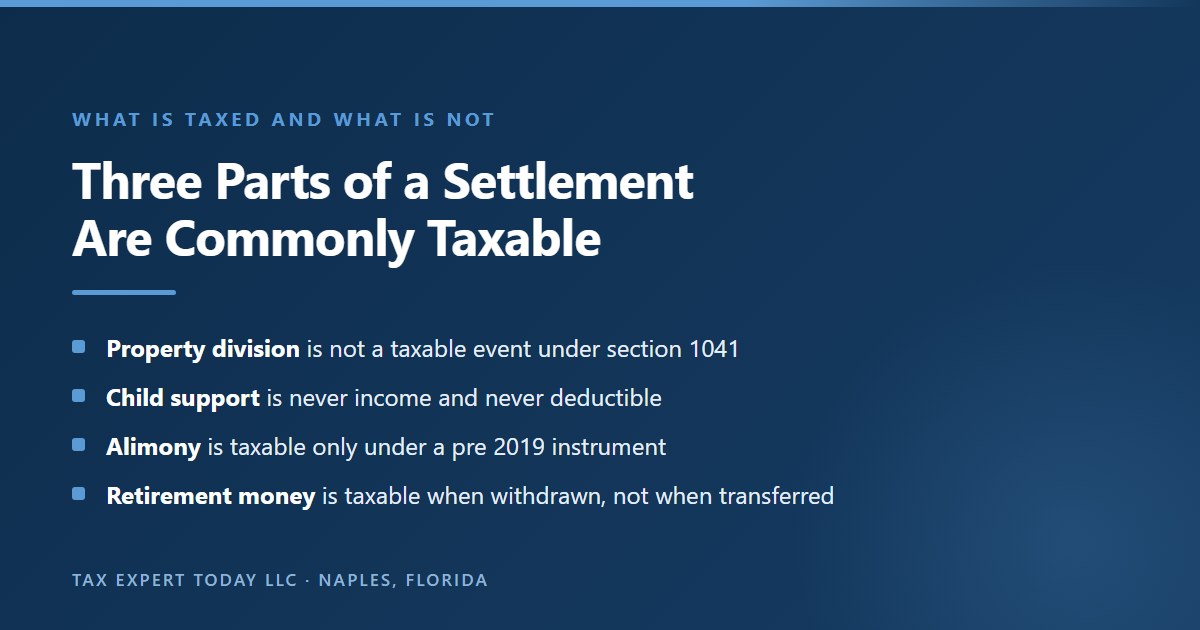
Three parts of a settlement are commonly taxable: alimony under an agreement executed before 2019, retirement money that is withdrawn rather than transferred under a court order, and any payment that compensates one spouse for services rather than dividing property. Everything else, including the property division itself and all child support, is generally outside the income tax at the moment of transfer.
- Property division is not a taxable event. IRC §1041 removes gain and loss from transfers between spouses and from transfers incident to divorce.
- Child support is never taxable. It is not income to the recipient and not deductible by the payer, in every year and under every agreement.
- Alimony depends entirely on the date of the instrument. Agreements executed before 2019 keep the old deduction and inclusion rules, and agreements executed after 2018 do not.
- Retirement money is taxable if it is withdrawn. The transfer mechanism, not the divorce itself, is what keeps it tax free.
- Carryover basis defers rather than forgives. The spouse who receives an appreciated asset inherits the built in gain along with it.
The table below is the map for the rest of this guide. Each row is a component that shows up in a typical settlement, with the treatment at the moment of the division and the authority that produces it.
| Settlement component | Taxable when received? | Authority |
|---|---|---|
| Real estate, cash, vehicles and securities divided between the spouses | No | IRC §1041(a) |
| Equalizing lump sum paid to balance the property split | No | IRC §1041(a); IRS Topic 452 excludes noncash property settlements from alimony |
| Child support | No | IRS Topic 452 |
| Alimony under an instrument executed after 2018 | No | TCJA §11051; IRS Topic 452 |
| Alimony under an instrument executed before 2019 and not modified to adopt the repeal | Yes, to the recipient | IRS Topic 452 |
| Retirement plan money paid to a spouse under a qualified domestic relations order | Yes, to the receiving spouse, when it is distributed | IRC §414(p); IRS guidance on divorce and retirement plans |
| IRA moved directly to the other spouse under the decree | No | IRC §408(d)(6) |
| IRA the owner withdraws in order to pay the other spouse | Yes, to the account owner, plus the penalty if under age 59 and a half | IRS, Filing taxes after divorce or separation |
| Payment for services rendered by one spouse | Yes, to the recipient | Temp. Treas. Reg. §1.1041-1T, Q&A-4 |
| An appreciated asset later sold by the spouse who received it | Yes, on the sale, measured from the original basis | IRC §1041(b)(2) |
Notice what the third column does. Almost every row that says no traces back to the same statute, and almost every row that says yes traces to something outside it. That is the structure of the whole subject, and it is why the next section starts with §1041 rather than with a list of exceptions. Nearly every rule that makes a divorce settlement taxable is a departure from that statute rather than an application of it.
Why Is Property Division Not a Taxable Divorce Settlement?
IRC §1041(a) states that no gain or loss is recognized on a transfer of property from an individual to a spouse, or to a former spouse where the transfer is incident to the divorce. The rule is mandatory rather than elective, and it applies even where the transfer is a genuine sale for consideration, which is what separates it from ordinary tax principles.
- The rule covers both directions. Neither the transferring spouse nor the receiving spouse recognizes anything on the transfer.
- Consideration does not break it. Nonrecognition applies even where the transfer is made in exchange for the release of marital rights.
- Unequal divisions still qualify. Temp. Treas. Reg. §1.1041-1T, Q&A-10 confirms the result holds for an equal or an unequal division of community property.
- The transfer is treated as a gift. IRC §1041(b)(1) deems the property acquired by gift, which drives the basis rule discussed later in this guide.
The regulation is explicit that this displaced the older common law result. Q&A-10 states that the transferor recognizes no gain or loss even where the transfer was in exchange for the release of marital rights, and that the outcome therefore differs from United States v. Davis, 370 U.S. 65 (1962), which had treated exactly that exchange as a taxable disposition. Congress enacted §1041 in 1984 to end that result, and the design choice was to move the tax rather than to forgive it.
Two boundaries on the rule are worth stating because they are absolute rather than matters of degree. IRC §1041(d) provides that subsection (a) does not apply at all where the spouse or former spouse receiving the property is a nonresident alien, so nonrecognition simply is not available and the transfer is measured under ordinary rules. IRC §1041(e) removes nonrecognition for a transfer of property in trust to the extent the liabilities assumed, plus the liabilities the property is subject to, exceed the total adjusted basis of the property transferred. Neither of these is a technicality in a cross border marriage or in a settlement that routes assets through a trust.
There is also a category question that Q&A-4 answers in one line. Only transfers of property are governed by §1041, and transfers of services are not. A settlement that compensates one spouse for work performed is not sheltered, no matter what the document calls the payment, and that is one of the narrow routes by which a property division becomes a divorce settlement taxable to the person who receives it. Q&A-5 runs the other way and is more generous than most readers expect: the property does not have to have been owned during the marriage, so a transfer of property acquired after the marriage ceased can still fall under §1041.
When Does a Transfer Stop Being Incident to the Divorce?
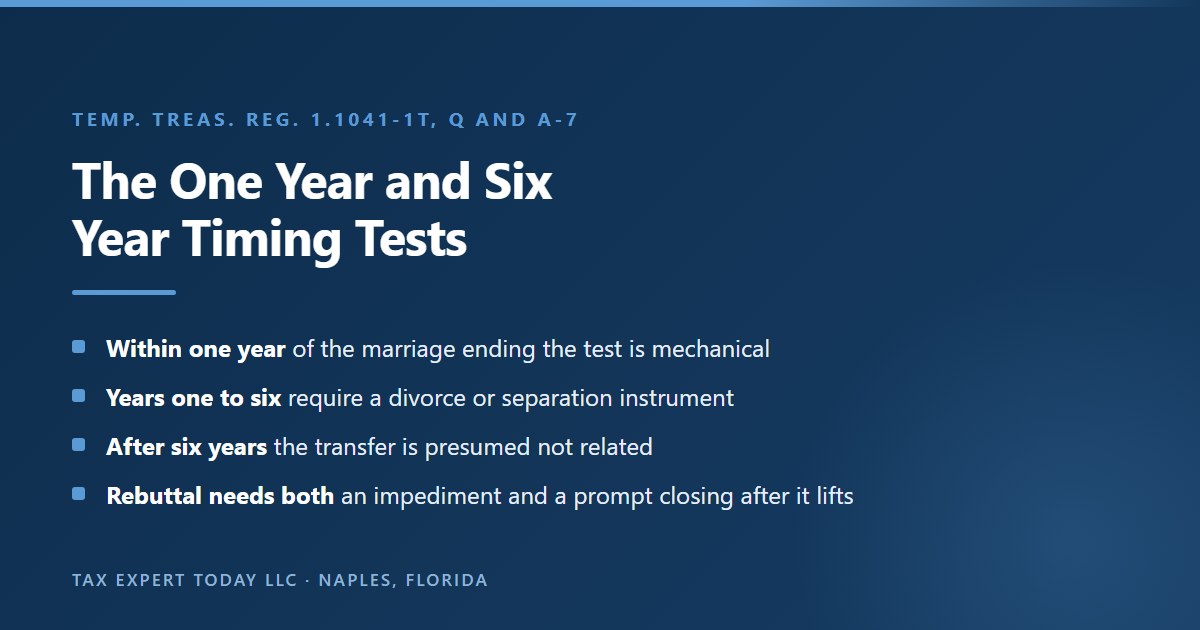
IRC §1041(c) treats a transfer as incident to the divorce if it occurs within one year after the marriage ends, or if it is related to the cessation of the marriage. Temp. Treas. Reg. §1.1041-1T, Q&A-7 turns the second test into a six year presumption tied to the divorce or separation instrument, and outside that window the presumption flips against the taxpayer.
- The one year test is mechanical. A transfer inside one year of the marriage ending qualifies without any showing that it relates to the divorce.
- Years one through six need an instrument. The transfer must be made pursuant to a divorce or separation instrument, including a later modification or amendment of it.
- After six years the presumption reverses. The transfer is presumed not related to the cessation of the marriage.
- Rebuttal has two required parts. The taxpayer must show an impediment delayed the transfer, and that it closed promptly once the impediment was removed.
This is the single most overlooked rule in the whole area, and it is where a settlement everyone assumed was tax free turns into a divorce settlement taxable to one of the parties years after the fact. The regulation is worth reading closely. Q&A-7 provides that any transfer not pursuant to a divorce or separation instrument, and any transfer occurring more than six years after the cessation of the marriage, is presumed to be not related to the cessation of the marriage. It then states that the presumption may be rebutted only by showing that the transfer was made to effect the division of property owned by the former spouses at the time the marriage ceased.
The regulation gives its own example of a successful rebuttal, and the structure matters because both halves are required. The presumption may be rebutted by showing that the transfer was not made within the one and six year periods because of factors which hampered an earlier transfer, such as legal or business impediments or disputes concerning the value of the property, and that the transfer was effected promptly after the impediment was removed. A taxpayer who can prove the delay but not the promptness has proved half of a two part test.
| Timing of the transfer | Treatment | What must be shown |
|---|---|---|
| While the parties are still married | Nonrecognition under §1041(a)(1) | Only the spousal relationship |
| Within one year after the marriage ends | Incident to divorce under §1041(c)(1) | Nothing further; the test is mechanical |
| Between one and six years, under the instrument | Related to the cessation under Q&A-7 | The transfer is pursuant to a divorce or separation instrument |
| Within six years but not under any instrument | Presumed not related | Rebuttal required |
| More than six years after the marriage ends | Presumed not related | An impediment delayed it, and it closed promptly once removed |
The practical consequence is that the calendar is a tax term of the settlement, not an administrative afterthought. Where a piece of the division is left open, whether because a property has to be sold, a business has to be valued, or a court has to rule on something else first, the six year clock is running from the date the marriage ceased rather than from the date the parties finally agree. Two other provisions interact with this timing. Q&A-8 confirms that annulments, and cessations of marriages void from the outset under state law, count as divorces for §1041 purposes. Q&A-9 permits a transfer to a third party to qualify, but only in three defined situations, and the third of them carries its own deadline: where the transferor relies on a written consent or ratification from the other spouse, that document must state that the parties intend §1041 treatment and must be received before the transferor files the return for the year of the transfer.
Is Alimony in a Divorce Settlement Taxable in 2026?
The answer turns entirely on when the instrument was executed. For a divorce or separation agreement executed after 2018, alimony is not deductible by the payer and not included in the income of the recipient. For an agreement executed before 2019 and never modified to adopt the repeal, the old rules survive and the recipient still reports the payments as income.
- Section 11051 of the 2017 Act did the work. It repealed the deduction for agreements executed after December 31, 2018.
- Older agreements were grandfathered, not converted. A pre 2019 instrument keeps deduction and inclusion indefinitely.
- Modification is the trap. A modification of an older instrument adopts the new rules only if it expressly states that the repeal applies.
- Labels do not control. IRS Topic 452 excludes noncash property settlements, in a lump sum or in installments, from the definition of alimony.
The exclusion list in Topic 452 is the part practitioners use most, because it decides which line of a settlement is alimony at all, and therefore which line is a divorce settlement taxable to the recipient. Alimony or separate maintenance does not include child support, noncash property settlements whether paid in a lump sum or in installments, payments that represent the share of one spouse of community property income, payments to keep up property belonging to the payer, use of the property of the payer, or voluntary payments not required by a divorce or separation instrument. A payment that fails these tests is not converted into taxable income by being described as support in the document.
One allocation rule inside Topic 452 causes real disputes and is almost never mentioned on the pages that rank for this topic. Where an instrument provides for both alimony and child support and the payer pays less than the full amount required, the payments apply to child support first, and only the remaining amount is treated as alimony. Under a grandfathered pre 2019 instrument, a payer who falls behind therefore loses the deduction before losing anything else, and the recipient reports less income than the schedule would suggest. The mechanics of the alimony rules, including the recapture provisions that apply to front loaded payments, are covered in depth in our guide to alimony taxes after divorce.
There is one filing detail on the grandfathered side that produces an automatic penalty. A payer claiming a deduction under a pre 2019 instrument must enter the Social Security number or individual taxpayer identification number of the recipient. IRS Topic 452 states that the deduction may otherwise be disallowed and that a fifty dollar penalty may apply.
Is Child Support Ever a Taxable Divorce Settlement Payment?
No. Child support is never deductible by the payer and is never included in the income of the recipient. Unlike the alimony rules, this treatment does not depend on the date of the instrument, the state, or the structure of the payment, and there is no version of a settlement in which properly characterized child support becomes a divorce settlement taxable to the parent who receives it.
- The treatment is unconditional. No date test and no grandfathering apply.
- Characterization is where the argument lives. What matters is whether an amount is child support, not how it is taxed once it is.
- Shortfalls are applied to support first. A partial payment reduces alimony before it reduces child support.
- Child support is separate from the child tax benefits. Paying support does not by itself entitle a parent to claim the child.
The last point causes more confusion than the tax treatment does. Which parent claims a child, and which credits travel with that claim, is decided under the dependency rules and Form 8332 rather than by who pays support. Those benefits do not all move together, and a release signed on Form 8332 moves some of them while leaving others with the custodial parent by operation of law. Our guide to Form 8332 and claiming a child after divorce walks that split, and the related question of which filing status each parent may use in the year of the divorce is covered in our guide to divorce filing status.
How Are Retirement Accounts in a Divorce Settlement Taxed?
Retirement money is the single most common way of making a divorce settlement taxable, and the cause is almost always the mechanism rather than the division. A qualified plan interest moved under a qualified domestic relations order and an IRA moved directly under the decree are both tax free. A withdrawal made in order to fund a payment is fully taxable to the account owner.
- Employer plans move under a court order. IRC §414(p) governs the qualified domestic relations order that divides a plan interest.
- IRAs move under a different provision. IRC §408(d)(6) treats a transfer under the decree as not a taxable transfer by the owner.
- The order applies to plans, not to IRAs. Using the wrong instrument for the wrong account type is the recurring drafting error.
- A withdrawal is not a transfer. The IRS states that amounts withdrawn from a traditional IRA to pay a former spouse are taxable to the owner.
The statutory language on the IRA side is unusually strong. IRC §408(d)(6) provides that the transfer of an interest in an individual retirement account or annuity to a spouse or former spouse under a divorce or separation instrument is not to be considered a taxable transfer made by that individual, notwithstanding any other provision of the subtitle, and that the interest is thereafter treated as an individual retirement account of the receiving spouse. The account changes owner rather than being distributed, which is precisely why nothing is taxed.
Set that against what the IRS says happens when the same economic result is reached the other way. On its page for taxpayers filing after a divorce, the agency states that if you withdraw amounts from your traditional IRA to pay your ex-spouse as part of your divorce settlement, those amounts are taxable to you, and that if you are under age 59 and a half you must also pay the ten percent additional tax unless an exception applies. The division is identical. The tax result is not, and the difference is created entirely by paperwork that costs nothing to get right at the time.
Employer plans carry their own asymmetry. Where a spouse receives payments under a qualified domestic relations order, those amounts are included in income when distributed unless they are rolled over into a traditional IRA, and amounts included in income under such an order are not subject to the ten percent early distribution tax. That penalty exception is one of the few genuine planning opportunities in a divorce, and it is available for plan distributions under an order rather than for IRA transfers, which is a distinction our guide to QDRO taxes in divorce works through in detail.

Does the Marital Home Make a Divorce Settlement Taxable?
Transferring the home to one spouse is not taxable under §1041, and IRC §121(d)(3) carries the ownership and use history across the transfer so the receiving spouse does not restart the two year clocks. The tax appears on the eventual sale, where the exclusion available to a single filer is half of what the couple had while married.
- Ownership periods tack. Under §121(d)(3)(A), the receiving spouse adds the ownership period of the transferor.
- Use can continue without occupancy. Under §121(d)(3)(B), a spouse granted use of the home under the instrument creates use credit for the absent owner.
- The exclusion amount changes with filing status. Two single owners do not have the same exclusion the married couple had.
- Basis follows the transferor. The gain is measured from the original cost, not from the value used in the settlement.
The provision in §121(d)(3)(B) is the one that rescues the spouse who moves out. It states that, solely for purposes of §121, an individual is treated as using the property as a principal residence during any period of ownership while a spouse or former spouse is granted use of the property under a divorce or separation instrument. Where the settlement allows one spouse to remain in the home for a period of years while the other retains an ownership interest, that language preserves the exclusion for the departing spouse, but only if the right of occupancy is actually granted by the instrument. The full mechanics, including how the numbers work in a buyout, are set out in our guide to divorce house buyout taxes.
Which Settlement Payments Are Taxable Because They Are Not Property?
Section 1041 shelters transfers of property and nothing else. A payment that compensates services, a right to income that has already been earned, or an obligation that carries built in ordinary income can fall outside the shelter even inside a settlement agreement, and these are the items that quietly make a divorce settlement taxable.
- Services are excluded by regulation. Q&A-4 states that transfers of services are not subject to §1041.
- Installment obligations are protected. IRC §453B(g) prevents acceleration on a transfer incident to divorce.
- Trust transfers have a limit. IRC §1041(e) taxes the excess where liabilities exceed basis.
- A nonresident alien spouse ends the shelter. IRC §1041(d) removes nonrecognition entirely.
The installment obligation rule is the friendliest of the group and deserves to be better known. IRC §453B ordinarily forces a seller who disposes of an installment note to recognize the deferred gain immediately. Subsection (g) provides that in the case of a transfer described in §1041(a), other than a transfer in trust, that acceleration rule does not apply, and that the same tax treatment with respect to the transferred installment obligation applies to the transferee as would have applied to the transferor. A spouse who sold a property or a business on an installment note before the divorce can therefore hand the note across without triggering the deferred gain, and the receiving spouse steps into the same reporting position.
The trust rule runs the other way and is the sharpest edge in §1041. Subsection (e) provides that nonrecognition does not apply to a transfer of property in trust to the extent that the sum of the liabilities assumed plus the liabilities to which the property is subject exceeds the total adjusted basis of the property transferred. Where a settlement routes a leveraged property into a trust for the benefit of a spouse, the excess is recognized, and proper adjustment is then made to the basis of the transferee to account for the gain recognized. A settlement that reaches for a trust structure for family law reasons can create an income tax event that a direct transfer of the same asset would not.
| Item in the settlement | Inside the §1041 shelter? | Reason |
|---|---|---|
| Real or personal property, tangible or intangible | Yes | Q&A-4 covers all property |
| Property acquired after the marriage ended | Yes | Q&A-5 imposes no ownership during marriage requirement |
| Payment for services performed by a spouse | No | Q&A-4 excludes transfers of services |
| An installment note transferred outright | Yes, with no acceleration | IRC §453B(g) |
| An installment note transferred in trust | No, the §453B(g) relief excludes trusts | IRC §453B(g) opening language |
| Leveraged property into trust, liabilities above basis | Only to the extent of basis | IRC §1041(e) |
| Any transfer to a nonresident alien spouse | No | IRC §1041(d); Q&A-3 |
| Transfer to a third party at the written request of the other spouse | Yes, if the Q&A-9 conditions are met | Temp. Treas. Reg. §1.1041-1T, Q&A-9 |
Business interests belong in this discussion as well, but they raise a set of entity level questions that go well beyond the transfer itself, including the corporate redemption rules in Treas. Reg. §1.1041-2, what happens to suspended losses, and whether a proposed trust would end an S corporation election. Those are addressed separately in our guide to business owner divorce taxes.
Why Does Carryover Basis Make a Divorce Settlement Taxable Later?
IRC §1041(b)(2) gives the receiving spouse the adjusted basis of the transferor rather than the value used in the settlement. Two assets of equal value can therefore carry very different after tax value, and a division that looks equal on the settlement schedule can be materially unequal once the embedded tax is subtracted.
- Value in the agreement is not basis. The receiving spouse inherits the original cost figure.
- The rule holds even in a genuine sale. Q&A-11 states the transferee does not take a cost basis even where the transfer is a bona fide sale.
- It applies to losses as well as gains. This is where §1041 departs from the ordinary gift rules.
- The transferor owes records, not just the asset. Q&A-14 imposes an affirmative duty to hand over basis and holding period information.
The loss point is the technical distinction most worth understanding, and nothing in the top ten search results for this question mentions it. Under the ordinary gift rule in IRC §1015(a), where the basis of the donor is greater than fair market value at the time of the gift, the basis for determining loss is that lower fair market value, which strands part of the built in loss permanently. Section 1041 does not follow that pattern. Q&A-11 states that the carryover basis rule applies whether the adjusted basis is less than, equal to, or greater than fair market value, and that it applies for purposes of determining loss as well as gain, and it says in terms that this rule is different from the rule applied in §1015(a). A spouse who receives an asset carrying a built in loss therefore keeps the entire loss, which is a genuine element of value in a negotiation and one that is almost never priced.
The recordkeeping obligation in Q&A-14 is the practical companion to all of this, and it is a requirement rather than a courtesy. The transferor of property under §1041 must, at the time of the transfer, supply the transferee with records sufficient to determine the adjusted basis and the holding period of the property as of the date of transfer, and the transferee must preserve and keep those records accessible. Where a settlement closes without that exchange, the spouse who received the asset may face a sale years later with no defensible basis figure, and the resulting gain is computed on what can be substantiated rather than on what was actually paid.
Q&A-12 shows how far the nonrecognition extends even where cash has already been taken out of an asset. In the example given by the regulation, one spouse owns property worth ten thousand dollars with an adjusted basis of one thousand dollars, borrows five thousand dollars against it in contemplation of the transfer, and then transfers the property subject to that debt. The transferor recognizes no gain or loss, and the basis in the hands of the receiving spouse remains one thousand dollars. The borrowed cash is not taxed, but every dollar of the original gain remains in the asset that changed hands, and that deferred gain is what eventually makes a divorce settlement taxable on a sale that may be a decade away.
Does a Divorce Settlement Trigger Gift Tax?
Usually not, but the protection comes from a timing rule rather than from the divorce itself. IRC §2516 deems transfers made under a written marital settlement agreement to be made for full and adequate consideration, provided the divorce occurs within a three year period that begins one year before the agreement is entered into.
- The window is three years, not two. It runs from one year before the agreement through two years after it.
- A written agreement is required. The relief attaches to a written agreement relative to marital and property rights.
- Court approval is not required. The statute applies whether or not the agreement is approved by the divorce decree.
- Support for minor children is covered. A reasonable allowance for the support of issue of the marriage during minority also qualifies.
The statutory text is short enough to quote in substance. Where spouses enter into a written agreement relative to their marital and property rights and divorce occurs within the three year period beginning on the date one year before the agreement is entered into, transfers of property made pursuant to that agreement, either to a spouse in settlement of marital or property rights or to provide a reasonable allowance for the support of issue of the marriage during minority, are deemed to be transfers made for full and adequate consideration in money or money worth. The window was widened to its current form in 1984, and the earlier version had allowed only two years after the agreement.
The reason this matters is that the income tax and the gift tax run on separate tracks. A transfer can be perfectly sheltered by §1041 for income tax purposes and still be a gift for transfer tax purposes if it falls outside §2516 and the marital deduction is no longer available because the marriage has ended. The IRS notes on its own divorce page that a taxpayer may have to report a property transfer on a gift tax return. Where a settlement is signed but the dissolution drags past the statutory window, that is the provision to check before assuming no reporting is required.
How Do Florida Rules Affect a Taxable Divorce Settlement?
Florida imposes no personal income tax, so a Florida resident faces only the federal analysis in this guide, and §1041, §408(d)(6), and the alimony rules apply unchanged. What Florida law changes is which assets enter the marital estate to begin with, and that is governed by Fla. Stat. §61.075 rather than by the Internal Revenue Code.
- No state layer on the division. A Florida resident has no state income tax consequence on the transfer or on a later sale.
- Equitable distribution decides the split. Fla. Stat. §61.075 governs which assets are marital and how they are distributed.
- The 2023 alimony reform changed the awards, not the tax. Senate Bill 1416 eliminated permanent alimony in Florida going forward.
- Residency has to be genuine. A recent move does not settle the question, and the facts establish domicile.
For divorce tax Naples clients the practical Florida effect is on size rather than on rate. Because there is no state income tax to layer on, the federal treatment is the entire tax picture, and every dollar of deferred gain identified above is a purely federal exposure, and nothing in Florida law makes a divorce settlement taxable that federal law does not. The Florida statute matters because it determines how much property is being divided in the first place, including whether appreciation in an asset one spouse owned before the marriage was enhanced by marital effort and therefore brought into the estate.
The 2023 reform is worth a sentence because it is frequently misread as a tax change. Senate Bill 1416 eliminated permanent alimony in Florida for cases going forward and restructured the durational categories. It did not alter the federal tax treatment of alimony at all, which continues to depend on the execution date of the instrument under the 2017 federal legislation. A Florida award entered today is not deductible to the payer and not income to the recipient, and that would be equally true in a state that had never reformed its alimony statute.
Divorce Settlement Tax Help in Naples and Southwest Florida
Tax Expert Today LLC works from Naples, Florida as the tax side of a divorce team. We do not practice family law, and we do not advise on custody, support amounts, or how a marital estate should be divided. What we do is price the tax consequences of a proposed settlement before it is signed, identify which components are taxable and to whom, model the after tax value of assets that look equal on the schedule, and coordinate with your family law attorney so the tax result matches the deal that was actually negotiated.
For divorce tax Naples FL clients, the pattern we see most often is a settlement that is complete on the family law side and silent on the tax side. Typical engagements include running the after tax comparison between two proposed divisions, confirming that retirement accounts are being moved by the correct instrument for the account type, checking the timing of any deferred transfer against the one year and six year tests, assembling the basis and holding period records the transferor is required to supply, and preparing the transition year returns once the division is complete. You can read more on our divorce tax consulting page, and about the broader practice at Naples FL tax planning.
Tax Expert Today LLC
11983 Tamiami Trail N, Naples, FL 34110
Phone: (239) 441-2005
Hours: Monday through Friday, 10:00am to 5:00pm ET
Does a Naples divorce change whether a divorce settlement is taxable? Not the federal answer. Florida has no personal income tax, so a Florida resident faces only the federal rules described above, and §1041, §408(d)(6), §121(d)(3) and the alimony rules apply exactly as written. What a Florida case changes is the size of the estate being divided, under Fla. Stat. §61.075, and in particular whether appreciation in separately owned property was enhanced by marital effort and therefore brought into the marital estate.
When to Engage a Professional
Not every divorce needs a tax advisor. Where the estate is a house with a modest gain, two ordinary bank accounts, and no business or retirement complexity, §1041 does the work, nothing makes the divorce settlement taxable in the year of the division, and the answer really is that simple. Professional involvement tends to earn its cost when one or more of the following is present.
- Retirement accounts are being divided. The instrument has to match the account type, and using the wrong one converts a tax free division into a taxable distribution.
- Assets carry very different basis. Equal value on the schedule can mean materially unequal value after tax.
- Part of the division is deferred. The one year and six year tests run from the date the marriage ceased, not from the date the parties finally agree.
- A trust is contemplated. IRC §1041(e) becomes live, and the §453B(g) relief for installment notes does not extend to transfers in trust.
- A spouse is a nonresident alien. IRC §1041(d) removes nonrecognition entirely and the transfer becomes taxable.
- A business interest is in the estate. The redemption rules, suspended losses, and entity elections all carry their own deadlines.
Where a joint return from the marriage is under examination or carries a balance, that liability question is separate from the division of property, and our guides to innocent spouse relief and injured spouse relief address the two different situations it can present. Where penalties have been assessed on a late or amended filing during the proceedings, reasonable cause penalty abatement may be available. A newly single filer whose withholding no longer matches the new picture, particularly one now receiving taxable alimony under a grandfathered instrument, can check the position with our quarterly estimated tax calculator. Readers relocating as part of the transition may also find our guide to retiring to Florida taxes useful.
This article is general information about tax mechanics and is not legal, tax, or family law advice for any particular situation. Tax outcomes depend on the specific facts, the exact language of the instrument, and the law in effect for the year in question. Please coordinate with your family law attorney on the terms of any settlement, and with a qualified tax advisor on the treatment of the items in it, before signing anything.
Frequently Asked Questions
Is a lump sum divorce settlement taxable? A lump sum that equalizes the property division is not taxable. IRC §1041 covers the transfer, and IRS Topic 452 confirms that noncash property settlements, whether paid in a lump sum or in installments, are not alimony. A lump sum that is genuinely support under a pre 2019 instrument is a different item and follows the grandfathered alimony rules.
Do I have to report a divorce settlement on my tax return? The property division itself is generally not reported as income. Taxable alimony under a grandfathered instrument is reported, distributions from retirement accounts are reported when they are taken, and a later sale of an asset received in the settlement is reported in the year of the sale. The IRS also notes that a transfer may have to be reported on a gift tax return.
What makes a divorce settlement taxable years after the divorce? Two things, usually. The first is carryover basis, which leaves the built in gain inside an asset until the spouse who received it sells. The second is timing: a transfer occurring more than six years after the marriage ceased, or one not made under a divorce or separation instrument, is presumed not related to the cessation of the marriage under Q&A-7.
Is money from a divorce settlement taxable if it comes from a retirement account? It depends entirely on the mechanism. An IRA moved directly to the other spouse under the decree is not taxable under IRC §408(d)(6), and a plan interest divided by a qualified domestic relations order is taxed to the receiving spouse only when distributed. Money the owner withdraws in order to make a payment is taxable to that owner.
Can we choose which spouse pays the tax on a settlement item? Not generally. Nonrecognition under §1041 is mandatory rather than elective, and the tax follows the asset through the carryover basis rule. There are narrow exceptions in specific structures, including the written agreement permitted by Treas. Reg. §1.1041-2(c) for a corporate redemption, which must be effective before the first timely filed return for the year of the redemption.
Does a divorce settlement change my filing status for the year? Filing status is determined by marital status on the last day of the tax year rather than by the settlement. A dissolution finalized on December 31 makes both parties unmarried for the entire year, and one that finalizes on January 1 leaves both married for the year that just ended.
Published September 9, 2026 by Dr. Pellumb Kabashi « Back to Learning Center
Have a question this article touches on?
Tax Expert Today LLC, based in Naples, Florida and serving clients across the United States.
Schedule a Consultation (239) 441-2005