
By Dr. Pellumb Kabashi, DBA, MBA, CES, CFE, EA
Founder, Tax Expert Today LLC · Tax advisors, enrolled agents, CPAs, and attorneys · Serving clients in all 50 states
Quick Answer: Alimony taxes depend almost entirely on one date. For any divorce or separation instrument executed after December 31, 2018, alimony is not deductible by the payer and not taxable to the recipient. For instruments executed on or before that date, the older rules survive, so the payer may still deduct and the recipient still reports the income, unless a later modification expressly adopts the new treatment.
Divorce produces two separate professional questions that are easy to blur together. The first is what the settlement should say, which belongs to a family law attorney. The second is what the settlement will cost after tax, which is where our firm works. This guide addresses the second question only. Anyone negotiating support should coordinate the tax analysis with their family law attorney before signing anything, because the tax result is set by the language of the instrument and by the date it is executed, and neither is easy to undo afterward.
How Are Alimony Taxes Handled After the 2019 Change?
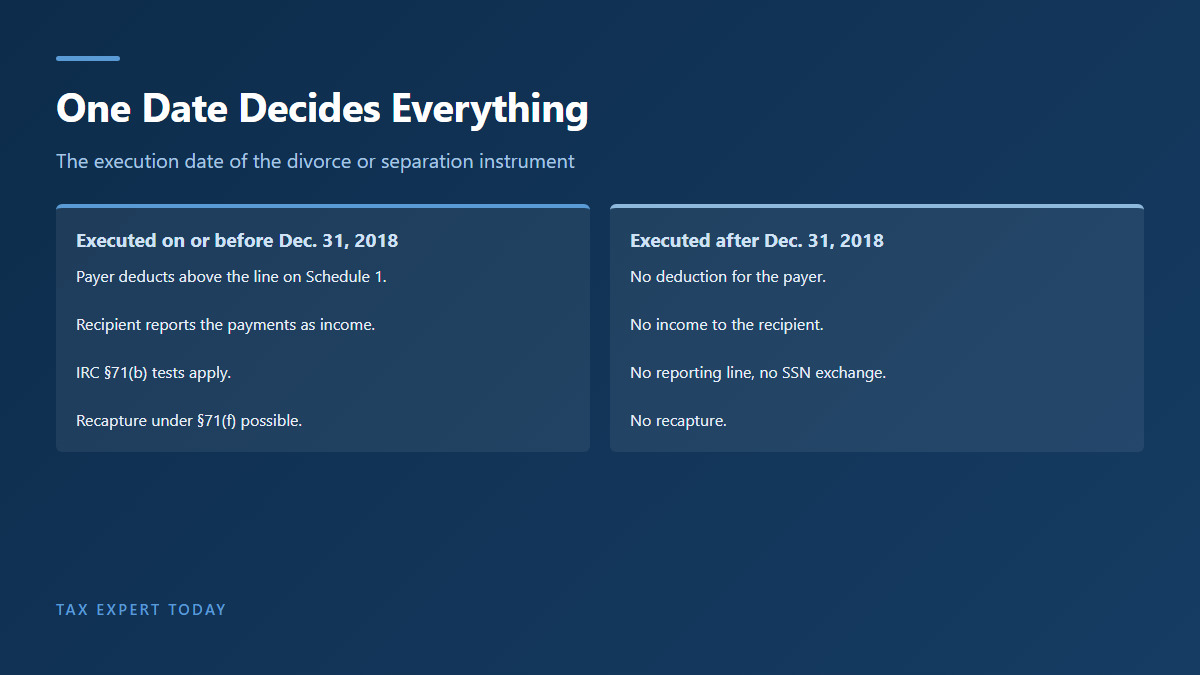
For divorce or separation instruments executed after December 31, 2018, alimony taxes are simple in form. The payer gets no deduction and the recipient reports no income. The payments move after tax, taxed once at the payer’s marginal rate, and the recipient receives them free of federal income tax. There is no reporting line and no Social Security number exchange requirement.
The change came from the Tax Cuts and Jobs Act, which repealed both halves of the old system. Section 215, which allowed the payer a deduction, and the inclusion rule in section 71, which put the payment into the recipient’s income, were switched off together for new instruments. The IRS states the rule and the effective date in Topic No. 452.
The practical consequence is a shrinking pool of money. Under the old system, support was commonly taxed in the lower earner’s bracket, which meant a dollar of support cost the payer less than a dollar and the household kept more in total. That arbitrage is gone for new agreements. When a settlement is negotiated today using a support figure borrowed from an older case, the after-tax burden on the payer is materially heavier than the number suggests.
| Feature | Instrument executed on or before Dec. 31, 2018 | Instrument executed after Dec. 31, 2018 |
|---|---|---|
| Deduction for the payer | Yes, above the line on Schedule 1 (Form 1040) | No deduction |
| Income to the recipient | Yes, reported on Schedule 1 (Form 1040) | Not reported, not taxable |
| Recipient Social Security number required | Yes, the payer reports it | Not applicable |
| Definitional tests of IRC §71(b) apply | Yes | No federal tax consequence either way |
| Recapture rule can apply | Yes, under IRC §71(f) | No |
| Counts as compensation for an IRA contribution | Generally yes, because it is taxable | Generally no, because it is not taxable |
| Child support treatment | Never deductible, never income | Never deductible, never income |
That last row deserves emphasis because it is constant across both regimes. Child support has never been deductible and has never been income. Only spousal support was ever in play, which is why the labeling of payments in the instrument carries so much weight. The child related credits are governed separately, and our guide to Form 8332 and claiming a child after divorce explains which of them a release can move.
Support treatment is only one half of the transition-year return. The other half is which status each spouse files under, which is fixed by marital status on December 31 and is covered in our guide to divorce filing status.
Which Divorce Agreements Are Still Grandfathered?
An instrument executed on or before December 31, 2018 keeps the old treatment indefinitely. The payer continues to deduct qualifying alimony above the line, and the recipient continues to include it in gross income. Nothing about the passage of time erodes this. A 2015 decree still paying support in 2026 is still governed by the pre-2019 rules.
Grandfathered status attaches to the instrument, not to the people. This matters because divorce files accumulate documents. The original decree, a later stipulation, a marital settlement agreement incorporated by reference, and a modification order can all exist in the same case with different dates. The controlling question is which document creates the obligation being paid, and when that document was executed. Support is only one line of a settlement, and the treatment of every other line is mapped in our guide to whether a divorce settlement is taxable.
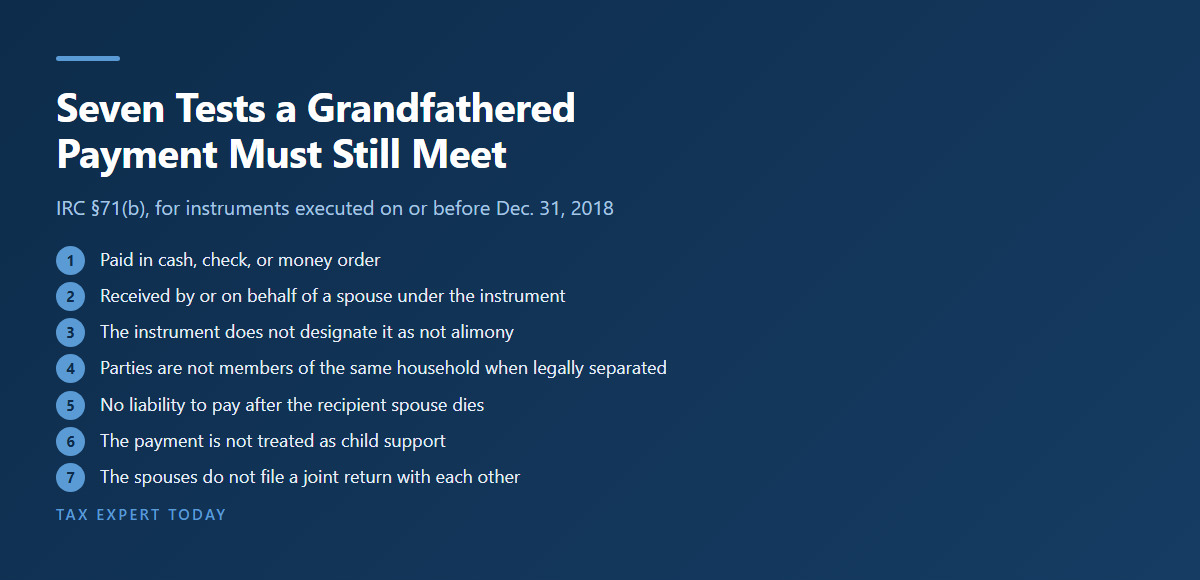
For a grandfathered arrangement to actually produce a deduction, the payment must still satisfy the definitional tests that IRC §71(b) imposed. These are mechanical and unforgiving:
- The payment is made in cash, check, or money order, not in property or services.
- The payment is received by or on behalf of a spouse or former spouse under a divorce or separation instrument.
- The instrument does not designate the payment as something other than alimony.
- Where the parties are legally separated under a decree of divorce or separate maintenance, they are not members of the same household when the payment is made.
- There is no liability to make any payment, in cash or property, after the death of the recipient spouse.
- The payment is not treated as child support.
- The spouses do not file a joint return with each other.
The death contingency requirement is the one that most often fails without anyone noticing. If the instrument is silent and state law does not independently terminate the obligation at the recipient’s death, the payments may not qualify as alimony at all, which can put a claimed deduction at risk for every open year. Publication 504 walks through each requirement in detail.
What Counts as Alimony for Tax Purposes?
Alimony for tax purposes is a narrower category than support in ordinary speech. The label used in the decree does not control by itself. A payment described as alimony that is really disguised child support is treated as child support, and a payment described as a property settlement that meets the alimony tests may be treated as alimony under a grandfathered instrument.
Two recharacterization rules do most of the work. The first is the child contingency rule of IRC §71(c)(2). If an amount is reduced on a contingency relating to a child, such as the child reaching majority, leaving school, or moving out, the amount subject to that reduction is treated as child support rather than alimony. Practitioners sometimes see a support schedule that steps down on a date suspiciously close to a child’s eighteenth birthday, and the rule reaches exactly that pattern.
The second is the recapture rule of IRC §71(f), which polices front loading. If payments in the first post-separation year and the second drop sharply relative to the year that follows, part of the earlier deduction can be recaptured into the payer’s income in the third year. The rule exists because a large early payment often looks more like a property division than like ongoing support. Recapture applies only to grandfathered instruments, since post-2018 payments produce no deduction to recapture in the first place.
Property division sits in its own category entirely. Under IRC §1041, a transfer of property between spouses or incident to divorce generally produces no recognized gain or loss, and the recipient takes the transferor’s basis. That carryover basis is the trap. Two assets of equal current value are not equal after tax if one carries a large built-in gain and the other does not, and a settlement that divides by market value alone can hand one party a future tax bill the other never sees. How the resulting assets are titled afterward is a separate question, addressed in our guide to Florida asset protection.
Can a Modification Change the Tax Treatment of Alimony?
A modification of a pre-2019 instrument does not automatically move it into the new regime. The old treatment survives an ordinary modification. The new rules apply to a modified pre-2019 instrument only if the modification expressly provides that the Tax Cuts and Jobs Act amendments apply to it. Silence preserves the grandfather.
This is one of the few places in tax where an election is made through drafting language rather than through a form. Because it is elective and express, it is also negotiable. A modification that reduces a support figure while simultaneously adopting the new treatment changes the after-tax position of both parties, and the headline number alone does not show it.
The reverse error is more common and more costly. Parties reopen a 2016 decree in 2026 to adjust an amount, the modification is drafted without any tax language, and both sides assume the payments have become non-taxable because that is the rule they have heard about. The payer stops deducting and the recipient stops reporting, when in fact the grandfathered treatment is still in force. That mismatch can persist across several returns before anyone reconciles it.
Because the tax result turns on the exact wording, the tax review needs to happen before execution rather than after. Coordination with the family law attorney handling the modification is the point at which this is cheap to fix.
How Did the 2023 Florida Alimony Reform Change the Picture?
Florida SB 1416, effective July 1, 2023, eliminated permanent alimony and restructured the remaining forms of support into temporary, bridge-the-gap, rehabilitative, and durational categories, with statutory limits tied to the length of the marriage. It is a family law change rather than a tax change, and it altered no part of the federal treatment described above.
The tax relevance is indirect but real. Shorter and more definite support periods concentrate the same total support into fewer years, which pushes more of it into the payer’s higher brackets in those years and changes what a given settlement actually costs. Durational awards with defined endpoints also make multi-year planning more tractable, because the horizon is knowable rather than open ended.
Florida imposes no personal income tax, so a Florida resident faces no state-level alimony consequence in either direction. That simplifies matters for parties who both remain in Florida, and it complicates matters for parties who do not, which is the subject of the next section. Readers should treat the substance of SB 1416 as a question for their family law attorney; our role is limited to what the resulting numbers do on a return.
Do States Follow the Federal Alimony Rules?
Not uniformly. Federal repeal did not bind the states, and several that impose an income tax continue to apply the older treatment for state purposes. California is the clearest example: the Franchise Tax Board continues to allow a state deduction for alimony paid and to require inclusion by the recipient, even where the federal return reflects neither.
The result is a split return. A California payer under a 2024 instrument may deduct nothing federally while deducting the same payments on the state return, and a California recipient may report income to the state that never appears on the federal return. The Franchise Tax Board guidance on alimony sets out the state position.
Residency itself is the variable underneath all of this, and the rules for when a state stops treating someone as a resident are their own subject. Our guide to the California exit tax covers how that determination actually works for a departing resident.
Cross-border cases are where this becomes expensive. When one former spouse leaves an income tax state for Florida and the other remains, the same payment stream can be non-taxable to the recipient in Florida while remaining deductible to the payer in the origin state, or the reverse. State conformity is worth confirming for both parties’ states of residence in the year of the agreement and again whenever either party relocates, since the answer depends on the specific state and on the residency facts.
| Situation | Federal result (post-2018 instrument) | State-level question to confirm |
|---|---|---|
| Both parties reside in Florida | No deduction, no income | None, because Florida imposes no personal income tax |
| Both parties reside in a conforming state | No deduction, no income | Confirm the state adopted the federal repeal |
| Both parties reside in a non-conforming state such as California | No deduction, no income | A state deduction to the payer and state income to the recipient may still apply |
| Payer in a non-conforming state, recipient in Florida | No deduction, no income | The payer may retain a state deduction while the recipient reports the income nowhere |
| Payer in Florida, recipient in a non-conforming state | No deduction, no income | The recipient may owe state tax on payments the payer cannot deduct anywhere |
| Either party relocates while payments continue | Unchanged by the move | Residency and part-year allocation for each year of the move |

What Do People Get Wrong About Alimony Taxes?
Most errors we see are not aggressive positions. They are assumptions carried over from a rule that no longer applies, or from a rule that still applies when the parties believe it does not. A few recur often enough to be worth naming.
- Assuming the 2019 change reached every case. It reached instruments executed after December 31, 2018 and nothing else. Grandfathered decrees remain fully deductible and fully includible.
- Treating a modification as a reset. Modifying a pre-2019 instrument preserves the old treatment unless the modification expressly adopts the new rules.
- Negotiating from a pre-2019 support number. A figure that made sense when it was deductible is a different economic proposition when it is not, and the difference falls entirely on the payer.
- Dividing property by market value alone. Carryover basis under IRC §1041 means equal value is not equal after tax. Appreciated stock and a cash account of the same size are not the same asset.
- Overlooking the death contingency. If liability does not end at the recipient’s death, a grandfathered payment may fail the definition of alimony entirely.
- Forgetting the IRA compensation link. Taxable alimony under a grandfathered instrument generally counts as compensation supporting an IRA contribution. Non-taxable alimony under a new instrument generally does not, which can quietly close a savings option for a recipient with no other earned income.
- Ignoring state conformity. A state that never conformed can produce a deduction or an income item that has no federal counterpart.
Each of these is identifiable before signature and difficult to correct afterward, which is the argument for running the tax analysis while the agreement is still a draft.
Alimony Tax Help in Naples & Southwest Florida
Tax Expert Today LLC advises divorcing and divorced clients on alimony taxes, grandfathered instrument analysis, modification language, property transfer basis, and multi-state conformity from our office at 11983 Tamiami Trail N, Naples, FL 34110. Our team includes tax advisors, enrolled agents, CPAs, and attorneys, and we work with clients in all 50 states. We work as the tax side of a divorce team and coordinate with the client’s family law attorney, who remains responsible for the family law strategy and the drafting of the agreement itself. To discuss a pending or completed divorce, call (239) 441-2005, Monday through Friday, 10am to 5pm ET, or review our divorce tax consulting services.
When to Engage a Professional
Some divorce tax questions are administrative and some are structural. Reporting a grandfathered payment on the correct line is administrative. Deciding what a support figure costs after tax, whether a modification should adopt the new treatment, how to divide assets that carry different basis, and which state has a claim on the payment stream is structural, and those decisions are effectively fixed once the agreement is executed.
Engaging a professional generally makes sense while the settlement is still being negotiated rather than after it is signed, when a pre-2019 instrument is being modified, when the parties live in or are moving between different states, when the marital home or a closely held business is part of the division, or when retirement accounts are being split. Outcomes depend on the specific facts and on the language of the instrument, and this guide is educational rather than advice on any particular case. Clients who are also weighing a move to Florida can review our Naples tax planning services for how residency interacts with the rest of the picture, along with our guide to estate planning for new Florida residents.
Frequently Asked Questions
Is alimony taxable in 2026?
It depends on when the divorce or separation instrument was executed. For instruments executed after December 31, 2018, alimony is not taxable to the recipient and not deductible by the payer. For instruments executed on or before that date, the older rules still apply, so the recipient includes the payments in income and the payer deducts them above the line.
Can I still deduct alimony from a 2015 divorce decree?
Generally yes. A pre-2019 instrument keeps its grandfathered treatment indefinitely, so qualifying payments remain deductible on Schedule 1 of Form 1040 and includible by the recipient. The payments must still meet the definitional requirements of IRC §71(b), including the rule that liability ends at the recipient’s death.
Does modifying an old alimony order change the tax rules?
Not by itself. Modifying a pre-2019 instrument preserves the old treatment unless the modification expressly provides that the Tax Cuts and Jobs Act amendments apply. Because that adoption is elective and made through drafting language, it should be reviewed with both the family law attorney and a tax advisor before the modification is executed.
Is child support ever deductible?
No. Child support has never been deductible by the payer or taxable to the recipient under either regime. Under a grandfathered instrument, an amount that is reduced on a contingency relating to a child may be recharacterized as child support under IRC §71(c)(2), even where the decree calls it alimony.
Do I owe tax when assets are divided in a divorce?
Generally not at the time of transfer. IRC §1041 treats a transfer of property between spouses or incident to divorce as producing no recognized gain or loss, and the recipient takes the transferor’s basis. The tax is deferred rather than eliminated, so it surfaces when the asset is later sold. Where the asset is the marital home, that deferred gain is analyzed in our guide to divorce house buyout taxes.
Where can I get help with alimony taxes in Naples, FL?
Tax Expert Today LLC works with divorcing and divorced clients from 11983 Tamiami Trail N, Naples, FL 34110, and serves clients in all 50 states. The team includes tax advisors, enrolled agents, CPAs, and attorneys covering alimony tax treatment, property transfer basis, retirement account division, and state conformity, coordinating with the client’s family law attorney. Retirement accounts divided by court order follow their own set of rules, which we cover in our guide to QDRO taxes. Call (239) 441-2005, Monday through Friday, 10am to 5pm ET.
Published July 18, 2026 by Dr. Pellumb Kabashi « Back to Learning Center
Have a question this article touches on?
Tax Expert Today LLC, based in Naples, Florida and serving clients across the United States.
Schedule a Consultation (239) 441-2005