
By Dr. Pellumb Kabashi, DBA, MBA, EA, CFE, CES
Founder, Tax Expert Today LLC · Tax advisors, enrolled agents, CPAs, and attorneys · Serving clients in all 50 states
Quick Answer: A dual status tax return is the single federal return filed for a year in which you were a U.S. nonresident for part of the year and a U.S. resident for the rest, usually the year you arrive or leave. Your status on December 31 decides whether Form 1040 or Form 1040-NR is the return and which form is the attached statement. Call (239) 441-2005 for a free consultation.
What is a dual status tax return?
A dual status tax return is the federal return for a year in which you were both a nonresident alien and a resident alien. It covers the year of arrival or departure in one filing: one form serves as the return, the other form is attached as a statement, and each period follows its own rules.
- It is about tax residency, not citizenship. Dual status has nothing to do with holding two passports. It describes a change in U.S. tax residence during one calendar year.
- It is one filing, not two separate returns. The return and the attached statement go to the IRS together as a single package.
- December 31 decides the lead form. A resident at year end files Form 1040 with a Form 1040-NR statement, and a nonresident at year end files the reverse.
- Two sets of rules apply inside one year. Worldwide income is taxed for the resident period, and generally only U.S. income is taxed for the nonresident period.
The IRS page on the taxation of dual-status individuals puts it plainly: you are a dual-status individual “when you have been both a U.S. resident and a nonresident in the same tax year,” and the most common dual-status years are the years of arrival and departure. The regulation behind the rule, Treasury Regulation section 1.871-13, says that a person who changes residence during the year is taxed “as though his taxable year were comprised of two separate periods,” one for the time of residence and one for the time of nonresidence.
That framing explains why a dual status tax return feels unfamiliar even to people who have filed U.S. returns before. A typical Form 1040 assumes the filer was a resident all year and taxes all income from every source. A typical Form 1040-NR assumes the filer was a nonresident all year and taxes only U.S. income and income connected with a U.S. business. In a year of change, neither assumption fits. The dual status tax return combines the two forms so that each slice of income is tested under the rules that applied on the day it was received.
This guide covers the mechanics: how the residency starting and ending dates are fixed, which form is the return and which is the statement, how the income in each period is taxed, the restrictions that apply, the elections that can replace dual status altogether, and the filing details that changed for the 2025 tax year. It is written for people who moved to the United States, often to Naples, Florida and the rest of Southwest Florida, and for people who left, and it links to the companion guides on the substantial presence test, Form 8840 and the closer connection exception, and Form 1040-NR.
Who has to file a dual status tax return?
You file a dual status tax return when you became a U.S. resident partway through the year without being a resident the year before, or when you stopped being a resident partway through the year and are not a resident the following year. Most filers are new arrivals and departing residents.
- New arrivals: people who meet the green card test or the substantial presence test for the first time during the year.
- Departing residents: people who leave, keep a foreign tax home and closer connection for the rest of the year, and are not residents the next year.
- Green card changes: people whose lawful permanent residence began or formally ended during the year.
- First-year electors: people who choose under section 7701(b)(4) to be treated as residents for part of the year before the year they meet the substantial presence test.
The statute sets the frame. Under 26 U.S.C. section 7701(b)(2)(A), a person who is a resident for a calendar year “but was not a resident of the United States at any time during the preceding calendar year” is treated as a resident “only for the portion of such calendar year which begins on the residency starting date.” Everything before that date is a period of nonresidence. Section 7701(b)(2)(B) works the other way for the last year: the portion of the year after the last day of presence can be a period of nonresidence if the person has a closer connection to a foreign country during that portion and is not a resident at any time during the next calendar year.
Not everyone who arrives or leaves ends up with a dual status tax return. Three common situations avoid it:
- Residency in the prior year carries forward. Publication 519 explains that if you were a resident during any part of the preceding year and are a resident for any part of the current year, you are treated as a resident from January 1. A person who left in November and came back in March is usually a full-year resident in the second year.
- Residency in the next year reaches back. If you are a resident during any part of the following year, you are treated as a resident through December 31 of the departure year, regardless of where you lived after leaving.
- A joint return election replaces dual status. A married person who elects under section 6013(g) or 6013(h) is treated as a resident for the whole year and files an ordinary joint Form 1040 instead.
A person who never becomes a resident at all is not dual status either. A Canadian winter visitor who spends five months in Naples, Florida each year and keeps the closer connection exception on Form 8840 remains a nonresident all year. If that visitor has U.S. income, the filing is an ordinary Form 1040-NR, not a dual status tax return.
When does U.S. residency start in the first year?
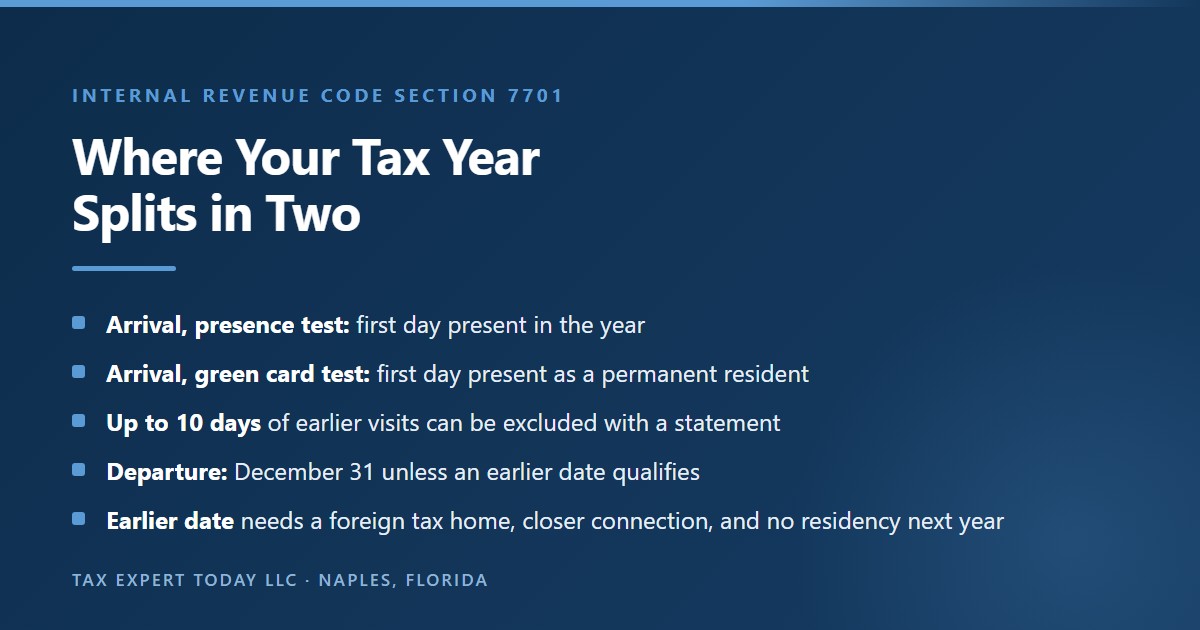
Under the substantial presence test, residency generally starts on the first day you were present in the United States during the year. Under the green card test, it starts on the first day you were present as a lawful permanent resident. Up to 10 days of earlier visits can be excluded if you file the required statement.
- Substantial presence test: the first day of physical presence in the calendar year, even if that day came on a short earlier trip.
- Green card test: the first day in the year you were in the United States as a lawful permanent resident.
- Both tests met: the earlier of the two starting dates.
- Nominal presence: up to 10 days of short visits can be disregarded with a signed statement showing a foreign tax home and closer connection on those days.
The residency starting date is the line that divides the year, so getting it right comes before anything else on a dual status tax return. Section 7701(b)(2)(A)(iii) sets the date for the substantial presence test as “the first day during such calendar year on which the individual is present in the United States.” The implementing rule in Treasury Regulation section 301.7701(b)-4 repeats the same dates for both residency tests. The weighted day count that decides whether the test is met in the first place is explained in our substantial presence test guide, which this article does not repeat.
The starting date rule creates a trap for people who visited before they moved. Publication 519 gives the example of a person who came for a business meeting from January 6 to 10, went home, and then moved to the United States on March 1. Without more, the starting date would be January 6, which would pull January income into the resident period. Section 7701(b)(2)(C) lets up to 10 days of presence be disregarded for this purpose if, on those days, the person had a closer connection to a foreign country and a tax home there. The days still count toward the substantial presence test itself; they only move the starting date.
The exclusion is not automatic. Treasury Regulation section 301.7701(b)-8 requires a statement from anyone relying on de minimis presence or seeking a residency starting or termination date, and Publication 519 describes it as a signed statement, made under penalties of perjury, that lists the dates being excluded, the first and last days of presence, the passport details, and facts showing the foreign tax home and closer connection. It is attached to the return, or mailed to the IRS in Austin, Texas if no return is required, by the due date for Form 1040-NR. The publication warns that without the statement “your first day of residency will be the first day you are present in the United States,” unless you can show by clear and convincing evidence that you took reasonable steps to learn of and comply with the requirement. Two further rules limit the exclusion: the days excluded across all periods cannot exceed 10, and you cannot exclude part of a consecutive stretch of presence if the whole stretch cannot be excluded.
For green card holders, section 7701(b)(2)(A)(ii) sets the starting date as the first day in the year on which the person “was present in the United States while a lawful permanent resident.” A person whose immigrant visa was approved abroad in February but who entered on that visa in May generally starts residency in May. A person who meets both tests uses the earlier date.
When does U.S. residency end in the last year?
Residency ends on December 31 unless you qualify for an earlier termination date. The earlier date is your last day of presence, or the day your green card status ended, but only if you kept a foreign tax home and a closer connection abroad for the rest of the year and are not a resident the next year.
- Default rule: a resident who leaves is treated as a resident through December 31 unless every condition for an earlier date is met.
- Substantial presence residents: the earlier date is the last day physically present in the United States.
- Green card holders: the earlier date is the first day you are no longer a lawful permanent resident.
- Statement required: a signed statement establishing the termination date must be filed, or the earlier date may be lost.
The departure year is where many dual status tax returns go wrong, because people assume that leaving the country ends their tax residence on the day they board the plane. Publication 519 says otherwise: “Your residency termination date is December 31, 2025, unless you qualify for an earlier date.” To qualify, the statute in section 7701(b)(2)(B) requires three things for the portion of the year after departure: the person was not present in the United States, had a closer connection to a foreign country, and is not a resident of the United States at any time during the next calendar year.
The green card rule deserves its own attention. A lawful permanent resident who moves abroad but keeps the card has not ended residency for tax purposes. Publication 519 explains that residency under the green card test continues “unless the status is taken away from you or is administratively or judicially determined to have been abandoned,” and the publication asks departing green card holders to state “the date that your status as a lawful permanent resident was abandoned or rescinded” with supporting documents. Holding a card in a drawer in another country usually keeps the holder a U.S. resident for tax purposes, with a full-year Form 1040 obligation.
A de minimis rule applies on the way out as well. Publication 519 explains that a person who qualifies for the earlier termination date can exclude up to 10 days of later presence when fixing that date. Its example describes a person who left on August 25, returned for a five-day vacation in December, and still kept August 25 as the termination date because the December visit could be excluded. As with the starting date, those days still count toward the substantial presence test.
The required statement mirrors the one used for the starting date: name, address, taxpayer identification number, visa and passport details, the last day of presence, facts establishing the foreign tax home and closer connection after departure, and for green card holders the date and documentation of abandonment or rescission. It is attached to the return or, if no return is required, mailed to the IRS in Austin, Texas by the Form 1040-NR due date.
Two further departure-year items often surprise people:
- Former long-term residents and Form 8854. The Instructions for Form 1040-NR state that former U.S. long-term residents “are required to file Form 8854” with their dual-status return for the last year of residency. A long-term resident is generally a green card holder in at least 8 of the last 15 years, and the exit tax tests that follow are explained in our Form 8854 and U.S. exit tax guide.
- The departure permit. Many departing aliens must obtain a certificate of compliance, often called a sailing permit, by filing Form 1040-C or Form 2063 before leaving. Any tax paid with Form 1040-C is later claimed as a payment on the dual status tax return.
Which form is the dual status tax return, and which is the statement?
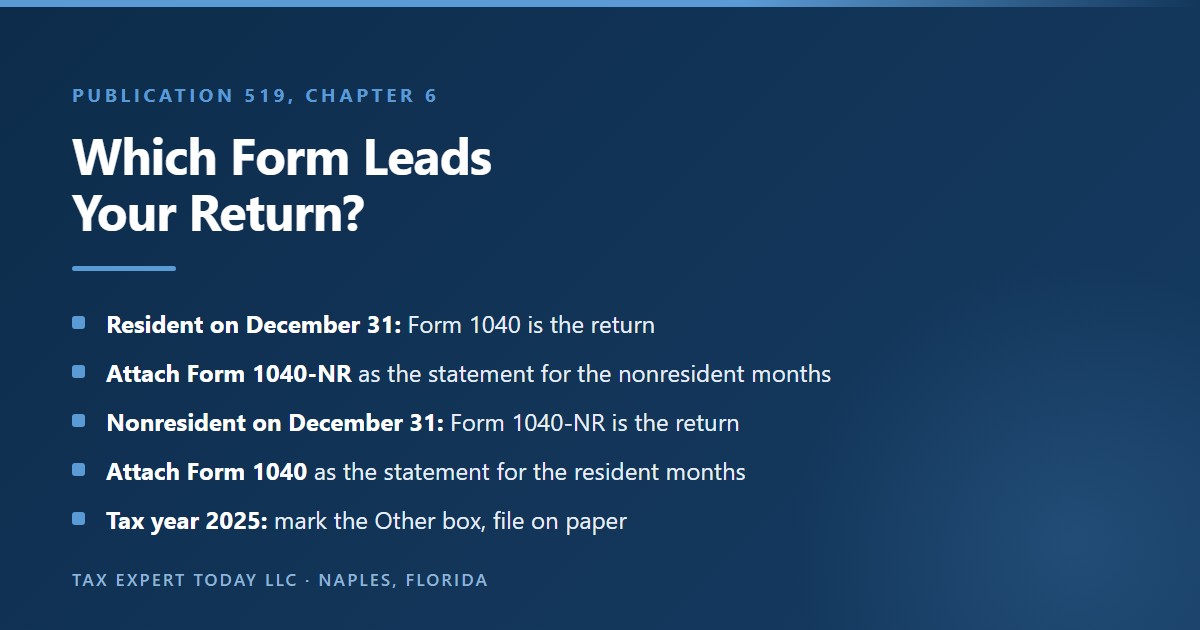
If you were a U.S. resident on December 31, Form 1040 is the dual status tax return and a Form 1040-NR is attached as the statement for the nonresident period. If you were a nonresident on December 31, Form 1040-NR is the return and a Form 1040 is attached as the statement for the resident period.
- Resident at year end: Form 1040 or 1040-SR is the return, marked as a dual status return, with Form 1040-NR attached as the statement.
- Nonresident at year end: Form 1040-NR is the return, marked as a dual status return, with Form 1040 or 1040-SR attached as the statement.
- Only the return is signed. The instructions say not to sign the form used as the statement.
- New for 2025 forms: the label is entered on the line next to the new “Other” checkbox at the top of each form.
| Your status on December 31 | Form filed as the return | Form attached as the statement | Typical situation |
|---|---|---|---|
| U.S. resident | Form 1040 or 1040-SR, labeled “Dual Status Return” | Form 1040-NR, labeled “Dual Status Stmt,” unsigned | Arrival year |
| Nonresident alien | Form 1040-NR, labeled “Dual Status Return” | Form 1040 or 1040-SR, labeled “Dual Status Stmt,” unsigned | Departure year |
| Married, with a section 6013(g) or (h) election | Joint Form 1040 for the full year | Election statement signed by both spouses, not a dual status statement | Either year, if the conditions are met |
The labeling instruction changed for the 2025 tax year. The 2025 edition of Publication 519 tells a filer who is a resident at year end to “check the ‘Other’ checkbox on top of the return and write ‘Dual Status Return’ on the entry line,” and to do the same on the attached Form 1040-NR using “Dual Status Stmt.” It adds a note that “for 2025, the ‘Other’ checkbox was added on Forms 1040, 1040-SR, and 1040-NR.” The Instructions for Form 1040-NR still describe entering “Dual-Status Return” across the top, so a careful return does both: the box is checked and the label is entered where the form now provides space for it.
The structure comes from Treasury Regulation section 1.6012-1(b)(2)(ii), which requires a person who is a resident on the last day of the year to file Form 1040 with “a separate schedule” showing the tax computation for the nonresident part, and a person who abandons residence during the year to file Form 1040NR with a schedule for the resident part, in each case unless a section 6013(g) or (h) election applies. The statement is not a formality. It is where the income for the other period is reported, so it must carry the filer’s name, address, and identifying number and enough detail to show how the income was divided between the two periods. The Instructions for Form 1040-NR direct filers not to sign the Form 1040-NR when it is used as a statement, and Publication 519 explains that the signature on the return also applies to the supporting statements and schedules.
How is income taxed in each part of a dual status year?
Income received during the resident period is taxed from all sources. Income received during the nonresident period is taxed only if it is U.S. source or effectively connected with a U.S. business. Effectively connected income is combined with resident period income at graduated rates, while other U.S. investment income is taxed at 30 percent or a lower treaty rate.
- Resident period: worldwide income, including foreign wages, foreign interest, and foreign dividends received while resident.
- Nonresident period, connected income: U.S. wages and U.S. business income, taxed at the same graduated rates.
- Nonresident period, investment income: U.S. dividends, interest, and similar items not connected with a business, taxed at a flat 30 percent or treaty rate with no deductions.
- Nonresident period, foreign income: generally not taxed, even if it was earned while resident.
The rule turns on when income is received, not when it is earned. Publication 519 states that foreign income received while a resident alien “is taxable even if you earned it while you were a nonresident alien,” and that foreign income received while a nonresident alien that is not effectively connected with a U.S. business “is not taxable even if you earned it while you were a resident alien.” A bonus for work done abroad before the move, paid after the residency starting date, generally falls into the resident period. A final foreign paycheck received before the starting date generally does not.
| Type of income | Received during the nonresident period | Received during the resident period |
|---|---|---|
| Foreign wages and foreign business income | Generally not taxed unless effectively connected with a U.S. business | Taxed at graduated rates |
| U.S. wages and U.S. business income | Effectively connected, taxed at graduated rates | Taxed at graduated rates |
| U.S. dividends and interest not connected with a business | Flat 30 percent or lower treaty rate, no deductions | Taxed at regular rates for residents |
| Foreign dividends and interest | Generally not taxed | Taxed at regular rates for residents |
| U.S. Social Security benefits | 85 percent subject to the flat 30 percent tax unless exempt or reduced by treaty | Taxable portion figured on the Form 1040 worksheet |
| Net investment income tax | Not applicable | May apply to the resident period |
The tax is then computed in two layers. The Instructions for Form 1040-NR explain that all income for the period of residence and all effectively connected income for the period of nonresidence, “after allowable deductions, is combined and taxed at the same rates that apply to U.S. citizens and residents.” Income that is not effectively connected for the nonresident period, the type described in 26 U.S.C. section 871(a), “is generally subject to the flat 30% rate or lower treaty rate,” and “no deductions are allowed against this income.” When Form 1040 is the return, the flat tax on that income is entered on Schedule 2 (Form 1040), line 17o. When Form 1040-NR is the return, it is entered on Form 1040-NR, line 23a.
Social Security creates its own split. Publication 519 explains that during the nonresident period 85 percent of U.S. Social Security benefits is subject to the flat 30 percent tax unless a treaty exempts or reduces it, while benefits received during the resident period are taxed under the ordinary worksheet. The Social Security Administration issues a single Form SSA-1042S for the whole year, so the publication warns that “it is important for you to keep careful records” of which payments came in which period.
Treaties generally apply only to the nonresident part of the year. Publication 519 notes that “generally, tax treaty provisions apply only to the part of the year you were a nonresident,” with exceptions, such as certain students, teachers, and researchers who keep treaty benefits after becoming residents. A reduced treaty rate on U.S. dividends received before the move, for example, does not carry over to dividends received after the residency starting date.
The net investment income tax follows the same divide. The Instructions for Form 1040-NR state that a dual-status taxpayer “may owe this tax for the part of the year you were a U.S. resident,” computed on Form 8960 and carried to Schedule 2. The nonresident period is outside its reach.
What restrictions apply on a dual status tax return?
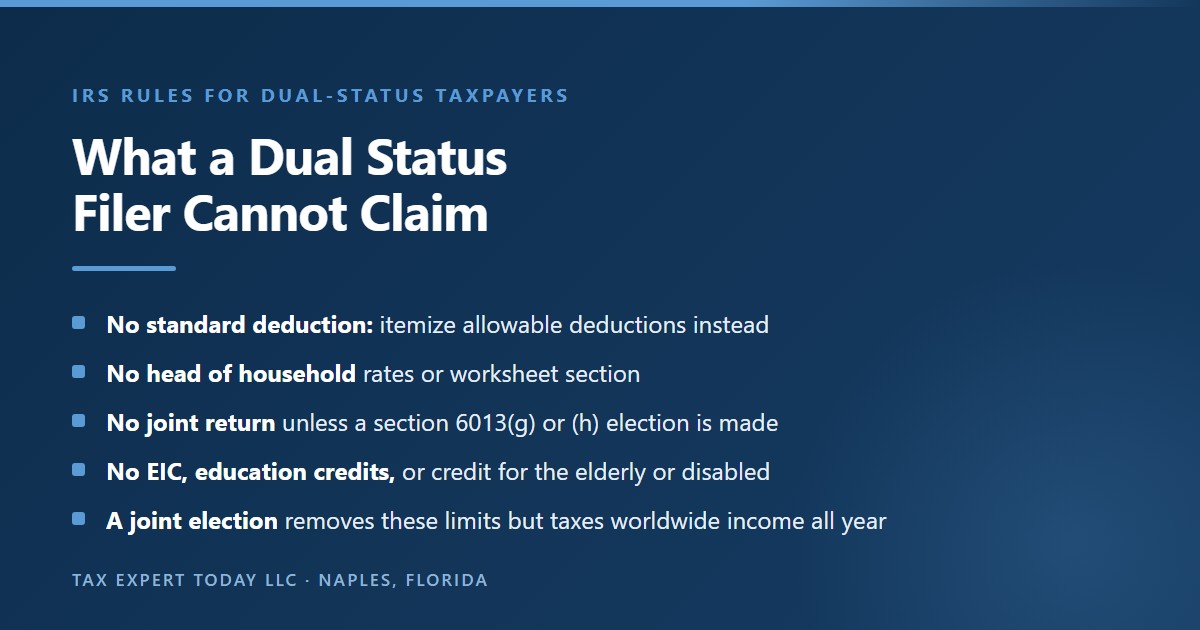
A dual status tax return cannot claim the standard deduction, cannot use head of household rates, and cannot be filed jointly unless an election replaces dual status. Married filers generally use married filing separately rates. The earned income credit, the credit for the elderly or disabled, and the education credits are not available without a joint return election.
- No standard deduction: allowable deductions must be itemized, even for the resident period.
- No head of household: the head of household rate table and worksheet section are off limits.
- No joint return: unless the couple makes a section 6013(g) or 6013(h) election.
- Limited credits: several common credits require a joint return election, and others carry special conditions.
The no standard deduction rule is the restriction that most changes the result. The Instructions for Form 1040-NR state that the standard deduction is not available “even for the part of the year you were a resident alien.” The statutory root is 26 U.S.C. section 63(c)(6)(B), which sets the standard deduction at zero for a nonresident alien individual. A dual status filer can itemize allowable deductions instead, and for the period of residence the instructions say those include “all deductions on Schedule A (Form 1040), including medical expenses, real property taxes, and certain interest.” A new arrival who bought a home in Collier County and paid property tax and mortgage interest after the residency starting date may have meaningful itemized deductions. A new arrival who rents may have very few.
| Item | Dual status tax return | Joint return under a section 6013(g) or (h) election |
|---|---|---|
| Standard deduction | Not allowed, itemize allowable deductions | Allowed |
| Filing status | Single, or married filing separately if married; no head of household | Married filing jointly |
| Income taxed | Worldwide for the resident period, U.S. income for the nonresident period | Worldwide income of both spouses for the entire year |
| Earned income credit, education credits, credit for the elderly or disabled | Not allowed | May be allowed if otherwise eligible |
| Child tax credit | May be allowed with valid SSNs and other conditions | May be allowed with valid SSNs and other conditions |
| Treaty claim to be a nonresident | Possible for the nonresident period | Not allowed for the year of the election |
The filing status rules are narrower than many people expect. Publication 519 explains that a married person who was a nonresident for all or part of the year and does not elect to file jointly must use the married filing separately rates on effectively connected income, and cannot use the single or married filing jointly columns. There is a limited exception for married residents of Canada, Mexico, or South Korea, and married U.S. nationals, who lived apart from their spouse for the last six months of the year.
The credit rules follow the same logic. The IRS page on dual-status individuals states that a nonresident married to a U.S. citizen or resident “may not take the earned income credit, the credit for the elderly or disabled, or an education credit unless you elect to be taxed as a resident jointly with your spouse.” Publication 519 adds that a dual-status alien can generally claim credits under the same rules as resident aliens, subject to those restrictions, and walks through the foreign tax credit, the child and dependent care credit, the saver’s credit, the child tax credit, the credit for other dependents, and the adoption credit, several of which carry their own conditions for married dual-status filers.
Can a married couple avoid a dual status tax return by filing jointly?
Often, yes. A couple can elect under section 6013(h) or 6013(g) to treat the dual status spouse as a resident for the whole year and file one joint Form 1040. The election restores the standard deduction and joint rates, but it taxes both spouses on worldwide income for the entire year.
- Section 6013(h): for a spouse who was a nonresident on January 1 and a resident on December 31, married to a citizen or resident at year end. It applies to that one year and can be used only once.
- Section 6013(g): for a nonresident spouse married to a citizen or resident at year end. It continues into later years until it is suspended or ended.
- Both spouses must agree and sign a statement attached to the joint return.
- The trade-off is worldwide income for the full year, including foreign income from the months before the move.
The two elections are close cousins with different reach. Under 26 U.S.C. section 6013(h), a person who is “a nonresident alien individual at the beginning of any taxable year but is a resident of the United States at the close of such taxable year,” and who is married at year end to a citizen or resident, can elect with the spouse to be treated as a resident “for all of such taxable year.” Subsection (h)(2) adds that two people who use this election “shall be ineligible to make an election under this subsection for any subsequent taxable year.” Publication 519 calls this “Choosing Resident Alien Status” and confirms that “neither you nor your spouse can make this choice for any later tax year, even if you are separated, divorced, or remarried.”
Section 6013(g) is the broader election. It applies when, at the close of the year, a nonresident alien is married to a citizen or resident and both make the election. The IRS page on the nonresident spouse explains how the choice is made, and Publication 519 states that once made it “applies to all later years unless suspended” or ended by revocation, death, legal separation, or inadequate records. It is suspended for any year in which neither spouse is a citizen or resident at any time during the year. If either spouse revokes it, neither can make the choice again.
| Question | Section 6013(h) choice | Section 6013(g) choice |
|---|---|---|
| Who qualifies | A spouse who was a nonresident at the start of the year and a resident at the end, married to a citizen or resident at year end | A spouse who is a nonresident at year end, married to a citizen or resident at year end |
| How long it lasts | The election year only | The election year and later years until suspended or ended |
| Can it be made again | No, only once for the same couple | Not after it has been revoked or otherwise ended |
| Income taxed | Worldwide income of both spouses for the whole year | Worldwide income of both spouses for each year it applies |
| Treaty nonresidence claim | Not available for the year | Not available while the election applies |
| How it is made | Checkbox on Form 1040 plus a statement signed by both spouses | Checkbox on Form 1040 plus a statement signed by both spouses |
Whether either election helps is a computation, not a rule of thumb. The election tends to help when the foreign income for the months before the move was small, when the U.S. spouse has substantial income that benefits from joint brackets, and when credits blocked by dual status, such as education credits, are in play. It tends to cost more when the arriving spouse had large foreign income before the move, such as a foreign bonus, a foreign business sale, or foreign investment gains, because all of it is pulled into the U.S. return. A foreign tax credit on Form 1116 may offset part of the U.S. tax on that foreign income, but the credit has limits and does not always cover the gap.
The election can also be made late. Publication 519 explains that it can be made on an amended joint return filed on Form 1040-X, generally within three years from the date the original return was filed or two years from the date the tax was paid, whichever is later, and that the couple must also amend any returns filed for later years. That is a useful safety valve when a dual status tax return was filed and a joint computation later turns out to be better, but it is a paper-heavy fix and should be modeled before it is made.
What is the first-year choice, and when does it help?
The first-year choice lets a person who arrives late in a year, and meets the substantial presence test the next year, elect to be treated as a resident for part of the arrival year. It requires 31 consecutive days of presence and presence on at least 75 percent of the days from the start of that period through December 31.
- Not a resident in the arrival year or the year before under either residency test.
- A resident under the substantial presence test in the following year.
- 31 consecutive days of presence in the arrival year.
- 75 percent presence from the first of those 31 days through year end, with up to 5 days of absence treated as presence.
The election comes from section 7701(b)(4). It exists for people who move in the autumn and would otherwise be nonresidents for the whole arrival year because they cannot reach 183 weighted days by December 31. Choosing it produces a dual status tax return for the arrival year, with residency starting on the first day of the earliest 31-day period that satisfies the test. Publication 519 illustrates it with a person who arrived on November 1, was present for 31 days in a row, left briefly, and returned on December 17: 46 days of presence out of 61 days in the testing period is 75.4 percent, so the choice was available and residency would start on November 1.
The timing is the unusual part. Section 7701(b)(4)(E) says the election “may not be made before the individual has met the substantial presence test” for the following year. For a person who arrived in late 2025, that test is often not met until mid-2026. Publication 519 says such a person can file Form 4868 to extend the 2025 return to October 15, 2026, should pay with the extension the tax expected “figured as if you were a nonresident alien the entire year,” and can then file once the test has been met. The election statement lists the 31-day period, the days of absence treated as presence, and the number of days present in the following year. Once made, it “may not be revoked without the approval of the IRS.”
Why would anyone choose to be a resident sooner? Usually to make a joint return available. A married person cannot use section 6013(h) unless they are a resident at the end of the year, and the first-year choice can create that resident status for an autumn arrival. It can also matter when a person has U.S. wages in the autumn that would otherwise be reported on a stand-alone Form 1040-NR with nonresident limits. The choice is not right for everyone, because resident status brings worldwide income for the resident period, and potentially FBAR and Form 8938 reporting, into the arrival year.
How do tax treaties and the tie-breaker rule fit in?
Treaty benefits generally apply only to the nonresident period of a dual status year. A separate treaty question arises when a person is a resident of both countries under each country’s law: the treaty tie-breaker may treat them as a nonresident of the United States, which requires Form 1040-NR and a Form 8833 disclosure.
- Reduced treaty rates on U.S. dividends, interest, and pensions generally stop at the residency starting date.
- Student, teacher, and researcher articles in some treaties can continue after a person becomes a resident.
- The tie-breaker can change U.S. residence for computing tax, and Publication 519 notes it can affect the residency termination date.
- Form 8833 discloses a treaty-based return position, including a tie-breaker claim.
A dual status tax return and a treaty tie-breaker claim are different things that are often confused. Dual status is a domestic law result: the person was a nonresident for part of the year and a resident for the rest. A tie-breaker claim is a treaty result: the person is a resident of both the United States and another country at the same time, and the treaty’s residence article assigns them to one country. The Instructions for Form 1040-NR explain that a dual-resident taxpayer who is treated as a resident of the foreign country under a tie-breaker “can be treated as a nonresident of the United States for purposes of figuring out your income tax liability” by filing Form 1040-NR and attaching Form 8833.
The two can interact in a departure year. Publication 519 notes that “claiming residency status under an applicable treaty tiebreaker provision in another country may also lead to a residency termination date that is earlier than December 31.” It also cautions that a long-term resident who is treated as a nonresident under a tie-breaker can trigger the section 877A expatriation rules. Those consequences are serious enough that a tie-breaker position should be considered with the exit tax analysis in our Form 8854 guide and documented as explained in our Form 8833 guide. The IRS page About Form 8833 carries the current form and instructions.
Canadian snowbirds deserve a specific note because they are common in Southwest Florida. A Canadian who stays under 183 days and files Form 8840 never becomes a resident, so there is no dual status year. A Canadian who crosses into residency, for example by obtaining a green card or by staying 183 days or more in a year, may face either a dual status tax return or a tie-breaker claim under Article IV of the Canada-United States treaty, depending on the facts. Our Form 8840 guide explains what happens in the year the closer connection exception is no longer available.
Which credits and payments carry across the two periods?
Tax withheld in either period, estimated tax payments, and tax paid with a departure permit are all credited on the dual status tax return. The foreign tax credit may be available on Form 1116, and the amounts from the attached statement are carried onto the return so the full year’s payments are counted once.
- Withholding from both periods: including Form W-2 wages and tax withheld at source on Form 1042-S.
- Estimated tax: paid with Form 1040-ES or Form 1040-ES (NR).
- Form 1040-C payments: tax paid when obtaining a departure permit.
- Foreign tax credit: generally claimed on Form 1116 for foreign tax on income taxed by the United States.
The Instructions for Form 1040-NR spell out how the two forms talk to each other. When Form 1040 is the return, the total tax withheld is shown on Form 1040, line 25d, and the amounts from the attached Form 1040-NR statement (lines 25d through 25g) are entered “in the space to the right of line 25d” and included in the line 25d total. When Form 1040-NR is the return, the process runs the other way, with the withholding from the attached Form 1040 carried onto the Form 1040-NR. Tax paid with Form 1040-C is included in total payments and identified to the left of the entry.
Withholding during the nonresident period often comes from Form 1042-S, which reports U.S. income paid to a foreign person and the tax withheld at source. Our Form 1042-S guide for recipients explains how that withholding is claimed and what to do if a treaty rate should have applied. A Form W-8BEN given to a bank or broker before the move should also be replaced once the person becomes a resident, because the certificate of foreign status is no longer accurate after the residency starting date.
The foreign tax credit is frequently the largest moving part. Publication 519 states that a dual-status filer who paid or accrued foreign income tax on foreign income “may be able to claim a credit for the foreign taxes,” generally by filing Form 1116. The credit is limited to the U.S. tax on the foreign income that the U.S. actually taxes, which in a dual status year is mostly foreign income received during the resident period. Our Form 1116 guide covers the limitation, and our guide to the foreign earned income exclusion versus the credit explains why the exclusion is rarely useful in an arrival year, since it depends on a foreign tax home and qualifying time abroad.
Do FBAR and Form 8938 rules apply in a dual status year?
They can. Form 8938 applies to a resident alien for any part of the year, with a reporting period limited to that part of the year. The FBAR rule borrows the federal tax definition of resident, so a person who became or stopped being a resident during the year should test the FBAR requirement for that year.
- Form 8938: a resident alien for any part of the tax year is a specified individual, and the reporting period is that part of the year.
- Dual-resident treaty filers: the Form 8938 instructions describe a special rule for the part of the year covered by a treaty-based nonresident computation.
- FBAR: a resident of the United States for FBAR purposes is a resident alien under section 7701(b), with a different definition of the United States.
- Missed filings: correcting late reports follows the procedures for delinquent information returns, not the dual status return itself.
The Instructions for Form 8938 list “a resident alien of the United States for any part of the tax year” as a specified individual, and they add an exception for partial years: “If you are a specified individual for less than the entire tax year, the reporting period is the part of the year that you are a specified individual.” In a dual status year, that generally means the foreign financial assets held during the resident period are tested against the Form 8938 thresholds. The difference between that form and the FBAR is explained in our FBAR versus Form 8938 guide.
The FBAR works from a different statute. The FinCEN rule at 31 CFR 1010.350(b)(2) defines a resident of the United States as “an individual who is a resident alien under 26 U.S.C. 7701(b) and the regulations thereunder,” using the Bank Secrecy Act definition of the United States. How that definition applies to account balances held before a residency starting date or after a termination date is a fact-specific question, and anyone who had foreign accounts with an aggregate balance above $10,000 during a year of arrival or departure should have the requirement reviewed. The threshold rules are in our FBAR filing guide.
Missing these forms in an arrival year is common, because a new resident’s foreign accounts are usually ordinary bank and pension accounts that do not feel like anything to report. The consequences are covered in our FBAR penalties guide, and the steps for late reports are in our guide to filing a late FBAR. Where income from those accounts was also left off a return, the Streamlined Filing Compliance Procedures may be relevant, but only where the failure was non-willful, because the program requires a certification of non-willful conduct under penalties of perjury.
When is a dual status tax return due, and can it be e-filed?
A dual status tax return for 2025 must be filed on paper; Publication 519 states that dual-status taxpayers cannot e-file for that year. It is generally due April 15 if you were a resident at year end or had U.S. wages subject to withholding, and June 15 if you were a nonresident at year end without such wages.
- Paper only for 2025: the return and the attached statement are mailed together.
- April 15: residents at year end, and nonresidents at year end with wages subject to withholding.
- June 15: nonresidents at year end without wages subject to withholding.
- Extensions: Form 4868 extends the time to file to October 15 for calendar year filers, not the time to pay.
| Situation for the 2025 tax year | Regular due date | Mail to, if not enclosing a payment |
|---|---|---|
| Resident on December 31, 2025 (Form 1040 is the return) | April 15, 2026 | Department of the Treasury, Internal Revenue Service, Austin, TX 73301-0215 |
| Nonresident on December 31, 2025, with wages subject to withholding | April 15, 2026 | Department of the Treasury, Internal Revenue Service, Austin, TX 73301-0215 |
| Nonresident on December 31, 2025, without wages subject to withholding | June 15, 2026 | Department of the Treasury, Internal Revenue Service, Austin, TX 73301-0215 |
| Any of the above, enclosing a payment | Same as above | Internal Revenue Service, P.O. Box 1303, Charlotte, NC 28201-1303 |
| First-year choice not yet available by April 15, 2026 | Extend with Form 4868 and file once the test is met | Same addresses |
The e-file restriction is easy to miss because almost every other individual return is filed electronically. The 2025 edition of Publication 519 states in its Forms To File section: “Dual-status taxpayers cannot e-file their U.S. income tax return for tax year 2025.” The Instructions for Form 1040-NR also note that paid preparers, who must generally e-file Form 1040-NR, are excepted when “filing for a dual-status taxpayer.” Commercial software that assumes electronic filing may produce a return that looks complete but cannot be transmitted, and a return printed from that software still needs the dual status labeling, the attached statement, and any residency statements assembled by hand.
The mailing addresses above come from the Instructions for Form 1040-NR section on what and where to file for a dual-status year, as current for the 2025 forms. Addresses and dates should be confirmed against the instructions for the year being filed, and if a due date falls on a weekend or legal holiday, the return is due the next business day. Florida has no personal income tax, so a person moving to Naples, Florida generally has no state return to coordinate, but a person moving from or to another state may have a part-year state return as well.
What does a dual status tax return look like for a move to Naples, Florida?
For a typical arrival, the months before the residency starting date go on a Form 1040-NR statement showing only U.S. income, the months after go on a Form 1040 showing worldwide income, and the two are combined into one paper return with itemized deductions and the tax computed in two layers.
- Fix the starting date first, including any statement excluding up to 10 days of earlier visits.
- Sort every income item by the date received, not the date earned.
- Decide on any election before preparing the return, because a joint election replaces the dual status computation.
- Check the information returns for the resident period, including Form 8938 and the FBAR.
Consider a hypothetical engineer from Germany who visits Naples, Florida for a job interview from February 2 to February 6, 2025, then moves on June 1, 2025 on a work visa and stays for the rest of the year. The engineer is present for 219 days in 2025, the 214 days from June 1 through December 31 plus the 5 days in February, which meets the substantial presence test without any prior year days. Without a statement, the residency starting date would be February 2. With a properly filed statement showing a German tax home and closer connection during the February visit, those five days are disregarded and the starting date becomes June 1.
The engineer’s income then sorts as follows. German salary received from January through May is foreign income received while a nonresident and is generally not taxed by the United States. A German bonus for 2024 work paid in July is foreign income received while a resident and is taxed, with a possible foreign tax credit for German tax on it. U.S. wages from June onward are taxed at graduated rates. Interest on a German savings account credited in December is taxed. The return is a paper Form 1040 marked “Dual Status Return” with a Form 1040-NR statement for January through May. The standard deduction is not available, so property tax, mortgage interest, and charitable gifts paid after June 1 are worth tracking. If the engineer is married to a U.S. citizen, the couple should compare that result with a joint return under section 6013(h), which would pull the German salary from January through May onto the U.S. return as well. Whether Social Security and Medicare tax applies to the salary after the move is a separate question, answered by the U.S.-Germany totalization agreement and its certificate of coverage rules.
A departure looks different. Consider a hypothetical green card holder who has lived in Naples for six years, files a record of abandonment of lawful permanent resident status with the green card attached on August 31, 2025, and moves to Brazil with no plan to return. If the person keeps a Brazilian tax home and closer connection for the rest of 2025 and is not a resident in 2026, the residency termination date can be the first day the person was no longer a lawful permanent resident, supported by the required statement and documents. The return is a paper Form 1040-NR marked “Dual Status Return” with a Form 1040 statement for January through August. Six years is short of the eight-year long-term resident threshold, so Form 8854 would generally not apply, but a person with eight or more years in green card status in the last fifteen should review the exit tax rules before surrendering the card. If the person sells a Naples home after leaving, the sale may be subject to FIRPTA withholding as a foreign seller.
What are the most common dual status tax return mistakes?
The most common mistakes are filing a full-year Form 1040 or Form 1040-NR instead of a dual status tax return, claiming the standard deduction, using the wrong residency dates, skipping the statements that support those dates, and attempting to e-file. Each can change the tax owed or the filing position.
- Wrong form: a full-year resident or nonresident return for a year that was split.
- Standard deduction claimed: commonly generated by software that does not know the year was dual status.
- Dates assumed, not established: missing statements for the 10-day exclusion or the earlier termination date.
- Information returns forgotten: Form 8938, the FBAR, Form 8854, and foreign ownership forms in the resident period.
| Mistake | Why it matters | What to check |
|---|---|---|
| Filing a full-year Form 1040 in an arrival year | Taxes foreign income from before the residency starting date | Whether a dual status tax return or a joint election fits the facts |
| Filing a full-year Form 1040-NR in a departure year | Leaves out worldwide income for the resident months | The residency termination date and the supporting statement |
| Claiming the standard deduction | Not allowed on a dual status tax return | Allowable itemized deductions, or a joint return election |
| No statement for the 10-day exclusion | The starting date may move back to the first visit | Dates of each visit and the foreign tax home on those days |
| Keeping a green card after moving abroad | Residency generally continues for tax purposes | Whether status was formally abandoned or rescinded, and when |
| Attempting to e-file the 2025 return | Dual-status returns cannot be e-filed for 2025 | Paper filing, labeling, and the correct mailing address |
| Ignoring Form 8938 and the FBAR | Information returns may be required for the resident period | Foreign account balances and asset values by period |
Software is a frequent source of these errors. Consumer programs are designed for full-year residents, and many either do not support a dual status tax return or require manual overrides that are easy to miss. The safest approach is to build the return from the residency dates outward: establish the dates, sort the income, decide on elections, compute the tax in two layers, then assemble the paper return with the statements attached.
What if you already filed the wrong return for a dual status year?
A return filed on the wrong basis can generally be corrected with an amended return, and a joint return election can sometimes be made late on an amended joint return. Missing residency statements are harder, because the IRS may hold you to the default dates unless reasonable steps to comply can be shown by clear and convincing evidence.
- Amended return: generally on Form 1040-X, with the corrected dual status return and statement attached.
- Late joint election: generally within three years of filing or two years of payment, whichever is later.
- Later years: a late election requires amending any later returns already filed.
- Penalties: late payment and accuracy penalties may follow, and relief depends on the facts.
The most common correction is a new arrival who filed a full-year Form 1040 with the standard deduction and all foreign income for the year. Depending on the numbers, the corrected dual status tax return may show more tax, because the standard deduction is lost, or less tax, because foreign income from before the move comes off. Either way, the amended return should rebuild the year from the residency dates rather than adjusting single lines.
The statements are the harder problem. Publication 519 explains that if the statement for the 10-day exclusion or the earlier termination date is not filed, “you cannot claim that you have a closer connection to a foreign country,” unless you can show by clear and convincing evidence that you took reasonable actions to become aware of the requirement and significant steps to comply. That standard is demanding, so the statements should be prepared with the original return whenever possible.
If an amended return shows additional tax, interest generally runs from the original due date and penalties may apply. Our guide on how IRS penalties may be removed explains the relief that may be available, which depends on the specific facts and is never assured.
Dual Status Tax Return Help in Naples & Southwest Florida
Tax Expert Today LLC works with international clients from an office in Naples, Florida and serves clients in all 50 states. Southwest Florida draws people in both directions: professionals relocating from Europe, Canada, and Latin America for work, retirees who become residents after years of seasonal visits, families who receive green cards through a U.S. spouse, and green card holders returning to their home countries.
- Dual status tax return help Naples: fixing residency starting and termination dates and preparing the supporting statements.
- International tax Naples FL: sorting income by period, applying treaty rates to the nonresident months, and computing the two-layer tax.
- Dual status alien tax Naples: comparing a dual status tax return with a joint return under section 6013(g) or 6013(h).
- Foreign tax Naples: coordinating Form 1116, Form 8938, the FBAR, and Form 8854 with the arrival or departure year.
Our international and expat tax services page explains how we approach arrival and departure years for people moving to or from the United States, and our Naples tax planning page covers broader planning for Southwest Florida residents.
Office: 11983 Tamiami Trail N, Naples FL 34110
Phone: (239) 441-2005
Hours: Monday through Friday, 10:00 to 5:00 ET
Frequently Asked Questions
I moved to Naples from Europe in the middle of the year. Do I file a dual status tax return?
Usually, yes, if you became a resident during the year under the green card test or the substantial presence test and were not a resident the year before. You would file Form 1040 marked as a dual status return with a Form 1040-NR statement for the months before your residency starting date, unless a joint return election applies.
Is a dual status tax return the same as being a dual citizen?
No. Dual status refers only to U.S. tax residency changing during one year. A dual citizen who holds a U.S. passport is a U.S. citizen for tax purposes all year and files an ordinary Form 1040. Dual status applies to people who are not U.S. citizens and who arrived in or left the United States during the year.
Can I take the standard deduction on a dual status tax return?
No. The IRS instructions state that a dual-status filer cannot take the standard deduction, even for the part of the year spent as a resident. Allowable itemized deductions can be claimed instead. A married couple that elects under section 6013(g) or 6013(h) files a joint return for the full year and can use the standard deduction.
Can I e-file a dual status tax return?
Not for tax year 2025. Publication 519 for 2025 states that dual-status taxpayers cannot e-file their U.S. income tax return for that year. The return and the attached statement are filed on paper, with the “Other” checkbox marked and the dual status label entered at the top of each form, and mailed to the address in the instructions.
Do I need to file a statement to use a June arrival date if I visited in February?
Generally, yes. Under the substantial presence test, residency starts on your first day of presence in the year. Up to 10 days of earlier presence can be disregarded only if you file a signed statement showing a foreign tax home and closer connection on those days. Without it, the starting date generally moves back to the first visit.
When does my residency end if I leave the United States and keep my green card?
Generally, it does not end. Residency under the green card test continues until lawful permanent resident status is rescinded or formally determined to have been abandoned. A green card holder who moves abroad and keeps the card is usually still a resident for tax purposes. Long-term holders should also review Form 8854 before ending status.
When to Engage a Professional
A dual status tax return is one of the few individual returns that still has to be assembled by hand. The residency dates, the statements that support them, the split of every income item by date received, the two-layer tax computation, the carryover of withholding between forms, and the comparison with a joint return election all have to be right together. A mistake in the dates changes every number that follows.
A professional review is worth considering if you moved to or from the United States during the year, if you visited before your move, if you are married to a U.S. citizen or resident and want to compare filing jointly, if you received a bonus, sale proceeds, or investment income from abroad around the time of your move, if you hold or held a green card while living abroad, or if you have foreign accounts or assets that may trigger Form 8938 or the FBAR. The right time to plan is before the end of the year of the move, when the dates and the elections can still be shaped.
Tax Expert Today LLC is a tax advisory firm in Naples, Florida serving clients in all 50 states. Call (239) 441-2005 to discuss your facts.
This article is general information, not advice for any particular taxpayer, and does not create a client relationship. The examples are hypothetical illustrations only and do not describe any client. The rules described here reflect the 2025 edition of Publication 519, the 2025 Instructions for Form 1040-NR and Form 8938, the IRS guidance on dual-status individuals, and the Code and regulations as of the date of writing. Residency dates, treaty positions, and elections depend on the specific facts. Verify current rules and confirm your own facts with a qualified tax professional before filing or making an election.
Published October 5, 2026 by Dr. Pellumb Kabashi « Back to Learning Center
Have a question this article touches on?
Tax Expert Today LLC, based in Naples, Florida and serving clients across the United States.
Schedule a Consultation (239) 441-2005