
By Dr. Pellumb Kabashi, DBA, MBA, EA, CFE, CES
Founder, Tax Expert Today LLC · Tax advisors, enrolled agents, CPAs, and attorneys · Serving clients in all 50 states
Quick Answer
The foreign earned income exclusion lets a qualifying U.S. taxpayer abroad exclude up to $132,900 of foreign wages in 2026, or $130,000 for 2025. The foreign tax credit instead offsets U.S. tax with foreign tax already paid. The exclusion usually wins in a low-tax country, and the credit usually wins where a refundable child credit or self-employment relief is at stake. Call (239) 441-2005 for a free consultation.
What is the foreign earned income exclusion?
The foreign earned income exclusion is an election under Internal Revenue Code section 911 that removes a capped amount of foreign wages and self-employment income from U.S. taxable income. It applies only to compensation for services performed outside the United States, only for a qualified individual with a foreign tax home, and only when the taxpayer files Form 2555 with the return.
- It is an election, not an automatic benefit. Nothing is excluded until Form 2555 is attached to a filed return.
- It reaches earned income only. Dividends, interest, capital gains, rent, and pension income are outside section 911 entirely.
- It requires a foreign tax home. A U.S. employee on a short foreign assignment who keeps a U.S. abode generally does not qualify.
- It does not remove the filing obligation. A U.S. citizen abroad files a U.S. return on worldwide income whether or not the exclusion zeroes out the tax.
A taxpayer who reports foreign accounts alongside foreign wages should keep the two regimes separate. The exclusion is an income tax election. The account reports are a Bank Secrecy Act obligation covered in our guide on whether you need to file an FBAR.
How much foreign income can I exclude in 2026?
For tax years beginning in 2026 the exclusion amount under section 911(b)(2)(D)(i) is $132,900, set by Revenue Procedure 2025-32. For 2025, the return most expatriates are filing now, the amount is $130,000. Married spouses who each qualify may each claim a full exclusion against their own earned income, so a qualifying couple can reach twice the single figure.
| Item | Tax year 2025 | Tax year 2026 |
|---|---|---|
| Maximum exclusion per qualifying individual | $130,000 | $132,900 |
| Authority for the amount | Rev. Proc. 2024-40, sec. 3.39 | Rev. Proc. 2025-32, sec. 3.39 |
| Maximum for two qualifying spouses | $260,000 | $265,800 |
| Housing expense limit, most locations | $39,000, or $106.85 per day | Set by the annual IRS notice |
| Form used to claim | Form 2555 | Form 2555 |
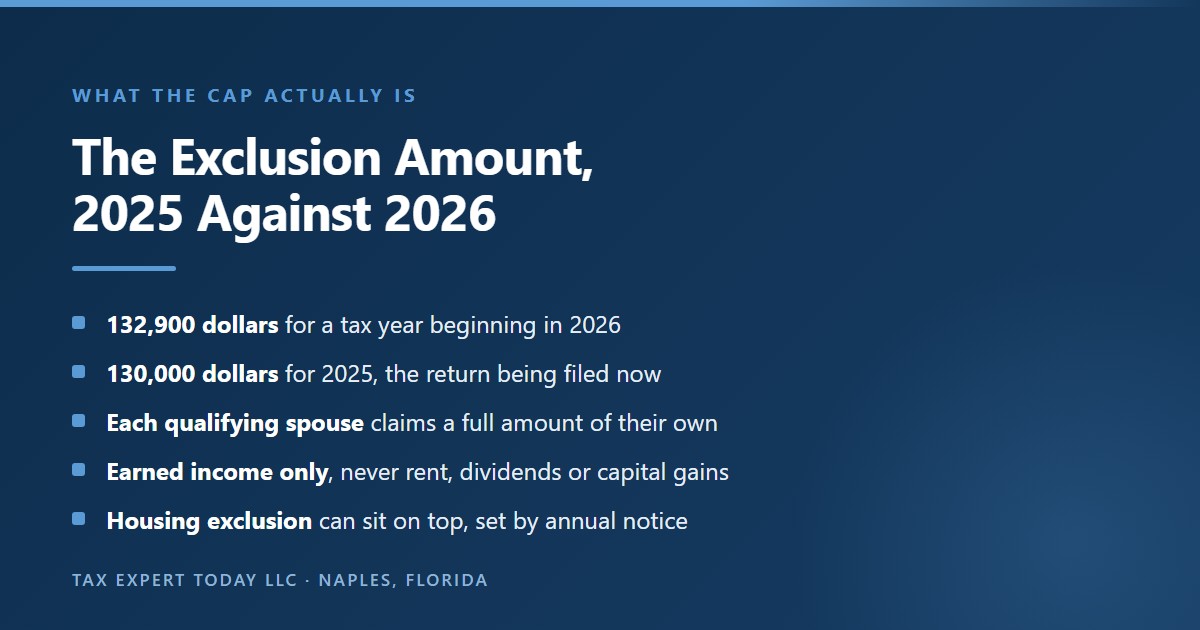
A separate foreign housing exclusion can sit on top of the earned income figure. The housing limit is generally computed as a percentage of the exclusion amount and then adjusted upward for high-cost locations in an annual IRS notice, which was Notice 2025-16 for 2025. A taxpayer whose city appears on that list should check it rather than assume the general limit applies.
What is the foreign tax credit, and how is it different?
The foreign tax credit under sections 901 and 904 is not an exclusion. The foreign income stays on the U.S. return in full, and the foreign income tax already paid on it becomes a dollar-for-dollar credit against the U.S. tax. The credit is claimed on Form 1116 and is limited to the U.S. tax attributable to foreign source income.
- The income remains in the return. That single difference drives most of the outcomes described below.
- The credit is capped by a limitation. Section 904(a) caps it at the U.S. tax multiplied by the ratio of foreign source income to total income.
- Unused credits do not vanish. Section 904(c) carries excess foreign taxes back one year and forward up to ten.
- It reaches beyond wages. Foreign tax on investment and rental income can generate credit, which the exclusion never can.
Because the credit depends on foreign tax actually paid, it does very little in a jurisdiction that imposes no income tax on wages. A taxpayer working in the United Arab Emirates or a similar no-tax jurisdiction has nothing to credit, and the exclusion is usually the only meaningful relief available. Where the credit route is chosen, the computation itself runs on Form 1116, one form for each category of foreign income.
Which is better, the foreign earned income exclusion or the credit?
Neither is better in the abstract. The exclusion generally wins where the foreign tax rate is below the U.S. rate and the household claims no refundable credits. The credit generally wins where the foreign tax rate is at or above the U.S. rate, where children make the refundable child credit valuable, or where income exceeds the exclusion cap.
| Fact pattern | Usually favors | Why |
|---|---|---|
| Low-tax or no-tax country, no children | Exclusion | Little or no foreign tax exists to credit |
| High-tax country such as Germany or the United Kingdom | Credit | Foreign tax often exceeds the U.S. tax, and the excess carries forward |
| Qualifying children and modest income | Credit | The exclusion bars the refundable additional child tax credit |
| Earned income well above the cap | Credit, or both | The exclusion leaves the excess fully taxable at unreduced rates |
| Investment or rental income carrying foreign tax | Credit | Section 911 does not reach unearned income |
| Self-employed contractor abroad | Depends | Neither one reduces self-employment tax |
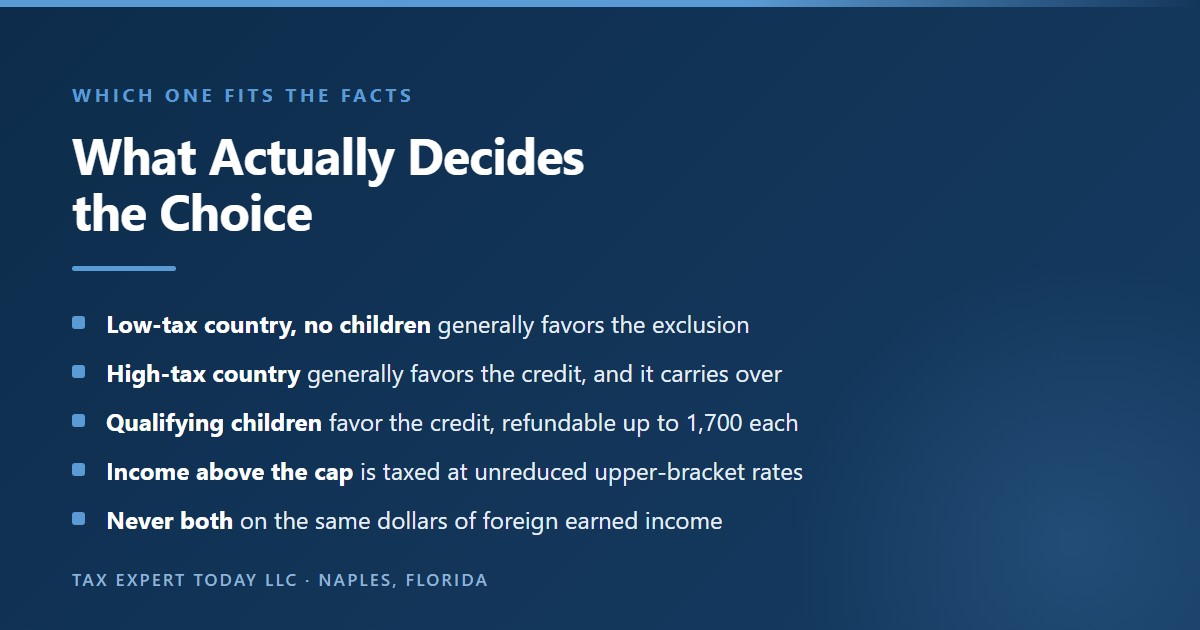
The two are not mutually exclusive across an entire return. What is prohibited is claiming both benefits on the same dollars. The Form 2555 instructions state that a taxpayer cannot take a credit or deduction for foreign income taxes paid on income excluded under section 911, and where only part of the income is excluded, the foreign taxes must be allocated so that only the taxes on the non-excluded portion generate credit.
Does the exclusion stop me from claiming the child tax credit?
It stops the refundable part. The Form 2555 instructions state plainly that a taxpayer cannot take the additional child tax credit when claiming either exclusion or the housing deduction. The same bar applies to the earned income credit. For 2026 the refundable amount is up to $1,700 per qualifying child, so the cost of the election rises with family size.
- The refundable credit is the casualty. Excluding the income removes the earned income the refundable computation depends on.
- The loss scales with children. On three qualifying children the forgone refundable amount can reach $5,100 for 2026 at $1,700 each.
- The credit route preserves it. Under Form 1116 the wages stay in the return, so the earned income needed for the refundable credit is still there.
- The earned income credit is barred too. The exclusion and the earned income credit cannot be combined on the same return.
This is the single most expensive miscalculation we see in expatriate returns. A family in a low-tax country reads that the exclusion wipes out the U.S. tax, elects it, and never notices that a refund the credit route would have produced is gone. Where the U.S. tax is already near zero, the exclusion buys very little and can cost several thousand dollars of refundable credit.
Do I still pay self-employment tax if I claim the exclusion?
Generally yes. Publication 54 states that for a self-employed U.S. citizen or resident the rules for paying self-employment tax are generally the same whether the person lives in the United States or abroad. A qualifying contractor files Schedule SE together with Form 2555, so the exclusion removes income tax exposure while the Social Security and Medicare component survives.
- Section 911 is an income tax provision. It does not reach the self-employment tax imposed on net earnings.
- Schedule SE still goes in. The exclusion appears on Form 2555 while the self-employment tax runs on its own schedule.
- Estimated payments still matter. A contractor expecting to qualify should fund the self-employment tax through estimates rather than assume the exclusion covers it.
- A totalization agreement is the separate route. Relief from dual social security coverage comes from an agreement between the two countries, not from section 911.
The practical consequence is that an incorporated or self-employed expatriate can show zero income tax and still owe a substantial balance. That surprise is common enough that it should be modeled before the first estimated payment of the year, not discovered at filing.
Can I switch from the exclusion to the foreign tax credit later?
Switching away is costly and close to irreversible. Section 911(e) provides that an election applies to the year made and to all later years unless revoked, and that a taxpayer who revokes may not elect again before the sixth taxable year after the revocation year without the consent of the Secretary. The Form 2555 instructions put it as a bar on the next five tax years without IRS approval.
- The election is sticky by design. It carries forward automatically, with no annual re-election required.
- Revocation is a written statement. The taxpayer attaches it to the return for the first year the exclusion is not wanted.
- The lockout is five tax years. Re-electing inside that window requires IRS consent, which is obtained through a private ruling and is not routine.
- A year with no foreign income is not a revocation. The instructions confirm there is no need to revoke merely because there is no foreign earned income that year.
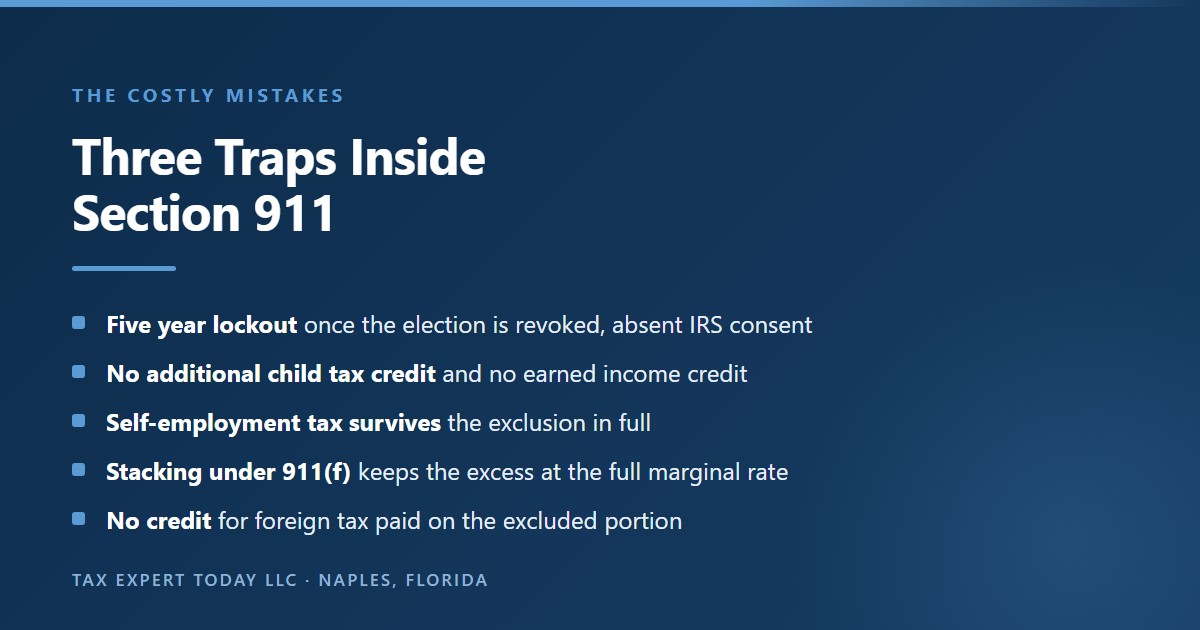
This is why the choice deserves modeling in the first qualifying year rather than the third. A taxpayer who elects the exclusion, moves to a high-tax country two years later, and then wants the credit is facing a five-year wait or a ruling request. Running both computations once, at the start, is far cheaper than unwinding the election afterward.
Does excluded income still push me into a higher bracket?
Yes. Section 911(f) requires the tax on income that is not excluded to be computed at the rates that would have applied had no exclusion been claimed. The excluded amount is stacked underneath, so it consumes the lower brackets. The result is that income above the cap is taxed at the taxpayer’s full marginal rate rather than starting again at the bottom.
- The Foreign Earned Income Tax Worksheet does the work. It sits in the Form 1040 instructions and produces the figure for the tax line.
- Alternative minimum tax follows the same rule. A parallel worksheet appears in the Form 6251 instructions.
- The cap is not a bracket reset. Earning $200,000 abroad in 2026 leaves roughly $67,100 taxed at upper-bracket rates, not at the lowest.
- Deductions must be allocated. Deductions definitely related to excluded income are disallowed to that extent.
Do I qualify? Bona fide residence or physical presence
Section 911(d)(1) requires a tax home in a foreign country plus one of two tests. The bona fide residence test asks for residence in a foreign country for an uninterrupted period that includes an entire taxable year. The physical presence test asks for at least 330 full days in a foreign country during any period of twelve consecutive months.
| Bona fide residence test | Physical presence test | |
|---|---|---|
| Who may use it | U.S. citizens, and resident aliens from a treaty country | U.S. citizens and resident aliens |
| Period measured | An uninterrupted period including a full taxable year | Any twelve consecutive months |
| Day count | No fixed count, intent and facts govern | 330 full days abroad |
| Brief U.S. trips | Permitted if residence is not abandoned | Each day in the United States reduces the count |
| Best for | A settled move with no fixed end date | A mobile or first partial year abroad |
The tax home condition does the quiet work in both tests. A taxpayer whose abode remains in the United States can fail on the tax home requirement even after 330 days abroad. Residency questions of this kind overlap with the rules explained in our guide to the substantial presence test, which runs in the opposite direction and asks when a foreign national becomes a U.S. tax resident.
What if my qualifying period straddles two tax years?
That is the ordinary case in a move year, and Form 2350 exists for it. A taxpayer who will not satisfy the bona fide residence test or the physical presence test by the normal due date can request an extension of time to meet the residency tests, granted generally for 30 days beyond the date the taxpayer can reasonably expect to qualify.
- An automatic two-month extension already applies. Where both the tax home and the abode are outside the United States and Puerto Rico on the regular due date, a calendar-year return is due June 15.
- A statement must be attached. Publication 54 requires a statement with the return explaining which situation qualified the taxpayer for that automatic extension.
- Four more months are available. A taxpayer who cannot file by June 15 can generally reach October 15, for six months in total.
- Form 2350 is the different one. It is filed by the due date of the return and buys time to finish qualifying, not merely time to file.
- Interest runs regardless. An extension of time to file is never an extension of time to pay, and interest accrues from the regular due date.
The practical sequence matters. A taxpayer who leaves the United States in August has no chance of reaching 330 full days inside that calendar year, but the twelve-month measuring period does not have to align with the tax year. Counting forward into the following summer can produce a qualifying period that supports a partial-year exclusion for the year of departure, prorated over the days of the qualifying period falling inside it.
Filing before that count is complete is how the election gets made on facts that have not happened yet. Form 2350 is the mechanism that avoids it, and the Form 2555 instructions confirm the initial choice is normally made on a timely filed return, including extensions, or on a return amending a timely filed one. The same timing discipline applies in reverse on the way home, where the qualifying period ends mid-year and the exclusion is again prorated.
What else does electing the exclusion change on my return?
More than most filers expect. Beyond the barred refundable credits, the election reaches the individual retirement account deduction, the deductions attributable to excluded income, and the foreign taxes that would otherwise have supported a credit. Each of these is a downstream consequence of removing the income from the return rather than offsetting the tax on it.
- The IRA deduction changes. The Form 2555 instructions state that special rules apply in figuring the deduction when either exclusion is claimed, with the detail in Publication 590-A.
- Related deductions are disallowed. Deductions definitely related to excluded income, including the deductible part of self-employment tax attributable to it, are not allowed to that extent.
- Foreign taxes on excluded income are lost. Where the whole of the foreign earned income is excluded, no credit or deduction is available for the foreign tax paid on it.
- Partial exclusion requires allocation. Where only part is excluded, only the foreign taxes allocable to the non-excluded portion can generate credit.
- Alternative minimum tax follows the same path. A separate worksheet in the Form 6251 instructions applies the stacking rule for AMT purposes.
Two further points are worth separating from the election itself. The exclusion is an income tax provision and has no effect on information reporting, so a taxpayer whose United States tax reaches zero through Form 2555 may still owe foreign account and foreign entity filings. Anyone holding an interest in a foreign company should read that alongside our guide to Form 5471 and foreign corporations, and anyone with unfiled foreign account reports should look at filing a late or delinquent FBAR before assuming the exclusion resolved the year.
Second, a treaty can change the analysis independently of section 911. Where a treaty provision overrides the ordinary domestic result, the position may itself have to be disclosed, which is the subject of our guide to Form 8833 and treaty-based return positions. A taxpayer on the receiving end of United States source payments while abroad should also understand the withholding certificate described in our guide to Form W-8BEN, because a mismatch there produces over-withholding the exclusion cannot recover.
Can my spouse and I use different methods?
Yes, because the election is individual rather than joint. Each spouse must qualify in their own right, with their own tax home and their own satisfied residence or presence test, and the Form 2555 instructions direct spouses who both qualify and both choose to claim the exclusion to figure their amounts separately against their own earned income.
- Qualification is not shared. One spouse meeting the 330-day count does nothing for the other, who must meet a test independently.
- The cap is per person. Neither spouse can absorb the other’s unused exclusion, so an uneven split of earnings wastes part of the combined ceiling.
- Housing amounts are figured separately. Spouses sharing one foreign household may allocate expenses between them, provided nothing is counted twice.
- Different methods are possible. Nothing requires both spouses to land on the same answer where their facts genuinely differ.
- The credit is still barred on excluded dollars. A spouse who excludes cannot then credit the foreign tax on that same income.
The mixed case is common in practice. One spouse is on a local employment contract in a high-tax country while the other earns modestly or works remotely for a United States employer. Running one return on the credit and the other on the exclusion is sometimes the correct answer, and it is rarely what a single software prompt produces.
What records should I keep to support the election?
Enough to reconstruct the tax home and the day count years later. The physical presence test turns on a countable number of full days abroad, and the tax home condition turns on facts about where the taxpayer’s regular place of business and abode actually sat. Both are ordinarily examined long after the year in question.
- A contemporaneous travel log. Entry and exit dates for every trip, recorded as they happen rather than reconstructed from memory.
- Passport stamps and boarding passes. The independent corroboration that makes a self-prepared log credible.
- Housing evidence abroad. A lease, utility accounts, and local registrations that show an established abode rather than a hotel stay.
- Employment documents. A contract showing an indefinite rather than temporary foreign assignment supports the tax home position.
- Evidence about the United States abode. What happened to the former home matters, because retaining one available for use undercuts the tax home condition.
A full day means a complete 24-hour period, so partial travel days generally do not count toward the 330. That detail decides close cases more often than any other, and it is the reason a taxpayer sitting near the line should be counting before the twelve-month window closes rather than at filing. Where the count will not be reached, the treaty and credit routes remain available, and the analysis moves to the material covered above rather than ending.
Foreign Earned Income Exclusion Help in Naples & Southwest Florida
Tax Expert Today LLC works with expatriates, dual citizens, and cross-border households from an office in Naples, Florida, and serves clients in all 50 states. Southwest Florida is a heavily international market, and the fact patterns we see most often are Florida-domiciled citizens working abroad, returning expatriates with a partial qualifying year, and self-employed contractors who expected the exclusion to cover their self-employment tax.
- Expat tax Naples FL: side-by-side modeling of Form 2555 against Form 1116 before the election is locked in.
- Foreign tax Naples: allocation of foreign taxes where only part of the wages are excluded.
- Partial-year arrivals and departures: testing whether the 330-day count can be met across two tax years.
- Refundable credit modeling: quantifying what the additional child tax credit would be worth under the credit route.
Florida imposes no personal income tax, which removes a variable that complicates this analysis in most other states. A Florida-domiciled expatriate coordinating the election has no state credit mechanism to reconcile, so the federal computation stands alone. Our international and expat tax services page describes how we approach that work, and returning residents frequently pair it with the account reporting questions covered in FBAR versus Form 8938.
Office: 11983 Tamiami Trail N, Naples FL 34110
Phone: (239) 441-2005
Hours: Monday through Friday, 10:00 to 5:00 ET
Frequently Asked Questions
I live in Naples, Florida but worked abroad for eight months. Do I qualify?
Possibly, because the physical presence test measures any twelve consecutive months rather than a calendar year. Eight months abroad in one calendar year can combine with months in the adjacent year to reach 330 full days. The tax home condition must still be satisfied, and keeping a Naples abode available can undercut it.
Can I claim the exclusion on some income and the credit on the rest?
Yes, provided the same dollars are not used twice. Where only part of the foreign earned income is excluded, foreign taxes must be allocated between the excluded and non-excluded portions, and only the taxes allocable to the non-excluded portion may generate credit.
Does the exclusion cover my foreign rental income?
No. Section 911 reaches compensation for personal services only. Foreign rental income, dividends, interest, and capital gains stay fully taxable, although foreign tax paid on them may support a credit.
I never filed while living abroad. Where does that leave me?
The exclusion is normally claimed on a timely filed return, including extensions, or on a return amending a timely filed return, though exceptions exist. Taxpayers with unfiled years and unreported foreign accounts should look at the streamlined filing compliance procedures, which are available only where the failure to file was non-willful.
Does claiming the exclusion increase audit exposure?
Filing Form 2555 is an ordinary election claimed by a large number of taxpayers each year and is not itself an audit trigger. Substantiation matters more than the election: day counts, travel records, and the tax home facts should be documented contemporaneously rather than reconstructed later.
When to Engage a Professional
The section 911 election is one of the few individual tax choices that is close to irreversible for five years, and it interacts with refundable credits, self-employment tax, and the foreign tax credit limitation in ways that a software default does not evaluate. Modeling both routes in the first qualifying year is the point at which professional input changes the outcome rather than documenting it.
Consider a consultation if any of the following applies: the household has qualifying children and the U.S. tax is already near zero, foreign earned income exceeds the annual cap, the foreign country imposes tax at or above U.S. rates, self-employment income is involved, the qualifying period straddles two tax years, or a prior exclusion election needs to be revisited. Where unfiled years or unreported accounts are also present, the penalty exposure discussed in our guides on FBAR penalties and getting IRS penalties removed should be assessed before anything is filed.
Tax Expert Today LLC is a tax advisory firm in Naples, Florida serving clients in all 50 states. Call (239) 441-2005 to discuss your facts.
Primary Sources
- IRS, Foreign earned income exclusion
- Revenue Procedure 2025-32, section 3.39 (2026 exclusion amount of $132,900)
- Instructions for Form 2555 (revocation bar, additional child tax credit, foreign tax credit interaction)
- 26 U.S.C. section 911 (exclusion, qualified individual, election and revocation, stacking)
- 26 U.S.C. section 904 (credit limitation, one-year carryback and ten-year carryforward)
- IRS, Foreign tax credit
This article is general information, not advice for any particular taxpayer, and does not create a client relationship. Inflation-adjusted figures change annually and statutory rules change. Verify current amounts and confirm your own facts with a qualified tax professional before making or revoking a section 911 election.
Published September 14, 2026 by Dr. Pellumb Kabashi « Back to Learning Center
Have a question this article touches on?
Tax Expert Today LLC, based in Naples, Florida and serving clients across the United States.
Schedule a Consultation (239) 441-2005