
By Dr. Pellumb Kabashi, DBA, MBA, EA, CFE, CES
Founder, Tax Expert Today LLC · Tax advisors, enrolled agents, CPAs, and attorneys · Serving clients in all 50 states
Quick Answer: Act 60 Puerto Rico decrees lower Puerto Rico tax, not federal tax. A U.S. citizen excludes only Puerto Rico source income under section 933, and only after passing the section 937 presence, tax home, and closer connection tests. U.S. source income stays federally taxable, pre-move investment gains can keep a U.S. source for ten years, and Form 8898 may be due. Call (239) 441-2005 for a free consultation.
What does the Act 60 Puerto Rico decree cover?
An Act 60 Puerto Rico decree is a Puerto Rico tax grant. For a resident individual investor, it sets the Puerto Rico rate on Puerto Rico source interest, dividends, and post-move capital gains. It does not change the Internal Revenue Code, so the federal result depends on section 933 and section 937, not on the decree.
- What Act 60 is: the Puerto Rico Incentives Code, Act No. 60 of July 1, 2019, which merged earlier incentive laws such as Act 22 of 2012.
- Who grants the decree: the Office of Incentives for Businesses within Puerto Rico’s Department of Economic Development and Commerce (DDEC).
- What the decree governs: Puerto Rico income tax on covered income, under Puerto Rico law.
- What it cannot govern: whether the IRS treats you as a bona fide resident, or where your income is sourced for federal purposes.
- Why it matters in 2026: Act No. 38-2026 changed the investor rate for applications filed on or after January 1, 2027.
Searches for Act 60 Puerto Rico usually land on pages written to sell a relocation, a condominium, or a decree application. This guide is written from the other side of the ledger: the federal rules that decide how much of the promised Puerto Rico benefit a U.S. citizen actually keeps. We are a federal tax practice in Naples, Florida, and we do not advise on Puerto Rico law. Questions about obtaining, keeping, or amending a decree belong with Puerto Rico counsel. What we cover is the part every decree holder still answers to the IRS for.
The core point is simple and often lost in marketing copy. A U.S. citizen is taxed by the United States on worldwide income wherever he or she lives. The one large exception for Puerto Rico is section 933, which excludes income derived from sources within Puerto Rico for a person who is a bona fide resident of Puerto Rico for the entire taxable year. Two conditions do all of the work: bona fide residence, which is defined in section 937(a), and Puerto Rico source, which is defined in section 937(b) and the regulations. A decree satisfies neither condition. A person can hold a valid decree and still fail the federal residence tests, and a person can pass the federal tests and still have most of his or her income treated as U.S. source.
The Puerto Rico side of the arrangement is real. Under the Incentives Code, the resident individual investor decree can reduce Puerto Rico tax on covered passive income to a fixed rate, and the rate depends on when the application was filed. But Puerto Rico can only grant relief from Puerto Rico tax. If the IRS concludes that a decree holder never became a bona fide resident, or that a gain came from U.S. sources, the federal tax is due as if the move had not happened, with interest and possible penalties.
| Question | Short answer for 2026 | Where the rule lives |
|---|---|---|
| Does an Act 60 decree reduce federal income tax? | No, it governs Puerto Rico tax only | Section 933 and section 937 set the federal result |
| What federal income can be excluded? | Puerto Rico source income of a bona fide resident for the entire year | Section 933(1); Treas. Reg. 1.933-1(a) |
| How is bona fide residence decided? | Presence test, tax home test, and closer connection test, all three | Section 937(a); Treas. Reg. 1.937-1 |
| Is U.S. source income still taxed? | Yes, on a federal return | Section 937(b)(2); Publication 570 |
| What about gain on assets owned before the move? | Generally U.S. source for roughly ten years, with an election for the post-move portion | Treas. Reg. 1.937-2(f)(1) |
| Is there a notice form? | Form 8898 when worldwide gross income exceeds $75,000 in the year residence starts or ends | Section 937(c); Instructions for Form 8898 |
| Is self-employment tax still owed? | Generally yes | Publication 570 |
| What changed for 2027 decree applications? | A 4 percent Puerto Rico rate replaces 0 percent on covered income | Act No. 38-2026; DDEC Informative Bulletin 2026-004 |
Does Act 60 exempt a U.S. citizen from federal income tax?
No. An Act 60 decree has no federal effect by itself. A U.S. citizen who becomes a bona fide resident of Puerto Rico excludes only income from Puerto Rico sources under section 933. Wages earned on the mainland, U.S. dividends, U.S. rental income, and most gain on assets owned before the move remain subject to federal tax.
- Citizenship controls: U.S. citizens are taxed on worldwide income unless a specific exclusion applies.
- The exclusion is narrow: section 933 reaches Puerto Rico source income only.
- Residence must be real: section 937(a) requires presence, tax home, and closer connection, all three.
- Source rules apply: income treated as U.S. source can never be Puerto Rico source under section 937(b)(2).
- Federal filing continues: many decree holders still file Form 1040 every year.
It helps to separate the two tax systems clearly. Puerto Rico has its own income tax, administered by the Puerto Rico Department of the Treasury (Hacienda), and the Act 60 decree is a grant made under that system. The United States imposes its income tax on its citizens wherever they live. Puerto Rico is not a foreign country, so the foreign earned income exclusion in section 911 does not apply to a move there, and our Form 2555 line by line guide explains that exclusion for people who move abroad instead. For Puerto Rico, Congress wrote a separate rule in section 933.
Section 933(1) provides that, for an individual who is a bona fide resident of Puerto Rico during the entire taxable year, income derived from sources within Puerto Rico is excluded from gross income, except amounts received for services performed as an employee of the United States or any of its agencies. The same paragraph adds a limit that matters in practice: the individual may not deduct any deductions, other than the personal exemption, or claim any credit properly allocable to the excluded income. In other words, the exclusion is paired with a matching loss of the deductions that relate to it.
What section 933 does not do is just as important. It does not exclude income from U.S. sources, and it does not exclude income from foreign sources. A Puerto Rico resident who owns shares of a U.S. corporation and receives dividends has U.S. source dividends. A Puerto Rico resident who keeps a rental condominium in Naples has U.S. source rents. A Puerto Rico resident who flies to Miami for client meetings and is paid for the days worked there has U.S. source compensation for those days. All of that income belongs on a federal return.
The IRS has said publicly that this is where it sees problems. Its list of active Large Business and International compliance campaigns includes a Puerto Rico Act 22 campaign aimed at taxpayers who claimed the benefits without meeting section 937, and at taxpayers who met section 937 but may be reporting U.S. source income as Puerto Rico source income. We return to that campaign later in this guide, because it explains why careful records are not optional for anyone who makes this move.
What does section 933 exclude, and what does it leave taxable?
Section 933 excludes Puerto Rico source income earned by someone who is a bona fide resident of Puerto Rico for the entire taxable year. It leaves taxable all U.S. source income, all foreign source income, and wages paid by the U.S. government. Deductions and credits that relate to the excluded income are disallowed on the federal return.
- Excluded: Puerto Rico source wages, business income, interest, dividends, and gains, when the residence test is met for the whole year.
- Not excluded: U.S. source income of every kind.
- Not excluded: foreign source income, such as dividends from a company organized outside the United States and Puerto Rico.
- Not excluded: pay for services as an employee of the United States or a federal agency.
- Disallowed: deductions and credits properly allocable to the excluded income.
The regulation at Treas. Reg. section 1.933-1 repeats the statutory rule and gives an example that is useful for anyone planning a move. In the example, a U.S. citizen moves to Puerto Rico in April, buys a house, accepts a permanent position with a local employer, and continues to live and work in Puerto Rico for the following three years with a closer connection to Puerto Rico than to anywhere else. Assuming the section 937 requirements are met, including the year of move exception, the regulation treats the individual as a bona fide resident for the year of the move and applies the section 933 exclusion for that year.
The regulation also clarifies that an employee of the government of Puerto Rico is not treated as an employee of the United States for this purpose. That means a Puerto Rico government salary can be excluded under section 933, while a federal salary earned in Puerto Rico cannot. Publication 570 notes that federal wages earned in Puerto Rico are also Puerto Rico source income for Puerto Rico tax purposes, so a foreign tax credit may be available on the federal return to avoid double taxation of that pay.
| Type of income received by a bona fide resident | Federal treatment |
|---|---|
| Salary from a Puerto Rico employer for work done in Puerto Rico | Excluded under section 933 |
| Salary for days worked in Florida | U.S. source, taxable |
| Dividends from a U.S. corporation | U.S. source, taxable |
| Dividends from a Puerto Rico corporation | Generally Puerto Rico source, excluded (subject to the source rules) |
| Rent from a Naples condominium | U.S. source, taxable |
| Gain on a sale of U.S. real property | U.S. source, taxable |
| Gain on stock owned before the move and sold within the ten year window | Generally U.S. source, taxable, unless the post-move election applies |
| Federal government salary earned in Puerto Rico | Taxable; a credit may apply for Puerto Rico tax |
| Dividends from a company in a foreign country | Foreign source, taxable |
The disallowance of related deductions deserves attention because it is easy to miss on a return. If a bona fide resident pays expenses that relate to excluded Puerto Rico income, those expenses do not reduce the federal tax on the remaining U.S. source income. Deductions that do not relate to any particular income, such as the standard deduction, are divided between excluded and nonexcluded income. We work an example of that split later in this guide.
Who is a bona fide resident of Puerto Rico under section 937?
Under section 937(a), a person is a bona fide resident of Puerto Rico for a year only if he or she meets the presence test, has no tax home outside Puerto Rico, and has no closer connection to the United States or a foreign country than to Puerto Rico. Failing any one test ends the analysis.
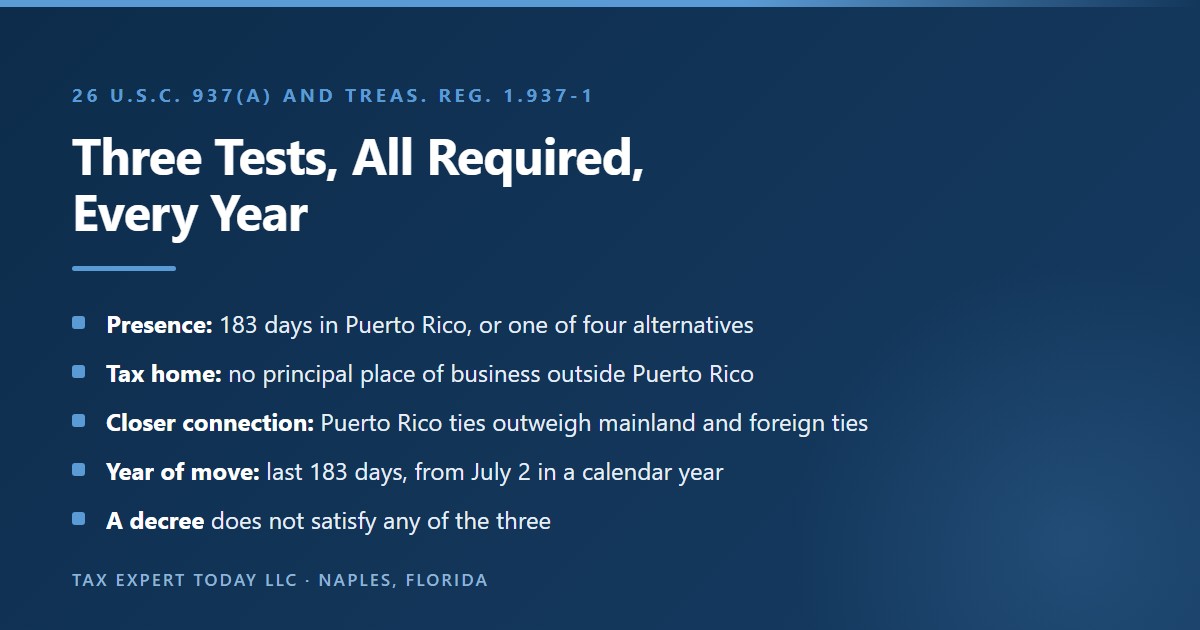
- Presence test: 183 days in Puerto Rico, or one of four alternatives in the regulations.
- Tax home test: the regular or principal place of business, or the regular place of abode if there is none, must be in Puerto Rico.
- Closer connection test: ties to Puerto Rico must outweigh the combined ties to the United States and foreign countries.
- All year: the tax home and closer connection tests apply to every part of the taxable year, except in the year of a move.
- No election: holding a decree or signing a statement does not make anyone a bona fide resident.
Before 2004, residence in a U.S. possession was largely a facts and circumstances question, and taxpayers argued about it with the IRS case by case. Congress replaced that approach with the three part test in section 937(a), added by the American Jobs Creation Act of 2004. The statute itself says a bona fide resident is a person who is present for at least 183 days during the taxable year in the possession, who does not have a tax home outside the possession during the taxable year, and who does not have a closer connection to the United States or a foreign country than to the possession. The Treasury then wrote detailed regulations at Treas. Reg. section 1.937-1 that soften the 183 day rule with alternatives and define each test.
The three tests measure different things. The presence test counts days. The tax home test looks at where you work or, if you do not work, where you actually live. The closer connection test weighs your whole life: home, family, belongings, banking, voting, licenses, and the address you give on official documents. A person can meet the day count easily and still fail the other two, which is the pattern the IRS campaign targets: someone who spends enough nights in San Juan but runs a business from Florida, or keeps a family home in Naples that remains the center of his or her life.
| Test | What it measures | Period | Regulation |
|---|---|---|---|
| Presence | Days physically present, or one of the alternatives | The taxable year (one alternative looks at three years) | Treas. Reg. 1.937-1(c) |
| Tax home | Regular or principal place of business, or regular place of abode | Every part of the taxable year | Treas. Reg. 1.937-1(d) |
| Closer connection | Comparative ties to Puerto Rico versus the United States and foreign countries combined | Every part of the taxable year | Treas. Reg. 1.937-1(e) |
| Year of move | Modifies the tax home and closer connection tests for the move year | Last 183 days (move in) or first 183 days (move out) | Treas. Reg. 1.937-1(f) |
The comparison in the closer connection test is worth reading slowly. The regulation compares your connections to Puerto Rico with the aggregate of your connections to the United States and all foreign countries. A person whose ties are spread between Puerto Rico, Florida, and a vacation home in Spain must show more connection to Puerto Rico than to Florida and Spain together. That is a harder standard than a simple most significant place test.
How does the presence test work?
The presence test is met if any one of five alternatives applies: 183 days in Puerto Rico in the year; 549 days over three years with at least 60 each year; no more than 90 days in the United States; limited U.S. earned income with more Puerto Rico days than U.S. days; or no significant connection to the United States.
- Alternative 1: at least 183 days present in Puerto Rico during the taxable year.
- Alternative 2: at least 549 days in Puerto Rico over the current and two prior years, with at least 60 days in each year.
- Alternative 3: no more than 90 days present in the United States during the year.
- Alternative 4: U.S. earned income of no more than the section 861(a)(3)(B) amount, and more days in Puerto Rico than in the United States.
- Alternative 5: no significant connection to the United States during the year.
The five alternatives come from Treas. Reg. section 1.937-1(c)(1). Most people who move from Florida aim for the first alternative, because it is the easiest to document: count the days and keep the evidence. The other four exist because some lives do not fit a single calendar year. A person who travels heavily may never reach 183 days in Puerto Rico but may spend very few days in the United States, which satisfies the third alternative. A person whose stays vary from year to year may meet the three year average in the second alternative.
The fourth alternative is narrow. It requires that earned income in the United States, if any, not exceed the amount in section 861(a)(3)(B), which is $3,000 under section 861(a)(3)(B), and that the person be present for more days in Puerto Rico than in the United States. It suits a retiree or investor who earns almost nothing on the mainland. The fifth alternative, no significant connection to the United States, turns on three specific ties defined in the regulation: a permanent home in the United States, current registration to vote anywhere in the United States, or a spouse or minor child whose principal place of abode is in the United States, with limited exceptions for children living with a custodial parent or attending school.
| Alternative | Day or income threshold | Who it tends to fit | Main risk |
|---|---|---|---|
| 183 days in Puerto Rico | 183 or more days in the taxable year | Most full time movers | Undocumented travel days |
| Three year average | 549 days over three years, at least 60 each year | People with uneven years | A year below 60 days breaks it |
| Limited U.S. days | No more than 90 days in the United States | Frequent international travelers | Counting partial days in the United States |
| Low U.S. earned income | U.S. earned income of $3,000 or less, and more Puerto Rico days than U.S. days | Retirees and passive investors | Any mainland consulting income |
| No significant connection | No U.S. permanent home, no U.S. voter registration, no spouse or minor child living in the United States | People who fully left the mainland | Keeping a Naples home available for personal use |
Two cautions apply to every alternative. First, the presence test is only one of three tests. Passing it does not make anyone a bona fide resident unless the tax home and closer connection tests are also met. Second, the IRS can ask for proof. Travel records, passport stamps, credit card statements, phone location data, and airline loyalty statements are the ordinary evidence in an examination, and the burden of showing the days falls on the taxpayer. A calendar kept at the time is far more persuasive than a reconstruction prepared after a letter arrives.
How are days counted for the Puerto Rico presence test?
A day counts as a Puerto Rico day if you are physically present there at any time during the day. A day spent partly in Puerto Rico and partly in the United States counts as a Puerto Rico day. Days away for qualifying inpatient medical treatment or a declared disaster can also count as Puerto Rico days, if documented.
- Any part of a day: physical presence at any time during the day counts.
- Travel days: a day in both Puerto Rico and the United States is a Puerto Rico day.
- Medical days: qualifying inpatient treatment for you or a close family member you accompany counts toward Puerto Rico.
- Disasters: days you cannot return during a declared major disaster period or evacuation order count toward Puerto Rico.
- Excluded U.S. days: short transit days, student days, and certain charitable sports days do not count as U.S. days.
The counting rules in Treas. Reg. section 1.937-1(c)(3) are more generous than many people expect. If you leave San Juan in the morning and land in Fort Myers in the afternoon, that day counts as a day in Puerto Rico. The regulation says so directly: a day on which an individual is physically present in both the United States and the relevant possession is a day of presence in the possession. That rule makes a difference for anyone who commutes back to Southwest Florida regularly, because each round trip produces two Puerto Rico days rather than two U.S. days.
The medical rule is detailed. A day counts as a Puerto Rico day if you are outside Puerto Rico to receive qualifying medical treatment, or to accompany on a full time basis a parent, spouse, or child who is receiving it. Qualifying treatment means inpatient care requiring an overnight stay in a hospital, hospice, or residential medical facility, plus medically necessary periods immediately before or after. The regulation also requires records: the patient’s name, the facility, the physician’s contact information, the dates, receipts, and a signed physician certification describing the treatment and its medical necessity, which must be produced within 30 days of a request.
The disaster rule covers days you leave or cannot return during a 14 day period in which a major disaster occurs in Puerto Rico, as declared by FEMA, or during a mandatory evacuation order for the area where your home is located. Hurricane seasons in both Puerto Rico and Southwest Florida make this rule more than theoretical. Note that it protects days when the disaster is in Puerto Rico; a hurricane that strikes Naples while you are there to protect a property you still own does not convert those days into Puerto Rico days.
| Situation on a given day | How it counts | Rule |
|---|---|---|
| In Puerto Rico at any time during the day | Puerto Rico day | Treas. Reg. 1.937-1(c)(3)(i)(A) |
| Flew from San Juan to Fort Myers the same day | Puerto Rico day | Treas. Reg. 1.937-1(c)(3)(iii)(A) |
| Inpatient surgery in Florida, documented | Puerto Rico day | Treas. Reg. 1.937-1(c)(3)(i)(B) and (c)(4) |
| Unable to return during a declared Puerto Rico disaster period | Puerto Rico day | Treas. Reg. 1.937-1(c)(3)(i)(C) |
| Connecting through Miami between two foreign points, under 24 hours | Not a U.S. day | Treas. Reg. 1.937-1(c)(3)(ii)(B) |
| A full day in Naples on vacation | U.S. day | Treas. Reg. 1.937-1(c)(3)(ii) |
Keep in mind that a generous counting rule for the presence test does not carry over to the closer connection analysis. Frequent trips back to Naples may count as Puerto Rico days under the day rule, while still showing that your social, family, and business life remains on the mainland. The tests are applied separately, and the second one does not care how the days were counted.
What is the tax home test for Puerto Rico residence?
The tax home test is met if you have no tax home outside Puerto Rico at any time during the year. Your tax home is your regular or principal place of business or, if you have none, your regular place of abode. Running a business day to day from Florida can defeat the test.
- Working people: the tax home is where the regular or principal place of business is located.
- Retirees and passive investors: the tax home is the regular place of abode.
- Whole year rule: a tax home outside Puerto Rico during any part of the year fails the test, except in the year of a move.
- Section 911 principles: the definition borrows from the foreign earned income exclusion, without its second sentence.
- Seafarers and officials: special rules apply to vessel crews, students, and Puerto Rico government officials.
The tax home concept comes from section 911(d)(3), the rule that decides whether an American working abroad has a foreign tax home. Treas. Reg. section 1.937-1(d) applies those principles, but without the second sentence of section 911(d)(3), which would otherwise say that a person whose abode is in the United States has no foreign tax home. The practical result is that the test focuses on where you work. If your regular or principal place of business is in Puerto Rico, your tax home is in Puerto Rico. If you have more than one regular place of business, the principal one controls.
For a business owner who moves from Naples, this is where plans most often fail, and the same facts appear in our guide on moving before selling a business. Consider a founder who keeps an office in Naples, meets employees there several days a month, signs contracts there, and manages the company’s banking from there, while sleeping in Dorado most nights. The day count may be met, but the principal place of business may still be Naples. The regulation says the tax home must not be outside Puerto Rico during any part of the taxable year, so a business center that stays on the mainland for even part of the year is a problem. The facts that matter include where the person spends working hours, where decisions are made, where staff and clients are met, and where the business is registered and operates.
For a retiree or passive investor without a trade or business, the tax home is the regular place of abode in a real and substantial sense. That standard looks at where the person actually lives, not where he or she owns property. A retiree who buys a condominium in San Juan but continues to spend most weeks in a Naples home that remains furnished and staffed will find it hard to show that the Puerto Rico home is the regular place of abode.
The regulation contains special rules for limited groups. A crew member of a vessel used predominantly in local and international waters is not treated as having a tax home outside Puerto Rico just because of the employment. Days spent as a student, or serving as an elected representative or full time official of the Puerto Rico government, are disregarded in deciding whether there was a tax home outside Puerto Rico. These rules rarely apply to someone relocating from Southwest Florida, but they illustrate how specific the definitions are.
What is the closer connection test?
The closer connection test asks whether, at every point in the year, your ties to Puerto Rico outweigh your combined ties to the United States and any foreign country. The IRS weighs your permanent home, family, belongings, organizations, banking, business activity, driver’s license, voter registration, and the residence you state on official documents.
- Permanent home: where a dwelling is available to you at all times, owned or rented.
- Family and belongings: where your spouse and children live, and where your cars, furniture, and personal items are kept.
- Community ties: social, cultural, political, and religious organizations you belong to.
- Financial and official ties: routine banking, driver’s license, voting, and the address on forms you sign.
- Aggregate comparison: Puerto Rico ties are compared with U.S. and foreign ties added together.
Treas. Reg. section 1.937-1(e) adopts the principles of section 7701(b)(3)(B)(ii) and Treas. Reg. section 301.7701(b)-2(d), the rule used to decide whether a foreign visitor has a closer connection to his or her home country than to the United States. Our substantial presence test guide covers that original setting. The regulation lists ten factors that are considered, without limiting the inquiry to them: the location of the permanent home; the location of family; the location of personal belongings such as cars, furniture, clothing, and jewelry; the location of social, political, cultural, or religious organizations with a current relationship; where routine personal banking takes place; where business activities are conducted, other than those that form the tax home; the jurisdiction that issued the driver’s license; the jurisdiction where the person votes; the country of residence designated on forms and documents; and the types of official forms filed.
On the permanent home factor, the underlying regulation says it does not matter whether the home is a house, an apartment, or a furnished room, or whether it is owned or rented. What matters is that the dwelling is available at all times, continuously, and not solely for stays of short duration. A Naples house kept furnished, with the utilities on and nobody else living in it, is available at all times. That is why the question of what to do with a Florida home is usually the hardest planning question in a Puerto Rico move.
| Factor from Treas. Reg. 301.7701(b)-2(d)(1) | Points toward Puerto Rico | Points toward the mainland |
|---|---|---|
| Permanent home | Home in Puerto Rico; Florida home sold or rented to others | Naples home kept available for personal use |
| Family | Spouse and minor children live in Puerto Rico | Spouse or children stay in Florida |
| Personal belongings | Cars, furniture, and valuables moved | Cars registered and garaged in Florida |
| Organizations | Memberships and congregation in Puerto Rico | Club, church, and board seats kept in Naples |
| Routine banking | Day to day banking in Puerto Rico | Everyday accounts and safe deposit box in Naples |
| Business activities | Management done from Puerto Rico | Board meetings and staff oversight in Florida |
| Driver’s license | Puerto Rico license | Florida license kept |
| Voting | Registered and voting in Puerto Rico | Florida voter registration kept |
| Residence on forms | Puerto Rico address used consistently | Florida address on brokerage, insurance, or loan documents |
| Official documents | Filings consistent with Puerto Rico residence | Florida homestead exemption or declaration of domicile still on file |
No single factor decides the outcome, and the regulation does not assign weights. In practice, examiners look for consistency. A file in which every factor points to Puerto Rico is straightforward. A file in which the person has a Puerto Rico address but a Florida license, Florida voter registration, a Florida homestead exemption, and a spouse living in Naples is unlikely to survive review, however many nights were spent on the island.
Can I keep my Naples home and still be a bona fide resident of Puerto Rico?
Possibly, but a Naples home kept available for your personal use weighs against you in the closer connection test and is a significant connection that defeats the fifth presence alternative. Many people who keep a Florida home also fail the tax home test if their business or regular abode stays there. The facts decide it, year by year.
- Closer connection: a Florida home available at all times is a permanent home on the mainland side of the comparison.
- Presence alternative 5: a permanent home in the United States is a significant connection, so that alternative is unavailable.
- Presence alternative 1: 183 days in Puerto Rico can still be met with a Florida home.
- Tax home: regular use of the Naples home as your abode, or as a business base, can place your tax home in Florida.
- Family: a spouse who stays in Naples weighs heavily toward the mainland.
This is the question we hear most often from Southwest Florida clients who are considering Puerto Rico, and the honest answer is that there is no bright line. The statute and regulations do not say that owning a Florida home disqualifies anyone. They do say, in effect, that the home will be counted. In the closer connection test, a permanent home is the first factor on the list. In the presence test, a permanent home in the United States is one of the three significant connections that make the fifth alternative unavailable. And in the tax home test, a home that remains your regular place of abode can place your tax home on the mainland.
Owning a second property is not the same as keeping a permanent home. A Naples condominium that is rented to unrelated tenants at fair rent for the full year is not available to you at all times. The regulation recognizes that difference expressly for the presence test, as we explain in the next section. A home that is kept empty, furnished, and reserved for your visits is a different matter. It is available continuously, and it tells an examiner that your life can resume in Naples on any day you choose.
The family factor often matters more than the property itself. A common pattern is that one spouse moves to Puerto Rico while the other stays in Naples for work, school, or aging parents. The regulation compares the moving spouse’s connections, and a spouse living in the Florida home is a strong connection to the United States. A minor child whose principal place of abode is in Florida is also a significant connection that rules out the fifth presence alternative. Couples considering a move should map out each spouse’s position separately, because bona fide residence is decided person by person.
For a retiree who keeps a Naples home and spends winters there, the practical risk is that the home becomes the regular place of abode for a meaningful part of the year. Because the tax home and closer connection tests apply to every part of the taxable year, a three month season in Naples, with the Puerto Rico home closed, is difficult to reconcile with either test. For residents moving from other states, our dual state residency guide describes how state auditors build the same kind of comparison, and the logic carries over.
Does renting out my Florida home help with the Puerto Rico tests?
Renting helps with one test. Under the significant connection rule, a U.S. home rented to others is not a permanent home unless you use part of it as a residence under section 280A(d) principles, and any day not rented at fair rent counts as personal use. The other tests remain.
- The rental exception: a rented U.S. home is not a permanent home for the fifth presence alternative unless you use it as a residence.
- Personal use days: a day not rented at fair rent for the whole day counts as personal use.
- Repair days: days spent mainly on repair and maintenance are not personal use.
- Scope: the exception is written for the presence test; the closer connection test is still a facts and circumstances review.
- Source: the rent itself is U.S. source income and is taxable federally.
Treas. Reg. section 1.937-1(c)(5)(ii)(B) provides that if an individual or the individual’s spouse owns property and rents it to another person at any time during the taxable year, the property is not a permanent home for the significant connection rule unless the taxpayer uses any portion of it as a residence during the year under the principles of section 280A(d). The regulation then tightens the definition of use. You are treated as using the rental property for personal purposes on any day that counts as personal use under section 280A(d)(2), and also on any day that the property, or any part of it, is not rented to another person at fair rental for the entire day. Days spent mainly on repair and maintenance work are not personal use days.
The last part of that rule surprises owners. A vacant day between tenants is treated as a personal use day under this regulation, even if you never set foot in the property. A seasonal rental in Naples that sits empty from May to November therefore produces a large number of personal use days. If you use the home as a residence under the section 280A(d) principles, it is a permanent home, and you lose the fifth presence alternative. Because the first presence alternative, 183 days in Puerto Rico, does not depend on this rule, most people who keep a rented Florida property rely on the day count instead.
Renting also has a direct federal cost that is easy to overlook. Rent from real property located in the United States is U.S. source income. It is reported on Schedule E of a federal return, and section 933 does not exclude it. Expenses that relate to the rental, such as depreciation, insurance, and property management, are deducted against it in the usual way. For an owner who previously used the Naples home as a residence, our guide on selling a home after a move explains how a later sale may still qualify for the home sale exclusion, which is a separate federal rule from anything in section 933.
| Use of the Naples home during the year | Permanent home for presence alternative 5? | Effect on closer connection | Federal tax on the rent |
|---|---|---|---|
| Kept empty and available for your visits | Yes | Strong mainland factor | None (no rent) |
| Rented at fair rent all year, no personal use | No | Weaker mainland factor | Rent is U.S. source, taxable |
| Rented in season, vacant in summer | Likely yes, if you use it as a residence under section 280A(d) principles | Mixed | Rent is U.S. source, taxable |
| Rented to a relative below fair rent | Days below fair rent count as personal use | Mainland factor | Rent is U.S. source; rental loss rules limited |
| Sold before the move | No | Removes the factor | Gain on the sale is U.S. source |
Should I keep my Florida homestead exemption after moving to Puerto Rico?
Generally no, if you intend to be a bona fide resident of Puerto Rico. Florida grants the homestead exemption only to an owner who in good faith makes the property his or her permanent residence. Keeping it is a sworn statement that your permanent residence is in Florida, which conflicts directly with a Puerto Rico residence claim.
- The Florida rule: the exemption requires that the owner makes the property his or her permanent residence in good faith.
- The conflict: a homestead claim is evidence on the mainland side of the closer connection test.
- Related records: a Florida declaration of domicile, driver’s license, and voter registration carry the same message.
- Timing: homestead status is set as of January 1 each year, so the move date matters.
- Family exception: the exemption can also rest on the permanent residence of dependents, which raises its own residence questions.
Florida’s homestead exemption, in section 196.031 of the Florida Statutes, is available to a person who, on January 1, has legal or beneficial title to Florida real property and who in good faith makes it his or her permanent residence or the permanent residence of others legally or naturally dependent on him or her. The exemption is valuable, and many Naples owners keep it for decades without thinking about it. It is also one of the clearest documents an examiner can find on the question of where a person considers home.
The closer connection factors in the regulation include the country of residence designated on forms and documents and the types of official forms filed. A homestead application, and each year it stays in place, is exactly that kind of document. Someone who claims to be a bona fide resident of Puerto Rico while keeping a Florida homestead exemption on the same property is telling two governments two different things. Florida property appraisers also review homestead status, and our Florida residency audit guide shows how residence records are tested in practice, so the inconsistency can create a Florida problem as well as a federal one.
The same reasoning applies to the other documents Floridians typically file when they establish residence: a declaration of domicile with the county clerk, a Florida driver’s license, vehicle registrations, and voter registration. Our guide on how to establish Florida residency lists those steps for people moving into Florida. A person moving to Puerto Rico generally needs to unwind them, in an order that keeps the records consistent with the date of the move. Florida’s own rules for giving up the exemption, and any recapture that may apply, are questions for a Florida property tax professional, but the federal point is simple: the records should match the residence you claim.
How does the year of the move to Puerto Rico work?
In the move year, the tax home and closer connection tests are met if you were not a bona fide resident in the three prior years, had no tax home or closer connection elsewhere during the last 183 days, and are a bona fide resident for the next three years. The presence test still applies.
- Three years before: not a bona fide resident of Puerto Rico in any of them.
- Last 183 days: no tax home outside Puerto Rico and no closer connection elsewhere on any of those days.
- Three years after: a bona fide resident of Puerto Rico in each of them.
- Presence test: not relaxed; one of the five alternatives must still be met for the move year.
- Result: bona fide residence for the whole move year, so section 933 can apply to Puerto Rico source income for that year.
Without a special rule, nobody could become a bona fide resident in the year of a move, because the tax home and closer connection tests apply to every part of the year, and the months before the move were spent on the mainland. Treas. Reg. section 1.937-1(f)(1) solves that by replacing the whole year requirement with a test that looks at the last 183 days of the move year, together with a look back and a look forward. The Instructions for Form 8898 restate the same three conditions in plain language.
The look forward condition is the one that creates exposure later. Bona fide residence in the move year depends on being a bona fide resident for each of the three following taxable years. A person who moves in 2027, claims the exclusion for 2027, and returns to Naples in 2029 has not met the condition, and the 2027 position can fail along with the later years. A return for the move year therefore rests partly on facts that have not yet happened when it is filed. People who are unsure whether they will stay should understand that risk before taking the position.
The look back condition prevents people from moving in and out repeatedly to claim the year of move rule. If you were a bona fide resident of Puerto Rico in any of the three taxable years before the move year, the special rule is not available, and the ordinary whole year tests apply.
| Condition for the move year | What it requires | Example for a move in 2027 |
|---|---|---|
| Look back | Not a bona fide resident in the three prior years | Not a bona fide resident in 2024, 2025, or 2026 |
| Last 183 days | No tax home or closer connection outside Puerto Rico on any of those days | July 2 through December 31, 2027 |
| Look forward | Bona fide resident in each of the three following years | Bona fide resident in 2028, 2029, and 2030 |
| Presence test | One of the five alternatives for the move year | For example, 183 days in Puerto Rico during 2027 |
What is the latest date in a year to move to Puerto Rico?
For a calendar year taxpayer in a 365 day year, the last 183 days begin on July 2. Moving after that date fails the year of move rule for that year. A July 2 arrival also leaves exactly 183 days for the presence test, so any trip back to Florida could break it unless another presence alternative applies.
- The arithmetic: July 2 through December 31 is 183 days in a 365 day year.
- Leap years: in a 366 day year the window also begins on July 2, because the extra February day falls in the first half of the year.
- Presence pressure: an early July arrival leaves no margin under the 183 day alternative.
- Other alternatives: the 90 day United States limit is usually unavailable to someone who spent the first half of the year in Florida.
- Practical result: many people schedule the move early in the year or wait for January 1.
Here is the count for 2027, a 365 day year. July 2 through July 31 is 30 days. August has 31, September 30, October 31, November 30, and December 31. The total is 183. So the last 183 days of 2027 begin on July 2, and a person who has a tax home or a closer connection outside Puerto Rico on July 2 or later fails the year of move rule for 2027. In a leap year the window still begins on July 2, because the extra day falls in February. The general point holds either way: the move needs to be complete, with the business, the home, and the family ties shifted, by the start of the final 183 days.
The presence test is where a midyear move becomes tight. A person who spends January through June in Naples and arrives in Puerto Rico on July 2 can reach 183 Puerto Rico days only by never leaving the island for the rest of the year, because the first half of the year produced no Puerto Rico days. A single week in Naples for Thanksgiving would leave the person short. The third alternative, no more than 90 days in the United States, is not available after six months in Florida. The second alternative, 549 days over three years, needs presence in the two prior years. The fifth alternative, no significant connection to the United States, requires having no permanent home, no voter registration, and no spouse or minor child living in the United States for the year, which is hard for someone who lived in Florida until July.
That is why many movers either arrive early in the year, so that the 183 day count is comfortable, or wait until January 1 of the next year, so that the move year and the first full year are the same. Waiting has its own cost if the person had planned to sell appreciated assets soon after arriving, because the ten year rule discussed later applies regardless of timing. The right choice depends on the person’s travel needs, family situation, and the assets involved.
| Hypothetical arrival date in 2027 | Last 183 days covered? | Days available in Puerto Rico for alternative 1 | Room for trips back |
|---|---|---|---|
| January 4 | Yes | 362 | Up to 179 days away |
| April 1 | Yes | 275 | Up to 92 days away |
| June 1 | Yes | 214 | Up to 31 days away |
| July 2 | Yes, exactly | 183 | None |
| August 1 | No | 153 | Fails the year of move rule and the 183 day alternative |
The table counts the arrival day as a Puerto Rico day and assumes no Puerto Rico days earlier in the year. It is a simplified illustration of the day arithmetic, not a substitute for a full review of the other two tests.
What is Form 8898, and who must file it?
Form 8898 is the Statement for Individuals Who Begin or End Bona Fide Residence in a U.S. Territory. A person must file it for a tax year in which worldwide gross income exceeds $75,000 and he or she takes the position of becoming, or ceasing to be, a bona fide resident of Puerto Rico. Spouses test and file separately.
- Legal basis: section 937(c) requires notice when you take the position that you became or ceased to be a bona fide resident.
- Income threshold: worldwide gross income over $75,000 for the year, not counting a spouse’s income.
- Starting residence: filed for the year you first claim bona fide residence after filing as a mainland citizen or resident.
- Ending residence: filed for the year you stop being a bona fide resident.
- Spouses: each spouse who meets the test files his or her own Form 8898.
Section 937(c)(1) says that if, for any taxable year, an individual takes the position for U.S. income tax reporting purposes that he or she became, or ceased to be, a bona fide resident of a possession, the individual must file notice of that position with the IRS. Form 8898 is the notice. The Instructions for Form 8898 narrow the requirement to years in which worldwide gross income is more than $75,000 and one of three positions is taken: becoming a bona fide resident of a territory after a year for which you filed as a U.S. citizen or resident but not as a bona fide resident; ceasing to be a bona fide resident after a year for which you filed as one; or moving from the Virgin Islands, Guam, or the Northern Mariana Islands to Puerto Rico or American Samoa.
Worldwide gross income has a broad meaning in the instructions. It means all income received in the form of money, goods, property, and services, including income from sources outside the United States, even if part or all of it is excluded, and before any deductions, credits, or rebates. For a person moving with a large portfolio, that means gross proceeds of income items, not net income after expenses, and it includes the Puerto Rico income that section 933 will exclude. A spouse’s income is not counted, and if both spouses must file, each files a separate Form 8898.
The form itself (Rev. October 2024) is short. It asks for identifying information, the territory, the date residence began or ended, and a series of questions that track the closer connection factors: where the person’s home and family are, where the driver’s license was issued, where the person is registered to vote, where personal belongings and bank accounts are located, and where the person’s business is conducted. Those questions are a preview of what an examiner will ask. Answering them honestly on the form, and keeping the records that support each answer, is part of making a position that will hold.
| Situation in the tax year | Worldwide gross income | Form 8898 required? |
|---|---|---|
| First year claiming Puerto Rico bona fide residence after filing as a Florida resident | $400,000 | Yes |
| Same move | $60,000 | No, under the $75,000 threshold |
| Second and later years as a bona fide resident, no change | Any amount | No, nothing began or ended that year |
| Year of returning to Naples after years as a bona fide resident | $150,000 | Yes |
| Married couple moving together, each with more than $75,000 | Each spouse tested separately | Yes, one form for each spouse |
When and where is Form 8898 filed, and what is the penalty?
Form 8898 is due by the due date of your Form 1040, including extensions, and is mailed separately to the IRS in Austin, Texas, not attached to the return. The IRS also offers a mobile friendly version. Failing to file, or filing an incomplete or incorrect form, can bring a $1,000 penalty unless the failure was due to reasonable cause.
- Due date: the due date of Form 1040, including extensions.
- Where: Internal Revenue Service, 3651 S. IH 35, MS 4301 AUSC, Austin, TX 78741, per the current instructions.
- Not with the return: the instructions say not to file Form 8898 with your tax return.
- Penalty: $1,000 for each failure under section 6688, unless reasonable cause and not willful neglect is shown.
- Criminal exposure: the civil penalty applies in addition to any criminal penalty.
The Instructions for Form 8898 (revised October 2024, page reviewed April 2026) say to file the form by the due date, including extensions, for filing Form 1040, and to mail it to the Austin address shown above. They also say not to file it with the tax return and not to send the tax return to that address. Because the form travels separately, it is common for it to be forgotten in the year of a move, when the return itself is already complicated. A filing checklist for the move year should list it as a separate item with its own proof of mailing.
The civil penalty in the statute comes from section 6688, which imposes a $1,000 penalty for each failure to furnish information required under section 937(c), unless the failure is due to reasonable cause and not willful neglect, and states that the penalty is in addition to any criminal penalty. The instructions extend the description to forms that omit required information or include incorrect information. A $1,000 penalty is small compared with the tax at stake in most Puerto Rico moves, but the form matters for another reason: it is the IRS’s record of who claims to have become a resident, and that list is a natural starting point for the compliance campaign.
Reasonable cause is a facts and circumstances defense. It usually requires showing that the person exercised ordinary business care and prudence and still could not comply, for example because of serious illness or reliance on incorrect professional advice after full disclosure of the facts. Our guide to reasonable cause penalty relief explains how the IRS evaluates that defense in general. The better course is to file the form on time.
What income counts as Puerto Rico source income?
Section 937(b) applies rules similar to the U.S. source rules to decide what is Puerto Rico source income, and adds that anything treated as U.S. source can never be Puerto Rico source. In general, services are sourced where performed, rent where the property sits, and interest and dividends by the payer’s residence or place of organization.
- Services: compensation is sourced where the work is physically performed.
- Rent and real property gain: sourced where the property is located.
- Interest: generally sourced by the residence of the payer.
- Dividends: generally sourced by where the paying corporation is organized, with special rules.
- Override: U.S. source or U.S. effectively connected income cannot be treated as Puerto Rico source.
Section 937(b)(1) tells us to apply rules similar to the rules for determining whether income is from U.S. sources, or effectively connected with a U.S. trade or business, when deciding whether income is from sources within a possession. Section 937(b)(2) then adds a one way override: any income treated as income from U.S. sources, or as effectively connected with a U.S. trade or business, is not treated as Puerto Rico source income or as effectively connected with a Puerto Rico business. Treas. Reg. section 1.937-2 builds out those rules and adds special provisions, including the rule for property owned before the move and an anti-abuse provision.
The override matters because the U.S. source rules sometimes reach income that a taxpayer might expect to follow the taxpayer to Puerto Rico. A gain that the regulations treat as U.S. source stays U.S. source even if the taxpayer is a bona fide resident on the day of the sale. Income connected with a business that is still conducted on the mainland stays U.S. income even if the owner lives in Puerto Rico. The IRS campaign describes this as the second part of the problem it is addressing: people who meet section 937 but report U.S. source income as Puerto Rico source income.
| Income item | General source rule | Puerto Rico source for a bona fide resident? |
|---|---|---|
| Wages for work physically done in Puerto Rico | Where services are performed | Yes, generally |
| Wages for days worked in Florida | Where services are performed | No, U.S. source |
| Consulting fees for work done in Puerto Rico for a mainland client | Where services are performed, subject to the regulations and any business still conducted on the mainland | Often yes; review carefully |
| Rent from a Naples condominium | Where the property is located | No, U.S. source |
| Rent from a San Juan apartment | Where the property is located | Yes |
| Interest from a U.S. bank or Treasury securities | Residence of the payer | No, U.S. source |
| Dividends from a U.S. corporation | Where the payer is organized | No, U.S. source |
| Gain on stock bought after becoming a resident | Generally residence of the seller, with special rules | Often yes, after the ten year rule is considered |
| Gain on stock owned before the move, sold within the ten year window | Treas. Reg. 1.937-2(f)(1) | No, except the portion covered by the election |
| Gain on a sale of Florida real estate | Where the property is located | No, U.S. source |
Many decree holders are surprised by the line for U.S. dividends and interest. A brokerage account full of U.S. stocks, U.S. bond funds, and U.S. Treasury securities produces U.S. source income no matter where its owner lives, and the federal tax on that income does not change because of a move to Puerto Rico. Puerto Rico source investment income generally requires Puerto Rico payers or Puerto Rico sales of personal property under the source rules, and decree rules about what Puerto Rico will exempt are a separate question for Puerto Rico counsel.
Is remote work for mainland clients Puerto Rico source income?
Compensation for personal services is generally sourced where the services are physically performed, so work done while physically in Puerto Rico is generally Puerto Rico source, even for a mainland client. Days worked on the mainland are U.S. source. Income of a business still conducted in the United States can remain U.S. income.
- Place of performance: the location where you physically do the work controls the source of service income.
- Travel days: pay for client meetings or work days in Florida is U.S. source.
- Allocation: mixed work years usually need a day based or other reasonable allocation.
- Business location: income of a business whose operations stay on the mainland raises effectively connected income questions.
- Entity choices: moving the work into a Puerto Rico entity has its own federal and Puerto Rico rules that need separate review.
The general U.S. rule in section 861(a)(3), which section 937(b)(1) carries over by analogy, is that compensation for labor or personal services is sourced where the services are performed. A consultant who lives in Puerto Rico and does the work there, by phone and computer, for a client in Miami is generally earning income for services performed in Puerto Rico. That is the logic behind many of the remote work moves that followed the pandemic. It is also the logic that turns every trip back to the mainland into a sourcing question: the days of work performed in Florida produce U.S. source income, even if the client is the same and the invoice is issued from San Juan.
The analysis becomes harder when the individual owns a business that existed on the mainland before the move. If employees, customers, inventory, and management remain in Florida, the income of that business may be effectively connected with a U.S. trade or business, and section 937(b)(2) says such income cannot be Puerto Rico income. Restructuring a mainland business so that a new Puerto Rico entity performs services in Puerto Rico can change the result, but only if the substance actually changes, and the regulations include an anti-abuse rule aimed at arrangements designed to avoid the source rules. We recommend that business owners treat this as a separate project with both federal and Puerto Rico advisers.
| Hypothetical work pattern for a consultant in 2028 | Days | Fees allocated | Source |
|---|---|---|---|
| Work performed in Puerto Rico | 200 | $200,000 | Puerto Rico |
| Work performed during client visits in Florida | 20 | $20,000 | United States |
| Work performed at a conference in Spain | 5 | $5,000 | Foreign |
| Total working days and fees | 225 | $225,000 | $25,000 stays federally taxable |
In this hypothetical, fees of $1,000 per working day are allocated by days worked. The $20,000 for Florida work days and the $5,000 for the Spanish conference are not excluded under section 933. The consultant’s self-employment tax, discussed later, is a separate matter and applies regardless of the exclusion. The allocation method in a real case depends on the facts and should be supported by calendars and billing records.
How is gain on property owned before the move to Puerto Rico taxed?
Under Treas. Reg. 1.937-2(f)(1), gain on stocks, securities, and other investment property owned before becoming a bona fide resident is not Puerto Rico source if, in any of the ten years before the year of sale, you were a mainland U.S. citizen or resident. In practice, sales within about ten years of the move stay U.S. source.
- Covered property: property of the kinds described in section 731(c)(3)(C)(i) or section 954(c)(1)(B), broadly marketable securities and other investment property.
- Owned before: the rule applies only to property owned before you became a bona fide resident.
- Look back: it applies if you were a U.S. citizen or resident, other than a bona fide Puerto Rico resident, in any of the ten years before the year of sale.
- Exchanges: property received in a nonrecognition exchange for covered property keeps the same treatment.
- Election: you may elect to treat the portion of gain that built up after the move as Puerto Rico source.
This rule is the reason the timing of a sale matters as much as the timing of a move. Treas. Reg. section 1.937-2(f)(1)(i) provides that, except where an election is made, income from sources within Puerto Rico does not include gains from the disposition of described property by a described individual. The property is described if it is of a kind listed in section 731(c)(3)(C)(i) or section 954(c)(1)(B), and was owned by the individual before he or she became a bona fide resident. The individual is described if he or she is a bona fide resident for the year of sale and, for any of the ten years preceding that year, was a citizen or resident of the United States other than a bona fide resident of Puerto Rico. The regulation also points to section 1277(e) of the Tax Reform Act of 1986, an older statutory rule with a similar effect.
Because a U.S. citizen who moves from Florida was a mainland resident in the years before the move, the look back condition is met for every sale year until ten full years have passed since the last mainland year. If the last mainland year is 2026 and the person is a bona fide resident from 2027, the condition is met for sales through 2036, the tenth year after 2026. From 2037 on, none of the ten preceding years is a mainland year, and the special rule no longer applies. The exact span depends on the person’s own years of residence, which is why we describe it as roughly ten years after the move rather than as a fixed date.
The regulation closes the obvious workarounds. If covered property is exchanged for other property in a transaction where gain is not recognized, the new property inherits the same status. If an individual who owns at least 10 percent by value of an entity transfers covered property to it in a nonrecognition transaction, gain later recognized by the entity on that property can be treated as non Puerto Rico source to the same extent. Putting appreciated securities into a new company before selling them does not, by itself, move the gain to Puerto Rico.
How does the post-move gain election work for marketable securities?
An individual covered by the ten year rule may elect to treat as Puerto Rico source the part of the gain attributable to the period of Puerto Rico residence. For marketable securities, that portion is measured from the closing market value on the first day of the possession holding period. The election is made by reporting the gain that way.
- Who may elect: a bona fide resident who is subject to the ten year rule for the property sold.
- Marketable securities: covered property actively traded throughout the holding period.
- Measurement: the Puerto Rico portion is the gain over the closing value on the first day of the possession holding period.
- Start date: the possession holding period starts on the first day you do not have a tax home outside Puerto Rico.
- How to elect: report the gain on the return for the year of sale using the method in the regulation.
Treas. Reg. section 1.937-2(f)(1)(vi) allows an individual subject to the ten year rule to elect to treat as Puerto Rico source the portion of the gain attributable to the possession holding period. The election is considered made if the return for the year of disposition reports the gain using the method in the regulation. For marketable securities, defined as covered property that is actively traded throughout the holding period, the Puerto Rico portion is determined by reference to the fair market value at the close of the market on the first day of the possession holding period. That day is the first day on which the individual does not have a tax home outside Puerto Rico, so a precise move date and a statement showing the closing values that day are the core records for this election.
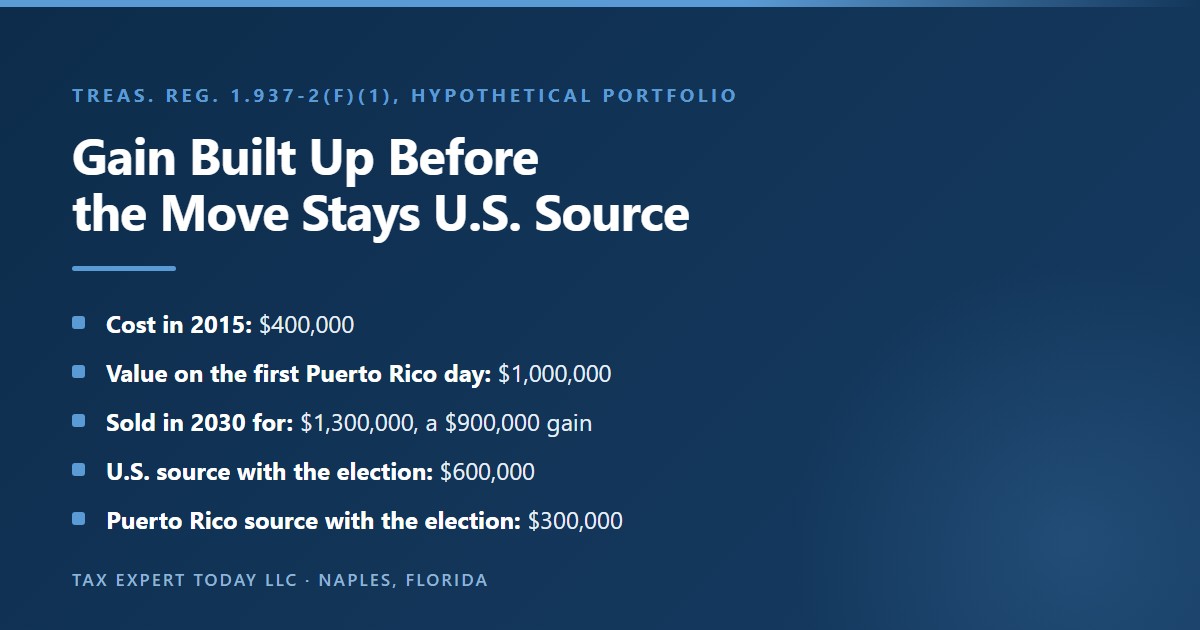
Here is a hypothetical. A Naples investor bought a diversified portfolio of U.S. listed stocks in 2015 for $400,000. The investor moves to Puerto Rico and has no tax home outside Puerto Rico from January 4, 2027, when the portfolio closes at $1,000,000. The investor meets section 937 for 2027 onward and sells the portfolio in 2030 for $1,300,000. Total gain is $900,000.
| Hypothetical portfolio sale in 2030 | Without the election | With the election |
|---|---|---|
| Cost basis (2015) | $400,000 | $400,000 |
| Closing value on January 4, 2027 | $1,000,000 | $1,000,000 |
| Sale price (2030) | $1,300,000 | $1,300,000 |
| Total gain | $900,000 | $900,000 |
| U.S. source gain, reported on the federal return | $900,000 | $600,000 |
| Puerto Rico source gain, excluded under section 933 | $0 | $300,000 |
| Puerto Rico tax on the $300,000 under a decree applied for by December 31, 2026 (0 percent) | Not applicable | $0 |
| Puerto Rico tax on the $300,000 under a decree applied for on or after January 1, 2027 (4 percent) | Not applicable | $12,000 |
Two lessons follow from the example. First, the $600,000 of gain that built up while the investor lived in Naples is taxed federally at the ordinary long term capital gain rates whether or not the investor moves, and the net investment income tax may also apply, as explained later. Second, the Puerto Rico rate on the remaining $300,000 depends on the decree terms and on Puerto Rico’s own source rules, which are matters for Puerto Rico counsel; the 0 percent and 4 percent lines show the arithmetic of the two decree rates only. The example ignores state tax, which Florida does not impose on individuals, and assumes the investor remains a bona fide resident in every year through the sale.
How is gain on property that is not publicly traded split?
For covered property that is not a marketable security, such as shares in a private company, the elective Puerto Rico portion is the total gain multiplied by a fraction: days in the possession holding period over total days in the holding period. The rest of the gain stays U.S. source while the ten year rule applies.
- Numerator: days in the possession holding period, added together if residence was interrupted.
- Denominator: total days in your holding period, including tacked holding periods.
- Straight line: the method assumes gain built up evenly over time, regardless of when value actually grew.
- Interrupted residence: each earlier possession period ends on the first day you have a tax home outside Puerto Rico.
- Proof: the dates of the tax home change and the acquisition date drive the result.
For property other than marketable securities, Treas. Reg. section 1.937-2(f)(1)(vi)(B) uses a day count instead of a valuation. The Puerto Rico portion of the gain equals the total gain multiplied by a fraction whose numerator is the number of days in the possession holding period and whose denominator is the total number of days in the individual’s holding period for the property. The denominator includes days that must be added to the holding period under sections 735(b) and 1223 and any other holding period rule.
Here is a hypothetical. A Naples business owner has held shares of a closely held company for 4,000 days when the shares are sold. The owner’s possession holding period, counted from the first day without a tax home outside Puerto Rico, is 1,460 days. The total gain is $500,000.
| Hypothetical private company share sale | Amount |
|---|---|
| Total gain | $500,000 |
| Days in the possession holding period | 1,460 |
| Total days in the holding period | 4,000 |
| Fraction (1,460 divided by 4,000) | 36.5 percent |
| Puerto Rico source portion if the election is made | $182,500 |
| U.S. source portion, reported on the federal return | $317,500 |
The day count method can help or hurt. If most of the company’s growth happened after the move, the straight line fraction assigns too much of the gain to the mainland years. If most of the growth happened before the move, the fraction assigns more to the Puerto Rico years than the actual value change would. The regulation does not let the taxpayer choose a valuation method for nonmarketable property, so the fraction controls when the election is made. Other rules can also affect the result, including the sourcing of gain on a sale of a partnership interest or of shares in a company with U.S. real property, so a large private sale needs a full source analysis before closing.
What happens when I sell my Naples home after moving to Puerto Rico?
Gain on the sale of Florida real estate is U.S. source income, so section 933 never excludes it, no matter how long you have lived in Puerto Rico. The federal home sale exclusion in section 121 may still apply if you owned and used the Naples home as your principal residence for two of the five years before the sale.
- Source: gain on real property is sourced where the property is located, which is the United States.
- Section 933: does not apply to U.S. source gain.
- Section 121: up to $250,000 of gain, or $500,000 for qualifying married couples filing jointly, may be excluded if the ownership and use tests are met.
- Timing: the two out of five year window starts closing on the day you stop using the home as your principal residence.
- Rental period: renting the home after the move can affect depreciation recapture and part of the exclusion.
Real property is the simplest sourcing case. Gain on the sale of real property located in the United States is U.S. source income, and section 937(b)(2) prevents it from being treated as Puerto Rico source. A Naples home, a Fort Myers rental, or a vacant lot in Lehigh Acres produces federally taxable gain for a bona fide resident of Puerto Rico just as it would for a Florida resident. The Puerto Rico decree has nothing to say about that gain for federal purposes.
The good news for many movers is that section 121, the exclusion of gain on the sale of a principal residence, is a federal rule that does not depend on where the seller lives on the day of sale. If the seller owned the Naples home and used it as a principal residence for at least two years during the five years ending on the date of sale, up to $250,000 of gain may be excluded, or up to $500,000 for a married couple filing jointly who meet the requirements. Because the use test looks back five years from the sale, a home that stops being the principal residence on the day of the move must generally be sold within three years after that day to keep full eligibility. Periods of nonqualified use and depreciation claimed during a rental period can reduce the result.
The interaction with the Puerto Rico residence tests is the important planning point. Keeping the Naples home available while it is listed for sale may preserve the federal exclusion, but it also keeps a permanent home on the mainland for the closer connection test. Renting it while it is on the market reduces the personal use problem, but produces U.S. source rent and depreciation recapture on sale. Our guide on selling a home after a move explains the timing of the section 121 window in more detail; the same window applies when the move is to Puerto Rico.
Do bona fide residents of Puerto Rico still file a federal tax return?
Often yes. A bona fide resident of Puerto Rico must file Form 1040 if gross income from sources outside Puerto Rico meets the filing threshold, using a standard deduction reduced in proportion to the excluded income. Puerto Rico source income is left off the federal return. A separate Puerto Rico return is filed with Hacienda.
- Federal return: Form 1040 reporting U.S. source and foreign source income.
- Excluded income: Puerto Rico source income of a bona fide resident is not reported as taxable income.
- Filing threshold: tested against the standard deduction allowed after the proportional reduction.
- Puerto Rico return: filed with the Puerto Rico Department of the Treasury under Puerto Rico rules.
- No income tax filing duty: Form 1040-SS may still be required for self-employment tax.
IRS Publication 570, the IRS guide for individuals with income from U.S. territories, explains the filing rules. The current edition was written for 2025 returns and was last reviewed in April 2026. A bona fide resident of Puerto Rico who has income from sources outside Puerto Rico generally files a federal Form 1040 reporting that income, and excludes Puerto Rico source income under section 933. The same person files a Puerto Rico income tax return reporting worldwide income under Puerto Rico law, and how Puerto Rico treats income that the United States also taxes is a question for a Puerto Rico preparer.
Whether a federal return is required depends on a filing threshold that is adjusted for the exclusion. Publication 570 explains that, because the standard deduction applies to all types of income, it must be divided between excluded income and income from other sources. The regular standard deduction is multiplied by a fraction: gross income subject to U.S. income tax over gross income from all sources, including excluded territory income. The result is the allowable standard deduction, and the filing requirement is generally based on it. A person with modest U.S. source income and large excluded Puerto Rico income can therefore have a federal filing requirement at a low dollar level.
The publication also notes a mutual agreement procedure between the United States and Puerto Rico for cases of double taxation, and points to Form 1040-SS for bona fide residents who have no federal income tax filing requirement but owe self-employment tax or claim the additional child tax credit. The point to take from these rules is that a move to Puerto Rico rarely ends a person’s relationship with the IRS. For most decree holders, it changes the content of the federal return rather than eliminating it.
| Return or form | Who generally files it | Filed with |
|---|---|---|
| Form 1040 | Bona fide residents with U.S. source or foreign source income over the adjusted threshold | IRS |
| Form 1040-SS | Bona fide residents with self-employment income and no Form 1040 filing requirement | IRS |
| Form 8898 | People who begin or end bona fide residence with worldwide gross income over $75,000 | IRS, Austin address, separately |
| FinCEN Form 114 (FBAR) | People with foreign accounts over $10,000 in aggregate | FinCEN, electronically |
| Form 8938 | Specified individuals over the applicable threshold | IRS, with Form 1040 |
| Puerto Rico income tax return | Puerto Rico residents | Puerto Rico Department of the Treasury |
| Decree annual report | Decree holders | DDEC, under Puerto Rico rules |
How are deductions and the standard deduction handled on the federal return?
Deductions that relate only to excluded Puerto Rico income are not allowed on the federal return. Deductions that do not relate to any particular income, such as the standard deduction, charitable gifts, and mortgage interest on a home, are allowed only in the proportion that U.S. taxable gross income bears to gross income from all sources.
- Directly related deductions: disallowed if they relate to excluded income, allowed if they relate to taxable income.
- Unrelated deductions: divided using the gross income fraction.
- The fraction: gross income subject to U.S. tax divided by gross income from all sources, including excluded income.
- Examples in Publication 570: the standard deduction, medical expenses, charitable contributions, real estate taxes, and home mortgage interest.
- Self-employment tax deduction: not allowed if all self-employment income is excluded; partly allowed if only part is excluded.
The rule starts with section 933 itself, which denies any deduction or credit properly allocable to the excluded income. Publication 570 then explains how to apply it. Deductions that specifically apply to excluded territory income are not allowable. Deductions that do not apply to any particular type of income are divided between excluded income and other income, using the fraction described above. The publication’s own example multiplies the regular standard deduction by taxable gross income over total gross income.
Here is a hypothetical for a married couple who are both bona fide residents of Puerto Rico in 2026 and file a joint federal return. Their gross income from all sources is $200,000. Of that, $144,000 is Puerto Rico source investment and consulting income excluded under section 933. The remaining $56,000 is U.S. source: $20,000 of dividends from U.S. corporations and $36,000 of gross rent from a Naples condominium. The 2026 standard deduction for married couples filing jointly is $32,200, per Rev. Proc. 2025-32.
| Hypothetical 2026 joint federal return | Amount |
|---|---|
| Gross income from all sources | $200,000 |
| Puerto Rico source income excluded under section 933 | $144,000 |
| Gross income subject to U.S. tax | $56,000 |
| Fraction (56,000 divided by 200,000) | 28 percent |
| Regular 2026 standard deduction, married filing jointly | $32,200 |
| Allowable standard deduction (28 percent of $32,200) | $9,016 |
| Standard deduction lost because of the exclusion | $23,184 |
The rental expenses on the Naples condominium, such as depreciation, management fees, insurance, and property tax on the rental, relate directly to the U.S. source rent and are deducted against it on Schedule E in the usual way. Expenses that relate directly to the excluded consulting income are not deductible on the federal return at all. The example is simplified: it ignores qualified dividend rates, the net investment income tax, and any self-employment tax, each of which can apply to this couple.
Do Puerto Rico residents pay U.S. self-employment tax?
Generally yes. Publication 570 states that bona fide residents of a U.S. territory with self-employment income must generally pay U.S. self-employment tax, even if they have no federal income tax filing obligation. The section 933 exclusion removes income tax on Puerto Rico source earnings, not Social Security and Medicare tax.
- The rule: net earnings from self-employment are subject to self-employment tax regardless of the income tax exclusion.
- 2026 wage base: $184,500 for the Social Security portion, per Publication 570.
- Medicare portion: applies without a wage base cap; the additional Medicare tax can also apply.
- Form: Schedule SE with Form 1040, or Form 1040-SS if no income tax return is required.
- Deduction: the income tax deduction for half of self-employment tax is limited when the income is excluded.
Publication 570 says directly that bona fide residents of the territories who have self-employment income must generally pay self-employment tax to the United States, that self-employment tax includes both Social Security and Medicare, and that bona fide residents may be subject to U.S. self-employment tax even if they have no income tax filing obligation with the United States. It also states that the maximum self-employment income subject to Social Security tax is $176,100 for 2025 and increases to $184,500 for 2026.
For a consultant or business owner who moves to Puerto Rico and continues to work as a sole proprietor or partner, this is a large and often unexpected cost. The section 933 exclusion can remove federal income tax on the Puerto Rico source earnings, but the self-employment tax remains. On $200,000 of net earnings in 2026, the self-employment tax computed on Schedule SE is in the tens of thousands of dollars, and it is owed whether or not any federal income tax is due. Our self-employment tax calculator, along with the IRS Schedule SE page, shows how the computation works for a given amount of earnings.
The income tax deduction for one half of self-employment tax follows the same allocation logic as other deductions. Publication 570 explains that if a bona fide resident of Puerto Rico excludes all self-employment income, the deduction cannot be taken on Schedule 1, because it relates to excluded income. If only part of the self-employment income is excluded, only part of the deduction is allowed. Structures in which the individual is paid as an employee of a Puerto Rico entity raise a different set of payroll tax questions, which depend on the entity and Puerto Rico law and need their own review.
Does the net investment income tax apply to Puerto Rico residents?
It can. Publication 570 says bona fide residents of Puerto Rico who have a federal filing obligation may owe the 3.8 percent net investment income tax if their modified adjusted gross income from non-territory sources exceeds the threshold. U.S. dividends, interest, rent, and U.S. source capital gains are the usual triggers.
- Rate: 3.8 percent on the lesser of net investment income or the excess of modified adjusted gross income over the threshold.
- Thresholds: $200,000 for single filers and $250,000 for married couples filing jointly under section 1411, not indexed.
- Puerto Rico rule: measured using income from non-territory sources for bona fide residents with a federal filing obligation.
- Common triggers: U.S. source gains under the ten year rule, U.S. dividends, and Naples rental income.
- Estimated tax: the tax must be included when figuring estimated payments.
The net investment income tax, enacted in section 1411, adds 3.8 percent to investment income above a threshold. Publication 570 addresses territory residents directly: bona fide residents of Puerto Rico and American Samoa who have a federal income tax return filing obligation may be liable for the tax if their modified adjusted gross income from non-territory sources exceeds a specified threshold amount, and they must take that tax into account in estimated payments.
Go back to the portfolio example above. The investor who sells in 2030 has $600,000 of U.S. source gain if the election is made, or $900,000 if it is not. That U.S. source gain is non-territory income, and much of it is likely to sit above the net investment income tax threshold. On $600,000 of U.S. source gain above a $250,000 joint threshold, with no other income, the tax would apply to $350,000 and equal $13,300. The example is hypothetical and simplified, but it shows that the federal cost of selling within the ten year window includes this tax as well as the capital gain rates.
| Hypothetical joint filers, U.S. source gain in the sale year | Amount |
|---|---|
| U.S. source capital gain (non-territory income) | $600,000 |
| Threshold for married filing jointly | $250,000 |
| Excess over the threshold | $350,000 |
| Net investment income (the gain) | $600,000 |
| Tax base (the lesser of the two) | $350,000 |
| Net investment income tax at 3.8 percent | $13,300 |
Do I still file an FBAR as a bona fide resident of Puerto Rico?
Yes, if you have financial accounts in a foreign country with an aggregate maximum value over $10,000 during the year. For FBAR purposes, Puerto Rico is part of the United States, so accounts at banks in Puerto Rico are not foreign accounts. Accounts in Switzerland, Canada, or anywhere outside the United States and its territories still count.
- Who files: U.S. persons, including citizens living in Puerto Rico.
- Threshold: aggregate maximum value of foreign accounts over $10,000 at any time in the year.
- Puerto Rico accounts: not foreign, because the FBAR definition of the United States includes the territories.
- Foreign accounts: still reportable, including foreign brokerage, bank, and certain pension accounts.
- Due date: April 15 with an automatic extension to October 15.
The FinCEN filing instructions for the Report of Foreign Bank and Financial Accounts define the United States for FBAR purposes to include the States, the District of Columbia, all U.S. territories and possessions, including the Commonwealth of Puerto Rico, and Indian lands. The underlying regulation, 31 CFR 1010.100, defines territories and insular possessions to include Puerto Rico. The practical effect is that a decree holder’s operating accounts at a Puerto Rico bank are domestic accounts for FBAR purposes and are not reported on FinCEN Form 114.
Accounts outside the United States and its territories are a different matter. A Puerto Rico resident who also holds a brokerage account in Switzerland, a bank account in Canada, or an account in any foreign country is a U.S. person with a foreign account and files an FBAR if the aggregate maximum value of all foreign accounts exceeds $10,000 at any time during the year. Our guide Do I Need to File an FBAR? explains the threshold and what counts as an account. If past years were missed, the guide to filing a late FBAR describes the delinquent procedures.
FBAR penalties are imposed under Title 31, the Bank Secrecy Act, not under the Internal Revenue Code, and they are adjusted for inflation each year. We do not repeat the dollar amounts here, and the FBAR penalty calculator applies them to hypothetical facts; our FBAR penalties guide sets out the current figures and the difference between willful and non-willful failures. The key point for a Puerto Rico move is that the FBAR obligation follows citizenship, not residence, and a move to Puerto Rico does not end it for accounts outside the United States and its territories.
Does Form 8938 apply to Puerto Rico bank accounts?
It depends on residence. Form 8938 treats an account at a Puerto Rico financial institution as a specified foreign financial asset in general, so a mainland resident may need to report it. A bona fide resident of Puerto Rico does not report accounts at Puerto Rico institutions, Puerto Rico entity stock, or interests in Puerto Rico entities.
- General rule: accounts at institutions organized under the laws of a U.S. possession are specified foreign financial assets.
- Bona fide resident exception: assets tied to the possession where you are a bona fide resident are not reported and not counted toward the threshold.
- Covered exceptions: accounts at Puerto Rico institutions, qualifying branches, Puerto Rico entity stock and securities, and interests in Puerto Rico entities.
- Different from FBAR: the two forms define foreign differently for Puerto Rico assets.
- Move year: check the exception carefully for the year residence begins or ends.
The Instructions for Form 8938 take a different approach from the FBAR rules. They state that a specified foreign financial asset includes a financial account maintained by a financial institution organized under the laws of a U.S. possession, naming Puerto Rico, and that stock or securities issued by a person organized under the laws of a possession can be specified foreign financial assets. They then provide an exception for bona fide residents of a possession. If you are a bona fide resident of Puerto Rico, you do not include, and do not report, accounts at financial institutions organized under Puerto Rico law, accounts at qualifying branches subject to the same Puerto Rico reporting rules, stock or securities issued by Puerto Rico entities, and interests in Puerto Rico entities.
The difference between the two forms creates a trap in the planning years. A Naples resident who opens a Puerto Rico account and buys into a Puerto Rico company before moving may have a Form 8938 reporting obligation for those assets, if the applicable threshold is met, even though the same accounts are not foreign for FBAR purposes. After the person becomes a bona fide resident, the exception removes those assets from Form 8938. Our guide comparing the FBAR and Form 8938 explains how the two reporting regimes differ in general.
| Asset | FBAR for a U.S. citizen | Form 8938 for a mainland resident | Form 8938 for a bona fide Puerto Rico resident |
|---|---|---|---|
| Account at a Puerto Rico bank | Not foreign | Specified foreign financial asset | Excepted |
| Shares of a Puerto Rico company held directly | Not an account | Can be a specified foreign financial asset | Excepted |
| Account at a Swiss bank | Foreign account | Specified foreign financial asset | Specified foreign financial asset |
| U.S. brokerage account in Florida | Not foreign | Not reported | Not reported |
What changed in Act 60 Puerto Rico for 2027 decree applications?
Puerto Rico’s Act No. 38-2026, enacted March 10, 2026, amended the resident individual investor rules. Applications filed by December 31, 2026 keep the 0 percent Puerto Rico rate on covered capital gains, interest, and dividends, with decrees to 2035. Applications filed on or after January 1, 2027 receive a 4 percent rate, with decrees to 2055.
- Enactment: Act No. 38-2026, March 10, 2026, amending the Incentives Code, Act No. 60-2019.
- Filed by December 31, 2026: 0 percent on covered net capital gains, interest, and dividends; decree expires December 31, 2035.
- Filed on or after January 1, 2027: 4 percent fixed rate; decree runs to December 31, 2055.
- Prior residence: applicants filing after December 31, 2026 must not have been Puerto Rico residents in the six years before relocating.
- Home ownership: for those later applications, the required primary residence must be held directly, jointly with a spouse, or through a qualifying grantor trust.
The details come from DDEC Informative Bulletin No. 2026-004, dated April 24, 2026, issued by Puerto Rico’s Office of Incentives for Businesses to explain the amendments enacted by Act No. 38-2026 on March 10, 2026. According to the bulletin, the office will receive applications for the 0 percent rate on net capital gains, interest, and dividends until December 31, 2026, measured by the Incentives Portal filing fee time stamp, and those decrees carry an expiration date of December 31, 2035. Applications received from January 1, 2027 fall under a 4 percent fixed income tax rate on the same categories, with decree coverage until December 31, 2055.
The bulletin also explains choices for current holders. A holder of an existing decree, or of a decree applied for before January 1, 2027, may request an extension to December 31, 2055, but under the amended Incentives Code the extension comes with the 4 percent rate, effective January 1 of the year the request is filed. Extension requests may be filed no later than December 31, 2035. The bulletin adds that applicants filing after December 31, 2026 must not have been Puerto Rico residents during the six year period immediately preceding their relocation, and that for those applications the primary residential property must be owned directly, jointly with a spouse, or by a qualifying grantor trust, rather than through an entity.
| Feature (Puerto Rico law) | Application filed by December 31, 2026 | Application filed on or after January 1, 2027 |
|---|---|---|
| Puerto Rico rate on covered net capital gains, interest, and dividends | 0 percent | 4 percent fixed |
| Decree expiration | December 31, 2035 (extension to 2055 available with the 4 percent rate) | December 31, 2055 |
| Prior residence restriction | Not a Puerto Rico resident from January 17, 2006 through January 17, 2012 | Not a Puerto Rico resident in the six years before relocation |
| Primary residence ownership | Prior rules, including eligible Puerto Rico entities | Directly, jointly with a spouse, or by a qualifying grantor trust |
| Effect on U.S. federal tax | None | None |
The last row is the point of this guide. None of these changes alters the federal rules. A 4 percent decree and a 0 percent decree produce the same federal result: the same section 937 tests, the same ten year rule on pre-move gains, the same treatment of U.S. dividends and Naples rent, and the same self-employment tax. The decree rate affects only the Puerto Rico tax on income that is Puerto Rico source in the first place. Decisions about whether to apply before the deadline, and about other decree conditions, are Puerto Rico law questions for Puerto Rico counsel, and we do not recommend making a move on a deadline without first testing the federal side.
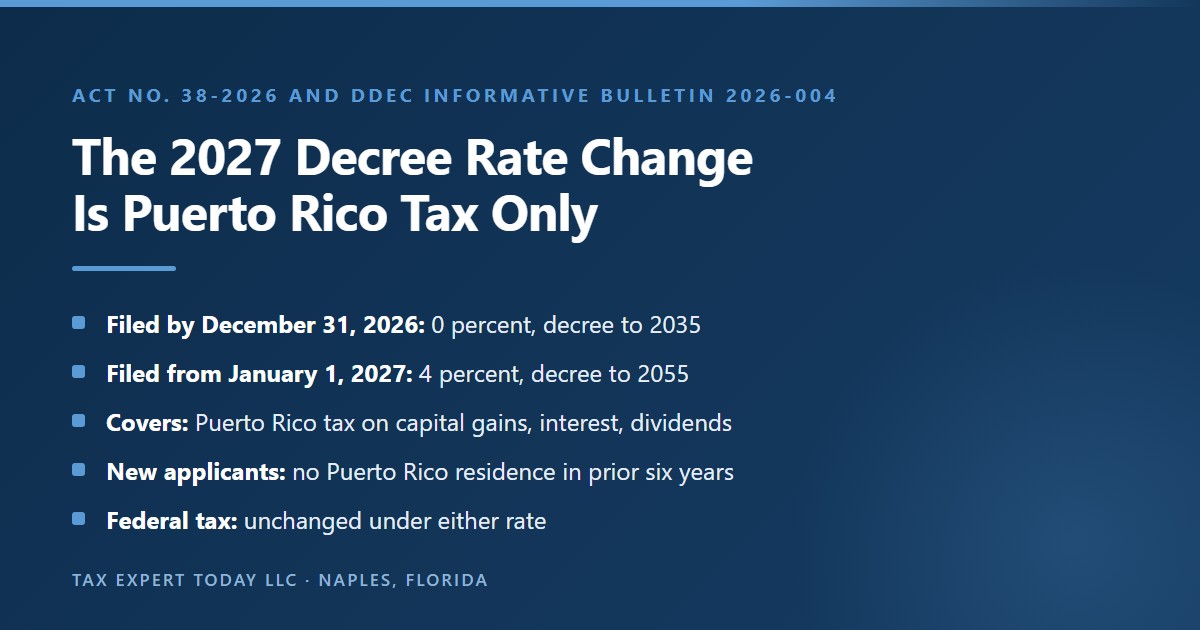
What is the IRS compliance campaign on Puerto Rico tax incentives?
The IRS Large Business and International division lists a Puerto Rico Act 22 compliance campaign among its active campaigns. It addresses taxpayers who claimed the Puerto Rico benefits without meeting section 937, and taxpayers who met section 937 but may be reporting U.S. source income as Puerto Rico source. Treatment includes examinations, outreach, and letters.
- Name: Puerto Rico Act 22, Individual Investors Act.
- Practice area: Withholding, Exchange and International Individual Compliance.
- First target: people claiming benefits without meeting the section 937 residence tests.
- Second target: people who meet section 937 but treat U.S. source income as Puerto Rico source.
- Tools: examinations, outreach, and soft letters.
The IRS describes the campaign on its page of active LB&I compliance campaigns. The description says the campaign addresses taxpayers who have claimed benefits through Puerto Rico Act 22 without meeting the requirements of section 937, and that as a result these individuals may be excluding income subject to U.S. tax on a filed return, or failing to file and report income subject to U.S. tax. It adds that the campaign will also address individuals who have met section 937 but may be erroneously reporting U.S. source income as Puerto Rico source income. The stated objective is to address noncompliance through a variety of treatment streams, including examinations, outreach, and soft letters.
The campaign is named for Act 22 of 2012, the predecessor law that Act 60 absorbed in 2019. Its description fits Act 60 decree holders in the same way, because the federal rules it tests, section 937 residence and income source, are the same. What the campaign tells a taxpayer is where an examiner will look first: the day count and its evidence, the location of the tax home, the closer connection factors, the Form 8898, and the source of each large item of income, especially gains on property owned before the move.
For someone who has already moved and received a letter, the path depends on the facts. If the residence and sourcing positions are supported, the response is a matter of assembling the records. If a return reported a position that cannot be supported, amended returns, a response that corrects the position, and attention to penalties may be needed. Our guide to IRS penalty relief explains the penalty relief options that exist in general, and any question of potential criminal exposure belongs with a tax attorney before anything is filed.
| Area an examiner is likely to test | Evidence that supports the position |
|---|---|
| Presence test | Contemporaneous travel calendar, passport, airline records, card statements, phone location history |
| Tax home | Office lease, staff location, meeting records, where contracts were signed and work was done |
| Closer connection | Puerto Rico license, voter registration, home deed or lease, family location, memberships, banking |
| Form 8898 | Copy of the form and proof of timely mailing |
| Income source | Acquisition dates, closing values on the first day of the possession holding period, work day logs |
| Year of move | Records for the last 183 days of the move year and the three years after |
Is moving to Puerto Rico the same as giving up U.S. citizenship?
No. Puerto Rico is a U.S. territory, and a U.S. citizen who moves there remains a U.S. citizen and a U.S. taxpayer. The expatriation rules of section 877A and Form 8854 apply to people who renounce citizenship or end long term green card status, not to a move to Puerto Rico. No exit tax is triggered by the move.
- Citizenship: unchanged by a move to Puerto Rico.
- Exit tax: section 877A applies to covered expatriates, which a move to Puerto Rico does not create.
- Form 8854: not required because of the move.
- Federal filing: continues under the territory rules in Publication 570.
- Green card holders: a lawful permanent resident who moves to Puerto Rico generally remains a resident alien for federal purposes.
Some promotional material describes Puerto Rico as a way to leave the U.S. tax system without giving up a passport. That is not accurate. A move to Puerto Rico is a move within the United States for citizenship purposes. Section 933 is a targeted exclusion for one category of income, and the person who uses it is still a U.S. citizen subject to federal tax on everything else. The exit tax regime in section 877A, which treats a covered expatriate as having sold worldwide assets the day before expatriation, applies to citizens who relinquish citizenship and to long term residents who end their green card status. Our Form 8854 expatriation guide explains those rules for people who are actually leaving the United States.
The comparison is still useful because it shows how differently the two paths treat appreciated assets. Expatriation generally taxes built-in gain at the date of expatriation through the mark to market rule. A move to Puerto Rico does not tax built-in gain at the move, but the ten year rule keeps that gain U.S. source when the assets are sold in the following decade. In both cases, gain that accrued while the person lived on the mainland generally remains within the federal system.
Lawful permanent residents raise their own questions, and the section 7701(b) residency rules decide their starting status. The presence test in the regulation applies to U.S. citizens and resident aliens, and section 933 applies to an individual, whether a citizen or an alien, who is a bona fide resident of Puerto Rico. A green card holder who moves to Puerto Rico generally keeps resident alien status for federal purposes and can use section 933 for Puerto Rico source income if the section 937 tests are met. Immigration consequences of spending long periods outside the fifty states are a separate matter for immigration counsel.
How does moving back to Florida from Puerto Rico work for taxes?
In the year you leave, U.S. citizens who were bona fide residents of Puerto Rico for at least two years can, under strict conditions, keep bona fide residence for the part of the year before departure, and section 933(2) can exclude Puerto Rico source income for that period. Form 8898 may be due.
- Two year rule: section 933(2) protects Puerto Rico source income for the residence period before the departure, for citizens with at least two years of bona fide residence.
- Regulation: Treas. Reg. 1.937-1(f)(2)(ii) sets the conditions for the part year treatment.
- Closer connection: must be to Puerto Rico throughout the part of the year before the tax home leaves.
- Form 8898: required for the year of departure if worldwide gross income exceeds $75,000.
- Move year look forward: leaving within three years can undo the year of move rule for the arrival year.
Section 933(2) deals with the year a citizen leaves Puerto Rico. For a U.S. citizen who has been a bona fide resident of Puerto Rico for a period of at least two years before the date the residence changes, income derived from Puerto Rico sources that is attributable to the part of the period of Puerto Rico residence before that date is excluded, again with no deductions or credits allocable to it. Treas. Reg. section 1.937-1(f)(2)(ii) implements this with five conditions: the individual is a citizen, was a bona fide resident of Puerto Rico for at least two taxable years immediately before the year, ceases to be a bona fide resident during the year, ceases to have a tax home in Puerto Rico during the year, and has a closer connection to Puerto Rico than to the United States or a foreign country throughout the part of the year before the tax home leaves.
The Instructions for Form 8898 give an example: a U.S. citizen who moves from Puerto Rico to Florida in May and meets the requirements for the part of the year before the move must file Form 8898 for that year if worldwide gross income is more than $75,000. The income earned after the move is taxed in the ordinary way for a Florida resident.
The bigger risk on a return to Florida is the arrival year, and returning residents can use our guide to Florida domicile for executives to rebuild the Florida records. Recall that the year of move rule for the arrival year requires bona fide residence in each of the three following years. A person who moves to Puerto Rico in 2027 and returns to Naples in 2029 has not met that condition, which can unwind the arrival year position as well as affect the departure year. Anyone who expects to stay only a short time should model the federal result for every year involved before relying on the exclusion. Our bona fide residence test guide covers the separate foreign country version of residence used for the foreign earned income exclusion, which works differently and does not apply to Puerto Rico.
Do Puerto Rico residents make federal estimated tax payments?
Often yes. A bona fide resident who expects to owe federal income tax on U.S. source income, self-employment tax, or the net investment income tax generally makes estimated payments under the usual federal rules. Publication 570 reminds residents to include the net investment income tax when figuring estimated tax.
- What drives payments: U.S. source income, self-employment tax, and the net investment income tax.
- Usual rules: quarterly federal estimated payments and the safe harbors based on prior year tax.
- Large sales: a U.S. source gain under the ten year rule can create a large payment for one quarter.
- Puerto Rico payments: are separate and follow Puerto Rico law.
- Penalty: underpayment can produce the federal estimated tax penalty.
The federal estimated tax system does not stop because most of a person’s income becomes excluded. Publication 570 discusses estimated tax payments for territory residents and specifically reminds bona fide residents that the net investment income tax must be taken into account. In practice, a decree holder with U.S. dividends, Naples rent, or a sale of pre-move securities should plan federal estimated payments the same way a Florida resident would, and should expect the first year after the move to be the hardest to estimate, because the prior year safe harbor is based on a mainland year with a different income picture.
For a large sale of securities within the ten year window, the payment is often concentrated in a single quarter. Our quarterly estimated tax calculator shows how the installments are figured. The IRS Form 1040-ES page has the federal worksheets. Puerto Rico has its own estimated tax system for Puerto Rico tax, which is a question for a Puerto Rico preparer.
What records prove bona fide residence in Puerto Rico?
Keep a contemporaneous day log with travel evidence, proof of where you work and live, and documents for each closer connection factor: deed or lease, Puerto Rico license and voter registration, family location, memberships, and banking. Keep a copy of Form 8898, the move date records, and the closing values of securities on the first possession day.
- Days: a calendar kept as you go, backed by airline, passport, and card records.
- Tax home: office lease, employment or engagement letters, and where meetings took place.
- Closer connection: license, voter registration, deed or lease, vehicle registration, memberships, and banking.
- Sourcing: acquisition dates, the first possession day, closing values, and work day logs.
- Filings: Form 8898 with proof of mailing, and the decree and annual reports.
The IRS campaign makes the quality of the file the deciding factor in most cases. The section 937 tests are factual, and the regulations put the burden of producing documents on the taxpayer, sometimes within 30 days, as in the medical treatment rule. The presence test regulation sets those record rules. A file built after a letter arrives is weaker than one built as the year unfolds. The table below is a practical checklist we use when reviewing a Puerto Rico residence position.
| Record | Which test it supports | How long to keep it |
|---|---|---|
| Daily location log with travel receipts | Presence; year of move | For as long as the year can be examined, and longer for move years |
| Puerto Rico home deed or lease | Closer connection; tax home for retirees | Ownership period plus the open years |
| Puerto Rico driver’s license and vehicle registration | Closer connection | All residence years |
| Voter registration in Puerto Rico and cancellation in Florida | Closer connection; significant connection | All residence years |
| Florida homestead removal and declaration of domicile changes | Closer connection | Permanently |
| Office lease and staff location | Tax home | All residence years |
| Work day log for any mainland work | Income source | All residence years |
| Securities statements showing closing values on the first possession day | Ten year rule election | Until every pre-move asset is sold and the years are closed |
| Form 8898 and proof of mailing | Section 937(c) | Permanently |
What are the most common Act 60 Puerto Rico federal tax mistakes?
The common mistakes are treating the decree as a federal exemption, keeping a Florida home and life that outweigh Puerto Rico ties, running a business from the mainland, treating U.S. dividends and pre-move gains as Puerto Rico income, forgetting Form 8898 and self-employment tax, and leaving within three years of the move.
- Decree as exemption: assuming Puerto Rico’s grant controls the federal result.
- Mainland life: keeping homestead, license, voter registration, and family in Naples.
- Mainland business: leaving the principal place of business in Florida.
- Source errors: reporting U.S. dividends, Naples rent, or pre-move gains as excluded.
- Missed filings: Form 8898, Form 1040-SS or Schedule SE, FBAR for foreign accounts, and Form 8938 in the planning years.
Most of these mistakes come from reading the Puerto Rico rules and assuming the federal rules follow. The decree is real, but it is a Puerto Rico grant. The federal result depends on residence and source, and those rules have their own vocabulary and their own evidence. Under these rules, the residence tests and the ten year rule account for most of the federal risk, followed by self-employment tax that was simply never computed.
| Mistake | Federal consequence | Rule |
|---|---|---|
| Treating the decree as a federal exemption | Tax on all income as a mainland resident if section 937 is not met | Sections 933 and 937(a) |
| Keeping the Naples home available, homestead in place | Closer connection test likely fails | Treas. Reg. 1.937-1(e) |
| Running the company day to day from Florida | Tax home outside Puerto Rico; business income may stay U.S. income | Treas. Reg. 1.937-1(d); section 937(b)(2) |
| Excluding U.S. dividends or Naples rent | Underreported U.S. source income | Section 937(b) |
| Excluding gain on pre-move stock sold within the window | Underreported U.S. source gain | Treas. Reg. 1.937-2(f)(1) |
| Forgetting Form 8898 | $1,000 penalty unless reasonable cause | Sections 937(c) and 6688 |
| Skipping self-employment tax | Unpaid self-employment tax and penalties | Publication 570 |
| Returning within three years | Year of move rule fails for the arrival year | Treas. Reg. 1.937-1(f)(1)(iii) |
| Moving after July 2 and expecting the move year to qualify | Move year fails | Treas. Reg. 1.937-1(f)(1)(ii) |
What should a Floridian review before a Puerto Rico move in 2026 or 2027?
Before relying on Act 60 Puerto Rico benefits, test the federal side: map each spouse’s residence under section 937, decide what happens to the Naples home and homestead, locate the business and tax home, list pre-move assets under the ten year rule, estimate the remaining U.S. source income and self-employment tax, and plan the move date around July 2.
- Residence map: each spouse separately, for the move year and the three years after.
- Naples home: sell, rent at fair rent, or keep, with the section 121 window in mind.
- Business: where the principal place of business will actually be.
- Assets: which holdings are covered by the ten year rule, and their closing values on the first possession day.
- Cash flow: federal tax that remains on U.S. source income, self-employment tax, and the net investment income tax.
We recommend a written federal review before any decree application is filed, and particularly before a filing driven by the December 31, 2026 date in the Puerto Rico bulletin. A rushed decision about the Puerto Rico rate does not change any of the federal rules, and the most expensive outcomes we see come from moves that met a Puerto Rico deadline but not the section 937 tests. The review below is the order we follow.
| Step | Question to answer | Rule involved |
|---|---|---|
| 1 | Will each spouse meet the presence test every year, and by which alternative? | Treas. Reg. 1.937-1(c) |
| 2 | Where will the tax home be from the first day of the last 183 days of the move year? | Treas. Reg. 1.937-1(d) and (f) |
| 3 | Which mainland ties remain, and do they outweigh Puerto Rico ties in total? | Treas. Reg. 1.937-1(e) |
| 4 | What happens to the Naples home, the homestead exemption, and Florida registrations? | Fla. Stat. 196.031; closer connection factors |
| 5 | Which assets were owned before the move, and when might they be sold? | Treas. Reg. 1.937-2(f)(1) |
| 6 | What U.S. source income continues, such as dividends, rent, and mainland work? | Section 937(b) |
| 7 | What self-employment tax and net investment income tax remain? | Publication 570; section 1411 |
| 8 | Which information returns apply: Form 8898, FBAR, and Form 8938? | Section 937(c); FinCEN rules; Form 8938 instructions |
| 9 | Is the person prepared to stay at least through the third year after the move? | Treas. Reg. 1.937-1(f)(1)(iii) |
| 10 | Which Puerto Rico questions go to Puerto Rico counsel? | Act No. 60-2019 as amended by Act No. 38-2026 |
Floridians who are comparing Puerto Rico with other moves may find our guides on leaving California taxes and on retiring to Florida helpful for the state side of a relocation, because the state residence questions follow similar facts and circumstances reasoning even though the federal rules here are different.
Act 60 Puerto Rico Help in Naples & Southwest Florida
Tax Expert Today LLC reviews the federal side of Puerto Rico moves from an office in Naples, Florida, serving clients in all 50 states and abroad. Many of the people who ask us about Act 60 Puerto Rico already live in Southwest Florida and want to know what a move would mean for the Naples home they intend to keep, the company they run, and the portfolio they built here. Our team of tax advisors, enrolled agents, CPAs, and attorneys tests the section 937 residence position for each spouse, sources each income item, applies the ten year rule to pre-move assets, prepares Form 8898 and the continuing federal returns, and coordinates with Puerto Rico counsel, who handle the decree itself.
- Act 60 Puerto Rico help Naples: the federal residence and source review before a decree application.
- Form 8898 help Naples: the notice for the year residence begins or ends.
- International tax Naples FL: territory returns, the ten year rule, and the net investment income tax.
- Foreign tax Naples: foreign accounts and assets held alongside Puerto Rico holdings.
- FBAR Naples: foreign account reporting that continues after the move.
Our international and expat tax services page explains how we work with people moving to Puerto Rico and abroad. The international tax Naples FL guide covers the wider picture for Southwest Florida, and owners planning a sale or a move can see our Naples, Florida tax planning page.
Office: 11983 Tamiami Trail N, Naples FL 34110
Phone: (239) 441-2005
Hours: Monday through Friday, 10:00 to 5:00 ET
Frequently Asked Questions
Where can I get help with the federal side of an Act 60 Puerto Rico move in Naples, Florida?
Tax Expert Today LLC, located at 11983 Tamiami Trail N in Naples, Florida, reviews section 937 residence, income sourcing, the ten year rule, and Form 8898 for people considering or completing a move to Puerto Rico. The firm includes tax advisors, enrolled agents, CPAs, and attorneys and serves clients in all 50 states. Call (239) 441-2005 to discuss your facts.
Does an Act 60 decree mean I pay no federal income tax?
No. The decree governs Puerto Rico tax. For federal purposes, a U.S. citizen excludes only Puerto Rico source income under section 933, and only after meeting the presence, tax home, and closer connection tests of section 937. U.S. source income, including U.S. dividends and Naples rent, remains federally taxable.
How many days do I need to spend in Puerto Rico?
The most common route is at least 183 days in Puerto Rico during the year. The regulations allow four alternatives, including 549 days over three years with at least 60 each year, or no more than 90 days in the United States. The presence test is only one of three tests.
Who has to file Form 8898?
A person whose worldwide gross income exceeds $75,000 for the year in which he or she takes the position of becoming, or ceasing to be, a bona fide resident of Puerto Rico. It is due by the Form 1040 due date, including extensions, and is mailed separately. The penalty for not filing is $1,000 unless there is reasonable cause.
Is gain on stock I owned before moving to Puerto Rico tax free?
Generally not within about ten years of the move. Treas. Reg. 1.937-2(f)(1) treats gain on investment property owned before becoming a bona fide resident as non Puerto Rico source if you were a mainland resident in any of the ten preceding years. An election can treat the post-move portion as Puerto Rico source.
Do I still pay self-employment tax after moving to Puerto Rico?
Generally yes. Publication 570 states that bona fide residents with self-employment income must generally pay U.S. self-employment tax, even without a federal income tax filing obligation. It is reported on Schedule SE or, if no Form 1040 is required, on Form 1040-SS.
What changed in Act 60 for 2027?
Under Puerto Rico’s Act No. 38-2026, decree applications filed on or after January 1, 2027 receive a 4 percent Puerto Rico rate on covered capital gains, interest, and dividends, with decrees to 2055. Applications filed by December 31, 2026 keep the 0 percent rate with decrees to 2035. Federal rules are unchanged.
When to Engage a Professional
A Puerto Rico move involves two tax systems that do not coordinate automatically. The Puerto Rico decree sets one result, and the federal rules can set a very different one. Each federal question turns on facts: whether each spouse meets the presence, tax home, and closer connection tests in every year, whether the year of move rule is available, which income is Puerto Rico source, how the ten year rule applies to each asset, and which forms are due. A mistake in any of them can mean federal tax, interest, and penalties on income that was assumed to be excluded.
A professional review is worth considering before any decree application is filed, before a business is restructured, before appreciated assets are sold, when a Florida home will be kept, when one spouse will stay on the mainland, and whenever an IRS letter about Puerto Rico residence arrives. Questions about the decree itself, Puerto Rico tax returns, and Puerto Rico law belong with Puerto Rico counsel, and any matter that could involve criminal exposure belongs with a tax attorney.
Tax Expert Today LLC is a tax advisory firm in Naples, Florida serving clients in all 50 states. Call (239) 441-2005 to discuss your facts.
This article is general information, not legal or tax advice for any particular taxpayer, and does not create a client relationship. It describes federal tax rules only and does not advise on Puerto Rico law or on whether to relocate. The examples are hypothetical illustrations only, do not describe any client, use simplified figures, and ignore Puerto Rico tax except where a decree rate is shown for arithmetic. Whether a person is a bona fide resident of Puerto Rico, how income is sourced, and what tax is due depend on the facts and on law and guidance that may change, and the IRS decides each case on the information available to it. The federal rules described here reflect 26 U.S.C. sections 121, 877A, 933, 937, 1411, and 6688; Treasury Regulations sections 1.933-1, 1.937-1, 1.937-2, and 301.7701(b)-2; the Instructions for Form 8898 (Rev. October 2024); Publication 570; the Instructions for Form 8938; the FinCEN FBAR filing instructions; and the IRS LB&I active campaigns page. Puerto Rico rules are summarized from Act No. 38-2026 as described in DDEC Informative Bulletin No. 2026-004 (April 24, 2026). All sources were reviewed on November 16, 2026.
Published November 16, 2026 by Dr. Pellumb Kabashi « Back to Learning Center
Have a question this article touches on?
Tax Expert Today LLC, based in Naples, Florida and serving clients across the United States.
Schedule a Consultation (239) 441-2005