
By Dr. Pellumb Kabashi, DBA, MBA, EA, CFE, CES
Founder, Tax Expert Today LLC · Tax advisors, enrolled agents, CPAs, and attorneys · Serving clients in all 50 states
Quick Answer: The Canada US tax treaty is the 1980 income tax convention between the two countries, amended by five protocols through 2007. For a Canadian who winters in Florida, it decides residency when both countries claim you, limits U.S. tax on pensions and investment income, makes U.S. Social Security taxable only in Canada, and prorates the U.S. estate tax credit on Florida property. Call (239) 441-2005 for a free consultation.
What is the Canada US tax treaty?
The Canada US tax treaty is the Convention Between the United States of America and Canada with Respect to Taxes on Income and on Capital, signed September 26, 1980, and amended by protocols in 1983, 1984, 1995, 1997, and 2007. It allocates taxing rights, caps withholding rates, and settles residency when both countries claim the same person.
- Five protocols: June 14, 1983, March 28, 1984, March 17, 1995, July 29, 1997, and September 21, 2007.
- Two jobs: deciding which country may tax an item of income, and requiring the residence country to give credit for tax paid to the other.
- Estate rules too: the 1995 protocol added Article XXIX B, which coordinates U.S. estate tax with the Canadian tax that arises at death.
- Not self-executing for you: most benefits must be claimed on a U.S. return or a withholding certificate.
The treaty text the IRS publishes on its Canada tax treaty documents page combines the 1980 convention with Protocols 1 to 4, and the 2007 protocol is posted separately by the Treasury Department together with its technical explanation. There is no single official consolidated version on the U.S. side, which is one reason summaries online disagree: an article written from the 1980 text alone will describe Social Security, interest, and the saving clause incorrectly. This guide reads every rule from the amended text as it stands after the 2007 protocol.
Most published explanations of the treaty are written for one of two readers: a U.S. citizen who lives and works in Canada, or a Canadian business with U.S. customers. This one is written for a third reader who is far more common in Southwest Florida: the Canadian resident who spends the winter in Naples, Fort Myers, or Marco Island, may own a condominium or a rental home here, and receives some U.S. income such as Social Security, dividends from a U.S. brokerage account, or rent. For that person the treaty is less about business profits and more about five practical questions: am I a U.S. resident, what happens to my Florida rent, what happens when I sell, how are my pensions taxed, and what happens to my Florida property when I die.
Which Canada US tax treaty articles matter most to a Florida snowbird?
Seven articles do most of the work for a Canadian who winters in Florida: Article IV on residence, Article VI on real property income, Article XIII on gains, Article XVIII on pensions and Social Security, Article XXII on gambling losses, Article XXIV on double tax relief, and Article XXIX B on estate tax at death.
- Residence first: Article IV decides which country treats you as resident when both domestic laws do.
- Property second: Articles VI and XIII let the United States tax Florida rent and Florida sale gains.
- Income third: Article XVIII and the withholding articles set the U.S. tax on pensions and investment income.
- Death last: Article XXIX B prorates the U.S. estate tax credit and coordinates with Canadian tax.
The table below maps each article to what it does for a snowbird and the U.S. form or certificate that usually claims the benefit. Several of these forms have their own detailed guides on this site, and the right-hand column points to them rather than repeating the mechanics here.
| Treaty article | What it does for a Canadian snowbird | How the benefit is usually claimed | Detailed guide |
|---|---|---|---|
| Article IV (Residence) | Breaks a tie when both countries treat you as resident | Form 1040-NR with Form 8833 | Form 8833 |
| Article VI (Real property income) | Lets the United States tax rent from a Florida property | Form W-8ECI to the payer and Form 1040-NR | Form 1040-NR |
| Article X (Dividends) | Caps U.S. tax on portfolio dividends at 15 percent | Form W-8BEN to the broker | Form W-8BEN |
| Article XIII (Gains) | Lets the United States tax gain on Florida real estate; most other gains are taxed only in Canada | FIRPTA withholding, then Form 1040-NR | FIRPTA withholding |
| Article XVIII (Pensions and Social Security) | U.S. Social Security taxable only in Canada; periodic U.S. pensions capped at 15 percent at source | Payer certificate, or a refund claim on Form 1040-NR | Totalization agreements |
| Article XXII (Other income) | Allows U.S. gambling losses to offset U.S. gambling winnings | Form 1040-NR refund claim | This guide |
| Article XXIV (Double tax relief) | Canada credits U.S. tax on income the treaty lets the United States tax | Canadian return | Form 1116 (U.S. side) |
| Article XXIX B (Taxes at death) | Prorated U.S. estate tax credit; small estate relief; credit for Canadian tax at death | Form 706-NA | This guide |
Two other provisions run underneath everything else. Article XXIX(2), the saving clause, lets the United States tax its own citizens and residents as if the treaty did not exist, subject to listed exceptions. And the treaty never replaces a filing requirement: a Canadian who owes nothing because of the treaty may still have to file a return or a statement to say so. Both points are covered in their own sections below.
How does the United States decide whether a Canadian snowbird is a U.S. resident?
A Canadian citizen without a green card is a U.S. resident for income tax purposes if the substantial presence test is met: at least 31 days in the current year and 183 weighted days over three years, counting all current year days, one third of last year, and one sixth of the year before.
- Weighted count: 122 days in each of three straight years produces exactly 183 weighted days.
- Common surprise: a four month winter every year meets the test even though no single year reaches 183 days.
- Two exits: the closer connection exception on Form 8840, or the treaty tie-breaker in Article IV.
- Green card holders: residents under the green card test regardless of days.
The test comes from 26 U.S.C. section 7701(b)(3), and our substantial presence test guide walks through the day counting rules, the exempt day categories, and the residency start date in full. For this guide the only point that matters is the arithmetic that catches snowbirds. Because the formula weights the current year at one, the prior year at one third, and the year before that at one sixth, any person who spends the same number of days in the United States every year multiplies that number by 1.5. Anyone spending 122 or more days a year here, year after year, meets the test. A typical Canadian winter in Naples, Florida runs from November or December to April, which is often 150 days or more.
Meeting the test does not, by itself, mean a Canadian owes U.S. tax on worldwide income. It means the United States, under its own law, treats that person as a resident unless an exception applies. Canada, under its own law, almost certainly still treats the same person as a Canadian resident. Two systems now claim the same taxpayer, and the remaining sections explain the two routes that resolve the conflict: one under U.S. domestic law and one under the treaty.
Form 8840 or the treaty tie-breaker: which one applies?
If you were present fewer than 183 days in the current year, the domestic closer connection exception on Form 8840 is usually the simpler route. At 183 days or more in the current year, that exception is unavailable by statute, and the only remaining route is the Article IV tie-breaker, claimed on Form 1040-NR with Form 8833.
- Form 8840: a statement under U.S. law; you are treated as never having met the substantial presence test.
- Form 8833: a treaty position; you are a U.S. resident under U.S. law but a Canadian resident under the treaty.
- Hard bar: 183 or more days in the current year closes the Form 8840 route.
- Green card: a pending or approved green card application closes the Form 8840 route too.
Section 7701(b)(3)(B) says an individual is not treated as meeting the substantial presence test for a year if the individual is present on fewer than 183 days during that year and has a tax home in, and a closer connection to, a foreign country. Section 7701(b)(3)(C) removes the exception for anyone who had an application for adjustment of status pending or took other steps to apply for permanent residence during the year. The Form 8840 instructions repeat both limits and then add the sentence that matters most: even if you are not eligible for the closer connection exception, you may qualify for nonresident status by reason of a treaty. Our Form 8840 guide covers the statement line by line; this section covers the choice between it and the treaty.
| Point of comparison | Closer connection exception (Form 8840) | Treaty tie-breaker (Form 8833) |
|---|---|---|
| Legal source | 26 U.S.C. section 7701(b)(3)(B) | Article IV(2) of the treaty and 26 CFR section 301.7701(b)-7 |
| Current year day limit | Fewer than 183 days | No day limit |
| Green card application pending | Not available | Can still be claimed, but see the long-term resident warning below |
| Your U.S. status afterward | Nonresident alien for all purposes | Nonresident only for computing income tax; resident for other Code purposes |
| What you file | Form 8840 alone if you have no U.S. filing requirement, or attached to Form 1040-NR | Form 1040-NR with Form 8833 attached |
| Deadline | The Form 1040-NR due date, including extensions | The Form 1040-NR due date, including extensions |
| Consequence of missing it | Loss of the exception unless clear and convincing evidence of reasonable steps | Penalty of $1,000 per failure to disclose under section 6712, plus the position itself is exposed |
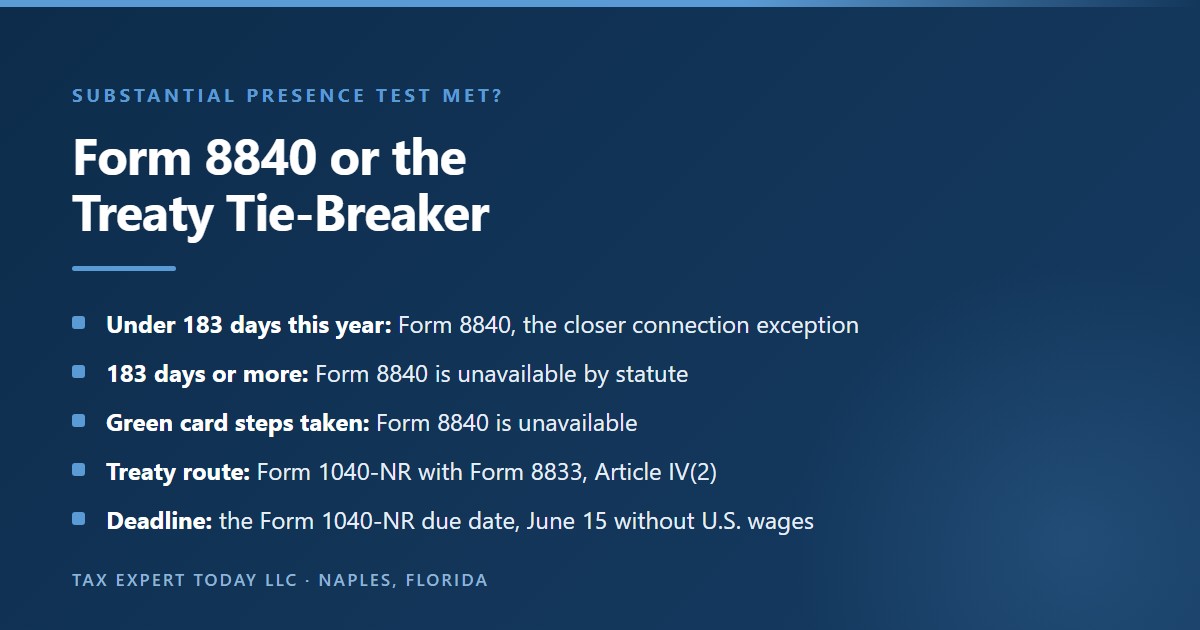
The difference in the “status afterward” row is easy to miss and has real consequences. A person who qualifies for the closer connection exception is treated as never having met the substantial presence test, so that person is simply a nonresident alien. A person who relies on the treaty remains a U.S. resident under U.S. domestic law. Regulation section 301.7701(b)-7(a)(1) treats that dual resident as a nonresident alien “for purposes of computing that individual’s United States income tax liability,” and paragraph (a)(3) says that for other Code purposes the individual is generally still treated as a U.S. resident. Whether particular information returns still apply to a treaty nonresident is a fact-specific question, and it is one reason the treaty route deserves a professional review rather than a box checked on autopilot.
The Form 1040-NR due date drives both deadlines. Under IRS Publication 519, a nonresident alien who did not receive wages subject to withholding and files on a calendar year basis must file no later than June 15 of the following year. For most retired Canadian snowbirds the practical deadline for the 2026 year is therefore June 15, 2027.
How does the Article IV tie-breaker work?
Article IV(2) applies a fixed sequence of tests and stops at the first one that gives an answer: permanent home, then centre of vital interests, then habitual abode, then citizenship, and finally agreement between the two tax authorities. A Canadian who keeps a permanent home only in Canada is usually resolved at the first step.
- Step 1, permanent home: a dwelling available to you on a continuing basis, owned or rented.
- Step 2, centre of vital interests: where your personal and economic relations are closer.
- Step 3, habitual abode: where you customarily live, measured over time.
- Step 4 and 5: citizenship, and then the competent authorities by mutual agreement.
The text of Article IV(2) reads, in substance: the individual is deemed resident in the country where he has a permanent home available; if he has a permanent home in both or in neither, he is deemed resident where his personal and economic relations are closer, which the treaty calls the centre of vital interests; if that cannot be determined, he is resident where he has an habitual abode; if he has an habitual abode in both or neither, he is resident in the country of which he is a citizen; and if he is a citizen of both or neither, the competent authorities settle the question by mutual agreement.
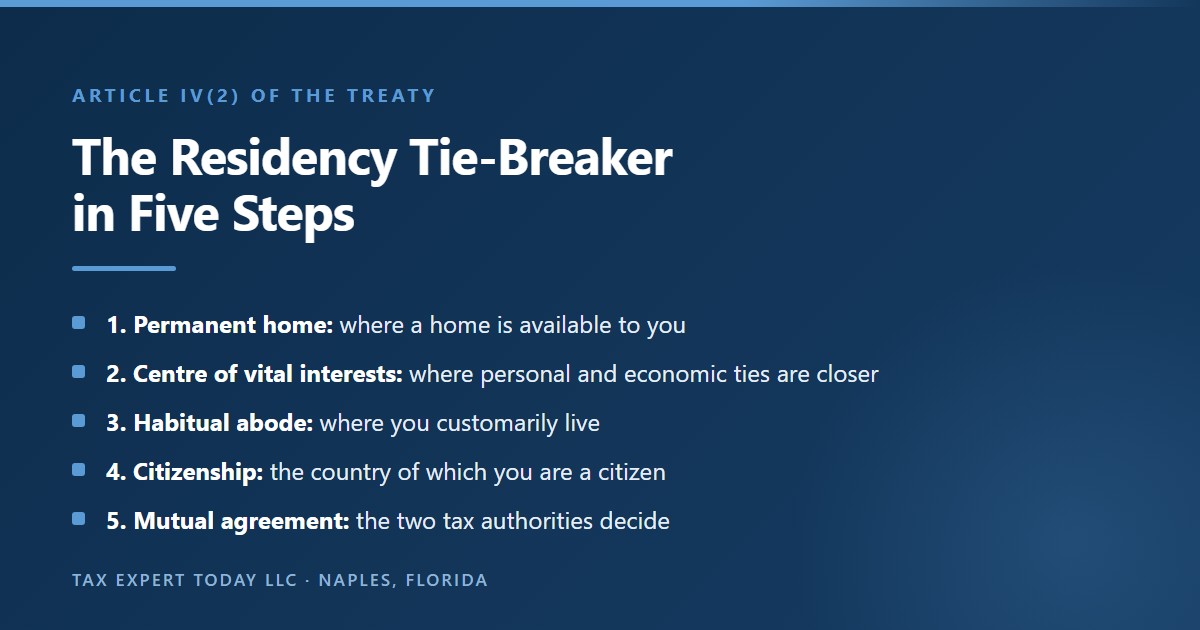
The first step is where a snowbird who owns a Naples condominium has to be careful. A permanent home is a dwelling that is available to you on a continuing basis, whether you own it or rent it, and a Florida condominium you keep year round, furnished and ready for your return, can be a permanent home available to you in the United States. If you also keep your house in Ontario or British Columbia, you have a permanent home in both countries, and the analysis moves to the second step. A snowbird who rents a different seasonal unit each winter and keeps only one home, in Canada, is in a stronger position at step one.
At the second step, the centre of vital interests looks at the whole picture of personal and economic relations. The facts that usually point to Canada for a snowbird are familiar: provincial health coverage, a Canadian driver’s licence and vehicle registration, family, physicians, bank and investment accounts, clubs and community ties, the address on pension statements, and the home where the household spends the larger part of the year. The facts that pull toward the United States include a Florida driver’s licence, voter registration, a Florida homestead exemption, Florida bank accounts used for daily life, and a Florida residence declared for any purpose. A Florida homestead exemption in particular requires a declaration of permanent residence in Florida, which is difficult to reconcile with a claim that Canada is your centre of vital interests.
The third and fourth steps are rarely reached for a Canadian snowbird, because the first two usually decide the case. The fifth step, mutual agreement, is a formal competent authority process and is uncommon for individuals. The more realistic risk is not that the tie-breaker fails, but that it is claimed without the filing that U.S. law requires, which is the subject of the next section.
What does claiming the treaty tie-breaker require on the U.S. side?
A dual resident who claims to be a Canadian resident under the treaty must file Form 1040-NR for the year and attach Form 8833 disclosing the position. Failing to disclose a treaty-based position carries a $1,000 penalty for each failure under section 6712, which the IRS may waive for reasonable cause.
- Return: Form 1040-NR, computed as a nonresident alien for the dual residence period.
- Disclosure: Form 8833, checking the box for a dual-resident taxpayer under Regulation section 301.7701(b)-7.
- Penalty: $1,000 per failure for an individual under section 6712(a).
- Green card warning: a long-term resident who uses the tie-breaker can trigger expatriation under section 877A.
The filing requirement comes from paragraph (b) of the regulation, which requires an alien individual described in paragraph (a) to file a return on Form 1040-NR and attach a statement, now Form 8833, disclosing the position. The current Form 8833 (Rev. December 2022) includes a separate checkbox for “a dual-resident taxpayer” disclosing a treaty-based return position as required by Regulations section 301.7701(b)-7, and it states on its face that failure to disclose may result in a penalty of $1,000, or $10,000 for a C corporation. The penalty itself is in 26 U.S.C. section 6712, and subsection (b) lets the IRS waive it on a showing of reasonable cause and good faith, the same general standard discussed in our reasonable cause guide. Our Form 8833 guide explains how to complete each line, and the Form 1040-NR guide covers the return itself.
The green card warning deserves its own paragraph because it is the costliest mistake in this area. Form 8833 notes that if the taxpayer is a dual resident and a long-term resident, electing to be treated as a resident of a foreign country for purposes of claiming treaty benefits causes the taxpayer to be deemed to have expatriated under section 877A. A long-term resident is generally a green card holder who held that status in at least 8 of the last 15 years. For that person, a tie-breaker claim is not a routine filing; it can start the exit tax analysis described in our Form 8854 and exit tax guide. A Canadian who holds a green card and spends most of the year in Canada should have that question answered before any Form 8833 is filed.
The year a Canadian actually moves to Florida, or leaves it, raises a separate issue. Part of that year may be a resident period and part a nonresident period, and the return becomes a dual status return. Our dual status tax return guide covers the residency starting and ending dates and the statement that goes with them.
How is Florida rental income taxed under the Canada US tax treaty?
Article VI lets the United States tax rent a Canadian resident earns from Florida real property. U.S. law then applies a flat 30 percent tax on gross rent unless the owner elects under section 871(d) to be taxed on net income at graduated rates, which requires filing Form 1040-NR. Canada also taxes the rent and credits the U.S. tax.
- Default rule: 30 percent of gross rent, withheld by the tenant or property manager, with no deductions.
- Net election: section 871(d) lets the owner deduct expenses and depreciation and pay tax only on net rent.
- Paperwork: Form W-8ECI to the payer and an annual Form 1040-NR.
- Canadian side: the rent is reported in Canada, which gives credit for U.S. tax under Article XXIV.
Article VI(1) says income derived by a resident of one country from real property situated in the other “may be taxed in that other State,” and paragraph 3 extends that to income from “the direct use, letting or use in any other form of real property.” The treaty does not reduce the U.S. rate on rent. The rate comes from U.S. domestic law, which taxes a nonresident alien’s rent at 30 percent of the gross amount unless the rent is treated as effectively connected with a U.S. trade or business. Section 871(d) lets a nonresident alien who derives income from U.S. real property held for the production of income elect to treat that income as effectively connected, which moves it onto Form 1040-NR at graduated rates with deductions allowed.
The difference is usually large, because the gross basis tax ignores mortgage interest, condominium fees, property taxes, insurance, management fees, repairs, and depreciation. The table below is a hypothetical illustration only, built on assumed numbers for a single Canadian owner of a Southwest Florida condominium rented for part of the year. It is not a projection for any taxpayer.
| Hypothetical line item | Gross basis (no election) | Net basis (section 871(d) election) |
|---|---|---|
| Gross rent received in 2026 | $30,000 | $30,000 |
| Expenses and depreciation allowed | $0 | $22,000 |
| Amount subject to U.S. tax | $30,000 | $8,000 |
| Rate applied | Flat 30 percent | Graduated; $8,000 falls in the 10 percent bracket (up to $12,400 in 2026) |
| U.S. tax before credits | $9,000 | $800 |
| Return required | None, if the full 30 percent was withheld | Form 1040-NR every year the election is in effect |
Two cautions go with this table. First, nonresident aliens generally cannot claim the standard deduction, so the graduated rates apply to net rent from the first dollar. The 2026 bracket figures come from Rev. Proc. 2025-32. Second, depreciation claimed while the property is rented reduces its basis, which increases the gain when the property is sold. The election is a long-term decision, and it is generally binding for later years unless revoked with IRS consent. When the property is held through an LLC taxed as a partnership rather than directly, the withholding shifts to the partnership regime described in our Form 8804 guide.
On the Canadian side, a Canadian resident reports worldwide income, including Florida rent. Article XXIV(2)(a) requires Canada, subject to its own foreign tax credit rules, to deduct from Canadian tax the income tax paid to the United States on profits, income, or gains arising in the United States. Rent from Florida property is income the treaty lets the United States tax, so Article XXIV(3)(a) deems it to arise in the United States for this purpose. The Canadian computation of rental income and the Canadian credit are matters for a Canadian adviser; the U.S. objective is to pay the correct U.S. tax and document it so the Canadian credit can be claimed.
What happens when a Canadian sells a Florida home?
Article XIII(1) lets the United States tax a Canadian resident’s gain on Florida real property. At closing, FIRPTA generally requires the buyer to withhold 15 percent of the amount realized, unless an exception or an IRS withholding certificate applies. The seller then files Form 1040-NR to report the actual gain and recover any excess withholding.
- Taxing right: the United States may tax the gain; Canada also taxes it and credits the U.S. tax.
- Withholding: 15 percent of the gross sale price under FIRPTA, not 15 percent of the gain.
- Reduced withholding: a withholding certificate application on Form 8288-B can lower it to the expected tax.
- Annual return: Form 1040-NR reports the sale and claims credit for the withholding.
Article XIII(1) provides that gains derived by a resident of one country from the alienation of real property situated in the other “may be taxed in that other State.” Article XIII(3) extends the same right to shares of a company and interests in a partnership, trust, or estate whose value is derived principally from real property in the other country, so holding a Florida condominium through a Canadian corporation or a family trust does not take the gain outside U.S. tax. Most other gains, such as gains on publicly traded U.S. shares held by a Canadian resident, fall under the residual rule in Article XIII(4) and are taxable only in Canada.
The mechanics at closing come from U.S. domestic law, the Foreign Investment in Real Property Tax Act, and are covered step by step in our FIRPTA withholding guide. The point for treaty purposes is that the treaty does not switch off FIRPTA. It confirms that the United States has the right to tax the gain, so the withholding stands, and the seller’s actual tax is settled on Form 1040-NR. Because the withholding is computed on the amount realized rather than the gain, a seller with a modest gain can have far more withheld than the eventual tax, which is why sellers often apply for a withholding certificate before closing.
Two treaty provisions help in narrower cases. Article XIII(7), as replaced by the 2007 protocol, lets an individual who is treated by one country as having sold property and is taxed there by reason of that deemed sale elect to be treated in the other country as having sold and repurchased the property at fair market value at that time. This matters most at death or on emigration, when Canada deems a disposition and the United States otherwise would not, and it can prevent the same appreciation from being taxed twice at different times. Article XIII(5), also replaced by the 2007 protocol, preserves a former resident’s home country right to tax certain gains for ten years after leaving, if the person had been resident there for at least 120 months during any 20 consecutive years.
How are U.S. Social Security and Canadian CPP and OAS benefits taxed under the treaty?
Under Article XVIII(5), U.S. Social Security paid to a resident of Canada is taxable only in Canada, which exempts 15 percent of it. Canada Pension Plan and Old Age Security benefits paid to a resident of the United States are taxable only in the United States, as if they were U.S. Social Security.
- Canadian resident with U.S. Social Security: no U.S. tax under the treaty; Canada taxes 85 percent.
- U.S. resident with CPP or OAS: no Canadian tax under the treaty; the United States taxes it like Social Security.
- Residence decides: the tie-breaker result for the year controls which rule applies.
- Coverage is separate: which country’s system you pay into is governed by the totalization agreement, not the income tax treaty.
The rule has changed twice, which is why older articles conflict. The original 1980 text taxed Social Security only in the paying country. The 1995 protocol reversed that, and the 1997 protocol settled the current rule: benefits under the social security legislation of one country paid to a resident of the other “shall be taxable only in that other State,” with two conditions. Subparagraph (a) says a U.S. benefit paid to a resident of Canada is taxable in Canada as though it were a Canada Pension Plan benefit, “except that 15 per cent of the amount of the benefit shall be exempt from Canadian tax.” Subparagraph (b) says a Canadian benefit paid to a resident of the United States is taxable in the United States as though it were a benefit under the Social Security Act, except that a type of benefit not taxed in Canada when paid to Canadian residents is exempt from U.S. tax.
For a typical snowbird who remains a Canadian resident, the practical result is that U.S. Social Security earned during years of U.S. work is reported in Canada, not the United States. For a Canadian who has become a U.S. resident, for example after moving to Florida permanently, CPP and OAS are reported on the U.S. return under the same rules as U.S. Social Security, as explained in IRS Publication 597. The question of which country’s social security system a worker contributes to is a different matter, handled by the separate social security agreement; our totalization agreement guide explains how that agreement assigns coverage and combines credits.
How does the treaty treat pensions, IRAs, RRSPs, and RRIFs?
Periodic pensions are taxable in the recipient’s country of residence, and the paying country may tax them at no more than 15 percent of the gross payment. Article XVIII(7) lets a U.S. citizen or resident defer U.S. tax on income accruing inside an RRSP or RRIF, and Rev. Proc. 2014-55 makes that deferral automatic for eligible individuals.
- Periodic pensions: source country tax capped at 15 percent under Article XVIII(2)(a).
- RRSP and RRIF growth: U.S. tax deferred until distribution under Article XVIII(7).
- No election form: Form 8891 was retired; eligible individuals are treated as having elected.
- Still reportable: deferral of tax is not an exemption from foreign account reporting.
Article XVIII(1) lets the residence country tax pensions and annuities arising in the other country, and paragraph 2(a) lets the source country also tax them, but limits that tax to 15 percent of the gross amount of a periodic pension payment when a resident of the other country is the beneficial owner. A Canadian resident receiving a periodic distribution from a U.S. pension plan or a U.S. IRA is the usual case. Lump sums are not periodic payments and are not covered by the 15 percent cap, which is a frequent source of over-withholding that can only be corrected through a Form 1040-NR refund claim. Our guide to retiring to Florida covers the U.S. side of pension and IRA planning for people who become Florida residents.
The RRSP and RRIF rule runs the other way. It protects a person who is a U.S. citizen or resident and holds a Canadian retirement plan, such as a Canadian who has become a Florida resident while keeping an RRSP. Without the treaty, the United States would not recognize the RRSP as a tax-deferred plan, and the income earned inside it could be taxable in the United States each year. Article XVIII(7), added by the 1995 protocol, lets that person “elect to defer taxation” on income accrued in the plan until it is distributed. Rev. Proc. 2014-55 simplified the election: section 4.02 says an eligible individual who did not previously make the election “will be treated as having made the election” in the first year it was available, and the separate Form 8891 is no longer required. An eligible individual is one who has filed the required U.S. returns, has not reported the plan’s undistributed earnings as income, and has reported distributions as if the election were in effect. A person who did report the earnings, or who does not meet the other conditions, must request IRS consent under section 4.04.
Deferral of income tax is not the same as relief from information reporting. A U.S. person with an RRSP or RRIF generally counts it toward the FBAR threshold explained in our FBAR guide, and Rev. Proc. 2014-55 itself discusses Form 8938. Separately, Rev. Proc. 2020-17 exempts eligible U.S. individuals from the section 6048 trust reporting requirements for certain tax-favored foreign retirement trusts, which reduces the role of Form 3520 for qualifying plans. For a Canadian who remains a nonresident of the United States, none of this applies: the RRSP is simply a Canadian plan taxed under Canadian rules.
How does the treaty treat U.S. dividends, interest, and gambling winnings?
U.S. portfolio dividends paid to a Canadian resident are capped at 15 percent U.S. tax, or 5 percent for a company owning at least 10 percent of the voting stock. Interest is generally taxable only in Canada under the 2007 protocol. Article XXII(3) lets Canadians deduct U.S. gambling losses against U.S. gambling winnings, usually through a Form 1040-NR refund claim.
- Dividends: 15 percent instead of the 30 percent statutory rate, claimed by giving the broker Form W-8BEN.
- Interest: exempt at source under the replaced Article XI, subject to the anti-abuse exceptions in that article.
- Gambling: losses deductible to the extent of winnings, as for a U.S. resident.
- Refund route: Form 1040-NR, using the Form 1042-S the payer issued.
| Type of U.S. income | U.S. statutory rate for a nonresident | Treaty rule for a Canadian resident | How it is claimed |
|---|---|---|---|
| Portfolio dividends | 30 percent | 15 percent maximum (Article X(2)(b)) | Form W-8BEN to the broker |
| Dividends to a company with at least 10 percent of voting stock | 30 percent | 5 percent maximum (Article X(2)(a)) | Form W-8BEN-E to the payer |
| Interest | 30 percent unless a domestic exemption applies | Generally taxable only in Canada (Article XI(1), 2007 protocol) | Form W-8BEN to the payer |
| Periodic pension and IRA payments | 30 percent | 15 percent maximum (Article XVIII(2)(a)) | Certificate to the payer, or Form 1040-NR refund claim |
| U.S. Social Security | 30 percent of 85 percent of the benefit | Taxable only in Canada (Article XVIII(5)) | Treaty claim with the Social Security Administration |
| Gambling winnings | 30 percent | Losses deductible against winnings (Article XXII(3)) | Form 1040-NR with records of losses |
| Gain on publicly traded U.S. shares | Generally not taxed for a nonresident present under 183 days | Taxable only in Canada (Article XIII(4)) | No U.S. filing for the gain itself |
The dividend rates come from Article X(2) as amended by the 1995 protocol, and the interest rule from the new Article XI that the 2007 protocol substituted, which provides that interest arising in one country and beneficially owned by a resident of the other “may be taxed only in that other State.” The treaty rates are claimed in advance by giving the payer a withholding certificate; our Form W-8BEN guide explains how the treaty line is completed and when a certificate expires. When too much is withheld, the payer reports it on Form 1042-S, which is explained from the recipient’s side in our Form 1042-S guide.
The gambling rule is short and valuable. The 1995 protocol added Article XXII(3), which provides that losses incurred by a resident of one country on wagering transactions, the gains on which may be taxed in the other country, “shall, for the purpose of taxation in that other State, be deductible to the same extent that such losses would be deductible if they were incurred by a resident of that other State.” Publication 597 puts it plainly: Canadian residents may deduct gambling losses in the United States against gambling winnings in the United States in the same manner as a U.S. resident. Because casinos withhold at the nonresident rate when a reportable win is paid, the treaty benefit is usually recovered after year end by filing Form 1040-NR with records that substantiate the losses, such as win and loss statements from the casino.
How does the Canada US tax treaty prevent double taxation?
Article XXIV makes the country of residence give a credit for tax paid to the other country on income the treaty lets that other country tax. For a Canadian resident, Canada deducts U.S. tax on Florida rent, Florida gains, and other U.S.-source income from Canadian tax. Special rules apply to U.S. citizens living in Canada.
- Residence country credits: Canada for a Canadian resident, the United States for a U.S. resident or citizen.
- Source rule: income the treaty lets a country tax is deemed to arise there for the credit.
- U.S. citizens in Canada: Article XXIV(4) to (6) resource income so both credits work.
- U.S. side mechanics: Form 1116 for a U.S. resident claiming credit for Canadian tax.
The structure of Article XXIV is simple at its core. Paragraph 1 requires the United States to allow its citizens and residents a credit for income tax paid to Canada, within the limits of U.S. law. Paragraph 2 requires Canada to deduct from Canadian tax the income tax paid to the United States on profits, income, or gains arising in the United States. Paragraph 3 then supplies the source rule both credits depend on: income that may be taxed in the other country under the treaty is deemed to arise in that other country. Paragraph 7 confirms that state and provincial income taxes of general application count as income tax for this purpose, which matters for snowbirds who earn income in states other than Florida.
The special rules in paragraphs 4 to 6 apply to a U.S. citizen who is a resident of Canada, for example a dual citizen who winters in Florida but lives in Canada. Because the saving clause lets the United States tax its citizens on worldwide income, both countries would otherwise tax the same Canadian-source income as residents. Article XXIV(4) has Canada credit U.S. tax only up to the amount the United States would have charged a non-citizen, and has the United States credit the remaining Canadian tax. Article XXIV(6) then resources income to Canada to the extent needed for the U.S. credit to work. On the U.S. side, that credit is computed on Form 1116, and our Form 1116 guide walks through the baskets and the limitation. Whether a U.S. citizen living abroad is better served by the credit or by the foreign earned income exclusion is covered in our exclusion versus credit guide.
What is the saving clause and why does it matter to dual citizens?
The saving clause in Article XXIX(2) lets each country tax its own residents, and lets the United States tax its citizens, as if the treaty did not exist, except for benefits listed in Article XXIX(3). A U.S. citizen living in Canada therefore cannot use most treaty articles to reduce U.S. tax, though the listed exceptions still apply.
- Who it hits: U.S. citizens, and residents as determined under Article IV.
- What survives: the Social Security rule, the pension deferral, the double tax articles, and parts of the estate article.
- Former citizens: taxable on U.S.-source income for ten years after loss of status under Article XXIX(2)(b).
- Canadian snowbird: unaffected unless the person is also a U.S. citizen or green card holder.
The current text was substituted by Article 24 of the 2007 protocol. Paragraph 2(a) says the treaty “shall not affect the taxation by a Contracting State of its residents (as determined under Article IV (Residence)) and, in the case of the United States, its citizens.” Paragraph 2(b) lets the United States tax a former citizen or former long-term resident on income from U.S. sources for the ten years following the loss of status. Paragraph 3(a) then lists the provisions that still apply despite the saving clause, including paragraphs 1, 3, 4, 5, 6(b), 7, 8, 10, and 13 of Article XVIII, Articles XXIV, XXV, and XXVI, and specified paragraphs of Article XXIX B.
For a Canadian citizen who is not a U.S. citizen, the saving clause mostly matters through its reference to Article IV: once the tie-breaker makes that person a resident of Canada, the United States cannot use the saving clause to tax that person as a resident. For a dual citizen, the clause is the reason U.S. returns, FBARs, and other reporting continue no matter where the person lives, and the reason relief usually comes through the credit rules in Article XXIV rather than through exemptions. A dual citizen who has fallen behind on U.S. filings should read our guides on the streamlined filing compliance procedures, which are available only where the failure was non-willful, and on FBAR penalties, before filing anything.
How does U.S. estate tax apply to a Canadian who owns Florida property?
A Canadian resident who is not a U.S. citizen is subject to U.S. estate tax on U.S.-situs assets, including Florida real estate and shares of U.S. companies. U.S. law allows only a $13,000 credit, but Article XXIX B(2) substitutes a prorated share of the full U.S. citizen credit, which for 2026 is based on a $15,000,000 basic exclusion amount.
- Without the treaty: a $13,000 credit under section 2102(b), which shelters roughly the first $60,000.
- With the treaty: the citizen credit multiplied by U.S.-situs assets divided by the worldwide estate.
- Filing trigger: Form 706-NA when U.S.-situs assets exceed $60,000 at death.
- Condition: the prorated credit is allowed only if the worldwide estate is fully disclosed.
The U.S. statutory credit for a nonresident who is not a citizen is in 26 U.S.C. section 2102(b)(1): “A credit of $13,000 shall be allowed.” At the graduated rates in section 2001(c), that credit covers about $60,000 of taxable estate, and the IRS page on nonresidents with U.S. assets confirms that the executor must file Form 706-NA if the fair market value of the decedent’s U.S.-situs assets exceeds $60,000. For a Canadian with a Naples condominium, that threshold is passed by the condominium alone.
Article XXIX B(2) gives the estate of a Canadian resident who is not a U.S. citizen a unified credit equal to the greater of the $13,000 statutory credit or “the amount that bears the same ratio to the credit allowed under the law of the United States to the estate of a citizen of the United States as the value of the part of the individual’s gross estate that at the time of the individual’s death is situated in the United States bears to the value of the individual’s entire gross estate wherever situated.” The credit is reduced by any credit previously used on gifts, and the paragraph closes with the condition that matters in practice: the prorated credit “shall be allowed only if all information necessary for the verification and computation of the credit is provided.” In other words, the executor has to document the worldwide estate to the IRS.
The citizen credit the ratio is applied to grew substantially under Public Law 119-21, which the IRS refers to as the Working Families Tax Cuts and which Rev. Proc. 2025-32 refers to as the OBBBA. Section 3.14 of that revenue procedure states that the basic exclusion amount is $15,000,000 for calendar year 2026. Applying the rate table in section 2001(c), the tentative tax on $15,000,000 is $5,945,800, which is the citizen credit used in the hypothetical below.
| Hypothetical estate of a Canadian resident dying in 2026 | Without the treaty | With Article XXIX B(2) |
|---|---|---|
| Worldwide gross estate | $6,000,000 | $6,000,000 |
| Florida condominium (the only U.S.-situs asset) | $900,000 | $900,000 |
| Tentative U.S. estate tax on $900,000 before deductions | $306,800 | $306,800 |
| Credit | $13,000 | 15 percent ($900,000 / $6,000,000) of $5,945,800 = $891,870 |
| U.S. estate tax after the credit | $293,800 | $0 (the credit cannot exceed the tax) |
| Form 706-NA required | Yes | Yes, with worldwide estate documentation |
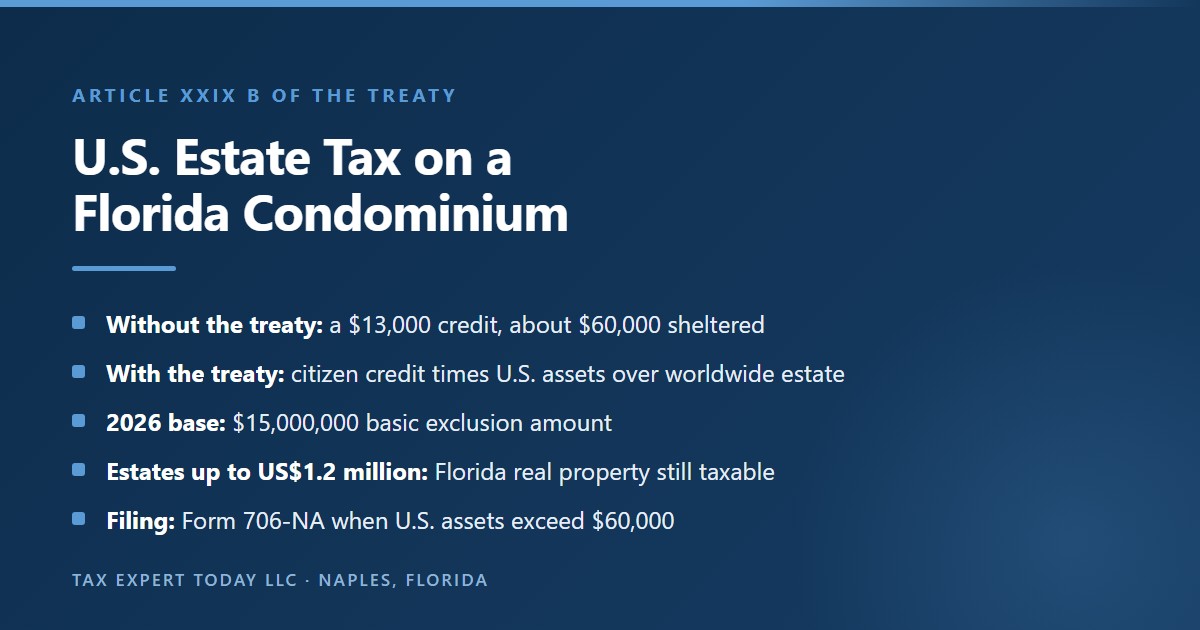
The hypothetical is simplified on purpose. It ignores deductions such as a mortgage that may be partly deductible, state death taxes, and the marital credit discussed below, and it assumes the condominium is the only U.S.-situs asset. Shares of U.S. corporations are also U.S.-situs property for a nonresident’s estate even when they are held in a Canadian brokerage account, so a Canadian with a large U.S. stock portfolio will have a larger U.S. share of the estate and a different result. The point of the table is the mechanism: the treaty can turn a significant U.S. estate tax into none, but only through a filed Form 706-NA that documents the worldwide estate.
What is the small estate rule for Canadians with estates under $1.2 million?
Under Article XXIX B(8), if a Canadian resident who is not a U.S. citizen dies with a worldwide gross estate of US$1.2 million or less, the United States may impose estate tax only on property whose gain it could tax under Article XIII. In practice that means U.S. real property, including a Florida home.
- Threshold: worldwide gross estate of US$1.2 million or less, measured at death.
- Still taxable: Florida real estate, because Article XIII(1) lets the United States tax gains on it.
- Removed: U.S. publicly traded shares, because gains on them are taxable only in Canada.
- Not a filing exemption: the estate may still need Form 706-NA to claim the treaty position.
The text of Article XXIX B(8) provides that, if the value at death of the entire gross estate wherever situated “does not exceed 1.2 million U.S. dollars or its equivalent in Canadian dollars, the United States may impose its estate tax upon property forming part of the estate of the individual only if any gain derived by the individual from the alienation of such property would have been subject to income taxation by the United States in accordance with Article XIII (Gains).” Snowbirds sometimes read this as a promise that a modest estate pays no U.S. estate tax. It is narrower than that. A Florida condominium is exactly the kind of property whose gain the United States may tax under Article XIII(1), so it remains within the U.S. estate tax even in a small estate. What the rule removes from the U.S. estate is the U.S. stock portfolio and similar property whose gains Article XIII(4) reserves to Canada.
For most small estates, the prorated credit in Article XXIX B(2) will then exceed the tax on the condominium, as it does in the larger hypothetical above, but the executor still has to establish both the worldwide value and the treaty position. The $1.2 million figure is fixed in U.S. dollars in the treaty text and is not indexed for inflation.
How does Canadian tax at death interact with U.S. estate tax?
Canada taxes a deceased resident’s accrued gains through income tax at death, while the United States imposes an estate tax. Article XXIX B(6) lets U.S. estate tax on U.S. property be deducted from the Canadian income tax on U.S.-source income and gains for the year of death, so the same Florida property is not fully taxed twice.
- Two different taxes: Canadian income tax on gains at death and U.S. estate tax on value.
- Bridge: Article XXIX B(6) treats U.S. estate tax as creditable against the Canadian tax on U.S.-source amounts.
- Above US$1.2 million: the deduction extends to income and gains from property situated in the United States.
- Spousal rollover: Article XXIX B(5) helps preserve the Canadian spousal rollover when a U.S. resident dies.
Without coordination, the two systems would collide. Canada generally taxes a resident at death as if capital property had been sold, so the gain built up in a Florida condominium is taxed in Canada as income. The United States taxes the full value of the condominium through estate tax. Article XXIX B(6) addresses this by providing that, in determining the Canadian tax payable by an individual who was a resident of Canada immediately before death, U.S. federal or state estate or inheritance taxes on property situated in the United States shall be allowed as a deduction from the Canadian tax otherwise payable for the year of death on income, profits, or gains arising in the United States in that year. Where the worldwide gross estate exceeded US$1.2 million, the deduction also extends to income, profits, or gains for that year from property situated in the United States at death.
Article XIII(7), discussed in the sale section above, works alongside this rule. If Canada taxes a deemed disposition at death and the United States does not, the estate may elect to treat the property for U.S. purposes as sold and repurchased at fair market value at that time, which can align the cost basis the two countries use for later sales. The Canadian computations at death, the terminal return, and the Canadian spousal rollover rules are Canadian law and belong with a Canadian adviser; the U.S. side needs the Form 706-NA, the treaty disclosures, and a record of the values that both returns use.
Is there a treaty marital credit for a surviving spouse?
Yes. Article XXIX B(3) and (4) allow an additional nonrefundable marital credit, generally up to the amount of the unified credit, for property passing to a surviving spouse, if both spouses were residents of either country and the executor elects the credit and irrevocably waives the U.S. marital deduction, including any qualified domestic trust route.
- Size: the lesser of the unified credit under paragraph 2 and the U.S. estate tax on the qualifying property.
- Residence condition: the decedent and the surviving spouse must be residents of either country, or the decedent a U.S. citizen.
- Trade-off: claiming the credit means giving up the marital deduction for that estate.
- Timing: the election is made on a return filed by the deadline for a qualified domestic trust election.
The marital credit matters because the U.S. estate tax marital deduction is generally unavailable when the surviving spouse is not a U.S. citizen, unless property passes to a qualified domestic trust. Paragraph 3 of Article XXIX B allows a credit “in addition to the unified credit” for qualifying property passing to the surviving spouse, and paragraph 4 sets it at the lesser of the unified credit and the estate tax otherwise imposed on that property. In effect, a married Canadian couple can use up to two prorated credits against the U.S. estate tax on Florida property. The election is irrevocable and gives up the marital deduction, so it is a planning decision for the executor and the family’s advisers rather than an automatic benefit.
Which U.S. forms does a Canadian snowbird actually file?
Most Canadian snowbirds file nothing until a trigger occurs. The common triggers are meeting the substantial presence test (Form 8840 or Form 1040-NR with Form 8833), earning Florida rent with a net election (Form 1040-NR), selling U.S. real property, recovering over-withheld tax, and death with U.S. assets over $60,000 (Form 706-NA).
- Presence: Form 8840 under 183 current year days; Form 8833 with Form 1040-NR at 183 or more.
- Income: Form W-8BEN or W-8ECI to payers, and Form 1040-NR where tax is computed on net income.
- Sale: FIRPTA withholding at closing, then Form 1040-NR.
- Death: Form 706-NA when U.S.-situs assets exceed $60,000.
| Situation | U.S. form | Usual timing for a calendar year filer without U.S. wages |
|---|---|---|
| Substantial presence test met, fewer than 183 days this year, no green card steps | Form 8840 | June 15 of the following year (the Form 1040-NR due date) |
| 183 or more days this year, or the closer connection test fails | Form 1040-NR with Form 8833 (dual resident box) | June 15 of the following year |
| U.S. dividends, interest, or pensions paid by a U.S. payer | Form W-8BEN to the payer | Before the first payment; generally valid until the end of the third calendar year after signing |
| Florida rent, net basis election | Form W-8ECI to the payer; Form 1040-NR | Certificate before rent is paid; return by June 15 |
| Sale of Florida real property | Buyer withholds under FIRPTA; optional Form 8288-B before closing; Form 1040-NR | Withholding at closing; return by June 15 of the following year |
| Refund of over-withheld tax (gambling, lump sums, excess dividend withholding) | Form 1040-NR with Forms 1042-S attached | June 15 of the following year; refund claims are subject to time limits |
| Death with U.S.-situs assets over $60,000 | Form 706-NA | Nine months after the date of death, unless extended |
Two practical notes go with the table. First, a Form 8840 filed by itself, for a snowbird with no other U.S. filing requirement, is mailed to the IRS Service Center in Austin, Texas, by the Form 1040-NR due date, as the form’s instructions direct. Second, the Form 8840 instructions state that if you do not timely file it, “you will not be eligible to claim the closer connection exception and may be treated as a U.S. resident,” unless you can show by clear and convincing evidence that you took reasonable actions to become aware of the filing requirements and significant steps to comply. A missed Form 8840 is therefore not a small paperwork issue: it can turn a nonresident into a resident taxable on worldwide income for that year, leaving the treaty tie-breaker as the remaining defense.
What does the Canada US tax treaty not do for a snowbird?
The treaty does not remove filing requirements, does not switch off FIRPTA withholding, does not generally bind U.S. states, does not protect a U.S. citizen from U.S. tax on worldwide income, and does not decide provincial health coverage or immigration status. Each of those is governed by separate rules.
- Filing: a treaty benefit usually has to be claimed on a form, sometimes on a return showing no tax.
- Withholding: payers apply statutory withholding unless they receive a valid certificate.
- States: the treaty covers federal taxes, and states decide for themselves whether to follow it.
- Immigration: days counted for tax are not the same as time allowed in the United States under immigration rules.
Florida has no personal income tax, so the state issue rarely arises for a snowbird who earns income only in Florida. It does arise for a Canadian who owns property or earns income in another state, because many states do not follow the federal treaty and tax nonresidents under their own rules. Immigration is a separate question entirely: the substantial presence test counts days for tax purposes, and the length of stay permitted to a Canadian visitor is set by immigration law, not the tax treaty. Provincial health coverage rules in Canada set their own limits on time spent outside the province, and they are not tax rules. This guide does not address immigration or health coverage.
The treaty also does not cure a past failure to file. A Canadian who should have filed Form 8840 or Form 1040-NR for earlier years, or a dual citizen who has never filed U.S. returns, has a compliance question to resolve, and the right path depends on the facts. Our snowbird first year guide covers the domestic version of this problem, for U.S. citizens who split the year between Florida and another state, and our Florida residency guide covers what it takes to make Florida a legal home.
What does the treaty look like for a hypothetical Canadian couple in Naples?
Consider a hypothetical retired Canadian couple who spend about 165 days each winter in a Naples condominium they own, rent it for the summer, hold U.S. shares, and receive U.S. Social Security. They meet the substantial presence test, can usually use Form 8840, and face U.S. tax on rent and U.S. estate tax on the condominium.
- Residency: 165 weighted over three years is 247.5 days, so the test is met; 165 is under 183, so Form 8840 is available.
- Rent: 30 percent of gross unless they elect net basis and file Form 1040-NR.
- Social Security: taxable only in Canada.
- Estate: condominium exposed; prorated credit through Form 706-NA.
This illustration is hypothetical and does not describe any client. The table follows the couple through a single year and shows which rule applies at each point. The figures used are assumptions chosen to show the mechanics.
| Event in the hypothetical year | Treaty or Code rule | U.S. result | What they file or give |
|---|---|---|---|
| Present 165 days in each of three years | Section 7701(b)(3): 165 + 55 + 27.5 = 247.5 weighted days | Substantial presence test met | Form 8840 for each spouse, since each was present under 183 days and keeps a closer connection to Canada |
| Summer rent of the condominium | Article VI and section 871(d) | Taxed in the United States; net basis if elected | Form W-8ECI to the manager and Form 1040-NR |
| Dividends from U.S. shares | Article X(2)(b) | 15 percent withheld at source | Form W-8BEN to the broker |
| U.S. Social Security from earlier U.S. work | Article XVIII(5)(a) | No U.S. tax; taxable in Canada with a 15 percent exemption | Treaty claim with the payer |
| A reportable slot machine win at a Florida casino | Article XXII(3) | Losses deductible against winnings | Form 1040-NR with loss records to recover withholding |
| Death of one spouse holding the condominium | Article XXIX B(2), (3), (6) | Prorated credit, possible marital credit, coordination with Canadian tax | Form 706-NA with worldwide estate information |
Change one fact and the answers move. If the couple stayed 190 days in a single year, the Form 8840 route would close for that year and they would need the treaty tie-breaker, Form 1040-NR, and Form 8833. If one spouse held a green card, both the Form 8840 route and the tie-breaker would carry the expatriation questions discussed above. If they sold the condominium, FIRPTA withholding and a Form 1040-NR for the year of sale would follow. That sensitivity to single facts is why a one-page summary of the treaty rarely gives a snowbird a reliable answer.
What are the most common Canada US tax treaty mistakes snowbirds make?
The most frequent problems are not exotic. They are missing a Form 8840, claiming the tie-breaker without filing Form 8833, letting 30 percent be withheld on gross rent, ignoring FIRPTA until closing, assuming a small estate owes no U.S. estate tax, and taking a Florida homestead exemption while claiming Canadian residence.
- Counting only this year: the weighted three year formula is what catches people.
- Silent treaty claims: a treaty position not disclosed on Form 8833 can carry a $1,000 penalty.
- Inconsistent residence: declaring Florida residence for one purpose and Canadian residence for tax.
- No estate plan for the condominium: the $60,000 Form 706-NA threshold is low.
- Not filing Form 8840 on time. The exception is lost if the form is not timely filed, subject to a narrow reasonable steps defense.
- Relying on the 183 day rule of thumb. Staying under 183 days in one year does not avoid the substantial presence test; it only preserves the closer connection exception.
- Claiming Canadian residence without Form 8833. Regulation section 301.7701(b)-7 requires a Form 1040-NR and a disclosure statement for the treaty route.
- Accepting 30 percent on gross rent. Without a section 871(d) election and Form 1040-NR, rent is taxed on the gross amount.
- Treating FIRPTA as optional. The buyer is liable for the withholding and title companies apply it; the time to plan is before the contract.
- Misreading the small estate rule. Under Article XXIX B(8), Florida real property remains taxable even below US$1.2 million.
- Undermining the tie-breaker. A Florida homestead exemption, voter registration, or Florida driver’s licence can point the centre of vital interests toward the United States.
- Losing refunds to time limits. Over-withheld tax on lump sums, gambling winnings, or dividends is recovered only by filing, and refund claims are subject to statutory time limits.
Canada US Tax Treaty Help in Naples & Southwest Florida
Tax Expert Today LLC works with international clients from an office in Naples, Florida and serves clients in all 50 states. Southwest Florida has a large community of Canadian winter residents, and many of the questions above arrive together: a condominium in Naples or Bonita Springs, a summer rental, U.S. investment accounts, a pension from earlier U.S. work, and a family that wants to know what happens to the Florida property at death. We look at the U.S. side of those questions and coordinate with the client’s Canadian adviser on the Canadian side.
- Canada US tax treaty help Naples: reviewing residency under the substantial presence test, Form 8840, and the Article IV tie-breaker.
- Canadian snowbird tax Naples: Form 1040-NR for Florida rental income, the section 871(d) election, and refund claims.
- International tax Naples FL: FIRPTA planning before the sale of Southwest Florida property.
- Foreign tax Naples: U.S. estate tax exposure on Florida property and the Article XXIX B credits.
Our international and expat tax services page explains how we approach cross-border work. The international tax Naples FL guide and the Naples tax planning page cover the wider picture for residents and seasonal residents of Naples, Bonita Springs, Fort Myers, and Marco Island.
Office: 11983 Tamiami Trail N, Naples FL 34110
Phone: (239) 441-2005
Hours: Monday through Friday, 10:00 to 5:00 ET
Frequently Asked Questions
We are Canadian and spend every winter in Naples, Florida. Do we have to file anything with the IRS?
Possibly. If your weighted days over three years reach 183, you meet the substantial presence test. If you were in the United States fewer than 183 days this year and keep a closer connection to Canada, each spouse generally files Form 8840 by June 15 of the following year. At 183 days or more, the treaty route on Form 1040-NR with Form 8833 applies instead.
Does the Canada US tax treaty stop the United States from taxing my Florida rental income?
No. Article VI lets the United States tax rent from Florida real property. U.S. law taxes it at 30 percent of gross rent unless you elect under section 871(d) to be taxed on net income and file Form 1040-NR. Canada also taxes the rent and gives credit for the U.S. tax under Article XXIV.
Is U.S. Social Security taxable in the United States for a Canadian resident?
Not under the treaty. Article XVIII(5) makes U.S. Social Security paid to a resident of Canada taxable only in Canada, and Canada exempts 15 percent of it. Canada Pension Plan and Old Age Security paid to a U.S. resident are taxable only in the United States, as if they were U.S. Social Security.
What is the difference between Form 8840 and Form 8833 for a snowbird?
Form 8840 claims the closer connection exception under U.S. law and is available only if you were present fewer than 183 days in the current year and have no green card application pending. Form 8833 discloses a treaty position, such as residence in Canada under the Article IV tie-breaker, and is attached to Form 1040-NR.
Will my estate owe U.S. estate tax on my Florida condominium?
It may. A nonresident’s Florida real estate is subject to U.S. estate tax, and Form 706-NA is required when U.S. assets exceed $60,000. Article XXIX B(2) gives a Canadian resident’s estate a prorated share of the U.S. citizen credit, based on a $15,000,000 basic exclusion amount in 2026, which often eliminates the tax if the worldwide estate is documented.
Does the treaty help U.S. citizens who live in Canada?
Less than people expect. The saving clause in Article XXIX(2) lets the United States tax its citizens as if the treaty did not exist, apart from listed exceptions such as the Social Security rule, the RRSP deferral in Article XVIII(7), and the double tax relief in Article XXIV. A U.S. citizen in Canada still files U.S. returns and FBARs.
When to Engage a Professional
The Canada US tax treaty is a set of tie-breakers and credits layered on top of two complete domestic tax systems, and most of its benefits are delivered through forms that have deadlines and consequences of their own. A snowbird can go years without a problem and then meet one in a single season: a winter that runs past 183 days, a first summer rental, a sale, a green card application, or a death in the family. Each of those changes which rules apply and which forms are due.
A professional review is worth considering when your weighted day count approaches 183, before you file a first Form 8840 or claim the treaty tie-breaker, when you hold or are applying for a green card, before you rent or sell Florida property, when U.S. tax has been withheld that you may be able to recover, and when you are planning how Florida property will pass at death. Coordinating the U.S. and Canadian advisers before the event is simpler than reconciling two returns after it.
Tax Expert Today LLC is a tax advisory firm in Naples, Florida serving clients in all 50 states. Call (239) 441-2005 to discuss your facts.
This article is general information, not advice for any particular taxpayer, and does not create a client relationship. The examples are hypothetical illustrations only and do not describe any client. The rules described here reflect the Convention Between the United States and Canada with Respect to Taxes on Income and on Capital as amended by the protocols of 1983, 1984, 1995, 1997, and 2007, the Internal Revenue Code and regulations cited, Rev. Proc. 2014-55, Rev. Proc. 2025-32, IRS Publication 597, and the current Forms 8833 and 8840, as of the date of writing. Canadian tax rules are outside the scope of this article and should be confirmed with a Canadian adviser. Verify current rules and confirm your own facts with a qualified tax professional before filing or making a decision.
Published October 12, 2026 by Dr. Pellumb Kabashi « Back to Learning Center
Have a question this article touches on?
Tax Expert Today LLC, based in Naples, Florida and serving clients across the United States.
Schedule a Consultation (239) 441-2005