
By Dr. Pellumb Kabashi, DBA, MBA, EA, CFE, CES
Founder, Tax Expert Today LLC · Tax advisors, enrolled agents, CPAs, and attorneys · Serving clients in all 50 states
Quick Answer
Form 8840 is the statement a foreign national files to claim the closer connection exception, which keeps a person who meets the substantial presence test treated as a nonresident. It works only with fewer than 183 days in the United States that year, a foreign tax home all year, stronger ties abroad, and no green card steps. It is due with Form 1040-NR. Call (239) 441-2005 for a free consultation.
What is Form 8840?
Form 8840, the Closer Connection Exception Statement for Aliens, is how a foreign national who meets the substantial presence test claims to remain a nonresident alien for the year. It records visa status, day counts, the foreign tax home, and the personal and financial contacts that show the person is more closely connected to another country than to the United States.
- It implements a statutory exception. The rule sits in section 7701(b)(3)(B) of the Internal Revenue Code and in Regulations section 301.7701(b)-2.
- It is a statement, not a tax return. Form 8840 reports no income and computes no tax.
- It is filed every year the exception is needed. Qualifying one year says nothing about the next.
- Each person files separately. The 2025 instructions require a separate Form 8840 for each alien individual, so spouses file two.
The substantial presence test in 26 U.S.C. section 7701(b) makes a foreign national a United States resident for income tax purposes once enough days accumulate over a three-year window, regardless of intent. Residency brings worldwide income onto a Form 1040 and pulls in foreign account reporting. The closer connection exception is the release valve Congress built for people whose lives are centered elsewhere but who spend a meaningful part of each year here. Form 8840 is how that claim is made, and without a timely form the exception is generally lost.
The form matters most in places where seasonal residents gather, and Naples, Florida is one of them. A Canadian couple who spend each winter in a Collier County condominium, a European retiree who divides the year between home and the Gulf Coast, and a foreign executive who visits a Florida property between business trips can all cross the substantial presence line without ever intending to move. The mechanics of the day count itself are covered in our guide to the substantial presence test. This article picks up where that one leaves off, with the exception, how it is claimed, what can undermine it, and what happens in a year it is not available.
Who needs to file Form 8840?
A foreign national needs Form 8840 in any year the weighted substantial presence count reaches 183 days while actual presence in the current year stays below 183 days, and the person wants to be treated as a nonresident. Someone who does not meet the substantial presence test at all has no reason to file it.
- Meet the substantial presence test. At least 31 days this year and 183 weighted days over three years.
- Stay under 183 actual days this year. The current year count is not weighted for this purpose.
- Keep a foreign tax home for the entire year. It must be in the country claimed as the closer connection.
- Take no steps toward a green card. A pending or filed application for permanent residence blocks the exception.
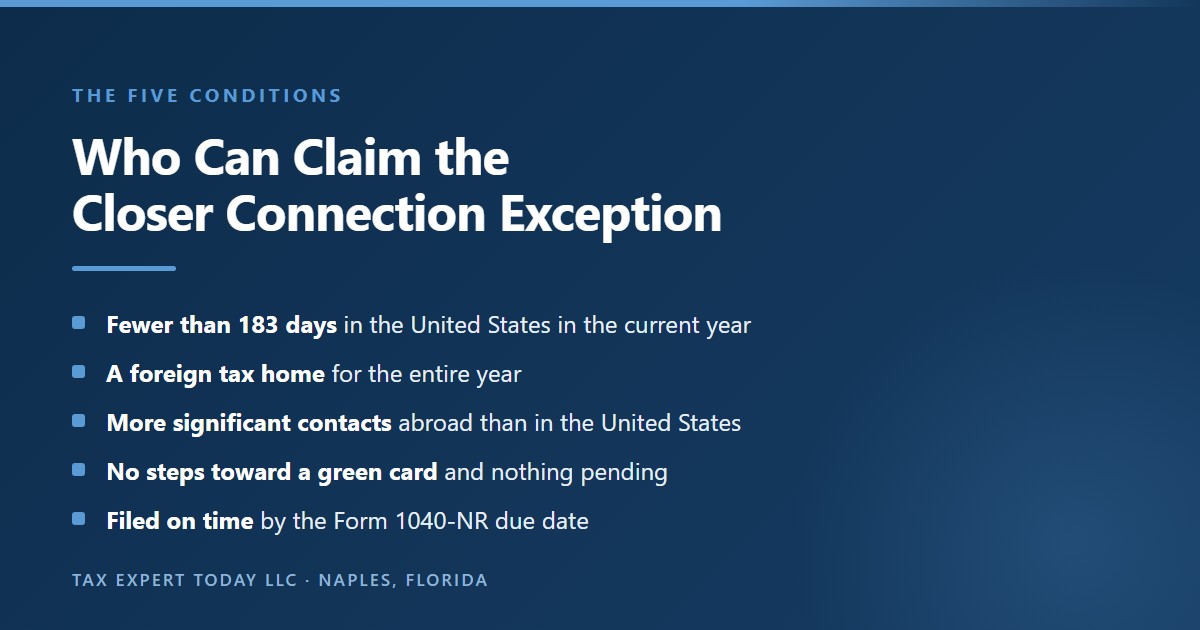
The weighted count uses every day of presence in the current year, one third of the days in the prior year, and one sixth of the days in the year before that. The 2025 Form 8840 instructions restate the formula exactly, and IRS Publication 519 walks through the same computation. For a snowbird who returns every winter for the same stretch, the arithmetic has a practical consequence. A steady 122 days a year produces 122 plus 40.67 plus 20.33, which is 183 weighted days, so roughly four months a season is where most seasonal visitors first meet the test. Our substantial presence test guide covers which days count and which are excluded, so this article does not repeat that detail.
| Condition for the closer connection exception | Where the rule comes from | What defeats it |
|---|---|---|
| Present in the United States fewer than 183 days in the current year | IRC 7701(b)(3)(B); Form 8840 instructions | 183 or more actual days in that calendar year |
| A tax home in a foreign country for the entire year | IRC 7701(b)(3)(B)(ii); Pub. 519 | Any period in which the tax home was in the United States |
| A closer connection to that foreign country than to the United States | Treas. Reg. 301.7701(b)-2(d) | More significant contacts with the United States |
| No application or affirmative step toward permanent residence | IRC 7701(b)(3)(C); Treas. Reg. 301.7701(b)-2(f) | A pending adjustment of status or a petition filed during the year |
| A timely filed Form 8840 | Treas. Reg. 301.7701(b)-8(d) | Missing the Form 1040-NR due date without qualifying relief |
What does the 183-day limit mean for Form 8840?
The 183-day limit is a hard bar applied to actual days in the current calendar year only. At 182 days or fewer, the exception can be claimed if the other conditions are met. At 183 days or more, it is unavailable however strong the ties abroad, and only an income tax treaty remains.
- Two different 183 figures are in play. The weighted three-year count triggers residency, and the unweighted current year count limits the exception.
- A day means any part of a day. Presence at any time during a day generally counts as a full day.
- The count runs by calendar year. A season that straddles New Year is split across two tax years.
- Some days are excluded entirely. Qualifying medical days and certain in-transit days do not count at all.
The calendar-year split surprises many seasonal residents. A couple who arrive in Naples, Florida on November 1 and leave on April 30 are here for roughly six months in a single season, but those days fall into two tax years, about 61 days in the first year and about 120 in the second. Each calendar year is tested on its own. The risk is that one calendar year holds the end of one season and the start of the next. A stay from January 1 to May 15 followed by a return on October 1 puts 135 plus 92 days, or 227 days, into a single calendar year, even though neither season felt unusually long.
| Hypothetical days in the United States | 2023 | 2024 | 2025 | Weighted total for 2025 | Exception available for 2025? |
|---|---|---|---|---|---|
| Short winter visitor | 90 | 90 | 110 | 110 + 30 + 15 = 155 | Not needed; the test is not met |
| Steady snowbird | 150 | 150 | 150 | 150 + 50 + 25 = 225 | Yes, if the other conditions are met |
| Long season | 170 | 175 | 182 | 182 + 58.33 + 28.33 = 268.67 | Yes, but with no margin at all |
| Extended stay | 170 | 175 | 190 | 190 + 58.33 + 28.33 = 276.67 | No; only a treaty position remains |
These figures are hypothetical illustrations only. The practical lesson is that the day count must be tracked contemporaneously. U.S. Customs and Border Protection makes an individual’s recent arrival and departure history available through its I-94 website, and comparing that record with a personal travel calendar before the return is prepared is the simplest way to catch a miscount. Line 5 of Form 8840 asks for the day count in each of the three years, so the number is disclosed on the face of the statement.
Which days do not count toward the 183-day limit?
Days excluded from the substantial presence test are also excluded from the current year count for the exception. The categories most relevant to seasonal residents are days a person could not leave because of a medical condition that arose in the United States, and days in transit of less than 24 hours between two foreign points.
- Medical condition days. Excluded only if the condition arose here and prevented a planned departure.
- Pre-existing conditions do not qualify. A known condition that existed before arrival cannot support the exclusion.
- Commuter days from Canada or Mexico. Regular commuting to work from a residence there is excluded.
- Exempt individual days. Qualifying students, teachers, trainees, and certain government-related individuals exclude days.
The medical exclusion is narrow and deserves care. Under Regulations section 301.7701(b)-3(c), a day is excluded only when the person intended to leave and was unable to because of a medical condition or problem that arose while in the United States. If the person later becomes able to leave and stays beyond a reasonable period to make arrangements, the exclusion stops. A condition the person knew about before arriving does not qualify even if no treatment was needed at entry. A snowbird who is hospitalized in March after a fall and cannot travel home as planned may be able to exclude those days, while a snowbird who extends a stay for a scheduled procedure generally cannot.
Medical days and exempt individual days are claimed on a different form. The Form 8840 instructions state that a person excluding days because of a medical condition, or as an exempt individual other than a foreign government-related individual, must file Form 8843. A snowbird who needs both the medical exclusion and the closer connection exception in the same year may therefore file both statements.
How do you show a closer connection to another country?
A closer connection is shown by maintaining more significant contacts with the foreign country than with the United States. The regulation lists ten factors, including the location of the permanent home, family, belongings, banking, driver’s license, voting, and the residence stated on official forms. No single factor decides the question, and the list is not exhaustive.
- Home and family. Where a permanent home is continuously available and where the family lives.
- Belongings and banking. Where cars, furniture, and routine personal banking are located.
- Civic and official ties. Where the person votes, holds a driver’s license, and says they reside on documents.
- Forms filed. Whether the person has signed forms claiming foreign status, such as Form W-8BEN, or domestic status, such as Form W-9.
Regulations section 301.7701(b)-2(d)(1) sets out the factors, and Publication 519 adds professional affiliations and charitable organizations to the list. Part IV of Form 8840, lines 14 through 30, turns those factors into specific questions. The regulation defines a permanent home broadly: it may be a house, an apartment, or a furnished room, owned or rented, as long as it is available at all times, continuously, and not solely for short stays. That definition cuts both ways for a seasonal resident, because a Florida condominium kept furnished and available all year can itself be a permanent home in the United States.
When permanent homes exist in both countries, the other contacts carry the weight. The IRS reads Part IV as a whole, and the story it tells should be consistent. A person whose family, doctors, bank, car, and voting registration are in Ontario, and whose Florida property is a seasonal residence, presents a straightforward closer connection. A person whose spouse lives in Florida full time, who banks locally, and who holds a Florida driver’s license presents a much harder one even with a house abroad.
Which Florida ties can undercut a Form 8840 claim?
The Florida ties that most often undercut a closer connection claim are the ones that declare Florida a permanent home: a homestead exemption, a declaration of domicile, a Florida driver’s license or voter registration, a car registered here, and a Form W-9 signed at a local bank. Each one maps directly to a question in Part IV of Form 8840.
- Homestead exemption. Florida grants it for property the owner in good faith makes a permanent residence.
- Declaration of domicile. A sworn statement that a Florida abode is the person’s permanent home.
- Driver’s license and vehicle. Lines 17, 18, and 22 ask where cars are kept and registered and where the license was issued.
- Form W-9 at a bank. Line 25b asks directly whether a Form W-9 was ever completed.
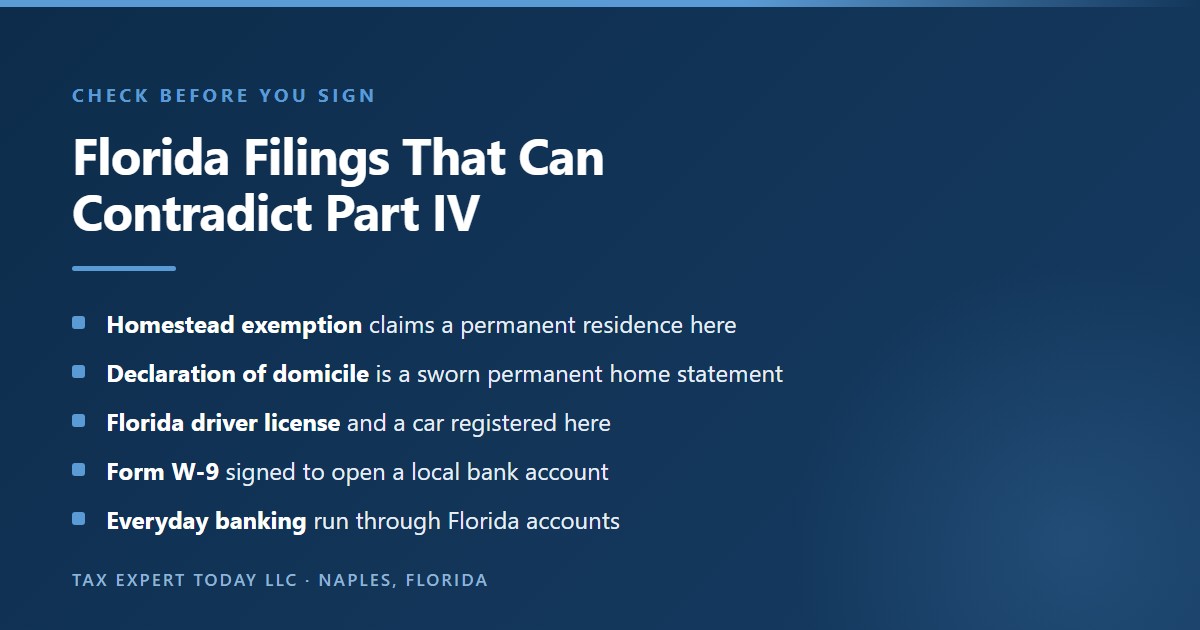
The homestead exemption is the clearest conflict. Under section 196.031 of the Florida Statutes, the exemption belongs to a person who holds title on January 1 and who “in good faith makes the property his or her permanent residence.” A Form 8840 filed the same year states, under penalties of perjury when filed on its own, that the person’s closer connection and permanent home are abroad. The two statements point in opposite directions. The same is true of a declaration of domicile under section 222.17, which is a sworn statement that a Florida abode is the person’s permanent home. None of this makes a Florida property owner ineligible for the exception, but it means that local filings made for property tax or estate planning reasons should be reviewed before a Form 8840 is signed.
| Part IV question on Form 8840 | What a seasonal resident typically answers | Florida filing that can contradict it |
|---|---|---|
| Line 14: regular or principal permanent home | The home in the country of residence | Homestead exemption on a Florida residence |
| Lines 17 and 18: where cars are located and registered | Registered in the home country | A car titled and registered in Florida |
| Line 20: routine personal banking | A bank in the home country | Florida accounts used for everyday spending |
| Lines 22a and 23: driver’s license and voter registration | Issued and registered abroad | A Florida driver’s license |
| Line 24: residence listed on official documents | The foreign country | A declaration of domicile or a Florida address listed as residence |
| Line 25b: whether a Form W-9 was ever completed | No | A W-9 signed to open a local account |
Form W-9 is the conflict people most often do not realize they created. Banks and brokerages routinely ask new customers to sign one, and a W-9 certifies United States person status. A foreign national generally provides Form W-8BEN instead, which certifies foreign status. Line 29 raises a subtler point: for stocks and bonds, the instructions treat the investment as located in the country of the issuing company or debtor, so shares of a United States public company count as a United States investment even when held through a foreign account.
How do you file Form 8840, and when is it due?
Form 8840 is due on the due date of Form 1040-NR, including extensions. If a Form 1040-NR is required, the statement is attached to it. If no return is required, the signed form is mailed by itself to the Internal Revenue Service Center in Austin, Texas, by that same date.
- With wages subject to withholding. The due date is the 15th day of the fourth month, April 15, 2026 for 2025.
- Without such wages. The due date is the 15th day of the sixth month, June 15, 2026 for 2025.
- Standalone filings are signed. The signature block and address lines are completed only when the form is filed by itself.
- Extensions carry over. A timely Form 4868 extends the date for the statement as well.
Most snowbirds have no wages here, so the June 15 date applies. Publication 519 states that for the 2025 calendar year an employee with wages subject to withholding files by April 15, 2026, and anyone else by June 15, 2026, and that a timely extension moves those dates to October 15, 2026 and December 15, 2026 respectively. For the 2026 winter season, the same rules put the ordinary deadline at June 15, 2027. The 2025 form directs a standalone filing to the Department of the Treasury, Internal Revenue Service Center, Austin, TX 73301-0215. Older versions of the regulation name a different service center, so the address printed in the current instructions is the one to use.
A Form 1040-NR is required, and the statement goes with it, when the person has income that must be reported, such as rent from a Florida property or wages from United States work. Rental income from a condominium that is let out while the owner is away is a common reason a snowbird has a filing obligation in the first place. When that property is later sold, the separate withholding regime described in our guide to FIRPTA withholding applies to the sale.
| Form | What it does | Who files it | Typical snowbird use |
|---|---|---|---|
| Form 8840 | Claims the closer connection exception under section 7701(b)(3)(B) | A foreign national who meets the substantial presence test with under 183 current year days | The routine annual statement for a winter resident |
| Form 8843 | Excludes days as an exempt individual or because of a medical condition | Students, teachers, trainees, and people medically unable to leave | A year with an unplanned hospital stay |
| Form 8833 | Discloses a treaty-based return position, including a residency tie-breaker | A dual resident claiming treaty residence abroad, among others | A year with 183 or more days here |
| Form 1040-NR | The nonresident income tax return | A nonresident with income that must be reported | Florida rental income or a property sale |
What happens if you file Form 8840 late or not at all?
A person who does not timely file Form 8840 is generally not eligible for the closer connection exception and may be treated as a United States resident for the year. There is no separate dollar penalty for the form. The exception is lost unless clear and convincing evidence shows reasonable steps to learn of and meet the requirement.
- The consequence is residency. Resident status brings worldwide income onto Form 1040.
- Foreign reporting follows. A resident alien is generally subject to FBAR and Form 8938 rules.
- Relief has a high standard. Clear and convincing evidence of awareness efforts and significant steps to comply.
- The IRS has discretion. The regulation lets the IRS disregard a late filing when it is in the government’s interest.
Regulations section 301.7701(b)-8(d) states the consequence and the relief standard. The standard is demanding. It is higher than the ordinary preponderance standard, and it looks at what the person actually did, such as asking an adviser, reading published guidance, or trying to file, not simply at whether the person knew of the rule. It is also a different test from the reasonable cause relief available for many tax penalties, which is discussed in our guide on how IRS penalties are removed, and the two should not be confused.
The downstream effect of losing the exception is the real exposure. A resident alien reports worldwide income, and a person with foreign accounts above the threshold discussed in our FBAR filing requirement guide would generally have an FBAR obligation for that year. Where missed resident years have already accumulated, the non-willful penalty framework explained in our article on FBAR penalties becomes relevant. The streamlined filing compliance procedures are sometimes discussed for resident aliens who have fallen behind, but they are available only where the failure was non-willful, and they require a certification of non-willfulness under penalty of perjury that must be accurate.
What if you spent 183 days or more in the United States?
At 183 days or more in the current year, Form 8840 is unavailable. A person who is also a tax resident of a treaty country may still be treated as a nonresident for income tax purposes by applying the treaty’s residency tie-breaker, filing Form 1040-NR, and attaching Form 8833 to disclose the treaty position.
- The treaty must have a tie-breaker. The Canada-United States convention does, in Article IV, paragraph 2.
- The person must be resident in both countries. Each country’s own law must treat the person as a resident.
- The position must be disclosed. Regulations section 301.7701(b)-7 requires Form 8833 with the return.
- A missing disclosure carries a penalty. Section 6712 imposes $1,000 per failure for an individual.
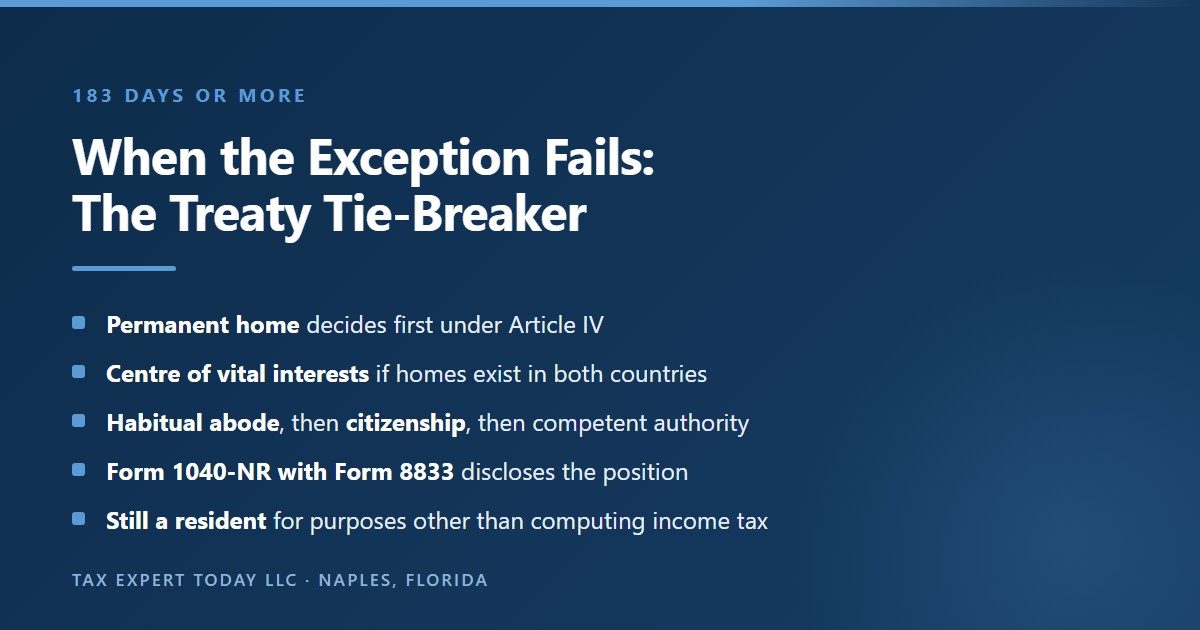
Under Article IV, paragraph 2 of the United States and Canada income tax convention, an individual resident in both countries is deemed a resident of the country where a permanent home is available. If there is a permanent home in both or neither, the test moves to the country with which personal and economic relations are closer, the centre of vital interests. If that cannot be determined, it moves to the country of habitual abode, then to citizenship, and finally to agreement between the two competent authorities. For a Canadian with a home in each country, the analysis usually turns on the centre of vital interests, which draws on much of the same evidence Part IV of Form 8840 collects.
The penalty for failing to disclose a treaty position appears in 26 U.S.C. section 6712: $1,000 for each failure by an individual. Our guide to Form 8833 explains how the disclosure is completed. The important point for a snowbird is that a treaty tie-breaker is not simply a substitute Form 8840. It produces a different kind of nonresident, with different consequences, which the next section explains.
Is Form 8840 the same as a treaty tie-breaker claim?
No. A person who qualifies for the closer connection exception is a nonresident under section 7701(b) itself. A person who relies on a treaty tie-breaker remains a United States resident under domestic law, is treated as a nonresident only for computing income tax, and stays a resident for other purposes. That difference affects foreign reporting.
- Form 8840 changes residency status. The person is simply not a resident alien for the year.
- A treaty position changes the tax computation. Other Code purposes still treat the person as a resident.
- Form 8938 has a specific carve-out. It applies to the part of the year covered by a timely Form 1040-NR with Form 8833.
- FBAR follows Title 31. FinCEN applies the section 7701(b) residency tests with no treaty exception stated.
Regulations section 301.7701(b)-7(a)(3) states that a dual resident who claims treaty benefits is generally treated as a United States resident for purposes of the Code other than computing income tax liability. The Form 8938 instructions contain a special rule for such dual resident taxpayers: specified foreign financial assets need not be reported on Form 8938 for the part of the year covered by Form 1040-NR, provided the person timely files that return and attaches Form 8833. The FBAR filing instructions take a different path. They determine whether an individual is a United States resident by applying the residency tests in section 7701(b), and they state no exception for a treaty tie-breaker. A treaty resident should therefore generally expect the FBAR question to remain open and should confirm it with an adviser before assuming the accounts drop out.
A person who qualifies for Form 8840, by contrast, is not a resident alien under section 7701(b) for that year, so the resident alien branch of the FBAR definition and the resident alien branch of the Form 8938 definition generally do not reach them on that basis. That is one reason keeping the current year count under 183 days is worth real attention for anyone with significant accounts abroad. Our comparison of FBAR and Form 8938 explains the two regimes side by side.
| Question | Closer connection exception (Form 8840) | Treaty tie-breaker (Form 8833) |
|---|---|---|
| Days allowed in the current year | Fewer than 183 | No fixed day limit; the treaty tests apply |
| Residency under section 7701(b) | Nonresident | Resident, treated as nonresident for computing income tax |
| Return filed | Form 1040-NR if income must be reported; otherwise the statement alone | Form 1040-NR with Form 8833 |
| Penalty for a missing form | Loss of the exception | $1,000 per failure under section 6712, and loss of the position |
| Form 8938 | Resident alien status does not arise | Special rule excuses the Form 1040-NR period if Form 8833 is timely attached |
| FBAR | Resident alien status does not arise | No treaty exception stated in the FBAR instructions; confirm with an adviser |
Can a green card applicant file Form 8840?
No. A person who personally applied for, or took other affirmative steps toward, lawful permanent residence during the year, or who had an application for adjustment of status pending, is not eligible for the closer connection exception. The bar applies regardless of day counts or ties abroad, and line 6 of Form 8840 asks the question directly.
- Line 6 is a gate. A “Yes” answer means the form should not be filed.
- Affirmative steps include petitions. The regulation lists immigrant petitions and labor certification filings among them.
- A treaty route may remain. The instructions point such a person to Form 8833 with Form 1040-NR.
- Green card holders are residents. A lawful permanent resident meets the green card test and never reaches this exception.
Regulations section 301.7701(b)-2(f) lists examples of affirmative steps, including filing an immigrant petition and filing an application for labor certification, and states that the list is not exhaustive. A petition filed by a family member or employer on the person’s behalf can matter, so a snowbird whose adult child in Florida has started a family petition should raise it before a Form 8840 is filed. The instructions for line 6 say that a person who checks “Yes” should not file Form 8840 but may qualify for nonresident status under a treaty, in which case Form 8833 is filed with Form 1040-NR.
Can you claim a closer connection to two foreign countries?
Yes, in one limited case: a person who changes tax home from one foreign country to another during the year. All five conditions in the regulation must be met, including a tax home in the first country on January 1, a closer connection to each country for its period, and resident taxation abroad. No more than two countries are allowed.
- Part II covers one country. Lines 7 and 8 identify the tax home and the country of closer connection.
- Part III covers two countries. Lines 9 through 13 document the move and the resident taxation.
- Verification is attached. A “Yes” on line 12 or 13 requires supporting documentation.
- Only one part is completed. The instructions direct Part II or Part III, never both.
Regulations section 301.7701(b)-2(e) sets out the five conditions. The fifth is the one most often missed: the person must be subject to tax as a resident under the internal laws of either foreign country for the entire year, or of both countries for the periods the tax home was in each. A retiree who moves from the United Kingdom to Canada in the middle of the year while wintering in Florida is the kind of fact pattern the rule is built for, and the documentation it requires should be assembled while the move is fresh.
Form 8840 Help in Naples & Southwest Florida
Tax Expert Today LLC works with seasonal residents and foreign nationals from an office in Naples, Florida, and serves clients in all 50 states. Collier and Lee counties draw a large share of winter residents from Canada and Europe every year, which makes the closer connection exception a routine part of local cross-border tax work rather than a rare filing.
- Form 8840 help Naples: preparing the annual statement and reviewing the day count against travel records.
- Snowbird tax Naples FL: reviewing homestead, domicile, banking, and W-9 history for conflicts with Part IV answers.
- International tax Naples FL: preparing Form 1040-NR for Florida rental income and property sales.
- Treaty positions: evaluating the Article IV tie-breaker and Form 8833 in a year with 183 or more days.
Florida has no personal income tax, so the residency question for a seasonal visitor here is a federal one. Our international and expat tax services page describes how we approach cross-border returns, and the Florida-side planning questions that often travel with a seasonal home are covered in our guide to retiring to Florida.
Office: 11983 Tamiami Trail N, Naples FL 34110
Phone: (239) 441-2005
Hours: Monday through Friday, 10:00 to 5:00 ET
Frequently Asked Questions
We are Canadian and spend every winter in Naples, Florida. Do we each need to file Form 8840?
If each of you meets the substantial presence test for the year and stays under 183 days, generally yes. The instructions require a separate Form 8840 for each alien individual. If neither of you has income that requires a Form 1040-NR, each signed form is mailed by itself to the Austin service center by the Form 1040-NR due date, which is June 15 for most people without United States wages.
Is there a penalty for not filing Form 8840?
There is no separate dollar penalty for the form. The consequence is that the closer connection exception is generally lost for the year, and the person may be treated as a United States resident, unless clear and convincing evidence shows reasonable efforts to learn of and meet the requirement.
Do I file Form 8840 every year?
It is filed for each year the exception is needed, meaning each year the substantial presence test is met with fewer than 183 current year days. Eligibility is tested fresh each year, so a change in travel, a new Florida filing, or an immigration petition can change the answer.
What is the difference between Form 8840 and Form 8843?
Form 8840 claims the closer connection exception for a person who meets the substantial presence test. Form 8843 excludes particular days from the count, for exempt individuals such as qualifying students and for days a medical condition that arose in the United States prevented departure.
Can I file Form 8840 if I own a home in Florida?
Owning a Florida home does not by itself prevent the exception, but the home counts as a contact with the United States, and a home available year-round can be a permanent home here. Filings that declare the property a permanent residence, such as a homestead exemption or a declaration of domicile, can contradict the Part IV answers.
What if I was in the United States for 183 days or more?
Form 8840 is then unavailable. A person who is also a tax resident of a treaty country may be able to claim treaty residence abroad under the tie-breaker rule by filing Form 1040-NR with Form 8833, which has different reporting consequences from the closer connection exception.
When to Engage a Professional
The closer connection exception is simple when the facts are simple: a stable home abroad, a season well under the limit, no Florida filings that claim permanence, and no immigration activity. It becomes a judgment call quickly when any of those change, and the consequences of getting it wrong, resident status and the foreign reporting that follows, are larger than the one-page statement suggests.
Consider a consultation if any of the following applies: a calendar year is close to 183 days, a medical stay may need to be excluded, a homestead exemption or declaration of domicile has been filed, a family member or employer has started an immigration petition, the Form 8840 for a prior year was never filed, Florida rental income or a property sale requires a Form 1040-NR, or a treaty position is being considered in a year with 183 or more days. Where prior years may have been resident years without the related foreign filings, the exposure discussed in our guide on FBAR penalties should be assessed before anything is filed.
Tax Expert Today LLC is a tax advisory firm in Naples, Florida serving clients in all 50 states. Call (239) 441-2005 to discuss your facts.
Primary Sources
- Form 8840 (2025), Closer Connection Exception Statement for Aliens, with instructions
- IRS: About Form 8840
- Publication 519, U.S. Tax Guide for Aliens (for 2025 returns)
- 26 U.S.C. section 7701(b) (substantial presence test and closer connection exception)
- Treas. Reg. section 301.7701(b)-2 (closer connection factors, two-country rule, green card bar)
- United States and Canada income tax convention (Article IV residence tie-breaker)
This article is general information, not advice for any particular taxpayer, and does not create a client relationship. The day counts in the examples are hypothetical illustrations only. Forms and instructions change annually, and a 2026 version of Form 8840 had not been released when this article was written. Verify current rules and confirm your own facts with a qualified tax professional before filing.
Published September 18, 2026 by Dr. Pellumb Kabashi « Back to Learning Center
Have a question this article touches on?
Tax Expert Today LLC, based in Naples, Florida and serving clients across the United States.
Schedule a Consultation (239) 441-2005