
By Dr. Pellumb Kabashi, DBA, MBA, EA, CFE, CES
Founder, Tax Expert Today LLC · Tax advisors, enrolled agents, CPAs, and attorneys · Serving clients in all 50 states
Quick Answer: Form 2555 is the IRS form a U.S. citizen or resident alien working abroad attaches to Form 1040 to claim the foreign earned income exclusion, up to $132,900 for 2026, and the foreign housing exclusion or deduction. It does not remove self-employment tax, and the stacking rule taxes any income left on the return at higher rates. Call (239) 441-2005 for a free consultation.
What is Form 2555?
Form 2555 is the IRS form that U.S. citizens and resident aliens with foreign earned income use to claim the foreign earned income exclusion and the foreign housing exclusion or deduction. It is attached to Form 1040 or 1040-SR and figures how much of the year’s foreign wages or self-employment income leaves the U.S. income tax base.
- Who uses it: U.S. citizens and resident aliens whose tax home is in a foreign country.
- What it claims: the foreign earned income exclusion, the housing exclusion, and the housing deduction.
- 2026 ceiling: $132,900 of foreign earned income per qualifying person.
- Attached to: Form 1040 or 1040-SR, mailed to the international filing address if filed on paper.
- What it does not do: remove self-employment tax or exclude investment income.
Form 2555 is three pages long, and most of its fifty lines are simple facts: where you lived, who paid you, when you arrived and left, and what you were paid. The difficulty sits in a handful of lines where the form interacts with the rest of the return. Whether to use Form 2555 at all, or to claim the foreign tax credit instead, is a separate decision covered in our guide to the foreign earned income exclusion vs credit. Whether you qualify under the bona fide residence test is covered in our guide to the bona fide residence test. This page is about the form itself, Part by Part and line by line, for the 2026 tax year.
We built it around the two places where Form 2555 most often surprises people in April. The first is the stacking rule in section 911(f), which means the income you exclude still pushes the income you do not exclude into higher brackets. The second is self-employment tax, which the exclusion does not touch. Both are worked below with hypothetical figures, using the 2026 amounts printed on the 2026 Form 2555 and the 2026 rate tables in Rev. Proc. 2025-32.
| Question | Short answer for 2026 | Where the rule lives |
|---|---|---|
| Maximum foreign earned income exclusion | $132,900 per qualifying person, prorated by day | Rev. Proc. 2025-32, section 3.39; Form 2555, line 37 |
| Base housing amount for a full year | $21,264 (16 percent of $132,900), or $58.26 per day | Section 911(c)(1)(B); Form 2555, line 32 |
| General limit on housing expenses | $39,870 (30 percent of $132,900), or $109.23 per day | Section 911(c)(2)(A); Notice 2026-25 |
| Higher limits for listed cities | Set by location, such as London at $68,600 | Notice 2026-25, section 3 table |
| Does the exclusion lower the tax rate on other income? | No, the stacking rule applies | Section 911(f); Foreign Earned Income Tax Worksheet |
| Does it reduce self-employment tax? | No | Section 1402(a)(11); Schedule SE instructions |
| Where does the exclusion go on the return? | Schedule 1 (Form 1040), line 8d, as a negative amount | Form 2555, line 45 |
| Where does the housing deduction go? | Schedule 1 (Form 1040), line 24j | Form 2555, line 50 |
Who must file Form 2555, and who cannot use it?
Form 2555 is filed by a U.S. citizen or resident alien who wants to exclude foreign earned income or claim the housing benefit, and who meets the tax home test plus either the bona fide residence test or the physical presence test. U.S. government employees cannot use it for their government pay, and nonresident aliens do not file it.
- Tax home test: your regular place of business or work must be in a foreign country.
- Residence or presence: pass either the bona fide residence test or the 330 day physical presence test.
- Earned income: wages, salary, or self-employment income for work performed abroad.
- Excluded group: pay from the U.S. government or its agencies to its employees.
- Not required: Form 2555 is an election, so a filer who prefers the foreign tax credit may skip it.
The 2026 Instructions for Form 2555 say you may qualify for the exclusion and the housing benefit if both of two conditions apply: you meet the tax home test, and you meet either the bona fide residence test or the physical presence test. The instructions add a direct note that income from working abroad as an employee of the U.S. government does not qualify for either exclusion or for the housing deduction, and tell those filers not to file Form 2555.
No one is required to file Form 2555. The exclusion is an election under Treas. Reg. section 1.911-7(a), and an American abroad who pays foreign income tax at a high rate may get a better result by leaving Form 2555 off the return and claiming the credit on Form 1116. Living abroad also does not end the duty to file a U.S. return. The filing threshold is tested on gross income before the exclusion, so a person who excludes every dollar may still have to file a Form 1040 with Form 2555 attached to show the exclusion.
Resident aliens are a smaller but real group. A green card holder or a person who meets the substantial presence test is taxed like a citizen and may use Form 2555 under the physical presence test. The bona fide residence test is open only to citizens and to resident aliens who are citizens or nationals of a country with which the United States has an income tax treaty in effect, as the note at the top of Part II of the form states.
| Person | Can claim on Form 2555? | Which test can be used |
|---|---|---|
| U.S. citizen working for a foreign or U.S. private employer abroad | Yes, if a foreign tax home | Bona fide residence or physical presence |
| U.S. citizen running a business abroad | Yes, for earned income from the business | Bona fide residence or physical presence |
| Green card holder who is a citizen of a treaty country | Yes | Bona fide residence or physical presence |
| Green card holder who is a citizen of a non-treaty country | Yes | Physical presence only |
| U.S. government civilian or military employee | No, for government pay | Not applicable |
| Nonresident alien spouse who joins a section 6013(g) election | Possibly, under the physical presence test | Physical presence, per the instructions note |
| Worker on a 28 day on, 28 day off rotation who returns home to the United States | Generally no, abode in the United States | Fails the tax home test |
The last row comes straight from the instructions. Their example describes an employee on an offshore oil rig in a foreign country’s waters who returns to a family home in the United States on every off period. That person has an abode in the United States and does not meet the tax home test, so neither exclusion nor the housing deduction is available. Rotational workers, pilots, and crew members should read the tax home test before anything else on the form.
What changed on Form 2555 for 2026?
For 2026 the maximum exclusion rose to $132,900, the full-year base housing amount to $21,264, and the general housing expense limit to $39,870, with higher limits for listed cities in Notice 2026-25. The structure of the form, the tests, and the stacking rule are unchanged, and the IRS released the 2026 form and instructions in the fall of 2026.
- Exclusion: $132,900 on line 37, under Rev. Proc. 2025-32.
- Base housing amount: $58.26 per day, or $21,264 for 365 days, on line 32.
- Housing limit: $109.23 per day, or $39,870, unless your city is listed.
- City table: Notice 2026-25, published in Internal Revenue Bulletin 2026-17.
- Look-back election: 2025 filers could apply the 2026 city limits if higher.
The inflation figures come from two places. Rev. Proc. 2025-32, section 3.39, states that for taxable years beginning in 2026 the foreign earned income exclusion amount under section 911(b)(2)(D)(i) is $132,900. Notice 2026-25 then applies the statutory percentages: the base housing amount is 16 percent of that figure, which is $21,264 for a full year, and the general housing expense limit is 30 percent, which is $39,870.
The 2026 Form 2555 prints these amounts directly. Line 32 tells you to multiply $58.26 by the number of qualifying days, or to enter $21,264 if you entered 365 days. Line 37 tells you to enter $132,900. The instructions for line 29b give the $39,870 general limit and the $109.23 daily figure. Because these numbers change every year, a draft built from a prior-year form will carry the wrong amounts, which is one of the most common errors on a return prepared early in the season.
The section 911 framework itself was not amended for 2026. The 2026 instructions list only the new exclusion amount as the year’s new item, and repeat two reminders that matter to some readers: the Windfall Elimination Provision was repealed for Social Security payments after 2023, and certain individuals serving in a combat zone in support of the U.S. Armed Forces may have a foreign tax home even while their abode is in the United States.
| Amount on the 2026 form | Full year | Per day | Line |
|---|---|---|---|
| Maximum foreign earned income exclusion | $132,900 | $364.11 (computed, the form uses a ratio) | 37 to 40 |
| Base housing amount | $21,264 | $58.26 | 32 |
| General limit on housing expenses | $39,870 | $109.23 | 29b |
| Social Security wage base for self-employment tax (Schedule SE, not Form 2555) | $184,500 | Not applicable | Schedule SE |
How is Form 2555 organized?
Form 2555 has nine Parts. Part I collects general facts, Part II or Part III proves you qualify, Part IV totals foreign earned income, Part VI figures the housing amount, Part VII figures the exclusion, Part VIII totals what leaves income, and Part IX figures a housing deduction for self-employed income. Most filers skip at least one Part.
- Pages 1 and 2: facts about you, your employer, your tax home, and your days.
- Part II or III: complete one, never both.
- Part IV: the income figure everything else depends on.
- Parts VI to IX: the computations that move numbers to Schedule 1.
- Common skip: employees with no housing claim jump from Part V to Part VII.
Reading the form as a map before filling it in saves a lot of rework. The facts on pages 1 and 2 determine which tests you pass and for how many days. The days then drive the proration on lines 31, 38, and 39. The income total on line 26 drives every limit after it. If a date or a day count is wrong on page 1, every computed line on page 3 is wrong with it.
| Part | Lines | What it does | Who completes it |
|---|---|---|---|
| Part I, General Information | 1 to 9 | Address, occupation, employer, prior years, citizenship, second household, tax home | Everyone |
| Part II, Bona Fide Residence Test | 10 to 15e | Dates of residence, living quarters, family, statements to foreign authorities, U.S. visits | Filers using the residence test |
| Part III, Physical Presence Test | 16 to 18 | The 12 month period and every trip within it | Filers using the presence test |
| Part IV, All Taxpayers | 19 to 26 | Foreign earned income, including noncash income and allowances | Everyone |
| Part V, All Taxpayers | 27 | Carries line 26 forward and asks whether you claim housing | Everyone |
| Part VI, Housing | 28 to 36 | Housing expenses, limits, base amount, and the housing exclusion | Filers claiming housing |
| Part VII, Foreign Earned Income Exclusion | 37 to 42 | The prorated $132,900 cap and the exclusion | Filers claiming the exclusion |
| Part VIII, Both Exclusions | 43 to 45 | Total excluded, less deductions allocable to it | Filers claiming either exclusion |
| Part IX, Housing Deduction | 46 to 50 | Housing amount not covered by employer pay, plus a one-year carryover | Mainly self-employed filers |
How do you complete Part I of Form 2555?
Part I asks for your foreign address, occupation, employer details, the last year you filed Form 2555, any past revocation, your citizenship, any second household kept because of adverse conditions, and your tax home with the date it was established. Answers here are compared with Parts II and III, so they must match.
- Line 1: your full foreign address, including the country.
- Lines 3 to 5: employer name, addresses, and type, including “Self.”
- Lines 6a to 6d: prior Form 2555 filings and any revocation.
- Lines 8a and 8b: a separate family residence kept because of adverse conditions.
- Line 9: each tax home and the date it began.
Line 5 matters more than it looks. The boxes are a foreign entity, a U.S. company, self, a foreign affiliate of a U.S. company, and other. A U.S. company employer often means U.S. Social Security and Medicare withholding continues, while self employment points straight to the Schedule SE issue covered later. If more than one box applies, check all that apply.
Lines 6a through 6d look backward. Line 6a asks for the last tax year you filed Form 2555 or the old Form 2555-EZ. Line 6c asks whether you have ever revoked either exclusion, and line 6d asks which one and the year the revocation took effect. These questions exist because of the five year rule in Treas. Reg. section 1.911-7(b): once you revoke an election, you may not make the same election again without IRS consent, and the instructions describe that as your next five tax years. If you claimed the exclusion in a past year and then claimed the foreign tax credit on the same type of income without filing a revocation statement, the IRS may read the credit year as a revocation. That is a question to resolve before filing, not after.
Line 9 asks for your tax home or homes and the date each was established. The instructions define a tax home as your regular or principal place of business, employment, or post of duty, regardless of where you maintain your family residence. If you do not have a regular place of business, your tax home is where you regularly live. You are not treated as having a foreign tax home for any period during which your abode is in the United States, and abode is judged by where your family, economic, and personal ties are. Owning a house in Naples, Florida while working in London does not by itself put your abode in the United States, but it is one of the facts weighed.
| Line | Typical entry | What a reviewer checks it against |
|---|---|---|
| 1 | Flat 4, 12 Example Road, London, United Kingdom | Line 29a location and the city housing limit |
| 2 | Software engineer | The type of income on lines 19 and 20 |
| 5 | A foreign entity, or Self | Whether Schedule SE or U.S. withholding is expected |
| 6a | 2025 | Prior returns and any gap that suggests a revocation |
| 7 | United States | Which test can be used in Part II or III |
| 9 | London, United Kingdom, March 1, 2024 | Dates in Part II or III and the day count on line 31 or 38 |
Should you complete Part II or Part III of Form 2555?
You complete Part II if you qualify under the bona fide residence test, or Part III if you qualify under the physical presence test, and never both. Part II suits a settled resident for a full calendar year, and Part III suits anyone with 330 full days abroad in 12 months.
- Part II: a full tax year of foreign residence, judged by intent and conduct.
- Part III: 330 full days in any 12 consecutive months, a pure count.
- First year abroad: often Part III, because residence needs a full calendar year.
- Treaty filers: resident aliens from non-treaty countries can use Part III only.
- Caution: both Parts ask for U.S. business days, which are not foreign income.
The choice between the tests, the evidence each needs, and the traps in each are covered in depth on our bona fide residence test page, so here we focus only on what the form asks and how the answers flow into the computation. The key point is that the qualifying period you prove in Part II or Part III sets the number of days used on line 31 for housing and line 38 for the exclusion.
Part II asks when your bona fide residence began and ended (enter “Continues” if it has not ended), what kind of housing you lived in, whether family lived with you, whether you told the foreign country you are not a resident there, and whether you must pay income tax to that country. The form itself states the consequence of the statement question: if you answer Yes to line 13a and No to line 13b, you do not qualify as a bona fide resident. That combination describes a person who told the host country that they are not a resident in order to avoid its tax, and the regulations do not let the same person claim residence there for U.S. purposes.
Part III asks for the 12 month period, your principal country of employment, and a travel log. A full day means the 24 hour period that starts at midnight, so the day you fly out of the United States and the day you land back generally do not count as foreign days. The 12 month period must include 365 days (366 in a leap year), and part of it must fall in 2026. You must enter both a start and an end date, and the instructions specifically say not to enter “Continues” as the ending date.
| Feature | Part II, bona fide residence | Part III, physical presence |
|---|---|---|
| Who can use it | Citizens, and resident aliens from treaty countries | Citizens and all resident aliens |
| Time needed | An uninterrupted period that includes an entire tax year | 330 full days in any 12 consecutive months |
| Nature of the test | Facts and intent, with acts weighing more than words | A count of full days |
| Short trips to the United States | Allowed if residence is not abandoned | Reduce the count, and must fit within the 35 day margin |
| Key disqualifier | Claiming nonresidence to the foreign country | Fewer than 330 full days |
| Ending date entry | “Continues” is allowed | An actual date is required |
How are days and income for work in the United States reported on Form 2555?
Line 14 in Part II and line 18 in Part III ask for every stay in the United States, the days spent there on business, and the income earned there on business. That U.S. business income is not foreign earned income, cannot be excluded, and is reported on Form 1040 outside the Form 2555 totals.
- Columns: date arrived, date left, business days, and income earned in the United States.
- Source rule: pay for work performed in the United States is U.S. source.
- Computation: attach how the U.S. portion was figured, often a workday ratio.
- Effect: lowers foreign earned income on Part IV.
- Common miss: two weeks of meetings at a U.S. headquarters.
Foreign earned income means pay for personal services you performed in a foreign country. Where you are paid, which currency you are paid in, and where your employer is located do not decide the question. The place where the work is done decides it. When an employee based in Madrid spends ten working days at the company’s U.S. office, the salary for those ten days is U.S. source income. The form asks you to list it in column (d) of line 14 or column (f) of line 18, to attach the computation, and to report it on Form 1040 without including it in Part IV.
The usual computation is a workday ratio. Suppose, as a hypothetical, an employee earns $150,000 for 240 working days and spends 12 of those days working in the United States. The U.S. source portion is $150,000 multiplied by 12 over 240, or $7,500. That $7,500 is taxed on the return in the ordinary way, and the remaining $142,500 is the foreign earned income that goes on line 19. The attached statement should show the days, the total workdays, and the arithmetic.
Business days in the United States also matter for the physical presence count. Every full day spent in the United States is a day that is not a full foreign day. A filer who passes the 330 day test with only a few days to spare can lose it with one extra visit, and then the whole Part III claim fails, not just the income for the days at home.
What goes on Part IV of Form 2555?
Part IV totals all foreign earned income you earned and received in 2026, including wages, a reasonable share of business profit, noncash income such as employer housing or a car, and every allowance or reimbursement. Line 24 adds it up, line 25 removes excludable meals and lodging, and line 26 is your foreign earned income.
- Line 19: wages, salaries, bonuses, and commissions for foreign work.
- Line 20: your allowable share of business or partnership income for personal services.
- Line 21: fair market value of a home, meals, car, or other property from your employer.
- Line 22: allowances for cost of living, family, education, home leave, quarters, and other purposes.
- Line 25: employer meals and lodging excludable under section 119.
Part IV is the base for every limit that follows, and Treas. Reg. section 1.911-3 is the regulation that defines foreign earned income. The instructions define foreign earned income as wages, salaries, professional fees, and other compensation received for personal services you performed in a foreign country during your qualifying period, and they say it also includes noncash income (such as a home or car) and allowances or reimbursements. Amounts must be reported in U.S. dollars, using the exchange rates in effect when you actually or constructively received the income.
The instructions also list what is not foreign earned income, even when it arrives while you live abroad. Pensions, annuities, and Social Security benefits are not. Interest, dividends, capital gains, and alimony are not. Pay from the U.S. government to its employees is not. Amounts received after the end of the tax year following the year the services were performed are not, and neither are amounts included because of employer contributions to a nonexempt employees’ trust or a nonqualified annuity. Distributions of corporate earnings that are really dividends rather than reasonable pay for your services are not foreign earned income either, which matters to owners of a foreign company who pay themselves a mix of salary and dividends.
| Payment | Foreign earned income? | Where it goes |
|---|---|---|
| Salary for work performed in France | Yes | Line 19 |
| Annual bonus for 2026 work, paid in March 2027 | Yes, but excludable only within the timing rules | 2027 return, under the prior year rule |
| Bonus for 2026 work paid in 2028 | No | Taxable, not excludable |
| Employer-paid apartment | Yes, at fair rental value, unless excludable under section 119 | Line 21a |
| Company car used personally | Yes, at fair market value | Line 21c |
| Cost of living allowance | Yes | Line 22a |
| Dependent tuition allowance | Yes | Line 22c |
| Home leave travel paid by the employer | Yes | Line 22d |
| Interest on a foreign savings account | No | Form 1040, taxable |
| Dividends from your own foreign company | No | Form 1040, taxable |
| U.S. Social Security or a pension | No | Form 1040, taxable as applicable |
How do employer allowances change Form 2555?
Employer allowances for cost of living, education, home leave, quarters, and tax equalization are foreign earned income on line 22, so they raise line 26. Because the $132,900 cap does not grow with them, generous packages often leave income above the cap, which is then taxed at stacked rates. The same amounts also count as employer-provided amounts on line 34.
- Line 22a: cost of living and overseas differential.
- Line 22c: education allowances, including dependent school fees.
- Line 22d: home leave travel paid or reimbursed.
- Line 22e: quarters allowance, often the largest item.
- Line 34: the same employer amounts reappear for the housing exclusion ratio.
Expatriate packages are where Part IV gets large. A typical assignment letter lists base salary, a cost of living allowance, a housing or quarters allowance, school fees for the children, and a paid trip home each year. Each of these is pay for services, and each belongs in Part IV. People who look only at their base salary are often surprised when their foreign earned income is far above $132,900 even though their salary was not.
Here is a hypothetical, with simplified figures. A U.S. citizen is assigned to Dubai for all of 2026 and passes the physical presence test for the full year. The employer pays a base salary of $150,000, a cost of living allowance of $12,000, school fees of $25,000, home leave travel of $8,000, and a quarters allowance of $30,000 that the employee uses to rent an apartment. The employee’s actual rent and utilities are $36,000.
| Form 2555 line | Amount | Note |
|---|---|---|
| 19, wages | $150,000 | Base salary |
| 22a, cost of living | $12,000 | Allowance |
| 22c, education | $25,000 | School fees paid by the employer |
| 22d, home leave | $8,000 | Annual trip home |
| 22e, quarters | $30,000 | Housing allowance |
| 24 and 26, foreign earned income | $225,000 | No section 119 meals or lodging |
| 28, housing expenses | $36,000 | Rent and utilities |
| 29b, Dubai limit for a full year | $57,174 | Notice 2026-25 |
| 33, housing cost amount | $14,736 | $36,000 less $21,264 |
| 36, housing exclusion | $14,736 | All income is employer-provided, so line 35 is 1.000 |
| 42, foreign earned income exclusion | $132,900 | Smaller of $132,900 and $210,264 |
| 43 and 45, total excluded | $147,636 | No allocable deductions assumed |
In this hypothetical, $77,364 of the $225,000 stays in adjusted gross income. After the 2026 standard deduction of $16,100 for a single filer, taxable income is $61,264. Because of the stacking rule explained below, the U.S. tax on that $61,264 is figured as if it sat on top of the $147,636 excluded, which produces $15,273.36 of tax under the 2026 rate table, compared with $8,190.08 if the same $61,264 were taxed from the bottom of the brackets. The United Arab Emirates does not impose an individual income tax on wages, so there is no foreign tax credit to offset that remaining U.S. tax. These figures are illustrations only.
How is self-employment income reported in Part IV of Form 2555?
Self-employed filers report their earned share of business profit on line 20a, or on line 20b for a partnership. If personal services alone produce the income, all of the net profit is earned income. If capital is also a material income-producing factor, earned income is limited to a reasonable amount for services, capped at 30 percent of net profit.
- Service business: a consultant, designer, or developer counts all net profit as earned.
- Capital-intensive business: earned income cannot exceed 30 percent of net profit.
- Profit measure: net profit after the deduction for half of self-employment tax.
- Partnerships: list the partnership name, address, and type of income on line 20b.
- Line 34: skip lines 34 and 35 and enter zero on line 36 if all income is self-employment.
The line 20 instructions address a business in which both personal services and capital are material income-producing factors. In that case a reasonable amount of compensation for your personal services is earned income, but it cannot be more than 30 percent of your share of the net profits after subtracting the deduction for the employer-equivalent portion of self-employment tax. If capital is not an income-producing factor and personal services produced the income, the 30 percent rule does not apply, and your entire gross income from the business is earned income.
Most remote workers and freelancers abroad are in the first group. A software developer working from Lisbon, a writer in Mexico City, or a consultant in Singapore earns money from personal services, not from capital, so all of the net profit from Schedule C is foreign earned income for the days worked abroad. An owner of a restaurant, a rental fleet, or a manufacturing shop abroad is in the second group, and only part of the profit can be excluded even if the owner works full time in the business.
Self-employed filers face two more points that employees do not. First, the housing benefit works differently: with no employer-provided amounts, there is no housing exclusion, and the housing amount becomes a deduction in Part IX that is limited by income left after the exclusion. Second, the exclusion does not reduce self-employment tax. Both are worked later in this guide, because together they explain why many freelancers abroad still owe a U.S. balance after excluding every dollar of profit from income tax.
When is foreign earned income counted on Form 2555?
Foreign earned income is counted in the year you perform the services, but a cash-basis filer reports pay in the year received. Pay received in 2026 for 2025 work is excludable only to the extent it would have been in 2025, and pay received after the following year is never excludable.
- Earned when: the year you did the work.
- Reported when: the year you received it, for cash-basis filers.
- Prior year pay: excluded against the prior year’s unused limit, with a statement.
- Advance pay: received in 2025 for 2026 work requires an amended 2025 return.
- Too late: pay received after the end of the year following the work year.
Bonuses and final paychecks cause most of the timing questions. The 2026 instructions handle them in three steps. Income received in 2026 for services performed in 2025 can be excluded from 2026 income if, and to the extent, it would have been excludable had you received it in 2025. That amount is not entered in Part IV. Instead you attach a statement showing the computation, enter the amount to the left of line 45 with the words “Exclusion of Income Earned in 2025,” and include it in the line 45 total.
There is also a payroll-period exception: if, because of your employer’s payroll periods, you received your last salary payment for 2025 in 2026, it may be treated as earned in 2026. In the other direction, income received in 2025 for services performed in 2026 can be excluded from 2025 income only by amending the 2025 return on Form 1040-X. And income received after the end of the tax year following the year of the services is never foreign earned income, so a bonus for 2026 work that is paid in 2028 is taxable in full.
For a person whose 2025 exclusion was already used up, the prior year rule adds nothing, because the bonus would not have been excludable in 2025 either. For a person who moved abroad partway through 2025 and had unused 2025 room, the rule can matter a great deal, and the attached statement is the only place the IRS sees the computation.
How does the foreign housing exclusion work on Form 2555?
The foreign housing exclusion removes the part of your reasonable foreign housing costs that exceeds a base amount of $21,264 for a full 2026 year, up to a limit of $39,870 or a higher city limit. It is figured in Part VI before the earned income exclusion, and only the employer-provided share can be excluded.
- Floor: the first $21,264 of housing cost for a full year is never excluded.
- Ceiling: expenses above $39,870, or the listed city limit, are not counted.
- Order: the housing exclusion comes first, then the income exclusion on what remains.
- Employees: claim the housing exclusion on line 36.
- Self-employed: claim a housing deduction in Part IX instead.
The housing benefit is the most valuable and least understood part of Form 2555. Under section 911(c), the housing cost amount is your reasonable housing expenses for the year minus a base housing amount, which is 16 percent of the maximum exclusion figured on a daily basis. Housing expenses are also capped, generally at 30 percent of the maximum exclusion, but Notice 2026-25 raises the cap for hundreds of high-cost locations. Treas. Reg. section 1.911-4 sets out the regulatory definitions of housing expenses and the housing cost amount. The result is that the housing benefit only helps a person whose housing costs more than $21,264 a year, and it helps most in expensive cities.
The order matters. Line 41 subtracts the housing exclusion from foreign earned income before the $132,900 exclusion is applied on line 42. For a highly paid employee, that means the housing exclusion sits on top of the full income exclusion, and the two together can remove more than $132,900. In the Dubai hypothetical above, the employee excluded $147,636, which is $132,900 plus $14,736 of housing. A filer whose income is below $132,900 gains nothing from the housing exclusion in the end, because the income exclusion would have covered the same dollars anyway.
The secondary search term for this topic, “foreign housing exclusion,” almost always means this Part of Form 2555. There is no separate form for it. The IRS page on the foreign housing exclusion or deduction points back to Form 2555, and the housing election is made on the same form as the income exclusion, although each is a separate election under Treas. Reg. section 1.911-7(a)(1).
What counts as a qualified housing expense on line 28 of Form 2555?
Qualified housing expenses on line 28 are reasonable costs of foreign housing for you and a spouse and dependents living with you: rent, utilities other than telephone, property insurance, nonrefundable lease fees, furniture rental, residential parking, and repairs. Mortgage principal, deductible interest and taxes, the cost of buying a home, domestic labor, and pay television are excluded.
- Included: rent, utilities, insurance, lease fees, rented furniture, parking, repairs.
- Employer housing: fair rental value counts if not excluded under section 119 on line 25.
- Excluded: buying or improving a house, mortgage principal, depreciation.
- Also excluded: deductible interest and taxes, domestic help, pay television, buying furniture.
- Standard: reasonable, meaning not lavish or extravagant under the circumstances.
The line 28 instructions list the categories. Housing expenses include rent, utilities (other than telephone charges), real and personal property insurance, nonrefundable fees paid to obtain a lease, rental of furniture and accessories, residential parking, and household repairs. You may also include the fair rental value of housing your employer provides if you have not excluded it on line 25. You may include the expenses of a second foreign household, explained below.
Owners abroad get less from the housing benefit than renters. The instructions exclude deductible interest and taxes, amounts a tenant-stockholder of a cooperative may deduct, the cost of buying or improving a house, mortgage principal, and depreciation. An American who buys an apartment in Madrid can count utilities, insurance, and repairs, but not the purchase price, the principal payments, or the mortgage interest. Separately, the instructions exclude domestic labor, pay television, and the purchase of furniture or accessories, so a housekeeper and a new sofa are personal costs even for a renter.
| Expense | Line 28? | Reason |
|---|---|---|
| Monthly rent | Yes | Listed in the instructions |
| Electricity, water, heating, and gas | Yes | Utilities other than telephone |
| Mobile phone and home internet | Telephone charges, no | Telephone charges are carved out of utilities |
| Renter’s insurance | Yes | Real and personal property insurance |
| Nonrefundable agency fee to sign a lease | Yes | Fees paid to obtain a lease |
| Refundable security deposit | No | Not an expense while refundable |
| Rented furniture package | Yes | Rental of furniture and accessories |
| Purchased furniture | No | Buying furniture is excluded |
| Residential parking space | Yes | Listed in the instructions |
| Housekeeper or nanny | No | Domestic labor is excluded |
| Mortgage principal on an owned home | No | Excluded |
| Repairs to a rented or owned home | Yes | Household repairs |
Two limits on timing also apply. Expenses count only for periods during which you meet the tax home test and either the residence or presence test, and only for periods in which the value of your housing is not excluded under section 119, unless you kept a second foreign household. Rent paid for December 2025, before you qualified, does not belong on a 2026 Form 2555 even if the check cleared in January 2026.
How do you find the housing limit on line 29b of Form 2555?
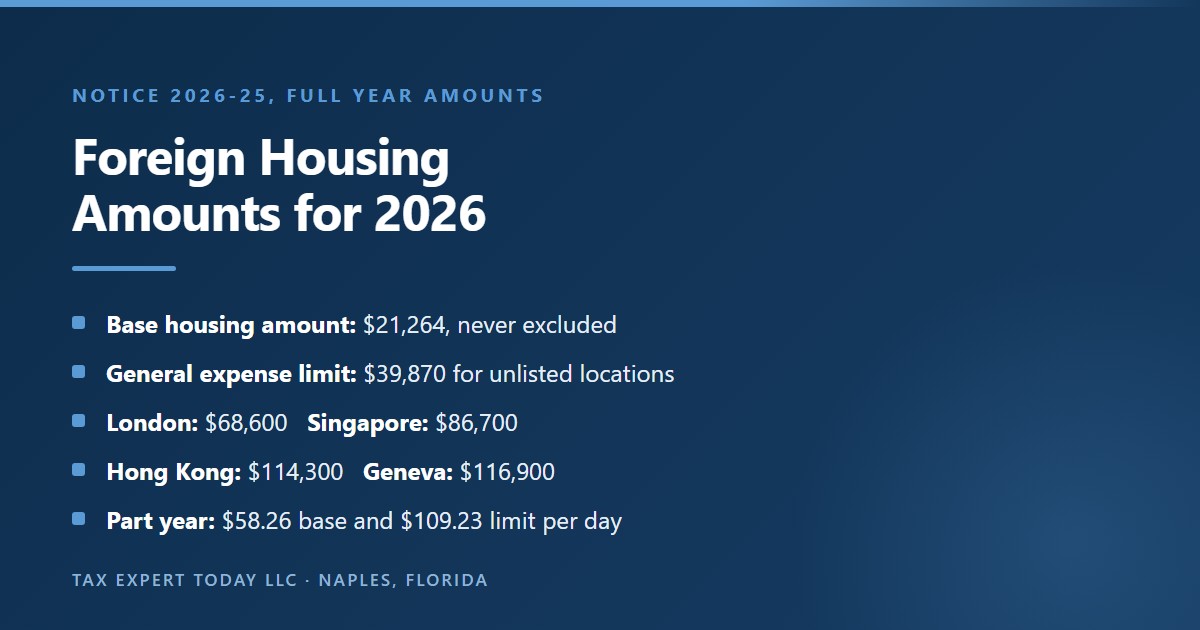
If your city is not listed in Notice 2026-25 and you qualified for all 365 days of 2026, line 29b is $39,870. If your city is listed, or you qualified for fewer days, you complete the Limit on Housing Expenses Worksheet, using the full year or daily figure from the notice, and $109.23 per day for unlisted locations.
- Line 29a: enter the city and country only if the location is listed in the notice.
- Full year, unlisted: $39,870.
- Full year, listed: the “full year” column for your location.
- Part year: the daily figure times qualifying days.
- Moved during the year: one worksheet per location, days not to exceed line 31.
Notice 2026-25 explains that the limits are adjusted for geographic differences in housing costs relative to the United States, under the authority in section 911(c)(2)(B). Its table gives, for each listed location, a full-year limitation and a daily limitation. A sample of the 2026 figures, as printed in the notice, is below. A filer whose location is not on the list uses the general figures, and should search the notice by both city and country before concluding that a location is unlisted.
| Location (country, city) | 2026 limit, full year | 2026 limit, daily |
|---|---|---|
| Switzerland, Geneva | $116,900 | $320.27 |
| China, Hong Kong | $114,300 | $313.15 |
| Singapore, Singapore | $86,700 | $237.53 |
| France, Paris, Sevres, Suresnes, and Versailles | $73,600 | $201.64 |
| United Kingdom, London | $68,600 | $187.95 |
| Australia, Sydney | $65,600 | $179.73 |
| Canada, Toronto | $62,700 | $171.78 |
| Spain, Madrid | $59,700 | $163.56 |
| United Arab Emirates, Dubai | $57,174 | $156.64 |
| Mexico, Mexico City | $47,900 | $131.23 |
| Portugal, Lisbon | $44,800 | $122.74 |
| Any location not listed | $39,870 | $109.23 |
The worksheet in the instructions has four lines. Line 1 is the number of qualifying days in 2026. If that is 365, you take the full-year figure for your location and stop. If it is fewer, you take the daily figure for your location, or $109.23 if it is not listed, and multiply by the days. The instructions give their own example: a filer in an unlisted location who qualifies from January 1 to October 3, 2026, has 276 days and a limit of $30,147.48, which is $109.23 times 276.
There is also a look-back election. Section 4 of Notice 2026-25 let a 2025 filer apply the 2026 limits to 2025 if they were higher, and the instructions say the IRS and Treasury anticipate allowing 2026 filers to apply the 2027 limits in the same way, with the authorization to come in a future notice. A filer in a city where rents rose sharply should check the 2027 notice when it is published, because a higher limit could still be used on the 2026 return or on an amended one.
How do lines 30 through 36 of Form 2555 compute the housing exclusion?
Line 30 takes the smaller of your expenses and your limit. Line 31 counts qualifying days, line 32 multiplies them by $58.26, and line 33 subtracts that base to give the housing cost amount. Lines 34 and 35 find the share paid by an employer, and line 36 multiplies the two to give the housing exclusion.
- Line 30: the smaller of line 28 or line 29b.
- Line 31: qualifying days that fall in 2026.
- Line 32: $58.26 times line 31, or $21,264 for 365 days.
- Line 35: employer-provided amounts divided by foreign earned income, no more than 1.000.
- Line 36: housing exclusion, not more than line 34.
The 2026 form states the rule on line 33 plainly: if the result is zero or less, do not complete the rest of Part VI or any of Part IX. A filer who pays $18,000 a year in rent for a full year has nothing to claim, because $18,000 is below the $21,264 base. A filer who pays $54,000 in London has a housing cost amount of $32,736 for a full year, because the $54,000 is under the $68,600 London limit and the base is $21,264.
Line 34 is where employees and the self-employed part ways. The instructions define employer-provided amounts as any amount your employer paid or incurred on your behalf that is foreign earned income: wages, the fair market value of compensation in kind, rent paid directly to a landlord, and reimbursements for housing, for dependents’ education, or under a tax equalization plan. For most employees every dollar of Part IV is employer-provided, so line 35 is 1.000 and the full housing cost amount is excluded. A person with both wages and self-employment income gets a fraction. A person whose income is all from self-employment skips lines 34 and 35 and enters zero on line 36.
| Line | Hypothetical London employee, full year | Hypothetical Lisbon employee, 122 days |
|---|---|---|
| 28, housing expenses | $54,000 | $14,000 |
| 29b, limit | $68,600 (London, full year) | $14,974.28 ($122.74 times 122) |
| 30, smaller of 28 or 29b | $54,000 | $14,000 |
| 31, qualifying days | 365 | 122 |
| 32, base amount | $21,264 | $7,107.72 ($58.26 times 122) |
| 33, housing cost amount | $32,736 | $6,892.28 |
| 35, employer share | 1.000 | 1.000 |
| 36, housing exclusion | $32,736 | $6,892.28 |
How do married couples handle housing on Form 2555?
Spouses who both qualify and share one foreign home on a joint return may figure housing jointly, one spouse claiming with one base amount, or separately, each with a base amount. Spouses filing separately in one home must figure it separately. Spouses in separate homes each claim only if their homes and tax homes are not within commuting distance.
- Joint computation: one spouse claims, using combined expenses and one base amount.
- Shorter period: if periods differ and the shorter one claims, only that period’s expenses count.
- Separate computation: each spouse uses their own base amount, with no duplicated expenses.
- Separate homes: both claim only if neither home is within commuting distance of the other spouse’s tax home.
- Exclusion itself: always figured separately, one Part VII per spouse.
Couples where both spouses work abroad can each exclude up to $132,900 on a joint return, but each spouse must complete a separate Form 2555 and a separate Part VII, as the Part VII instructions explain. Community property rules do not change the result: the exclusion is not affected by the income-splitting provisions of community property laws, and the sum of the amounts figured separately is the total on a joint return. If only one spouse works, only that spouse files Form 2555, and the other spouse’s personal income does not raise the cap.
Housing is the one place where couples have a choice. Figuring jointly means one spouse aggregates both spouses’ housing expenses, subject to the line 29b limit, and subtracts one base amount. Figuring separately means each spouse uses their own base amount, and the couple may allocate expenses between them, so long as nothing is excluded or deducted twice. The joint method subtracts one base amount but applies one expense limit, while the separate method subtracts two base amounts but lets each spouse work within their own limit and their own employer-provided ratio. Which method produces the larger total depends on the expenses, the limit for the location, and how each spouse’s income compares with the cap, so it is worth computing both ways.
When one spouse is a nonresident alien who has not joined in a section 6013(g) election, only the U.S. spouse files Form 2555, and the couple usually files separately. That choice, and what the joint election brings onto the U.S. return, is covered in our guide to the nonresident alien spouse.
What is a second foreign household on Form 2555?
A second foreign household is a separate home abroad kept for your spouse and dependents because living conditions at your tax home were dangerous, unhealthful, or otherwise adverse. You answer Yes on line 8a, give its location and days on line 8b, and may add its reasonable expenses to line 28.
- Trigger: adverse conditions at the tax home, not personal preference.
- Location: the second home must also be outside the United States.
- Form entries: line 8a Yes, and line 8b city, country, and days.
- Expenses: included on line 28 with the main home.
- Common case: a worker at a remote site whose family lives in a nearby capital.
The rule exists for people whose job sits somewhere a family cannot safely or reasonably live, such as a remote energy site or a region with a security warning. The instructions allow the expenses of the separate household to be included on line 28 if you maintained it for your spouse and dependents at a place other than your tax home because the living conditions at your tax home were dangerous, unhealthful, or otherwise adverse. It is not available because a family prefers a different city. It also interacts with section 119: a worker who lives in an employer camp that is excluded under section 119 may still count the expenses of the family’s second household, as the instructions note.
Records matter here. The return should be supported by evidence of the conditions at the tax home, such as an employer policy that families may not accompany workers to the site, a government travel advisory, or a description of the camp. Without that file, a second household claim looks like two homes for personal reasons, and the second set of expenses can be disallowed.
How is the exclusion figured in Part VII of Form 2555?
Part VII starts with $132,900 on line 37, prorates it on lines 38 to 40 by the share of 2026 days in your qualifying period, subtracts any housing exclusion from foreign earned income on line 41, and enters the smaller result on line 42. That line 42 figure is your foreign earned income exclusion for 2026.
- Line 37: $132,900.
- Line 38: qualifying days in 2026, the same number as line 31 if Part VI was completed.
- Line 39: 1.000 for a full year, otherwise days divided by 365, rounded to at least three places.
- Line 41: foreign earned income less the housing exclusion.
- Line 42: the smaller of line 40 or line 41.
For a person abroad all year, Part VII is short: line 40 is $132,900, and the exclusion is the smaller of $132,900 and foreign earned income after the housing exclusion. The first and last years abroad are where proration matters. Consider a hypothetical engineer who moves to Lisbon on September 1, 2026, and stays through 2027, so the physical presence test is met for the 12 months from September 1, 2026, to August 31, 2027. The qualifying days that fall in 2026 are 122 (September 30, October 31, November 30, and December 31).
| Line | Entry | Computation |
|---|---|---|
| 37 | $132,900 | Printed on the 2026 form |
| 38 | 122 days | September 1 to December 31, 2026 |
| 39 | 0.334 | 122 divided by 365, rounded to three places |
| 40 | $44,388.60 | $132,900 times 0.334 |
| 41 | Foreign earned income less line 36 | Pay for work performed in Portugal after September 1 |
| 42 | Smaller of line 40 or line 41 | Wages earned in the United States before the move are not on Form 2555 |
Two practical points follow. First, the engineer’s salary for January through August, earned while working in the United States, is not foreign earned income and is taxed normally. Second, the engineer cannot prove the 330 days by April 15, 2027, or even by the automatic June 15, 2027 date, because the 12 month window does not close until August 31, 2027. The instructions give two choices: file Form 2350 to extend the due date to a date after the test will be met, or file on time without the exclusion and amend after qualifying. The Form 2350 route and its timing are covered on our bona fide residence test page, and a person with a U.S. arrival or departure year that also changes residency status should read our guide to the dual status tax return.
What goes on lines 43 through 45 of Form 2555?
Line 43 adds the housing exclusion and the foreign earned income exclusion. Line 44 subtracts deductions taken in figuring adjusted gross income that are allocable to the excluded income, such as part of the deductible half of self-employment tax. Line 45 is the net figure, which goes on Schedule 1, line 8d, as a negative amount.
- Line 43: line 36 plus line 42.
- Line 44: above-the-line deductions definitely related to the excluded income.
- Line 45: line 43 minus line 44, carried to Schedule 1, line 8d.
- Proration: if only part of the income is excluded, deductions are split by the ratio.
- Not prorated: the section 119 exclusion and the housing deduction.
Line 44 is a quiet trap. Section 911(d)(6) denies any deduction, exclusion, or credit to the extent it is properly allocable to or chargeable against excluded amounts. The line 44 instructions put that into practice: you report all of your above-the-line deductions in full on Schedule 1, and then enter on line 44 the part that is not allowed because it relates to excluded income. The examples given are the deductible part of self-employment tax and expenses claimed on Schedule C. If only part of your foreign earned income is excluded, those deductions are prorated using the ratio of excludable income to total foreign earned income.
This explains why a self-employed person who excludes every dollar of profit cannot also use the deduction for half of self-employment tax to create a loss. The deduction is reported on Schedule 1, but the same amount is backed out of the exclusion on line 44, so the net effect is zero. Itemized deductions follow a similar idea through the Foreign Earned Income Tax Worksheet, where line 2b collects itemized deductions or exclusions that could not be claimed because they relate to excluded income.
The 2026 instructions then explain the final move: enter line 45 on Schedule 1, line 8d, reduce the other items of additional income by that negative amount, and carry the result through Schedule 1, line 10, to Form 1040, line 8. If Schedule 1, line 10, is negative, enter it in parentheses and reduce total income accordingly. The exclusion therefore never appears as a deduction. It appears as negative income, which is why software summaries sometimes show total income lower than the wages on the W-2 or the foreign pay statement.
How does the housing deduction in Part IX of Form 2555 work?
Part IX gives a deduction for the housing cost amount that was not excluded because it was not employer-provided, which mainly helps the self-employed. The deduction is the smaller of the unexcluded housing amount or foreign earned income left after both exclusions. It goes on Schedule 1, line 24j, and any excess carries forward one year only.
- When to complete it: line 33 is more than line 36, and line 27 is more than line 43.
- Line 46: housing cost amount not excluded.
- Line 47: foreign earned income not already excluded.
- Line 49: carryover from 2025, from the worksheet in the instructions.
- Line 50: total housing deduction, carried to Schedule 1, line 24j.
The deduction exists so that a self-employed person abroad is not shut out of the housing benefit. It has a built-in limit that surprises many freelancers. Line 48 is the smaller of the unused housing amount (line 46) and the foreign earned income still in the return after the exclusions (line 47). The form instructs filers who claim the income exclusion to complete Parts VII and VIII before Part IX, so the income exclusion is applied first. If the exclusion has already absorbed all of your income, line 47 is zero and the housing deduction for the year is zero.
Take a hypothetical self-employed consultant who lives in Mexico City all of 2026, passes the physical presence test, earns $120,000 of net profit, and pays $36,000 in rent and utilities. The housing cost amount on line 33 is $14,736, which is $36,000 minus $21,264, and Mexico City’s $47,900 limit is not reached. Because all income is self-employment income, line 36 is zero. The exclusion on line 42 is $120,000, the smaller of $132,900 and $120,000. Line 47 is $120,000 minus $120,000, or zero. The housing deduction on line 48 is therefore zero.
| Line | Hypothetical Mexico City consultant | Explanation |
|---|---|---|
| 27, foreign earned income | $120,000 | Net profit, personal services only |
| 33, housing cost amount | $14,736 | $36,000 less $21,264 |
| 36, housing exclusion | $0 | No employer-provided amounts |
| 42, foreign earned income exclusion | $120,000 | Income is below $132,900 |
| 43, total | $120,000 | Line 36 plus line 42 |
| 46, housing not excluded | $14,736 | Line 33 less line 36 |
| 47, income not excluded | $0 | Line 27 less line 43 |
| 48, housing deduction this year | $0 | Smaller of line 46 or line 47 |
| Carryover to 2027 | $14,736 | Line 46 less line 48, usable in 2027 only |
The instructions describe the one-year carryover. If line 46 is more than line 47, the difference can be carried to the next tax year. If it cannot be deducted in that next year because of that year’s limit, it cannot be carried any further. The Housing Deduction Carryover Worksheet for line 49 takes the prior year’s lines 46 and 48 to find the unused amount, then caps it at the room left in the current year (line 47 minus line 48). In practice, a consultant whose income stays below the exclusion every year never uses the carryover. A consultant whose income jumps above $132,900 the following year may use it.
A housing deduction claimed in Part IX is not an itemized deduction. It is taken above the line on Schedule 1, line 24j, so it lowers adjusted gross income whether or not you itemize. It also has to be included on line 2a of the Foreign Earned Income Tax Worksheet, which means it is stacked along with the exclusion, as described next.
What is the Form 2555 stacking rule?
The stacking rule in section 911(f) taxes the income you did not exclude at the rates that would apply if the excluded income were still on the return. You figure tax on taxable income plus the excluded amount, then subtract the tax on the excluded amount alone. Excluded income still sets the bracket for everything above it.
- Statute: section 911(f)(1)(A), applied through the Foreign Earned Income Tax Worksheet.
- Step one: tax on taxable income plus the Form 2555 lines 45 and 50.
- Step two: tax on the lines 45 and 50 amount alone.
- Result: the difference goes on Form 1040, line 16.
- Effect: the remaining income starts in the bracket where the exclusion ended.
Many people assume that excluding $132,900 is the same as earning $132,900 less. It is not. Section 911(f)(1)(A) provides that if any amount is excluded, the tax is the excess of the tax that would be imposed if taxable income were increased by the excluded amount, over the tax that would be imposed if taxable income equaled the excluded amount. In plain terms, the excluded dollars fill the lower brackets, and the taxable dollars are taxed in the brackets above them.
The Form 2555 instructions say that if you claim either exclusion or the housing deduction, you must figure tax on your nonexcluded income using the rates that would have applied had you not claimed the exclusions, and they direct you to the Foreign Earned Income Tax Worksheet in the Form 1040 instructions. That worksheet has six lines. Line 1 is taxable income from Form 1040, line 15. Line 2a is the total of Form 2555, lines 45 and 50, for you and a spouse on a joint return. Line 2b removes itemized deductions or exclusions you could not claim because they relate to excluded income. Line 3 adds line 1 and line 2c. Line 4 is the tax on line 3. Line 5 is the tax on line 2c. Line 6 is line 4 minus line 5, and that amount is the regular tax on Form 1040, line 16.
The worksheet also tells you not to complete it if Form 1040, line 15 is zero. A filer whose exclusion and deductions bring taxable income to zero has no income tax from the stacking rule, although self-employment tax and other taxes may still apply.
How much does the stacking rule cost on Form 2555? A worked example
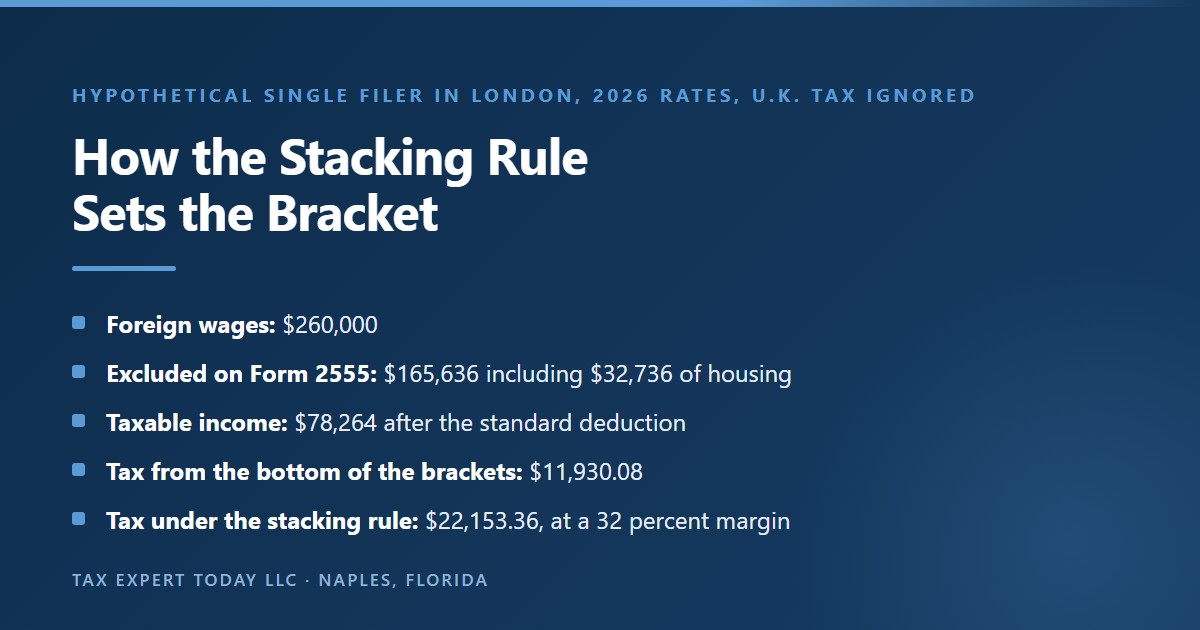
In a hypothetical 2026 example, a single London employee with $260,000 of foreign wages excludes $165,636 and has $78,264 of taxable income. Taxed from the bottom of the brackets that would be $11,930.08, but the stacking rule produces $22,153.36, because the remaining income is taxed starting at the 24 and 32 percent rates.
- Foreign wages: $260,000, with $54,000 of rent and utilities in London.
- Excluded: $32,736 of housing plus $132,900 of income, $165,636 in all.
- Taxable income: $78,264 after the $16,100 standard deduction.
- Stacked tax: $54,504.00 minus $32,350.64, or $22,153.36.
- Marginal rate: 32 percent on the next dollar, not 22 percent.
Here is the full computation, using the 2026 rate table for unmarried individuals in Rev. Proc. 2025-32. The facts are hypothetical. A U.S. citizen works in London for a U.K. employer for all of 2026, meets the physical presence test for the full year, earns $260,000 of wages, has no other income, pays $54,000 in rent and utilities, and takes the standard deduction. To isolate the stacking rule, the example ignores U.K. tax and any foreign tax credit, which would matter a great deal in real life and is discussed below.
| Step | Line | Amount |
|---|---|---|
| Foreign earned income | Form 2555, line 27 | $260,000.00 |
| Housing cost amount ($54,000 less $21,264) | Form 2555, line 33 | $32,736.00 |
| Housing exclusion (employer share 1.000) | Form 2555, line 36 | $32,736.00 |
| Foreign earned income exclusion | Form 2555, line 42 | $132,900.00 |
| Total excluded | Form 2555, line 45 | $165,636.00 |
| Adjusted gross income | Form 1040, line 11a | $94,364.00 |
| Taxable income after $16,100 standard deduction | Form 1040, line 15; worksheet line 1 | $78,264.00 |
| Line 1 plus line 2c | Worksheet line 3 | $243,900.00 |
| Tax on $243,900 | Worksheet line 4 | $54,504.00 |
| Tax on $165,636 | Worksheet line 5 | $32,350.64 |
| Regular tax | Worksheet line 6; Form 1040, line 16 | $22,153.36 |
| For comparison, tax on $78,264 from the bottom of the table | Not used | $11,930.08 |
The tax on line 4 equals the tax this person would have owed with no exclusion at all, because $260,000 minus the $16,100 standard deduction is also $243,900. That is the clearest way to see what the stacking rule does. The exclusion removes the tax on the first $165,636 of the stack, which is $32,350.64, and leaves the tax on everything above it in place. Every additional dollar of income in this example is taxed at 32 percent, the bracket that covers income between $201,775 and $256,225 for a single filer in 2026.
In a real London case, the U.K. tax on $260,000 of salary would usually be larger than the U.S. tax, and a foreign tax credit for the U.K. tax on the non-excluded income may eliminate the remaining U.S. tax. That interaction is why the choice between the exclusion and the credit deserves its own analysis, which our guide to the foreign earned income exclusion vs credit walks through. In a country with little or no income tax, such as the United Arab Emirates in the earlier example, the stacking result is the U.S. tax actually owed.
How does the stacking rule treat capital gains and dividends on Form 2555?
If you have qualified dividends or long-term capital gains, the Foreign Earned Income Tax Worksheet routes line 4 through the Qualified Dividends and Capital Gain Tax Worksheet, starting from worksheet line 3. If net capital gain exceeds taxable income, a capital gain excess reduces the gains taxed at preferential rates, under section 911(f)(2).
- Line 4 method: the capital gain worksheet, using worksheet line 3 as its line 1.
- Capital gain excess: the gain worksheet line 4 amount minus Form 1040, line 15.
- Effect: part of the gains is treated as used up by the excluded income.
- Software: handles the steps, but only if the gain and dividend data are complete.
- Review point: large one-time gains in a year abroad.
Expats with investment portfolios should know that the stacking rule reaches investment income too. The Form 1040 instructions tell a Form 2555 filer to use the Foreign Earned Income Tax Worksheet instead of computing tax directly with the capital gain worksheet. Inside the stacking worksheet, line 4 is figured with the Qualified Dividends and Capital Gain Tax Worksheet or the Schedule D Tax Worksheet, entering worksheet line 3 as that worksheet’s line 1. The instructions then define a capital gain excess, which arises when the qualified dividend and gain figure exceeds Form 1040, line 15, and require it to reduce the amounts taxed at the preferential rates. Section 911(f)(2)(A) is the source of that adjustment.
The practical result is that excluded wages push qualified dividends and long-term gains up the 0, 15, and 20 percent ladder in the same way they push ordinary income up the ordinary brackets. An expat who sells a U.S. brokerage position in the same year as a large exclusion should model the sale before it happens, because the 0 percent capital gain bracket that a low taxable income seems to promise may not be available after stacking. Investment income of an American abroad is also often subject to the 3.8 percent net investment income tax, which the exclusion does not reduce, and foreign mutual funds bring their own problems covered in our guide to Form 8621 and PFIC reporting.
Does Form 2555 reduce self-employment tax?
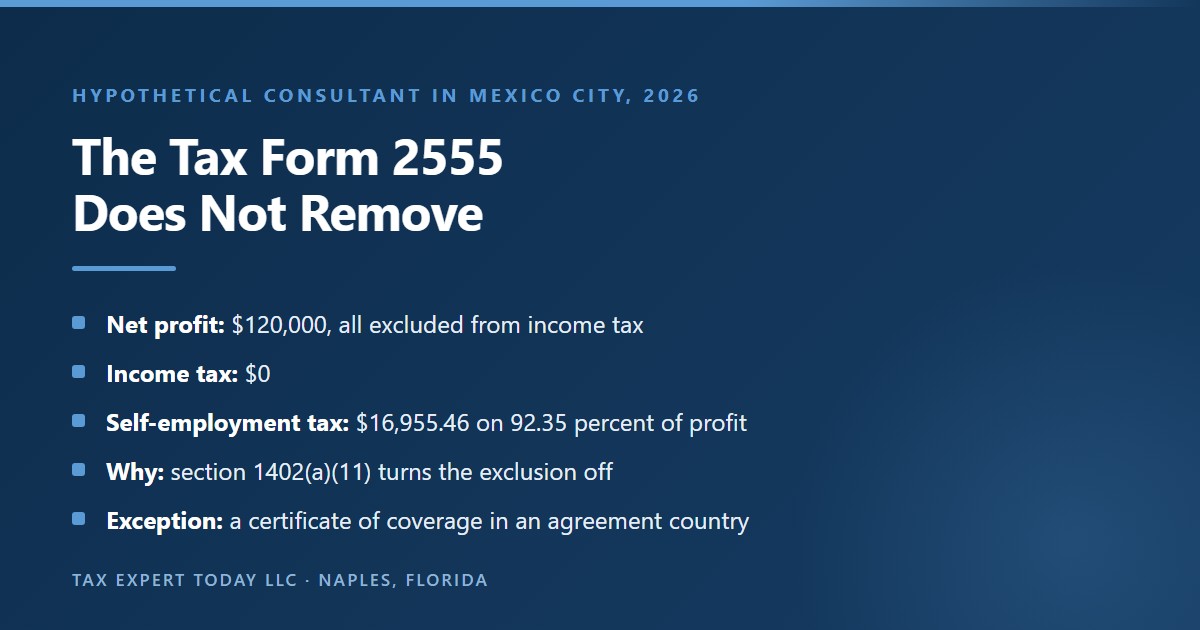
No. Section 1402(a)(11) says the foreign earned income exclusion does not apply in computing net earnings from self-employment, so a self-employed American abroad generally owes 15.3 percent Schedule SE tax on the profit even when Form 2555 excludes all of it from income tax. A totalization agreement certificate of coverage is the main exception.
- Statute: section 1402(a)(11) turns the exclusion off for self-employment tax.
- Rates: 12.4 percent Social Security up to $184,500 for 2026, plus 2.9 percent Medicare.
- Base: 92.35 percent of net profit.
- Exception: coverage under a foreign system through a totalization agreement.
- Payment: quarterly estimated tax, even with no income tax due.
This is the surprise that brings many freelancers abroad to a tax professional for the first time. Section 1402(a)(11) provides that in computing net earnings from self-employment, the exclusion from gross income provided by section 911(a)(1) shall not apply. The 2026 Instructions for Schedule SE say the same thing in practical language: if you are a self-employed U.S. citizen or resident alien living outside the United States, in most cases you must pay self-employment tax, and foreign earnings from self-employment cannot be reduced by your foreign earned income exclusion when computing it.
Return to the hypothetical Mexico City consultant with $120,000 of net profit for 2026. Form 2555 excludes all $120,000 from income tax, and Form 1040, line 15 is zero. Schedule SE still applies to the full profit. The United States does not have a social security agreement with Mexico in the list printed in the 2026 Schedule SE instructions, so there is no totalization exception.
| Schedule SE step, 2026 | Amount | Computation |
|---|---|---|
| Net profit from Schedule C | $120,000.00 | Hypothetical |
| Net earnings from self-employment | $110,820.00 | 92.35 percent of profit |
| Social Security portion | $13,741.68 | 12.4 percent, below the $184,500 wage base |
| Medicare portion | $3,213.78 | 2.9 percent, no cap |
| Self-employment tax | $16,955.46 | Schedule 2, carried to Form 1040 |
| Deductible half of self-employment tax | $8,477.73 | Schedule 1, then backed out on Form 2555, line 44 |
| Form 2555, line 45 | $111,522.27 | $120,000 less $8,477.73 |
| Federal income tax | $0.00 | Taxable income is zero |
| Total federal tax owed | $16,955.46 | All of it self-employment tax |
The line 44 entry is the reason the half of self-employment tax deduction does not create a loss. All of the consultant’s income is excluded, so all of the deduction relates to excluded income and is entered on line 44, lowering line 45 to $111,522.27. The deduction is still taken in full on Schedule 1, and the two entries offset each other. The outcome is no income tax and $16,955.46 of self-employment tax, which is typically paid through quarterly estimates during the year.
There is a related limit worth noting. The additional 0.9 percent Medicare tax applies to self-employment income above a threshold, $200,000 for a single filer under the Schedule SE instructions, and is figured on Form 8959. The Social Security portion stops at the $184,500 wage base for 2026, but the Medicare portion does not stop, so a high-earning freelancer abroad pays Medicare tax on every dollar of net earnings.
How does a totalization agreement change Form 2555 results?
A totalization agreement can assign a self-employed or employed American to one country’s social security system. If the foreign country covers you, you obtain a certificate of coverage from its agency and attach a copy to your return, and no U.S. self-employment tax is due on that income. Form 2555 itself is unchanged.
- Agreement countries for 2026: 30, listed in the Schedule SE instructions.
- Proof: a certificate of coverage from the foreign social security agency.
- Self-employed rule: generally the country of residence covers the worker.
- Employees: special rules for workers sent abroad by a U.S. employer.
- No agreement: U.S. self-employment tax applies, and foreign social tax may too.
The 2026 Schedule SE instructions list the agreement countries: Australia, Austria, Belgium, Brazil, Canada, Chile, the Czech Republic, Denmark, Finland, France, Germany, Greece, Hungary, Iceland, Ireland, Italy, Japan, Luxembourg, the Netherlands, Norway, Poland, Portugal, the Slovak Republic, Slovenia, South Korea, Spain, Sweden, Switzerland, the United Kingdom, and Uruguay. Under these agreements a person generally pays social security and Medicare taxes only to the country in which they live. The IRS totalization agreements page explains the role of the certificate of coverage.
Change one fact in the consultant example: the consultant lives in Lisbon instead of Mexico City. Portugal is on the list. If the consultant is covered by the Portuguese social security system and obtains a certificate of coverage, the U.S. self-employment tax of $16,955.46 is replaced by Portuguese social contributions, and the U.S. return shows no self-employment tax on that income. The certificate is the proof. Without it, a U.S. return that simply omits Schedule SE looks like an error. Our guide to the totalization agreement covers how the certificate is requested, the employee rules, and what happens in a country without an agreement.
Which credits and deductions does Form 2555 take away?
Claiming either exclusion or the housing deduction bars the earned income credit and the additional child tax credit, denies a foreign tax credit or deduction for foreign taxes on excluded income, limits IRA contributions for excluded compensation, and disallows any deduction definitely related to excluded income. These costs belong in the decision before filing.
- Earned income credit: not allowed with Form 2555.
- Additional child tax credit: the refundable portion is not allowed.
- Foreign tax credit: none for tax on excluded income, prorated for partial exclusion.
- IRA: excluded pay generally does not count as compensation for contributions.
- Allocable deductions: disallowed under section 911(d)(6).
The 2026 instructions list these effects under Choosing the Exclusion(s). You cannot take the additional child tax credit or the earned income credit if you claim either exclusion or the housing deduction. You cannot take a credit or deduction for foreign income taxes paid or accrued on income that is excluded, and if only part of your income is excluded, you cannot claim a credit or deduction for the foreign taxes allocable to the excluded part. Special rules apply to the IRA deduction, with details in Publication 590-A.
For families, the additional child tax credit is the refundable portion of the child tax credit. A family with children whose income is mostly excluded may have no income tax for the nonrefundable child tax credit to offset, and Form 2555 then blocks the refundable portion as well. Families living in high-tax countries sometimes find that the foreign tax credit route, which does not carry this bar, leaves room for a refundable credit. That comparison is part of the choice covered on our exclusion versus credit page.
| Item | Effect of claiming Form 2555 | Source |
|---|---|---|
| Earned income credit | Not allowed | Instructions for Form 2555, Choosing the Exclusion(s) |
| Additional child tax credit | Not allowed | Instructions for Form 2555, Choosing the Exclusion(s) |
| Foreign tax credit on excluded income | Not allowed; prorated if partly excluded | Section 911(d)(6); Publication 514 |
| Foreign tax credit on income above the exclusion | Allowed for the taxes allocable to that income | Section 911(d)(6); Form 1116 |
| Deductions definitely related to excluded income | Disallowed or prorated | Form 2555, Part VIII and line 44 |
| IRA deduction | Special rules, excluded pay generally not compensation | Publication 590-A |
| Housing deduction and section 119 exclusion | Not treated as definitely related to excluded income | Instructions for Form 2555, Part VIII |
Can Form 2555 and Form 1116 be used on the same return?
Yes. You can exclude up to the cap on Form 2555 and claim a foreign tax credit on Form 1116 for foreign tax on income above the cap or on other income, such as foreign rental income or dividends. No credit is allowed for foreign tax allocable to the excluded income, so the foreign tax must be split.
- Allowed: credit for foreign tax on wages above the exclusion.
- Allowed: credit for foreign tax on passive income, such as dividends.
- Not allowed: credit for the share of tax on excluded wages.
- Method: allocate the foreign tax by the ratio of excluded to total foreign earned income.
- Caution: claiming the credit instead of the exclusion can count as a revocation.
For a person whose salary is well above $132,900, using both forms is common. The excluded portion is tax free in the United States, and the foreign tax on the rest is credited against the stacked U.S. tax on the rest. The arithmetic of the split comes from section 911(d)(6) and Publication 514: the foreign tax on wages is divided between the excluded and non-excluded portions, and only the second part is creditable. Our Form 1116 guide walks through categories, limits, and carryovers, and a partner or shareholder who receives foreign tax information on a Schedule K-3 will use the same form.
Order matters in software. Most programs compute Form 2555 first, then Form 1116 using the remaining income, and then the Foreign Earned Income Tax Worksheet. A preparer who enters the foreign tax as if no exclusion were claimed will overstate the credit, and the IRS can reduce it on processing or examination.
How do you make the Form 2555 election, and can it be made late?
You elect each exclusion by filing Form 2555 with Form 1040 for the first year. Treas. Reg. section 1.911-7(a)(2) also allows an amended return within the refund period, an original return within one year after the unextended due date, or later if no tax is owed or the IRS has not discovered the omission.
- Timely return: including extensions.
- Amended return: amending a timely return within the section 6511(a) period.
- One-year window: an original return filed within a year of the unextended due date.
- Later returns: allowed if no tax is owed, or if filed before the IRS discovers the failure to elect.
- Required legend: “Filed Pursuant to Section 1.911-7(a)(2)(i)(D)” for the last category.
The election rules matter to Americans who discover a filing gap after years abroad. Treas. Reg. section 1.911-7(a)(2)(i) says a valid election must be made with a timely return including extensions, with a later return amending that timely return within the period in section 6511(a), with an original return filed within one year after the due date determined without regard to extensions, or with a return filed after those periods if one of two conditions holds. The first condition is that the taxpayer owes no federal income tax after the exclusion, whether the return is filed before or after the IRS discovers the failure to elect. The second is that the taxpayer owes tax after the exclusion but files before the IRS discovers the failure. A return in that last category must carry the statement “Filed Pursuant to Section 1.911-7(a)(2)(i)(D)” at the top of the first page.
The wording matters. A person who has never filed while abroad and whose income is under the cap may still be able to elect the exclusion on late returns, because no income tax would be owed after the exclusion. That does not settle the self-employment tax, penalties, or foreign account reporting that may also be missing, and those questions are separate. A person with unfiled years and unreported foreign accounts should read our guides to the Streamlined Filing Compliance Procedures, which are available only to taxpayers whose failures were non-willful, and to filing a late FBAR before filing anything, because the route chosen affects how the returns are prepared and which statements go with them. Whether a particular route fits depends on the facts, and willfulness questions belong with qualified counsel.
Once made, the election stays in effect for that year and all future years until revoked, as the regulation and the instructions both state. The instructions add a helpful note: you do not need to revoke a prior choice just because you have no foreign earned income or foreign housing costs for the year. Revocation, the five year bar on electing again without IRS consent, and when switching to the credit makes sense are covered in our guide to the foreign earned income exclusion vs credit.
When and where is Form 2555 filed?
Form 2555 is filed with your Form 1040. A 2026 calendar-year return is due April 15, 2027, but if you live and have your tax home outside the United States and Puerto Rico on that date, you get an automatic two month extension to June 15, 2027, by attaching a statement. Interest still runs from April 15.
- Regular due date: April 15, 2027, for 2026 returns.
- Automatic extension: June 15, 2027, with a statement explaining that you qualify.
- Further extension: Form 4868, or Form 2350 to wait until you meet a test.
- Interest: runs on unpaid tax from April 15 regardless of the extension.
- Paper returns: mail to the special international addresses, not your state’s address.
The instructions explain the timing, and the IRS foreign earned income exclusion page summarizes the same rules. A 2026 calendar-year Form 1040 is generally due April 15, 2027. You are automatically granted a two month extension to June 15, 2027, if on the due date you live outside the United States and Puerto Rico and your tax home is outside the United States and Puerto Rico, and you must attach a statement explaining that you meet both conditions. The extension also applies to paying the tax, but interest is owed on any tax not paid by the regular due date.
The instructions also tell paper filers to mail Form 1040 to one of the special addresses designated for returns with Form 2555 attached, and not to the address for their state of residence. The addresses are on the IRS page for international filers. Most expats now file electronically, which avoids the address question and shortens the wait for any refund.
The first year abroad is the hardest one to time. If you will not meet the bona fide residence test or the physical presence test until after June 15, 2027, you may file Form 2350 to extend to a date after you expect to qualify, or file without the exclusion and amend later with Form 1040-X. The instructions note that an amended return is generally due within three years after the original return was filed or within two years after the tax was paid, whichever is later.
| Situation for a 2026 calendar-year filer | Due date | What to attach or file |
|---|---|---|
| Living in the United States on April 15, 2027 | April 15, 2027 | Form 4868 to extend filing to October 15, 2027 |
| Living and working abroad on April 15, 2027 | June 15, 2027 | Statement that both conditions are met |
| Abroad and needing more time | October 15, 2027 | Form 4868 filed by June 15, 2027 |
| First year, test not yet met by the due date | A date after you expect to qualify | Form 2350, filed before the due date |
| Return filed without the exclusion, test met later | Within the amended return period | Form 1040-X with Form 2555 |
Does Form 2555 replace the FBAR or Form 8938?
No. Form 2555 reports earned income and housing, while the FBAR reports foreign financial accounts to FinCEN and Form 8938 reports specified foreign financial assets with the return. An expat who excludes every dollar of salary may still have to file both, because the thresholds look at account balances, not at taxable income.
- FBAR: FinCEN Form 114, if foreign account balances exceed $10,000 in aggregate at any time.
- Form 8938: higher thresholds for taxpayers living abroad, filed with Form 1040.
- Salary account: the foreign bank account receiving your pay is usually reportable.
- Pensions: a foreign employer pension may be reportable on Form 8938.
- No offset: excluding income does not exclude the account.
Almost every American who works abroad is paid into a foreign bank account, which means almost every Form 2555 filer also has an FBAR question. The exclusion does nothing to the account reporting rules. Our guide to whether you need to file an FBAR covers the $10,000 aggregate threshold and the accounts that count, and our comparison of FBAR vs Form 8938 explains the different thresholds that apply to taxpayers living abroad. A foreign company you own, a foreign partnership, or a foreign trust brings separate forms as well.
How does Form 2555 interact with state taxes and a Florida domicile?
Form 2555 is a federal election, and states decide for themselves whether to follow it. Florida has no personal income tax, so a Floridian abroad has no state return to coordinate, but a former resident of a taxing state may still be treated as domiciled there, and some states do not allow the exclusion.
- Florida: no individual income tax, so no state version of Form 2555 is needed.
- Former state: may still claim you as a domiciliary while you are abroad.
- Conformity: some states add the federal exclusion back to income.
- Domicile evidence: declaration of domicile, driver license, voter registration, and home.
- Planning point: settle the state question before the first year abroad.
Florida residents who move abroad avoid one layer of complexity, because Florida does not tax individual income. Americans who leave from a high-tax state face a different question: whether that state still treats them as domiciled there while abroad. A person who keeps a house, a driver license, and voter registration in a former state may be taxed by that state on worldwide income, and not every state conforms to the federal exclusion. Our guides to establishing Florida residency, the dual state residency trap, and leaving California taxes cover the evidence that matters. The state rules on the exclusion vary and change, so the current law of the specific state should be checked before filing.
What records support a Form 2555 claim?
Keep evidence of your tax home, your days, your income, and your housing costs: passport stamps and travel records, a day-count calendar, an employment contract or assignment letter, pay statements in foreign currency with exchange rates, a lease and utility bills, and, for self-employed filers, books and any certificate of coverage.
- Days: passport stamps, boarding passes, and a calendar of every border crossing.
- Tax home: employment contract, assignment letter, or business registration abroad.
- Residence: residence permit, foreign tax returns, and family and community ties.
- Income: pay slips, allowance letters, and the exchange rates used.
- Housing: lease, rent receipts, utility bills, and insurance policies.
The 2026 form warns, just before Part II, that if you do not give the information asked for, any exclusion or deduction you claim may be disallowed. The same principle applies to evidence. Publication 54 describes the residence and presence tests with examples that show what evidence the IRS weighs. In an examination, the questions are usually where you were on which days, where your work was based, and whether the housing costs were real and reasonable. A day-count calendar kept during the year, matched to passport stamps and travel receipts, answers the first question far better than a reconstruction made three years later.
| Form 2555 claim | Primary evidence | Supporting evidence |
|---|---|---|
| Tax home abroad (line 9) | Employment contract or assignment letter | Foreign business registration, office lease |
| Bona fide residence (Part II) | Residence permit and foreign tax returns | Lease, school enrollment, local accounts, community ties |
| Physical presence (Part III) | Passport stamps and a day calendar | Boarding passes, travel invoices, payroll location reports |
| U.S. business days (lines 14 and 18) | Travel records and calendar | Expense reports and meeting records |
| Foreign earned income (Part IV) | Pay slips and allowance letters | Bank statements and exchange rate sources |
| Housing expenses (line 28) | Lease and rent receipts | Utility bills, insurance, lease agent invoices |
| Self-employment and social security | Books and Schedule C support | Certificate of coverage for agreement countries |
What are the most common mistakes on Form 2555?
The most common Form 2555 mistakes are using last year’s amounts, counting travel days as foreign days, leaving allowances out of Part IV, excluding U.S. business-day pay, computing tax without the stacking worksheet, assuming the exclusion removes self-employment tax, and claiming a housing deduction the income limit does not allow.
- Old figures: $132,900, $21,264, and $39,870 are the 2026 amounts.
- Day count: full days only, from midnight to midnight.
- Allowances: school fees, home leave, and quarters belong in Part IV.
- Stacking: tax must come from the Foreign Earned Income Tax Worksheet.
- Self-employment tax: still owed unless a certificate of coverage applies.
Some errors are mechanical, such as entering a prior year’s base housing amount or the wrong city limit. Others come from misunderstanding the rules. A filer who adds up 330 days by counting the day of departure and the day of arrival may fall short when the IRS applies the full-day rule. A filer who leaves a tuition allowance off Part IV understates income that the employer has already reported. A filer who uses ordinary tax tables instead of the stacking worksheet understates tax. These are the patterns we see most often when a return prepared abroad is reviewed in the United States.
| Mistake | What happens | Fix |
|---|---|---|
| Using 2025 amounts on a 2026 form | Wrong exclusion, base, or limit | Use the amounts printed on the 2026 form and in Notice 2026-25 |
| Counting partial days in Part III | The 330 day test may fail entirely | Count only full days from midnight to midnight |
| Omitting allowances from Part IV | Income is understated | Report every allowance on line 22 |
| Including U.S. business-day pay in Part IV | Excludes U.S. source income | Report it in line 14 or 18 and on Form 1040 |
| Skipping the stacking worksheet | Tax is understated | Compute Form 1040, line 16 on the worksheet |
| Omitting Schedule SE | Self-employment tax is unpaid | File Schedule SE, or attach a certificate of coverage |
| Claiming the Part IX deduction with no income left | Deduction disallowed | Apply the line 47 limit and track the one-year carryover |
| Claiming a credit on excluded wages | Credit is overstated | Allocate foreign tax under section 911(d)(6) |
| Filing both Part II and Part III | Inconsistent qualification | Complete only one |
Can a missed Form 2555 exclusion be claimed on an amended return?
Often, yes. If you filed a timely return without Form 2555, you can elect the exclusion on Form 1040-X within the refund period in section 6511(a). If you filed late, the one-year window and the no-tax-owed and before-discovery rules in Treas. Reg. section 1.911-7(a)(2) decide whether a late election is still valid.
- Timely original return: amend within the section 6511(a) period.
- Refund period: generally three years from filing or two years from payment.
- Late original return: check the one-year and discovery rules.
- Prior credit claimed: confirm no revocation issue first.
- First year abroad: amending after the test is met is a planned route.
Amending to add Form 2555 is common in the first year abroad, when the filer files on time without the exclusion and then amends once the 330 days or the full tax year of residence is complete. It is also common when someone simply did not know the exclusion existed. The question to settle first is whether a foreign tax credit claimed on the original return for the same income could be read as a revocation of an earlier election, because a revocation bars a new election for five years without IRS consent. Where the original return was not timely, the four paths in the regulation, described above, decide whether the amended or late election is valid.
What should an American abroad do before the 2026 year ends?
Before December 31, 2026, confirm your day count and qualifying dates, collect allowance letters and housing receipts, check whether your city has a higher housing limit, estimate the stacked tax on income above the cap, plan self-employment tax payments, request a certificate of coverage if eligible, and decide whether the exclusion or the credit fits better.
- Day count: reconcile the calendar with passport stamps while memories are fresh.
- Income file: gather pay slips, allowance letters, and bonus timing.
- Housing file: lease, receipts, and the Notice 2026-25 limit for your city.
- Estimates: stacked income tax and self-employment tax for the fourth quarter.
- Election review: exclusion, credit, or both, before the return is drafted.
Most Form 2555 problems are easier to prevent in December than to fix in April. A filer close to the 330 day line can plan travel in the last weeks of the year so that the 12 month window still works, or can choose a different 12 month period that includes more foreign days. A freelancer whose income is rising past $132,900 can use the stacking computation to estimate the fourth quarter payment rather than discovering a balance due in June. A family moving abroad in early 2027 can start the residence file before the move, when lease and school records are easiest to collect.
| Task | Why it matters on Form 2555 | Lines affected |
|---|---|---|
| Reconcile travel days | Sets the qualifying period and day ratio | 16, 18, 31, 38, 39 |
| Collect allowance letters | Completes foreign earned income | 19 to 26, 34 |
| Check the city housing limit | May raise the housing exclusion | 29a, 29b |
| Estimate stacked tax | Avoids an underpayment surprise | 45, 50, then the worksheet |
| Plan self-employment tax | Schedule SE is not reduced by the exclusion | Schedule SE, not Form 2555 |
| Request a certificate of coverage | Removes U.S. self-employment tax in agreement countries | Schedule SE, not Form 2555 |
| Review past elections | Avoids an unintended revocation | 6a to 6d |
Form 2555 Help in Naples & Southwest Florida
Tax Expert Today LLC prepares and reviews Form 2555 for Americans working abroad from an office in Naples, Florida and serves clients in all 50 states and overseas. Southwest Florida has a large community with family abroad: retirees whose children work in London or Dubai, professionals on assignment who keep a Naples home, Canadian and European families with American children, and remote workers who split the year between Florida and another country. Our team of tax advisors, enrolled agents, CPAs, and attorneys helps clients confirm whether they qualify, complete each Part of Form 2555, run the stacking worksheet, handle Schedule SE and certificates of coverage, and coordinate the exclusion with the foreign tax credit and foreign account reporting.
- Form 2555 help Naples: the exclusion, the housing exclusion, and the Part IX deduction.
- Foreign housing exclusion Naples: Notice 2026-25 city limits and couples’ housing.
- International tax Naples FL: Form 1116, Schedule K-3, and foreign entity reporting.
- Foreign tax Naples: foreign tax credit allocation and treaty positions.
- FBAR Naples: foreign salary accounts and Form 8938 for Americans abroad.
Our international and expat tax services page explains how we work with Americans abroad and with families who have cross-border income. The international tax Naples FL guide covers the wider picture for Southwest Florida, and owners and families focused on long-range planning can see our Naples, Florida tax planning page.
Office: 11983 Tamiami Trail N, Naples FL 34110
Phone: (239) 441-2005
Hours: Monday through Friday, 10:00 to 5:00 ET
Frequently Asked Questions
Where can I get help with Form 2555 in Naples, Florida?
Tax Expert Today LLC, located at 11983 Tamiami Trail N in Naples, Florida, helps U.S. citizens and resident aliens abroad with Form 2555, the foreign housing exclusion, and related international reporting. The firm includes tax advisors, enrolled agents, CPAs, and attorneys and serves clients in all 50 states and abroad. Call (239) 441-2005 to discuss your facts.
What is the maximum Form 2555 exclusion for 2026?
For 2026 the maximum foreign earned income exclusion is $132,900 per qualifying person, under Rev. Proc. 2025-32. It is prorated by day for a partial year. A married couple who both qualify may each exclude up to $132,900, but each spouse files a separate Form 2555.
Does Form 2555 lower self-employment tax?
No. Section 1402(a)(11) provides that the foreign earned income exclusion does not apply in computing net earnings from self-employment. A self-employed American abroad generally owes Schedule SE tax on the full profit unless a totalization agreement certificate of coverage shows coverage under the foreign country’s system.
Why do I owe tax after excluding my foreign income?
Usually because of the stacking rule in section 911(f). Tax on income you did not exclude is figured at the rates that would apply if the excluded income were still on the return, using the Foreign Earned Income Tax Worksheet. Self-employment tax, investment income, and U.S. business-day pay can also leave a balance.
What is the foreign housing exclusion limit for 2026?
The general limit on housing expenses for a full 2026 year is $39,870, and the first $21,264 of housing cost is never excluded. Notice 2026-25 sets higher limits for listed locations, such as $68,600 for London and $114,300 for Hong Kong. Partial years use daily figures.
Can I file Form 2555 if I am self-employed abroad?
Yes. A self-employed person who meets the tax home test and either residence test can exclude earned business profit, subject to a 30 percent limit where capital is a material income-producing factor. Housing is claimed as a Part IX deduction, which is limited by income left after the exclusion.
Can I claim Form 2555 on a late return?
Often. Treas. Reg. section 1.911-7(a)(2) allows the election on an original return filed within one year after the unextended due date, and on later returns if no income tax is owed after the exclusion or if the return is filed before the IRS discovers the failure to elect. Other filing problems should be reviewed at the same time.
When to Engage a Professional
Form 2555 looks like a fact form, but the facts carry judgment: where your tax home is when your family stays in the United States, whether a trip home breaks the physical presence count, whether an allowance is foreign earned income, how a bonus paid in the following year is treated, whether a business is capital intensive, and how foreign tax is split between excluded and non-excluded income. The stacking rule and self-employment tax then decide how much is owed, and the election rules decide whether an exclusion can still be claimed for a past year.
A professional review is worth considering in the first and last years abroad, when income passes the $132,900 cap, when an employer provides a large allowance package, when a spouse also works abroad, when you are self-employed in a country with or without a totalization agreement, when you have capital gains in a year with a large exclusion, when you have unfiled years, or when you are deciding between the exclusion and the foreign tax credit. Questions involving immigration status, foreign law, or possible willfulness should also involve qualified legal counsel.
Tax Expert Today LLC is a tax advisory firm in Naples, Florida serving clients in all 50 states. Call (239) 441-2005 to discuss your facts.
This article is general information, not legal or tax advice for any particular taxpayer, and does not create a client relationship. The examples are hypothetical illustrations only, do not describe any client, use simplified figures, and ignore foreign taxes unless stated. Whether a person qualifies, how income and housing costs are classified, how foreign tax is allocated, and whether an election is valid depend on the facts and on law and guidance that may change. State rules on the exclusion vary. The rules described here reflect 26 U.S.C. sections 911, 1401, and 1402; Treasury Regulations sections 1.911-2, 1.911-3, 1.911-4, 1.911-6, and 1.911-7; Rev. Proc. 2025-32; Notice 2026-25; Form 2555 (2026) and its Instructions; the Instructions for Schedule SE (2026); the Instructions for Form 1040 (Foreign Earned Income Tax Worksheet); and the IRS pages on the foreign housing exclusion and totalization agreements, all reviewed on November 12, 2026.
Published November 12, 2026 by Dr. Pellumb Kabashi « Back to Learning Center
Have a question this article touches on?
Tax Expert Today LLC, based in Naples, Florida and serving clients across the United States.
Schedule a Consultation (239) 441-2005