
By Dr. Pellumb Kabashi, DBA, MBA, EA, CFE, CES
Founder, Tax Expert Today LLC · Tax advisors, enrolled agents, CPAs, and attorneys · Serving clients in all 50 states
Quick Answer: Form W-8BEN-E is the certificate a foreign entity gives a United States payer or bank to document its foreign status, its entity type, and its FATCA status, and to claim a treaty rate where one applies. Without a valid W-8BEN-E, the payer generally withholds 30 percent. The form goes to the payer, never to the IRS. Call (239) 441-2005 for a free consultation.
What is Form W-8BEN-E?
Form W-8BEN-E is the IRS Certificate of Status of Beneficial Owner for United States Tax Withholding and Reporting (Entities). A foreign corporation, trust, estate, or other foreign entity signs it to tell a payer that it is foreign, what kind of entity it is, what its FATCA status is, and whether a tax treaty lowers the withholding rate.
- Who signs it: an officer or other person with capacity to sign for the foreign entity.
- Who receives it: the United States payer, broker, bank, or partnership, known as the withholding agent.
- What it documents: foreign status, chapter 3 entity type, chapter 4 (FATCA) status, and any treaty claim.
- What it is not: a tax return. It computes no tax and is never filed with the IRS.
- Current version: Rev. October 2021, eight pages and thirty parts.
The W-8BEN-E exists because of how the United States taxes foreign persons on passive income. Under section 881(a), a foreign corporation owes a flat 30 percent tax on United States source interest, dividends, rents, royalties, and other fixed or determinable annual or periodical income that is not connected with a United States business. The foreign corporation usually files no return for that income. Instead, section 1442 makes the payer collect the tax by withholding it from the payment.
A payer cannot know by looking at an invoice or an account application whether the payee is foreign, whether it owns the income or is passing it along to someone else, or whether a treaty applies. The withholding certificate answers those questions in a standard format, signed under penalties of perjury. The IRS instructions state the purpose in one sentence: the form is used by foreign entities to document their statuses for purposes of chapter 3 and chapter 4, as well as for certain other Code provisions.
The form is long because the second of those chapters, the Foreign Account Tax Compliance Act, sorts foreign entities into more than thirty categories, and the form carries a separate certification for most of them. A typical filer completes Part I, sometimes Part III, one status certification, and the signature in Part XXX. The rest of the form does not apply to that filer and stays blank.
This guide is written for the people who actually receive the request: the owner of a Canadian or European holding company with a United States brokerage account, a foreign company that sells services to an American customer, a family trust abroad, and the United States business that has to collect the form before it pays. Individuals do not use this form. A nonresident alien individual uses the certificate covered in our guide to Form W-8BEN.
Who must provide Form W-8BEN-E?
A foreign entity must give Form W-8BEN-E to the withholding agent or payer when it receives a payment subject to chapter 3 withholding, receives a withholdable payment under FATCA, or holds an account with a foreign financial institution that requests the form. The entity must be the beneficial owner of the income, not an agent or intermediary.
- Foreign corporations: operating companies and holding companies organized outside the United States.
- Foreign complex trusts and estates: each is the beneficial owner of its own income.
- Foreign tax-exempt entities and pension funds: when they claim a treaty rate or document FATCA status.
- Hybrid entities: foreign partnerships or disregarded entities taxed as residents by a treaty country and claiming the treaty.
- Foreign partners: entity partners in a partnership doing business in the United States.
The instructions list three triggers in the section titled Who Must Provide Form W-8BEN-E. The first is a payment subject to chapter 3 withholding, which generally means United States source fixed or determinable annual or periodical income, often shortened to FDAP income. The second is a withholdable payment, the FATCA term for the payments chapter 4 polices. The third has nothing to do with a payment: a foreign bank that follows FATCA may ask any entity account holder for the form simply to document who its customers are.
Several other Code provisions borrow the form. A foreign entity that is a partner in a partnership with a United States trade or business uses it for the withholding under section 1446. A foreign seller on a payment card network or an online marketplace uses it to show that it is a foreign participating payee, so the platform does not issue a Form 1099-K. A foreign entity that sells a life insurance contract or receives a reportable death benefit uses it under section 6050Y. A foreign entity with a United States brokerage account uses it so that sale proceeds are not reported on Form 1099 and are not subject to backup withholding.
| Situation | Why the W-8BEN-E is requested | Who requests it |
|---|---|---|
| Foreign company receives United States dividends, interest, or royalties | Chapter 3 withholding and any treaty rate | Broker, paying company, or licensee |
| Foreign company holds a United States brokerage or bank account | Chapter 3 and chapter 4 status, and exemption from Form 1099 reporting | Broker or bank |
| Foreign company holds an account at a non-United States bank | Chapter 4 status of the account holder | The foreign financial institution |
| Foreign company is a partner in a United States partnership | Foreign status for section 1446 withholding | The partnership |
| Foreign company sells on a marketplace or takes card payments | Foreign participating payee status under section 6050W | The platform or processor |
| Foreign company invoices a United States customer for services | Foreign status, so the customer does not treat it as an undocumented payee | The customer’s accounts payable department |
The beneficial owner requirement matters. For payments where no treaty is claimed, the instructions define the beneficial owner as the person required under United States tax principles to include the payment in gross income on a tax return. A nominee, an agent, a custodian, or a conduit is not the beneficial owner. An entity that receives income for someone else gives a different form, discussed below.
Who should not use Form W-8BEN-E?
The form is wrong for United States persons, foreign individuals, intermediaries, most foreign partnerships and simple or grantor trusts, entities with effectively connected income, and foreign governments or exempt organizations claiming a statutory exemption. Each has its own certificate, and the first page of the W-8BEN-E lists them in a box headed Do NOT use this form for.
- United States entities: use Form W-9, even when every owner is foreign.
- Foreign individuals: use Form W-8BEN, or Form 8233 for certain personal services.
- Intermediaries and most flow-through entities: use Form W-8IMY with a withholding statement.
- Effectively connected income: use Form W-8ECI.
- Foreign governments and exempt organizations claiming a Code exemption: use Form W-8EXP.
The most frequent error we see is a United States limited liability company with foreign owners signing a W-8BEN-E. A corporation or partnership organized under the law of a state is a United States person under section 7701(a)(30), and the instructions direct it to Form W-9. The foreign ownership matters for other filings, such as the reporting we cover in our guide to Form 5472 for foreign-owned companies, but it does not make the entity foreign.
The second frequent error runs the other way. A foreign partnership, a foreign simple trust, or a foreign grantor trust is not the beneficial owner of income paid to it. Its partners, beneficiaries, or grantor are. The instructions send those entities to Form W-8IMY, which travels with a withholding statement and a certificate from each owner. Two exceptions let a flow-through entity sign a W-8BEN-E anyway: when it is only documenting its chapter 4 status to a foreign bank, and when it is a hybrid entity claiming a treaty in its own name.
The third error involves income from a business carried on in the United States. Income that is effectively connected with a United States trade or business is taxed on a net basis on a return, not by 30 percent withholding, and the payee documents it on Form W-8ECI. The instructions add a warning: if income covered by a W-8BEN-E later becomes effectively connected, that is a change in circumstances and the W-8BEN-E is no longer valid. Our guide to effectively connected income explains where that line falls.
What is the difference between Form W-8BEN and W-8BEN-E?
Form W-8BEN is for foreign individuals. Form W-8BEN-E is for foreign entities. Both document foreign status and treaty claims for chapter 3, but only the entity form carries a chapter 4 (FATCA) status, a limitation on benefits certification, and the twenty-five separate status certifications in Parts IV through XXVIII.
- Length: one page for the individual form, eight pages for the entity form.
- FATCA status: not asked of individuals, required of entities receiving withholdable payments.
- Treaty claim: individuals state residence and an article; entities must also pass a limitation on benefits test.
- Identification: individuals give a date of birth in some cases; entities may need a GIIN.
- Signature: the individual signs for self; an authorized person signs for the entity.
| Feature | Form W-8BEN | Form W-8BEN-E |
|---|---|---|
| Who provides it | Nonresident alien individual | Foreign corporation, complex trust, estate, or other foreign entity |
| Pages and parts | One page, three parts | Eight pages, thirty parts |
| Chapter 3 entity type | Not applicable | Line 4, one of thirteen boxes |
| Chapter 4 (FATCA) status | Not applicable | Line 5, one of more than thirty boxes |
| Treaty claim | Residence, article, rate, and income type | Residence, derivation of income, limitation on benefits test, and special conditions |
| Disclosure of United States owners | None | Part XXIX for a passive NFFE with substantial United States owners |
| Who signs | The individual beneficial owner | An individual authorized to sign for the entity |
| General validity | Through the last day of the third following calendar year | Through the last day of the third following calendar year |
The dividing line is the legal nature of the payee, not the size of the business. A sole proprietor in Toronto who invoices under a trade name is an individual and signs a W-8BEN. The same person operating through an Ontario corporation has created an entity, and the corporation signs a W-8BEN-E. A foreign single-owner company that the United States treats as a disregarded entity is in between: the form follows the owner, so an individual owner signs a W-8BEN and an entity owner signs a W-8BEN-E.
The two forms answer different questions about treaties. An individual who is a resident of a treaty country generally qualifies for that treaty without more. An entity does not. Modern United States treaties contain a limitation on benefits article that asks who owns the entity and what it does, and the entity must identify the specific test it meets. That single difference accounts for most of the difficulty in Part III of the entity form.
Which W-8 form does a foreign entity use?
A foreign entity uses Form W-8BEN-E when it beneficially owns passive United States source income, Form W-8ECI for income connected with a United States business, Form W-8IMY when it is an intermediary or flow-through entity, and Form W-8EXP when it is a foreign government or exempt organization claiming a statutory exemption.
- W-8BEN-E: beneficial owner of income not connected with a United States business.
- W-8ECI: income taxed on a net basis because it is effectively connected.
- W-8IMY: intermediaries, foreign partnerships, simple trusts, and grantor trusts.
- W-8EXP: foreign governments, central banks, and foreign exempt organizations under sections 115(2), 501(c), 892, 895, or 1443(b).
- W-9: any entity that is a United States person.
| Payee | Type of income | Certificate |
|---|---|---|
| Foreign corporation | Dividends, interest, royalties, or other passive income | W-8BEN-E |
| Foreign corporation | Income effectively connected with a United States business | W-8ECI |
| Foreign partnership that is not a hybrid claiming a treaty | Any income it passes to partners | W-8IMY, with partner certificates |
| Foreign complex trust or foreign estate | Passive income | W-8BEN-E |
| Foreign simple or grantor trust | Passive income | W-8IMY, with beneficiary or grantor certificates |
| Foreign nominee, custodian, or qualified intermediary | Income held for others | W-8IMY |
| Foreign government claiming section 892 | Investment income | W-8EXP |
| Foreign charity claiming a treaty rate on taxable royalties | Unrelated business royalties | W-8BEN-E |
| Limited liability company formed in Florida or Delaware | Any income | W-9 |
One payee can owe more than one form to the same payer. A foreign corporation that earns dividends in a brokerage account and also earns effectively connected income from a United States branch gives a W-8BEN-E for the first and a W-8ECI for the second. The instructions also allow a withholding agent, at its option, to require a separate W-8BEN-E for each type of income when the payee claims different benefits for each.
The Instructions for the Requester of Forms W-8, last revised in June 2022, are written for the payer and explain what the payer may accept. A foreign entity that is unsure which certificate applies often finds the answer faster there than in the form instructions, because the requester instructions are organized by payee type.
What happens if a foreign entity does not provide a W-8BEN-E?
The payer must generally treat the payment as made to an undocumented payee and withhold. That means 30 percent under chapter 3 or chapter 4 on United States source passive income, 24 percent backup withholding on certain other reportable payments, or the section 1446 rate on a foreign partner’s share of partnership income.
- Chapter 3: 30 percent of the gross payment under sections 1441 and 1442.
- Chapter 4: 30 percent of a withholdable payment under section 1471 or 1472.
- Backup withholding: 24 percent on reportable payments such as broker proceeds.
- Treaty rate: unavailable until a valid claim is on file.
- Foreign bank accounts: the entity may be treated as a recalcitrant account holder or a nonparticipating institution.
| Regime | Authority | Rate without a valid certificate | Typical payments |
|---|---|---|---|
| Chapter 3 | Sections 1441 and 1442 | 30 percent of the gross amount | Dividends, interest, rents, royalties |
| Chapter 4 (FATCA) | Sections 1471 and 1472 | 30 percent of the withholdable payment | United States source interest and dividends paid to an undocumented foreign entity |
| Backup withholding | Section 3406 | 24 percent | Broker proceeds, bank deposit interest, foreign source income paid in the United States |
| Partnership withholding | Section 1446(a) | The highest applicable rate on the partner’s share of effectively connected taxable income | Allocations from a partnership with a United States business |
| Partnership interest transfers | Section 1446(f) | 10 percent of the amount realized | Sale of an interest in a partnership with a United States business |
Withholding at 30 percent is a gross tax. It is taken from the full payment with no deduction for expenses. On a hypothetical $40,000 dividend, an undocumented foreign company receives $28,000 and the remaining $12,000 goes to the Treasury. If the company was entitled to a 15 percent treaty rate, the correct tax was $6,000, and the other $6,000 can generally be recovered only by filing a United States return and claiming a refund, a slow process described later in this guide.
The payer has its own reason to insist. Section 1461 makes every person required to withhold liable for the tax, and section 1474(a) says the same for FATCA. A United States business that pays a foreign entity in full with no certificate on file has taken on the foreign entity’s tax as its own exposure. That is why accounts payable departments hold payments until the form arrives. Publication 515 describes the presumption rules a payer applies when documentation is missing.
Where do you send Form W-8BEN-E, and when?
Give the completed form to the person who asked for it, before the payment is made, credited to the account, or allocated. Do not send it to the IRS. A separate form generally goes to each withholding agent, and a new one is due within 30 days after any change that makes the form incorrect.
- Recipient: the payer, broker, bank, platform, or partnership that requested it.
- Timing: before the first payment, so the correct rate applies from the start.
- One per payer: each withholding agent needs its own signed certificate.
- Joint owners: every owner of jointly owned income must provide a certificate.
- Updates: within 30 days of a change in circumstances.
The instruction is printed at the top of the form itself: give this form to the withholding agent or payer, do not send to the IRS. The IRS learns of the payment later, when the withholding agent reports it on the annual statement we cover in our guide to Form 1042-S. The certificate stays in the payer’s files and is produced on examination to support the rate the payer applied.
Many payers now collect the form through an online portal that asks questions and populates the fields. The legal form is the same. The entity remains responsible for every certification, including those the software filled in from a short questionnaire, because an authorized person signs the whole document under penalties of perjury. It is worth downloading the completed form and reading it before signing.
Is there a new W-8BEN-E form for 2026?
No. The current W-8BEN-E is still the October 2021 revision, and the instructions carry the same date. The IRS page for the form was last reviewed on October 25, 2026 and lists no recent developments. A W-8BEN-E completed in 2026 or 2027 uses the 2021 form.
- Form revision: Rev. October 2021, Catalog Number 59689N.
- Instructions: Rev. October 2021.
- Requester instructions: Rev. June 2022.
- IRS form page: reviewed October 25, 2026, recent developments none.
- Practical point: a payer may reject an older revision, so download a fresh copy.
The IRS page for Form W-8BEN-E links the current form and instructions and is the place to check before signing, because the IRS posts changes there first. Search results for the form are crowded with document filling websites that host older copies. The safest source is the form on irs.gov.
The 2021 revision made several changes that still catch filers who learned the form earlier. Line 4 replaced the single foreign government box with two, one for an integral part of a foreign government and one for a controlled entity. A new line 9c lets an account holder state that it is not legally required to have a foreign taxpayer identification number. The line 14 instructions added a representation for residents of treaty countries whose treaty has no limitation on benefits article. The line 15 instructions were expanded for business profits claims and for partnership interest transfers under section 1446(f). The instructions also added guidance on electronic signatures.
What do chapter 3 and chapter 4 mean on the W-8BEN-E?
Chapter 3 is the older withholding regime in sections 1441 through 1464, which collects the 30 percent tax on United States source passive income of foreign persons. Chapter 4 is FATCA, sections 1471 through 1474, which withholds 30 percent when a foreign entity will not document its status or its United States owners.
- Chapter 3 question: who owns this income, and what rate applies to it?
- Chapter 4 question: is this entity hiding United States account holders or owners?
- Line 4: answers chapter 3 by entity type.
- Line 5: answers chapter 4 by FATCA status.
- Part III: treaty claims, which apply to chapter 3 only.
| Point of comparison | Chapter 3 | Chapter 4 (FATCA) |
|---|---|---|
| Code sections | 1441 through 1464, excluding 1445 and 1446 | 1471 through 1474 |
| Purpose | Collect tax owed by foreign persons | Enforce reporting of United States accounts and owners |
| Rate | 30 percent, or a lower treaty rate | 30 percent, with no treaty reduction at source |
| Line on the form | Line 4 and Part III | Line 5 and Parts IV through XXIX |
| How withholding is avoided | Treaty claim or a Code exemption such as portfolio interest | Certifying a compliant or excepted status, or disclosing United States owners |
| Is the tax a final tax? | Generally yes, it satisfies the foreign person’s liability | No, it is a compliance measure that can be credited or refunded |
The two regimes stack on the same payment, but a payer withholds only once. The definitions in the instructions say chapter 3 contains sections 1441 through 1464 excluding sections 1445 and 1446, and chapter 4 contains sections 1471 through 1474. When chapter 4 withholding applies to a payment, it is credited against the chapter 3 tax on that payment, so an undocumented entity loses 30 percent, not 60 percent.
The difference in purpose explains the difference in design. Chapter 3 withholding is the tax itself. A foreign corporation that suffers 30 percent on a dividend has paid what section 881 imposes. Chapter 4 withholding is leverage. Under section 1471 and section 1472, it applies only because a foreign financial institution has not agreed to report its United States accounts or a non-financial foreign entity has not said who its substantial United States owners are. An entity that certifies its status correctly never pays it.
How do you fill out Form W-8BEN-E line by line?
Complete Part I for every filer, Part II only for certain branches and disregarded entities, Part III only when claiming a treaty, exactly one of Parts IV through XXVIII to certify the chapter 4 status checked on line 5, Part XXIX if a passive NFFE has substantial United States owners, and Part XXX to sign.
- Part I, lines 1 to 10: identity, entity type, FATCA status, addresses, and tax numbers.
- Part II, lines 11 to 13: a branch or disregarded entity receiving the payment.
- Part III, lines 14 and 15: the treaty claim.
- Parts IV to XXVIII, lines 16 to 43: one certification matching line 5.
- Parts XXIX and XXX: United States owners and the signature.
| Type of filer | Parts usually completed | Parts usually left blank |
|---|---|---|
| Foreign operating company, no treaty claim | I, XXV, XXX | II, III, IV to XXIV, XXVI to XXIX |
| Foreign operating company claiming a treaty rate | I, III, XXV, XXX | II and every other status part |
| Foreign holding company with only foreign owners | I, III if a treaty applies, XXVI (line 40a and 40b), XXX | XXIX and every other status part |
| Foreign holding company with a United States owner above 10 percent | I, III if a treaty applies, XXVI (line 40a and 40c), XXIX, XXX | Every other status part |
| Foreign bank or fund registered under FATCA | I with a GIIN on line 9a, XXX | Parts IV to XXVIII in most cases |
| Hybrid entity claiming a treaty in its own name | I (line 5 usually blank), III, XXX | Status parts, with a W-8IMY provided alongside |
The instructions for Parts IV through XXVIII say to complete only one part certifying the chapter 4 status. They also say that an entity checking nonparticipating FFI, participating FFI, registered deemed-compliant FFI (other than a sponsored FFI), reporting Model 1 FFI, reporting Model 2 FFI, or direct reporting NFFE (other than a sponsored one) on line 5 is not required to complete any of those certifications. For those filers the GIIN on line 9a does the work.
A practical way to approach the form is to answer four questions in order before touching it. What is this entity for United States tax purposes? Is it a financial institution? If it is not, is its income mostly active or mostly passive? Is a treaty rate being claimed? Each answer selects a line, and once all four are settled the form takes a few minutes. Filers who start typing on line 1 and decide as they go are the ones whose forms come back rejected.
What goes on lines 1, 2, and 3 of the W-8BEN-E?
Line 1 is the legal name of the organization that is the beneficial owner. Line 2 is its country of incorporation or organization. Line 3 is the name of a disregarded entity receiving the payment, and it is completed only in narrow FATCA situations. Most filers complete lines 1 and 2 and leave line 3 blank.
- Line 1: the full legal name as registered, not a trade name.
- Line 1 for a disregarded entity or branch: the legal name of the owner, not the disregarded entity.
- Line 2: where a corporation is incorporated, or the law under which another entity is created, organized, or governed.
- Line 3: a disregarded entity with its own GIIN that is a reporting Model 1 or Model 2 FFI and is not claiming a treaty as a hybrid.
- Account holders: read “beneficial owner” as “account holder” when only documenting an account.
Line 1 causes more trouble than its length suggests. The name must match the organizational documents and the name on the account or contract. Where a company trades under a brand, the brand does not go here. Where the payee on the invoice is a single-owner entity that the United States disregards, the instructions say not to enter that business name at all. The owner’s legal name goes on line 1, looking through multiple disregarded entities if there is a chain.
Line 2 is the country of incorporation, which is not always the country of tax residence. A company incorporated in the British Virgin Islands and managed from the United Kingdom writes British Virgin Islands on line 2. Its residence for treaty purposes is a separate question answered on line 6 and in Part III. Payers compare the two lines, and a mismatch is not an error, but it does prompt questions about the treaty claim that the entity should be ready to answer.
Line 3 has three conditions in the instructions, all of which must be met for a disregarded entity receiving a withholdable payment: it has registered with the IRS and has a GIIN associated with its own legal name, it is a reporting Model 1 FFI or reporting Model 2 FFI, and it is not a hybrid entity using the form to claim treaty benefits. An ordinary single-owner operating company meets none of them. The instructions allow such a filer to mention the disregarded entity’s name on line 10 instead, so the payer can match the certificate to the account.
How do you choose the chapter 3 status on line 4?
Check the one box that describes the entity under United States tax principles, not under the law of its home country. The thirteen choices include corporation, partnership, simple trust, grantor trust, complex trust, estate, disregarded entity, and several government and exempt categories. A flow-through entity must also answer whether it is a hybrid making a treaty claim.
- Rule of decision: United States classification rules, not local labels.
- One box only: the form says must check one box only.
- Hybrid question: appears only for disregarded entities, partnerships, simple trusts, and grantor trusts.
- Tax-exempt organization box: only for entities exempt under section 501(c).
- Not required: when the form only documents an account at a foreign financial institution.
| Line 4 box | Who checks it | Common trap |
|---|---|---|
| Corporation | An entity the United States treats as a corporation, including per se corporations and eligible entities that default or elect to that treatment | Assuming a foreign limited company is automatically a corporation without checking for an election |
| Partnership | A foreign entity with two or more members taxed as a partnership, when it is permitted to use this form | Using this form when Form W-8IMY is required |
| Disregarded entity | A single-owner entity signing as a hybrid treaty claimant or only documenting an account | Signing in the disregarded entity’s name when the owner should sign |
| Simple trust | A trust required to distribute all income currently, described in section 651(a) | The beneficiaries, not the trust, are the beneficial owners |
| Grantor trust | A trust whose income is treated as owned by the grantor or another person under sections 671 through 679 | The owner provides the beneficial owner certificate |
| Complex trust | A foreign trust that is neither simple nor grantor | Treating a discretionary family trust as simple |
| Estate | A foreign estate, which is the beneficial owner of its income | Heirs signing in their own names before distribution |
| Foreign government, integral part or controlled entity | Governments not claiming section 892 on this payment | Using this form when Form W-8EXP applies |
| Central bank of issue, international organization | Those bodies, for payments where no statutory exemption is claimed | Same as above |
| Tax-exempt organization, private foundation | Section 501(c) entities claiming a treaty rate or documenting an account | A foreign charity that is not a section 501(c) organization checking this box |
The instruction that the box must reflect United States tax principles is the heart of line 4. Many foreign business forms have no exact United States equivalent, and the classification comes from the regulations, not from the name. Treas. Reg. 301.7701-2 lists foreign entities that are always corporations, called per se corporations. The list includes, for example, a Canadian corporation or company, a United Kingdom public limited company, and a German Aktiengesellschaft. An entity on that list checks corporation and has no choice in the matter.
The same regulation carves out exceptions that matter in practice. For Canada, it excludes a Nova Scotia unlimited liability company, and any other company or corporation all of whose owners have unlimited liability under federal or provincial law, from per se status. Those entities are eligible entities that can be partnerships or disregarded entities for United States purposes, and that is exactly the kind of entity that produces the hybrid question on line 4.
When a partnership, disregarded entity, simple trust, or grantor trust checks its box, the form asks whether the entity is a hybrid making a treaty claim. The instructions allow a “no” answer in only two cases: the entity is using the form solely to document itself as an account holder of a foreign financial institution with no withholdable payment or reportable amount involved, or it is using the form solely to document itself as a participating payee under section 6050W. In every other case such an entity is either a hybrid treaty claimant, which answers yes and completes Part III, or it is on the wrong form.
How does United States entity classification change the line 4 answer?
A foreign entity that is not a per se corporation is an eligible entity. By default it is a corporation if every member has limited liability, a partnership if it has two or more members and at least one has unlimited liability, and disregarded if its single owner has unlimited liability. Form 8832 can change the default.
- All members limited: default is an association taxed as a corporation.
- Two or more members, one unlimited: default is a partnership.
- One owner with unlimited liability: default is a disregarded entity.
- Election: Form 8832 lets an eligible entity choose a different classification.
- Why it matters: the classification decides which W-8 form applies and who signs it.
| Foreign eligible entity | Default classification | Certificate that usually follows |
|---|---|---|
| Limited company with one shareholder, limited liability | Corporation | W-8BEN-E signed by the company, corporation box |
| Limited company with several shareholders, limited liability | Corporation | W-8BEN-E signed by the company, corporation box |
| Same company after a Form 8832 election to be disregarded | Disregarded entity | The owner’s W-8BEN or W-8BEN-E, unless a hybrid treaty claim applies |
| Unlimited liability company with one owner | Disregarded entity | The owner’s certificate, or a hybrid claim by the company |
| General partnership or unlimited company with two or more owners | Partnership | W-8IMY with partner certificates, or a hybrid claim |
The default rules for foreign eligible entities are in Treas. Reg. 301.7701-3(b)(2). They are the reverse of the domestic defaults in one respect that surprises people: a foreign limited company with one owner is a corporation by default, while a United States limited liability company with one owner is disregarded by default. A member has limited liability for this purpose if the member has no personal liability for the entity’s debts by reason of being a member, judged under the law under which the entity is organized.
An election on Form 8832 is common where a United States person owns the foreign entity, because it changes how that owner is taxed. It also changes the W-8BEN-E. If a foreign limited company has elected to be disregarded and its owner is a United States citizen, the payee for United States tax purposes is a United States person, and the correct certificate is a Form W-9 from the owner. A W-8BEN-E signed by the company in that situation certifies foreign status that does not exist for United States tax purposes.
Before answering line 4, a foreign entity with any United States owner, past or present, should confirm whether a Form 8832 was ever filed. The election is easy to forget and stays in force. For foreign corporations with United States shareholders, the classification also drives the reporting we describe in our guides to Form 5471 and Form 8858 for foreign disregarded entities.
How do you choose the chapter 4 status on line 5?
First decide whether the entity is a foreign financial institution. If it is, the status depends on whether it has registered with the IRS or is covered by an intergovernmental agreement. If it is not, it is a non-financial foreign entity, and the usual choice is between active NFFE and passive NFFE.
- Step one: is the entity a depository, custodial, or investment entity, or a specified insurance company?
- If yes: choose among the FFI statuses, most of which require a GIIN.
- If no: test for an excepted NFFE status such as publicly traded or active.
- If none fits: the entity is a passive NFFE and must address its United States owners.
- When line 5 is required: for a withholdable payment or an account at a requesting FFI.
| Line 5 status | Plain description | Part to complete | GIIN on line 9a? |
|---|---|---|---|
| Active NFFE | Not a financial institution, and less than half of income and assets are passive | XXV | No |
| Passive NFFE | Not a financial institution and not active or otherwise excepted | XXVI, and XXIX if needed | No |
| Publicly traded NFFE or affiliate | Stock regularly traded on an established securities market, or a group member of such a company | XXIII | No |
| Reporting Model 1 FFI | Financial institution reporting to its own government under a Model 1 agreement | None | Yes |
| Reporting Model 2 FFI or participating FFI | Financial institution reporting to the IRS under an FFI agreement | None | Yes |
| Nonreporting IGA FFI | Institution treated as compliant under Annex II of an agreement | XII | Sometimes |
| Owner-documented FFI | Small investment entity that gives its owner information to a designated withholding agent | X | No |
| Nonparticipating FFI | Financial institution that is not compliant, deemed compliant, or exempt | None | No |
| Direct reporting NFFE | Passive entity that reports its United States owners directly to the IRS | None, or XXVIII if sponsored | Yes |
The definition of a financial institution in the instructions covers an entity that is a depository institution, a custodial institution, an investment entity, or an insurance company (or its holding company) that issues cash value insurance or annuity contracts, with the detail in Treas. Reg. 1.1471-5(e). Banks and funds know which they are. The category that catches people unprepared is the investment entity, discussed later, because a private family holding company can fall into it when a financial institution manages its portfolio.
By checking a box on line 5, the instructions say, the entity represents that it qualifies for that classification in its country of residence. That phrase matters in countries with an intergovernmental agreement. An entity resident in such a country may determine its status under the definitions in the agreement, which sometimes differ from the Treasury regulations. The special instructions near the end of the IRS instructions explain how the two sets of definitions interact, and a later section of this guide covers them.
Line 5 is required only in two situations: the entity is the payee of a withholdable payment, or it is documenting the status of a financial account it holds with an FFI that requests the form. A foreign company that receives only payments outside the definition of a withholdable payment, such as certain payments for services in the ordinary course of business, may not be required to provide a chapter 4 status. In practice most payer portals require the line anyway, and a clear status rarely hurts.
What address goes on lines 6 and 7?
Line 6 is the permanent residence address in the country where the entity claims to be a tax resident. It cannot be a post office box, a mailing-only address, or the address of a financial institution, unless it is the entity’s registered address. Line 7 is a mailing address, completed only if different.
- Line 6: the address in the country of tax residence.
- Treaty claims: residence is determined the way the treaty requires.
- Registered address exception: allowed if it is the only address used and appears in the organizational documents.
- No tax residence anywhere: use the principal office.
- Line 7: mailing address, only when different from line 6.
The address lines look administrative, but payers are required to test them. A United States address on line 6 or line 7 is a warning sign that a payer must resolve before relying on a claim of foreign status. A treaty claim for one country with a permanent residence address in another is a second warning sign. An entity with a legitimate reason for either, such as a United States mailing address for a foreign company’s finance team, should expect to be asked for an explanation and supporting documents.
For a company incorporated in one country and managed in another, line 6 follows tax residence, not incorporation. That keeps line 6 consistent with the country written on line 14a. The instructions make the point directly: if the form is given to claim a treaty rate, residency must be determined in the manner required by the treaty.
When does line 8 require a United States TIN?
A United States taxpayer identification number, for an entity an employer identification number, is required on line 8 when the entity is a partner allocated effectively connected income, claims the section 871(f) annuity exemption, or claims treaty benefits without giving a foreign TIN on line 9b. Treaty claims on actively traded securities need neither.
- Required: a partner in a partnership with a United States trade or business.
- Required: a treaty claim where no foreign TIN is given on line 9b.
- Not required: treaty claims on dividends and interest from actively traded stocks and debt.
- Not required: treaty claims on dividends from registered mutual funds.
- How to obtain one: Form SS-4, or the online application.
| Purpose of the form | United States TIN on line 8 | Foreign TIN on line 9b |
|---|---|---|
| Foreign status only, no treaty, account not at a United States office | Not required | Not required |
| Treaty rate on dividends from publicly traded United States stocks | Not required | Not required for the treaty claim itself |
| Treaty rate on a royalty or on a dividend from a private company | Required, unless a foreign TIN is given | Satisfies the requirement in place of a United States TIN |
| Financial account at a United States office with Form 1042-S income | Depends on the claim | Required, unless an exception or line 9c applies |
| Partner in a partnership with a United States business | Required | Does not replace the United States TIN |
The rule comes from Treas. Reg. 1.1441-1(e)(4)(vii), which says a TIN must be stated on a withholding certificate on which a beneficial owner claims a reduced treaty rate, other than for certain actively traded amounts or where a foreign tax identifying number has been provided. Treas. Reg. 1.1441-6(b)(1) adds a condition on the foreign number: the issuing country must have an income tax treaty or an information exchange agreement in effect with the United States.
For most foreign companies claiming a treaty rate, the foreign TIN is the easier route, because the company already has one. An employer identification number becomes unavoidable for a foreign partner in a partnership engaged in a United States business. The instructions explain why: the partner is itself considered engaged in that business, must file a United States return, and must have a TIN. A foreign entity applies on Form SS-4. Foreign individuals who need a number for other reasons use the process in our guide to Form W-7 and the ITIN, which does not apply to entities.
What is a GIIN on line 9a, and who needs one?
A GIIN is a global intermediary identification number, assigned when an entity registers with the IRS for FATCA. Line 9a requires it from participating FFIs, registered deemed-compliant FFIs, reporting Model 1 and Model 2 FFIs, direct reporting NFFEs, sponsored direct reporting NFFEs, and certain trustees. Active and passive NFFEs do not have one.
- Who has one: financial institutions and a few NFFEs that registered with the IRS.
- Who does not: ordinary operating companies and holding companies.
- Pending registration: write “applied for,” and the payer must receive and verify the number within 90 days.
- Branches: a branch receiving the payment gives its GIIN on line 13, not line 9a.
- Verification: payers check the number against the published IRS list.
A GIIN is not a tax number in the ordinary sense. It identifies a financial institution in the FATCA registration system, and withholding agents confirm it against the IRS FFI list search and download tool. A non-financial company that is asked for a GIIN by an overseas customer or bank can usually answer that it is an NFFE and is not required to register. Writing a company registration number or a local tax number on line 9a is a mistake that leads to rejection, because the payer cannot verify it.
The instructions also require a GIIN from a nonreporting IGA FFI that is treated as registered deemed-compliant under Annex II of a Model 2 agreement or under the regulations, and from the foreign trustee of a trustee-documented trust, which gives the GIIN it received when it registered. A sponsored closely held investment vehicle in Part VII enters the GIIN of its sponsoring entity on line 9a.
When is a foreign TIN required on line 9b, and what is line 9c?
Line 9b requires the tax number issued by the entity’s country of residence when the form documents a financial account held at a United States office of a financial institution and the entity receives United States source income reportable on Form 1042-S. Line 9c is a checkbox for account holders not legally required to have one.
- Trigger: a financial account at a United States office, plus Form 1042-S income.
- Exception: governments, central banks, and international organizations identified on line 4.
- Exception: residents of a United States territory.
- Exception: residents of a jurisdiction on the IRS list of those that do not issue foreign TINs.
- Line 9c: check when the entity is not legally required to obtain a number.
The foreign TIN rule is narrower than many portals make it appear. It applies to account holders of financial accounts at United States offices, including a United States branch of a foreign institution. A foreign company that is simply paid a royalty by a United States licensee is not within the mandatory rule, although, as the line 8 discussion shows, it may choose to give its foreign TIN on line 9b to support a treaty claim.
The IRS maintains a list of jurisdictions that do not issue foreign TINs. When we checked it on November 25, 2026, the page, last reviewed on August 17, 2026, listed Australia, Bermuda, the British Virgin Islands, the Cayman Islands, and Japan. The list covers jurisdictions that do not issue numbers and jurisdictions whose laws restrict the collection or disclosure of them and that asked to be included. An account holder resident in a listed jurisdiction is not required to give a foreign TIN.
Line 9c was added in the 2021 revision. An account holder that is not legally required to obtain a number from its jurisdiction of residence checks the box and is treated as having explained the absence. The instructions allow a further explanation in the margin or on an attached statement. Leaving line 9b blank with no checkbox and no explanation, where the rule applies, makes the certificate invalid for the payments it was meant to cover.
What is line 10 used for?
Line 10 is a free reference field. The entity or the payer may use it for an account number, a code linking the form to a related Form W-8IMY, the name of a disregarded entity in whose name the account is held, or a note identifying income from a notional principal contract that is not effectively connected.
- Account numbers: to tie the certificate to a specific account.
- Linked forms: a reference that associates the W-8BEN-E with a W-8IMY.
- Disregarded entities: the name on the account when line 3 does not apply.
- Swaps: identifying notional principal contract income.
- Optional: the line is never required.
Line 10 is most useful for the single owner of a disregarded entity. The owner’s name is on line 1, yet the bank account and the invoices carry the disregarded entity’s name. A short entry on line 10 naming that entity lets the payer match the certificate to its records without making the certificate say something untrue about who the beneficial owner is.
The line also matters for hybrid entities, which usually provide two forms at once. The special instructions suggest using line 10 so the withholding agent can associate the W-8BEN-E, which carries the treaty claim, with the W-8IMY and owner documentation, which carry the chapter 4 status of the owners.
When is Part II of the W-8BEN-E completed?
Part II applies only when the payment is received by a disregarded entity that has its own GIIN, or by a branch, including a disregarded branch, operating in a country other than the entity’s country of residence on line 2. It reports the FATCA status, address, and GIIN of that branch or disregarded entity.
- Line 11: the chapter 4 status of the branch or disregarded entity.
- Line 12: its address.
- Line 13: its GIIN, if any.
- Typical filer: a bank or fund with branches in several countries.
- Not for: an ordinary company with a foreign sales office.
The instructions give an example. ABC Co., a participating FFI resident in Country A, operates through a branch in Country B, a Model 1 jurisdiction, and the branch is treated as a reporting Model 1 FFI. ABC Co. does not enter its GIIN on line 9. The Country B branch completes Part II, identifies itself as a reporting Model 1 FFI, and gives its own GIIN on line 13.
FATCA status is tested branch by branch because each branch of a financial institution is subject to the rules of the country where it operates. A non-financial company has no reason to complete Part II. If no box on line 11 applies to the disregarded entity, the instructions say this part does not need to be completed at all.
How does a foreign entity claim treaty benefits in Part III?
The entity names its treaty country on line 14a, certifies on line 14b that it derives the income and meets the treaty’s limitation on benefits article by checking the specific test it satisfies, and uses line 15 only when the rate claimed depends on extra conditions. Part III applies to chapter 3 withholding only.
- Line 14a: residence in a named treaty country.
- Line 14b: the entity derives the income and passes a limitation on benefits test.
- Line 14c: a narrow rule for older treaties and certain payments from foreign corporations.
- Line 15: article, paragraph, rate, income type, and the conditions met.
- Also needed: a United States TIN or a foreign TIN, except for actively traded securities.
A treaty claim is a claim that the statutory 30 percent rate in section 881 is reduced by an agreement between the United States and another country. Treas. Reg. 1.1441-6(b)(1) sets three conditions for the reduction: the payment is treated as derived by a resident of the treaty country, the resident is the beneficial owner, and all other requirements for benefits under the treaty are satisfied. Part III is where the entity certifies each of them.
The same regulation tells the payer what a certificate must contain before the payer may apply the lower rate. It must include a taxpayer identifying number, subject to the exceptions already described. It must include the representation that the beneficial owner derives the income under section 894. For an entity, it must include a statement that the entity meets the limitation on benefits provision of the treaty, if any, and it must identify the specific provision relied on. A Part III with line 14a filled in and nothing checked on line 14b does not support a treaty rate.
The heading of Part III reads “For chapter 3 purposes only.” A treaty does not switch off FATCA. An entity that makes a flawless treaty claim but leaves its chapter 4 status undocumented still faces 30 percent withholding on a withholdable payment. The two halves of the form have to be completed together.
The rates themselves are not on the form. They are in the treaty, and the IRS summarizes them in its tax treaty tables. Table 1 lists the rates on interest, dividends, royalties, and other income by country. The table carries its own caution that it is not a comprehensive guide to every eligibility requirement and that the treaty text and the Treasury technical explanation should be reviewed. The treaty texts are collected on the IRS page United States income tax treaties, A to Z.
What does line 14a certify about treaty residence?
Line 14a certifies that the beneficial owner is a resident of the named country within the meaning of the income tax treaty between the United States and that country. Residence is a treaty concept that usually turns on being liable to tax there by reason of domicile, management, incorporation, or a similar criterion.
- What to write: the treaty country, which should match the country of the line 6 address.
- What it means: resident as the treaty defines it, not merely incorporated there.
- Dual resident companies: the treaty’s tie-breaker rule decides, and some treaties deny benefits until the authorities agree.
- Treaty must be in force: a claim under a treaty that does not exist or is not in force gives the payer reason to know the claim is wrong.
- Entities taxed as United States corporations: cannot use a treaty to reduce United States tax on their own United States income.
Incorporation in a treaty country is neither necessary nor sufficient. A company incorporated in a non-treaty jurisdiction and managed and controlled in a treaty country may be a resident of the treaty country under that country’s law and the treaty. A company incorporated in a treaty country that is fiscally transparent there, or that is not subject to tax there, may not be a resident at all. The entity is certifying the conclusion, so someone should have read the residence article of the specific treaty.
The regulations give payers one concrete test. Under Treas. Reg. 1.1441-6(b)(1)(ii), a withholding agent has reason to know a claim is unreliable or incorrect when the beneficial owner claims benefits under a treaty that does not exist or is not in force, and the agent may check the IRS list of treaties to find out. A W-8BEN-E naming a country with no United States income tax treaty on line 14a will be rejected on sight.
The instructions also close a door that some structures try to open. An income tax treaty may not apply to reduce tax on an item of income received by an entity that is treated as a domestic corporation for United States tax purposes. Neither the domestic corporation nor its shareholders are entitled to a treaty reduction on United States source income the corporation receives. A foreign parent cannot look through its United States subsidiary to claim a treaty rate on what the subsidiary earns.
What does “derives the item of income” mean on line 14b?
Income is derived by the entity that receives it only if that entity is not fiscally transparent under the law of its own jurisdiction for that item. If the entity is transparent there, the income is derived instead by an interest holder whose own jurisdiction treats the entity as transparent and treats the holder as non-transparent.
- Entity not transparent at home: the entity derives the income and can claim the treaty.
- Entity transparent at home: the owners may derive it, under their own treaties.
- Both possible: in some cases the entity and the owners each derive the item.
- Named in the treaty: an entity type specifically identified as a resident is treated as deriving the income.
- Source of the rule: section 894(c) and Treas. Reg. 1.894-1(d).
The derivation requirement exists to stop the same payment from escaping tax in both countries because the two countries classify an entity differently. Section 894(c) denies a reduced treaty rate on income derived through an entity that is fiscally transparent for United States purposes where the treaty country does not treat the income as that person’s income, the treaty does not address the point, and the treaty country does not tax a distribution of the income.
Treas. Reg. 1.894-1(d) builds the general test the instructions repeat. An item of income paid to an entity is considered derived by the entity only if the entity is not fiscally transparent under the laws of the entity’s jurisdiction with respect to that item. It is considered derived by an interest holder only if the holder is not fiscally transparent in its jurisdiction and the entity is considered fiscally transparent under the laws of the holder’s jurisdiction.
The instructions define fiscal transparency by what the owners must do. An entity is fiscally transparent for an item of income to the extent its interest holders must, on a current basis, take into account separately their shares of the item, whether or not distributed, and determine its character as if they had realized it directly. Partnerships, common trust funds, and simple or grantor trusts are generally transparent. An ordinary company that pays tax on its own profits is not.
For most foreign corporations the box on line 14b is easy to certify on this point, because the company is a taxpayer at home and nowhere treats it as transparent. The difficult cases are the hybrids and reverse hybrids covered later, and holding companies in countries that offer a transparent or exempt regime for certain income.
What is the limitation on benefits test on line 14b?
A limitation on benefits article restricts a treaty to residents with a real connection to the treaty country, so that residents of third countries cannot route income through a shell company. The entity must check the one box on line 14b for the specific test it meets, and each treaty words its tests differently.
- Purpose: to prevent treaty shopping.
- Requirement: identify the specific provision relied on, not just assert compliance.
- One box: generally only one is needed, even if several tests are met.
- Not every test is in every treaty: a box may be checked only if the treaty contains that test.
- Reference: IRS Table 4 lists the article and paragraph for each test by country.
| Line 14b box | General requirement, as summarized in the IRS instructions |
|---|---|
| Government | The entity is the contracting state, a political subdivision, or a local authority |
| Tax-exempt pension trust or pension fund | Generally, more than half the beneficiaries or participants are residents of the fund’s country |
| Other tax-exempt organization | Generally, more than half the beneficiaries, members, or participants of the religious, charitable, scientific, artistic, cultural, or educational organization are residents of its country |
| Publicly traded corporation | Generally, the principal class of shares is primarily and regularly traded on a recognized stock exchange |
| Subsidiary of a publicly traded corporation | Generally, more than 50 percent of vote and value is owned by five or fewer publicly traded corporations that meet the test, with qualifying intermediate owners |
| Company that meets the ownership and base erosion test | Generally, more than 50 percent of vote and value is owned by qualifying residents of the same country, and less than 50 percent of gross income is paid or accrued to persons who are not good shareholders |
| Company that meets the derivative benefits test | Generally, more than 95 percent is owned by seven or fewer equivalent beneficiaries, with a base erosion condition; generally limited to USMCA, European Union, and European Economic Area treaties |
| Company with an item of income that meets the active trade or business test | Generally, an active business in the residence country, substantial in relation to the United States activity if the payer is related, with the income connected to that business |
| Favorable discretionary determination received | The United States competent authority has granted benefits despite failure of the objective tests |
| No LOB article in treaty | The treaty contains no limitation on benefits article |
| Other | A test not listed, such as a headquarters company test, with the article and paragraph written in |
The instructions are careful about how far their own summary goes. Each test is summarized for general convenience but may not be relied on for a final determination. The filer must check the text of the limitation on benefits article itself to determine which tests are available under that treaty and what each requires. A test that carries the same name in two treaties can have different thresholds, different rules for intermediate owners, and different lists of recognized stock exchanges.
The IRS publishes Table 4, Limitation on Benefits, which sets out the article and paragraph for each major test in each treaty and assigns each test a category code from 01 to 11. The table notes that residents of a country whose treaty has no such article do not need to satisfy these additional tests. It is the fastest way to find where a test sits in a given treaty, and it is the starting point, not the end, of the analysis.
From the payer’s side, the requester instructions say the payer may rely on the entity’s claim on line 14b unless it has actual knowledge that the claim is incorrect. That standard protects the payer. It does not protect the entity, whose authorized signer has certified the test under penalties of perjury.
Which limitation on benefits box fits a privately owned holding company?
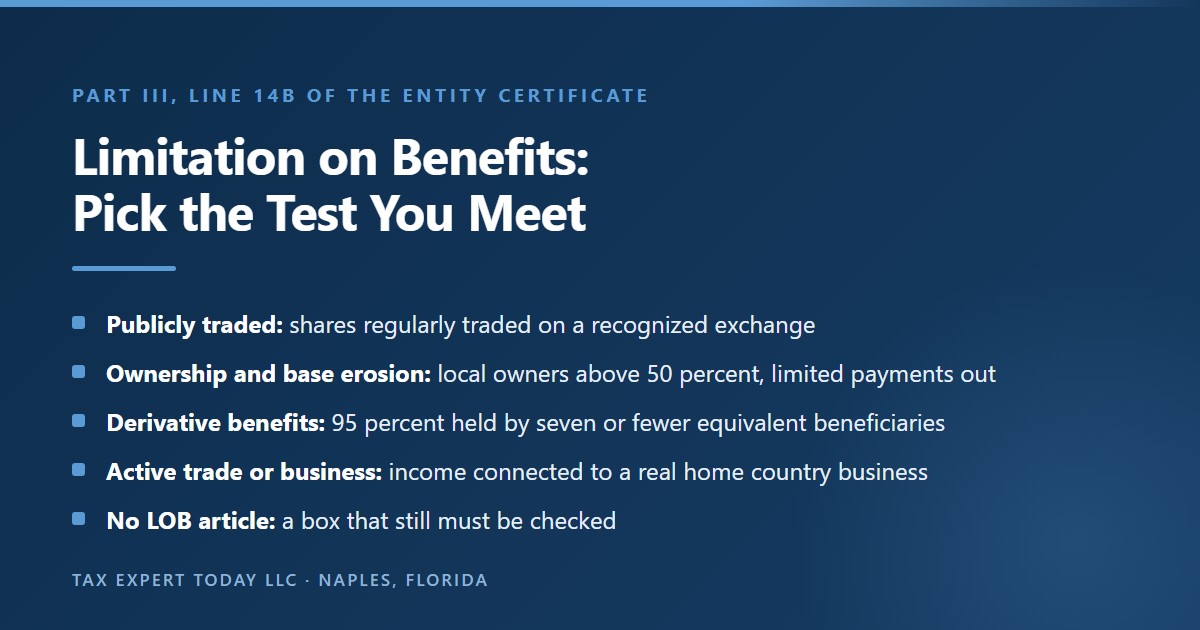
A closely held company usually looks first to the ownership and base erosion test, then to the active trade or business test, and, under certain treaties, to the derivative benefits test. A pure holding company owned by residents of a third country often meets none of them, and the treaty rate is not available.
- Owned by local residents: ownership and base erosion is the natural test.
- Operating business at home: active trade or business may apply to connected income.
- Owned by residents of other treaty countries: derivative benefits, where the treaty has it.
- Owned through chains of entities: every company in the chain may need to be a qualifying resident.
- None met: a discretionary determination from the competent authority is the only route.
The ownership prong asks who ultimately owns the company. In the general summary, more than 50 percent of the vote and value must be owned, directly or indirectly, by individuals, governments, tax-exempt entities, and publicly traded corporations resident in the same country as the company, and all companies in the chain of ownership must be resident in that same country. A Canadian company wholly owned by Canadian resident individuals is the straightforward case.
The base erosion prong asks where the company’s income goes. Less than 50 percent of gross income may be paid or accrued, directly or indirectly, to persons who would not be good shareholders for the ownership test. A company that is owned by local residents but pays most of its income out as deductible interest, royalties, or fees to a related entity in a third country can fail here even though ownership passes. Holding companies financed by shareholder loans from abroad should run this calculation before the box is checked.
The active trade or business test is applied item by item. The company must be engaged in an active trade or business in its country of residence, the income must be derived in connection with or incidental to that business, and, if the payer is a related party, the home country activity must be substantial in relation to the United States activity. Managing investments for the company’s own account generally does not count as an active trade or business under these articles, so a pure investment holding company should not expect to qualify this way.
The derivative benefits test, in the words of the instructions, is generally limited to USMCA, European Union, and European Economic Area country treaties. It generally requires that more than 95 percent of the company be owned by seven or fewer equivalent beneficiaries, meaning ultimate owners resident in one of those countries who would be entitled to the same benefit under their own treaty with the United States, with a base erosion condition as well. It can rescue a company owned by residents of another qualifying treaty country. It does not help a company owned from a non-treaty jurisdiction.
Where no objective test is met, the form offers a box for a favorable discretionary determination. The instructions state that, unless a treaty or technical explanation specifically provides otherwise, benefits may not be claimed while the request is pending. An entity in that position gives a W-8BEN-E without a treaty claim, accepts 30 percent withholding, and seeks a refund if the determination is later granted.
What if the treaty has no limitation on benefits article?
The entity still completes line 14b. It checks the box labeled “No LOB article in treaty.” The 2021 instructions added this requirement, so leaving line 14b blank because the treaty has no such article makes the treaty claim incomplete. The entity must still be a resident that derives the income.
- Box to check: No LOB article in treaty.
- Added: by the October 2021 instructions.
- Still required: residence, beneficial ownership, and derivation of the income.
- Check Table 4: to confirm whether the treaty has an article.
- Treaties change: new protocols regularly add these articles.
A few older United States treaties were signed before limitation on benefits articles became standard. The instructions say that an entity resident in such a country must also complete the applicable checkbox on line 14b, and a caution repeats the point: an entity that derives the income as a resident of a treaty country must check the “No LOB article in treaty” box if the applicable treaty does not contain a limitation on benefits provision.
The absence of an article does not mean the absence of scrutiny. United States domestic law contains its own anti-conduit rules, and the beneficial owner definition in the instructions excludes a conduit whose participation in a transaction is disregarded. The IRS treaty tables page also notes that new treaties are regularly negotiated that include these provisions, so the answer for a given country can change.
When is line 14c checked?
Line 14c applies to a foreign corporation claiming benefits under a treaty that entered into force before January 1, 1987 and has not been renegotiated, on United States source dividends paid by another foreign corporation or on interest paid by a United States trade or business of another foreign corporation. The claimant must be a qualified resident.
- Income covered: dividends from a foreign corporation, and branch interest.
- Treaties covered: those in force before 1987 and not renegotiated.
- Test: qualified resident status under section 884.
- Newer treaties: do not check 14c; use the line 14b boxes.
- Frequency: rare for small and midsize filers.
The line connects to the branch profits tax rules in section 884. In general, the instructions say, a foreign corporation is a qualified resident of a country if it meets a 50 percent ownership and base erosion test, is primarily and regularly traded on an established securities market in its country of residence or the United States, carries on an active trade or business in its country of residence, or gets a ruling from the IRS that it is a qualified resident.
Most filers will never check this box. It is mentioned here because payer portals display it alongside lines 14a and 14b, and a filer who checks it by reflex has made a certification that does not apply. The instructions are explicit that an entity claiming under a treaty that entered into force after December 31, 1986 should not check line 14c. Foreign corporations with a United States branch will find the related return discussed in our guide to Form 1120-F.
When is line 15 required for special rates and conditions?
Line 15 is used only when the treaty benefit claimed depends on conditions that the line 14 certifications do not cover. The entity states the treaty article and paragraph, the rate, the type of income, and the facts showing it meets the additional conditions. Ordinary interest and portfolio dividend claims generally do not need it.
- Needed: a preferential dividend rate based on a percentage of ownership.
- Needed: royalties, where the treaty has different rates for different kinds.
- Needed: interest at other than the generally applicable rate.
- Needed: business profits or gains not attributable to a permanent establishment.
- Generally not needed: the standard interest rate and the standard portfolio dividend rate.
| Claim | What line 15 should state | Example given in the IRS instructions |
|---|---|---|
| Reduced dividend rate based on ownership | The article, the rate, the percentage owned, and the holding period | Under the United States and Italy treaty, the 5 percent rate requires ownership of 25 percent of the voting stock for a 12 month period |
| Zero rate on dividends | The article and each condition met, including the limitation on benefits conditions | Article 10(3) of the United States and Germany treaty, with direct ownership of shares representing 80 percent or more of the voting power for the 12 month period |
| Interest at a special rate | The paragraph that grants the exemption and the conditions met | Under the United States and Australia treaty the general rate is 10 percent under Article 11(2), with an exemption if the conditions of Article 11(3) are met |
| Royalties | The type of royalty and the rate that applies to it | Treaties with different withholding rates for different types of royalties |
| Exempt organization article | The article relied on | The treaties with Canada, Mexico, Germany, and the Netherlands |
| Business profits or gains | A statement that the income is not attributable to a permanent establishment, and the article | A foreign partner’s gain under section 864(c)(8) on a partnership interest |
The printed line reads as a sentence with blanks: the beneficial owner is claiming the provisions of Article and paragraph of the treaty identified on line 14a to claim a percent rate of withholding on a specified type of income, followed by space to explain the additional conditions in the article that the beneficial owner meets. The instructions say to indicate the specific article and paragraph or subparagraph and to set out the requirements the entity meets.
The requester instructions tell payers that they may accept a brief explanation, and that they may accept a treaty claim without this explanation under an interest or dividends article, other than for dividends subject to a preferential rate based on ownership. In other words, a foreign company with a brokerage portfolio that claims the ordinary treaty rate on dividends from listed stocks completes lines 14a and 14b and normally leaves line 15 empty.
Many filers complete line 15 anyway, writing the dividend article and the standard rate. That is not wrong, and some payers prefer it because it tells their system which rate to apply. The risk is in writing a rate the entity does not qualify for. A company that holds 2 percent of a listed United States company and writes the 5 percent direct investment rate on line 15 has made a false statement about its ownership.
How does a Canadian company complete Part III?
A Canadian resident corporation writes Canada on line 14a, checks the limitation on benefits box for the test it meets under Article XXIX A, and gives its Canadian business number on line 9b. On a portfolio dividend the treaty rate shown in IRS Table 1 is 15 percent, and on most interest it is zero.
- Line 14a: Canada.
- Line 14b: the Article XXIX A test the company actually satisfies.
- Dividends: 15 percent generally, and 5 percent at the direct investment rate under Article X(2).
- Interest: generally zero under Article XI(1), with contingent interest excepted.
- Royalties: zero or 10 percent, depending on the type, under Article XII.
| Income paid to a Canadian resident company | Statutory rate | Rate shown in IRS Table 1 (Rev. May 2023) | Treaty article |
|---|---|---|---|
| Dividends, portfolio holding | 30 percent | 15 percent | X(2) |
| Dividends qualifying for the direct dividend rate | 30 percent | 5 percent | X(2) |
| Interest, general | 30 percent | 0 percent | XI(1) |
| Contingent interest that is not portfolio interest | 30 percent | 15 percent | XI |
| Royalties | 30 percent | 0 or 10 percent, by type | XII(2) and (3) |
We read these figures from the IRS Table 1 on November 25, 2026. The direct dividend rate is a company-to-company rate that depends on the Canadian company’s share of the voting stock of the United States payer, so a claim for it belongs on line 15 with the ownership percentage. The treaty and its protocols are posted on the IRS page of Canada tax treaty documents, and our guide to the Canada and United States tax treaty covers how it works for individuals.
IRS Table 4 places the Canadian limitation on benefits rules in Article XXIX A, and lists paragraphs for a publicly traded company test, an ownership and base erosion test, an active trade or business test, a derivative benefits test, and a discretionary determination. A private company owned by Canadian resident individuals typically examines the ownership and base erosion paragraphs first. The paragraph numbers in Table 4 should be confirmed against the treaty text before a box is checked.
The Canada treaty also has its own rules for fiscally transparent entities, in Article IV, which bear on unlimited liability companies and on United States limited liability companies owned by Canadians. Those rules can deny a treaty rate where the two countries classify the entity differently. A Canadian structure that includes either kind of entity should have Article IV read against its facts before Part III is signed.
Does a treaty claim on a W-8BEN-E require Form 8833?
Sometimes. Section 6114 requires disclosure of treaty-based return positions, and the regulations waive that reporting for many reduced withholding rates but in narrower terms for entities than for individuals. A foreign corporation that claims a treaty rate at source should confirm whether a disclosure on Form 8833 is still required for its position.
- Rule: section 6114 requires disclosure of positions that a treaty overrules or modifies the Code.
- Waivers: listed in Treas. Reg. 301.6114-1(c).
- Individuals: reduced withholding on passive income is generally waived.
- Entities: the waiver is narrower and has exceptions.
- Table 4 note: the IRS says the table assists with both Form W-8BEN-E and Form 8833.
The W-8BEN-E and Form 8833 serve different audiences. The certificate goes to the payer and supports the rate at source. The disclosure goes to the IRS with a return. Section 6114 imposes the disclosure duty, and Treas. Reg. 301.6114-1(c) lists the positions for which reporting is waived. One waiver covers reduced withholding on dividends, interest, rents, or royalties to the extent the income is beneficially owned by an individual or a state. Entities must look to the other paragraphs of the regulation, which waive reporting for some withholding positions and specifically require it for others, including certain related party payments.
The IRS treaty tables page says Table 4 will assist taxpayers in completing Form W-8BEN-E and Form 8833, if required to be filed. The conditional wording is deliberate. Our guide to Form 8833 and treaty-based return positions walks through the disclosure rules and the penalty for failing to disclose. An entity that has a United States filing obligation for any other reason should raise the question with its preparer in the same conversation as the W-8BEN-E.
What is an active NFFE on the W-8BEN-E?
An active NFFE is a foreign entity that is not a financial institution, had less than 50 percent passive gross income for the preceding year, and holds assets of which less than 50 percent, on a weighted quarterly average, produce or are held to produce passive income. It checks line 5 and certifies in Part XXV.
- Not a financial institution: the first condition, before any percentage is measured.
- Income test: less than 50 percent of gross income for the preceding calendar or fiscal year is passive.
- Asset test: less than 50 percent of assets produce or are held for passive income, measured quarterly.
- Both tests: the entity must meet the income test and the asset test.
- Consequence: no GIIN and no disclosure of United States owners.
| Passive income under Treas. Reg. 1.1472-1(c)(1)(iv)(A) | Note |
|---|---|
| Dividends, including substitute dividends | Passive in the ordinary case |
| Interest and income equivalent to interest | Passive in the ordinary case |
| Rents and royalties | Not passive when derived in the active conduct of a business conducted, at least in part, by the entity’s own employees |
| Annuities | Passive |
| Net gains from property that produces the income above | Passive |
| Net gains from commodities transactions | With exceptions for hedging and active commodity businesses |
| Net foreign currency gains | Passive |
| Net income from notional principal contracts | Passive |
| Amounts received under cash value insurance contracts | Passive |
The certification on the form has three parts: the entity is a foreign entity that is not a financial institution, less than 50 percent of its gross income for the preceding calendar year is passive income, and less than 50 percent of the assets it holds are assets that produce or are held for the production of passive income, calculated as a weighted average of the percentage of passive assets measured quarterly. The definition sits in Treas. Reg. 1.1472-1(c)(1)(iv), which also allows the test to be run on a fiscal year.
The test is run on gross income, not net profit, and on the prior year, not the current one. A manufacturing company with thin margins and a large cash reserve can pass the income test easily, because sales revenue dwarfs its interest income, yet come close on the asset test in a year when cash and investments are a large share of its balance sheet. A company that sold its operating business last year and now holds only the proceeds will generally fail both tests and has become a passive NFFE, which is a change in circumstances for any certificate it signed earlier.
The rent and royalty carve-out matters to property companies and licensing companies. Rents and royalties are passive unless they are derived in the active conduct of a trade or business conducted, at least in part, by employees of the entity. A company whose staff manage and lease its properties may treat that rent as active. A company that owns a building and outsources everything to a manager is in a weaker position. The regulation also contains exceptions from passive income for certain related party amounts and dealers.
Active NFFE status is the simplest outcome on the form, and that makes it the status most often claimed without checking. The signer is certifying two measured facts about the prior year. A short worksheet showing the income split and the four quarterly asset measurements, kept with the company’s copy of the form, is the right support for the checkbox.
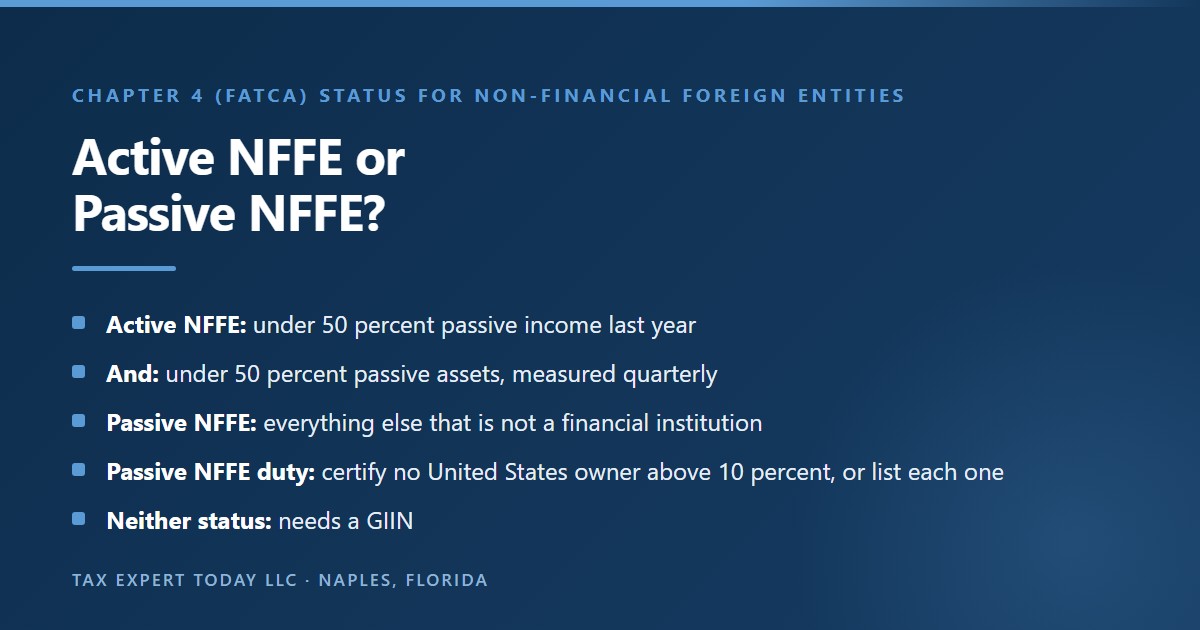
What is a passive NFFE, and what does Part XXVI require?
A passive NFFE is a non-financial foreign entity that is not active, publicly traded, or otherwise excepted. In Part XXVI it certifies on line 40a that it is not a financial institution, and then either certifies on line 40b that it has no substantial United States owners or checks line 40c and lists them in Part XXIX.
- Line 40a: not a financial institution and not claiming another NFFE status.
- Line 40b: no substantial United States owners.
- Line 40c: the name, address, and TIN of each substantial United States owner is given in Part XXIX.
- One of 40b or 40c: the form says to check whichever applies.
- Result: with either certification, chapter 4 withholding does not apply.
Passive NFFE status is not a penalty category. It is the default category for an entity that holds investments and is not a financial institution, and it carries one obligation: tell the payer whether any United States person owns more than 10 percent. Section 1472(b) waives the 30 percent withholding when the beneficial owner provides either a certification that it has no substantial United States owners or the name, address, and TIN of each one, the payer has no reason to know the information is incorrect, and the payer reports the owner information to the IRS.
The instructions add a useful note. An NFFE that may qualify as an active NFFE, or under another part of the form, may still check line 40a and disclose its substantial United States owners or certify that it has none. An entity whose income mix hovers near 50 percent from year to year can choose the passive certification so that its form does not become wrong in a year when the percentages shift.
The same instructions contain a warning in the other direction. An entity that would be a passive NFFE but for the fact that it is managed by certain types of financial institutions should not complete line 40a, because it would be considered a financial institution and not a passive NFFE. That point is important enough to have its own section below.
Who is a substantial United States owner for Part XXIX?
A substantial United States owner is a specified United States person who owns, directly or indirectly, more than 10 percent of a foreign corporation by vote or value or of a foreign partnership’s profits or capital interests, or who is treated as an owner of a trust or holds more than 10 percent of its beneficial interests.
- Corporations: more than 10 percent of the stock, by vote or value.
- Partnerships: more than 10 percent of profits or capital interests.
- Grantor trusts: any specified United States person treated as an owner under sections 671 through 679.
- Other trusts: more than a 10 percent beneficial interest.
- Indirect ownership counts: ownership through other entities is included.
| Type of foreign entity | Substantial United States owner | What Part XXIX reports |
|---|---|---|
| Corporation | A specified United States person owning more than 10 percent by vote or value | Name, address, and TIN |
| Partnership | A specified United States person owning more than 10 percent of profits or capital | Name, address, and TIN |
| Trust with a United States grantor | The United States person treated as owner of any portion | Name, address, and TIN |
| Trust with United States beneficiaries | A specified United States person holding more than 10 percent of the beneficial interests | Name, address, and TIN |
| Entity giving the form to a reporting Model 1 or Model 2 FFI | Controlling United States persons, as the agreement defines them | The same details, in Part XXIX or an attached statement |
The definition is in section 1473(2) and Treas. Reg. 1.1473-1(b). A specified United States person is any United States person other than those excluded by the statute and regulations, a list that includes publicly traded corporations and their affiliates, tax-exempt organizations, governments, banks, and certain regulated entities. A United States citizen is a United States person wherever that citizen lives, so a shareholder who holds a United States passport and has lived abroad for decades is still within the definition.
The threshold is more than 10 percent, so an owner at exactly 10 percent is not a substantial United States owner under the statute. Ownership is traced through entities, and the regulations contain attribution rules for doing so. For a family company the practical exercise is to draw the ownership chart down to individuals and mark every United States citizen and resident.
The form allows the owner information to be given on a separate attached statement, which remains subject to the perjury statement in Part XXX. The withholding agent reports the owners to the IRS. For the United States owner, the disclosure simply confirms what that person’s own returns should already show. A United States person who owns part of a foreign corporation may have a Form 5471 filing, an inclusion under the rules for Subpart F income, reporting of a passive foreign investment company on Form 8621, and reporting of the shares themselves under the rules compared in our guide to FBAR and Form 8938.
How does a passive NFFE holding company complete the form?
It completes Part I as a corporation with passive NFFE status, makes any treaty claim in Part III, checks line 40a, then either line 40b or line 40c with Part XXIX, and signs Part XXX. The example below is hypothetical and uses invented names and round numbers to show the mechanics.
- Line 4: corporation.
- Line 5: passive NFFE.
- Part III: residence, limitation on benefits test, and tax number.
- Part XXVI: line 40a, plus 40b or 40c.
- Part XXIX: each substantial United States owner, if line 40c is checked.
Hypothetical example, not a client matter. Northlake Holdings Ltd. is an Ontario corporation that holds a portfolio of listed United States stocks in an account at a United States broker. It has no employees and no business other than holding investments. A Canadian resident individual who is not a United States citizen owns 70 percent of its shares. Her daughter, a United States citizen who lives in Naples, Florida, owns the other 30 percent. The portfolio pays $40,000 of United States source dividends in a year. The broker does not exercise discretionary management over the account.
| Line or part | Entry for the hypothetical company | Reason |
|---|---|---|
| Line 1 | Northlake Holdings Ltd. | Legal name of the beneficial owner |
| Line 2 | Canada | Country of incorporation |
| Line 3 | Blank | No disregarded entity receives the payment |
| Line 4 | Corporation | A Canadian corporation is a per se corporation |
| Line 5 | Passive NFFE | Not a financial institution, and its income and assets are passive |
| Line 6 | Its Ontario address | Permanent residence address in the country of tax residence |
| Line 8 | Blank | No United States TIN is required for these claims |
| Line 9b | Its Canadian business number | A financial account at a United States office with Form 1042-S income |
| Line 14a | Canada | Treaty residence |
| Line 14b | The Article XXIX A test the company meets | Confirmed against the treaty text, given the United States shareholder |
| Line 15 | Generally blank for portfolio dividends | The 15 percent rate does not depend on special conditions |
| Line 40a and 40c | Checked | It has a substantial United States owner |
| Part XXIX | The daughter’s name, Naples address, and Social Security number | She owns more than 10 percent |
| Part XXX | Signed by a director with capacity to sign | Certification under penalties of perjury |
The arithmetic shows what is at stake. With no certificate, the broker withholds 30 percent of $40,000, which is $12,000. With a valid treaty claim at the 15 percent portfolio rate, it withholds $6,000. If the company makes the treaty claim correctly but leaves Part XXVI incomplete, the treaty does not help, because chapter 4 withholding at 30 percent applies to the undocumented entity and the result is $12,000 again. Hypothetical figures, not a client matter.
The 5 percent direct dividend rate is not available on these facts. That rate is for a company that owns the required share of the voting stock of the paying corporation, and a portfolio investor in listed stocks does not. The limitation on benefits question is also not automatic here. The ownership tests in the treaty look at who the shareholders are and where they reside, and a company with a 30 percent shareholder resident in the United States should have the relevant paragraph of Article XXIX A read against its ownership before the box is checked.
The disclosure in Part XXIX has consequences for the daughter that have nothing to do with the broker. As a United States person who owns 30 percent of a foreign corporation whose assets are all passive, she likely has annual reporting for the shares, and the company is likely a passive foreign investment company in her hands, with the regime described in our Form 8621 guide. Those obligations existed before the W-8BEN-E was signed. The form just makes the ownership visible to the IRS through the broker’s reporting.
When is a family holding company a financial institution instead of a passive NFFE?
When its gross income is primarily from investing or trading in financial assets and it is managed by a financial institution, such as a bank or investment adviser with discretionary authority. Such an entity is an investment entity under the FATCA regulations, and checking passive NFFE on line 5 would be incorrect.
- Two conditions: income primarily from financial assets, and management by a financial institution.
- Typical trigger: a discretionary portfolio management mandate.
- Result: the entity is an FFI and needs an FFI status.
- Common solutions: owner-documented FFI, a sponsored entity status, or registration for a GIIN.
- Trusts: a trust with a corporate trustee is a frequent example.
The instructions flag the issue in a note to line 40a and point to Treas. Reg. 1.1471-5(e)(4)(i)(B). The regulation treats an entity as an investment entity if its gross income is primarily attributable to investing, reinvesting, or trading in financial assets and the entity is managed by another entity that is itself a depository institution, custodial institution, specified insurance company, or investment entity of the kind that manages assets for customers.
The distinction turns on who makes the investment decisions. A family company whose directors choose the investments, with a broker that only executes orders and holds the securities, is generally not managed by the broker. The same company after it signs a discretionary management agreement with a bank or an asset manager generally is. A family trust whose trustee is a licensed trust company is in the same position for the same reason.
The form provides several statuses for small investment entities that do not want to register. An owner-documented FFI in Part X gives its owner information to a designated withholding agent, which reports on its behalf. A sponsored, closely held investment vehicle in Part VII relies on a sponsoring entity. Under many intergovernmental agreements, a trustee-documented trust relies on its trustee. Each has conditions, and each is selected by the facts, not by preference. An entity that has been signing as a passive NFFE while under discretionary management should correct its status with a new form.
Which W-8BEN-E parts apply to foreign financial institutions?
Parts IV through XII cover the foreign financial institution statuses that require a certification: sponsored FFIs, four kinds of certified deemed-compliant FFI, certain investment entities, owner-documented FFIs, restricted distributors, and nonreporting IGA FFIs. Participating and reporting FFIs complete none of them and rely on the GIIN on line 9a.
- No part required: participating, reporting Model 1, reporting Model 2, and most registered deemed-compliant FFIs.
- Part IV: sponsored FFIs.
- Parts V to IX: certified deemed-compliant categories.
- Part X: owner-documented FFIs.
- Parts XI and XII: restricted distributors and nonreporting IGA FFIs.
| Part | Status | Lines | Key requirement in the instructions |
|---|---|---|---|
| IV | Sponsored FFI | 16 and 17 | Name of the sponsoring entity, a box for investment entity or controlled foreign corporation, and a GIIN on line 9 |
| V | Certified deemed-compliant nonregistering local bank | 18 | Certify all requirements of the status |
| VI | Certified deemed-compliant FFI with only low-value accounts | 19 | Certify all requirements of the status |
| VII | Certified deemed-compliant sponsored, closely held investment vehicle | 20 and 21 | Name of the sponsoring entity, and its GIIN on line 9a |
| VIII | Certified deemed-compliant limited life debt investment entity | 22 | Certify all requirements of the status |
| IX | Certain investment entities that do not maintain financial accounts | 23 | An FFI solely because of Treas. Reg. 1.1471-5(e)(4)(i)(A) that maintains no financial accounts |
| X | Owner-documented FFI | 24a to 24d | An owner reporting statement with documentation for each owner, or an auditor’s letter |
| XI | Restricted distributor | 25a to 25c | Certifies only for accounts maintained under a distribution agreement with a restricted fund |
| XII | Nonreporting IGA FFI | 26 | Name the jurisdiction, the model of agreement, and the Annex II category |
Part X deserves a closer look because it is the status a small family investment company most often needs. Line 24a certifies that the entity meets the requirements and is giving the form to a United States financial institution, participating FFI, or reporting Model 1 or Model 2 FFI that agrees to act as its designated withholding agent. The entity then checks line 24b, promising an FFI owner reporting statement and valid documentation for each person on it, or line 24c, promising an auditor’s letter instead. The instructions say to check one of the two and not both.
Line 24d is optional and easy to overlook. It certifies that the entity has no contingent beneficiaries or designated classes with unidentified beneficiaries. The instructions explain the benefit: with that certification, and an aggregate account balance with the withholding agent that does not exceed $1,000,000 on the measurement dates, an owner reporting statement can remain valid indefinitely for chapter 4 purposes for offshore obligations, absent a change in circumstances.
For Part XII the instructions ask for precision. The entity names the jurisdiction whose agreement applies, indicates whether it is a Model 1 or Model 2 agreement, and gives the specific Annex II category using the language of the annex that most specifically describes it. The instructions give the example of writing “investment entity wholly owned by exempt beneficial owners” in place of the broader phrase “exempt beneficial owner.”
Which parts apply to governments, retirement plans, and nonprofits?
Parts XIII through XVII cover foreign governments and central banks, international organizations, exempt retirement plans, entities wholly owned by exempt beneficial owners, and territory financial institutions. Parts XXI and XXII cover section 501(c) organizations and other nonprofit organizations. Each requires a checkbox certifying that the conditions of the status are met.
- Part XIII: foreign governments, governments of United States possessions, and foreign central banks of issue.
- Part XIV: international organizations.
- Part XV: exempt retirement plans, with six alternative boxes.
- Part XVI: entities wholly owned by exempt beneficial owners.
- Parts XXI and XXII: section 501(c) organizations and nonprofit organizations.
| Part | Status | Lines | Point to watch |
|---|---|---|---|
| XIII | Foreign government, government of a United States possession, or foreign central bank of issue | 27 | Use Form W-8EXP instead when claiming section 115(2), 892, or 895 |
| XIV | International organization | 28a and 28b | Use Form W-8EXP to claim an exemption from chapter 3 withholding |
| XV | Exempt retirement plans | 29a to 29f | Check the box for the category of plan that applies |
| XVI | Entity wholly owned by exempt beneficial owners | 30 | Owner documentation for each direct owner or debt holder |
| XVII | Territory financial institution | 31 | Organized under the laws of a United States possession |
| XXI | 501(c) organization | 35 | Date of the IRS determination letter, or an opinion of United States counsel |
| XXII | Nonprofit organization | 36 | A foreign nonprofit that is not claiming section 501(c) status |
The interaction with Form W-8EXP is the recurring issue in this group. A foreign government, a foreign central bank, or a section 501(c) organization that wants an exemption from chapter 3 withholding under the Code provides Form W-8EXP. The same body uses Form W-8BEN-E when it is claiming a treaty rate, or only documenting foreign status or chapter 4 status. The instructions give the example of a foreign section 501(c) organization receiving royalty income that is taxable as unrelated business income but is eligible for a reduced rate under the royalty article of a treaty. That organization provides Form W-8BEN-E.
Foreign charities in countries with an intergovernmental agreement have a separate rule. A nonprofit entity established and maintained in such a jurisdiction that meets the definition of active NFFE under Annex I of the agreement should not check a box on line 5 when documenting itself as an account holder of an FFI. It provides a certification of its status under the agreement instead, as the special instructions describe.
Foreign pension funds are among the larger investors in United States securities, and many treaties give them a zero rate on dividends. Such a fund uses Part XV for its chapter 4 status, the pension fund box on line 14b for its limitation on benefits test, and usually line 15 for the specific treaty paragraph that grants the pension rate.
What are the excepted NFFE statuses in Parts XVIII through XXIV?
These parts cover non-financial entities that are excused from disclosing United States owners because of what they are: members of a nonfinancial group, start-up companies, entities in liquidation or bankruptcy, publicly traded companies and their affiliates, and certain territory entities. Each avoids the passive NFFE owner disclosure if its conditions are met.
- Part XVIII: excepted nonfinancial group entities, such as holding and treasury companies of an operating group.
- Part XIX: excepted nonfinancial start-up companies.
- Part XX: excepted nonfinancial entities in liquidation or bankruptcy.
- Part XXIII: publicly traded NFFEs and their affiliates.
- Part XXIV: excepted territory NFFEs.
| Part | Status | Line | What the filer adds |
|---|---|---|---|
| XVIII | Excepted nonfinancial group entity | 32 | A checkbox certifying all requirements |
| XIX | Excepted nonfinancial start-up company | 33 | The date of formation, or of the board resolution approving a new line of business |
| XX | Excepted nonfinancial entity in liquidation or bankruptcy | 34 | The date the plan of liquidation, plan of reorganization, or bankruptcy petition was filed |
| XXIII | Publicly traded NFFE | 37a | The name of a securities exchange on which the stock is publicly traded |
| XXIII | NFFE affiliate of a publicly traded corporation | 37b | The name of the publicly traded entity and the market on which it trades |
| XXIV | Excepted territory NFFE | 38 | A checkbox certifying all requirements |
| XXVII | Excepted inter-affiliate FFI | 41 | A checkbox, for group entities holding only certain deposit accounts |
| XXVIII | Sponsored direct reporting NFFE | 42 and 43 | The name of the sponsoring entity, and a GIIN on line 9a |
The start-up status in Part XIX is the one new businesses ask about. A newly formed company has no prior year income on which to run the active NFFE test, and it may hold mostly cash while it gets going. The start-up status covers that gap for a limited period, and the instructions say the new line of business cannot be that of a financial institution or a passive NFFE. The filer enters the formation date on line 33, and the payer can tell from that date when the status will run out.
The group entity status in Part XVIII is for holding companies, treasury centers, and captive finance companies that sit inside a group whose business is not financial. Without it, the intermediate holding company of an industrial group would be tested on its own income, which is all dividends and interest from subsidiaries, and would be passive. The status does not extend to investment funds and similar vehicles, so a private equity holding structure cannot use it.
Part XXIII rests on section 1472(c)(1), which exempts payments beneficially owned by a corporation whose stock is regularly traded on an established securities market and by members of the same expanded affiliated group. A subsidiary of a listed parent checks line 37b and names the parent and its market. The parent may be a United States or a foreign company.
How do intergovernmental agreements change the W-8BEN-E?
An intergovernmental agreement, or IGA, is a FATCA agreement between the United States and another government. It changes which line 5 box a financial institution checks, lets an entity determine its status under the agreement’s definitions, permits alternative certifications, and substitutes controlling United States persons for substantial United States owners when the form goes to a reporting FFI.
- Model 1: institutions report to their own government, which exchanges the data with the IRS.
- Model 2: institutions report directly to the IRS under an FFI agreement.
- Line 5: an FFI in an IGA country checks a reporting Model box, not participating FFI.
- Alternative certification: an FFI may supply its own status wording for the entity to attach.
- Controlling persons: reported in Part XXIX when the recipient is a reporting IGA FFI.
The Treasury Department publishes the list of jurisdictions and the text of each agreement on its FATCA page. When we checked it on November 25, 2026, the list showed, for example, Canada with a Model 1 agreement in force since June 27, 2014. The IRS also keeps a general FATCA page with registration resources.
For a financial institution, the instructions are direct. An FFI in a jurisdiction treated as having an agreement in effect should not check participating FFI but should check reporting Model 1 FFI or reporting Model 2 FFI as applicable. An institution treated as registered deemed-compliant under an agreement should check nonreporting IGA FFI and provide its GIIN. An FFI related to a reporting IGA FFI that is treated as nonparticipating in its own country checks nonparticipating FFI.
For a non-financial entity, the agreement matters when the form is going to a foreign bank. The special instructions allow an FFI in an agreement jurisdiction to provide an alternative chapter 4 status certification, and the entity may attach it in place of a certification in Parts IV through XXVIII if the entity determines that it accurately reflects its status and the FFI provides a written statement that it supplied the certification to meet its due diligence requirements. Any such certification remains subject to the perjury statement in Part XXX.
An entity may also determine its status under the definitions in an agreement. The instructions add a qualification: an entity that determines under an agreement that it is an NFFE must still determine whether it is an excepted NFFE under the regulations in order to complete the form, unless an FFI has given it an alternative certification covering that status. The instructions also list, as a change in circumstances for an FFI, the removal of its jurisdiction from the list or a change in the model of its agreement.
How does a hybrid entity claim treaty benefits on a W-8BEN-E?
A hybrid entity is transparent for United States tax purposes but taxed as a resident by a treaty country. It may claim that treaty in its own name on Form W-8BEN-E, checking its flow-through box on line 4, answering yes to the hybrid question, completing Part III, and usually leaving line 5 blank.
- Definition: fiscally transparent under the Code, not transparent in the treaty country.
- Line 4: disregarded entity, partnership, simple trust, or grantor trust, with “yes” to the hybrid question.
- Line 5: blank, unless it is a disregarded entity treated as the payee for chapter 4.
- Line 9b: the entity’s own foreign tax number, not its owners’.
- Second form: a W-8IMY or the owner’s certificate for chapter 4 purposes.
| Line | Ordinary filer | Hybrid entity making a treaty claim |
|---|---|---|
| 1 | Legal name of the beneficial owner, or of the owner of a disregarded entity | The hybrid entity’s own legal name |
| 2 | Country of incorporation or organization | Country under whose laws it is created, organized, or governed |
| 3 | Rarely completed | Left blank |
| 4 | Entity type under United States principles | Flow-through box, plus “yes” to the hybrid question |
| 5 | Chapter 4 status | Left blank, except for a disregarded entity that is the chapter 4 payee |
| 6, 7, 8 | As instructed | As instructed |
| 9b | Foreign TIN where required | The number issued to the entity by its country of residence |
| 10 | Optional reference | Used to link this form to the W-8IMY and owner documentation |
| Part III and Part XXX | Completed if a treaty is claimed, and always signed | Both required |
The special instructions titled Hybrid Entity Making a Claim of Treaty Benefits rewrite Part I for this filer. The reason is that the form normally looks through a transparent entity to its owners, and a hybrid claim deliberately does not. For purposes of completing the form as a hybrid making a treaty claim, the instructions say, the entity is treated as the beneficial owner and should be identified on line 1.
The hybrid entity still has to deal with FATCA, and the treaty claim form does not do that. If the hybrid is a flow-through entity claiming treaty benefits on a withholdable payment, the instructions say it should also provide Form W-8IMY with a withholding statement, if required, establishing the chapter 4 status of each partner or owner. If it is a disregarded entity, its single owner should provide a W-8BEN-E or W-8BEN to the withholding agent along with the hybrid’s form, unless the disregarded entity is treated as the payee for chapter 4 purposes and has its own GIIN.
The classic example is a company formed in a treaty country that has elected, or defaults, to be disregarded or a partnership for United States purposes while remaining an ordinary corporate taxpayer at home. Because it is taxed at home on the income, it derives the income under Treas. Reg. 1.894-1(d) and can meet the first half of line 14b. It must still pass a limitation on benefits test in its own right.
A treaty can narrow this. Some treaties contain their own provisions on fiscally transparent entities that override the general approach, and the instructions tell the filer to claim benefits “as permitted under an applicable tax treaty.” A hybrid claim should never be made from the form instructions alone.
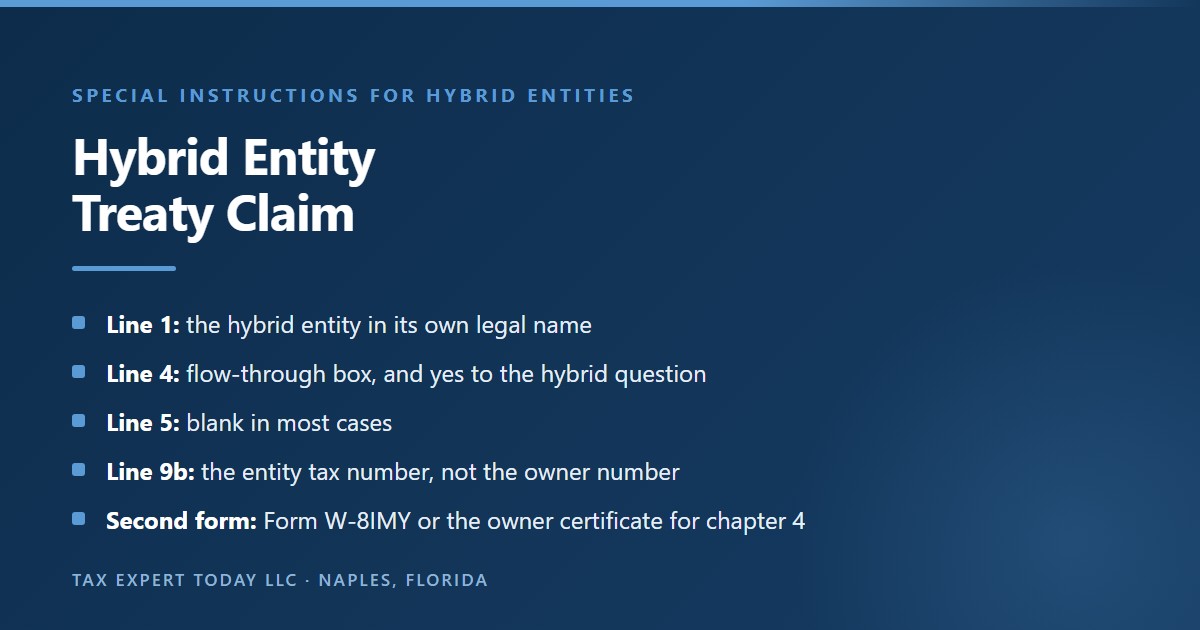
What is a reverse hybrid entity, and which form does it use?
A reverse hybrid entity is the mirror image: a corporation for United States tax purposes that is fiscally transparent under the law of a treaty country. It may not claim a treaty for itself. It gives Form W-8BEN-E only for payments with no treaty claim, and Form W-8IMY when its owners claim treaties.
- Definition: not transparent under United States principles, transparent in the treaty country.
- Own treaty claim: not allowed.
- No treaty claimed: Form W-8BEN-E, with a chapter 4 status for withholdable payments.
- Owners claiming treaties: Form W-8IMY, a withholding statement, and each owner’s certificate.
- Domestic reverse hybrids: a United States entity of this kind gets no treaty reduction at all.
The logic follows the derivation rule. If the entity’s home country treats it as transparent, the entity does not derive the income there, so it cannot be the treaty resident for that item. Its owners may derive the income under the treaties of their own countries if those countries also see the entity as transparent. The instructions say a foreign reverse hybrid entity may not use the W-8BEN-E to attempt to claim treaty benefits on its own behalf, and that when it transmits its interest holders’ documentation to claim benefits for them, it provides Form W-8IMY.
A reverse hybrid that claims no treaty is an ordinary corporate beneficial owner for chapter 3. It signs a W-8BEN-E, checks corporation on line 4, leaves Part III blank, accepts the statutory rate or relies on a Code exemption such as portfolio interest, and provides its chapter 4 status when it receives a withholdable payment.
The domestic version is stricter. Under Treas. Reg. 1.894-1(d)(2), a treaty may not reduce United States tax on United States source payments received by a domestic reverse hybrid entity, and its foreign interest holders are not entitled to a treaty reduction on items the entity receives. A United States limited liability company that has elected to be a corporation, owned by residents of a country that views it as transparent, falls under that rule.
How does a disregarded entity handle Form W-8BEN-E?
Generally it does not sign one. The single owner provides the certificate that fits the owner: Form W-8BEN-E for a foreign entity owner, Form W-8BEN for a foreign individual, or Form W-9 for a United States person. The disregarded entity signs only as a hybrid treaty claimant or to document an account.
- Foreign entity owner: the owner signs Form W-8BEN-E with its own name on line 1.
- Foreign individual owner: the owner signs Form W-8BEN.
- United States owner: the owner signs Form W-9.
- Hybrid treaty claim: the disregarded entity signs in its own name.
- Account documentation only: the disregarded entity may sign for chapter 4 purposes.
| Disregarded entity | Single owner | Who provides what |
|---|---|---|
| United States LLC | Foreign corporation | The foreign corporation provides Form W-8BEN-E, or Form W-8ECI for effectively connected income |
| United States LLC | Nonresident alien individual | The individual provides Form W-8BEN, or Form W-8ECI |
| Foreign company that elected to be disregarded | United States citizen or resident | The owner provides Form W-9 |
| Foreign company that is disregarded | Foreign corporation in the same country | The owner provides Form W-8BEN-E; line 10 may name the disregarded entity |
| Foreign disregarded entity taxed as a resident of a treaty country | Any | The entity may provide Form W-8BEN-E as a hybrid treaty claimant, with the owner’s certificate alongside |
| Foreign disregarded entity that is an FFI with its own GIIN | Foreign entity | The owner completes Part II for the disregarded entity |
The definition in the instructions is the regulatory one: a business entity that has a single owner and is not a corporation under Treas. Reg. 301.7701-2(b) is disregarded as an entity separate from its owner. For withholding purposes the payment is treated as made to the owner, and the owner’s status decides the form and the rate.
The first row of the table is the one Florida businesses meet most often. A foreign corporation forms a single-member limited liability company in Florida or Delaware to hold an investment or run an operation. The LLC opens a bank account and receives payments. The payer asks the LLC for a Form W-9, the LLC has an employer identification number, and it is tempting to sign. The LLC is disregarded, the owner is foreign, and the correct certificate is the foreign owner’s. Which certificate depends on the income: passive income not connected with a United States business goes on a W-8BEN-E, and business income goes on a W-8ECI. The same LLC has a separate annual filing described in our guide to Form 5472.
The instructions also cover a narrow case. A disregarded entity with a United States owner, or one with a foreign owner that cannot complete Part II because it is in the same country as its owner and has no GIIN, may provide the form to an FFI solely to document itself for chapter 4 purposes. It completes Part I as if it were a beneficial owner and does not complete line 3.
Do foreign partnerships and trusts use W-8BEN-E or W-8IMY?
Foreign partnerships, simple trusts, and grantor trusts generally use Form W-8IMY, because their partners, beneficiaries, or grantors are the beneficial owners. Foreign complex trusts and foreign estates are beneficial owners themselves and use Form W-8BEN-E. The flow-through entities switch to W-8BEN-E only for hybrid treaty claims or account documentation.
- Foreign partnership: W-8IMY with a withholding statement and partner certificates.
- Foreign simple trust: W-8IMY, with the beneficiaries’ certificates.
- Foreign grantor trust: W-8IMY, with the owner’s certificate.
- Foreign complex trust: W-8BEN-E in the trust’s own name.
- Foreign estate: W-8BEN-E in the estate’s own name.
| Entity | Beneficial owner of the income | Certificate | Line 4 box if W-8BEN-E is used |
|---|---|---|---|
| Foreign partnership | The partners | W-8IMY | Partnership, only for a hybrid claim or account documentation |
| Foreign simple trust | The beneficiaries | W-8IMY, or W-8BEN-E for section 1446 purposes | Simple trust |
| Foreign grantor trust | The grantor or other owner | W-8IMY | Grantor trust, only for a hybrid claim or account documentation |
| Foreign complex trust | The trust | W-8BEN-E | Complex trust |
| Foreign estate | The estate | W-8BEN-E | Estate |
| Withholding foreign partnership or trust | The partners or beneficiaries, with the entity taking on withholding | W-8IMY | Not applicable |
The beneficial owner definitions in the instructions are worth reading in full for anyone with a foreign trust. The beneficial owners of income paid to a foreign simple trust, meaning a trust described in section 651(a), are generally the beneficiaries. The beneficial owners of income paid to a foreign grantor trust are the persons treated as the owners of the trust. The beneficial owner of income paid to a foreign complex trust is the trust itself, and the beneficial owner of income paid to a foreign estate is the estate itself.
Trust classification is a United States tax question that does not always match the trust deed’s vocabulary. A discretionary family trust in which the trustee may accumulate income is generally a complex trust. A trust that must distribute all of its income every year and makes no charitable gifts or distributions of principal is generally simple. A trust whose settlor kept certain powers or interests may be a grantor trust. Where a United States person created or benefits from the foreign trust, the reporting in our guide to Form 3520 runs alongside the withholding certificate.
One exception appears in the definitions. For section 1446 purposes, a foreign simple trust is required to provide a Form W-8BEN-E on its own behalf, not on behalf of its beneficiaries. Foreign partnerships and foreign grantor trusts documenting themselves for section 1446 still provide Form W-8IMY with accompanying documentation. Our guide to Form 8865 covers the separate reporting for United States persons with interests in foreign partnerships.
Does a foreign company with a United States LLC provide a W-8BEN-E or a W-9?
It depends on how the LLC is taxed. An LLC taxed as a corporation or partnership is a United States person and provides Form W-9. A single-member LLC that is disregarded is ignored, and its foreign owner provides Form W-8BEN-E or Form W-8ECI. The LLC’s foreign ownership alone never makes a W-8BEN-E correct.
- LLC with two or more members, default: a domestic partnership, Form W-9.
- LLC that elected corporate status: a domestic corporation, Form W-9.
- Single-member LLC, default: disregarded, so the owner’s form applies.
- Foreign owner with passive income: Form W-8BEN-E.
- Foreign owner with United States business income: Form W-8ECI.
The instructions tell a United States partnership, trust, or estate to provide a Form W-9 pertaining to itself, and they treat a payment to a United States partnership as a payment to a United States payee. The foreign partners do not disappear from the system. The domestic partnership becomes the withholding agent for its foreign partners, collects their W-8 forms, and withholds under the rules covered in our guide to Form 8804 and partnership withholding. The customer who pays the partnership has no withholding to do.
A domestic corporation owned by a foreign parent is likewise a United States payee that gives a Form W-9 to its customers. The parent’s W-8BEN-E comes into play one step later, when the United States corporation pays a dividend, interest, or a royalty to the parent. At that point the United States subsidiary is the withholding agent and must have the parent’s certificate before it pays, including the treaty claim and the limitation on benefits box.
That second step is where closely held groups slip. A United States subsidiary that pays its foreign parent a dividend or interest on an intercompany loan without collecting a W-8BEN-E, withholding, and filing Forms 1042 and 1042-S has a compliance failure of its own, even when a treaty would have reduced the rate to zero. The treaty rate is available at source only if the certificate was in hand when the payment was made.
Does a foreign company paid for services need a W-8BEN-E?
Often it is asked for one even though no tax is withheld. Payment for services performed entirely outside the United States is generally foreign source income, outside chapter 3 withholding. The W-8BEN-E documents that the payee is foreign, so the United States customer does not treat it as an undocumented payee subject to reporting.
- Services performed abroad: generally foreign source, with no 30 percent withholding.
- Purpose of the form: to establish foreign status and avoid Form 1099 reporting and backup withholding.
- Services performed in the United States: United States source, and a different analysis.
- Platforms and processors: the form establishes foreign participating payee status under section 6050W.
- Part III: usually unnecessary when the income is foreign source.
A software developer in Poland, a design studio in Argentina, or a consulting company in India that performs all of its work at home for a United States customer is usually in this position. The customer’s accounts payable system requires a tax form from every vendor. The foreign company cannot give a Form W-9, because it is not a United States person, so it gives a W-8BEN-E. The form typically shows the entity type on line 4, an active NFFE status on line 5, and no treaty claim, because there is no United States tax to reduce.
The instructions describe this use. The form may be required to claim an exception from domestic information reporting on Form 1099 and backup withholding for certain types of income, including foreign source interest, dividends, rents, or royalties, and a payment settlement entity is not required to report payments made to a beneficial owner documented as foreign with an applicable Form W-8. Foreign sellers on online marketplaces meet the same request for the same reason.
The analysis changes when people travel. Compensation for services performed in the United States is United States source income. If a foreign company sends staff to work at a customer’s site in Florida, part of its fee is United States source, and the questions become whether the company has a United States trade or business, whether a treaty’s business profits article protects it because it has no permanent establishment, and which certificate fits. The 2021 instructions added line 15 guidance for exactly that claim: an entity claiming treaty benefits on business profits not attributable to a permanent establishment states so on line 15 with the relevant article.
Royalties are different from services, and the label on the invoice does not decide which a payment is. A fee for a license to use software, a trademark, or a patent in the United States is generally a United States source royalty subject to chapter 3 withholding, even when the licensor never sets foot in the country. A foreign company that both licenses technology and provides services under one contract should expect the customer to split the payment and to need a treaty claim for the royalty portion.
Does a W-8BEN-E cover rent from Florida real estate?
Only partly. Rent from United States real property paid to a foreign corporation is United States source income subject to 30 percent withholding on the gross amount unless it is effectively connected income. A W-8BEN-E documents the foreign owner but does not remove that withholding. Most owners instead provide Form W-8ECI and file a return.
- Default: 30 percent of gross rent, withheld by the tenant or property manager.
- Treaties: generally do not reduce United States tax on real property rent.
- Net basis alternative: effectively connected treatment, by activity or by election.
- Certificate for net basis: Form W-8ECI, with a United States TIN.
- Sale of the property: a separate withholding regime under FIRPTA.
This is the situation a Canadian or European holding company that owns a condominium or a commercial unit in Collier or Lee County meets. Rent is on the list of fixed or determinable income in section 1441(b), and the person who pays it, or the property manager who collects it, is a withholding agent. If the foreign owner provides only a W-8BEN-E with no claim of effectively connected status, the manager is required to send 30 percent of each gross rent payment to the IRS, with no allowance for mortgage interest, property tax, insurance, association fees, or depreciation.
Most foreign owners prefer to be taxed on net rental income. A foreign corporation whose rental activity rises to a United States trade or business has effectively connected income, and the Code also allows a foreign corporation to elect to treat real property income as effectively connected. Either way the owner gives the manager a Form W-8ECI, which stops the 30 percent withholding, and files the return described in our guide to Form 1120-F, where expenses are deducted. The election and its timing have their own requirements, and a foreign corporation with United States business income also has to consider the branch profits tax.
The sale of the property is governed by a different withholding rule. The instructions define chapter 3 as excluding section 1445, the provision behind the withholding on dispositions of United States real property interests. A W-8BEN-E on file with a property manager does nothing for the closing. Our guides to FIRPTA withholding and the Form 8288-B withholding certificate cover that transaction.
How does the W-8BEN-E work for portfolio interest?
Portfolio interest is exempt from the 30 percent tax by statute, with no treaty needed. A foreign corporation claims the exemption by giving the payer a W-8BEN-E establishing that the beneficial owner is not a United States person. The exemption does not apply to 10 percent shareholders, certain bank loans, or related party interest paid to controlled foreign corporations.
- Authority: section 881(c) for foreign corporations.
- Requirement: an obligation in registered form and a statement of foreign beneficial ownership.
- Excluded: interest received by a 10 percent shareholder of the payer.
- Excluded: interest received by a bank on an ordinary course loan.
- Excluded: interest received by a controlled foreign corporation from a related person, and certain contingent interest.
Section 881(c) provides that no tax is imposed on portfolio interest received by a foreign corporation from United States sources. Portfolio interest is interest paid on an obligation in registered form for which the withholding agent has received a statement that the beneficial owner is not a United States person. The W-8BEN-E is that statement. The instructions confirm that the form may be used to claim an exemption from withholding for portfolio interest pursuant to section 881(c).
The exclusions are where private lending arrangements fail. Portfolio interest does not include interest received by a 10 percent shareholder of the payer, so a foreign parent that lends to its own United States subsidiary cannot use the exemption and must look to a treaty. It does not include interest received by a bank on an extension of credit made under a loan agreement in the ordinary course of its business, or interest received by a controlled foreign corporation from a related person. Contingent interest tied to the debtor’s profits or cash flow is also excluded.
The instructions carry a warning for the future: a later version of the form may require persons receiving interest payments to identify any obligation for which they have one of the prohibited relationships. The current form has no such line, so the exemption is implicit in the certification of foreign status. A foreign lender should confirm in writing with the borrower that neither exclusion applies before the borrower pays interest gross.
How is the W-8BEN-E used by foreign partners under section 1446?
A foreign entity that is a partner in a partnership with a United States trade or business gives the partnership a W-8BEN-E to document its foreign status for withholding on its share of effectively connected income, and gives a buyer the form when it sells its interest. It must enter a United States TIN on line 8.
- Section 1446(a): the partnership withholds on the foreign partner’s share of effectively connected taxable income.
- Section 1446(f): a buyer withholds 10 percent of the amount realized on a transfer of the interest.
- Line 8: a United States TIN is required.
- Treaty claims on a sale: made on line 15, as gain not attributable to a permanent establishment.
- Foreign partnerships and grantor trusts as partners: provide Form W-8IMY instead.
The instructions explain that, generally, a foreign person that is a partner in a partnership and submits a W-8BEN-E for purposes of section 1441 or 1442 will satisfy the documentation requirements under section 1446(a) or (f) as well, although in some cases the requirements do not match. The certification in Part XXX reflects this use: the form may relate to the partner’s share of a partnership’s effectively connected taxable income or to the partner’s amount realized from the transfer of a partnership interest subject to withholding under section 1446(f).
The form does not reduce the section 1446(a) withholding. That withholding is a prepayment of the partner’s own tax on business income, credited on the partner’s return. What the form does is establish who the partner is and that it is foreign, so the partnership applies the corporate or noncorporate rate correctly and reports the partner on the right statements. The partner will also receive the international schedule described in our guide to Schedule K-3.
On a sale of the interest, the 2021 instructions allow a foreign partner that derives gain subject to tax under section 864(c)(8) to claim treaty benefits on the form by stating on line 15 that the gain is not attributable to a permanent establishment and citing the gains article. For a publicly traded partnership interest, the partner must identify the name of each partnership to which the claim relates. The instructions then point to a regulation that treats the gain as attributable to a permanent establishment to the extent the partnership’s assets form part of one, so the claim is narrower than it first appears.
Who can sign Form W-8BEN-E in Part XXX?
An authorized representative or officer of the entity signs and dates the form and checks the box certifying capacity to sign for the entity on line 1. An agent may sign only under a power of attorney that specifically authorizes it, attached to the form. The signature is made under penalties of perjury.
- Who: an officer, director, trustee, executor, or other person with legal capacity to bind the entity.
- Capacity box: must be checked.
- Agents: need a power of attorney, and Form 2848 may be used.
- Date format: month, day, and four-digit year.
- Commitment: a new form within 30 days if any certification becomes incorrect.
The certification is longer than the signature block suggests. Under penalties of perjury, the signer declares that the form has been examined and is true, correct, and complete, and further certifies that the entity on line 1 is the beneficial owner of all the income or proceeds to which the form relates, or is using the form to certify its chapter 4 status or for section 6050W or 6050Y purposes; that the entity is not a United States person; that the form relates to the categories of income listed; and that, for broker transactions or barter exchanges, the beneficial owner is an exempt foreign person.
The signer also authorizes the form to be provided to any withholding agent that has control, receipt, or custody of the income, and agrees to submit a new form within 30 days if any certification becomes incorrect. Every checkbox elsewhere on the form, including the limitation on benefits test and the active or passive NFFE certification, falls under the same declaration.
When an agent signs, the instructions require a power of attorney in proper form, or a copy, specifically authorizing the agent to represent the principal in making, executing, and presenting the form. Form 2848 may be used for this purpose. The instructions add that the agent, as well as the beneficial owner, may incur liability for the penalties provided for an erroneous, false, or fraudulent form. An outside accountant or lawyer should not sign a client’s W-8BEN-E as a convenience.
Can a W-8BEN-E be signed electronically?
Yes, if the withholding agent allows it. The electronic signature must indicate that the form was electronically signed by a person authorized to do so, for example with a time and date stamp and a statement that the form has been electronically signed. Typing a name on the signature line is not an electronic signature.
- Permission: the withholding agent decides whether to accept electronic signatures.
- Evidence: a time and date stamp and a statement of electronic signing.
- Not enough: a typed name alone.
- Additional support: a payer may ask for documentation that the signer was authorized.
- Authority: Treas. Reg. 1.1441-1(e)(4)(i)(B).
The 2021 instructions added this guidance, drawing on the final chapter 3 regulations. A withholding agent may rely on an electronically signed withholding certificate if the entity provides any additional information or documentation the agent requests to support that the form was signed by the entity or another authorized person. In practice, forms signed through a recognized electronic signature service or through the payer’s own portal meet the standard, and a scanned copy of an ink signature is widely accepted.
The portal route has one drawback. Many portals build the form from a questionnaire and present only a summary before signature. The signer is still certifying the full form. Where the portal allows a download of the completed W-8BEN-E, the company should keep a copy with its records, together with the support for each certification.
How long is a W-8BEN-E valid?
Generally from the date it is signed until the last day of the third succeeding calendar year, unless a change in circumstances makes it incorrect sooner. A form signed on any day in 2026 remains valid through December 31, 2029. Under conditions in the regulations, parts of a certificate can remain valid indefinitely.
- General rule: through the last day of the third following calendar year.
- Earlier expiry: the day a change in circumstances makes any information incorrect.
- Both chapters: the same general period applies for chapter 3 and chapter 4.
- Indefinite validity: possible for the foreign status portion when given with documentary evidence.
- Treaty claims: the treaty portion generally still expires on the three year schedule.
| Date signed | Valid through, absent a change in circumstances |
|---|---|
| January 5, 2024 | December 31, 2027 |
| December 30, 2024 | December 31, 2027 |
| March 14, 2025 | December 31, 2028 |
| November 25, 2026 | December 31, 2029 |
| January 4, 2027 | December 31, 2030 |
The rule is in Treas. Reg. 1.1441-1(e)(4)(ii)(A): a withholding certificate remains valid until the earlier of the last day of the third calendar year following the year in which it is signed or the day a change in circumstances makes any information on it incorrect. The table shows a planning point. Because the period runs to a calendar year end, a form signed in early January lasts almost a full year longer than one signed a week earlier in late December.
The indefinite validity rule in paragraph (e)(4)(ii)(B) of the same regulation covers a beneficial owner withholding certificate, other than the portion making a claim for treaty benefits, together with documentary evidence provided by an entity supporting its claim of foreign status, if both are received by the withholding agent before the validity period of either would otherwise expire. For chapter 4, Treas. Reg. 1.1471-3(c)(6)(ii) has its own list, which includes a certificate from a participating FFI or registered deemed-compliant FFI whose GIIN the withholding agent has verified.
Treaty statements have special rules. The regulation provides that a treaty statement identifying the limitation on benefits provision for a publicly traded corporation does not expire if the withholding agent determines from public information at each renewal date that the entity is still publicly traded, and that a statement from a government or tax-exempt organization, other than a pension fund, remains valid indefinitely. A private company’s treaty claim renews every three years.
Payers send renewal requests before the expiry date, and some send them every year regardless. Signing a fresh form earlier than required is harmless. Ignoring the request is not, because on the first payment after expiry the payer must treat the entity as undocumented.
What counts as a change in circumstances?
Any change that makes information on the form incorrect for chapter 3 or chapter 4. Examples include a new country of residence, a change in entity classification, a move from active to passive NFFE status, a new substantial United States owner, loss of the treaty test relied on, or income becoming effectively connected. Notice is due within 30 days.
- Residence: a change of tax residence or permanent residence address.
- Classification: a Form 8832 election or a change in the number of owners.
- FATCA status: active to passive, or NFFE to investment entity.
- Ownership: a United States person crossing the 10 percent line, or a change that breaks the treaty ownership test.
- Nature of income: passive income becoming effectively connected.
| Event | Part of the form affected | What to do |
|---|---|---|
| The company moves its management to another country | Line 6 and Part III | New form; the old treaty claim may no longer apply |
| An operating company sells its business and holds only investments | Line 5, Part XXV | New form as a passive NFFE, addressing United States owners |
| A shareholder becomes a United States resident or citizen | Part XXVI and Part XXIX | New form disclosing the owner if above 10 percent |
| Shares are sold to a buyer in a third country | Line 14b | Retest the limitation on benefits article; new form if the test fails |
| The company signs a discretionary management agreement with a bank | Line 5 | Retest for investment entity status |
| The company opens a United States office and earns business income | Part XXX certification | Form W-8ECI for the effectively connected income |
| The company files Form 8832 to be disregarded | Line 4, and who signs | The owner provides its own certificate |
The instructions state the duty in one sentence: if a change in circumstances makes any information on the form incorrect for purposes of either chapter 3 or chapter 4, the entity must notify the withholding agent or financial institution within 30 days of the change by providing the required documentation. They refer to Treas. Reg. 1.1441-1(e)(4)(ii)(D) for the chapter 3 definition and Treas. Reg. 1.1471-3(c)(6)(ii)(E) for chapter 4.
Changes in ownership are the ones that go unnoticed, because the company’s finance staff may not learn of them. A shareholder’s move to the United States, a green card, or the test described in our guide to the substantial presence test can turn a foreign owner into a United States person without any change on the company’s share register. Companies with family shareholders in more than one country should ask about residence once a year.
What must a United States payer check before relying on a W-8BEN-E?
The payer may rely on a properly completed form unless it has actual knowledge or reason to know that a claim is unreliable or incorrect. It should confirm the form is complete, signed, and current, that the addresses and entity type are consistent with a foreign payee, and that any treaty claim names a treaty in force.
- Completeness: name, country, entity type, status, address, signature, date, and capacity box.
- Consistency: no unexplained United States address or conflicting country.
- Treaty claims: a treaty in force, a limitation on benefits box, and a tax number where required.
- FATCA: a GIIN verified against the IRS list, or the right certification part completed.
- Timing: on file before payment, and renewed before expiry.
| Item reviewed | What a careful payer looks for |
|---|---|
| Form version | Rev. October 2021 |
| Line 1 and the payee record | The same legal name as the contract, invoice, or account |
| Line 4 | One box, and the hybrid question answered where it applies |
| Line 5 and the status part | One box, with the matching part completed |
| Lines 6 and 7 | A foreign address that is not a post office box, and an explanation for any United States mailing address |
| Lines 8, 9a, 9b, 9c | The identification number the claim requires, and a GIIN that verifies |
| Part III | Country on 14a, a box on 14b, and line 15 where the rate depends on conditions |
| Part XXIX | Owner details where line 40c is checked |
| Part XXX | Signature, printed name, date, and the capacity box |
Treas. Reg. 1.1441-1(e)(4)(viii) states the reliance rule: a withholding agent may rely on the information and certifications on a withholding certificate without having to inquire into their truth, unless it has actual knowledge or reason to know that the information or certification is incorrect. For the limitation on benefits box, the standard is actual knowledge. A payer is not expected to audit a foreign company’s shareholder register.
The payer’s duties continue after the form is filed away. It withholds at the rate the form supports, deposits the tax, and reports the payment and the withholding to the IRS and to the payee each year on Forms 1042 and 1042-S, including payments on which no tax was withheld because of a treaty or an exemption. A United States business making its first payment to a foreign entity should set up that reporting at the same time it collects the certificate. Form 1042-S has its own due date and electronic filing rules.
Where the payer does have reason to doubt a form, the fix is usually a conversation and a corrected form, not a refusal to deal. A request that names the specific line and the specific problem gets a usable form back faster than a general rejection.
How does a foreign entity recover over-withheld tax?
First ask the withholding agent, which can sometimes correct over-withholding within the same year under the reimbursement or set-off procedures. Otherwise the entity claims a refund from the IRS by filing a United States income tax return with the Form 1042-S attached. A foreign corporation generally uses Form 1120-F.
- Step one: give the payer a valid form and ask whether it can adjust the withholding.
- Step two: obtain Form 1042-S showing the income and the tax withheld.
- Step three: file a return claiming the refund, with a TIN.
- Time limit: the ordinary refund limitation periods apply.
- Chapter 4 withholding: credits and refunds follow the chapter 3 approach under section 1474(b).
Over-withholding usually has a mundane cause: the form arrived after the payment, the treaty claim was incomplete, or the form expired. A payer that has not yet deposited or reported the tax has some ability to fix the error itself, and Publication 515 describes the adjustment procedures available to withholding agents. Once the year has closed and the Form 1042-S has been issued, the money is with the Treasury and only a return gets it back.
A foreign corporation claims the refund on Form 1120-F, which requires an employer identification number. An entity that provided only a foreign TIN on its W-8BEN-E will need to apply for one. Refund claims that rest on a treaty must show the same facts the W-8BEN-E would have certified, including the limitation on benefits test, and may bring a Form 8833 disclosure with them. Individuals in the same position use the return covered in our guide to Form 1040-NR.
Refunds of withheld tax take time, and the IRS matches the claim against the withholding agent’s own filing before paying. Errors on the Form 1042-S, such as a wrong recipient name or income code, delay the claim. The practical lesson is that a few minutes spent getting the W-8BEN-E right before the first payment saves a filing that can run for many months.
What are the most common W-8BEN-E mistakes?
The most common mistakes are using the form for a United States entity, checking a line 4 box based on local law, claiming active NFFE status without testing it, naming a treaty country with no limitation on benefits box checked, omitting the tax number a treaty claim requires, and leaving the capacity box or date blank.
- Wrong form: a domestic LLC, an individual, an intermediary, or business income.
- Wrong classification: ignoring a Form 8832 election or the per se list.
- Untested status: active NFFE checked by default.
- Incomplete treaty claim: line 14a without 14b, or a rate the entity does not qualify for.
- Signature defects: no capacity box, no date, or a typed name.
| Mistake | Why it is wrong | Correction |
|---|---|---|
| A Florida LLC with foreign members signs a W-8BEN-E | A domestic partnership or corporation is a United States person | Form W-9 from the LLC |
| The disregarded entity’s name is on line 1 | The owner is the beneficial owner | Owner’s name on line 1; entity name on line 10 |
| Two boxes checked on line 5 | The form allows one status | Choose one and complete its part |
| Passive NFFE checked, but neither 40b nor 40c | The owner certification is the point of the status | Check one, and complete Part XXIX if 40c |
| Company number written on line 9a | Line 9a is only for a GIIN | Leave line 9a blank; tax number on line 9b |
| Line 14a completed and nothing on 14b | The limitation on benefits provision must be identified | Check the test met, or “No LOB article in treaty” |
| Line 14c checked under a modern treaty | It applies only to pre-1987 treaties and specific payments | Uncheck it |
| A 5 percent dividend rate on line 15 for a portfolio holding | The direct investment rate has an ownership condition | Claim the portfolio rate |
| A post office box on line 6 | Not a permanent residence address | Street address, or the registered address if it qualifies |
| More than one status part completed | The instructions call for only one | Complete the part that matches line 5 |
| The form is mailed to the IRS | The IRS does not receive this form | Give it to the withholding agent |
Most of these mistakes cost only time, because the payer rejects the form and asks again. The ones that cause real trouble are the ones a payer cannot see. A payer has no way to know that a company’s passive income rose above half last year, that a shareholder moved to Florida, or that the ownership test in the treaty stopped being met when shares changed hands. Those forms are accepted, the lower rate is applied, and the error surfaces later in an examination of the payer or in a review of the entity’s own position.
A signed W-8BEN-E is a statement made under penalties of perjury, and the instructions refer to penalties for an erroneous, false, or fraudulent form. Where an entity discovers that a form it gave was wrong, the right response is a corrected form without delay, and a review of whether tax was under-withheld in the meantime. Where a filing obligation was missed as a result, relief may depend on the kind of showing described in our guide to reasonable cause for IRS penalties, and the facts should be reviewed before anything is filed.
What does a completed W-8BEN-E look like for three common filers?
An operating company completes Part I, Part XXV, and Part XXX, adding Part III for a treaty rate. A passive holding company completes Part I, Part III, Part XXVI, and sometimes Part XXIX. A hybrid entity completes Part I with line 5 blank, Part III, and Part XXX, and provides a second form for chapter 4.
- Operating company: corporation, active NFFE, treaty claim only if United States source income is paid.
- Holding company: corporation, passive NFFE, treaty claim, and the owner certification.
- Hybrid entity: flow-through box with “yes,” treaty claim in its own name.
- All three: signed by a person with capacity, dated, with the capacity box checked.
- None of the three: needs a GIIN.
| Line or part | Operating company licensing software to a United States customer | Family holding company with a United States brokerage account | Unlimited liability company taxed at home, disregarded in the United States |
|---|---|---|---|
| Line 1 | Company’s legal name | Company’s legal name | The entity’s own legal name |
| Line 4 | Corporation | Corporation | Disregarded entity, hybrid “yes” |
| Line 5 | Active NFFE | Passive NFFE | Blank in most cases |
| Tax number | Foreign TIN on line 9b, or a United States TIN on line 8 | Foreign TIN on line 9b | The entity’s own foreign TIN on line 9b |
| Line 14a and 14b | Treaty country and the test met | Treaty country and the test met | Treaty country and the test met, if the treaty permits the claim |
| Line 15 | Royalty article, rate, and type of royalty | Usually blank for portfolio dividends | As the income requires |
| Status part | Part XXV | Part XXVI, and XXIX if a United States owner exceeds 10 percent | None on this form |
| Second document | None | None | The owner’s W-8BEN-E or W-8BEN, linked on line 10 |
These are patterns, not templates. The entries for a real entity depend on its classification, its income and assets in the prior year, its owners, and the text of its treaty. The table is useful mainly as a check: a completed form that looks very different from the pattern for its type deserves a second look before it is signed.
What should a foreign entity gather before completing a W-8BEN-E?
Gather the organizational documents, any United States entity classification election, the prior year income statement and quarterly balance sheets, a full ownership chart down to individuals with each person’s citizenship and residence, the foreign and United States tax numbers, the treaty text, and a description of the income to be paid.
- Identity: certificate of incorporation or trust deed, and the registered address.
- Classification: any Form 8832, and the liability of members under local law.
- FATCA test: prior year gross income by type, and assets at each quarter end.
- Owners: an ownership chart showing every person above 10 percent and any United States citizen or resident.
- Treaty: the residence, dividend, interest, royalty, and limitation on benefits articles.
| Document or fact | Line or part it supports |
|---|---|
| Certificate of incorporation, articles, or trust deed | Lines 1, 2, and 4 |
| Form 8832 and IRS acceptance letter, if any | Line 4 |
| Proof of tax residence, such as a residence certificate | Line 6 and line 14a |
| Foreign tax number and any United States EIN | Lines 8 and 9b |
| Prior year income statement by category | Part XXV income test |
| Balance sheets at each quarter end | Part XXV asset test |
| Ownership chart with citizenship and residence | Line 14b, Part XXVI, and Part XXIX |
| Investment management and custody agreements | Line 5, investment entity question |
| Treaty text and IRS Tables 1 and 4 | Part III |
| Contract or account agreement describing the payments | Choice of form and line 15 |
| Board resolution or other evidence of signing authority | Part XXX |
None of these documents is attached to the form in the ordinary case. They are the entity’s support for what it certified, kept with its copy. The exceptions are the items the form itself calls for: a power of attorney when an agent signs, owner documentation for an owner-documented FFI or an entity wholly owned by exempt beneficial owners, an alternative certification under an intergovernmental agreement, and any statement explaining a missing foreign TIN.
An entity that keeps this file current can answer a renewal request in minutes. It can also answer the harder question that arrives when a payer’s examiner or the entity’s own auditor asks how a box was chosen three years ago.
W-8BEN-E Help in Naples & Southwest Florida
Tax Expert Today LLC works with foreign-owned companies and the United States businesses that pay them from our office at 11983 Tamiami Trail N, Naples, FL 34110. Call (239) 441-2005, Monday through Friday, 10 a.m. to 5 p.m. Eastern. Naples, Florida and the rest of Collier, Lee, and Charlotte counties are home to many Canadian and European families who hold United States investments and Florida real estate through companies and trusts formed at home, and to local businesses that license software, pay royalties, or buy services from abroad. Our international and expat tax services include review of entity classification, chapter 4 status testing, treaty and limitation on benefits analysis, and preparation of Form W-8BEN-E for signature by the entity. Our team includes tax advisors, enrolled agents, CPAs, and attorneys.
- W-8BEN-E help Naples FL: line by line review before a foreign entity signs.
- International tax Naples FL: foreign holding companies, trusts, and cross-border family structures.
- Foreign tax Naples: treaty rates, withholding, and refund claims for over-withheld tax.
- Withholding agent support: Forms 1042 and 1042-S for Southwest Florida businesses that pay foreign entities.
- Foreign-owned Florida LLCs: the right certificate, plus Form 5472 and Form 1120-F where they apply.
For an overview of our local practice, see our page on international tax in Naples, FL. For planning that reaches beyond a single form, see Naples, FL tax planning. Readers who hold foreign accounts personally may also want our pillar guide, Do I Need to File an FBAR?, and nonresident owners of Florida property may want our guide to Form 706-NA and the estate tax for foreign owners.
When to Engage a Professional
Many foreign operating companies can complete a W-8BEN-E on their own once they understand which parts apply. Professional review is generally worth considering where the entity’s United States classification is uncertain or an election was filed; where a treaty rate is claimed by a privately owned company and the limitation on benefits test has not been read against the ownership chart; where the entity is a hybrid or reverse hybrid; where an investment entity question arises because a bank or adviser manages the portfolio; where any owner is a United States citizen or resident; where the income is rent from United States real estate or may be connected with a United States business; and where tax has already been over-withheld or a prior form is now known to be wrong.
We do not publish fees. Outcomes depend on the facts of each entity, the text of the applicable treaty, and IRS review, and nothing in this guide is a promise of any particular withholding rate or refund. This guide is general information, not advice for a specific situation. To discuss a W-8BEN-E for your entity or for a foreign payee of your business, call Tax Expert Today LLC at (239) 441-2005 or visit our contact page.
Frequently Asked Questions
What is a W-8BEN-E form used for?
Form W-8BEN-E is used by a foreign entity to certify to a United States payer or a financial institution that it is foreign, what type of entity it is, what its FATCA status is, and whether a tax treaty reduces the 30 percent withholding rate on United States source income. It is given to the payer, not the IRS.
Who needs to fill out a W-8BEN-E?
A foreign corporation, complex trust, estate, or other foreign entity that beneficially owns United States source income, receives a withholdable payment, is a partner in a partnership with a United States business, or holds an account at a foreign financial institution that requests the form. United States entities and foreign individuals use other forms.
What is the difference between W-8BEN and W-8BEN-E?
Form W-8BEN is for foreign individuals and is one page. Form W-8BEN-E is for foreign entities and is eight pages, because it also documents the entity’s chapter 4 (FATCA) status and requires a limitation on benefits certification for any treaty claim.
How long is a W-8BEN-E valid?
Generally from the date signed through the last day of the third succeeding calendar year, so a form signed in 2026 is valid through December 31, 2029. It becomes invalid earlier if a change in circumstances makes any information incorrect, and the entity must provide a new form within 30 days of the change.
Is there a new W-8BEN-E for 2026?
No. The current form and instructions are the October 2021 revisions. The IRS page for the form was last reviewed on October 25, 2026 and lists no recent developments. Download the form from irs.gov, because other websites may host older versions.
Does an active NFFE need a GIIN?
No. A GIIN is issued to entities that register with the IRS for FATCA, mainly foreign financial institutions and direct reporting NFFEs. An active NFFE or passive NFFE leaves line 9a blank and certifies its status in Part XXV or Part XXVI.
Can a United States LLC owned by foreigners use a W-8BEN-E?
No. An LLC taxed as a partnership or corporation is a United States person and provides Form W-9. A single-member LLC that is disregarded does not sign its own form; its foreign owner provides Form W-8BEN-E, Form W-8BEN, or Form W-8ECI, depending on the owner and the income.
Where can I get help with a W-8BEN-E in Naples, FL?
Tax Expert Today LLC, at 11983 Tamiami Trail N, Naples, FL 34110, reviews and prepares Form W-8BEN-E for foreign entities and assists Southwest Florida businesses that pay foreign entities. The team includes tax advisors, enrolled agents, CPAs, and attorneys and serves clients in all 50 states. Call (239) 441-2005, Monday through Friday, 10 a.m. to 5 p.m. Eastern.
Published November 25, 2026 by Dr. Pellumb Kabashi « Back to Learning Center
Have a question this article touches on?
Tax Expert Today LLC, based in Naples, Florida and serving clients across the United States.
Schedule a Consultation (239) 441-2005