
By Dr. Pellumb Kabashi, DBA, MBA, EA, CFE, CES
Founder, Tax Expert Today LLC · Tax advisors, enrolled agents, CPAs, and attorneys · Serving clients in all 50 states
Quick Answer: A totalization agreement is a treaty between the United States and another country that assigns your work to one country’s Social Security system so you do not pay Social Security tax to both on the same earnings. It can also combine work credits from both countries so you qualify for benefits. As of September 1, 2026, 31 agreements are in force. Call (239) 441-2005 for a free consultation.
What is a totalization agreement?
A totalization agreement is a bilateral Social Security treaty that does two jobs. It assigns each period of work to one country’s system so the same earnings are not taxed twice, and it lets each country count credits earned in the other so a worker with a split career can qualify for a partial benefit.
- Double tax relief: the agreement decides which country’s Social Security tax applies to a job or a business, and exempts the work from the other country’s tax.
- Benefit protection: credits earned in the partner country can be counted to meet U.S. eligibility rules, and the reverse.
- Payment abroad: agreements can allow benefits to be paid to residents of the partner country without the usual restrictions.
- Not an income tax treaty: a totalization agreement covers Social Security and Medicare taxes, not federal income tax.
The legal authority sits in section 233 of the Social Security Act, codified at 42 U.S.C. section 433. The statute authorizes the President to enter into “agreements establishing totalization arrangements” between the U.S. Social Security system and the system of a foreign country. It requires every agreement to provide that work results in a period of coverage under one system “but not under both,” and to set out the rules for deciding which one applies. The Internal Revenue Code then gives the agreement its tax effect. Section 3101(c) exempts wages from the employee share of Social Security and Medicare tax, section 3111(c) does the same for the employer share, and section 1401(c) exempts self-employment income, in each case “to the extent that” the income is subject under the agreement “exclusively to the laws applicable to the social security system of such foreign country.”
The Social Security Administration describes the same two purposes on its overview of U.S. international Social Security agreements: the agreements “eliminate dual Social Security taxation” and “help fill gaps in benefit protection for workers who have divided their careers between the United States and another country.” The IRS points to the agreements from its own totalization agreements page, which says they “must be considered when determining whether an individual is subject to U.S. Social Security/Medicare tax, or whether a U.S. citizen or resident is subject to the social security taxes of a foreign country.”
For someone who lives in Naples, Florida and works abroad, or who moved to Southwest Florida after a career in Europe, Canada, Japan, or South America, the agreement usually matters at two moments. The first is while the work is happening, when the question is which country’s payroll tax or self-employment tax applies. The second is at retirement, when the question is whether the credits earned in each country add up to a benefit. This guide covers both, along with the paperwork that proves an exemption, the tax rules that interact with the agreements, and the mistakes that tend to cost money. It links to the companion guides on the foreign earned income exclusion and the foreign tax credit, Form 1116, and the substantial presence test.
Which countries have a totalization agreement with the United States?
As of September 1, 2026, the United States has 31 totalization agreements in force. The network covers most of Western Europe, Canada, Australia, Japan, South Korea, Chile, Brazil, Uruguay, and several Central European countries. The newest, with Romania, entered into force on September 1, 2026, and is not yet on many older published lists.
- Most of Europe is covered: 24 of the 31 partner countries are European.
- Key gaps remain: Mexico, India, China, Israel, the United Arab Emirates, Singapore, and New Zealand have no agreement in force on the SSA list.
- Dates matter: only work performed and wages paid on or after the entry into force date can be exempt.
- Older lists say 30: any list printed before September 2026 will be missing Romania.
The table below reproduces the list and the original entry into force dates published by the Social Security Administration, read on the publication date of this guide. SSA notes that some agreements were later revised and that the date shown is the date the original agreement took effect.
| Partner country | Entry into force | Partner country | Entry into force |
|---|---|---|---|
| Italy | November 1, 1978 | Greece | September 1, 1994 |
| Germany | December 1, 1979 | South Korea | April 1, 2001 |
| Switzerland | November 1, 1980 | Chile | December 1, 2001 |
| Belgium | July 1, 1984 | Australia | October 1, 2002 |
| Norway | July 1, 1984 | Japan | October 1, 2005 |
| Canada | August 1, 1984 | Denmark | October 1, 2008 |
| United Kingdom | January 1, 1985 | Czech Republic | January 1, 2009 |
| Sweden | January 1, 1987 | Poland | March 1, 2009 |
| Spain | April 1, 1988 | Slovak Republic | May 1, 2014 |
| France | July 1, 1988 | Hungary | September 1, 2016 |
| Portugal | August 1, 1989 | Brazil | October 1, 2018 |
| Netherlands | November 1, 1990 | Uruguay | November 1, 2018 |
| Austria | November 1, 1991 | Slovenia | February 1, 2019 |
| Finland | November 1, 1992 | Iceland | March 1, 2019 |
| Ireland | September 1, 1993 | Romania | September 1, 2026 |
| Luxembourg | November 1, 1993 | Source: SSA, U.S. International Social Security Agreements | |
The absence of a country from this list is just as important as its presence. A U.S. citizen working in a country with no agreement can owe both U.S. Social Security tax and the local social insurance contribution on the same earnings, with no treaty mechanism to remove one of them. The section on non-agreement countries later in this guide explains what relief remains in that situation.
IRS Publication 54 adds a timing rule that is easy to overlook: “Only wages paid on or after the effective date of the totalization agreement can be exempt from U.S. social security tax.” For Romania, that means wages and self-employment earnings for work before September 1, 2026, remain under the pre-agreement rules, even if the worker was in Romania for the whole year.
Why do U.S. citizens working abroad face double Social Security tax?
U.S. Social Security reaches further abroad than most foreign systems. It covers U.S. citizens and residents working overseas for American employers for any length of assignment, and it covers self-employed citizens and residents wherever they work. Most other countries tax anyone working on their soil, so the two claims overlap.
- American employers abroad: U.S. coverage continues for citizens and residents with no time limit, even if the employee was hired abroad.
- Foreign affiliates: coverage can extend to employees of a foreign affiliate if the U.S. parent has a section 3121(l) agreement with Treasury.
- Self-employed people: U.S. self-employment tax applies to citizens and residents even with no U.S. business operations.
- Host countries: most countries impose social contributions on anyone who works within their borders.
The SSA overview explains the mechanism in detail. U.S. Social Security “extends to American citizens and resident non-U.S. citizens employed abroad by American employers without regard to the duration of an employee’s foreign assignment, and even if the employee has been hired abroad.” It adds that “U.S. citizens and residents who are self-employed outside the United States are often subject to dual Social Security tax liability since they remain covered under the U.S. program even if they maintain no business operations in the United States.”
The coverage for employees of foreign affiliates comes from section 3121(l) of the Internal Revenue Code, under which Treasury will, at an American employer’s request, enter into an agreement to extend U.S. Social Security to citizens and residents who work outside the United States for one or more of the employer’s foreign affiliates. Many U.S. multinationals sign these agreements so that their employees keep earning U.S. credits while on assignment. The tradeoff is that those employees are then covered by two systems unless a totalization agreement steps in.
The direction also runs the other way. U.S. law covers services performed as an employee in the United States “regardless of the citizenship or country of residence of the employee or employer,” in SSA’s words, and generally offers no exemption for short assignments. A German engineer posted to a Fort Myers plant for two years, or a Canadian manager working out of a Naples office, would ordinarily be covered by U.S. Social Security from the first paycheck.
SSA illustrates the cost for employers who tax-equalize their expatriates with what it calls the “pyramid” effect. When an employer pays the employee’s share of a foreign contribution, many countries treat that payment as taxable income, which raises the income tax the employer has also agreed to pay, which raises taxable income again. In SSA’s illustration, a $50,000 salary in a country with a 30 percent social contribution rate and a 72 percent marginal income tax rate produces total tax costs of $33,000, an effective rate of 66 percent of salary. The figures are SSA’s hypothetical, but they show why multinational employers track these agreements closely.
For individuals, the larger problem is that the second set of contributions often buys nothing. SSA notes that a worker who stays abroad for a few years may never become insured under the host country’s program, so “for all practical purposes, the contributions are lost.” Totalization agreements address that problem from both ends: by removing one of the two taxes during the working years, and by counting foreign credits at retirement.
How does a totalization agreement decide which country covers you?
Every agreement starts with a territoriality rule: an employee is covered only by the country where the work is physically performed. Exceptions then apply for workers temporarily sent abroad by their employer and for self-employed people. Neither the worker nor the employer gets to choose the system they prefer.
- Territoriality is the default: work in Germany is covered by Germany, work in Florida is covered by the United States.
- Detached workers are the main exception: a temporary transfer by the same employer keeps home country coverage.
- Self-employment has its own rule: many agreements assign coverage to the country of residence.
- There is no election: SSA calls the idea that workers can elect their system “a general misconception.”
The SSA overview is direct on the last point: “A general misconception about U.S. agreements is that they allow dually covered workers or their employers to elect the system to which they will contribute. This is not the case.” The agreements also “do not change the basic coverage provisions” of either country’s laws. They only exempt workers from one system when the work would otherwise be covered by both. A person whose work is covered by only one system to begin with gets nothing from the agreement on the tax side.
Under the basic territoriality rule, “an employee who would otherwise be covered by both the U.S. and a foreign system remains subject exclusively to the coverage laws of the country in which he or she is working.” A U.S. citizen hired locally by a French company in Lyon is covered by France. A U.S. citizen who moves to Spain and joins a Spanish branch of a U.S. company on a local, open-ended contract is generally covered by Spain. The statutory exemptions in sections 3101(c), 3111(c), and 1401(c) then switch off the U.S. tax for that work.
Each agreement also includes a special exceptions provision that lets the two countries’ authorities depart from the normal rules by mutual consent. SSA gives the example of an assignment that runs a few months past the five year detached worker limit. It also cautions that the provision “is invoked fairly infrequently and only in compelling cases” and “is not intended to give workers or employers the freedom to routinely elect coverage in conflict with normal agreement rules.” Planning that depends on an exception being granted is planning on an uncertain outcome.
What is the detached worker rule in a totalization agreement?
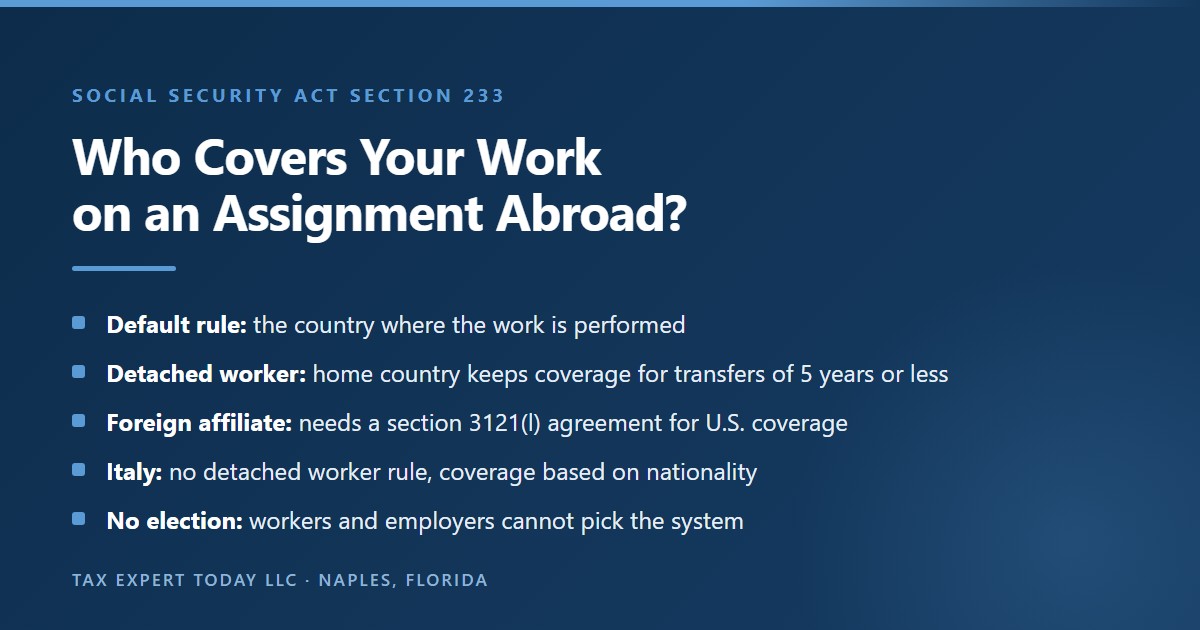
The detached worker rule keeps an employee covered only by the home country when the employer temporarily sends that employee to work in the partner country. In U.S. agreements it generally applies to assignments expected to last five years or less. Every U.S. agreement except the one with Italy contains this rule.
- Same employer: the worker must be transferred by the same employer, to a branch or to a covered foreign affiliate.
- Five years or less: the assignment must be expected to last no more than about five years when it begins.
- Affiliates need a 3121(l) agreement: U.S. coverage continues at a foreign affiliate only if the American employer has one in place.
- Italy is different: the U.S.-Italy agreement uses nationality rather than a detached worker test.
SSA describes the rule as “designed to minimize disruptions in the coverage careers of workers whose employers send them abroad on temporary assignment.” A U.S. citizen or resident “temporarily transferred by an American employer to work in an agreement country continues to be covered under the U.S. program and is exempt from coverage under the system of the host country.” The worker and the employer pay only into U.S. Social Security for the assignment. SSA adds that the five year limit “is substantially longer than the limit normally provided in the agreements of other countries.”
The rule works for transfers to a branch and to a foreign affiliate, with one condition. In SSA’s words, “for U.S. coverage to continue when a transferred employee works for a foreign affiliate, the American employer must have entered into a section 3121(l) agreement with the U.S. Treasury Department with respect to the foreign affiliate.” Without that agreement, the affiliate’s employee is not covered by U.S. Social Security in the first place, so there is no U.S. coverage to preserve.
The rule can also follow a worker through a chain of assignments. SSA’s example is an employee sent from New York to Hong Kong for four years and then to London for four more. Because the employee was originally sent from the United States and stayed covered by U.S. Social Security throughout, the employee can be exempted from U.K. coverage under the U.S.-U.K. agreement for the London years.
Italy is the exception. The U.S.-Italy agreement “does not include a detached-worker rule,” according to SSA, and coverage for expatriate workers is based principally on nationality. A U.S. citizen employed or self-employed in Italy who would be covered by U.S. Social Security without the agreement stays covered by the U.S. program and is exempt from Italian contributions.
| Hypothetical situation | Rule that applies | System that covers the work |
|---|---|---|
| Naples-based employee sent by a U.S. company to its Frankfurt branch for three years | Detached worker rule | United States only, with an SSA certificate of coverage |
| U.S. citizen hired locally in Madrid by a Spanish employer, open-ended contract | Territoriality rule | Spain only |
| Employee sent to a U.S. company’s U.K. affiliate for four years, parent has a 3121(l) agreement | Detached worker rule | United States only |
| Same transfer, but the parent has no 3121(l) agreement for the affiliate | No U.S. coverage to keep | United Kingdom |
| Assignment planned from the start for seven years in Canada | Exceeds the detached worker limit | Generally Canada, under territoriality |
| U.S. citizen employed in Rome | U.S.-Italy nationality rule | United States, if U.S. coverage would otherwise apply |
The examples are hypothetical and simplified. Each agreement has its own text, and some contain different time limits or conditions for particular categories of workers. The country-specific pamphlets on SSA’s agreement descriptions page are the place to confirm the details before an assignment begins.
How are self-employed expats treated under a totalization agreement?
A self-employed U.S. citizen or resident owes U.S. self-employment tax on worldwide net earnings, even while living abroad and even when the income is excluded from income tax. Many agreements remove the double tax by assigning self-employment coverage to the country where the person resides; others allow a temporary transfer of the business.
- The $400 threshold applies abroad: self-employment tax is due if net earnings from self-employment are at least $400.
- The exclusion does not help: income excluded under the foreign earned income exclusion still counts for self-employment tax.
- Residence rule is common: under the U.K. and Romania agreements, a self-employed resident of the partner country is covered there.
- Proof is required: the foreign certificate of coverage is attached to the U.S. return every year.
Publication 54 sets out the baseline: “If you are a self-employed U.S. citizen or resident, the rules for paying self-employment tax are generally the same whether you are living in the United States or abroad,” and “you must pay self-employment tax if your net earnings from self-employment are at least $400.” The tax itself comes from section 1401, which imposes 12.4 percent for Social Security and 2.9 percent for Medicare on self-employment income. The Social Security portion stops at the annual wage base, which the IRS lists in Topic 751 as $184,500 for 2026 earnings. The Medicare portion has no cap, and an additional 0.9 percent Medicare tax can apply above filing status thresholds.
The interaction with the foreign earned income exclusion surprises many expats. Publication 54 states: “You must take all of your self-employment income into account in figuring your net earnings from self-employment, even income that is exempt from income tax because of the foreign earned income exclusion.” Its own example describes a consultant abroad with $95,000 of foreign earned income, $27,000 of business deductions, and a $68,000 net profit, who “must pay self-employment tax on your net profit of $68,000, even though you are qualified for the foreign earned income exclusion.” The exclusion can bring income tax to zero while the self-employment tax bill is untouched. Only a totalization agreement removes that layer, and only if the agreement assigns the work to the other country. A rough sense of the U.S. figure can be had from the self-employment tax calculator.
On the agreement side, Publication 54 summarizes: “As a general rule, self-employed persons who are subject to dual taxation will only be covered by the social security system of the country where they reside.” SSA’s overview is more precise. “Some U.S. agreements eliminate dual coverage of self-employment by assigning coverage to the worker’s country of residence, while others permit a self-employed worker to transfer his or her self-employment activity from one country to the other for a temporary period.” The agreement text for the specific country controls.
Two examples from SSA’s country pamphlets show the residence rule in its plain form. The U.S.-U.K. pamphlet says: “Self-employed workers who reside in the United States are assigned U.S. coverage. Self-employed workers who reside in the United Kingdom are assigned U.K. coverage.” The U.S.-Romania pamphlet uses the same words for Romania. Both pamphlets then add the instruction that matters at filing time: “Self-employed workers should attach a copy of the certificate of coverage to their U.S. tax return every year as proof of the exemption.”
| Hypothetical self-employed person | Agreement in force? | Likely coverage | U.S. self-employment tax |
|---|---|---|---|
| U.S. citizen consultant living in London | Yes, residence rule | United Kingdom | Exempt under section 1401(c), with a U.K. certificate attached each year |
| U.S. citizen designer living in Bucharest, work from October 2026 | Yes, from September 1, 2026 | Romania for work after entry into force | Exempt for covered periods with a Romanian certificate; earlier 2026 work is not covered by the agreement |
| U.S. citizen freelancer living in Mexico City | No | United States, plus any Mexican contribution owed locally | Due on net earnings of $400 or more, even if the income is excluded from income tax |
| U.K. national living in Naples, Florida with a U.K. client base | Yes, residence rule | United States | Due as a U.S. resident; a U.S. certificate can establish the U.K. exemption |
| U.S. citizen with a Florida LLC, spending four months a year in Spain | Yes, but check residence and transfer rules | Depends on the Spanish agreement text and where the person resides | Usually due if the person remains a U.S. resident for agreement purposes |
A self-employed person can also be on the other side of the rule. When a self-employed person’s earnings should be exempt from the foreign tax and subject only to U.S. tax, Publication 54 says the person “should request a certificate of coverage from the U.S. SSA’s Office of Earnings and International Operations,” which “will establish your exemption from the foreign social security tax.” A Naples consultant who keeps a home and a tax residence in Florida but performs some work in an agreement country can use that U.S. certificate to resist a foreign contribution demand.
For business owners who pay themselves through an S corporation, the analysis turns on wages rather than self-employment income, and the employee and employer exemptions under sections 3101(c) and 3111(c) apply instead of section 1401(c). The wage side has its own planning questions, covered in the guide to S corporation reasonable compensation.
What is a certificate of coverage under a totalization agreement?
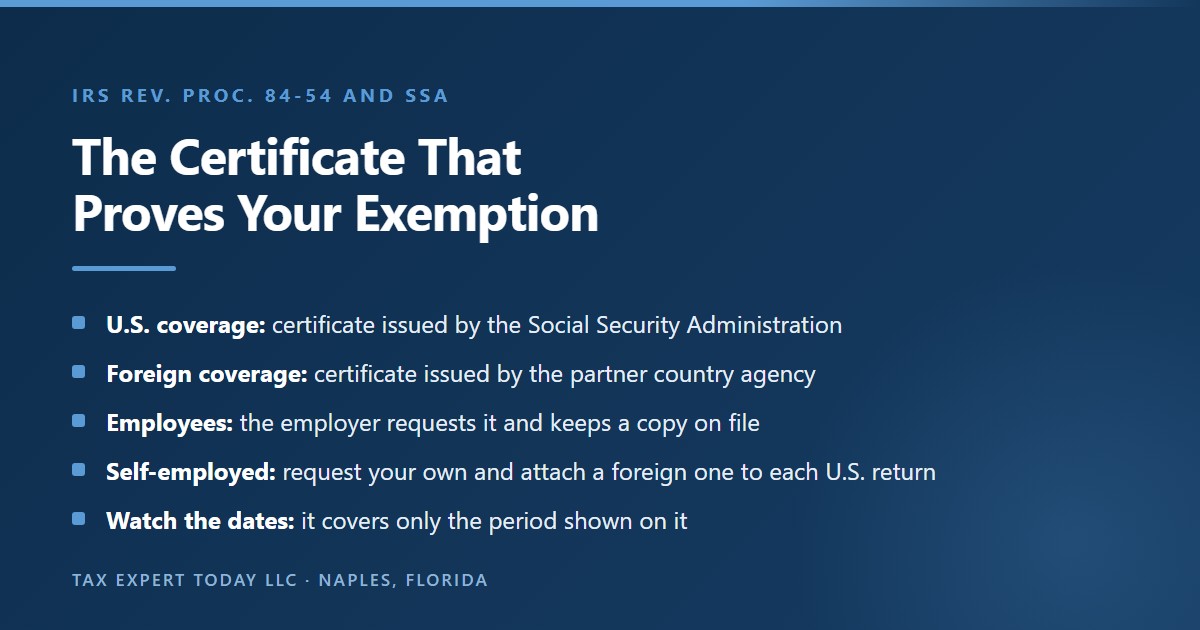
A certificate of coverage is the official document, issued by the country whose system continues to cover you, that proves you are exempt from the other country’s Social Security tax. Without it, the exemption is generally not recognized. Employers request certificates for transferred employees; self-employed people request their own.
- U.S. certificates come from SSA: requests can be filed online through SSA’s certificate of coverage service.
- Foreign certificates come from the partner country: for example, HM Revenue and Customs for the United Kingdom.
- Employers keep them on file: SSA tells employers not to send them to the IRS unless asked.
- Self-employed people attach them: a copy goes with the U.S. return each year under Rev. Proc. 84-54.
The IRS totalization agreements page sets the rule for workers coming to the United States: a person “who wishes to claim an exemption from U.S. Social Security and Medicare taxes because of a totalization agreement must secure a Certificate of Coverage from the social security agency of their home country and present it to their U.S. employer, according to the procedures set forth in Revenue Procedures 80-56 and 84-54, and Revenue Ruling 92-9.” The same page notes that Revenue Ruling 92-9 provides “an alternate procedure for an individual who is unable to secure a Certificate of Coverage from their home country.”
For U.S. workers going abroad, SSA issues the certificate. Its online certificate of coverage service explains that “if a Social Security agreement assigns coverage of the employee’s work to the United States, the Social Security Administration issues a U.S. Certificate of Coverage,” which “serves as proof that the employee and employer are exempt from the payment of Social Security taxes to the foreign country.” Employers and self-employed individuals can request certificates online, and SSA also accepts requests by mail and fax under the procedures in each country pamphlet.
SSA lists the information a request should contain: the employer’s name and address in the United States and in the other country, the worker’s full name, place and date of birth, citizenship, U.S. and foreign Social Security numbers, place and date of hiring, and the beginning and ending dates of the assignment. If the worker will work for a foreign affiliate, the request should state whether a section 3121(l) agreement covers the affiliate. Self-employed people should state their country of residence and the nature of their work. Requests under the agreements with France and Japan also need to state whether the worker and accompanying family members have health insurance.
What happens next depends on which country issued the certificate. Per SSA, when the other country certifies that an employee is covered by its system, “the employer can immediately stop withholding and paying U.S. Social Security taxes on the employee’s earnings,” and should keep the certificate in its files “so it can be produced in the event the Internal Revenue Service ever questions why no taxes are being paid.” A self-employed U.S. citizen or resident covered abroad “must attach a photocopy of the foreign certificate to his U.S. tax return each year,” because under Revenue Procedure 84-54 the foreign certificate “serves as proof of the exemption from U.S. Social Security taxes for the period shown on the certificate.”
| Step | Employee on a temporary assignment | Self-employed person |
|---|---|---|
| 1. Confirm the agreement | Partner country, entry into force date, detached worker limit | Partner country, entry into force date, residence or transfer rule |
| 2. Identify the covering country | Usually the home country for assignments of five years or less | Usually the country of residence |
| 3. Who requests | The employer | The individual |
| 4. Where to request | SSA for U.S. coverage; the partner agency for foreign coverage | SSA for U.S. coverage; the partner agency for foreign coverage |
| 5. What to do with it | Present it to the host country; the employer keeps a copy for an IRS inquiry | Attach a copy of a foreign certificate to the U.S. return every year |
| 6. Watch the end date | Request an extension or plan for coverage to switch if the assignment runs long | Request a new certificate if residence or the business changes |
Two timing points are worth noting. First, the certificate covers the period shown on it, so an assignment that is extended beyond the certified dates needs fresh paperwork. Second, Publication 54 says a person permanently working abroad whose pay is exempt from U.S. tax should obtain a statement from the foreign agency, and if that agency “will not issue such a statement,” the worker or employer can obtain one from SSA stating that the wages are not covered by the U.S. system. That statement is kept by the employer as proof of the exemption.
What happens if you work in a country with no totalization agreement?
Without an agreement, both countries can tax the same earnings. A U.S. citizen working abroad for an American employer, or self-employed abroad, generally keeps paying U.S. Social Security and Medicare tax while also owing the local contribution. The foreign social tax may, however, be eligible for the foreign tax credit when no agreement covers it.
- No exemption mechanism: sections 3101(c), 3111(c), and 1401(c) apply only where an agreement is in effect.
- The exclusion does not reduce U.S. self-employment tax: excluded income still counts toward net earnings from self-employment.
- Foreign tax credit is possible: Publication 514 bars a credit only for social taxes paid to agreement countries.
- Local hires by foreign employers: a U.S. citizen working for a foreign company abroad is often outside U.S. Social Security entirely.
The rule on the credit appears in Publication 514: “No deduction or credit is allowed, however, for social security taxes paid or accrued to a foreign country with which the United States has a social security agreement.” The flip side is that a foreign social tax paid to a country without an agreement is not barred by that sentence. Whether it qualifies as a creditable foreign income tax under the general rules is a separate question that depends on the tax, and the computation runs through Form 1116.
A credit against income tax does not offset U.S. self-employment tax, and it cannot be refunded where the foreign earned income exclusion already brings income tax to zero. For a self-employed U.S. citizen in a non-agreement country, the practical result is often two full layers of social tax with partial relief at best. That is why the choice between the exclusion and the credit, discussed in the guide to the foreign earned income exclusion versus the credit, deserves a fresh look whenever a move involves a country outside the network.
Employees in non-agreement countries are in a different position depending on who employs them. A U.S. citizen working for a foreign employer abroad, with no section 3121(l) agreement in the picture, is usually outside U.S. Social Security coverage altogether, so only the local system applies. A U.S. citizen working abroad for an American employer stays covered by U.S. Social Security and is also likely to be covered locally, which is the double tax the agreements were designed to remove.
Are French CSG and CRDS taxes covered by the totalization agreement?
No. In 2019 the United States and France confirmed through diplomatic communications that the French CSG and CRDS are not social taxes covered by the U.S.-France agreement. The IRS therefore will not challenge foreign tax credits for CSG and CRDS on that ground, and taxpayers who did not claim them may be able to amend.
- Creditable position: the IRS will not deny the credit on the basis that the agreement applies.
- Ten year window: refund claims for foreign tax credits generally run ten years from the original due date.
- Specific labeling: amended returns are marked “French CSG/CRDS Taxes” in red at the top.
- Form 1116 required: the amended return goes with Form 1116 under its instructions.
The IRS page records the policy: “In 2019, the United States and the French Republic memorialized through diplomatic communications an understanding that the French Contribution Sociale Generalisee (CSG) and Contribution au Remboursement de la Dette Sociate (CRDS) taxes are not social taxes covered by the Agreement on Social Security between the two countries. Accordingly, the IRS will not challenge foreign tax credits for CSG and CRDS payments on the basis that the Agreement on Social Security applies to those taxes.”
The page continues that “individual taxpayers, who paid or accrued these taxes but did not claim them, can file amended returns to claim a foreign tax credit,” and that individuals generally “have ten (10) years to file a claim for refund” for creditable foreign taxes, measured from the day after the regular due date of the return for the year the taxes were paid or accrued. The instruction for the paperwork is specific: write “French CSG/CRDS Taxes” in red at the top of Form 1040-X and file it with Form 1116.
The French position illustrates a broader point. Publication 514’s bar on credits applies to social security taxes “paid or accrued to a foreign country with which the United States has a social security agreement,” but only to taxes the agreement actually covers. Where a foreign levy sits outside the covered programs, its treatment has to be analyzed on its own terms. People who paid CSG or CRDS while living in France, or on French income after a move to Southwest Florida, are the group most likely to benefit from reviewing prior returns within the refund window.
How does a totalization agreement help you qualify for Social Security benefits?
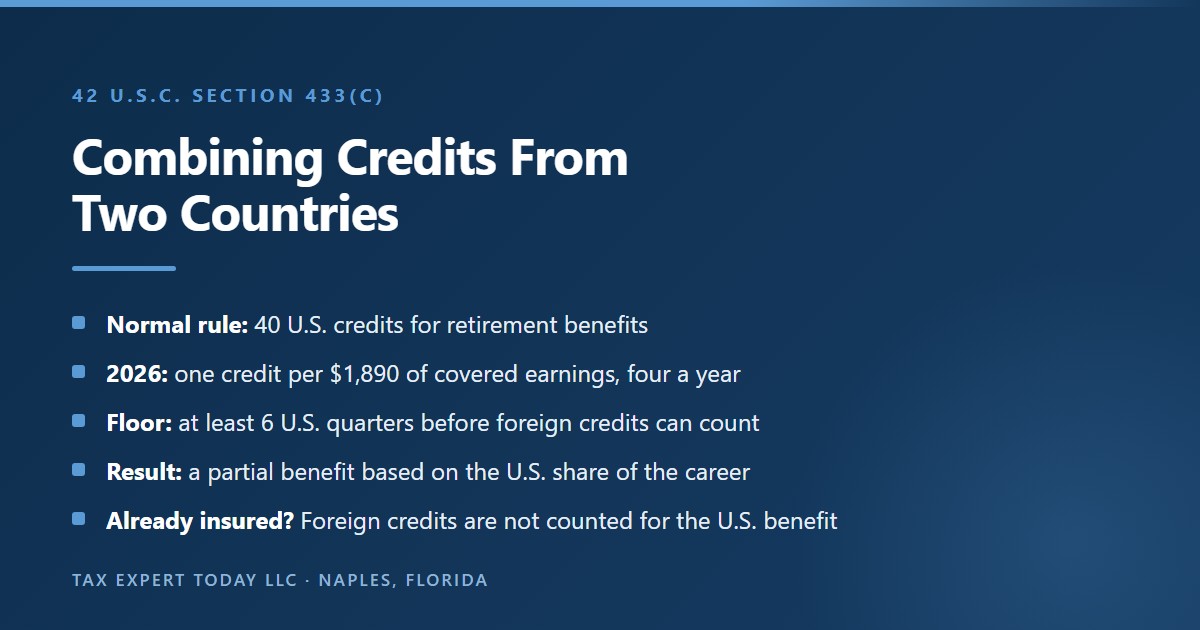
If you have some U.S. work credits but not enough to qualify for a benefit, a totalization agreement lets SSA count your coverage in the partner country toward the U.S. eligibility rules. You need at least six U.S. quarters of coverage, and the result is a partial benefit based on the share of your career worked in the United States.
- Forty credits is the normal threshold: most workers need 40 credits to be insured for retirement benefits.
- 2026 credit value: one credit for each $1,890 of covered earnings, up to four credits ($7,560) per year.
- Six quarter floor: SSA can totalize only if you have at least six quarters of U.S. coverage.
- Only when needed: if your U.S. credits already qualify you, foreign credits are not counted.
The statutory floor is in 42 U.S.C. section 433(c)(1)(A), which requires every agreement to provide for combining periods of coverage “in the case of an individual who has at least 6 quarters of coverage” under U.S. law. Section 433(c)(1)(C) then requires that “the benefit amount payable under this subchapter shall be based on the proportion of such individual’s periods of coverage which was completed under this subchapter.” In plain terms, totalizing helps a person qualify, and the benefit is then scaled down to the U.S. portion of the career.
SSA’s credits page sets the normal rule: “You must earn at least 40 Social Security credits to be eligible for Social Security benefits,” and “in 2026, you earn one Social Security and Medicare credit for every $1,890 in covered earnings each year,” with $7,560 needed for the maximum of four credits. The SSA overview explains how an agreement fills the gap: “if a worker has some U.S. coverage but not enough to qualify for benefits, SSA will count periods of coverage that the worker has earned under the Social Security program of an agreement country,” and a partial benefit “is based on the proportion of the worker’s total career completed in the paying country.”
The agreement only helps when it is needed. The U.S.-U.K. pamphlet is explicit: “If you already have enough credits under the U.S. system to qualify for a benefit, the United States cannot count your U.K. credits.” The partner country applies its own minimums in the same way. Romania, for example, requires at least 15 years of contributions for its regular pension, and its pamphlet explains that it credits three months of Romanian coverage for each U.S. quarter it is asked to count.
| Hypothetical worker | U.S. credits | Foreign coverage | Effect of the agreement |
|---|---|---|---|
| Worked 7 years in the United States, 25 years in Germany | 28 credits | 25 years in Germany | German coverage can be counted to reach U.S. insured status; the U.S. benefit is a partial benefit reflecting the U.S. share |
| Worked 12 years in the United States, 20 years in Canada | 40 or more credits | 20 years in Canada | Already insured in the United States, so Canadian credits are not counted for the U.S. benefit; Canada may count U.S. credits for its own benefit |
| Worked 1 year in the United States, 30 years in Japan | 4 credits | 30 years in Japan | Below the six quarter floor, so SSA cannot totalize; no U.S. benefit from the agreement |
| Worked 5 years in the United States, 20 years in India | 20 credits | 20 years in India | No agreement in force, so no totalization; the U.S. record stands alone |
Nothing needs to be filed in advance to preserve totalization rights. SSA states that “people generally do not need to take action concerning Totalization benefits under an agreement until they are ready to file a claim for retirement, survivors or disability benefits,” and that a claim “may be filed at any Social Security office in the United States or the foreign country.” What helps at claim time is a clean record of the foreign coverage, so keeping foreign pension statements and contribution histories is worth the effort.
The agreements can also affect who can be paid and where. Under section 433(c)(2), an agreement may allow a person entitled to U.S. benefits to receive them while residing in the partner country, notwithstanding the alien nonpayment rule in 42 U.S.C. section 402(t). For former spouses and survivors, the family benefit rules interact with these provisions; the guide to divorce and Social Security benefits covers the U.S. side of that question.
Did the Social Security Fairness Act change anything for people with foreign pensions?
Yes. The Social Security Fairness Act, signed on January 5, 2025, ended the Windfall Elimination Provision and the Government Pension Offset. Those rules had reduced U.S. benefits for some people who also received a pension from work not covered by U.S. Social Security, including work covered by a foreign system. The repeal applies to benefits for months after December 2023.
- Who it affects: people receiving a non-covered pension, which SSA says includes some people whose work was covered by a foreign social security system.
- Effective point: SSA adjusted benefits back to January 2024.
- Who acts: SSA has adjusted affected benefits; people who never claimed may want to revisit the decision.
- Planning shift: a foreign pension no longer shrinks the U.S. benefit through WEP.
SSA’s Social Security Fairness Act page states that “the Act was signed into law on January 5, 2025” and “ends the Windfall Elimination Provision (WEP) and Government Pension Offset (GPO).” It lists among the groups helped “people whose work had been covered by a foreign social security system,” and it explains that one-time payments covered the increase “back to January 2024, the month when WEP and GPO no longer applies.”
For a retiree in Naples who earned a full U.S. benefit and also a pension from a career abroad, the practical change is that the U.S. benefit is computed without the WEP reduction. People who never applied for a U.S. benefit because they expected WEP to cut it sharply may want to revisit that decision. The income tax treatment of the foreign pension itself is a separate question, covered in the next section.
How are foreign Social Security benefits taxed after a move to Florida?
A totalization agreement does not decide how a foreign Social Security benefit is taxed. The income tax treaty does. Without a treaty rule, foreign social security benefits paid to a U.S. resident are generally taxable as annuities; under the treaties with Canada and Germany, those benefits are treated as if they were U.S. Social Security.
- Default rule: foreign social security benefits are taxable as annuities unless a treaty exempts them or treats them as U.S. benefits.
- Canada and Germany: benefits are reported as if paid by U.S. Social Security.
- Treaty positions may need disclosure: some treaty-based positions are reported on Form 8833.
- No Florida income tax: Florida does not impose a personal income tax, so only the federal rules apply.
Publication 915 states the default: foreign social security benefits “are taxable as annuities, unless they are exempt from U.S. tax or treated as a U.S. social security benefit under a tax treaty.” For two countries it spells out the treaty result: “Under income tax treaties with Canada and Germany, social security benefits paid by those countries to U.S. residents are treated for U.S. income tax purposes as if they were paid under the social security legislation of the United States.” Those benefits go on the same worksheet as U.S. benefits, which can leave part of them untaxed.
The same publication covers the reverse case for people who leave. It notes that U.S. Social Security benefits received by residents of Canada, Egypt, Germany, Ireland, Israel, Italy, Japan, Romania, and the United Kingdom are exempt from U.S. tax, and that residents of Switzerland are taxed at a 15 percent rate on the total benefit, while most other nonresident aliens face 30 percent withholding on 85 percent of the benefit. These outcomes come from income tax treaties, not from the totalization agreements, which is why the two sets of documents have to be read together.
When a return relies on a treaty to change the normal U.S. result, the disclosure rules discussed in the guide to Form 8833 and treaty-based return positions may apply. Retirees who are not U.S. citizens and who split the year between Florida and another country should also confirm their residency status under the substantial presence test, because the answer decides whether they file a resident return, a Form 1040-NR, or a dual status tax return for the year of the move.
How do foreign workers in the United States use a totalization agreement?
A worker sent to the United States by a foreign employer from an agreement country can stay covered only by the home system, usually for assignments of five years or less. The worker obtains a certificate of coverage from the home country’s agency and gives it to the U.S. employer, which can then stop withholding Social Security and Medicare tax.
- Certificate first: the exemption depends on the home country certificate, not on the visa or the contract.
- Employer keeps it: the U.S. employer retains the certificate to show the IRS why no tax was withheld.
- Self-employment tax can apply to some nonresidents: an agreement can impose U.S. self-employment tax even where the Code would not.
- Withholding in error: refunds go through the employer first, then Form 843.
The IRS describes the inbound procedure on its totalization agreements page: the individual “must secure a Certificate of Coverage from the social security agency of their home country and present it to their U.S. employer.” SSA adds that once the employer has the foreign certificate, it “can immediately stop withholding and paying U.S. Social Security taxes on the employee’s earnings.” The U.K. pamphlet tells U.S. employers to “retain certificates of coverage in case of an audit by the IRS” and not to send a copy to the IRS “unless the IRS specifically requests the certificate of coverage.”
The IRS page on Social Security tax, Medicare tax, and self-employment adds two points for people arriving in the United States. First, “nonresident aliens are not subject to self-employment tax,” but “self-employment tax may be imposed on a nonresident alien under the terms of an international Social Security agreement.” Second, if Social Security or Medicare taxes were withheld in error, the worker should ask the employer for a refund, and if that fails, “file a claim for refund with the Internal Revenue Service on Form 843,” with the supporting documents the page lists.
Foreign professionals who come to Southwest Florida on assignment often face several other first-year questions at once: when U.S. tax residency begins, whether a treaty changes the income tax result, and whether foreign accounts must be reported. The guides to the substantial presence test, Form W-8BEN, and the FBAR filing requirement cover those pieces.
What does the new U.S.-Romania totalization agreement change in 2026?
The U.S.-Romania agreement entered into force on September 1, 2026, making Romania the 31st agreement country. From that date, workers and self-employed people covered by both systems can be assigned to one, and Romanian and U.S. credits can be combined for old-age, survivors, and disability benefits.
- Self-employment follows residence: a self-employed resident of Romania is covered by Romania, and a resident of the United States by the United States.
- Romanian certificates: requested from Romania’s National House of Public Pension.
- Benefit programs covered: old-age, survivors, and disability benefits under Romania’s first pillar.
- No retroactive relief: work and wages before September 1, 2026, fall under the pre-agreement rules.
The SSA pamphlet for Romania explains that the agreement “covers old-age, survivors, and disability benefits,” and that Romania’s second and third pension pillars “are not subject to this Agreement for purposes of benefits.” It applies the residence rule to self-employment and directs certificate requests to Romania’s National House of Public Pension in Bucharest. For a U.S. citizen self-employed in Romania, the 2026 return is likely to have two periods: January through August under the old rules, and September through December under the agreement.
Because many published guides still say the United States has 30 agreements, it is worth confirming the current list on the SSA agreements page before relying on any secondary summary, including this one.
What do totalization agreement situations look like for Naples, Florida residents?
For Southwest Florida residents, totalization questions tend to arise in four settings: employees sent abroad by Florida employers, self-employed consultants who work for clients overseas, foreign nationals posted to Florida, and retirees with careers in two countries. Each turns on the agreement text, the dates, and the certificate.
- Outbound employees: the detached worker rule and the employer’s certificate request.
- Consultants: residence for agreement purposes and the U.S. or foreign certificate.
- Inbound workers: the home country certificate and the U.S. employer’s records.
- Retirees: combined credits, the end of WEP, and the income tax treaty.
| Hypothetical Naples, Florida situation | Main question | Typical next step |
|---|---|---|
| A Naples company sends an engineer to its Netherlands branch for 30 months | Does U.S. coverage continue? | Employer requests a U.S. certificate from SSA before the move |
| A semi-retired consultant in Naples bills clients in Ireland while living in Florida | Can Ireland demand contributions? | Request a U.S. certificate showing U.S. coverage |
| A Canadian executive transferred to a Bonita Springs subsidiary for three years | Should U.S. payroll tax be withheld? | Obtain the Canadian certificate and give it to the U.S. employer |
| A retiree who worked 8 years in New York and 25 years in Switzerland | Is a U.S. benefit available? | Apply for a totalized U.S. benefit and gather Swiss coverage records |
| A U.S. citizen moving from Naples to Lisbon to freelance | Which system covers self-employment? | Check the Portugal agreement rule and request the right certificate |
| A retiree receiving a German pension in Naples | How is the pension taxed? | Apply the U.S.-Germany income tax treaty and report it as Social Security |
Each example is hypothetical and simplified, and none describes a client. The right answer in any real situation depends on the agreement text, the dates, the employer’s arrangements, and the person’s residence.
What are the most common totalization agreement mistakes?
The most common mistakes are assuming the foreign earned income exclusion removes self-employment tax, assuming an agreement exists with every country, skipping the certificate of coverage, letting an assignment run past the certified dates, and claiming a foreign tax credit for social taxes covered by an agreement.
- Excluding income and ignoring Schedule SE: excluded income is still self-employment income.
- Relying on an old country list: Romania joined on September 1, 2026, and many countries have no agreement.
- No certificate on file: the exemption is proven by the certificate, not by the agreement alone.
- Crediting covered social taxes: Publication 514 bars a credit for taxes paid to agreement countries.
| Mistake | Why it causes a problem | What the rules provide |
|---|---|---|
| Treating the foreign earned income exclusion as a self-employment tax exemption | Self-employment tax can be assessed on the full net profit | Publication 54: excluded income still counts for self-employment tax |
| Claiming an agreement exemption without a certificate | The IRS or the foreign agency may not recognize the exemption | Rev. Proc. 84-54 and the SSA certificate procedure |
| Claiming a foreign tax credit for covered foreign social taxes | The credit is disallowed | Publication 514 bars the credit and the deduction |
| Assuming an assignment over five years keeps U.S. coverage | Coverage may switch to the host country | The detached worker rule generally covers assignments of five years or less |
| Assuming the employee can choose the system | Contributions may be paid to the wrong country | SSA: the agreements do not allow an election |
| Not amending for French CSG or CRDS | An available credit may be lost to the refund deadline | The IRS 2019 position and the ten year refund window |
Self-employment tax that should have been paid and was not can lead to tax, interest, and penalties on the U.S. side. The guide to how IRS penalties may be removed explains the relief that may be available, which depends on the specific facts and is never assured. People who also missed foreign account reports in the same years should read the guides to FBAR penalties and the Streamlined Filing Compliance Procedures, which are available only where the failure was non-willful and require a certification under penalty of perjury.
Totalization Agreement Help in Naples & Southwest Florida
Tax Expert Today LLC works with international clients from an office in Naples, Florida and serves clients in all 50 states. Southwest Florida draws people with careers in more than one country: executives posted from Europe and Canada, consultants who keep Florida as home while working for overseas clients, and retirees who spent decades abroad before settling in Naples, Bonita Springs, Fort Myers, or Marco Island.
- Totalization agreement help Naples: identifying which system covers an assignment or a business, and the certificate that proves it.
- International tax Naples FL: coordinating self-employment tax, the foreign earned income exclusion, and the foreign tax credit.
- Expat Social Security tax Naples: reviewing Schedule SE for U.S. citizens abroad and for foreign nationals in Florida.
- Foreign tax Naples: applying the income tax treaty to foreign pensions and Social Security benefits.
Our international and expat tax services page explains how we approach cross-border work, and the international tax Naples FL guide and the Naples tax planning page cover the wider picture for Southwest Florida residents.
Office: 11983 Tamiami Trail N, Naples FL 34110
Phone: (239) 441-2005
Hours: Monday through Friday, 10:00 to 5:00 ET
Frequently Asked Questions
I live in Naples, Florida and do consulting work for clients in Germany. Do I owe German social contributions?
Usually not, if you reside in the United States and the work is self-employment covered by U.S. Social Security. Under the residence approach used in many agreements, a self-employed U.S. resident stays in the U.S. system. A U.S. certificate of coverage from SSA is the document that proves this to the German authorities, so request one if a contribution demand arrives.
Does the foreign earned income exclusion eliminate self-employment tax?
No. Publication 54 states that all self-employment income counts toward net earnings from self-employment, even income excluded from income tax under the foreign earned income exclusion. Only a totalization agreement that assigns the work to the other country, supported by a certificate of coverage, removes the U.S. self-employment tax.
How many totalization agreements does the United States have?
Thirty-one as of September 1, 2026, when the agreement with Romania entered into force. The Social Security Administration publishes the current list with each agreement’s entry into force date. Lists published before September 2026 show 30 agreements.
Can I choose which country’s Social Security system I pay into?
No. The Social Security Administration describes the idea that workers or employers can elect their system as a general misconception. The agreements assign coverage by objective rules, mainly where the work is done, temporary assignment by the same employer, and residence for self-employment. A rarely used special exceptions provision requires agreement by both countries.
Can I claim a foreign tax credit for social security taxes paid abroad?
Not for social security taxes paid to a country that has an agreement with the United States. Publication 514 bars both the credit and the deduction for those taxes. Social taxes paid to a country without an agreement, and levies that an agreement does not cover, such as the French CSG and CRDS, are analyzed under the general foreign tax credit rules.
How many U.S. credits do I need for a totalized benefit?
At least six quarters of U.S. coverage. Below that floor, SSA cannot combine your foreign coverage with your U.S. record. If you already have the 40 credits normally needed for retirement benefits, your foreign credits are not counted for the U.S. benefit, although the partner country may still count your U.S. credits for its own benefit.
When to Engage a Professional
Totalization agreements look simple from a distance: one country, one tax. In practice the answer depends on the specific agreement text, the entry into force date, the employer’s structure, any section 3121(l) agreement, where the worker resides, how long the assignment is expected to last, and whether the right certificate exists for the right period. A missing certificate or a misread residence rule can lead to self-employment tax assessed on income that was excluded from income tax, or to contributions paid to the wrong country for years.
A professional review is worth considering before an overseas assignment begins, when you start or move a self-employed business across a border, when you receive a foreign contribution demand or a U.S. notice about self-employment tax, when you work in a country that has just joined or does not belong to the network, when you are planning a claim for a totalized benefit, or when you receive a foreign pension after moving to Florida. Planning is easier before the work starts than after the returns are filed.
Tax Expert Today LLC is a tax advisory firm in Naples, Florida serving clients in all 50 states. Call (239) 441-2005 to discuss your facts.
This article is general information, not advice for any particular taxpayer, and does not create a client relationship. The examples are hypothetical illustrations only and do not describe any client. The rules described here reflect the Social Security Administration’s published agreement list and country pamphlets, IRS Publications 54, 514, and 915, IRS Topic 751, and the statutes cited, as of the date of writing. Agreement terms differ by country and change when agreements are revised or added. Verify current rules and confirm your own facts with a qualified tax professional before filing or making a decision.
Published October 7, 2026 by Dr. Pellumb Kabashi « Back to Learning Center
Have a question this article touches on?
Tax Expert Today LLC, based in Naples, Florida and serving clients across the United States.
Schedule a Consultation (239) 441-2005