
By Dr. Pellumb Kabashi, DBA, MBA, EA, CFE, CES
Founder, Tax Expert Today LLC · Tax advisors, enrolled agents, CPAs, and attorneys · Serving clients in all 50 states
Quick Answer: Form 3520 is the annual information return that reports large foreign gifts and transactions with foreign trusts. A United States person files it after receiving more than $100,000 from a nonresident alien individual or foreign estate, or more than $20,573 in 2026 from a foreign corporation or partnership, or on creating, funding, or receiving from a foreign trust. The gift itself is usually not taxable. The failure to report it is what carries the penalty. Call (239) 441-2005 for a free consultation.
What Is Form 3520, and Who Has to File It?
Form 3520 is an information return, not a tax return. It reports transactions with foreign trusts and the receipt of large foreign gifts and bequests, under 26 U.S.C. §6048 and §6039F. It reports no tax and computes no liability. A United States person files it when a reporting threshold is crossed, and the penalties attach to the missing form rather than to any unpaid tax.
- It is filed separately from your Form 1040. The IRS instructions direct it to a dedicated address in Ogden, Utah, not to the service center that receives your income tax return.
- It covers four distinct situations. The form is divided into four parts, and most filers complete only one of them.
- The trigger is a transaction, not income. Receiving money can create a filing duty even where the money is not taxable to you at all.
- One form per person, per year. Spouses may file a joint Form 3520 where they file a joint income tax return.
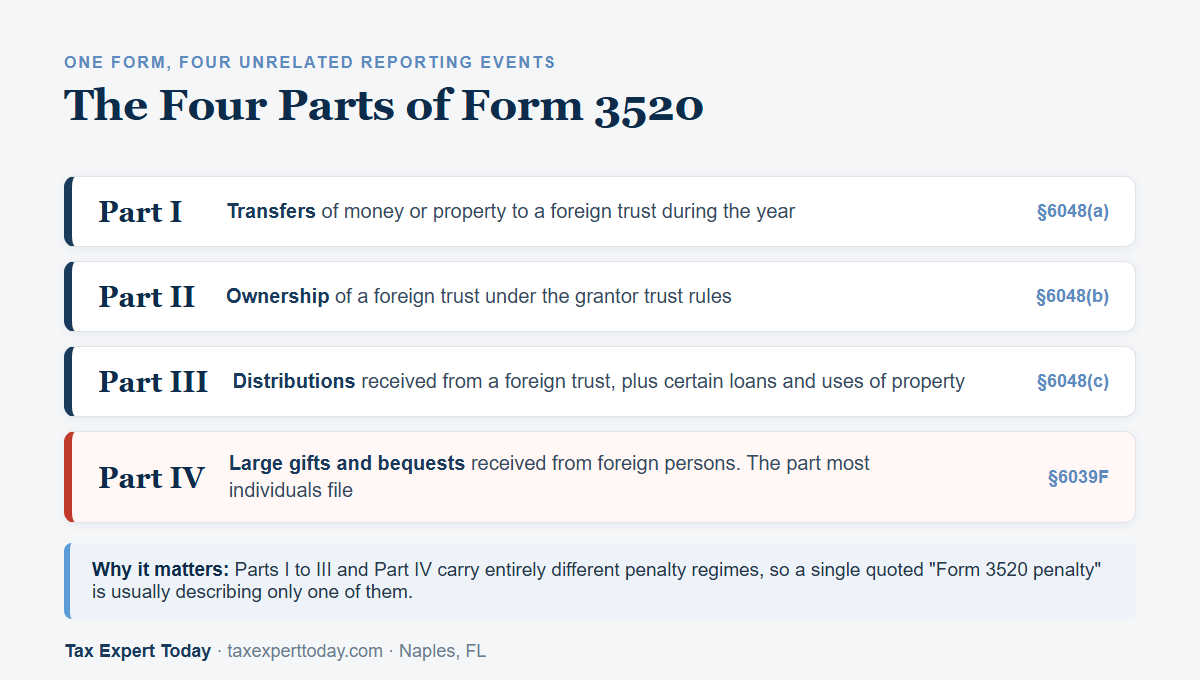
That structure explains most of the confusion around this form. The Instructions for Form 3520 describe four separate reporting events sharing one piece of paper, and the rules governing each of them come from different code sections with different penalty regimes. A person who received an inheritance from a parent abroad and a person who is treated as the owner of a foreign trust are both filing Form 3520, but almost nothing else about their situations is the same.
| Part | What it reports | Governing section |
|---|---|---|
| Part I | Transfers of money or property to a foreign trust during the year | §6048(a) |
| Part II | Ownership of a foreign trust under the grantor trust rules | §6048(b) |
| Part III | Distributions received from a foreign trust, and certain loans and uses of trust property | §6048(c) |
| Part IV | Large gifts and bequests received from foreign persons | §6039F |
The four parts of Form 3520. Part IV is the one most individual filers encounter, and it is governed by an entirely different code section from the trust parts.
What Are the Form 3520 Reporting Thresholds for 2026?
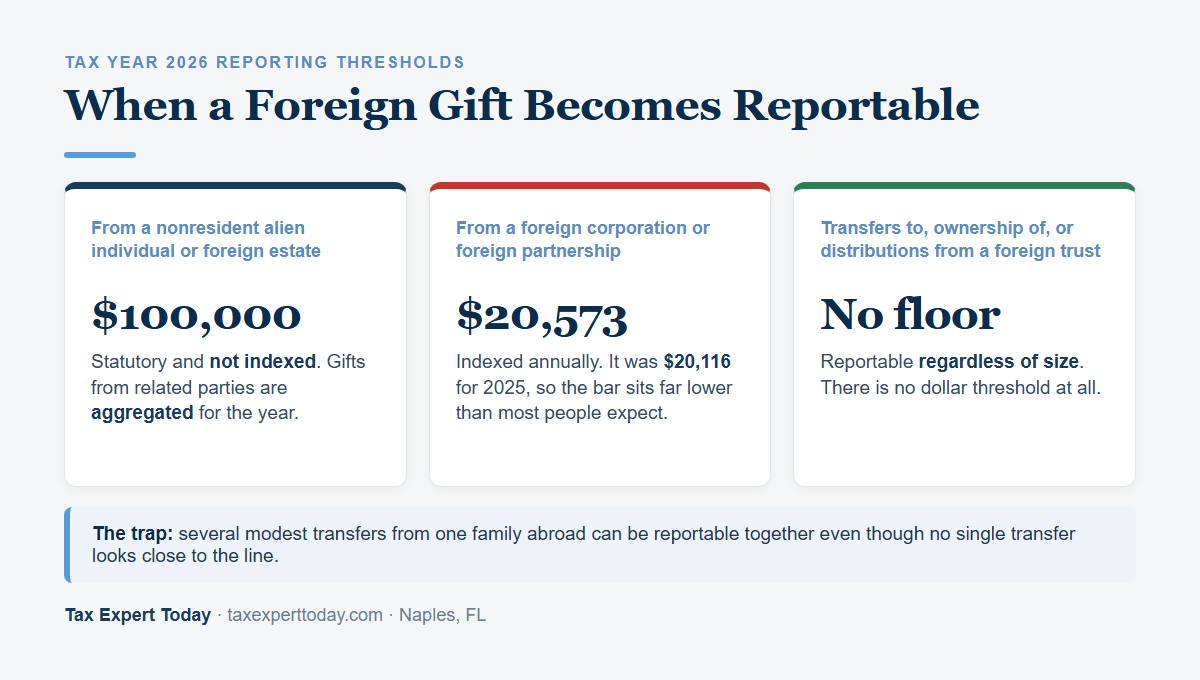
Two different thresholds apply to foreign gifts. Gifts and bequests from a nonresident alien individual or a foreign estate are reportable once the aggregate exceeds $100,000 during the year. Gifts from a foreign corporation or foreign partnership are reportable at a much lower figure, $20,573 for 2026, because that threshold is adjusted for inflation each year.
- The $100,000 figure is statutory and does not move. It has not been indexed, so it is the same in 2026 as it was decades ago.
- The entity threshold is indexed. The IRS publishes it annually, and it rose from $20,116 for 2025 to $20,573 for 2026.
- Aggregation is required. You add together gifts from related parties, so several smaller transfers from one family abroad can cross the line together.
- Trust reporting has no dollar threshold at all. A transfer to a foreign trust, or a distribution from one, is reportable regardless of size.
- Crossing the line means itemizing. Once the threshold is met, the IRS expects each gift and each donor to be identified separately.
The aggregation rule is the one that catches people. A parent and a sibling abroad who each send a share of a family sale are related parties, and the IRS combines their transfers when testing the $100,000 threshold. Nothing about any individual transfer looks like a reportable event, and the total is reportable anyway. The IRS page on gifts from a foreign person is explicit that the test is applied to the aggregate received during the taxable year.
| Source of the gift | 2025 threshold | 2026 threshold | Indexed? |
|---|---|---|---|
| Nonresident alien individual or foreign estate | More than $100,000 | More than $100,000 | No |
| Foreign corporation or foreign partnership | More than $20,116 | More than $20,573 | Yes, annually |
| Foreign trust (transfer, ownership, or distribution) | No threshold | No threshold | Not applicable |
Reporting thresholds by source. The entity figure is roughly one fifth of the individual figure, which is why a gift from a family business abroad is reportable far sooner than the same gift from the family itself.
Is a Foreign Gift Taxable Income?
Generally, no. A gift or inheritance received from a foreign person is not income to the recipient, and reporting it on Form 3520 does not create a tax liability. The duty is informational. What is taxable is any income the asset later produces, and any income earned inside a foreign trust that is attributed to a United States owner or distributed to a beneficiary.
- The gift itself is not reported on Form 1040. It does not enter gross income, and Form 3520 is not attached to the income tax return.
- Later income is taxable normally. Interest, dividends, rent, and gain on a later sale are reportable in the ordinary way.
- A foreign account holding the money may trigger other filings. An FBAR or a Form 8938 duty can arise from where the funds sit rather than from where they came from.
- Trust distributions are a different question entirely. Part III distributions can carry taxable income, and the default calculation is unfavorable where records are incomplete.
This distinction between reportable and taxable is the single most common misunderstanding in this area, and it cuts in an uncomfortable direction. A recipient who correctly concludes that an inheritance from abroad is not taxable often concludes from that, incorrectly, that there is nothing to file. The result is a return that was accurate on its own terms and a missing information return alongside it, which is precisely the fact pattern the penalty regime was written to address.
What Are the Form 3520 Penalties?
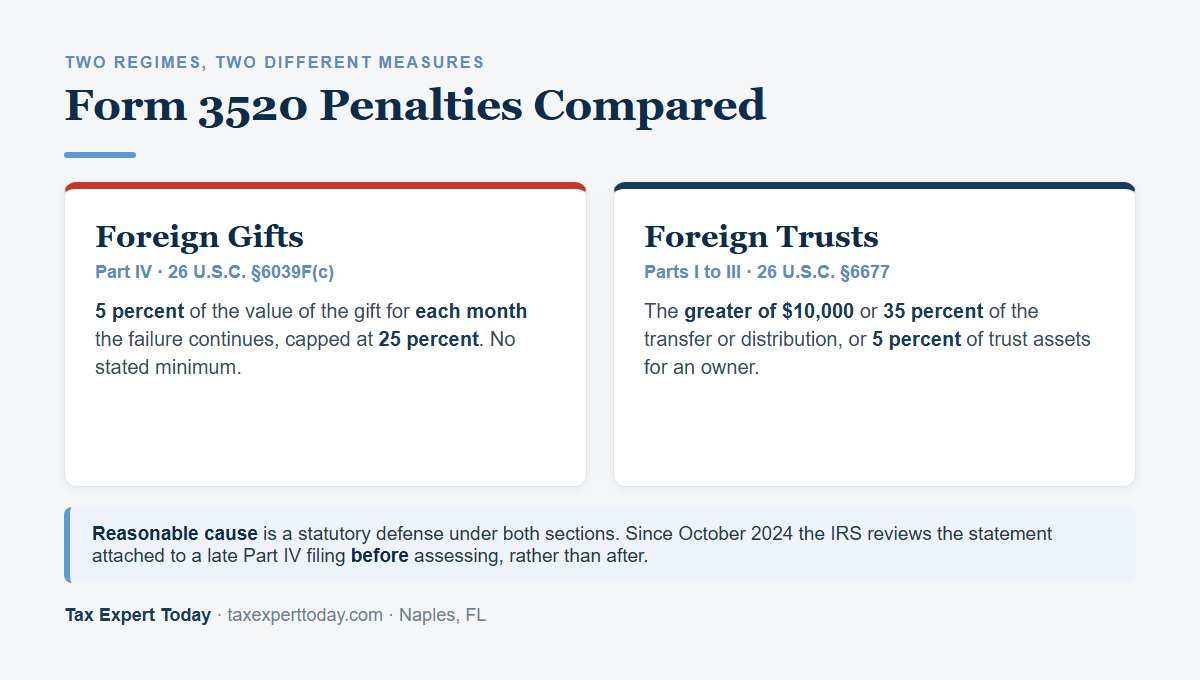
Two separate penalty regimes apply depending on which part of the form is late. Failure to report a foreign gift under §6039F carries 5 percent of the value of the gift for each month the failure continues, capped at 25 percent. Failure to report a foreign trust transaction under §6677 carries the greater of $10,000 or a percentage measure of the amount involved.
- The gift penalty is measured on the gift. Under 26 U.S.C. §6039F(c), 5 percent per month accrues to a 25 percent ceiling.
- The trust penalty has a floor and a percentage. Under 26 U.S.C. §6677, the initial penalty is the greater of $10,000 or 35 percent of the transfer or distribution, or 5 percent of trust assets in the case of an owner.
- Continuation penalties can follow. Additional amounts accrue after the IRS issues notice and the failure is not corrected.
- Reasonable cause is a statutory defense. Both sections provide that no penalty applies where the failure was due to reasonable cause and not willful neglect.
- Foreign secrecy law is expressly not reasonable cause. The instructions state that a foreign country’s own penalties for disclosure do not excuse the failure.
The proportions here are what make the form worth attention. A 25 percent ceiling applied to a $400,000 inheritance is a $100,000 penalty on a receipt that generated no tax at all, and the National Taxpayer Advocate has reported that for tax years 2018 through 2021 the average Part IV penalty assessed against taxpayers earning $400,000 or less exceeded $235,000. Those are assessment figures rather than final outcomes, and the same reporting noted that most of the assessed amounts were later abated, but the assessment is the event a taxpayer has to respond to.
| Foreign gifts (Part IV) | Foreign trusts (Parts I to III) | |
|---|---|---|
| Code section | §6039F(c) | §6677 |
| Measure | 5% of the gift per month | Greater of $10,000 or 35% of the amount, or 5% of assets for an owner |
| Ceiling | 25% of the gift | Limited to the gross reportable amount |
| Minimum | None stated | $10,000 |
| Reasonable cause | Available | Available |
The two penalty regimes compared. Summaries that quote a single Form 3520 penalty figure are usually describing one of these two and applying it to the other.
What Changed About Automatic Penalty Assessment?
The IRS stopped automatically assessing penalties on late filed Forms 3520 reporting foreign gifts. Announced in October 2024, the change means the IRS now reads a reasonable cause statement attached to a late Part IV filing before assessing anything, rather than assessing first and leaving the taxpayer to contest it afterward. Review of trust related statements followed.
- The old sequence assessed first. A late form generated a penalty notice by system, even where a full reasonable cause explanation was attached to the filing.
- The new sequence reads first. The reasonable cause statement is considered as part of the initial review.
- It began with Part IV. Foreign gifts and bequests were addressed first, with the trust portion of the form and Form 3520-A to follow.
- The filing duty did not change. Nothing about the change reduces who must file or what must be reported.
- Penalties remain available. The change governs when the IRS assesses, not whether it can.
The data behind the change is worth stating plainly, because it explains why the old process drew the attention it did. In the Taxpayer Advocate reporting on the change, roughly 67 percent of Form 3520 penalties assessed for 2018 through 2021 were later abated. A penalty regime that reverses itself in two of every three cases is one where the assessment step was doing very little sorting, and reading the taxpayer’s explanation before assessing rather than after is the correction. For anyone filing late now, the practical consequence is that the quality of the reasonable cause statement attached to the filing matters at an earlier point in the process than it used to.
How Is Form 3520-A Different, and When Is It Due?
Form 3520-A is the annual information return of the foreign trust itself, not of the United States person. A foreign trust with at least one United States owner files it, and the owner is responsible for ensuring it is filed. It is due earlier than Form 3520, on the fifteenth day of the third month after the end of the trust’s tax year, which is March 15 for a calendar year trust.
- Different filer, different form. Form 3520-A reports the trust’s income, assets, and United States beneficiaries.
- Different due date. March 15 rather than April 15, with Form 7004 available to extend it.
- The owner carries the risk. Where the trust does not file, the United States owner may file a substitute Form 3520-A to avoid the §6677(b) penalty.
- The penalty measure differs. For an owner, the measure is 5 percent of the gross value of the portion of trust assets treated as owned.
The earlier deadline is a frequent and avoidable failure. A taxpayer who extends the individual return to October 15 has extended Form 3520 along with it, but has done nothing at all for Form 3520-A, which needed its own Form 7004 back in March. The Instructions for Form 3520-A set out the substitute filing route for the case where a foreign trustee will not or cannot file, and that route exists precisely because a United States owner has limited practical control over a foreign institution’s filing calendar.
How Do You File a Late Form 3520?
A late Form 3520 is filed the same way a timely one is, on paper to the Ogden service center, with a reasonable cause statement attached explaining why it was not filed on time. There is no separate amnesty program for foreign gift reporting. Where unreported foreign income is also involved, the Streamlined Filing Compliance Procedures may be the correct route instead.
- File the correct year’s form. Each year that was missed is a separate return with its own potential penalty.
- Attach the reasonable cause statement to the filing. Under the current review process, that statement is read before an assessment is made.
- Be specific rather than general. Reasonable cause turns on the facts and the ordinary business care exercised, not on a statement that the rule was unknown.
- Consider whether income was also unreported. A gift is not income, but the account it landed in may have produced income that was never reported.
- Do not confuse this with the FBAR programs. Form 3520 is a Title 26 filing and follows a different track from the late FBAR rules.
That last point deserves emphasis, because the offshore compliance landscape shifted during 2026 and the two systems are frequently discussed together as if they moved in step. They did not. Where a taxpayer has both a missing Form 3520 and unreported foreign income, the Streamlined Filing Compliance Procedures remain available for non willful conduct only, and certifying non willfulness where the conduct was in fact willful carries its own serious consequences. Which route fits is a facts question, and it is one worth settling before anything is mailed.
How Long Does the IRS Have to Assess a Form 3520 Penalty?
The ordinary three year assessment window does not begin until the required information return is filed. Under 26 U.S.C. §6501(c)(8), where a taxpayer fails to furnish information required under sections including §6038, §6046A, and §6048, the period for assessment stays open until three years after the information is finally furnished.
- An unfiled form leaves the year open. The clock does not run against the IRS while the return is missing.
- The extension can reach the whole return. Depending on the facts, the open period is not limited to items connected with the missing form.
- Filing starts the clock. The three year period begins when the information is furnished, which is an argument for filing rather than waiting.
- Reasonable cause can limit the reach. The statute provides a narrowing where the failure was due to reasonable cause and not willful neglect.
This is the quiet reason that an old, unfiled Form 3520 does not simply age out of relevance. A taxpayer who received a foreign inheritance in 2015 and never reported it does not have a closed year in the ordinary sense, because 26 U.S.C. §6501(c)(8) holds the period open until the form is furnished. The same structure applies to the other international information returns, including Form 5471, and it is why practitioners treat missing international filings as an open item rather than a historical one.
Form 3520 Help in Naples and Southwest Florida
Tax Expert Today LLC works with recipients of foreign gifts and inheritances, foreign trust owners and beneficiaries, and expatriates on the information reporting that follows. If you are searching for foreign gift reporting Naples, international tax Naples FL, or Form 3520 help, the office is on Tamiami Trail North and the threshold review is usually where the engagement begins.
Our office is at 11983 Tamiami Trail N, Naples, FL 34110, and the phone is (239) 441-2005. Hours are Monday through Friday, 10am to 5pm ET. The firm is led by Dr. Pellumb Kabashi, founder of Tax Expert Today LLC, and serves clients in all 50 states as well as United States taxpayers living abroad. Naples, Florida has a large population of foreign born residents and dual citizens, and inheritances from abroad are a routine event here rather than an exotic one. Our international and expatriate tax services cover the full reporting chain, from the initial threshold question through the late filing statement where a year was missed.
Do I need to file Form 3520 if I live in Naples, Florida and inherited property in another country? Possibly, and the answer turns on value and timing rather than on location. Florida imposes no state income tax and no state inheritance tax, so the state side of a foreign inheritance is generally quiet. The federal information reporting duty is unaffected by which state you live in. If the aggregate received from a nonresident alien individual or foreign estate exceeded $100,000 during the year, Part IV reporting is required whether you live in Naples or anywhere else.
Frequently Asked Questions
Does Form 3520 mean I owe tax on the gift? Generally no. Form 3520 is an information return. A gift or bequest from a foreign person is not income to the recipient, and filing the form does not create a liability. Income the asset later produces is taxable in the ordinary way.
Can Form 3520 be filed electronically? No. The IRS instructions direct Form 3520 to a dedicated address at the Ogden service center, and it is filed separately from the income tax return rather than attached to it.
What if the gift came from several relatives abroad? Gifts from related parties are aggregated when testing the $100,000 threshold. Several transfers that individually look small can be reportable in combination.
Is the threshold for a gift from a foreign company the same $100,000? No. Gifts from a foreign corporation or foreign partnership are reportable at the inflation adjusted figure, which is $20,573 for 2026, and that is a substantially lower bar.
What happens if I file Form 3520 late? The reasonable cause statement attached to the filing is now reviewed before a penalty is assessed on a late Part IV filing. Penalties remain available, and the strength of the explanation matters.
Do I have to file Form 3520 every year? Only for a year in which a reportable event occurred. Foreign trust ownership tends to produce an annual filing, while a one time inheritance generally produces one.
When to Engage a Professional
Form 3520 rewards getting the classification right at the start. The threshold question is usually straightforward, but the questions behind it are not: whether a transfer from a family entity abroad is a gift or a distribution, whether an arrangement is a foreign trust at all under United States rules, whether a missed year should be filed on its own or inside a broader compliance route, and what a reasonable cause statement needs to contain to be read seriously. Those determinations shape the penalty exposure far more than the mechanics of completing the form.
Consider professional help where the amounts are large, where more than one year was missed, where a foreign trust or a family entity is involved, or where unreported foreign income sits alongside the unreported gift. To discuss your situation, call (239) 441-2005 or review our international and expatriate tax services. Every situation turns on its own facts, and this article is general information rather than advice on yours.
Published August 18, 2026 by Dr. Pellumb Kabashi « Back to Learning Center
Have a question this article touches on?
Tax Expert Today LLC, based in Naples, Florida and serving clients across the United States.
Schedule a Consultation (239) 441-2005