
By Dr. Pellumb Kabashi, DBA, MBA, EA, CFE, CES
Founder, Tax Expert Today LLC · Tax advisors, enrolled agents, CPAs, and attorneys · Serving clients in all 50 states
Quick Answer
Form 8858 is the IRS information return a United States person files for each foreign disregarded entity it owns and each foreign branch it operates, directly or through certain foreign corporations and partnerships. It is attached to the income tax return, has no dollar threshold, and carries a $10,000 penalty for each late or missing report. Call (239) 441-2005 for a free consultation.
What is Form 8858?
Form 8858 is the IRS information return for foreign disregarded entities and foreign branches. A United States person that owns a foreign entity treated as disregarded for federal tax purposes, or that runs a business operation abroad, files one Form 8858 for each entity or branch and attaches it to the income tax return.
- One form per entity or branch. Two foreign disregarded entities and one foreign branch means three separate Forms 8858.
- It rides with the return. The form is due when the owner’s income tax or information return is due, including extensions.
- There is no minimum. Unlike the FBAR or Form 8938, Form 8858 has no dollar threshold that removes the requirement.
- It comes with Schedule M. Most filers also complete the separate Schedule M for transactions with related parties.
The full name of the form is “Information Return of U.S. Persons With Respect to Foreign Disregarded Entities (FDEs) and Foreign Branches (FBs).” According to the IRS page for Form 8858, certain United States persons that own a foreign disregarded entity or foreign branch “directly or, in certain circumstances, indirectly or constructively” use the form to satisfy the reporting requirements of sections 6011, 6012, 6031, and 6038 and the related regulations. The current instructions are the December 2024 revision of the Instructions for Form 8858, and the IRS page lists no recent developments as of this writing.
The form exists because a disregarded entity is invisible on a United States return. If a Naples, Florida consultant owns a single-member company in Ireland and that company is disregarded for federal tax purposes, its income and expenses flow straight onto the owner’s own return as if the company did not exist. The IRS still wants to know that the company exists, where it is organized, what currency it keeps its books in, what it owns, what it earned, what foreign tax it paid, and what it did with related parties. Form 8858 is where that information goes.
Form 8858 is part of a family of international information returns, and choosing the right one depends on how the foreign entity is classified. A foreign entity taxed as a corporation is reported on Form 5471, which is covered in our Form 5471 guide. A foreign entity taxed as a partnership is reported on Form 8865. A foreign entity that is disregarded, or a business run abroad without a separate entity, belongs on Form 8858. This guide covers that last group: what counts, who files, what the form asks for, what happens when it is missed, and how to fix past years.
What is a foreign disregarded entity?
A foreign disregarded entity, or FDE, is an entity organized outside the United States that is treated as disregarded as separate from its owner for federal income tax purposes under the entity classification regulations. It is usually a single-owner foreign company that either defaults to disregarded status or elects it on Form 8832.
- It must be foreign. The entity is not created or organized in the United States.
- It must have one owner. Only a single-owner eligible entity can be disregarded.
- Classification drives the form. The same company can require Form 8858, Form 5471, or Form 8865 depending on how it is classified.
- Some foreign companies can never be disregarded. Entities on the per se corporation list are always corporations.
The Form 8858 instructions define an FDE as “an entity that is not created or organized in the United States and that is disregarded as an entity separate from its owner for U.S. income tax purposes under Regulations sections 301.7701-2 and 301.7701-3.” Those two regulations, often called the check-the-box rules, decide how a business entity is classified when it is not automatically a corporation.
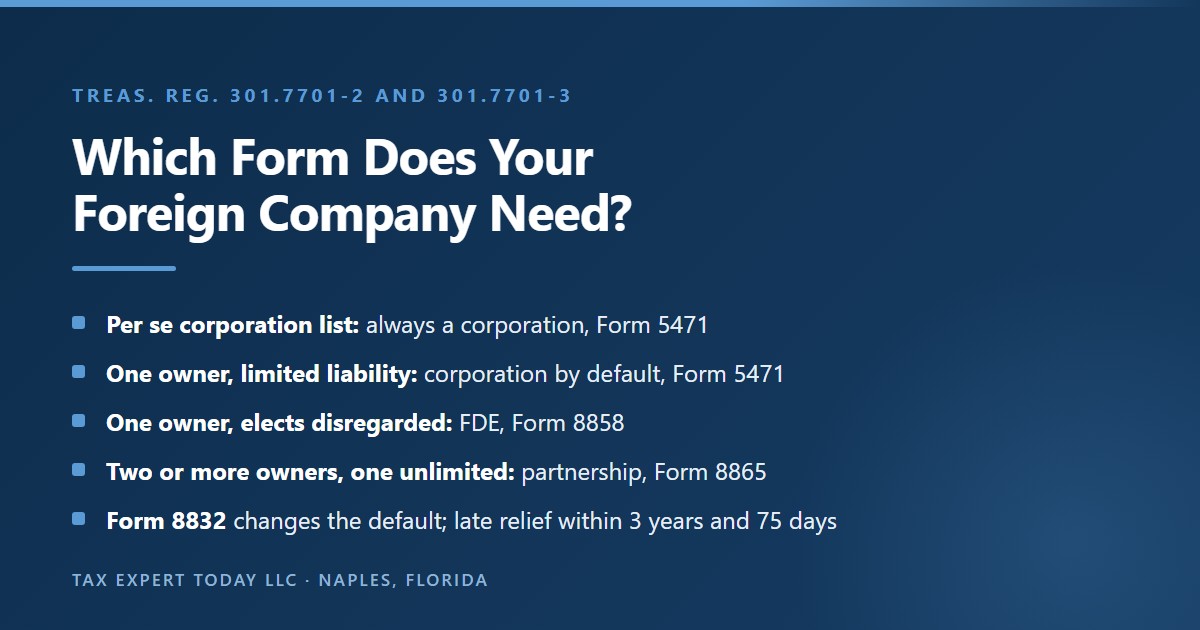
The starting point is Treasury Regulation section 301.7701-2(b)(8), which lists foreign entity types that are always treated as corporations. The list includes, for example, a Canadian corporation, a German Aktiengesellschaft, a French Societe Anonyme, a Brazilian Sociedade Anonima, and a European Societas Europaea. These “per se” corporations cannot elect to be disregarded, so a United States owner of one will look to Form 5471, not Form 8858.
Every other foreign business entity is an eligible entity, and Treasury Regulation section 301.7701-3(b)(2) sets its default classification. Unless the entity elects otherwise, a foreign eligible entity is a partnership if it has two or more members and at least one member does not have limited liability; an association, which is taxed as a corporation, if all members have limited liability; and disregarded as an entity separate from its owner if it has a single owner that does not have limited liability. Limited liability is judged under the foreign law that governs the entity, and in some cases its organizational documents.
That default rule surprises many owners. Most foreign private limited companies give their owners limited liability, so a single-owner private company abroad usually defaults to corporate status, not disregarded status. It becomes an FDE only if it files an election on Form 8832, Entity Classification Election, to be disregarded. The table below shows how the classification maps to the form the United States owner files.
| Foreign entity situation | Classification without an election | Information return usually involved |
|---|---|---|
| Entity type on the per se corporation list, for example a German Aktiengesellschaft or a French Societe Anonyme | Corporation; no election is available | Form 5471 |
| Single owner, and the owner has limited liability under foreign law, as with most private limited companies | Association taxed as a corporation | Form 5471, unless the entity elects to be disregarded |
| Single owner, and the owner does not have limited liability | Disregarded entity | Form 8858 |
| Single-owner eligible entity that elects disregarded status on Form 8832 | Disregarded entity from the election date | Form 8858 |
| Two or more members, all with limited liability | Association taxed as a corporation | Form 5471, unless the entity elects partnership status |
| Two or more members, at least one without limited liability | Partnership | Form 8865 |
The instructions add a practical point about elections. An eligible entity needs an employer identification number to file Form 8832, and a foreign entity that elects to become an FDE must have an EIN under the identification number regulations. When an election is late, Revenue Procedure 2009-41 provides relief for an eligible entity that files a late classification election within 3 years and 75 days of the requested effective date, if its conditions are met. Outside that window, relief generally requires a private letter ruling.
What is a foreign branch for Form 8858?
A foreign branch is an integral business operation carried on by a United States person outside the United States, judged on all the facts. For Form 8858, the term also includes a foreign qualified business unit, which is a trade or business conducted abroad with its own separate set of books and records.
- No entity is needed. A foreign branch can exist even when nothing was incorporated or registered abroad.
- Separate books matter. The instructions say the existence of separate books and records may affect whether an activity is a foreign branch.
- Individuals can have one. The definition applies to corporations, partnerships, trusts, estates, and individuals.
- Treaty status counts. Activities that form a permanent establishment under a treaty are deemed a foreign branch.
Foreign branches were added to Form 8858 for tax years beginning in 2018, and they are the part of the form that catches people off guard. The instructions define a foreign branch by reference to Treasury Regulation section 1.367(a)-6T(g), which describes “an integral business operation carried on by a U.S. person outside the United States.” Evidence of a branch includes, but is not limited to, a separate set of books and records and an office or other fixed place of business used by employees or officers abroad. The same regulation says that activities that constitute a permanent establishment under a tax treaty are deemed to be a foreign branch, and that any United States person, including an individual, can be treated as having one.
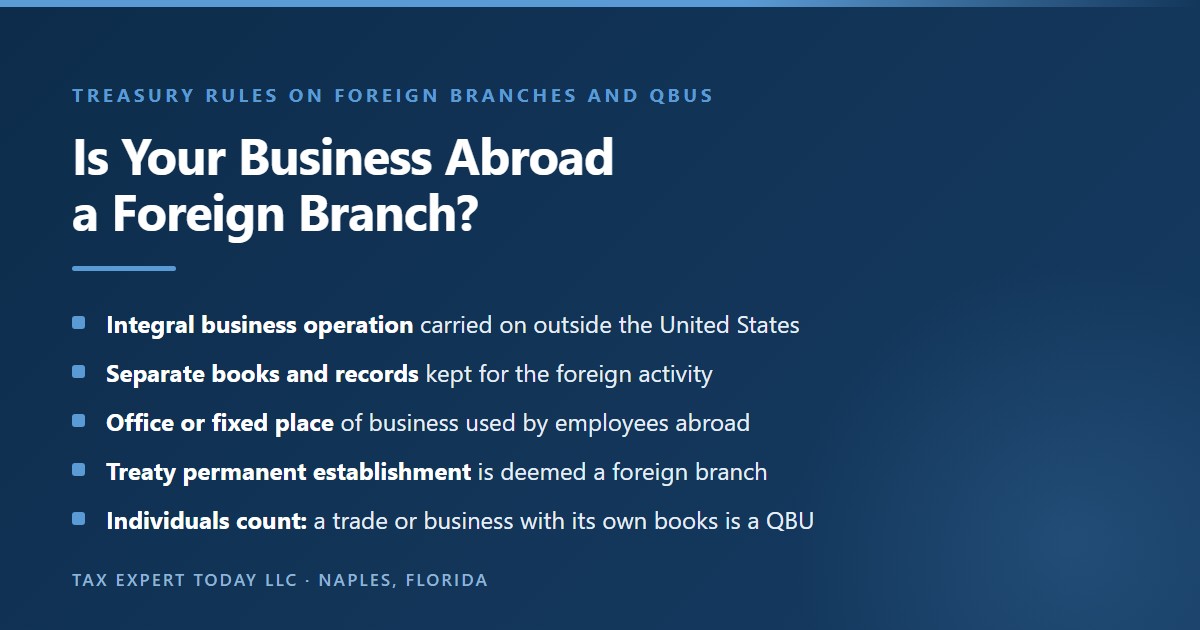
The instructions then widen the definition: “For purposes of filing a Form 8858, an FB also includes a qualified business unit (QBU) … that is foreign.” Under Treasury Regulation section 1.989(a)-1(b), a QBU is “any separate and clearly identified unit of a trade or business of a taxpayer provided that separate books and records are maintained.” An individual is not a QBU, but the activities of an individual qualify as a QBU if the activities constitute a trade or business and a separate set of books and records is kept for them. That is the rule that can bring a sole proprietor’s foreign operation onto Form 8858.
The question that comes up most often is whether a United States individual who reports self-employment income on Schedule C, and who works from abroad or keeps a foreign office, has a foreign branch. There is no single bright-line test, and the answer depends on the facts. The factors the regulations point to are the ones to examine first: whether the foreign activity is a trade or business in its own right, whether it keeps its own books and records, whether there is an office or fixed place of business abroad used by employees, and whether the activity would be a permanent establishment under a treaty. A freelancer who travels and invoices everything from a single set of United States books presents a very different picture from a business that runs a staffed office abroad with its own accounting records, local bank account, and local tax filings. Where the facts are close, the position taken on the return should be documented.
Who must file Form 8858?
A United States person must file Form 8858 if it is the tax owner of a foreign disregarded entity or operates a foreign branch, directly or through tiers of disregarded entities. Certain Form 5471 and Form 8865 filers must also file it when their foreign corporation or partnership owns an FDE or operates a foreign branch.
- Direct owners file the full form. Category 1 and category 2 filers complete Form 8858 and Schedule M.
- Some CFC and partnership owners file too. Categories 3 and 4 reach through foreign corporations and partnerships.
- Partners can be pulled in. Categories 5 and 6 cover certain partners in partnerships with FDEs or branches.
- Every type of United States person is covered. Citizens, resident aliens, domestic entities, estates, and domestic trusts.
The instructions define a United States person as a citizen or resident alien of the United States, a domestic partnership, a domestic corporation, any estate other than a foreign estate, and any domestic trust. Resident alien status follows the tax residency rules, so a green card holder or a person who meets the substantial presence test is a United States person for this purpose even if not a citizen.
Two definitions in the instructions decide who files. The “tax owner” of an FDE is “the person that is treated as owning the assets and liabilities of the FDE for purposes of U.S. income tax law.” The “direct owner” is “the legal owner of the disregarded entity.” Usually they are the same person. They differ when, for example, a foreign partnership legally owns one FDE, which legally owns a second FDE: the partnership is the tax owner of both, while the first FDE is the direct owner of the second.
The instructions sort filers into six categories. The December 2024 revision clarified categories 1 and 2, revised category 6, and repurposed category 5 for a new group of partners.
| Filer category | Who it covers | What to complete |
|---|---|---|
| Category 1 | A United States person that is directly the tax owner of an FDE or operates a foreign branch at any time during its tax year | The entire Form 8858 and the separate Schedule M |
| Category 2 | A United States person that, indirectly through one or more tiers of FDEs, is the tax owner of an FDE or operates a foreign branch | The entire Form 8858 and the separate Schedule M |
| Category 3 | Certain United States persons required to file Form 5471 for a controlled foreign corporation that is the tax owner of an FDE or operates a foreign branch | Category 4 Form 5471 filers: the entire form and Schedule M. Category 5 Form 5471 filers: page 1 identifying information and Schedules G, H, and J only |
| Category 4 | Certain United States persons required to file Form 8865 for a controlled foreign partnership that is the tax owner of an FDE or operates a foreign branch | Category 1 Form 8865 filers: the entire form and Schedule M. Category 2 Form 8865 filers: page 1, Schedules G, H, J, and Schedule M |
| Category 5 | A United States partner in a partnership that owns an FDE or operates a foreign branch, where the partnership’s section 987 method requires the partner to recognize section 987 gain or loss | Page 1 and Schedule C-1 for each FDE and foreign branch of the partnership |
| Category 6 | A United States corporation, other than a RIC, REIT, or S corporation, that is a partner in a partnership that checked box 11 (Dual Consolidated Loss) on Schedules K-2 and K-3 | Lines 1 through 5, Schedule G line 3, and its distributive share of Schedule G lines 10 through 13 |
Most individuals who encounter Form 8858 are category 1 filers: they own a foreign single-owner entity that is disregarded, or they run a business abroad that rises to the level of a foreign branch. Owners of foreign corporations meet the form a different way. When a controlled foreign corporation owns a disregarded subsidiary or runs a branch in another country, the United States shareholder attaches a Form 8858 for that FDE or branch to the Form 5471 it files for the corporation. For individual shareholders in that position, the related income inclusions are covered in our guide to GILTI for individual shareholders.
When is Form 8858 not required?
Form 8858 has no dollar threshold, so the exceptions are narrow. The main ones let one person file for others with the same requirement, allow a short summary filing for a dormant FDE, and excuse a category 2 Form 8865 filer when a category 1 filer completes the form. Activities that are not a branch need no form.
- Multiple filers. One person may file for others who have the same Form 8858 and Form 5471 or Form 8865 requirement.
- Dormant FDEs. Announcement 2004-4 allows a summary return with identifying information only.
- Category 2 partners. They are excused when a category 1 Form 8865 filer completes the full form and Schedule M.
- No branch, no form. An activity abroad that is not a foreign branch or foreign QBU does not trigger the form.
The multiple filer rule applies to category 4 and 5 filers of Form 5471 and category 1 filers of Form 8865 who also must file Form 8858. One person may file Form 8858 and Schedule M for the others, and the information may be filed with the multiple filer information for the controlled foreign corporation or partnership. The instructions add a warning in the penalty section: a person who agrees to have another person file the form may still be subject to the penalties if the other person does not file a correct and proper form.
The dormant FDE procedure comes from Announcement 2004-4, the same announcement that introduced Form 8858 for annual accounting periods beginning on or after January 1, 2004. A dormant FDE is one that would be a dormant controlled foreign corporation if it were treated as a foreign corporation. If the summary procedure is elected, the filer completes only the identifying information before Schedule C on page 1 and labels the top margin “Filed Pursuant to Announcement 2004-4 for Dormant FDE.” A dormant company that holds a bank account or simply exists is the typical case, but the dormant controlled foreign corporation definition has its own limits that should be checked before relying on the summary filing.
What is not an exception is just as important. There is no exception for a small FDE, an FDE that lost money, an FDE owned for part of the year, or an FDE that has no United States tax effect because its income is already on the owner’s return. The instructions also require a separate Form 8858 for each FDE or branch, and they say that when an FDE is formed and terminated in the same tax year, even on the same day, two forms are required: one marked initial and one marked final.
What does Form 8858 report?
Form 8858 reports who owns the FDE or branch, where it operates, its functional currency, an organizational chart, an income statement, a balance sheet, foreign taxes, other information, its taxable income or earnings, and, on Schedule M, its transactions with the filer and related parties. Section 987 currency gain or loss is reported on Schedule C-1.
- Page 1 identifies everyone. The FDE or branch, its tax owner, and its direct owner, each with an identifying number.
- An organizational chart is required. It shows the ownership chain, classifications, and countries of organization.
- Financial statements follow U.S. GAAP. Schedules C and F use functional currency and U.S. dollar columns.
- Related-party flows go on Schedule M. Sales, services, loans, and other transactions with related entities.
The first page asks for the FDE or branch’s name and address, its identifying number, the country where its principal business activity is conducted, a six-digit principal business activity code, a description of the activity, and its functional currency as a three-letter ISO 4217 code. An FDE generally enters an EIN on line 1b(1). A foreign branch, which does not file Form 8832, may not have an EIN, and then enters a reference ID number on line 1b(2). The filer creates the reference ID number; it must be alphanumeric, no longer than 50 characters, used consistently from year to year, and never reused for a different entity. The instructions also say not to enter a Social Security number on lines 1b(1) or 1b(2).
Line 5 requires an organizational chart showing the chain of ownership between the tax owner and the FDE or branch, and between the FDE or branch and every entity in which it has a 10 percent or greater direct or indirect interest, with names, ownership percentages, tax classifications, and countries of organization. The schedules then break down as follows.
| Schedule | What it reports | Points to watch |
|---|---|---|
| Schedule C, Income Statement | Summary income statement in functional currency and U.S. dollars under U.S. GAAP | The average exchange rate under section 989(b) may be used if U.S. GAAP statements in dollars are not kept; check the box above line 1 |
| Schedule C-1, Section 987 Gain or Loss | Section 987 gain or loss for a QBU whose functional currency differs from its owner’s | Separate Schedule C-1 for each QBU and each owner; statements required for recognized and deferred amounts |
| Schedule F, Balance Sheet | Summary balance sheet translated into U.S. dollars under U.S. GAAP | Special rules apply if the entity uses DASTM for a hyperinflationary currency |
| Schedule G, Other Information | Yes or no questions on QBU status, base erosion payments, dual consolidated losses, and global minimum taxes | Line 14 asks whether the FDE or branch paid a QDMTT, IIR, or UTPR top-up tax |
| Schedule H, Current Earnings and Profits or Taxable Income | Book income adjusted to U.S. tax principles, translated at the average rate | Attach a schedule listing each adjustment; blocked income cannot reduce the amount |
| Schedule I, Transferred Loss Amount | Branch losses recaptured under section 91 when a domestic corporation transfers a branch to a foreign corporation | Completed only for FDEs or branches owned by a domestic corporation, not by a CFC |
| Schedule J, Income Taxes Paid or Accrued | Foreign income taxes by country, foreign tax year, and separate category | Adjustments are reported in the year to which the tax relates, which may require an amended return |
| Schedule M (separate schedule) | Transactions between the FDE or branch and the filer or other related entities | Lines 20 and 21 report the largest outstanding loan balances during the year, not year-end balances |
Not every filer completes every schedule. Lines 7 and 8 of Schedule G, which ask about base erosion payments, are skipped by an individual who owns the FDE or branch directly or through tiers of FDEs and branches. Lines 10 through 13, on dual consolidated losses, are completed only when the tax owner is a United States corporation other than a RIC, REIT, or S corporation. Schedule I applies only when a domestic corporation owns the FDE or branch. For a typical individual with one foreign disregarded company, the core of the form is page 1, the organizational chart, Schedules C, F, G, H, and J, and Schedule M if there were related-party transactions.
The IRS estimate of the work involved is worth noting. The paperwork notice in the instructions estimates 25 hours and 49 minutes of recordkeeping, 4 hours and 46 minutes of learning about the law or the form, and 5 hours and 24 minutes of preparing and sending Form 8858, plus about 24 hours of recordkeeping for Schedule M. Those are IRS averages, not a prediction for any particular filer, but they explain why the form should be planned for well before the return is due.
When and where is Form 8858 due?
Form 8858 is due when the filer’s income tax return or information return is due, including extensions. The tax owner attaches it, with Schedule M if required, to its own return. A filer that is not the tax owner attaches it to the Form 5471 or Form 8865 filed for the foreign corporation or partnership that is the tax owner.
- Individuals. Attached to Form 1040, due April 15 or the extended October 15 date.
- Calendar-year corporations. Attached to Form 1120, due with the corporate return including extensions.
- Partnerships. Attached to Form 1065 when the partnership is the tax owner or runs the branch.
- Electronic filing. E-filed Forms 1120 and 1065 carry Form 8858 electronically; e-filed Forms 1040 attach it to Form 8453.
The timing rule is simple, but it has a consequence. Because Form 8858 rides with the return, a return filed without it is treated as missing the required information even if the income from the FDE was fully reported. The instructions also require consistency in the annual accounting period: the period reported for an FDE or branch is the tax year of the United States tax owner, or the annual accounting period of the controlled foreign corporation or partnership that is the tax owner.
For e-filers, the instructions say that a Form 1120 or Form 1065 filed electronically must include Form 8858 as an electronic attachment, while a filer of Form 1040, Form 1040-SR, or Form 1041 that files electronically attaches Form 8858 to the applicable Form 8453. A computer-generated Form 8858 may be filed only if it conforms to the official form, and the instructions say that computer-generated forms generally require prior approval from the IRS under Publication 1167.
What are the penalties for not filing Form 8858?
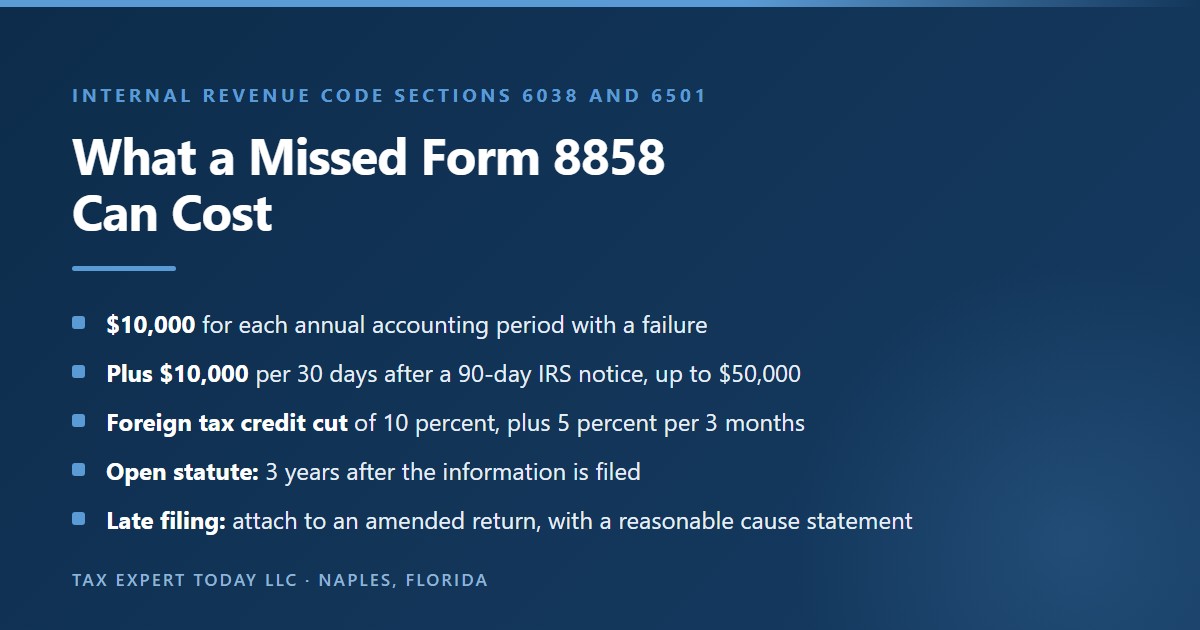
The instructions describe a $10,000 penalty for each annual accounting period for failing to file the required information on time, plus $10,000 for each 30 days the failure continues more than 90 days after an IRS notice, up to $50,000 more. Foreign tax credits can be cut by 10 percent, and the assessment period can stay open.
- Initial penalty. $10,000 for each annual accounting period with a failure.
- Continuation penalty. $10,000 per 30-day period after the 90-day notice window, capped at $50,000.
- Foreign tax credit reduction. 10 percent, plus 5 percent for each 3-month period after the notice window, subject to limits.
- Open statute. Section 6501(c)(8) can keep the return open until 3 years after the information is furnished.
The penalty provisions are in 26 U.S.C. section 6038. Section 6038(b)(1) imposes a penalty of $10,000 “for each annual accounting period with respect to which such failure exists” when a person fails to furnish required information on time. Section 6038(b)(2) adds $10,000 for each 30-day period, or fraction of one, that the failure continues more than 90 days after the IRS mails a notice of the failure, and caps that increase at $50,000. Section 6038(c) separately reduces the foreign taxes available for credit by 10 percent, with an additional 5 percent for each 3-month period the failure continues after the 90-day notice window, subject to the limits in section 6038(c)(2).
A note on scope is important here. The statute defines the “foreign business entity” subject to section 6038 as a foreign corporation or a foreign partnership, and the Form 8858 instructions describe the $10,000 penalty “for each annual accounting period of each CFC or CFP.” That fits the Form 5471 and Form 8865 filers who report FDEs and branches of their foreign corporations and partnerships. A United States person who owns an FDE directly files Form 8858 to satisfy the reporting rules of sections 6011, 6012, 6031, and 6038 and the related regulations, and the exact penalty exposure in that setting depends on the filer’s category and facts. That is not a reason to treat the form as optional: the information is required, the instructions list criminal penalties under sections 7203, 7206, and 7207 for failing to file information required by section 6038, and any related tax understatement carries its own penalties.
The quieter consequence is often the larger one. Under 26 U.S.C. section 6501(c)(8)(A), when information required under section 6038 and the other listed international reporting sections is not furnished, the time to assess “any tax imposed by this title with respect to any tax return, event, or period to which such information relates shall not expire before the date which is 3 years after the date on which the Secretary is furnished the information.” If the failure is due to reasonable cause and not willful neglect, section 6501(c)(8)(B) limits the open period to the items related to the failure.
| Consequence | Amount or effect | Authority |
|---|---|---|
| Failure to furnish required information on time | $10,000 for each annual accounting period | 26 U.S.C. 6038(b)(1) |
| Failure continuing more than 90 days after IRS notice | $10,000 for each 30-day period or fraction, up to $50,000 more | 26 U.S.C. 6038(b)(2) |
| Reduction of foreign tax credit | 10 percent, plus 5 percent per 3-month period after the notice window, subject to limits | 26 U.S.C. 6038(c) |
| Assessment period stays open | Until 3 years after the information is furnished; limited to related items if reasonable cause applies | 26 U.S.C. 6501(c)(8) |
| Criminal penalties | May apply for failure to file information required by section 6038 | 26 U.S.C. 7203, 7206, 7207 |
A hypothetical shows how the dollar penalties scale. Suppose a filer subject to the section 6038 penalty missed the Form 8858 for one FDE for three tax years. The initial penalty would be $10,000 for each year, or $30,000. If the forms were still not filed 90 days after an IRS notice, and the failure continued another 150 days, five 30-day periods would add $50,000 for each year, the maximum increase. If the filer also claimed $20,000 of foreign tax credits in one of those years, a 10 percent reduction would remove $2,000 of credit for that year. The figures are illustrations of how the statute works, not an estimate of what the IRS would assess in any case, and reasonable cause can be raised where the facts support it.
How do functional currency and section 987 affect Form 8858?
Every FDE and foreign branch reports in its functional currency, usually the currency of its main economic environment, and translates into U.S. dollars at rates set by the instructions. Exchange rates must be reported as foreign currency units per dollar. When the owner’s currency differs, section 987 gain or loss is reported on Schedule C-1.
- Use an ISO code. Lines 1j, 3e, and 4d take a three-letter ISO 4217 alphabet code such as EUR or GBP.
- Divide, do not multiply. Rates are reported as units of foreign currency per one U.S. dollar, rounded to at least four places.
- Average rate for income. Schedule H income is translated at the average exchange rate for the year under section 989(b).
- Section 987 can apply to individuals. The section 987 regulations apply to any individual or corporation, other than excluded foreign persons.
The instructions are specific about exchange rates. All rates are reported using a “divide-by convention,” meaning the number of units of foreign currency that equal one U.S. dollar, rounded to at least four places. The instructions illustrate with an FDE that earned 30,255,400 Japanese yen at an average rate of 105.7846 yen to the dollar: the filer divides the yen amount by 105.7846 and enters 105.7846 as the rate. Reporting the inverse rate, dollars per unit of foreign currency, is an error the instructions specifically warn against.
Here is a hypothetical in euros. A Naples, Florida consultant owns a single-member Irish company that elected disregarded status. For the year, the company’s Schedule H taxable income in its functional currency is 180,000 euros, and assume the average exchange rate for the year is 0.9235 euros per U.S. dollar. Dividing 180,000 by 0.9235 gives $194,911, rounded, which is the dollar amount on Schedule H, line 7, and 0.9235 is entered as the rate. Because the company is disregarded, that income is also reported on the owner’s own return, and the Irish tax the company paid is listed on Schedule J and may support a foreign tax credit on Form 1116, which is covered in our Form 1116 guide. The rate is assumed for illustration only.
Section 987 is the more technical layer. When an FDE or branch is a QBU with a functional currency different from its owner’s, the owner may recognize currency gain or loss on remittances and terminations under 26 U.S.C. section 987. Treasury Regulation section 1.987-1(b)(1) provides that, with limited exceptions for persons who are not United States persons and certain foreign corporations, any individual or corporation is subject to the section 987 regulations. The current regulations, and the related QBU rule in Regulation section 1.989(a)-1(b)(4), generally apply to taxable years beginning after December 31, 2024, unless a taxpayer chose to apply them earlier. For a calendar-year filer, that means the 2025 return filed in 2026 is the first year the current rules generally govern. Schedule C-1 reports recognized section 987 gain or loss on line 2b and deferred amounts on line 3b, each with a supporting statement, and line 5 asks for a statement if the owner changed its method of accounting for section 987.
How does Form 8858 fit with Forms 5471, 8865, 8938, and the FBAR?
Form 8858 covers disregarded entities and branches; Form 5471 covers foreign corporations; Form 8865 covers foreign partnerships. Owning an FDE can also trigger the FBAR for its accounts and can affect Form 8938. Each form has its own trigger and penalty, and filing one rarely satisfies another.
- Classification picks the entity form. Corporation, partnership, or disregarded entity decides between 5471, 8865, and 8858.
- Accounts are separate. Foreign bank accounts of an FDE can create FBAR filing duties for the owner.
- Form 8938 is a separate test. It applies to specified foreign financial assets above its own thresholds.
- Inbound is different. Form 5472 covers foreign-owned United States entities, the reverse situation.
| Form | What triggers it | Relationship to Form 8858 |
|---|---|---|
| Form 8858 | Tax owner of an FDE, or operating a foreign branch, directly or through certain CFCs and partnerships | The form this guide covers |
| Form 5471 | Certain ownership of, or control over, a foreign corporation (see IRS: About Form 5471) | A CFC’s FDEs and branches are reported on Forms 8858 attached to the Form 5471 |
| Form 8865 | Certain interests in a foreign partnership | A controlled foreign partnership’s FDEs and branches are reported on Forms 8858 attached to the Form 8865 |
| Form 8832 | An eligible entity choosing a classification other than its default | The election that turns a single-owner foreign company into an FDE |
| FinCEN Form 114 (FBAR) | Financial interest in or signature authority over foreign financial accounts above $10,000 in aggregate | The FDE’s foreign bank accounts are a separate reporting question |
| Form 8938 | Specified foreign financial assets above the filing thresholds | Coordinates with other international forms; some items reported elsewhere are not duplicated |
| Form 5472 | A foreign-owned United States corporation, or a foreign-owned domestic disregarded entity | The inbound mirror image: a foreign owner of a United States entity, not a United States owner of a foreign one |
The account question deserves its own look. An FDE often holds a bank account in its home country, and a United States owner may have a financial interest in that account or signature authority over it. The FBAR threshold and who must file are covered in our FBAR filing guide, signature authority is covered in our FBAR signature authority guide, and the overlap with Form 8938 is covered in our FBAR vs Form 8938 comparison. For readers who arrived here because a foreign person owns a United States LLC, the right form is the one in our Form 5472 guide, not Form 8858.
Treaty positions can also connect to Form 8858. Whether a business abroad is a permanent establishment under a treaty matters for foreign branch status, and a return position that relies on a treaty may need its own disclosure, which is explained in our Form 8833 guide.
What if you did not file Form 8858 in past years?
The IRS now tells taxpayers who are not under examination or investigation, and who have not been contacted about the delinquent returns, to file late international information returns through normal filing procedures, attached to an amended income tax return. A reasonable cause statement may be attached, but penalties may be assessed without considering it.
- Attach to an amended return. Delinquent Forms 8858 go with an amended income tax return under its instructions.
- Reasonable cause is still relevant. A statement can be attached, though the IRS may assess first and review later.
- Unreported income changes the path. Streamlined procedures exist only where the failure was non-willful.
- Contact first changes everything. The normal filing route is described for taxpayers the IRS has not already contacted.
The IRS page that once described the Delinquent International Information Return Submission Procedures now reads as guidance for anyone with a delinquent international information return. As of its April 2026 update, the IRS page on delinquent international information returns says that taxpayers who are not under a civil examination or a criminal investigation, and who have not already been contacted by the IRS about the delinquent returns, “should file the delinquent information returns through normal filing procedures.” It adds that penalties may be assessed in accordance with existing procedures, and that all delinquent international information returns other than Forms 3520 and 3520-A should be attached to an amended income tax return.
On reasonable cause, the same page says taxpayers may attach a reasonable cause statement to each delinquent information return, but that “penalties may be assessed without considering the attached reasonable cause statement,” and taxpayers may need to respond to IRS correspondence and resubmit the reasonable cause information. Only for Forms 3520 and 3520-A does the page say the statement will be considered before a penalty is assessed. For Form 8858, that means the practical plan includes preparing the reasonable cause narrative carefully at the time of filing and being ready to support it again in response to a notice. The page also says amended returns are not automatically subject to audit but may be selected through the normal audit selection processes.
A separate question is whether income was also left off the returns. If the FDE or branch income was reported correctly and only the information return is missing, the late-filing route above is the usual starting point. If income was not reported, the Streamlined Filing Compliance Procedures may be available, but only to individuals whose failure was non-willful, and each requires a certification of non-willful conduct under penalty of perjury. A taxpayer whose conduct was willful should not use the streamlined procedures, because a false certification creates its own exposure. The program and its certification are explained in our streamlined filing guide. Missing FBARs follow their own rules, which changed on July 1, 2026, as described in our guide to filing a late FBAR, and the penalties for those are explained in our FBAR penalties guide.
Two technical points often matter in catch-up work. First, the statute of limitations under section 6501(c)(8) can make older years relevant even when the general three-year period would have closed, so the number of years to correct is a facts question. Second, if a foreign company was supposed to be disregarded but its Form 8832 election was never filed, the company may have been a foreign corporation all along, which changes the form to Form 5471 and can change the income computation. Revenue Procedure 2009-41 may allow a late election if the request is made within 3 years and 75 days of the intended effective date and its other conditions are met.
What records do you need to prepare Form 8858?
Preparing Form 8858 requires the FDE or branch’s organizing documents and classification history, an ownership chart, financial statements in its functional currency, exchange rates, foreign tax returns and payments, a record of related-party transactions and loan balances, and the books and records that support branch or QBU status.
- Classification history. The entity type, the country of organization, and any Form 8832 election with its effective date.
- Financial statements. An income statement and balance sheet, ideally maintained under or reconciled to U.S. GAAP.
- Currency data. The functional currency and the average and spot rates used, in the divide-by format.
- Related-party detail. Every transaction with the owner and related entities, and the largest loan balances during the year.
| Record | Where it is used on Form 8858 | Typical source |
|---|---|---|
| Certificate of formation or registration and governing documents | Page 1 identifying information; classification analysis | Foreign company registry, formation agent, or local counsel |
| Form 8832 and IRS acceptance letter, or evidence of default classification | Confirms FDE status and the EIN on line 1b(1) | Owner’s files or prior preparer |
| Ownership chart with percentages and classifications | Line 5 organizational chart | Prepared for the return from the ownership records |
| Income statement and balance sheet in functional currency | Schedules C, F, and H | Foreign bookkeeper or accountant; local statutory accounts |
| Average and year-end exchange rates | Schedules C, F, H, J, and M | A consistently applied published rate source |
| Foreign income tax returns, assessments, and payment records | Schedule J; foreign tax credit on Form 1116 or Form 1118 | Foreign tax authority filings and bank records |
| Intercompany invoices, loan agreements, and monthly loan balances | Schedule M, including the largest outstanding balances on lines 20 and 21 | Accounting records of both the owner and the FDE or branch |
| Separate books, office lease, and payroll records abroad | Supports or refutes foreign branch and QBU status | Business records of the foreign operation |
The records list is also an early warning. If the foreign operation has no separate books, the branch analysis needs attention. If no Form 8832 can be found for a company that has been treated as disregarded, the classification needs attention before anything else, because the wrong classification changes every number on the return. If loans moved back and forth between the owner and the FDE, Schedule M needs the largest balance during the year, which requires more than a year-end statement.
Does Florida have its own Form 8858 requirement?
No. Form 8858 is a federal information return, and Florida does not impose a personal income tax, so an individual living in Naples, Florida reports FDE and branch information only on the federal return. A Florida corporation that owns an FDE or foreign branch should review the Florida corporate income tax treatment separately.
- Federal only for individuals. No Florida personal income tax return means no state copy of Form 8858.
- Residency still matters federally. A move to Florida from abroad can make a person a United States person for the first time.
- Corporations differ. Florida corporate income tax starts from federal figures, so a corporate owner should check the state treatment.
- Foreign countries have their own rules. The FDE also files whatever its home country requires.
The Florida question usually comes up in one of two ways. Some clients are new residents who became United States persons on arrival, through a green card or the substantial presence test, and who already owned a foreign company in their home country. Their first Form 8858, or Form 5471 if the company is a corporation, may be due with their first full United States return. Others are United States citizens who set up a foreign company while living abroad and moved to Southwest Florida without changing the structure. In both cases, the foreign company’s classification and reporting should be reviewed as part of the move, not after the first return is filed. Readers in that position may also find our guide to the foreign earned income exclusion versus the credit useful for the income side of the return.
Form 8858 Help in Naples & Southwest Florida
Tax Expert Today LLC works with international clients from an office in Naples, Florida, and serves clients in all 50 states. Collier and Lee counties are home to business owners who kept companies in Canada, Europe, and Latin America after moving here, consultants who run operations abroad, and United States citizens who returned from years overseas with a foreign entity still in place.
- Form 8858 help Naples: confirming whether a foreign company is an FDE, a corporation, or a partnership, and preparing one form per entity or branch.
- Foreign disregarded entity tax Naples FL: reviewing Form 8832 elections, EINs, and reference ID numbers before the return is filed.
- International tax Naples FL: testing foreign branch and QBU status for businesses that operate abroad.
- Foreign branch reporting Naples: coordinating Form 8858 with Form 5471, Form 1116, the FBAR, and Form 8938.
Our international and expat tax services page explains how we approach cross-border engagements for owners of foreign entities, and our Naples tax planning page covers the broader planning work for Southwest Florida residents.
Office: 11983 Tamiami Trail N, Naples FL 34110
Phone: (239) 441-2005
Hours: Monday through Friday, 10:00 to 5:00 ET
Frequently Asked Questions
I moved to Naples and still own a one-person company in my home country. Do I need Form 8858?
It depends on how the company is classified. If it is disregarded for federal tax purposes, generally yes, once you are a United States person. Many single-owner foreign private companies default to corporate status, which points to Form 5471 instead, unless a Form 8832 election made them disregarded. The classification should be confirmed first.
Is there a minimum amount before Form 8858 is required?
No. Form 8858 has no dollar threshold. A small FDE, a loss-making FDE, or one owned for part of the year still generally requires the form. The limited relief that exists is a summary filing procedure for dormant FDEs under Announcement 2004-4 and the rules that let one person file for others with the same requirement.
Do I need Form 8858 if I work remotely from another country?
Not automatically. A foreign branch requires an integral business operation abroad, and the QBU rule requires a trade or business with separate books and records. Separate books, a fixed office used by employees, local tax filings, or a treaty permanent establishment point toward a branch. The answer depends on the facts and should be documented.
What is the penalty for not filing Form 8858?
The instructions describe a $10,000 penalty for each annual accounting period, plus up to $50,000 more if the failure continues after an IRS notice, along with a possible 10 percent reduction of foreign tax credits. Section 6501(c)(8) can also keep the assessment period open until three years after the information is filed.
Is Form 8858 the same as Form 5472?
No. Form 8858 is filed by a United States person that owns a foreign disregarded entity or runs a foreign branch. Form 5472 is filed for a foreign-owned United States corporation or a foreign-owned United States disregarded entity. They cover opposite directions: outbound ownership on Form 8858, inbound ownership on Form 5472.
How do I file Form 8858 for past years I missed?
The IRS currently directs taxpayers who have not been contacted and are not under examination to attach delinquent international information returns to an amended income tax return through normal filing procedures. A reasonable cause statement may be attached, although penalties may be assessed before it is considered. Unreported income may call for a different path.
When to Engage a Professional
Form 8858 is short to describe and demanding to complete. The classification question comes first and affects everything after it: the same foreign company can be an FDE, a corporation, or a partnership depending on its entity type, its owners’ liability, and whether a Form 8832 election was filed. The form then requires GAAP-based financial statements in two currencies, divide-by exchange rates, a related-party schedule built on the largest loan balances during the year, and, for owners with a different functional currency, section 987 computations under regulations that generally apply for the first time to 2025 returns.
A professional review is worth considering if you became a United States resident while owning a foreign company, if you formed or elected a foreign disregarded entity, if your business has an office, staff, or separate books abroad, if you own a foreign corporation that has its own subsidiaries or branches, or if you discovered that past returns were filed without Form 8858. The right time to review the structure is before the first return that reports it.
Tax Expert Today LLC is a tax advisory firm in Naples, Florida serving clients in all 50 states. Call (239) 441-2005 to discuss your facts.
Primary Sources
- IRS: About Form 8858, Information Return of U.S. Persons With Respect to FDEs and FBs
- IRS: Instructions for Form 8858 (Rev. December 2024)
- 26 U.S.C. section 6038 (information reporting and penalties)
- Treasury Regulation section 301.7701-3 (classification of eligible entities)
- Treasury Regulation section 1.367(a)-6T (definition of foreign branch)
- IRS: What to do about a delinquent international information return
This article is general information, not advice for any particular taxpayer, and does not create a client relationship. The penalty and currency figures are hypothetical illustrations only; the exchange rate used is assumed, and the penalty example assumes a filer subject to the section 6038 dollar penalty and ignores reasonable cause, interest, and any related tax. The rules described here reflect the December 2024 Instructions for Form 8858, the IRS guidance on delinquent international information returns as updated in April 2026, and the Code and regulations as of the date of writing. Entity classification, foreign branch status, and section 987 positions depend on the specific facts. Verify current rules and confirm your own facts with a qualified tax professional before filing or making an election.
Published October 2, 2026 by Dr. Pellumb Kabashi « Back to Learning Center
Have a question this article touches on?
Tax Expert Today LLC, based in Naples, Florida and serving clients across the United States.
Schedule a Consultation (239) 441-2005