
By Dr. Pellumb Kabashi, DBA, MBA, EA, CFE, CES
Founder, Tax Expert Today LLC · Tax advisors, enrolled agents, CPAs, and attorneys · Serving clients in all 50 states
Quick Answer: A qualified domestic trust (QDOT) lets an estate claim the marital deduction for property left to a surviving spouse who is not a U.S. citizen. The estate tax is deferred, not removed: principal distributions and the trust balance at the spouse’s death are taxed at the first spouse’s rates. The 2026 exemption is $15,000,000. Call (239) 441-2005 for a free consultation.
What is a qualified domestic trust?
A qualified domestic trust is a trust that holds property left to a surviving spouse who is not a U.S. citizen so the first spouse’s estate can still claim the estate tax marital deduction. It needs a U.S. trustee who can withhold tax, an executor’s election on Form 706, and it defers the estate tax rather than removing it.
- Why it exists: section 2056(d) denies the unlimited marital deduction when the surviving spouse is not a U.S. citizen, and a qualified domestic trust is the statutory way back in.
- What it defers: the estate tax the first spouse’s estate would otherwise owe on property passing to the spouse.
- When tax is collected: on principal distributions during the spouse’s life and on the trust balance at the spouse’s death.
- What reports it: the executor elects on Form 706, and the trustee later files Form 706-QDT.
When a married U.S. citizen or U.S. domiciliary dies, property left to a surviving spouse who is a U.S. citizen generally qualifies for an unlimited marital deduction, so no federal estate tax is due until the second spouse dies. Congress treated a non-citizen spouse differently. Under 26 U.S.C. section 2056(d)(1), if the surviving spouse is not a citizen of the United States, no marital deduction is allowed, and the special half-inclusion rule for spousal joint property in section 2040(b) does not apply either. The concern is collection. A spouse who is not a citizen can leave the country with the inherited property, and the United States may never be able to tax it at the second death.
The qualified domestic trust is the compromise written into 26 U.S.C. section 2056A. Property that passes to the spouse in a qualified domestic trust is treated as qualifying for the marital deduction, so the first estate pays nothing on it at the first death. In exchange, the property stays inside a trust with a U.S. trustee, and an estate tax is imposed later on principal that comes out of the trust and on whatever is left when the surviving spouse dies. The tax is computed as though the property had been added to the first spouse’s taxable estate, which is why practitioners describe the QDOT tax as a deferred estate tax of the first spouse rather than a tax on the survivor.
This guide explains the mechanics in the order an executor and family actually meet them: whether a qualified domestic trust is needed at all in 2026, what the trust instrument must say, the security rules that apply above and below $2 million, how the deferred tax is computed, what Form 706-QDT reports and when, the post-death options, retirement accounts, the spouse who later naturalizes, and the Canada United States treaty credit that often makes a qualified domestic trust unnecessary for a Canadian spouse. It is written for families in Southwest Florida, where many couples include one spouse who holds Canadian, British, German, or another foreign citizenship. The drafting of the trust instrument itself is legal work for an estate planning attorney, and this article describes the tax rules that the instrument has to satisfy.
Why does a non-citizen spouse lose the unlimited marital deduction?
Section 2056(d)(1) disallows the estate tax marital deduction whenever the surviving spouse is not a U.S. citizen, regardless of whether that spouse holds a green card or lives in the United States. Citizenship, not residence or immigration status, controls. The only routes back to a deduction are a QDOT or the spouse becoming a citizen before the return is filed.
- Green card holders included: a lawful permanent resident spouse is still a non-citizen for this rule.
- Joint property affected: the 2040(b) rule that includes only half of spousal joint property does not apply.
- Gift side mirrors it: section 2523(i) denies the gift tax marital deduction for gifts to a non-citizen spouse.
- Two exits: a qualified domestic trust under 2056(d)(2), or citizenship before the return under 2056(d)(4).
The statute is short. Section 2056(d)(1) says that, except as provided in paragraph (2), if the surviving spouse of the decedent is not a citizen of the United States, no deduction is allowed under subsection (a) and section 2040(b) does not apply. Paragraph (2) then carves out property passing to the surviving spouse in a qualified domestic trust. Paragraph (4) carves out the case where the surviving spouse becomes a citizen before the estate tax return is made and was a U.S. resident at all times after the death. Everything else in this area is built on those three provisions.
The rule turns on the surviving spouse’s citizenship, not the decedent’s. A non-citizen decedent who leaves property to a U.S. citizen spouse can claim the marital deduction in the ordinary way. A U.S. citizen decedent who leaves property to a spouse with a green card cannot, unless a qualified domestic trust or the citizenship exception applies. Immigration status, the length of the marriage, and the place the couple lives do not change the answer. A couple that has lived in Naples, Florida for twenty years, with one spouse holding a Canadian passport and a green card is inside the rule.
The disallowance matters only if the estate would owe tax without the deduction. In 2026 the basic exclusion amount is $15,000,000 per person under Revenue Procedure 2025-32, which reflects the increase enacted in 2025. Many estates that leave everything to a non-citizen spouse therefore owe nothing even with no marital deduction at all, because the exclusion absorbs the whole estate. The QDOT question becomes real for estates above the exclusion, for decedents who used part of their exclusion on lifetime gifts, and for families who expect the estate to grow. For a fuller explanation of how lifetime gifts reduce the exclusion available at death, see our guide to the lifetime gift tax exemption in 2026.
Who needs a qualified domestic trust in 2026?
A qualified domestic trust is generally worth considering when the first spouse’s taxable estate, plus adjusted taxable gifts, exceeds the $15,000,000 basic exclusion for 2026 and the surviving spouse will not be a U.S. citizen by the time the estate tax return is filed. Below the exclusion, the estate usually owes no tax, so the deduction is not needed.
- Estate above $15,000,000: the portion above the exclusion would be taxed at 40 percent without a QDOT or a treaty credit.
- Large lifetime gifts: prior taxable gifts reduce the exclusion left at death and can push a smaller estate into tax.
- Growth expected: a plan written today may need a qualified domestic trust option if the estate grows before death.
- Treaty spouse: a Canadian citizen spouse may be better served by the treaty marital credit than by a qualified domestic trust.
The exclusion amount drives the analysis. Before the 2025 legislation, the exclusion had been scheduled to fall by roughly half at the start of 2026, and much of the older material on QDOTs was written with that drop in mind. It did not happen. Revenue Procedure 2025-32 states that the basic exclusion amount is $15,000,000 for calendar year 2026, with inflation adjustments for later years. Some pages still describe a 2026 exemption below that figure or warn of a coming cut, and readers should check the date and the figure on anything they rely on.
The table below shows how the need for a qualified domestic trust changes with the size of the estate and the facts. The figures are hypothetical and assume the first spouse is a U.S. citizen domiciled in Florida, made no prior taxable gifts, and leaves the estate to a non-citizen spouse.
| Hypothetical situation (2026 death) | Tax without any marital deduction | Is a QDOT likely to matter? |
|---|---|---|
| Taxable estate of $4,000,000 | None; the $15,000,000 exclusion covers it | Usually not, although the plan may keep a qualified domestic trust option for growth |
| Taxable estate of $14,000,000 with no prior gifts | None | Usually not today; revisit if the estate grows |
| Taxable estate of $9,000,000 after $8,000,000 of prior taxable gifts | Tax on about $2,000,000 at 40 percent | Yes, unless a treaty credit or citizenship applies |
| Taxable estate of $21,000,000 | $2,400,000 due nine months after death | Yes; a qualified domestic trust can defer the tax on the $6,000,000 excess |
| Taxable estate of $21,000,000 and the spouse is a Canadian citizen | Possibly none if the treaty marital credit is elected | Compare the treaty election with a qualified domestic trust before choosing |
Two further situations push families toward a qualified domestic trust even when the estate sits near the exclusion. The first is valuation risk. A Florida home, a closely held business, or a real estate portfolio may be valued higher on examination than on the return, and a QDOT election made on a protective basis can preserve the deduction if values rise. The second is the plan written years before death. A will or revocable trust signed today has to work at a death that may happen in ten or twenty years, when the estate and the law may both be different, so many estate planning attorneys include QDOT provisions or a standby QDOT that the executor can use if needed.
What are the requirements for a qualified domestic trust?
A qualified domestic trust must have at least one trustee who is a U.S. citizen or domestic corporation, must bar principal distributions unless that trustee can withhold the QDOT tax, must meet the Treasury security regulations, must otherwise qualify for the marital deduction, and needs an election by the executor on the estate tax return.
- U.S. Trustee: an individual U.S. citizen or a domestic corporation must serve as trustee.
- Withholding right: the U.S. Trustee must be able to withhold the tax from any principal distribution.
- Collection rules: the trust must meet the security requirements in Treas. Reg. section 20.2056A-2(d).
- Marital deduction form: the trust must otherwise qualify, for example as a QTIP or general power of appointment trust.
- Election: the executor elects QDOT treatment on Form 706.
Section 2056A(a) defines the trust. The trust instrument must require that at least one trustee be an individual citizen of the United States or a domestic corporation, and must provide that no distribution other than a distribution of income may be made unless a trustee who is a U.S. citizen or domestic corporation has the right to withhold the tax imposed on that distribution. The trust must also meet the requirements the Treasury prescribes by regulation to ensure the tax is collected, and the executor’s election must apply to it. The regulations call the required trustee the U.S. Trustee and define a domestic corporation as one created or organized under the laws of the United States, any state, or the District of Columbia.
A qualified domestic trust is not a separate kind of marital deduction. It is an extra layer of requirements on top of an ordinary marital trust. The Instructions for Form 706-QDT describe a qualified domestic trust as any trust that qualifies for the estate tax marital deduction under section 2056 and also meets the QDOT requirements. In practice the trust is usually drafted as a qualified terminable interest property trust, which pays all income to the surviving spouse at least annually, or as a trust that gives the spouse income and a general power of appointment. Section 2056A(b)(14) confirms that a provision letting the trustee withhold the QDOT tax does not by itself break the income or power of appointment requirements.
| Requirement | Where it comes from | What it means in practice |
|---|---|---|
| At least one U.S. Trustee | Section 2056A(a)(1)(A); Treas. Reg. 20.2056A-2(c) | An individual U.S. citizen or a domestic corporation, such as a U.S. bank or trust company, serves as trustee |
| Right to withhold tax on principal | Section 2056A(a)(1)(B) | No principal leaves the trust unless the U.S. Trustee can hold back the QDOT tax |
| Security to ensure collection | Section 2056A(a)(2); Treas. Reg. 20.2056A-2(d) | A bank trustee, bond, or letter of credit above $2,000,000; foreign real property limit at or below it |
| Marital deduction qualification | Section 2056(b); Form 706-QDT instructions | The trust is drafted as a QTIP, power of appointment, or other qualifying marital trust |
| Executor’s election | Section 2056A(a)(3) and (d) | Made on Form 706, irrevocable, and not allowed on a return filed more than one year late |
| Annual reporting in some cases | Treas. Reg. 20.2056A-2(d)(3) | A U.S. Trustee statement when the trust owns foreign real property without security, or the residence exclusion ends |
The U.S. Trustee requirement is the one families notice first. A surviving spouse can serve as a co-trustee, and a foreign relative can serve too, but at least one trustee must be a U.S. citizen or domestic corporation and that trustee must hold the withholding power. Each trustee is personally liable for the QDOT tax under section 2056A(b)(6), so an individual who agrees to serve takes on real exposure. That is one reason many larger QDOTs use a U.S. bank or trust company, which also satisfies the bank trustee security option described next.
What are the security rules for a QDOT above $2 million?
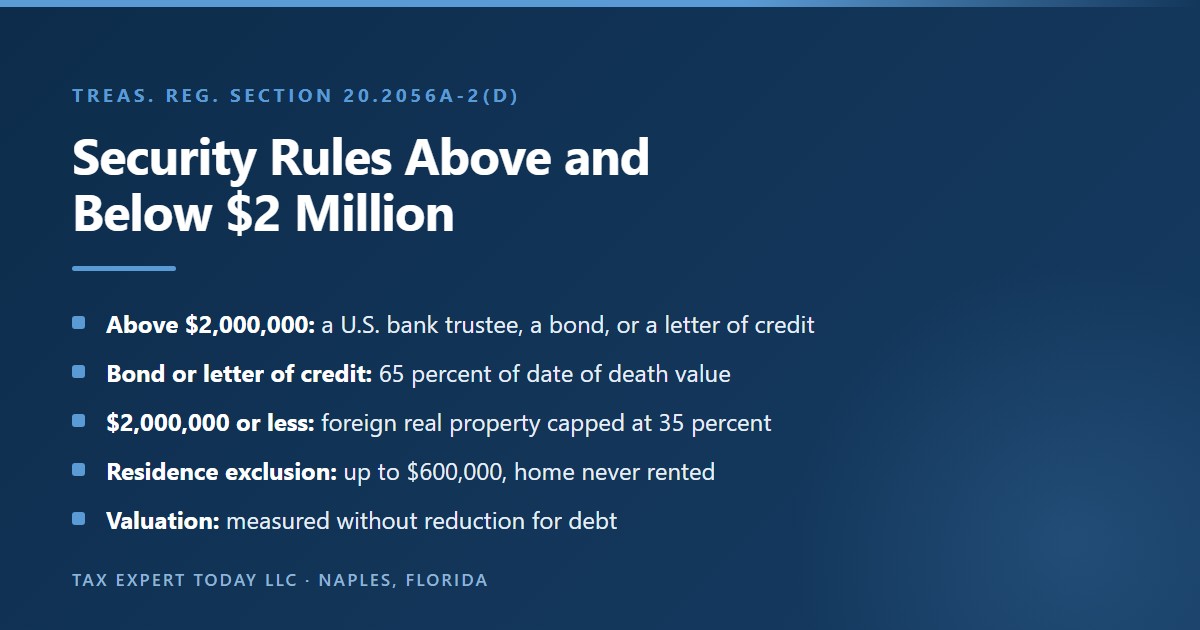
If the assets passing to the QDOT exceed $2,000,000 at the date of death, the trust instrument must require at all times one of three arrangements: a U.S. bank as trustee, a bond in favor of the IRS equal to 65 percent of the trust assets, or an irrevocable letter of credit for the same 65 percent.
- Bank Trustee: at least one U.S. Trustee is a bank under section 581, or a U.S. branch of a foreign bank serving with a U.S. Trustee.
- Bond: furnished by the U.S. Trustee, 65 percent of date of death value, with an approved surety and automatic annual renewal.
- Letter of credit: irrevocable, 65 percent of date of death value, issued or confirmed by a qualifying bank.
- Flexibility: the trust may switch among the three, but one must be in force at every moment.
The security regulation measures the threshold using the fair market value of the assets passing to the QDOT, determined without reduction for any debt on those assets, as finally determined for estate tax purposes, at the date of death or the alternate valuation date. If several QDOTs are created for the same spouse, their values are added together. A mortgage on a Naples home does not reduce the value for this test, so a $2,500,000 property with a $1,000,000 loan counts at $2,500,000.
Above the threshold, the trust instrument must require one of three arrangements during the entire term of the trust. Under the Bank Trustee option, at least one U.S. Trustee must be a bank as defined in section 581, or a U.S. branch of a foreign bank may serve as long as a U.S. Trustee serves alongside it. Under the bond option, the U.S. Trustee must furnish a bond in favor of the Internal Revenue Service equal to 65 percent of the fair market value of the trust assets at the date of death, as finally determined. The bond must be with a satisfactory surety, cannot be cancelled, must run for at least one year, and must renew automatically unless notice of non-renewal is mailed at least 60 days before the term ends. Under the letter of credit option, the U.S. Trustee furnishes an irrevocable letter of credit for the same 65 percent, issued by a U.S. bank, a U.S. branch of a foreign bank, or a foreign bank with confirmation by a U.S. bank.
| QDOT value at death (without reduction for debt) | What the trust instrument must require | Practical notes |
|---|---|---|
| More than $2,000,000 | Bank Trustee, or a bond of 65 percent of value, or a letter of credit of 65 percent of value, at all times | The $600,000 residence exclusion can reduce the value used for the threshold and the bond amount |
| $2,000,000 or less | No more than 35 percent of trust assets in real property outside the United States, tested each year end, or one of the three arrangements above | A trust holding a Florida home and U.S. securities usually meets the 35 percent test easily |
| Any size with foreign real property and no security | Annual written statement by the U.S. Trustee | Required under Treas. Reg. 20.2056A-2(d)(3) in the circumstances it lists |
The regulation also anticipates valuation changes. If the estate tax return reports QDOT assets at $2,000,000 or less but the value is finally determined above $2,000,000, the U.S. Trustee has a reasonable period, not more than sixty days after the final determination, to put one of the three arrangements in place. A similar sixty day window applies to adjust the amount of a bond or letter of credit after a valuation change. The regulation includes a separate rule for substantial undervaluation, which is one more reason to support the date of death values with qualified appraisals.
The choice among the three arrangements is a cost question as much as a legal one. A corporate trustee charges an annual fee but removes the need for a surety. A bond or letter of credit lets a family member serve as U.S. Trustee but carries premiums and, for a letter of credit, collateral or credit approval. The trust instrument can leave the choice to the trustee or limit the trustee to one or two of the options, and a trust that states it must be administered in compliance with the regulation’s options is treated as meeting them.
What rules apply to a QDOT of $2 million or less?
A QDOT whose assets are $2,000,000 or less at death does not need a bank trustee, bond, or letter of credit if the trust instrument limits real property located outside the United States to no more than 35 percent of trust value, measured at the end of each year. Otherwise it must use one of the three security arrangements.
- Annual test: foreign real property is measured on the last day of the trust’s taxable year.
- Look-through: real property held through entities the trust owns can count toward the 35 percent.
- Residence exclusion does not apply: the $600,000 residence rule is ignored for the 35 percent test.
- Annual statement: a trust that owns foreign real property without security files a U.S. Trustee statement.
For smaller trusts, Treas. Reg. section 20.2056A-2(d)(1)(ii) offers a simpler path. The trust instrument must provide either that no more than 35 percent of the fair market value of the trust assets, determined annually on the last day of the trust’s taxable year, will consist of real property located outside the United States, or that the trust will meet one of the three security arrangements. A look-through rule treats real property held through a corporation or partnership in which the trust holds an interest as owned in part by the trust, so a qualified domestic trust cannot avoid the limit by holding a foreign home through a company.
The 35 percent limit is aimed at the obvious risk: a trust whose main asset is a house in the spouse’s home country, outside the reach of U.S. collection. A trust funded with a Florida residence, U.S. brokerage accounts, and U.S. bank deposits does not have that problem. For a couple who also owns a cottage in Ontario or an apartment in Europe, however, the limit can bite if that foreign property passes into the QDOT, and the trust may need a bond or bank trustee even though its total value is under $2,000,000.
The regulation adds an annual reporting duty in specific cases. The U.S. Trustee must file a written statement if the qualified domestic trust directly owns foreign real property at year end and does not use a bank trustee or security, if a personal residence that was covered by the exclusion is sold or stops being used as a residence during the year, or if the look-through rule treats the trust as owning foreign real property at year end. The statement is a compliance item that is easy to forget years after the estate is closed, so the trust administration calendar should carry it.
How does the personal residence exclusion work for a Naples home?
The executor may elect to exclude up to $600,000 of value from a personal residence and related furnishings owned directly by the QDOT, both when testing the $2,000,000 threshold and when sizing a bond or letter of credit. The home must be available to the surviving spouse at all times and may not be rented to anyone.
- Two uses: the exclusion applies to the $2,000,000 threshold and, separately, to the bond or letter of credit amount.
- Which homes: the spouse’s principal residence or one other residence.
- No rental: the home cannot be rented to another party, even when the spouse is away.
- Sale: the exclusion ends on a sale unless the proceeds are reinvested in a new residence within 12 months.
Treas. Reg. section 20.2056A-2(d)(1)(iv) contains two parallel elections. For the $2,000,000 threshold, the executor may elect to exclude up to $600,000 in value attributable to real property and related furnishings owned directly by the QDOT that is used by, or held for the use of, the surviving spouse as a personal residence. For the security requirement, the executor may make a similar election to exclude up to $600,000 when computing the amount of the bond or letter of credit. Each election is made by attaching a statement to the estate tax return that identifies the property by address. The election may be made whether the residence is inside or outside the United States, but it does not apply when testing the 35 percent foreign real property limit.
The definitions are strict. A personal residence is the spouse’s principal residence or one other residence of the spouse. It must be available at all times for use by the surviving spouse, and the regulation states that the residence may not be rented to another party, even when the spouse does not occupy it. Related furnishings include ordinary furniture, appliances, fixtures, and decorative items, but not rare art, valuable antiques, or automobiles. In Southwest Florida this rule deserves attention, because many families rent a seasonal home for part of the year. A Naples condominium that is placed on the seasonal rental market does not qualify for the exclusion.
A hypothetical shows the effect. Suppose a qualified domestic trust receives a Naples home worth $700,000 that the surviving spouse lives in, plus $1,700,000 of U.S. securities, for a total of $2,400,000. Without the exclusion the trust is above $2,000,000 and needs a bank trustee, bond, or letter of credit. If the executor elects the $600,000 residence exclusion, the value for the threshold test is $1,800,000, and the trust can instead rely on the 35 percent foreign real property rule, which it meets easily because it owns no foreign real property. If the same trust were valued at $3,000,000 including the home, the threshold would still be exceeded, but a bond would be sized at 65 percent of $2,400,000, or $1,560,000, rather than 65 percent of $3,000,000.
If the home is later sold or stops being used as the spouse’s residence, the exclusion generally ends, and the U.S. Trustee must file the annual statement. The regulation keeps the exclusion in place after a sale if the adjusted sales price is reinvested in a new residence within 12 months. A family that expects the surviving spouse to downsize from a house to a condominium should plan the purchase timing with that rule in mind.
How is the QDOT estate tax calculated?
The QDOT estate tax equals the extra net estate tax the first spouse’s estate would have owed if the taxed amount, plus all earlier taxed QDOT amounts, had been added to that estate, minus the tax on the earlier amounts alone. It uses the first spouse’s rates and remaining credits, not the surviving spouse’s own exclusion.
- Base: the first spouse’s taxable estate, increased by the distribution or the remaining trust value.
- Rates: those in effect at the first spouse’s death, under section 2001.
- Credits: the first spouse’s unified credit and other credits, to the extent still available.
- Tentative rate: if the first estate’s tax is not finally determined, the highest rate applies until it is.
Section 2056A(b)(2)(A) sets out the formula. For each taxable event, the tax is the tax that would have been imposed under section 2001 on the first decedent’s estate if its taxable estate had been increased by the amount involved in this event plus the aggregate amount involved in previous taxable events, reduced by the tax that would have been imposed if the taxable estate had been increased by the previous amounts only. Treas. Reg. section 20.2056A-6 confirms that the rates in effect on the date of the first decedent’s death are used and that the tax means the net tax after allowable credits, including the unified credit under section 2010. In other words, each QDOT event is taxed as the next layer of the first spouse’s estate.
That structure has two consequences families should understand, both tied to the section 2010 unified credit. First, if the first spouse’s estate did not use its full exclusion, the unused part can shelter QDOT distributions until it runs out. Second, the surviving spouse’s own exclusion plays no part. If the spouse’s own estate later pays U.S. estate tax on other property, the QDOT tax is not offset by the spouse’s $15,000,000 exclusion. Section 2056(d)(3) instead allows the spouse’s estate a credit under section 2013 for QDOT tax paid on property that is also taxed in the spouse’s estate, computed without the usual time limit, which prevents the same property from being taxed twice.
Timing adds a wrinkle, and so does the year of a move. A spouse who arrives in or leaves the United States during a year may also face a dual status income tax return for that year, which is a separate income tax question. On the estate tax side, under section 2056A(b)(2)(B), if the first estate’s tax has not been finally determined when a taxable event occurs, the QDOT tax is computed at the highest estate tax rate in effect at the first spouse’s death, which is 40 percent, and any excess is refunded with interest if a claim is filed within one year after the final determination. If the first decedent created more than one QDOT, section 2056A(b)(2)(C) also requires the highest rate unless the executor designates one U.S. citizen or domestic corporation as the person responsible for filing and paying for all of the trusts. Section 2056A(b)(11) treats QDOT tax paid out of the trust as a further distribution, so paying the tax from trust principal is itself a taxable distribution.
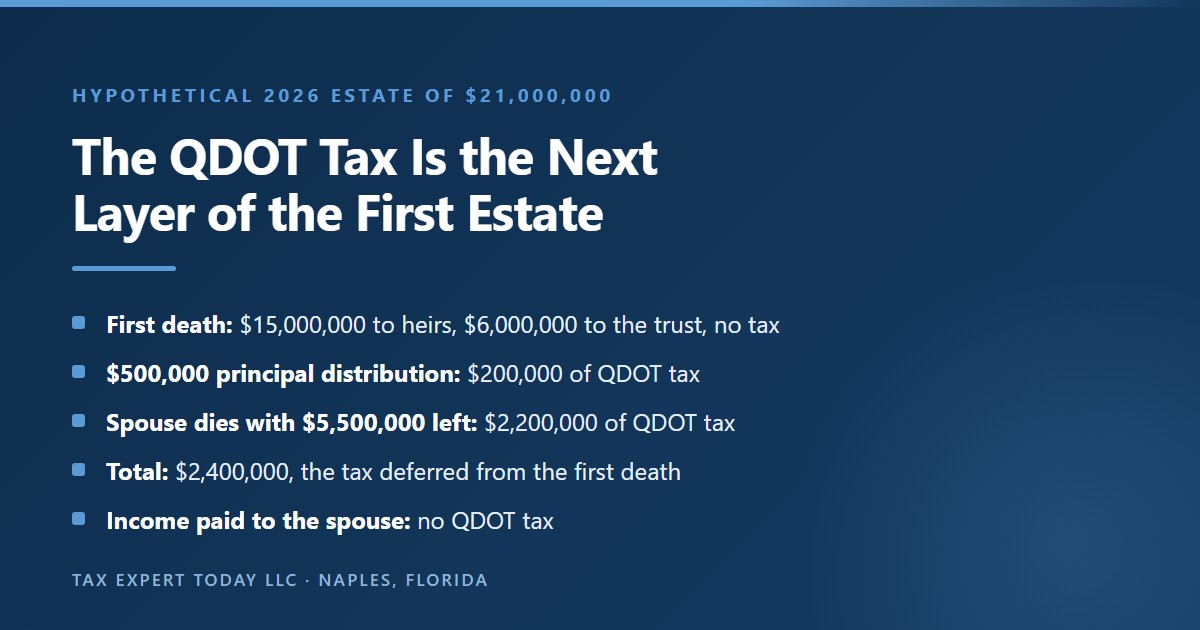
A hypothetical illustrates the layering. A U.S. citizen dies in 2026 with a taxable estate of $21,000,000 before any marital deduction and no prior taxable gifts. The executor leaves $15,000,000 to children and other beneficiaries, which the exclusion covers, and places the remaining $6,000,000 in a qualified domestic trust for the non-citizen spouse. No estate tax is due at the first death. Two years later the trustee distributes $500,000 of principal to the spouse for a purpose that does not qualify as hardship. The QDOT tax on that distribution is the net tax on a $15,500,000 estate, which is $200,000, less the net tax on $15,000,000, which is zero, so $200,000 is due. If the spouse later dies with $5,500,000 left in the trust, the QDOT tax at that point is the net tax on $21,000,000, which is $2,400,000, less the net tax on $15,500,000, which is $200,000, so $2,200,000 is due. The total, $2,400,000, equals what the first estate would have paid at death on the full $21,000,000. These figures are hypothetical illustrations and ignore growth, deductions, and interest.
Which QDOT distributions are taxed and which are not?
Income paid to the surviving spouse is not subject to the QDOT estate tax, although it is taxable income to the spouse. Principal distributions are taxed unless they qualify as hardship distributions. The trust balance at the spouse’s death is taxed, and the whole trust is taxed if it stops qualifying as a QDOT.
- Income distributions: exempt from the QDOT tax under section 2056A(b)(3)(A); income tax still applies.
- Hardship distributions of principal: exempt under section 2056A(b)(3)(B) but still reported on Form 706-QDT.
- Other principal distributions: taxed under section 2056A(b)(1)(A).
- Death of the spouse: the remaining trust value is taxed under section 2056A(b)(1)(B).
- Disqualification: the trust is taxed as if the spouse died on the date it stops qualifying.
Section 2056A(b)(1) imposes the estate tax on two events: any distribution before the surviving spouse’s death, and the value of the property remaining in the trust on the date of the spouse’s death. Section 2056A(b)(3) then exempts distributions of income to the surviving spouse and distributions to the spouse on account of hardship. Income has the meaning given by section 643(b), which generally follows the trust instrument and local law. Capital gains allocated to principal are not income for this purpose, so a trustee who sells appreciated securities and pays out the proceeds is making a principal distribution.
| Event | QDOT estate tax? | Reported on Form 706-QDT? | Due date of the QDOT tax |
|---|---|---|---|
| Income paid to the surviving spouse | No | No | Not applicable; income tax applies to the spouse |
| Hardship distribution of principal | No | Yes, even if it is the only event in the year | Not applicable |
| Other principal distribution | Yes | Yes | April 15 of the following year |
| QDOT tax paid from trust principal | Yes, treated as a further distribution | Yes | April 15 of the following year |
| Death of the surviving spouse | Yes, on the remaining value | Yes | Nine months after the death |
| Trust ceases to qualify as a qualified domestic trust | Yes, on the full value as if the spouse died | Yes | Nine months after the failure |
The trust also stays exposed to a disqualification charge for its whole life. Section 2056A(b)(4) provides that if a qualified domestic trust ceases to meet the trustee, withholding, and security requirements, the tax applies as if the surviving spouse died on the date of cessation. A trust that loses its last U.S. Trustee, lets a required bond lapse without a replacement, or moves its administration abroad can trigger the full tax years after the first death. Section 2056A(b)(8) gives the government a lien for the QDOT tax under section 6324, and section 2056A(b)(6) makes each trustee personally liable.
Basis follows a separate rule. Section 2056A(b)(13) treats a distribution on which QDOT tax is imposed as a transfer by gift for purposes of section 1015, and the QDOT tax paid as a gift tax. Property in the trust generally received a basis adjustment at the first spouse’s death because it was included in that estate, and the gift treatment in section 2056A(b)(13) brings the section 1015 rules for gift tax paid into play when a taxed distribution is made. The interaction is technical, and the trustee’s records should track the basis of each asset from the first death forward.
What counts as a hardship distribution?
A hardship distribution is a principal distribution made in response to an immediate and substantial financial need relating to the health, maintenance, education, or support of the surviving spouse or a person the spouse must legally support. It is not hardship if the money is reasonably available from the spouse’s own liquid assets.
- Immediate and substantial need: the standard in Treas. Reg. section 20.2056A-5(c)(1).
- Covered purposes: health, maintenance, education, or support of the spouse or a legal dependent.
- Other sources first: publicly traded stock or a certificate of deposit the spouse owns counts as reasonably available.
- Not counted as available: closely held business interests, real estate, and tangible personal property.
The hardship exemption is narrower than the familiar health, education, maintenance, and support standard used in many trusts. Treas. Reg. section 20.2056A-5(c)(1) treats a distribution of principal as made on account of hardship only if it responds to an immediate and substantial financial need relating to the spouse’s health, maintenance, education, or support, or that of any person the spouse is legally obligated to support. A distribution is not hardship if the amount could be obtained from other sources reasonably available to the spouse. The regulation gives the sale of personally owned publicly traded stock and cashing in a certificate of deposit as examples of reasonably available sources, and it states that closely held business interests, real estate, and tangible personal property are not considered reasonably available.
Two practical points follow. First, a trustee who makes a hardship distribution should document the need and the spouse’s other resources at the time, because the exemption depends on those facts. Second, the exemption removes the tax but not the reporting. The Form 706-QDT instructions require the trustee to report a hardship distribution even if it is the only distribution during the year. A medical emergency, an uninsured hospital stay, or a sudden support obligation are the kinds of facts the regulation contemplates. A distribution to buy a larger home or to fund travel generally is not.
When is Form 706-QDT due?
Form 706-QDT is an annual return due by April 15 of the year after any calendar year with a taxable distribution or a hardship distribution. When the surviving spouse dies, or the trust stops qualifying, the return is due nine months after that event and must include that year’s distributions. Form 4768 gives an automatic six month extension to file.
- Distribution years: file and pay by April 15 of the following year.
- Spouse’s death: file and pay within nine months of the death.
- Loss of QDOT status: file within nine months of the failure to qualify.
- Extension: Form 4768 extends the time to file, with the Form 706-QDT box checked.
- First return: attach a copy of the trust instrument.
The Instructions for Form 706-QDT describe the return as an annual return filed by the trustee, or by a designated filer where one person has been designated for several QDOTs of the same decedent. The return reports and computes the tax on taxable distributions, on the value remaining in the trust at the spouse’s death, and on the corpus portion of certain annuity payments. Section 2056A(b)(5) sets the due dates: the tax on distributions is due on the 15th day of the fourth month after the calendar year of the distribution, and the tax at the spouse’s death is due nine months after the death. Distributions in the year of the spouse’s death are due with the death return, which can be earlier than April 15.
| Event | Rule | Hypothetical date |
|---|---|---|
| Principal distribution on June 10, 2026 | Form 706-QDT and payment by April 15 of the following year | Thursday, April 15, 2027 |
| Surviving spouse dies on August 17, 2027 | Form 706-QDT within nine months, including all 2027 distributions | Wednesday, May 17, 2028 |
| Trust ceases to qualify | Form 706-QDT within nine months of the failure | Nine months after the failure date |
| Spouse becomes a U.S. citizen | Final Form 706-QDT notice by April 15 of the following year | April 15 of the year after naturalization, subject to weekend rules |
| More than one QDOT with a designated filer | Each trustee gives its Schedule B to the designated filer at least 60 days before the due date | 60 days before the return due date |
The instructions also note that the tax may be paid in installments under section 6166 if the trust qualifies, that late filing and late payment penalties under section 6651 apply unless there is reasonable cause, and that section 6662 imposes a 20 percent penalty for valuation understatements of the kind described in the instructions. Reasonable cause for a late estate return follows the general principles explained in our guide to reasonable cause penalty abatement, and the general options are summarised in our guide on how to get IRS penalties removed, but the better course is a trust calendar that never lets the April 15 date pass unnoticed.
How and when is the QDOT election made?
The executor makes the QDOT election on the first spouse’s Form 706 estate tax return. Once made, the election is irrevocable. Section 2056A(d) bars the election on a return filed more than one year after the due date, including extensions, so a late return can still carry it within that window.
- Where: on Form 706 for the first spouse’s estate, identifying the trust.
- Irrevocable: the election cannot be withdrawn once made.
- Outer limit: no election on a return filed more than one year after the extended due date.
- Protective election: available where qualification or values are uncertain.
- Reformation: a court proceeding started by the extended due date can conform a trust to the rules.
Section 2056A(d) is short and specific. The election is made by the executor on the return of the tax imposed by section 2001, it is irrevocable once made, and no election may be made on any return filed more than one year after the time prescribed by law, including extensions, for filing the return. The Form 706 is due nine months after death, and Form 4768 can extend the filing date by six months. Some summaries describe a hard nine month deadline with no extension for the election. The statute is more forgiving than that, but relying on the one year outer limit is poor planning, because the trust must also be in place before the return is filed.
A hypothetical calendar shows the dates. For a death on March 10, 2026, Form 706 is due Thursday, December 10, 2026. An extension on Form 4768 moves the filing date to Thursday, June 10, 2027. The QDOT election cannot be made on a return filed more than one year after that extended date, which means June 2028. Interest on any tax that turns out to be due runs from the original payment date, and an extension to file is not an extension to pay unless separately granted.
Section 2056(d)(5) adds an important safety valve. Whether a trust qualifies as a qualified domestic trust is determined as of the date the return is made, or, if a judicial proceeding is started on or before the extended due date to change the trust into a qualified domestic trust, as of the time the changes are made. A will or revocable trust that leaves property to a non-citizen spouse in a trust that is close to, but not quite, a qualified domestic trust can often be reformed under state law if the proceeding is started in time. The statute extends the assessment period for one year after the IRS is notified of the result. Reformation is legal work for the family’s estate planning attorney, and the tax rule supplies the deadline.
Can a QDOT be created after the first spouse dies?
Yes. Property that passes outright to a non-citizen spouse can still qualify if it is transferred to a QDOT, or irrevocably assigned to one under an assignment enforceable under local law, before the estate tax return is filed and by the last date for the QDOT election. The trust may be created by the executor or by the surviving spouse.
- Statutory basis: section 2056(d)(2)(B).
- Who creates it: the decedent, the executor, or the surviving spouse.
- Two methods: an actual transfer of the property, or an irrevocable assignment enforceable under local law.
- Timing: before the return is filed and on or before the last date the election can be made.
Section 2056(d)(2)(B) provides that property passing from the decedent to the surviving spouse is treated as passing in a qualified domestic trust if it is transferred to such a trust before the date the estate tax return is made, or is irrevocably assigned to such a trust under an irrevocable assignment made on or before that date that is enforceable under local law. Treas. Reg. section 20.2056A-2 adds that the trust can be created by the decedent, by the decedent’s executor, or by the surviving spouse, and that the transfer or assignment must occur before the return is filed and on or before the last date on which the QDOT election may be made.
This rule rescues many estates. A couple with simple wills that leave everything to each other may never have considered citizenship. If the citizen spouse dies first and the estate is above the exclusion, the surviving spouse can create a qualified domestic trust and transfer the inherited property into it before the Form 706 is filed, and the executor can then elect. The cost is that the spouse gives up outright ownership of that property and accepts a U.S. Trustee, the security rules, and the QDOT tax on principal. There is also a transferor trap. Under Treas. Reg. section 20.2056A-4(b)(5), the property is treated as passing from the decedent to the QDOT only for the marital deduction. For every other purpose, including gift, estate, and generation-skipping transfer tax, the surviving spouse is treated as the person who transferred the property into the trust. An example in the regulation shows a spouse whose QDOT gave a vested remainder to grandchildren making a taxable gift of that remainder on the date of the transfer, which is why a spouse-created QDOT is often drafted so the spouse keeps a power over the remainder. Property passing under a revocable trust, joint ownership, or beneficiary designation can be moved into a qualified domestic trust under the same rule.
How do IRAs and retirement accounts pass to a non-citizen spouse?
Retirement plans and annuities that cannot be assigned to a trust are handled under special rules. The surviving spouse agrees either to pay the QDOT tax on the principal portion of each payment or to roll that principal portion into a QDOT. An IRA may be treated the same way at the spouse’s option.
- Nonassignable arrangements: qualified plans, individual retirement annuities, and similar plans that cannot be transferred to a trust.
- IRAs: an inherited IRA may be treated as nonassignable at the spouse’s option, or assigned to the QDOT.
- Option one: the spouse agrees to pay the QDOT tax on the corpus portion of each payment.
- Option two: the spouse agrees to roll the corpus portion of each payment into a qualified domestic trust.
- Filings: an information statement and the agreement are attached to Form 706.
Many retirement plans cannot be assigned. Section 401(a)(13) generally bars the assignment of qualified plan benefits, and an individual retirement annuity under section 408(b) is not transferable. Treas. Reg. section 20.2056A-4(c) addresses this by treating a nonassignable annuity or other arrangement as meeting the QDOT requirements if the surviving spouse agrees to one of two procedures. The spouse may agree to pay the QDOT tax on the corpus portion of each payment, or may agree to roll over and transfer the corpus portion of each payment into a qualified domestic trust within the time the regulation allows. The executor files an information statement and the agreement with the estate tax return and makes the QDOT election for the arrangement. The regulation also states that a spouse’s interest as beneficiary of an individual retirement account under section 408(a), although assignable, may be treated as a nonassignable arrangement eligible for these procedures at the spouse’s option.
The corpus portion is the part of each payment that represents a return of the value included in the estate, as opposed to the income earned on it. The regulation provides the method for measuring it. The rollover agreement also exempts the part of a corpus payment that would qualify as a hardship distribution if paid from a qualified domestic trust. Because required minimum distribution rules, income tax on the payments, and the QDOT computation all interact, a large retirement account passing to a non-citizen spouse is one of the areas where the executor’s tax adviser and the plan custodian need to coordinate before the Form 706 is filed.
What happens if the surviving spouse becomes a U.S. citizen?
If the spouse naturalizes before the Form 706 is filed and was a U.S. resident at all times after the death, the ordinary marital deduction applies and no QDOT is needed. If the spouse naturalizes later, the QDOT tax stops applying when the residence or no-taxed-distribution condition is met and the trustee files a final Form 706-QDT.
- Before the return: section 2056(d)(4) restores the marital deduction outright.
- After the return: section 2056A(b)(12) ends the QDOT tax on later events.
- Condition: U.S. residence at all times since the death, or no taxed distributions before citizenship.
- Otherwise: the spouse can elect to treat prior taxed distributions as the spouse’s own taxable gifts.
- Notice: a final Form 706-QDT by April 15 of the year after naturalization.
Citizenship is the cleanest exit, and the law provides two versions of it. Under section 2056(d)(4), the disallowance does not apply at all if the surviving spouse becomes a U.S. citizen before the day the estate tax return is made and was a resident of the United States at all times after the decedent’s death and before becoming a citizen. In that case the property can pass outright with an ordinary marital deduction. Because the return can be extended, a spouse who is already in the naturalization process may have time to complete it before the return is filed.
After a qualified domestic trust is in place, section 2056A(b)(12) and Treas. Reg. section 20.2056A-10 end the QDOT tax if the spouse becomes a citizen and either was a U.S. resident at all times after the death and before naturalizing, or received no taxable distributions before becoming a citizen. The U.S. Trustee must notify the IRS and certify the citizenship by filing a final Form 706-QDT on or before April 15 of the year after the year the spouse becomes a citizen. If neither condition is met, the spouse can still end the tax by electing to treat earlier taxed distributions as the spouse’s own taxable gifts and to treat the first spouse’s unified credit used against those distributions as a reduction of the spouse’s own credit. The Form 706-QDT instructions explain this election under Line 4, Spousal Election.
Once the QDOT tax no longer applies, the regulations on portability also stop adjusting the first spouse’s deceased spousal unused exclusion amount, discussed below. A spouse who is eligible to naturalize and intends to remain in the United States should know that citizenship removes the trust’s tax overlay, although the trust itself continues under its terms unless the instrument or state law allows it to be modified.
How does the Canada US treaty marital credit compare with a QDOT?
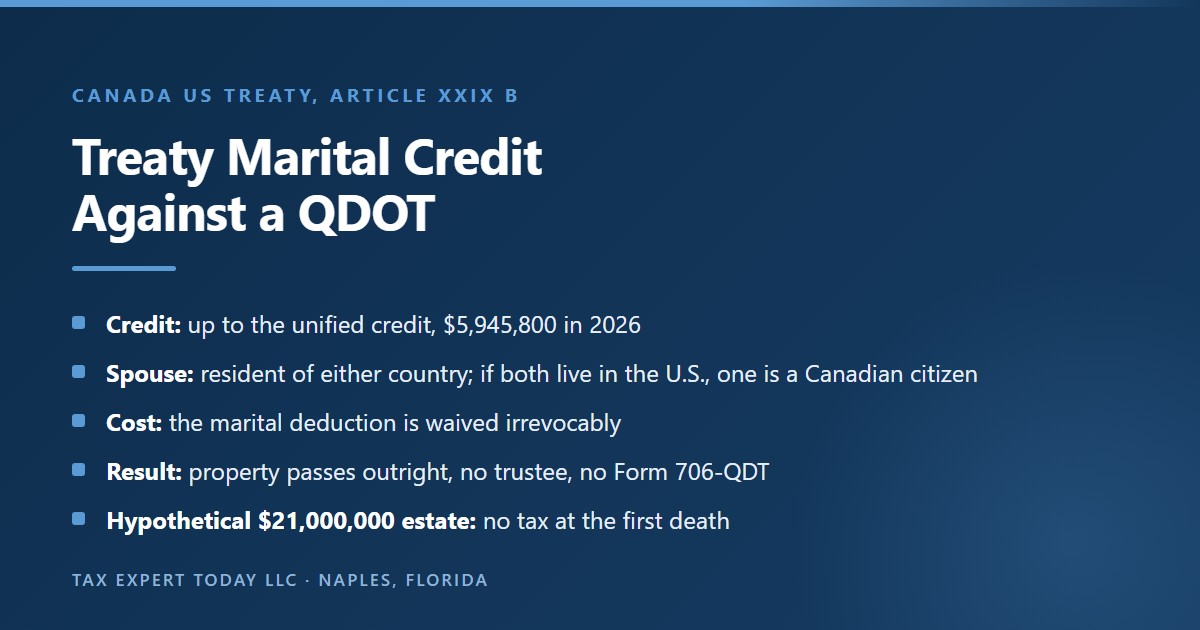
Article XXIX B of the Canada United States treaty can give the estate of a U.S. citizen or resident a second credit, up to the unified credit, for property passing to a qualifying spouse. Electing it waives the marital deduction, so the property passes without a QDOT and no tax is deferred.
- Size of the credit: the lesser of the unified credit allowed to the estate and the estate tax on the qualifying property.
- Residence tests: the decedent was a U.S. citizen or a resident of either country, and the spouse was a resident of either country.
- Both in the United States: if both spouses lived in the United States, one or both must be a Canadian citizen.
- Cost: the executor irrevocably waives the marital deduction, including any QDOT deduction.
- Deadline: elected on a return filed by the date a QDOT election could be made.
Paragraph 3 of Article XXIX B allows a non-refundable credit, in addition to the unified credit, for property that passes to the surviving spouse and would qualify for the marital deduction if the spouse were a U.S. citizen. The treaty calls that property qualifying property. The credit is available if the decedent was, at death, a citizen of the United States or a resident of either country, the surviving spouse was a resident of either country at the decedent’s death, and, where both spouses were U.S. residents, one or both was a citizen of Canada. The executor must elect the treaty benefit and irrevocably waive any estate tax marital deduction on a U.S. return filed by the date a QDOT election could be made. Paragraph 4 limits the credit to the lesser of the unified credit allowed to the estate, determined without regard to credits used on prior gifts, and the estate tax that would otherwise be imposed on the transfer of the qualifying property.
For a large estate the treaty credit can be worth as much as the unified credit itself. The unified credit in 2026 is the tentative tax on $15,000,000, which under the section 2001(c) rate table is $5,945,800. Return to the hypothetical $21,000,000 estate from the tax calculation section, using the section 2001 rate table, and assume the surviving spouse is a Canadian citizen living with the decedent in Naples, Florida. If all $21,000,000 passes to the spouse, the tentative tax is $8,345,800. The treaty credit is the lesser of the $5,945,800 unified credit and the $8,345,800 tax on the qualifying property, so $5,945,800. Together with the ordinary unified credit, credits of $11,891,600 exceed the tentative tax, and no estate tax is due at the first death in this hypothetical. The property passes to the spouse outright, with no U.S. Trustee, no security, and no Form 706-QDT.
| Hypothetical $21,000,000 estate, 2026 death | Tax at the first death | Later U.S. tax on this property | Ongoing obligations |
|---|---|---|---|
| Outright to the non-citizen spouse, no QDOT, no treaty election | $2,400,000 due nine months after death | Included in the spouse’s own estate under the spouse’s own rules | None beyond the estate return |
| $15,000,000 to other heirs and $6,000,000 to a qualified domestic trust | None | Up to $2,400,000 on principal and at the spouse’s death, plus 40 percent on growth inside the trust | U.S. Trustee, security if above $2,000,000, Form 706-QDT, possible annual statement |
| All to a Canadian citizen spouse with the Article XXIX B election | None in this hypothetical | Included in the spouse’s own estate under the spouse’s own rules | None beyond the estate return and the treaty election |
The comparison is not automatic. The treaty election uses the decedent’s exclusion in full in a case like this, so no unused exclusion remains for portability. The property then sits in the spouse’s own estate. If the spouse remains a U.S. domiciliary, the spouse’s estate has its own exclusion. If the spouse returns to Canada, Canadian deemed disposition rules at death and U.S. tax on U.S. situs property both enter the picture, and paragraph 2 of Article XXIX B gives a Canadian resident’s estate a prorated unified credit. Our guide to the Canada US tax treaty for Florida snowbirds explains those rules, and a spouse who later gives up U.S. residence or a green card should also review the Form 8854 exit tax rules. A qualified domestic trust, by contrast, keeps the first spouse’s estate in a trust taxed at the first spouse’s rates, which can suit a family that wants control over the remainder for children from a prior marriage. The two paths are compared on the facts, and the election must be made on a return filed in time.
How does a QDOT compare with paying the estate tax at the first death?
A QDOT defers tax but taxes later growth inside the trust at the first spouse’s 40 percent rate, and it limits access to principal. Paying the tax at the first death removes the trust overlay and lets the property pass outright, but it reduces the assets available to the surviving spouse immediately.
- Deferral value: the family keeps the tax money invested until a distribution or the spouse’s death.
- Growth cost: appreciation inside the QDOT is taxed at the first spouse’s marginal rate when it comes out.
- Access: non-hardship principal distributions trigger tax, so the spouse’s practical access is limited.
- Administration: trustee fees, security costs, and annual filings run for the spouse’s lifetime.
Deferral is usually valuable, but it is not free. Section 2056A(b)(1)(B) taxes the value of the property remaining in the trust at the spouse’s death, not the value that went in. If the $6,000,000 QDOT in the hypothetical grows to $9,000,000 by the time the surviving spouse dies, the QDOT tax is computed on the larger figure, layered onto the first spouse’s estate at 40 percent. Outright property that grows in the spouse’s own hands is instead taxed, if at all, in the spouse’s own estate, where the spouse’s own exclusion applies. For a younger surviving spouse with a long life expectancy and an expectation of growth, that difference can be large.
Access matters as well. A QDOT spouse receives the income and can receive hardship distributions without tax, but any other principal distribution carries the QDOT tax. A spouse who expects to need capital for a home purchase, a business, or support of a child abroad may find a qualified domestic trust constraining. Life insurance often adds to the problem, because proceeds are generally included in the gross estate when the insured held incidents of ownership in the policy, and that inclusion can push an estate above the exclusion unless the policy sits outside the estate, for example in an irrevocable life insurance trust. Some families split the estate: enough in a qualified domestic trust to defer tax on the amount above the exclusion, with the rest passing outright or to a credit shelter trust sheltered by the exclusion. The right mix depends on the size of the estate, the ages and health of the spouses, the spouse’s citizenship plans, and where the spouse expects to live, which is why the analysis is done before death whenever possible.
How does portability work when a QDOT is used?
The executor can still elect portability of the first spouse’s unused exclusion when a QDOT is used, but the unused amount is only preliminary. It is redetermined after the final QDOT taxable event, and the surviving spouse generally cannot use it until then, except for certain lifetime gifts or on becoming a citizen.
- Computation: made on the first spouse’s Form 706, the same way as for a citizen spouse.
- Redetermination: required after the final QDOT distribution, the termination of the trusts, or the spouse’s death.
- Timing: generally available to the spouse only after that final event.
- Citizenship: if the QDOT tax ends because the spouse naturalizes, the amount is no longer adjusted.
Portability lets a surviving spouse add the deceased spouse’s unused exclusion, called the DSUE amount, to the spouse’s own exclusion. Treas. Reg. section 20.2010-2(c)(4) provides that when property passes to a qualified domestic trust, the DSUE amount is computed on the decedent’s return in the ordinary way but is subject to later adjustment, and must be redetermined on the final distribution or other event on which QDOT tax is imposed, generally the termination of all of the decedent’s QDOTs or the death of the surviving spouse. That makes sense, because QDOT distributions use up the first spouse’s remaining exclusion as they are taxed. Treas. Reg. section 20.2010-3(c)(3) adds that the earliest date the DSUE amount can be included in the surviving spouse’s exclusion is the date of that final event, with a cross-reference allowing the redetermined amount to be applied to certain taxable gifts by the spouse.
If the spouse becomes a U.S. citizen and the QDOT tax ceases to apply under section 2056A(b)(12), section 20.2010-2(c)(4)(ii) provides that the DSUE amount is no longer subject to adjustment. A timely portability election is therefore still worth considering for an estate with a qualified domestic trust, because it preserves the possibility. The executor makes it on a complete and timely Form 706, and an estate below the filing threshold that wants portability files a return for that purpose. Portability is covered more generally in our guide to Florida estate planning for new residents.
How are jointly owned Florida homes and accounts treated with a non-citizen spouse?
When the surviving spouse is not a citizen, the rule that includes only half of spousal joint property in the first estate does not apply. The first estate includes the full value of jointly held property except the part the survivor can show the survivor paid for, and that included share needs a QDOT or treaty credit to avoid tax.
- Normal rule switched off: section 2056(d)(1)(B) turns off the half-inclusion rule of section 2040(b).
- Contribution test applies: the full value is included except what the surviving spouse proves the spouse contributed.
- Common Florida forms: tenancy by the entirety and joint tenancy with right of survivorship.
- Records matter: proof of the survivor’s contribution reduces the amount included.
For a citizen couple, section 2040(b) includes one half of a qualified joint interest in the first spouse’s estate, whoever paid for it. Section 2056(d)(1)(B) provides that section 2040(b) does not apply when the surviving spouse is not a citizen. The general rule of section 2040(a) then includes the entire value of jointly held property in the first estate, except the part attributable to consideration furnished by the survivor. In Florida, married couples often own their home as tenants by the entirety and hold bank and brokerage accounts jointly with right of survivorship. If the citizen spouse paid for those assets, the full value can be included in that spouse’s estate.
The joint property passes to the survivor by operation of law, outside the will, so it is not automatically in a qualified domestic trust. If the estate is above the exclusion, the surviving spouse can transfer or assign the inherited joint property to a qualified domestic trust under section 2056(d)(2)(B) before the return is filed, as described above. Families with a non-citizen spouse should keep records showing which spouse funded the home and accounts, because the survivor’s proven contribution comes out of the first estate. Florida homestead property also carries state law rules on who may inherit it and how it may be devised, which the family’s estate planning attorney addresses when the plan is drafted.
What gifts can a U.S. citizen make to a non-citizen spouse during life?
Section 2523(i) denies the gift tax marital deduction for gifts to a non-citizen spouse, but gives a larger annual exclusion instead. For 2026 the first $194,000 of present interest gifts to a non-citizen spouse is excluded, compared with $19,000 for gifts to anyone else. Larger gifts use the donor’s lifetime exclusion.
- 2026 figure: $194,000 under section 4.42 of Revenue Procedure 2025-32.
- Present interests only: future interests do not qualify for the increased exclusion.
- Marital form required: the amount above the regular $19,000 exclusion must be in a form that would qualify for the marital deduction but for 2523(i).
- Any donor: available whether the donor spouse is a citizen, resident, or nonresident.
Revenue Procedure 2025-32 sets the 2026 figures. Section 4.42 provides, under section 2523(i) and section 2503, that the first $19,000 of gifts to any person, other than gifts of future interests, is excluded from taxable gifts, and that the first $194,000 of gifts to a spouse who is not a citizen of the United States, other than gifts of future interests, is excluded under sections 2503 and 2523(i)(2). Treas. Reg. section 25.2523(i)-1 adds that the gift in excess of the ordinary annual exclusion must be in a form that would qualify for the marital deduction but for the citizenship rule, and that the increased exclusion is available regardless of the donor’s own status.
Annual gifts are a practical way to shift assets to a non-citizen spouse over time, so less needs to pass through a qualified domestic trust at death. Ten years of gifts at the 2026 level would move $1,940,000 without using any lifetime exclusion, before inflation adjustments. Gifts above the annual figure use the donor’s lifetime exclusion and require a gift tax return. Retitling a jointly owned Florida home into the non-citizen spouse’s name, or adding the spouse to an account, can also be a gift, so those changes are reviewed for gift tax before they are made. Trusts built for gifts to a spouse, such as a spousal lifetime access trust, follow their own rules when the spouse is not a citizen.
Does estate tax residence follow the green card or the substantial presence test?
Neither. For U.S. estate tax, a resident is a person domiciled in the United States at death, meaning the person lived here with no definite present intention of leaving. A green card or the income tax substantial presence test is evidence, but domicile is a facts and intent test.
- Legal test: Treas. Reg. section 20.0-1(b)(1) defines a resident decedent as one domiciled in the United States.
- Intent required: residence without an intention to remain indefinitely is not domicile.
- Income tax differs: the substantial presence test and the green card test govern income tax residence only.
- Why it matters: a domiciled decedent is taxed on worldwide assets; a nonresident only on U.S. situs assets.
The citizenship of the surviving spouse decides whether a qualified domestic trust is needed. The residence of the decedent decides how much of the estate the United States taxes in the first place. Treas. Reg. section 20.0-1(b)(1) defines a resident decedent as one who had a domicile in the United States at the time of death, and explains that a person acquires a domicile by living in a place, even briefly, with no definite present intention of later leaving. Residence without that intention does not create domicile, and an intention to change domicile has no effect without an actual move.
This is different from the income tax tests. A Canadian snowbird who meets the substantial presence test for income tax can still be a nonresident for estate tax if the Canadian home remains the person’s domicile, and a green card holder who intends to leave can, on some facts, argue that no U.S. domicile existed. Our guide to the substantial presence test covers the income tax side. For a couple in which one spouse is a U.S. citizen, the citizen spouse’s estate is taxed on worldwide assets regardless of domicile, and the QDOT question arises at that spouse’s death whenever the survivor is not a citizen.
Does Florida impose its own estate tax?
Florida’s estate tax under section 198.02 of the Florida Statutes is tied to the federal credit for state death taxes, which no longer applies to estates of decedents dying after 2004. As a result, a Florida resident’s estate generally owes no separate Florida estate tax, and the QDOT analysis is federal.
- Statute: Fla. Stat. section 198.02 measures the tax by the federal state death tax credit.
- Federal credit gone: the credit was replaced by a deduction under section 2058.
- Result: no separate Florida estate tax on a Florida resident’s estate in the ordinary case.
- Other states: property or a former domicile in another state can still bring that state’s estate tax.
Florida Statutes section 198.02 imposes a tax on the estate of every Florida resident equal to the amount by which the federal credit for state death taxes exceeds the death taxes paid to other states. Because the federal credit was phased out and replaced by a deduction for state death taxes under section 2058, the Florida tax computed under this formula is generally zero. That is one reason Florida is attractive for estate planning, as our guide to establishing Florida residency explains.
The absence of a Florida estate tax does not remove the need for a qualified domestic trust, which is a federal rule. It also does not protect property in other states. A couple who moved to Naples from a state with its own estate tax, or who still owns real estate in such a state, can face that state’s tax on the property located there, and some states have their own rules for non-citizen spouses. Our guides to the Massachusetts estate tax and the Connecticut estate tax for Florida residents show how that works for two common former home states. The decision to form a qualified domestic trust is made on the federal numbers, with any state exposure layered on top.
What are the most common QDOT mistakes?
The most common QDOT mistakes are assuming the marital deduction applies to a green card spouse, missing the funding and election deadlines, renting out a residence used for the $600,000 exclusion, letting the U.S. Trustee or security lapse, and failing to file Form 706-QDT for distributions, including hardship distributions.
- Planning errors: no QDOT provision in a will or trust for a non-citizen spouse in a taxable estate.
- Deadline errors: funding the trust after the return is filed, or filing the return too late to elect.
- Administration errors: distributing capital gains as if they were income, or skipping the April 15 return.
- Status errors: forgetting to file the final Form 706-QDT when the spouse naturalizes.
| Mistake | Consequence | Better practice |
|---|---|---|
| Treating a green card spouse like a citizen spouse | No marital deduction; tax may be due on the excess over the exclusion | Confirm the spouse’s citizenship when the plan is drafted and again at death |
| Funding the QDOT after Form 706 is filed | Property does not qualify under section 2056(d)(2)(B) | Transfer or irrevocably assign the property before the return is filed |
| Filing Form 706 more than one year after the extended due date | The QDOT election cannot be made | Calendar the nine month due date and the Form 4768 extension |
| Renting the residence used for the $600,000 exclusion | The exclusion is unavailable or ends, and security may be required | Keep the home available to the spouse at all times, or plan for security |
| Losing the only U.S. Trustee or letting a bond lapse | The trust can cease to qualify and be taxed as if the spouse died | Name successor U.S. Trustees and track bond renewal dates |
| Paying capital gains to the spouse as income | A taxable principal distribution with no return filed | Apply the section 643(b) income definition and the trust terms |
| Not reporting a hardship distribution | A missed Form 706-QDT, even though no tax is due | File Form 706-QDT for any year with a hardship distribution |
| Not filing the final Form 706-QDT after naturalization | The trust remains in the QDOT regime on paper | File the final return by April 15 of the following year |
Most of these problems are calendar and record keeping problems rather than legal puzzles. A qualified domestic trust may run for decades, often well after the professionals who set it up have moved on, so the trust’s records should carry the date of death values, the residence exclusion election, the security arrangement and its renewal dates, the income and principal accounting, and the list of returns due each year. A non-citizen spouse who also has foreign bank accounts or receives a large gift or bequest from abroad has separate reporting duties, including Form 3520 for certain foreign gifts and trusts, and our guide to whether you need to file an FBAR covers that side.
Qualified Domestic Trust Help in Naples & Southwest Florida
Tax Expert Today LLC works with international and estate planning clients from an office in Naples, Florida and serves clients in all 50 states. Many Southwest Florida couples include one spouse who holds Canadian, British, German, or another foreign citizenship, and the qualified domestic trust rules decide whether the first estate owes tax at the first death, what the trustee must file afterward, and how the treaty credit compares. We model the QDOT, outright, and treaty alternatives with the family’s figures, prepare the Form 706 with the QDOT, portability, and residence exclusion elections, prepare the annual Form 706-QDT, and work alongside the family’s estate planning attorney, who drafts the trust documents.
- QDOT trust Naples FL: side by side modeling of a qualified domestic trust, an outright bequest, and the Article XXIX B treaty credit.
- Estate planning for a non-citizen spouse Naples: Form 706 elections, the post-death transfer to a qualified domestic trust, and retirement account agreements.
- International tax Naples FL: Form 706-QDT returns, hardship distribution reporting, and the final return after naturalization.
- Foreign tax Naples: U.S. side coordination with Canadian and other foreign advisers on death taxes and treaty claims.
Our international and expat tax services page explains how we approach cross-border work for couples in which one spouse is not a U.S. citizen, and our estate and trust planning page covers the wider estate tax work. The international tax Naples FL guide covers the broader picture for residents and seasonal residents of Southwest Florida.
Office: 11983 Tamiami Trail N, Naples FL 34110
Phone: (239) 441-2005
Hours: Monday through Friday, 10:00 to 5:00 ET
Frequently Asked Questions
My spouse is a Canadian citizen with a green card and we live in Naples, Florida. Do we need a QDOT?
Only if the first estate would owe tax without a marital deduction, which in 2026 generally means a taxable estate above $15,000,000 after prior gifts. A green card spouse is still a non-citizen, so the ordinary marital deduction is not available. The Article XXIX B treaty credit may be an alternative and is compared with a QDOT before the return is filed.
What is a qualified domestic trust?
A qualified domestic trust is a trust for a surviving spouse who is not a U.S. citizen that allows the first spouse’s estate to claim the marital deduction. It needs a U.S. trustee who can withhold tax and an executor’s election on Form 706. Principal distributions and the balance at the spouse’s death are taxed at the first spouse’s rates.
Is income from a QDOT taxed?
Income paid to the surviving spouse is not subject to the QDOT estate tax under section 2056A(b)(3)(A), although it is taxable income to the spouse. Distributions of principal are subject to the QDOT estate tax unless they qualify as hardship distributions, and capital gains allocated to principal are not income for this purpose.
What is the deadline to set up a QDOT after a death?
The property must be transferred to the QDOT, or irrevocably assigned to it, before the Form 706 is filed and by the last date the election can be made. The election cannot be made on a return filed more than one year after the due date, including extensions. Planning around the nine month due date is the safer course.
What happens to a QDOT if my spouse becomes a U.S. citizen?
If the spouse naturalizes before the Form 706 is filed and lived in the United States at all times after the death, the ordinary marital deduction applies. If the spouse naturalizes later, the QDOT tax stops if the spouse was a U.S. resident throughout or received no taxed distributions, and the trustee files a final Form 706-QDT.
How much can I give my non-citizen spouse each year without gift tax?
For 2026, the first $194,000 of present interest gifts to a spouse who is not a U.S. citizen is excluded from taxable gifts under Revenue Procedure 2025-32. The amount above the regular $19,000 exclusion must be in a form that would qualify for the marital deduction if the spouse were a citizen.
When to Engage a Professional
A qualified domestic trust is a deferral device with strict entry deadlines and a long administrative tail. The decision to use one, rather than an outright bequest or the treaty credit, turns on numbers that change with the size of the estate, the 2026 exclusion, the spouse’s citizenship plans, and where the spouse will live. Once the trust exists, every principal distribution, residence change, trustee change, and naturalization has a tax consequence or a filing.
A professional review is worth considering when a U.S. citizen or Florida domiciliary has a spouse who is not a citizen and an estate near or above the exclusion, when a will or revocable trust predates the current exclusion, when an estate must decide within nine months whether to fund a qualified domestic trust, when an inherited IRA or pension passes to a non-citizen spouse, when a trustee is asked for a principal distribution, or when the surviving spouse is about to naturalize or move abroad.
Tax Expert Today LLC is a tax advisory firm in Naples, Florida serving clients in all 50 states. Call (239) 441-2005 to discuss your facts.
This article is general information, not legal or tax advice for any particular taxpayer, and does not create a client relationship. The examples are hypothetical illustrations only and do not describe any client. Trust instruments, wills, and reformation proceedings are legal documents that should be drafted or reviewed by a licensed estate planning attorney. The rules described here reflect 26 U.S.C. sections 2001, 2010, 2040, 2056, 2056A, and 2523, Treasury Regulations sections 20.0-1, 20.2010-2, 20.2010-3, 20.2056A-2, 20.2056A-4, 20.2056A-5, 20.2056A-6, 20.2056A-10, and 25.2523(i)-1, the Instructions for Form 706-QDT (08/2025), Revenue Procedure 2025-32, Article XXIX B of the Canada United States Income Tax Convention, and Florida Statutes section 198.02, as of the date of writing. Canadian and other foreign tax rules are outside the scope of this article and should be confirmed with an adviser in that country. Verify current rules and confirm your own facts with a qualified tax professional before filing or making a decision.
Published October 19, 2026 by Dr. Pellumb Kabashi « Back to Learning Center
Have a question this article touches on?
Tax Expert Today LLC, based in Naples, Florida and serving clients across the United States.
Schedule a Consultation (239) 441-2005