
By Dr. Pellumb Kabashi, DBA, MBA, EA, CFE, CES
Founder, Tax Expert Today LLC · Tax advisors, enrolled agents, CPAs, and attorneys · Serving clients in all 50 states
Quick Answer
Form 8854 is the expatriation statement a former United States citizen or long-term green card holder files for the year they expatriate. It certifies five years of tax compliance and determines whether the person is a covered expatriate subject to the exit tax, which for 2026 taxes net deemed gain above $910,000. Call (239) 441-2005 for a free consultation.
What is Form 8854?
Form 8854, Initial and Annual Expatriation Statement, is the IRS form that a person who gives up United States citizenship or ends long-term residency files for the year of expatriation. It reports a balance sheet, certifies five years of federal tax compliance, and computes the exit tax when the filer is a covered expatriate.
- It is required by statute. The reporting obligation comes from section 6039G of the Internal Revenue Code.
- It is filed by the individual. No bank, employer, or consulate files it for you.
- It has an initial and an annual version. Parts I and II are filed once; Parts I and III can recur for years.
- It decides covered expatriate status. A missing or incomplete certification can make a person covered regardless of wealth.
The IRS describes the form on its About Form 8854 page, and the line-by-line rules are in the Instructions for Form 8854 (2025). The instructions state the purpose plainly: Form 8854 is used “to certify compliance with tax obligations in the 5 tax years before expatriation and to comply with their initial and annual information reporting obligations under section 6039G.” The substantive tax, often called the United States exit tax, lives in 26 U.S.C. section 877A. Form 8854 is the document that connects the two.
Most of what is written about Form 8854 explains how to fill in the boxes. The harder questions come earlier: when expatriation actually happens for tax purposes, which of the three covered expatriate tests applies, and why a person with modest wealth can still be caught because of an FBAR or Form 5471 that was never filed. This guide walks through those questions in order, then turns to the practical points that arise for people who lived in Naples, Florida and across Southwest Florida before moving abroad or returning home.
Who must file Form 8854?
You must file an initial Form 8854 if you relinquished United States citizenship during the year, or if you were a long-term resident who ended lawful permanent residency during the year. An annual Form 8854 is required in later years if you deferred exit tax, hold an eligible deferred compensation item, or benefit from a nongrantor trust.
- Former citizens. Anyone who relinquished citizenship, whether by birth or naturalization, files the initial statement.
- Long-term residents. A green card holder in at least 8 of the last 15 tax years files when that status ends.
- Annual filers. Deferral, eligible deferred compensation, and nongrantor trust interests keep the filing alive.
- Not short-term green card holders. Someone who held a green card for fewer than 8 years is not a long-term resident.
The 2025 instructions define a long-term resident as someone who was a lawful permanent resident “in at least 8 of the last 15 tax years ending with the year you are no longer treated as a lawful permanent resident.” Two details in that definition matter in practice. First, the count is by tax year, not by full years of residence, so a green card issued late in one year and surrendered early in a later year can reach eight tax years faster than the calendar suggests. Second, a year does not count if, in that year, you were treated as a resident of a foreign country under a tax treaty and did not waive the treaty benefits. The statutory definition is in 26 U.S.C. section 877(e), which section 877A adopts.
| Filer | What triggers the filing | Parts of Form 8854 completed |
|---|---|---|
| Former United States citizen | Relinquishment of citizenship during the tax year | Parts I and II (initial statement) |
| Long-term resident (8 of 15 tax years) | End of lawful permanent residency during the tax year | Parts I and II (initial statement) |
| Covered expatriate who elected to defer exit tax | Each year until the deferred tax and interest are paid | Parts I and III (annual statement) |
| Covered expatriate with an eligible deferred compensation item | Each year, to report distributions or certify none were received | Parts I and III (annual statement) |
| Covered expatriate who is a beneficiary of a nongrantor trust | Each year, to report distributions or certify none were received | Parts I and III (annual statement) |
| Green card holder for fewer than 8 of 15 tax years | Not a long-term resident, so no expatriation statement | None under section 877A |
A person who is not required to file an income tax return for the year of expatriation still files Form 8854. The instructions direct that filer to mail the form separately by the date the return would have been due, including extensions.
When does expatriation happen for tax purposes?
For a former citizen, the expatriation date is the earliest of renunciation before a consular officer, a signed relinquishment statement to the State Department, a certificate of loss of nationality, or a court cancellation of naturalization. For a long-term resident, it is generally the date Form I-407 is filed or a final abandonment or removal order issues.
- Renunciation is confirmed later. The renunciation date counts only if a certificate of loss of nationality is later issued.
- Form I-407 ends a green card. Filing it with a consular or immigration officer is the usual route.
- A treaty can end residency. Claiming foreign residence under a treaty tie-breaker, with notice to the IRS, is an expatriation event.
- The day before matters. The deemed sale is measured on the day before the expatriation date.
The expatriation date drives everything that follows: which year’s thresholds apply, which return the form is attached to, and the valuation date for the deemed sale. The rules below are taken from the Instructions for Form 8854 and the IRS expatriation tax page.
| Status given up | Event | Expatriation date |
|---|---|---|
| Citizenship | Renunciation before a United States diplomatic or consular officer | Date of renunciation, if a certificate of loss of nationality is later issued |
| Citizenship | Signed statement of voluntary relinquishment furnished to the State Department | Date the statement was furnished, if later confirmed by a certificate |
| Citizenship | State Department issues a certificate of loss of nationality | Date of issuance |
| Citizenship | A United States court cancels a certificate of naturalization | Date of cancellation |
| Long-term residency | Form I-407 filed with a consular or immigration officer | Date of filing |
| Long-term residency | Final administrative or judicial order of abandonment or removal | Date the order becomes final |
| Long-term residency | Treated as a treaty resident of another country, benefits not waived, IRS notified | Date that treaty treatment began |
The earliest-date rule means the order of steps matters. Someone who signs a relinquishment statement in March, receives the certificate in July, and assumes the July date controls may have placed the expatriation in the wrong tax period. The last row of the table is the one most often overlooked by long-term residents: a green card holder who starts filing as a treaty resident of another country, and tells the IRS so on Form 8833, can end long-term residency for tax purposes without ever surrendering the card. The IRS expatriation tax page confirms that notice is given “on Forms 8833 and 8854.”
What makes someone a covered expatriate?
An expatriate is a covered expatriate if any one of three tests is met: average annual net income tax for the five prior years above an inflation-adjusted threshold, net worth of $2 million or more on the expatriation date, or failure to certify five years of federal tax compliance on Form 8854. Only covered expatriates owe the exit tax.
- Tax liability test. More than $206,000 average for 2025 expatriations, and $211,000 for 2026.
- Net worth test. $2 million or more on the expatriation date, a figure that is not indexed for inflation.
- Certification test. Failing to certify compliance for the five prior tax years.
- Any one is enough. Meeting a single test makes the person covered, subject to narrow exceptions.
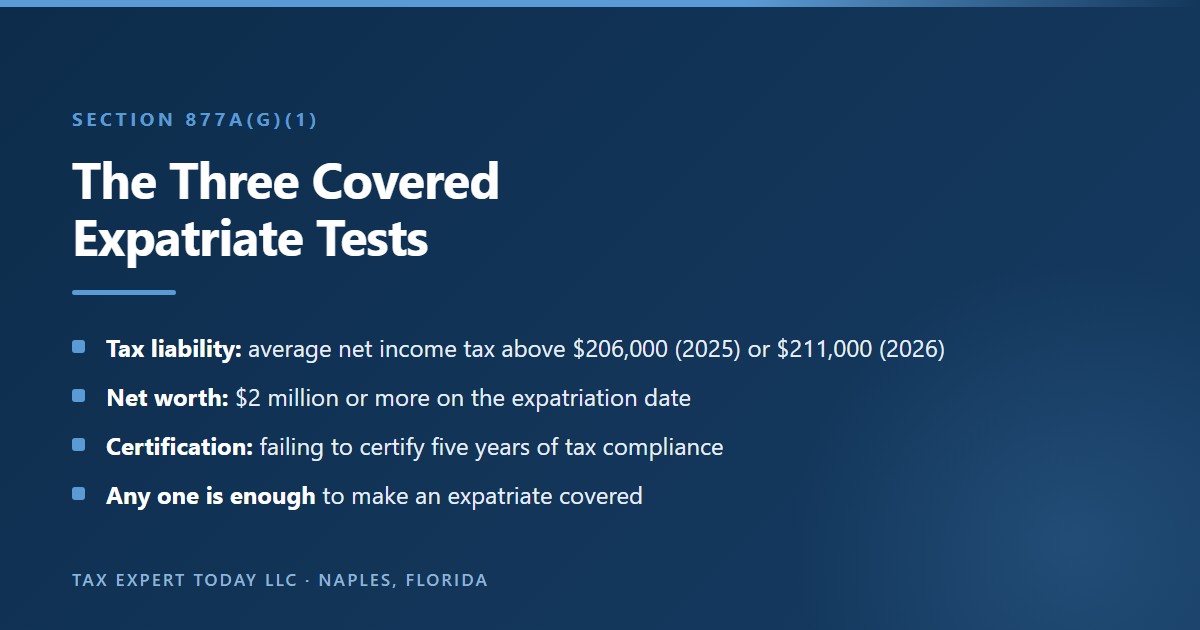
The three tests are set out in section 877A(g)(1), which cross-references the tax liability and net worth tests in section 877(a)(2). The tax liability threshold is adjusted every year. The IRS expatriation tax page lists the history, and Revenue Procedure 2025-32 sets the 2026 amount at $211,000.
| Year of expatriation | Average annual net income tax threshold | Net worth threshold | Exit tax exclusion amount |
|---|---|---|---|
| 2023 | More than $190,000 | $2,000,000 or more | Per the Form 8854 instructions for that year |
| 2024 | More than $201,000 | $2,000,000 or more | Per the Form 8854 instructions for that year |
| 2025 | More than $206,000 | $2,000,000 or more | $890,000 |
| 2026 | More than $211,000 | $2,000,000 or more | $910,000 |
The tax liability test looks at net income tax, not income. Line 1 of Part II, Section A asks for the total tax less any foreign tax credit for each of the five years, and the 2025 instructions point to Form 1040, line 24, less Schedule 3, line 1, for 2024. An expatriate who lived abroad and paid most of their tax to another country, offset by the credit on Form 1116, may have a low United States net figure even with a high income.
The net worth test is measured on the expatriation date, and it uses gift tax ownership rules rather than a simple bank balance. That is discussed below under the balance sheet. The instructions also add a disclosure hook: if net worth was $2 million or more at any point in the five years before expatriation but fell below that figure by the expatriation date, the filer checks “Yes” on line 3 and attaches a statement explaining the change. The IRS example is a gift of real property to a child reported on a gift tax return.
Why is the five-year certification the test that catches people?
The certification test turns any unfiled return, information return, or unpaid liability in the five years before expatriation into covered expatriate status, regardless of income or wealth. A person with a modest net worth who never filed an FBAR, Form 8938, Form 5471, or Form 3520 cannot truthfully certify, and becomes subject to the exit tax rules.
- It reaches information returns. Line 7 covers income, employment, and gift tax returns and “information returns, if applicable.”
- It reaches payment. Tax, interest, and penalties must also have been paid.
- It ignores the thresholds. The instructions warn the exit tax applies “regardless of whether” income or net worth thresholds are exceeded.
- It must be fixed before filing. The usual path is to bring the five years into compliance first.
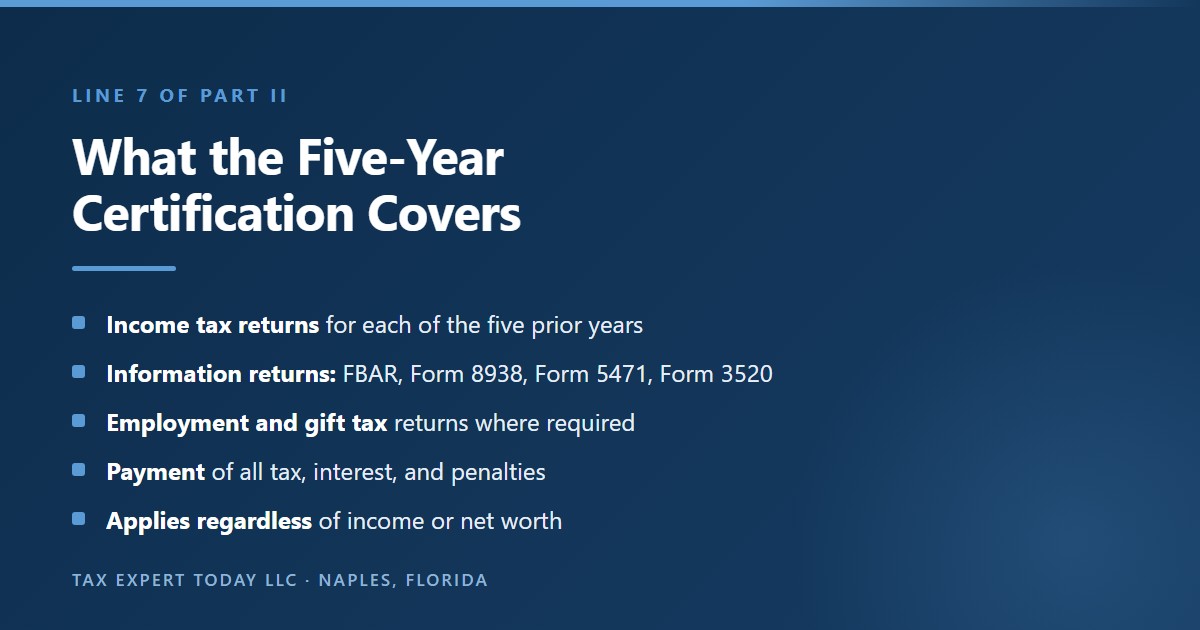
Line 7 of Part II, Section A asks whether you “have complied with your tax obligations for the 5 tax years ending before the date on which you expatriated, including but not limited to, your obligations to file income tax, employment tax, gift tax, and information returns, if applicable, and your obligation to pay all relevant tax liabilities, interest, and penalties.” The caution that follows in the instructions is direct: you will be subject to tax under section 877A if you have not certified, “regardless of whether your average annual income tax liability or net worth exceeds the applicable threshold amounts.”
For people who have lived abroad for years, the gaps are usually in the information returns rather than the income tax returns. The common ones are these.
| Missed filing | Who typically misses it | Where it is explained |
|---|---|---|
| FinCEN Form 114 (FBAR) | Anyone with foreign accounts over $10,000 in aggregate, including joint accounts with a spouse | Do I need to file an FBAR? |
| Form 8938 | Filers above the specified foreign financial asset thresholds | FBAR vs Form 8938 |
| Form 5471 | Owners and officers of a foreign company, including a small family business | Form 5471 guide |
| Form 3520 | Recipients of large foreign gifts or inheritances and owners of foreign trusts | Form 3520 guide |
| Federal income tax return | Citizens abroad who assumed the foreign earned income exclusion removed the filing duty | FEIE vs foreign tax credit |
| Gift tax return (Form 709) | People who made large gifts to children in the years before leaving | Gift tax rules; the balance sheet also asks about these transfers |
This is why expatriation and the FBAR cluster are closely linked. A person whose unfiled FBARs were non-willful may be able to use the Streamlined Filing Compliance Procedures to catch up before expatriating. Streamlined is available only where the failure was non-willful, and it requires a certification of non-willful conduct under penalty of perjury, so it is not a route for someone whose conduct was willful. A person who has filed the tax returns but missed only the FBARs may look instead at the delinquent FBAR procedures. The penalty exposure behind those choices is explained in our guide to FBAR penalties. Which route fits depends on the facts, and none of them is assured.
Are dual citizens and minors exempt from the exit tax?
Certain dual citizens from birth and certain minors are not treated as covered expatriates solely because they meet the tax liability or net worth test. They are still covered if they fail the five-year certification, so they must file Form 8854 and certify compliance to use the exception. The exception never removes the filing requirement itself.
- Dual citizens from birth. Citizen of the United States and another country at birth, and still a citizen and tax resident of that country.
- Ten-year residence limit. Not a United States resident for more than 10 of the 15 tax years ending with expatriation.
- Minors. Expatriated before age 18 and a half, with no more than 10 tax years of United States residence.
- Certification still required. Both exceptions fail if the five-year certification is not made.
The exceptions are in section 877A(g)(1)(B) and are restated in the instructions. For both, United States residence is measured with the substantial presence test described in chapter 1 of Publication 519, not by where the person felt at home. A dual citizen born in the United States to foreign parents, who left as a child and never returned, often fits the exception comfortably on residence. The weak point is usually the certification, because many such individuals have never filed a United States return at all.
For that group, the IRS offers Relief Procedures for Certain Former Citizens, discussed later in this guide. The relief procedures have their own eligibility tests, and the IRS states that the $2 million net worth test applies under them without exceptions.
How does the U.S. exit tax work?
A covered expatriate is taxed as if every asset had been sold at fair market value on the day before the expatriation date. The net gain is reduced by an exclusion amount, $890,000 for 2025 and $910,000 for 2026, allocated among the gain assets. The remaining gain is reported as if the property had actually been sold.
- Deemed sale. Property is treated as sold for fair market value on the day before expatriation.
- Exclusion amount. The first $910,000 of net gain is excluded for 2026 expatriations.
- Losses count. Losses are allowed to the extent the Code otherwise allows them, and the wash sale rule does not apply.
- Character is kept. Capital gain stays capital gain, and ordinary gain stays ordinary income.
This mark-to-market rule is section 877A(a). The exclusion amount started at $600,000 and is indexed for inflation. The IRS confirms $890,000 for calendar year 2025 on its expatriation tax page, and Revenue Procedure 2025-32 sets $910,000 for taxable years beginning in 2026. The exclusion is not a deduction against all income. It reduces only the gain from the deemed sale, and it cannot reduce the gain allocated to any single asset below zero.
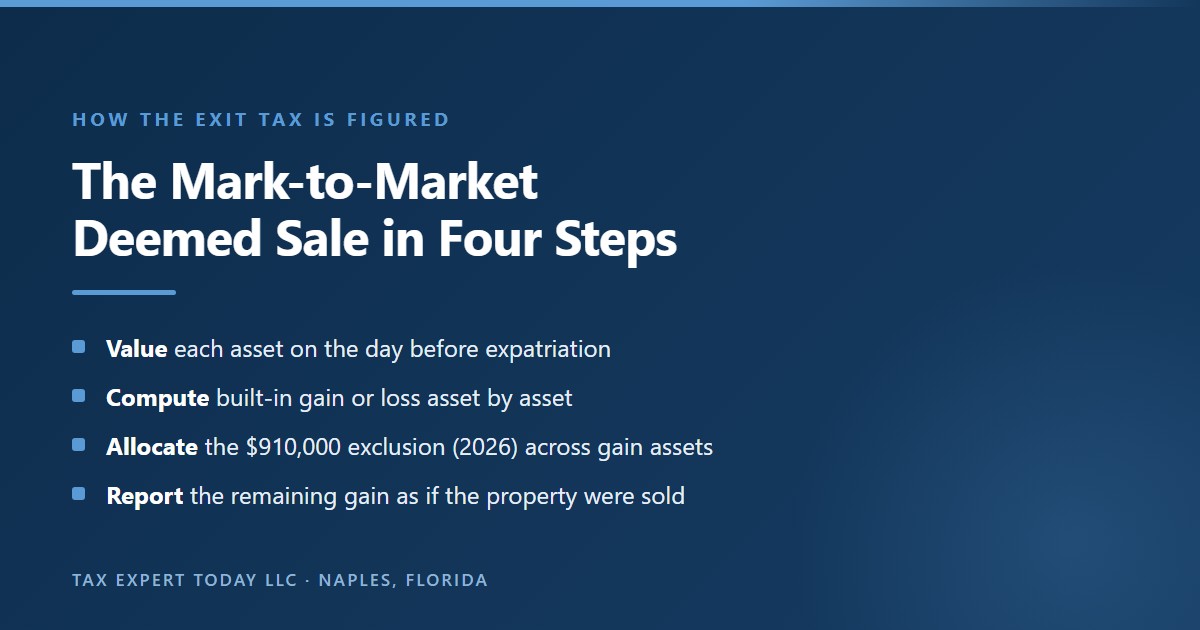
The allocation works asset by asset. The 2025 instructions include a worked example with three assets held on the day before expatriation. It is reproduced below using the IRS figures and the 2025 exclusion amount.
| Asset (IRS example) | Adjusted basis | Fair market value | Built-in gain or loss | Exclusion allocated | Gain recognized |
|---|---|---|---|---|---|
| Asset A (business property) | $200,000 | $2,000,000 | $1,800,000 | $801,000 | $999,000 |
| Asset B (personal property) | $800,000 | $1,000,000 | $200,000 | $89,000 | $111,000 |
| Asset C (personal property) | $800,000 | $500,000 | ($300,000) | None, loss asset | Loss reported separately |
| Total gain assets | $2,000,000 | $890,000 | $1,110,000 |
Each gain asset receives a share of the exclusion in proportion to its gain: Asset A carried 1,800,000 of the 2,000,000 total gain, so it receives 90 percent of $890,000, or $801,000. The loss on Asset C is not netted against the exclusion. It is reported on the return for the part of the year that includes the day before expatriation, subject to the usual loss limits. The IRS Notice 2009-85 example makes the same point and adds that the capital loss limits of section 1211(b) still apply, while the wash sale rule of section 1091 does not.
The recognized gain is reported “in the same manner as if the property had actually been sold.” The instructions give two examples that matter to many readers: gain on depreciated rental property is reported on Form 4797, and gain on stock or a personal residence is reported on Form 8949. Column (f) of Section C, line 2 asks you to name the form used for each property.
Basis is a second place where the rules depart from an ordinary sale. Column (c) of Section C explains that the basis used generally cannot be less than the fair market value of the property on the date you first became a United States resident. A naturalized citizen or a long-term resident can make an irrevocable election under section 877A(h)(2) to determine basis without regard to that restriction, marked “(h)(2)” beside the entry. Whether the election helps depends on whether an asset has risen or fallen in value since the owner first became a resident, so it is decided property by property.
Which assets are taxed differently from the deemed sale?
Four categories are carved out of the mark-to-market deemed sale: eligible deferred compensation items, ineligible deferred compensation items, specified tax deferred accounts such as IRAs and 529 plans, and interests in nongrantor trusts. Each has its own rule, ranging from 30 percent withholding on later payments to immediate inclusion of the full value.
- Eligible deferred compensation. Taxed by withholding when paid, if Form W-8CE is given and treaty relief is waived.
- Ineligible deferred compensation. The present value is included in income on the day before expatriation.
- Specified tax deferred accounts. Treated as fully distributed on the day before expatriation.
- Nongrantor trust interests. Distributions later face withholding unless a valuation ruling election is made.
These rules are in paragraphs (d), (e), and (f) of section 877A, and Section C, line 1 of the form lists each category. Amounts checked on line 1 are not entered on line 2 with the deemed sale property; each is identified on a separate attached statement as of the day before expatriation.
| Category | Examples from the instructions | How it is taxed | Form 8854 action |
|---|---|---|---|
| Eligible deferred compensation item | A 401(k) or pension from a United States payor, where the payor is notified and treaty relief is waived | 30 percent withholding on each taxable payment after expatriation | Line 1a, irrevocable treaty waiver statement, Form W-8CE to the payor, annual Form 8854 |
| Ineligible deferred compensation item | Deferred compensation from a foreign payor, or where the waiver or notice is not made | Present value of the accrued benefit included in income on the day before expatriation | Line 1b, statement of present value |
| Specified tax deferred account | Traditional and Roth IRAs (other than SEP and SIMPLE), 529 plans, ABLE accounts, Coverdell accounts, HSAs, Archer MSAs | Entire interest treated as distributed on the day before expatriation | Line 1c, statement of each account balance |
| Interest in a nongrantor trust | A beneficiary interest in a domestic or foreign trust the expatriate is not treated as owning | 30 percent withholding on taxable distributions, treaty relief waived, unless a valuation ruling election is made | Line 1d, waiver statement or section 877A(f)(4)(B) election, annual Form 8854 |
The eligible deferred compensation rule has a timing trap. To notify the payor on time, the instructions require Form W-8CE to be filed with the payor by the earlier of the day before the first distribution on or after the expatriation date, or 30 days after the expatriation date. The instructions also note that a deferred compensation item does not include the part attributable to services performed outside the United States while the person was not a citizen or resident.
For a retiree whose savings sit mostly in an IRA, the specified tax deferred account rule is often the largest single number on the return. The account is treated as distributed in full, so for a traditional IRA the balance is generally taxed as ordinary income in the year of expatriation, even though no money leaves the account. The instructions state that the deemed distribution is included on Form 1040 for the portion of the year that includes the expatriation date. Our guide to retiring to Florida taxes covers how IRAs and pensions are taxed for residents; for a covered expatriate the timing is compressed into one year.
Can the exit tax be deferred?
Yes. A covered expatriate can make an irrevocable election, property by property, to defer paying the exit tax until the property is sold or until death. Deferral requires a tax deferral agreement with the IRS, adequate security such as a bond, a waiver of treaty rights that would block collection, and interest on the deferred amount.
- Property by property. The election can cover some assets and not others.
- Security is required. A bond meeting section 6325 or other security acceptable to the IRS.
- Interest runs. Interest is charged for the entire deferral period.
- Annual filing continues. Form 8854 is filed every year until the deferred tax and interest are paid.
The mechanics are in Part II, Section D. Before completing it, the filer prepares two hypothetical Form 1040 returns, one including the section 877A gain and loss and one excluding it, and attaches both. The difference is the tax eligible for deferral, which is then allocated among the gain properties in column (g) of Section C. The instructions set out the remaining conditions: the expatriate must appoint a United States person as a limited agent for communications about the agreement, and the original deferral request is mailed with Form 8854 to the Internal Revenue Service at 3651 S IH35, MS 4301 AUSC, Austin, TX 78741. The instructions warn that the address printed in Notice 2009-85 is no longer valid.
Deferral does not reduce the tax. It changes when it is paid, and interest accrues in the meantime. It tends to be considered where the largest gain sits in an asset that cannot easily be sold, such as a closely held business interest or real estate, and the expatriate would otherwise need to raise cash to pay tax on a sale that has not happened. When a deferred asset is later sold, the deferred tax and interest on that asset are due by the due date, without extensions, of the return for the year of the disposition.
How is net worth figured on the Form 8854 balance sheet?
Net worth for Form 8854 is figured on the Part II, Section B balance sheet as of the expatriation date, listing fair market value and United States adjusted basis for every asset and liability. You are treated as owning any interest that would be a taxable gift if transferred just before expatriation, including certain trust interests.
- Good faith estimates are allowed. The instructions say formal appraisals are not required.
- Retirement and deferred pay count. Pensions and deferred compensation are listed at present value.
- Partnerships and trusts need statements. Each interest is listed separately with any EIN.
- Controlled foreign companies are flagged. Line 5a identifies nonmarketable stock in would-be controlled foreign corporations.
The balance sheet is required under section 6039G whether or not the filer is covered, and it is the usual way to test the $2 million line. The ownership rule is broad: the instructions treat you as owning any interest in property that would be taxable as a gift under chapter 12 had you transferred it immediately before expatriation, ignoring the annual exclusion, gift splitting, and the marital and charitable deductions. Values are determined under the gift tax valuation principles of section 2512, and beneficial interests in trusts are valued under the two-step process in Notice 97-19.
Two practical points follow. First, a couple does not measure net worth jointly. Each spouse who expatriates has their own balance sheet, so assets titled to one spouse can place that spouse over the line while the other stays under it. Second, line 5a asks for nonmarketable stock in foreign corporations that would be controlled foreign corporations if you were still a United States person. A business owner who files Form 5471 will recognize the category, and the same company shares will appear again in Section C if the filer is covered.
What does section 2801 mean for gifts and inheritances from a covered expatriate?
Section 2801 taxes a United States citizen or resident who receives a gift or bequest from a covered expatriate. The recipient pays tax at the highest estate and gift tax rate on the value above the annual exclusion, $19,000 for 2026. A donor is presumed covered unless they authorize disclosure of their tax information to the recipient.
- The recipient pays. The tax falls on the United States person who receives the property.
- The rate is the top rate. It equals the highest rate in the section 2001(c) table on the date of receipt.
- Some transfers are excluded. Gifts to a spouse or charity, and property shown on a timely United States gift or estate tax return, are outside it.
- Foreign tax reduces it. Gift or estate tax paid to another country on the same transfer is credited.
The rule is in 26 U.S.C. section 2801, and it reaches gifts made at any time after expatriation as well as bequests at death. It matters most to families where one member leaves and the children or grandchildren stay in the United States. Section 2801(c) limits the tax to the value of covered gifts and bequests above the annual exclusion, and Revenue Procedure 2025-32 sets that figure at $19,000 for 2026. Transfers to a domestic trust are taxed as if the trust were a citizen, and distributions from a foreign trust that are attributable to covered gifts are taxed when distributed to a United States beneficiary.
The 2025 Form 8854 instructions flag new guidance on the section 2801 tax in their opening notes, and they add a presumption that matters to the family: a donor who gives a gift to a United States citizen or resident “is presumed to be a covered expatriate for purposes of the section 2801 tax unless you authorize the disclosure of your relevant income tax return or income tax return information to the recipient.” A former citizen who was never covered may therefore still need to take a step to protect a child’s gift from the presumption. Reporting of foreign gifts in general is covered in our Form 3520 guide.
When and where is Form 8854 filed?
The initial Form 8854 is attached to the income tax return for the year that includes the expatriation date, filed by its due date including extensions, and a copy is sent to the IRS in Austin, Texas. A filer with no return requirement mails the form alone by the date the return would have been due.
- Attach and mail a copy. The original goes to the Austin address; a copy is attached to the return.
- Usually a dual-status return. A mid-year expatriate generally files a dual-status return for that year.
- Annual forms follow the same pattern. Attach to Form 1040-NR if one is filed, and mail a copy marked “Copy.”
- Sign it. The form is not valid unless signed, and a paid preparer signs with a PTIN.
The instructions say to “send your original initial or annual Form 8854” to Internal Revenue Service, 3651 S IH35, MS 4301 AUSC, Austin, TX 78741, and to attach the form to the Form 1040, 1040-SR, or 1040-NR for the year. For most people who expatriate partway through a year, that return is a dual-status return. Notice 2009-85 explains that a covered expatriate who was a citizen or long-term resident for only part of the year files a Form 1040-NR with a Form 1040 attached as a schedule, and that no dual-status return is needed when the expatriation date is January 1. The mechanics of the nonresident return are in our guide to Form 1040-NR.
| Statement | Who files | Attached to | Deadline |
|---|---|---|---|
| Initial (Parts I and II) | Everyone who expatriated during the year, covered or not | Form 1040, 1040-SR, or 1040-NR (usually dual-status) for the year of expatriation | Due date of that return, including extensions |
| Initial, no return required | An expatriate with no income tax filing requirement for the year | Mailed alone to the Austin address | The date the return would have been due, including extensions |
| Annual (Parts I and III) | Covered expatriates with deferred tax, eligible deferred compensation, or nongrantor trust interests | Form 1040-NR (or 1040) for the year, with a copy marked “Copy” to Austin | Due date of that return, including extensions |
| Tax deferral agreement request | Covered expatriates electing deferral | Original, marked “Original,” mailed with Form 8854 to Austin | With the initial Form 8854 |
The instructions end the Where To File section with a reminder that anyone who was a United States person for any part of the year may still owe an FBAR and a Form 8938 for that year. The year of expatriation is a reporting year like any other, and it is one of the five years the next certification will look back on if the person ever needs to certify again.
What is the Form 8854 penalty?
An expatriate who is required to file Form 8854 and fails to file it, leaves out required information, or includes incorrect information owes a $10,000 penalty for that year, unless the failure was due to reasonable cause and not willful neglect. The larger cost is usually covered expatriate status from a missing certification.
- $10,000 per year. The amount is fixed by section 6039G(c) and applies to each required year.
- Incomplete counts as a failure. Omitted or incorrect information triggers the same penalty.
- Reasonable cause is the defense. The statute excuses failures due to reasonable cause and not willful neglect.
- The IRS sends notices. The IRS says it is sending notices to expatriates who have not complied.
The penalty is in 26 U.S.C. section 6039G(c), and the IRS repeats it on its expatriation tax page under the heading “Significant penalty imposed for not filing expatriation form,” noting that it is “sending notices to expatriates who have not complied with the Form 8854 requirements, including the imposition of the $10,000 penalty where appropriate.” A covered expatriate with an annual filing duty can face the penalty year after year.
The $10,000 figure is often smaller than the consequence of the missing certification. A person who never files Form 8854 has not certified five years of compliance, and the certification test makes them a covered expatriate regardless of wealth. Where a penalty has been assessed, the standard relief routes for information return penalties are the ones to review, and our guide on how to get IRS penalties removed explains how reasonable cause arguments are built. Relief depends on the facts and is never assured.
What if you expatriated years ago and never filed Form 8854?
File it. The IRS directs former citizens and long-term residents who never filed to submit the missing Form 8854, and the required income tax returns, for the year of expatriation. A former citizen with low tax liability and net worth below $2 million may qualify for the Relief Procedures for Certain Former Citizens, which avoid covered status.
- Late is better than never. The missing certification is what makes a non-filer covered.
- Relief procedures exist. They are for former citizens whose failures were non-willful.
- Strict eligibility. Net worth under $2 million and aggregate tax of $25,000 or less for six years.
- Older expatriations use older rules. Expatriations between June 4, 2004 and June 16, 2008 follow section 877.
The Relief Procedures for Certain Former Citizens are aimed at people who often did not know they were United States citizens or did not know that citizens abroad must file. If the conditions are met, the IRS states, the individual will not be a covered expatriate “nor will they be liable for any unpaid taxes and penalties for these years or any previous years.” The conditions are strict, and the IRS says they “must be strictly met.”
| Relief procedures condition (IRS FAQ Q2) | What it means in practice |
|---|---|
| Relinquished citizenship after March 18, 2010 | Available to former citizens only, not to former long-term residents |
| No filing history as a United States citizen or resident | A Form 1040-NR filed in the good faith belief that you were not a citizen does not count against you |
| Did not exceed the section 877(a)(2)(A) tax liability threshold | Average annual net income tax for the five years was at or below the threshold |
| Net worth under $2,000,000 at expatriation and at submission | Applied without the dual citizen and minor exceptions |
| Aggregate tax of $25,000 or less for the year of expatriation and the five prior years | After deductions and credits, excluding section 877A, penalties, and interest |
| All required returns filed for the six years at issue | Income tax returns, schedules, and information returns, including FBARs |
| Failures due to non-willful conduct | Negligence, inadvertence, mistake, or a good faith misunderstanding of the law |
People who expatriated between June 4, 2004 and June 16, 2008 are in a different position. The instructions explain that those who have not filed Form 8854 continue to be treated as United States citizens or lawful permanent residents for income tax purposes until they file it, under section 7701(n) as then in effect, and that they use the 2018 Form 8854 with the year changed. Anyone in that group should be careful about assuming that an old renunciation ended their United States tax status.
How does giving up a green card differ from renouncing citizenship?
A green card holder is inside the expatriation rules only as a long-term resident, meaning a lawful permanent resident in at least 8 of the last 15 tax years. Residency usually ends with Form I-407, but it can also end through a treaty tie-breaker. Long-term residents also have a basis rule tied to when residency began.
- The 8 of 15 count comes first. Fewer than 8 tax years means no section 877A exposure.
- Treaty years can drop out. Years as a non-waiving treaty resident of another country are not counted.
- A treaty claim can itself expatriate. Claiming foreign treaty residence with notice to the IRS ends long-term residency.
- Relief procedures do not apply. They are limited to former citizens.
The practical difference is that long-term residents can drift into expatriation without meaning to. Under section 7701(b)(6), and as the instructions explain, a lawful permanent resident stops being treated as one if they commence to be treated as a resident of a foreign country under a tax treaty, do not waive the treaty benefits, and notify the IRS. A long-term green card holder who moves back to Europe and files a Form 8833 treaty tie-breaker position to avoid being taxed as a United States resident may have created an expatriation date, and with it a Form 8854 filing requirement and possibly the exit tax.
The reverse question arises too. A person who spends part of the year in the United States without a green card is not a long-term resident at all, and their residence questions are governed by the substantial presence test and, for Canadians and other seasonal visitors, the closer connection exception on Form 8840. Form 8854 is the counterpart to Form 8840: one is filed by a foreign national showing they never became a United States resident, the other by a United States person showing they have stopped being one.
How does the U.S. exit tax differ from a state exit tax?
The federal exit tax under section 877A applies only when a person gives up citizenship or long-term residency. Moving from one state to another, such as from New Jersey or New York to Florida, is not expatriation and never triggers section 877A or Form 8854, although the state may still tax income or withhold on a property sale.
- Federal trigger. Relinquishing citizenship or ending long-term residency.
- State issues. Residency audits, withholding on sales, and source income rules after a move.
- Florida has no personal income tax. There is no Florida exit tax on leaving the country.
- Different forms. State issues are handled on state returns, not on Form 8854.
The phrase “exit tax” is used for both, which causes confusion. When people talk about the New Jersey exit tax, they usually mean estimated withholding on the sale of New Jersey real estate by a departing resident, explained in our guide to the New Jersey exit tax. The New York exit tax guide covers the similar New York rules. Neither has anything to do with Form 8854, and a person who moves to Naples and stays a United States citizen has no federal expatriation filing at all.
What does the exit tax mean for a Florida home and Florida retirement accounts?
For a covered expatriate, a Florida home is deemed sold at fair market value on the day before expatriation, and the gain is reported on Form 8949 as if sold. IRAs are treated as fully distributed. The exclusion amount is shared across all gain assets, so a large home gain can consume much of it.
- The home is property like any other. It is on the balance sheet and in the deemed sale.
- No cash changes hands. Tax is owed on a sale that has not happened unless deferral is elected.
- IRAs are deemed distributed. For a traditional IRA, the full balance is generally ordinary income.
- Check other exclusions early. Confirm with an adviser whether any other exclusion applies to the home.
The hypothetical below shows how the pieces combine for a long-term green card holder, retired in Naples, who files Form I-407 in 2026 to return to their home country. The figures are illustrations only. They ignore any other exclusion that may apply to the home, any basis election, state or foreign tax, and treaty considerations, and they assume the person is covered because net worth exceeds $2 million.
| Item (hypothetical, 2026 expatriation) | Basis | Fair market value | Gain | Share of $910,000 exclusion | Gain reported |
|---|---|---|---|---|---|
| Naples home | $500,000 | $1,200,000 | $700,000 | $637,000 | $63,000 (Form 8949) |
| Taxable brokerage account | $600,000 | $900,000 | $300,000 | $273,000 | $27,000 (Form 8949) |
| Traditional IRA | Not in the deemed sale | $400,000 | Not applicable | None | $400,000 ordinary income as a deemed distribution |
| Total | $2,500,000 | $1,000,000 | $910,000 | $90,000 gain plus $400,000 ordinary income |
Two lessons come out of the example. The exclusion amount covered most of the capital gain, but it did nothing for the IRA, which is outside the deemed sale and taxed on a separate rule. And the number that made the person covered was net worth, not income, so a retiree with modest taxable income can still be inside the regime. A person in this position who is close to the $2 million line has reason to measure it carefully and early, because the test is applied on a single day.
Retirees who are not covered expatriates still file Form 8854, still certify, and still need a return for the year of expatriation, but they do not owe the mark-to-market tax. For them, the Florida questions are the ordinary ones about a nonresident owning or selling United States property afterward, including FIRPTA withholding if the home is later sold as a foreign person.
Form 8854 Help in Naples & Southwest Florida
Tax Expert Today LLC works with international clients from an office in Naples, Florida, and serves clients in all 50 states. Collier and Lee counties are home to long-term green card holders from Canada, Europe, and Latin America who spent their working years here, and to United States citizens who have family and property abroad. Expatriation questions often arise for them in retirement, when a return home is being planned.
- Form 8854 help Naples: preparing the initial statement, the balance sheet, and the attached statements.
- Exit tax Naples FL: testing covered expatriate status before the expatriation date, while facts can still be organized.
- International tax Naples FL: bringing FBARs, Form 8938, and Form 5471 into compliance so the five-year certification can be made.
- Green card holders: counting the 8 of 15 tax years and reviewing any treaty positions already taken.
Florida has no personal income tax, so the expatriation questions a Southwest Florida resident faces are federal ones. Our international and expat tax services page explains how we approach cross-border engagements, and our FBAR filing guide is the starting point for the foreign account reporting that the certification depends on.
Office: 11983 Tamiami Trail N, Naples FL 34110
Phone: (239) 441-2005
Hours: Monday through Friday, 10:00 to 5:00 ET
Frequently Asked Questions
I have had a green card for twelve years and I am retiring from Naples back to Germany. Do I need to file Form 8854?
If you held the green card in at least 8 of the last 15 tax years, you are generally a long-term resident, and surrendering the card with Form I-407 is an expatriation. You would file an initial Form 8854 with the return for that year. Whether you owe exit tax depends on the three covered expatriate tests.
Who needs to file Form 8854?
Anyone who relinquished United States citizenship during the year, and any long-term resident who ended lawful permanent residency during the year. Covered expatriates who deferred tax, hold eligible deferred compensation, or benefit from a nongrantor trust also file an annual Form 8854.
When is Form 8854 due?
The initial Form 8854 is due with the income tax return for the year of expatriation, by that return’s due date including extensions. If no return is required, it is mailed to the IRS in Austin, Texas by the date the return would have been due.
Can I avoid the U.S. exit tax?
Only by not being a covered expatriate or by fitting an exception. That generally means staying under the tax liability and net worth tests, qualifying as a dual citizen from birth or a minor, and, in every case, being able to certify five years of compliance. Planning should be reviewed before the expatriation date.
Does the exit tax apply to my IRA?
For a covered expatriate, an IRA other than a SEP or SIMPLE is treated as fully distributed on the day before expatriation, and that deemed distribution is taxed under the normal distribution rules, so a traditional IRA balance is generally ordinary income. It is not part of the deemed sale and does not share the exclusion amount.
What is the penalty for not filing Form 8854?
$10,000 for each year a required form is not filed or is incomplete or incorrect, unless the failure was due to reasonable cause and not willful neglect. A missing form also means the five-year certification was never made, which can make the person a covered expatriate.
When to Engage a Professional
Form 8854 is manageable when the facts are simple: a dual citizen from birth with a clean filing history and modest assets, or a short-term green card holder who is not a long-term resident at all. It becomes worth professional help when the numbers are close to a threshold, when the five years are not clean, or when the balance sheet includes a business, a trust, or retirement assets.
Consider a consultation if any of the following applies: your net worth is anywhere near $2 million, you have unfiled FBARs, Forms 8938, 5471, or 3520 in the last five years, you hold deferred compensation or a nongrantor trust interest, you own a home or business with a large built-in gain, you have taken a treaty tie-breaker position as a green card holder, or you expatriated in a prior year and never filed. The most useful time to review these facts is before the expatriation date, because the tests are applied on that date.
Tax Expert Today LLC is a tax advisory firm in Naples, Florida serving clients in all 50 states. Call (239) 441-2005 to discuss your facts.
Primary Sources
- IRS: About Form 8854, Initial and Annual Expatriation Statement
- Instructions for Form 8854 (2025)
- IRS: Expatriation tax
- IRS: Relief Procedures for Certain Former Citizens
- 26 U.S.C. section 877A (tax responsibilities of expatriation)
- Revenue Procedure 2025-32 (2026 thresholds and exclusion amount)
This article is general information, not advice for any particular taxpayer, and does not create a client relationship. The Naples home, brokerage, and IRA figures are hypothetical illustrations only; the asset allocation example is the IRS example from the Form 8854 instructions. Thresholds and the exclusion amount are adjusted annually; the 2025 Form 8854 instructions and Revenue Procedure 2025-32 were current when this article was written. Immigration and nationality questions, including the renunciation process, are outside the scope of this article. Verify current rules and confirm your own facts with a qualified tax professional before expatriating or filing.
Published September 25, 2026 by Dr. Pellumb Kabashi « Back to Learning Center
Have a question this article touches on?
Tax Expert Today LLC, based in Naples, Florida and serving clients across the United States.
Schedule a Consultation (239) 441-2005