
By Dr. Pellumb Kabashi, DBA, MBA, EA, CFE, CES
Founder, Tax Expert Today LLC · Tax advisors, enrolled agents, CPAs, and attorneys · Serving clients in all 50 states
Quick Answer: The substantial presence test is the day count that decides whether a foreign national is taxed as a United States resident. You meet it if you were present at least 31 days in the current year and 183 days across three years, counting every day this year, one third of last year, and one sixth of the year before. Meeting it taxes your worldwide income. Call (239) 441-2005 for a free consultation.
Published: August 12, 2026
What Is the Substantial Presence Test?
The substantial presence test is the physical presence formula the IRS uses to decide whether a foreign national is treated as a United States resident for income tax purposes. It is a mechanical day count rather than a judgment about intent, immigration status, or where you consider home to be. Meeting it makes you a resident alien taxed on worldwide income.
- It is one of two tests. A person is a resident alien if they hold a green card or meet the substantial presence test, under 26 U.S.C. §7701(b)(1)(A).
- Intent does not enter the formula. A visitor who never sought residency can meet the test purely on days counted.
- Immigration status and tax status are separate. You can be a nonimmigrant for visa purposes and a resident for tax purposes in the same year.
- The consequence is scope, not rate. Residents report worldwide income, not only income connected to the United States.
That last point is what makes the test worth understanding before the year ends rather than after. A nonresident alien is taxed on income effectively connected with a United States trade or business and on certain United States source income. A resident alien is taxed the way a citizen is taxed, on income from every country, and carries the foreign information reporting duties that follow from that. The day count is simple arithmetic. What it switches on is not. The same status decides which certificate a United States payer is entitled to hold, because a nonresident alien certifies foreign status on Form W-8BEN, and a person who crosses into resident alien status has 30 days to notify the payer and switch to Form W-9. How the nonresident side of that line is actually reported, including the 16-month filing rule that protects deductions, is covered in our guide to Form 1040-NR.
How Do You Calculate the Substantial Presence Test?
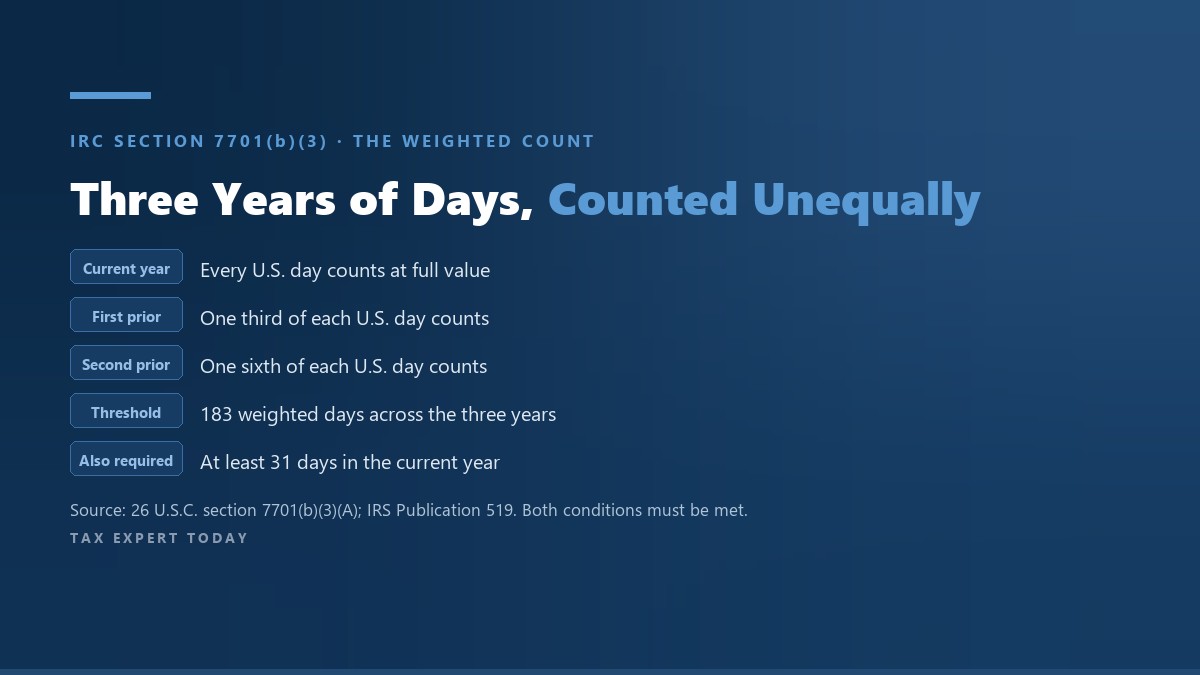
You meet the test if you were physically present in the United States on at least 31 days during the current year, and at least 183 days across a three year window using a weighted count. Count all of the current year days, one third of the prior year days, and one sixth of the days from two years back.
- Both conditions must be satisfied. Failing the 31 day threshold defeats the test even where the weighted total exceeds 183.
- The weighting is fixed. Current year at full value, first prior year at one third, second prior year at one sixth.
- A partial day generally counts as a day. Presence at any point in a day is presence for that day, subject to the exclusions below.
- The window always ends with the current year. It is a rolling three year lookback, not a fixed period.
| Year in the window | Multiplier | IRS example: 120 days each year |
|---|---|---|
| Current year | 1 | 120 days |
| First preceding year | 1/3 | 40 days |
| Second preceding year | 1/6 | 20 days |
| Weighted total | — | 180 days, which does not meet the test |
The weighted three year count, using the worked example published by the IRS. At 120 days a year the total lands three days short.
The example is instructive because it shows how narrow the margin can be. A person spending four months a year in the United States, every year, on a steady and unremarkable schedule, sits just under the line. Add eleven days in the current year and the same person crosses it. This is the arithmetic that catches seasonal residents, and it is why the count deserves attention in November rather than in April.
Which Days Do Not Count Toward the Substantial Presence Test?
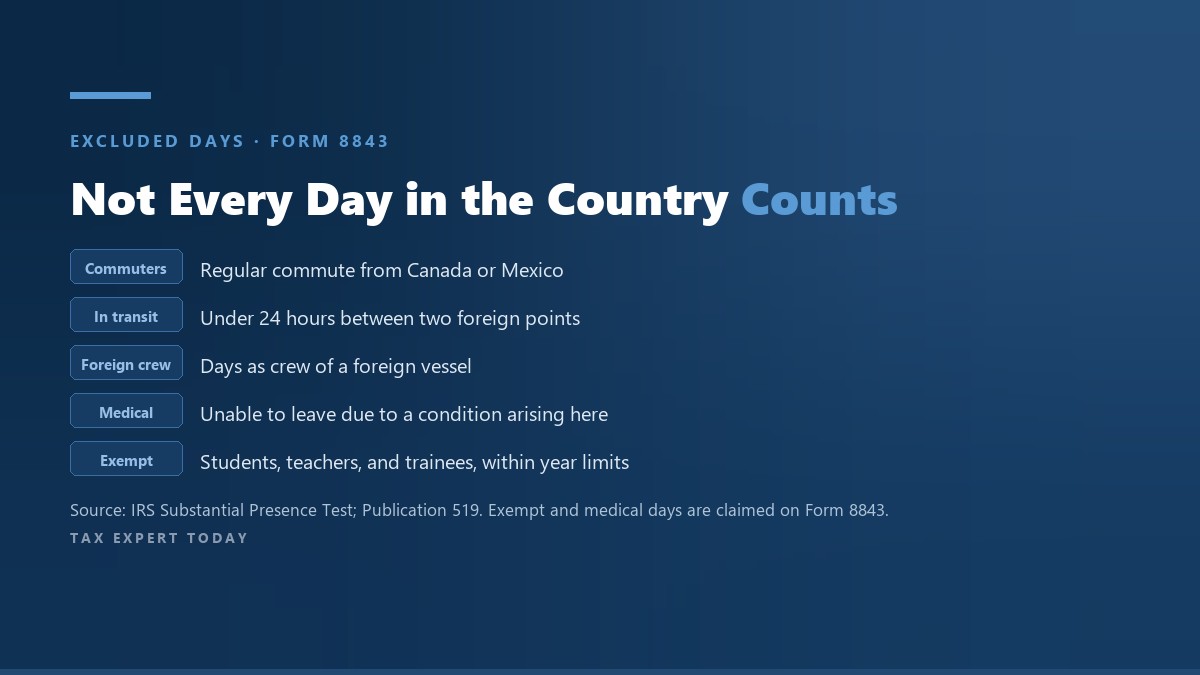
Several categories of presence are excluded from the count entirely. Regular commuters from Canada or Mexico, travelers in transit for under 24 hours, crew members of foreign vessels, individuals who cannot leave because of a medical condition that arose here, and exempt individuals all subtract days from the total.
- Regular border commuters. Days commuting to work from a residence in Canada or Mexico do not count where you commute on more than 75 percent of the workdays in your working period.
- Transit under 24 hours. Days in the United States for less than 24 hours while traveling between two other countries are excluded.
- Foreign vessel crew. Days present as a crew member of a foreign vessel do not count.
- Medical conditions arising here. Days you were unable to leave because of a medical condition that developed while you were in the United States are excluded, but a condition that existed before arrival is not covered.
- Exempt individuals. Days in certain visa categories are excluded, subject to the year limits in the next section.
Two of these carry a filing obligation rather than an automatic benefit. Where days are excluded because you were an exempt individual or because of a medical condition, the IRS requires Form 8843 with the income tax return, and where no return is otherwise required, the form is sent on its own. The exclusion is claimed, not assumed, and a taxpayer who simply omits the days without filing has not documented the position.
Who Is an Exempt Individual, and for How Long?
An exempt individual is not someone exempt from tax. It is someone whose days of presence are excluded from the count because of their visa category. Students, teachers, trainees, foreign government related individuals, and certain athletes qualify, but the student and teacher categories expire after a set number of calendar years.
- Students on F, J, M, or Q visas. Exempt status ends once you have been exempt for any part of more than five calendar years.
- Teachers and trainees on J or Q visas. Not exempt if you were exempt as a teacher, trainee, or student for any part of two of the six preceding calendar years.
- A narrow extension exists for teachers. The two of six limit stretches to three of six where a foreign employer paid all compensation in the relevant years.
- Calendar years, not twelve month periods. A single day in January consumes an entire calendar year of the allowance.
| Category | Visa | Limit on exempt years | Form required |
|---|---|---|---|
| Student | F, J, M, Q | More than 5 calendar years ends it | Form 8843 |
| Teacher or trainee | J, Q | Any part of 2 of the 6 preceding years | Form 8843 |
| Teacher, foreign employer paid | J, Q | Extends to 3 of the 6 preceding years | Form 8843 |
| Foreign government related | A, G | No calendar year limit | Form 8843 |
Exempt individual categories and the year limits that end them, per IRS Publication 519.
The calendar year point is where long term students are most often surprised. A graduate student who arrived in late December of one year and left in early January six years later has touched seven calendar years, not six, and the exempt allowance ran out well before the coursework did. Once it runs out, the days count normally, and a student who has been in the United States continuously will meet the substantial presence test almost immediately.
What Changes If You Meet the Substantial Presence Test?
Meeting the test converts you into a resident alien taxed on worldwide income, and it switches on the foreign information reporting regime. That second consequence is the one most day count guides omit, and it is where the penalties live. Reporting duties attach to accounts and entities abroad regardless of whether they generate any United States tax.
- Worldwide income becomes reportable. Foreign salary, rental income, pensions, interest, and gains enter your United States return.
- The FBAR threshold applies. A United States person whose foreign accounts exceeded $10,000 in aggregate at any point in the year has a FinCEN Form 114 duty. See our guide to whether you need to file an FBAR.
- Form 8938 may apply separately. The FATCA thresholds are different and higher, and the two filings are not alternatives, as explained in FBAR versus Form 8938.
- Foreign entities trigger their own returns. An interest in a foreign corporation can require Form 5471, where the penalty starts at $10,000 per year per corporation.
- Signature authority alone can be enough. Control over an account you do not own carries its own reporting duty, covered in FBAR signature authority.
The practical risk is a timing mismatch. A person crosses the day count in a year they were not thinking about United States tax at all, and the information returns for that same year come due on the ordinary schedule. Because those penalties attach to the missing form rather than to unpaid tax, a taxpayer with no United States tax liability whatsoever can still face them. That asymmetry is the reason the day count matters well beyond the income tax return itself.
Can You Meet the Test and Still Be Taxed as a Nonresident?
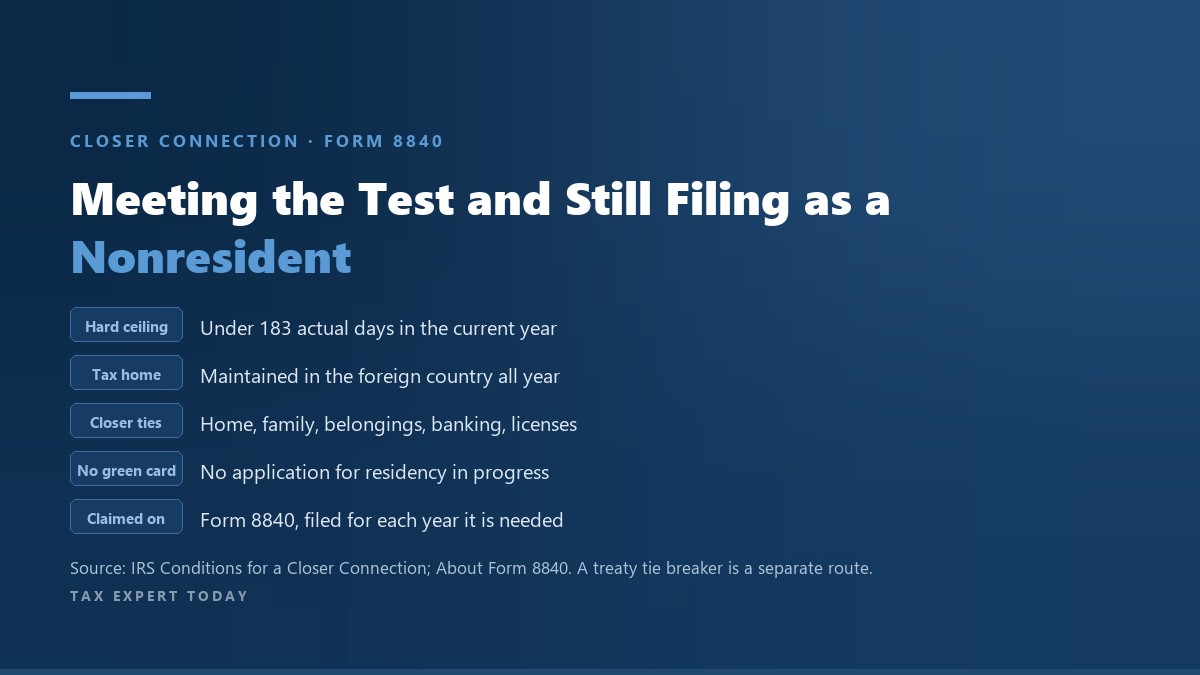
Yes, in defined circumstances. The closer connection exception allows a person who meets the substantial presence test to be treated as a nonresident, provided four conditions are met and the position is claimed on Form 8840. It is unavailable to anyone present 183 days or more in the current year.
- Under 183 days in the current year. This is a hard ceiling, and it is measured on actual current year days, not the weighted total.
- A tax home in the foreign country. It must be maintained for the entire year.
- A closer connection to that country. The IRS weighs contacts such as your permanent home, family, belongings, and where you bank, vote, and hold licenses.
- No green card application in progress. Having taken steps toward lawful permanent resident status defeats the exception.
- It is claimed on a form. Form 8840 is the statement, and the exception can also be extended to two foreign countries in limited cases.
A separate route exists where an income tax treaty applies. A treaty residency tie breaker can assign residence to the other country even where domestic law would treat you as a United States resident, and the position is disclosed on Form 8833. The two routes are not interchangeable. The closer connection exception is a domestic rule with a firm day ceiling, while a treaty tie breaker depends entirely on the text of the specific treaty. Neither is self executing, and both depend on facts that should be documented while the year is still open rather than reconstructed later. How the closer connection exception is claimed each year, and which Florida filings can undermine it, is covered in our guide to Form 8840.
What Is the 183 Day Rule for Canadian Snowbirds in Florida?
Canadian winter residents are the group most often caught by this test, because a routine seasonal pattern can cross the weighted threshold without any single year looking unusual. Roughly four months each winter puts a snowbird within days of the line, and the closer connection exception on Form 8840 is the standard answer.
- The arithmetic is unforgiving. Four months a year, every year, produces a weighted count in the high 170s or low 180s.
- One long season can tip it. A single extended winter, or a delayed return home, can push the three year total past 183.
- Form 8840 is filed annually. The exception is claimed each year it is needed, not once.
- Under 183 current year days is essential. A snowbird who stays past that point in a single year loses access to the exception for that year entirely.
- The treaty is a separate question. The Canada United States treaty tie breaker is analyzed on its own terms and is not a substitute for the day count discipline.
Southwest Florida sees this pattern constantly, and the failure mode is rarely aggressive planning. It is usually a person who has wintered in the same place for a decade, never filed anything, and has no idea the count exists. Because meeting the test also switches on the foreign account reporting duties described above, a Canadian resident with ordinary bank accounts, a registered retirement savings plan, and a corporation at home can acquire several United States filing obligations in a year they spent doing nothing different from the year before.
When Does Your U.S. Residency Actually Start?
Residency does not begin on January 1 of the year you meet the test. Under the statute, your residency starting date is generally the first day you were physically present in the United States during that calendar year, which makes the year a dual status year with a nonresident period before that date.
- The first day of presence governs. This is the general rule under 26 U.S.C. §7701(b)(2)(A).
- Up to 10 days can be disregarded. Days on which you had a closer connection to a foreign country and a tax home there may be excluded from the starting date determination.
- The 10 days work in blocks. You cannot exclude part of a period of consecutive days if the whole period does not qualify.
- A dual status year splits the return. Income before the starting date is taxed under nonresident rules, and income after it under resident rules.
- A first year choice may be available. In some circumstances an earlier residency start can be elected, which is occasionally advantageous.
Dual status years carry their own restrictions that catch people off guard, including limits on the standard deduction and on certain filing statuses. The practical planning point is that a few days at the start of the year can move the residency starting date by months, and with it the amount of foreign income that falls inside the United States net. Where the timing is close, that is a question worth answering before the arrival rather than after. A United States citizen moving in the opposite direction faces a different election altogether, because foreign wages may qualify for the foreign earned income exclusion rather than turning on a day count at all.
Substantial Presence Test Help in Naples and Southwest Florida
Tax Expert Today LLC works with foreign nationals, seasonal residents, and expatriates on residency determinations, closer connection filings, and the foreign reporting duties that follow. If you are searching for international tax Naples FL or expat tax help Naples, the office is on Tamiami Trail North and the day count review is where most engagements begin.
Our office is at 11983 Tamiami Trail N, Naples, FL 34110, and the phone is (239) 441-2005. Hours are Monday through Friday, 10am to 5pm ET. The firm is led by Dr. Pellumb Kabashi, founder of Tax Expert Today LLC, and serves clients in all 50 states as well as United States taxpayers living abroad. Naples, Florida draws a large seasonal population from Canada and from Europe, and residency questions here are ordinary work rather than an unusual specialty. Our international and expatriate tax services cover the residency analysis, the closer connection or treaty position, and the information returns that follow from a residency change.
Do you help snowbirds who have never filed anything in the United States? Yes. That is one of the more common situations we see in Southwest Florida. The first step is establishing whether the test was actually met in each open year, because the answer is frequently no once excluded days are applied correctly. Where it was met, the analysis turns to whether the closer connection exception or a treaty position was available, and what reporting was required. Outcomes depend on the specific facts and on how many years are involved.
Frequently Asked Questions
Does the substantial presence test apply to United States citizens?
No. Citizens and lawful permanent residents are taxed on worldwide income regardless of where they live, so the day count is irrelevant to them. The test exists only to classify foreign nationals who do not hold a green card.
Do I count the day I arrive and the day I leave?
Generally yes. Presence during any part of a day counts as a full day, which is why arrival and departure days both enter the total unless one of the specific exclusions applies, such as transit of less than 24 hours between two foreign destinations.
What happens if I meet the test but do not file anything?
You remain a resident alien for that year by operation of law, and the return and information reporting obligations are treated as unfiled rather than as not required. Because information return penalties attach to the missing form rather than to unpaid tax, exposure can exist even with no tax due.
Is the closer connection exception the same as a tax treaty position?
No. The closer connection exception is a domestic rule under section 7701(b) claimed on Form 8840 and is unavailable at 183 days or more of current year presence. A treaty tie breaker arises under a specific bilateral treaty and is disclosed on Form 8833. They are analyzed separately.
Can days be excluded for a medical problem?
Only where the condition arose while you were already in the United States and prevented you from leaving. A condition that existed before you arrived does not qualify, and the exclusion is claimed on Form 8843 rather than applied automatically.
I am a Canadian who winters in Naples. Do I need to do anything each year?
If your weighted three year count reaches 183 days and your current year presence is under 183 days, Form 8840 is generally filed for that year to claim the closer connection exception. It is an annual filing, and the underlying day records are what support it.
When to Engage a Professional
A residency determination is worth professional review when the weighted count is anywhere near 183 days, when you hold foreign accounts or an interest in a foreign entity, when several years may be open at once, or when a treaty position is in play. The day count itself is arithmetic, but the consequences of crossing it reach into information reporting where the penalties are largest and the defenses are the most fact dependent.
Dr. Pellumb Kabashi is an Enrolled Agent and the founder of Tax Expert Today LLC in Naples, Florida. If you are uncertain whether you met the substantial presence test in any open year, or whether a closer connection or treaty position was available to you, call (239) 441-2005 or review our international and expatriate tax services. This article is general information and is not tax advice for any specific situation, and outcomes depend on individual facts.
Published August 12, 2026 by Dr. Pellumb Kabashi « Back to Learning Center
Have a question this article touches on?
Tax Expert Today LLC, based in Naples, Florida and serving clients across the United States.
Schedule a Consultation (239) 441-2005