
By Dr. Pellumb Kabashi, DBA, MBA, EA, CFE, CES
Founder, Tax Expert Today LLC · Tax advisors, enrolled agents, CPAs, and attorneys · Serving clients in all 50 states
Quick Answer: Form 8865 is the information return a U.S. person files for an interest in a foreign partnership. It is required in four situations: control of more than 50 percent, a 10 percent interest in a partnership controlled by U.S. persons, certain property contributions, and 10 percent ownership changes. It is due with your income tax return, and the penalty starts at $10,000. Call (239) 441-2005 for a free consultation.
What is Form 8865?
Form 8865 is the Return of U.S. Persons With Respect to Certain Foreign Partnerships. It reports information required by three Code sections: section 6038 for controlled foreign partnerships, section 6038B for property transferred to a foreign partnership, and section 6046A for acquisitions, dispositions, and changes in a foreign partnership interest. It reports, it does not compute tax.
- Who files: a U.S. person who falls into one or more of four categories of filers.
- What it covers: one foreign partnership per form, with the schedules each category requires.
- When it is due: attached to the filer’s income tax return, by its due date including extensions.
- What it costs to miss: a $10,000 penalty per partnership per year for most categories, plus collateral consequences.
The Instructions for Form 8865 describe the form’s purpose in one sentence: it reports the information required under section 6038, section 6038B, or section 6046A. Each of those sections has its own trigger and its own penalty, which is why the form is organized around categories of filers rather than a single ownership test.
Form 8865 is an information return. The partnership’s income still reaches the U.S. partner through the partner’s own return, usually through the Schedule K-1 and Schedule K-3 figures the form carries. What the form adds is visibility: the IRS learns who controls the partnership, what the partnership earned and owns, what was contributed to it, and who bought in or sold out. The penalties for missing it are separate from any tax on the income and apply even when the partnership lost money.
For readers in Southwest Florida, the form most often appears in a Canadian setting. A U.S. citizen who retires to Naples, Florida may still hold an interest in an Ontario or British Columbia limited partnership, a share of a family rental arrangement, or an unlimited liability company formed years ago for a cottage or a business. Whether any of those produces a Form 8865 filing depends first on how U.S. tax law classifies the entity, which is the question most guides skip and the one this guide is built around.
Who must file Form 8865 in 2026?
A U.S. person must file Form 8865 for a foreign partnership if they are a Category 1, 2, 3, or 4 filer for that partnership. The categories cover control, a 10 percent interest in a partnership controlled by U.S. persons, reportable property contributions, and reportable changes in a direct interest of at least 10 percent.
- Category 1: control, meaning more than a 50 percent interest at any time during the partnership’s tax year.
- Category 2: a 10 percent or greater interest while U.S. persons, each owning at least 10 percent, control the partnership.
- Category 3: a contribution of property in exchange for an interest, if one of two size tests is met.
- Category 4: a reportable event under section 6046A during the filer’s own tax year.
A filer who qualifies under more than one category files once for that partnership but includes everything each category requires. The instructions give the example of a Category 2 and Category 3 filer, who submits page 1 and Schedules A, A-2, N, K-1, and K-3 for Category 2 plus Schedules A-1 and O for Category 3. A separate Form 8865 is completed for each foreign partnership.
| Category | Trigger | Statute | Measured over |
|---|---|---|---|
| Category 1 | More than a 50 percent interest in capital, profits, or deductions and losses, at any time | Section 6038 | The partnership’s tax year |
| Category 2 | A 10 percent or greater interest while U.S. persons each owning at least 10 percent control the partnership, and no Category 1 filer exists | Section 6038 | The partnership’s tax year |
| Category 3 | A section 721 contribution of property, if the filer owns at least 10 percent immediately afterward or contributions in the 12 months ending on the transfer date exceed $100,000 | Section 6038B | The filer’s tax year |
| Category 4 | An acquisition, disposition, or change in proportional interest that crosses or moves by a 10 percent direct interest | Section 6046A | The filer’s tax year |
Source: Instructions for Form 8865 (2025), Categories of Filers. Constructive ownership applies when measuring the 50 percent and 10 percent tests.
A “U.S. person” for this purpose is a citizen or resident of the United States, a domestic partnership, a domestic corporation, and any estate or trust that is not foreign, as defined in section 7701(a)(30). That definition reaches a green card holder and anyone who meets the substantial presence test, so a Canadian who spends enough of the year in Naples to become a U.S. resident can become a Form 8865 filer for partnerships back home. A Canadian who stays below the test, or files Form 8840 to claim a closer connection to Canada, generally remains a nonresident and is outside the form.
What is a Category 1 filer?
A Category 1 filer is a U.S. person who controlled the foreign partnership at any time during the partnership’s tax year. Control means more than a 50 percent interest in capital, profits, or deductions and losses, counting interests owned constructively through family members and entities. Category 1 filers complete the fullest version of Form 8865.
- Threshold: more than 50 percent, so an exact 50 percent interest alone is not control.
- Any one measure counts: capital, profits, or deductions and losses.
- Timing: control at any moment during the partnership year is enough.
- Section 721(c): a U.S. transferor reporting under Regulations section 1.721(c)-6 is also a Category 1 filer.
The Category 1 filer reports the partnership’s full financial picture: the income statement on Schedule B, Schedule K and the partners’ Schedules K-1 and K-3, Schedule K-2, the balance sheet on Schedule L, the reconciliations on Schedules M-1 and M-2, transactions with related parties on Schedule N, and capital gains on Schedule D (Form 1065). For a partnership that keeps books in Canadian dollars, every figure is translated into U.S. dollars, and the instructions require all information to be in English.
More than one U.S. person can be a Category 1 filer for the same partnership in the same year, most often because family attribution makes two spouses each the constructive owner of the other’s share. In that case only one of them needs to file the form. The others attach a statement titled “Controlled Foreign Partnership Reporting” to their own income tax returns, identifying the partnership, the person who filed, and where the form was filed. A partner with a controlling interest only in losses or deductions may not be the designated filer if another U.S. person controls capital or profits.
The regulations under section 6038 govern this reporting in detail. Two points from the instructions matter most in practice. First, the designated filer must still include separate Schedules N, K-1, and K-3 for each Category 1 filer who is not filing. Second, a Category 1 filer who relies on another’s filing still has to file a separate Form 8865 if they are also a Category 3 or Category 4 filer in the same year.
What is a Category 2 filer?
A Category 2 filer is a U.S. person who owned a 10 percent or greater interest in a foreign partnership during its tax year while U.S. persons, each owning at least 10 percent, together controlled it. If the partnership had a Category 1 filer that year, no one is a Category 2 filer.
- Two tests: the filer’s own 10 percent interest, and control by 10 percent U.S. owners as a group.
- Displaced by Category 1: one controlling U.S. owner eliminates Category 2 for everyone else.
- Lighter schedules: page 1, Schedules A, A-2, N, K-1, and K-3.
- Form 1065 relief: a partnership that files Form 1065 can supply the K-1 and K-3 in place of the 8865 versions.
Category 2 is the category that catches small groups of Americans investing together abroad. Picture three U.S. citizens who each own 20 percent of a partnership in Portugal, with the remaining 40 percent held by local investors. No one controls the partnership alone, but U.S. persons each owning at least 10 percent hold 60 percent together, so each of the three is a Category 2 filer. If a fourth U.S. partner held a 2 percent interest, that partner would not count toward the group test, because only U.S. owners holding at least 10 percent are counted.
The interaction with Category 1 is easy to miss. Under the instructions, if the foreign partnership had a Category 1 filer at any time during the year, no person is considered a Category 2 filer. A minority U.S. owner of a partnership controlled by a U.S. parent may have no Category 2 obligation at all, although they may still be a Category 3 or 4 filer because of their own contributions or changes in ownership.
What is a Category 3 filer?
A Category 3 filer is a U.S. person who contributed property to a foreign partnership in exchange for an interest during their tax year, if they owned at least 10 percent immediately afterward or the contribution, added to their own and related persons’ contributions over the prior 12 months, exceeds $100,000. Cash counts as property.
- Size test one: a 10 percent or greater interest, directly or constructively, right after the contribution.
- Size test two: contributions above $100,000 in the 12 months ending on the transfer date.
- Related persons count: contributions by related persons are added for the $100,000 test.
- Report on Schedule O: plus Schedule A-1, and Schedules G and H when section 721(c) applies.
Category 3 follows section 6038B and the regulations at section 1.6038B-2. It is measured over the contributor’s tax year, not the partnership’s. A domestic partnership that contributes property to a foreign partnership is treated as if its partners contributed their proportionate shares, unless the domestic partnership itself files Form 8865 and reports the contribution, in which case the partners do not have to.
Two special rules widen the category. A U.S. transferor who contributes appreciated property to a section 721(c) partnership reports under the gain deferral method on Schedules G and H. And a U.S. person who previously transferred appreciated property, reported it under section 6038B, and remains a partner when the foreign partnership later disposes of that property is a Category 3 filer again in the year of the disposition. The general rule that a contribution to a partnership is not taxable comes from section 721; section 721(c) is the exception that can require gain when the partners are related foreign persons.
A practical Canadian example: a U.S. citizen living in Naples, Florida sends $120,000 to an Ontario limited partnership to fund a share of a new rental building. Cash is property for this purpose, the contribution exceeds $100,000, and the contributor is a Category 3 filer for that year even if the interest received is only 8 percent. If the contributor also crosses 10 percent, they are a Category 4 filer as well, but the instructions excuse the separate Category 4 report when the contribution is properly reported under Category 3.
What is a Category 4 filer?
A Category 4 filer is a U.S. person who had a reportable event under section 6046A during their tax year. The three events are an acquisition, a disposition, and a change in proportional interest, each measured by direct ownership and each requiring a move across 10 percent or a change of at least 10 percentage points.
- Acquisition: rising to a 10 percent direct interest, or rising by 10 points since the last reportable event.
- Disposition: falling below 10 percent, or falling by 10 points since the last reportable event.
- Change in proportional interest: a 10 point shift caused by other partners or the partnership agreement.
- Report on Schedule P: the acquisition, disposition, or change, with dates and values.
The instructions illustrate each test with numbers. An increase from 9 percent to 10 percent is an acquisition, because the filer crossed the 10 percent line. An increase from 11 percent to 21 percent is an acquisition, because the direct interest rose by at least 10 points from the last reportable event. A decrease from 10 percent to 8 percent is a disposition, and a decrease from 21 percent to 11 percent is a disposition. A change in proportional interest can happen without the filer doing anything, for example when another partner withdraws or when the partnership agreement shifts profit shares on a set date.
Category 4 uses direct interests, not constructive ones, which is the opposite of Categories 1 and 2. A U.S. person who owned at least 10 percent on December 31, 1999 compares against that date until their first reportable event. Penalties for Category 4 arise under section 6679 rather than section 6038, and the regulations at section 1.6046A-1 set out the reporting detail.
Category 4 often appears at the end of a relationship. A snowbird who sells their share of a Canadian partnership on moving to Florida full time, or whose interest is diluted when new partners join, may have a Category 4 filing for that year even though they no longer hold anything. The sale itself can also have Canadian tax consequences under the Canada US tax treaty that need to be coordinated with the U.S. return.
How does constructive ownership change your Form 8865 category?
For the 50 percent and 10 percent tests, Form 8865 applies the constructive ownership rules of section 267(c), excluding section 267(c)(3). An individual is treated as owning interests held by their spouse, siblings, ancestors, and lineal descendants, and owners of entities are treated as owning their proportionate share of what the entity holds.
- Family attribution: spouse, brothers and sisters, parents and grandparents, children and grandchildren.
- Entity attribution: proportionate ownership through corporations, partnerships, estates, and trusts.
- Partner attribution excluded: section 267(c)(3) does not apply for Form 8865.
- Nonresident alien relatives: attribution from them applies only if the filer also owns a direct or indirect interest.
Constructive ownership is why a couple can each be Category 1 filers on what feel like minority stakes. If a U.S. citizen owns 30 percent of a Canadian limited partnership and their spouse owns 25 percent, each spouse is treated as owning 55 percent, so each is a Category 1 filer and the multiple Category 1 filers exception lets one of them file. The rule draws on section 267(c), read so that its references to corporations and stock apply to partnerships and partnership interests.
The nonresident alien rule is narrower than many people assume. The instructions say an interest is attributed from a nonresident alien individual under the family rules only if the person receiving the attribution owns a direct or indirect interest in the partnership under section 267(c)(1) or (5). A U.S. citizen who owns nothing in their Canadian brother’s partnership is not pulled in by the brother’s interest. A U.S. citizen who owns even a small direct interest in the same partnership can be.
| Hypothetical ownership | Direct interest | Constructive interest | Result |
|---|---|---|---|
| U.S. citizen 30 percent, U.S. resident spouse 25 percent | 30 percent | 55 percent | Each spouse is a Category 1 filer; one may file for both |
| U.S. citizen 6 percent, nonresident alien sibling 50 percent | 6 percent | 56 percent | Category 1, because the citizen also owns a direct interest |
| U.S. citizen with no interest, nonresident alien sibling 60 percent | 0 percent | 0 percent | No filing; attribution from a nonresident alien requires a direct or indirect interest |
| U.S. citizen owns 40 percent of a Canadian corporation that holds 50 percent of the partnership | 0 percent | 20 percent | Category 2 only if 10 percent U.S. owners together control; check Form 5471 for the corporation |
| Three unrelated U.S. citizens at 20 percent each | 20 percent each | 20 percent each | Each is a Category 2 filer, because U.S. persons at 10 percent or more hold 60 percent |
All rows are hypothetical illustrations of the constructive ownership rules in the Instructions for Form 8865 and section 267(c). They describe no client.
Constructive ownership also opens an exception. A Category 1 or 2 filer who holds no direct interest, and is a filer only because of constructive ownership from another U.S. person, does not file if that other U.S. person files, or if another Category 1 filer files under the multiple filer exception. The indirect partner must attach the “Controlled Foreign Partnership Reporting” statement to their own return to use the exception, and the instructions warn that the penalties apply if its requirements are not met.
What counts as a foreign partnership for Form 8865?
A foreign partnership is a partnership not created or organized in the United States or under the law of the United States, any state, or the District of Columbia. A “partnership” for tax purposes includes limited partnerships, joint ventures, and other unincorporated business arrangements that are not corporations, trusts, or estates under the section 7701 regulations.
- Foreign by place of organization: an Ontario or Alberta limited partnership is foreign.
- Tax classification decides: a foreign entity called a company can be a partnership for U.S. tax purposes.
- Shared expenses are not enough: a joint undertaking merely to share expenses is not a partnership.
- Co-owned rentals: mere co-ownership of rented property is not a partnership unless services are provided.
The instructions define a partnership broadly as the relationship between two or more persons who join to carry on a trade or business, each contributing money, property, labor, or skill and each expecting to share in the profits and losses, whether or not there is a formal partnership agreement. The term includes a limited partnership, syndicate, group, pool, joint venture, or other unincorporated organization through which a business, financial operation, or venture is carried on.
The word on the foreign document does not control. A foreign “company” may be a partnership for U.S. tax purposes, and a foreign “partnership” can elect to be taxed as a corporation. What matters is the classification under the entity classification regulations at sections 301.7701-1 through 301.7701-3, which is why the next sections walk through classification before returning to the form.
The same regulations draw a line around rentals. Section 301.7701-1(a)(2) says that mere co-ownership of property that is maintained, kept in repair, and rented or leased does not constitute a separate entity for federal tax purposes. The Form 8865 instructions add the other side of the line: if the co-owners provide services to the tenants, a partnership exists. That distinction decides many Canadian cottage and condominium situations, discussed below.
How does entity classification decide between Form 8865, Form 5471, and Form 8858?
The U.S. tax classification of a foreign entity decides which information return applies. A partnership leads to Form 8865, a corporation leads to Form 5471, and a single owner entity disregarded as separate from its owner leads to Form 8858. Classification comes from the per se list, the default rules, or a Form 8832 election.
- Per se corporation: listed foreign entity types are corporations and cannot elect otherwise.
- Eligible entity: any other business entity, which takes a default classification or elects one.
- Default for foreign entities: based on how many owners there are and whether they have limited liability.
- Election: Form 8832 can change the default, subject to timing limits.
The first question is whether the entity is on the per se corporation list in section 301.7701-2(b)(8). The entry for Canada reads “Corporation and Company.” An entity on the list is a corporation for U.S. tax purposes no matter what its owners prefer, and a U.S. owner reports it on Form 5471 when that form’s thresholds are met. An ordinary Canadian corporation incorporated under the federal or a provincial business corporations act therefore never produces a Form 8865 for its shareholders.
Any business entity not on the list is an “eligible entity.” Under section 301.7701-3(b)(2), unless it elects otherwise, a foreign eligible entity is a partnership if it has two or more members and at least one member does not have limited liability, an association taxed as a corporation if all members have limited liability, and disregarded as separate from its owner if it has a single owner that does not have limited liability.
| Foreign entity situation | Default U.S. classification | U.S. information return for the owner |
|---|---|---|
| On the per se list (for Canada, a corporation or company) | Corporation, no election possible | Form 5471 |
| Eligible entity, two or more members, at least one without limited liability | Partnership | Form 8865 |
| Eligible entity, two or more members, all with limited liability | Association taxed as a corporation | Form 5471, unless it elects partnership status |
| Eligible entity, one owner without limited liability | Disregarded entity | Form 8858 |
| Eligible entity, one owner with limited liability | Association taxed as a corporation | Form 5471, unless it elects disregarded status |
Source: 26 CFR sections 301.7701-2(b)(8) and 301.7701-3(b)(2). Whether a particular form is required still depends on that form’s own thresholds.
The difference between the three forms is more than paperwork. A foreign corporation brings in the controlled foreign corporation rules and, for individual shareholders, the GILTI regime, and a passive one can be a PFIC reported on Form 8621. A foreign partnership passes its income through to the partners each year, which usually lines up better with Canadian taxation of the same income and the foreign tax credit on Form 1116. A disregarded entity is treated as a branch of its owner and is covered in our Form 8858 guide.
What is the difference between Form 5471 and Form 8865?
Form 5471 reports a U.S. person’s interest in a foreign corporation, and Form 8865 reports an interest in a foreign partnership. Both are attached to the income tax return, both carry a $10,000 starting penalty under section 6038, and both keep the assessment period open. Which one applies depends on the entity’s U.S. tax classification, not its foreign name.
- Entity type: corporation for Form 5471, partnership for Form 8865.
- Income timing: partnership income flows through each year; corporate income generally does not, subject to anti-deferral rules.
- Categories: Form 5471 has five categories, Form 8865 has four.
- Shared penalty base: section 6038 covers both “foreign business entities.”
The two forms share a statute. Section 6038(e)(1) defines a “foreign business entity” as a foreign corporation and a foreign partnership, and the same $10,000 penalty, 90 day continuation penalty, and foreign tax credit reduction apply to both. That is why the classification question carries so much weight: the filer is going to face a demanding information return either way, but the tax result underneath the return can be very different.
The People Also Ask box for “form 8865” asks this exact question, and the practical answer for Canadian holdings is short. An ordinary Canadian corporation is a Form 5471 entity. A Canadian limited partnership is usually a Form 8865 entity. A Canadian unlimited liability company can be either, or a Form 8858 entity, depending on how many owners it has and whether it has made an election. Each is discussed below.
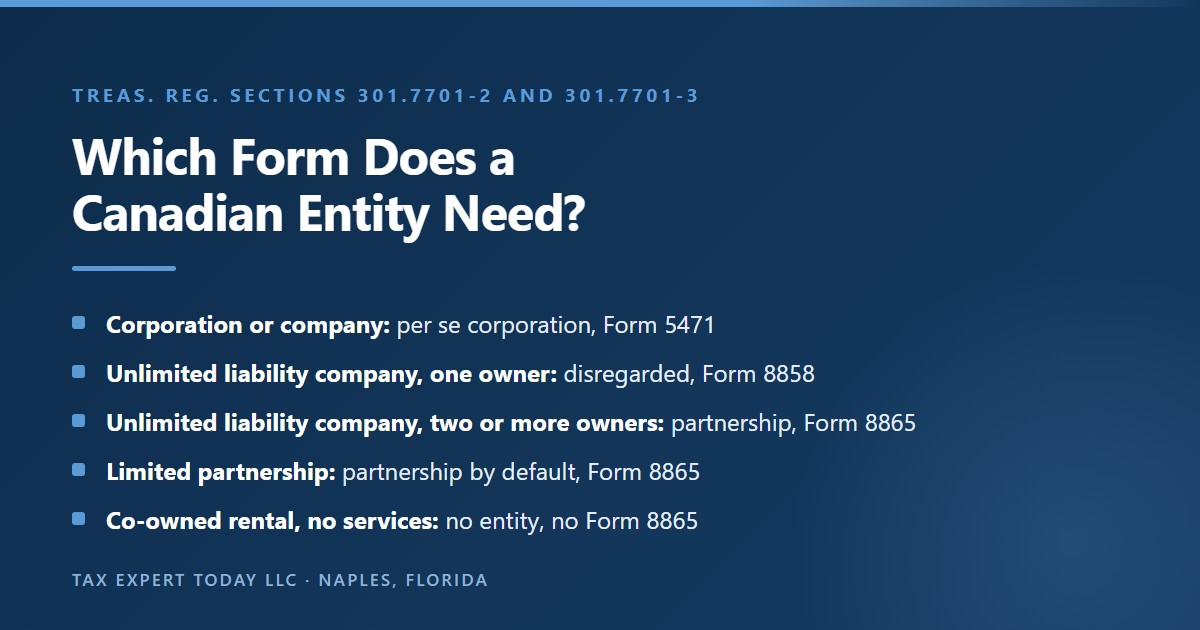
How are Canadian entities classified for U.S. tax purposes?
An ordinary Canadian corporation or company is a per se corporation and is reported on Form 5471. A Nova Scotia unlimited liability company, or any Canadian company whose owners all have unlimited liability, is carved out of the per se list and is an eligible entity. Canadian limited and general partnerships are eligible entities that default to partnership status.
- Canadian corporation: per se corporation, Form 5471, no election available.
- Unlimited liability company: eligible entity; disregarded with one owner, partnership with two or more.
- Limited partnership: eligible entity; partnership by default because the general partner has unlimited liability.
- Co-owned rental: often no entity at all, unless services are provided.
The carve out is written into the regulation. Section 301.7701-2(b)(8)(ii)(A)(1) says that, with regard to Canada, a Nova Scotia Unlimited Liability Company “(or any other company or corporation all of whose owners have unlimited liability pursuant to federal or provincial law)” is not treated as a per se corporation. Alberta and British Columbia also have unlimited liability company statutes, and an entity organized under them falls within the parenthetical when all of its owners have unlimited liability under that law.
Whether a member has limited liability is decided by the governing statute. Under section 301.7701-3(b)(2)(ii), a member has limited liability if it has no personal liability for the entity’s debts by reason of being a member, and a member has personal liability if creditors may seek satisfaction of any portion of the entity’s debts from the member as such. An agreement in which someone else agrees to indemnify the member does not change the answer.
| Canadian arrangement | Per se or eligible | Default classification | Likely U.S. form for a U.S. owner | Can Form 8832 change it? |
|---|---|---|---|---|
| Corporation under the federal or a provincial business corporations act | Per se | Corporation | Form 5471 | No |
| Unlimited liability company with one owner | Eligible | Disregarded entity | Form 8858 | Yes, to a corporation |
| Unlimited liability company with two or more owners | Eligible | Partnership | Form 8865 | Yes, to a corporation |
| Limited partnership with a general partner | Eligible | Partnership | Form 8865 | Yes, to a corporation |
| General partnership | Eligible | Partnership | Form 8865 | Yes, to a corporation |
| Rental property held as co-owners with no services to tenants | Usually no separate entity | Not a partnership | No Form 8865; report the rental directly | Not applicable |
| Co-owned property where the owners provide services to occupants | Eligible | Partnership | Form 8865 if a category applies | Yes, to a corporation |
Source: 26 CFR sections 301.7701-1(a)(2), 301.7701-2(b)(8), and 301.7701-3(b)(2); Instructions for Form 8865, definition of partnership. Whether a specific provincial entity’s members have limited liability depends on its governing statute and documents and should be confirmed for each entity.
One caution runs through the whole table. Canada taxes these arrangements under its own rules, and Canadian treatment of an unlimited liability company or a partnership often differs from the U.S. classification. A U.S. owner who changes a classification for U.S. purposes is not changing anything in Canada, and the two systems need to be read together, usually with a Canadian adviser on the Canadian side. Our Canada US tax treaty guide covers residence and the tie breaker rules, and treaty positions that override the Code are disclosed on Form 8833.
How is a Canadian unlimited liability company treated?
A Canadian unlimited liability company whose owners all have unlimited liability is an eligible entity, not a per se corporation. With one owner it is disregarded by default and reported on Form 8858. With two or more owners it is a partnership by default and can require Form 8865. It may elect corporate status on Form 8832.
- Single U.S. owner: disregarded, so its activity appears on the owner’s return and on Form 8858.
- Two or more owners: partnership, so Form 8865 if a category is met.
- Elected corporation: Form 5471, with the corporate anti-deferral rules.
- Canadian side: Canada generally treats the company as a corporation, which is the reason these entities are used.
Unlimited liability companies are popular in cross-border planning because the two countries see them differently. Canada generally treats the company as a Canadian corporation for its own tax purposes, while the United States, under the carve out, treats it as an eligible entity. For a U.S. citizen who owns a Canadian cottage or small business through a single owner unlimited liability company, the default result is a disregarded entity: the income is reported on the owner’s U.S. return as if earned directly, and Form 8858 is the information return.
Form 8865 enters the picture when the company has more than one owner. A brother and sister who each own half of an Alberta unlimited liability company holding a rental building own a partnership for U.S. purposes. If the brother is a U.S. citizen living in Naples, Florida and the sister is a Canadian resident, the brother owns 50 percent directly. Because the sister is a nonresident alien and the U.S. sibling also owns a direct interest, her 50 percent is attributed to him, he is treated as owning 100 percent, and he is a Category 1 filer.
The attribution result surprises many families. A direct 50 percent interest alone is not control, because control requires more than 50 percent. The family attribution rule from a nonresident alien relative applies here because the brother holds a direct interest of his own. If the brother owned nothing in the company, the sister’s interest would create no Form 8865 obligation for him at all.
How is a Canadian limited partnership treated?
A Canadian limited partnership organized under provincial law is not on the per se list, so it is an eligible entity. Because a limited partnership has a general partner with unlimited liability, it defaults to partnership status and its U.S. partners look to Form 8865. It can elect corporate status on Form 8832, which changes the form to Form 5471.
- Default: partnership, because at least one member (the general partner) lacks limited liability.
- Limited partners: may be Category 1, 2, 3, or 4 filers depending on their interests and transactions.
- Corporate general partner: still leaves the partnership with a member lacking limited liability under the default rule.
- Related returns: U.S. source income or U.S. property can bring Form 8804 and FIRPTA into play.
Ontario, British Columbia, and Alberta limited partnerships are common vehicles for Canadian real estate syndications, private equity style funds, and family holding arrangements. A U.S. person who invests in one is a partner in a foreign partnership. Whether a Form 8865 is due turns on the categories: a U.S. limited partner holding 4 percent with no U.S. control group has no Category 1 or 2 obligation, but may be a Category 3 filer in the year of a contribution above $100,000 and a Category 4 filer in a year their direct interest crosses 10 percent.
Some Canadian funds organized as limited partnerships prepare U.S. reporting packages for U.S. investors, and some do not. A U.S. investor should not assume that a Canadian T5013 slip contains what Form 8865 or the U.S. return needs. The slip reports Canadian amounts under Canadian rules. The U.S. partner needs the partnership’s income computed under U.S. rules, translated into U.S. dollars, and broken out for the foreign tax credit on Schedule K-3.
When a Canadian limited partnership owns U.S. real estate or earns business income in the United States, the U.S. side adds its own withholding and filing regime. The partnership itself may owe section 1446 withholding reported on Form 8804 on its effectively connected income, and a sale of U.S. real property brings in FIRPTA withholding. Those obligations sit alongside, not instead of, the U.S. partner’s own Form 8865.
Does a co-owned Canadian rental property require Form 8865?
Usually not, if the owners simply hold and rent the property. Under section 301.7701-1(a)(2), mere co-ownership of property that is maintained, kept in repair, and rented does not create a separate entity. If the co-owners provide services to the occupants, a partnership can exist, and a U.S. co-owner may then have a Form 8865 filing.
- Passive co-ownership: no entity, so each owner reports their share of rent and expenses directly.
- Services to occupants: cleaning during stays, meals, guided activities, or hotel style operations point toward a partnership.
- Title is not the test: a joint tenancy deed does not prevent a partnership if the owners run a business together.
- Other reporting still applies: Canadian bank accounts used for the rental can trigger the FBAR and Form 8938.
Many Southwest Florida families own a Canadian cottage or condominium with siblings or children, and many rent it out for the weeks they are in Naples, Florida. If the family rents the cottage through a listing site, collects the rent, pays for repairs, and provides nothing beyond what a landlord provides, the regulation’s example of tenants in common leasing property applies by analogy: there is no separate entity, and each U.S. co-owner reports their share of the rental on Schedule E. There is no Form 8865.
The answer changes when the arrangement starts to look like an operating business. The Form 8865 instructions say that if co-owners provide services to the tenants, a partnership exists. A family that operates the property as a small inn, offers meals or tours, employs staff to serve guests, or runs several units as a coordinated hospitality business is closer to a partnership. If that partnership is foreign and a U.S. co-owner meets a category, the form is due.
Even when no Form 8865 is due, the money side still needs attention. A Canadian bank account that holds the rent, alone or combined with other foreign accounts, can require an FBAR once the aggregate exceeds $10,000 at any time during the year, and specified foreign financial assets can require Form 8938. Our guide to whether you need to file an FBAR and the comparison of the FBAR and Form 8938 walk through those thresholds.
What does a Form 8832 election change?
A Form 8832 election lets an eligible entity choose a classification other than its default: a partnership or multi-owner entity can elect to be a corporation, and a single owner entity can elect corporate or disregarded status. The election can reach back up to 75 days, and a change generally cannot be repeated for 60 months.
- Effective date: the date chosen, but not more than 75 days before filing or more than 12 months after.
- 60 month limitation: after a change, another change generally waits 60 months.
- Newly formed exception: an initial election effective on the date of formation does not start the 60 month clock.
- Deemed transactions: a change is treated as a contribution or liquidation, which can be taxable.
The Form 8832 instructions and section 301.7701-3(c) set the timing. If an election specifies an effective date more than 75 days before the filing date, it is effective 75 days before filing. If it specifies a date more than 12 months after filing, it is effective 12 months after filing. After an entity changes its classification, it generally cannot change again for 60 months, although the IRS may permit an earlier change by private letter ruling when more than 50 percent of the ownership has changed hands.
A change in classification is not a relabeling. Section 301.7701-3(g) treats each change as a set of deemed transactions. A partnership that elects to be an association is treated as contributing all its assets and liabilities to the association for stock and then distributing the stock to its partners. An association that elects to become a partnership is treated as liquidating, distributing its assets to shareholders, who then contribute them to a new partnership. That deemed liquidation can produce gain, and for a foreign corporation it can produce U.S. tax consequences that should be modeled before anyone signs the form.
Form 8832 is filed with the IRS service center listed in its instructions, and a copy is attached to the entity’s federal tax or information return for the year of the election. If the entity does not file a U.S. return, the copy goes with the returns of its direct or indirect owners for the year that includes the effective date. The Form 8865 instructions point back to this rule, so the year a foreign partnership elects a new classification, the Form 8865 or Form 5471 filer should check whether the copy belongs with their return.
What if the entity classification election was late?
Revenue Procedure 2009-41 provides relief for a late classification election filed within 3 years and 75 days of the requested effective date, if its requirements are met. An entity outside that procedure generally has to request a private letter ruling. Late election relief is claimed on Form 8832 with an explanation.
- Window: 3 years and 75 days from the requested effective date.
- Where claimed: Part II of Form 8832, with a statement explaining the delay.
- Outside the window: a private letter ruling, which is slower and has a user fee.
- Relevance date: classification of a foreign entity matters from the date an event creates a U.S. filing obligation.
Revenue Procedure 2009-41 applies to an eligible entity that requests relief for a late election filed within 3 years and 75 days of the requested effective date. Form 8832 itself includes a “Late Election Relief” section in which the entity explains why the election was not filed on time and declares under penalties of perjury that the requirements of section 4.01 of the revenue procedure are met.
Foreign entities have an added wrinkle. Under section 301.7701-3(d), a foreign eligible entity’s classification is “relevant” when it affects the liability of any person for federal tax or information purposes, and the date it becomes relevant is the date an event creates an obligation to file a U.S. return or information return for which the classification must be determined. The regulation’s own example is the acquisition of an interest that requires a U.S. person to file Form 5471. For a long held Canadian entity, the classification may have become relevant years ago, when its first U.S. owner appeared, and the classification that applied then may still control.
Which Form 8865 schedules does each category file?
Every category completes the identifying information on page 1 and Schedule A on constructive ownership. Category 1 filers complete the partnership’s full financial statements and the partners’ schedules. Category 2 filers complete Schedules A-2, N, K-1, and K-3. Category 3 filers add Schedules A-1 and O. Category 4 filers add Schedule P.
- Category 1: Schedules B, D, K, K-1, K-2, K-3, L, M-1, M-2, and N, with A-1 for certain partners.
- Category 2: Schedules A-2, N, K-1, and K-3 beyond page 1 and Schedule A.
- Category 3: Schedule O for the transfer, plus Schedule A-1.
- Category 4: Schedule P for the acquisition, disposition, or change.
| Schedule | What it reports | Category 1 | Category 2 | Category 3 | Category 4 |
|---|---|---|---|---|---|
| Page 1 and Schedule A | Identifying information and constructive ownership | Yes | Yes | Yes | Yes |
| Schedule B and Schedule D (Form 1065) | Trade or business income, capital gains and losses | Yes | No | No | No |
| Schedules K and K-2 | Partnership totals, including international items | Yes | No | No | No |
| Schedules K-1 and K-3 | Each direct partner’s share, including international items | Yes | Yes | No | No |
| Schedules L, M-1, and M-2 | Balance sheet, book to tax reconciliation, capital accounts | Yes, unless item H11 applies | No | No | No |
| Schedule N | Transactions with partners and related entities | Yes | Yes | No | No |
| Schedule O | Transfers of property to the partnership | No | No | Yes | No |
| Schedule P | Acquisitions, dispositions, and changes in interest | No | No | No | Yes |
| Schedules G and H | Section 721(c) gain deferral method | When a U.S. transferor applies it | No | When a U.S. transferor applies it | No |
Source: Instructions for Form 8865 (2025), Filing Requirements for Categories of Filers chart and the Category 2 and Category 3 example. A filer in more than one category completes the schedules for each.
When the foreign partnership itself files a U.S. Form 1065, the instructions allow relief. Category 1 and 2 filers can attach copies of the completed Form 1065 schedules in place of the equivalent Form 8865 schedules. A Category 1 filer still completes the first two pages and Schedules A, A-1, A-2, A-3, G, H, M, and N as applicable, and a Category 2 filer still completes the first two pages and Schedules A, A-2, and N.
When is Form 8865 due and where is it filed?
Form 8865 is attached to the filer’s income tax return and filed by that return’s due date, including extensions. For a calendar year individual, the 2025 form was due April 15, 2026, or October 15, 2026 on extension. A filer with no return to file submits it when and where a return would be due.
- Attach, do not mail separately: the form travels with the income tax return.
- Extension follows: extending the return extends Form 8865.
- No return required: file the form by itself at the time and place a return would be due.
- Tax year reported: Category 1 and 2 report the partnership year ending with or within the filer’s year.
The 2025 Form 8865 is filed with the income tax return for the tax year beginning in 2025. Category 1 and 2 filers report information for the partnership’s tax year that ends with or within their own tax year. Category 3 and 4 filers report the transfers and events that occurred during their own tax year, which matters when a Canadian partnership uses a fiscal year that does not match the U.S. calendar.
| Calendar year individual filer | Tax year 2025 form | Tax year 2026 form |
|---|---|---|
| Regular due date | Wednesday, April 15, 2026 | Thursday, April 15, 2027 |
| Automatic two month extension for a U.S. citizen or resident living abroad | Monday, June 15, 2026 | Tuesday, June 15, 2027 |
| Extended due date with Form 4868 | Thursday, October 15, 2026 | Friday, October 15, 2027 |
| Filer not required to file an income tax return | When a return would have been due | When a return would have been due |
Dates follow the individual income tax return calendar; each listed date falls on a weekday. A partnership, corporation, trust, or estate filer follows its own return’s due date.
The form cannot be filed late without consequence just because the income tax return was filed late. If the return was filed after its due date, the Form 8865 attached to it is late too, and the $10,000 penalty applies per partnership per year unless reasonable cause is shown. For a Naples, Florida taxpayer who extended the 2025 return to October 15, 2026, that deadline has now passed, and any Form 8865 not filed with the return is delinquent.
What does the Form 8865 small partnership exception skip?
Item H11 on Form 8865 lets a Category 1 filer skip Schedules L, M-1, and M-2 when the partnership’s total receipts for the year were less than $250,000 and its total assets at the end of the year were less than $1 million. Both tests must be met. The rest of the Category 1 schedules are still required.
- Receipts test: total receipts under $250,000, as defined in the instructions.
- Asset test: year end total assets under $1 million.
- Only Category 1: items H10 and H11 are answered only by Category 1 filers.
- What it saves: the balance sheet, book to tax reconciliation, and capital account analysis.
“Total receipts” for item H11 is a defined term. The instructions build it from gross receipts or sales on Schedule B, other income on Schedule B, certain Schedule K income lines, and rental income or net gain reported on Form 8825. A small Canadian rental partnership with modest rents and a single building may meet both tests, but a partnership holding one Naples or Toronto property worth more than $1 million at year end does not, however small its income.
The exception reduces the work but not the filing obligation. A Category 1 filer still prepares the income statement, the partners’ shares, and the international schedules, and still faces the full penalty if the form is late. The relief is a reason to file a complete, accurate form, not a reason to file nothing.
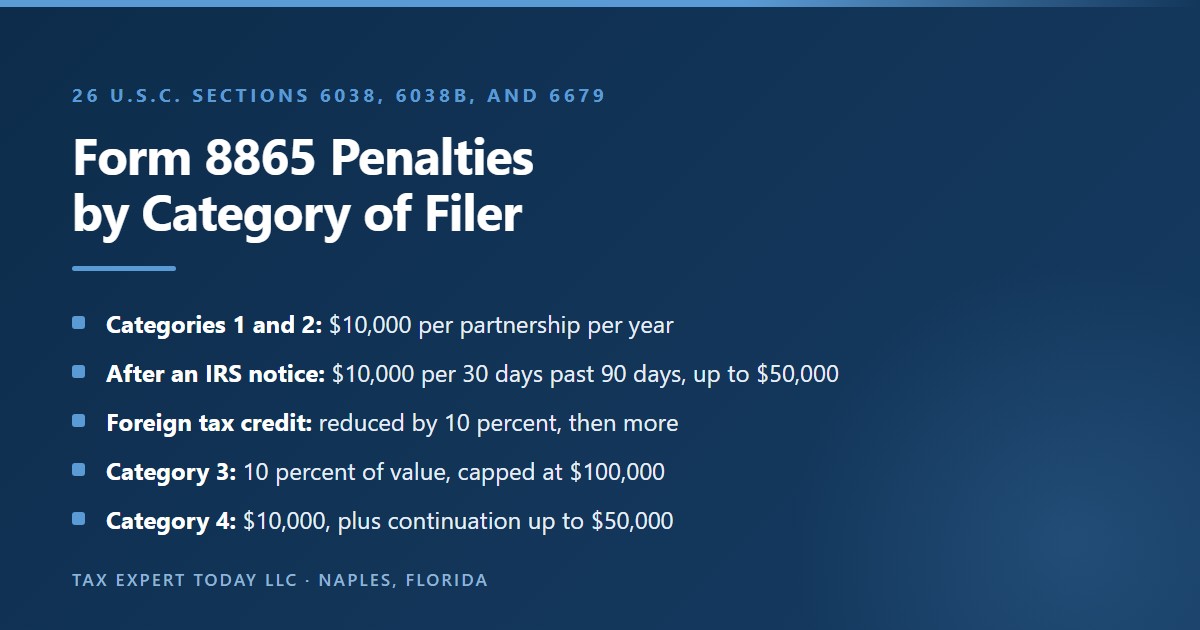
What are the penalties for not filing Form 8865?
For Category 1 and 2 filers, the penalty is $10,000 per partnership per year, plus $10,000 per 30 days of failure beginning 90 days after an IRS notice, up to $50,000 more. Category 4 follows the same pattern under section 6679. Category 3 is 10 percent of the property’s value, capped at $100,000 absent intentional disregard.
- Categories 1 and 2: $10,000 initial, up to $50,000 continuation, so up to $60,000 per partnership per year.
- Foreign tax credit reduction: 10 percent of creditable foreign taxes, rising 5 percent per 3 months after the notice period.
- Category 3: 10 percent of fair market value, plus gain recognition as if the property were sold.
- Category 4: $10,000 initial and up to $50,000 continuation under section 6679.
The penalty figures come straight from the statutes and the instructions. Section 6038(b)(1) imposes $10,000 for each annual accounting period for which the failure exists. Section 6038(b)(2) adds $10,000 for each 30 day period, or fraction of one, that the failure continues more than 90 days after the IRS mails notice, and says the increase “shall not exceed $50,000.” Ranking guides state the cap differently, some as $50,000 and some as $60,000. Both are describing the same rule: the continuation penalty is capped at $50,000, so the combined maximum dollar penalty for one partnership and one year is $60,000.
| Filer | Initial penalty | Continuation after IRS notice | Maximum dollar penalty | Other consequences |
|---|---|---|---|---|
| Category 1 and 2 (section 6038) | $10,000 per partnership per year | $10,000 per 30 days after 90 days, capped at $50,000 | $60,000 per partnership per year | 10 percent foreign tax credit reduction, plus 5 percent per 3 months after the notice period |
| Category 3 (section 6038B) | 10 percent of the property’s fair market value at contribution | None | $100,000 per exchange, no cap if intentional disregard | Gain recognized as if the property had been sold at fair market value |
| Category 4 (section 6679) | $10,000 | $10,000 per 30 days after 90 days, capped at $50,000 | $60,000 | Criminal penalty under section 7203 may also apply |
| Any category (section 6501(c)(8)) | Not a penalty | Not applicable | Not applicable | Assessment period stays open until 3 years after the information is furnished |
Sources: 26 U.S.C. sections 6038(b) and (c), 6038B(c), 6679(a), and 6501(c)(8); Instructions for Form 8865 (2025), Penalties. Each penalty is subject to the reasonable cause exception in its statute.
The foreign tax credit reduction in section 6038(c) is often overlooked and can matter more than the dollar penalty for a Canadian partnership that pays real Canadian tax. A failure to furnish the information reduces the foreign taxes available for credit under section 901 by 10 percent, with an additional 5 percent reduction for each 3 month period the failure continues after the 90 day notice period, subject to the limits in the statute. The section 6038B(c) penalty for Category 3 adds a second cost for appreciated property: the transferor recognizes gain as if the property had been sold for its value at the time of the contribution.
Accuracy penalties can follow as well. Under section 6662(j), an underpayment attributable to an “undisclosed foreign financial asset,” which includes an asset for which required information was not provided, carries a higher accuracy related penalty than an ordinary underpayment. Criminal penalties under sections 7203, 7206, and 7207 can apply to a failure to file or to false information, which is why the instructions treat the form as more than a formality.
Can the IRS assess the section 6038(b) penalty?
The courts are divided. In Farhy, the Tax Court held in 2023 that the IRS lacked authority to assess the section 6038(b) penalty, and the D.C. Circuit reversed in 2024. In Mukhi, the Tax Court held again in 2024 that the penalty is not assessable for taxpayers outside the D.C. Circuit. The question is unsettled.
- Section at issue: section 6038(b), the same penalty that applies to Form 8865 Category 1 and 2 filers.
- D.C. Circuit: held the penalty assessable in Farhy (2024).
- Tax Court: continued to hold it is not assessable in Mukhi (2024), for appeals outside the D.C. Circuit.
- Practical effect: the penalty still exists; the dispute is over how the IRS can collect it.
The issue in this line of cases is procedural. The Tax Court reasoned that section 6038(b) lacks the language other penalty provisions use to make a penalty assessable like a tax, so the government would have to sue to collect it. The D.C. Circuit read the text, structure, and function of the Code differently and held that the IRS may assess the penalty. Under the Tax Court’s practice of following the law of the circuit to which an appeal would go, the result can depend on where the taxpayer lives.
Two cautions keep this from being a planning tool. First, the cases are about how the penalty is collected, not whether the filing is required; the form is due either way, and the section 6501(c)(8) assessment period and the foreign tax credit reduction do not depend on the outcome. Second, the law is still moving. We could not confirm, at the time of writing, whether the Eighth Circuit or the Eleventh Circuit, which hears appeals from Florida, has ruled on the question, so anyone relying on these cases should check their current status with a professional before taking a position.
How does a missing Form 8865 keep the statute of limitations open?
Under section 6501(c)(8), when information required under section 6038, 6038B, or 6046A is not furnished, the time to assess any tax on the related return does not expire until 3 years after the information is provided. If the failure was due to reasonable cause and not willful neglect, the extension is limited to the items related to the failure.
- Whole return exposure: without reasonable cause, the entire related return stays open.
- Reasonable cause: limits the open period to the items connected to the missing information.
- Clock restarts on filing: the 3 years run from the date the IRS receives the required information.
- Applies to other forms: the same rule covers Forms 5471, 8938, 3520, and 8621.
Section 6501(c)(8)(A) lists sections 1295(b), 1298(f), 6038, 6038A, 6038B, 6038D, 6046, 6046A, and 6048. For information required under any of them, the time for assessment of any tax with respect to any return, event, or period to which the information relates does not expire before 3 years after the IRS is furnished the information. Section 6501(c)(8)(B) narrows the effect to the items related to the failure if the failure was due to reasonable cause and not willful neglect.
For a taxpayer who has filed U.S. returns for years without the Form 8865 for a Canadian partnership, this rule is often the most important consequence. A return that would normally have closed three years after filing may remain open to adjustment on every item, not only the partnership income. Filing the missing forms is what starts the clock.
What if you did not file Form 8865 in past years?
A taxpayer who is not under examination or investigation and has not been contacted by the IRS about the missing returns can file the delinquent Forms 8865 with amended returns under the IRS delinquent information return procedures. A reasonable cause statement may be attached, but penalties may still be assessed during processing, and there is no automatic waiver.
- Eligibility: no civil examination, no criminal investigation, and no prior IRS contact about the returns.
- How filed: attached to an amended income tax return under the normal amended return instructions.
- Reasonable cause statement: may be attached; the IRS may still assess and then consider it on response.
- Unreported income: a different path applies, and the streamlined procedures are for non-willful conduct only.
The IRS describes the procedure on its Delinquent International Information Return Submission Procedures page. Taxpayers who have identified the need to file delinquent international information returns, who are not under a civil examination or criminal investigation, and who have not already been contacted by the IRS about the returns should file them through normal filing procedures, and “penalties may be assessed in accordance with existing procedures.” All delinquent international information returns other than Forms 3520 and 3520-A are attached to an amended income tax return.
The page is candid that a reasonable cause statement does not stop an assessment. During processing, penalties may be assessed without considering the attached statement, and the taxpayer may need to respond to IRS correspondence and resubmit reasonable cause information. Our guide to reasonable cause for IRS penalties explains what the standard looks for, and the outcome in any particular case depends on its facts.
When the missing Form 8865 is part of a larger gap, such as unreported partnership income or unfiled FBARs, the delinquent information return procedure is not the whole answer. The streamlined filing compliance procedures are available only to taxpayers whose failure was non-willful and who certify to that under penalties of perjury, and taxpayers whose conduct may have been willful face a different path. Our guides to filing a late FBAR and FBAR penalties cover the account side. Choosing among these paths is a judgment about facts and risk that should be made with a professional before anything is filed.
How does Form 8865 relate to the FBAR and Form 8938?
Form 8865 does not replace the FBAR. An interest in a foreign partnership that is reported on a timely Form 8865 generally does not have to be repeated on Form 8938, but the filer checks item E and counts the Form 8865 on Form 8938. Foreign bank accounts, including those owned by a controlled partnership, can still require an FBAR.
- FBAR: a FinCEN filing for foreign financial accounts above $10,000 in aggregate, separate from the tax return.
- Form 8938: duplicative reporting relief for assets reported on Form 8865, with a count on Part IV.
- Item E: checked when the filer also files Form 8938 and includes this Form 8865 in the count.
- Controlled partnerships: a U.S. person owning more than 50 percent of an entity may have FBAR filing for the entity’s accounts.
The Form 8865 instructions explain item E. The filer checks the box only if they also file Form 8938 for the year and include this Form 8865 in the total number of Forms 8865 reported on Form 8938, Part IV. That is the duplicative reporting rule: the asset does not have to be listed again in detail on Form 8938, but the filer still tells the IRS how many Forms 8865 are attached.
The FBAR is a different system with its own rules, filed with FinCEN rather than the IRS. A U.S. person with a financial interest in, or signature authority over, foreign accounts whose aggregate value exceeds $10,000 at any time in the year files an FBAR, and a financial interest can include accounts of an entity in which the person owns more than 50 percent. Our FBAR signature authority guide explains when a role in a partnership’s accounts creates a filing, and FBAR versus Form 8938 sets out the overlap.
Related international forms can also arise from the same Canadian facts. A gift or inheritance from a Canadian parent may require Form 3520, a Canadian mutual fund or exchange traded fund held outside a registered plan may be a PFIC, and a U.S. limited liability company owned by a Canadian relative may need Form 5472. The international forms are designed to work together, and a missing one tends to be found when another is reviewed.
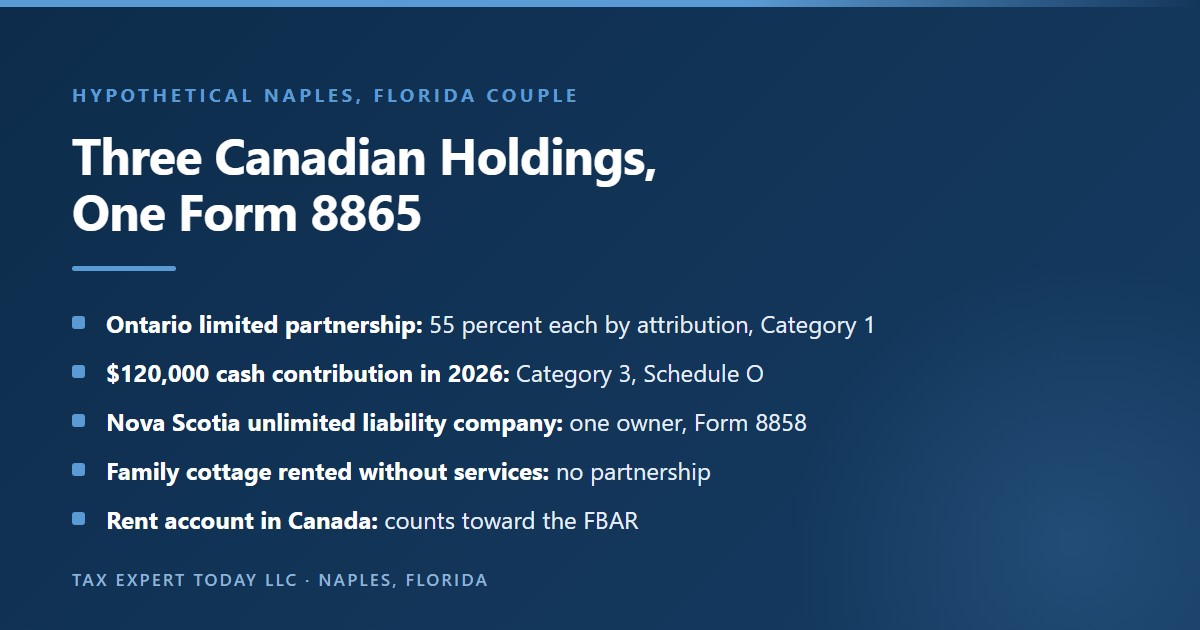
How does Form 8865 work for a Naples, Florida couple with Canadian holdings?
In this hypothetical, a U.S. citizen and a green card spouse in Naples, Florida hold an Ontario limited partnership interest of 30 and 25 percent, a Nova Scotia unlimited liability company, and a cottage share. Only the partnership produces Form 8865: both spouses are Category 1 filers, one files for both, and a 2026 cash contribution adds Category 3.
- Ontario limited partnership: 55 percent constructive interest for each spouse, so Category 1 for both.
- Nova Scotia unlimited liability company: one U.S. owner, disregarded, Form 8858 instead.
- Family cottage: rented without services, so no partnership and no Form 8865.
- 2026 contribution of $120,000: Category 3 for the contributing spouse, reported on Schedule O.
The facts are invented for illustration and describe no client. Spouse A is a U.S. citizen. Spouse B is a Canadian citizen with a green card, which makes B a U.S. resident and a U.S. person. They live in Naples, Florida. A owns 30 percent of an Ontario limited partnership that owns a Toronto apartment building; B owns 25 percent; unrelated Canadian investors own the remaining 45 percent, and the general partner is a Canadian corporation owned by those investors. A also owns 100 percent of a Nova Scotia unlimited liability company that holds a small commercial property, and A co-owns a lakeside cottage with two siblings who live in Canada, renting it through a listing site for the summer weeks the family is in Florida.
The limited partnership. The partnership is an eligible entity with a general partner that lacks limited liability, so it is a partnership by default and a foreign partnership because it was organized in Ontario. Under family attribution, A is treated as owning B’s 25 percent and B is treated as owning A’s 30 percent, so each spouse has a 55 percent interest and each is a Category 1 filer. Under the multiple Category 1 filers exception, one Form 8865 is filed, say by A, with separate Schedules N, K-1, and K-3 for B, and B attaches the “Controlled Foreign Partnership Reporting” statement to B’s return. The building is worth more than $1 million, so the item H11 exception is not available and Schedules L, M-1, and M-2 are completed.
The 2026 contribution. In 2026, the partnership calls capital to renovate the building and A contributes $120,000 in cash. A owns at least 10 percent immediately afterward and the contribution exceeds $100,000, so A is also a Category 3 filer and completes Schedule O and Schedule A-1. Because A is a Category 3 filer as well, A could not rely on B’s filing for the partnership even if B were the designated Category 1 filer. If A had not reported the contribution, the section 6038B penalty would be 10 percent of $120,000, or $12,000; because the contribution was cash, the gain recognition consequence would have no practical effect.
The unlimited liability company. The Nova Scotia company has a single owner with unlimited liability under its governing statute, so under the per se carve out and the default rules it is disregarded. Its income goes on A’s return directly and A files Form 8858, not Form 8865. If A ever adds a second owner, the company becomes a partnership by default and the Form 8865 analysis begins. If A instead elected corporate status on Form 8832, the deemed contribution would be modeled first and the company would move to Form 5471.
The cottage. The three siblings hold title as co-owners and rent the cottage without providing services to the guests. Under section 301.7701-1(a)(2) that is mere co-ownership of rented property, not a separate entity, so there is no partnership and no Form 8865. A reports one third of the rent and expenses on Schedule E, and the Canadian account that receives the rent counts toward A’s FBAR aggregate.
| Hypothetical holding | U.S. classification | Form for A | Form for B | Why |
|---|---|---|---|---|
| Ontario limited partnership (A 30, B 25 percent) | Foreign partnership | Form 8865, Category 1 and, in 2026, Category 3 | Statement under the multiple Category 1 filers exception | Family attribution gives each spouse 55 percent |
| Nova Scotia unlimited liability company (A 100 percent) | Disregarded entity | Form 8858 | None | Single owner with unlimited liability |
| Lakeside cottage (A one third with two Canadian siblings) | No separate entity | None; Schedule E for the rental share | None | Mere co-ownership of rented property, no services |
| Canadian bank account for the cottage rent | Foreign financial account | FBAR if aggregate above $10,000; Form 8938 if its threshold is met | Depends on B’s own accounts | Account reporting is separate from entity reporting |
Hypothetical illustration only. It describes no client and is not a prediction for any taxpayer.
What are the most common Form 8865 mistakes?
The most common mistakes are treating the foreign entity’s name as its U.S. classification, overlooking constructive ownership through a spouse or relative, missing a Category 3 contribution, relying on a Canadian slip for U.S. figures, and assuming that filing an FBAR covers a partnership interest. Each one is avoidable with a classification review before the return is prepared.
- Name over substance: calling every Canadian “company” a corporation without checking the per se list and the unlimited liability carve out.
- Ignoring family: testing only the filer’s direct interest when the spouse or a relative also owns part of the partnership.
- Missing contributions: treating a capital call as an investment rather than a reportable transfer.
- Canadian figures: copying T5013 amounts without U.S. computation and translation.
| Mistake | Why it matters | Correct approach |
|---|---|---|
| Assuming a Canadian unlimited liability company is a corporation | It may be disregarded or a partnership, which changes the form and the tax result | Check section 301.7701-2(b)(8)(ii) and count the owners |
| Testing only direct ownership for Categories 1 and 2 | Family and entity attribution can create control | Apply section 267(c), excluding 267(c)(3) |
| Ignoring a cash capital call above $100,000 | Category 3 applies even below 10 percent ownership | Track contributions by the filer and related persons over 12 months |
| Treating a co-owned rental as a partnership, or the reverse | Creates an unneeded filing or misses a required one | Ask whether the owners provide services to occupants |
| Changing classification without modeling the deemed transactions | An election can trigger a deemed liquidation or contribution | Model section 301.7701-3(g) before filing Form 8832 |
| Filing the FBAR and stopping there | The FBAR does not satisfy Form 8865 | File each form the facts require, and count Forms 8865 on Form 8938 |
| Assuming the Farhy line of cases removes the obligation | The cases concern assessment, and the law is unsettled | File the form; evaluate any penalty dispute separately with a professional |
One mistake deserves its own line: waiting. The section 6501(c)(8) rule means that an unfiled Form 8865 keeps the related return open, and every year that passes adds another form and another potential penalty. A classification review of every foreign holding, done once and updated when ownership changes, is the simplest protection.
Form 8865 Help in Naples & Southwest Florida
Tax Expert Today LLC works with international clients from an office in Naples, Florida and serves clients in all 50 states. Many Southwest Florida residents and seasonal residents hold Canadian limited partnerships, unlimited liability companies, family rental property, or interests in partnerships elsewhere abroad, and the first question in each case is how U.S. tax law classifies the entity. We review the classification, determine which categories apply to each family member, prepare Form 8865 and its schedules alongside the related international forms, and coordinate with the client’s Canadian adviser on the Canadian side.
- Form 8865 filing help Naples: category analysis, constructive ownership, and complete Form 8865 preparation.
- International tax Naples FL: entity classification for Canadian and other foreign entities, including Form 8832 elections and late election relief.
- Foreign tax Naples: foreign tax credit coordination through Schedule K-3 and Form 1116.
- FBAR Naples: FBAR and Form 8938 reporting for the accounts that sit beside the partnership.
Our international and expat tax services page explains how we approach cross-border reporting for U.S. persons with foreign partnerships, companies, and accounts. The international tax Naples FL guide covers the broader picture for residents and seasonal residents of Southwest Florida.
Office: 11983 Tamiami Trail N, Naples FL 34110
Phone: (239) 441-2005
Hours: Monday through Friday, 10:00 to 5:00 ET
Frequently Asked Questions
I live in Naples, Florida and own part of a cottage in Ontario with my Canadian siblings. Do I need Form 8865?
Usually not, if the family simply owns and rents the cottage. Under section 301.7701-1(a)(2), mere co-ownership of rented property is not a separate entity, so there is no partnership to report. If the owners provide services to guests, a partnership can exist. The rental share still goes on Schedule E, and the rent account counts toward the FBAR.
What is Form 8865 used for?
Form 8865 is the information return a U.S. person files to report an interest in, transfers to, or ownership changes in a foreign partnership. It carries the information required by sections 6038, 6038B, and 6046A. It does not compute tax, but missing it can bring a $10,000 penalty per partnership per year and keep the related return open.
What is the difference between Forms 5471 and 8865?
Form 5471 reports an interest in a foreign corporation and Form 8865 reports an interest in a foreign partnership. Which one applies depends on the entity’s U.S. tax classification under the section 7701 regulations, not its foreign name. Both share the section 6038 penalty and the extended statute of limitations under section 6501(c)(8).
Is a Canadian unlimited liability company reported on Form 8865?
Only if it has two or more owners and has not elected corporate status. A Nova Scotia, Alberta, or British Columbia unlimited liability company whose owners all have unlimited liability is not a per se corporation. With one owner it is disregarded and reported on Form 8858; with two or more it is a partnership and may require Form 8865.
When is Form 8865 due?
Form 8865 is attached to the filer’s income tax return and is due on that return’s due date, including extensions. For a calendar year individual, the 2026 form is due April 15, 2027, or October 15, 2027 with an extension. A filer with no income tax return to file submits Form 8865 at the time and place a return would be due.
What is the penalty for not filing Form 8865?
For Category 1 and 2 filers, $10,000 per partnership per year, plus $10,000 for each 30 days the failure continues more than 90 days after an IRS notice, capped at $50,000 more. Category 4 follows the same pattern. Category 3 is 10 percent of the contributed property’s value, capped at $100,000 unless the failure was intentional.
When to Engage a Professional
Form 8865 is rarely the hard part on its own. The hard part is the classification and ownership analysis that comes first: whether a foreign arrangement is an entity at all, whether it is a partnership, a corporation, or a disregarded entity, which family members are treated as owning what, and which categories apply in a given year. A wrong answer at that stage produces the wrong form, a missed form, or an election with tax consequences no one modeled.
A professional review is worth considering when a U.S. citizen or resident owns any part of a Canadian or other foreign partnership, limited partnership, or unlimited liability company, when a spouse or relative also holds an interest, when a capital call or contribution approaches $100,000, when an interest is bought, sold, or diluted, when a Form 8832 election is under consideration or may have been missed, or when prior returns were filed without the information returns the facts required.
Tax Expert Today LLC is a tax advisory firm in Naples, Florida serving clients in all 50 states. Call (239) 441-2005 to discuss your facts.
This article is general information, not legal or tax advice for any particular taxpayer, and does not create a client relationship. The examples are hypothetical illustrations only and do not describe any client. Canadian tax treatment is determined under Canadian law and should be reviewed by a Canadian adviser. The rules described here reflect 26 U.S.C. sections 267, 721, 6038, 6038B, 6046A, 6501, 6662, 6679, and 7701, Treasury Regulations sections 301.7701-1, 301.7701-2, 301.7701-3, 1.6038-3, 1.6038B-2, and 1.6046A-1, Revenue Procedure 2009-41, and the 2025 Form 8865 and its instructions, as published when this article was written. Court decisions on the assessment of the section 6038(b) penalty are evolving.
Published October 21, 2026 by Dr. Pellumb Kabashi « Back to Learning Center
Have a question this article touches on?
Tax Expert Today LLC, based in Naples, Florida and serving clients across the United States.
Schedule a Consultation (239) 441-2005