
By Dr. Pellumb Kabashi, DBA, MBA, EA, CFE, CES
Founder, Tax Expert Today LLC · Tax advisors, enrolled agents, CPAs, and attorneys · Serving clients in all 50 states
Quick Answer
Form 1042-S is the statement a United States payer sends a foreign person to show United States source income paid and the federal tax withheld from it. The recipient uses it to decide whether a Form 1040-NR is needed, and claims the box 10 withholding credit on line 25g to recover any tax withheld above the correct treaty rate. Call (239) 441-2005 for a free consultation.
What is Form 1042-S?
Form 1042-S, Foreign Person’s U.S. Source Income Subject to Withholding, is an information return filed with the IRS and furnished to a foreign recipient by the bank, broker, university, tenant, or other withholding agent that paid the income. It reports the type of income, the gross amount, the rate applied, and the tax actually withheld.
- It is issued by the payer, not by you. The withholding agent files Copy A with the IRS and sends Copies B, C, and D to the recipient.
- It covers foreign persons only. United States citizens and residents receive Forms 1099 and W-2 for the same kinds of income.
- It arrives even when nothing was withheld. Exempt payments, such as treaty-exempt wages or certain bank interest, are still reported.
- It is your proof of tax paid. The amount in box 10 is the withholding credit you claim on a United States return.
The IRS describes the form on its About Form 1042-S page, and the detailed rules for payers are in the 2026 Instructions for Form 1042-S. Most of what is written about Form 1042-S is aimed at the institutions that issue it: how to complete each box, when to file, and how to avoid penalties. This guide is written for the other side of the transaction. If a Form 1042-S arrived in your mailbox, or in a brokerage or university portal, the questions that matter are different: what the codes mean, whether the rate was right, whether you have to file a return, and how to get back tax that should not have been withheld.
Those questions come up constantly in Naples, Florida and across Southwest Florida, where Canadian and European owners of Gulf Coast condominiums hold United States brokerage accounts, rent their homes to seasonal tenants, and keep deposits at local banks. Each of those relationships can produce a Form 1042-S every spring.
Who receives a Form 1042-S?
A Form 1042-S is sent to a foreign person who received United States source income of a type subject to nonresident withholding, such as dividends, interest, rents, royalties, pensions, scholarships, or treaty-exempt compensation. It goes to nonresident alien individuals, foreign corporations, foreign estates and trusts, and some foreign intermediaries.
- Foreign investors. Nonresident holders of United States stocks, funds, and bonds receive one from the broker or fund company.
- Foreign owners of United States rental property. The tenant or property manager who withholds on gross rent reports it on Form 1042-S.
- Students, researchers, and scholars. Taxable scholarships and treaty-exempt wages are reported on Form 1042-S rather than Form W-2.
- Depositors from treaty partner countries. Certain bank deposit interest is reported even though it is not taxed.
The obligation to withhold and report sits in 26 U.S.C. section 1441, which reaches everyone “having the control, receipt, custody, disposal, or payment” of the listed income items of a nonresident alien. That is why a private tenant renting a Florida home from a foreign owner can be a withholding agent in the same way a large bank is. The table below maps the Southwest Florida most common situations to the form that usually results.
| Recipient situation | Typical income code (box 1) | Usual withholding result |
|---|---|---|
| Canadian resident with a United States brokerage account, dividends from United States stocks | 06 (dividends paid by United States corporations) | Treaty rate if a valid Form W-8BEN is on file, otherwise 30 percent |
| Foreign owner renting out a Naples condominium, no net election | 14 (real property income) | 30 percent of gross rent |
| Nonresident depositor at a United States bank, resident of an information exchange country | 29 (deposit interest) | Generally no withholding, reported for information exchange |
| Foreign student with a taxable scholarship | 16 (scholarship or fellowship grants) | 14 percent for F, J, M, or Q status, or a treaty exemption |
| Foreign researcher whose wages are exempt under a treaty | 18 or 19 (dependent services or teaching) | Zero, with a treaty exemption code |
| Nonresident receiving a United States pension or annuity | 15 (pensions, annuities, alimony, insurance premiums) | 30 percent or a treaty rate |
Two nearby forms are often confused with Form 1042-S. A nonresident receiving United States Social Security benefits gets Form SSA-1042S from the Social Security Administration, and a foreign seller of United States real estate receives Form 8288-A for FIRPTA withholding. Both are claimed on the same Form 1040-NR, but on different lines. Our guide to FIRPTA withholding covers the real estate sale side.
How do you read Form 1042-S box by box?
A recipient needs only a handful of boxes: box 1 for the income type, box 2 for the gross amount, box 3 or 4 for the chapter, exemption code, and rate, box 7a for tax withheld, and box 10 for the total withholding credit. Box 13 shows your details as the payer recorded them.
- Box 1 and box 2. What kind of income it was and how much was paid before withholding.
- Box 3 or box 4. Whether chapter 3 (nonresident withholding) or chapter 4 (FATCA) applied, and the rate used.
- Box 10. The number you claim as a credit on a return.
- Box 13. Your name, country, status code, and United States taxpayer identification number, if the payer had one.
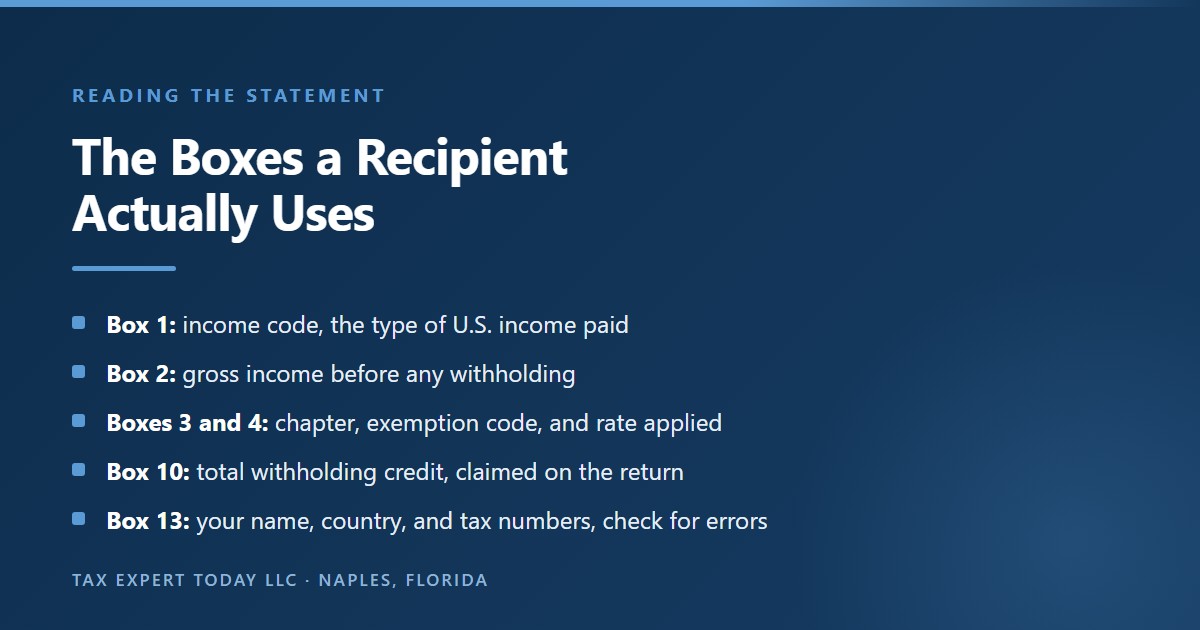
The 2026 Form 1042-S has more than forty fields, and most of them exist for the payer’s reporting of intermediaries and FATCA status. The boxes that change what a recipient does are summarized below, using the box descriptions from the 2026 instructions.
| Box | What it shows | Why it matters to the recipient |
|---|---|---|
| 1 | Income code | Tells you which treaty article and which line of the return the income belongs to |
| 2 | Gross income | The amount reported on the return, before any withholding |
| 3, 3a, 3b | Chapter indicator, chapter 3 exemption code, and tax rate | Shows whether a treaty or code exemption was applied and at what rate |
| 4a, 4b | Chapter 4 exemption code and rate | Shows whether FATCA withholding applied; usually an exemption code for an individual |
| 7a | Federal tax withheld | Tax the payer actually withheld from your payment |
| 8 and 9 | Tax withheld by other agents, and overwithheld tax repaid to you | Adjustments the payer already made; box 9 is shown as a negative number |
| 10 | Total withholding credit | Boxes 7a, 8, and 9 combined; this is the credit claimed on your return |
| 11 | Tax paid by withholding agent, amounts not withheld | Tax the payer paid from its own funds; the instructions say it is not included in box 10 |
| 13a to 13p | Recipient name, country, address, status codes, United States and foreign tax numbers, date of birth | Errors here can delay or derail a refund claim |
Box 10 deserves particular attention. The 2026 instructions tell payers to enter “the combined amounts reported in box 7a (federal tax withheld), box 8 (tax withheld by other agents), and box 9 (overwithheld tax repaid to recipient pursuant to adjustment procedures),” and give the example of $600 in box 7a, $120 in box 8, and a negative $50 in box 9 producing $670 in box 10. Publication 519 confirms that box 10 is where a recipient finds the tax withheld for purposes of the return.
What do the income codes on Form 1042-S mean?
The two-digit code in box 1 identifies the type of United States source income paid, such as 06 for dividends from United States corporations, 14 for real property income, 15 for pensions and annuities, 16 for scholarships, and 29 for deposit interest. The code decides which treaty article applies and how the income is reported on a return.
- Interest codes. 01 through 05, 22, 29, 30, 31, 33, 51, and 54 cover different kinds of interest and original issue discount.
- Dividend codes. 06, 07, 08, 34, 40, 52, 53, and 56 cover ordinary dividends, substitute payments, and dividend equivalents.
- Compensation codes. 17 through 20 cover independent services, dependent services, teaching, and studying or training.
- Other codes. Rents, royalties, capital gains, pensions, gambling winnings, and partnership distributions each have their own code.
The full list is printed on the back of the recipient copies of the 2026 Form 1042-S. The codes a Southwest Florida recipient is most likely to see are these.
| Code | Income type | Common Southwest Florida example |
|---|---|---|
| 01 | Interest paid by United States obligors, general | Interest on a note from a United States borrower |
| 06 | Dividends paid by United States corporations, general | Dividends in a United States brokerage account |
| 09 | Capital gains | Gains of a nonresident present in the United States 183 days or more |
| 14 | Real property income and natural resources royalties | Rent from a Naples or Fort Myers condominium |
| 15 | Pensions, annuities, alimony, and insurance premiums | A United States employer pension paid to a returning foreign national |
| 16 | Scholarship or fellowship grants | A graduate student stipend at a Florida university |
| 23 | Other income | Payments that fit no specific category |
| 29 | Deposit interest | Interest on a savings account or certificate of deposit at a local bank |
| 36 and 37 | Capital gains distributions and return of capital | Mutual fund distributions to a foreign shareholder |
Code 29 is a good example of why the code matters. Publication 515 (2026) explains that interest on deposits with banks, savings institutions, and certain insurance company arrangements is not subject to chapter 3 withholding when it is not connected with a United States business. It is still reported: deposit interest of $10 or more paid to a nonresident alien who lives in a country with which the United States has agreed to exchange tax information must go on Form 1042-S, and Revenue Procedure 2021-32 lists those countries. The purpose is information exchange with your home country, not United States tax. A Canadian snowbird who receives a code 29 form with zero withholding generally has nothing to file in the United States for that interest, but should expect the home country tax authority to receive the same information.
What do the exemption codes and the chapter 3 and chapter 4 boxes mean?
Box 3 shows whether the payment was reported under chapter 3, the ordinary nonresident withholding regime, or chapter 4, the FATCA regime. The exemption code explains why the rate is below 30 percent: code 04 means a treaty, code 02 means an exemption in the Internal Revenue Code, and code 01 means effectively connected income.
- Chapter indicator “3”. The payment was withheld on, or exempted, under the nonresident withholding rules of sections 1441 and 1442.
- Chapter indicator “4”. FATCA withholding applied, which is uncommon for an individual with proper documentation.
- Exemption code 04. A reduced treaty rate or treaty exemption was applied, based on your Form W-8BEN or Form 8233.
- Blank exemption code with a 30 percent rate. No reduction was applied, which is often the first sign of overwithholding.
The chapter 3 exemption codes on the 2026 form include 01 for effectively connected income, 02 for an exemption or reduced rate under the Internal Revenue Code, 03 for income not from United States sources, 04 for a treaty exemption or reduced rate, and 05 for portfolio interest. The chapter 4 codes in box 4a are separate, and for most individual recipients box 4a simply shows that the payment was not subject to chapter 4 withholding.
If you live in a treaty country and see a 30 percent rate with no code 04, the usual cause is documentation. The payer either never received a valid Form W-8BEN, received one that had expired, or received one that did not claim the treaty article or did not include a United States or foreign taxpayer identification number where one was required. Form W-8BEN is the front end of the same transaction that Form 1042-S reports at the back end, so fixing the certificate for next year and recovering this year’s overwithholding are two separate tasks.
Do I need to report Form 1042-S on my tax return?
Not always. A nonresident with no United States business whose tax was fully and correctly withheld at the source generally does not have to file a return. A return is required if you had a United States business or too little was withheld, and it is the only way to get a refund of excess withholding.
- Correct withholding, passive income only. Generally no return is required, because the tax was satisfied at the source.
- Too much withheld. No return is required, but filing Form 1040-NR is how the excess is refunded.
- Too little withheld. A return is required to report and pay the difference.
- Any United States business, including wages. A return is required, and the Form 1042-S income and credit go on it.
The recipient copies of the 2026 Form 1042-S carry this rule on their back: every nonresident alien individual with United States income generally must file, but “a return is generally not required” where the person “was not engaged in a trade or business in the United States at any time during the tax year and if the tax liability of such person was fully satisfied by the withholding of U.S. tax at the source.” Corporations file Form 1120-F, and everyone else files Form 1040-NR.
Publication 519 gives a Florida-shaped example: a nonresident who rents out a single-family house, whose tenants properly withheld 30 percent of the $10,000 rent and reported it on Form 1042-S, “do[es] not have to file a U.S. tax return” because the liability was satisfied. The same example goes on to note that the owner may instead elect to be taxed on net rental income, which does require a return. Our Form 1040-NR guide walks that election and the timely filing rule that protects the deductions.
Filing is also worth considering when no refund is at stake. A return starts the statute of limitations on assessment, documents a treaty position, and, for a rental owner who has elected net basis taxation, is required every year the election is in force.
How is Form 1042-S withholding claimed on Form 1040-NR?
Enter the total of box 10 from all of your Forms 1042-S on Form 1040-NR, line 25g, and attach a copy of each Form 1042-S to the front of the return. Report the income itself on the correct schedule, usually Schedule NEC for passive income at the 30 percent or treaty rate.
- Line 25g, not line 25c. The 1040-NR instructions keep Form 1042-S withholding off the general “other forms” line.
- Attach to the front. Forms W-2, 1042-S, SSA-1042S, RRB-1042S, and 8288-A all go on the front of the return.
- Report the income too. Box 2 gross income goes on Schedule NEC, or on the connected income lines if it is effectively connected.
- Expect a slower refund. The instructions allow up to 6 months for refunds of tax shown on Forms 1042-S, 8805, or 8288-A.
The 2025 Instructions for Form 1040-NR say to “Enter on line 25g the total amount shown as federal income tax withheld under chapter 3 or 4 on your Form(s) 1042-S,” that the “withholding credit should be shown in box 10,” and to attach the forms to the front of the return. The same instructions state an exception to line 25c: tax withheld on Forms 8805, 8288-A, and 1042-S goes on lines 25e, 25f, and 25g respectively.
The income side of the return is where treaty rates are applied. Schedule NEC (Form 1040-NR) has separate columns for income taxed at 10 percent, 15 percent, 30 percent, and other rates, and the income from box 2 is entered in the column for the rate that should have applied. If the tax on Schedule NEC is less than the line 25g credit, the difference is refunded. If it is more, the balance is due. The Form 1040-NR return mechanics, including the due dates of April 15 with wages and June 15 without them, are covered in detail in our separate guide.
What if a treaty rate should have been applied and was not?
If the payer withheld 30 percent but a treaty entitled you to a lower rate, file Form 1040-NR, report the income at the treaty rate, claim the full box 10 withholding on line 25g, and the difference is refunded. A Form 8833 treaty disclosure is generally not required for a reduced treaty rate on dividends, interest, rents, or royalties.
- Confirm the treaty and the article. Check the rate for your country and income type in the IRS treaty tables.
- Report at the treaty rate. Enter the income in the Schedule NEC column for the treaty rate.
- Claim everything that was withheld. The whole box 10 amount goes on line 25g.
- Fix the certificate. Give the payer a current Form W-8BEN so next year’s rate is right at the source.
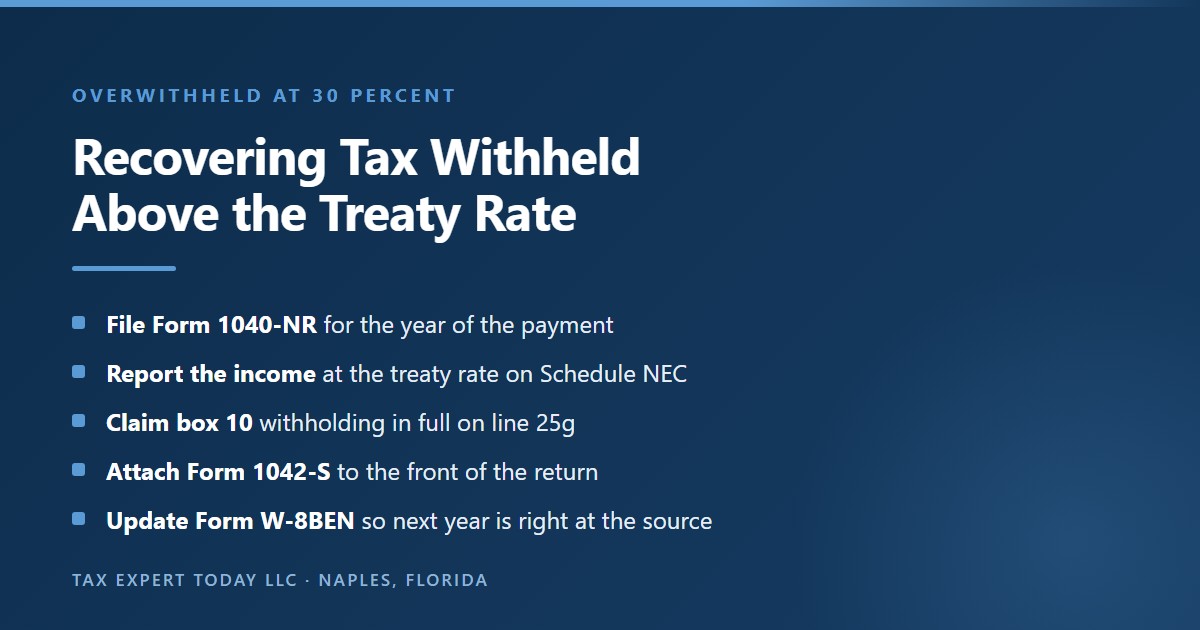
The treaty rate depends on your country of residence and the kind of income, and the IRS publishes the rates in its tax treaty tables. The hypothetical below shows how the numbers work for an investor from a country whose treaty sets a 15 percent rate on portfolio dividends, a rate found in many United States treaties. The figures are illustrations only.
| Step | Hypothetical amount | Where it comes from |
|---|---|---|
| Dividends paid by United States corporations (income code 06) | $8,000 | Form 1042-S, box 2 |
| Tax withheld at 30 percent because no valid Form W-8BEN was on file | $2,400 | Form 1042-S, boxes 7a and 10 |
| Tax at the 15 percent treaty rate | $1,200 | Form 1040-NR, Schedule NEC, 15 percent column |
| Withholding claimed as a credit | $2,400 | Form 1040-NR, line 25g |
| Overpayment refunded if no other income or tax | $1,200 | Form 1040-NR refund lines |
A frequent worry is whether this triggers a Form 8833 treaty-based return position disclosure. Publication 519 lists the exceptions, and the first is that you do not have to file Form 8833 if you “claim a reduced rate of withholding tax under a treaty on interest, dividends, rent, royalties, or other FDAP income ordinarily subject to the 30% rate.” Treaty positions on wages, pensions, and payments to students, teachers, and trainees are also on the exception list, as are amounts reported on Form 1042-S that you received as a direct account holder of a United States financial institution. The exceptions have limits, and Form 8833 is still required for positions such as a treaty tie-breaker on residency, so the specific position should be checked before filing. The penalty for a required but missing disclosure is $1,000 per failure for an individual.
A treaty claim also assumes you are actually a resident of the treaty country for treaty purposes and meet any limitation on benefits article. A person who has spent enough time in Florida to meet the substantial presence test may not be a nonresident at all, which changes the analysis entirely. The residency question comes first.
Can the withholding agent fix overwithholding before I file a return?
Sometimes. A withholding agent that overwithheld can repay you directly under the reimbursement or set-off procedures, generally until the extended due date for filing Form 1042-S or, if earlier, the date the form is filed or furnished. Once the form is issued, the usual route is a refund claim on Form 1040-NR.
- Act early. Ask the payer about an adjustment as soon as you spot the wrong rate, ideally before March 15.
- Same calendar year repayment. The payer simply reduces the box 7a amount on the form.
- Following year repayment. The repaid amount appears in box 9 as a negative number.
- The payer decides. These procedures are available to the withholding agent, not a right you can compel.
Publication 515 explains that a payer who discovers overwithholding by March 15 of the following year can use undeposited tax to make the adjustment, and otherwise can use “either the reimbursement procedure or the set-off procedure.” The regulation is Treas. Reg. section 1.1461-2. The 2026 Form 1042-S instructions add that payers may rely on proposed regulations that extend the window for these adjustments to the extended due date for filing Form 1042-S, “unless the Form 1042-S has already been filed or furnished.”
In practice, large brokers and fund companies rarely reopen a year once statements are out, and a private tenant who withheld on rent almost never has the systems to do it. Where the amount is meaningful and the timing allows, a written request with a corrected Form W-8BEN attached is worth sending in January or February. Otherwise, plan on the return.
What if my Form 1042-S is wrong or missing?
Ask the withholding agent to issue a corrected Form 1042-S, which carries the “Amended” checkbox and an amendment number. Do not claim a credit that differs from what the payer reported to the IRS, because the instructions warn that a mismatch can cause delays and disallowed refund claims. If no form arrives, contact the payer first.
- Wrong name, country, or taxpayer number. Request an amended form before you file.
- Wrong amount or rate. The payer corrects the amount; a wrong rate may instead be resolved on your return.
- No form at all. Payers must furnish it by March 15, and may get a 30-day extension to furnish recipient copies.
- Keep the payer’s records. Year-end brokerage statements and rent ledgers support your figures if the IRS asks.
The 2026 instructions are direct about the risk: “All copies must match the copy filed with the IRS. Any differences between the copy of the form issued to recipients and the copy filed with the IRS will lead to delays in processing the recipient’s tax return. The IRS may disallow claims for refund or credit for amounts withheld reported on Form 1042-S if the form attached to such claims differs from the copy that was filed with the IRS.” A refund claim is only as good as the form behind it.
On timing, Forms 1042-S must be filed with the IRS and furnished to recipients by March 15 of the year after the payment, moved to the next business day when March 15 falls on a weekend or legal holiday. For 2026 payments the date is March 15, 2027. A payer can ask for a one-time extension of up to 30 days to furnish recipient copies. A form that is still missing in April is a reason to contact the payer in writing and keep a record of the request.
What if I am a United States resident and received a Form 1042-S?
A United States citizen or resident should not normally receive Form 1042-S. If you did, the payer probably still has an old Form W-8BEN on file. Report the income on Form 1040, claim the withholding on line 25c with the form attached, and give the payer a Form W-9 so future payments are reported on Form 1099.
- Newly resident. A foreign national who became a resident during the year often still has foreign status on file with a broker.
- Green card holders. Permanent residents are residents for income tax purposes even while living abroad.
- Line 25c on Form 1040. The 2025 Form 1040 instructions list tax withheld on Form 1042-S under line 25c, “Other Forms.”
- Update the payer. A Form W-9 replaces the Form W-8BEN and stops nonresident withholding.
The 2025 Instructions for Form 1040 tell residents to include on line 25c any “Tax withheld that is shown on Form 1042-S, Form 8805, or Form 8288-A,” and to attach the form “to claim a credit for the withholding.” The year a foreign national becomes, or stops being, a resident is often a dual status year, when part of the year is reported as a resident and part as a nonresident, and a Form 1042-S issued for that year needs to be matched to the correct part.
Residency also brings reporting that nonresidents do not have. A resident with foreign bank or investment accounts over the thresholds generally has FBAR filing obligations and may need Form 8938, and missed years carry the penalty exposure described in our guide to FBAR penalties. A Form 1042-S showing that a payer still treats you as foreign is sometimes the first clue that residency began earlier than you realized. Where the snowbird day count is close, the closer connection exception on Form 8840 may keep you a nonresident, which is the situation Form 1042-S assumes.
How long do I have to claim a refund of Form 1042-S withholding?
In general, a refund of 1042-S withholding should be claimed within three years of the original due date of the Form 1040-NR for that year. The Internal Revenue Code treats tax withheld under chapter 3 or 4 as paid on the return’s due date, and a refund claim generally cannot recover tax paid more than three years before the claim.
- Deemed payment date. Chapter 3 and 4 withholding is treated as paid on the last day prescribed for filing the return.
- Claim period. Three years from filing the return or two years from payment, whichever is later.
- Late original returns. A first-time Form 1040-NR can itself be the claim, subject to the look-back limit.
- Do not wait. Refunds of 1042-S withholding already take up to 6 months to process.
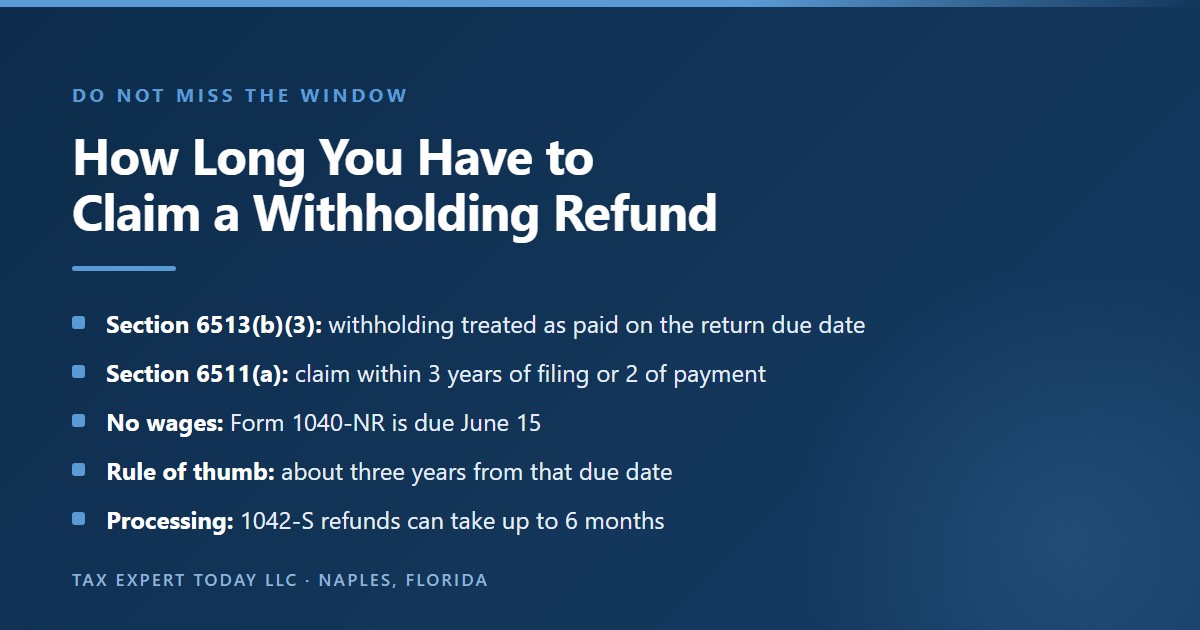
26 U.S.C. section 6513(b)(3) provides that “Any tax withheld at the source under chapter 3 or 4 shall, in respect of the recipient of the income, be deemed to have been paid by such recipient on the last day prescribed for filing the return.” 26 U.S.C. section 6511(a) then requires a claim “within 3 years from the time the return was filed or 2 years from the time the tax was paid, whichever of such periods expires the later,” with a look-back rule in section 6511(b) that limits how much can be refunded. For a nonresident with no wages, whose Form 1040-NR is due June 15, the practical deadline to recover withholding for a given year is generally around June 15 three years later. Edge cases, such as extensions and returns filed years late, should be reviewed before relying on a date.
| Tax year of the Form 1042-S | Form 1040-NR due (no wages) | Generally claim refund by |
|---|---|---|
| 2023 | June 17, 2024 | Mid-June 2027 |
| 2024 | June 16, 2025 | Mid-June 2028 |
| 2025 | June 15, 2026 | Mid-June 2029 |
The dates in the middle column reflect the weekend rule, which moves a due date that falls on a Saturday, Sunday, or legal holiday to the next business day. Because the refund period is measured from the actual statutory dates, confirm the exact date for your year before relying on the last few days of the window.
How is Form 1042-S different from Form 1099 and Form SSA-1042S?
Form 1042-S reports United States income paid to a foreign person and the nonresident withholding on it. Form 1099 reports similar income paid to United States persons, usually with no withholding. Form SSA-1042S reports Social Security benefits paid to a nonresident and comes from the Social Security Administration, not a private payer.
- Status drives the form. The payer’s records of your status, from Form W-8BEN or Form W-9, decide which form you receive.
- Withholding differs. 1042-S income is often withheld at 30 percent or a treaty rate; 1099 income usually is not.
- Different lines on the return. Form 1042-S withholding goes on 1040-NR line 25g, while SSA-1042S benefits are reported on Schedule NEC, line 8.
- Same year, both forms. In a residency change year, a person can receive both a 1042-S and a 1099 from the same broker.
| Feature | Form 1042-S | Form 1099 (various) | Form SSA-1042S |
|---|---|---|---|
| Recipient | Foreign person | United States person | Nonresident Social Security beneficiary |
| Issued by | Any withholding agent | Any payer | Social Security Administration |
| Typical withholding | 30 percent or treaty rate, or exempt | Usually none, except backup withholding | Generally 30 percent of 85 percent of benefits, or a treaty rate |
| Due to recipient | March 15 | Generally January 31 or February 15 | Mailed early in the year |
| Claimed on | Form 1040-NR line 25g, or Form 1040 line 25c for a resident | Form 1040 lines 25b and 25c | Benefits on Schedule NEC line 8, form attached to the front of Form 1040-NR |
Nonresident Social Security withholding and its treaty exceptions follow their own rules in Publication 519, and some treaties exempt those benefits from United States tax altogether; Table 1 of the IRS tax treaty tables lists them. Those rules are outside the scope of this guide, but they often travel with a Form 1042-S in the same household.
What does Form 1042-S mean for a foreign owner of Florida rental property?
A foreign owner who rents out Florida property without electing net basis taxation should receive a Form 1042-S with income code 14 showing 30 percent withheld from gross rent. If that owner instead elects to be taxed on net rental income, the rent is effectively connected and is reported on Form 1040-NR, where the withholding becomes a credit.
- No election. 30 percent of gross rent, satisfied by withholding, and no return is generally required.
- Net basis election. Expenses and depreciation are deducted, and graduated rates apply to the net.
- Withholding on elected rent. A tenant or agent generally stops withholding once it has a Form W-8ECI on file.
- Entity ownership. Property held through a United States LLC changes who reports what and can add Form 5472.
The difference in tax can be large, which is why the Form 1042-S for a rental property is often the document that starts the planning conversation. The hypothetical below compares the two approaches for a condominium with $30,000 of gross annual rent. The figures are illustrations only and ignore any treaty and state considerations.
| Item | 30 percent on gross (no election) | Net basis election (hypothetical) |
|---|---|---|
| Gross rent | $30,000 | $30,000 |
| Deductible expenses and depreciation | Not allowed | $24,000 |
| Taxable amount | $30,000 | $6,000 |
| Federal tax | $9,000, withheld and shown on Form 1042-S | Graduated rates on $6,000, figured on Form 1040-NR |
| Return required | Generally no | Yes, every year the election is in force |
The election, how it is made, and the rule that a late return can forfeit the deductions are explained in our Form 1040-NR guide. Owners who hold property through a United States limited liability company should also review Form 5472 for foreign-owned entities, because a single-member LLC owned by a foreign person has its own annual filing even when no income tax is due. And when the property is eventually sold, withholding moves from Form 1042-S to Form 8288-A under FIRPTA.
Can a late Form 1040-NR claiming 1042-S withholding be penalized?
If the Form 1042-S withholding fully covers the tax, a late return that only claims a refund generally produces no failure to file or failure to pay penalty, because those penalties are figured on unpaid tax. If the withholding was too low, a late return can carry both penalties plus interest, and relief depends on reasonable cause or first-time abatement.
- Refund returns. No balance due generally means no penalty measured on unpaid tax.
- Balance due returns. Failure to file and failure to pay penalties can both apply.
- Deductions at risk. For connected income, a very late return can lose deductions under the timely filing rule.
- Relief exists. Tax penalties can sometimes be removed for reasonable cause or on a clean compliance history.
Most 1042-S catch-up returns are refund returns, which is why the refund deadline, not a penalty, is usually the binding constraint. Where a balance is due, the standard penalty relief routes apply to nonresident returns as they do to residents, and our guide on how to get IRS penalties removed explains the options. Any relief depends on the facts and is never assured.
Form 1042-S Help in Naples & Southwest Florida
Tax Expert Today LLC works with nonresident clients from an office in Naples, Florida, and serves clients in all 50 states. Collier and Lee counties are home to a large community of Canadian, European, and Latin American property owners and investors, and Form 1042-S questions arrive every spring alongside the tax season.
- Form 1042-S help Naples: reading the codes, checking the rate against the treaty, and deciding whether a return is needed.
- Nonresident tax refund Naples FL: preparing Form 1040-NR to recover overwithheld tax through line 25g.
- International tax Naples FL: fixing the Form W-8BEN or W-9 behind the problem so next year’s withholding is right.
- Florida rental owners: comparing 30 percent gross withholding with the net basis election before the next season.
Florida has no personal income tax, so the Form 1042-S questions a Southwest Florida investor faces are federal ones. Our international and expat tax services page explains how we approach cross-border returns, and the Florida planning issues that often come with a seasonal home are covered in our guide to retiring to Florida.
Office: 11983 Tamiami Trail N, Naples FL 34110
Phone: (239) 441-2005
Hours: Monday through Friday, 10:00 to 5:00 ET
Frequently Asked Questions
We are Canadian snowbirds with a savings account at a Naples bank, and we received a Form 1042-S with nothing withheld. Do we need to file anything?
Generally not for that interest alone. Bank deposit interest paid to a nonresident is usually exempt from United States withholding, and the form exists so the information can be shared with your home country under a tax information exchange arrangement. If you have other United States income, a business, or a residency question, those items are reviewed separately.
Is Form 1042-S the same as a W-2?
No. Form W-2 reports wages subject to regular withholding. Form 1042-S reports income paid to a foreign person under the nonresident rules, including wages that are exempt under a treaty. A nonresident who works in the United States can receive both, and both are attached to the front of Form 1040-NR.
Where do I enter Form 1042-S on Form 1040-NR?
Enter the box 10 withholding credit from all Forms 1042-S on line 25g and attach each form to the front of the return. The income in box 2 is reported on Schedule NEC or on the connected income lines, depending on the type of income.
My broker withheld 30 percent on my dividends even though my country has a treaty. How do I get the difference back?
File Form 1040-NR for that year, report the dividends at the treaty rate on Schedule NEC, and claim the full withholding on line 25g. The difference is refunded, which can take up to 6 months. Give the broker a current Form W-8BEN so the treaty rate applies from then on.
When should I receive my Form 1042-S?
Payers must furnish Form 1042-S by March 15 of the year after the payment, or the next business day if March 15 falls on a weekend or holiday. A payer may obtain a one-time extension of up to 30 days for recipient copies.
Does a Form 1042-S mean I owe United States tax?
Not necessarily. It reports income and the tax already withheld. If the withholding was correct and you had no United States business, your liability is usually satisfied. If too little was withheld, or you had connected income, a return and payment may be required.
When to Engage a Professional
Form 1042-S is simple when the rate is right and there is nothing else going on: a foreign investor with correctly withheld dividends, or a depositor with exempt bank interest. It becomes worth a second opinion when money is left on the table or when the form is a symptom of something larger, such as a residency change, a rental property, or an entity that has its own filing requirements.
Consider a consultation if any of the following applies: 30 percent was withheld although your country has a treaty, you received a Form 1042-S after becoming a resident or green card holder, you own Florida rental property and have never compared gross withholding with the net election, your Form 1042-S shows the wrong name, country, or identification number, the refund window for an older year is closing, or you hold United States property through an LLC.
Tax Expert Today LLC is a tax advisory firm in Naples, Florida serving clients in all 50 states. Call (239) 441-2005 to discuss your facts.
Primary Sources
- IRS: About Form 1042-S, Foreign Person’s U.S. Source Income Subject to Withholding
- 2026 Instructions for Form 1042-S
- Publication 515 (2026), Withholding of Tax on Nonresident Aliens and Foreign Entities
- 2025 Instructions for Form 1040-NR (line 25g)
- 26 U.S.C. section 6513 (when withheld tax is deemed paid)
- Treas. Reg. section 1.1461-2 (adjustments for overwithholding)
This article is general information, not advice for any particular taxpayer, and does not create a client relationship. The dividend and rental figures are hypothetical illustrations only. Treaty rates vary by country and type of income. Forms, instructions, and due dates change annually; the 2026 Form 1042-S and its instructions and the 2025 return instructions were current when this article was written. Verify current rules and confirm your own facts with a qualified tax professional before filing.
Published September 23, 2026 by Dr. Pellumb Kabashi « Back to Learning Center
Have a question this article touches on?
Tax Expert Today LLC, based in Naples, Florida and serving clients across the United States.
Schedule a Consultation (239) 441-2005