
By Dr. Pellumb Kabashi, DBA, MBA, EA, CFE, CES
Founder, Tax Expert Today LLC · Tax advisors, enrolled agents, CPAs, and attorneys · Serving clients in all 50 states
Quick Answer: Schedule K-3 is the international extension of Schedule K-1. A partnership or S corporation uses it to report each owner’s share of foreign source income, foreign taxes, and other cross-border items. Most individual owners use only Parts II and III, which feed the Form 1116 foreign tax credit, and small passive foreign tax amounts may let you skip Form 1116. Call (239) 441-2005 for a free consultation.
What is Schedule K-3?
Schedule K-3 is a statement a partnership or S corporation gives each owner showing that owner’s share of items with international tax relevance: foreign source income by country and category, foreign taxes paid, asset values for expense apportionment, and information on foreign corporations, PFICs, and foreign partners. It extends Schedule K-1 rather than replacing it.
- The full name: Partner’s Share of Income, Deductions, Credits, etc. International, for Form 1065.
- The entity copy: Schedule K-2 is the summary filed with the entity return; each owner gets a K-3.
- Three versions: Form 1065 for partnerships, Form 1120-S for S corporations, and Form 8865 for certain foreign partnerships.
- The main user: any owner who claims a foreign tax credit on Form 1116.
- The goal: one standard format in place of the old attached statements.
Before the 2021 tax year, partnerships passed international information to their owners through line 16 of Schedule K-1, a few codes on line 20, and whatever footnotes and white paper statements the preparer chose to attach. Every fund and every operating partnership did it a little differently. The IRS replaced that patchwork with two standardized schedules. Schedule K-2 reports the entity’s total international items on its own return, and Schedule K-3 reports each owner’s share, the same way Schedule K-1 reports each owner’s share of the ordinary items on Schedule K.
The Partner’s Instructions for Schedule K-3 describe the form simply: it “reports items of international tax relevance from the operation of a partnership,” and the partner must include the information on its own tax or information returns where it applies. The same instructions add a point that most partners never hear. A partnership sometimes fills in the K-3 on assumptions about its partners that turn out to be wrong, and when that happens the partner must treat the items according to the partner’s own facts, not the partnership’s assumption. The K-3 is evidence you use. It is not a final answer you copy.
This guide is written for the person holding the schedule, the partner or S corporation shareholder, not the preparer of the entity return. It explains which parts change an individual’s return, which parts usually do not, when you can set the schedule aside, how foreign partners use it, and what to do when it arrives late or wrong. The companion schedule on the entity side, Schedule K-2, is covered only where it explains what you receive.
| Schedule | Who prepares it | Who receives it | What it reports |
|---|---|---|---|
| Schedule K (Form 1065 or 1120-S) | The entity | Filed with the entity return | Total ordinary income, deductions, credits, and separately stated items |
| Schedule K-1 | The entity | Each owner and the IRS | The owner’s share of the Schedule K items |
| Schedule K-2 | The entity | Filed with the entity return | Total items of international tax relevance |
| Schedule K-3 | The entity | Each owner who needs it, and the IRS | The owner’s share of the Schedule K-2 items |
Why did I receive a Schedule K-3 when my partnership has no foreign business?
You can receive a Schedule K-3 from a purely domestic partnership because your own foreign tax credit depends on partnership information. Section 904 limits the credit using your foreign source taxable income, and that figure depends on how your expenses are apportioned across all your assets and income, including your share of the partnership’s U.S. assets and income.
- The limitation rule: the credit cannot exceed the U.S. tax on your foreign source taxable income.
- Expense apportionment: interest expense is spread by the tax book value of assets, including partnership assets.
- Partner-determined source: gain on some personal property sold by the partnership is sourced by the partner’s residence.
- Research expenses: they are apportioned by gross receipts by industry code, which the K-1 does not show.
- Possible benefit: the K-3 data can increase your allowable credit, not only reduce it.
This is the part of the K-3 rules that surprised the most people when the schedules arrived. A Naples dental practice organized as an LLC taxed as a partnership has no foreign customers, no foreign bank accounts, and no foreign partners. One of its members also owns an international stock fund in a brokerage account and pays foreign tax on those dividends. That member claims a foreign tax credit on Form 1116, and the credit is capped by the limitation in section 904. The cap depends on how much of the member’s total taxable income is foreign source, and that depends on how the member’s deductions, including interest expense, are split between U.S. and foreign income.
The IRS explains in the Partner’s Instructions why that split reaches back into the partnership. Interest expense is apportioned under section 864(e) and Regulations section 1.861-9 based on the tax book value of the taxpayer’s assets, and a partner’s assets include its share of the partnership’s assets. Research and experimental expenses are apportioned under Regulations section 1.861-17 based on gross receipts by Standard Industrial Classification code. Under section 865(i)(5), personal property sold by the partnership is treated as sold by the partners, and gain on certain nondepreciable personal property is sourced by the residence of the seller. None of these figures appears on Schedule K-1. All of them can appear on Schedule K-3.
The instructions also make a point that is easy to miss: the K-3 can help you. The IRS gives an example in which a partner’s share of a domestic partnership’s U.S. assets pulls more interest expense onto U.S. source income, which leaves more foreign source taxable income and a larger foreign tax credit limitation. A worked version of that math appears later in this guide.
Who must file Schedules K-2 and K-3?
Any partnership filing Form 1065 that has items relevant to its partners’ U.S. tax, withholding, or reporting under the international provisions of the Internal Revenue Code must complete the relevant parts of Schedules K-2 and K-3. S corporations filing Form 1120-S follow parallel rules, and U.S. persons filing Form 8865 complete the Form 8865 versions.
- Partnerships: Form 1065 filers with foreign activity, foreign partners, or partners who need the data.
- S corporations: Form 1120-S filers, using a shorter seven-part version.
- Foreign partnership owners: Form 8865 filers, using the Form 8865 Schedules K-2 and K-3.
- Relevant parts only: an entity completes the parts and sections that apply, not all twenty pages.
- Two exceptions: the domestic filing exception and the Form 1116 exemption exception.
The Partnership Instructions for Schedules K-2 and K-3 put the filing requirement in one sentence: any partnership required to file Form 1065 that has items relevant to the determination of the U.S. tax or certain withholding tax or reporting obligations of its partners under the international provisions of the Code must complete the relevant parts. The same instructions add that a partnership with no foreign source income, no assets generating foreign source income, no foreign partners, and no foreign taxes paid or accrued may still need to report information, for exactly the reason in the previous section.
That broad rule is softened in two ways. First, a partnership completes only the parts and sections that apply to it and to the partners who need them. A partnership whose only international relevance is one partner’s foreign tax credit may complete only Parts II and III for that partner. Second, two exceptions let a qualifying domestic partnership skip the schedules entirely unless a partner asks for one. Both exceptions depend on notice to the partners and on whether any partner makes a request in time, so they are as much about the partner’s choices as the partnership’s.
Three related returns sit beside this one. A U.S. person who owns an interest in a foreign partnership may file Form 8865, which carries its own K-2 and K-3. A partnership that owns part of a foreign corporation may attach Form 5471. A partnership with foreign partners and effectively connected income also deals with Form 8804 partnership withholding. Schedule K-3 is the reporting layer that carries pieces of all of those to each owner.
The Form 8865 version of Schedule K-3
A third version of the schedule exists for Form 8865, the return a U.S. person files with respect to certain foreign partnerships. When a U.S. person files Form 8865 for a foreign partnership, the IRS publishes separate Form 8865 Schedules K-2 and K-3 and separate instructions for them. The structure follows the Form 1065 version: international items at the partnership level on K-2, and the filer’s share on K-3. The practical difference is who prepares it. A domestic partnership prepares its own K-2 and K-3 and sends K-3s to its partners. With a foreign partnership, the U.S. person filing Form 8865 is the one who must assemble the information, often from foreign financial statements that were never built for U.S. reporting.
That difference matters for a Southwest Florida family that owns an interest in a family business or a real estate partnership abroad. The foreign partnership may have no idea what a K-3 is, and its accountants may report on a different fiscal year, in a different currency, under different accounting rules. The U.S. owner needs the income by source and category for Form 1116, the foreign taxes paid by the partnership, and the information that Form 8865 itself requires. Planning that information request early, in the foreign partnership’s own terms, avoids most of the late summer pressure that otherwise comes with Form 8865.
Whichever version you hold, the logic for an individual is the same. Parts II and III serve the foreign tax credit, the foreign corporation and PFIC parts serve the inclusion and PFIC rules, and a partner uses only the parts the entity completed for that partner.
What is the domestic filing exception for Schedule K-3?
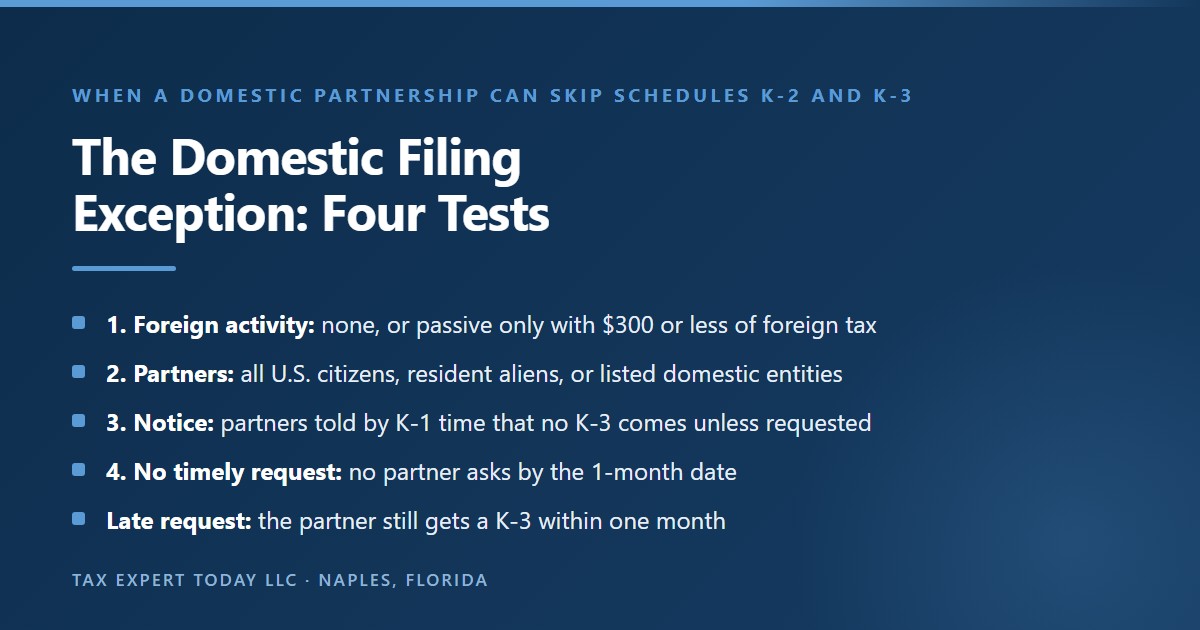
The domestic filing exception lets a domestic partnership skip filing Schedules K-2 and K-3, and skip furnishing a K-3, when four criteria are met: little or no foreign activity, only qualifying U.S. partners, a notice to partners that they will not get a K-3 unless they ask, and no K-3 request by the 1-month date.
- Criterion 1: no foreign activity, or only passive foreign income with no more than $300 of creditable foreign tax reported on payee statements.
- Criterion 2: every direct partner is a U.S. citizen, resident alien, or a listed domestic entity.
- Criterion 3: partners are notified, no later than delivery of the K-1, that no K-3 comes unless requested.
- Criterion 4: no partner requests a K-3 on or before the 1-month date.
- Late request: a request after that date still gets a K-3, but the exception survives for everyone else.
The exception is the reason many partners never see a K-3 at all. Instead, they receive a short notice with their Schedule K-1 saying the partnership qualifies for the domestic filing exception and will not provide Schedule K-3 unless asked. The notice is not boilerplate to ignore. It starts the clock on your right to request the schedule, and it is the moment to decide whether you need it.
For the 2025 tax year the Partnership Instructions define foreign activity broadly: foreign income taxes paid or accrued, foreign source income or loss, an ownership interest in a foreign partnership, a foreign corporation, or a foreign disregarded entity, or ownership of a foreign branch. A partnership with any of those fails criterion 1 unless its only foreign activity is passive category income carrying no more than $300 of creditable foreign tax, shown on a payee statement such as a Form 1099 from a mutual fund.
| Criterion | What the partnership must show | Common way it fails |
|---|---|---|
| 1. Limited or no foreign activity | No foreign activity, or only passive foreign income with $300 or less of creditable foreign tax on payee statements | A foreign subsidiary, a foreign bank account generating foreign source interest, or a foreign fund with larger withholding |
| 2. U.S. citizen or resident alien partners | Every direct partner is a U.S. citizen, resident alien, qualifying domestic estate or trust, S corporation, single-member LLC owned by one of those, or a domestic partnership whose partners qualify | One Canadian, Mexican, or other nonresident alien partner, or a foreign trust |
| 3. Partner notification | A notice, at the latest when the K-1 is furnished, that partners will not receive a K-3 unless they request it | No notice sent, or a notice sent after the K-1 |
| 4. No timely request | No partner requests K-3 information on or before the 1-month date | A partner who claims the foreign tax credit asks early |
Criterion 2 was widened for 2025. The 2025 instructions list domestic partnerships whose own direct partners qualify among the eligible partner types, so a tiered structure of U.S. partnerships owned by U.S. individuals can now use the exception. Several pages that still rank for this topic were written for 2022 and say any partnership partner disqualifies the exception. That was the old rule. Check the instructions for the year you are filing.
What is the 1-month date, and how do I request a Schedule K-3?
The 1-month date is one month before the date the partnership files Form 1065. For a calendar year 2025 partnership on extension, the IRS says the latest 1-month date is August 17, 2026. A partner who asks on or before that date makes the partnership file K-2 and K-3; a later request still gets a K-3 within one month.
- Request in writing: email or letter to the partnership or its preparer, kept with your records.
- Name the parts: usually Parts II and III for a foreign tax credit, or Part III Section 2 alone.
- Ask every year: a request covers one year unless you specifically ask for future years as well.
- Request early: January or February avoids a summer scramble.
- Late request: the partnership must provide the K-3 within one month of receiving it.
The timing rule is precise. A partnership that satisfies criteria 1 through 3 but receives a request from any partner on or before the 1-month date loses the exception for that year. It must then file Schedules K-2 and K-3 and furnish a K-3 to the requesting partner, although it completes only the parts and sections relevant to that partner. A partnership that receives a request only after the 1-month date keeps the exception. It does not file K-2 and K-3 with the IRS and does not furnish K-3 to the partners who did not ask, but it must give the requesting partner a K-3, completed with the requested information, no later than one month after it receives the request.
The IRS illustrates this with a hypothetical partnership that files its extended 2025 Form 1065 on August 31, 2026. A partner’s request received on February 1, 2026 comes before the 1-month date of July 31, 2026, so the partnership must file K-2 and K-3. In a second version, the request arrives on August 20, 2026, after the 1-month date, so the partnership keeps the exception but must deliver the requested K-3 by September 20, 2026.
Two practical points follow. First, because the 1-month date is tied to the actual filing date, a partner cannot know it in advance. The safe course is to ask early, ideally when you receive the notice or before. Second, a request carries over only if you say so. The 2025 instructions say a partner “must request that the partnership provide subsequent year Schedule K-3 information specifically or must request such information on an annual basis.” One sentence in your letter asking for K-3 information for the current and all later years avoids repeating the request every spring.
What a Schedule K-3 request should say
A request does not need a special form. A short letter or email to the partnership’s tax contact, kept with your records, does the job. A request that covers the points below gives the partnership what it needs and gives you evidence of the date if a question comes up later.
- Who and which entity: your name as it appears on the K-1, the partnership name, and its EIN.
- Which year: the tax year, and a sentence asking for K-3 information for all later years as well.
- Which parts: for a foreign tax credit, Parts II and III; for a fund with foreign holdings, also Parts V, VI, and VII.
- Why: one line saying you expect to file Form 1116, which tells the preparer the request is real.
- How to deliver: an email address or mailing address for the completed schedule.
Send the request when the notice arrives, or before the partnership’s busy season if you already know you will need it. For an investor in several partnerships, a standing request sent each January to every partnership is the simplest system. Keep the sent email or a copy of the letter with the tax year’s records.
What is the Form 1116 exemption exception?
The Form 1116 exemption exception lets a domestic partnership skip Schedules K-2 and K-3 when every partner qualifies for the section 904(j) election to claim the foreign tax credit without Form 1116 and the partnership receives notice of that eligibility by the 1-month date. It is a second, narrower door for partnerships that fail the domestic filing exception.
- The link: partners who do not file Form 1116 do not need Parts II and III.
- The direction of notice: here the partners notify the partnership of their eligibility.
- The partner notice still applies: partners are told they will not get a K-3 unless they ask.
- A timely request still overrides it: a request by the 1-month date requires the schedules.
- Typical use: a family partnership whose only foreign item is fund withholding above $300.
The Partnership Instructions describe the exception with a hypothetical married couple who each own half of a domestic partnership that invests in a mutual fund. The fund reports $400 of creditable foreign tax on passive income. That fails the $300 test in criterion 1 of the domestic filing exception, so the partnership cannot use that exception. But the couple file jointly, have no other foreign taxes, and qualify for the section 904(j) election, which allows up to $600 of passive foreign tax on a joint return without Form 1116. Because neither partner needs Form 1116, neither needs Parts II and III, and the partnership may use the Form 1116 exemption exception if it receives the couple’s notice of eligibility by the 1-month date.
The exception lines up with the partner-side rule covered later in this guide. The partner who qualifies for the 904(j) election can claim the credit directly on Schedule 3 of Form 1040 and has no use for Parts II and III. The partner who does not qualify needs them, and should ask.
What are the parts of Schedule K-3?
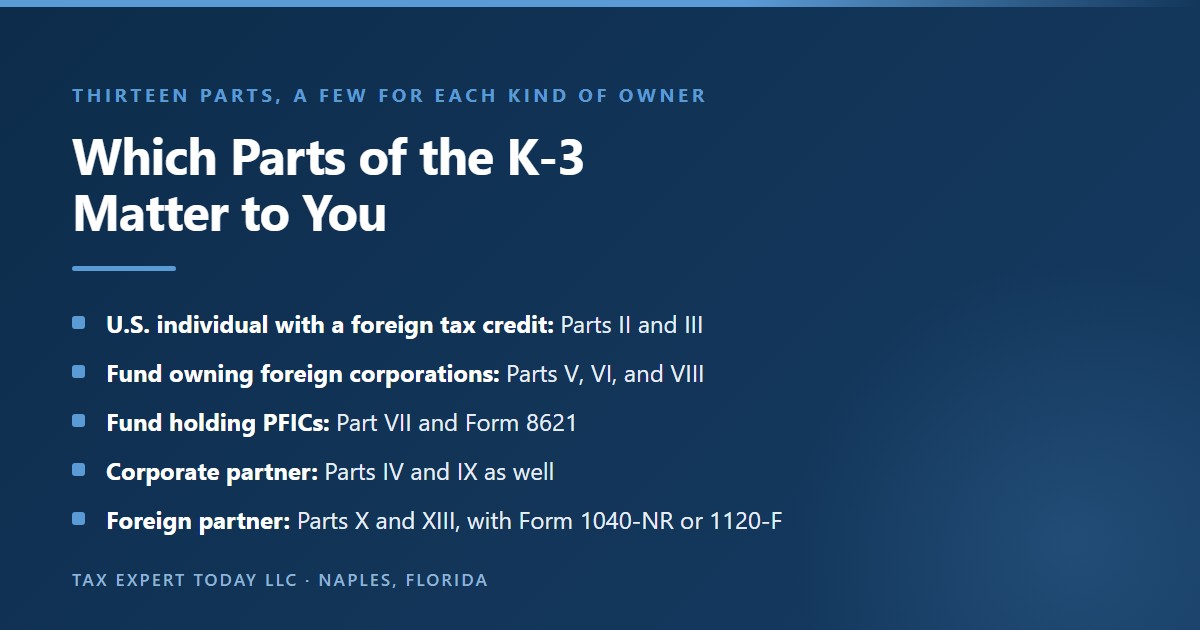
The Form 1065 Schedule K-3 has thirteen parts. Parts I through III serve the foreign tax credit, Part IV the FDII deduction, Parts V through VIII foreign corporations and PFICs, Part IX the base erosion tax, Part X foreign partners, Parts XI and XII section 871(m) and dealer items, and Part XIII foreign partners on a transfer.
- Individuals: mostly Parts II and III, sometimes Parts V, VI, and VII.
- Corporate partners: Parts IV, VIII, and IX matter mainly to C corporations.
- Foreign partners: Parts X and XIII.
- Check boxes: page 1 shows which parts the partnership completed.
- Part I: a checklist of other items and attached statements.
The length of the form scares people more than its content should. The IRS form runs about twenty pages, but most partners receive a version with only two or three parts completed. Page 1 includes check boxes showing which parts apply, and the first thing to do with any K-3 is read those boxes. The table below lists each part, what it reports, and where the information typically goes on an individual’s return.
| Part | What it reports | Where an individual partner uses it |
|---|---|---|
| I | Other current year international information, by check box and attached statement | Various; for example foreign oil and gas taxes, splitter arrangements, section 267A disallowed deductions, attached Form 8858 or 8621 |
| II | Foreign tax credit limitation: gross income and deductions by source, country, and separate category | Form 1116, Part I |
| III | Other information for Form 1116: R&E apportionment, asset values for interest apportionment, foreign taxes | Form 1116, Part I expense apportionment and Part II foreign taxes |
| IV | Section 250 deduction for foreign-derived intangible income | Mainly corporate partners on Form 8993 |
| V | Distributions from foreign corporations to the partnership | Dividend and previously taxed earnings analysis |
| VI | Section 951(a)(1) and section 951A inclusions | Subpart F and GILTI computations, including Form 8992 |
| VII | Passive foreign investment companies | Form 8621 |
| VIII | Partnership’s interest in foreign corporation income (section 960) | Deemed paid credit computations, mainly corporate partners and section 962 electors |
| IX | Base erosion and anti-abuse tax | Corporate partners on Form 8991 |
| X | Foreign partner’s character and source of income and deductions | Foreign partners on Form 1040-NR or 1120-F |
| XI and XII | Section 871(m) covered partnerships and qualified derivatives dealers | Withholding agents and certain foreign partners |
| XIII | Foreign partner’s share of deemed sale items on a transfer of a partnership interest | Foreign partners on Schedule P of Form 1040-NR or 1120-F |
Which parts of Schedule K-3 change an individual partner’s return?
For most U.S. individual partners, only Parts II and III change the return, and only if they file Form 1116 to claim a foreign tax credit. Parts V through VII matter when the partnership owns foreign corporations or PFICs. Parts IV, VIII, and IX are mainly for corporate partners, and Parts X and XIII are for foreign partners.
- Foreign tax credit filers: Parts II and III go onto Form 1116.
- Owners of funds with foreign corporations: Part VI can create Subpart F or GILTI income.
- Owners of funds holding PFICs: Part VII supports Form 8621.
- No foreign tax credit and no foreign corporations: the K-3 may change nothing on the return.
- Always: read the Part I check boxes for attached statements.
A partner who receives a K-3 should sort it in three steps. First, look at the check boxes on page 1 to see which parts were completed. Second, ask whether you claim a foreign tax credit this year or carry one over. Third, ask whether the partnership owns any foreign corporation, foreign fund, or foreign partnership. The answers usually narrow a twenty page form to two or three pages that matter.
| Your situation | Parts that usually matter | Return forms affected |
|---|---|---|
| U.S. individual, no foreign tax credit, partnership has no foreign corporations | Usually none; review Part I | Often none |
| U.S. individual claiming the credit with Form 1116 | Parts II and III | Form 1116 |
| U.S. individual with $300 or less of passive foreign tax ($600 joint), all on payee statements | Part III, Section 4 for the tax amount only | Schedule 3 (Form 1040), no Form 1116 |
| Partner in a fund that owns controlled foreign corporations | Parts V, VI, and VIII | Form 8992, Form 5471 information, possibly a section 962 election |
| Partner in a fund holding foreign mutual funds or other PFICs | Part VII | Form 8621 |
| Nonresident alien partner | Parts X and XIII | Form 1040-NR and Schedule P |
Part VI deserves a word for individuals who invest through private funds. If the partnership owns stock in a controlled foreign corporation, the partner may have a current inclusion under section 951(a)(1) or section 951A even with no cash distribution. Section 951A income was known as GILTI; for tax years beginning after 2025 the statute calls it net CFC tested income. Our guide to GILTI for individual shareholders explains how an individual computes that inclusion and when a section 962 election is worth testing. Part VII serves the same role for passive foreign investment companies, and our guide to Form 8621 and PFIC reporting covers the elections and the excess distribution regime that Part VII information supports.
How do I read a Schedule K-3 step by step?
Read a Schedule K-3 in five steps: confirm the entity, tax year, and your identifying details; read the page 1 check boxes; open only the completed parts; match each completed part to the form it supports on your return; and compare the totals with your Schedule K-1 and with last year’s K-3 before you file.
- Step 1, the header: entity name, EIN, tax year, and whether the schedule is final or amended.
- Step 2, the check boxes: which parts were completed and which statements are attached.
- Step 3, the completed parts: skip blank parts rather than guessing at them.
- Step 4, the destination: Form 1116, Form 8621, Form 8992, or Form 1040-NR.
- Step 5, the cross-check: K-1 totals, prior year K-3, and your own 1099s.
Step 1: the header. Confirm that the schedule is for the right entity, the right tax year, and you. A K-3 marked amended replaces an earlier one, and a fiscal year entity reports on the year in which its tax year ends. If you hold interests through more than one partnership, keep each K-3 with its matching K-1, because the totals on one should reconcile to the other.
Step 2: the check boxes. Page 1 lists every part with a box. A checked box means the entity completed that part for you. Part I also has its own boxes for items such as foreign oil and gas taxes, splitter arrangements, section 267A disallowed deductions, and attached Forms 8858 or 8621. Box 9 in Part I tells you the partnership attached Form 8858, Form 8621, or both to its own return; if you need that information, the instructions tell you to request it from the partnership.
Step 3: the completed parts. Turn only to the parts that are checked. A blank part is not a missing part. The instructions tell partnerships to complete only what is relevant, and for many partners that means Parts II and III and nothing else.
Step 4: the destination. Match each part to the form it supports, using the table earlier in this guide. Parts II and III go to Form 1116 if you file one. Part VI goes to the inclusion computations. Part VII goes to Form 8621. Part X goes to Form 1040-NR or Form 1120-F.
Step 5: the cross-check. Compare the foreign taxes in Part III, Section 4 with any foreign tax shown on the K-1 or its statements, so the same tax is not counted twice. Compare the categories and countries with last year’s K-3; a new country or a new category is worth a question to the partnership. And compare the K-3 with your own Forms 1099, so that a fund held both inside and outside the partnership is reported once in each place.
| Step | Where to look | What a problem looks like |
|---|---|---|
| 1. Header | Top of page 1 | Wrong tax year, wrong identifying number, or an amended box you did not expect |
| 2. Check boxes | Page 1 part boxes and Part I boxes | An attached statement referenced but missing from the package |
| 3. Completed parts | Each checked part | A checked part with no amounts, or amounts in a part that is not checked |
| 4. Destination | Your return forms | A Part VI or VII amount with no matching form on your return |
| 5. Cross-check | K-1, prior year K-3, Forms 1099 | Foreign tax counted twice, or a new country with no explanation |
How do Parts II and III of Schedule K-3 feed Form 1116?
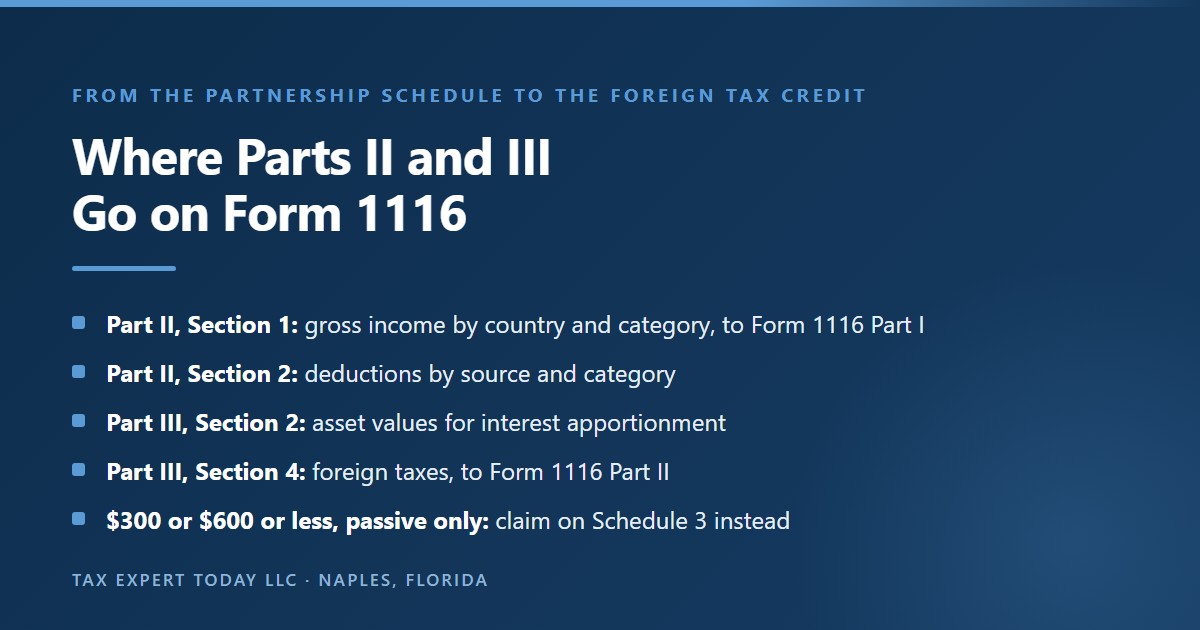
Part II reports your share of partnership gross income and deductions by source, country, and separate category, which you add to your other income on Form 1116, Part I. Part III supplies asset values and gross receipts for apportioning your own expenses, and Part III, Section 4 reports the foreign taxes for Form 1116, Part II.
- Part II, lines 1 to 24: gross income by type, country code, and category.
- Part II, Section 2: deductions by type and source.
- Part III, Section 1: gross receipts by SIC code for research expense apportionment.
- Part III, Section 2: tax book value of assets for interest expense apportionment.
- Part III, Section 4: foreign taxes paid or accrued, by category and country.
Form 1116 is built around separate categories of income: passive, general, foreign branch, section 951A, and income re-sourced by treaty. A partner files a separate Form 1116 for each category that applies. Part II of the K-3 is organized the same way, with columns for U.S. source income and each foreign category, and with country codes for each foreign source item. The Partner’s Instructions tell an individual to add the amounts in the foreign category columns to other income in those categories and report the totals on Form 1116, Part I, line 1a, after any adjustments for capital gain rate differentials under section 904(b).
Some Part II amounts arrive with the code XX instead of a country. That means the partnership could not determine the source because it depends on your residence, usually gain on personal property sourced under section 865. You must determine the source yourself. For a U.S. resident the gain is generally U.S. source, but the instructions explain that gain can be treated as foreign source where you have a foreign tax home and a foreign country imposed at least a 10 percent tax on it. Column (c), income sourced at the partner level, follows the same logic.
Part III, Section 4, line 1 reports direct foreign taxes under section 901 or 903. The Partner’s Instructions tell an individual to report those taxes in the applicable portions of Form 1116, Part II, by separate category, and to use the statement attached to the K-3 for the country and date detail. Reductions of taxes, such as the reduction for foreign oil and gas extraction taxes or taxes suspended under the splitter rules of section 909, go on Form 1116, Part III, line 12. Our full guide to Form 1116 and the foreign tax credit walks through each of those lines.
| Schedule K-3 location | What it holds | Where it goes on Form 1116 |
|---|---|---|
| Part II, Section 1, lines 1 to 24 | Gross income by source, country, and category | Part I, line 1a, added to other foreign source gross income in the same category |
| Part II, Section 2 | Deductions and losses by source and category | Part I, lines 2 to 5, as definitely related or apportioned deductions |
| Part III, Section 1 | Gross receipts by SIC code | Your research and experimental expense apportionment worksheet |
| Part III, Section 2 | Tax book value of partnership assets by source and category | Your interest expense apportionment, feeding Part I, line 4b |
| Part III, Section 4 | Foreign taxes paid or accrued | Part II, by category and country; reductions on Part III, line 12 |
One exception affects small investors. Under Regulations section 1.861-9(e)(4), a limited partner who owns less than 10 percent of the partnership and does not hold the interest in the ordinary course of an active trade or business generally does not apportion interest expense using the partnership’s assets. The Partner’s Instructions say the partnership did not complete Part III, Section 2 for such a partner. If that section is blank on your K-3, that may be the reason, not an error.
How can Schedule K-3 data raise a foreign tax credit? A hypothetical
Schedule K-3 can raise a foreign tax credit when your share of a partnership’s U.S. assets pulls more of your interest expense onto U.S. source income. That leaves more foreign source taxable income, which raises the section 904 limitation and lets you use more of the foreign tax you paid.
- The mechanism: interest expense is apportioned by the tax book value of your assets.
- The input: your share of partnership asset values from Part III, Section 2.
- The result: less interest assigned against foreign income, a higher limit.
- Unused credit: excess foreign tax can generally be carried back one year and forward ten under section 904(c).
- Not automatic: the effect depends on your own asset mix and expenses.
The following is a hypothetical with simplified figures, not a client example. A Naples, Florida investor owns a portfolio of international stock funds with a tax book value of $40,000 that produces $16,000 of passive category foreign source income before interest expense, and $160,000 of other investment assets that produce U.S. source income. The investor paid $4,000 of foreign income tax on the foreign income, has $10,000 of investment interest expense that is not directly allocable to any asset, and faces a 24 percent U.S. rate on the margin. The investor is also a member of a domestic real estate partnership, with a share of its assets valued at $200,000 for tax book value purposes, all producing U.S. source income.
| Step | Without the K-3 asset data | With the K-3 asset data |
|---|---|---|
| Total assets used for apportionment | $200,000 | $400,000 |
| Assets producing passive foreign income | $40,000 | $40,000 |
| Interest apportioned to foreign income ($10,000 times the foreign share) | $2,000 | $1,000 |
| Foreign source taxable income ($16,000 less interest) | $14,000 | $15,000 |
| Limitation at 24 percent | $3,360 | $3,600 |
| Foreign tax usable this year (of $4,000 paid) | $3,360 | $3,600 |
| Excess foreign tax for carryback or carryover | $640 | $400 |
In this hypothetical, including the partnership’s U.S. assets adds $240 of usable credit this year. The amounts are small on purpose, so the mechanics are visible. With larger portfolios and larger partnership interests the difference grows in proportion. The same logic can work the other way: if the partnership holds foreign assets, or has interest expense of its own, the K-3 data can reduce the limitation. Either way, the IRS expects partners who file Form 1116 to use the information, which is why the instructions encourage those partners to request the K-3 even from a domestic partnership.
When can I set Schedule K-3 aside under the section 904(j) election?
You can usually set Parts II and III aside if all your foreign source income is passive, all of it and the tax were reported on qualified payee statements such as Form 1099-DIV or Schedule K-3, and total creditable foreign tax is $300 or less, $600 on a joint return. You then claim the credit on Schedule 3.
- Passive only: mostly dividends and interest; general category business income disqualifies the election.
- Qualified payee statement: Form 1099-DIV, 1099-INT, Schedule K-1 (Form 1041), and Schedule K-3 all qualify.
- Dollar cap: $300 single, $600 married filing jointly, counting every source.
- Trade-off: no carryback or carryover of foreign tax in an election year.
- Not for estates and trusts: individuals only.
Section 904(j) of the Code turns off the foreign tax credit limitation for an individual whose creditable foreign taxes do not exceed $300, or $600 on a joint return, and whose foreign source income is all passive and reported on payee statements. The Instructions for Form 1116 list Schedule K-3 (Form 1065) and Schedule K-3 (Form 1120-S) among the qualified payee statements. So a partner who receives a K-3 showing a small amount of passive foreign tax, and whose total foreign tax from every source stays under the cap, can still use the election. To make it, the partner enters the smaller of total foreign tax or regular tax on the foreign tax credit line of Schedule 3 (Form 1040), Part I, line 1.
The election has limits worth knowing before you rely on it. The general creditability rules still apply, so a tax that is not a creditable foreign income tax does not become creditable because it is small. Any reduction you would have entered on line 12 of Form 1116 still applies. Foreign taxes paid in an election year cannot be carried back or forward. And the cap counts all your foreign taxes, not just those from one partnership: $250 from a K-3 plus $200 from a brokerage Form 1099-DIV is $450, over the single filer cap.
| Condition for the section 904(j) election | What to check on your documents |
|---|---|
| All foreign source gross income is passive category income | The K-3 Part II amounts appear only in the passive category column; no general category or foreign branch amounts |
| All income and taxes reported on a qualified payee statement | Every foreign item comes from a Form 1099-DIV, 1099-INT, Schedule K-3, or similar statement |
| Total creditable foreign taxes of $300 or less ($600 joint) | Add Part III, Section 4 amounts from every K-3 to every Form 1099 foreign tax figure |
| Filer is an individual | Estates and trusts cannot use the election |
| Election made on the return | Credit entered on Schedule 3 (Form 1040), Part I, line 1 without attaching Form 1116 |
A partner who qualifies for the election and expects to keep qualifying can tell the partnership so by the 1-month date. That notice is what lets the partnership use the Form 1116 exemption exception described earlier, which saves the partnership the cost of the schedules and, indirectly, saves the partners that cost as well.
How does Schedule K-3 information pass through tiered partnerships and funds?
When a partnership owns an interest in another partnership, the K-3 it receives becomes an input to the K-3s it issues. The upper-tier partnership must carry its share of the lower-tier Parts II and III onto the schedules it gives its own partners, so information moves up the chain one tier at a time.
- The rule: a partnership partner includes its K-3 information on the K-3s it provides to its partners.
- The timing effect: each tier waits for the tier below, which pushes final K-3s toward September.
- Funds of funds: the most common source of very late K-3s for individual investors.
- Character carries through: income keeps its source and category as it moves up under section 702.
- Requests travel down: an upper tier may need to request the lower-tier K-3 to serve its own partners.
Under section 702, a partner takes into account its distributive share of separately stated items, and the character of each item is determined as if the partner realized it directly from the source the partnership did. That principle is why foreign source passive income earned by a lower-tier fund remains foreign source passive income when it reaches an individual three tiers up. The Partner’s Instructions put the reporting consequence plainly: a partnership that is itself a partner in a partnership must include the information it receives on its Schedule K-3, Parts II and III, on the Schedules K-3, Parts II and III, that it provides to its own partners.
For an individual investor, the practical effect is time. A private equity fund that invests through several underlying partnerships cannot finish its own K-3s until each underlying partnership finishes. Each tier may extend its return under Form 7004, and the information moves up only as fast as the slowest tier. It is common for a fund investor to receive an estimate in the spring and the final K-1 and K-3 package close to the September 15 extended due date. Investors in those funds usually plan on extending their own returns with Form 4868 as a matter of routine.
Tiering also affects the domestic filing exception. For 2025, the instructions accept a domestic partnership as a qualifying direct partner only if its own direct partners qualify, so the exception can work through a chain of U.S. partnerships owned by U.S. individuals. A single foreign partner anywhere in the chain, or a lower-tier fund with significant foreign activity, can end the exception for everyone above it. A partner who files Form 1116 and invests through a fund of funds should send the K-3 request to the fund it holds directly, because that fund is the one that must collect information from the tiers below.
| Structure | Who issues your K-3 | What usually delays it |
|---|---|---|
| Direct interest in an operating partnership | That partnership | Its own return preparation and any extension |
| Interest in a fund that owns operating partnerships | The fund | Waiting on each underlying partnership’s K-3 |
| Interest in a fund of funds | The top fund | Two or more tiers of K-3s, each on extension |
| Interest held through your own holding LLC taxed as a partnership | Your holding LLC, from the K-3s it receives | Your LLC cannot finish until every K-3 it receives is final |
A family that holds investments through its own family limited partnership or multi-member LLC is in the same position as a fund. The family entity receives K-3s from its investments and must issue K-3s to its members when the members need them. That is one reason family entities often adopt a standing practice of extending the entity return and the members’ returns together, and of tracking each underlying K-3 on a simple checklist so the last one is not missed.
How is the S corporation Schedule K-3 different?
The S corporation Schedule K-3, filed with Form 1120-S, has seven parts instead of thirteen. It covers the foreign tax credit, distributions from and inclusions from foreign corporations, PFICs, and section 960 information. It has no foreign partner parts, because S corporation shareholders must generally be U.S. persons.
- Parts I to III: the same foreign tax credit structure as the partnership version.
- Part IV: distributions from foreign corporations to the S corporation.
- Part V: section 951(a)(1) and 951A inclusions.
- Part VI: PFIC information for Form 8621.
- Part VII: section 960 information on foreign corporation income.
The Shareholder’s Instructions for Schedule K-3 (Form 1120-S) describe the schedule as an extension of Schedule K-1 (Form 1120-S), used to report shareholders’ shares of the items reported on Schedule K-2. Most S corporations qualify for a domestic filing exception of their own, because their shareholders are U.S. individuals and certain domestic trusts and estates. The same notice and 1-month date rules apply, and the S corporation instructions use the same style of example: a shareholder who must file Form 1116 requests the K-3 by the 1-month date, and the corporation provides Parts II and III to that shareholder only.
| Feature | Partnership K-3 (Form 1065) | S corporation K-3 (Form 1120-S) |
|---|---|---|
| Number of parts | 13 | 7 |
| Foreign tax credit parts | Parts II and III | Parts II and III |
| Foreign corporation inclusions | Part VI | Part V |
| PFIC information | Part VII | Part VI |
| Foreign owner parts | Parts X and XIII | None |
| FDII and BEAT parts | Parts IV and IX | None |
| Domestic filing exception | Yes, four criteria | Yes, parallel criteria |
What does a foreign partner do with Parts X and XIII?
A foreign partner uses Part X to see the character and source of its share of partnership income, separating effectively connected income from fixed or periodic U.S. income, and reports it on Form 1040-NR or Form 1120-F. Part XIII applies when a foreign partner sells or transfers its interest and shows the deemed sale items for Schedule P.
- Part X: ECI and FDAP income by character and source.
- Section 1446(a): the partnership withholds on ECI allocable to foreign partners.
- Form 8805: shows the tax withheld, claimed as a credit on the partner’s return.
- Part XIII: the section 864(c)(8) deemed sale on transfer of an interest.
- Schedule P: filed with Form 1040-NR or Form 1120-F by the transferring partner.
For a foreign partner, the K-3 does a different job. A nonresident alien who is a partner in a partnership engaged in a U.S. trade or business is treated as engaged in that business, and the share of effectively connected income is taxed at graduated rates on a net basis. Fixed, determinable, annual, or periodical income that is not effectively connected is taxed differently, generally at a flat rate on the gross amount unless a treaty reduces it. Part X tells the partner which is which, item by item, so the partner can complete Form 1040-NR or, for a foreign corporation, Form 1120-F.
The partnership has its own duty under section 1446. It pays a withholding tax on the effectively connected taxable income allocable to foreign partners, reports it on Form 8804, and gives each foreign partner a Form 8805 showing the tax paid on that partner’s behalf. Our guide to Form 8804 partnership withholding covers the installment payments and rates. The Form 8805 credit and the Part X figures should line up; when they do not, the partner should ask the partnership why before filing.
Part XIII becomes relevant on exit. Under section 864(c)(8), gain or loss a foreign partner recognizes on selling a partnership interest is treated as effectively connected to the extent the partner would have had effectively connected gain if the partnership had sold all its assets at fair market value. Part XIII gives the transferring partner its share of those deemed sale items. The transferee generally must withhold under section 1446(f) on the amount realized unless an exception applies. The partner reports the transfer on Schedule P (Form 1040-NR) or Schedule P (Form 1120-F).
| Foreign partner item | Where it comes from | Where the partner reports it |
|---|---|---|
| Effectively connected income and deductions | Schedule K-3, Part X | Form 1040-NR or Form 1120-F |
| U.S. source FDAP income | Schedule K-3, Part X | Form 1040-NR (not effectively connected schedule) or Form 1120-F |
| Section 1446(a) tax paid by the partnership | Form 8805 | Credit on Form 1040-NR or Form 1120-F |
| Deemed sale items on transfer of the interest | Schedule K-3, Part XIII | Schedule P (Form 1040-NR) or Schedule P (Form 1120-F) |
| Section 1446(f) withholding on a transfer | Form 8288-A from the transferee or partnership | Credit on Form 1040-NR or Form 1120-F |
How does Schedule K-3 work for a Florida real estate partnership with Canadian members?
A Florida real estate partnership with even one Canadian member fails the domestic filing exception, because every direct partner must be a U.S. person or a listed domestic entity. It generally must file Schedule K-2, issue a K-3 with Part X to the Canadian members, and consider section 1446 withholding on effectively connected income allocated to them.
- Exception lost: one nonresident alien partner fails criterion 2.
- Part X: tells each Canadian member what is effectively connected and what is not.
- Withholding: section 1446 tax on effectively connected income allocable to the Canadian members.
- U.S. members: receive only the parts they need, often none or Parts II and III.
- Treaty return: the Canadian members file Form 1040-NR and claim relief at home under the treaty.
Here is a hypothetical, with simplified facts, that reflects a pattern common in Southwest Florida. Four friends form a Florida LLC taxed as a partnership to buy and manage three rental condominiums in Naples and Bonita Springs. Two members live in Florida. Two are Canadian residents who winter in Naples and are not U.S. residents for tax purposes. The LLC rents the units through a management company and handles repairs, leasing, and tenant turnover year round.
Whether rental activity is a U.S. trade or business depends on the facts, and active management of several units often supports that conclusion. Where it does, each Canadian member’s share of net rental income is effectively connected income, taxed at graduated rates on a net basis, and the LLC owes section 1446 withholding on the effectively connected taxable income allocable to those members. Where it does not, a nonresident can often still elect under section 871(d) to treat real property income as effectively connected, which lets the member deduct expenses instead of paying a flat tax on gross rents. Either way, the K-3 Part X tells each Canadian member how the LLC characterized and sourced the items.
The two Florida members are not in the same position. Their shares of rental income are U.S. source, and if neither claims a foreign tax credit, the K-3 may hold nothing that changes their returns. The LLC completes the parts relevant to each partner, so the Florida members may receive no K-3 or only Parts II and III. The Canadian members file Form 1040-NR, claim the Form 8805 credit, and then report the same income in Canada with a foreign tax credit there under the treaty. Our guide to the Canada US tax treaty for Florida snowbirds covers that cross-border step.
If one Canadian member later sells the LLC interest, Part XIII, section 864(c)(8), and section 1446(f) withholding all come into play. Real property adds a further layer, because gain on a U.S. real property interest is also governed by the FIRPTA rules. A sale of this kind is worth planning before a letter of intent is signed, not after.
How do trusts and estates use Schedule K-3?
A trust or estate that is a partner uses Schedule K-3 the same way an individual does for the foreign tax credit, but with one important difference: the section 904(j) election to skip Form 1116 is not available to estates or trusts. A fiduciary that claims a foreign tax credit generally needs Parts II and III and should request them.
- No small-tax shortcut: the Form 1116 instructions say the election is not available to estates or trusts.
- Form 1116 with Form 1041: the trust or estate computes its own limitation.
- Beneficiary share: foreign taxes and income may pass to beneficiaries on Schedule K-1 (Form 1041).
- Request on time: the fiduciary should request the K-3 before the 1-month date.
- Grantor trusts: items are generally reported by the grantor, who uses the K-3 directly.
Many Southwest Florida families hold partnership interests in revocable living trusts, irrevocable family trusts, or the estate of a parent who has died. How the K-3 is used depends on the kind of trust. A revocable trust is usually a grantor trust, so the grantor reports the partnership items on the grantor’s own Form 1040 and uses the K-3 exactly as an individual would, including the section 904(j) election if the grantor qualifies. A non-grantor trust or an estate files its own Form 1041 and computes a foreign tax credit on Form 1116 for the foreign taxes it keeps.
The Instructions for Form 1116 state that the election to claim the credit without Form 1116 is not available to estates or trusts. A fiduciary with even a small amount of foreign tax therefore needs the limitation computation, and the limitation needs the source and category detail that Parts II and III provide. The domestic filing exception still allows domestic non-grantor trusts and decedents’ estates with solely U.S. citizen or resident alien beneficiaries as qualifying partners, so the partnership may not send a K-3 unless the fiduciary asks. That makes the request the fiduciary’s job.
Where a trust or estate distributes income, the foreign taxes and the related income can pass to beneficiaries on Schedule K-1 (Form 1041), and the beneficiaries then claim the credit on their own returns. The Form 1116 instructions list Schedule K-1 (Form 1041) among the qualified payee statements, so a beneficiary with small passive foreign taxes may still use the section 904(j) election even though the trust itself could not. A trustee who expects to distribute should plan for the K-3 data to flow through the trust to the beneficiaries in the same year.
| Type of owner | Who uses the K-3 | Section 904(j) election available? |
|---|---|---|
| Individual | The individual, on Form 1040 | Yes, if the conditions are met |
| Revocable or other grantor trust | Generally the grantor, on Form 1040 | Yes, at the grantor level, if the conditions are met |
| Non-grantor trust | The trust on Form 1041, and beneficiaries for distributed amounts | No for the trust; yes for a qualifying beneficiary |
| Decedent’s estate | The estate on Form 1041, and beneficiaries for distributed amounts | No for the estate; yes for a qualifying beneficiary |
What if my Schedule K-3 is late, missing, or wrong?
If a Schedule K-3 you need is late, ask the partnership in writing and consider extending your own return rather than guessing. If you receive one you believe is wrong, ask for a corrected schedule. If you report an item differently from the partnership, the partner instructions point you to Form 8082, Notice of Inconsistent Treatment.
- Late: extend your individual return with Form 4868 to October 15.
- Missing: check whether you received a domestic filing exception notice instead.
- Wrong assumption: treat items according to your own facts, as the instructions direct.
- Disagreement: Form 8082 discloses an inconsistent position.
- Amended K-3: may require an amended individual return.
Schedules K-1 and K-3 from partnerships that extend their returns often arrive in late summer or early September, after the April deadline for individuals. For a partner who needs the K-3 for Form 1116, the cleanest course is usually to extend the individual return and wait. Filing in April with estimated international figures and amending later is possible, but it doubles the work and creates two returns that must be reconciled.
A K-3 that never arrives may not be missing at all. If the partnership qualified for the domestic filing exception, the K-1 package should include a notice saying you will not get a K-3 unless you ask. If you need the information, you can still request it. A request after the 1-month date does not end the exception, but the partnership must provide a K-3 with the requested information within one month after it receives your request.
When a K-3 arrives with an item you believe is wrong, start with the partnership. The Partner’s Instructions acknowledge that a partnership may have prepared the schedule on assumptions about its partners that are incorrect, and they say the partner must treat the items according to the partner’s actual facts. They also say the general K-1 rules on inconsistent treatment and errors apply to the K-3. Under the centralized partnership audit regime, a partner generally must treat partnership items consistently with the partnership return unless the partner discloses the inconsistency on Form 8082. A disagreement worth keeping should be disclosed, not buried.
What penalties apply to Schedule K-2 and K-3 failures?
The main risk falls on the entity. A partnership return that omits required K-2 or K-3 information can be treated as incomplete under section 6698, which imposes a penalty per partner per month for up to twelve months, and a failure to furnish a correct K-3 to a partner can draw information return penalties under sections 6721 and 6722.
- Section 6698: a base amount of $195 per partner per month, indexed for inflation, for up to 12 months.
- Section 6721: failure to file correct information returns with the IRS.
- Section 6722: failure to furnish correct payee statements to the recipient.
- Reasonable cause: a defense under each provision, on the facts.
- Partner side: errors on the partner’s own return carry the usual accuracy rules.
Section 6698 applies when a partnership fails to file its return on time or files a return that “fails to show the information required.” The penalty is a base amount of $195, adjusted each year for inflation, multiplied by the number of persons who were partners at any time during the year, for each month or part of a month the failure continues, up to twelve months. A partnership with ten partners that leaves out required K-2 and K-3 information is exposed to that amount times ten, times the number of months. The statute excuses the penalty when the failure is due to reasonable cause.
Section 6721 and section 6722 cover information returns filed with the IRS and payee statements furnished to recipients. The dollar amounts are indexed and tiered by how quickly a failure is corrected. Whether and how they reach a given K-3 failure depends on the facts. The IRS offered good faith penalty relief in the first year of the schedules, under Notice 2021-39 for 2021, but that relief was tied to the transition. A partnership preparing 2025 or 2026 schedules should plan to comply in full.
| Provision | Who it applies to | What triggers it | Defense |
|---|---|---|---|
| Section 6698 | The partnership | Late Form 1065, or a return that fails to show required information | Reasonable cause |
| Section 6721 | The filer of an information return | Failure to file a correct information return with the IRS on time | Reasonable cause; reduced amounts for prompt correction |
| Section 6722 | The issuer of a payee statement | Failure to furnish a correct statement to the recipient on time | Reasonable cause; reduced amounts for prompt correction |
| Accuracy rules on the partner’s return | The partner | An understatement from misreporting foreign income or credits | Reasonable cause and good faith; adequate disclosure |
For a partner, the practical lesson is about evidence. If you requested a K-3, keep the request. If you received a domestic filing exception notice, keep it with the K-1. If you computed a foreign tax credit without the partnership data, keep a note of what you asked for and when. These records support a reasonable cause position if a later notice questions the return. Our guide on how IRS penalty relief works explains the standards the IRS applies.
When are Schedules K-2 and K-3 due for 2026?
Schedules K-2 and K-3 follow the entity return. For calendar year 2026, Forms 1065 and 1120-S are due March 15, 2027, or September 15, 2027 on extension. The individual return is due April 15, 2027, or October 15, 2027 on extension, so partners waiting on a K-3 often extend.
- Entity return: the 15th day of the third month after year end.
- Entity extension: six months with Form 7004.
- Partner copy: furnished by the entity return due date, including extensions.
- Individual extension: Form 4868, which extends filing, not payment.
- 1-month date: one month before the date the partnership actually files.
A partner can plan the year around these dates. The 2026 instructions for Schedules K-2 and K-3 were not yet published when this guide was written, so the 2027 calendar below applies the same structure the 2025 instructions use. Confirm the 1-month date rule and any changes in the 2026 instructions when they appear.
| Date (2026 tax year) | Event | What a partner should do |
|---|---|---|
| January to February 2027 | Partnership begins preparing its return | Send a written K-3 request if you file Form 1116, naming the parts and asking for later years too |
| March 15, 2027 | Form 1065 and Form 1120-S due without extension | Watch for K-1 packages and any domestic filing exception notice |
| April 15, 2027 | Individual return due; FBAR due | File Form 4868 if the K-3 has not arrived |
| About one month before the extended filing date | The 1-month date for an extended partnership | A request after this date still gets a K-3 within one month of the request |
| September 15, 2027 | Extended Form 1065 and Form 1120-S due | Expect late K-1 and K-3 packages near this date |
| October 15, 2027 | Extended individual return due | File with the K-3 data on Form 1116 or under the section 904(j) election |
What are the most common Schedule K-3 mistakes?
The most common mistakes are ignoring the domestic filing exception notice, assuming a domestic partnership can never matter to a foreign tax credit, copying the K-3 without applying your own facts to items marked XX, double counting foreign taxes already on a Form 1099, and missing a Part VI or Part VII item that triggers another form.
- Ignoring the notice: the request window closes before most partners think about it.
- Double counting: the same fund tax can appear on a K-3 and a brokerage 1099.
- Skipping XX items: partner-sourced gain is your determination.
- Missing other forms: Part VI and Part VII can mean Form 8992 or Form 8621.
- Overlooking the cap: the $300 or $600 test counts all sources together.
Treating the notice as junk mail. The domestic filing exception notice is your cue to decide whether you need the K-3. A partner who files Form 1116 and ignores it may end up computing the credit without the asset and income data, which can understate the credit as easily as overstate it.
Assuming domestic means irrelevant. The IRS has said repeatedly in its instructions that a partnership with no foreign income, assets, partners, or taxes may still need to report K-3 information for a partner who claims the credit. The partnership’s own facts are only half the question.
Copying the K-3 line for line. Amounts with the country code XX and amounts in column (c) require your own sourcing. Items the partnership reported on assumptions about you must be adjusted to your actual facts. The schedule is an input, not a finished answer.
Double counting foreign tax. A partnership that invests in a mutual fund receives a Form 1099-DIV and passes the foreign tax through on the K-3. If you also hold the same fund in a personal brokerage account, you will see two separate foreign tax amounts. That is correct. The mistake is entering the partnership’s tax once from the K-1 and again from the K-3.
Missing the second form. A Part VI inclusion or a Part VII PFIC item can create a separate filing obligation. A partner who sees either part completed should look at Form 8992, Form 8621, and the related elections before filing, and should check whether the partnership attached Form 5471 or Form 8858 information, which the Part I check boxes flag.
What records should a partner keep for Schedule K-3?
Keep every K-3 with its matching K-1, the domestic filing exception notice if you received one, a copy of any K-3 request with its date, the Form 1116 worksheets that used the K-3 figures, and any Form 8082 you filed. Foreign tax credit years can stay open for a long time, so keep these records well beyond three years.
- Schedules: each K-1 and K-3, including amended versions.
- Notices and requests: the exception notice and your dated request.
- Worksheets: Form 1116 apportionment and carryover schedules.
- Disclosures: any Form 8082 or Form 8275 filed with the return.
- Retention: a foreign tax credit refund claim can generally be made within ten years under section 6511(d)(3).
Foreign tax credits have a longer memory than most items on a return. Excess foreign tax carries back one year and forward ten years under section 904(c), so a figure computed from a 2026 K-3 can affect returns through 2036. And under section 6511(d)(3), a claim for refund that relates to foreign taxes paid or accrued can generally be made within ten years from the due date of the return for the year the taxes were paid or accrued, rather than the usual three. A partner who later discovers that a K-3 was wrong, or receives an amended K-3 years later, may still be able to act on it, but only with the original records in hand.
The request and the notice deserve a place in the file because they explain why a return was prepared the way it was. A partner who received a domestic filing exception notice, did not need the K-3, and claimed a small credit under the section 904(j) election has a complete story if the notice and the payee statements are kept together. A partner who asked for a K-3 that never came, and computed the credit without it, has a reasonable cause story only if the request is in the file.
Disclosure forms belong in the file too. Under the centralized partnership audit regime in section 6222, a partner generally must treat a partnership item consistently with the partnership’s return unless the partner notifies the IRS of the inconsistency, which is what Form 8082 does. A separate disclosure on Form 8275 may be considered where a position is uncertain for other reasons. Either form, and the reasoning behind it, should be kept with the K-3 it relates to.
| Record | Why it matters | Keep for at least |
|---|---|---|
| Schedule K-1 and Schedule K-3 | Source of every partnership figure on the return | The carryover period plus the ten year refund window |
| Domestic filing exception notice | Shows why no K-3 was received | As long as the return year is open |
| Dated K-3 request | Supports a reasonable cause position if the K-3 never came | As long as the return year is open |
| Form 1116 worksheets and Schedule B (Form 1116) | Support the limitation and the carryover balances | Until every carryover is used or expires |
| Form 8082 or Form 8275 | Records any position different from the partnership’s | As long as the return year is open |
How does Schedule K-3 fit with other international filings?
Schedule K-3 carries partnership information to you; it does not replace your own international filings. You may still owe an FBAR for your own foreign accounts, Form 8938 for specified foreign financial assets, Form 8621 for PFICs, and Form 5471 or Form 8865 for interests you hold directly or through the entity.
- FBAR: your own foreign accounts over $10,000 in aggregate; a K-3 does not report them.
- Form 8938: specified foreign financial assets above the thresholds for your filing status.
- Form 8621: PFIC holdings, which Part VII may support.
- Form 5471: certain interests in foreign corporations.
- Form 8865: certain interests in foreign partnerships.
A K-3 is a pass-through statement. It tells you what the entity did and what share of it belongs to you. Your own reporting obligations depend on what you own and control. The table below sets the K-3 beside the international filings a partner most often meets, with links to the guides that cover each.
| Filing | What triggers it | How the K-3 relates |
|---|---|---|
| FBAR (FinCEN Form 114) | Financial interest in or signature authority over foreign accounts above $10,000 in aggregate | Does not report your accounts; the entity may have its own FBAR |
| Form 8938 | Specified foreign financial assets above the threshold for your filing status | Separate obligation; a partnership interest in a domestic entity is generally not itself a foreign asset |
| Form 1116 | Claiming a foreign tax credit above the section 904(j) cap or with non-passive income | Parts II and III feed it directly |
| Form 8621 | Direct or indirect PFIC ownership | Part VII supplies the information |
| Form 5471 | Certain ownership or control of a foreign corporation | Part I flags attachments; Parts V, VI, and VIII report related items |
| Form 8865 | Certain interests in a foreign partnership | Form 8865 has its own K-2 and K-3 |
If a K-3 shows that a partnership owns foreign entities you did not know about, that is a reason to review your own filings for prior years. The FBAR pillar and our guide to the Streamlined Filing Compliance Procedures cover how a taxpayer whose failure was non-willful may come into compliance. The streamlined procedures require a certification, under penalty of perjury, that the failure was non-willful, and they are not available for willful conduct.
Schedule K-3 Help in Naples & Southwest Florida
Tax Expert Today LLC works with partners, S corporation shareholders, and the entities that issue K-3s from an office in Naples, Florida and serves clients in all 50 states. Southwest Florida has a high share of partners who need this schedule: retirees who hold private fund and real estate partnership interests, family limited partnerships with international stock funds, and Florida real estate LLCs with Canadian, European, and Latin American members. We help partners decide whether to request a K-3, prepare the request before the 1-month date, test the section 904(j) election, carry Parts II and III onto Form 1116, review Part VI and Part VII items, and help foreign members use Part X and Form 8805 on Form 1040-NR. We also help partnerships apply the domestic filing exception and the Form 1116 exemption exception with the required notices.
- Schedule K-3 help Naples: partner requests, Form 1116 preparation from Parts II and III, and section 904(j) testing.
- International tax Naples FL: foreign tax credit planning, GILTI and PFIC items reported through funds, and treaty questions.
- Foreign tax Naples: Florida partnerships with Canadian and other foreign members, Part X, and section 1446 withholding.
- FBAR Naples: FBAR and Form 8938 reporting for partners with their own foreign accounts.
Our international and expat tax services page explains how we work with U.S. owners of foreign income and foreign owners of U.S. businesses, our business consulting page covers entity structure for Florida partnerships and S corporations, and the international tax Naples FL guide covers the wider picture for Southwest Florida residents with foreign income, accounts, and property.
Office: 11983 Tamiami Trail N, Naples FL 34110
Phone: (239) 441-2005
Hours: Monday through Friday, 10:00 to 5:00 ET
Frequently Asked Questions
I live in Naples, Florida and my K-1 came with a notice saying I will not get a Schedule K-3 unless I ask. Should I ask?
Ask if you claim a foreign tax credit on Form 1116 or carry one over, because Parts II and III can change your limitation. If all your foreign tax is passive, reported on payee statements, and $300 or less ($600 joint), you can usually use the section 904(j) election instead.
What is the difference between Schedule K-2 and Schedule K-3?
Schedule K-2 is filed with the partnership or S corporation return and reports the entity’s total items of international tax relevance. Schedule K-3 goes to each owner and reports that owner’s share of the Schedule K-2 items, the way Schedule K-1 reports a share of Schedule K.
Do I have to attach Schedule K-3 to my Form 1040?
No. You keep the Schedule K-3 with your records and use its figures on the forms it supports, such as Form 1116, Form 8621, or Form 8992. The partnership files the K-3 information with the IRS when it is required to file it.
Can I file my return before my Schedule K-3 arrives?
You can, but a partner who needs the K-3 for Form 1116 usually does better to file Form 4868 and wait. Filing with estimates means an amended return later if the K-3 changes the foreign tax credit or reports an inclusion you did not expect.
Why is Part III, Section 2 of my Schedule K-3 blank?
If you are a limited partner holding less than 10 percent of the partnership, not in the ordinary course of an active business, the regulations generally do not have you apportion interest expense using the partnership’s assets. The IRS instructions say the partnership does not complete that section for such partners.
Does an S corporation have to give me a Schedule K-3?
Only if it has items of international tax relevance for you and does not qualify for an exception. Most S corporations with only U.S. shareholders and no foreign activity can use the domestic filing exception, but a shareholder who needs the information can request it by the 1-month date.
When to Engage a Professional
Schedule K-3 looks like an entity problem, but the decisions that matter belong to the partner: whether to request it, by when, which parts to ask for, whether the section 904(j) election makes the request unnecessary, how to source items the partnership could not source, and whether a Part VI or Part VII item creates a separate filing. Those decisions repeat every year, and the request window closes before most partners think about the return.
A professional review is worth considering when you claim a foreign tax credit and hold partnership or S corporation interests, when a K-3 shows controlled foreign corporation or PFIC items, when you are a foreign partner in a U.S. partnership or a U.S. partner in a partnership with foreign members, when you plan to sell a partnership interest that a foreign person holds, or when a K-3 suggests that prior years were filed without information you now see.
Tax Expert Today LLC is a tax advisory firm in Naples, Florida serving clients in all 50 states. Call (239) 441-2005 to discuss your facts.
This article is general information, not legal or tax advice for any particular taxpayer, and does not create a client relationship. The examples are hypothetical illustrations only and do not describe any client, and the figures are simplified. Whether rental or other activity is a U.S. trade or business, and how a treaty applies, depend on the facts. The rules described here reflect 26 U.S.C. sections 864, 865, 904, 1446, 6698, 6721, and 6722, Treasury Regulations sections 1.861-9 and 1.861-17, the 2025 Partner’s Instructions for Schedule K-3 (Form 1065), the 2025 Partnership Instructions for Schedules K-2 and K-3 (Form 1065), the 2025 Shareholder’s Instructions for Schedule K-3 (Form 1120-S), and the Instructions for Form 1116, as published when this article was written. Confirm current guidance, including the 2026 instructions when released, before filing.
Published November 2, 2026 by Dr. Pellumb Kabashi « Back to Learning Center
Have a question this article touches on?
Tax Expert Today LLC, based in Naples, Florida and serving clients across the United States.
Schedule a Consultation (239) 441-2005