
By Dr. Pellumb Kabashi, DBA, MBA, EA, CFE, CES
Founder, Tax Expert Today LLC · Tax advisors, enrolled agents, CPAs, and attorneys · Serving clients in all 50 states
Quick Answer: Form 1120-F is the U.S. income tax return of a foreign corporation. A foreign company that does business in the United States, earns U.S. income not fully covered by withholding, or owns U.S. rental property and wants to be taxed on net income generally files it. Missing the 18 month timely filing window can cost the company every deduction. Call (239) 441-2005 for a free consultation.
What is Form 1120-F?
Form 1120-F, U.S. Income Tax Return of a Foreign Corporation, is the return a corporation organized outside the United States uses to report its U.S. income, gains, losses, deductions, and credits, to figure its U.S. income tax, to claim refunds of tax withheld, and to compute the branch profits tax under section 884.
- Who files it: a corporation formed under foreign law, or a foreign entity that is treated as a corporation for U.S. tax purposes.
- What it reports: U.S. source passive income in Section I, effectively connected income in Section II, and the branch profits tax in Section III.
- What it is not: it is not the return of a U.S. company owned by foreigners, which files Form 1120 instead.
- Where the rules live: sections 881, 882, 884, and 897 of the Internal Revenue Code and the annual IRS instructions.
The IRS Instructions for Form 1120-F describe the form’s purpose in a single sentence: use it “to report the income, gains, losses, deductions, and credits; and to figure the U.S. income tax liability of a foreign corporation.” The same paragraph adds three more jobs: claiming a refund, transmitting Form 8833 for a treaty-based position, and calculating and paying the branch profits tax and the tax on excess interest. The form is long, with a page of identifying questions, a schedule for income that is not connected with a U.S. business, a full business income statement, a branch tax computation, and balance sheet schedules.
The legal structure behind the form has two tracks. Section 881 taxes a foreign corporation at a flat 30 percent on the gross amount of fixed or periodic U.S. source income, such as dividends, interest, and rent, that is not connected with a U.S. trade or business. Section 882 taxes income that is effectively connected with a U.S. trade or business on a net basis at the regular corporate rate, which section 11(b) sets at 21 percent of taxable income. Form 1120-F reports both tracks on one return. The current version is the 2025 Form 1120-F, and the IRS keeps the form, its schedules, and any recent developments on its About Form 1120-F page.
This guide is written for a specific reader: the owner or adviser of a foreign corporation that holds U.S. real estate, such as a Canadian holding company that owns a condominium in Naples, Florida, or a European company that owns a rental house in Fort Myers. The general explainers that rank for this form are written for operating businesses expanding into the United States. They cover who files and when, and they say almost nothing about the real estate rules that decide what a property-holding corporation actually pays: the net basis election, the 18 month timely filing rule, the branch profits tax on rental profits, and the FIRPTA credit on a sale.
Who must file Form 1120-F?
A foreign corporation must generally file Form 1120-F if, during the tax year, it was engaged in a U.S. trade or business, had income treated as effectively connected with a U.S. business, or had U.S. source income whose tax was not fully satisfied by withholding at source. Refund claims and treaty-based positions also require the form.
- U.S. trade or business: the filing requirement applies even if the business produced no U.S. source income or the income is exempt under a treaty.
- Deemed business income: gain on U.S. real property and rent covered by a net basis election count as effectively connected income.
- Under-withheld passive income: a return is required when withholding did not cover the full 30 percent tax.
- Refunds and deductions: a corporation claiming a refund, a deduction, or a credit must file to get it.
The IRS instructions list four core triggers. A foreign corporation must file if it “was engaged in a trade or business in the United States, whether or not it had U.S. source income from that trade or business, and whether or not income from such trade or business is exempt from U.S. tax under a tax treaty”; if it had income, gains, or losses treated as effectively connected; if it was not engaged in a U.S. business but had U.S. source income whose tax “has not been fully satisfied by the withholding of tax at source”; or if it was, or had a branch that was, a qualified derivatives dealer. The underlying statutory filing rule sits in Treasury Regulation section 1.6012-2.
Three additional groups must file. A foreign corporation claiming a refund of an overpayment must file. A foreign corporation claiming the benefit of any deduction or credit must file. And a foreign corporation taking a position that a treaty overrides or modifies the Internal Revenue Code, where that position must be disclosed on Form 8833, must file and attach it. If the corporation has no gross income because of a treaty or Code exemption, it still files, completing the identifying information and attaching a statement or Form 8833 showing what was exempted.
| Situation during the tax year | Form 1120-F required? | Basis in the instructions |
|---|---|---|
| Engaged in a U.S. trade or business, even with no U.S. source income | Yes | Who Must File, first trigger |
| Owns U.S. rental property and makes the net basis election | Yes | Income treated as effectively connected (section 882(d)) |
| Sells U.S. real property, even if not otherwise in business | Yes | Gain from a U.S. real property interest is treated as effectively connected |
| Receives U.S. dividends with the full 30 percent withheld, no business | No | Exceptions From Filing, full tax withheld at source |
| Receives U.S. rent with less than 30 percent withheld, no election | Yes | Tax not fully satisfied by withholding |
| Wants a refund of over-withheld tax | Yes | Refund claims require the return |
| Only income is portfolio interest or bank deposit interest exempt under section 881(c) or (d) | No | Exceptions From Filing |
| Limited U.S. activity it believes creates no effectively connected income | Protective return recommended | Regulations section 1.882-4(a)(3)(vi) |
The instructions also name three exceptions. A foreign corporation does not have to file if it did not engage directly or indirectly in a U.S. trade or business and its full U.S. tax was withheld at source; if its only U.S. source income is exempt under section 881(c) or (d), which covers portfolio interest and certain bank deposit interest; or if it is a beneficiary of an estate or trust engaged in a U.S. business but would not otherwise need to file. Certain foreign insurance companies and former foreign sales corporations file different forms.
The entity question comes first. A foreign entity is a corporation for U.S. purposes either because it is on the per se corporation list, because it defaults into corporate status, or because it elected corporate status on Form 8832. The instructions require a foreign eligible entity that elected to be classified as a corporation to file Form 1120-F “under the same circumstances as a per se corporation,” and to attach a copy of Form 8832 for the year of the election. A Canadian numbered company, a British limited company, and a German GmbH are each examples of entities that are commonly treated as corporations, but the classification of a specific entity should be confirmed before the first return is prepared.
Does a foreign corporation that owns a Florida rental property have to file Form 1120-F?
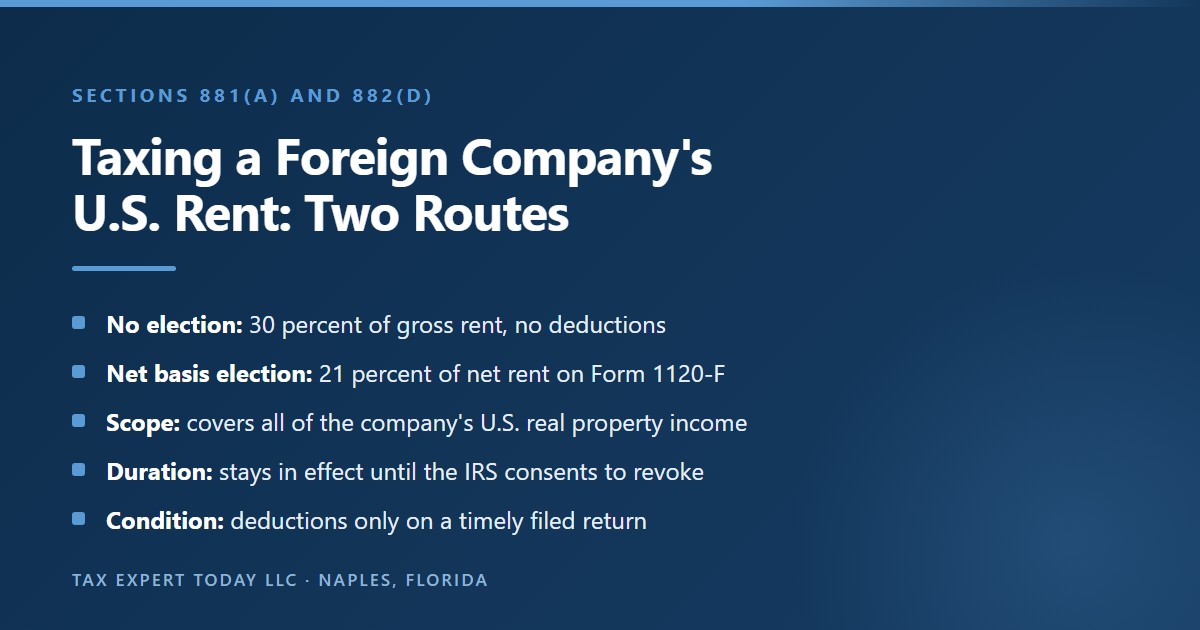
Usually, yes. A foreign corporation that rents out U.S. property either pays 30 percent of gross rent through withholding or elects under section 882(d) to be taxed on net rental income at 21 percent. The election requires Form 1120-F every year, and a property manager that under-withholds also creates a filing requirement.
- No election: 30 percent of gross rent, with no deductions for mortgage interest, condominium fees, taxes, or depreciation.
- With the election: net rent taxed at 21 percent, reported on Form 1120-F, Section II.
- Passive rental alone: holding a single condominium for rent is often not a U.S. trade or business by itself, which is why the election matters.
- Active operation: a corporation that runs a hotel or a portfolio with substantial management activity may already be engaged in a U.S. business.
Rent from a U.S. property is U.S. source income. If the foreign corporation is not engaged in a U.S. trade or business, the rent falls under section 881 as fixed or determinable, annual or periodic income, and the tax is 30 percent of the gross amount. The tenant or the property manager is the withholding agent and is supposed to withhold that 30 percent under section 1442, as IRS Publication 515 explains for withholding agents. If the full 30 percent is withheld, the corporation may have no filing requirement at all, but it also has no way to deduct a single expense.
The second route is the election in section 882(d). A foreign corporation that derives income from U.S. real property “may elect for such taxable year to treat all such income as income which is effectively connected with the conduct of a trade or business within the United States.” Once that election is made, the rent is taxed under section 882(a)(1) as business income, deductions are allowed, and the corporation must file Form 1120-F to claim them. The IRS instructions confirm the election “may be made whether or not the corporation is engaged in a U.S. trade or business during the tax year.”
Whether a rental activity is already a U.S. trade or business without the election is a factual question, and the effectively connected income rules in section 864(c) do not define a rental business by a bright line. Holding a single condominium that a manager rents out under a net lease, with the owner making few decisions, is commonly treated as passive investment. Operating multiple properties with regular, continuous management activity by the corporation’s own officers or agents can rise to a trade or business. Because the answer can be uncertain, the election is often made to remove the doubt, and a protective return can preserve deductions if the facts are unclear. The effectively connected income guide walks through how the trade or business question is analyzed.
Most foreign corporations that own a Florida condominium and rent it for any meaningful part of the year end up filing Form 1120-F, because 30 percent of gross rent is rarely the better result. Condominium association fees, property taxes, insurance, management commissions, repairs, and depreciation commonly absorb most of the gross rent on a Southwest Florida seasonal rental. The worked example later in this guide shows the difference in dollars.
How is rental income taxed without the net basis election?
Without the election, a foreign corporation’s U.S. rent is taxed at a flat 30 percent of the gross amount under section 881(a), collected by withholding. No deductions are allowed. Income tax treaties generally do not reduce the rate on rent from real property, so the 30 percent usually applies in full.
- Tax base: every dollar of gross rent, before any expense.
- Collection: the property manager or tenant withholds and reports on Form 1042-S.
- Return: none required if the full 30 percent was withheld and the corporation has no other filing trigger.
- Common problem: managers who withhold nothing, which leaves the tax unpaid and the corporation exposed.
Section 881(a) imposes “a tax of 30 percent of the amount received from sources within the United States by a foreign corporation as interest, dividends, rents, salaries, wages, premiums, annuities,” and other fixed or determinable income, to the extent the amount is not effectively connected with a U.S. business. The word “rents” is in the statute itself. The Form 1120-F instructions describe this income as reported in Section I, page 4, and add that “such income (except as indicated below) will generally be subject to tax at a 30% rate.”
Most income tax treaties follow a pattern in which income from immovable property may be taxed in full by the country where the property is located, so treaty rate reductions that apply to dividends and interest generally do not reach rent. A foreign corporation should not assume that its home country treaty lowers the 30 percent on a Florida rental, and any treaty position should be checked against the specific treaty text and the limitation on benefits article.
The practical problem in Southwest Florida is often the opposite of over-withholding. A seasonal rental managed by a small local agency, or rented directly through a vacation platform, may have no one withholding anything. In that situation the 30 percent tax is still owed, the corporation has a filing requirement because the tax was “not fully satisfied by the withholding of tax at source,” and the timely filing clock for deductions under the net basis route is already running. That is how many foreign corporations discover the 18 month rule after the fact.
To avoid withholding on rent once the election is made, the corporation gives the withholding agent a Form W-8ECI. Treasury Regulation section 1.871-10(d)(1)(iii) points to the statement filed with a withholding agent at the beginning of a year for which the election is to be made. The Form W-8BEN guide explains the W-8 series and which form a foreign payee gives to which payer.
How does the section 882(d) net basis election work?
The election lets a foreign corporation treat all of its U.S. real property income as effectively connected income, taxed at 21 percent after deductions. It is made by attaching a statement to Form 1120-F for the first year it applies, and it stays in effect for later years unless the IRS consents to a revocation.
- Scope: it covers all income from all of the corporation’s U.S. real property, not one property at a time.
- How to make it: a statement attached to the return, listing every U.S. property and the details the regulation requires.
- Timing: it can be made for a year until the refund claim period for that year expires.
- Duration: it continues in later years, including years with no rental income, until revoked.
Section 882(d)(1) allows the election for income “from real property located in the United States, or from any interest in such real property, including (i) gains from the sale or exchange of real property or an interest therein, (ii) rents or royalties from mines, wells, or other natural deposits, and (iii) gains described in section 631(b) or (c).” Once made, “such income shall be taxable as provided in subsection (a)(1) whether or not such corporation is engaged in trade or business within the United States during the taxable year.” The statute then adds the durability rule: the election “shall remain in effect for all subsequent taxable years, except that it may be revoked with the consent of the Secretary.”
The mechanics are in Treasury Regulation section 1.871-10, which governs both the individual election under section 871(d) and the corporate election under section 882(d). The initial election may be made “at any time before the expiration of the period prescribed by section 6511(a)” for filing a claim for credit or refund for that year, and it may be made without the Commissioner’s consent. The statement filed with the return must include a complete schedule of all U.S. real property the corporation owns, the extent of its ownership in each, the location, a description of any substantial improvements, and the income from each property, among other details.
| Feature | 30 percent gross basis (no election) | Net basis (section 882(d) election) |
|---|---|---|
| Tax rate | 30 percent (section 881(a)) | 21 percent (sections 882(a) and 11(b)) |
| Tax base | Gross rent | Rent minus allowable deductions |
| Deductions for interest, fees, taxes, depreciation | None | Allowed, if the return is timely under Regulations section 1.882-4 |
| Form 1120-F | Not required if the full tax was withheld | Required every year |
| Withholding on rent | 30 percent by the manager or tenant | Generally avoided by giving the manager Form W-8ECI |
| Branch profits tax | Not applicable | Can apply to after-tax rental earnings that leave the United States |
| Losses | Not usable | Can carry forward as a net operating loss under the corporate rules |
| Revocation | Not applicable | Generally requires IRS consent once the refund period has passed |
Three consequences of the election are often missed. First, it applies to all U.S. real property income of the corporation, so a company that owns two condominiums cannot elect for one and leave the other on the gross basis. Second, the election brings the branch profits tax into play, because rental income becomes effectively connected and creates effectively connected earnings and profits. Third, the election only produces its benefit if the corporation files Form 1120-F on time, because deductions are allowed only on a timely return.
The regulation also has a revocation window. Within the refund claim period for the first election year, the corporation may revoke the election without consent. After that period, the election stays in force for all subsequent years, “including taxable years for which the taxpayer realizes no income from real property,” and a revocation requires a written request to the IRS. The regulation’s 75 day window for certain consent requests is short, so a decision to change course should be planned before the year begins rather than after.
What is the 18 month timely filing rule under Regulations section 1.882-4?
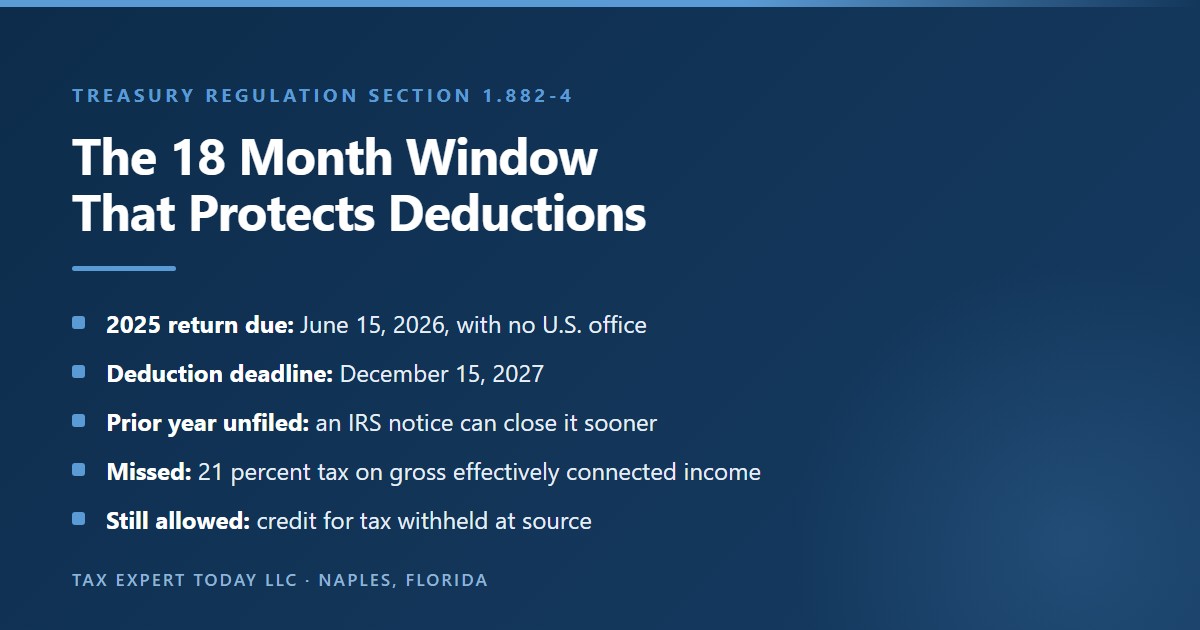
A foreign corporation may claim deductions and most credits against effectively connected income only if it files Form 1120-F on a timely basis, which generally means within 18 months after the original due date. If the prior year return was never filed, the deadline is the earlier of 18 months or the date the IRS mails a notice.
- Statutory basis: section 882(c)(2) allows deductions and credits only on a true and accurate return.
- Normal deadline: 18 months after the section 6072 due date for that year’s return.
- Earlier deadline: if the immediately preceding year was not filed, the IRS notice date can cut the window short.
- Survivors: the charitable deduction and credits for tax withheld at source remain available on a late return.
The rule starts in section 882(c)(2), which provides that a foreign corporation receives the benefit of deductions and credits “only by filing or causing to be filed with the Secretary a true and accurate return, in the manner prescribed in subtitle F, including therein all the information which the Secretary may deem necessary.” Treasury Regulation section 1.882-4(a)(3) turns that sentence into a deadline. If a return was filed for the immediately preceding year, or the current year is the first year a return is required, “the required return for the current taxable year must be filed within 18 months of the due date as set forth in section 6072.”
The regulation then tightens the rule for a corporation that skipped the prior year. If no return was filed for the immediately preceding year, the current year return “must have been filed no later than the earlier of the date which is 18 months after the due date” or “the date the Internal Revenue Service mails a notice to the foreign corporation advising the corporation that the current year tax return has not been filed and that no deductions” or credits may be claimed. In other words, once a corporation has missed one year, an IRS notice can end the window for the next year early.
The consequence is severe. Without deductions, the corporation’s effectively connected income is taxed at 21 percent on the gross amount. For a rental property that means 21 percent of gross rent with no allowance for mortgage interest, association fees, property taxes, insurance, management fees, repairs, or depreciation. For a sale, the regulation’s denial of deductions can also affect selling expenses. The IRS instructions list the items that survive regardless of timeliness: the charitable contributions deduction, the credit from Form 2439, the credit for federal tax on fuels, and “U.S. income tax paid or withheld at source.”
| Tax year (calendar) | Due date, no U.S. office | 18 month deadline for deductions | Due date, U.S. office | 18 month deadline for deductions |
|---|---|---|---|---|
| 2023 | June 17, 2024 (June 15 fell on a Saturday) | December 2025 | April 15, 2024 | October 2025 |
| 2024 | June 16, 2025 (June 15 fell on a Sunday) | December 2026 | April 15, 2025 | October 2026 |
| 2025 | June 15, 2026 | December 15, 2027 | April 15, 2026 | October 15, 2027 |
| 2026 | June 15, 2027 | December 15, 2028 | April 15, 2027 | October 15, 2028 |
The table assumes a calendar year corporation and measures from the original due date, because the regulation refers to the due date “as set forth in section 6072.” Whether a weekend or holiday adjustment shifts the 18 month measurement is a technical point, and a corporation near the edge should not rely on it. The safer reading is to treat the earliest possible date as the deadline. The table also assumes the prior year return was filed; if it was not, an IRS notice can make the deadline earlier still.
There is a waiver. Under Regulations section 1.882-4(a)(3)(ii), the deadlines “may be waived if the foreign corporation establishes to the satisfaction of the Commissioner” that it “acted reasonably and in good faith in failing to file.” The regulation then limits the waiver: a corporation “shall not be considered to have acted reasonably and in good faith if it knew that it was required to file the return and chose not to do so,” and it must cooperate in determining its liability. The factors the IRS weighs include whether the corporation voluntarily came forward before the IRS discovered the failure, whether it was aware of the protective return option, and whether intervening events beyond its control prevented filing. A waiver is a facts and circumstances request, not a formality, and the outcome is never assured.
What is a protective Form 1120-F, and when should one be filed?
A protective Form 1120-F is a return a foreign corporation files when it believes it has no effectively connected income or no U.S. tax under a treaty, to preserve its right to deductions and credits if that belief later proves wrong. It is mostly blank, but it starts the timely filing protection.
- When it fits: limited U.S. activities that the corporation concludes are not a U.S. trade or business.
- Treaty version: income the corporation believes is not attributable to a U.S. permanent establishment.
- What goes on it: identifying information, the protective return box, required questions, and Form 8833 if a treaty is the reason.
- Why it matters: without it, a later finding of effectively connected income can arrive with no deductions.
The Form 1120-F instructions explain that if a foreign corporation “conducts limited activities in the United States in a tax year that the foreign corporation determines does not give rise to gross income that is effectively connected,” it “should follow the instructions for filing a protective return to safeguard its right to receive the benefit of the deductions and credits.” The instructions add that a corporation should also file a protective return “if it determines initially that it has no U.S. tax liability under the provisions of an applicable income tax treaty,” and they warn that a corporation “that does not file a return will lose the right to take deductions and credits against effectively connected income.”
On the form, the corporation checks the “Protective return” box at the top of page 1, enters its name, address, and employer identification number, answers the identifying items, and has an authorized officer sign. If the protective position rests on a treaty exemption, Form 8833 is attached. The instructions list the specific page 2 and page 3 items that must be completed and note that Schedule P is not required on a protective return. If the corporation has Section I passive income, it completes that section too.
For a real estate holding company, a protective return can make sense in two situations. The first is a corporation that holds land or a vacant property that produces no rent yet but may be sold or developed later, where the corporation wants to preserve deductions such as carrying costs if a later year is treated as a trade or business. The second is a corporation that accepts 30 percent gross withholding on rent but has facts that could later be characterized as an active rental business. In both cases, the protective filing is cheap compared with losing deductions.
A protective return is not the same as the section 882(d) election. The election affirmatively converts rent into effectively connected income; a protective return preserves a position without conceding that the income is connected. A corporation that has made the election should file a full return, not a protective one, because its rent is effectively connected by election.
When is Form 1120-F due, and how is it extended?
A foreign corporation with no U.S. office or place of business files by the 15th day of the 6th month after its year ends, which is June 15 for a calendar year. A corporation with a U.S. office files by the 15th day of the 4th month, April 15. Form 7004 extends the filing deadline by six months.
- No U.S. office: June 15 for a calendar year, with tax payment due the same day.
- U.S. office: April 15 for a calendar year, with tax payment due the same day.
- June 30 fiscal year with a U.S. office: the 15th day of the 3rd month after the year ends.
- Extension: Form 7004 filed by the original due date gives six more months to file, not to pay.
Section 6072 sets corporate due dates, and the Form 1120-F instructions apply them. A foreign corporation “that maintains an office or place of business in the United States must generally file Form 1120-F by the 15th day of the 4th month after the end of its tax year,” with an exception for June 30 fiscal years, which file by the 15th day of the 3rd month. A foreign corporation “that does not maintain an office or place of business in the United States must generally file Form 1120-F by the 15th day of the 6th month after the end of its tax year.” If the due date falls on a weekend or legal holiday, the return can be filed on the next business day.
| Foreign corporation type | Return and tax due (calendar year) | Extended filing deadline with Form 7004 | Tax payment |
|---|---|---|---|
| No office or place of business in the United States (typical property holding company) | June 15 | December 15 | In full by June 15 |
| Office or place of business in the United States | April 15 | October 15 | In full by April 15 |
| June 30 fiscal year, with a U.S. office | September 15 | Six or seven months later, depending on when the tax year began (see the Form 7004 instructions) | By the original due date |
The Instructions for Form 7004 say “the automatic extension period for time to file is generally 6 months,” with a transitional exception for C corporations with June 30 years beginning before January 1, 2026. The extension does not extend the time to pay. The Form 1120-F instructions require a foreign corporation without a U.S. office to pay any tax due “in full no later than the 15th day of the 6th month after the end of the tax year,” and one with a U.S. office to pay by the unextended due date.
Most foreign holding companies that own a Florida condominium have no U.S. office of their own. A property manager’s office is generally not the corporation’s office for this purpose, although the facts of a particular arrangement should be reviewed. The June 15 due date is therefore the common one, and it is a different date from the April 15 individual deadline that many Canadian and European owners are used to seeing on their personal U.S. filings.
The due date matters twice. It is the date the return and payment are due, and it is the starting point for the 18 month timely filing window under Regulations section 1.882-4. An extension on Form 7004 gives more time to file without a late filing penalty, but because the regulation measures the 18 months from the section 6072 due date, a corporation should not treat the extension as moving the deduction deadline.
How is effectively connected income taxed on Form 1120-F?
Effectively connected income is reported in Section II of Form 1120-F and taxed at the 21 percent corporate rate after deductions. Expenses are allocated to that income under Regulations section 1.861-8 on Schedule H, and interest expense is allocated under the formula in Regulations section 1.882-5 on Schedule I, not simply taken as paid.
- Rate: 21 percent of effectively connected taxable income under sections 882(a) and 11(b).
- Deductions: allowed only to the extent connected with the U.S. income and only on a timely return.
- Interest: computed under a three step formula that can produce more or less than the interest actually paid.
- Branch-level interest tax: interest allocated to the U.S. business in excess of interest it actually paid can be taxed again.
Section 882(a)(1) provides that a foreign corporation engaged in a U.S. trade or business “shall be taxable as provided in section 11, 55, or 59A, on its taxable income which is effectively connected with the conduct of a trade or business within the United States.” Section 882(c)(1) then limits deductions to those “connected with income which is effectively connected,” allocated and apportioned under regulations. Section II of Form 1120-F looks much like a domestic Form 1120 income statement: gross receipts, rents, capital gain from Schedule D, depreciation, taxes, interest, and other deductions, down to taxable income.
Two schedules make the foreign corporation version different. Schedule H reports deductions allocated to effectively connected income under Regulations section 1.861-8, and the instructions require it if the corporation has deductions on Section II, lines 12 through 27. Schedule I reports interest expense allocable to effectively connected income under Regulations section 1.882-5, and the instructions say it “must be attached whether or not such allocable interest is deductible.” For a property holding company with a mortgage, Schedule I is the route by which mortgage interest reaches the return.
The Regulations section 1.882-5 formula looks at the corporation’s U.S. assets, a ratio of liabilities to assets, and an interest rate, and the result can differ from the interest the corporation actually paid on its U.S. mortgage. Where the formula allocates more interest to the U.S. business than the business actually paid, section 884(f) can treat the excess as if paid by a U.S. subsidiary to its foreign parent, which triggers the branch-level interest tax at 30 percent unless a treaty reduces it. For a single-property holding company, the excess interest computation is usually small or zero, but it must still be worked through.
Depreciation follows the normal U.S. rules. Residential rental property is generally recovered over 27.5 years and nonresidential real property over 39 years under section 168, and only the building portion of the purchase price is depreciable, not the land. A foreign corporation that has owned a Florida property for several years without filing will often find that its depreciation schedule has never been set up, and reconstructing basis from the original closing statement is one of the first tasks in catching up.
Florida adds its own layer. Florida imposes a corporate income tax and has its own return, Form F-1120, and a foreign corporation with Florida rental income should have the state filing reviewed separately. The federal Form 1120-F does not satisfy any state filing.
What is the branch profits tax, and does it apply to rental profits?
The branch profits tax under section 884 is a second, 30 percent tax on a foreign corporation’s after-tax U.S. earnings that are not reinvested in U.S. assets. Once a corporation elects net basis taxation on its rental income, those rental earnings can be subject to it when they leave the United States, unless a treaty lowers the rate.
- Purpose: it mirrors the dividend withholding tax a U.S. subsidiary would pay when distributing profits abroad.
- Base: the dividend equivalent amount, which is effectively connected earnings and profits adjusted for changes in U.S. net equity.
- Rate: 30 percent by statute, or the treaty rate for a qualified resident that meets the limitation on benefits article.
- Reported: Section III, Part I of Form 1120-F.
Section 884(a) imposes “a tax equal to 30 percent of the dividend equivalent amount for the taxable year.” The IRS instructions describe the logic plainly: the tax falls on “the after-tax earnings of a foreign corporation’s U.S. trade or business (that is, effectively connected earnings and profits (ECEP)) that are not reinvested in a U.S. trade or business by the close of the tax year, or are disinvested in a later tax year.” An increase in U.S. net equity during the year is treated as reinvestment, and a decrease is treated as a disinvestment of prior earnings.
A foreign corporation that owns U.S. property directly through a branch would otherwise pay less than a foreign corporation that owns the same property through a U.S. subsidiary, because the subsidiary would face a 30 percent dividend withholding tax on distributions. The branch profits tax closes that gap. The Regulations under section 1.884-1 define the dividend equivalent amount, U.S. assets, and U.S. liabilities in detail.
Rental earnings are effectively connected earnings and profits once the net basis election is made. If the corporation sends its after-tax rental profit home to its shareholders, or uses it to pay down a foreign loan, its U.S. net equity typically does not increase, and the profit becomes part of the dividend equivalent amount. If the corporation keeps the cash in a U.S. bank account used in the rental business or spends it on capital improvements to the property, the reinvestment can reduce or defer the branch profits tax. The instructions also note that no estimated tax payments are required for the branch profits tax.
Treaties can lower the rate, but the rules are specific. A foreign corporation generally must be a qualified resident of the treaty country and must meet the limitation on benefits article of any treaty that entered into force after December 31, 1986. If the treaty does not state a branch profits rate, the instructions say to use the rate the treaty specifies for dividends paid by a wholly owned U.S. subsidiary. The instructions also note that “benefits other than a rate reduction may be available under certain treaties, such as the Canadian income tax treaty,” which is relevant to many Southwest Florida holding companies. The Canada US tax treaty guide covers the treaty structure, and any treaty-based reduction claimed on the return generally requires Form 8833.
| Step on Section III, Part I | What it measures | Where the rule is |
|---|---|---|
| Start with effectively connected taxable income | The 21 percent tax base from Section II | Instructions, Section III, line 1 |
| Adjust to effectively connected earnings and profits | Section 312 principles, including subtracting federal income tax | Instructions, line 2; Regulations section 1.884-1(f) |
| Measure U.S. net equity at the start and end of the year | U.S. assets minus U.S. liabilities | Instructions, lines 4a and 4b; Regulations section 1.884-1(c) to (e) |
| Compute the dividend equivalent amount | Earnings reduced by an equity increase, or increased by an equity decrease | Regulations section 1.884-1(b) |
| Apply the rate | 30 percent, or the treaty rate if the corporation qualifies | Section 884(a); Regulations section 1.884-1(g) |
One coordination rule is worth knowing. Under the instructions, if a foreign corporation is subject to the branch profits tax for a year, “it will not be subject to withholding at source” on dividends paid out of earnings and profits for that year. The branch tax replaces the second level of tax on those earnings; it does not stack on top of a separate withholding on the same dividends.
How does a foreign corporation report the sale of U.S. real estate on Form 1120-F?
Gain on the sale of a U.S. real property interest is treated as effectively connected income under section 897, even if the corporation is not otherwise in business. It is computed on Schedule D (Form 1120), carried to Section II, taxed at 21 percent, and the FIRPTA tax withheld at closing is claimed on line 5i with Form 8288-A attached.
- Character: a foreign corporation pays the 21 percent corporate rate on capital gain; there is no lower capital gains rate for corporations.
- Withholding: the buyer generally withholds 15 percent of the amount realized under section 1445(a).
- Credit: the withheld amount is a payment on Form 1120-F, page 1, line 5i, supported by Form 8288-A.
- Refund: if withholding exceeds the tax, the excess is refunded only by filing the return.
Section 897(a)(1) treats gain or loss of a nonresident alien individual or a foreign corporation from the disposition of a U.S. real property interest “as if the taxpayer were engaged in a trade or business within the United States during the taxable year and as if such gain or loss were effectively connected with such trade or business.” The Form 1120-F instructions apply it directly: a foreign corporation that disposes of a U.S. real property interest “must treat the gain or loss from the disposition as ECI, even if the corporation is not engaged in a U.S. trade or business. Figure this gain or loss on Schedule D (Form 1120),” and “carry the result to Section II, line 8.”
On the withholding side, section 1445(a) requires the buyer to “deduct and withhold a tax equal to 15 percent of the amount realized on the disposition.” The buyer reports and pays the withholding on Form 8288 and gives the seller Form 8288-A. The IRS FIRPTA withholding page confirms the 15 percent rate and describes the withholding certificate route. On the return, the instructions direct the corporation to “include the amount withheld on line 5i, page 1,” and they require attaching “any Forms 8288-A, 8805, and 1042-S to substantiate amounts withheld.”
The withholding is based on the gross price, and the tax is based on the gain, so the two numbers rarely match. A foreign corporation selling a property with a large basis, or one with selling costs and depreciation already taken into account, often has a 15 percent withholding that exceeds its 21 percent tax on gain. The corporation can apply before closing for a reduced withholding amount using Form 8288-B, explained in the Form 8288-B withholding certificate guide, or it can let the full 15 percent be withheld and claim the excess back on Form 1120-F. The FIRPTA withholding guide covers the buyer’s side and the exemptions.
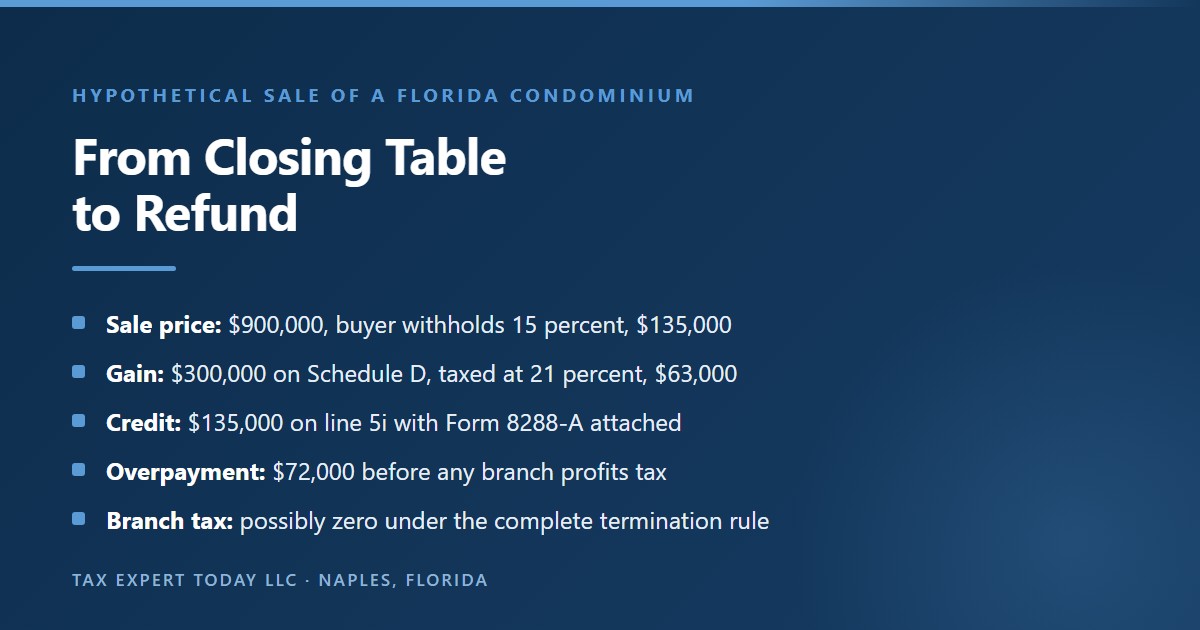
| Item on a hypothetical sale | Amount | Where it goes |
|---|---|---|
| Sale price (amount realized, before costs) | $900,000 | Basis for FIRPTA withholding |
| FIRPTA withholding at 15 percent | $135,000 | Buyer files Form 8288; corporation receives Form 8288-A |
| Adjusted basis after depreciation, plus selling costs | $600,000 | Schedule D (Form 1120) |
| Gain | $300,000 | Section II, line 8 |
| Federal income tax at 21 percent | $63,000 | Page 1 tax computation |
| Withholding credit claimed | $135,000 | Page 1, line 5i, with Form 8288-A attached |
| Overpayment before any branch profits tax | $72,000 | Refunded only if the return is filed |
The table is a hypothetical illustration, not a client result, and it leaves out the branch profits tax on purpose, because the next section explains how the sale year can create a large branch profits tax and how the complete termination rule may remove it. It also assumes the corporation’s return is timely, so that selling costs and depreciation adjustments are allowed. A late return can lose deductions under Regulations section 1.882-4 while the withholding credit survives, since tax “paid or withheld at source” is on the list of credits allowed regardless of timeliness.
The instructions also note an election under section 897(i): a foreign corporation that holds a U.S. real property interest “may elect to be treated as a domestic corporation for purposes of sections 897 and 1445.” The election has specific eligibility conditions and consequences for the shareholders and is used in particular structuring situations. It is mentioned here for completeness; whether it fits a given company is a question for a full review, not a default choice.
How does the complete termination rule affect branch profits tax after a sale?
If a foreign corporation completely terminates its U.S. business in the year it sells its property, Temporary Regulations section 1.884-2T(a) can eliminate the branch profits tax for that year. The corporation must hold no U.S. assets at year end, stay out of U.S. business for three years, and attach Form 8848.
- Result: no branch profits tax for the year of complete termination, and the remaining accumulated earnings are extinguished for section 884 purposes.
- Condition one: no U.S. assets at the close of the year, or an irrevocable liquidation resolution followed by distribution of U.S. assets by the next year end.
- Condition two: neither the corporation nor a related corporation uses the U.S. assets or their proceeds in a U.S. business for three years.
- Condition three: no effectively connected income for three years, and a waiver of the limitations period attached on Form 8848.
Without this rule, the sale year can be expensive. Gain on the sale of the corporation’s property is effectively connected income, the after-tax gain is effectively connected earnings and profits, and selling the property sharply reduces U.S. net equity. If the corporation then sends the proceeds home, the dividend equivalent amount can include the entire after-tax gain plus earlier undistributed rental earnings. At the statutory 30 percent rate, the branch profits tax on the hypothetical $237,000 of after-tax gain above would be $71,100.
Temporary Regulations section 1.884-2T(a)(1) provides that a foreign corporation “shall not be subject to the branch profits tax for the taxable year in which it completely terminates all of its U.S. trade or business.” The operating rules in paragraph (a)(2) require that, as of the close of that year, the corporation “either has no U.S. assets, or its shareholders have adopted an irrevocable resolution in that taxable year to completely liquidate and dissolve the corporation” and distribute its U.S. assets by the close of the following year; that neither the corporation nor a related corporation uses the U.S. assets of the terminated business, or property attributable to them, in a U.S. trade or business for three years; that the corporation has no effectively connected income for three years, other than under section 864(c)(6) or (c)(7); and that it attaches a waiver of the period of limitations to its return for each year of complete termination.
The Form 1120-F instructions apply the rule on the form: if the corporation completely terminated its U.S. business during the year, it enters zero on the branch profits tax line, completes the related question at the bottom of page 7, and “must also attach Form 8848 extending the period for assessment for the year of complete termination to a date not earlier than the close of the sixth year following the close of that tax year.”
The practical consequence is a planning question that should be answered before closing, not after. A foreign corporation that sells its only Florida property and wants to buy another U.S. property with the proceeds within three years may not qualify for complete termination, because reinvesting the proceeds in U.S. business assets breaks condition two. A corporation that plans to leave the U.S. market entirely may qualify, provided it truly has no U.S. assets and no effectively connected income for the following three years. A U.S. bank account holding sale proceeds at year end can itself be a U.S. asset problem, depending on how it is used.
What happens when a foreign corporation distributes U.S. property to its shareholders?
A foreign corporation that distributes a U.S. real property interest to its shareholders generally recognizes gain under section 897(d), and section 1445(e)(2) requires it to withhold tax equal to the 21 percent corporate rate on that gain. Moving a Florida condominium out of a company and into the owners’ names is a taxable event.
- Gain recognition: the corporation is generally treated as selling the property at fair market value.
- Withholding: 21 percent of the gain recognized, withheld by the corporation itself.
- Reporting: the gain goes on Form 1120-F, and the withholding is reported on the FIRPTA forms.
- Shareholder side: the shareholders may have their own U.S. and home country consequences.
Section 1445(e)(2) provides that “in the case of any distribution by a foreign corporation on which gain is recognized under subsection (d) or (e) of section 897, the foreign corporation shall deduct and withhold under subsection (a) a tax equal to the highest rate of tax in effect for the taxable year under section 11(b) multiplied by the amount of gain recognized.” The IRS FIRPTA page states the same rule in plain terms: “A foreign corporation that distributes a U.S. real property interest must withhold a tax equal to 21% of the gain it recognizes on the distribution to its shareholders who are foreign persons.”
This matters for owners who set up a foreign company years ago to hold a Florida property and now want to simplify. Unwinding the structure by distributing the property, liquidating the company, or merging it is governed by Temporary Regulations section 1.897-5T, which covers corporate distributions and reorganizations involving U.S. real property, and by the branch termination rules in Regulations section 1.884-2T. Each route has a different tax result, and the corporation’s Form 1120-F for the year of the change is where the result is reported.
A related reason some foreign buyers choose a corporation in the first place is U.S. estate tax exposure. A nonresident individual who holds U.S. real estate directly can face U.S. estate tax at death, and holding through a foreign corporation is one structure that is commonly discussed for that reason. Whether a particular structure achieves its intended result depends on the facts, on how the company is operated, and on the owner’s home country rules, and it is a question for estate counsel. Any change to an existing structure should be reviewed for income tax, estate tax, and foreign tax consequences together. The Florida estate planning guide for new residents and our estate and trust planning services describe the estate side of that review.
How do treaty claims work on Form 1120-F?
A foreign corporation claiming that a treaty reduces or eliminates U.S. tax generally must disclose the position on Form 8833 attached to Form 1120-F and answer item W(1). It must be a resident of the treaty country under the treaty and meet any limitation on benefits article.
- Business profits: treaties generally tax business profits only if attributable to a U.S. permanent establishment.
- Real property: treaties generally let the United States tax rent and gain from U.S. real property in full.
- Branch profits tax: treaties may lower the rate for a qualified resident.
- Disclosure: section 6114 requires disclosure of most treaty-based return positions.
Section 6114 requires each taxpayer who takes the position that a treaty “overrules (or otherwise modifies) an internal revenue law” to disclose that position on its return. The Form 1120-F instructions require a corporation making such a claim to complete item W(1) and attach Form 8833, unless a waiver in the regulations applies. The Form 8833 guide explains when disclosure is required and when it is waived.
For a property holding company, treaty relief is narrower than many owners expect. The permanent establishment rule protects business profits, but most treaties contain a separate article for income from real property that leaves source country taxation intact, and a separate rule preserving source country taxation of gain on real property. The result is that a Canadian or European company renting out a Florida condominium generally pays U.S. tax on the rent and on a later sale regardless of whether it has a U.S. permanent establishment. Treaty value for these companies usually shows up in the branch profits tax rate and, in some cases, in specific provisions such as those in the Canadian treaty that the IRS instructions single out.
To claim a reduced rate on Section I passive income, the instructions require “a certificate of entitlement to treaty benefits (for example, Form W-8BEN-E)” and say the corporation “must generally be a resident of the particular treaty country within the meaning of the treaty and satisfy the limitation on benefits article, if any.” A company with mostly passive investment income owned by people outside the treaty country can fail the limitation on benefits tests even though it is incorporated in a treaty country.
Does a foreign corporation filing Form 1120-F also need Form 5472?
A foreign corporation engaged in a U.S. trade or business must file Form 5472 with its Form 1120-F for each related party with which it had reportable transactions. Separately, a U.S. LLC owned by a foreign corporation files a pro forma Form 1120 with Form 5472, and the penalty for missing it is $25,000.
- Reporting corporation: the Form 5472 instructions include “a foreign corporation engaged in a trade or business within the United States.”
- Reportable transactions: loans, rent, management fees, and capital contributions between the corporation and related parties.
- Disregarded U.S. LLC: files its own pro forma Form 1120 and Form 5472, even though its income is reported by the foreign owner.
- Penalty: $25,000 per failure, plus $25,000 for each 30 day period after 90 days from an IRS notice.
Section 6038A requires information reporting by a “reporting corporation,” which the Instructions for Form 5472 define to include “a foreign corporation engaged in a trade or business within the United States.” The Form 1120-F instructions list Form 5472 among the other forms that may be required, filed “by or for a foreign corporation engaged in a U.S. trade or business that had reportable transactions with a related party.” Form 5472 is attached to the income tax return by its due date, including extensions.
A common Florida structure adds a layer. A foreign corporation forms a Florida LLC to hold title to the condominium. If the LLC has one owner and has not elected corporate status, it is disregarded for income tax purposes, so its rent is the foreign corporation’s rent and is reported on the foreign corporation’s Form 1120-F. But the Form 5472 instructions treat a foreign-owned U.S. disregarded entity as a corporation for section 6038A purposes, and it “will now be required to file a pro forma Form 1120, U.S. Corporation Income Tax Return, with Form 5472 attached.” The Form 5472 guide covers that filing in detail.
The penalty is the reason this matters. Section 6038A(d) imposes “a penalty of $25,000 for each taxable year with respect to which such failure occurs,” and if the failure “continues for more than 90 days after the day on which the Secretary mails notice,” an additional $25,000 for each 30 day period. Regulations section 1.6038A-4(b) allows reasonable cause relief and says it will be applied liberally to a small corporation that had no knowledge of the requirement, has limited presence in the United States, and promptly and fully complies once it learns of the rule. Relief depends on the facts and is never assured.
What schedules and attachments go with Form 1120-F?
The attachments depend on the corporation’s activity. A property holding company typically files Schedule H for allocated deductions, Schedule I for interest, Schedule D for a sale, Schedule L balance sheets, the net basis election statement in its first year, Forms 8288-A or 1042-S for credits, and Form 8833 or Form 5472 where they apply.
- Every year with Section II deductions: Schedule H.
- Every year with interest expense: Schedule I, even if the interest is not deductible.
- Large corporations: Schedule M-3 when total assets are $10 million or more.
- Partnership investors: Schedule P for effectively connected income from partnerships.
| Attachment | When it is required | Typical for a property holding company? |
|---|---|---|
| Net basis election statement (Regulations section 1.871-10(d)(1)(ii)) | First year the section 882(d) election applies | Yes, once |
| Schedule H (Form 1120-F) | Deductions on Section II, lines 12 through 27 | Yes |
| Schedule I (Form 1120-F) | Any interest expense allocable to effectively connected income | Yes, if the property is mortgaged or the company has debt |
| Schedule D (Form 1120) | Sale of a U.S. real property interest or other capital asset | Sale year |
| Form 4562 | Depreciation and amortization | Yes |
| Form 8288-A | FIRPTA tax withheld on a sale, claimed on line 5i | Sale year |
| Form 1042-S | Tax withheld on Section I income or on rent before the election took effect | Sometimes |
| Form 8833 | Treaty-based return position | If claiming treaty benefits |
| Form 5472 | Reportable related party transactions by a corporation engaged in a U.S. business | Often |
| Form 8848 | Complete termination of the U.S. business for branch profits tax | Final sale year, if the exception is claimed |
| Schedule M-3 (Form 1120-F) | Total assets of $10 million or more on Schedule L | Rarely, for a single property |
| Form 8832 copy | Year the entity elected corporate classification | Election year only |
The instructions state that a corporation with total assets on Schedule L “of $10 million or more on the last day of the tax year must file Schedule M-3.” They describe Schedule P as required “to report all ECI included in Schedules K-3 (Form 1065) the foreign corporation receives for each of its directly held partnership interests,” which matters for a foreign corporation that invests in a U.S. real estate partnership rather than owning property directly. A corporation in that position also receives Form 8805 for partnership withholding, explained in the Form 8804 partnership withholding guide.
What are the penalties for a late or missing Form 1120-F?
The late filing penalty is 5 percent of unpaid tax per month, up to 25 percent, with a 2026 minimum of the smaller of the tax due or $525 for returns more than 60 days late. Late payment adds 0.5 percent per month. For a foreign corporation, the larger cost is often losing all deductions under the 18 month rule.
- Failure to file: 5 percent per month or part of a month, capped at 25 percent of the unpaid tax.
- Failure to pay: one half of 1 percent per month, capped at 25 percent.
- Deduction forfeiture: tax on gross effectively connected income if the return is not timely under Regulations section 1.882-4.
- Information returns: $25,000 per Form 5472 failure, separately.
The Form 1120-F instructions describe the late filing penalty as “5% of the unpaid tax for each month or part of a month the return is late, up to a maximum of 25% of the unpaid tax,” and the summary of new provisions at the front of the instructions states that “for tax returns required to be filed in 2026, the minimum penalty for failure to file a return that is more than 60 days late has increased to the smaller of the tax due or $525.” The late payment penalty is “½ of 1% of the unpaid tax for each month or part of a month the tax is not paid, up to a maximum of 25%.” Both penalties are imposed under section 6651, and interest runs on unpaid tax and penalties.
Both penalties have a reasonable cause exception, and the instructions add a procedural caution: “do not attach an explanation when you file Form 1120-F. Instead, if the corporation receives a penalty notice after the return is filed, send an explanation to the IRS at that time.” The general framework for penalty relief is covered in the guide to IRS penalty relief. Relief depends on the facts, and no result can be promised in advance.
| Consequence | Trigger | Amount or effect | Relief route |
|---|---|---|---|
| Failure to file penalty | Return filed after the due date, including extensions | 5 percent per month, up to 25 percent of unpaid tax; 2026 minimum of the smaller of tax due or $525 after 60 days | Reasonable cause, raised after a notice |
| Failure to pay penalty | Tax paid after the original due date | 0.5 percent per month, up to 25 percent | Reasonable cause |
| Loss of deductions and credits | Return not filed within 18 months, or earlier after an IRS notice if the prior year was missed | Tax on gross effectively connected income | Good faith waiver under Regulations section 1.882-4(a)(3)(ii) |
| Form 5472 penalty | Missing or incomplete Form 5472, or records not kept | $25,000 per failure, plus $25,000 per 30 days after 90 days from notice | Reasonable cause under Regulations section 1.6038A-4(b) |
| Estimated tax penalty | Underpaid installments when tax is $500 or more | Computed on Form 2220 | Exceptions on Form 2220 |
For a foreign corporation with a rental property that has never filed, the penalty math is often less important than the deduction math. If rent has been collected for several years with no withholding and no return, the late filing and late payment penalties apply to the tax due, and that tax itself may be computed on gross income for years outside the 18 month window. A catch-up plan usually starts by sorting the open years into those still inside the window, where full deductions remain available, and those outside it, where the good faith waiver is the only route to deductions.
Does a foreign corporation have to pay estimated tax?
Yes. A foreign corporation must make quarterly estimated tax payments if it expects its total tax for the year, less credits, to be $500 or more. Underpayments are measured on Form 2220. No estimated payments are required for the branch profits tax.
- Threshold: $500 or more of expected tax after credits.
- With a U.S. office: installments must be paid by electronic funds transfer.
- Without a U.S. office: EFTPS can be used if the corporation has a U.S. bank account, or a foreign bank wire can be arranged.
- Branch profits tax: excluded from estimated tax under Regulations section 1.884-1(a).
The Form 1120-F instructions state that “the corporation must make installment payments of estimated tax if it expects its total tax for the year (less applicable credits) to be $500 or more,” and refer to section 6655 for the computation. A foreign corporation with a U.S. office “must use electronic funds transfer to make installment payments,” while one without a U.S. office “may pay the estimated tax by EFTPS, providing it has a U.S. bank account,” or may arrange a payment through its foreign bank. The instructions add that “no estimated tax payments are required with respect to a foreign corporation’s liability for the branch profits tax.”
For a rental holding company under the net basis election, estimated tax is often small because deductions absorb most of the rent. In a sale year, the picture changes, but the FIRPTA withholding on the sale counts as a credit and may cover the tax on the gain. A corporation that sells late in the year and expects a large gain should still check whether its installments for the earlier quarters were adequate, since withholding at closing may not be treated as having been paid ratably through the year.
Should Form 1120-F be filed on paper or electronically?
A foreign corporation may e-file Form 1120-F, and it must e-file if it files 10 or more returns of any type during the calendar year. A paper return goes to the Internal Revenue Service Center, P.O. Box 409101, Ogden, UT 84409. Waivers from mandatory e-filing are available for hardship.
- Mandatory e-file: 10 or more returns of any type in a calendar year, counting information and employment returns.
- Paper filing address: P.O. Box 409101, Ogden, UT 84409.
- Private delivery services: cannot deliver to a P.O. box; use the street address published for designated services.
- EIN: required on the return; the corporation applies on Form SS-4 if it has none.
The instructions state that “for returns filed on or after January 1, 2024, corporations are required to e-file Form 1120-F if the corporation files 10 or more returns of any type during the calendar year (including income tax, employment tax,” information, and excise returns). A small holding company that files one Form 1120-F and a Form 5472 is usually under the threshold and may file on paper. The paper address is “Internal Revenue Service Center, P.O. Box 409101, Ogden, UT 84409.”
The return needs an employer identification number. If the number has been applied for but not received by the due date, the instructions allow “Applied For” and the application date on a paper return. A foreign corporation applying for an EIN does so on Form SS-4, and the responsible party listed on that application is often a foreign individual who may need an ITIN or may use the foreign option on the form. The Form W-7 guide explains when a foreign individual needs an ITIN and when an EIN is the right number instead.
How does a foreign corporation catch up on unfiled Form 1120-F returns?
A foreign corporation that owned U.S. property without filing usually catches up by reconstructing each open year’s income and basis, filing the returns in order, attaching the net basis election statement for the first year it applies, and requesting a good faith waiver for any year outside the 18 month window. The facts decide what is possible.
- Sort the years: separate years still inside the 18 month window from years outside it.
- Rebuild the books: rent statements, Forms 1042-S, closing statements, association ledgers, and property tax bills.
- Make the election: the net basis election statement is attached to the first year it is to apply.
- Request the waiver: a written explanation under Regulations section 1.882-4(a)(3)(ii) for late years.
The order matters because of the regulation’s look-back rule. Whether a current year return is timely depends partly on whether the immediately preceding year was filed, and once the IRS mails a notice for a year, the window for that year can close immediately. A corporation that comes forward before the IRS contacts it is in a better position on two counts: the 18 month windows for recent years may still be open, and voluntary disclosure of the failure before IRS discovery is one of the factors the regulation lists for the good faith waiver.
The waiver standard is demanding. The regulation says a corporation “shall not be considered to have acted reasonably and in good faith if it knew that it was required to file the return and chose not to do so,” and its examples include a company that was told by a U.S. adviser that returns might be required and that protective returns were available, did not file, and was denied a waiver. Owners who relied on a property manager, a closing agent, or a home country accountant who never mentioned Form 1120-F should document exactly what they were told and when, because those facts are the substance of any waiver request.
The catch-up also reaches beyond Form 1120-F. A foreign-owned U.S. LLC that held the property may owe pro forma Form 1120 and Form 5472 filings for the same years. The property manager may owe Forms 1042 and 1042-S for rent paid without withholding. And the shareholders, if they are U.S. persons, may have their own reporting under the Form 5471 rules and the FBAR rules. Each piece should be planned together rather than filed one at a time. Any approach should be framed around accurate reporting going forward; no filing strategy can promise that penalties will be reduced or removed.
How does a Canadian holding company report a Naples, Florida condominium on Form 1120-F?
In a hypothetical case, an Ontario holding company that rents a Naples, Florida condominium for $60,000 a year with $50,000 of expenses and depreciation pays about $2,100 of federal tax under the net basis election, plus up to $2,370 of branch profits tax, compared with $18,000 under the 30 percent gross method.
- Gross method: 30 percent of $60,000 equals $18,000, with no return if fully withheld.
- Net method, timely return: 21 percent of $10,000 equals $2,100.
- Branch profits tax: up to 30 percent of $7,900 of after-tax earnings sent home, or $2,370, before any treaty benefit.
- Net method, late return outside the window: 21 percent of $60,000 equals $12,600, plus penalties.
The facts are invented for illustration and do not describe any client. A corporation organized in Ontario, owned by two Canadian individuals, bought a condominium in Naples, Florida several years ago. It has no U.S. office and no U.S. employees. A local management company rents the unit to seasonal tenants, collects $60,000 of gross rent in 2025, and pays the expenses from the rent. The owners use the unit for a few weeks a year, which raises its own questions about personal use and deductibility that a real return would have to address and that this simplified example sets aside.
| 2025 hypothetical rental figures | Amount |
|---|---|
| Gross rent collected by the manager | $60,000 |
| Condominium association fees | ($9,000) |
| Collier County property tax | ($8,000) |
| Insurance | ($5,000) |
| Management commissions | ($6,000) |
| Repairs, utilities, and supplies | ($3,800) |
| Depreciation on the building portion ($500,500 over 27.5 years) | ($18,200) |
| Net rental income (effectively connected taxable income) | $10,000 |
Under the 30 percent gross method, the manager should have withheld $18,000 and filed Forms 1042 and 1042-S. If it did, the corporation may have no return to file, but it has paid $18,000 of tax on a property that produced $10,000 of net income. If the manager withheld nothing, the corporation still owes the $18,000 and has a filing requirement.
Under the net basis election with a timely return, the corporation attaches the election statement to its 2025 Form 1120-F (or to the first year it chooses within the refund claim period), reports $10,000 of effectively connected taxable income in Section II, and pays $2,100 at 21 percent. It gives the manager a Form W-8ECI so rent is paid without 30 percent withholding. In Section III, its effectively connected earnings and profits are about $7,900 after subtracting the federal tax. If the corporation sends that cash to Canada rather than keeping it in U.S. assets used in the rental, the dividend equivalent amount can be up to $7,900, and the branch profits tax at the statutory 30 percent rate is up to $2,370. The Canada treaty may reduce that figure, which is a point to confirm in the treaty text and disclose on Form 8833 where required.
| Approach (hypothetical) | Federal income tax | Branch profits tax | Total before any treaty benefit |
|---|---|---|---|
| 30 percent of gross rent, no election | $18,000 | None | $18,000 |
| Net basis election, timely Form 1120-F, earnings sent home | $2,100 | Up to $2,370 | Up to $4,470 |
| Net basis election, timely Form 1120-F, earnings kept in U.S. rental assets | $2,100 | Reduced or deferred, depending on U.S. net equity | About $2,100 or more |
| Election made, but return filed outside the 18 month window with no waiver | $12,600 (21 percent of gross) | Computed on a larger earnings base | $12,600 or more, plus late filing and payment penalties |
Two years later, suppose the corporation sells the condominium for $900,000 with an adjusted basis and selling costs of $600,000. The buyer withholds $135,000. The corporation reports $300,000 of gain, pays $63,000 at 21 percent, and claims the $135,000 on line 5i with Form 8288-A attached, which leaves a $72,000 overpayment before any branch profits tax. If the owners plan to leave the U.S. market and the corporation meets every condition of the complete termination rule, attaching Form 8848, the branch profits tax for that year can be zero. If the corporation buys another Florida property with the proceeds within three years, the termination exception is generally unavailable and the branch profits tax computation applies.
This example shows why the real estate holding company is the hard case for Form 1120-F. The rental years turn on one election and one deadline, and the sale year turns on whether the company reinvests or leaves. The Canadian owners in this example also have Canadian reporting for the same income, which is determined under Canadian law and should be coordinated with an adviser in Canada.
What are the most common Form 1120-F mistakes for real estate holders?
The most common mistakes are assuming the property manager handles the return, missing the 18 month window, never attaching the net basis election statement, ignoring the branch profits tax, forgetting Form 5472 for a U.S. LLC, and losing the Form 8288-A credit after a sale.
- Relying on the manager: a manager may issue Form 1042-S but does not prepare the corporation’s return.
- Using the individual deadline: April 15 is the wrong date for most foreign holding companies; June 15 usually applies.
- Treating Form 1040-NR as the return: the owners’ personal nonresident return does not report the corporation’s rent.
- Missing the attachments: no election statement, no Schedule I, or no Form 8288-A copy.
Filing in the wrong name. When a foreign corporation owns the property, the corporation reports the rent on Form 1120-F. The shareholders do not report it on their own Form 1040-NR returns, and an individual net basis election under section 871(d) does not cover corporate income. The individual rules are explained in IRS Publication 519. Reporting rent on the wrong return can leave the corporation with no timely return at all for the 18 month rule.
Assuming no tax because there was no profit. A corporation that elected net basis treatment and had a loss still files, because the return is the only way to establish and carry forward the loss. A corporation that never elected owes 30 percent of gross rent whether or not the property made money.
Making the election without the statement. Regulations section 1.871-10(d)(1)(ii) requires a statement with a schedule of every U.S. property and the related details. A return that simply reports net rent without the statement leaves the election open to challenge.
Ignoring Section III. Once rent is effectively connected, the branch profits tax computation must be completed each year, even when the answer is zero because earnings were reinvested. Omitting the U.S. net equity statements leaves the computation unsupported.
Missing Form 5472. The $25,000 penalty under section 6038A applies to the foreign-owned U.S. LLC that holds title, separately from the foreign corporation’s own filing. This is one of the most frequently assessed penalties in this area.
Letting the FIRPTA credit lapse. The 15 percent withheld at closing is not a final tax. It is a credit that is recovered only by filing Form 1120-F for the sale year with Form 8288-A attached, and refund claims have their own statute of limitations.
Not reviewing the structure. A corporation set up years ago for reasons that no longer apply may cost more in annual filings, branch profits tax, and sale year tax than direct ownership would. Changing the structure is itself a taxable event in many cases, so the review should compare the full cost of keeping it with the full cost of unwinding it. Our business consulting services cover that kind of entity comparison.
Form 1120-F Help in Naples & Southwest Florida
Tax Expert Today LLC works with international clients from an office in Naples, Florida and serves clients in all 50 states. Southwest Florida has a large community of Canadian and European owners, and many of them hold condominiums, houses, and small rental buildings through a holding company formed at home. The Form 1120-F question tends to surface late: when a property manager asks for a Form W-8ECI, when a buyer’s closing agent explains FIRPTA withholding, or when a home country accountant asks how the U.S. rent was taxed. We help foreign corporations determine whether a return is required, evaluate the net basis election, organize catch-up filings and good faith waiver requests, compute the branch profits tax, and coordinate the sale year return with the FIRPTA forms and a Form 8288-B request.
- Foreign corporation tax return Naples: Form 1120-F preparation for holding companies that own Southwest Florida property.
- International tax Naples FL: net basis elections, branch profits tax, and treaty positions on Form 8833.
- Foreign tax Naples: FIRPTA withholding, Form 8288-B withholding certificates, and the line 5i credit on a sale.
- FBAR Naples: foreign account reporting for U.S. shareholders and officers of foreign holding companies.
Our international and expat tax services page explains how we approach cross-border filings for foreign corporations, nonresident owners, and U.S. citizens abroad. The international tax Naples FL guide covers the broader picture for residents and seasonal residents of Southwest Florida.
Office: 11983 Tamiami Trail N, Naples FL 34110
Phone: (239) 441-2005
Hours: Monday through Friday, 10:00 to 5:00 ET
Frequently Asked Questions
Our Canadian company owns a condominium in Naples, Florida that it rents out. Does it need to file Form 1120-F?
Usually yes. If the company elects under section 882(d) to be taxed on net rental income, it must file Form 1120-F every year, generally by June 15 for a calendar year company with no U.S. office. If it does not elect, the manager must withhold 30 percent of gross rent, and any shortfall in that withholding also creates a filing requirement.
What is Form 1120-F used for?
Form 1120-F is the U.S. income tax return of a foreign corporation. It reports U.S. source passive income, income effectively connected with a U.S. business, deductions, and credits, and it computes the branch profits tax. It is also used to claim refunds of U.S. tax withheld and to disclose treaty-based positions on Form 8833.
When is Form 1120-F due?
A foreign corporation with no U.S. office or place of business files by the 15th day of the 6th month after its year ends, June 15 for a calendar year. One with a U.S. office files by the 15th day of the 4th month, April 15. Form 7004 extends the filing deadline by six months but not the time to pay.
What happens if a foreign corporation files Form 1120-F late?
Late filing and late payment penalties apply to unpaid tax. More importantly, under Regulations section 1.882-4, deductions and most credits are allowed only if the return is filed within 18 months of the due date, or earlier after an IRS notice if the prior year was not filed. Tax withheld at source remains creditable. A good faith waiver may be requested.
What is a protective Form 1120-F?
It is a return filed by a foreign corporation that believes it has no effectively connected income, or no U.S. tax because of a treaty, to preserve its right to deductions and credits if that position is later rejected. The corporation checks the protective return box, completes the identifying items, and attaches Form 8833 if a treaty is the basis.
Does a foreign corporation pay branch profits tax on rental income?
It can. Once rent is effectively connected through the net basis election, after-tax rental earnings that are not reinvested in U.S. assets are part of the dividend equivalent amount, taxed at 30 percent under section 884 unless a treaty lowers the rate for a qualified resident. Earnings kept in U.S. rental assets can reduce or defer it.
When to Engage a Professional
Form 1120-F is one of the more technical returns the IRS publishes, and the cost of an error for a foreign corporation is unusually high, because a late return can forfeit every deduction rather than simply adding a penalty. The judgment calls sit around the form: whether the corporation is engaged in a U.S. business, whether the net basis election makes sense for its properties, how the branch profits tax interacts with what the owners plan to do with the cash, whether a treaty position is available and properly disclosed, and how a sale should be timed and documented.
A professional review is worth considering when a foreign company buys or begins renting U.S. property, when a property manager or closing agent asks about withholding forms, when prior years were not filed and the 18 month windows need to be sorted, when a sale is approaching and a Form 8288-B request or the complete termination rule may apply, when a U.S. LLC sits between the foreign corporation and the property, or when the owners are considering whether to keep or unwind the structure.
Tax Expert Today LLC is a tax advisory firm in Naples, Florida serving clients in all 50 states. Call (239) 441-2005 to discuss your facts.
This article is general information, not legal or tax advice for any particular taxpayer, and does not create a client relationship. The examples are hypothetical illustrations only and do not describe any client, and the figures are simplified. Treaty benefits depend on the specific treaty, residence, and limitation on benefits rules, and Canadian and other foreign tax treatment is determined under foreign law and should be reviewed by an adviser in that country. Estate planning and entity structuring questions should be reviewed with qualified counsel. The rules described here reflect 26 U.S.C. sections 11, 168, 881, 882, 884, 897, 1442, 1445, 6038A, 6072, 6114, 6651, and 6655, Treasury Regulations sections 1.871-10, 1.882-4, 1.884-1, 1.884-2T, 1.897-5T, 1.6012-2, and 1.6038A-4, the 2025 Instructions for Form 1120-F, the Instructions for Forms 5472 and 7004, and IRS FIRPTA guidance, as published when this article was written. Confirm current IRS guidance before filing.
Published October 26, 2026 by Dr. Pellumb Kabashi « Back to Learning Center
Have a question this article touches on?
Tax Expert Today LLC, based in Naples, Florida and serving clients across the United States.
Schedule a Consultation (239) 441-2005