
By Dr. Pellumb Kabashi, DBA, MBA, EA, CFE, CES
Founder, Tax Expert Today LLC · Tax advisors, enrolled agents, CPAs, and attorneys · Serving clients in all 50 states
Quick Answer: Form 8833 is the disclosure a taxpayer attaches to a United States tax return when a tax treaty overrides or modifies a provision of the Internal Revenue Code and reduces tax as a result. The current version is Rev. December 2022. A separate form is required for each treaty position, each year, and failing to disclose carries a penalty of $1,000, or $10,000 for a C corporation, under section 6712. Many routine treaty benefits are waived from disclosure entirely. Call (239) 441-2005 for a free consultation.
What Is Form 8833, and Who Has to File It?
Form 8833, Treaty-Based Return Position Disclosure Under Section 6114 or 7701(b), tells the IRS that you are relying on a tax treaty to change how the Internal Revenue Code would otherwise tax you. It is a disclosure rather than a claim form. The treaty benefit exists whether or not you file it, and the form is how you put the IRS on notice that you are taking the position.
- The current revision is Rev. December 2022. Many published guides and search results still point to the December 2013 or September 2017 revisions, which are superseded.
- It attaches to a return. Form 8833 travels with Form 1040-NR, Form 1120-F, or whichever return the position affects.
- One form per position, per year. A taxpayer taking two distinct treaty positions files two forms, and files again the following year if the positions continue.
- Filing can be required even with no return duty. If you would not otherwise have to file a return at all, you must file one solely to make the disclosure.
- It reports no tax. No liability is computed on the form, which is why the exposure attaches to the missing disclosure rather than to an underpayment.
That last point is the one that surprises people. Under Regulations section 301.6114-1(a)(1)(ii), a taxpayer whose income is fully exempted by a treaty, and who therefore owes nothing and would file nothing, may still be required to file a return at the service center where a return would normally go, for the sole purpose of attaching the disclosure. The obligation is informational, and it survives the absence of tax.
What Is a Treaty-Based Return Position?
You take a treaty-based return position when you maintain that a United States treaty overrules or modifies a provision of the Internal Revenue Code, and that this causes or potentially causes a reduction of tax on your return. The definition is functional. It does not depend on the type of income or on your immigration status, only on whether the treaty is doing work that the Code alone would not do.
- Reduction of tax is the trigger. If the treaty changes nothing about your liability, no position is being taken.
- The word treaty is read broadly. It includes income tax treaties, estate and gift tax treaties, and friendship, commerce, and navigation treaties.
- Potential reduction counts. The instructions capture positions that potentially cause a reduction, not only those that produce one in the current year.
- Same type, same payor may be combined. A taxpayer may treat payments or income items of the same type from the same payor as a single item for reporting purposes.
The statute behind this is short. Section 6114 requires a taxpayer who takes such a position to disclose it on the return, or in the manner the Secretary prescribes, and the regulations supply the detail. What the statute does not do is limit itself to exotic arrangements. A common position, such as maintaining that business profits are not attributable to a permanent establishment in the United States, sits squarely inside the definition.
Which Positions Must Be Disclosed on Form 8833?
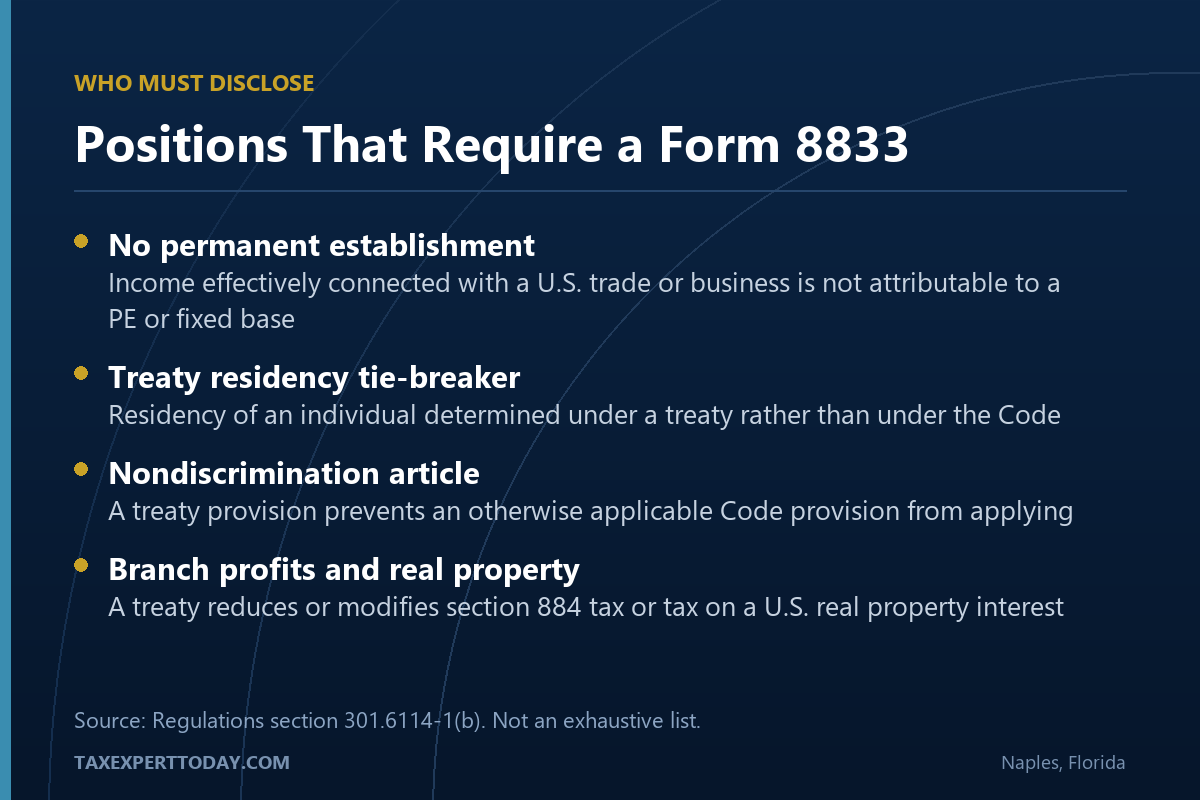
Regulations section 301.6114-1(b) lists the positions that specifically require a Form 8833. The list is not exhaustive, and some of the listed positions are then waived elsewhere in the regulation, so both halves have to be read together. The items below are the ones that arise most often in practice.
- Permanent establishment positions. Maintaining that income effectively connected with a United States trade or business is not attributable to a permanent establishment or fixed base.
- Residency determined by treaty. Maintaining that an individual is a resident of the other country under a treaty tie-breaker rather than under the Code.
- Nondiscrimination provisions. Maintaining that a nondiscrimination article prevents an otherwise applicable Code provision from applying.
- Real property and branch profits. Positions that reduce or modify the tax on the disposition of a United States real property interest, or the branch profits tax under section 884.
- Source and foreign tax credit changes. A treaty that alters the source of an item of income or deduction, unless the taxpayer is an individual, or that grants a credit for a foreign tax the Code would not allow.
| Position | Where it comes from | Typical filer |
|---|---|---|
| No permanent establishment in the United States | Business profits article | Foreign company with United States activity |
| Treaty residency under a tie-breaker | Residence article | Dual-resident individual |
| Reduced or eliminated branch profits tax | Treaty article on branch profits | Foreign corporation with a United States branch |
| Foreign tax credit not allowed by the Code | Relief from double taxation article | Individual or entity with foreign taxes |
| Source of income altered by treaty | Source rules in the treaty | Entities, not individuals |
Frequently encountered positions that Regulations section 301.6114-1(b) specifically requires be reported. The regulation contains further items, and the waivers in subsection (c) must be checked against each one.
When Is Form 8833 Not Required?
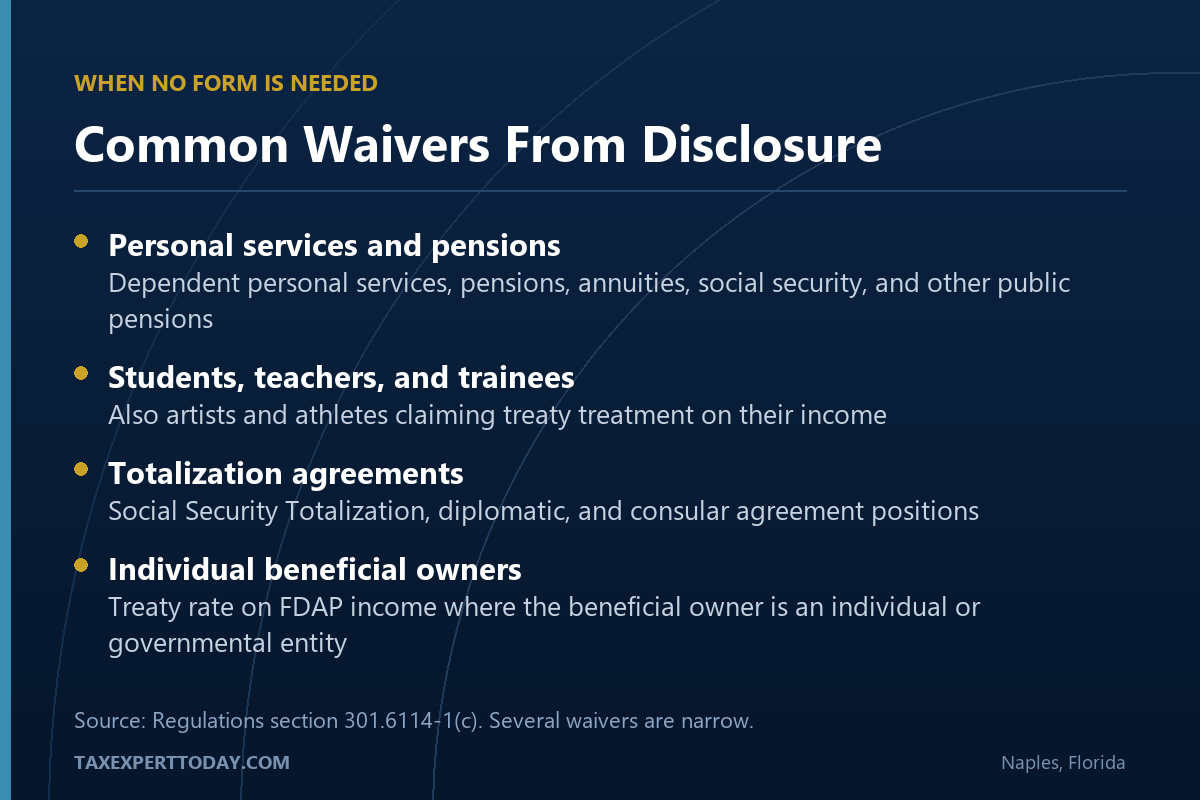
Most individual treaty benefits are waived from disclosure. Regulations section 301.6114-1(c) removes the reporting duty for a long list of ordinary situations, which is why the majority of people who use a treaty never file this form. The waiver is a rule in the regulation rather than an informal practice, and it can be relied on where it applies.
- Personal services, pensions, and social security. Treaty positions on dependent personal services income, pensions, annuities, social security, and other public pensions are waived.
- Students, teachers, trainees, artists, and athletes. Income of these categories is covered by the same waiver.
- Totalization agreements. A position that a Social Security Totalization Agreement modifies your income is waived, as are diplomatic and consular agreement positions.
- Individual beneficial owners of passive income. A treaty reducing the rate on fixed or determinable annual or periodical income is waived where the beneficial owner is an individual or a governmental entity.
- Disclosure already made upstream. If a partnership, trust, or estate disclosed the position, the partner or beneficiary does not repeat it.
| Situation | Form 8833 generally required? |
|---|---|
| Student or trainee claiming a treaty exemption on wages | Waived under subsection (c) |
| Foreign pension treated under a treaty article | Waived under subsection (c) |
| Individual receiving treaty-rate dividends as beneficial owner | Waived under subsection (c) |
| Dual-resident individual using a tie-breaker | Required |
| Company claiming no permanent establishment | Required |
| Payment over $500,000 to a related foreign party under a treaty with a limitation on benefits article | Required |
A simplified view of the waiver landscape. Several waivers are narrow, and the form instructions add back a short list of positions that must be reported despite an apparently applicable waiver, so each fact pattern is checked against both subsections.
A current illustration of how specific this analysis gets appeared on August 11, 2026, when the IRS published guidance on income reporting for foreign corporations operating under the Jones Act waiver. The guidance states that income from transporting cargo between United States ports under that waiver is not derived from the international operation of ships, is therefore not eligible for the gross income exclusion under section 883, and that affected corporations should report on Form 1120-F without completing Schedule S or filing a Form 8833 treaty position for those operations. It is a narrow item, but it shows that the question of whether a treaty position exists at all comes before the question of whether to disclose it.
What Is the Penalty for Not Filing Form 8833?
Section 6712 imposes a penalty of $1,000 on each failure to meet the requirements of section 6114, and $10,000 in the case of a C corporation. The words each such failure matter. Because a separate form is required for each position and each year, the exposure multiplies across positions and across open years rather than being capped at a single amount.
- The penalty is per failure. Two undisclosed positions across three years are counted as separate failures, not one.
- Reasonable cause is available. Section 6712(b) allows the Secretary to waive all or part of the penalty where the taxpayer shows reasonable cause and good faith.
- It stacks. Section 6712(c) provides that this penalty is in addition to any other penalty imposed by law.
- It is separate from the tax result. A treaty position can be entirely correct and the penalty can still apply, because the failure being penalized is the missing disclosure.
| Element | Rule | Authority |
|---|---|---|
| Penalty, individual and most taxpayers | $1,000 | §6712(a) |
| Penalty, C corporation | $10,000 | §6712(a) |
| Measured per | Each failure to meet §6114 | §6712(a) |
| Relief | Waiver for reasonable cause and good faith | §6712(b) |
| Interaction | In addition to any other penalty | §6712(c) |
The section 6712 penalty at a glance. These are the statutory amounts. Whether a penalty is asserted, and whether a waiver is granted, depends on the facts presented.
How Do Dual-Resident Taxpayers Use Form 8833?
An alien individual is a dual-resident taxpayer when both the United States and another country treat that person as a resident under their own laws. Where the treaty contains a tie-breaker and the individual concludes that it makes them a resident of the other country, the individual may claim benefits as a resident of that country by filing Form 1040-NR with Form 8833 attached.
- The return changes. The filing is made on Form 1040-NR rather than Form 1040 for the part of the year the person is a dual-resident taxpayer.
- The disclosure is mandatory here. Regulations section 301.7701(b)-7 requires it, and this is one of the positions no waiver reaches.
- The effect is limited to income tax. Under Regulations section 301.7701(b)-7(a)(3), the individual is still treated as a United States resident for purposes other than figuring income tax liability.
- Competent authority may be available. A dual-resident taxpayer may also be eligible for United States competent authority assistance under Revenue Procedure 2015-40 or its successor.
The third bullet is the one that carries the most practical weight, and it leads directly into the two sections below.
Can Filing Form 8833 End Your United States Residency?
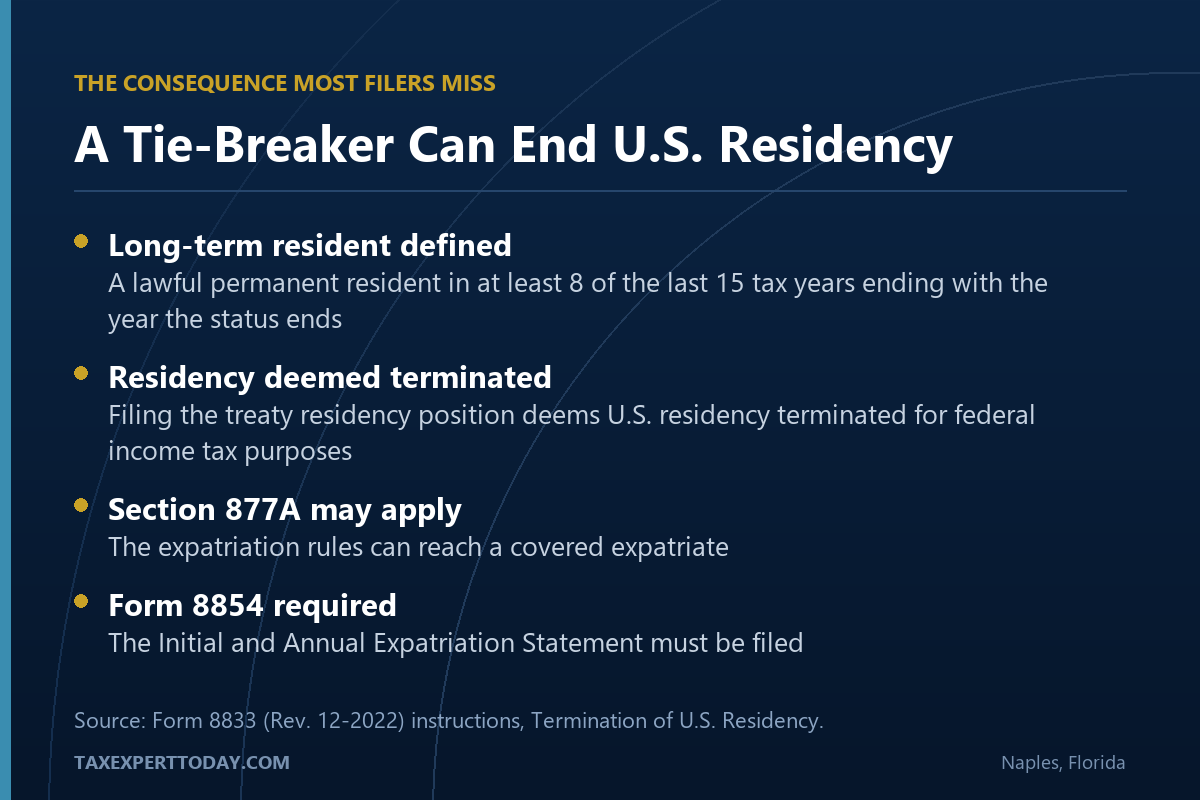
Yes, in one specific situation. If you are a dual-resident taxpayer and a long-term resident, and you file Form 8833 to be treated as a resident of the other country under a treaty, the form instructions state that you will be deemed to have terminated your United States residency status for federal income tax purposes. That can bring you within section 877A and require Form 8854.
- Long-term resident has a definition. You are one if you were a lawful permanent resident in at least 8 of the last 15 tax years ending with the year your status ends.
- The termination is deemed, not elected. It follows from taking the treaty position, whether or not that consequence was intended.
- Section 877A may apply. The expatriation rules can impose a mark-to-market regime on covered expatriates.
- Form 8854 is required. The instructions direct the person to file the Initial and Annual Expatriation Statement.
- Immigration status is a separate question. Tax residency and lawful permanent resident status under immigration law are governed by different rules and different agencies.
This is the single most consequential item on the form and it is easy to miss, because nothing on the face of Form 8833 announces it. A green card holder of long standing who takes what looks like a routine tie-breaker position to reduce one year of tax can trigger a deemed termination of residency with effects far larger than the position was worth. The Form 8854 instructions and Publication 519 set out the surrounding rules, and this is a point at which a considered review before filing is worth more than any remedy afterward. What that termination sets in motion, from the initial expatriation statement to the covered expatriate tests, is explained in our guide to Form 8854 and the U.S. exit tax. For a Canadian resident, the tie-breaker itself is Article IV(2) of the Canada US tax treaty, and the questions it raises for snowbirds are covered in that guide.
Does a Treaty Position Remove FBAR and Form 8938 Reporting?
Generally no. A treaty affects how income is taxed. It does not switch off the information reporting regimes that apply to foreign accounts and foreign assets. A dual-resident taxpayer who elects treaty benefits remains a United States resident for purposes other than computing income tax, which is exactly where the reporting duties live.
- The FBAR is filed under Title 31. It sits outside the income tax code that a tax treaty modifies.
- Form 8938 reporting continues. The FATCA duty under section 6038D is not a tax computation and is not displaced by a treaty rate.
- Foreign entity and trust forms continue. Filings such as Form 5471 and Form 3520 respond to ownership and transactions rather than to liability.
- Separate penalty regimes. Each of these forms carries its own penalty structure, independent of section 6712.
This is where a treaty position most often goes wrong in practice. The tax answer is reached correctly, and the reporting is then treated as though it followed the tax answer. Our guides to whether you need to file an FBAR and to the difference between the FBAR and Form 8938 set out those separate duties, and Form 3520 reporting for foreign gifts and trusts works the same way. Where a year has already been missed, the streamlined filing compliance procedures remain available for non-willful conduct only, and certifying non-willfulness where the facts do not support it carries its own serious risk. A foreign national who stays under 183 days in the United States may not need a treaty position at all, because the closer connection exception claimed on Form 8840 is a domestic rule that removes resident status itself rather than only changing the tax computation.
How Do You Complete and File Form 8833?
The form is one page with six numbered items, and the substance sits in lines 4 through 6. You identify the treaty and article relied on, the Code provision overruled or modified, the limitation on benefits test met where one applies, and then explain the position in narrative form together with the amount of income affected.
- Identify yourself and the treaty country. Enter your taxpayer identifying number, your address in the country of residence written out in full, and your United States address.
- Name the limitation on benefits test. Line 4 asks for the specific test met, and Table 4 of the IRS tax treaty tables summarizes the tests treaty by treaty.
- Cite the regulation subsection where line 5 applies. If the position is one specifically required to be reported, enter the subsection of Regulations section 301.6114-1(b) involved.
- Explain the position on line 6. Every filer completes line 6, including the reasoning and the amount, or a reasonable estimate, of the income affected.
- Attach it to the right return. The form goes with the return the position affects, and a separate form is used for each position.
A pending competent authority request is worth noting here. Where a taxpayer has asked the United States competent authority for a discretionary determination and the request is still pending, benefits generally may not be claimed unless the treaty or its technical explanation provides otherwise. Reading the applicable treaty text and technical explanation from the IRS treaty library before completing line 6 is ordinary practice, because the explanation on that line is what the IRS reads first. Any double taxation that survives a treaty position is usually relieved through the foreign tax credit, which an individual computes on Form 1116.
Form 8833 Help in Naples and Southwest Florida
Tax Expert Today LLC works with dual residents, green card holders, foreign nationals with United States income, and companies weighing a permanent establishment position. If you are searching for Form 8833 help Naples, international tax Naples FL, or tax treaty Naples, the office is on Tamiami Trail North, and the review usually begins with whether a disclosable position exists at all.
Our office is at 11983 Tamiami Trail N, Naples, FL 34110, and the phone is (239) 441-2005. Hours are Monday through Friday, 10am to 5pm ET. The firm is led by Dr. Pellumb Kabashi, founder of Tax Expert Today LLC, and serves clients in all 50 states as well as United States taxpayers living abroad. Naples, Florida has a substantial population of foreign born residents, seasonal residents from treaty countries, and long-term green card holders considering a move abroad, which is precisely the group for whom the residency termination rule matters most. Our international and expatriate tax services cover treaty analysis alongside the information reporting that accompanies it.
Does living in Naples, Florida change whether I file Form 8833? No. Form 8833 is a federal disclosure and the duty is the same in every state. Florida imposes no state income tax, so there is no parallel state treaty question to resolve, which simplifies the analysis compared with a high tax state. What Florida residence does affect is the practical side of a residency tie-breaker, because a person maintaining a home here while claiming treaty residence elsewhere should expect the facts behind that claim to be examined closely.
Frequently Asked Questions
Is Form 8833 required to claim a tax treaty benefit? Not always. The treaty benefit exists independently of the form. Disclosure is required only where section 6114 and Regulations section 301.6114-1(b) reach the position and no waiver in subsection (c) applies.
Which revision of Form 8833 is current? The current revision is Rev. December 2022. Older revisions from 2013 and 2017 still circulate widely online and in search results, so it is worth confirming the revision before filing.
Can Form 8833 be filed electronically? It is attached to the return it supports, so it follows that return. Because line 6 calls for a narrative explanation, some software requires the statement to be attached as a PDF, and some positions push the return to paper filing.
Do I file a separate Form 8833 for each treaty position? Yes. A separate form is required annually for each treaty-based return position, although payments or income items of the same type from the same payor may be treated as a single item.
What if I never filed Form 8833 for a past position? The section 6712 penalty applies to each failure, and section 6712(b) permits a waiver on a showing of reasonable cause and good faith. The right approach depends on how many years and positions are involved and on whether income was also unreported.
Do students and teachers claiming a treaty exemption file Form 8833? Usually no. Positions on income of students, trainees, teachers, and on dependent personal services are among those for which reporting is waived under Regulations section 301.6114-1(c).
When to Engage a Professional
Form 8833 is short, and that brevity is misleading. The judgment sits before the form: whether the treaty actually overrides the Code on your facts, whether the position falls in the mandatory list or a waiver, whether a limitation on benefits article lets you through, and whether the position carries a consequence larger than the tax it saves. A residency tie-breaker taken by a long-term green card holder is the clearest example, because the deemed termination of residency and the section 877A regime can dwarf the benefit claimed. A treaty rate taken at source is claimed on a different document, the certificate the payer holds rather than a return, and the line 10 conditions behind that claim are set out in our guide to Form W-8BEN. A taxpayer living abroad usually weighs a treaty position alongside the ordinary domestic reliefs as well, and the choice between the foreign earned income exclusion and the foreign tax credit is the one that most often decides the return. One common position that usually falls within the waivers, a reduced treaty rate on income reported to you on Form 1042-S, is explained in our guide to Form 1042-S.
Consider professional help where you hold a green card and are considering a treaty residency position, where a company is taking a permanent establishment or branch profits position, where more than one year or more than one position is open, or where foreign accounts and assets sit alongside the treaty claim. To discuss your situation, call (239) 441-2005 or review our international and expatriate tax services. Every situation turns on its own facts, and this article is general information rather than advice on yours.
Published August 25, 2026 by Dr. Pellumb Kabashi « Back to Learning Center
Have a question this article touches on?
Tax Expert Today LLC, based in Naples, Florida and serving clients across the United States.
Schedule a Consultation (239) 441-2005