
By Dr. Pellumb Kabashi, DBA, MBA, EA, CFE, CES
Founder, Tax Expert Today LLC · Tax advisors, enrolled agents, CPAs, and attorneys · Serving clients in all 50 states
Quick Answer: The bona fide residence test lets a U.S. citizen, or a resident alien from a treaty country, claim the foreign earned income exclusion by showing a real home abroad for an uninterrupted period that includes one full calendar year. Intent, housing, family, visa, and foreign tax status decide it, not a day count. Call (239) 441-2005 for a free consultation.
What is the bona fide residence test?
The bona fide residence test is one of two ways a U.S. taxpayer abroad qualifies for the foreign earned income exclusion and foreign housing benefits. It asks whether you have made a genuine home in a foreign country for an uninterrupted period that includes an entire tax year, judged on intent and conduct, not a day count.
- The statute: section 911(d)(1)(A) of the Internal Revenue Code defines a qualified individual as a citizen who is a bona fide resident of a foreign country for an uninterrupted period that includes an entire taxable year.
- The calendar rule: for a calendar year filer, the full tax year means January 1 through December 31.
- The facts rule: living abroad for twelve months does not by itself make you a bona fide resident.
- The alternative: the physical presence test, which counts 330 full days in any twelve month period, is the other route.
U.S. citizens are taxed on worldwide income wherever they live. The exclusion in section 911 softens that rule for people who earn their living abroad, and for 2026 it lets a qualifying person exclude up to $132,900 of foreign earned income, plus a housing amount, according to the IRS page on figuring the foreign earned income exclusion. Before any of that applies, the taxpayer has to qualify. Qualification has three parts: a tax home in a foreign country, foreign earned income, and either the bona fide residence test or the physical presence test.
This guide goes deep on qualification only. Whether to use the exclusion at all, or to claim the foreign tax credit instead, is a separate decision covered in our guide to the foreign earned income exclusion versus the foreign tax credit. The two questions are linked, because a taxpayer who cannot pass either test has only the credit available, but they are answered in a different order. First you find out whether you qualify. Then you decide whether qualifying is worth using.
The IRS states the rule on its bona fide residence test page in a single sentence: you meet the test “if you are a bona fide resident of a foreign country or countries for an uninterrupted period that includes an entire tax year.” Every word in that sentence carries weight. “Bona fide” points to intent and conduct. “Uninterrupted” refers to the residence, not to your body staying in one place. “Entire tax year” means a whole calendar year for most individuals, with no proration and no rolling window.
Who can use the bona fide residence test?
Two groups can use the bona fide residence test: U.S. citizens, and U.S. resident aliens who are citizens or nationals of a country that has an income tax treaty in effect with the United States. Other resident aliens, such as a green card holder from a non-treaty country, must use the physical presence test instead.
- U.S. citizens: always eligible to try the test, wherever they were born and whatever passports they also hold.
- Treaty country resident aliens: eligible if they are U.S. residents under section 7701(b)(1)(A) and hold citizenship or nationality of a treaty partner.
- Non-treaty resident aliens: limited to the physical presence test.
- Nonresident aliens: not covered by section 911 at all, because they are not taxed on foreign income in the first place.
The statute itself names only citizens in section 911(d)(1)(A). The extension to treaty country resident aliens comes from the nondiscrimination articles in U.S. income tax treaties, and the IRS reflects it on the bona fide residence page and in Part II of Form 2555, which carries the note: “Only U.S. citizens and resident aliens who are citizens or nationals of U.S. treaty countries can use this test.” The Form 2555 instructions point to Table 3 of the IRS treaty tables for the list of countries with an income tax treaty in effect.
Two points trip people up here. First, a resident alien is someone who meets the green card test or the substantial presence test for the year. A green card holder who moves abroad usually remains a U.S. resident for tax purposes until the card is formally surrendered or deemed abandoned, so the foreign earned income rules matter to that person as much as to a citizen. Second, a resident alien from a country whose treaty with the United States has been terminated or suspended may lose access to the bona fide residence test for the affected years. Publication 54 reports, for example, that the United States terminated its income tax treaty with Hungary effective for tax years beginning on or after January 1, 2024, and that key articles of the Russia treaty were suspended from August 16, 2024. Treaty status should be checked for the specific year, not assumed from memory.
| Taxpayer | Bona fide residence test | Physical presence test |
|---|---|---|
| U.S. citizen living abroad | Available | Available |
| Green card holder who is a citizen of a treaty country | Available | Available |
| Green card holder who is a citizen of a non-treaty country | Not available | Available |
| Resident alien under the substantial presence test, treaty country citizen | Available | Available |
| Dual citizen of the United States and another country | Available as a U.S. citizen | Available |
| Nonresident alien | Not relevant; foreign income is generally not taxed by the United States | Not relevant |
What does “bona fide resident of a foreign country” actually mean?
A bona fide resident is someone who went to a foreign country intending to stay for an indefinite or prolonged period and who made a home there to carry out that intention. Treasury regulations borrow the standard used to decide whether a foreign person is a U.S. resident, which separates true residents from transients and sojourners.
- Indefinite or prolonged stay: the purpose of the move requires an extended stay, not a short, defined project.
- A home, not a base: the taxpayer sets up permanent quarters, often with family.
- Return later is allowed: an intention to come back to the United States someday does not defeat the test.
- A fixed end date hurts: a stay limited to a definite period ordinarily points away from residence.
Treasury Regulation section 1.911-2(c) says bona fide residence is determined “by applying, to the extent practical, the principles of section 871 and the regulations thereunder, relating to the determination of the residence of aliens.” The section 871 regulation it refers to, Treasury Regulation section 1.871-2(b), was written to decide whether a foreign person living in the United States is a resident, and it reads naturally when you turn it around. A person who comes for “a definite purpose which in its nature may be promptly accomplished is a transient,” while a person whose purpose requires “an extended stay” and who makes a home to that end becomes a resident, even if he or she always intends to return home once the purpose is done.
The same regulation adds a point that matters for expats on time-limited visas: a person whose stay is “limited to a definite period by the immigration laws” is generally not a resident, “in the absence of exceptional circumstances.” That is why Form 2555 asks about the visa and whether it limits the length of the stay.
Publication 54 frames the test from the taxpayer’s side in its questions and answers. To be a bona fide resident, “you must show that you entered a foreign country intending to remain there for an indefinite or prolonged period and, to that end, you are making your home in that country.” The IRS then lists what it considers: “the type of quarters occupied, whether your family went with you, the type of visa, the employment agreement, and any other factor pertinent to show whether your stay in the foreign country is indefinite or prolonged.”
The IRS bona fide residence page gives the classic illustration of what passes. “If you go there to work for an indefinite or extended period and you set up permanent quarters there for yourself and your family, you probably have established a bona fide residence in a foreign country, even though you intend to return eventually to the United States.” It gives the classic illustration of what fails too: a person who goes abroad “to work for a specified period of time” ordinarily is not a bona fide resident, “even though you work there for one tax year or longer.”
What factors does the IRS weigh in a bona fide residence test determination?
The IRS weighs the full picture of your life abroad: why you went, how long you expect to stay, how you live, whether your family came, your visa and employment terms, whether you pay foreign tax, and the ties you kept in the United States. When your words and acts conflict, your acts carry more weight.
- Intent and purpose: an open-ended job, a business, retirement, or a family move points toward residence.
- Housing: a purchased home or long lease reads differently from a hotel or a rented room.
- Family: a spouse and children living with you abroad is strong evidence.
- Foreign tax status: filing as a resident of the foreign country supports the claim; claiming to be a nonresident there can defeat it.
- U.S. ties: a U.S. home kept available for your use, U.S. voting, and U.S. licenses are weighed, but none is automatically fatal.
The Form 2555 instructions put the evidentiary rule plainly: “Evidence of your intention may be your words and acts. If these conflict, your acts carry more weight than your words.” A taxpayer who writes on a form that the move is permanent, but who signed a two-year employment contract with a return flight paid by the employer, kept a house in Florida furnished and empty, and lived in serviced apartments, will usually find the acts outweigh the words.
The IRS also says plainly that it “decides whether you qualify as a bona fide resident of a foreign country largely on the basis of facts you report on Form 2555,” and that it “cannot make this determination until you file Form 2555.” In practice, Part II of Form 2555 is the test. Each question maps to a factor.
| Form 2555 Part II line | What it asks | Why it matters |
|---|---|---|
| Line 10 | The date bona fide residence began and ended, or “Continues” | Sets the qualifying period used to prorate the exclusion |
| Line 11 | Kind of living quarters: purchased house, rented house or apartment, rented room, or employer-furnished quarters | Permanence of housing is evidence of intent |
| Lines 12a and 12b | Whether family lived with you abroad, who, and for what period | Family relocation is one of the strongest residence facts |
| Lines 13a and 13b | Whether you told the foreign country you are not a resident, and whether you must pay its income tax | “Yes” to 13a and “No” to 13b disqualifies you outright |
| Line 14 | Each U.S. visit: dates arrived and left, business days, and U.S. business income | Shows whether trips were brief and temporary; U.S. work income is not excludable |
| Line 15a | Contractual terms about the length of employment abroad | A fixed term points toward a temporary stay |
| Lines 15b and 15c | Visa type and whether it limits the stay or employment | A time-limited visa weighs against residence absent exceptional facts |
| Lines 15d and 15e | Whether you kept a U.S. home, its address, whether rented, and who lived there | A U.S. home occupied by family can suggest your abode stayed in the United States |
No single answer is decisive except line 13. A taxpayer can own a home in Naples, Florida, rent it to a tenant, and still be a bona fide resident of Portugal. A taxpayer can travel back to the United States several times a year and still qualify. The question is always whether the whole pattern looks like a person who lives abroad, or like a person who works abroad while living, in substance, somewhere else.
Many practitioners also keep a residence file for clients who rely on this test: the foreign lease or deed, the residence permit, foreign tax returns and assessments, school enrollment for children, local bank statements, utility bills in the taxpayer’s name, health insurance in the foreign system, club and community memberships, and a travel log. None of these documents is filed with the return. They exist so that, if the IRS questions the Form 2555 answers years later, the taxpayer can show the facts rather than reconstruct them from memory.
How is the bona fide residence test different from the physical presence test?
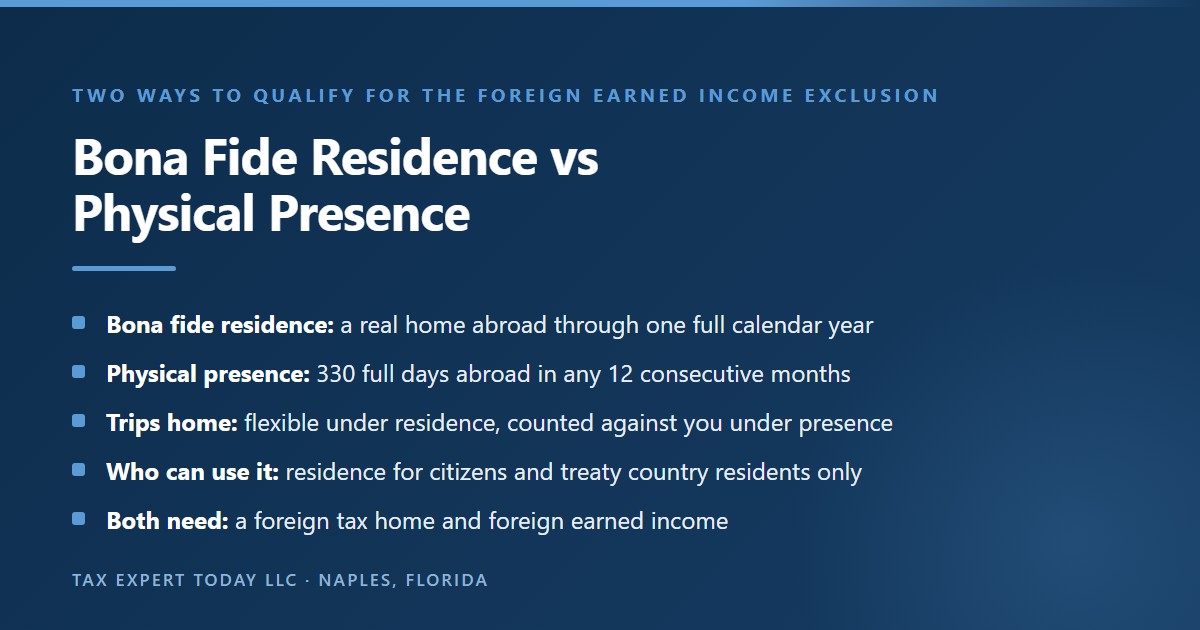
The bona fide residence test asks about the nature of your life abroad over a full calendar year. The physical presence test ignores intent and asks one mechanical question: were you in a foreign country for at least 330 full days during any twelve consecutive months? Either test works if you also have a foreign tax home.
- Measurement: facts and circumstances for bona fide residence; a day count for physical presence.
- Time window: a calendar year for bona fide residence; any rolling twelve-month period for physical presence.
- Travel: generous for bona fide residence, provided trips are brief and you intend to return; tight for physical presence, about 35 days outside foreign countries in the window.
- Who can use it: citizens and treaty country resident aliens for bona fide residence; citizens and all resident aliens for physical presence.
The physical presence rules are in Treasury Regulation section 1.911-2(d). A twelve-month period “may begin with any day but must end on the day before the corresponding day in the twelfth succeeding month.” The 330 full days “need not be consecutive.” A full day is “a continuous period of twenty-four hours beginning with midnight and ending with the following midnight,” so arrival and departure days usually do not count, and time over international waters does not count as time in a foreign country. Publication 54 summarizes the contrast: the physical presence test “is based only on how long you stay in a foreign country or countries” and does not depend on the kind of residence you establish, your intentions about returning, or the nature and purpose of your stay. The IRS page on the physical presence test walks through the counting rules with examples.
| Feature | Bona fide residence test | Physical presence test |
|---|---|---|
| Legal source | Section 911(d)(1)(A); Reg. 1.911-2(c) | Section 911(d)(1)(B); Reg. 1.911-2(d) |
| Core question | Have you made a genuine home abroad? | Were you in a foreign country 330 full days in twelve months? |
| Minimum period | An uninterrupted period including one entire tax year | Any twelve consecutive months |
| Intent relevant? | Yes, central | No |
| Trips to the United States | Allowed if brief and temporary, with intent to return | Every day outside a foreign country counts against you |
| Eligible taxpayers | Citizens; resident aliens from treaty countries | Citizens; all resident aliens |
| Disqualifier | Statement of nonresidence accepted by the foreign country | Fewer than 330 full days in every possible window |
| Form 2555 section | Part II | Part III |
| Typical user | Long-term expats, retirees with foreign earnings, families who relocate | Rotational workers, digital nomads, first-year movers |
The physical presence test is the subject of a large share of searches on this topic, and it is the right answer for many people. It is often the faster route in the first year abroad, because a twelve-month window can start on the day of arrival, while the bona fide residence test cannot be met until a full calendar year has passed. It is also the only route for resident aliens from non-treaty countries. Its weakness is travel. A person who spends more than about five weeks of any twelve-month window outside foreign countries, including days in the United States and days in transit over the ocean, fails it for that window, no matter how settled that person is abroad.
Which test should you rely on, bona fide residence or physical presence?
Rely on the test your facts pass most clearly, and document both when you can. Physical presence is easier to prove and often available sooner. Bona fide residence suits settled expats who travel often, because it tolerates long or frequent U.S. visits that would break the 330 day count.
- Choose physical presence: when the day count is comfortably above 330 and your stay has a fixed end date.
- Choose bona fide residence: when you have lived abroad through a full calendar year with a real home but traveled too much for 330 days.
- Use either: when both are met; Part II and Part III cannot both be completed on one Form 2555, so pick the stronger one.
- Do not choose by convenience: the test claimed must be supportable if the IRS asks for proof.
The Form 2555 instructions say “You must complete either Part II or Part III of Form 2555, but not both parts.” A taxpayer who meets both tests should complete the part that is easiest to support with records. In many years that is Part III, because a passport stamp history and an airline record are hard to argue with. Once a taxpayer has been abroad for several years, Part II often becomes the more natural choice, because it carries forward year after year, and because the qualifying period under the bona fide residence test runs from the day residence began to the day it is abandoned, without the need to pick a new twelve-month window each year.
The choice of test on a Form 2350 extension request is not binding. Publication 54 answers that question directly: “You are not bound by the test indicated in the application for extension of time.” A taxpayer who asked for an extension expecting to pass the physical presence test can file under the bona fide residence test if that is what the facts support, provided the return is filed by the approved date.
A practical rule that follows from all this: keep a travel log every year, even if you plan to rely on bona fide residence. Line 14 of Form 2555 asks for every U.S. visit during the year, with arrival and departure dates and business days, and the physical presence test may be the fallback if residence is ever challenged.
What does “uninterrupted period that includes an entire tax year” mean?
It means your foreign residence, not your physical presence, must continue without a break through at least one full calendar year, January 1 through December 31 for most filers. Brief trips to the United States or elsewhere do not interrupt it, provided you clearly intend to return to your foreign home without unreasonable delay.
- Residence, not presence: Publication 54 says “uninterrupted” refers to the bona fide residence proper and not to physical presence.
- A full calendar year: a stay from June of one year to October of the next fails, even though it lasts sixteen months.
- Moving between countries is allowed: the test says a foreign country “or countries,” so a transfer from one foreign post to another can keep the period unbroken.
- Abandonment ends it: the period closes on the date you give up the foreign residence.
Publication 54 answers the most common question in its questions and answers section. Asked whether a taxpayer must be physically present abroad for the entire year, the IRS says no: “‘Uninterrupted’ refers to the bona fide residence proper and not to the physical presence of the individual. During the period of bona fide residence in a foreign country, even during the first full year, you can leave the country for brief and temporary trips back to the United States or elsewhere for vacation or even for business.”
The IRS bona fide residence page gives two examples that show where the line falls. In the first, a Lisbon representative of a U.S. employer arrives with family on November 1, 2024, on an indefinite assignment, spends April 2025 in the United States meeting with the employer while the family stays in Lisbon, and returns. “On January 1, 2026, you completed an uninterrupted period of residence for a full tax year (2025), and you may qualify as a bona fide resident.” In the second, the same person transfers back to the United States on December 13, 2025. That person “would not qualify under the bona fide residence test. Although your stay in the foreign country lasted more than a year, it did not include a full tax year.” The IRS adds that the person may still qualify under the physical presence test.
| Hypothetical period abroad | Includes a full calendar year? | Bona fide residence possible? |
|---|---|---|
| September 1, 2025 to March 31, 2027 | Yes, all of 2026 | Yes, from September 1, 2025 to March 31, 2027, if the facts support residence |
| February 1, 2026 to December 15, 2027 | No, neither 2026 nor 2027 is complete | No; consider the physical presence test |
| December 20, 2025 to January 10, 2027 | Yes, all of 2026 | Yes, for the whole span if residence began December 20 |
| July 1, 2026 onward, still abroad | Not yet; 2027 must be completed | Not until January 1, 2028; see Form 2350 below |
| Germany 2024 to mid 2026, then Spain onward | Yes, 2025 in Germany | Yes, the move between foreign countries need not break the period |
How many days can you spend in the United States and still pass the bona fide residence test?
There is no fixed number. The bona fide residence test has no day limit, so the question is whether each trip was brief and temporary and whether you clearly intended to return to your foreign home. Long or frequent U.S. stays, U.S. work, and a family that stays behind in the United States all weaken the claim.
- Vacation and family visits: generally consistent with residence abroad when they are short and you go back.
- Business trips: allowed, but income for work performed while in the United States is U.S. source and not excludable.
- Extended U.S. stays: a stay of several months can look like your real home has moved back.
- Line 14 disclosure: every U.S. visit is listed on Form 2555, with dates and business days.
The IRS phrase is “brief or temporary trips back to the United States or elsewhere so long as you clearly intend to return to your foreign residence or to a new foreign bona fide residence without unreasonable delay.” The phrase does not set a number of days, and the IRS has never published one for this test. That flexibility is the main reason settled expats use the bona fide residence test. A retiree in Costa Rica who spends six weeks in Florida every summer, or a consultant in Singapore who flies to New York four times a year, may have no chance of passing the physical presence test in some windows but can still be a bona fide resident of the foreign country.
The flexibility has two limits. The first is the earnings rule. Income for services performed in the United States is not foreign earned income, whatever test you rely on. Form 2555 line 14 asks for “Income earned in U.S. on business” for each visit, and the form instructs you not to include it in Part IV but to report it on Form 1040. A taxpayer who spends forty working days in a U.S. office should expect roughly that share of salary, figured on a reasonable allocation, to stay taxable. The second limit is the abode rule discussed below. If the trips are so long and the U.S. ties so strong that your abode is in the United States, you lose the foreign tax home, and with it the exclusion, for that period.
Does telling a foreign country you are not a resident disqualify you?
Yes, in most cases. Under section 911(d)(5), if you give the foreign country’s authorities a statement that you are not a resident and they treat you as not subject to their income tax as a resident on your earnings, you are not a bona fide resident of that country for U.S. purposes. A pending, unresolved statement also blocks the test.
- The rule is statutory: section 911(d)(5) and Reg. 1.911-2(c) both state it.
- Form 2555 line 13: “Yes” to the statement question and “No” to the foreign tax question means you do not qualify.
- Pending claims count: if the foreign country has not yet decided, the IRS treats you as not a bona fide resident as of that date.
- Treaty exemptions differ: an exemption under a treaty or agreement does not by itself prevent residence.
Section 911(d)(5) is short. If an individual “submits a statement to the authorities of that country that he is not a resident of that country,” and the individual “is held not subject as a resident of that country to the income tax of that country by its authorities with respect to such earnings,” then that individual “shall not be considered a bona fide resident of that country.” The logic is consistency. A person cannot tell the foreign government “I do not live here, so do not tax me as a resident” and tell the IRS “I live there, so let me exclude my income.”
This is one of the gaps the ranking pages tend to skip, and it arises in practice more often than people expect. Common versions include a contractor who files as a nonresident in the host country to claim a lower flat withholding rate, an employee who signs a host country form claiming nonresident status under a special expatriate regime, a person who claims treaty nonresident status in the foreign country under a tie-breaker article, and a remote worker who never registers for local tax at all and tells a local bank or landlord that he or she is only visiting. The first three can trip section 911(d)(5) directly. The last does not involve a statement to the tax authorities, but the lack of any local tax footprint is itself a factor that can weaken a residence claim.
The IRS distinguishes a treaty exemption from a statement of nonresidence. Its bona fide residence page says “An income tax exemption provided in a treaty or other international agreement will not in itself prevent you from being a bona fide resident of a foreign country,” and that “Whether a treaty prevents you from becoming a bona fide resident of a foreign country is determined under all provisions of the treaty, including specific provisions relating to residence or privileges and immunities.” A teacher or researcher exempt from local tax under a treaty article is not automatically disqualified; a person who affirmatively claimed to be a nonresident usually is. Because the answer turns on the foreign country’s forms and the specific treaty, foreign filings should be reviewed alongside the U.S. return.
What is a tax home, and why can it defeat a bona fide residence claim?
A tax home is the general area of your main place of business, employment, or post of duty. It is a separate requirement from the bona fide residence test, and section 911(d)(3) adds that you cannot have a foreign tax home for any period your abode is in the United States, so a passing residence test still fails without it.
- Tax home: where you are permanently or indefinitely engaged to work, regardless of where your family home is.
- Abode: where your family, economic, and personal ties are; a domestic idea, not a work idea.
- The abode rule: an abode in the United States cancels a foreign tax home for that period.
- A U.S. dwelling is not fatal: keeping a house in the United States does not by itself put your abode there.
Every route to the exclusion requires a foreign tax home. The IRS page on the tax home in a foreign country defines it as “the general area of your main place of business, employment, or post of duty, regardless of where you maintain your family home.” Section 911(d)(3) then provides that “An individual shall not be treated as having a tax home in a foreign country for any period for which his abode is within the United States,” with an exception for people serving in a combat zone in support of the U.S. Armed Forces.
The IRS explains that abode “has a domestic rather than a vocational meaning” and that its location “often will depend on where you maintain your economic, family, and personal ties.” The regulations add that “Maintenance of a dwelling in the United States by an individual, whether or not that dwelling is used by the individual’s spouse and dependents, does not necessarily mean that the individual’s abode is in the United States.” The IRS gives two contrasting examples. A worker on an offshore oil rig in a foreign country’s waters on a 28 days on, 28 days off rotation, who returns to the family home in the United States during every off period, has a U.S. abode and fails the tax home test. An employee transferred abroad for an indefinite period who rents out the U.S. house, stores the car, moves the spouse, children, furniture, and pets to London, opens local bank accounts, takes local driving licenses, and joins local civic groups has an abode abroad.
The interaction matters because the bona fide residence test and the tax home test look at overlapping facts but ask different questions. A person can be a bona fide resident of Mexico, with a home and family there, but have a U.S. tax home because the main place of employment is an office in Texas that the person commutes to weekly. That person does not qualify. The tests have to be passed together, for the same period.
What happens if you have not met the bona fide residence test by your first filing deadline?
You have two choices. You can file Form 2350 to extend the deadline to a date after you expect to qualify, usually 30 days beyond it, and then file once with the exclusion. Or you can file on time, report worldwide income, pay the tax, and later file Form 1040-X to claim the exclusion once you qualify.
- The timing problem: someone who moves abroad mid-year cannot meet the bona fide residence test until a full calendar year has passed, which is after the normal deadline.
- Option one: Form 2350, a special extension filed by the due date of the return.
- Option two: file without the exclusion, then amend once the test is met.
- Interest still runs: neither option stops interest on tax not paid by the regular due date.
This is the second gap in the ranking pages and the place where most first-year mistakes happen. The Form 2555 instructions describe it this way: “The first year you plan to take the foreign earned income exclusion and/or the housing exclusion or deduction, you may not yet have met either the physical presence test or the bona fide residence test by the due date of your return (including the automatic 2-month extension, discussed earlier). If this occurs, you can either: Apply for a special extension to a date after you expect to qualify, or File your return timely without claiming the exclusion and then file an amended return after you qualify.”
The automatic two-month extension mentioned there is separate. A U.S. citizen or resident who lives outside the United States and Puerto Rico and whose tax home is also outside them on the regular due date gets until June 15 to file, with a statement attached explaining that both conditions are met. Interest still runs from April 15. A regular six-month extension on Form 4868 is also available, and Publication 54 describes a further discretionary two-month extension to December 15 for taxpayers out of the country, requested by letter, which Publication 54 says “is not available to taxpayers who have an approved extension of time to file on Form 2350.”
How does Form 2350 work for the bona fide residence test?
Form 2350 asks the IRS for an extension past the normal limits so you can meet the bona fide residence or physical presence test before filing. It must be filed by the return’s due date, often June 15 for expats, and the extension generally runs to 30 days after the date you reasonably expect to qualify.
- Who uses it: U.S. citizens and resident aliens abroad who expect to file Form 2555 but will qualify only after the due date.
- Three conditions: you are a citizen or resident alien, you expect to meet a test after the due date, and your tax home is foreign throughout the qualifying period.
- How to file: give it to an IRS representative, e-file it, or mail it to the address in the Form 2350 instructions.
- The approved date is a hard deadline: a return filed after it may face a failure-to-file penalty.
The IRS Form 2350 page says U.S. citizens and resident aliens abroad use the form to ask for an extension “only if they expect to file Form 2555” and need time to meet either test. Publication 54 lists the three conditions quoted above and explains that, if granted, the extension “will generally be for 30 days beyond the date on which you can reasonably expect to qualify.” It also says “You must file Form 2350 by the due date for filing your return,” and that when both the tax home and abode are outside the United States and Puerto Rico on the regular due date, that due date for a calendar year filer is June 15.
Publication 54 recommends filing “early in order to allow for the timely filing of your return if your request is denied.” If plans change and the test cannot be met, the IRS says to “file your income tax return as soon as possible to limit interest charged on any tax due after the regular due date of the return.” If the bona fide residence date ends up later than the extension granted, Publication 54 says to “apply for a new extension to a date 30 days beyond the date you expect to qualify as a bona fide resident.”
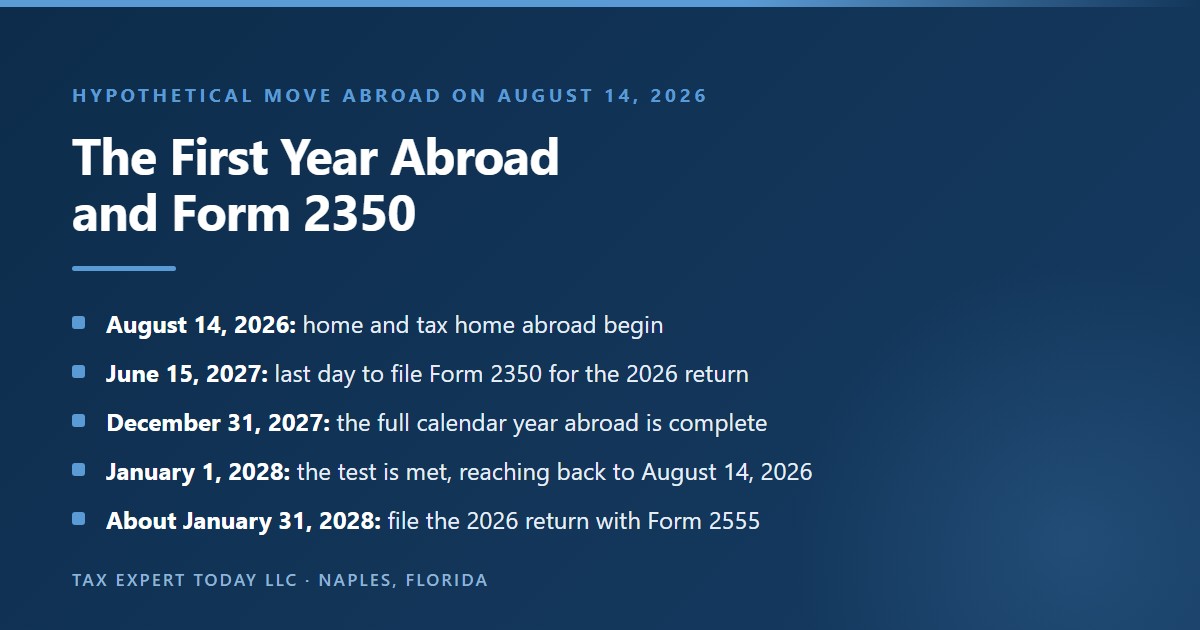
A first-year timeline, hypothetical
Consider a U.S. citizen who leaves Florida and establishes a home and tax home in Portugal on August 14, 2026, on an open-ended basis. The facts below are hypothetical and simplified.
| Date | Event | Consequence |
|---|---|---|
| August 14, 2026 | Moves to Portugal; residence and tax home begin | The qualifying period, if later confirmed, starts here |
| April 15, 2027 | Regular due date of the 2026 return | Interest on unpaid 2026 tax runs from this date |
| June 15, 2027 | Automatic two-month extended due date while living abroad | Latest date to file Form 2350 for the 2026 return |
| December 31, 2027 | The full calendar year 2027 is completed abroad | The uninterrupted period now includes an entire tax year |
| January 1, 2028 | First day the bona fide residence test can be met | Qualification reaches back to August 14, 2026 |
| About January 31, 2028 | Typical Form 2350 extended due date, 30 days after qualifying | File the 2026 return with Form 2555 Part II by this date |
Notice what the timeline shows. The 2026 return cannot claim the bona fide residence test until 2028, roughly nineteen months after the move. The same taxpayer could reach the physical presence test much sooner, because a twelve-month window starting August 14, 2026 could close in August 2027 if the person spent 330 full days abroad, and Publication 54 lets the person file under whichever test is met. That is why many advisers request the Form 2350 extension for the earlier physical presence date when the travel pattern supports it, and fall back on bona fide residence only if travel breaks the count.
Filing first and amending later
The other route is to file on time without the exclusion. Publication 54 says “If you file a return before you meet the bona fide residence test or the physical presence test, you must report your worldwide income and pay tax on that income. If you later meet either of the tests, file Form 1040-X,” available at IRS.gov/Form1040X, to claim the exclusion. The Form 2555 instructions add that Form 1040-X “must be filed within 3 years after the date the original return was filed or within 2 years after the date the tax was paid, whichever is later.” This route costs cash up front, because the tax is paid and refunded later. It avoids the risk of missing an extended due date. The choice is usually about cash flow and certainty: Publication 54 notes the extension route “allows you to file only once and saves you from paying the tax and waiting for a refund.”
| First-year approach | Cash flow | Main risk | Suits |
|---|---|---|---|
| Form 2350, then file with Form 2555 | No large payment if the exclusion covers the income, but interest runs on any balance due | Missing the approved date, or a plan change that means you never qualify | Taxpayers confident they will stay abroad |
| File on time with worldwide income, then Form 1040-X | Pay the full tax now, recover it later | Forgetting to amend within the limitation period | Taxpayers whose plans are uncertain |
| File on time and claim the foreign tax credit instead | Depends on foreign tax paid | Exclusion may later be more valuable; a later switch has limits | High-tax countries; see the credit guide |
What if you had to leave the foreign country because of war or civil unrest?
Section 911(d)(4) lets the IRS waive the minimum time requirement for people forced to leave a listed country because of war, civil unrest, or similar conditions. Each year a revenue procedure names the countries and departure dates. For 2025, Revenue Procedure 2026-16 lists seven countries.
- The list for 2025: Haiti and Ukraine from January 1, the Democratic Republic of the Congo from January 28, South Sudan from March 7, Iraq from June 11, Lebanon from June 22, and Mali from October 30.
- You must have been there first: residence or presence must have begun on or before the listed date.
- You must show reasonable expectation: but for the conditions, you would have met the test.
- The exclusion is limited: only the days in the actual period of residence or presence count.
Section 911(d)(4) treats an individual who leaves a foreign country during a period the Secretary determines individuals were required to leave “because of war, civil unrest, or similar adverse conditions in such foreign country which precluded the normal conduct of business,” before meeting the time requirements, as a qualified individual if the person “could reasonably have been expected to have met such requirements but for the conditions.” Publication 54 explains that early each year the IRS publishes the country list in the Internal Revenue Bulletin, and the IRS page on exceptions to the bona fide residence and physical presence tests adds that “your tax home must be in the foreign country and you must be a bona fide resident of, or be physically present in, the foreign country on or before the beginning date of the waiver.”
| Country (tax year 2025) | Departure on or after |
|---|---|
| Haiti | January 1, 2025 |
| Ukraine | January 1, 2025 |
| Democratic Republic of the Congo | January 28, 2025 |
| South Sudan | March 7, 2025 |
| Iraq | June 11, 2025 |
| Lebanon | June 22, 2025 |
| Mali | October 30, 2025 |
Source: Revenue Procedure 2026-16, section 3.01. The revenue procedure gives its own example: an individual who left Haiti on or after January 1, 2025, is treated as a qualified individual for the period of residence or presence in Haiti “if the individual establishes a reasonable expectation that he or she would have met the requirements of section 911(d) but for those conditions.” The list for tax year 2026 will not be published until early 2027. Leaving because of personal illness or a job loss is not covered by this waiver; Publication 54’s questions and answers make clear that an early return for illness does not by itself let you figure the exclusion for the time you were abroad.
How much can you exclude once you pass the bona fide residence test?
For 2026, up to $132,900 of foreign earned income per qualifying person, prorated by the qualifying days that fall in the year. You may also exclude or deduct a housing amount: costs above a base of 16 percent of the exclusion, capped generally at 30 percent, or $39,870, unless a higher local limit applies.
- Maximum exclusion: $132,900 for 2026 and $130,000 for 2025, according to the IRS.
- Proration: the maximum is multiplied by qualifying days in the year over the days in the year.
- Housing base: 16 percent of the maximum exclusion, $21,264 for a full 2026 year.
- Housing cap: generally 30 percent, $39,870 for 2026, with higher limits for listed high-cost cities.
The IRS exclusion page states: “For tax year 2026, the maximum exclusion is $132,900 per person.” It sets the housing limitation at “generally 30% of the maximum foreign earned income exclusion. For 2025, the housing amount limitation is $39,000; for 2026, it is $39,870.” Publication 54 ties the base housing amount to 16 percent of the maximum exclusion, or the daily equivalent multiplied by the qualifying days in the year.
Proration is where the bona fide residence test pays off in the arrival and departure years. Because qualification reaches back to the date residence began, the arrival year counts too. In the hypothetical move on August 14, 2026, the qualifying days in 2026 run from August 14 through December 31, which is 140 days. The 2026 maximum exclusion would be 140 divided by 365, times $132,900, or about $50,975. In 2027, a full year abroad, the person could exclude up to the 2027 maximum, which the IRS will set later with its annual inflation adjustments.
| Hypothetical figure, tax year 2026 | Full year qualifying | Qualifying from August 14 |
|---|---|---|
| Qualifying days in 2026 | 365 | 140 |
| Maximum foreign earned income exclusion | $132,900 | About $50,975 |
| Base housing amount (16 percent, prorated) | $21,264 | About $8,156 |
| General housing expense limit (30 percent, prorated) | $39,870 | About $15,293 |
| Largest housing amount at the general limit | $18,606 | About $7,137 |
The figures above are illustrations of the proration math using the 2026 IRS amounts, not a computation for any taxpayer, and a high-cost location can raise the housing limit. The housing exclusion applies to amounts treated as employer-provided; a self-employed person generally takes a housing deduction instead, subject to its own limit, as Publication 54 explains.
Three limits apply whatever the test. Only earned income for services performed abroad qualifies, so interest, dividends, capital gains, rents, pensions, and Social Security are not excluded. Self-employment tax is not reduced by the exclusion, so a self-employed expat may still owe U.S. Social Security and Medicare tax unless a totalization agreement assigns coverage to the foreign country. And under the stacking rule, income that remains taxable is taxed at the rates that would apply if the excluded income had not been excluded, through the Foreign Earned Income Tax Worksheet referred to in the Form 2555 instructions.
Can both spouses use the bona fide residence test?
Yes, if each spouse separately qualifies. Each spouse must have foreign earned income, a foreign tax home, and pass one of the two tests on his or her own facts. The spouses do not need to use the same test, and each can exclude up to the full maximum, $265,800 combined for 2026.
- Separate qualification: one spouse’s residence does not qualify the other.
- Different tests are fine: one spouse can use bona fide residence and the other physical presence.
- No transfer of unused exclusion: a non-working spouse has no earned income to exclude.
- Housing is shared carefully: joint filers in one household may compute housing jointly or separately, without duplication.
Publication 54 says that “If both you and your spouse work abroad and have a tax home in a foreign country, and each of you meets either the bona fide residence test or the physical presence test, you can each choose the foreign earned income exclusion,” and it adds that the two spouses need not meet the same test. The IRS exclusion page confirms that together they can exclude up to twice the annual maximum.
Where one spouse is not a U.S. citizen or resident, the analysis starts earlier, with filing status and the section 6013(g) election that treats a nonresident spouse as a U.S. resident. That election can make the foreign spouse’s own earnings eligible for the exclusion, but it also brings the spouse’s worldwide income and accounts onto the U.S. return. Our guide to filing with a nonresident alien spouse covers that decision in detail.
Do you have to requalify for the bona fide residence test every year?
Your residence must continue each year, but once you have completed a full qualifying year, the qualifying period simply runs on until you abandon the foreign residence. On each year’s Form 2555 you report the start date and “Continues” if you are still a resident, and the IRS can test the facts for any year.
- One full year opens the period: after that, the period runs from the start date to the abandonment date.
- Each return restates the facts: Part II is completed every year the exclusion is claimed.
- The election continues: the choice to exclude stays in effect until revoked.
- Revocation has a five-year cost: re-electing within five years requires IRS approval.
The IRS describes the effect of one full year: “Once you establish bona fide residency in a foreign country for an uninterrupted period that includes an entire tax year, you will qualify as a bona fide resident starting with the date you began the residency and ending with the date you abandon your foreign residence. This means you could qualify as a bona fide resident for parts of one or two other tax years in addition to the full tax year(s) of bona fide residency.” Its example: a resident of England from March 1, 2022 through September 14, 2025, who was a bona fide resident for all of 2023, also qualifies for March 1 through December 31, 2022, and January 1 through September 14, 2025.
The election to exclude is separate from the test. Publication 54 says that once chosen, the exclusion “remains in effect for that year and all later years unless you revoke it,” and that claiming the foreign tax credit on excluded income, the additional child tax credit, or the earned income credit in a later year counts as a revocation. If you revoke “and within 5 years again wish to choose the same exclusion, you must apply for IRS approval” through a ruling request. That five-year rule is one reason the exclusion versus credit decision deserves attention before the first Form 2555 is filed, as our Form 1116 foreign tax credit guide discusses.
Can you pass the bona fide residence test and keep a Florida domicile?
Often, yes, because the two questions are different. Federal bona fide residence asks where you live now and why; state domicile asks which place you intend to return to as your permanent home. The IRS allows an eventual intent to return, but strong Florida residence claims, such as a homestead, must be weighed against the foreign residence claim.
- Two different tests: section 911 looks at residence abroad; state law looks at domicile.
- Return intent is allowed: the IRS says residence abroad can exist “even though you intend to return eventually to the United States.”
- Florida has no personal income tax: a Florida domicile mainly matters because it can shut out a former high-tax state.
- Consistency matters: statements to Florida that you reside there are facts the IRS can weigh against Part II answers.
This is the third gap in the ranking pages, and it is the one most relevant to people who leave from, or move through, Southwest Florida. A U.S. citizen who moves abroad does not stop being domiciled somewhere in the United States for state law purposes. Domicile is the place a person treats as a permanent home and intends to return to. Most expats keep one, whether they think about it or not. The state that holds it can matter a great deal, because several states tax residents on worldwide income and do not recognize the federal foreign earned income exclusion in the same way.
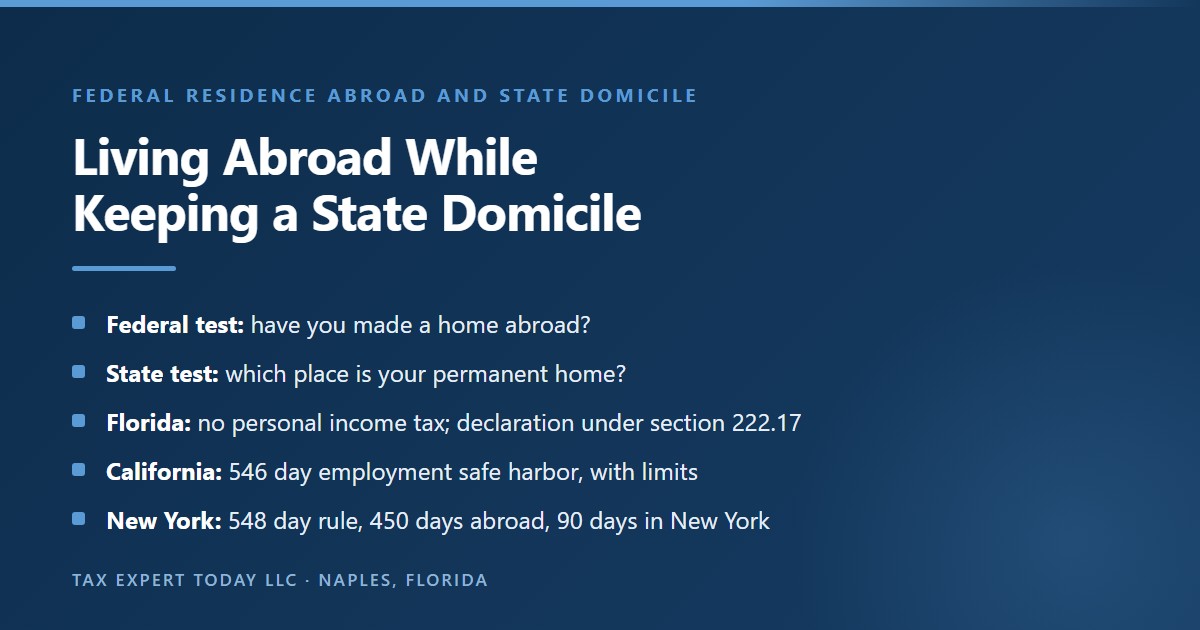
Florida does not impose a personal income tax, so a Florida domiciliary who moves abroad generally has no state income tax return to file on foreign wages. Many people therefore establish or confirm a Florida domicile before leaving, especially when they are leaving California or New York. Florida provides a formal tool for this. Under Florida Statutes section 222.17, a person who has established a Florida domicile may file a sworn declaration with the clerk of the circuit court “showing that he or she resides in and maintains a place of abode in that county which he or she recognizes and intends to maintain as his or her permanent home.” A person with homes in more than one state may declare that the Florida abode is the “predominant and principal home.” Our guide to establishing Florida residency covers the declaration, the driver license, voter registration, and the other domicile steps.
The federal and state claims can coexist, but the wording and timing deserve care. A declaration of domicile filed right before the move abroad, a Florida driver license, and a Florida voter registration are ordinary for an expat and are consistent with an intent to return. A Florida homestead exemption is a different kind of claim, because it rests on a representation that the Florida property is the owner’s permanent residence. Holding a homestead on a Naples home while telling the IRS on Form 2555 that you have made your home in Spain with your family is the kind of conflict the Form 2555 instructions warn about when they say acts carry more weight than words. The facts should be reviewed together, in one plan, before either filing is made.
| Question | Federal bona fide residence test | State domicile |
|---|---|---|
| What it decides | Eligibility for the foreign earned income exclusion and housing benefits | Which state, if any, can tax you as a resident |
| Core inquiry | Have you made a home abroad for an indefinite or prolonged period? | Which place do you intend as your permanent home? |
| Intent to return to the United States | Allowed | Usually the heart of the analysis |
| Key evidence | Foreign housing, family, visa, contract, foreign tax status, U.S. visits | Declaration of domicile, licenses, voting, property, where family and belongings are |
| Where reported | Form 2555 Part II | State return, or no return in Florida |
| Main risk | Denial of the exclusion for the year | A former state claiming you never left |
How do California and New York treat a domiciliary who lives abroad?
Both can keep taxing a domiciliary who moves abroad unless a specific exception applies. California has a safe harbor for employment-related absences of at least 546 consecutive days. New York has a 548-day rule for domiciliaries who spend at least 450 days abroad. Neither state simply follows the federal bona fide residence test.
- California: a domiciliary abroad under an employment-related contract for 546 consecutive days is generally treated as a nonresident, subject to exceptions.
- California limits: intangible income above $200,000 in a year, or a tax avoidance purpose, defeats the safe harbor.
- New York: the 548-day rule requires at least 450 days in foreign countries and no more than 90 days in New York for the taxpayer, spouse, and minor children.
- Changing domicile: moving domicile to Florida before leaving removes the need to rely on either exception.
The Franchise Tax Board explains California’s rule in FTB Publication 1031: “an individual domiciled in California who is outside California under an employment-related contract for an uninterrupted period of at least 546 consecutive days will be considered a nonresident unless” the individual has intangible income exceeding $200,000 in a taxable year while the contract is in effect, or the principal purpose of the absence is to avoid personal income tax. Return visits to California “that do not exceed a total of 45 days during any taxable year covered by the employment contract are considered temporary.” The safe harbor is tied to employment, so a retiree or a self-employed person abroad without a contract falls back on a facts and circumstances analysis. Our leaving California checklist covers the departure steps.
New York’s rule is in section 605(b)(1)(A)(ii) of the Tax Law, which the New York Form IT-203 instructions call the “548-day rule.” A New York domiciliary is not taxed as a resident if, within any period of 548 consecutive days, the taxpayer is present in a foreign country or countries for at least 450 days, and the taxpayer, the taxpayer’s spouse (unless legally separated), and the taxpayer’s minor children are not present in New York for more than 90 days during that period, with a further prorated limit for the partial years at each end. The instructions also tell taxpayers who received a federal Form 2350 extension to submit a copy of the approved form with the New York return. The broader problem of two states claiming one person is covered in our guide to the dual state residency tax trap.
| State of domicile when you leave | State income tax on foreign wages while abroad | Relief to look at |
|---|---|---|
| Florida | None; Florida has no personal income tax | Not needed; document the domicile |
| California | Possible if you remain a resident | 546-day employment safe harbor, or a facts and circumstances nonresidence claim |
| New York | Possible if you remain a resident | 548-day rule, or the 30-day rule for domiciliaries without a New York abode |
| Other income tax states | Depends on that state’s residency law | State specific; check whether the state follows the federal exclusion |
| Domicile changed to Florida before leaving | None, if the change is real and documented | Former state may audit the change of domicile |
New York’s 30-day rule, in the same statute, applies to a domiciliary who maintains no permanent place of abode in New York, maintains one elsewhere, and spends no more than 30 days of the year in New York. State rules change and depend on facts, so each state’s current law should be confirmed for the year in question.
What happens to the bona fide residence test in the year you move back to the United States?
If you completed at least one full qualifying year, the qualifying period runs until the date you abandon the foreign residence, so the departure year is prorated and still counts. If you leave before completing any full calendar year abroad, the bona fide residence test is not met, and only the physical presence test may help.
- After a full year: the last year is prorated through the abandonment date.
- Before a full year: no bona fide residence, whatever the reason, except under a listed war or civil unrest waiver.
- Earnings after return: income for work performed in the United States after the move is not excludable.
- Moving expenses: generally suspended for most taxpayers; check current law.
The IRS England example shows the departure year in action: residence through September 14, 2025 yields qualifying days from January 1 through September 14, 2025, because all of 2023 was a full year abroad. The danger is the short stay. Publication 54 answers a question from someone who returned early because of illness, and the answer is that no exclusion is available, because the taxpayer did not complete the qualifying period under either the bona fide residence test or the physical presence test. The foreign tax paid can still help, because the IRS adds that the taxpayer “may be able to claim that tax as a deduction or as a credit against your U.S. tax.”
Returning green card holders and long-term residents have one more item to consider. A person who gives up a green card after holding it in at least 8 of the last 15 years can fall under the expatriation rules, which our Form 8854 exit tax guide explains. That decision is separate from the exclusion, but it is often being made at the same time.
Can a retiree, a remote worker, or a digital nomad pass the bona fide residence test?
A retiree with a home abroad can pass the residence test but needs earned income for the exclusion to matter, since pensions and investment income are never excluded. A remote worker who settles in one country can pass it. A digital nomad moving every few months usually cannot, and relies on physical presence instead.
- Retirees: residence is often clear, but Social Security, pensions, and IRA withdrawals are not foreign earned income.
- Remote employees of U.S. companies: wages for work physically performed abroad are foreign source earned income, even if paid from the United States.
- Digital nomads: frequent moves, short leases, and tourist entries point toward transience.
- Tourist status: a stay limited by immigration law to a definite period weighs against residence.
The exclusion follows where the work is done, not where the employer is. Publication 54 describes foreign earned income as income “received for performing personal services in a foreign country.” A software developer employed by a Florida company who lives in Lisbon and works from a home office there earns foreign earned income for those workdays. Whether that developer is a bona fide resident of Portugal depends on the factors above: residence permit or visa type, lease, family, Portuguese tax status, and U.S. trips. A developer who spends three months in Lisbon, three in Mexico City, and three in Bangkok on tourist entries, with no local tax registration anywhere, is unlikely to be a bona fide resident of any of them, although that person may still pass the physical presence test if the days add up.
Retirees who move abroad face a different question. Many pass the bona fide residence test easily, with a purchased home, a residence visa, and a spouse living with them, but have little or no earned income. For them the test matters only for any part-time work or consulting abroad. Their pensions and Social Security remain fully taxable in the United States, subject to any relief under the relevant tax treaty and the foreign tax credit.
What other U.S. filings come with living abroad?
Passing the bona fide residence test changes how foreign wages are taxed, not what you must report. Expats generally still file Form 1040 if income exceeds the filing threshold, counting excluded income, plus FBAR for foreign accounts over $10,000 in aggregate, Form 8938 above the higher thresholds for those abroad, and forms for foreign entities.
- Filing requirement: Publication 54 says gross income for the filing test includes income you can exclude.
- FBAR: required when foreign accounts together exceed $10,000 at any time in the year.
- Form 8938: for taxpayers living abroad, generally above $200,000 at year end or $300,000 at any time if single, and $400,000 or $600,000 if married filing jointly.
- Foreign entities and funds: Forms 5471, 8865, 8858, and 8621 can apply depending on ownership.
A frequent misunderstanding is that a person whose foreign wages are entirely excluded has no U.S. return to file. Publication 54 is explicit: “For purposes of determining whether you must file a return, gross income includes any income that you can exclude as foreign earned income or as a foreign housing amount.” The exclusion is claimed on the return. If the return is not filed, there is no exclusion.
Foreign account reporting runs on a separate track with its own penalties. Our guide Do I need to file an FBAR? explains the $10,000 aggregate threshold, and FBAR versus Form 8938 sets the two regimes side by side. Expats who discover they missed prior years should read about how to file a late FBAR and the Streamlined Filing Compliance Procedures, which are available only where the failure was non-willful and require a certification of non-willful conduct under penalty of perjury. Penalty exposure is covered in our guide to FBAR penalties. Signature authority over an employer’s foreign account can create an FBAR obligation even without ownership, as explained in our FBAR signature authority guide.
| Filing | Trigger for an expat | Affected by the bona fide residence test? |
|---|---|---|
| Form 1040 with Form 2555 | Gross income, including excludable income, above the filing threshold | Yes; the test is how the exclusion is claimed |
| Form 2350 | First year, when the test will be met after the due date | Yes; it exists for this purpose |
| FinCEN Form 114 (FBAR) | Foreign accounts over $10,000 in aggregate at any time | No |
| Form 8938 | Specified foreign financial assets above the thresholds for taxpayers abroad | Indirectly; living abroad raises the thresholds |
| Form 1116 | Foreign tax credit on income not excluded | Yes; no credit on excluded income |
| Forms 5471, 8865, 8858, 8621 | Foreign companies, partnerships, disregarded entities, funds | No |
How does the bona fide residence test compare with the substantial presence test?
They work in opposite directions. The substantial presence test counts days to decide whether a foreign person becomes a U.S. resident. The bona fide residence test asks whether a U.S. citizen has made a home abroad. A green card holder abroad can face both, because U.S. residence continues while the person tries to qualify for the exclusion.
- Substantial presence: a weighted day count for people coming into the United States.
- Bona fide residence: a facts and circumstances test for people living outside the United States.
- Shared root: Reg. 1.911-2(c) borrows the section 871 resident versus transient standard.
- Arrival and departure years: people moving into or out of U.S. residence may file a dual status return.
For the inbound mirror of this test, see our guide to the substantial presence test, and for the closer connection exception that lets some visitors avoid U.S. residence, see Form 8840. A person who becomes or stops being a U.S. resident during the year may file a dual status tax return, and a nonresident who files only for U.S. source income uses Form 1040-NR.
What are the most common bona fide residence test mistakes?
The most common mistakes are claiming the test before a full calendar year abroad is complete, missing the Form 2350 deadline, telling the foreign country you are a nonresident, keeping a U.S. abode, excluding pay for U.S. workdays, and assuming excluded income means no return or no FBAR.
- Claiming too early: a first-year return filed with Part II before the full year is met is premature.
- Late Form 2350: it must be filed by the return’s due date, not after.
- Inconsistent foreign filings: a nonresident claim abroad can disqualify you under section 911(d)(5).
- U.S. abode: family and economic life left in the United States can cancel the foreign tax home.
- Ignoring the state: a former California or New York domicile can still produce a state bill.
| Mistake | What goes wrong | Safer approach |
|---|---|---|
| Claiming the test for a partial first year | No full calendar year yet, so the claim fails | File Form 2350 or file without the exclusion and amend |
| Filing Form 2350 after June 15 | The extension is not available | Calendar the extended due date at the time of the move |
| Nonresident statement to the host country | Section 911(d)(5) blocks bona fide residence | Coordinate foreign and U.S. filings; consider physical presence |
| Family stays in the U.S. home | Abode may remain in the United States | Review tax home and abode before relying on either test |
| Excluding salary for U.S. workdays | U.S. source income is not foreign earned income | Allocate wages by workdays and report the U.S. portion |
| Assuming no return is due | The exclusion cannot be claimed without a return | File every year income exceeds the threshold |
| Forgetting the five-year revocation rule | Switching to the credit can lock out the exclusion | Model both methods before the first election |
| Homestead and foreign residence claims together | Words and acts conflict | Review Florida and federal positions in one plan |
Bona Fide Residence Test Help in Naples & Southwest Florida
Tax Expert Today LLC works with expatriates and globally mobile families from an office in Naples, Florida and serves clients in all 50 states. Southwest Florida has a steady flow of people in both directions: Floridians taking assignments or retiring in Europe, Latin America, and Asia, and people who leave California or New York, establish a Florida domicile, and then move abroad. The bona fide residence test question usually arrives in the first spring after the move, when the first return is due and the full calendar year abroad has not yet passed. We help clients decide between the bona fide residence and physical presence tests, file Form 2350 on time, prepare Form 2555 Part II with a supporting residence file, allocate wages for U.S. workdays, model the exclusion against the foreign tax credit, and coordinate the Florida domicile record and any former state’s residency rules with the federal position.
- Bona fide residence test help Naples: first-year planning, Form 2350 extensions, and Form 2555 Part II preparation.
- International tax Naples FL: exclusion versus foreign tax credit modeling, housing amounts, and treaty questions.
- Foreign tax Naples: coordinating foreign residence filings so they do not undercut the U.S. claim.
- FBAR Naples: FBAR and Form 8938 reporting for expats and their families.
Our international and expat tax services page explains how we work with U.S. citizens and green card holders living abroad, and the international tax Naples FL guide covers the wider picture for Southwest Florida residents with foreign income, accounts, and property.
Office: 11983 Tamiami Trail N, Naples FL 34110
Phone: (239) 441-2005
Hours: Monday through Friday, 10:00 to 5:00 ET
Frequently Asked Questions
I live in Naples, Florida and I am moving to Spain this summer. Can I claim the bona fide residence test on my first return?
Not on a return filed by the normal deadline. The test requires an uninterrupted period that includes a full calendar year, so a summer 2026 move cannot qualify until all of 2027 is complete. You can file Form 2350 by the due date to extend until about 30 days after you qualify, or file on time without the exclusion and amend later.
Is the bona fide residence test the same as living abroad for a year?
No. The IRS says you do not automatically become a bona fide resident by living abroad for one year. The test looks at your intent and conduct, including housing, family, visa, employment terms, and foreign tax status, and the period must include an entire calendar year.
How many days can I spend in the United States under the bona fide residence test?
There is no fixed limit. Trips must be brief or temporary, and you must clearly intend to return to your foreign home without unreasonable delay. Pay for work performed during U.S. visits is not foreign earned income and stays taxable.
What is the difference between the bona fide residence test and the physical presence test?
The bona fide residence test asks whether you have made a genuine home abroad for a period including a full calendar year. The physical presence test only counts whether you were in a foreign country for at least 330 full days during any twelve consecutive months, regardless of intent.
Can a green card holder use the bona fide residence test?
Only if the green card holder is a citizen or national of a country with an income tax treaty in effect with the United States. Other resident aliens can still qualify for the exclusion under the physical presence test.
Does claiming to be a nonresident in my host country hurt my U.S. claim?
It can end it. Under section 911(d)(5), if you tell the foreign country’s authorities you are not a resident and they hold you not subject to their income tax as a resident on those earnings, you are not a bona fide resident of that country for the exclusion.
When to Engage a Professional
The bona fide residence test is short to state and easy to misapply. The facts are spread across two or three countries, the evidence is assembled years before an examiner might look at it, and the first-year timing rules leave little room for a late decision. The judgment calls are whether your facts will support residence or only physical presence, which deadline to calendar, whether foreign filings are consistent with the U.S. position, whether your abode has really moved, and whether your former state will accept that you left.
A professional review is worth considering before the move, before the first return after the move, when a host country offers a special nonresident or expatriate regime, when family members stay in the United States, when you keep a home in Florida or another state, when you work on U.S. soil during the year, or when prior returns were filed without the exclusion or without foreign account reporting.
Tax Expert Today LLC is a tax advisory firm in Naples, Florida serving clients in all 50 states. Call (239) 441-2005 to discuss your facts.
This article is general information, not legal or tax advice for any particular taxpayer, and does not create a client relationship. The examples are hypothetical illustrations only and do not describe any client, and the figures are simplified. Foreign residence and foreign tax treatment are determined under foreign law and should be reviewed by an adviser in that country. State residency and domicile depend on each state’s law and the taxpayer’s facts. The rules described here reflect 26 U.S.C. section 911, Treasury Regulations sections 1.871-2 and 1.911-2, IRS Publication 54, Form 2555 and its instructions, the IRS Form 2350 page, the IRS pages on the bona fide residence test, the physical presence test, the foreign tax home, and figuring the exclusion, Revenue Procedure 2026-16, Florida Statutes section 222.17, FTB Publication 1031, and the New York Form IT-203 instructions, as published when this article was written. Confirm current guidance before filing.
Published October 30, 2026 by Dr. Pellumb Kabashi « Back to Learning Center
Have a question this article touches on?
Tax Expert Today LLC, based in Naples, Florida and serving clients across the United States.
Schedule a Consultation (239) 441-2005