
By Dr. Pellumb Kabashi, DBA, MBA, EA, CFE, CES
Founder, Tax Expert Today LLC · Tax advisors, enrolled agents, CPAs, and attorneys · Serving clients in all 50 states
Quick Answer: A U.S. citizen or resident married to a nonresident alien spouse cannot file as single. The choices are married filing separately, head of household if a qualifying child or relative lives in the home, or a joint return after electing under section 6013(g) to treat the spouse as a U.S. resident, which brings the spouse’s worldwide income onto the return. Call (239) 441-2005 for a free consultation.
What does it mean to have a nonresident alien spouse for U.S. tax purposes?
A nonresident alien spouse is a husband or wife who is neither a U.S. citizen nor a U.S. resident under the green card or substantial presence test. When the other spouse is a citizen or resident, the couple cannot file jointly unless both elect to treat the foreign spouse as a U.S. resident for the year.
- The label is about tax status: immigration status, a visa, or a marriage certificate does not decide it; section 7701(b) of the Internal Revenue Code does.
- The default is separation: without an election, the foreign spouse’s foreign income stays off the U.S. return.
- Single is not an option: a married taxpayer chooses among married filing separately, head of household, or the joint election.
- The decision repeats: the election, once made, carries into later years until it is suspended or ended.
The situation is common. A U.S. citizen marries someone abroad and the spouse never moves to the United States. A U.S. citizen working overseas marries a local national. A green card holder living in Naples, Florida marries a person who still lives and works in another country while the immigration paperwork is pending. In each case one spouse files U.S. returns on worldwide income and the other, for U.S. purposes, is a nonresident alien who is taxed by the United States only on certain U.S. source income.
The IRS describes the core rule on its Nonresident Spouse page: if, at the end of the tax year, one spouse is a U.S. citizen or resident and the other is not, the couple “can choose to treat the nonresident spouse as a U.S. resident for tax purposes.” If they do not make that choice, the U.S. spouse files separately, or as head of household when the household facts support it. Publication 519 states the general prohibition plainly: “Generally, you cannot file as married filing jointly if either spouse was a nonresident alien at any time during the tax year.”
This guide is written for the ongoing marriage, the year after year situation in which the foreign spouse stays a nonresident and the couple has to choose a filing approach every spring. The year a spouse moves to or leaves the United States raises a different set of rules for that single year, and those are covered in our guide to the dual status tax return. The ranking explainers on this topic are short question and answer entries and forum threads. Ours puts the three filing choices side by side with 2026 numbers and shows what the joint election pulls onto the U.S. return before a couple makes a choice that, once ended, cannot be made again.
How do you know whether your spouse is a nonresident alien?
Your spouse is a nonresident alien for a tax year unless the spouse is a U.S. citizen, held a green card at any time in the year, or met the substantial presence test by counting days in the United States. A spouse who lives abroad and visits only briefly is almost always a nonresident alien.
- Green card test: lawful permanent residence at any time during the calendar year makes the spouse a resident.
- Substantial presence test: at least 31 days this year and 183 weighted days over three years, counting all of this year, one third of last year, and one sixth of the year before.
- Exempt days: certain students, teachers, trainees, and diplomats do not count days for a period of years.
- Closer connection: a spouse who meets the day count may still be a nonresident by filing Form 8840 in the right circumstances.
Residency for income tax purposes is defined in 26 U.S.C. section 7701(b). A person who is not a citizen is a resident alien only by meeting one of its tests. The day counting test is explained step by step in our guide to the substantial presence test, and the exception for a person with stronger ties to another country is in our guide to Form 8840 and the closer connection exception.
The practical point is that the answer can change from year to year. A spouse who spends a long winter in Southwest Florida while a visa application is pending can cross the substantial presence threshold without anyone noticing. A spouse who receives a green card in October becomes a resident for part of that year, which turns the year into a dual status year. Before choosing a filing status, confirm the foreign spouse’s status for the specific year being filed, using passport stamps, travel records, and the date on any immigration approval.
It also matters which spouse is the U.S. person. The rules in this guide apply in both directions: a U.S. citizen wife married to a foreign husband, a green card holder husband married to a foreign wife, or two people of the same sex in a marriage recognized where it was performed. The IRS rules turn on status at the end of the tax year and on the presence of at least one U.S. citizen or resident spouse, not on gender or on which spouse earns more.
| Foreign spouse’s situation in the tax year | Likely status | Where to look |
|---|---|---|
| Lives abroad all year, short visits to the United States | Nonresident alien | Section 7701(b), substantial presence day count |
| Holds a green card on any day of the year | Resident alien | Section 7701(b)(1)(A)(i), green card test |
| Spends long stretches in the United States without a green card | Possibly resident under the day count | Substantial presence test, Form 8840 exception |
| Moves to the United States during the year | Dual status for that year | Section 6013(h) and the dual status rules |
| Is a U.S. citizen by birth abroad or through a parent | U.S. citizen, taxed on worldwide income | Citizenship documents, not the tax tests |
One trap deserves a sentence of its own: some spouses are U.S. citizens without knowing it, usually because a parent was a U.S. citizen when they were born. A spouse who is actually a citizen is not a nonresident alien at all and has his or her own filing obligations, including foreign account reporting. If there is any family history of U.S. citizenship, settle that question before relying on anything below.
What filing statuses can you use when your spouse is a nonresident alien?
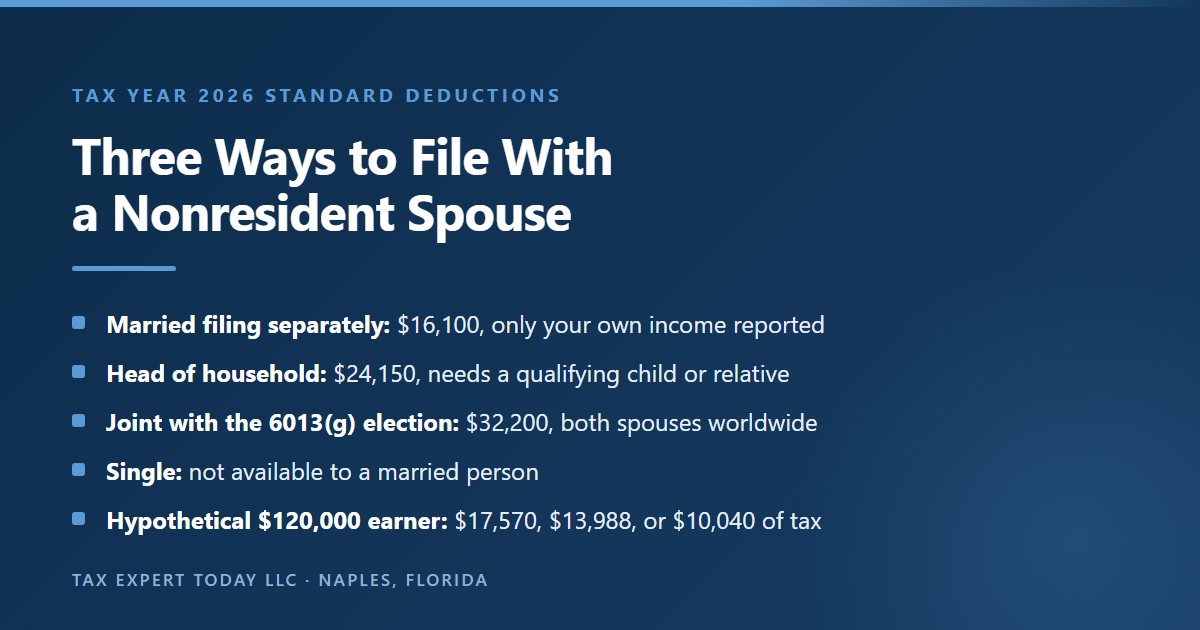
A U.S. citizen or resident with a nonresident alien spouse has three realistic options: married filing separately, which is the default; head of household, if the U.S. spouse maintains a home for a qualifying child or relative; or married filing jointly after both spouses elect under section 6013(g) to treat the foreign spouse as a resident.
- Married filing separately: only the U.S. spouse’s income is reported, with the smallest standard deduction and several credits lost.
- Head of household: the U.S. spouse is treated as unmarried for this purpose, with a larger deduction and wider brackets.
- Married filing jointly with the election: the lowest rates and largest deduction, at the price of reporting both spouses’ worldwide income.
- Single: not available to a married person, regardless of where the spouse lives.
For 2026 the gap between those choices is large. The IRS 2026 inflation adjustment release sets the standard deduction at $32,200 for married couples filing jointly, $16,100 for married individuals filing separately, and $24,150 for heads of household. The brackets follow the same pattern. The 12 percent bracket for a joint return runs to $100,800 of taxable income; for a separate return it ends at $50,400; for a head of household it ends at $67,450, according to the 2026 tables in Revenue Procedure 2025-32.
| Feature (tax year 2026) | Married filing separately | Head of household | Joint return with the 6013(g) election |
|---|---|---|---|
| Standard deduction | $16,100 | $24,150 | $32,200 |
| Top of the 12 percent bracket | $50,400 | $67,450 | $100,800 |
| Top of the 22 percent bracket | $105,700 | $105,700 | $211,400 |
| Foreign spouse’s foreign income reported | No | No | Yes, worldwide |
| Foreign spouse needs an SSN or ITIN | Not if the spouse is not otherwise required to have one | Not for the spouse | Yes |
| Extra requirement | None | A qualifying child or relative and a home maintained for more than half the year | A signed election statement with the first joint return |
| Follows the couple into later years | No | No | Yes, until suspended or ended |
The table explains why there is no universal answer. A couple in which the foreign spouse earns little or nothing usually saves money by filing jointly, because the U.S. spouse’s income is spread across the wider joint brackets. A couple in which the foreign spouse earns a substantial salary, owns investment accounts, or holds foreign funds may pay more, and file far more paperwork, by bringing that income and those assets into the U.S. system. A U.S. spouse raising a child in a home in Florida may get most of the benefit through head of household status without making any election at all. The sections that follow walk through each option and then price them side by side.
Can you file as single if your spouse is a nonresident alien?
No. A person legally married at the end of the year cannot file as single, even if the spouse has never been to the United States, has no U.S. income, and has no Social Security number. The filing status must be one of the married options or head of household.
- Common error: tax software users check “single” because the spouse has no U.S. number.
- Why it matters: a single return understates the tax compared with married filing separately, because single and separate brackets differ at higher incomes.
- The fix: married filing separately with “NRA” entered where the spouse’s number would go, if the spouse has no number and is not required to have one.
- The legitimate alternative: head of household, which is not single status but often produces a better result.
The mistake usually begins with software. A return preparation program asks for the spouse’s Social Security number, the U.S. spouse has none to enter, and the easy way forward appears to be the single box. The Form 1040 instructions address this directly for married filing separately: when the spouse does not have, and is not required to have, an SSN or ITIN, the filer enters “NRA” in the entry space. For electronic filing, the instructions direct the filer to enter the spouse’s name or “NRA” in the entry space. That is the mechanism for a separate return; it is not permission to file as single.
The difference between single and separate status shows up most at higher incomes. In 2026 the 35 percent bracket begins at the same point for single and separate filers, but the 37 percent bracket begins at $640,600 for a single filer and at half the joint threshold for a married person filing separately, according to Revenue Procedure 2025-32. Credits and deductions with income phaseouts also use different thresholds for separate filers. A return filed as single when the taxpayer was married is a return with the wrong filing status, and correcting it later can mean an amended return, additional tax, and interest.
The opposite misconception also circulates: that a U.S. citizen married to a foreign national must file jointly and report the spouse’s income. That is not the default. The joint return with a nonresident spouse exists only because both spouses choose it. A couple that does nothing is filing separately, and the foreign spouse’s foreign income stays outside the U.S. system.
How does married filing separately work with a nonresident alien spouse?
On a married filing separately return, the U.S. spouse reports only his or her own worldwide income and deductions. The foreign spouse’s foreign income is not reported, and the foreign spouse generally files nothing unless the spouse has U.S. source income that requires a Form 1040-NR. The cost is the smallest deduction and the loss of several credits.
- What goes on the return: the U.S. spouse’s wages, self-employment income, investment income, and foreign income from all sources.
- What stays off: the foreign spouse’s salary, foreign bank interest, foreign pension, and foreign investments.
- 2026 standard deduction: $16,100.
- Credits usually lost: the earned income credit, the education credits, and in most cases the child and dependent care credit.
Separate filing is the simplest structure and keeps the foreign spouse entirely out of U.S. information reporting. The U.S. spouse checks the married filing separately box, enters the foreign spouse’s name, and enters either the spouse’s identifying number or “NRA” as described in the Form 1040 instructions. There is no election statement and nothing to revoke later.
The costs are real. Publication 519 notes that the American opportunity and lifetime learning credits cannot be claimed by a person who is married filing separately. The earned income credit under section 32(d) applies to a married individual “only if a joint return is filed,” subject to a special rule for separated spouses discussed below. The credit for child and dependent care expenses also generally requires a joint return for married taxpayers, with an exception for certain married individuals living apart. Several deductions and credits also phase out at lower income levels for separate filers than for joint filers.
Separate filing does not change the U.S. spouse’s own foreign reporting. A U.S. citizen who files separately still reports worldwide income, still files an FBAR if the U.S. spouse’s own foreign accounts, including accounts held jointly with the foreign spouse, exceed $10,000 in the aggregate at any time during the year, and still files Form 8938 if the U.S. spouse’s specified foreign financial assets exceed the thresholds for a separate filer. Our guide to whether you need to file an FBAR covers the account test, and the guide to FBAR versus Form 8938 covers the second form.
The foreign spouse may have a U.S. filing requirement in his or her own right. A nonresident alien who earns income from work performed in the United States, owns U.S. rental property, or receives U.S. source income that was not fully covered by withholding may need to file a Form 1040-NR nonresident return. That filing is separate from the U.S. spouse’s return and covers only U.S. source and effectively connected income. Joint ownership of a U.S. rental property, for example, can create a 1040-NR filing for the foreign spouse even though the couple files separately.
When can you file as head of household with a nonresident alien spouse?
A U.S. citizen or resident is treated as not married for head of household purposes if the spouse was a nonresident alien during the year and no election is made. The U.S. spouse qualifies by paying over half the cost of a home shared with a qualifying child or relative, other than the spouse.
- Statutory basis: section 2(b)(2)(B) says a taxpayer “shall be considered as not married” if the spouse is a nonresident alien at any time during the year.
- The spouse never qualifies: the qualifying person must be someone other than the nonresident spouse.
- 2026 benefit: a $24,150 standard deduction and a 12 percent bracket that runs to $67,450.
- Not available with the election: a couple that elects joint filing is married for all purposes on that return.
The rule comes from 26 U.S.C. section 2(b)(2)(B), which provides that “a taxpayer shall be considered as not married at the close of his taxable year if at any time during the taxable year his spouse is a nonresident alien.” The IRS Nonresident Spouse page restates it in practical terms: if the couple does not choose to treat the nonresident spouse as a U.S. resident, the U.S. spouse “may be able to use head of household filing status,” provided the U.S. spouse pays more than half the cost of maintaining a household for certain dependents or relatives “other than your nonresident spouse.”
The household test is where most claims succeed or fail. A qualifying child generally must live with the U.S. spouse for more than half the year, with exceptions for temporary absences such as school. A child who lives abroad with the foreign parent and visits the United States for the summer usually does not meet that test for the U.S. parent. A dependent must also generally be a U.S. citizen, U.S. national, U.S. resident, or a resident of Canada or Mexico, so a child born and living abroad may need U.S. citizenship documentation and a Social Security number to be claimed. A dependent parent can qualify the U.S. spouse for head of household without living in the same home, if the U.S. spouse pays more than half the cost of the parent’s home and the parent meets the dependency rules.
Head of household status is not available to a nonresident alien at any time during the year, a limit that appears in section 2(b)(3). That limit applies to the foreign spouse, not the U.S. spouse. Publication 519 also cautions that a person treated as unmarried for head of household purposes “may still be considered married for purposes of the earned income credit,” in which case the special rule for separated spouses must be met to claim that credit.
For many U.S. citizens living in Florida with a child from the marriage while the other parent remains abroad, head of household is the overlooked middle option. It captures much of the rate benefit of a joint return without bringing the foreign spouse’s income, accounts, and investments into U.S. reporting, and it requires no election that will follow the couple into later years.
What is the section 6013(g) election to treat a nonresident spouse as a U.S. resident?
The section 6013(g) election lets a U.S. citizen or resident and a nonresident alien spouse jointly choose to treat the foreign spouse as a U.S. resident for the entire tax year. A joint return is required for the first year, both spouses are taxed on worldwide income, and the election continues until suspended or ended.
- Who can elect: a nonresident alien married, at the close of the year, to a U.S. citizen or resident, with both spouses joining.
- Scope: the foreign spouse is a resident for chapter 1 income tax and for wage withholding under chapter 24.
- First year: a joint return is required for the year the election is made.
- Later years: joint or separate returns are allowed, but both spouses remain residents for income tax while the election is in effect.
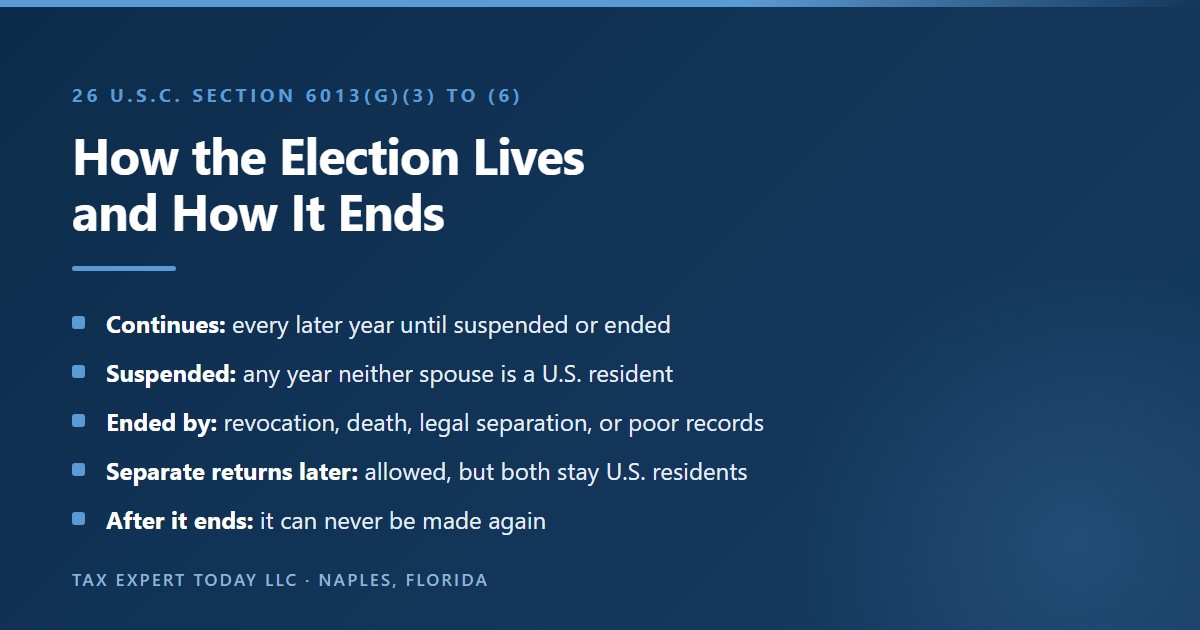
Section 6013(g)(1) provides that a nonresident alien individual for whom the election is in effect “shall be treated as a resident of the United States” for purposes of chapter 1 for all of the taxable year, and for purposes of chapter 24 wage withholding. Section 6013(g)(2) makes the election available to an individual who, at the close of the taxable year, “was a nonresident alien individual married to a citizen or resident of the United States, if both of them made such election.” Section 6013(g)(3) then provides that the election “shall apply to the taxable year for which made and to all subsequent taxable years until terminated,” except in a year when neither spouse is a citizen or resident.
The IRS Nonresident Spouse page lists the consequences. The spouses are treated as U.S. residents for all years the choice is in effect; for Social Security and Medicare withholding, the nonresident spouse may still be treated as a nonresident. A joint return is required for the year of the choice, but “you and your spouse can file joint or separate returns in later years.” Each spouse “must report their entire worldwide income for the year you make the choice and for all later years unless the choice is ended or suspended.” And generally neither spouse can claim treaty benefits as a resident of a foreign country while the choice is in effect.
The regulations at section 1.6013-6 illustrate the reach of the election with an example: a U.S. citizen husband and a nonresident wife who make the election must include in gross income their income “from sources within and without the United States” for the election year and later years. The regulation also includes a protective example: a couple unsure whether the foreign spouse is already a resident can make the election to cover the possibility that she is not, and the election “will not be considered evidence” that she was a nonresident.
Two features separate this election from almost every other filing choice. It is joint, so both spouses must sign the election statement, and either spouse can later revoke it. And it is durable. A couple that elects in 2026 to capture a lower tax bill is also choosing, unless one of them revokes in time, how the foreign spouse will be taxed in 2027, 2028, and beyond, including in years when the foreign spouse’s income or assets may look very different.
How do you make the 6013(g) election on a joint return?
Both spouses sign a statement attached to their first joint Form 1040. It declares that on the last day of the year one spouse was a nonresident alien and the other a U.S. citizen or resident, that both choose resident treatment for the entire year, and lists each spouse’s name, address, and identification number.
- Form 1040: check the box in the Filing Status section and enter the nonresident spouse’s name.
- Signed statement: declaration of status at year end and the choice to be treated as residents for the entire year.
- Identification: name, address, and SSN or ITIN for each spouse.
- Later years: check the same box while the choice remains in effect, without a new statement.
Publication 519 describes the mechanics under How To Make the Choice: “check the box in the Filing Status section of Form 1040 or 1040-SR and enter the name of the nonresident spouse in the entry space, and attach a statement, signed by both spouses, to your joint return for the first tax year for which the choice applies.” The statement must contain “a declaration that one spouse was a nonresident alien and the other spouse a U.S. citizen or resident alien on the last day of your tax year, and that you choose to be treated as U.S. residents for the entire tax year,” together with the name, address, and taxpayer identification number of each spouse. If one spouse has died, the statement includes the name and address of the person making the choice for the deceased spouse.
The election can also be made late. The IRS Nonresident Spouse page explains that a couple “can also make the choice by filing a joint amended return on Form 1040X” within three years from the date the original return was filed or two years from the date the tax was paid, whichever is later. There is a catch that is easy to miss: “If you make the choice with an amended return, you and your spouse must also amend any returns that you may have filed after the year for which you made the choice.” A late election is therefore not a single amended return. It can be a chain of amended returns, each bringing the foreign spouse’s worldwide income for that year into the computation.
| Step | What it involves | Authority |
|---|---|---|
| 1. Confirm status | One spouse a U.S. citizen or resident and the other a nonresident alien on December 31 | Section 6013(g)(2); Publication 519 |
| 2. Obtain a number | SSN if eligible, otherwise an ITIN through Form W-7 attached to the joint return | IRS Nonresident Spouse page; Instructions for Form W-7 |
| 3. Prepare the statement | Declaration, names, addresses, numbers, both signatures | Publication 519, How To Make the Choice |
| 4. File the joint return | Form 1040 with the box checked, both spouses’ worldwide income, and the statement attached | Section 6013(g); Regulations section 1.6013-6 |
| 5. Add the information returns | Form 8938, Form 8621, Form 1116 or 2555, and others as the foreign spouse’s assets and income require | Instructions for Form 8938 and the related forms |
| 6. Later years | Check the box again; report worldwide income for both spouses until the choice is suspended or ended | Section 6013(g)(3) |
A practical note on signatures: the foreign spouse must sign both the statement and the joint return. For a couple living on different continents, that means planning the paperwork early, especially in the first year when an original signed Form W-7 may also be required.
Does a nonresident alien spouse need an ITIN or Social Security number?
For a joint return under the election, yes. The foreign spouse needs a Social Security number or, if not eligible for one, an Individual Taxpayer Identification Number obtained by filing Form W-7 with the joint return. For a separate return, the U.S. spouse can enter “NRA” if the foreign spouse has no number and is not required to have one.
- W-7 category: box e, spouse of a U.S. citizen or resident alien electing to file jointly.
- Timing: the W-7 is submitted with the first joint return, not before it.
- Documents: a passport or other identity documents, original or certified by the issuing agency, or verified through an acceptance agent or IRS office.
- Expiration: an ITIN not used on a federal return for three consecutive years expires and must be renewed.
The IRS Nonresident Spouse page states that a nonresident spouse included on a joint or separate return “must have either a Social Security Number (SSN) or an Individual Taxpayer Identification Number (ITIN),” and that a spouse not eligible for an SSN “can file Form W-7 with the IRS to apply for an ITIN.” Publication 54 adds the timing: the spouse can apply for an ITIN “when you timely file the joint return on which you choose to treat your nonresident alien spouse as a U.S. resident.” For a separate return, the Form 1040 instructions allow “NRA” when the spouse does not have and is not required to have a number.
The Instructions for Form W-7 describe category e, Spouse of U.S. citizen/resident alien, as covering a resident or nonresident alien spouse who is not eligible for an SSN and who is “electing to file a U.S. federal tax return jointly with a spouse who is a U.S. citizen or resident alien.” The applicant enters the full name and SSN or ITIN of the U.S. spouse. The instructions also note that, for tax years after 2017, spouses are not eligible for an ITIN unless they are claimed for an allowable tax benefit or file their own return, which is why the W-7 travels with the joint return rather than being filed in advance.
The expiration rule matters for couples who elect in one year and file separately or have the election suspended later. The W-7 instructions state that an ITIN not included “on at least one U.S. federal tax return for the last 3 consecutive tax years” expires on December 31 of the third year and must be renewed before it is used again. A couple returning to joint filing after a gap should check the number before filing, because an expired ITIN can delay processing. The steps for the application itself, including where to send it and how acceptance agents work, are in our guide to Form W-7.
The first joint return with a new ITIN application is typically filed on paper, because the W-7 and its documents must accompany the return. That affects timing. A couple expecting a refund from switching to joint filing should expect a longer wait the first year than a routine electronic return would take.
How do the three filing choices compare in dollars when the foreign spouse has no income?
In a hypothetical 2026 example with a U.S. spouse earning $120,000 and a foreign spouse with no income, the joint election produces about $10,040 of federal income tax, head of household about $13,988, and married filing separately about $17,570. When the foreign spouse earns nothing, joint filing usually wins on tax alone.
- Joint return: $120,000 less the $32,200 deduction leaves $87,800, taxed at no more than 12 percent.
- Head of household: $120,000 less $24,150 leaves $95,850, with part of it taxed at 22 percent.
- Separate return: $120,000 less $16,100 leaves $103,900, with more of it taxed at 22 percent.
- The spread: about $7,530 a year between the best and worst choice in this example.
This example is hypothetical and simplified. It assumes a U.S. citizen living in Naples, Florida with $120,000 of wages, a spouse who lives abroad with no income of any kind, and a child who lives with the U.S. spouse all year, so that head of household is available. It uses the 2026 standard deductions from the IRS inflation release and the 2026 rate tables in Revenue Procedure 2025-32, and it ignores credits, which would be roughly the same across the three choices for a single child at this income, and state tax, which Florida does not impose on personal income.
| Hypothetical 2026 computation | Married filing separately | Head of household | Joint return with the election |
|---|---|---|---|
| U.S. spouse’s wages | $120,000 | $120,000 | $120,000 |
| Foreign spouse’s income | Not reported | Not reported | $0 |
| Standard deduction | $16,100 | $24,150 | $32,200 |
| Taxable income | $103,900 | $95,850 | $87,800 |
| Tax computation | $5,800 plus 22% of $53,500 | $7,740 plus 22% of $28,400 | $2,480 plus 12% of $63,000 |
| Federal income tax | $17,570 | $13,988 | $10,040 |
| Difference from separate filing | None | $3,582 lower | $7,530 lower |
The arithmetic is simple, and it explains why so many couples are told to file jointly. The joint brackets are twice as wide as the separate brackets, so a single earner on a joint return keeps more income in the 10 and 12 percent brackets. Head of household sits between the two because its brackets and deduction are larger than the separate amounts and smaller than the joint amounts.
But the example is built on a clean assumption: a foreign spouse with no income, no foreign accounts, no foreign investment funds, no pension, and no foreign business. Real couples rarely look like that for long. A spouse who returns to work, inherits an investment account, or contributes to a pension plan at home changes the comparison, and once the election is in place it applies to those new items automatically. The next sections show how quickly the answer can change.
What happens to the comparison when the nonresident spouse has foreign income?
When the foreign spouse earns a salary taxed abroad, the joint election can stop being the cheapest choice. In a hypothetical where the foreign spouse earns $70,000 and pays $17,500 of foreign tax, the joint return costs about $15,246 after the foreign tax credit, more than the $13,988 head of household figure.
- Why: the joint return adds the foreign salary to U.S. taxable income, and the foreign tax credit is capped at the U.S. tax on that income.
- Excess foreign tax: foreign tax above the cap is not refunded; it carries to other years under the foreign tax credit rules.
- Exclusion route: excluding the salary under section 911 produces about $16,236 because of the stacking rule.
- Takeaway: the more the foreign spouse earns, the more carefully the joint election has to be priced.
Keep the same hypothetical household from the previous section, a U.S. citizen in Naples, Florida earning $120,000 with a child at home, and change one fact: the foreign spouse earns $70,000 of wages from work performed abroad and pays $17,500 of income tax to the home country, an effective rate of 25 percent. On a separate return or a head of household return, nothing about the U.S. spouse’s computation changes, because the foreign spouse’s income is not on the return. On a joint return under the election, the $70,000 must be reported, and the couple must then decide how to relieve the double tax.
Using the foreign tax credit, joint taxable income is $190,000 less the $32,200 deduction, or $157,800. The 2026 joint tax on that amount is $24,140 ($11,600 plus 22 percent of the $57,000 above $100,800). The credit is limited to the share of U.S. tax attributable to foreign source taxable income. On Form 1116 the standard deduction is apportioned by gross income, so foreign taxable income in this example is about $58,137 of the $157,800 total, and the limit is about $8,894. The U.S. tax after the credit is about $15,246, and roughly $8,606 of foreign tax is left over as an excess credit.
| Hypothetical 2026 result | Separate | Head of household | Joint, foreign tax credit | Joint, earned income exclusion |
|---|---|---|---|---|
| Income on the U.S. return | $120,000 | $120,000 | $190,000 | $190,000, with $70,000 excluded |
| Taxable income | $103,900 | $95,850 | $157,800 | $87,800 |
| Tax before relief | $17,570 | $13,988 | $24,140 | $24,140 less $7,904 under the stacking rule |
| Foreign tax relief | Not applicable | Not applicable | Credit of about $8,894 | Exclusion; no credit on the excluded wages |
| U.S. federal income tax | $17,570 | $13,988 | About $15,246 | About $16,236 |
| Foreign tax still paid abroad | $17,500 by the foreign spouse | $17,500 by the foreign spouse | $17,500, about $8,606 carried over | $17,500 |
The exclusion route works differently. If the foreign spouse qualifies for the foreign earned income exclusion, the $70,000 is excluded, but section 911(f) requires the tax on the remaining income to be computed as if the excluded amount were still there. The tax is the tax on $157,800 ($24,140) minus the tax on $70,000 ($7,904), or $16,236. The exclusion protects the foreign salary but pushes the U.S. spouse’s wages into the 22 percent bracket anyway.
In this household, head of household is the lowest federal figure, and it involves no foreign spouse reporting at all. Without the child, head of household disappears, and the choice narrows to separate filing at $17,570 against joint filing at about $15,246, a gap of roughly $2,300 that has to be weighed against the reporting the election brings with it. These are illustrations, not projections. The actual numbers depend on the foreign country’s tax rate, the type of income, credits, the U.S. spouse’s own foreign income, and whether excess credits from earlier years are available. The point is structural: the joint election is not automatically the cheaper choice once the foreign spouse has income.
Can a nonresident spouse treated as a resident claim the foreign earned income exclusion?
Possibly, but usually only through the physical presence test. Section 911(d)(1)(B) allows the exclusion to “a citizen or resident of the United States” present in a foreign country for at least 330 full days in 12 consecutive months. The bona fide residence test in 911(d)(1)(A) is written for citizens, with treaty nondiscrimination rules sometimes extending it.
- 2026 exclusion amount: $132,900 per qualifying person, according to the IRS inflation release.
- Tax home: the spouse’s tax home must be in a foreign country.
- Physical presence: 330 full days abroad in a 12 month period, which a spouse who lives abroad full time usually meets.
- Interaction: no foreign tax credit on foreign tax attributable to excluded income.
Section 911(d)(1) defines a qualified individual as one whose tax home is in a foreign country and who is either (A) “a citizen of the United States” who is a bona fide resident of a foreign country for an uninterrupted period that includes an entire taxable year, or (B) “a citizen or resident of the United States” who is present in a foreign country or countries during at least 330 full days in any 12 consecutive months. A nonresident spouse treated as a resident under section 6013(g) is a resident for chapter 1 purposes, and the exclusion is a chapter 1 provision, so the physical presence route is the natural fit for a spouse who lives abroad.
Each spouse who qualifies computes the exclusion separately on his or her own Form 2555, even on a joint return. For 2026 the IRS release sets the maximum exclusion at $132,900. The exclusion only covers earned income, wages, salaries, and professional fees for services, and not investment income, pensions, or rental income. A foreign spouse with substantial investment income will still bring that income onto the joint return even if the salary is excluded.
Choosing between the exclusion and the credit is a decision with its own long-term effects, because revoking the exclusion has a waiting period before it can be chosen again. Our comparison of the foreign earned income exclusion versus the foreign tax credit explains that trade-off in detail. For a couple considering the 6013(g) election, the relevant question comes first: whether bringing the foreign spouse’s salary into the U.S. system produces any benefit at all, after the exclusion or credit has done its work.
The stacking rule in section 911(f) is the piece most often missed. A couple who expects the exclusion to remove the foreign salary entirely, leaving the U.S. spouse’s wages to be taxed in the low joint brackets, will be surprised to find that the U.S. spouse’s wages are taxed as though the excluded salary were still at the bottom of the brackets.
How does the foreign tax credit work on a joint return with a foreign spouse?
On a joint return, foreign income taxes paid by either spouse can be claimed on Form 1116, limited to the U.S. tax on foreign source taxable income. When the foreign rate is higher than the U.S. rate, the credit usually covers the foreign salary and leaves excess credits that carry back one year and forward ten.
- Form: Form 1116, generally one for each category of income, such as general and passive.
- Limit: U.S. tax multiplied by foreign source taxable income over worldwide taxable income.
- Excess: unused foreign tax carries back one year and forward ten years.
- Effect on the U.S. spouse: the credit never reduces U.S. tax on the U.S. spouse’s U.S. source wages.
The credit is the reason a high-earning foreign spouse in a high-tax country often adds little or no net U.S. tax on his or her own salary. In the hypothetical above, the foreign spouse’s $17,500 of foreign tax more than covered the U.S. tax attributable to the $70,000 salary. What the credit cannot do is reduce the U.S. tax on the U.S. spouse’s own wages. Adding the foreign salary to the return pushed more of the U.S. spouse’s wages into the 22 percent bracket, and that extra tax remained.
The credit also has categories. Wages fall in the general category. Interest, dividends, and most investment income fall in the passive category, and the limit is computed separately for each. A foreign spouse with modest investment income taxed at a low foreign rate can produce U.S. tax on the passive side even when the salary side is fully covered. Our guide to Form 1116 and the foreign tax credit walks through the categories, the limit, and the carryover rules.
Excess credits are not useless. Unused foreign tax can carry back one year and forward ten years under section 904(c), which matters for a couple who expect to elect for several years and whose mix of income will change. But carryovers have to be tracked year by year on Form 1116 Schedule B, and they require the couple to keep filing in a way that lets them be used. Excess credits generated while the election is in effect do not help on a later separate return of a spouse who is no longer a U.S. taxpayer.
Currency conversion adds another layer. Foreign taxes are generally translated to dollars using the exchange rate for the date paid or an average rate, depending on the method used, and foreign income is translated at the rates that apply to the type of income. A couple whose foreign salary is paid in euros, pounds, or pesos will see the U.S. numbers move from year to year even when the salary in local currency does not.
What does the joint election pull onto the U.S. return besides income?
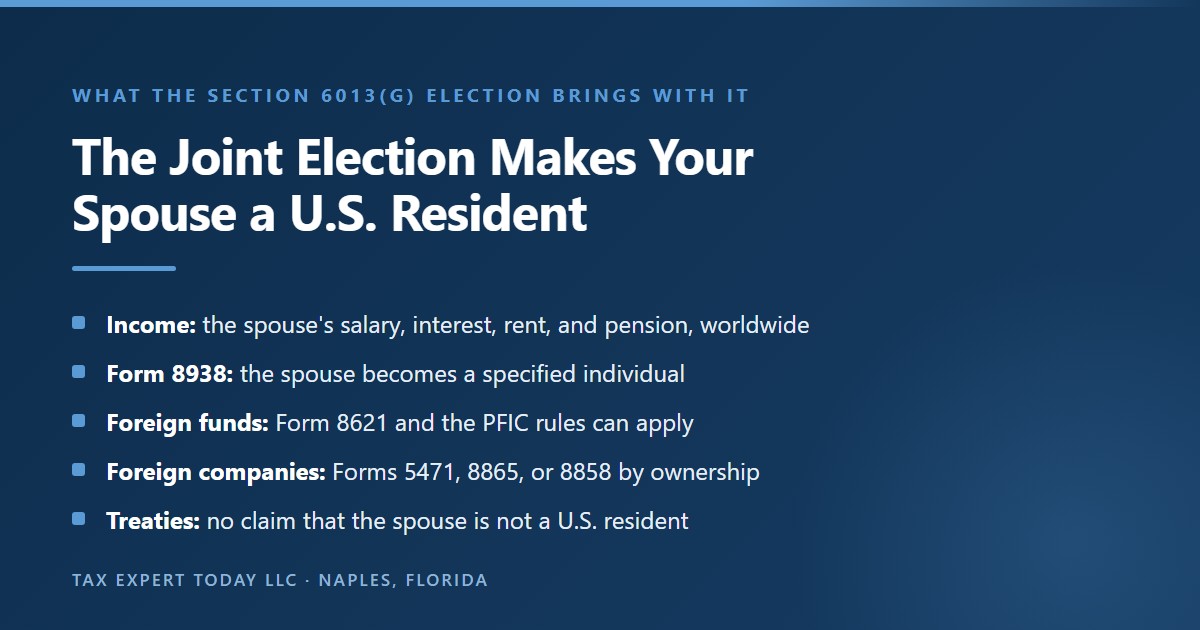
Once the foreign spouse is a resident under section 6013(g), the spouse is generally treated like any other U.S. resident for income tax reporting. That can bring Form 8938 for foreign financial assets, Form 8621 for foreign mutual funds, Forms 5471 or 8858 for foreign companies, and reporting of foreign pensions and foreign real estate income onto the joint return.
- Foreign accounts and securities: Form 8938 if the thresholds are met.
- Foreign funds: passive foreign investment company reporting on Form 8621, often with punitive default rules.
- Foreign businesses: Forms 5471, 8865, or 8858 for owned or controlled entities.
- Foreign pensions and rentals: income and gains reported under U.S. rules, with treaty relief limited by the saving clause.
This is the part of the decision that the short explainers skip. The tax savings in a no-income year are easy to see. The compliance load is easier to underestimate, and it applies automatically because the election makes the foreign spouse a resident for the whole of chapter 1, not just for the rate tables. A foreign spouse who holds a bank account, a brokerage account, a pension plan, a local investment fund, or a share of a family company abroad will often find that each one carries a U.S. form.
| Foreign spouse’s asset or activity | Possible U.S. reporting once the election applies | Where to read more |
|---|---|---|
| Bank and brokerage accounts | Form 8938 if the joint thresholds are exceeded; interest and dividends on the return | FBAR vs Form 8938 |
| Foreign mutual funds or exchange traded funds | Form 8621 and the passive foreign investment company rules | Form 8621 and PFIC reporting |
| Salary and bonuses | Earned income; Form 2555 or Form 1116 for relief | Exclusion vs credit |
| Ownership in a foreign corporation | Form 5471 depending on ownership and control, plus possible GILTI or Subpart F income | Form 5471 |
| Interest in a foreign partnership | Form 8865 depending on ownership and role | Form 8865 |
| Foreign rental property | Rental income and depreciation under U.S. rules; gain on sale | Schedule E and Publication 54 |
| Gifts or inheritances from foreign relatives | Form 3520 if gifts from a foreign person exceed $100,000 in a year | Form 3520 |
Not every item applies to every couple, and thresholds and exceptions narrow many of them. But the table shows why the decision should be made with a full list of the foreign spouse’s assets and income in hand. A couple who files jointly in a year when the foreign spouse has only a checking account may find, two years later, that the same election now requires a Form 8621 for every foreign fund in a new retirement or savings plan, prepared under rules that were designed to discourage U.S. persons from holding those funds at all.
The penalties attached to some of these forms are separate from the income tax. Form 8938 and Form 5471, for example, carry their own penalties for failure to file, and some extend the statute of limitations on the whole return while the form is missing. That is a reason to treat the first joint year as the start of a reporting program, not a one-time filing.
Does the 6013(g) election make the foreign spouse file Form 8938?
It can. The Instructions for Form 8938 list “a nonresident alien who makes an election to be treated as a resident alien for purposes of filing a joint income tax return” as a specified individual. On a joint return, the couple files Form 8938 if their combined specified foreign financial assets exceed the joint threshold for where they live.
- Joint return, living in the United States: more than $100,000 on the last day of the year or more than $150,000 at any time.
- Joint return, living abroad: more than $400,000 on the last day of the year or more than $600,000 at any time.
- Separate return, living in the United States: more than $50,000 at year end or $75,000 at any time.
- No return required: no Form 8938, even if the assets exceed the threshold.
The Instructions for Form 8938 set out the specified individual categories: a U.S. citizen, a resident alien for any part of the year, “a nonresident alien who makes an election to be treated as a resident alien for purposes of filing a joint income tax return,” and certain bona fide residents of American Samoa or Puerto Rico. That third category is directly about the 6013(g) election. Without the election, a foreign spouse living abroad is not a specified individual, and only the U.S. spouse’s own assets matter.
The instructions also give the thresholds. For a married couple filing a joint return and living in the United States, the threshold is met only if specified foreign financial assets are “more than $100,000 on the last day of the tax year or more than $150,000 at any time during the tax year.” For a couple living abroad, as defined in the instructions, the joint figures are more than $400,000 on the last day of the year or more than $600,000 at any time. A married person filing separately uses $50,000 and $75,000 in the United States, or $200,000 and $300,000 abroad.
| Form 8938 filing situation (Instructions for Form 8938) | Threshold on the last day of the year | Threshold at any time during the year |
|---|---|---|
| Joint return, living in the United States | More than $100,000 | More than $150,000 |
| Joint return, living abroad (presence abroad test met) | More than $400,000 | More than $600,000 |
| Married filing separately, living in the United States | More than $50,000 | More than $75,000 |
| Married filing separately, living abroad | More than $200,000 | More than $300,000 |
| No income tax return required for the year | No Form 8938, even if the assets exceed the threshold | |
The difference between those thresholds is important for a couple in which the U.S. spouse lives in Florida and the foreign spouse lives abroad. The higher “living abroad” thresholds apply only to a taxpayer whose tax home is in a foreign country and who meets a presence abroad test, which the instructions describe as bona fide residence abroad for a U.S. citizen or presence in a foreign country for at least 330 full days in 12 consecutive months. A U.S. spouse who lives in Florida does not meet that test, so a couple split between two countries should confirm the test is met before assuming the higher figures apply.
Form 8938 reports a wide range of assets beyond bank accounts, including foreign securities held outside a financial account, interests in foreign entities, and certain foreign pension and deferred compensation interests. Our guide comparing the FBAR and Form 8938 sets the two regimes side by side, including what each one counts and who must file.
Does the election make the foreign spouse a U.S. person for FBAR purposes?
The FBAR rule defines a U.S. resident by reference to section 7701(b), the green card and substantial presence tests, and does not mention the 6013(g) election. Read on its face, the election alone does not appear to make the foreign spouse a U.S. person for FBAR. The U.S. spouse still reports accounts owned, co-owned, or signed on.
- Regulation: 31 CFR 1010.350(b) covers citizens, residents under section 7701(b), and U.S. entities.
- Joint accounts: an account held jointly with the foreign spouse is fully reportable by the U.S. spouse.
- Signature authority: the U.S. spouse reports accounts he or she can sign on, even if owned by the foreign spouse.
- Caution: the FBAR and Form 8938 answers can differ for the same spouse in the same year.
The FBAR is a Bank Secrecy Act report under Title 31, not an income tax form. Its definition of “United States person” in 31 CFR 1010.350(b) includes a citizen, a resident of the United States, and U.S. entities. A resident is “an individual who is a resident alien under 26 U.S.C. 7701(b) and the regulations thereunder,” using the Title 31 definition of the United States. The section 6013(g) election, by its own terms, treats the spouse as a resident “for purposes of chapter 1” and chapter 24 wage withholding. It is not one of the 7701(b) tests.
The FinCEN materials we reviewed do not address the election directly, and the question has practical stakes because FBAR penalties are significant even when the failure is non-willful. A conservative approach is to identify the issue on the first joint year and decide, with an adviser, how the foreign spouse’s separately owned accounts will be handled, rather than assuming either answer. What is not in doubt is the U.S. spouse’s own obligation. An account held jointly with the foreign spouse is an account in which the U.S. spouse has a financial interest, and the full balance counts toward the $10,000 aggregate test. An account owned only by the foreign spouse but on which the U.S. spouse has signature authority is reportable by the U.S. spouse as well, as explained in our guide to FBAR signature authority.
This is one place where the separate and joint filing choices do not change the answer. Whether the couple files separately, as head of household, or jointly, the U.S. spouse’s FBAR obligation for joint and signature accounts is the same. Couples who discover several years of unfiled FBARs on joint accounts should read our guides to filing a late or delinquent FBAR and to FBAR penalties before choosing a path. The Streamlined Filing Compliance Procedures are available only where the failure was non-willful and require a certification of that fact under penalty of perjury, so they are not a universal fix.
What happens to the foreign spouse’s mutual funds and pension under the election?
Foreign mutual funds and many foreign exchange traded funds are passive foreign investment companies. Once the foreign spouse is a U.S. resident under the election, those holdings can trigger Form 8621 and harsh default tax rules. Foreign pensions are taxed under U.S. rules, and treaty relief may be limited because the election blocks most treaty residence claims.
- PFIC definition: section 1297 covers a foreign corporation that meets the income test or the asset test.
- Default rule: excess distributions and gains taxed at the highest rate with an interest charge.
- Alternatives: qualified electing fund or mark to market elections, where available, change the result.
- Pensions: contributions, growth, and distributions may be taxed differently than at home.
Under section 1297, a foreign corporation is a passive foreign investment company if 75 percent or more of its gross income is passive or if at least 50 percent of its assets produce or are held to produce passive income. Most pooled investment funds organized outside the United States meet one of those tests. For a person living abroad, local funds are ordinary savings vehicles. For a U.S. taxpayer, they are among the most expensive investments to hold, both in tax and in preparation cost.
The default regime, often called the excess distribution regime, spreads a large distribution or a gain on sale back over the holding period, taxes the amounts allocated to prior years at the highest rate in effect for each year, and adds an interest charge. Elections can avoid that result, but they generally must be made in the first year the fund is held by a U.S. person to work cleanly. A couple making the 6013(g) election for the first time should therefore list the foreign spouse’s funds before filing, because the first joint return is often the first year the foreign spouse is a U.S. person for this purpose. Our guide to Form 8621 and PFIC reporting covers the regimes and elections.
Foreign pensions raise a parallel problem. Many countries give pension contributions and growth favorable treatment that the United States does not automatically follow. Some U.S. income tax treaties include pension provisions that sit in the exceptions to the saving clause and may still apply, but the IRS Nonresident Spouse page cautions that “generally, neither you nor your spouse can claim tax treaty benefits as a resident of a foreign country for a tax year for which the choice is in effect,” adding that “the exception to the saving clause of a tax treaty might allow a tax treaty benefit on certain specified income.” Whether a particular pension qualifies depends on the specific treaty and the type of plan.
The combination of PFIC exposure and pension complexity is why the election is often a poor fit for a foreign spouse with a substantial investment portfolio at home, even when the rate savings look attractive. The tax saved on the U.S. spouse’s wages can be consumed by preparation fees and by tax on funds that the foreign spouse never intended to hold as a U.S. taxpayer.
Can you claim tax treaty benefits after making the election?
Generally no. Publication 519 states that, under the election, “neither you nor your spouse can claim under any tax treaty not to be a U.S. resident.” Both spouses are taxed as U.S. residents on worldwide income. Treaty provisions that fall within the exceptions to the saving clause may still apply to specified items of income.
- Lost: the tie-breaker claim that the foreign spouse is a resident of the treaty country and therefore not a U.S. resident.
- Possibly kept: saving clause exceptions, which often cover certain pensions, social security, and relief from double taxation articles.
- Disclosure: a treaty position that is taken may require Form 8833.
- Practical result: the foreign spouse’s home country continues to tax its resident, and the United States taxes the same person as a resident.
Most U.S. income tax treaties contain a saving clause that lets the United States tax its citizens and residents as if the treaty did not exist, followed by a list of exceptions. The election makes the foreign spouse a resident for U.S. income tax, and the election statement itself declares that both spouses choose to be treated as U.S. residents for the entire year. Publication 519 is explicit that neither spouse can then claim, under any tax treaty, not to be a U.S. resident.
The result is that the foreign spouse is a resident of two countries for income tax at once. The home country taxes the spouse as its resident, and the United States taxes the spouse as a resident under the election. The double tax is then relieved through the foreign tax credit or the exclusion, as described above, and through whatever treaty articles survive the saving clause. Where a treaty position is claimed, Form 8833 may be required, as explained in our guide to Form 8833 and treaty-based return positions.
The treaty point also explains why the election tends to work well when the foreign spouse has little income and few assets. In that situation, there is little for the treaty to protect, and the joint rates deliver most of the benefit. As the foreign spouse’s income and assets grow, the value of treaty protection grows with it, and the election gives much of that protection up.
Does the election change Social Security, Medicare, or state tax?
The election applies to federal income tax under chapter 1 and to federal income tax withholding on wages. The IRS notes that, for Social Security and Medicare purposes, the nonresident spouse may still be treated as a nonresident. State income tax follows state law, and a state may or may not follow the federal election.
- Federal income tax: the foreign spouse is a resident while the election is in effect.
- FICA: the spouse’s status for Social Security and Medicare is determined separately.
- Totalization agreements: coverage between the U.S. and a partner country may be governed by a separate agreement.
- Florida: no state personal income tax, so the question usually arises only after a move to another state.
The IRS Nonresident Spouse page makes the distinction in its list of consequences: the spouses are treated as U.S. residents for income tax while the choice is in effect, but “for Social Security and Medicare tax withholding purposes, the nonresident spouse may still be treated as a nonresident.” A foreign spouse working abroad for a foreign employer is generally covered by the home country’s social insurance system, and where the two countries have signed an agreement, the rules in that agreement decide which system applies. Our guide to the totalization agreement explains how those agreements work.
State income tax is set by each state. Florida does not tax personal income, so a U.S. spouse living in Naples, Florida has no state return to coordinate. A couple who later moves to a state with an income tax should check whether that state allows a joint return when one spouse is a nonresident alien, whether it follows the federal election, and how it treats the foreign spouse’s income, because the answers vary from state to state.
Does the election change gift or estate tax rules between spouses?
No. The section 6013(g) election applies to income tax, not to gift or estate tax. Gifts to a spouse who is not a U.S. citizen do not qualify for the unlimited marital deduction under section 2523(i), but the 2026 annual exclusion for those gifts is $194,000. Estate transfers to a non-citizen spouse raise separate planning issues.
- Gift tax: no unlimited marital deduction for a non-citizen spouse, whether or not the election is made.
- 2026 annual exclusion for a non-citizen spouse: $194,000, according to the IRS inflation release.
- Estate tax: the marital deduction for a non-citizen surviving spouse generally requires a qualified domestic trust.
- Reverse gifts: a U.S. spouse who receives more than $100,000 in a year from a foreign person may have to report it on Form 3520.
Section 2523(i) provides that if the donor’s spouse “is not a citizen of the United States,” no marital deduction is allowed, and instead the annual exclusion for gifts to that spouse is increased. The statute names $100,000, adjusted for inflation; the IRS 2026 inflation release states that the exclusion for gifts to a spouse who is not a citizen “increases to $194,000 for calendar year 2026.” Because the 6013(g) election is limited to chapter 1 income tax and chapter 24 withholding, it does not make the foreign spouse a citizen for gift tax purposes, and it does not restore the unlimited marital deduction.
This matters in ordinary family finance. A U.S. spouse who adds the foreign spouse to the title of a Florida home, transfers a large sum to fund a purchase abroad, or pays off a mortgage on property the foreign spouse owns may be making a gift. Above the annual exclusion, a gift tax return may be required, even though tax is unlikely to be due given the lifetime exemption. At death, property passing to a non-citizen surviving spouse generally qualifies for the estate tax marital deduction only through a qualified domestic trust, described in our guide to the qualified domestic trust (QDOT).
Gifts in the other direction are an information reporting issue. The Form 1040 instructions direct a U.S. person who received a gift or bequest from a foreign individual totaling more than $100,000 to look to Form 3520. Whether gifts from a spouse who is a resident under the election are treated as gifts from a foreign person for that purpose is a question to settle with an adviser before a large transfer, and our guide to Form 3520 for foreign gifts and trusts covers the reporting itself. Estate and gift planning for a mixed citizenship couple is a specialized area, and these points should be reviewed with qualified estate counsel.
What happens if neither spouse is a U.S. resident in a later year?
The election is suspended. Under section 6013(g)(3), it does not apply for any year in which neither spouse is a U.S. citizen or resident at any time during the year. Each spouse then files, if required, as a nonresident alien. If either spouse becomes a U.S. resident again, the election comes back into effect without a new statement.
- Suspension trigger: both spouses are nonresident aliens for the entire year.
- Not a termination: a suspended election is not ended, and the one election rule is not triggered.
- Revival: the election applies again in a later year when either spouse is a citizen or resident.
- Never suspended for citizens: a U.S. citizen spouse is always a U.S. person, so the election cannot be suspended while that spouse is a citizen.
Section 6013(g)(3) provides that the election continues “until terminated under paragraph (4) or (5); except that any such election shall not apply for any taxable year if neither spouse is a citizen or resident of the United States at any time during such year.” The regulation describes the result: the election “is suspended and is not in effect” for such a year, “if both spouses are nonresident aliens for the entire taxable year.”
Publication 519 gives an example. A resident alien husband and a nonresident wife elect and file jointly. The husband becomes a nonresident alien early in a later year. Because he was a resident for part of that year, they can still file joint or separate returns for that year. In the following year, when neither is a resident at any time, the choice is suspended, and if either meets the nonresident filing requirements, each files separately as a nonresident alien. If the husband becomes a resident again in a later year, “their choice is no longer suspended.”
Suspension only applies when the U.S. spouse is a resident alien rather than a citizen. A U.S. citizen remains a U.S. citizen wherever he or she lives, so a citizen married to a foreign spouse can move abroad with the spouse and the election will continue in effect. That is a significant point for citizens who elect while living in Florida and later relocate to the foreign spouse’s country: the election follows them, and the foreign spouse continues to be a U.S. resident for income tax, now while living at home. Suspension does not end the election, so it does not count against the once in a lifetime limit.
The year a resident alien spouse leaves the United States, and the year a foreign spouse arrives, are dual status questions in their own right. The section 6013(h) election for the year a spouse becomes a resident and its interaction with an existing 6013(g) election are addressed in Regulations section 1.6013-7, which provides that if a 6013(g) election is already in effect, it “shall apply to that subsequent taxable year” and a separate 6013(h) election is not made. The mechanics of a move year are covered in our dual status tax return guide.
How do you end the 6013(g) election, and why can you not make it again?
The election ends by revocation of either spouse, the death of a spouse, a legal separation, or IRS termination for inadequate records. Once it ends in any of those ways, section 6013(g)(6) bars the same two people from making it again, and the IRS describes it as a once in a lifetime choice even for a later marriage.
- Revocation: either spouse, by the due date of the return for the first year the revocation is to apply.
- Death: generally ends after the year of death, with an extension while the survivor uses surviving spouse rates.
- Legal separation: ends as of the beginning of the year of the decree.
- Inadequate records: the IRS may terminate it if either spouse fails to keep or provide records.
Section 6013(g)(4) lists the four termination events. Revocation by either taxpayer ends the election “as of the first taxable year for which the last day prescribed by law for filing the return” has not yet occurred. Death ends it as of the beginning of the survivor’s first year after the year of death, unless the survivor is a U.S. citizen or resident entitled to surviving spouse rates, in which case it ends at the close of the last year those rates are available. A legal separation under a decree of divorce or separate maintenance ends it “as of the beginning of the taxable year in which such legal separation occurs.” And section 6013(g)(5) lets the IRS terminate it if either spouse fails to keep books and records, grant access to them, or supply information needed to determine the tax.
| Event | When the election ends | Can it be made again? |
|---|---|---|
| Revocation by either spouse | The first year whose return due date has not yet passed when the revocation is filed | No |
| Death of a spouse | Beginning of the survivor’s first year after the year of death, or later if surviving spouse rates apply | No |
| Legal separation by decree | Beginning of the year in which the separation occurs | No |
| IRS termination for inadequate records | As of the close of the year before the year the IRS determines | No |
| Neither spouse a U.S. resident for a year | Suspended for that year only | Not ended; it revives automatically |
Revocation has formal requirements. Publication 519 says the revoking spouse must attach a signed statement declaring that the choice is being revoked, with the name, address, and identification number of each spouse, and a list of any states, foreign countries, and territories with community property laws in which either spouse is domiciled or has real property producing income. If the revoking spouse must file a return, the statement goes with the return for the first year the revocation applies; if not, it goes with any return filed or, failing that, to the service center where the last joint return was filed.
The one election rule is the reason this decision deserves more than a glance at the tax table. Section 6013(g)(6) states that if an election “for any two individuals is terminated,” those two individuals “shall be ineligible to make an election under this subsection for any subsequent taxable year.” The IRS Nonresident Spouse page goes further in its caution: if the choice is ended for any of the listed reasons, “neither spouse can make this choice in any later tax year, even if married to a different individual,” calling it “a once-in-a-lifetime choice.” A couple who elects for one good year, revokes when the foreign spouse’s income rises, and then wishes to elect again when circumstances change will find the door closed.
Can you file separately in a later year while the election is still in effect?
Yes, but filing separately does not undo the election. While it remains in effect, the foreign spouse is still a U.S. resident for income tax and reports worldwide income on his or her own Form 1040 if a filing requirement exists. Only revocation or another termination event ends that.
- Joint is required only in year one: later years can be joint or separate.
- Separate does not mean nonresident: the foreign spouse remains a resident under the election.
- Two worldwide returns: each spouse may file a Form 1040 reporting worldwide income.
- Head of household is lost: with the election in effect, the U.S. spouse is not treated as unmarried under section 2(b)(2)(B).
This is the most misunderstood feature of the election. The IRS states that a couple “must file a joint income tax return for the year you make the choice (but you and your spouse can file joint or separate returns in later years),” and in the same list that “each spouse must report their entire worldwide income for the year you make the choice and for all later years unless the choice is ended or suspended.” The two statements fit together only one way: in a later year, a couple can file separately, but both spouses are still residents, so the separate returns are two resident returns, not one resident return and one nonresident return.
Couples sometimes switch to separate returns believing that this takes the foreign spouse’s income and assets out of U.S. reporting. It does not. If the foreign spouse has income above the filing threshold, a separate Form 1040 is required, and Form 8938, Form 8621, and the other information returns can still apply. And because the foreign spouse is not a nonresident alien while the election is in effect, the U.S. spouse no longer has the section 2(b)(2)(B) route to head of household based on a nonresident spouse.
The only way to restore the default treatment is to end the election, usually by revocation, with the permanent consequence described above. That makes the timing of a revocation a planning question. Revoking for a year when the foreign spouse’s income is expected to rise permanently may be sensible. Revoking for a one-time spike, such as the sale of a foreign home, gives up the election for good to solve a single year’s problem.
How should a couple decide between separate filing, head of household, and the joint election?
Start with the foreign spouse’s full financial picture, not the tax table. Joint filing tends to fit a foreign spouse with little income and few foreign assets. Head of household tends to fit a U.S. spouse raising a child at home. Separate filing tends to fit a foreign spouse with significant income, foreign funds, pensions, or business interests.
- List everything: foreign income, accounts, funds, pensions, companies, and real estate of the foreign spouse.
- Price all three: run each filing status with current figures, including credits and foreign tax relief.
- Add the compliance cost: each extra form adds preparation time and penalty exposure.
- Look ahead: consider where the couple will live and what the foreign spouse will earn in coming years.
| Household facts | Option that often fits | Why |
|---|---|---|
| Foreign spouse has no income and only a local checking account | Joint return with the election | Wide joint brackets and a $32,200 deduction with little added reporting |
| U.S. spouse lives in the U.S. with a qualifying child; foreign spouse abroad with a salary | Head of household | A $24,150 deduction and wider brackets without bringing the foreign salary onto the return |
| Foreign spouse holds foreign mutual funds or a large portfolio | Separate or head of household | Avoids passive foreign investment company rules on the foreign spouse’s holdings |
| Foreign spouse owns or controls a foreign company | Separate or head of household, after review | Avoids Form 5471 reporting and possible GILTI or Subpart F inclusions |
| Foreign spouse earns a high salary in a high tax country | Depends on the numbers | The foreign tax credit may cover the salary, but the U.S. spouse’s wages move into higher brackets |
| The couple expects to move to the U.S. within a year or two | Review the move year rules first | A dual status year may call for section 6013(h) or (g), and the timing matters |
The decision is often reframed as a single question: is the tax saved by joint filing worth bringing the foreign spouse fully into the U.S. system, possibly for many years? For a young couple where the foreign spouse is a student or not working, the answer is frequently yes. For a couple where the foreign spouse has a career, a pension, and savings at home, the answer is frequently no, even if the first year’s tax table suggests otherwise.
Credits deserve a place in the comparison. The joint return can unlock the earned income credit, the education credits, and the child and dependent care credit that separate filing generally loses. For a lower-income U.S. spouse with children, those credits can matter more than the bracket difference. The head of household option does not restore the earned income credit automatically, because the U.S. spouse may still be considered married for that credit unless the separated spouse rule is met.
There is no penalty for running the numbers each year. Before the election is made, the couple can choose separate filing or head of household one year and the election the next. After the election is made, the choice in later years is between joint and separate resident returns, and the only exit is the permanent one. That asymmetry is the strongest argument for doing the full analysis before the first joint return is filed.
Nonresident alien spouse filing in the move year: how this page differs from the dual status guide
This guide covers the ongoing marriage in which the foreign spouse stays a nonresident year after year. The year a spouse arrives in or departs from the United States is a dual status year with its own rules, including the section 6013(h) election, and is covered separately in our dual status guide.
- Ongoing marriage: section 6013(g), head of household under section 2(b)(2)(B), or separate filing, as described here.
- Arrival year: section 6013(h) or 6013(g) can turn a dual status year into a full resident year.
- Departure year: the dual status rules apply unless an existing election covers the year.
- Same limit: section 6013(h)(2) also allows only one election for the same two people.
Section 6013(h) covers an individual who is a nonresident alien at the beginning of a year but a resident at its close and who is married at year end to a citizen or resident. If both elect, the arriving spouse is treated as a resident for the entire year. Like 6013(g), it is limited: section 6013(h)(2) provides that if the election applies for two individuals for any year, they “shall be ineligible to make an election under this subsection for any subsequent taxable year.” The IRS page on dual status individuals explains the restrictions that apply when no election is made, including that a nonresident married to a citizen or resident generally cannot take the earned income credit or certain other credits.
The two elections overlap. Publication 519 notes that a couple who already made the 6013(g) choice and still have it in effect “do not need to make the choice explained here.” For a couple whose foreign spouse is planning to move to Florida, the sequence matters: making a 6013(g) election years earlier changes how the move year is handled, and making a 6013(h) election in the move year uses up that election for the couple. Our dual status tax return guide works through the arrival and departure years in detail, and the substantial presence test guide covers when residency begins.
What are the most common mistakes with a nonresident alien spouse?
The most common mistakes are filing as single, claiming head of household with the spouse as the qualifying person, making the election without listing the foreign spouse’s assets, filing separately in a later year believing the election has ended, overlooking joint foreign accounts on the FBAR, and revoking without knowing it can never be made again.
- Wrong status: single instead of married filing separately.
- Wrong qualifying person: the nonresident spouse cannot be the head of household qualifying person.
- Unpriced election: electing for the rate savings without pricing PFIC, Form 8938, and pension consequences.
- Missed reporting: joint accounts with the foreign spouse left off the U.S. spouse’s FBAR.
Filing as single. As explained above, a married person cannot file as single. The fix is married filing separately with “NRA” entered where permitted, or head of household where the household facts qualify.
Treating the spouse as the qualifying person. The head of household rule for a nonresident spouse treats the U.S. spouse as unmarried, but the IRS is explicit that the household must be maintained for dependents or relatives “other than your nonresident spouse.” A U.S. spouse with no child or dependent relative at home does not qualify.
Electing without a full asset list. The first joint return is the moment the foreign spouse’s accounts, funds, and companies become U.S. reporting items. Preparing that return without a complete list of those holdings, and their values during the year, is how missed Forms 8938 and 8621 begin.
Assuming a separate return ends the election. In later years, separate returns are allowed, but the foreign spouse is still a U.S. resident until the election is revoked or otherwise ended.
Missing joint accounts on the FBAR. A joint account with the foreign spouse at a foreign bank is reportable by the U.S. spouse at its full value, whatever filing status the couple uses.
Forgetting the ITIN. A first joint return filed without an SSN or ITIN for the foreign spouse, or without the Form W-7 attached, will not be processed as intended. An ITIN unused for three consecutive years expires.
Revoking casually. A revocation is permanent for the couple. It should be made deliberately, with the next several years in view, not as a quick fix for a single year’s tax.
Ignoring gift rules. Large transfers to a non-citizen spouse are not covered by the unlimited marital deduction, whatever the income tax election, and the 2026 annual exclusion for those gifts is $194,000.
Nonresident Alien Spouse Help in Naples & Southwest Florida
Tax Expert Today LLC works with international families from an office in Naples, Florida and serves clients in all 50 states. Southwest Florida is home to many U.S. citizens and green card holders married to spouses who live in Canada, Europe, Latin America, and elsewhere, and to couples in which one spouse is still waiting for a visa or permanent residence. The filing status question usually comes up in January or February, when a return preparation program asks for a spouse’s Social Security number that does not exist. We help couples confirm each spouse’s tax status, price married filing separately, head of household, and the section 6013(g) election side by side, prepare the election statement and the Form W-7 for a first joint return, inventory the foreign spouse’s accounts, funds, and pensions before the election is made, and coordinate the FBAR and Form 8938 for the U.S. spouse.
- Nonresident alien spouse tax help Naples: filing status analysis, the 6013(g) election statement, and first-year joint returns with Form W-7.
- International tax Naples FL: foreign tax credit and foreign earned income exclusion planning for mixed citizenship couples.
- Foreign tax Naples: PFIC reporting on Form 8621, foreign pensions, and treaty questions for a foreign spouse’s holdings.
- FBAR Naples: FBAR and Form 8938 reporting for joint accounts and signature authority accounts with a foreign spouse.
Our international and expat tax services page explains how we approach cross-border filing for U.S. citizens, green card holders, and their foreign spouses. The international tax Naples FL guide covers the broader picture for residents and seasonal residents of Southwest Florida.
Office: 11983 Tamiami Trail N, Naples FL 34110
Phone: (239) 441-2005
Hours: Monday through Friday, 10:00 to 5:00 ET
Frequently Asked Questions
I live in Naples, Florida and my wife lives in Germany. Can I file as head of household?
Possibly. Because your spouse is a nonresident alien, section 2(b)(2)(B) treats you as not married for head of household purposes if you do not make the joint election. You still need a qualifying child or relative, other than your wife, and you must pay more than half the cost of the home that person shares with you for more than half the year.
Can I file as single if my spouse is a nonresident alien?
No. A person married at the end of the year cannot file as single. The options are married filing separately, head of household if a qualifying child or relative lives with you, or a joint return after both spouses elect under section 6013(g) to treat the foreign spouse as a U.S. resident.
What do I enter for my spouse’s Social Security number on a separate return?
If your spouse does not have and is not required to have an SSN or ITIN, the Form 1040 instructions say to enter “NRA” in the entry space. On a joint return under the election, your spouse needs an SSN or an ITIN, applied for with Form W-7 attached to the first joint return.
Do we have to file jointly every year after making the 6013(g) election?
No. A joint return is required only in the first year. In later years you may file joint or separate returns, but while the election is in effect both spouses are treated as U.S. residents and must report worldwide income. Only a revocation or another termination event ends it.
Can we revoke the election and make it again later?
No. Section 6013(g)(6) bars the same two people from making the election again once it is terminated, and the IRS describes it as a once in a lifetime choice. A suspension, which happens when neither spouse is a U.S. resident during a year, is different and does not end the election.
Does the election make my foreign spouse file Form 8938?
It can. The Form 8938 instructions list a nonresident alien who elects to be treated as a resident for a joint return as a specified individual. On a joint return for a couple living in the United States, Form 8938 is required if specified foreign financial assets exceed $100,000 at year end or $150,000 at any time.
When to Engage a Professional
Filing with a nonresident alien spouse looks like a simple choice of a box on Form 1040. In practice it combines a filing status decision, a permanent election, the foreign spouse’s entire financial life, and several information reporting regimes that carry their own penalties. The tax table is the easy part. The judgment calls are whether the foreign spouse’s assets and income make the election worth it, how the foreign tax credit and the exclusion will interact with the U.S. spouse’s wages, which reporting forms the election will trigger, and when, if ever, a revocation makes sense.
A professional review is worth considering before the first joint return is filed, when a foreign spouse holds foreign funds, a pension, or a business interest, when the couple plans to move to or from the United States, when a child’s dependency or citizenship documentation is uncertain, when prior returns were filed as single or omitted joint foreign accounts, or when a revocation is being considered.
Tax Expert Today LLC is a tax advisory firm in Naples, Florida serving clients in all 50 states. Call (239) 441-2005 to discuss your facts.
This article is general information, not legal or tax advice for any particular taxpayer, and does not create a client relationship. The examples are hypothetical illustrations only and do not describe any client, and the figures are simplified and omit credits, phaseouts, and state tax. Treaty benefits depend on the specific treaty, and foreign tax treatment is determined under foreign law and should be reviewed by an adviser in that country. Gift and estate planning questions should be reviewed with qualified counsel. The rules described here reflect 26 U.S.C. sections 2, 32, 911, 1297, 2523, 6013, and 7701(b), Treasury Regulations sections 1.6013-6 and 1.6013-7, 31 CFR 1010.350, IRS Publications 54 and 519, the Instructions for Forms 1040, 8938, and W-7, the IRS Nonresident Spouse page, and the 2026 inflation adjustments in Revenue Procedure 2025-32, as published when this article was written. Confirm current IRS guidance before filing.
Published October 28, 2026 by Dr. Pellumb Kabashi « Back to Learning Center
Have a question this article touches on?
Tax Expert Today LLC, based in Naples, Florida and serving clients across the United States.
Schedule a Consultation (239) 441-2005