
By Dr. Pellumb Kabashi, DBA, MBA, EA, CFE, CES
Founder, Tax Expert Today LLC · Tax advisors, enrolled agents, CPAs, and attorneys · Serving clients in all 50 states
Quick Answer: Form W-8BEN is the IRS certificate a nonresident alien individual gives to a United States payer to establish foreign status and claim a reduced treaty rate. Without it the payer generally withholds 30 percent under section 1441. The form goes to the withholding agent rather than to the IRS, and it stays valid through the last day of the third succeeding calendar year. Call (239) 441-2005 for a free consultation.
What Is Form W-8BEN, and Who Has to Provide It?
Form W-8BEN is the Certificate of Foreign Status of Beneficial Owner for United States Tax Withholding and Reporting, used by individuals. A nonresident alien who is the beneficial owner of an amount subject to withholding gives it to the withholding agent or payer. The current revision is October 2021. Providing it is required whether or not a reduced treaty rate is being claimed.
- It is an individual form only. A foreign entity documenting its status or claiming treaty benefits uses Form W-8BEN-E instead, not this form.
- It is given to the payer, never to the IRS. The IRS instructs foreign persons not to send the form in, but to give it to the person requesting it.
- It is required even without a treaty claim. The instructions direct a foreign person to submit the form when requested whether or not a reduced rate or exemption is being claimed.
- It also serves FATCA account documentation. A foreign financial institution may request it to document an account as something other than a United States account.
- One form per withholding agent is the norm. Generally a separate Form W-8BEN goes to each withholding agent, and a payer may require a separate form for each type of income.
The income the form is aimed at is defined by the statute rather than by the payer. Section 1441 imposes tax at 30 percent on United States source amounts paid to foreign persons consisting of interest, dividends, rents, royalties, premiums, annuities, compensation for services, substitute payments in a securities lending transaction, and other fixed or determinable annual or periodical income. The IRS instructions are explicit that the tax is imposed on the gross amount paid rather than on any net figure, which is why the form matters so much to a person receiving royalties or platform income from the United States. Where the foreign person owns a United States entity rather than simply receiving a payment from one, a second and entirely separate regime applies, and the annual return it calls for is Form 5472.
What Happens If You Do Not Provide Form W-8BEN?
The payer withholds at the default statutory rate. The IRS instructions state that if the form is not provided, the withholding agent may have to withhold at the 30 percent rate under chapters 3 and 4, at the backup withholding rate, or at the rate applicable under section 1446. The money is remitted to the Treasury, and recovering it requires filing a United States tax return.
- Thirty percent applies to the gross payment. There is no allowance for expenses at the withholding stage, so a gross royalty or gross service fee is reduced by the full amount.
- Backup withholding is a separate rate. The IRS confirms the current backup withholding rate is 24 percent, imposed under section 3406 where a correct taxpayer identification number is not furnished.
- Partnership income has its own rate. Section 1446 governs a foreign partner share of effectively connected income, and section 1446(f) requires 10 percent withholding on the amount realized from certain partnership interest transfers.
- Timing is unforgiving. The form must reach the payer before the payment is made, credited, or allocated, not afterward.
- Recovery is a filing exercise. Once withheld, the amount is recovered through a return claiming credit for the tax shown on Form 1042-S, not by asking the payer to reverse it.
| Situation | Rate applied | Authority | Form the payer files |
|---|---|---|---|
| No W-8BEN on file, U.S. source FDAP income | 30 percent of gross | Sec. 1441 | Form 1042-S |
| Valid W-8BEN with an accepted treaty claim | The treaty rate for that income type | The relevant treaty article | Form 1042-S |
| No correct TIN furnished on a Form 1099 payment | 24 percent | Sec. 3406 | Form 1099 series |
| Foreign partner share of effectively connected income | The section 1446 rate | Sec. 1446(a) | Form 8805 |
| Transfer of a partnership interest by a foreign person | 10 percent of amount realized | Sec. 1446(f) | Form 8288 series |
Which W-8 Form Applies to Your Situation?
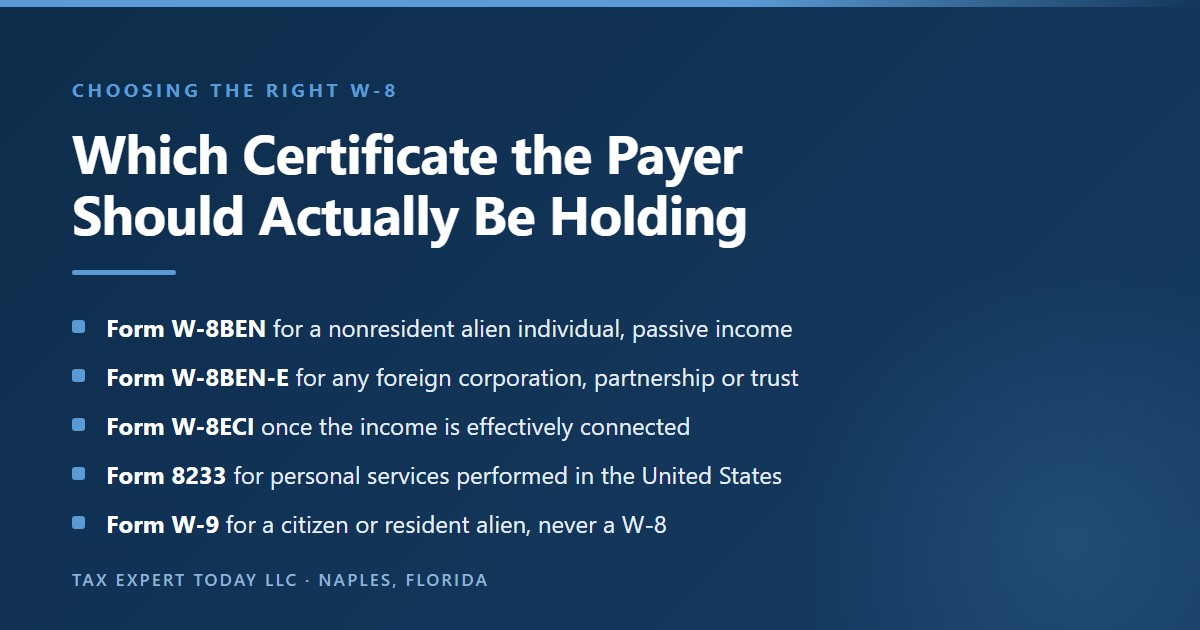
Form W-8BEN is one of several. The instructions list the situations in which it is the wrong form, and choosing incorrectly is a common reason a certificate is rejected. Entities use W-8BEN-E, intermediaries use W-8IMY, effectively connected income uses W-8ECI, personal services compensation uses Form 8233 or Form W-4, and any United States person uses Form W-9.
- A foreign entity never uses W-8BEN. Corporations, partnerships, and trusts documenting foreign status or claiming treaty benefits use Form W-8BEN-E.
- A United States person never uses it. That includes a citizen residing abroad and a resident alien individual, both of whom use Form W-9.
- Effectively connected income goes on W-8ECI. Income connected with a United States trade or business is excluded, unless it is allocable through a partnership.
- Personal services performed in the United States use Form 8233. A nonresident alien claiming exemption on compensation for independent or dependent personal services files that form or Form W-4 instead.
- A foreign trustee uses an entity form. The trustee of a foreign trust provides Form W-8BEN-E or Form W-8IMY for the trust rather than a personal certificate.
| You are | Correct form | Why |
|---|---|---|
| Nonresident alien individual receiving U.S. source passive income | Form W-8BEN | Beneficial owner of an amount subject to withholding |
| Foreign corporation, partnership, or trust | Form W-8BEN-E | Entity documentation and entity treaty claims |
| Foreign intermediary, nominee, or custodian | Form W-8IMY | Acting for the account of others rather than your own |
| Foreign person with effectively connected income | Form W-8ECI | Income connected to a U.S. trade or business |
| Nonresident alien performing personal services in the U.S. | Form 8233 or Form W-4 | Compensation for services sits outside W-8BEN |
| U.S. citizen, resident alien, or other U.S. person | Form W-9 | Not a foreign person at all |
The distinction that causes the most trouble in practice is the one between passive income and effectively connected income, because it can change during a relationship rather than at the outset. The instructions address this directly. If any of the income for which a Form W-8BEN was provided becomes effectively connected, that is a change in circumstances, the W-8BEN is no longer valid for that income, and Form W-8ECI must be filed. A foreign consultant whose engagement grows into a United States presence can cross that line without noticing.
How Do You Complete Form W-8BEN Line by Line?
Part I identifies the beneficial owner, Part II makes the treaty claim, and Part III is the certification signed under penalties of perjury. The lines that most often cause rejection are line 3, the permanent residence address, line 5, the United States taxpayer identification number, and line 6a, the foreign tax identifying number issued by the jurisdiction of tax residence.
- Line 3 must be a residence, not a mailing convenience. A care of address, a post office box, or the address of a financial institution does not establish residence for treaty purposes.
- Line 6a requires the foreign TIN for account holders. An account holder at a United States office of a financial institution receiving income reportable on Form 1042-S must give the foreign tax identifying number from the jurisdiction on line 3.
- Two exceptions relieve the foreign TIN. Residents of a United States territory are excused, as are residents of a jurisdiction on the IRS List of Jurisdictions That Do Not Issue Foreign TINs.
- Line 6b is the alternative certification. An account holder not legally required to obtain a foreign TIN may check that box instead of supplying a number.
- A foreign TIN can substitute for a U.S. TIN on a treaty claim. The instructions permit the line 6a number to be provided for treaty benefit purposes rather than a United States number on line 5.
| Part | What it establishes | The line that fails most often |
|---|---|---|
| Part I, lines 1 to 8 | Identity, citizenship, residence, and identifying numbers | Line 3, where a mailing address is entered instead of a residence |
| Part II, lines 9 and 10 | The treaty country and the specific treaty conditions | Line 10, left blank when the claim requires it |
| Part III | Certification under penalties of perjury | Unsigned or undated, which voids the certificate |
When Does a Treaty Claim Require Line 10?
Line 10 is required only where the treaty benefit depends on conditions beyond the representations already made on line 9 and Part III. The instructions state it is generally not applicable to interest or ordinary dividend articles. It is required for royalties where the treaty sets different rates for different royalty types, for students and researchers, for business profits not attributable to a permanent establishment, and for remittance based claims.
- Royalties with tiered treaty rates need line 10. Where a treaty distinguishes between, for example, copyright and industrial royalties, the specific article and rate must be stated.
- Students and researchers must complete it. Scholarship and fellowship grant claims turn on conditions the general certification does not cover.
- Business profits without a permanent establishment need it. The claimant states that the profits or gains are not attributable to a permanent establishment and cites the relevant article.
- Remittance based claims need it. Some treaties limit benefits to income actually remitted to the treaty country, which has to be asserted.
- Interest and ordinary dividends generally do not. A preferential dividend rate based on ownership percentage is the exception that does require the line.
A treaty claim is only as good as the treaty article behind it, and the article has to exist. The IRS publishes tax treaty tables setting out the reduced rates by country and income type, and a claim that names an article number the treaty does not contain, or a rate the table does not support, invites the withholding agent to disregard the form and withhold at 30 percent. Where a treaty position also has to be disclosed on a return, the separate rules for a treaty-based return position on Form 8833 come into play, and those are a different obligation from the certificate given to the payer. The treaty rate also matters on the other side of the border, because a United States person who suffers foreign withholding above the treaty rate can generally credit only the treaty amount on Form 1116.
How Long Does Form W-8BEN Stay Valid?
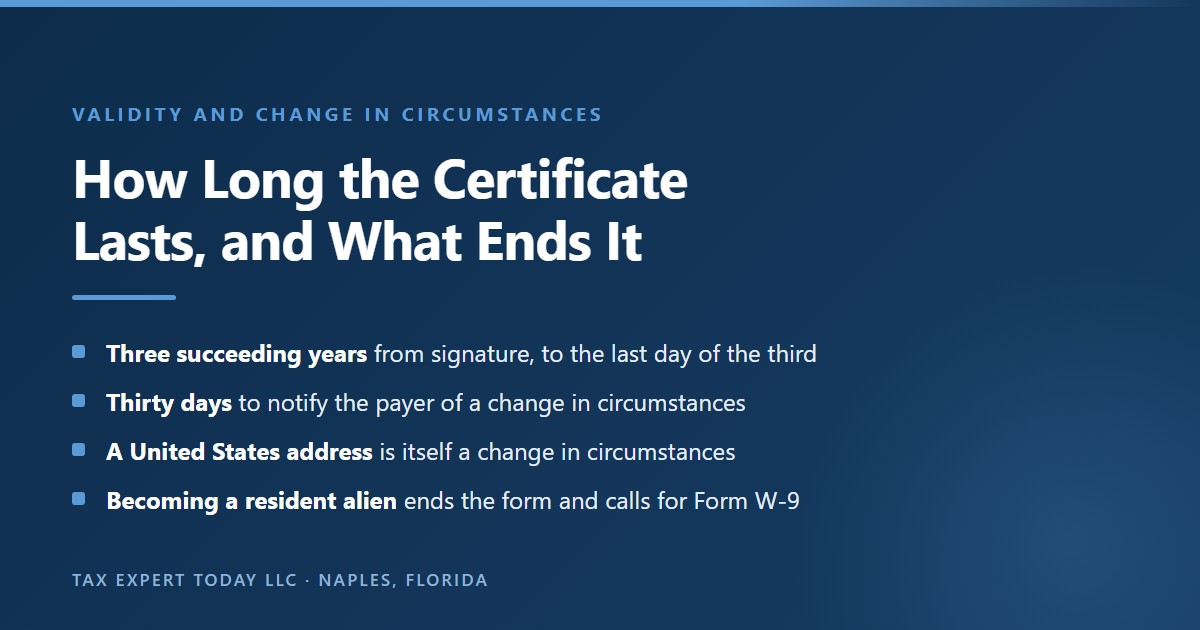
A Form W-8BEN generally remains in effect from the date it is signed through the last day of the third succeeding calendar year, unless a change in circumstances makes information on it incorrect. The IRS example in the instructions is a form signed on September 30, 2015 that remains valid through December 31, 2018. Under certain conditions the form remains in effect indefinitely until a change of circumstances occurs.
- The clock runs on calendar years, not on months. A form signed in December has almost the same expiry as one signed the previous January, which is why signing dates matter.
- The chapter 3 rule sits in the regulations. The period of validity for chapter 3 purposes is determined under 26 CFR 1.1441-1(e)(4)(ii).
- The chapter 4 rule is separate. For FATCA purposes the validity period is determined under 26 CFR 1.1471-3(c)(6)(ii).
- Indefinite validity is conditional, not automatic. It applies only under the conditions described in the regulations, and a change of circumstances still ends it.
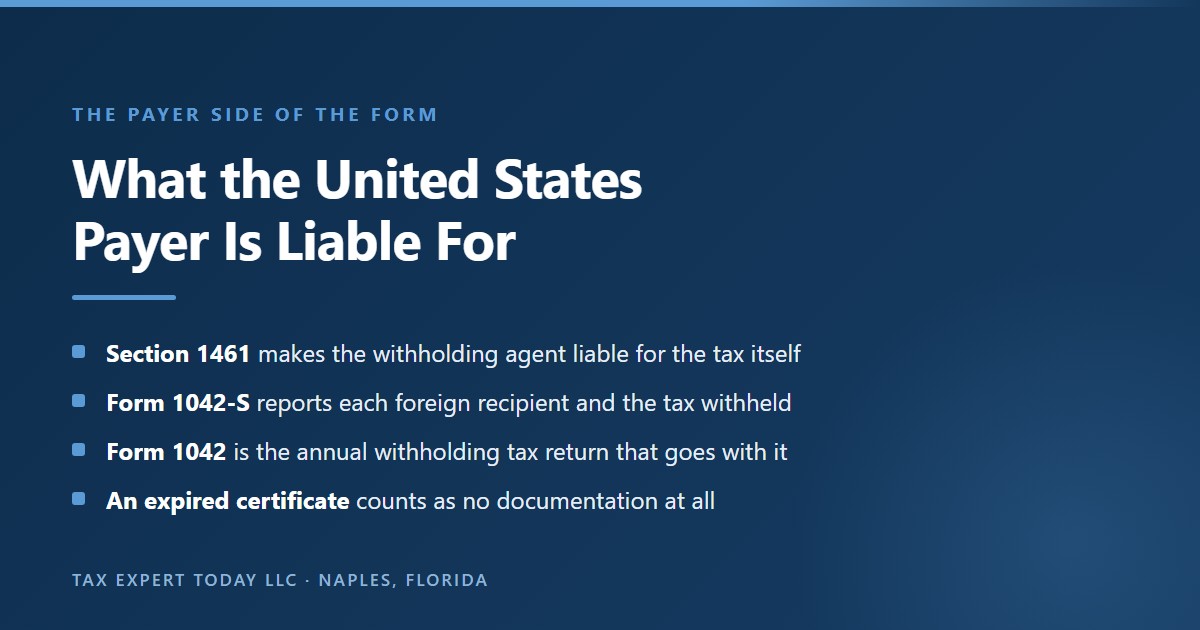
- Expiry is the payer problem too. A withholding agent relying on a lapsed certificate is treated as having no valid documentation.
What Counts as a Change in Circumstances?
Any change that makes information on the submitted form incorrect. The holder must notify the withholding agent, payer, or foreign financial institution within 30 days of the change and file a new Form W-8BEN or other appropriate form. A change of address to an address in the United States is a change in circumstances. A move within the same foreign country generally is not.
- Thirty days is the deadline, and it runs from the change. It does not run from the next payment or from the year end.
- A move to the United States breaks a treaty claim. Where the form claims treaty benefits, a move to the United States or outside the country of claim is a change in circumstances requiring notice within 30 days.
- Becoming a United States person ends the form entirely. On becoming a citizen or resident alien, the holder is no longer subject to the 30 percent rate under section 1441 or to section 1446 withholding on a foreign partner share.
- The replacement is usually Form W-9. The instructions state a Form W-9 may be required once United States status is acquired.
- Income becoming effectively connected also qualifies. That triggers a switch to Form W-8ECI for the affected income.
How Does the Substantial Presence Test Affect a W-8BEN?
It can void the form without the holder doing anything deliberate. An individual who meets the substantial presence test is a resident alien for income tax purposes, and a resident alien is not entitled to use Form W-8BEN at all. Because the test counts days across a three year window, a person can cross into residency mid year and hold a certificate that has quietly become incorrect.
- Day counting is cumulative, not annual. The substantial presence test weighs days in the current year and fractions of the two preceding years, so a pattern of visits can add up unexpectedly.
- Immigration status is not the test. Tax residency and visa category are separate questions, and holding a foreign passport settles neither.
- The notification duty is on the holder. The withholding agent has no way to know about day counts, so the 30 day notice obligation rests with the individual.
- Treaty benefits may survive through a saving clause exception. Most treaties contain a saving clause, and where an exception preserves a benefit the claim is made on Form W-9 rather than on W-8BEN.
- Residency brings worldwide reporting with it. A resident alien reports worldwide income and may pick up foreign account obligations, including the FBAR filing requirement for United States persons and the separate Form 8938 comparison.
This is the point at which a W-8BEN question stops being a form question. Someone who has become a United States tax resident partway through a year is looking at a different return, a different set of information reports, and potentially a dual status year. The certificate is the smallest part of that picture, but it is often the first symptom, because a payer asks for a fresh form and the honest answer to line 3 has changed. For a seasonal visitor who meets the substantial presence test, the annual Form 8840 statement is often what keeps a nonresident certification consistent with the rest of the file.
What Does the U.S. Payer Owe as Withholding Agent?
More than most payers expect. Section 1461 makes every person required to deduct and withhold personally liable for the tax. The liability belongs to the payer rather than being a mere collection duty on behalf of the recipient. A payer that accepts an invalid certificate, or that never requests one, can be assessed the tax that should have been withheld, along with interest and penalties.
- The statute is blunt about liability. Section 1461 makes the withholding agent liable for the tax and indemnifies it against claims by the payee for amounts properly withheld.
- Annual reporting is separate from withholding. Amounts paid to foreign persons are reported on Form 1042-S per recipient, with Form 1042 as the annual withholding tax return.
- Reasonable reliance requires a valid form. A certificate that is unsigned, expired, internally inconsistent, or carrying a United States address alongside a foreign status claim does not support reliance.
- Collecting the form is not the end of the duty. The payer has to monitor expiry and act on any change in circumstances the payee reports.
- Penalty relief runs through the ordinary channels. Where an assessment follows, the analysis moves to reasonable cause penalty relief and the wider question of how IRS penalties are removed.
Almost every widely read guide to this form is written for the foreign recipient. The exposure, though, sits with the United States business writing the check. A small company paying a foreign designer, licensing software from an overseas developer, or distributing to a foreign member of a limited liability company is a withholding agent under chapter 3 whether or not it has ever heard the term. That asymmetry is why a W-8BEN question from a client is frequently the visible edge of a much larger payer side problem.
How Does a Foreign Person Recover Over Withheld Tax?
Through a United States income tax return rather than through the payer. A nonresident alien files Form 1040-NR and claims credit for the tax withheld as shown on Form 1042-S. Where a valid treaty rate was available but 30 percent was withheld because no certificate was on file, the difference is recovered as a refund on that return, subject to the ordinary limitations period.
- Form 1042-S is the substantiating document. It reports the income paid and the tax withheld, and it is what the payee relies on to support the credit claimed.
- A taxpayer identification number is usually required. Claiming a refund generally requires a United States number, which for most individuals means applying for an ITIN.
- The treaty position may need disclosure. A return position based on a treaty can carry a separate disclosure obligation on Form 8833.
- Prevention costs far less than recovery. Providing a correct certificate before payment avoids a refund cycle that can run well beyond a year.
- Related withholding follows the same pattern. Amounts collected on a real property sale under FIRPTA withholding rules for foreign sellers are likewise reconciled on a return rather than reversed at source.
Form W-8BEN Help in Naples and Southwest Florida
Tax Expert Today LLC works with foreign individuals asked for a certificate by a United States payer, with United States businesses that have discovered a withholding duty after the fact, and with people who have crossed into United States tax residency and no longer qualify to use the form. If you are searching for W-8BEN help Naples, international tax Naples FL, or foreign withholding Naples, the office is on Tamiami Trail North, and the review usually starts with confirming tax residency rather than with the form itself.
Our office is at 11983 Tamiami Trail N, Naples, FL 34110, and the phone is (239) 441-2005. Hours are Monday through Friday, 10am to 5pm ET. The firm is led by Dr. Pellumb Kabashi, founder of Tax Expert Today LLC, and serves clients in all 50 states as well as United States taxpayers living abroad. Naples, Florida has a large seasonal population from Canada and Europe, together with United States businesses that pay foreign contractors and license foreign content, so both sides of the W-8BEN relationship show up here regularly. Our international and expatriate tax services cover the residency determination, the treaty analysis, and the return that reconciles whatever was withheld.
Does Florida require its own version of Form W-8BEN? No. Florida imposes no state individual income tax and operates no parallel nonresident withholding certificate, so the analysis for a Naples, Florida payment is entirely federal. That removes a layer that exists in states with their own nonresident withholding regimes. It also means the federal certificate carries the whole weight, because there is no second filing that might catch an error in the first.
Frequently Asked Questions
Do you send Form W-8BEN to the IRS? No. The IRS instructions direct you to give the form to the person requesting it, normally the payer, the party crediting your account, or a partnership allocating income to you. Sending it to the IRS does not satisfy the payer documentation requirement.
How long is Form W-8BEN valid? Generally from the date of signature through the last day of the third succeeding calendar year, unless a change in circumstances makes any information on it incorrect. Under certain conditions described in the regulations it remains in effect indefinitely until a change of circumstances occurs.
What is the difference between Form W-8BEN and Form W-8BEN-E? Form W-8BEN is for individuals. Form W-8BEN-E is for entities, including foreign corporations, partnerships, and trusts documenting foreign status, documenting chapter 4 status, or claiming treaty benefits.
Do you need a United States taxpayer identification number for Form W-8BEN? Not always. An account holder receiving income reportable on Form 1042-S generally must provide a foreign tax identifying number on line 6a, and that number may also be used for treaty benefit purposes rather than a United States number on line 5.
What happens if you become a United States resident after filing Form W-8BEN? You must notify the withholding agent, payer, or foreign financial institution within 30 days of becoming a United States citizen or resident alien, and you may be required to provide Form W-9. You are no longer subject to the 30 percent rate under section 1441.
Can the payer be penalized for not collecting Form W-8BEN? Yes. Section 1461 makes every person required to deduct and withhold personally liable for the tax, so a payer that fails to withhold because no valid certificate was obtained can be assessed the amount that should have been withheld.
Does Florida require its own version of Form W-8BEN? No. Florida imposes no state individual income tax and operates no parallel nonresident withholding certificate, so the analysis for a Naples, Florida payment is entirely federal.
When to Engage a Professional
Form W-8BEN looks like a one page administrative task, and for a straightforward dividend or interest payment it very nearly is. The complications are not on the form. They sit in the three questions the form assumes have already been answered: whether the person is genuinely a nonresident alien, whether the income is passive or effectively connected, and whether the treaty article being claimed actually says what the claim asserts. Each of those can be wrong in a way the form itself will never reveal.
Consider professional help where days spent in the United States are approaching the substantial presence thresholds, where a treaty claim depends on line 10 conditions, where income that began as passive is turning into a United States trade or business, where a payer has already withheld 30 percent and a refund claim is the only route back, or where you are the United States payer and have been making payments abroad without certificates on file. To discuss your situation, call (239) 441-2005 or review our international and expatriate tax services. Every situation turns on its own facts, and this article is general information rather than advice on yours.
Published September 9, 2026 by Dr. Pellumb Kabashi « Back to Learning Center
Have a question this article touches on?
Tax Expert Today LLC, based in Naples, Florida and serving clients across the United States.
Schedule a Consultation (239) 441-2005