
By Dr. Pellumb Kabashi, DBA, MBA, EA, CFE, CES
Founder, Tax Expert Today LLC · Tax advisors, enrolled agents, CPAs, and attorneys · Serving clients in all 50 states
Quick Answer
Form 1116 is the IRS form an individual, estate, or trust files to claim the foreign tax credit for income tax paid to another country. A separate form is required for each income category, the credit is capped by a limitation fraction, and excess foreign tax carries back one year and forward ten. Small passive amounts up to $300, or $600 on a joint return, can skip the form. Call (239) 441-2005 for a free consultation.
What is Form 1116?
Form 1116 is the computation the Internal Revenue Code requires before foreign income tax can reduce United States tax. It sorts foreign source income into separate categories, lists the foreign taxes paid or accrued on each, and applies the section 904 limitation so that the credit never exceeds the United States tax attributable to that foreign income.
- It implements sections 901 and 904. Section 901 allows the credit, and section 904 caps it.
- It attaches to the return. The 2025 form is filed with Form 1040, 1040-SR, 1040-NR, 1041, or 990-T.
- The result flows to Schedule 3. The final credit on line 35 is carried to Schedule 3 (Form 1040), line 1.
- It has four parts. Part I figures foreign source taxable income, Part II lists the taxes, Part III computes the credit, and Part IV totals the categories.
The form exists because the United States taxes its citizens and residents on worldwide income. A retiree in Naples, Florida holding an international index fund, a dual citizen with a pension from abroad, and an employee on assignment in London can all find the same dollars taxed twice. The foreign tax credit is the main statutory relief, and Form 1116 is where that relief is measured. The choice between this credit and the section 911 exclusion for wages earned abroad is a separate question, covered in our guide to the foreign earned income exclusion versus the credit. This article assumes the credit route has been chosen and explains how the form itself works.
One change for 2025 returns deserves attention early. The instructions now require lines 25 through 32 in Part IV to be completed even when only one Form 1116 is filed, which is a departure from prior practice in which a single-category filer could stop sooner.
Who has to file Form 1116, and who can skip it?
A citizen, resident alien, estate, or trust that paid or accrued creditable foreign income tax generally files Form 1116. An individual may skip the form when all foreign source income is passive, all of it and its tax appear on a qualified payee statement, and total creditable foreign tax is $300 or less, or $600 on a joint return.
| Condition for claiming the credit without Form 1116 | What it means in practice |
|---|---|
| All foreign source gross income is passive category income | Typically dividends and interest from funds and brokerage accounts |
| Income and tax are reported on a qualified payee statement | Form 1099-DIV, Form 1099-INT, Schedule K-1 (Form 1041), Schedule K-3, or a similar substitute statement |
| Total creditable foreign tax does not exceed the threshold | $300, or $600 if married filing jointly |
| The filer is an individual | The election is not available to estates or trusts |
| Result of the election | The limitation on lines 15 through 23 does not apply, and no carryover arises to or from that year |
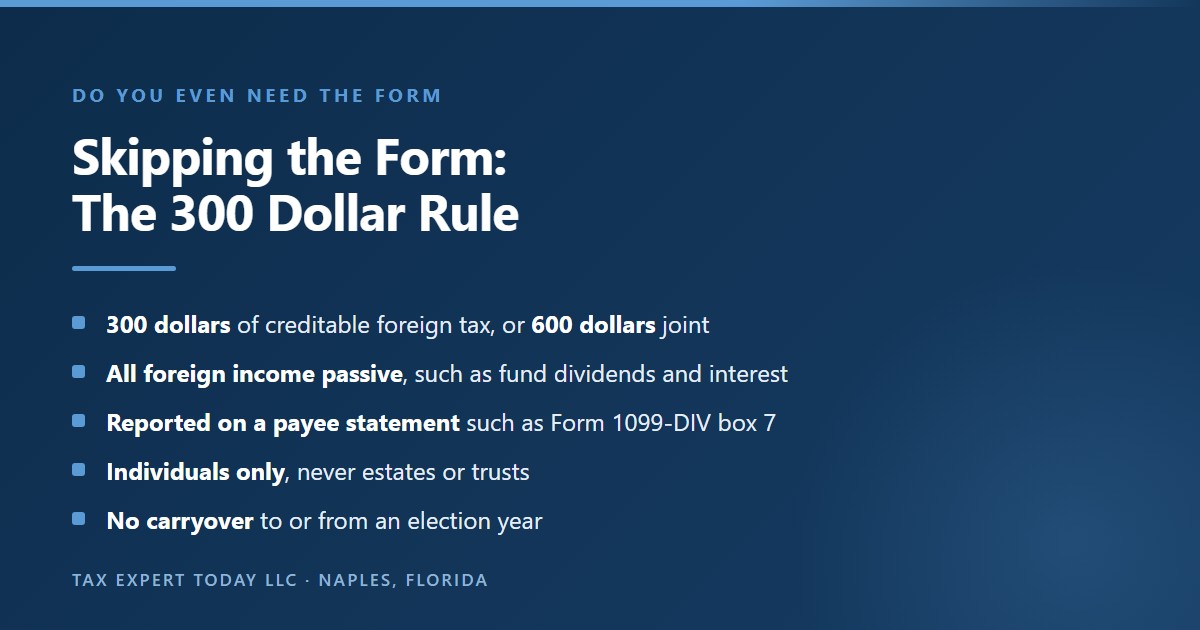
The skip rule comes from section 904(j), which the statute describes as an exemption for certain individuals. When it applies, the filer enters the smaller of total foreign tax or regular tax directly on Schedule 3, line 1. Two rules still bind a filer who uses it. Only creditable foreign tax counts, so an amount withheld above a treaty rate is not creditable merely because it appears on a statement. And any reduction that would have been entered on line 12 of the form still applies.
- Nonresident aliens generally cannot claim the credit. Section 906 allows it in narrow cases, such as foreign tax on foreign source income effectively connected with a United States trade or business.
- The U.S. Virgin Islands is handled differently. Tax paid there is figured on Form 8689, not Form 1116.
- Estates and trusts always use the form. The $300 exemption is an individual-only rule.
- Skipping the form can cost carryovers. Foreign tax in an election year cannot be carried to or from any other year.
How does the Form 1116 limitation work?
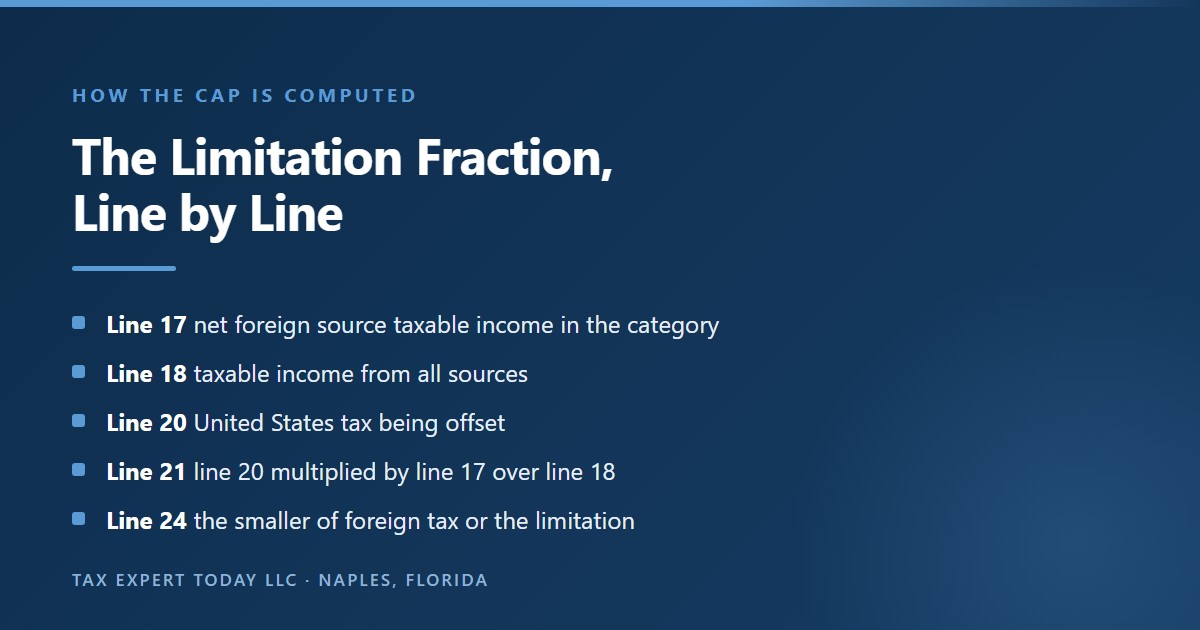
The limitation multiplies the United States tax by a fraction: net foreign source taxable income in the category over total taxable income. The credit is the smaller of that result or the foreign tax available. Section 904(a) states the rule, and lines 17 through 24 of the form carry it out for each category separately.
- Line 17 is the numerator. It is net foreign source taxable income in the category after required adjustments.
- Line 18 is the denominator. For individuals it is taxable income, with the new senior deduction added back.
- Line 20 is the tax being offset. It is the regular tax from Form 1040 plus the amount on Schedule 2, line 1z.
- Line 24 is the credit for the category. It is the smaller of foreign tax available on line 14 or the limitation on line 23.
A hypothetical illustrates the arithmetic. The figures below are invented for illustration and do not describe any actual taxpayer.
| Line | Hypothetical single filer, 2025, passive category | Amount |
|---|---|---|
| 17 | Net foreign source taxable income | $20,000 |
| 18 | Taxable income from all sources | $100,000 |
| 19 | Line 17 divided by line 18 | 0.2000 |
| 20 | United States tax (assumed for illustration) | $15,000 |
| 21 | Maximum credit, line 20 multiplied by line 19 | $3,000 |
| 14 | Foreign taxes available for credit | $4,200 |
| 24 | Credit allowed, the smaller of lines 14 and 23 | $3,000 |
| Excess foreign tax eligible to carry back and forward | $1,200 |
Reverse the facts and the outcome reverses too. Had the foreign tax been $2,000, the full $2,000 would be allowed and $1,000 of unused limitation would remain in that category, which is room that carryovers from other years can absorb. The fraction is why the credit behaves so differently from a deduction. Foreign income taxed abroad at a rate above the effective United States rate on that income generates excess credit, and foreign income taxed at a lower rate generates excess limitation.
The 2025 instructions add one adjustment worth flagging for retirees. Public Law 119-21 created a deduction of up to $6,000 for a taxpayer who has reached age 65, and $6,000 for a qualifying spouse on a joint return, reported on Schedule 1-A (Form 1040), line 37, for tax years 2025 through 2028. That deduction is added back to taxable income on line 18. Because a larger denominator shrinks the fraction, older filers should expect the add-back to change the limitation, and should not assume last year’s result carries forward.
What are the Form 1116 income categories?
Section 904(d) divides foreign income into separate limitation categories, and each category gets its own Form 1116 with only one box checked. The 2025 form lists seven: section 951A, foreign branch, passive, general, section 901(j), certain income re-sourced by treaty, and lump-sum distributions. Excess credit in one category cannot absorb limitation in another.
| Box | Category | Typical individual income |
|---|---|---|
| a | Section 951A category | Inclusions by a United States shareholder of a controlled foreign corporation; no carryover is allowed in this category |
| b | Foreign branch category | Business profits attributable to a qualified business unit operating abroad |
| c | Passive category | Dividends, interest, royalties, rents, annuities, and non-business capital gains |
| d | General category | Wages, salary, overseas allowances, and active trade or business income |
| e | Section 901(j) income | Income from a sanctioned country, one form per country, generally completed only through line 17 |
| f | Certain income re-sourced by treaty | United States source income treated as foreign source under an elected treaty provision |
| g | Lump-sum distributions | A foreign source pension lump sum taxed using Form 4972 |
The categories matter because they stop averaging. Without them, a high-tax salary from a European employer could shelter low-taxed investment income by lending it unused credit. With them, the salary sits in the general category and the investment income in the passive category, and each is measured on its own. Most individual filers need one or two forms, usually passive and general.
- Use one form per category. The instructions tell filers to check only one box on each form.
- Use one column per country. Within a form, each foreign country or territory gets its own column in Part I and its own line in Part II.
- Apportion shared taxes. Where one foreign tax covers income in more than one category, it is apportioned by the ratio of net foreign taxable income in each category.
- Treaty re-sourcing may require disclosure. Re-sourced income can trigger Form 8833, explained in our guide to treaty-based return positions.
Which foreign taxes qualify for the credit?
The credit reaches income, war profits, and excess profits taxes, and taxes imposed in lieu of them, paid to a foreign country, a United States territory, or a subdivision such as a province. Property taxes and most taxes on sales or gross receipts do not qualify, and interest and penalties never do.
- Only tax legally owed counts. An amount the foreign country would refund is not creditable, whether or not the refund is claimed.
- Holding periods apply to dividends. Withholding on a dividend is not creditable unless the stock was held at least 16 days within the 31-day period beginning 15 days before the ex-dividend date.
- Subsidies and offsets disqualify. Foreign tax returned to the payer through a subsidy or offset by certain credits is not creditable.
- Sanctioned countries are excluded. Tax paid to a country designated under section 901(j) produces no credit.
- Some disallowed taxes remain deductible. Taxes denied for holding period or boycott reasons may still be deducted even in a credit year.
The treaty point causes more lost credit than any other. The instructions give an example in which a foreign country withholds $25 on a payment, the treaty reduces the liability to $15, and only $15 is creditable. The remaining $10 is a claim against the foreign government, not against the IRS. A holder of foreign securities should therefore confirm that the correct treaty rate was applied at source, since the excess cannot be rescued on Form 1116.
What is the high-tax kickout on Form 1116?
Passive income is moved out of the passive category when the foreign tax on it, after allocating expenses, exceeds the highest United States rate that could apply. Section 904(d)(2)(F) calls it high-taxed income, and Form 1116 reports the move in a column labeled HTKO, with the related taxes shifted on line 13.
- The benchmark is the top section 1 rate. Revenue Procedure 2025-32 confirms the seven individual rates, topping out at 37 percent, remain in effect.
- The income is reclassified, not lost. It moves to the category it would otherwise fall into, and its taxes move with it.
- Two forms are touched. The passive form shows the amounts as negatives, and the receiving form shows them as positives.
- The purpose is anti-averaging. Without the rule, heavily taxed passive income could lend excess credit to lightly taxed passive income.
A hypothetical shows the mechanics. Assume $1,000 of foreign passive income, after allocated expenses, bears $400 of foreign tax. The effective foreign rate is 40 percent, which exceeds 37 percent, so the income is high-taxed. It is entered as a negative in the HTKO column on the passive category form and as a positive on the form for the category to which it is reclassified, and the $400 is moved on line 13 in the same way. The skip election treats high-taxed income as passive for its own eligibility test, which is one of the few places the two rules meet.
How do I report foreign tax from a Form 1099-DIV?
Mutual funds and exchange-traded funds that invest abroad often pass foreign tax through to shareholders, reported in Form 1099-DIV box 7, with the country in box 8. That income is normally passive category income, and above the $300 or $600 threshold it belongs on a passive category Form 1116.
- No currency conversion is needed. Where the statement reports the tax in U.S. dollars, the filer enters “1099 taxes” in column (l) and completes columns (q) through (u).
- The foreign income must be identified too. The fund’s year-end tax information usually states the foreign source portion of the dividends.
- Box 8 may say various. A broadly diversified fund often reports “various,” and the fund’s country detail supports the columns in Part I.
- Qualified dividends need a check. Foreign source qualified dividends may require the rate adjustment described in the next section.
This is the most common reason a household with no foreign address still needs Form 1116. An investor with a large international allocation can cross the $600 joint threshold without ever leaving Collier County. Brokerage software often imports box 7 automatically but leaves the foreign source income figure blank or defaulted, which produces a limitation fraction of zero and a credit that quietly disappears into a carryover. Checking the fund’s supplemental statement before filing is the fix.
Do qualified dividends and capital gains need an adjustment?
Often yes. Foreign source qualified dividends and capital gains taxed at preferential United States rates are scaled down before entering the fraction, so they do not inflate the limitation. The instructions multiply amounts taxed at 15 percent by 0.4054 and amounts taxed at 20 percent by 0.5405, and leave out amounts taxed at 0 percent.
- The rule comes from section 904(b)(2). It aligns the numerator with the lower rate the United States actually applied.
- An exception is available. A filer may elect not to adjust if both thresholds below are met.
- The exception is all or nothing. A filer who elects it may not adjust any foreign source qualified dividends or capital gain distributions.
- Schedule D filers follow separate steps. The instructions route them to a different worksheet sequence.
For 2025 the adjustment exception has two tests. First, line 5 of the Qualified Dividends and Capital Gain Tax Worksheet must not exceed $394,600 for a joint return or qualifying surviving spouse, or $197,300 for a single, head of household, or married filing separately return. Second, foreign source capital gain distributions plus foreign source qualified dividends must total less than $20,000. A filer meeting both may report the dividends without adjustment, which usually produces a slightly larger limitation and is simpler to support.
How do foreign tax credit carryovers work?
Foreign tax that exceeds the limitation in a category is carried back one year and then forward up to ten years under section 904(c), applied to the earliest year first. The carryover stays in its category, and Schedule B (Form 1116) reconciles the balances each year a carryover is used or created.
- The period cannot be extended. A year in which the carryover could not be used still counts against the ten.
- A carryback needs an amended return. The earlier year is revised with Form 1040-X and a revised Form 1116.
- Deduction years interrupt the chain. A credit cannot be carried to a year in which foreign taxes were deducted, and the carryover is still reduced as if a credit had been claimed.
- Section 951A category taxes never carry. Line 10 is left blank on that form.
- Skip-election years are walled off. Carryovers cannot move to or from a year in which the $300 or $600 rule was used.
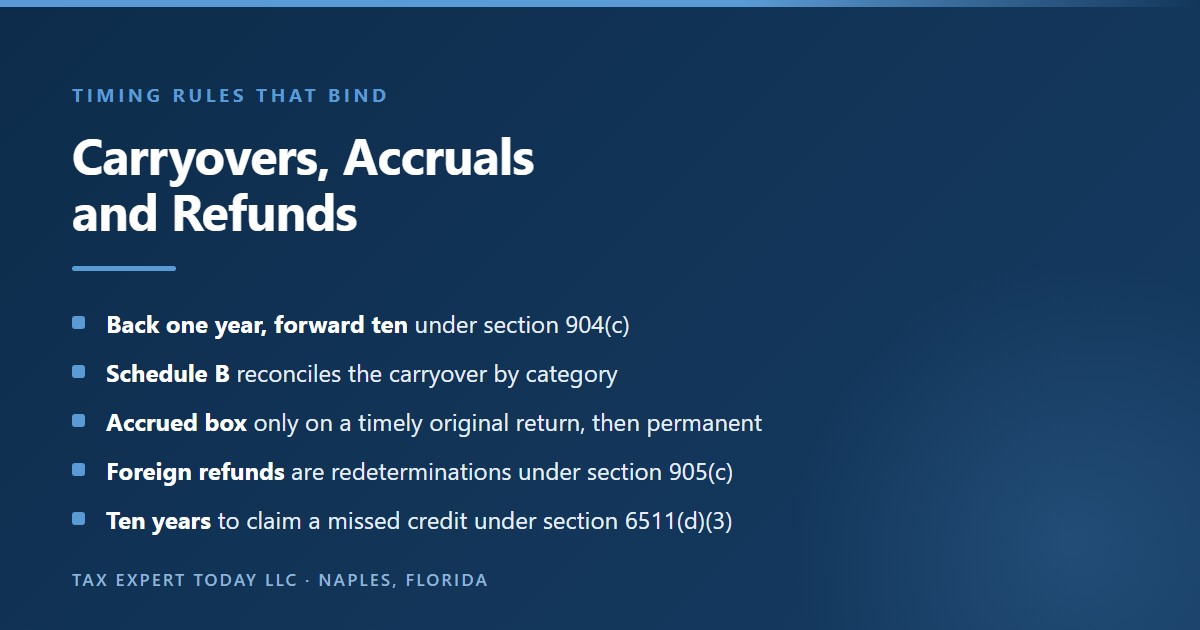
Schedule B tracks each vintage of excess tax by the year it arose, from the tenth preceding tax year forward, so the expiring layers are visible. That matters in practice because a carryover is only valuable if future limitation exists to absorb it. An employee who returns from a high-tax posting to a purely domestic career may hold years of carryover and no foreign income to use it against, and those credits simply expire. Where a return to the United States is planned, modeling the carryover before the move, and considering whether foreign source income can be generated legitimately in the meantime, is where planning adds value.
Pre-2018 carryovers in the old general category follow special allocation rules, and a filer holding them can generally allocate them to the post-2017 general category, or partly to the foreign branch category under a safe harbor in Regulations section 1.904-2(j)(1)(iii). A filer with pre-2018 balances still on the books should confirm how they were allocated when the categories changed.
Should I claim foreign taxes when paid or when accrued?
A cash-basis filer may elect under section 905(a) to credit foreign taxes in the year they accrue rather than the year they are paid. The election is made by checking the Accrued box in Part II on a timely filed original return, cannot be made on an amended return, and binds every later year.
- Accrual matches tax to income. Foreign tax for a calendar year often is not paid until the following year, which can mismatch the paid method.
- The election is permanent. Section 905(a) provides that credits for all subsequent years are taken on the same basis.
- Unpaid accruals are reversed. Accrued tax not paid within 24 months after the close of the year is removed from the credit until paid.
- Average exchange rates usually apply. Accrued taxes are generally translated at the average rate for the year, with exceptions.
The paid method creates a timing trap for anyone with a foreign tax year that differs from the calendar year, or whose foreign assessment arrives late. Foreign tax for 2025 paid in 2026 is credited in 2026 under the paid method, but the income was reported in 2025, so the 2025 return may show foreign income with little tax against it and the 2026 return may show tax with little income. The accrual election can smooth that mismatch, but because it cannot be undone, it deserves a deliberate decision in the first year it is considered.
How do I convert foreign taxes into U.S. dollars?
Under the paid method, foreign tax is translated at the exchange rate on the day it was paid or withheld. Under the accrual method, the average exchange rate for the tax year generally applies. A filer converting currency must attach a detailed explanation of how the rate was determined, unless the statement already reports dollars.
- Refunds use the original rate. A refund is translated at the rate in effect when the tax was paid, not when the refund arrived.
- Late payment breaks the average-rate rule. Accrued tax paid more than two years after the year closes is translated at the payment-date rate.
- Prepayment breaks it too. Tax paid in a year before the year it relates to also uses the payment-date rate.
- Inflationary currencies are excluded. A currency with cumulative inflation of at least 30 percent over 36 months cannot use the average rate.
- A payment-date election exists. An accrual-basis filer may elect payment-date rates for nonfunctional currency taxes, binding until revoked with IRS consent.
Currency is where otherwise careful returns go wrong, because the Part II columns ask for amounts in both the foreign currency and dollars. Using a single year-end rate for tax that was withheld monthly is a common shortcut that the rules do not permit under the paid method. Keeping the foreign pay statements or assessment notices, with dates, makes the translation reproducible if the return is examined.
What happens if a foreign tax is refunded or changes later?
A change in foreign tax after a credit is claimed is a foreign tax redetermination under section 905(c). A filer who receives a refund of foreign tax previously credited must generally amend to reduce the credit, and Schedule C (Form 1116) summarizes redeterminations that occurred during the current year relating to prior years.
- An increase in U.S. tax needs a statement. The amended return notes that the change is a foreign tax credit change increasing United States tax, with a revised Form 1116 attached.
- The assessment period stays open. Sections 6501(c)(5) and 905(c) except these increases from the ordinary statute of limitations.
- Failure to notify carries a penalty. The instructions warn of a penalty unless the failure is due to reasonable cause and not willful neglect.
- No U.S. change may mean no amendment. If the redetermination does not change United States tax for any year, Schedule C with the current return can be enough.
- Contested taxes wait. A contested foreign liability is generally not credited until the contest is resolved, unless a provisional credit is elected with Form 7204.
The notification duty is the one filers most often miss. A foreign authority that refunds part of a prior-year assessment sends the money to the taxpayer, not a notice to the IRS, so the burden of reporting it falls entirely on the filer. Where a penalty has already been asserted, the reasonable cause standard is discussed in our guide on penalty abatement for reasonable cause, and the broader options are in our guide on getting IRS penalties removed.
Should I take a credit or a deduction for foreign taxes?
A credit usually produces more benefit, because it reduces tax dollar for dollar while a deduction only reduces taxable income and requires itemizing on Schedule A. The two cannot generally be mixed for the same year. A deduction may still make sense where the limitation would leave most of the tax unusable and no carryover would ever be absorbed.
- The choice applies to all foreign income taxes for the year. Taking the credit for any eligible foreign tax generally bars deducting any part of that year’s foreign taxes.
- Some taxes are deductible anyway. Taxes disallowed as credits for holding period, boycott, or sanctioned country reasons may still be deducted.
- Switching to the credit has a long window. A change from deduction to credit can be made within the special ten-year period in section 6511(d)(3).
- Switching to the deduction has a short window. A change from credit to deduction must be made within the ordinary three-year period in section 6511(a).
The ten-year window is one of the more valuable rules in this area and one of the least used. Section 6511(d)(3)(A) provides that a refund claim attributable to foreign taxes for which credit is allowed may be made within ten years from the due date of the return for the year the taxes were actually paid or accrued. A taxpayer who deducted foreign tax, or ignored it altogether, several years ago may still be able to claim the credit by amending, subject to the carryover and deduction-year rules described above.
Can I still claim the credit for an earlier year?
Often yes. Because of the ten-year refund period for foreign tax credit claims, a filer who never claimed the credit for a past year can generally file Form 1040-X with Form 1116 for that year. The accrual election, however, can only be made on a timely filed original return, so an amended claim uses the paid method.
- The window runs from the original due date. It is measured from the due date of the return for the year the tax was paid or accrued.
- Each year is recomputed. The limitation for the earlier year uses that year’s income, categories, and tax.
- Carryovers ripple forward. A newly claimed year can create a carryover that changes later returns, which Schedule B then reconciles.
- Unfiled years are a different problem. A taxpayer who never filed at all faces filing obligations first, not just a missed credit.
Where the missing credit sits alongside unfiled returns or unreported foreign accounts, the order of operations matters. The streamlined filing compliance procedures are available only where the failure was non-willful and require a certification under penalty of perjury, and the account reporting side is covered in our guides on whether you need to file an FBAR and filing a late FBAR. A credit claim filed without addressing those obligations can draw attention to them rather than resolve them.
How does Form 1116 interact with the foreign earned income exclusion?
Foreign tax attributable to wages excluded on Form 2555 cannot be credited. Line 12 of Form 1116 removes it, and income excluded under section 911 is never entered on line 1a. Where only part of the wages is excluded, the instructions supply a fraction that allocates the foreign tax between the excluded and non-excluded portions.
- The numerator is excluded income. Excluded foreign earned income and housing amounts, less otherwise deductible expenses allocable to them.
- The denominator is total foreign earned income. Total foreign earned income, less deductible expenses allocable to it, including the housing deduction.
- Only the remainder is creditable. Foreign tax on wages above the exclusion cap can still produce a credit.
- Investment income is unaffected. Foreign tax on dividends and interest is outside section 911 and flows through Form 1116 normally.
Whether to claim the exclusion at all, and what that election costs in refundable credits and flexibility, is the subject of our separate guide on the exclusion versus the credit. For Form 1116 purposes the only question is mechanical: once the exclusion has been claimed, the allocation on line 12 must be computed rather than estimated.
What other reductions can shrink the credit?
Line 12 also reduces available foreign taxes for several reporting and policy failures. The one individual filers meet most often is the reduction for not filing Form 5471 or Form 8865 on time, which cuts all foreign taxes otherwise available for credit by 10 percent, with further reductions if the failure continues.
- Controlling a foreign corporation triggers it. Section 6038(c) reduces the credit for a controlling shareholder who fails to file Form 5471 by the return due date.
- Controlling a foreign partnership triggers it too. The same 10 percent reduction applies to Form 8865 failures.
- Dollar penalties offset the reduction. The credit reduction is itself reduced by any dollar penalty imposed under section 6038(b).
- Boycott participation reduces it. Form 5713 filers reduce taxes or the credit for international boycott operations.
- Splitting events defer it. Under section 909, foreign tax cannot be credited before the related income is taken into account.
The Form 5471 link is the reason information returns and the credit should be reviewed together. A business owner abroad who claims a large credit while missing an information return can lose a slice of that credit in addition to the separate penalty. The filing requirement is explained in our guide to Form 5471 and foreign corporations. The 2025 instructions also make clear that other information-return regimes, such as the gift and trust reporting in our Form 3520 guide, run on their own tracks and do not replace Form 1116.
Does the foreign tax credit apply to the alternative minimum tax?
Yes. A separate alternative minimum tax foreign tax credit may be allowed, figured under the Instructions for Form 6251 for individuals and Schedule I (Form 1041) for estates and trusts. Its computation parallels Form 1116 but uses alternative minimum taxable income, so the regular and minimum tax credits can differ in the same year.
- A separate computation is required. A filer subject to the minimum tax works the credit a second time on the minimum tax base.
- Carryovers are tracked separately. Differences between the two computations can leave different carryover balances.
- Capital gain adjustments differ. The instructions point minimum tax filers to Regulations section 1.904(b)-1(b)(3) for the rate adjustment.
- Most filers are unaffected. The computation matters only where the alternative minimum tax actually applies.
What are the most common Form 1116 mistakes?
Most errors fall into a few groups: claiming tax that was not legally owed, putting income in the wrong category, missing the capital gain adjustment, mishandling the Form 2555 allocation, and losing track of carryovers. Each one either overstates the credit, which invites adjustment, or understates it, which leaves money unclaimed.
| Mistake | Effect | Where the rule sits |
|---|---|---|
| Crediting withholding above the treaty rate | Credit overstated | Regulations section 1.901-2(e)(2)(i) |
| Wages entered in the passive category | Wrong limitation and possible averaging | Section 904(d); Categories of Income in the instructions |
| Foreign source income left blank after importing box 7 | Limitation of zero, credit pushed into carryover | Part I, line 1a |
| No adjustment to foreign qualified dividends | Limitation overstated | Section 904(b)(2); line 1a instructions |
| Crediting tax on excluded wages | Credit overstated | Line 12 instructions; section 911 |
| Schedule B not attached or not reconciled | Carryover unsupported or lost | Line 10 instructions |
| Foreign refund not reported | Assessment period open, penalty exposure | Section 905(c); Schedule C (Form 1116) |
| Accrued box checked on an amended return | Election not valid | Section 905(a); Part II instructions |
A filer receiving income subject to United States withholding while living abroad faces the mirror-image problem, which is explained in our guide to Form W-8BEN. The records that prevent most of the errors above are the same in every case: foreign assessments or pay statements with dates, fund supplemental statements showing foreign source income by country, and a running carryover schedule by category and year.
Form 1116 Help in Naples & Southwest Florida
Tax Expert Today LLC prepares and reviews foreign tax credit computations from an office in Naples, Florida, and serves clients in all 50 states. Southwest Florida has a large population of retirees with international portfolios, dual citizens with pensions from abroad, and seasonal residents with ties to Canada and Europe, which makes Form 1116 a routine part of local tax work rather than an expatriate specialty.
- Foreign tax credit help Naples: preparing passive and general category forms, including the qualified dividend adjustment.
- Foreign tax Naples FL: reviewing prior years for credits that were deducted, defaulted to zero, or never claimed within the ten-year window.
- Carryover reconciliation: rebuilding Schedule B balances by category and year before they expire.
- Redeterminations: handling foreign refunds and changed assessments through amended returns and Schedule C.
Florida imposes no personal income tax, so a Florida resident has no state return on which a second foreign tax credit question arises, and the federal computation stands on its own. Our international and expat tax services page describes how we approach cross-border returns, and foreign account questions that often travel with Form 1116 are covered in FBAR versus Form 8938.
Office: 11983 Tamiami Trail N, Naples FL 34110
Phone: (239) 441-2005
Hours: Monday through Friday, 10:00 to 5:00 ET
Frequently Asked Questions
I live in Naples, Florida and my international fund reported foreign tax on my 1099-DIV. Do I need Form 1116?
Only if the total creditable foreign tax exceeds $300, or $600 on a joint return, or another condition of the skip rule is not met. Below the threshold, and with all foreign income passive and reported on the statement, the tax can generally be entered directly on Schedule 3, line 1.
Can I carry unused foreign tax credit forward?
Yes. Under section 904(c), foreign tax exceeding the limitation in a category is carried back one year and forward up to ten years, earliest year first. Schedule B (Form 1116) reconciles the balances, and the carryover stays in its original category.
Can I file one Form 1116 for everything?
Only if all foreign income falls in a single category. Each separate category requires its own form, so a filer with foreign wages and foreign dividends generally files one general category form and one passive category form, and completes Part IV.
Is foreign value added tax creditable?
Generally no. The credit is limited to foreign income, war profits, and excess profits taxes and taxes imposed in lieu of them. Publication 514 explains that taxes based on gross receipts or sales rather than net income generally do not qualify unless imposed in lieu of an income tax, and a value added tax is a tax on sales rather than on income.
Can a nonresident alien use Form 1116?
Generally not. Section 906 allows a nonresident alien a credit only in limited situations, such as foreign tax on foreign source income effectively connected with a United States trade or business, or for a resident of Puerto Rico for the entire year.
When to Engage a Professional
Form 1116 rewards precision more than most individual forms. The limitation is computed category by category, the capital gain adjustment changes the fraction, carryovers expire on a fixed schedule, and several elections, including the accrual election and the switch between credit and deduction, have timing rules that cannot be fixed later. A software default rarely evaluates any of those choices.
Consider a consultation if any of the following applies: foreign income falls in more than one category, the foreign tax rate exceeds the United States rate, carryovers exist from prior years, a foreign refund or reassessment has occurred, foreign tax was deducted or ignored in an earlier year, Form 2555 is also being filed, or an information return such as Form 5471 is outstanding. Where unfiled years or unreported accounts are also present, the exposure discussed in our guide on FBAR penalties should be assessed before any amended return is filed.
Tax Expert Today LLC is a tax advisory firm in Naples, Florida serving clients in all 50 states. Call (239) 441-2005 to discuss your facts.
Primary Sources
- Instructions for Form 1116 (2025) (skip rule, categories, carryovers, redeterminations)
- Form 1116 (2025), Foreign Tax Credit
- Publication 514, Foreign Tax Credit for Individuals (for 2025 returns)
- 26 U.S.C. section 904 (limitation, categories, carryback and carryover, $300 exemption)
- 26 U.S.C. section 905 (accrual election and foreign tax redeterminations)
- 26 U.S.C. section 6511 (ten-year refund period for foreign tax credit claims)
This article is general information, not advice for any particular taxpayer, and does not create a client relationship. The hypothetical figures are illustrations only. Thresholds and forms change annually, and 2026 versions of Form 1116 and its instructions had not been released when this article was written. Verify current rules and confirm your own facts with a qualified tax professional before filing.
Published September 16, 2026 by Dr. Pellumb Kabashi « Back to Learning Center
Have a question this article touches on?
Tax Expert Today LLC, based in Naples, Florida and serving clients across the United States.
Schedule a Consultation (239) 441-2005