
By Dr. Pellumb Kabashi, DBA, MBA, CES, CFE, EA
Founder, Tax Expert Today LLC · Tax advisors, enrolled agents, CPAs, and attorneys · Serving clients in all 50 states
Quick answer: Decanting a trust means a trustee moves the assets of one irrevocable trust into a second trust with better terms. It is usually not an income tax event and usually not a gift, but it can be either. The federal exposure sits in three places: a beneficiary who consents or releases a power, a change that breaks generation skipping exempt status, and a state tax residence that does not move with the assets. Call (239) 441-2005 for a free consultation.
Published: September 2026
Almost everything written about decanting a trust is written by trust lawyers for trust lawyers, and it stops where the instrument is signed. The mechanics are well covered. What is not covered is the part that lands on a tax return, which is why the searches that sit next to this topic are questions like whether decanting is a taxable event and what the tax consequences are. This guide answers the tax half. It works through the four separate federal taxes that have to be tested separately, the one regulation that decides whether a generation skipping exempt trust survives the exercise, the reason the IRS still refuses to rule on any of it in 2026, and what the Florida statute permits for a trustee who is now administering the trust from Southwest Florida.
The reader this is written for has usually already moved. The trust was drafted in New York, New Jersey, Illinois or Connecticut, the family is now in Naples or Fort Myers, and the instrument no longer fits. Decanting is one of the tools on the table. It is also the tool with the least published federal guidance behind it, so the sequencing matters more here than it does almost anywhere else in estate planning. Where the underlying domicile change is still being built rather than settled, the day counting and record keeping run in parallel and are covered by our Florida 183 day rule calculator.
What Does Decanting a Trust Actually Mean?
Decanting a trust is the exercise of a trustee power to invade principal, used to pour the assets of an existing irrevocable trust into a second trust with different terms rather than distributing them outright. The authority comes from the instrument, from common law, or from a state statute, and in most states no court order is required.
- It is a distribution, not an amendment. The legal theory is that a trustee who may distribute principal outright may distribute it to another trust for the same beneficiary, which is a lesser act.
- The old trust does not need an amendment clause. Under Fla. Stat. §736.04117(9), a spendthrift clause or a provision prohibiting amendment does not block the exercise.
- The trustee is the actor. Florida defines an authorized trustee as a trustee other than the settlor or a beneficiary who holds the power to invade principal, which keeps an interested party out of the driver seat.
- Florida added a restatement route. The statute permits the trustee to modify the terms of the first trust directly, not only to appoint the assets to a separate second trust, which avoids retitling every asset.
- Florida did not adopt the Uniform Trust Decanting Act. It has its own provision, first enacted by chapter 2007-153 and amended by chapters 2018-35 and 2025-159, so a practitioner working from the uniform act text is reading the wrong statute for a Florida trust.
That is the whole of what the ranking pages cover. The tax analysis starts here.
Is Decanting a Trust a Taxable Event?
There is no single answer, because decanting is tested against four different taxes and each has its own rule. A purely administrative decanting is usually neutral under all four. A decanting that changes who gets what can be a gift, can strip generation skipping exempt status, and can pull assets into a beneficiary estate.
The mistake is to ask whether decanting is taxable as one question. It is four questions, and the answers do not track each other. A change can be safe for generation skipping purposes and still be a gift. The regulation that governs the generation skipping side says so in terms, which is covered further below.
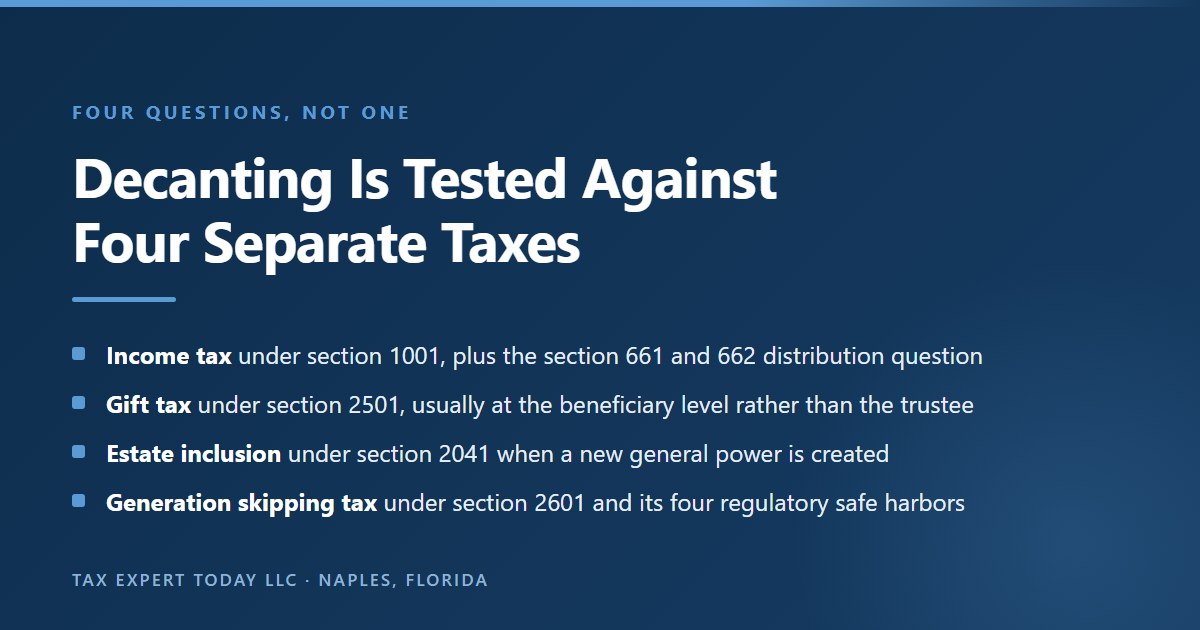
| Tax | Governing provision | When it is usually neutral | What puts it in play |
|---|---|---|---|
| Income tax and gain | IRC §1001, IRC §§661 and 662 | The second trust is treated as a continuation of the first and no obligation is discharged | A change in grantor trust status, a distribution that satisfies a fixed obligation, or an S corporation or retirement asset that loses its qualification |
| Gift tax | IRC §2501, IRC §2514 | The trustee acts alone under a discretionary power and no beneficiary consents or releases anything | A beneficiary with a vested interest consents, signs a release, or allows a general power of appointment to lapse |
| Estate inclusion | IRC §2041 | No new general power of appointment is created in a beneficiary | A second trust that grants a beneficiary a power to appoint to the beneficiary, the beneficiary estate, or the creditors of either |
| Generation skipping transfer tax | IRC §2601, Treas. Reg. §26.2601-1(b)(4) | The exercise fits one of the four regulatory safe harbors | A shift of a beneficial interest to a lower generation, or an extension of the vesting period beyond the original trust |
Each row is worked separately below. The order matters, because the gift analysis and the generation skipping analysis are frequently confused with each other, and the safe harbor that protects one does nothing for the other.
When Does Decanting a Trust Create a Taxable Gift?
A decanting is rarely a gift by the trustee, because a trustee exercising a fiduciary power is not transferring property the trustee owns. The risk sits with the beneficiaries. A beneficiary who consents to a change reducing a vested interest, releases a withdrawal power, or lets a general power of appointment lapse can be treated as the donor.
- The trustee is generally not the donor. A discretionary distribution made under a power the instrument already granted is an exercise of fiduciary duty, not a gratuitous transfer of the trustee own property under IRC §2501.
- Beneficiary consent is the classic trap. Practitioners often collect consents or releases from beneficiaries to protect the trustee from a breach of trust claim. That protective step can convert a neutral decanting into a taxable transfer by the consenting beneficiary.
- A released or lapsed general power is a transfer. IRC §2514 treats the exercise or release of a general power of appointment as a transfer of the underlying property, with a narrow annual exception for a lapse.
- Vested interests are the ones that matter. Florida draws the same line for state law purposes: under §736.04117(2)(a)(2) a decanting under an absolute power may not reduce any vested interest, and a vested interest is defined as an unconditional right to a mandatory distribution or a present right of withdrawal.
- A reportable gift is not always a taxable one. For 2026 the annual exclusion is $19,000 per donee and the basic exclusion amount is $15,000,000, both confirmed in Rev. Proc. 2025-32, so most beneficiary level gifts on a decanting produce a Form 709 filing obligation rather than a check to the Treasury.
The planning point is that the release the trust lawyer wants and the release the tax adviser fears are the same document. Deciding whether to obtain beneficiary consent is a tax decision as much as a fiduciary one, and it belongs in the analysis before anyone circulates a signature page. Our guide to the lifetime gift tax exemption for 2026 covers how a reportable gift interacts with the wider exemption picture.
Does Decanting Trigger Income Tax or Capital Gain?
In the ordinary case there is no realization event, because the second trust is treated as a continuation of the first and nothing is sold or exchanged. Exposure appears in three narrower places: a change in grantor trust status, a distribution that carries out distributable net income, and a transfer that disqualifies an asset.
- Section 1001 usually is not reached. A trustee moving property between trusts for the same beneficiaries does not exchange property for materially different property, so no gain is realized under IRC §1001 on the transfer itself.
- Grantor trust status can flip. Florida addresses this directly. Under §736.04117(5)(c), a trustee may decant regardless of whether the settlor is treated as owner of either trust under IRC §§671 to 679, but if the settlor is not the owner of the first trust the settlor may not become the owner of the second unless the settlor at all times holds the power to turn that treatment off.
- S corporation stock has its own bar. Under §736.04117(5)(b) the trustee may not move S corporation stock to a second trust that is not a permitted shareholder under IRC §1361(c)(2), and may not draft a second trust that fails to qualify as a qualified subchapter S trust where the first trust qualified.
- Retirement assets have their own bar. Under §736.04117(5)(d), an interest subject to the minimum distribution rules of IRC §401(a)(9) may not be moved if the move would shorten the otherwise applicable maximum distribution period.
- The distribution deduction question is unresolved. Whether a decanting is a distribution for which the first trust takes a deduction under IRC §661, with a corresponding inclusion for a beneficiary under IRC §662, is one of the specific questions the IRS will not rule on, listed at item 37 of Rev. Proc. 2026-3, section 4.01.
Those three Florida prohibitions are not drafting suggestions. They are limits on the trustee power itself, which means a decanting that violates one is not merely bad tax planning but an act outside the statutory authority. That distinction matters if the exercise is later challenged.
What Happens to a Generation Skipping Exempt Trust When You Decant It?
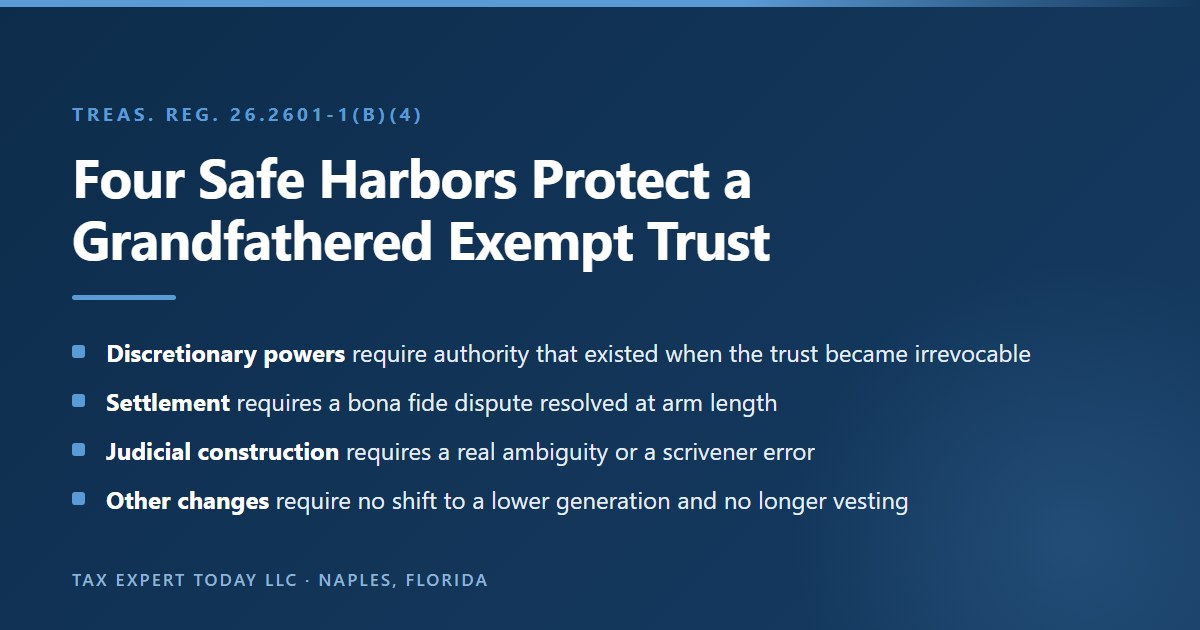
A trust exempt from generation skipping transfer tax, whether because it was irrevocable on September 25, 1985 or because exemption was allocated to it, can lose that status if it is modified the wrong way. Treas. Reg. §26.2601-1(b)(4) supplies four safe harbors. An exercise fitting one of them leaves exempt status intact.
The single most useful sentence in the whole regulation is the one that limits it. The regulation states that its rules apply only for the purpose of deciding whether an exempt trust retains exempt status, and that they do not decide whether the transaction results in a gift subject to gift tax, whether the trust may be included in a beneficiary gross estate, or whether gain is realized for purposes of section 1001.
In other words, clearing the generation skipping hurdle proves nothing about the gift tax hurdle. A practitioner who reads a safe harbor opinion as a clean bill of health has read half the page. This is the most common conflation in the material published on this topic, and it is the reason the four column table above separates the taxes rather than presenting decanting as one question.
Which Generation Skipping Safe Harbor Applies, and Why Does the Irrevocability Date Matter?
The four safe harbors are discretionary powers, court approved settlement, judicial construction, and other changes. The first is the natural fit for a decanting, but it carries a timing condition that defeats most grandfathered trusts: the authority must have existed in the instrument or under state law when the exempt trust became irrevocable.
| Safe harbor | Regulation | What it requires | Where it fails |
|---|---|---|---|
| Discretionary powers | §26.2601-1(b)(4)(i)(A) | The instrument, or state law as it stood when the trust became irrevocable, authorized the distribution without beneficiary or court consent, and the new trust does not extend vesting beyond the original perpetuities period | The state decanting statute was enacted after the trust became irrevocable, so it cannot supply the authority retroactively |
| Settlement | §26.2601-1(b)(4)(i)(B) | A court approved settlement of a bona fide administration or construction issue, reached at arm length and within the range of reasonable outcomes | There is no genuine dispute, so the settlement is a modification dressed as litigation |
| Judicial construction | §26.2601-1(b)(4)(i)(C) | A court construes an ambiguity or corrects a scrivener error, on a bona fide issue, consistently with how the highest court of the state would rule | The instrument is not ambiguous and nothing was drafted in error |
| Other changes | §26.2601-1(b)(4)(i)(D) | A judicial or valid nonjudicial reformation that does not shift a beneficial interest to a lower generation and does not extend the time for vesting beyond the original trust | The new trust adds a younger beneficiary, increases the amount of a generation skipping transfer, or lengthens the term |
Work the dates before anything else. Florida first enacted its decanting statute in 2007. A trust that became irrevocable before September 25, 1985, which is the population of grandfathered trusts the regulation was written for, could not have had Florida statutory decanting authority available to it at that moment, because the statute did not exist. The instrument itself may still supply the authority, and if it does the first safe harbor remains available. If it does not, the analysis moves to the fourth safe harbor, and the two conditions there become the whole exercise: no shift to a lower generation, and no extension of vesting.
The regulation defines the shift test usefully. A modification shifts a beneficial interest to a lower generation beneficiary if it can result in either an increase in the amount of a generation skipping transfer or the creation of a new one. The word to notice is can. The test is about what the second instrument permits, not about what the trustee currently intends to do with it.
The first safe harbor also carries a drafting allowance that is easy to miss. An exercise of a distributive power that postpones vesting for a term of years not exceeding 90 years, measured from the date the original trust became irrevocable, is not treated as postponing vesting beyond the perpetuities period. Florida separately subjects the exercise to Fla. Stat. §689.225, which fixes the start of the permissible perpetuities period by reference to the first trust rather than the second.
Why Will the IRS Not Rule on Decanting in 2026?
Treasury opened a study of the tax consequences of decanting in 2011 and has never closed it. IRS Notice 2011-101 requested public comments and announced that private letter rulings would not be issued on decantings that change beneficial interests while the study was pending. Fifteen years later the guidance has not been published and the no ruling position is still in force.
- The notice listed thirteen relevant facts. Notice 2011-101 identified the circumstances Treasury thought might drive the answer, including a change in a beneficiary right, a change in grantor trust status, a change of situs or governing law that pushes out the termination date, whether beneficiary consent or a court order was required, and whether the distributing trust is generation skipping exempt.
- The no ruling position survives in the current revenue procedure. Rev. Proc. 2026-3 carries decanting in section 4.01, the list of areas in which rulings will not ordinarily be issued, at item 37 for the distribution deduction question, item 55 for the gift question under section 2501, and item 61 for the generation skipping question under sections 2601 and 2663.
- Rulings remain available on the neutral cases. Notice 2011-101 preserved private letter rulings for transfers that do not change any beneficial interest and do not change the applicable rule against perpetuities period, which is a meaningful carve out for a purely administrative decanting.
- The practical consequence is that advisers reason by analogy. With no revenue ruling and no regulation on point, the working authority is the generation skipping regulation, older private letter rulings on trust mergers and severances, and the statutory text.
This is the reason a decanting deserves a written analysis rather than a checklist. The absence of guidance does not mean the transaction is untaxed. It means the taxpayer carries the risk of a position that cannot be pre cleared, and that the file should show the reasoning at the time the instrument was signed.
What Does the Florida Decanting Statute Allow, and What Does It Forbid?
Fla. Stat. §736.04117 splits trustees into two tiers. A trustee with an absolute power to invade principal has wide latitude to reshape the second trust. A trustee limited to an ascertainable standard has much less. Both tiers face the same prohibition: a decanting may not reduce a federal tax benefit the original contribution claimed.
| Question | Absolute power, subsection 2 | Limited power, subsection 3 |
|---|---|---|
| Definition | A power to invade principal that is not limited to specific or ascertainable purposes. Best interests, welfare, comfort and happiness all count as absolute | A power limited to a standard such as health, education, maintenance and support |
| Beneficiaries of the second trust | May include only beneficiaries of the first trust | Beneficial interests in the aggregate must be substantially similar to those in the first trust |
| Vested interests | May not be reduced | Protected through the substantially similar standard |
| Powers of appointment | May be retained, omitted, created or modified, and the class of permissible appointees may differ from the first trust | An existing power must be carried over with the same class of appointees, and a new power may not be created |
| Term | May extend beyond the term of the first trust | May extend beyond the term of the first trust, with limited additional powers during the extension |
The prohibition in subsection 5 is the tax provision inside the state statute, and it is the one worth reading closely. A trustee may not distribute principal in a manner that would prevent a contribution from qualifying for, or would reduce, a federal tax benefit originally claimed or claimable. The statute then names the benefits: the present interest and minor exclusions under IRC §2503(b) and §2503(c), the marital deduction under IRC §2056, §2056A or §2523, the charitable deduction under IRC §170(a), §642(c), §2055(a) or §2522(a), direct skip treatment under IRC §2642(c), and a catch all for any other income, gift, estate or generation skipping benefit.
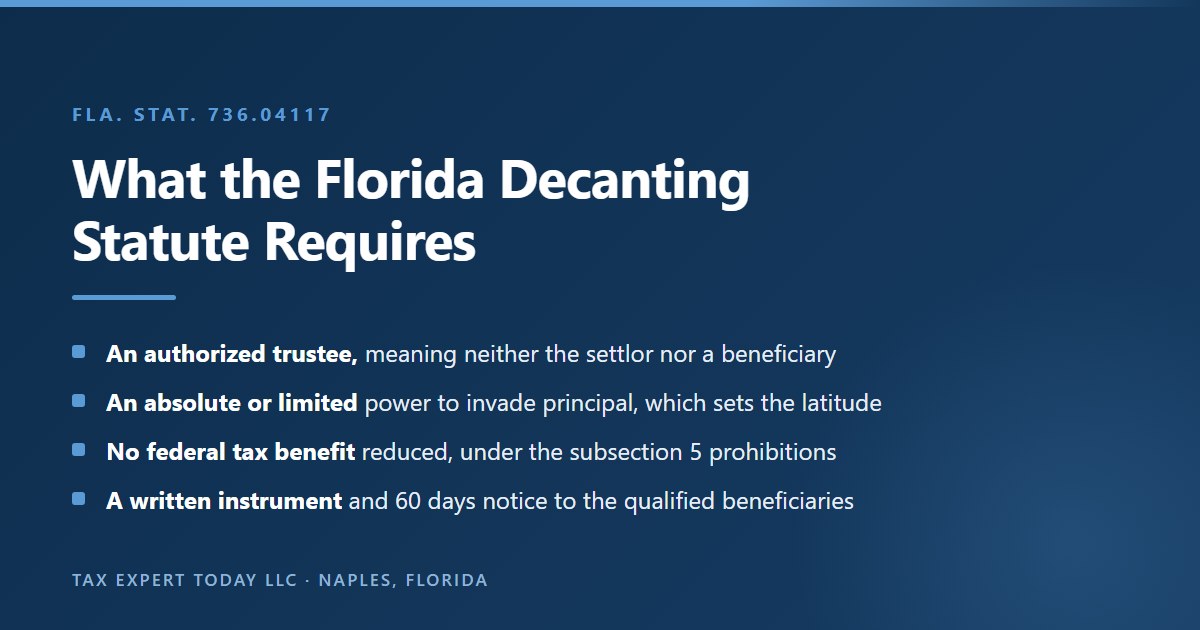
Three procedural requirements complete the picture. The exercise must be by a written instrument signed and acknowledged by the authorized trustee and filed with the records of the first trust. The trustee must give written notice of the intended exercise at least 60 days before the effective date to all qualified beneficiaries of the first trust, all trustees of the first trust, any person holding the power to remove or replace the authorized trustee, and in the grantor trust case described in subsection 5(c), the settlor. That notice period may be waived in writing by everyone entitled to it. Finally, subsection 12 fixes the reach of the statute: it applies to trusts governed by Florida law or having a principal place of administration in Florida.
Subsection 7 adds two limits that matter to a trustee personally. The exercise may not increase the trustee compensation beyond what the first instrument specified, and it may not relieve the trustee of liability for breach of trust or expand indemnification beyond the first instrument. A trustee who reads the statute as a licence to improve the trustee own position has read it wrong.
How Does Decanting Fit With a Move to Florida?
Sequencing decides the outcome. The Florida statute reaches a trust only if Florida law governs it or Florida is its principal place of administration, so for a trust drafted in a departure state the situs question comes first and the decanting question second. Reversing that order produces a decanting under a statute that does not apply to the trust.
- Situs first, decanting second. Subsection 12 of §736.04117 is a jurisdictional gate. A New York trust with a New York trustee and New York governing law is not a candidate for a Florida statutory decanting until administration has actually moved, a process governed by Fla. Stat. §736.0108 and covered in our guide to trust situs after moving to Florida.
- The departure state statute may allow it instead. Most states now have a decanting provision of some kind, so the answer is frequently that the exercise happens under the old state statute before the move rather than under Florida law after it.
- A situs change was on the list Treasury flagged. Notice 2011-101 specifically identified the case where the situs or governing law of the receiving trust differs from the distributing trust and produces a later termination date, so this fact pattern is one of the ones with no ruling available.
- Homestead and asset protection questions run separately. Florida creditor protection and homestead treatment are their own analysis, described in our guides to Florida asset protection for new residents and Florida estate planning for new residents.
- The departure state may still tax the assets on the way out. A trust holding a former residence or investment property in the old state keeps a nonresident filing obligation regardless of where the trust is administered, a point covered in our guide to selling your home after moving to Florida.
Does Decanting a Trust Change Which State Taxes the Trust?
Usually not by itself. Most states fix the tax residence of a trust at a moment in the past, typically the domicile of the grantor when the trust became irrevocable or when it ceased to be a grantor trust. A decanting done in the present does not travel back to that moment, so the departure state classification frequently survives the exercise intact.
New York is the clearest example. A trust that became irrevocable while the grantor was domiciled in New York is a New York resident trust permanently, and the only relief is a statutory exception with three conditions on trustees, corpus and source income. Decanting into a Florida trust does not undo the classification. It may help satisfy the exception, because moving every trustee out of New York is one of the three conditions, but that is a different proposition from changing residence.
California runs the opposite way, testing present facts about the residence of fiduciaries and noncontingent beneficiaries, so a change in trustee identity through a decanting does have an immediate effect there. The point is that decanting a trust answers a federal question and a governing law question, not a state residency question, and the state answer depends entirely on which test the departure state uses. Our guides to the dual state residency trap, to nonresident state tax returns and to snowbird filing in the first year cover the filing consequences that continue after a move.
What Should You Gather Before Anyone Can Answer This?
The analysis behind decanting a trust cannot start from the goal. It starts from the instrument, the dates and the tax history of the trust, because the safe harbor that is available and the statute that applies are both decided by facts that were fixed years ago.
- The complete first trust instrument including every amendment, so the invasion power can be read and classified as absolute or limited.
- The date the trust became irrevocable and, if different, the date it ceased to be a grantor trust. This single date controls the first generation skipping safe harbor and most departure state residency tests.
- The generation skipping inclusion ratio and any allocation history, including whether the trust was irrevocable on September 25, 1985 and therefore grandfathered.
- The current trustee list with the domicile of each trustee, which drives both the state residency analysis and whether an authorized trustee under the Florida definition even exists.
- A beneficiary schedule showing which interests are vested, because a vested interest cannot be reduced under the absolute power tier and is the interest whose holder becomes a donor on consent.
- The last three fiduciary income tax returns, federal and state, so the filing pattern and any existing state classification are visible before anything changes.
- A schedule of assets flagged for the three Florida prohibitions, meaning S corporation stock, retirement accounts subject to the minimum distribution rules, and anything that carried a marital, charitable or annual exclusion benefit into the trust.
Trust Decanting Help in Naples & Southwest Florida
Tax Expert Today LLC works with families and trustees who have relocated to Florida from New York, New Jersey, Illinois, Connecticut, Pennsylvania and other high tax states, and who are holding a trust drafted somewhere else under terms that no longer fit. The firm brings together tax advisors, enrolled agents, CPAs and attorneys, and handles trust, residency and multistate tax matters nationwide. Southwest Florida draws heavily from exactly the states whose resident trust statutes reach backward, so the pattern of an out of state instrument administered from a Florida address is familiar ground here.
Our office is located at 11983 Tamiami Trail N, Naples, Florida 34110. You can reach us at (239) 441-2005, Monday through Friday, 10am to 5pm ET. We also work with clients across all 50 states.
- Trust decanting help Naples: reading the invasion power, classifying it against the two tiers of §736.04117, and pricing the gift, income and generation skipping consequences before an instrument is drafted.
- Estate and trust planning Naples FL: fitting a proposed decanting into the wider plan, described on our estate and trust planning page and alongside vehicles such as a qualified personal residence trust or a charitable remainder trust.
- Trust situs review Naples: establishing whether Florida law even reaches the trust yet, which is the gate that decides whether a Florida decanting is available at all.
- Florida residency Naples FL: building the domicile record that the grantor side of the analysis depends on, including the issues raised in a Florida residency audit and in our guide to establishing Florida residency.
- Tax planning Naples FL: sequencing a trustee change, a release of a power or a decanting against the moment a departure state statute takes its snapshot, described on our Naples tax planning page.
- Tax resolution Naples: unfiled fiduciary years, late state filings and outstanding notices, described on our Naples tax resolution page and on our resolution and audit support page.
- Statewide and nationwide: multistate fiduciary and trust work handled from Naples for clients across Florida and the country.
Our trustee in New Jersey wants to decant our family trust into a Florida trust now that we live in Naples. What do we need to check first?
Three things, in order. First, whether Florida law reaches the trust at all. Fla. Stat. §736.04117(12) applies only to trusts governed by Florida law or having a principal place of administration in Florida, so if the trustee is still in New Jersey and the instrument still designates New Jersey law, the exercise would have to happen under the New Jersey statute rather than the Florida one. Second, the date the trust became irrevocable, because that date decides whether the first generation skipping safe harbor is available or whether the analysis falls to the fourth. Third, whether any beneficiary is being asked to sign a consent or a release, since that signature is what most often turns a neutral decanting into a reportable gift. We would want to see the instrument, the irrevocability date, the trustee list and the last three fiduciary returns before offering a view. New Jersey also has its own consequences on the way out, covered in our guides to the New Jersey exit tax and the New Jersey inheritance tax for nonresidents.
When to Engage a Professional
Decanting a trust purely for administrative reasons, done by a corporate trustee under a clear absolute power and changing nothing about who receives what, is a well trodden path and the tax analysis is short. Most decantings are not that. The moment the second instrument treats any beneficiary differently from the first, the transaction crosses from administration into a set of federal questions on which the IRS has declined to rule for fifteen years. Coordinating that work with the wider relocation plan is part of what our estate and trust planning practice does, alongside the retirement income questions covered in our guide to retiring to Florida.
Consider engaging an advisor when any of the following is present: the trust is generation skipping exempt or grandfathered, where the safe harbor analysis has to be documented before the instrument is signed; a beneficiary is being asked to consent, release a power, or waive the 60 day notice, each of which carries a potential gift consequence; the invasion power is limited to an ascertainable standard rather than absolute, which narrows what the second trust may do; the trust holds S corporation stock or retirement assets subject to the minimum distribution rules, both of which the Florida statute expressly protects; the trust was drafted in a state with a backward looking resident trust rule, so the state analysis and the federal analysis point in different directions; or the plan is to change situs and decant in the same exercise, where the order of operations decides which statute governs.
The firm brings together tax advisors, enrolled agents, CPAs and attorneys and works with clients nationwide from its Naples office. If you have relocated to Southwest Florida and are considering reshaping a trust drafted in a state you have left, call (239) 441-2005 or use our contact page to arrange a consultation. Outcomes depend on the specific facts of each trust, and nothing here is a prediction about any particular exercise.
This article is educational and general in nature. It is not legal, tax or accounting advice, and it does not create a professional relationship. Federal guidance on decanting remains outstanding and state law varies and changes. Decanting is a legal act that should be handled with a qualified trusts and estates attorney licensed in the governing jurisdiction. Please consult a qualified advisor about your own situation.
Published September 7, 2026 by Dr. Pellumb Kabashi « Back to Learning Center
Have a question this article touches on?
Tax Expert Today LLC, based in Naples, Florida and serving clients across the United States.
Schedule a Consultation (239) 441-2005