
By Dr. Pellumb Kabashi, DBA, MBA, CES, CFE, EA
Founder, Tax Expert Today LLC · Tax advisors, enrolled agents, CPAs, and attorneys · Serving clients in all 50 states
What Happens to the Gain When Selling Your Home After Moving to Florida?
Quick answer: Selling your home after moving to Florida does not move the gain to Florida. Real property is taxed by the state where it sits, so your former state can still tax the gain on the northern house even after you become a Florida resident. What Florida residency changes is everything else. The federal Section 121 exclusion still applies, and it runs on a clock that starts the day you move out.
Published: July 2026
Most people who relocate to Southwest Florida do not sell the old house first. They buy in Naples, move, and then list the northern property once the market looks right or once the last child finishes a school year. That sequence is usually the right lifestyle choice, and it is where the tax questions start. Two separate systems are now looking at the same sale. The federal system asks whether you still qualify for the Section 121 exclusion. The old state asks whether it may tax a gain on land inside its borders that is being sold by somebody who now lives 1,200 miles away. The California side of the same transaction, including Form 593 withholding and nonresident sourcing, is covered in our California capital gains tax on home sale guide.
The answers are not symmetrical, and the common assumption that a Florida move washes the gain clean is the single most expensive misunderstanding in this area. This guide walks through what selling your home after moving to Florida actually involves: the federal clock, the state sourcing rule, the money withheld at the closing table, and what changes if the house is rented out in the meantime.
How Long Do You Have to Sell Before the Section 121 Exclusion Expires?
Direct answer: Generally about three years from the date you stop living in the home. IRC §121(a) requires that the property was owned and used as your principal residence for periods aggregating two years or more during the five-year period ending on the date of sale. Once you move out, the two years of use you already have start sliding toward the back edge of that five-year window.
The arithmetic is worth doing slowly, because it produces a real deadline that most sellers never hear. Suppose you lived in the New Jersey house as your principal residence for the two years immediately before moving to Naples, and your move date is the last day of that use. The five-year lookback is measured backward from the closing date. For your two years of use to still sit inside that window, the closing has to occur no later than roughly three years after the move date. A second deadline runs alongside it at the closing table, because the withholding election has to be made before escrow closes, as explained in our guide to California Form 593.
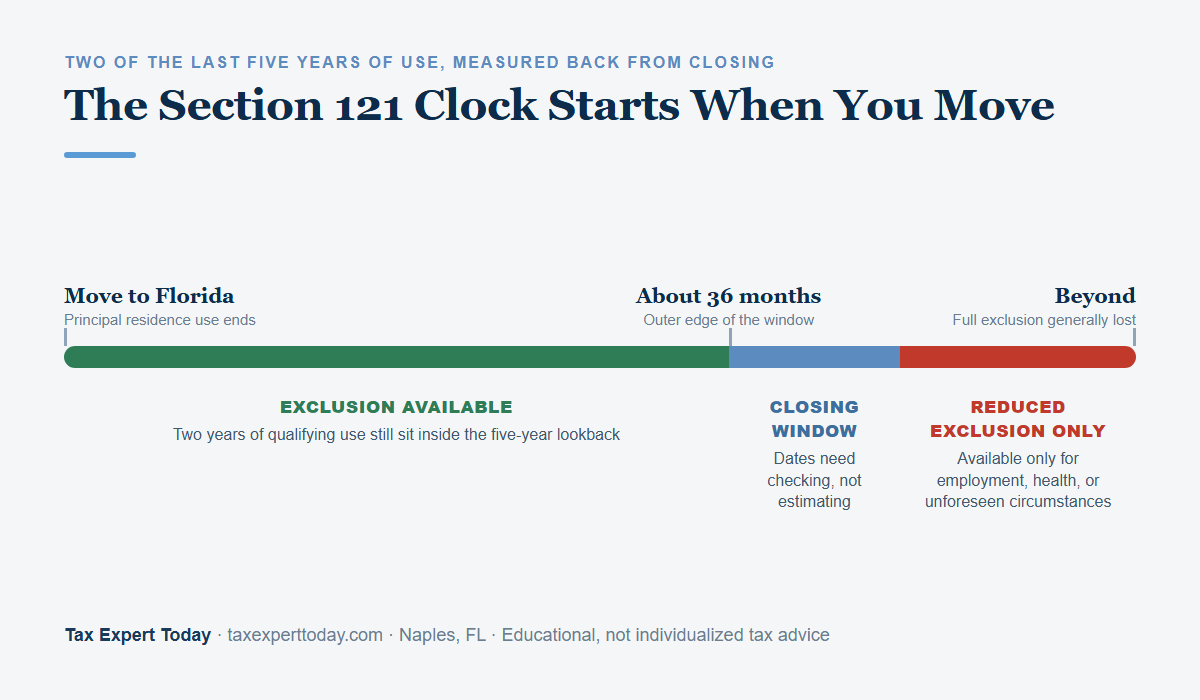
| Closing date, measured from the move | Years of qualifying use inside the five-year lookback | Section 121 result |
|---|---|---|
| Within 12 months | Full two years remain in the window | Exclusion available if the other tests are met |
| At about 24 months | Full two years remain in the window | Exclusion available if the other tests are met |
| Approaching 36 months | The two years are at the outer edge of the window | Last practical window in most fact patterns |
| Beyond about 36 months | Less than two years remain in the window | Full exclusion generally lost, subject to the reduced exclusion rules |
Two cautions apply to that table. First, the test counts periods aggregating two years, not a single unbroken block, so a fact pattern with earlier stretches of residence can behave differently. Second, the ownership requirement and the use requirement are separate, and on a joint return the rules under §121(b)(2)(A) allow either spouse to satisfy ownership while both must satisfy use. Anyone approaching the third anniversary of a move with an unsold northern home should have the dates checked against the closing calendar rather than estimated, because the difference between qualifying and not qualifying is the entire exclusion.
How Much Gain Does the Exclusion Actually Cover?
Direct answer: Up to $250,000 of gain for a single filer under §121(b)(1), and up to $500,000 on a joint return under §121(b)(2)(A). Those figures are statutory and are not indexed for inflation, which matters a great deal to anyone who bought a northern home decades ago and watched it appreciate through several cycles.
Because the caps have not moved, the exclusion covers a shrinking share of a long-held home in an appreciated market. A couple who purchased in 1996 and improved the property over thirty years may find that the excludable $500,000 leaves a substantial taxable remainder. That remainder is a long-term capital gain at the federal level, and it may also carry the net investment income tax depending on the return as a whole.
The exclusion is also not available on an unlimited schedule. Under §121(b)(3), it generally may not be claimed if the exclusion was already used on another sale within the two years before the current sale. Households that sold a prior residence shortly before relocating should confirm that the earlier sale does not block the later one. The interaction is easy to miss when a move involves selling a second property.
Does Your Old State Still Tax the Gain After You Become a Florida Resident?
Direct answer: Yes, in most cases. Gain from the sale of real property is sourced to the state where the property is physically located, and that sourcing rule does not care where the seller lives. Changing your domicile to Florida moves the taxation of intangible assets such as publicly traded stock, but land does not travel. The northern state retains its claim on the northern house.
This is the point at which the popular version of the story breaks down. It is entirely true that establishing Florida domicile before selling appreciated intangible assets can change which state taxes that gain, and that logic drives a great deal of legitimate planning. We cover the business and equity side of it in our guide to moving to Florida before selling a business. Real estate is the exception that people generalize away. A house in Westchester or Marin remains connected to New York or California by its location, and the gain on its sale is sourced accordingly.
The practical consequence is a nonresident return. As a Florida resident who sold property in the former state, you will generally file a nonresident income tax return there for the year of the sale, reporting the gain sourced to that state. Florida requires nothing in return, because Fla. Const. Art. VII §5 is the reason Florida imposes no personal income tax, so there is no Florida return and no Florida credit mechanism to worry about.
There is a meaningful piece of good news buried in this. Many states conform to the federal treatment of the principal residence exclusion, which means the same $250,000 or $500,000 that is excluded federally is often excluded on the nonresident return as well. In those states, a fully excluded sale can produce a nonresident return that reports the transaction and shows little or no tax. The return still has to be filed, and as the next section explains, filing it is usually how you get your money back.
What Gets Withheld at the Closing Table?
Direct answer: Several states require the closing agent to withhold estimated tax from a nonresident seller and remit it before the proceeds are released. The withholding is calculated on the sale, not on your actual liability, so a seller whose gain is fully excluded under Section 121 can still watch a large sum leave the closing table.
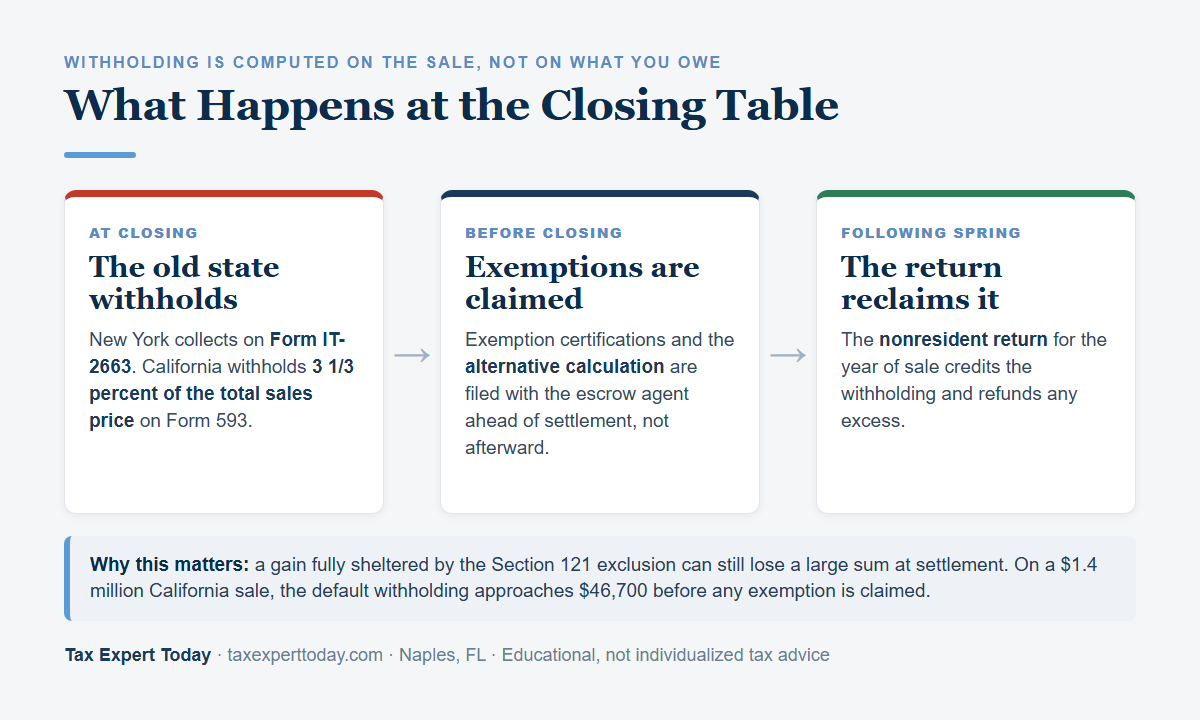
| State | Mechanism | Notes |
|---|---|---|
| New York | Form IT-2663, nonresident real property estimated income tax payment | The 2026 form applies to conveyances after December 31, 2025 and before January 1, 2027. It is filed and paid at the time of the conveyance. |
| California | Form 593 real estate withholding, described in FTB Publication 1016 | Default withholding is 3 1/3 percent of the total sales price unless the seller elects the alternative withholding calculation method. Sales of $100,000 or less are exempt, and other exemptions are claimed on the form before closing. |
Read the California default carefully, because the base is the wrong number for intuition. The 3 1/3 percent applies to the total sales price, not to the gain. On a $1.4 million sale, the default withholding approaches $46,700 even if the entire gain is sheltered by the Section 121 exclusion. The alternative withholding calculation method on Form 593 exists precisely to fix that mismatch, and the exemption certifications in the form are claimed before closing rather than afterward. Sellers who do not address the paperwork before the settlement date generally wait until the following spring, file the nonresident return, and claim the refund then.
Other states operate similar systems with different names and thresholds. The common thread is that the paperwork is handled by the closing agent under a deadline measured in days, while the seller is usually focused on the move itself. Raising the question with the escrow or title company several weeks before closing is the difference between certifying an exemption and financing the state for a year.
What Happens if You Rent the Northern Home Out After Moving?
Direct answer: Renting the home out after you move generally does not create a nonqualified use haircut, but it does create depreciation that the exclusion cannot shelter. This distinction is the most frequently garbled point in published guidance on the topic, and getting it right can change the computed tax substantially.
The nonqualified use rule in §121(b)(5) reduces the exclusion by the fraction of the ownership period during which the property was not used as a principal residence. Read alone, that sounds fatal to anyone who rents the old house while waiting for a buyer. The rule does not stop there. Under §121(b)(5)(C)(ii), the period of nonqualified use specifically does not include any portion of the five-year lookback period that falls after the last date the property was used as the taxpayer’s principal residence. A rental that begins when you leave for Florida sits entirely in that carve-out.
The practical effect is that post-move rental periods are generally benign for the exclusion fraction, while pre-move rental or vacation use of the same property is not. A property that served as a rental for six years before you converted it to your principal residence carries a nonqualified use fraction. The same property rented for eighteen months after you left for Naples typically does not.
Depreciation is the separate cost. Once the home is placed in service as a rental, depreciation is claimed, or is treated as allowable whether or not claimed. §121(d)(6) provides that the exclusion does not apply to gain to the extent of depreciation adjustments attributable to periods after May 6, 1997. That amount is unrecaptured Section 1250 gain under IRC §1250, and it is taxed at its own federal rate rather than the ordinary long-term capital gain rate. Renting the northern home for a year or two while the market recovers is often a sound decision, and it is one that should be made with the recapture number estimated in advance rather than discovered at filing. The worksheets in IRS Publication 523 walk through the allocation.
What if You Have to Sell Before Reaching Two Years of Use?
Direct answer: A reduced exclusion may be available. §121(c) provides a prorated exclusion where the sale occurs by reason of a change in place of employment, health, or, to the extent provided in regulations, unforeseen circumstances. The reduced amount is a fraction of the full $250,000 or $500,000 cap rather than a fraction of the gain.
Relocations to Florida frequently involve exactly these triggers. A move driven by a new work location, or by a health situation that makes a northern winter untenable, may support a reduced exclusion even where the two-year test is not satisfied. The qualifying conditions are specific and fact dependent, and the supporting documentation matters, so this is territory where the determination should be made on the actual facts rather than assumed in either direction.
It is also worth noting what the reduced exclusion is not. It is not a general hardship provision, and a sale motivated primarily by market timing or by a change of preference does not qualify merely because the taxpayer moved. Where the reduced exclusion is unavailable and the two-year test is missed, the gain is fully taxable at capital gain rates, which is precisely why the three-year window discussed earlier deserves a calendar entry rather than a mental note.
How Does Selling the Old Home Affect a Residency Audit?
Direct answer: Favorably, in most cases. Retaining the former residence is one of the facts a former state examines most closely when it questions whether a domicile change actually occurred. Selling it removes that argument, and the closing date becomes a durable, documented fact in the residency record.
High-tax states examine relocations on the basis of where the taxpayer’s life is actually centered, and the home occupies a privileged position in that analysis. A taxpayer who keeps the northern house furnished, insured, and available invites the argument that the move was nominal. That is a central theme in how these examinations run, which we cover in detail in our guide to the Florida residency audit and in our discussion of the dual state residency trap.
There is a timing tension worth naming. The residency analysis rewards selling early, while the Section 121 analysis tolerates waiting up to about three years. Where a household is under residency scrutiny, the domicile benefit of an early sale often outweighs the flexibility of waiting, and the two considerations should be weighed together rather than sequentially. Documenting the Florida move date through a Fla. Stat. §222.17 declaration of domicile supports both analyses at once, and our Florida 183 day rule calculator helps track the day counts that sit alongside it.
Key Terms in a Post-Move Home Sale
- Situs
- The physical location of real property, which determines the state that may tax gain on its sale regardless of the seller’s residence.
- Two-of-five-year test
- The Section 121 requirement that the property was owned and used as a principal residence for periods aggregating two years within the five years ending on the sale date.
- Period of nonqualified use
- Time after 2008 during which the property was not the principal residence, which reduces the exclusion, subject to the carve-out for periods after the last date of principal residence use.
- Unrecaptured Section 1250 gain
- The portion of gain attributable to depreciation taken on a rental period, which the Section 121 exclusion does not shelter and which carries its own federal rate.
- Nonresident withholding
- Estimated state tax collected by the closing agent from an out-of-state seller and credited against the nonresident return for the year of sale.
Sequencing the Sale Around the Move
Because the federal clock, the state sourcing rule, and the withholding paperwork all key off different dates, the sequence of a relocation deserves a plan rather than a reaction. The following order reflects how these decisions tend to interact in practice.
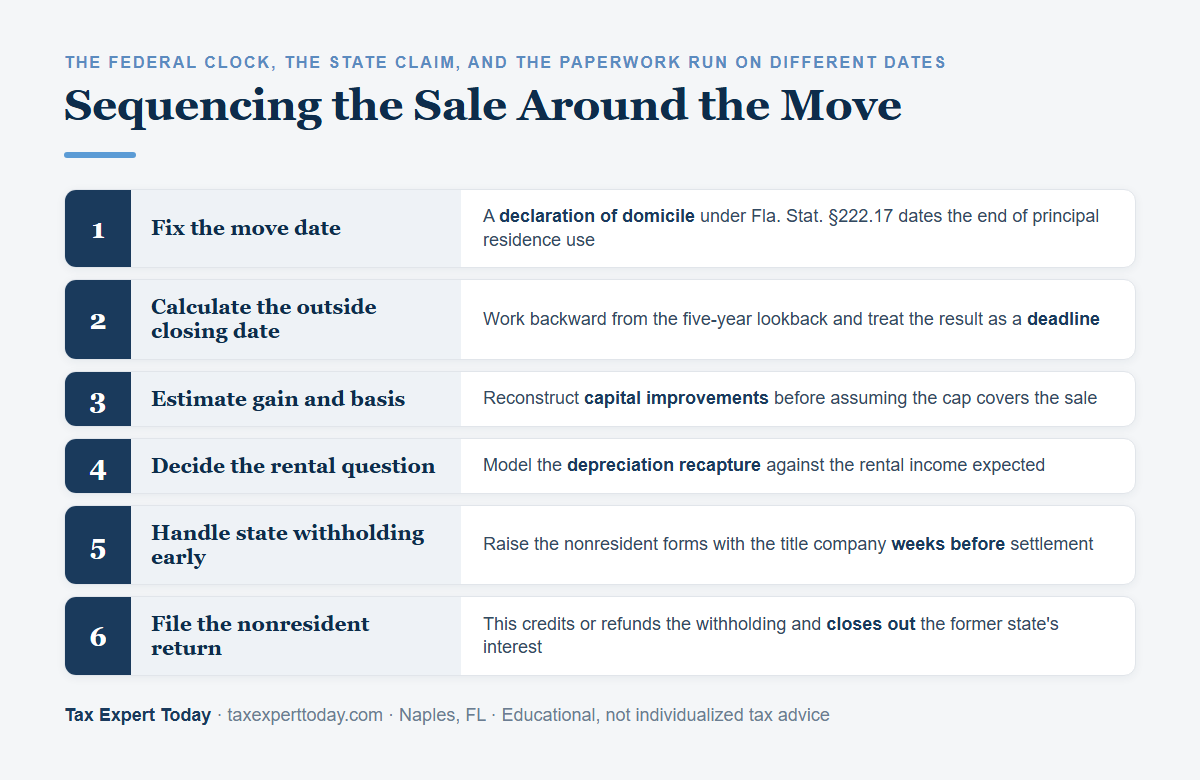
- Fix and document the move date. The date principal residence use ends starts the Section 121 clock and anchors the residency record. A declaration of domicile under Fla. Stat. §222.17 creates a dated instrument rather than a recollection.
- Calculate the outside closing date. Work backward from the five-year lookback to identify the last month in which a closing preserves two years of qualifying use, then treat that as a deadline rather than an estimate.
- Estimate the gain and the excludable portion. Reconstruct basis, including capital improvements made over the years of ownership, before assuming that the cap covers the sale. Long-held homes frequently exceed it.
- Decide the rental question deliberately. If the home will be rented while listed, model the depreciation that will be recaptured against the rental income expected.
- Handle state withholding before closing. Raise the nonresident forms with the title or escrow company weeks ahead so exemptions and alternative calculations are claimed at settlement instead of reclaimed a year later.
- File the nonresident return for the year of sale. This is how withheld amounts are credited or refunded, and it closes out the former state’s interest in the transaction.
Home Sale Tax Planning Help in Naples and Southwest Florida
Tax Expert Today LLC advises households relocating to Southwest Florida on the sequencing questions that surround a northern home sale, including the Section 121 timing analysis, the sourcing and filing obligations in the former state, and the coordination between the sale and the broader residency record. Our team includes tax advisors, enrolled agents, CPAs, and attorneys, and we work with clients on residency and tax matters nationwide, with a concentration of relocation work in Naples, Bonita Springs, Fort Myers, Marco Island, and the surrounding communities.
Because the analysis depends on the former state as much as on Florida, engagements of this kind usually begin with the closing timeline, the ownership and use history of the property, and the details of the move itself. Where the sale intersects estate planning or creditor protection questions, we coordinate with our estate and trust planning work and with Florida counsel where Florida specific instruments are involved.
Tax Expert Today LLC
11983 Tamiami Trail N, Naples, FL 34110
Phone: (239) 441-2005
Hours: Monday through Friday, 10:00 am to 5:00 pm ET
Related reading for households in the middle of a move: how to establish Florida residency, snowbird taxes in year one, retiring to Florida and the taxation of pensions and IRAs, Florida domicile for executives, and our Naples tax planning and Florida tax advisory services.
Frequently Asked Questions
I moved to Naples last year. Does selling my New York house mean I owe New York tax?
New York may tax the gain because the property is located there, and a nonresident return is generally required for the year of sale. Whether tax is actually due depends on the gain remaining after the Section 121 exclusion and on New York’s conformity to that exclusion. Form IT-2663 withholding is typically collected at the conveyance and credited on that return.
Does establishing Florida domicile before the sale eliminate the old state’s tax on the house?
Generally no. Domicile changes the state that taxes intangible assets, but real property gain is sourced to the state where the property sits. The Florida move is valuable for many reasons, and eliminating the former state’s claim on the northern house is usually not among them.
How long can I wait to sell without losing the exclusion?
Generally about three years from the date you stopped using the home as your principal residence, because the two years of qualifying use must fall within the five-year period ending on the sale date. The precise deadline depends on the actual pattern of ownership and use.
If I rent the house out while it is listed, do I lose the exclusion?
Usually not, because §121(b)(5)(C)(ii) excludes from nonqualified use any period after the last date the home was your principal residence. Depreciation claimed or allowable during the rental period is a separate matter and is not sheltered by the exclusion.
Do I need to file a Florida return on the sale?
No. Florida imposes no personal income tax on individuals, so there is no Florida return reporting the gain. The filing obligation for the year of sale sits with the state where the property was located.
Is a local advisor in Naples useful when the property is up north?
It is often the practical arrangement, because the analysis has a Florida side and a former state side that need to be handled together. Our office at 11983 Tamiami Trail N in Naples works with relocating households across Collier and Lee counties, and the former state filing is handled as part of the same engagement.
When to Engage a Professional on a Post-Move Home Sale
Selling your home after moving to Florida warrants professional analysis where the anticipated gain approaches or exceeds the exclusion cap, where the closing date is approaching the third anniversary of the move, where the home has been rented at any point, or where the former state is one that examines relocations closely. Those situations turn on dates and documents rather than on general rules, and the cost of an incorrect assumption is measured against a gain that took decades to accumulate.
Tax Expert Today LLC works with tax advisors, enrolled agents, CPAs, and attorneys on residency and tax matters nationwide. If you have relocated to Florida and are planning the sale of a home in a former state, you can reach the Naples office at (239) 441-2005 or through our contact page to discuss the specific timeline and filing obligations that apply to your situation. Outcomes depend on individual facts and on the law of the state involved, and nothing in this article is a prediction about any particular sale.
This article is educational in nature and does not constitute tax, legal, or investment advice. Tax results depend on individual circumstances and on the law in effect at the time of the transaction.
Published July 27, 2026 by Dr. Pellumb Kabashi « Back to Learning Center
Have a question this article touches on?
Tax Expert Today LLC, based in Naples, Florida and serving clients across the United States.
Schedule a Consultation (239) 441-2005