
By Dr. Pellumb Kabashi, DBA, MBA, CES, CFE, EA
Founder, Tax Expert Today LLC · Tax advisors, enrolled agents, CPAs, and attorneys · Serving clients in all 50 states
Quick Answer
A spousal lifetime access trust (SLAT) is an irrevocable trust one spouse funds by gift for the other spouse, moving assets and their growth out of the donor’s estate while the household keeps indirect access. In 2026 it uses part of a $15,000,000 exclusion that no longer sunsets, so the case rests on growth, not a deadline. Call (239) 441-2005 for a free consultation.
What is a spousal lifetime access trust?
A spousal lifetime access trust is an irrevocable trust that one spouse, the donor, creates and funds with a completed gift for the benefit of the other spouse, and usually their descendants. The gift uses the donor’s lifetime exclusion, and the assets and all later growth are kept out of both spouses’ taxable estates.
The phrase “spousal lifetime access trust” does not appear in the Internal Revenue Code. It is a practitioner label for a familiar structure: an irrevocable, usually grantor, trust in which the beneficiary spouse can receive distributions during life, and the children or later descendants take what remains after that spouse dies. The label stuck because it describes the selling point. The donor gives the property away for estate tax purposes, but as long as the marriage and the beneficiary spouse both last, the household can still draw on it.
That indirect access is the whole appeal, and it is also where most of the risk lives. The donor is not a beneficiary and cannot be one without pulling the trust back into the donor’s estate under IRC section 2036. The access runs only through the beneficiary spouse. Everything this guide covers, from the reciprocal trust doctrine to divorce and the death of the beneficiary spouse, is really a question about how durable that one line of access is.
- Irrevocable. The donor spouse generally cannot amend the terms or take the property back once the trust is funded.
- Funded by a completed gift. The transfer is reported on Form 709 and uses the donor’s lifetime exclusion.
- For the other spouse. The beneficiary spouse may receive income and principal, usually under a standard the trustee applies.
- Then for descendants. Children or grandchildren typically follow as current or remainder beneficiaries.
- Usually a grantor trust. The donor pays the income tax on trust earnings, which lets the trust grow untaxed.
How does a spousal lifetime access trust work, step by step?
The donor spouse signs an irrevocable trust naming the other spouse and descendants as beneficiaries, appoints a trustee, and transfers separate property by gift. A Form 709 reports the gift for the year. The trustee then invests and makes distributions to the beneficiary spouse under the trust standard, while the donor typically pays the income tax.
| Step | What happens | Governing rule |
|---|---|---|
| 1. Draft | An irrevocable trust for the beneficiary spouse and descendants, with a distribution standard and no retained interest for the donor | State trust law; IRC section 2036 and section 2038 define what the donor must not keep |
| 2. Fund | The donor transfers property that is the donor’s own separate property, not joint or community property | IRC section 2511 (a completed gift) |
| 3. Report | Form 709 reports the gift and any generation-skipping transfer tax exemption allocation | Instructions for Form 709; due April 15 of the following year under IRC section 6075(b) |
| 4. Administer | The trustee invests and makes distributions to the beneficiary spouse under the trust standard | The trust instrument; IRC section 2041 if the spouse is also a trustee |
| 5. Income tax | As a grantor trust, trust income is reported on the donor’s own return | IRC section 677(a) |
| 6. Later deaths | Trust assets are excluded from both spouses’ estates and continue for descendants | The trust instrument and the funding record |
Two design points carry most of the weight. The first is the source of the property. A SLAT has to be funded with assets that belong to the donor alone. If the beneficiary spouse contributes, even indirectly through joint or community property, that spouse becomes a partial grantor of a trust in which that spouse holds a life interest, and the portion that spouse contributed is at risk of inclusion in that spouse’s estate under section 2036. The second is the distribution standard. Most SLATs let an independent trustee distribute for any purpose, and let the beneficiary spouse, if serving as trustee, distribute to themselves only for health, education, maintenance, and support, the ascertainable standard carved out of the general power of appointment definition in section 2041(b)(1)(A).
Why does a spousal lifetime access trust save estate tax?
A SLAT saves estate tax by removing future growth from the donor’s estate. The gift itself is counted against the donor’s exclusion at its value on the date of the gift, so any appreciation after that date escapes the 40 percent estate tax entirely. The longer the trust holds growing assets, the larger the saving becomes.
This point is often blurred in marketing material. A gift to a spousal lifetime access trust does not make the gifted amount itself disappear from the transfer tax calculation. Under IRC section 2001(b), lifetime taxable gifts are added back as “adjusted taxable gifts” when the estate tax is computed. What the gift does accomplish is to freeze the value. The IRS counts the $10,000,000 that went in, not the $30,000,000 it may be worth decades later.
The table below shows the arithmetic for a hypothetical $10,000,000 gift growing at 6 percent a year. It assumes the donor’s estate is large enough to be taxable at the top 40 percent rate, which is the only situation in which a SLAT saves any estate tax at all.
| Years after the gift | Trust value at 6 percent | Growth kept out of the estate | Estate tax avoided at 40 percent |
|---|---|---|---|
| 10 | $17,908,477 | $7,908,477 | $3,163,391 |
| 20 | $32,071,355 | $22,071,355 | $8,828,542 |
| 30 | $57,434,912 | $47,434,912 | $18,973,965 |
Hypothetical illustration only. Assumes a constant 6 percent annual return, an estate taxable at 40 percent at the donor’s death, and no distributions. Actual returns, exclusion amounts, and tax rates will differ, and the result depends entirely on individual facts.
For a couple whose combined estate will fall under two indexed exclusions, the same table produces no saving at all, and the spousal lifetime access trust may cost them the basis step-up discussed later. That is why the first question in any SLAT analysis is not how the trust works but whether the family has an estate tax problem to solve.
How much can be given to a spousal lifetime access trust in 2026?
In 2026 each person has a $15,000,000 basic exclusion under IRC section 2010(c)(3), as set by P.L. 119-21 and confirmed in Rev. Proc. 2025-32. A donor can give up to the unused portion of that exclusion to a SLAT without paying gift tax. Gifts above it are taxed at 40 percent.
Rev. Proc. 2025-32 states that section 70106 of the 2025 budget reconciliation law, P.L. 119-21, amended section 2010(c)(3) to set the basic exclusion amount at $15,000,000 for calendar year 2026, that the generation-skipping transfer tax exemption is the same $15,000,000, and that both are adjusted for inflation for years after 2026. The annual exclusion for 2026 is $19,000 per donee.
| 2026 figure | Amount | What it means for a SLAT |
|---|---|---|
| Basic exclusion amount, per person | $15,000,000 | The most the donor spouse can give to a SLAT without gift tax, less any exclusion already used |
| GST exemption, per person | $15,000,000 | Can be allocated to the SLAT so grandchildren later take free of GST tax |
| Annual exclusion, per donee | $19,000 | Available only for present interest gifts, usually through withdrawal powers for descendants |
| Top gift and estate tax rate | 40 percent | Applies to gifts above the remaining exclusion |
| Scheduled sunset | None | The exclusion is indexed after 2026 rather than falling back to the pre-2018 level |
Two limits matter in practice. The donor spouse can use only that spouse’s own exclusion, because, as explained below, gift splitting is usually unavailable for a SLAT. And the donor should not give away so much that the household depends on the trust for its standard of living, because that dependence is exactly what a divorce or the beneficiary spouse’s death can cut off. A separate guide on the lifetime gift tax exemption in 2026 covers the exclusion mechanics in more depth.
Did P.L. 119-21 change the case for a SLAT?
Yes. Through 2025, most SLAT marketing rested on a deadline: the exclusion was scheduled to fall by roughly half on January 1, 2026, and a gift was the way to lock in the higher amount. P.L. 119-21 removed that sunset. A SLAT now has to justify itself on growth, income tax, and asset protection alone.
Under the 2017 law, the doubled exclusion was temporary. Planners told married clients to use it or lose it, and the spousal lifetime access trust was the favorite tool for doing so because it used one spouse’s exclusion while keeping the household’s access through the other. Treasury regulations under Treas. Reg. section 20.2010-1(c) confirmed that a gift made under the higher exclusion would not be clawed back if the exclusion later fell, which made the pitch concrete. Several pages that still rank for this topic describe that sunset as if it were still coming.
It is not. The comparison below shows how much of the old argument depended on the deadline. The pre-2026 column uses a projected post-sunset exclusion of about $7,000,000 purely for illustration; that figure never took effect.
| Question | Old pitch (scheduled sunset) | 2026 reality (P.L. 119-21) |
|---|---|---|
| Why fund now? | Lock in exclusion that was about to disappear | Freeze the value so future growth leaves the estate |
| Illustrative “bonus” exclusion captured by a $13,990,000 gift in 2025 | About $6,990,000, worth about $2,796,000 at 40 percent | $0; the exclusion at death is expected to be at least as high as the exclusion used |
| Deadline | December 31, 2025 | None; indexed each year after 2026 |
| Main benefit | Exclusion capture plus growth | Growth, the grantor trust income tax burn, and asset protection |
| Main risk | Giving away assets in a rush | Giving away more than the household can live without |
Hypothetical illustration only. Figures depend on each taxpayer’s facts. Future legislation could change the exclusion in either direction.
The practical consequence is that a family can now take its time. There is no year-end rush forcing a large gift before the trust terms, the funding assets, and the household budget have been worked through. For families who funded SLATs in a hurry in late 2025, the change is also a reason to review what was signed, because some trusts drafted under deadline pressure contain the very weaknesses described below.
What is the reciprocal trust doctrine?
The reciprocal trust doctrine lets the IRS “uncross” two trusts that spouses create for each other. Under United States v. Estate of Grace, if the trusts are interrelated and leave each spouse in about the same economic position as a trust for themselves, each spouse is treated as grantor of the trust benefiting them.
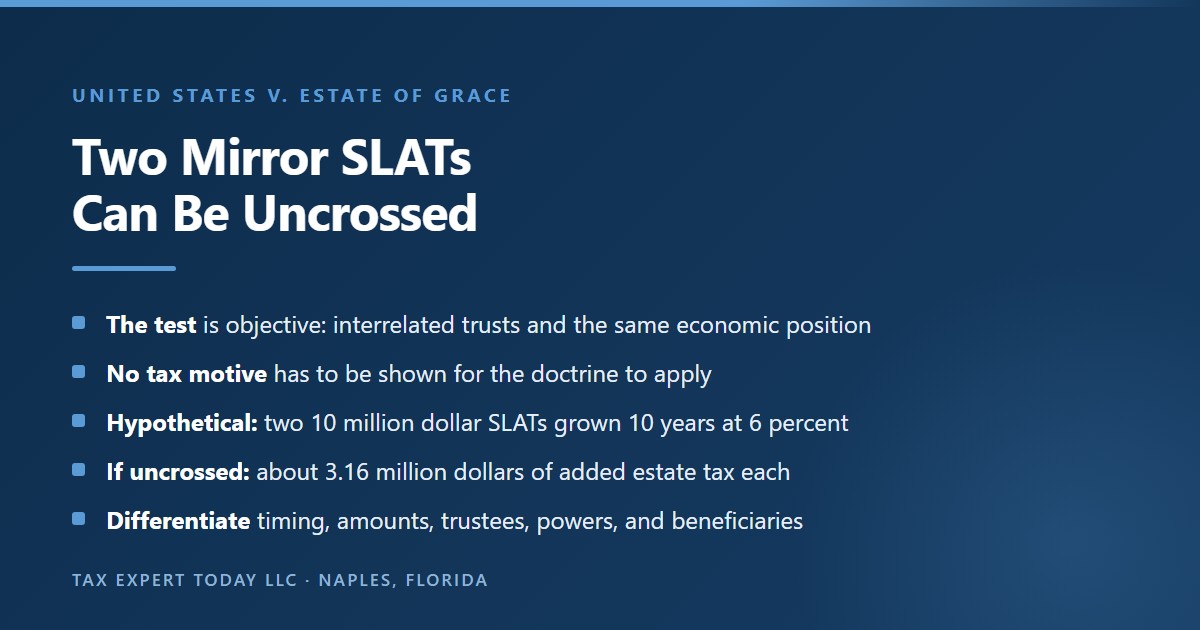
Couples who want to use both exclusions often ask whether each spouse can simply create a SLAT for the other. The difficulty is that two identical trusts, each for the other spouse, leave both spouses exactly where they started: each has a trust for their own benefit, funded in substance by their own property. In United States v. Estate of Grace, 395 U.S. 316 (1969), the Supreme Court held that applying the doctrine requires only that the trusts be interrelated and that the arrangement, to the extent of mutual value, leave the settlors in approximately the same economic position as if each had created a trust naming themselves as life beneficiary. No tax avoidance motive has to be shown.
When the doctrine applies, each spouse is treated as having created the trust that benefits them, and the trust is included in that spouse’s estate under section 2036. The estate tax plan for both trusts fails at once. The hypothetical below shows why the stakes are large.
| Hypothetical: two mirror SLATs | Spouse A | Spouse B |
|---|---|---|
| Amount gifted in 2026 | $10,000,000 | $10,000,000 |
| Value 10 years later at 6 percent | $17,908,477 | $17,908,477 |
| Growth the plan meant to exclude | $7,908,477 | $7,908,477 |
| Additional estate tax if the trusts are uncrossed, at 40 percent | About $3,163,391 | About $3,163,391 |
| Combined additional exposure | About $6,326,782 | |
Hypothetical illustration only. Assumes both estates are taxable at 40 percent, constant 6 percent growth, and no distributions. The actual calculation depends on each estate’s facts, prior gifts, and remaining exclusion.
How do couples avoid the reciprocal trust doctrine with two SLATs?
Couples who each create a SLAT generally make the trusts meaningfully different in timing, amount, beneficiaries, trustees, distribution standards, and powers, so that neither spouse ends up in roughly the same economic position as with a trust for themselves. No single difference is a safe harbor, and Grace looks at the arrangement as a whole.
The Grace test is objective, which cuts both ways. A couple cannot defeat the doctrine by proving good intentions, but they also do not need to prove a lack of tax motive if the trusts are genuinely different. Practitioners often point to Estate of Levy v. Commissioner, T.C. Memo. 1983-453, where the Tax Court declined to uncross two trusts because one spouse held a lifetime special power of appointment that the other did not. Many advisors treat that case as helpful rather than decisive, and layer several differences rather than relying on one.
| Feature | Mirror SLATs (high risk) | Differentiated SLATs (lower risk) |
|---|---|---|
| Timing | Signed and funded on the same day | Created months apart, often in different tax years |
| Amount and assets | Equal dollar amounts of similar assets | Different amounts and different asset types |
| Beneficiaries | Each spouse plus the same children | One trust adds grandchildren or a charity, or delays the spouse’s interest |
| Distribution standard | Identical HEMS standard in both | One discretionary with an independent trustee, one limited to HEMS |
| Powers of appointment | Same power in both, or none in both | A lifetime or testamentary limited power in one trust only |
| Trustees | Each spouse is trustee of the trust for them | Different independent trustees |
| Termination triggers | Same | Different events end or change the spouse’s interest |
General illustration of factors commonly considered. No combination ensures that the doctrine will not apply, and the analysis depends on the documents and the facts.
A second approach is to use only one SLAT. If one spouse creates a spousal lifetime access trust and the other spouse uses their exclusion on a different kind of gift, such as a trust for descendants only, a dynasty trust without a spousal interest, or a grantor retained annuity trust, there is nothing to uncross. The household gives up access to the second gift, which is the price of eliminating reciprocal trust risk.
Can spouses split gifts to a SLAT?
Usually not. Gift splitting under IRC section 2513 is not available when one spouse is a beneficiary of the trust, unless the spouse’s interest is ascertainable and severable at the time of the gift. Most SLATs give the spouse discretionary access, which is not ascertainable, so the whole gift counts against the donor spouse’s exclusion alone.
IRC section 2513 lets a married couple treat a gift by one spouse to a third party as made half by each. The consenting spouse cannot be the recipient. Under Treas. Reg. section 25.2513-1(b)(4) and the Form 709 instructions, where property is transferred partly to the spouse and partly to third parties, the consent is effective only if the third party interest is ascertainable at the time of the gift and severable from the spouse’s interest. A SLAT that lets the trustee pay the spouse whatever the spouse needs gives the spouse an interest with no ascertainable value, so nothing can be severed.
| Hypothetical: Spouse A gives $10,000,000 to a SLAT in 2026 | Spouse A | Spouse B |
|---|---|---|
| Exclusion available before the gift | $15,000,000 | $15,000,000 |
| Exclusion used if gift splitting were allowed | $5,000,000 | $5,000,000 |
| Exclusion actually used (no split for a SLAT) | $10,000,000 | $0 |
| Exclusion remaining after the gift | $5,000,000 | $15,000,000 |
| Annual exclusion gifts via withdrawal powers for three children | $57,000 (3 x $19,000) | Not doubled; $114,000 would require a valid split |
Hypothetical illustration based on 2026 figures in Rev. Proc. 2025-32. Assumes no prior taxable gifts. Individual results depend on each taxpayer’s facts and filing history.
A consent filed in error can create more than a reporting problem. The consent is effective for all gifts to third parties by either spouse during the year, and the Form 709 instructions state that the resulting gift tax liability is joint and several. A couple who split a SLAT gift should have the return reviewed, because the split may be invalid and both spouses’ exclusion balances may be misstated on every later return.
Why does a SLAT not qualify for the marital deduction?
A SLAT is designed to fail the marital deduction. The unlimited gift tax marital deduction under IRC section 2523 would defer tax only until the beneficiary spouse’s death, when the assets would be taxed in that spouse’s estate. A SLAT instead uses the donor’s exclusion now so that the assets are never taxed in either estate.
This is a frequent source of confusion, because a gift to a trust for a spouse sounds like it should be tax free under the marital deduction. It can be, if the trust is structured as a qualified terminable interest property trust under IRC section 2523(f) and the election is made. But a QTIP trust must pay the spouse all income at least annually and cannot benefit anyone else during the spouse’s life, and its assets are included in the spouse’s estate. That is the opposite of what a spousal lifetime access trust is for. A SLAT gives the trustee discretion, lets children benefit alongside the spouse, and is built so that the assets escape estate tax at both deaths.
| Feature | SLAT | Inter vivos QTIP trust |
|---|---|---|
| Gift tax treatment | Uses the donor’s exclusion | Marital deduction; no exclusion used |
| Spouse’s income right | Discretionary | All income at least annually |
| Other beneficiaries during spouse’s life | Permitted | Not permitted |
| Included in the beneficiary spouse’s estate | No, if properly drafted | Yes |
| Main purpose | Remove growth from both estates | Control and defer, with tax at the second death |
Why must a SLAT be funded with the donor’s separate property?
If the beneficiary spouse contributes to a SLAT, directly or through joint or community property, that spouse becomes a grantor of the portion they contributed while also holding a lifetime interest in it. That portion can be included in the beneficiary spouse’s estate under IRC section 2036, which defeats the purpose of the trust.
Joint accounts are the everyday trap. A transfer from a joint brokerage account is, in substance, a transfer of property half owned by each spouse. Advisors therefore commonly have the donor retitle assets into the donor’s sole name first, with the other spouse’s gift of their half properly documented, and wait before funding the trust. The waiting period is a judgment call rather than a rule, and some advisors treat any direct path from joint to trust as a step transaction risk.
Community property is the harder case, and it matters in Naples because so many Southwest Florida families moved here from California, Texas, Arizona, and other community property states. Florida is not a community property state, but under the Florida Uniform Disposition of Community Property Rights at Death Act, Florida Statutes section 732.217, property acquired as community property in another state, and property traceable to it, can keep that character after a move. Florida also now allows couples to create a community property trust under Florida Statutes section 736.1502 for trusts created on or after July 1, 2021.
| Funding source | Who is the grantor for tax purposes? | Estate inclusion risk for the beneficiary spouse |
|---|---|---|
| Donor’s separate property, titled in the donor’s name alone | The donor spouse only | Low, if the trust is otherwise properly drafted |
| Joint account transferred directly to the trust | Potentially both spouses, half each | The beneficiary spouse’s half may be included |
| Community property from a prior state of residence | Both spouses, one half each | High for the half attributed to the beneficiary spouse |
| Property partitioned into separate property by a written agreement before funding | The spouse who owns it after partition | Lower, but partition itself may be a gift and should be documented |
General illustration. The character of property depends on state law, the couple’s history, and any agreements between them. Couples who have lived in a community property state should have the tracing reviewed before funding.
Who pays income tax on a spousal lifetime access trust?
In most SLATs the donor spouse pays. Because trust income may be distributed to the donor’s spouse, IRC section 677(a) treats the donor as the owner of the trust for income tax purposes. Trust income, deductions, and credits are reported on the donor’s own return, and the trust itself usually pays no income tax.
IRC section 677(a) makes the grantor the owner of any portion of a trust whose income, without the approval or consent of an adverse party, is or may be distributed to the grantor or the grantor’s spouse. A SLAT exists to benefit the grantor’s spouse, so it is almost always a grantor trust. Many SLATs also include a power under IRC section 675(4)(C) to reacquire trust property by substituting other property of equivalent value, which reinforces grantor trust status and, as discussed below, can help with basis.
Paying that tax is not treated as a further gift. In Rev. Rul. 2004-64, the IRS concluded that a grantor’s payment of income tax on a grantor trust’s income is not a gift to the beneficiaries, because the grantor is the person legally liable for the tax. The ruling also warns that a mandatory reimbursement clause, or a discretionary one paired with an understanding or creditor access, can cause estate inclusion.
How much does the grantor trust income tax burn add?
A great deal over time. When the donor pays the trust’s income tax from assets outside the trust, the trust compounds at its full pretax return while the donor’s taxable estate shrinks by each payment. In a hypothetical $10,000,000 SLAT earning 6 percent, the difference after 20 years exceeds $9,000,000.
| Years | Trust value if the donor pays the tax | Trust value if the trust pays its own tax | Extra value in the SLAT | Income tax paid by the donor | Estate tax avoided on those payments at 40 percent |
|---|---|---|---|---|---|
| 10 | $17,908,477 | $15,089,581 | $2,818,896 | $2,372,543 | $949,017 |
| 20 | $32,071,355 | $22,769,546 | $9,301,808 | $6,621,406 | $2,648,563 |
| 30 | $57,434,912 | $34,358,292 | $23,076,620 | $14,230,474 | $5,692,189 |
Hypothetical illustration only. Assumes a $10,000,000 initial gift, a 6 percent total annual return, and income tax equal to 30 percent of each year’s return when the trust bears it (a 4.2 percent net return). Real returns, the mix of ordinary income and capital gain, and tax rates will differ.
The burn is a feature, but it is also a cash flow commitment that lasts as long as the trust is a grantor trust, which may be the donor’s lifetime. A donor who gives away the income producing assets and keeps only illiquid ones may struggle to pay the tax. Many SLATs therefore include a power, held by someone other than the donor, to turn off grantor trust status, and some permit a discretionary reimbursement of the donor’s tax under the limits described in Rev. Rul. 2004-64. The dynasty trust guide models the same burn over longer horizons.
How is a SLAT taxed if it stops being a grantor trust?
A non-grantor SLAT is a separate taxpayer filing Form 1041, and trust income retained in the trust reaches the 37 percent bracket above just $16,000 in 2026. Adding the 3.8 percent net investment income tax, retained income can be taxed at an effective rate close to that of a top-bracket married couple.
Grantor trust status can end on purpose, when a power holder releases the powers that create it, or by accident, most often at the donor’s death. After that, the trust is taxed under the compressed trust brackets in Rev. Proc. 2025-32: 10 percent to $3,300, 24 percent to $11,700, 35 percent to $16,000, and 37 percent above $16,000, with the 20 percent capital gain rate beginning above $16,250. The net investment income tax under IRC section 1411 applies to a trust’s undistributed investment income above the same $16,000 threshold.
| Retained ordinary investment income | 2026 trust income tax | Net investment income tax | Total | Effective rate | Same income taxed to a top-bracket grantor at 40.8 percent |
|---|---|---|---|---|---|
| $50,000 | $16,431 | $1,292 | $17,723 | 35.4 percent | $20,400 |
| $100,000 | $34,931 | $3,192 | $38,123 | 38.1 percent | $40,800 |
| $320,000 | $116,331 | $11,552 | $127,883 | 40.0 percent | $130,560 |
Hypothetical illustration using 2026 trust brackets from Rev. Proc. 2025-32. Assumes all income is ordinary, undistributed, and net investment income, with no deductions. Distributions to beneficiaries generally carry income out to them under the distributable net income rules, which changes the result.
The rates are close, which is the point. Turning off grantor status rarely saves much income tax for a high-income family. What it changes is who pays. The donor stops shrinking the estate with each payment, and the trust starts compounding more slowly. Families usually reserve the switch for a period when the donor needs liquidity or when, after a divorce, the donor no longer wants to pay tax on income that benefits a former spouse.
What happens to a spousal lifetime access trust in a divorce?
In a divorce the donor usually loses the household’s indirect access, because the former spouse typically remains the beneficiary under the irrevocable terms. Worse, under IRC section 672(e) the donor can remain taxed on trust income paid to the former spouse, since section 682, which once shifted that income, was repealed for post-2018 divorces.
This is the risk that most SLAT summaries mention in a single line and then leave. The mechanics are worth spelling out. IRC section 672(e)(1)(A) treats a grantor as holding any power or interest held by any individual who was the grantor’s spouse at the time the power or interest was created. The beneficiary spouse’s interest in a spousal lifetime access trust was created while the couple was married, so the rule continues to attribute that interest to the donor after the marriage ends. Section 677(a) therefore continues to treat the donor as owner of the trust.
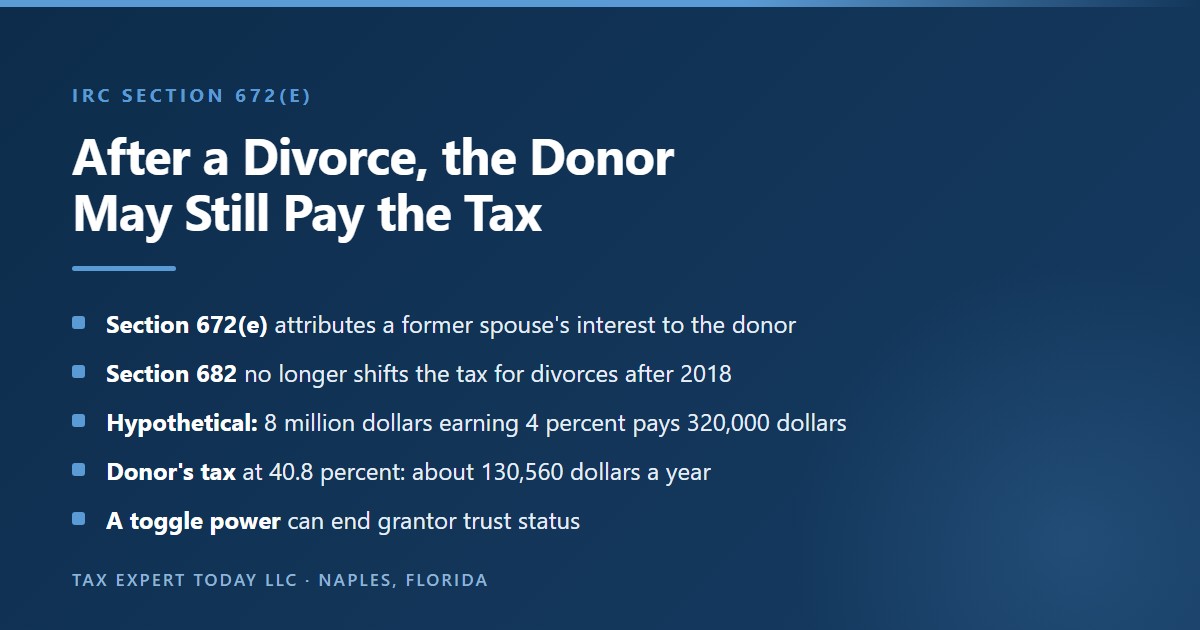
Before 2019, IRC section 682 shifted the income tax on trust income payable to a former spouse onto that former spouse. The 2017 tax law repealed section 682 for divorce or separation instruments executed after December 31, 2018, and for older instruments modified afterward if the modification expressly adopts the change. For most divorces today, nothing moves the tax off the donor.
| Hypothetical: $8,000,000 SLAT earning 4 percent in taxable income | Amount |
|---|---|
| Annual trust income paid to the former spouse | $320,000 |
| Donor’s federal tax on that income at 37 percent plus 3.8 percent NIIT | About $130,560 a year |
| Donor’s cumulative tax over 10 years at the same income | About $1,305,600 |
| Donor’s access to trust assets after the divorce | None under the typical terms |
Hypothetical illustration only. Assumes the donor remains in the top bracket, all income is ordinary net investment income, and grantor trust status is not turned off. Divorce outcomes depend on the trust terms, the settlement, and state law.
- Toggle power. A power held by a nonadverse person to turn off grantor trust status can end the donor’s tax exposure.
- Reimbursement clause. A discretionary power to reimburse the donor’s tax, within Rev. Rul. 2004-64, can offset part of the cost.
- Floating spouse definition. Defining the beneficiary as the person married to the donor at the relevant time can shift benefits to a later spouse.
- Settlement terms. The divorce agreement can address the trust, including valuation of the former spouse’s interest.
- Prenuptial or postnuptial agreement. Some couples address SLAT treatment in advance, with separate counsel for each spouse.
What happens when the beneficiary spouse dies first?
When the beneficiary spouse dies, the donor’s indirect access ends. The trust generally continues for the children or other remainder beneficiaries, and the donor cannot be added as a beneficiary without risking estate inclusion. Some trusts give the deceased spouse a limited power of appointment that can redirect assets, within limits, to a new trust.
The death of the beneficiary spouse is statistically the more common way access ends, and it is harder to plan around than divorce because the donor is still alive and still depends on the household budget the trust was helping to support. The trust assets remain outside both estates, which is the tax goal, but the donor has lost part of the family’s spending capacity at exactly the moment that spouse’s own needs may change.
| Event | Tax result for the trust | Access for the donor spouse | Common planning response |
|---|---|---|---|
| Beneficiary spouse dies first | Trust stays out of both estates if properly drafted | Ends | Keep enough assets outside the trust; life insurance on the beneficiary spouse |
| Donor spouse dies first | Trust stays out of the donor’s estate; grantor status usually ends | Not applicable | Trust continues for the surviving spouse and then descendants |
| Divorce | Trust stays out of both estates; donor may keep paying income tax | Ends in practice | Toggle power, floating spouse clause, settlement terms |
| Donor remarries after the beneficiary spouse’s death | Depends on the trust definition of spouse | May return through a new spouse under a floating spouse clause | Draft the definition of spouse carefully at the outset |
Life insurance is the classic hedge. An insurance policy on the beneficiary spouse’s life, owned outside both estates, can replace the household resources that the SLAT stops providing at that spouse’s death. Whether the premium is worth it depends on ages, health, and how much of the household budget the trust actually supports.
Can a SLAT benefit the donor after the beneficiary spouse dies in Florida?
Florida law can help. Florida Statutes section 736.0505(3) provides that, after the beneficiary spouse’s death, assets in a qualifying SLAT that pass to a trust for the donor are treated for Florida creditor purposes as contributed by the beneficiary spouse, not the donor. That can keep a later trust for the donor from being treated as self-settled.
The Florida statute applies to an irrevocable trust in which the settlor’s spouse is a beneficiary for that spouse’s lifetime, the settlor is not a beneficiary during that spouse’s lifetime, and the transfers were completed gifts under section 2511. Under section 736.0505(3)(b), another trust, to the extent its assets are attributable to such a trust, is deemed after the death of the settlor’s spouse to have been contributed by the settlor’s spouse rather than the settlor. In plain terms, the deceased spouse’s limited power of appointment could direct assets to a new trust for the surviving donor without that trust being treated as one the donor created for themselves.
That statute addresses Florida creditor law, not federal estate tax. Whether assets that return to benefit the donor are included in the donor’s estate under section 2036 is a separate federal question, and advisors remain cautious about any arrangement that looks like a prearranged return of the property. Families relying on this route should have both the Florida and federal analysis done before the trust is signed, not after the first death.
Can the donor spouse benefit indirectly from a SLAT?
Only through the beneficiary spouse’s independent use of distributions. If the donor has an express or implied understanding that trust assets will be used for the donor, such as living rent free in a trust owned home or having distributions routinely deposited to joint accounts, the IRS may argue the donor retained enjoyment under IRC section 2036.
Section 2036(a)(1) includes in the gross estate any property the decedent transferred while retaining, for life, the possession or enjoyment of the property or the right to its income. The regulations under Treas. Reg. section 20.2036-1 treat use or enjoyment as retained where there is an express or implied understanding at the time of transfer. The problem for SLATs is that the spouses live together and share expenses, so evidence of shared use comes naturally.
- Distributions go to the beneficiary spouse’s own account. Not to a joint account, and not directly to shared bills where avoidable.
- A trust owned residence needs fair rent. Or a clear record that the beneficiary spouse, not the donor, is the occupant with the right to use it.
- No routine pattern of paying the donor’s expenses. Irregular, need-based distributions look different from a standing allowance.
- The donor holds no trustee role. And no power to direct distributions to the beneficiary spouse.
- Records are kept. Trust accounting that shows who received what, and why, is the strongest evidence against an implied understanding.
Can the beneficiary spouse serve as trustee of a SLAT?
Yes, with limits. A beneficiary spouse serving as trustee should be restricted to distributions for their own health, education, maintenance, and support, the ascertainable standard in IRC section 2041(b)(1)(A). Broader discretion over distributions to themselves can be a general power of appointment that pulls the trust into that spouse’s estate.
IRC section 2041 includes in a decedent’s estate property over which the decedent held a general power of appointment, meaning a power exercisable in favor of the decedent, the decedent’s estate, or their creditors. The statute excludes a power to consume or invade property for the decedent’s benefit that is limited by an ascertainable standard relating to health, education, support, or maintenance. A lapse of a broader power can also be a taxable gift under IRC section 2514.
| Trustee arrangement | Distribution power | Estate inclusion risk for the beneficiary spouse | Flexibility |
|---|---|---|---|
| Beneficiary spouse as sole trustee | Limited to HEMS for themselves | Low if the standard is strictly drafted | Moderate |
| Beneficiary spouse with an independent co-trustee | HEMS for the spouse; independent trustee has broader discretion | Low | Higher |
| Independent trustee only | Full discretion | Lowest | Highest, but the family gives up control |
| Donor spouse as trustee | Any power to distribute to the spouse | Risk shifts to the donor under sections 2036 and 2038 | Generally avoided |
How much should a couple put into a SLAT?
Only the amount the household could lose access to without changing how it lives. A useful test is to set aside enough outside the trust to fund the family’s spending for life on its own, then consider a SLAT only for the excess. In a hypothetical $30,000,000 estate, that excess ranges from $5,000,000 to $22,500,000.
The biggest SLAT mistakes are funding decisions made from the tax side alone. The trust works only if the donor can comfortably live without it after a divorce or the beneficiary spouse’s death. The table below uses a simple sustainable withdrawal rate of 4 percent to estimate the outside assets a family might keep, and treats what remains of a $30,000,000 net worth as the most that might be considered for a spousal lifetime access trust.
| Annual household spending | Outside assets needed at a 4 percent draw | Maximum SLAT funding from a $30,000,000 net worth |
|---|---|---|
| $300,000 | $7,500,000 | $22,500,000 |
| $500,000 | $12,500,000 | $17,500,000 |
| $750,000 | $18,750,000 | $11,250,000 |
| $1,000,000 | $25,000,000 | $5,000,000 |
Hypothetical illustration only. A 4 percent draw is a planning shorthand, not a recommendation, and does not account for taxes, inflation, market risk, or the grantor trust income tax the donor may be paying on the SLAT. Every family’s sustainable spending level is different.
The same arithmetic also caps the benefit. A SLAT also cannot exceed the donor’s remaining exclusion without triggering gift tax, and a couple whose combined estate will fall under two indexed exclusions may not need one at all. The lifetime gift tax exemption guide shows how prior gifts reduce the amount available.
Should GST exemption be allocated to a SLAT?
Often yes, when grandchildren or later descendants are beneficiaries. Allocating the donor’s generation-skipping transfer tax exemption on the Form 709 for the funding year can give the trust an inclusion ratio of zero, so later distributions to grandchildren and the trust’s continuation past the children’s generation escape GST tax.
The GST exemption is $15,000,000 per person in 2026 under Rev. Proc. 2025-32. Under IRC section 2642, the inclusion ratio is fixed when exemption is allocated, and a timely allocation on the gift tax return uses the value at the date of the gift. IRC section 2632(c) can allocate exemption automatically to certain trusts, but relying on the automatic rules is risky because a SLAT with a spousal interest may or may not qualify as a GST trust depending on its terms. An express allocation, or an express election out, on the return removes the doubt. The dynasty trust guide walks through the inclusion ratio in detail.
- Allocate on a timely return. The value at the date of the gift is used, which is usually the lowest value the trust will ever have.
- Do not rely on automatic allocation. State the allocation or the election out explicitly on Schedule D.
- Keep every Form 709. A future trustee has to prove the inclusion ratio to each skip person who receives a distribution.
- Coordinate with the spouse’s plan. The beneficiary spouse’s own GST exemption is unaffected and can be used elsewhere.
What happens to basis when assets go into a SLAT?
Assets given to a SLAT keep the donor’s income tax basis under IRC section 1015 and do not receive a step-up at the donor’s death under section 1014, because they are not in the donor’s estate. For low-basis assets, the capital gain tax later paid by the family can exceed the estate tax the SLAT saved.
This is the trade that the growth tables leave out. IRC section 1014 gives property acquired from a decedent a basis equal to its fair market value at death, which erases built-in gain. Property given away during life instead takes the donor’s carryover basis under IRC section 1015. The comparison below uses the same $5,000,000 gift of two different assets, each growing to $9,000,000 by the donor’s death.
| Hypothetical: $5,000,000 gift growing to $9,000,000 | Low-basis stock (basis $1,000,000) | High-basis assets (basis $5,000,000) |
|---|---|---|
| Estate tax avoided on $4,000,000 of growth at 40 percent | $1,600,000 | $1,600,000 |
| Gain that would have been erased by a step-up | $8,000,000 | $4,000,000 |
| Capital gain tax on a later sale at 23.8 percent | $1,904,000 | $952,000 |
| Net benefit of the SLAT | About $304,000 worse off | About $648,000 better off |
Hypothetical illustration only. Assumes a taxable estate at 40 percent, a later sale at the 20 percent capital gain rate plus the 3.8 percent net investment income tax, and no swap before death. State taxes, holding periods, and future rates will change the result.
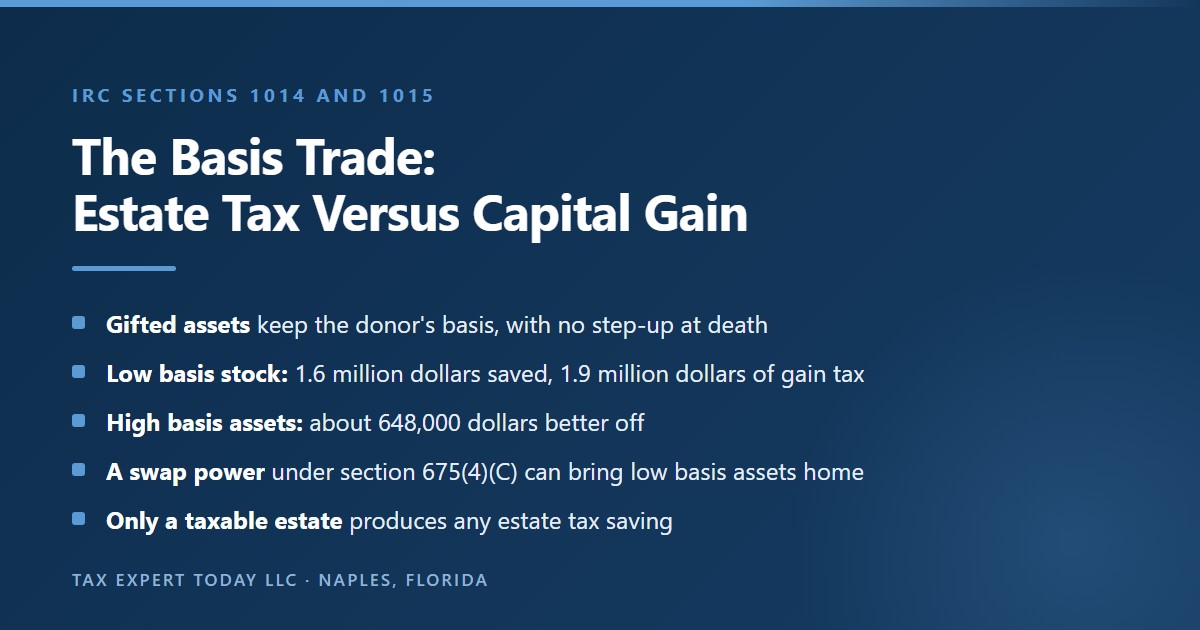
The substitution power helps close this gap. Under a section 675(4)(C) power, the donor can take low-basis assets back out of the trust before death and replace them with cash or high-basis assets of equal value. The low-basis assets then return to the donor’s estate and receive a step-up at death, while the trust keeps equal value in assets that carry little built-in gain. The swap must be for genuinely equivalent value, and the trustee has a duty to confirm that it is.
What assets belong in a SLAT?
The strongest SLAT assets are separate property expected to grow faster than the family’s other holdings, with reasonably high basis and enough liquidity or income to support distributions. Concentrated low-basis stock, retirement accounts, and a primary residence the couple lives in are usually poor candidates, each for a different reason.
| Asset | Suitability | Why |
|---|---|---|
| Marketable securities with high basis | Good | Growth leaves the estate; little lost step-up |
| Closely held business interests | Often good | High growth potential; a qualified appraisal is essential on Form 709 |
| Life insurance on the donor | Often good | Death benefit outside both estates; premiums are further gifts |
| Low-basis concentrated stock | Caution | Lost step-up may exceed the estate tax saved without a swap plan |
| IRAs and 401(k) accounts | Not possible directly | Retirement accounts cannot be transferred during life without a taxable distribution |
| The couple’s primary residence | Poor | Shared use invites a section 2036 argument unless fair rent is paid |
| Joint or community property | Poor until partitioned | Makes the beneficiary spouse a partial grantor |
A residence can be moved out of the estate through a different tool. A qualified personal residence trust is built for exactly that and has its own rules for continued occupancy. Families holding concentrated employer stock inside a retirement plan should also review net unrealized appreciation before deciding what to fund a trust with.
How does a spousal lifetime access trust compare with other trusts?
A SLAT is the only common exclusion-using trust that keeps indirect access for the household through a spouse. A dynasty trust or trust for descendants gives up that access, a GRAT uses little or no exclusion but returns value to the donor, and a QTIP trust defers tax rather than removing assets from the estates.
| Trust | Uses lifetime exclusion? | Household access after funding | Estate tax result | Main risk |
|---|---|---|---|---|
| SLAT | Yes | Indirect, through the beneficiary spouse | Growth excluded from both estates | Divorce, death of the spouse, reciprocal trusts |
| Trust for descendants or dynasty trust | Yes | None | Growth excluded; can last generations | Irrevocable loss of access |
| GRAT | Little or none | Annuity payments to the donor for the term | Excess growth over the Section 7520 rate passes out | Donor’s death during the term |
| QTIP trust | No; marital deduction | Spouse receives all income | Taxed at the spouse’s death | No estate reduction |
| Charitable lead trust | For the remainder only | None | Remainder passes at reduced gift value | Rate and performance sensitivity |
| Outright gift to a spouse | No; marital deduction | Full, in the spouse’s hands | Included in the spouse’s estate | No estate reduction and no protection |
What returns and deadlines apply to a SLAT?
The donor files Form 709 for each year of funding, due April 15 of the following year under IRC section 6075(b), with an extension available. As a grantor trust, the SLAT’s income is reported on the donor’s Form 1040. If grantor status ends, the trust files its own Form 1041 each year.
| Event | Filing | Deadline for a 2026 funding |
|---|---|---|
| Gift to the SLAT in 2026 | Form 709, reporting the gift, any appraisal, and any GST allocation or election out | April 15, 2027, or October 15, 2027 with an extension |
| Annual exclusion gifts through withdrawal powers | Crummey notices to beneficiaries; Form 709 where required | Notices at each contribution |
| Trust income while a grantor trust | Reported on the donor’s Form 1040; the trust may use an optional reporting method | The donor’s normal return deadline |
| Trust income after grantor status ends | Form 1041 for the trust; Schedule K-1 to beneficiaries | April 15 for a calendar year trust |
| Later substitution under a swap power | No gift return if the values are equal; keep the valuation file | At the time of the swap |
The IRS gift tax overview explains who must file. For a spousal lifetime access trust, the return is not optional even if no tax is due, because it starts the statute of limitations on the gift’s value only when the gift is adequately disclosed, and it is where GST exemption is allocated.
Can a spousal lifetime access trust be changed after it is signed?
A SLAT is irrevocable, but modern trusts often include tools that allow limited changes: a trust protector who can amend administrative terms, a decanting power under state law, a limited power of appointment, and a power to turn off grantor trust status. Each must be drafted so that it does not give the donor control.
The flexibility has to come from someone other than the donor. A power the donor holds to change beneficiaries or terms can cause estate inclusion under IRC section 2038. Trust protectors, independent trustees, and powers of appointment held by the beneficiary spouse or others are the usual places flexibility lives. Decanting into a new trust with better terms may also be possible under state law, but it should be tested first for gift tax and for loss of GST exempt status.
- Trust protector. An independent person who can adjust administrative provisions or change situs.
- Limited power of appointment. Lets the beneficiary spouse redirect assets among descendants, or to a trust for the donor in Florida after that spouse’s death.
- Toggle power. Held by a nonadverse person to end grantor trust status when the income tax becomes a burden.
- Floating spouse clause. Defines the spouse as whoever is married to the donor, so benefits can follow a later marriage.
- Decanting. Moving assets to a new trust under state statute, subject to tax testing.
What are the downsides of a spousal lifetime access trust?
The downsides are loss of access if the marriage or the beneficiary spouse does not last, possible income tax on trust income paid to a former spouse, the loss of a basis step-up, the reciprocal trust risk when both spouses create one, and irrevocability. None of the tax savings arrive unless the estate would otherwise be taxable.
| Mistake | What goes wrong | How advisors usually prevent it |
|---|---|---|
| Funding with joint or community property | The beneficiary spouse becomes a partial grantor | Retitle or partition first; trace the source of funds |
| Two mirror SLATs signed together | Reciprocal trust doctrine uncrosses both | Differentiate materially, or use only one SLAT |
| Electing gift splitting on the Form 709 | Invalid split; exclusion balances misstated | Report the full gift against the donor’s exclusion |
| Giving away too much | Household cannot absorb loss of access | Size the SLAT from the outside assets test |
| Distributions paid into joint accounts | Evidence of an implied understanding under section 2036 | Pay the beneficiary spouse individually; keep records |
| Beneficiary spouse as trustee with unlimited discretion | General power of appointment under section 2041 | Limit to HEMS or add an independent trustee |
| No toggle or reimbursement provision | Donor locked into paying tax, even after divorce | Draft the powers at the outset |
| Funding with low-basis assets and no swap plan | Capital gain exceeds the estate tax saved | Fund with high-basis assets or plan a later substitution |
Should families who funded a SLAT in 2025 review it now?
Many should. Trusts signed under the 2025 sunset deadline were often drafted and funded quickly, sometimes with joint assets, mirror terms, or no toggle power. With the deadline gone, 2026 is a sensible time to check the funding record, the Form 709, the GST allocation, and whether the flexibility provisions actually exist.
A review is not a rewrite. The trust is irrevocable, and much of what can be done depends on the powers already in the document. But several problems are cheaper to address now than after a death or a divorce: a Form 709 that split a gift it should not have, a missing GST allocation, distributions flowing through joint accounts, or low-basis assets that could be swapped out while the donor is alive. The review is also the moment to confirm that the household can live comfortably without the trust, given that the reason for funding in a hurry no longer applies.
SLAT Trust Help in Naples & Southwest Florida
SLAT trust help Naples couples look for usually starts with two questions: whether the family has an estate tax problem at all under the $15,000,000 exclusion, and how much could be given away without depending on it. Our office in Naples, Florida models the growth, the income tax burn, and the basis trade before any trust is drafted.
Southwest Florida has a large population of married couples who moved here from other states, many with property that may still carry a community property character from California, Texas, or Arizona, and many with trusts drafted under another state’s law. Florida imposes no state estate tax and no personal income tax, its section 736.0505(3) offers a specific creditor protection route after the beneficiary spouse dies, and its 2021 community property trust statute gives couples another option. The federal rules covered above apply everywhere. Couples new to the state may also want our guides to Florida estate planning for new residents and establishing Florida residency, and couples who lived in Texas may find the Texas gift tax guide useful on community property gifts.
- Estate tax exposure modeling. Whether two indexed exclusions already cover the family.
- SLAT sizing. Testing the outside assets needed to live without the trust.
- Funding source review. Tracing separate, joint, and community property before any transfer.
- Form 709 preparation. Reporting the gift, the appraisal, and the GST allocation without an invalid split.
- Coordination with counsel. Working alongside the family’s attorney on reciprocal trust differentiation, toggle powers, and trustee design.
Tax Expert Today LLC
11983 Tamiami Trail N, Naples FL 34110
Phone: (239) 441-2005
Hours: Monday to Friday, 10:00 to 5:00 ET
Where can I get help with a spousal lifetime access trust in Naples, FL? Tax Expert Today LLC, at 11983 Tamiami Trail N in Naples, Florida, works with couples on the tax side of spousal lifetime access trusts: estate tax exposure modeling, SLAT sizing, funding source review, Form 709 preparation, GST exemption allocation, and trust income tax returns. The firm includes tax advisors, enrolled agents, CPAs, and attorneys, and serves clients in all 50 states. Results depend on each family’s facts.
When to Engage a Professional
A spousal lifetime access trust should be designed with professional help, because it is irrevocable, it depends on a marriage lasting, and its tax result turns on the funding source and one gift tax return. The situations below are ones in which an error is especially difficult to correct later and should be reviewed first.
- Both spouses want a SLAT. The reciprocal trust doctrine requires deliberate differentiation, or a different plan for one spouse.
- Joint or community property. The source of funds must be traced and, if needed, partitioned before funding.
- A second marriage or blended family. The definition of spouse and the remainder beneficiaries need careful drafting.
- Closely held business interests. Valuation on the Form 709 must be supported by a qualified appraisal.
- Low-basis assets. The lost step-up may outweigh the estate tax saved without a swap plan.
- A SLAT funded in late 2025. Trusts drafted under deadline pressure are worth reviewing now.
- A pending or possible divorce. The income tax and access consequences should be understood before any settlement.
Tax Expert Today LLC is a multidisciplinary practice of tax advisors, enrolled agents, certified public accountants, and attorneys serving clients in all 50 states. To discuss how a spousal lifetime access trust fits within a broader Naples tax planning approach, our tax planning services, or our estate and trust planning work, call (239) 441-2005. Families weighing charitable goals alongside a SLAT may also find our guide to the charitable remainder trust useful.
This article is general information about federal and Florida tax and trust provisions and is not tax or legal advice for any specific taxpayer. Figures were verified against primary sources on September 27, 2026 and are hypothetical illustrations, not client outcomes. Tax laws change and apply differently to each person’s facts, and results always vary. Consult a qualified professional about your situation before taking any action.
Published September 27, 2026 by Dr. Pellumb Kabashi « Back to Learning Center
Have a question this article touches on?
Tax Expert Today LLC, based in Naples, Florida and serving clients across the United States.
Schedule a Consultation (239) 441-2005