
By Dr. Pellumb Kabashi, DBA, MBA, CES, CFE, EA
Founder, Tax Expert Today LLC · Tax advisors, enrolled agents, CPAs, and attorneys · Serving clients in all 50 states
Quick Answer
A dynasty trust is an irrevocable trust built to hold family wealth for several generations without estate or generation-skipping transfer tax at each death. It works only if GST exemption, $15,000,000 per person in 2026, is allocated correctly, and it lasts only as long as state perpetuities law allows. Call (239) 441-2005 for a free consultation.
What is a dynasty trust?
A dynasty trust is an irrevocable trust designed to last for multiple generations, holding assets for children, grandchildren, and later descendants without the assets being included in any beneficiary’s taxable estate. Its tax value comes from allocating generation-skipping transfer tax exemption at funding, so the trust and its growth stay outside the transfer tax system.
The phrase “dynasty trust” is not a term the Internal Revenue Code uses. It is a practitioner label for a long-duration, GST-exempt, discretionary trust. What makes it a dynasty trust is the combination of three features working together: the grantor allocates enough exemption to make the trust fully exempt from the generation-skipping transfer tax imposed by IRC section 2601; the beneficiaries receive distributions at the trustee’s discretion rather than owning the assets outright, so nothing is pulled into their estates when they die; and the trust is governed by the law of a state that permits it to continue for a very long time.
Remove any one of those features and the structure stops working as intended. A trust that is not fully exempt pays GST tax at 40 percent on the nonexempt share each time a generation passes. A trust that gives a child a general power of appointment pulls the assets into the child’s estate under IRC section 2041. A trust governed by a short perpetuities period must end, and distribute, long before the family planned.
- Irrevocable. The grantor gives up the assets and generally cannot amend the terms or take the property back.
- Multigenerational. Children, grandchildren, and later descendants are all potential beneficiaries of one continuing trust.
- GST-exempt. Exemption allocated at funding sets an inclusion ratio of zero, which shelters the trust and all later growth.
- Discretionary. An independent trustee decides distributions, which protects both the tax result and the assets.
- State-law limited. How long it can last depends on the governing state’s rule against perpetuities.
How does a dynasty trust work, step by step?
The grantor signs an irrevocable trust, names a trustee and descendants as beneficiaries, and transfers assets by gift. A Form 709 reports the gift and allocates GST exemption equal to the value transferred. The trustee then invests and makes discretionary distributions, and the trust continues through each generation until the perpetuities period ends.
| Step | What happens | Governing rule |
|---|---|---|
| 1. Draft | An irrevocable trust for descendants, with discretionary distribution standards and no general powers of appointment in beneficiaries | State trust law; IRC 2041 for powers |
| 2. Fund | The grantor gives cash, securities, business interests, or other property to the trustee | Gift tax under chapter 12; exclusion under IRC 2010(c) |
| 3. Report | A timely Form 709 reports the gift and allocates GST exemption on Schedule D | IRC 2632; Form 709 instructions |
| 4. Lock the ratio | Exemption equal to the value transferred produces an inclusion ratio of zero | IRC 2642(a) |
| 5. Administer | The trustee invests, files income tax returns, and makes discretionary distributions | Grantor trust rules or Form 1041 |
| 6. Continue | At each beneficiary’s death, the trust continues for the next generation with no estate or GST tax | Inclusion ratio of zero; state perpetuities law |
| 7. End | The trust terminates at the end of the permitted period and distributes to the then living descendants | Fla. Stat. 689.225 for a Florida trust |
The single most important moment is step 3. The gift tax return is where the exemption is either allocated correctly or missed, and the valuation consequences of a missed allocation compound for decades. The sections below explain why.
Why does a dynasty trust save transfer tax?
Without a trust, family wealth is exposed to estate tax each time it passes to a new generation, at a top rate of 40 percent. A fully exempt dynasty trust is taxed once, at funding, against the grantor’s exclusion. Every later generation inherits the full value, so the growth compounds without the repeated 40 percent reduction.
The top estate tax rate under IRC section 2001(c) is 40 percent on taxable amounts over $1,000,000, and under IRC section 2641 the GST tax rate is the maximum federal estate tax rate multiplied by the inclusion ratio. For a family whose descendants are also expected to have taxable estates, the arithmetic below shows why the structure exists. It is simplified on purpose: it assumes the heirs’ own exclusions are consumed by their own wealth, so the inherited amount bears the full 40 percent at each death.
Hypothetical illustration: $15,000,000 funded in 2026, 5 percent annual growth after income tax, a new generation every 30 years.
| End of generation | Years | Held outright, after 40 percent estate tax at each death | Held in a fully exempt dynasty trust | Dynasty trust as a multiple |
|---|---|---|---|---|
| Children | 30 | $38,897,481 | $64,829,136 | 1.67x |
| Grandchildren | 60 | $100,867,604 | $280,187,788 | 2.78x |
| Great-grandchildren | 90 | $261,566,383 | $1,210,955,476 | 4.63x |
Hypothetical only. Real results depend on investment returns, distributions, income taxes, future law, and each heir’s own estate. The comparison isolates the transfer tax effect.
The multiple grows with every generation because the tax is not avoided once but repeatedly. That is also why the structure is less valuable for a family whose children will never have a taxable estate: if no estate tax would have applied at the child’s death anyway, the first column is overstated and the benefit narrows to asset protection and control.
What is the generation-skipping transfer tax?
The generation-skipping transfer tax is a separate federal tax, on top of gift and estate tax, on transfers that skip a generation, such as gifts to grandchildren or trust distributions to them. It applies at a flat 40 percent to the nonexempt portion of a transfer, and a dynasty trust exists largely to keep that portion at zero.
Congress added the tax so that wealth could not bypass a generation’s estate tax simply by leaving it in trust. IRC section 2611 defines a generation-skipping transfer as one of three events, and each is taxed differently. The distinction matters in practice because a dynasty trust can produce all three over its life.
| Event | Definition | Who pays | Taxable amount |
|---|---|---|---|
| Direct skip | A transfer subject to gift or estate tax made directly to a skip person, including a trust whose beneficiaries are all skip persons (IRC 2612(c)) | The transferor, or the trustee for a skip from a trust (IRC 2603) | The value received, so the tax is computed on top of the gift (IRC 2623) |
| Taxable termination | An interest in trust property ends and afterward only skip persons hold interests, for example when the last child dies (IRC 2612(a)) | The trustee | The value of the property, with tax paid from it (IRC 2622) |
| Taxable distribution | Any other distribution from a trust to a skip person, such as a trustee paying a grandchild’s tuition while a child is living (IRC 2612(b)) | The transferee | The value received, with any tax the trust pays treated as a further distribution (IRC 2621) |
- Separate from estate tax. A transfer to a grandchild can bear gift or estate tax and GST tax on the same dollars.
- Flat rate. The rate is always the top estate tax rate times the inclusion ratio, never a graduated schedule.
- Exemption driven. Allocated exemption, not the identity of the beneficiary, decides whether the tax applies.
- Reported by the trust side. A trustee files Form 706-GS(T) for a taxable termination and furnishes Form 706-GS(D-1), and the recipient files Form 706-GS(D) for a taxable distribution.
Who is a skip person, and how are generations assigned?
A skip person is someone assigned to a generation two or more below the grantor, such as a grandchild, or a trust in which only such people hold interests. Family members are assigned by lineage; unrelated individuals are assigned by age, with a new generation for each 25 years of age difference.
The definitions sit in IRC section 2613 and the assignment rules in IRC section 2651. A dynasty trust that benefits children and grandchildren together is not itself a skip person while a child holds an interest, which is why the first taxable event in such a trust is usually a taxable distribution to a grandchild or a taxable termination at the last child’s death.
| Beneficiary | Generation assignment | Skip person? |
|---|---|---|
| Spouse or former spouse | Grantor’s own generation, regardless of age | No |
| Child, niece, or nephew | One generation below the grantor | No |
| Grandchild, grandniece, or grandnephew | Two generations below | Yes |
| Grandchild whose parent died before the transfer | Moved up one generation under the predeceased parent rule in IRC 2651(e) | Generally no |
| Unrelated person born 12.5 years or less after the grantor | Grantor’s generation | No |
| Unrelated person born more than 12.5 but not more than 37.5 years after | First younger generation | No |
| Unrelated person born more than 37.5 years after | A new generation for every further 25 years | Yes |
How much GST exemption is available in 2026?
For 2026 the GST exemption is $15,000,000 per individual, so a married couple can shelter $30,000,000. Under IRC section 2631(c) the exemption equals the basic exclusion amount, which P.L. 119-21 set at $15,000,000 for 2026, indexed for inflation after 2026, with no scheduled reversion to a lower figure.
The figure is confirmed in section 2.14 of Rev. Proc. 2025-32, which states that the GST exemption amount under IRC section 2631(c) equals $15,000,000 for calendar year 2026. The statutory change is in IRC section 2010(c)(3), where section 70106 of P.L. 119-21 replaced the old $5,000,000 base and struck the subparagraph that would have halved the exclusion after 2025. Our guide to the lifetime gift tax exemption in 2026 covers the gift side of the same change in detail.
| Calendar year | Basic exclusion and GST exemption per person | Source |
|---|---|---|
| 2025 | $13,990,000 | Rev. Proc. 2024-40 |
| 2026 | $15,000,000 | Rev. Proc. 2025-32, section 2.14 |
| 2027 and later | $15,000,000 adjusted for inflation from a 2025 base | IRC 2010(c)(3)(B) |
| Married couple, 2026 | $30,000,000 if each spouse allocates his or her own exemption | IRC 2631 |
“No scheduled sunset” is not the same as permanent in the everyday sense. Congress can change the exclusion in any future year. What changed in 2025 is that the law no longer contains a built-in cliff, so families are not forced to fund a trust before a known deadline. That removes a rush, but it does not remove the reason for the structure, which is the compounding shown earlier.
What is the inclusion ratio, and why does it decide everything?
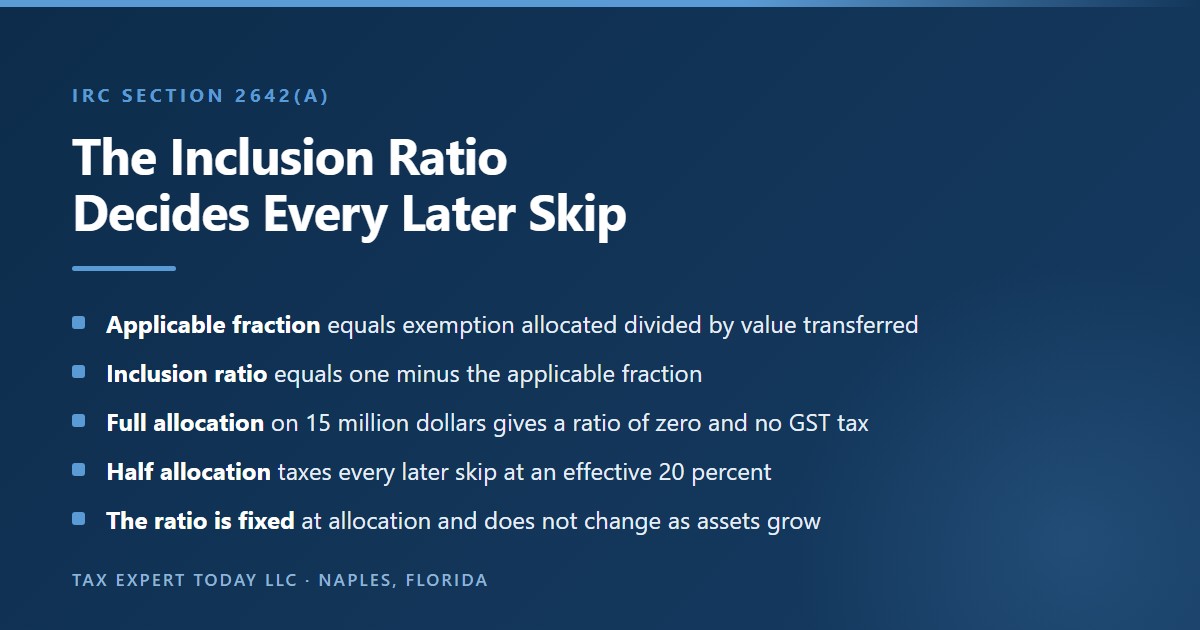
The inclusion ratio is the share of a trust that is exposed to GST tax. It equals one minus the applicable fraction, which is the GST exemption allocated divided by the value transferred. A dynasty trust aims for an inclusion ratio of exactly zero, because any higher figure taxes every later skip at a fixed percentage.
IRC section 2642(a) sets the formula, and the rate applied to any taxable event is 40 percent times that ratio. The ratio is fixed when exemption is allocated and does not change as the assets grow, which is the whole point: a trust at zero stays at zero whether it later holds $15,000,000 or $150,000,000.
Hypothetical illustration: a $15,000,000 transfer with different amounts of exemption allocated.
| Exemption allocated | Applicable fraction | Inclusion ratio | Effective GST rate on every later skip |
|---|---|---|---|
| $15,000,000 | 1.000 | 0.000 | 0.0 percent |
| $12,000,000 | 0.800 | 0.200 | 8.0 percent |
| $7,500,000 | 0.500 | 0.500 | 20.0 percent |
| $0 | 0.000 | 1.000 | 40.0 percent |
The consequence shows up decades later, when the assets have grown. The next table applies those ratios to a hypothetical taxable termination when the trust has reached $40,000,000 at the death of the last child.
| Inclusion ratio | GST tax on a $40,000,000 taxable termination | Passing to grandchildren’s shares |
|---|---|---|
| 0.0 | $0 | $40,000,000 |
| 0.2 | $3,200,000 | $36,800,000 |
| 0.5 | $8,000,000 | $32,000,000 |
| 1.0 | $16,000,000 | $24,000,000 |
Hypothetical only. The tax repeats at each later generation for a trust that is not fully exempt.
- Fixed at allocation. Growth after the allocation does not dilute or improve the ratio.
- Additions reset it. A later gift to the same trust forces a recomputation under IRC 2642(d), so partially exempt additions contaminate the whole trust.
- Separate trusts help. Planners often keep exempt and nonexempt property in separate trusts so each has a ratio of exactly zero or one.
- Precision matters. A ratio of 0.02 sounds harmless but taxes 0.8 percent of every future skip forever.
How is GST exemption allocated to a dynasty trust?
Exemption is allocated on Schedule D of a timely filed Form 709 for the year of the gift, or automatically under IRC section 2632(c) when the trust is a “GST trust”. The safest practice is an affirmative allocation on a timely return, even where the automatic rule would apply, so that the record is unambiguous.
Since 2001, IRC section 2632(c) allocates unused exemption automatically to “indirect skips”, which are gifts to a GST trust. Treas. Reg. section 26.2632-1(b)(2) confirms that the automatic allocation is effective whether or not a Form 709 is filed and becomes irrevocable after the return’s due date. A typical dynasty trust is a GST trust, but the definition has exceptions, and a trust that falls inside one of them receives no automatic allocation at all.
| The trust is NOT a GST trust if it provides that | Statute | Why it matters for a dynasty trust |
|---|---|---|
| More than 25 percent of corpus must be distributed to, or may be withdrawn by, a non-skip person before age 46 | 2632(c)(3)(B)(i) | Age-based distributions to children, common in older forms, switch the automatic rule off |
| More than 25 percent passes to non-skip persons living at the death of someone more than 10 years older | 2632(c)(3)(B)(ii) | A trust that ends for children at a parent’s death is treated as a non-skip trust |
| More than 25 percent goes to a non-skip person’s estate or is subject to a general power if that person dies early | 2632(c)(3)(B)(iii) | General powers of appointment given to children defeat automatic allocation |
| Any portion would be included in a non-skip person’s gross estate | 2632(c)(3)(B)(iv) | Estate inclusion for a child points the trust away from skip treatment |
| It is a charitable lead annuity trust, a charitable remainder trust, or a similar unitrust | 2632(c)(3)(B)(v) and (vi) | Split-interest trusts follow their own rules |
Because the definition turns on drafting details, the Form 709 is where intent should be made explicit. The Form 709 instructions warn that exemption “may be automatically allocated” to a gift to a GST trust, and they provide for elections in both directions: out of automatic allocation for a trust that will never make a skip, and into GST trust treatment under section 2632(c)(5) for a trust the grantor wants covered.
- Affirmative allocation. State the dollar amount allocated to the trust on Schedule D, Part 2.
- Election in. Elect GST trust treatment when the drafting is close to an exception.
- Election out. Prevent waste of exemption on trusts for children only.
- Keep the return. The allocation must be provable decades later by a trustee who never met the grantor.
What happens if the GST allocation is late or missed?
An allocation made on a timely Form 709 uses the value on the date of the gift. A late allocation uses the value on the date the late allocation is filed, under IRC section 2642(b)(3). If the assets have grown, more exemption is needed for the same zero ratio, and the grantor may not have enough left.
The timely return for a 2026 gift is due April 15, 2027, or later on extension. After that, the allocation is still possible, but it is priced at the current value. The table shows why that difference compounds.
Hypothetical illustration: a $10,000,000 gift to a dynasty trust in 2026.
| When exemption is allocated | Value used for the allocation | Exemption needed for a zero ratio |
|---|---|---|
| On a timely 2026 Form 709 | $10,000,000 (value at the gift) | $10,000,000 |
| Late, after the trust has grown to $12,100,000 | $12,100,000 (value at filing) | $12,100,000 |
| Late, after the trust has grown to $14,000,000 | $14,000,000 (value at filing) | $14,000,000 |
| Late, $14,000,000 value, only $10,000,000 exemption left | $14,000,000 | Not achievable: inclusion ratio 0.286, effective rate 11.43 percent |
Two relief routes exist. IRC section 2642(g)(1) directs the IRS to provide relief for a missed allocation or election, treating the deadline as not expressly fixed by statute, so relief is requested through the regulatory extension process with a showing of reasonable action and good faith. Section 2642(g)(2) adds a substantial compliance rule: an allocation that demonstrates an intent to reach the lowest possible inclusion ratio is treated as allocating the amount that produces it. Both routes are fact dependent and slower and more expensive than a correct return.
Do annual exclusion gifts to a dynasty trust avoid GST tax?
Not automatically. A gift that qualifies for the $19,000 annual gift tax exclusion receives a zero inclusion ratio under IRC section 2642(c) only if the trust is for one individual and would be included in that person’s estate. A dynasty trust for many descendants fails that test, so exemption must still be allocated.
Many families fund a dynasty trust with yearly gifts that use the annual exclusion, often through withdrawal rights known as Crummey powers, so that no lifetime exclusion is used. The gift tax result and the GST result diverge here. The gift is free of gift tax, but under IRC section 2642(c)(2) the nontaxable gift rule does not reach a shared, long-term trust, and the annual exclusion under IRC section 2503(b) does nothing for GST purposes by itself.
Hypothetical illustration: yearly exclusion gifts at the 2026 figure of $19,000 per donor per beneficiary.
| Donors | Beneficiaries with withdrawal rights | Gift tax free each year | GST exemption still needed each year for a zero ratio |
|---|---|---|---|
| 1 | 4 | $76,000 | $76,000 |
| 2 | 4 | $152,000 | $152,000 |
| 2 | 8 | $304,000 | $304,000 |
- Automatic allocation often catches it. A gift to a GST trust is an indirect skip, but exclusion gifts are not subject to gift tax, so check whether the automatic rule reached them.
- File anyway. A Form 709 that allocates exemption to exclusion gifts removes doubt, even when no gift tax is due.
- Watch the ratio on additions. An unallocated yearly gift to an exempt trust pushes its ratio above zero.
- Life insurance premiums count. Premiums paid through a dynasty trust are gifts and need the same allocation.
What is the rule against perpetuities, and how long can a dynasty trust last?
The rule against perpetuities is a state law limit on how long property can be tied up in trust before it must vest in someone. The traditional rule allowed roughly a lifetime plus 21 years. Many states now allow far longer periods, and a dynasty trust can last only as long as its governing state permits.
The federal tax law has no limit on duration. The limit comes entirely from state property law, which is why a trust’s governing law, not its tax status, decides whether the exemption allocated in 2026 shelters two generations or ten. Under the traditional common law form, an interest had to vest within 21 years after the death of someone alive when the trust was created. The uniform statutory version, adopted by Florida in 1988, added an alternative 90-year wait-and-see period. States have since moved in different directions, with some abolishing the rule for trusts and others extending the period to several hundred years or more.
- Traditional rule. A life in being plus 21 years, typically about 90 to 100 years in practice.
- Uniform statutory rule. The traditional test or a 90-year wait-and-see period, whichever validates the interest.
- Extended periods. Some states now permit hundreds of years or longer for trusts.
- Tax status is separate. The GST exemption shelters the trust for as long as state law lets it exist.
How long can a Florida dynasty trust last?
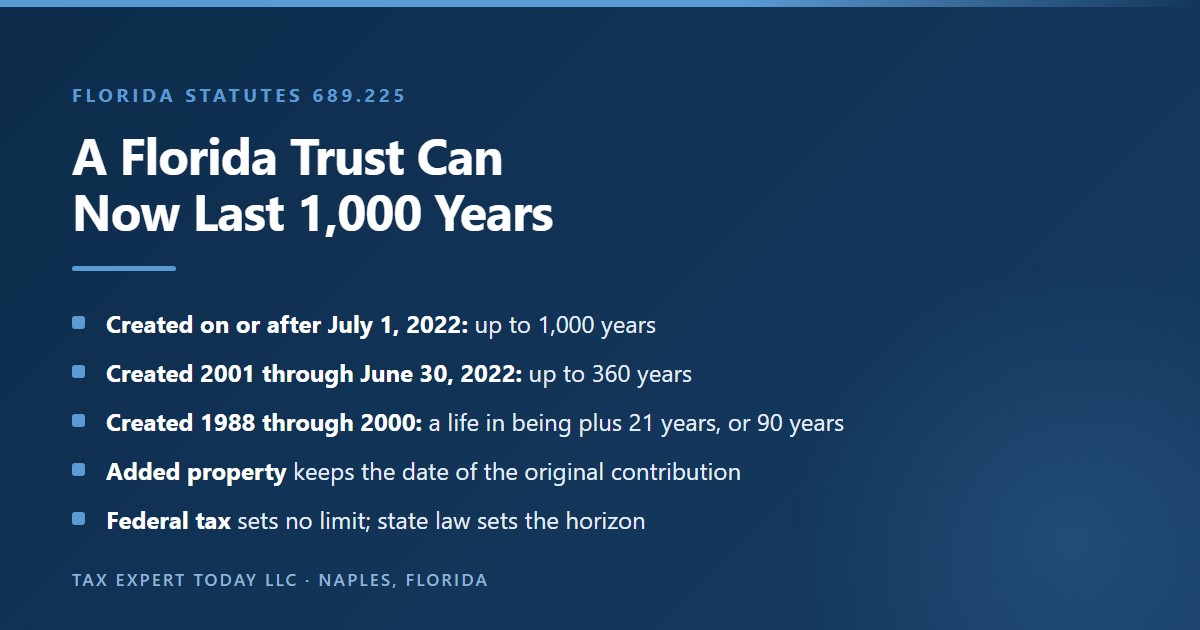
A Florida trust created on or after July 1, 2022 may last up to 1,000 years under Florida Statutes section 689.225(2)(g). A Florida trust created from January 1, 2001 through June 30, 2022 may last up to 360 years. Earlier trusts follow the 90-year statutory rule or the common law life plus 21 years.
The periods come directly from Florida Statutes section 689.225, which substitutes the longer period for the statute’s standard 90 years unless the trust itself requires earlier vesting. Section 689.225(7) also makes the statute the sole expression of the rule in Florida, so no separate common law limit applies on top of it.
| Florida trust created | Maximum period | Provision |
|---|---|---|
| Before October 1, 1988 | Common law rule, with judicial reformation available | 689.225(6)(c) |
| October 1, 1988 through December 31, 2000 | Life in being plus 21 years, or 90 years wait-and-see | 689.225(2)(a) |
| January 1, 2001 through June 30, 2022 | 360 years | 689.225(2)(f) |
| On or after July 1, 2022 | 1,000 years | 689.225(2)(g) |
One timing detail matters for existing trusts. Under section 689.225(3)(d), property added to a previously funded trust is treated as created when the original contribution was made, so adding assets in 2026 to a Florida trust first funded in 2015 does not give the new property a 1,000-year horizon. A new trust is needed for that.
Why does trust situs decide the horizon of a dynasty trust?
Trust situs is the state whose law governs the trust and where it is administered. It decides how long the trust may last, whether the state taxes the trust’s income, how strongly creditors are kept out, and whether the terms can be modernized later. Federal transfer tax results are the same in every state.
Situs is chosen in the instrument and supported by where the trustee is located and where administration actually happens. For a dynasty trust the choice carries more weight than for an ordinary trust, because the trust is expected to outlive everyone who signed it. A family that relocates later may find that an existing trust’s governing law, trustee residence, or beneficiary residence ties it to another state’s income tax. Those change-of-residence questions are covered in our separate guide to trust situs after moving to Florida, which this article does not repeat.
- Duration. The governing state’s perpetuities rule sets the outer limit on how many generations the exemption can protect.
- State income tax. Accumulated income can be taxed where the trustee, grantor, or beneficiaries reside, depending on the state.
- Creditor protection. Spendthrift and discretionary trust protections differ by state.
- Flexibility. Decanting and modification statutes decide how an old trust can be updated.
- Federal tax is neutral. The GST exemption, inclusion ratio, and estate tax results do not change with situs.
Who pays income tax on a dynasty trust?
It depends on whether the trust is a grantor trust. If it is, the grantor reports all trust income on his or her own return and pays the tax personally. If it is not, the trust pays tax on income it keeps, and beneficiaries pay tax on income distributed to them, through Form 1041 and Schedule K-1.
Grantor trust status comes from IRC sections 671 through 679, which treat the grantor as the owner of a trust for income tax purposes when certain powers or interests are retained. The status is an income tax label only. A properly drafted grantor trust is still outside the grantor’s estate for estate tax purposes, which is the combination that makes it attractive for a dynasty trust.
| Feature | Grantor dynasty trust | Non-grantor dynasty trust |
|---|---|---|
| Who reports income | The grantor, on Form 1040 | The trust, on Form 1041, with K-1s for distributions |
| Who pays the tax | The grantor, from personal funds | The trust on retained income; beneficiaries on distributed income |
| Tax brackets | The grantor’s individual brackets | Compressed trust brackets, 37 percent above $16,000 in 2026 |
| Effect on the trust | The trust grows without paying its own tax | Tax reduces the trust every year it accumulates |
| Effect on the grantor’s estate | Tax payments reduce the taxable estate without being gifts | None |
| Typical trigger | A substitution power under IRC 675(4)(C), among others | Absence of any grantor trust power |
| Can it change? | Yes, grantor status can usually be released, and it ends at the grantor’s death | Usually permanent |
Why do many dynasty trusts start as grantor trusts?
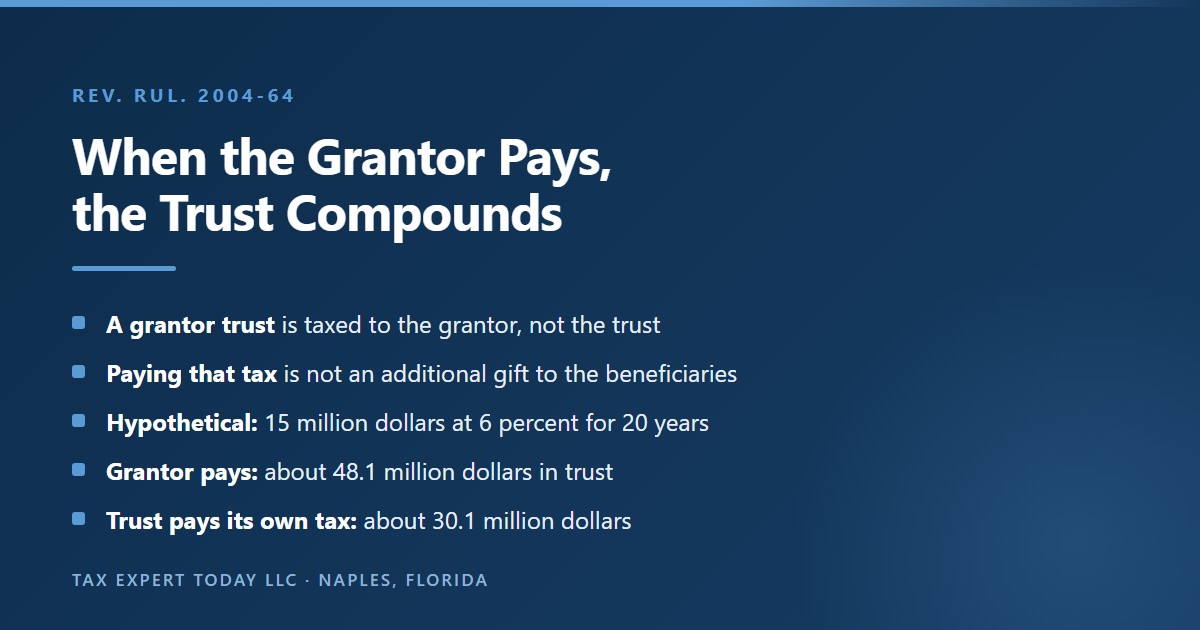
Because the grantor’s payment of the trust’s income tax is not treated as an additional gift. Rev. Rul. 2004-64 held that a grantor who pays tax on a grantor trust’s income makes no gift to the beneficiaries. The trust compounds untaxed while the grantor’s taxable estate shrinks by every dollar of tax paid.
Rev. Rul. 2004-64 addresses the gift and estate tax consequences when the grantor pays tax on grantor trust income, and also the effect of a clause allowing the trustee to reimburse the grantor for that tax. A mandatory reimbursement clause causes estate inclusion. A discretionary clause generally does not, provided that neither an understanding with the trustee nor state creditor law gives the grantor’s creditors access. Florida addresses the creditor point directly: Florida Statutes section 736.0505(1)(c) provides that a discretionary power to reimburse the settlor for tax does not by itself expose the trust to the settlor’s creditors.
Hypothetical illustration: $15,000,000 funded, 6 percent annual taxable return, 20 years, no distributions. The non-grantor case assumes all income is retained and taxed at a combined 40.8 percent (37 percent plus the 3.8 percent net investment income tax). The model is simplified to show direction and scale.
| Structure | Trust value after 20 years | Income tax paid by the grantor, first year |
|---|---|---|
| Grantor trust, grantor pays the tax | $48,107,032 | About $367,200 on $900,000 of income |
| Non-grantor trust, trust pays its own tax | $30,148,179 | $0 |
| Difference held for descendants | $17,958,853 | Paid from assets that would otherwise be in the taxable estate |
- The burn is intentional. The grantor’s tax payments are, in effect, tax-free transfers that never appear on a Form 709.
- It must be affordable. The grantor needs liquidity outside the trust to pay tax on income he or she never receives.
- It can be switched off. Drafting usually lets the grantor release the grantor trust power when the payments are no longer wanted.
- Reimbursement is optional. A discretionary reimbursement power adds a safety valve without, in Florida, inviting creditors.
How are non-grantor dynasty trusts taxed in 2026?
A non-grantor trust reaches the top 37 percent federal bracket at just $16,000 of taxable income in 2026, compared with $768,700 for a married couple filing jointly. The 3.8 percent net investment income tax also applies above that same $16,000 threshold, so retained investment income is taxed heavily.
The 2026 trust rate schedule appears in section 4.01 of Rev. Proc. 2025-32 under IRC section 1(e). For trusts, IRC section 1411(a)(2) imposes the net investment income tax on the lesser of undistributed net investment income or adjusted gross income above the dollar amount at which the highest bracket begins. Long-term capital gains and qualified dividends still receive preferential rates, with the 20 percent rate beginning above $16,250 for trusts in 2026.
| 2026 trust taxable income | Tax |
|---|---|
| Not over $3,300 | 10 percent |
| Over $3,300, not over $11,700 | $330 plus 24 percent of the excess over $3,300 |
| Over $11,700, not over $16,000 | $2,346 plus 35 percent of the excess over $11,700 |
| Over $16,000 | $3,851 plus 37 percent of the excess over $16,000 |
Hypothetical illustration: a non-grantor dynasty trust retains $500,000 of ordinary investment income in 2026. Regular income tax is $182,931 and the net investment income tax on the $484,000 above the threshold is $18,392, a total of $201,323, or about 40.3 percent. Distributing income to beneficiaries in lower brackets shifts the tax to them, but every distribution also moves assets out of the protected trust and into the beneficiary’s estate. That tension, income tax savings now against transfer tax protection later, is the central administrative decision in a non-grantor dynasty trust.
Can beneficiaries take money out of a dynasty trust?
Yes, through distributions the trustee makes under the trust’s standards, typically for health, education, maintenance, and support, or at the trustee’s broader discretion. Beneficiaries usually cannot demand principal. Many dynasty trusts also let the trust buy or hold assets, such as a home, for a beneficiary’s use without distributing them.
The structure deliberately keeps ownership in the trust. A beneficiary who could withdraw assets at will, or who held a general power of appointment, would have those assets included in his or her estate under IRC section 2041, defeating the purpose. A distribution power limited by an ascertainable standard relating to health, education, support, or maintenance is not a general power, which is why that wording recurs in dynasty trust instruments.
- Ascertainable standard. A beneficiary serving as trustee is typically limited to health, education, maintenance, and support.
- Independent trustee. A trustee who is not a beneficiary can hold broader discretion without estate inclusion for beneficiaries.
- Use instead of ownership. Rent-free use of a trust-owned residence or loans on documented terms keep value inside the trust.
- Distributions to grandchildren. From a fully exempt trust they carry no GST tax; from a partially exempt trust they are taxable distributions.
- Limited powers of appointment. Beneficiaries can often redirect their shares among descendants without estate inclusion.
What assets belong in a dynasty trust?
Assets expected to grow faster than average belong in a dynasty trust, because the trust shelters appreciation rather than current value. Closely held business interests, growth portfolios, and life insurance are common choices. Retirement accounts cannot be transferred into one during life, and assets with very low basis require a basis analysis first.
| Asset | Fit | Key consideration |
|---|---|---|
| Closely held business interests | Strong | High expected growth; valuation must be supported by a qualified appraisal on the Form 709 |
| Growth-oriented securities | Strong | Liquid and easy to value; basis carries over |
| Life insurance | Strong | Premiums are gifts needing GST allocation; proceeds are leveraged relative to exemption used |
| Real estate held for investment | Good | Often held through an LLC owned by the trust; watch state property tax reassessment rules |
| Cash | Neutral | No basis problem, but no appreciation advantage until invested |
| Very low basis stock | Mixed | Gives up the basis step-up at death; a substitution power can help later |
| IRAs and 401(k) balances | Not transferable during life | A trust can be a beneficiary at death, which raises separate distribution and income tax issues |
| The grantor’s own home | Usually poor | Continued use by the grantor risks estate inclusion under IRC 2036; a QPRT is the purpose-built vehicle |
For a business owner planning an eventual sale, funding the trust before a transaction, when value is lower and the growth is still ahead, is the classic pattern. The federal mechanics of the sale itself are covered in our guide to selling a business and the taxes involved.
What happens to basis when assets go into a dynasty trust?
Assets given to a dynasty trust keep the grantor’s cost basis, and they do not receive a new basis at the grantor’s death because they are not in the grantor’s estate. The trust avoids estate tax on the growth but may owe capital gains tax on that growth later, so the trade-off must be measured.
IRC section 1014 resets basis to fair market value only for property acquired from a decedent, which generally means property included in the decedent’s estate. Property given away during life keeps a carryover basis. With a $15,000,000 exclusion, many estates will owe no estate tax at all, and for them the lost step-up can outweigh the transfer tax saved.
Hypothetical illustration: $15,000,000 of stock with a $3,000,000 basis.
| Path | Transfer tax effect | Income tax effect |
|---|---|---|
| Given to a dynasty trust | Future growth excluded from the grantor’s estate | $12,000,000 built-in gain remains; about $2,856,000 at a 23.8 percent combined rate if sold |
| Held until death, estate above the exclusion | Taxed at up to 40 percent on value above the exclusion, up to $6,000,000 on this $15,000,000 | Basis stepped up to value at death, so the gain disappears |
| Held until death, estate below the exclusion | No estate tax | Basis stepped up, so the gain disappears |
| Given, then swapped back before death | Growth still excluded | Low-basis stock returns to the grantor for a step-up; high-basis assets go to the trust |
The last row describes the substitution power in IRC section 675(4)(C), a power to reacquire trust property by substituting property of equivalent value. It makes the trust a grantor trust, and it lets the grantor pull low-basis assets back into the estate before death, replacing them with cash or high-basis assets of equal value. The exchange must be at genuinely equivalent value, and the trustee has a fiduciary duty to confirm it.
How does the $15,000,000 exclusion change dynasty trust planning?
It removes the deadline pressure that drove funding before 2026, but not the reason for the trust. With no scheduled reduction, families can fund on their own timetable. The GST exemption still has to be allocated to shelter later generations, and unused exemption at death can be wasted if the estate plan does not direct it.
Before P.L. 119-21, the exclusion was scheduled to fall by about half after 2025, and many families rushed to fund trusts to lock in the higher amount. That scheduled drop was repealed. Three things did not change. The GST exemption still must be used affirmatively to protect grandchildren and later generations. The exemption is still use-it-or-lose-it at each spouse’s death for GST purposes. And growth after funding is still what the trust shelters most effectively, so funding earlier with appreciating assets still shelters more than funding later.
- Less urgency. No cliff means no forced funding before a legislative deadline.
- Same GST math. A trust funded with $15,000,000 of exemption shelters everything it grows into, whenever funded.
- Basis matters more. With higher exclusions, income tax on carryover basis can outweigh estate tax saved for mid-sized estates.
- Legislative risk remains. Future Congresses can change the amount, so the exemption allocated now is the only amount that is certain.
How should a married couple use two GST exemptions?
Each spouse has a separate $15,000,000 GST exemption in 2026, and unlike the estate tax exclusion it cannot be transferred to the surviving spouse through portability. A couple that leaves everything to the survivor outright can lose the first spouse’s GST exemption entirely. A reverse QTIP election is the standard way to preserve it.
Portability under IRC section 2010(c)(4) lets a surviving spouse use the deceased spouse’s unused basic exclusion, called DSUE, for estate and gift tax. The GST exemption in IRC section 2631(c) equals the basic exclusion amount but is personal to each transferor. For a marital trust that qualifies for the estate tax marital deduction, IRC section 2652(a)(3) lets the first spouse’s estate elect to be treated as the transferor for GST purposes, so the first spouse’s exemption can be allocated to that trust.
| Hypothetical 2026 plan for a couple | Estate and gift exclusion used | GST exemption preserved for descendants |
|---|---|---|
| Everything to the survivor outright, portability elected | Both exclusions, through DSUE | $15,000,000: the survivor’s own exemption only |
| Marital trust with a reverse QTIP election, remainder to a dynasty trust | Both exclusions | $30,000,000 |
| Each spouse funds a dynasty trust during life | $15,000,000 each | $30,000,000, allocated at funding |
| Gift splitting on one spouse’s gift | Half attributed to each spouse | Each spouse is treated as transferor of half, so both exemptions can be allocated |
Couples who each want a trust but also want indirect access to gifted assets through the other spouse often look at the spousal lifetime access trust, which raises its own reciprocal trust and divorce questions and is a subject for a separate analysis. That analysis now appears in our guide to the spousal lifetime access trust.
Can a dynasty trust be combined with a GRAT, QPRT, or charitable lead trust?
Yes, as the remainder beneficiary, but GST exemption cannot be allocated efficiently during the term of a GRAT or QPRT. Under the estate tax inclusion period rule in IRC section 2642(f), allocation waits until the term ends and is priced at the value then, often far more than the gift value at funding.
A retained-interest trust such as a grantor retained annuity trust or a qualified personal residence trust would be included in the grantor’s estate if the grantor died during the term. IRC section 2642(f) calls that period an estate tax inclusion period, or ETIP, and Treas. Reg. section 26.2632-1 defers any allocation until the ETIP closes. A zeroed-out GRAT makes a gift of almost nothing at funding, but the exemption needed to shelter its remainder is measured at the end of the term.
| Vehicle feeding a dynasty trust | When GST exemption is measured | Practical effect |
|---|---|---|
| Direct gift to the dynasty trust | At the gift, on a timely Form 709 | Most efficient use of exemption |
| GRAT remainder | At the end of the annuity term | A $10,000,000 GRAT leaving a $4,000,000 remainder needs $4,000,000 of exemption then, though the gift at funding was near zero |
| QPRT remainder | At the end of the residence term | Exemption must cover the home’s value at that later date |
| Charitable lead annuity trust remainder | At the end of the lead term, grown at the 7520 rate | Growth above the assumed rate is exposed; see our charitable lead trust guide |
| Sale to a grantor dynasty trust for a note | At the seed gift | Commonly used to move growth without an ETIP, but valuation and note terms draw scrutiny |
How much money is needed for a dynasty trust?
No legal minimum exists. A dynasty trust can be funded with any amount, and annual exclusion gifts can build one gradually. In practice the structure earns its drafting and administration cost mainly when the family expects taxable estates in later generations, or when asset protection across generations is a primary goal.
The honest answer depends on three questions rather than one number. First, will the grantor’s estate, or the children’s estates, exceed the exclusion at death? With $15,000,000 per person in 2026 and indexing thereafter, fewer families face estate tax than a decade ago, but assets that compound inside a family for 60 years can reach levels where the tax applies again. Second, is protection from beneficiaries’ creditors and divorcing spouses valuable in itself? For many families it is the main reason. Third, is the family prepared for the ongoing cost of a long-term trustee, annual returns, and periodic legal review? Fees for drafting and administration are scoped to each family after a consultation, and they should be weighed against the tax and protection benefits in a written projection before any trust is signed.
- Estate tax expected in later generations. The core tax case, strongest when growth assets are involved.
- Asset protection priority. A discretionary trust keeps assets out of a beneficiary’s divorce or creditor claims in many states.
- Family business continuity. The trust can hold voting control while beneficiaries share economic value.
- Smaller estates. The basis step-up and simplicity of outright gifts may serve better.
What is the difference between a dynasty trust and a regular irrevocable trust?
A regular irrevocable trust typically ends when children reach set ages or at a parent’s death, distributing assets that then enter the children’s estates. A dynasty trust continues for grandchildren and later generations, keeps assets out of every beneficiary’s estate, and has GST exemption allocated so that no generation-skipping tax applies as it continues.
| Feature | Typical irrevocable trust for children | Dynasty trust |
|---|---|---|
| Duration | Ends at set ages or a set event | As long as state perpetuities law allows |
| GST exemption | Often not allocated, or elected out | Allocated in full for a zero inclusion ratio |
| Estate tax at a child’s death | Distributed assets are in the child’s estate | Trust assets are outside the child’s estate |
| Creditor and divorce protection | Ends on distribution | Continues while assets stay in trust |
| Beneficiary control | Full ownership after distribution | Distributions, use of assets, limited powers of appointment |
| Administration | Shorter and simpler | Long-term trustee, succession planning, and periodic review |
| Typical choice of situs | Where the family lives | Chosen for duration, taxes, and flexibility |
What are the downsides of a dynasty trust?
The main downsides are permanence, cost, and lost flexibility. The trust is irrevocable and meant to last generations, so poor drafting or changed family circumstances are hard to fix. It gives up the basis step-up, can face compressed trust tax brackets, and requires a trustee and returns for as long as it exists.
- Irrevocability. The grantor cannot take assets back, and changing terms depends on state decanting and modification law.
- Carryover basis. Assets given during life do not receive a step-up at the grantor’s death.
- Trust income tax. A non-grantor trust hits the 37 percent bracket at $16,000 of taxable income in 2026.
- Allocation risk. A missed or late GST allocation can leave the trust partially taxable for its entire life.
- Family friction. Beneficiaries depend on a trustee’s decisions, and distribution disputes can arise over decades.
- Legislative uncertainty. Future changes to the exemption or GST rules could affect planning for new contributions.
Several of these are design problems rather than inherent flaws. A trust protector, a well-defined trustee succession clause, a substitution power, and a governing law with a modern decanting statute address much of the rigidity. The basis issue is addressed by choosing which assets to fund with and by retaining a swap power.
Can a dynasty trust be changed after it is signed?
Often, within limits set by state law and the trust instrument. Florida allows a trustee with discretion to invade principal to decant, or pour trust assets into a new trust with updated terms, under Florida Statutes section 736.04117. Trust protectors, nonjudicial modification, and court reformation can also help. Each route has tax traps.
Decanting under Florida Statutes section 736.04117 is the most common tool for modernizing an older trust, but a decanting that shifts beneficial interests or extends the trust’s duration can create GST exposure for a trust that is exempt because of an allocation or because it predates the tax. Changes that add a general power of appointment can cause estate inclusion for the beneficiary who receives it. A trust protector, a person named in the instrument with limited powers to amend administrative provisions, change situs, or remove a trustee, gives flexibility without returning control to the grantor.
- Decanting. Moves assets to a new trust with updated terms, subject to state statutory limits.
- Trust protector. A named individual or entity with defined powers to adapt the trust over time.
- Change of situs. Moving administration to another state, where the instrument permits it.
- Limited powers of appointment. Let each generation redirect shares among descendants.
- GST review first. Any modification to an exempt trust should be tested for loss of exempt status before it is signed.
What returns does a dynasty trust file?
The grantor files Form 709 for each year of funding, including years that use only the annual exclusion, to report gifts and allocate GST exemption. The trust files Form 1041 each year unless it is a grantor trust using an alternative method. GST events are reported on Form 706-GS(T), Form 706-GS(D-1), and Form 706-GS(D).
| Return | Filed by | When it applies |
|---|---|---|
| Form 709 | Grantor, and a consenting spouse when gifts are split | Every year of funding; Schedule D allocates GST exemption or elects out of automatic allocation |
| Form 1041 | Trustee | Annually for a non-grantor trust; a grantor trust may file a Form 1041 information statement or use an optional method |
| Form 706-GS(T) | Trustee | A taxable termination, such as the last child’s death in a trust with a ratio above zero |
| Form 706-GS(D-1) | Trustee, to each skip person and the IRS | Generally any distribution to a skip person, even from a fully exempt trust, to report the inclusion ratio |
| Form 706-GS(D) | The skip person receiving the distribution | A taxable distribution from a trust with a ratio above zero |
| Form 706 | Grantor’s executor | At death, where required, including to allocate any remaining GST exemption and make a reverse QTIP election |
The IRS overview pages on the gift tax and the estate tax summarize filing thresholds. For a dynasty trust, the practical point is record keeping: the trustee should hold every Form 709 that ever allocated exemption to the trust, because a future trustee has to prove the inclusion ratio to each skip person who receives a distribution.
Dynasty Trust Help in Naples & Southwest Florida
Dynasty trust help Naples families look for usually begins with two decisions: how much GST exemption to allocate now, and whether a Florida trust with a 1,000-year horizon fits the family. Our office in Naples, Florida models the allocation, the income tax structure, and the basis trade-off before any trust is drafted.
Southwest Florida has a large population of families who relocated from states with their own estate taxes or with shorter perpetuities periods, and many hold older trusts created elsewhere. Florida imposes no state estate tax and no personal income tax, and since July 1, 2022 it permits trusts of up to 1,000 years, which makes it a natural governing law for a new dynasty trust. The federal questions covered above apply everywhere. Families new to the state may also want to review our guide to Florida estate planning for new residents, and the charitable alternatives in our guides to the charitable remainder trust and the donor advised fund tax deduction.
- GST exemption allocation review. Reconciling every prior Form 709 before new funding.
- Grantor versus non-grantor modeling. Measuring the income tax burn against the grantor’s liquidity.
- Basis and swap power analysis. Deciding which assets to fund with and which to keep for a step-up.
- Coordination with counsel. Working alongside the family’s attorney on drafting, situs, and trust protector provisions.
- Form 709, Form 1041, and 706-GS reporting. For each year of funding and administration.
Tax Expert Today LLC
11983 Tamiami Trail N, Naples FL 34110
Phone: (239) 441-2005
Hours: Monday to Friday, 10:00 to 5:00 ET
Where can I get help setting up a dynasty trust in Naples, FL? Tax Expert Today LLC, at 11983 Tamiami Trail N in Naples, Florida, works with families on the tax side of dynasty trusts: GST exemption allocation, Form 709 preparation, grantor trust modeling, and trust income tax returns. The firm includes tax advisors, enrolled agents, CPAs, and attorneys, and serves clients in all 50 states. Results depend on each family’s facts.
When to Engage a Professional
Any dynasty trust should be designed with professional help, because it is irrevocable, it is meant to outlast everyone who signs it, and its tax result is fixed largely by one gift tax return. The situations below are ones in which an error is especially difficult to correct later and should be reviewed first.
- Prior gifts to trusts. Earlier returns may have allocated, or failed to allocate, GST exemption in ways that change what is left.
- Adding to an existing trust. New property can alter the inclusion ratio or inherit an older perpetuities date.
- Closely held business interests. Valuation on the Form 709 must be supported by a qualified appraisal.
- A married couple planning at the first death. The reverse QTIP election is the only way to preserve the first spouse’s GST exemption in a marital trust.
- A GRAT or QPRT remainder. The ETIP rule changes when and at what value exemption is measured.
- Low-basis assets. The lost step-up may outweigh the estate tax saved for estates near the exclusion.
- An older trust needing modernization. Decanting or modification must be tested for loss of GST exempt status.
Tax Expert Today LLC is a multidisciplinary practice of tax advisors, enrolled agents, certified public accountants, and attorneys serving clients in all 50 states. To discuss how a dynasty trust fits within a broader Naples tax planning approach, our tax planning services, or our estate and trust planning work, call (239) 441-2005. Families holding concentrated employer stock may also find our article on net unrealized appreciation useful before deciding what to fund a trust with.
This article is general information about federal and Florida tax and trust provisions and is not tax or legal advice for any specific taxpayer. Figures were verified against primary sources on September 24, 2026 and are subject to change. Every illustration is hypothetical and outcomes depend entirely on individual facts. Consult a qualified professional before acting.
Published September 24, 2026 by Dr. Pellumb Kabashi « Back to Learning Center
Have a question this article touches on?
Tax Expert Today LLC, based in Naples, Florida and serving clients across the United States.
Schedule a Consultation (239) 441-2005